Ontdek de Fascinerende Wereld van UFO's en UAP's: Jouw Bron voor Onthullende Informatie!
Ben jij ook gefascineerd door het onbekende? Wil je meer weten over UFO's en UAP's, niet alleen in België, maar over de hele wereld? Dan ben je op de juiste plek!
België: Het Kloppend Hart van UFO-onderzoek
In België is BUFON (Belgisch UFO-Netwerk) dé autoriteit op het gebied van UFO-onderzoek. Voor betrouwbare en objectieve informatie over deze intrigerende fenomenen, bezoek je zeker onze Facebook-pagina en deze blog. Maar dat is nog niet alles! Ontdek ook het Belgisch UFO-meldpunt en Caelestia, twee organisaties die diepgaand onderzoek verrichten, al zijn ze soms kritisch of sceptisch.
Nederland: Een Schat aan Informatie
Voor onze Nederlandse buren is er de schitterende website www.ufowijzer.nl, beheerd door Paul Harmans. Deze site biedt een schat aan informatie en artikelen die je niet wilt missen!
Internationaal: MUFON - De Wereldwijde Autoriteit
Neem ook een kijkje bij MUFON (Mutual UFO Network Inc.), een gerenommeerde Amerikaanse UFO-vereniging met afdelingen in de VS en wereldwijd. MUFON is toegewijd aan de wetenschappelijke en analytische studie van het UFO-fenomeen, en hun maandelijkse tijdschrift, The MUFON UFO-Journal, is een must-read voor elke UFO-enthousiasteling. Bezoek hun website op www.mufon.com voor meer informatie.
Samenwerking en Toekomstvisie
Sinds 1 februari 2020 is Pieter niet alleen ex-president van BUFON, maar ook de voormalige nationale directeur van MUFON in Vlaanderen en Nederland. Dit creëert een sterke samenwerking met de Franse MUFON Reseau MUFON/EUROP, wat ons in staat stelt om nog meer waardevolle inzichten te delen.
Let op: Nepprofielen en Nieuwe Groeperingen
Pas op voor een nieuwe groepering die zich ook BUFON noemt, maar geen enkele connectie heeft met onze gevestigde organisatie. Hoewel zij de naam geregistreerd hebben, kunnen ze het rijke verleden en de expertise van onze groep niet evenaren. We wensen hen veel succes, maar we blijven de autoriteit in UFO-onderzoek!
Blijf Op De Hoogte!
Wil jij de laatste nieuwtjes over UFO's, ruimtevaart, archeologie, en meer? Volg ons dan en duik samen met ons in de fascinerende wereld van het onbekende! Sluit je aan bij de gemeenschap van nieuwsgierige geesten die net als jij verlangen naar antwoorden en avonturen in de sterren!
Heb je vragen of wil je meer weten? Aarzel dan niet om contact met ons op te nemen! Samen ontrafelen we het mysterie van de lucht en daarbuiten.
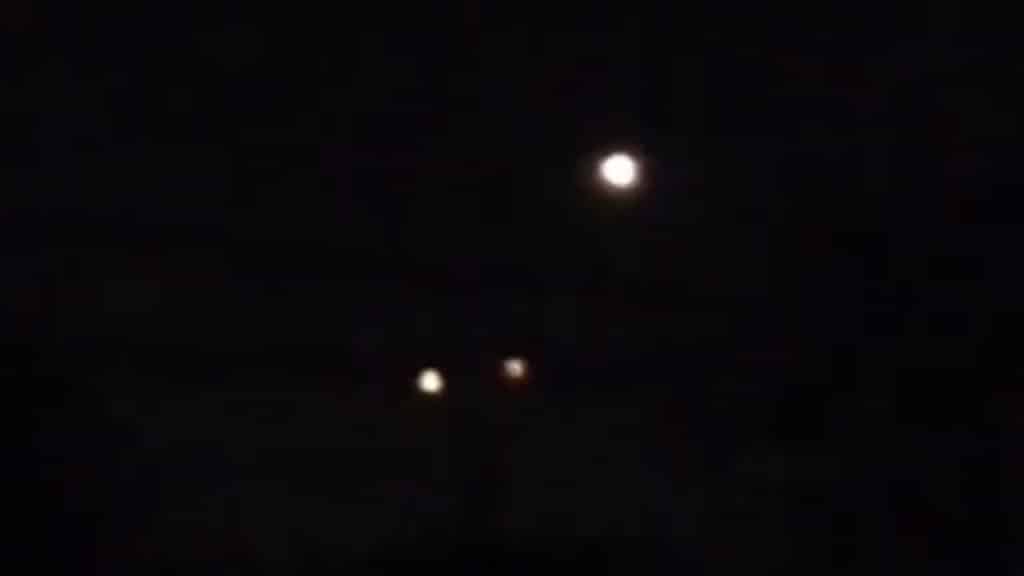
This UFO footage was filmed back in 2017 (25th November) but it was just recently submitted to MUFON’s website. It happened over Elmwood Park, a village in Cook County, Illinois.
Witness report:
Well out on my deck I observed several lights in the sky that seem to be hovering and changing directions
This new telescope that will make the James Webb look like a toy
The James Webb space telescope has only recently begun operations, astounding the globe and exceeding astronomers' expectations, but advancement continues: if all goes according to plan, humanity will have a new space telescope in a few decades that will make the Webb seem like a spyglass toy.
It will be the Stanford Gravity Telescope, an instrument so incredibly powerful that it will allow, for the first time in history, to see a planet in another solar system in detail. So much detail — on the scale of tens of kilometers per pixel — that astronomers say we can see continents, oceans, clouds, and even active volcanoes. In fact, they claim that we will be able to see how the atmosphere moves while the exoplanet rotates around its parent star.
How does it work
The project is one of three that has moved to phase 3 funding at NASA's Institute for Advanced Concepts, and its inventors recently published a new study in The Astrophysical Journal, offering new details on how they plan to make it happen. We already knew that this space telescope will not use conventional lenses but will exploit a phenomenon known as the Einstein Ring .
These rings can be seen around any massive object in space, from a star to a galaxy. The gravity created by the mass deforms the light that comes from very distant objects located behind it from the observer's point of view, amplifying it and creating a ring.
Using an algorithm, this ring can be put back together, transforming a distorted image into a normal image. James Webb, Hubble, and many ground-based observatories already use this effect with galaxies, revealing other galaxies so far away that we could not see with the direct use of today's mirrors and sensors.
Diagram of how the gravitational telescope would work.
The problem is that, in order to take advantage of the Einstein Ring that can 'generate' our sun, the telescope must be at a minimum distance of between 550 and 1,000 astronomical units (AU). Basically, the mission would seek to put the instrument 14 times the distance from the Sun to Pluto, enough to be able to investigate the thousands of planets that we know are in the range of 100 light years away.
Right now, Voyager 1 — the farthest man-made object from Earth — is at 156 AU after 44 years of travel. So the first problem will be to shorten the travel time. Right now the technology doesn't exist — such as direct fusion engines — to accelerate a telescope the size of Hubble to the rate of 20 AU per year, the minimum they consider acceptable.
So instead of sending a single telescope like Hubble or Webb, the team wants to send several small modular satellites toward the Sun, using their gravitational assist effect combined with solar sails to reach the point of observation in an acceptable time.
Concept of the telescope already assembled.
The constellation of modular mini-satellites — which to cut costs will be sent as cargo on other rocket flights — will be assembled in space autonomously, like Lego blocks. In this way, they say, we can have a mission ready to operate in just a decade from its launch. Once at its point of observation, the telescope would basically operate autonomously using artificial intelligence and following a preset list of targets. The reason for this autonomy is that, at the operating distance, communications between the telescope and Earth will take about 63 hours. To maneuver, the instrument could use ion engines during the ten years of the scientific mission.
Historical importance
It's an ingenious plan. Obviously, such a mission poses numerous challenges that have yet to be resolved. Like the James Webb, the plan to build this extraordinary machine has been a long time in the making and is still years away from being realized. In fact, some estimates give at least fifty years before we can execute it. Well over twenty that the Webb, which was unimaginable at the time, took time to go from fantasy to fantastic reality.
But these deadlines do not seem important on the historical scale. As Bruce Macintosh — one of the leaders of this project and professor of physics at the Stanford School of Humanities and Sciences and deputy director of the Kavli Institute for Particle Astrophysics and Cosmology (KIPAC) — says, this new telescope has the potential to affect the very human consciousness, as did 'Earthrise', the first image of Earth sunrise over the moon taken by Apollo 8.
"We want to take pictures of planets orbiting other stars that are as good as the pictures we can take of planets in our own solar system. With this technology, we hope to take a picture of a planet 100 light-years away that has the same impact than the Apollo 8 image of Earth," says Macintosh. The image taken by the Apollo had a profound effect worldwide that influenced the creation of institutions such as the American Environmental Protection Agency or Doctors Without Borders.
We really don't know what effect seeing another habitable planet a hundred light years away from Earth will have. In the short term, maybe not much. But if we want to survive as a species — aside from not destroying ourselves as we seem to be constantly trying — we're going to have to have a very long-term plan.
Mounds of snow-like frazil ice under the Antarctic ice shelf. According to research from UT Austin, Europa's ice shell could be made of the same stuff. Credit: Helen Glazer 2015, from the project "Walking in Antarctica" (helenglazer.com)
Below Europa's thick icy crust is a massive, global ocean where the snow floats upwards onto inverted ice peaks and submerged ravines. The bizarre underwater snow is known to occur below ice shelves on Earth, but a new study shows that the same is likely true for Jupiter's moon, where it may play a role in building its ice shell.
The underwater snow is much purer than other kinds of ice, which means Europa's ice shell could be much less salty than previously thought. That's important for mission scientists preparing NASA's Europa Clipper spacecraft, which will use radar to peek beneath the ice shell to see if Europa's ocean could be hospitable to life. The new information will be critical because salt trapped in the ice can affect what and how deep the radar will see into the ice shell, so being able to predict what the ice is made of will help scientists make sense of the data.
The study, published in the August edition of the journal Astrobiology, was led by The University of Texas at Austin, which is also leading the development of Europa Clipper's ice penetrating radar instrument. Knowing what kind of ice Europa's shell is made of will also help decipher the salinity and habitability of its ocean.
"When we're exploring Europa, we're interested in the salinity and composition of the ocean, because that's one of the things that will govern its potential habitability or even the type of life that might live there," said the study's lead author Natalie Wolfenbarger, a graduate student researcher at the University of Texas Institute for Geophysics (UTIG) in the UT Jackson School of Geosciences.
Europa is a rocky world about the size of the Earth's moon that is surrounded by a global ocean and a miles-thick ice shell. Previous studies suggest the temperature, pressure and salinity of Europa's ocean nearest to the ice is similar to what you would find beneath an ice shelf in Antarctica.
An illustration of NASA's Europa Clipper spacecraft flying by Jupiter's moon Europa. The spacecraft, which is planned to launch in 2024, will carry an ice-penetrating radar instrument developed by scientists at the University of Texas Institute for Geophysics. Credit: NASA/JPL-Caltech.
Armed with that knowledge, the new study examined the two different ways that water freezes under ice shelves, congelation ice and frazil ice. Congelation ice grows directly from under the ice shelf. Frazil ice forms as ice flakes in supercooled seawater which float upwards through the water, settling on the bottom of the ice shelf.
Both ways make ice that's less salty than seawater, which Wolfenbarger found would be even less salty when scaled up to the size and age of Europa's ice shell. What's more, according to her calculations, frazil ice—which keeps only a tiny fraction of the salt in seawater—could be very common on Europa. That means its ice shell could be orders of magnitude purer than previous estimates. This affects everything from its strength, to how heat moves through it, and forces that might drive a kind of ice tectonics.
"This paper is opening up a whole new batch of possibilities for thinking about ocean worlds and how they work," said Steve Vance, a research scientist at NASA's Jet Propulsion Laboratory (JPL) who was not involved in the study. "It sets the stage for how we might prepare for Europa Clipper's analysis of the ice."
According to co-author Donald Blankenship, a senior research scientist at UTIG and principal investigator for Europa Clipper's ice penetrating radar instrument, the research is validation for using the Earth as a model to understand the habitability of Europa.
"We can use Earth to evaluate Europa's habitability, measure the exchange of impurities between the ice and ocean, and figure out where water is in the ice," he said.
Scientists believe they may have caught a glimpse of a parallel universe bumping up against ours.
They’ve seen hints in signals from the most distant points of the universe that suggest the fabric of our universe has been disrupted by another incredibly different universe. Their analysis may be the proof for the multiverse theory.
According to researchers: “Dr Ranga-Ram Chary examined the noise and residual signals in the cosmic microwave background left over from the Big Bang (pictured) and found a number of scattered bright spots which he believes may be signals of another universe bumping into our own billions of years ago.”
At least that’s the tentative conclusion researchers have come to. According to some cosmological theories, collisions of alternative universes should be possible. Theories conclude that our universe is like a bubble among many.
Once a universe begins in a big bang type setting, it never stops expanding. That goes for all the universes. So it makes sense they’d periodically bump into one another.
They’re all likely in a row, say researchers, vibrating, bouncing around, and rubbing up on each other.
Dr. Chary believes that the signal he’s received indicate that this other universe is extremely different from our own.
He says it could have a ratio of subatomic particles called photos and baryons that are about 10 fold greater than in our universe.
Dr. Chary explains, “The fine tuning of parameters in the early universe required to reproduce our present day universe suggests that our universe may simply be a region within an eternally inflating super-region.
Many other regions beyond our observable universe would exist with each such region governed by a different set of physical parameters than the ones we have measured for our universe.”
More research will need to be done, but this could be the beginning of some very interesting discoveries.
As I took my early morning stroll, along the bohemian streets of Soho, London, I thought I could hear someone choking. Faint at first, by gradually getting louder. I looked all around, expecting to see some derelict party-person couhging up last nights good times. (It’s a common occurence in these parts). But no-one was around. Then I realised the sound must be coming from a far-off place. When I returned to my laptop and saw the Calvine UFO picture had been un-earthed and was now flooding the usual social media channels, I realised it must have been Nick Pope choking on his early morning cup of tea. Not only was the Calvine photo now in the public domain, but Pope’s arch-nemesis Dr. David Clarke had obtained the photo.
Dr. Clarke has been like a dog with a bone in regard to the Calvine UFO incident, and has done a huge amount of research, which has paid off with the discovery of the photo. Now, why this matters to Pope is that Calvine was one of the UK’s UFO stories that he loved to pontificate about. A mock-up of the Calvine photo was allegedly pinned on the wall in Pope’s office a la “I Want to Believe” in The X-Files. So instead of getting excited that the photo was now out of the shadows, and thinking about all the new avenues of research this opened up, Pope decided he needed to maintain his relevancy to the Calvine story.
First off, Pope went for the “I can not confirm or deny” approach
Then followd up with the “please look at my version that I had created, rather than the actual photo” approach.
Then Pope claimed there were “dark forces” at play which stopped the photo seeing the light of day. That was probably the Official Secrets Act, Nick. Strangely, these “dark forces” were vanquished by good old fashioned research. You could learn something there.
Then Pope started to sound desperate, making a pathetic comment about provenance, followed by the plea to look at Pope’s recreation. It’s just all starting to sound a bit sad and desperate!
The jig is up for Pope when it comes to Calvine. The photo is out there and people are now running with it in regards to researching just what is the object in question. This is no longer one of Pope’s pet projects because so many people are now divng in. For Pope, this jig is over. Now, let’s see how we can de-rail that UFO gravy train…
Astronomers Find A Potential ‘Major Planet’ Orbiting A Dead Star That Can Support Life For At Least 1 Billion Years Into The Future
It turns out that the existence of life on planets orbiting stars like our sun does not require those stars to be vibrant and powerful. A potential "major planet" that orbits a dying sun and could support life in the future has been found by scientists.
The “surprising” discovery was made by researchers from University College London while watching a white dwarf, the burning remnants of a star that ran out of hydrogen fuel. It is about 117 light-years away from us. This star, known as WD1054-226, has a ring of planetary rubble in its orbital habitable zone, also known as the Goldilocks zone, where temperatures should enable the planet to have liquid water on its surface.
If the newfound planet is proved to be a life-sustaining world, it will be the first time a life-sustaining planet has been identified around a dying sun.
Image credit: NASA
Scientists made the discovery while monitoring the light from the white dwarf and reported their results in the Royal Astronomical Society’s Monthly Notices. They discovered strong dips in light that matched to 65 uniformly distributed clouds of debris that orbited WD1054-226 every 25 hours, according to their findings.
Jay Farihi, the lead author of the study and professor at UCL Physics and Astronomy, said: “The moon-sized structures we have observed are irregular and dusty (e.g. comet-like) rather than solid, spherical bodies”
He described the structures as a “mystery we cannot explain,” but suggested one possible and “unexpected” explanation: a nearby planet.
He said: “”An exciting possibility is that these bodies are kept in such an evenly-spaced orbital pattern because of the gravitational influence of a nearby planet. Without this influence, friction and collisions would cause the structures to disperse, losing the precise regularity that is observed. A precedent for this ‘shepherding’ is the way the gravitational pull of moons around Neptune and Saturn help to create stable ring structures orbiting these planets. We were not looking for this.”
The idea of a “major planet” in the star’s habitable zone is thrilling, but he emphasises that such a planet has yet to be proven. Farihi stated that his team still requires further proof, which may be tough to get due to the inability to directly view the planet. To gain a clearer explanation, they may have to depend on computer models along with additional observations of the star and its circling debris.
The team anticipates that, if a planet exists, it was just recently formed — and that it would be habitable for at least 2 billion years, including at least 1 billion years in the future.
Their finding may also aid scientists in developing a better knowledge of our solar system, as more than 95% of all stars, including our sun, will ultimately become white dwarfs.
Four aging Air Force veterans on Tuesday, Dec. 7, finally spoke about their strange and extraordinary encounters with unidentified flying objects (UFO) during a conference held in Washington, D.C.
Three of the Air Force veterans personally appeared in the hearing while a fourth one was brought into the National Press Club conference via video feed from the Ozark Mountains in Missouri.
The story of each veteran was different but they share one important claim: UFOs tampered with Air Force nuclear weapons in the 1960s, which both terrified and mystified the airmen and made them remain silent for decades. (Related: Former US military officer claims UFOs shut down nuclear missiles.)
Also capturing the attention of Washington were the reports of Navy encounters with unknown flying objects or unexplained aerial phenomena (UAP) that have made national headlines and put UFOs back into political attention for the first time in years.
“I waited 40 years before I opened my mouth, and that’s a long time,” said David Schindele, a retired captain who worked as a nuclear missile launch control officer at Minot Air Force Base in North Dakota. “I had this terrible secret on my mind for all that time, and I felt such great relief to finally admit to my friends and close relatives what I experienced in the Air Force.”
Veteran Robert Salas told his story about a glowing red-orange craft that hovered at a Minuteman intercontinental ballistic missile silo in Montana and his account has been told for decades and has become a part of the growing UFO lore.
Through the years, the government has remained aloof to reports of UFOs flirting with the most powerful arms during the Cold War. But a different Capitol heard the stories of Salas and his fellow veterans this year.
The group claimed that UFOs have appeared since the 1960s and they’re backed up by the current accounts of Navy witnesses and fighter jet footage of UAP.
Salas has also gathered other Air Force veterans who have written witness affidavits describing their own alleged encounters years ago. He claimed that UFOs appeared at different times and put 20 Minuteman ICBMs off-line at different sites.
Schindele, on the other hand, shared that he and his commander visited a missile launch site near Minot in September 1966, and he was told that 10 missiles at silos in the area suffered guidance and control malfunctions when an 80- to 100-foot wide UFO with bright flashing lights lingered over the site.
Salas, who was a first lieutenant stationed at Malmstrom Air Force Base, Montana, in 1967, said he was working as a deputy missile combat crew commander in the underground nuclear missile control room when a flight security controller called in a panicky manner after seeing a large glowing, pulsating red oval-shaped object linger at the front gate.
Robert Jacobs, who graced the conference via video link from Missouri, said he was an Air Force first lieutenant based at Vandenberg Air Force Base, California, in 1964 when he set up a telescope video camera to catch an Atlas rocket test.
Jacobs said the video showed a disc-shaped object flying over the dummy warhead as it soared over the Pacific Ocean, circled it and shot it down with beams of light.
He said the film footage was cut and taken by men in gray suits. His commander ordered him not to say anything about it but Jacobs offered the story to media and it was eventually sold to the National Enquirer tabloid.
Graves, in an interview with Bill Whitaker, said that his F/A-18F Super Hornet squadron spotted UFOs southeast of Virginia Beach in 2014. The squadron, which has upgraded radar, zeroed in with infrared cameras on the UFOs.
Another encounter that his squadron recorded on video was a UFO hovering over Jacksonville, Florida in 2015. Graves, who worked for the Navy for more than a decade, confirmed that his squadron regularly spotted UFOs every day for at least a couple of years.
UFOs are a threat to national security
The retired lieutenant believes that UFOs are a threat to national security but agrees that they might be something else. He cited that other pilots think UFOs were one of three things, namely a secret American technology, an enemy’s spy plane or something out of this world.
“I would say the highest probability is it’s a threat observation program,” Graves said, adding that UFOs could either be a Chinese or Russian technology.
“If these were tactical jets from another country that were hanging out up there, it would be a massive issue. But because it looks slightly different, we’re not willing to actually look at the problem in the face. We’re happy to just ignore the fact that these are out there, watching us every day,” he added when asked whether he is worried about the presence of UFOs in restricted U.S. airspace.
The Department of Defense already has a special unit known as the Unidentified Aerial Phenomenon Task Force that is dedicated to UFO research. It was established in August last year to gain understanding into the origins and nature of UAP, which is the preferred term for UFOs given by the Pentagon.
The task force replaced the Advanced Aerospace Threat Identification Program (AATIP), which secretly existed from 2007 to 2012. The AATIP’s existence was never known to the public until the New York Times wrote about it in 2017.
UFOs are real and they do exist
Luis Elizondo, who led the AATIP in its final two years, confirmed that UFOs are real and the government itself said that they do exist. He added that unanswered questions still remain like what are UFOs and what are their intentions and capabilities. The former AATIP head noted that some sightings remain unexplained.
According to Elizondo, some of the UFOs could perform extraordinary feats.
“Imagine a technology that can do 6-to-700 g-forces, that can fly at 13,000 miles an hour, that can evade radar and that can fly through air and water and possibly space,” noted Elizondo, who added that the UFOs had no propulsion engine yet were able to defy gravity.
The Pentagon did not take his findings seriously, Elizondo said. He decided to quit out of frustration in 2017 and one of his last achievements was declassifying three UAP videos that the Pentagon made public last year.
The videos were leaked to the New York Times by Christopher Mellon, a former Deputy Assistant Secretary of Defense for Intelligence under former Presidents Bill Clinton and George W. Bush.
Elizondo said he was troubled that the government was doing nothing about UAPs. “It’s bizarre and unfortunate that someone like myself has to do something like that to get a national security issue like this on the agenda,” Elizondo stressed.
Watch the “Health Ranger Report” video below to know more about UFOs or UAPs.
Follow UFOs.news for more news and information related to UFOs.
Air Force Veterans Speak Up About Their Alien Craft Encounters
Four aging Air Force veterans on Tuesday, Dec. 7, finally spoke about their strange and extraordinary encounters with unidentified flying objects (UFO) during a conference held in Washington, D.C.
Three of the Air Force veterans personally appeared in the hearing while a fourth one was brought into the National Press Club conference via video feed from the Ozark Mountains in Missouri.
The story of each veteran was different but they share one important claim: UFOs tampered with Air Force nuclear weapons in the 1960s, which both terrified and mystified the airmen and made them remain silent for decades. (Related: Former US military officer claims UFOs shut down nuclear missiles.)
Also capturing the attention of Washington were the reports of Navy encounters with unknown flying objects or unexplained aerial phenomena (UAP) that have made national headlines and put UFOs back into political attention for the first time in years.
“I waited 40 years before I opened my mouth, and that’s a long time,” said David Schindele, a retired captain who worked as a nuclear missile launch control officer at Minot Air Force Base in North Dakota. “I had this terrible secret on my mind for all that time, and I felt such great relief to finally admit to my friends and close relatives what I experienced in the Air Force.”
Veteran Robert Salas told his story about a glowing red-orange craft that hovered at a Minuteman intercontinental ballistic missile silo in Montana and his account has been told for decades and has become a part of the growing UFO lore.
Through the years, the government has remained aloof to reports of UFOs flirting with the most powerful arms during the Cold War. But a different Capitol heard the stories of Salas and his fellow veterans this year.
The group claimed that UFOs have appeared since the 1960s and they’re backed up by the current accounts of Navy witnesses and fighter jet footage of UAP.
Salas has also gathered other Air Force veterans who have written witness affidavits describing their own alleged encounters years ago. He claimed that UFOs appeared at different times and put 20 Minuteman ICBMs off-line at different sites.
Schindele, on the other hand, shared that he and his commander visited a missile launch site near Minot in September 1966, and he was told that 10 missiles at silos in the area suffered guidance and control malfunctions when an 80- to 100-foot wide UFO with bright flashing lights lingered over the site.
Salas, who was a first lieutenant stationed at Malmstrom Air Force Base, Montana, in 1967, said he was working as a deputy missile combat crew commander in the underground nuclear missile control room when a flight security controller called in a panicky manner after seeing a large glowing, pulsating red oval-shaped object linger at the front gate.
Robert Jacobs, who graced the conference via video link from Missouri, said he was an Air Force first lieutenant based at Vandenberg Air Force Base, California, in 1964 when he set up a telescope video camera to catch an Atlas rocket test.
Jacobs said the video showed a disc-shaped object flying over the dummy warhead as it soared over the Pacific Ocean, circled it and shot it down with beams of light.
He said the film footage was cut and taken by men in gray suits. His commander ordered him not to say anything about it but Jacobs offered the story to media and it was eventually sold to the National Enquirer tabloid.
Graves, in an interview with Bill Whitaker, said that his F/A-18F Super Hornet squadron spotted UFOs southeast of Virginia Beach in 2014. The squadron, which has upgraded radar, zeroed in with infrared cameras on the UFOs.
Another encounter that his squadron recorded on video was a UFO hovering over Jacksonville, Florida in 2015. Graves, who worked for the Navy for more than a decade, confirmed that his squadron regularly spotted UFOs every day for at least a couple of years. note: The above image is CGI.
Hubble Sees Red Supergiant Star Betelgeuse Recovering After Never-Seen-Before Titanic Eruption
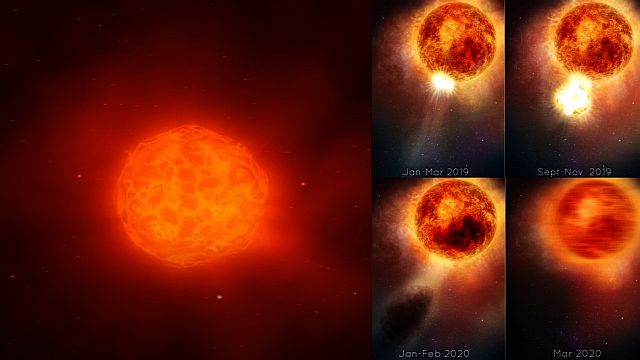
This graphic illustrates how the southern region of the rapidly evolving, bright, red supergiant star Betelgeuse may have suddenly become fainter for several months during late 2019 and early 2020.
Credit: NASA, ESA, and E. Wheatley (STScI)
Monster Star Had Never-Seen-Before Titanic Eruption
Betelgeuse, a red supergiant star, appears as a brilliant, ruby-red, twinkling spot of light in the upper right shoulder of the winter constellation Orion the Hunter. However, when viewed close up, astronomers know that it is a seething monster with a 400-day-long heartbeat of regular pulsations. This aging star is classified as a supergiant because it has swelled up to an astonishing diameter of approximately 1 billion miles. If placed at the center of our solar system it would reach out to the orbit of Jupiter.
The star’s ultimate fate is to explode as a supernova. When that eventually happens it will be briefly visible in the daytime sky from Earth. But there are a lot of fireworks going on now before the final detonation. Astronomers using Hubble and other telescopes have deduced that the star blew off a huge piece of its visible surface in 2019. This has never before been seen on a star. Our petulant Sun routinely goes through mass ejections of its outer atmosphere, the corona. But those events are orders of magnitude weaker than what was seen on Betelgeuse.
The first clue came when the star mysteriously darkened in late 2019. An immense cloud of obscuring dust formed from the ejected surface as it cooled. Astronomers have now pieced together a scenario for the upheaval. And the star is still slowly recovering; the photosphere is rebuilding itself. And the interior is reverberating like a bell that has been hit with a sledgehammer, disrupting the star’s normal cycle. This doesn’t mean the monster star is going to explode any time soon, but the late-life convulsions may continue to amaze astronomers.
This illustration plots changes in the brightness of the red supergiant star Betelgeuse, following the titanic mass ejection of a large piece of its visible surface. The escaping material cooled to form a cloud of dust that temporarily made the star look dimmer, as seen from Earth. This unprecedented stellar convulsion disrupted the monster star’s 400-day-long oscillation period that astronomers had measured for more than 200 years. The interior may now be jiggling like a plate of gelatin dessert.
Credit: NASA, ESA, Elizabeth Wheatley (STScI)
Hubble Sees Red Supergiant Star Betelgeuse Slowly Recovering After Blowing Its Top
After analyzing data from NASA’s Hubble Space Telescope and several other observatories, astronomers have concluded that the bright red supergiant star Betelgeuse quite literally blew its top in 2019, losing a substantial part of its visible surface and producing a gigantic Surface Mass Ejection (SME). This is something never before seen in a normal star’s behavior.
Our Sun routinely blows off parts of its tenuous outer atmosphere, the corona, in an event known as a Coronal Mass Ejection (CME). However, the Betelgeuse SME blasted off 400 billion times as much mass as a typical CME!
The monster star is still slowly recovering from this catastrophic upheaval. “Betelgeuse continues doing some very unusual things right now; the interior is sort of bouncing,” said Andrea Dupree of the Center for Astrophysics | Harvard & Smithsonian in Cambridge, Massachusetts.
These new observations yield clues as to how red stars lose mass late in their lives as their nuclear fusion furnaces burn out, before exploding as supernovae. The amount of mass loss significantly affects their fate. However, Betelgeuse’s surprisingly petulant behavior is not evidence the star is about to blow up anytime soon. So the mass-loss event is not necessarily the signal of an imminent explosion.
Dupree is now pulling together all the puzzle pieces of the star’s petulant behavior before, after, and during the eruption into a coherent story of a never-before-seen titanic convulsion in an aging star.
This includes new spectroscopic and imaging data from the STELLA robotic observatory, the Fred L. Whipple Observatory’s Tillinghast Reflector Echelle Spectrograph (TRES), NASA’s Solar Terrestrial Relations Observatory spacecraft (STEREO-A), NASA’s Hubble Space Telescope, and the American Association of Variable Star Observers (AAVSO). Dupree emphasizes that the Hubble data was pivotal to helping sort out the mystery.
“We’ve never before seen a huge mass ejection of the surface of a star. We are left with something going on that we don’t completely understand. It’s a totally new phenomenon that we can observe directly and resolve surface details with Hubble. We’re watching stellar evolution in real-time.”
The titanic outburst in 2019 was possibly caused by a convective plume, more than a million miles across, bubbling up from deep inside the star. It produced shocks and pulsations that blasted off the chunk of the photosphere leaving the star with a large cool surface area under the dust cloud that was produced by the cooling piece of photosphere. Betelgeuse is now struggling to recover from this injury.
Weighing roughly several times as much as our Moon, the fractured piece of photosphere sped off into space and cooled to form a dust cloud that blocked light from the star as seen by Earth observers. The dimming, which began in late 2019 and lasted for a few months, was easily noticeable even by backyard observers watching the star change brightness. One of the brightest stars in the sky, Betelgeuse is easily found in the right shoulder of the constellation Orion.
Even more incredible, the supergiant’s 400-day pulsation rate is now gone, perhaps at least temporarily. For almost 200 years astronomers have measured this rhythm as evident in changes in Betelgeuse’s brightness variations and surface motions. Its disruption attests to the ferocity of the blowout.
The star’s interior convection cells, which drive the regular pulsation may be sloshing around like an imbalanced washing machine tub, Dupree suggests. TRES and Hubble spectra imply that the outer layers may be back to normal, but the surface is still bouncing like a plate of gelatin dessert as the photosphere rebuilds itself.
Though our Sun has coronal mass ejections that blow off small pieces of the outer atmosphere, astronomers have never witnessed such a large amount of a star’s visible surface get blasted into space. Therefore, surface mass ejections and coronal mass ejections may be different events.
Betelgeuse is now so huge now that if it replaced the Sun at the center of our solar system, its outer surface would extend past the orbit of Jupiter. Dupree used Hubble to resolve hot spots on the star’s surface in 1996. This was the first direct image of a star other than the Sun.
NASA’s Webb Space Telescope may be able to detect the ejected material in infrared light as it continues moving away from the star.
The Hubble Space Telescope is a project of international cooperation between NASA and ESA (European Space Agency). NASA’s Goddard Space Flight Center in Greenbelt, Maryland, manages the telescope. The Space Telescope Science Institute (STScI) in Baltimore, Maryland, conducts Hubble science operations. STScI is operated for NASA by the Association of Universities for Research in Astronomy, in Washington, D.C.
Never seen before; gigantic surface mass ejection SME on red supergiant star Betelgeuse
Analyzing data from NASA's Hubble Space Telescope and several other observatories, astronomers have concluded that the bright red supergiant star Betelgeuse quite literally blew its top in 2019, losing a substantial part of its visible surface and producing a gigantic Surface Mass Ejection (SME). This is something never before seen in a normal star's behavior.
Our Sun routinely blows off parts of its tenuous outer atmosphere, the corona, in an event known as a Coronal Mass Ejection (CME). But the Betelgeuse SME blasted off 400 billion times as much mass as a typical CME!
The monster star is still slowly recovering from this catastrophic upheaval. "Betelgeuse continues doing some very unusual things right now; the interior is sort of bouncing," said Andrea Dupree of the Center for Astrophysics | Harvard & Smithsonian in Cambridge, Massachusetts.
These new observations yield clues as to how red stars lose mass late in their lives as their nuclear fusion furnaces burn out, before exploding as supernovae. The amount of mass loss significantly affects their fate. However, Betelgeuse's surprisingly petulant behavior is not evidence the star is about to blow up anytime soon. So the mass loss event is not necessarily the signal of an imminent explosion.
Dupree is now pulling together all the puzzle pieces of the star's petulant behavior before, after, and during the eruption into a coherent story of a never-before-seen titanic convulsion in an aging star.
Meer van UFO'S of UAP'S, ASTRONOMIE, RUIMTEVAART, ARCHEOLOGIE, OUDHEIDKUNDE, SF-SNUFJES EN ANDERE ESOTERISCHE WETENSCHAPPEN - DE ALLERLAATSTE NIEUWTJES


 Elmwood Park, Illinois UFO sighting