Ontdek de Fascinerende Wereld van UFO's en UAP's: Jouw Bron voor Onthullende Informatie!
Ben jij ook gefascineerd door het onbekende? Wil je meer weten over UFO's en UAP's, niet alleen in België, maar over de hele wereld? Dan ben je op de juiste plek!
België: Het Kloppend Hart van UFO-onderzoek
In België is BUFON (Belgisch UFO-Netwerk) dé autoriteit op het gebied van UFO-onderzoek. Voor betrouwbare en objectieve informatie over deze intrigerende fenomenen, bezoek je zeker onze Facebook-pagina en deze blog. Maar dat is nog niet alles! Ontdek ook het Belgisch UFO-meldpunt en Caelestia, twee organisaties die diepgaand onderzoek verrichten, al zijn ze soms kritisch of sceptisch.
Nederland: Een Schat aan Informatie
Voor onze Nederlandse buren is er de schitterende website www.ufowijzer.nl, beheerd door Paul Harmans. Deze site biedt een schat aan informatie en artikelen die je niet wilt missen!
Internationaal: MUFON - De Wereldwijde Autoriteit
Neem ook een kijkje bij MUFON (Mutual UFO Network Inc.), een gerenommeerde Amerikaanse UFO-vereniging met afdelingen in de VS en wereldwijd. MUFON is toegewijd aan de wetenschappelijke en analytische studie van het UFO-fenomeen, en hun maandelijkse tijdschrift, The MUFON UFO-Journal, is een must-read voor elke UFO-enthousiasteling. Bezoek hun website op www.mufon.com voor meer informatie.
Samenwerking en Toekomstvisie
Sinds 1 februari 2020 is Pieter niet alleen ex-president van BUFON, maar ook de voormalige nationale directeur van MUFON in Vlaanderen en Nederland. Dit creëert een sterke samenwerking met de Franse MUFON Reseau MUFON/EUROP, wat ons in staat stelt om nog meer waardevolle inzichten te delen.
Let op: Nepprofielen en Nieuwe Groeperingen
Pas op voor een nieuwe groepering die zich ook BUFON noemt, maar geen enkele connectie heeft met onze gevestigde organisatie. Hoewel zij de naam geregistreerd hebben, kunnen ze het rijke verleden en de expertise van onze groep niet evenaren. We wensen hen veel succes, maar we blijven de autoriteit in UFO-onderzoek!
Blijf Op De Hoogte!
Wil jij de laatste nieuwtjes over UFO's, ruimtevaart, archeologie, en meer? Volg ons dan en duik samen met ons in de fascinerende wereld van het onbekende! Sluit je aan bij de gemeenschap van nieuwsgierige geesten die net als jij verlangen naar antwoorden en avonturen in de sterren!
Heb je vragen of wil je meer weten? Aarzel dan niet om contact met ons op te nemen! Samen ontrafelen we het mysterie van de lucht en daarbuiten.
A chance alignment between Earth and a Mars-bound spacecraft has given us a rare glimpse into the movement of high-energy particles from the Sun.
A chance alignment between Earth and a Mars-bound spacecraft has given us a rare glimpse into the movement of high-energy particles from the Sun. The data from this event can help researchers understand the radiation environment near Mars — a key factor in planning crewed missions to our neighboring planet and beyond.
ENERGETIC PARTICLE PARADE
Illustration of energetic particles being ejected by the Sun. NASA’s Goddard Space Flight Center Conceptual Image Lab
The space between the planets in our solar system is filled with a wispy sea of charged particles that flow out from the Sun’s atmosphere. This particle population is augmented by cosmic rays — speedy protons and atomic nuclei accelerated in extreme environments across the universe — which ebb and flow against the 11-year solar activity cycle. This undulating particle background is punctuated by bursts of high-energy particles from the Sun, which can be unleashed suddenly in violent solar storms.
Spacecraft that venture out from the protection of Earth’s magnetic field must navigate this ocean of particles and weather solar storms. And if we someday wish to send astronauts to other planets, we’ll need to know how high-energy solar particles, which pose a risk to the health of astronauts and electronic systems alike, travel through the solar system.
WHEN SPACECRAFT ALIGN
Location of Tianwen-1 (TW-1) relative to Solar Orbiter (SolO), Parker Solar Probe (PSP), and STEREO-A (STA), Earth, and Mars. The black arrow marks the location of the active region that launched the solar storm. Adapted from Fu et al. 2022
In a new publication, a team led by Shuai Fu (Macau University of Science and Technology), Zheyi Ding (China University of Geosciences), and Yongjie Zhang (Chinese Academy of Sciences) studied the high-energy solar particles produced in an event in November 2020, when the Sun emitted a solar flare and a massive explosion of solar plasma called a coronal mass ejection.
This event coincided with a chance alignment of multiple spacecraft along the same solar magnetic field line. This alignment meant that several spacecraft near Earth and the Tianwen-1 spacecraft en route to Mars measured the same burst of energetic particles millions of miles apart, providing a rare opportunity to study how energetic particles from the Sun travel through space along magnetic field lines.
DIFFUSION AND EVOLUTION
Comparison of proton fluence (number of particles collected per unit area) measured by spacecraft at Earth (blue) and by Tianwen-1 at 1.39 au (red). The time increases from (a) to (h). The spectra at Earth and at Tianwen-1 “break” or bend at roughly the same energy, suggesting that there is little evolution as the particles travel outward. Click to enlarge. Fu et al. 2022
By comparing the timing of measurements from Tianwen-1 to those from three spacecraft near Earth, the team discerned that the magnetic field line that connected the spacecraft did not connect back to the origin of the particles. This means that the particles must have traveled, or diffused, across magnetic field lines to reach the spacecraft.
In addition, the team found that the shape of the particle energy distribution remained the same at moderate and high energies as the particles traveled between Earth and Tianwen-1’s location at 1.39 au. This suggests that the shape of the energy distribution is determined earlier, at the time the particles are accelerated to high energies, rather than as the particles travel through space.
The November 2020 event marked the first solar energetic particle event observed by Tianwen-1, but surely not the last. The spacecraft will continue to monitor high-energy particles from its station in Mars orbit as the solar cycle revs up, collecting valuable data for understanding the radiation environment around Mars and planning future missions.
CITATION
“First Report of a Solar Energetic Particle Event Observed by China’s Tianwen-1 Mission in Transit to Mars,” Shuai Fu et al 2022 ApJL934 L15. doi:10.3847/2041-8213/ac80f5
This post originally appeared on AAS Nova, which features research highlights from the journals of the American Astronomical Society.
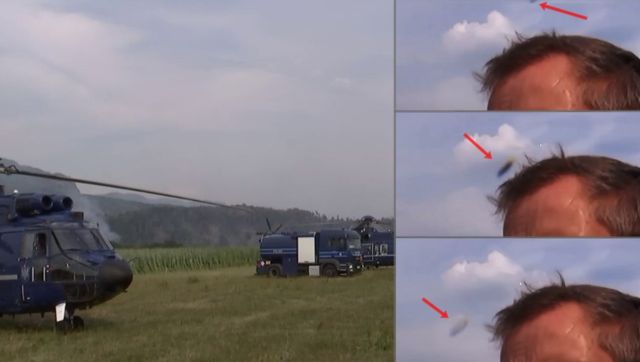
Possible UFO appears during live broadcast in Germany
Was a UFO accidentally filmed during an ARD live broadcast recording of a wildfire in eastern Germany?
The video footage appears to show a high speed cylindrical object flying by in the background.
The object has no obvious signs of propulsion and no wings, also it can't be a bird either since we don't see flapping wings. Maybe an insect flying close to the camera? But can an insect fly that speed? What could it be?
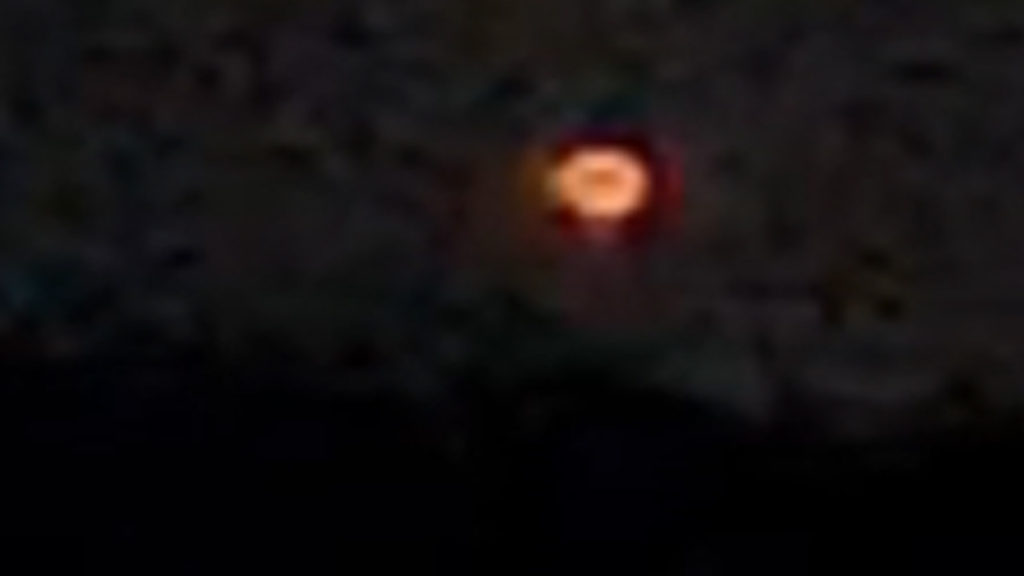
UFO fireball in the western skies looking from Anza, California 6-Aug-2022
This bright UFO was seen and recorded in the sky above Anza, California on 6th August 2022.
Witness report:
I saw a fireball in the sky that changed colors from red to orange and changed in size. I was able to get a video of it on my iPhone 13. There was also a small white light that blinked intermittently on the left of it. The red object seemed to have control of the power like a jet engine going on and off. It hovered for a while and then it just disappeared.
Astronomers Discover A Disappearing Space Object That Turns On And Off Every 20 Minutes And Sends Highly-Polarized Radio Signals
According to a research paper published in Nature, astronomers detected a “really weird” object 4,000 lightyears distant from Earth. Every other minute, the object vanishes from view and produces a massive burst of radio waves three times an hour.
Tyrone O’Doherty, a Curtin University student, first noticed the enigmatic object while scanning the sky in rural Western Australia. “It’s exciting that the source I identified last year has turned out to be such a peculiar object,” stated O’Doherty in a press statement.
The object, which the scientists claim is unlike anything else they’ve observed, emits a tremendous beam of radiation that, every 20 minutes, shines brightly in the sky. It also spins and vanishes every minute.
Scientists refer to space objects that “turn” on and off in the night sky as “transients”.
“When studying transients, you’re watching the death of a massive star or the activity of the remnants it leaves behind,” said Dr. Gemma Anderson, an ICRAR-Curtin astrophysicist and co-author of the work.
Slower transients, such as supernovae, might arrive in a matter of days and last for several months. Fast transients, such as neutron stars, “flash” on and off many times per second. However, transients between those two speeds are uncommon, and the current discovery is “really weird” and “completely unexpected.” according to the researchers.
“It was kind of spooky for an astronomer because there’s nothing known in the sky that does that,” said astrophysicist Dr. Natasha Hurley-Walker, who headed the research team. “And it’s really close to us – about 4000 lightyears distant. It’s there in our galaxy’s backyard.”
Hurley-Walker characterized the enigmatic object as being smaller than the sun yet brilliant, radiating highly polarized radio waves three times an hour. These radio pulses imply that it has an “extremely strong” magnetic field, which may correspond to a previously anticipated astrophysical object that has never been verified to exist. Scientists refer to the hypothetical item as an “ultra-long period magnetar.”
“It’s a type of slowly spinning neutron star that has been predicted to exist theoretically,” Hurley-Walker explained. “However, no one anticipated to immediately discover one like this since they were not thought to be that brilliant. It converts magnetic energy to radio waves considerably more efficiently than anything else we’ve seen previously.”
-
Astronomers believe it is a rare sort of neutron star or a collapsing white dwarf, but they need to examine it again to establish if it is a fluke or a new type of space object.
Ancient Source of Oxygen for Life Discovered Hidden Deep in the Earth’s Crust
ByNEWCASTLE UNIVERSITY
Researchers have uncovered a source of oxygen that may have influenced the evolution of life before the advent of photosynthesis.
Scientists at Newcastle University have discovered a source of oxygen deep in the Earth’s crust that may have influenced the evolution of life before the advent of photosynthesis.
The pioneering research project uncovered a mechanism that can generate hydrogen peroxide from rocks during the movement of geological faults. The study was led by Newcastle University’s School of Natural and Environmental Sciences and published today (August 8) in the journal Nature Communications.
While hydrogen peroxide in high concentrations can be harmful to life, it can also provide a useful source of oxygen to microbes. This additional source of oxygen may have influenced the early evolution, and possibly even origin, of life in hot environments on the early Earth before the evolution of photosynthesis.
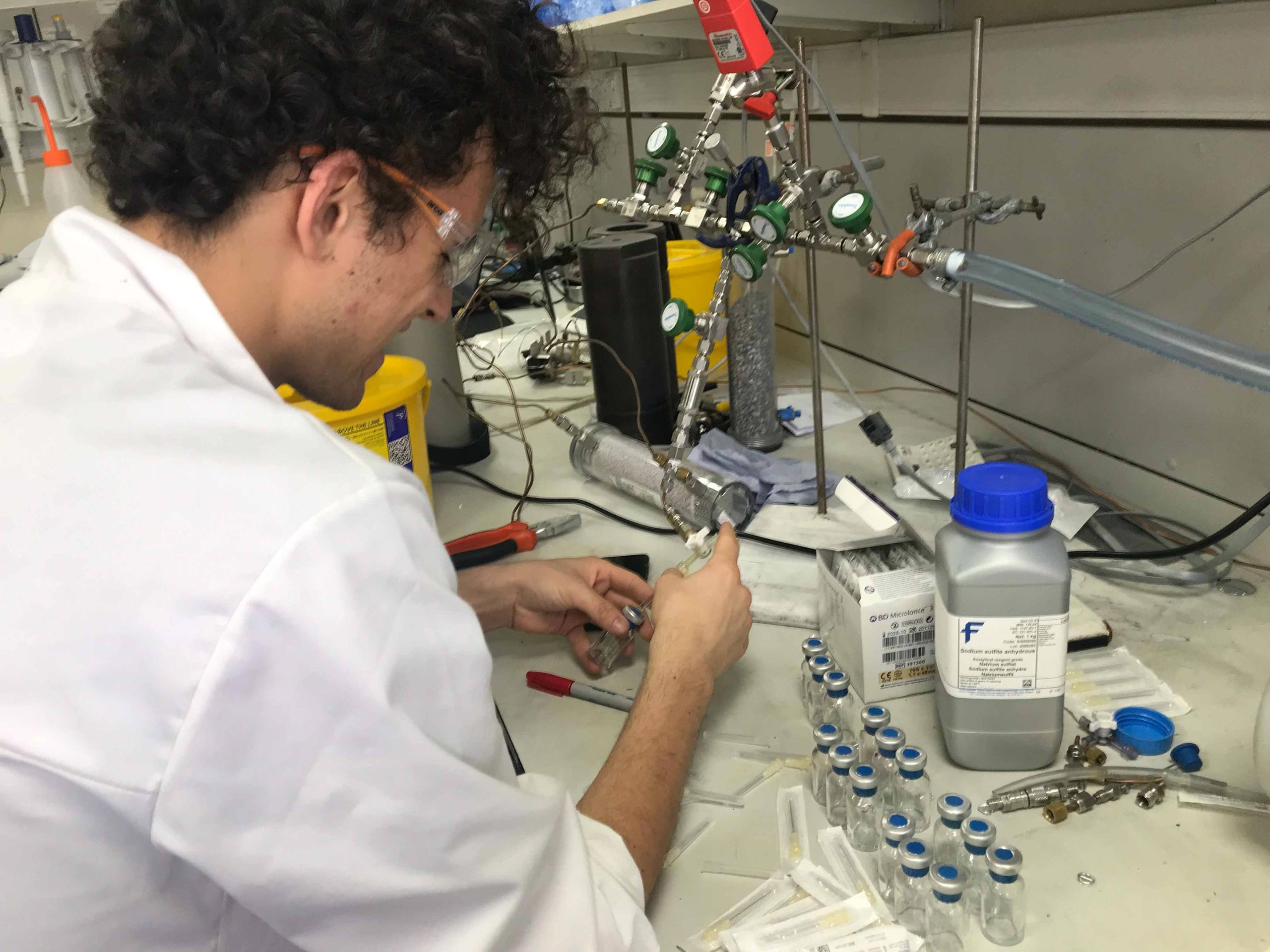
Researchers were able to simulate some of the key conditions of subsurface rock fracturing using vials in the lab. Rocks representative of oceanic and continental crust were crushed under nitrogen, added to oxygen-free water, then heated.
Credit: Jon Telling / Jordan Stone / Newcastle University
In tectonically active regions, the movement of the Earth’s crust not only generates earthquakes but also riddles the subsurface with cracks and fractures. These are lined with highly reactive rock surfaces containing many imperfections, or defects. Water can then filter down and react with these defects on the newly fractured rock.
Master’s student Jordan Stone simulated these conditions in the laboratory by crushing granite, basalt, and peridotite – rock types that would have been present in the early Earth’s crust. These were then added to water at varying temperatures under well-controlled oxygen-free conditions.
The research investigates a source of reactive oxygen associated with geological faulting; a potential oxygen source prior to cyanobacteria oxygenating the Earth’s atmosphere. This reactive oxygen may have had a role in the evolution of life from an oxygen-free to an oxygenated world and contributed to prebiotic chemistry in subsurface fractures prior to the origin of life.
Credit: Jon Telling / Jordan Stone / Newcastle University
The experiments revealed that substantial amounts of hydrogen peroxide – and as a result, potentially oxygen – were only generated at temperatures close to the boiling point of water. Importantly, the temperature of hydrogen peroxide formation overlaps the growth ranges of some of the most heat-loving microbes on Earth called hyperthermophiles, including evolutionary ancient oxygen-using microbes near the root of the Universal Tree of Life.
Lead author Jordan Stone, who conducted this research as part of his Master of Research in Environmental Geoscience, said: “While previous research has suggested that small amounts of hydrogen peroxide and other oxidants can be formed by stressing or crushing of rocks in the absence of oxygen, this is the first study to show the vital importance of hot temperatures in maximizing hydrogen peroxide generation.”
Lead author Jordan Stone, who conducted this research as part of his MRes in Environmental Geoscience at Newcastle University, UK, sets up one of the experiments.
Credit: Jon Telling / Jordan Stone / Newcastle University
Principal Investigator Dr. Jon Telling, Senior Lecturer, added: “This research shows that defects on crushed rock and minerals can behave very differently to how you would expect more ‘perfect’ mineral surfaces to react. All these mechanochemical reactions need to generate hydrogen peroxide, and therefore oxygen, is water, crushed rocks, and high temperatures, which were all present on the early Earth before the evolution of photosynthesis and which could have influenced the chemistry and microbiology in hot, seismically active regions where life may have first evolved.”
Reference:
“Tectonically-driven oxidant production in the hot biosphere” 8 August 2022, Nature Communications. DOI: 10.1038/s41467-022-32129-y
The work was supported through grants from the Natural Environmental Research Council (NERC) and the UK Space Agency. A major new follow-up project led by Dr. Jon Telling, funded by NERC, is underway to determine the significance of this mechanism for supporting life in the Earth’s subsurface.
NASA's 'Helical Engine' could reach 99% the speed of light
When it comes to space, there's a problem with our human drive to go all the places and see all the things. A big problem. It's, well, space. It's way too big. Even travelling at the maximum speed the Universe allows, it would take us years to reach our nearest neighbouring star.
But another human drive is finding solutions to big problems. And that's what NASA engineer David Burns has been doing in his spare time. He's produced an engine concept that, he says, could theoretically accelerate to 99 percent of the speed of light - all without using propellant.
He's posted it to the NASA Technical Reports Server under the heading "Helical Engine", and, on paper, it works by exploiting the way mass can change at relativistic speeds - those close to the speed of light in a vacuum. It has not yet been reviewed by an expert.
Understandably this paper has caused buzz approaching levels seen in the early days of the EM Drive. And yes, even some headlines claiming the engine could 'violate the laws of physics'.
But while this concept is fascinating, it's definitely not going to break physics anytime soon. As a thought experiment to explain his concept, Burns describes a box with a weight inside, threaded on a line, with a spring at each end bouncing the weight back and forth. In a vacuum - such as space - the effect of this would be to wiggle the entire box, with the weight seeming to stand still, like a gif stabilized around the weight.Overall, the box would stay wiggling in the same spot - but if the mass of the weight were to increase in only one direction, it would generate a greater push in that direction, and therefore thrust.
According to the principle of the conservation of momentum - in which the momentum of a system remains constant in the absence of any external forces - this should be not completely possible.
But! There's a special relativity loophole. Hooray for special relativity! According to special relativity, objects gain mass as they approach light speed. So, if you replace the weight with ions and the box with a loop, you can theoretically have the ions moving faster at one end of the loop, and slower at the other.
But Burns' drive isn't a single closed loop. It's helical, like a stretched out spring - hence "helical engine".
"The engine accelerates ions confined in a loop to moderate relativistic speeds, and then varies their velocity to make slight changes to their mass. The engine then moves ions back and forth along the direction of travel to produce thrust," he wrote in his abstract.
"The engine has no moving parts other than ions traveling in a vacuum line, trapped inside electric and magnetic fields."
It sounds really nifty, right? And it is - in theory. But it's not without significant practical problems.
According to New Scientist, the helical chamber would have to be pretty large. Around 200 metres (656 feet) long and 12 metres (40 feet) in diameter, to be precise.
And it would need to generate 165 megawatts of energy to produce 1 newton of thrust. That's the equivalent of a power station to produce the force required to accelerate a kilogram of mass per second squared. So a lot of input for a teeny tiny output. It is horribly inefficient.
But in the vacuum of space? It just might work. "The engine itself would be able to get to 99 per cent the speed of light if you had enoughAnd here's the other thing. Humans - not all of us, but still more than a few - desperately want to go to interstellar space. We may never get there. But if we never even try to think about it, that "may" becomes a "definitely." What's that saying - you miss 100 percent of the shots you don't take?time and power," Burns told New Scientist.
Burns notes the efficiency problem in his presentation, and also adds that his work hasn't been reviewed by experts, and there may be errors in his maths. We don't exactly have the blueprints for a fully functional space travel engine here.
What we do have is a piece of groundwork that could be used to develop such an engine. What we have is a dream of the stars.
The hush-hush vehicle is thought to be a space plane.
A Long March 2F rocket launches China's Shenzhou 14 crewed mission on June 4, 2022. A Long March 2F launched a mysterious reusable "test spacecraft" on Aug. 4.
(Image credit: CCTV+)
For the second time in two years, China has launched a classified reusable vehicle on a mystery mission to Earth orbit.
A Long March 2F rocket carrying a "test spacecraft" lifted off from Jiuquan Satellite Launch Center in the Gobi Desert on Thursday (Aug. 4; Aug. 5 Beijing time), China's state-run Xinhua news agency reported.
"The test spacecraft will be in orbit for a period of time before returning to the scheduled landing site in China, during which reusable and in-orbit service technology verification will be carried out as planned to provide technical support for the peaceful use of space," Xinhua wrote(opens in new tab) (in Chinese; translation by Google).
That's about all we know; Xinhua's update is just two paragraphs long and provides no further detail. But the mystery vehicle is thought to be a robotic space plane, perhaps one roughly the same size as the U.S. Space Force's X-37B, based on the Long March 2F's considerable payload capacity, SpaceNews reported(opens in new tab).
China also launched a reusable test spacecraft in September 2020, under a similar cloud of secrecy. That vehicle — which may or may not be the same one that lifted off on Thursday — stayed aloft for two days and released a small payload in orbit before coming down for a landing in China, SpaceNews noted.
For comparison, the X-37B space plane has been orbiting Earth for more than 800 days on its latest mystery mission, the sixth for the X-37B program. The Space Force is thought to have two of the 29-foot-long (8.8 meters), Boeing-built space planes in its fleet.
The Jiuquan launch was part of an extremely busy day in spaceflight. Thursday featured six rocket launches, starting with Rocket Lab's lofting of a spy satellite for the U.S. National Reconnaissance Office at 1 a.m. EDT (0500 GMT).
Mike Wall is the author of "Out There(opens in new tab)" (Grand Central Publishing, 2018;trated by Karl Tate), a book about the search for alien life. Follow him on Twitter @michaeldwall(opens in new tab). Follow us on Twitter @Spacedotcom(opens in new tab)or onFacebook(opens in new tab).
The quadrupedal robots are well suited for repetitive tasks.
Two Ghost Robotics Vision 60 Quadruped Unmanned Ground Vehicles (Q-UGVs) pose for a picture at Cape Canaveral Space Force Station, Fla., July 28, 2022. (Image credit: U.S. Space Force photo by Senior Airman Samuel Becker)
Man's new best friend is coming to the U.S. Space Force.-
The Space Force has conducted a demonstration using dog-like quadruped unmanned ground vehicles (Q-UGVs) for security patrols and other repetitive tasks. The demonstration used at least two Vision 60 Q-UGVs, or "robot dogs", built by Ghost Robotics and took place at Cape Canaveral Space Force Station on July 27 and 28.
According to a statement(opens in new tab) from the Department of Defense, Space Launch Delta 45 will use the robot dogs for "damage assessments and patrol to save significant man hours." The unit is responsible for all space launch operations from Kennedy Space Center and Cape Canaveral.
Images from the demonstration show personnel operating the robots with a hand controller inside a hangar. The Ghost Robotics Vision 60 Q-UGVs can be equipped with a wide variety of optical and acoustic sensors, enabling them to serve as automated "eyes and ears" around sensitive installations such as a Space Force base. The robots can be operated either autonomously or by a human controller and can even respond to voice commands.
U.S. Air Force 1st Lt. Andrew Cuccia, chief innovation officer, operates a Ghost Robotics, Vision 60 Quadruped Unmanned Ground Vehicle (Q-UGV) with a handheld controller at Cape Canaveral Space Force Station (Image credit: U.S. Space Force photo by Senior Airman Samuel Becker)
The dog-like robots can also serve as miniaturized communications nodes, carrying antennas to quickly extend networks beyond existing infrastructure or in locations where no such infrastructure exists.
A Ghost Robotics, Vision 60 Quadruped Unmanned Ground Vehicle (Q-UGV) is operated during a demo for 45th Security Forces Squadron at Cape Canaveral Space Force Station, Fla., July 28, 2022. (Image credit: U.S. Space Force photo by Senior Airman Samuel Becker)
The robots have been previously tested by the U.S. Air Force for perimeter defense tasks and as part of a large test of the service's Advanced Battle Management System (ABMS) data-sharing network. In that 2020 test, robot dogs at Nellis Air Force Base in Nevada "provided real-time strike targeting data to USAF operators" in Florida using Starlink satellite links, then-CEO of Ghost Robotics Jiren Parikh told The War Zone(opens in new tab).
The Ghost Robotics Q-UGVs are designed to withstand water and weather, and were recently demonstrated with a tail-like payload enabling them to travel underwater(opens in new tab).
Aside from their military applications, the robot dogs are also being eyed for uses in emergency management, public safety and industrial inspection.
Follow Brett on Twitter at @bretttingley(opens in new tab). Follow us on Twitter @Spacedotcom(opens in new tab)or onFacebook(opens in new tab).
If a distant solar system is millions of light years away and so we see it as it was millions of years ago, how can we see what it looks like now? Parul, aged 13, Sri Ganganagar, India
(Image credit: Tithi Luadthong/Shutterstock)
This article was originally published at The Conversation. The publication contributed the article to Space.com's Expert Voices: Op-Ed & Insights.
If a distant solar system is millions of light years away and so we see it as it was millions of years ago, how can we see what it looks like now? Parul, aged 13, Sri Ganganagar, India
What is the meaning of “now” and how does our “now” relate to the “now” somewhere else?
Nothing can travel faster than the speed of light: 300,000 kilometres per second. This means that it takes time for the light from a distant object in the universe to reach us.
Astronomers measure the vast distances across the universe in light years, the distance it takes light to travel in one year. If you use a telescope to look at a solar system at, say, ten light years distance – 95 trillion kilometres away – that means you see it as it was ten years ago on your watch.
Curious Kids is a series by The Conversation that gives children the chance to have their questions about the world answered by experts. If you have a question you’d like an expert to answer, send it to curiouskids@theconversation.comand make sure you include the asker’s first name, age and town or city. We won’t be able to answer every question, but we’ll do our very best.
If a friendly alien lived in that solar system ten light years away and we beamed a message to them, they would only receive the message in ten years’ time. Our “now”, when we send the message, will be in their future. But if we receive a message from them, our “now” will be in their past.
This seems to suggest that there is no way we could see what is happening right now in a distant solar system. But we can look to famous physicist Albert Einstein’stheories of relativity(opens in new tab) for an answer. These theories describe the relationship between objects and the space and time surrounding them.
Travelling in time
Einstein’s theories revealed something extraordinary. If you could leave the Earth and travel very fast through space, close to the speed of light itself, then time for you would pass at a slower rate than time for someone you had left behind on Earth.
An artist’s impression of a planet orbiting the star Epsilon Eridani, which is 10.5 light years away from us. (Image credit: NASA, ESA, and G. Bacon (STScI))
Imagine you went off travelling through space, going ten light years away and ten light years back, and left a twin sister behind on Earth. Time would pass differently for you both while you were away. For your sister, 20 years would pass. But for you, if you managed to reach within 1% of the speed of light, only three years would pass. When you got home, your sister would be 17 years older than you.
If you travelled within 0.1% of the speed of light, you’d come back just a month older than when you left. Your sister would be almost 20 years older than you.
This may seem like a trick, but we know it is true. When very fast moving particles called cosmic rays hit atoms in the Earth’s atmosphere, they create particles called muons(opens in new tab) that are unstable and fall apart. None of these muons should be able to reach the Earth’s surface. But we see them. Because their time runs slower than ours, they don’t fall apart before they reach us.
If you were able to travel at the speed of light, no time would pass for you. Your “now” would be the same as the “now” in the distant solar system or galaxy, because you would be there instantly. You would exist at your origin and at your destination at your same time, while others may have watched you travel over their time. Unfortunately, nothing with mass, such as a human being or a spaceship, can travel at exactly the speed of light.
Time is not a fixed thing. It only really has meaning for you and the way you see the world around you. When you come to think of it, time is perhaps the greatest mystery of life.
Follow all of the Expert Voices issues and debates — and become part of the discussion — on Facebook and Twitter. The views expressed are those of the author and do not necessarily reflect the views of the publisher.
Material from an accretion disk swirls around the young star FU Orionis in this artist’s concept.
NASA/JPL-Caltech
Accretion is one of the most fundamental processes in the cosmos. It is a universal phenomenon triggered by gravity, and the process by which bits of matter accumulate and coalesce with more bits of matter. It works inexorably on all scales to attract and affix smaller things to bigger things, from the tiniest dust grains to supermassive black holes.
Accretion creates everything there is: galaxies, stars, planets, and eventually, us. It is the reason the universe is filled with a whole bunch of somethings instead of a whole lot of nothing.
The fact that matter tends to glom together may seem intuitive. But to scientists, accretion remains a mysterious topic, filled with unanswered questions.
For instance: Why do some stellar nurseries form a few massive stars instead of lots of smaller ones? What causes so much accreting material to ultimately fall inward onto its central object, instead of just circling it forever? And how do space rocks ultimately stick together to form planets instead of just bouncing off each other? No one knows the definitive answers to any of these questions yet, but there are some theories gaining traction — and evidence.
The Taurus Molecular Cloud is a vast star-forming region threaded by a network of filaments. It was captured here by the European Space Agency’s Herschel Space Observatory, which operated from 2009 to 2013.
ESA/Herschel/NASA/JPL-Caltech, CC BY-SA 3.0 IGO; Acknowledgement: R. Hurt (JPL-Caltech)
All objects great and small
Accretion is the inevitable result of gravitational forces operating on all scales, and on all types of material — gas, dust, plasma, even dark matter. Gravity makes matter accrete. And when matter accretes, it forms objects. Thus, accretion and formation are very closely related in astronomy: The former can be considered an aspect of the latter.
The Soviet scientist Otto Schmidt devised the first accretion model of planetary formation in 1944, and his countryman Viktor Safronov fleshed out the mathematics of accretion in 1969. The underlying principles of gravitational attraction have since been applied to the formation of stars and even galaxies. The discovery of quasars and compact X-ray sources in the 1960s, using optical, radio, and X-ray observations, set the field in motion.
But the true renaissance began a decade ago, when the Atacama Large Millimeter/submillimeter Array (ALMA), an array of 66 radio telescopes in Chile, came online. With the ability to study distant, cool objects in detail came the data necessary to understand the process of accretion in a variety of circumstances. Seeing accretion in action promised to be a game-changer.
Today, ALMA and other advanced telescopes are observing numerous objects of different sizes and stages of evolution: galaxy groups, molecular clouds, stellar nurseries, protostars, planetary disks, black holes, and many more. We now know that whether on scales of kilometers or light-years, accretion operates on the same broad principles. The particular mechanisms remain mysterious, but the veil is beginning to lift.
The reason that the gas in a molecular cloud can accrete into a star may be due to magnetohydrodynamics (MHD), the physics of how magnetic fields interact with hot ionized gas.
Interstellar space and everything in it is permeated by a weak magnetic field. Normally, this background magnetic field has no effect on a cold, dense cloud of gas and dust.
But this changes when a collapsing cloud heats up and begins to generate plasma. Because plasma is electrically charged, it is linked to the magnetic field: As it moves, it drags the magnetic field lines with it. As the cloud collapses further and begins to form an accretion disk, the magnetic field becomes wound up by the disk’s rotation. The magnetic field also becomes stronger as the field lines bunch together.
All of these magnetic field lines then act as highways for plasma to escape the strong magnetic field: Following the field lines, the charged particles zip away from the accretion disk into space. This MHD wind carries angular momentum away from the disk — and this, astronomers suspect, helps the cloud collapse into a star.
The Giant GRB Ring is a suspected superstructure — a collection of nine gamma-ray bursts (immensely powerful stellar explosions) arranged in a loose ring that spans 5.6 billion light-years, as shown in this artist’s concept.
Pablo Carlos Budassi/Wikimedia Commons/CC BY-SA 4.0
Stellar nurseries at the crossroads
The largest structures in the universe are groups of galaxies that are gravitationally bound to each other. We are not yet able to see them, but peculiar arrangements of objects have been interpreted as evidence of such superstructures. They are given various names according to their observed shapes, such as arcs, rings, or walls.
The observable portions of superstructures consist mostly of molecular clouds of gas millions of light-years across. Over the eons, these diffuse regions are perturbed by a variety of effects: the chaotic motions of the galaxies within them, the winds thrown by quasar jets, the passing wakes of rotating black holes, and blasts from supernovae. Here and there, a confluence of gas and dust will become dense enough that gravity takes over and a domino effect begins, as more and more mass is drawn into a conglomeration, where a star-forming region is born.
The mechanics of these stellar nurseries, from which hundreds or thousands of stars are created, are not completely understood. Sometimes a region containing a few hundred solar masses of dense gas and dust will form 100 Sun-like stars. Other times a few massive stars will also appear. This difference is of particular interest to astronomers because massive stars can alter the evolution of a galaxy. What guides the seemingly random accretion process on these vast scales?
One theory posits that there are “filaments of flowing gas, which thread through these clusters,” says Todd Hunter, an astronomer at the National Radio Astronomy Observatory. Astronomers are starting to see evidence of these filaments. “They fragment and intersect at certain places, especially in the center of clusters,” says Hunter. “And where they meet is where protostars have access to a lot of gas on a short timescale” — which feeds the formation of massive stars.
The accretion disk that surrounds the elliptical galaxy M87 feeds its central supermassive black hole (SMBH) and relativistic jet in this artist’s concept.
ESO/M. Kornmesser
These objects are called infrared dark clouds, and they are very large, very cold objects that were difficult to detect and resolve until recently. The first observations were made with the Infrared Space Observatory in 1996. It was a serendipitous find, made during the first detailed survey of stellar populations in the galactic plane. Nowadays these regions are studied in detail with ALMA and the Submillimeter Array in Hawaii, which are more sensitive and have higher resolution at submillimeter wavelengths where cold molecular gas is easiest to detect.
These facilities have allowed astronomers to map the gas flows they believe provide the necessary supply for the growth of massive stars. One survey, published in The Astrophysical Journal in 2019, identified hundreds of protostellar and prestellar core candidates in a particular region and studied how they affect each other. The researchers suggest a kind of “competitive accretion” process takes place, alongside what they call “global hierarchical collapse” — where chaotic gravitational forces cause a series of collapses within collapses, with small-scale events happening later and faster than large-scale events. This process works over a couple of million years, eventually transforming a diffuse cloud of starless cores into a flattened disk of protostars.
A widening gyre
Where there is gravity and matter, there will also be accretion. Infalling matter forms a swirling accretion disk. This gravitational gyre forms because the infalling material — like everything else in the universe — had some motion and angular momentum before becoming caught up by an object’s gravity. The laws of physics state that angular momentum must be conserved — so, to fall into a star, black hole, or other object, material must lose its angular momentum first. It cannot be simply sucked toward the core along a straight line. Instead, it forms a flattened structure called an accretion disk.
At just 450 light-years away, the Taurus Molecular Cloud is an ideal place to search for accretion disks. Two examples are the young stars HL Tauri (bright blue, at upper center left) and V1213 Tauri (lower right). The latter is hidden by an accretion disk, though the star partly illuminates the disk above and below it. The visible disk and the jets comprise the object HH 30.
ESA/Hubble and NASA; Acknowledgement: Judy Schmidt
The closer the material is carried to the center, the faster it spins. (Physicists often use the metaphor of a figure skater to demonstrate this effect; when the skater pulls their arms in, they spin faster.) There’s just a small problem: For material to actually fall onto the core, it must slow down and eventually come to a stop. But how can this happen when the closer it gets, the faster it moves? Why doesn’t it just swirl around forever? What dissipates the angular momentum, allowing gravity to win the tug-of-war?
There are two prevailing theories. “The old idea is that disks are turbulent, and this turbulence generates a kind of viscosity,” or friction within a fluid, says Ilaria Pascucci, an astrophysicist and planetary scientist at the University of Arizona in Tucson. In this scenario, the disk is full of eddies, which means the gas particles don’t orbit smoothly. As inner material accelerates, it drags the material outside of it along for the ride, like a jar of molasses being stirred. “The viscosity redistributes angular momentum outward, enabling disk gas close in to accrete,” says Pascucci.
This turbulence-viscosity model of disk accretion was first suggested around 40 years ago. But astronomers have never really been able to make the numbers add up. The models required disks to be stickier and more viscous than turbulence could probably account for.
Then, in the last decade, an overlooked characteristic of accretion disks — magnetic fields — started to show promise. “What if the angular momentum is not redistributed in the disk, but extracted through winds?” Pascucci says.
The ghostly halo we see in the groundbreaking image of an SMBH from the Event Horizon Telescope is the hot, glowing plasma in the accretion disk surrounding it.
Event Horizon Telescope Collaboration
Star-forming regions have magnetic fields running through them. While they do not affect neutral gas, particles that have been heated and ionized have an electric charge and will tend to follow these magnetic field lines. As the large-scale clouds collapse under their own gravity, these magnetic field lines also become twisted and tangled. And if magnetic field lines are somehow bent outward, anchored to plasma that remains outside the collapsing cloud, plasma that is zipping along the magnetic field might be able to overcome gravity and accelerate away from the disk. Astronomers call these outflows magnetohydrodynamic (MHD) winds, and they could carry away angular momentum. This would enable the leftover disk material to fall onto the forming protostar.
Both observations and simulations seem to point toward the MHD wind hypothesis. The best evidence so far for an MHD wind is a 2021 study in The Astrophysical Journal of an active young star, where astronomers have measured how high the wind appears to sustain itself as it flows away from the disk. Measuring how powerful these winds are — and therefore how much angular momentum they carry away — will be the next major task in testing the theory.
Disk worlds
At the same time a star is forming, so are the planets that will orbit it. Both star formation and planet formation happen within disks via accretion. As gas and dust swirls around the star, delineations begin to appear in the disk. Astronomers saw this for the first time in 2014 in a young star called HL Tauri. This observation, made using ALMA, was a major advancement in our understanding of how planets form.
In a nascent planetary system, the congregation of matter depends on lots of different factors. Turbulence, magnetic fields, and the play of viscosity between gas and dust may cause a kind of traffic jam that eventually congeals to form protoplanets. Closer in, most of the gas gets consumed by the star, leaving rocky material and heavy metals, which form terrestrial planets.
In 2014, the ALMA radio telescope revealed distinctive gaps in HL Tauri’s accretion disk. They mark regions where planets are accreting and sweeping up material.
ALMA (ESO/NAOJ/NRAO)
But there is a long-standing question about how rocky bodies accrete, involving a concept called the bouncing barrier. Electrostatic forces cause small grains to stick together and larger planetesimals are attracted to each other by gravity. But how does a particle become a planet? Models show that objects in that middle range between tiny and massive just tend to bounce off each other. So how do amassing objects overcome this barrier to growth?
One theory is that the particles experience a drag force as they move through gas in the disk. “There’s a strong interaction between solid particles and the gas in the disk,” says James Stone, an astrophysicist at Princeton University. “This causes clumps to form, which over time can produce larger and larger objects.”
So far, this protoplanetary evolution mechanism, called streaming instability, seems to be a promising way to grow things from centimeter to kilometer sizes. The most intriguing part of the theory is that the gas is the crucial component: Without it, dust in the disk couldn’t coalesce to form planetesimals. But there is not yet direct evidence.
The hope is that within a decade or two, we will have seen lots of planets at different stages of formation. This will stand in as a kind of time-lapse and we can judge how well predictions of prevailing hypotheses, like streaming instability, match up to actual exoplanets. This ambitious venture received a kickstart in 2021 with the discovery of the youngest planet ever observed: 2M0437b. The discovery image, taken by the Subaru Telescope on Mauna Kea in Hawaii, shows a world still glowing hot from energy released during its formation, meaning it just recently (astronomically speaking) finished accreting. The study, led by Eric Gaidos of the University of Hawai’i, also fills in our picture of how quickly planetary systems form, because the star is only about 2.5 million years old.
Supercomputer simulations reveal the turbulent and hierarchical dynamics of collapsing infrared dark clouds (IRDCs), forming filaments within filaments. In the densest regions of this simulation, shown in red, molecular clouds are forming cores that will become massive stars.
Richard Klein, Lawrence Livermore National Laboratory; Pak Shing Li, University of California, Berkeley; Tim Sandstrom, NASA Ames Research Center
Gathering dust
Every star grows up on its own schedule. The protostar stage is like a star’s volatile teen years. When its accretion disk stabilizes and material stops falling into the core, it becomes a main sequence star. There may still be a debris disk and the planets around might still be figuring out where they orbit, but accretion has largely stopped. That doesn’t mean there won’t be any more accretion in the star’s future, though. Depending on its mass, when fusion ceases, it will then transition into either a white dwarf, a neutron star, or a black hole, all of which can form accretion disks of their own.
The supply for this new disk can come from a variety of sources. Compact objects, like white dwarfs and black holes, may siphon gas from a companion star. A white dwarf may also pull in material that it puffed off in the earlier red giant phase. And when black holes grow and merge to become the supermassive black holes (SMBHs) at the centers of galaxies, they draw material from the vast roaming stars, clouds, and nebulae within the galaxy itself.
As material from the disk falls into the central object — whether a star, planet, or singularity — it releases energy in the form of radiation. The disk itself also radiates as it swirls around the gravity well and heats up, with different factors like viscosity, friction, and speed making some parts hotter than others. The stronger the draw of the central object, the more powerful the radiation emitted, as gas can be transformed into plasma. The groundbreaking 2019 image of the supermassive black hole at the center of the galaxy M87 is not of the hole itself, but of the black hole’s shadow on the charged plasma swirling around it.
A black hole gains mass from everything it accretes over time. But while we understand how Sun-sized black holes form, we don’t know how SMBHs got as big as they are. For example, the SMBH at the center of the Whirlpool Galaxy (M51) in Canes Venatici has a mass equivalent to 1 million Suns. There is no way for a single small, stellar-mass black hole to accrete enough material to grow this large at the universe’s current age.
“It’s one of the biggest mysteries of black hole research,” says Joanna Piotrowska, a graduate student at Cambridge University. The laws of physics limit how quickly an object can accrete matter, called the Eddington limit. Above that limit, the radiation from the accretion disk is so intense, it blows material away — preventing more accretion from happening. “The mass of [SMBHs] exceeds what is expected from continuous accretion at the Eddington limit over the lifetime of our universe,” says Piotrowska.
One proposed solution is that SMBHs were big to start with. Perhaps in the early universe, even before the first stars, there were molecular clouds with just the right conditions to collapse straight away into singularities. The James Webb Space Telescope might be able to shed some light on this dark topic when it comes online this year. It was designed especially to see the first galaxies and stars, and those primordial formations could help us to understand the initial distribution of potential collapsible matter.
IRDCs appear as shadows splayed across the bright mid-infrared background of the Milky Way, as seen in this false-color image from NASA’s Spitzer Space Telescope. Though they are some of the darkest objects in the sky, these ultracold and dense clouds give birth to the brightest, most massive stars in the galaxy.
NASA/JPL-Caltech
And that’s not all ...
It’s tempting to picture accretion as a peaceful, gradual, and constructive process, like erosion in reverse. It can certainly take time to get going. But the methods by which an accretor gains mass can be quite quick and chaotic. Recently, observers have seen what they call accretion bursts around protostars — instances of extreme instability in a disk, where large amounts of material suddenly plunge into the star. Hunter recently observed this on NGC 6334 I, a protostar cluster in the Cat’s Paw Nebula (NGC 6334) in the constellation Scorpius, using the Stratospheric Observatory for Infrared Astronomy (or SOFIA). He theorizes that a high proportion of the total accretion of some stars — up to 50 percent — may actually happen in this way.
Furthermore, accretion is not always a constructive process — accretion in one place might actually preclude the process elsewhere. There is a rare kind of supernova, called Type 1ax, where the accretion disk around a white dwarf explodes. The accretion disks around quasars have powerful magnetic forces which shoot material out in supersonic jets. And there is evidence that winds from the jets of actively feeding SMBHs can actually quench, or turn off, star formation in their host galaxies.
These are exciting times for those who study accretion. Astronomers finally have the capability to compare their mathematical predictions to actual astrophysical objects at key stages of their lives. Whether their theories ultimately measure up to reality, or whether new ones will need to be invented to account for observations, only time — and a lot more data — will tell.
Meer van UFO'S of UAP'S, ASTRONOMIE, RUIMTEVAART, ARCHEOLOGIE, OUDHEIDKUNDE, SF-SNUFJES EN ANDERE ESOTERISCHE WETENSCHAPPEN - DE ALLERLAATSTE NIEUWTJES


 CAUGHT IN A SOLAR STORM ON THE WAY TO MARS