Ontdek de Fascinerende Wereld van UFO's en UAP's: Jouw Bron voor Onthullende Informatie!
Ben jij ook gefascineerd door het onbekende? Wil je meer weten over UFO's en UAP's, niet alleen in België, maar over de hele wereld? Dan ben je op de juiste plek!
België: Het Kloppend Hart van UFO-onderzoek
In België is BUFON (Belgisch UFO-Netwerk) dé autoriteit op het gebied van UFO-onderzoek. Voor betrouwbare en objectieve informatie over deze intrigerende fenomenen, bezoek je zeker onze Facebook-pagina en deze blog. Maar dat is nog niet alles! Ontdek ook het Belgisch UFO-meldpunt en Caelestia, twee organisaties die diepgaand onderzoek verrichten, al zijn ze soms kritisch of sceptisch.
Nederland: Een Schat aan Informatie
Voor onze Nederlandse buren is er de schitterende website www.ufowijzer.nl, beheerd door Paul Harmans. Deze site biedt een schat aan informatie en artikelen die je niet wilt missen!
Internationaal: MUFON - De Wereldwijde Autoriteit
Neem ook een kijkje bij MUFON (Mutual UFO Network Inc.), een gerenommeerde Amerikaanse UFO-vereniging met afdelingen in de VS en wereldwijd. MUFON is toegewijd aan de wetenschappelijke en analytische studie van het UFO-fenomeen, en hun maandelijkse tijdschrift, The MUFON UFO-Journal, is een must-read voor elke UFO-enthousiasteling. Bezoek hun website op www.mufon.com voor meer informatie.
Samenwerking en Toekomstvisie
Sinds 1 februari 2020 is Pieter niet alleen ex-president van BUFON, maar ook de voormalige nationale directeur van MUFON in Vlaanderen en Nederland. Dit creëert een sterke samenwerking met de Franse MUFON Reseau MUFON/EUROP, wat ons in staat stelt om nog meer waardevolle inzichten te delen.
Let op: Nepprofielen en Nieuwe Groeperingen
Pas op voor een nieuwe groepering die zich ook BUFON noemt, maar geen enkele connectie heeft met onze gevestigde organisatie. Hoewel zij de naam geregistreerd hebben, kunnen ze het rijke verleden en de expertise van onze groep niet evenaren. We wensen hen veel succes, maar we blijven de autoriteit in UFO-onderzoek!
Blijf Op De Hoogte!
Wil jij de laatste nieuwtjes over UFO's, ruimtevaart, archeologie, en meer? Volg ons dan en duik samen met ons in de fascinerende wereld van het onbekende! Sluit je aan bij de gemeenschap van nieuwsgierige geesten die net als jij verlangen naar antwoorden en avonturen in de sterren!
Heb je vragen of wil je meer weten? Aarzel dan niet om contact met ons op te nemen! Samen ontrafelen we het mysterie van de lucht en daarbuiten.
3 UFOs turn into 2 Over Bowers Gifford, England May 20, 2026, Aliens 👽 UFO UAP Sighting News
Original photo uploaded with video by eyewitness. See the haze?
Date of sighting: May 20, 2026
Location of sighting: Bowers Gifford, England
Source: NUFORC
The eyewitness states that he saw three objects and in the video we see it transform from three to two in the middle of the video. Also he states there was a haze around the object. That 100% confirms that this was a real UFO. Often UFOs have a haze around them caused by the propulsion systems on board, not done on purpose, but an accident and it causes most UFO photos and videos to be blurry. This is the real deal.
Scott C. Waring - UFO Sightings Daily
Eyewitness states:
Aura or haze around object, Emitted other objects 3 dark objects rotating around themselves moving slowly across sky Was stood outside on a clear evening, when I noticed the dark objects moving from west to east overhead. I thought it was moving in a constant motion and first thought it was an aeroplane, but quickly noticed it seemed to be changing shape, there were no navigation/recognition lights and was not the shape of normal aeroplane, which are very common to see in the sky here. It was then apparent that was 2 or 3 independent objects moving around each other that was causing the object to look like it was changing shape. It was moving at a constant velocity across the sky. I thought it could be a balloon or microlight, but it was much higher that I have witnessed any other microlight/paraglider before. I did see a couple of flashes of light from the two top objects, it could have been a reflection from the sun but I thought to myself , ok im seeing recognition lights/strobes but it was just 2 or 3 flashes then stopped. I then took out my phone and filmed it for 1:23 mins. It is clear to see it is high, but below the high clouds. It was moving much faster than any clouds. The two smaller objects above the main object almost looked like 2 balloons holding up some object. But the movement relative to each other was such that this did not seem possible.
I considered possibility of a drone (being a drone pilot myself) but again 3 independent objects moving around in the fashion they did would seem to rule this out, also the height. This was not a small object close to ground, it was very high and therefore relatively large. Much larger than any consumer drones for the height it was at. I have had a PPL license in the past so am quite used to seeing other aircraft in the sky but this did not seem to be the same as anything seen before. It was visible for over 5 mins in total as it passed overhead from horizon until it was lost behind building obstruction.
The objects were witnessed by myself and mum for the full duration of their passing overhead.
Created in 1587 by Italian nobleman and cartographer Urbano Monte, the massive Planisphere stretches nearly 10 feet wide when fully assembled and is packed with elaborate illustrations of continents, mythical creatures and unexplored lands.
Hidden within the map is a small depiction of Noah's Ark resting on the mountains of Ararat in modern-day Turkey, the same region many believe still hides the legendary vessel.
The striking detail has sparked fascination because the Bible states in Genesis 8:4 that the Ark came to rest on the 'mountains of Ararat' after the Great Flood.
Independent researcher Jimmy Corsetti wrote online: 'The same location as the Durupinar site, virtually the exact same length. Coincidence?'
Researchers have investigated the site since the 1970s, hoping to determine whether the formation is a natural geological structure or the remains of the biblical Ark.
A team currently scanning the region recently claimed to have identified hidden chambers and tunnel-like spaces beneath the earth using ground-penetrating radar.
Hidden within the map is a small depiction of Noah's Ark resting on the mountains of Ararat in modern-day Turkey, the same region many believe still hides the legendary vessel
Just 18 miles south of Mount Ararat, Turkey's tallest peak, the Durupınar Formation emerged less than a century ago
Monte created the map during the height of the Age of Exploration, when European cartographers were rapidly redrawing the known world following voyages to the Americas and Asia.
Unlike most maps from the 16th century, the Planisphere was designed from a north polar perspective, placing the Arctic at the center of the world.
The enormous map consists of 60 separate hand-drawn sheets that can be assembled into a single circular image measuring nearly 10 feet across.
It is filled with elaborate illustrations of ships, sea monsters, mythical creatures and detailed notes describing distant lands and cultures.
Historians believe Monte was inspired to create the map after a Japanese delegation visited Milan in 1585, exposing Europeans to new global perspectives.
The original manuscript is now housed at Stanford University's David Rumsey Map Center, where it was digitally restored and made available online.
Created in 1587 by Italian nobleman and cartographer Urbano Monte, the massive Planisphere stretches nearly 10 feet wide when fully assembled and is packed with elaborate illustrations of continents, mythical creatures and unexplored lands
A team of American researchers working at the Durupınar Formation near Mount Ararat uncovered evidence of hidden tunnels as described in the biblical account
Biblical measurements describe the ark as 300 cubits long, 50 cubits wide and 30 cubits high - that's approximately 515 feet long, 86 feet wide and 52 feet tall.
The measurements of the formation in Turkey appear to match those given in the Bible.
Located just 18 miles south of Mount Ararat, Turkey's highest peak, the Durupınar Formation has only been known to the modern world for less than a century.
According to local reports, heavy rains and earthquakes in May 1948 washed away the surrounding mud, revealing the mysterious formation. It was then discovered by a Kurdish shepherd.
What is even more intriguing is that the formation sits near a mountain with a peak that some believe matches the ark's shape and dimensions.
According to biblical measurements, the ark was '300 cubits long, 50 cubits wide, and 30 cubits high,' roughly 515 feet long, 86 feet wide and 52 feet tall.
Archaeologist and amateur researcher Ron Wyatt first visited the Durupınar site in eastern Turkey in 1977, claiming the boat-shaped geological formation was the remains of Noah's Ark.
In 2024, researchers identified angular structures as deep as 20 feet beneath the surface, features that could represent rooms below a deck-like platform
Decades later, in 2019, the Noah's Ark Scans team began exploring the mysterious mound with modern technology to peer deep below the surface.
The idea that the ark landed on Mount Ararat has long sparked debate. While many scientists argue that the formation is a naturally occurring geological feature, others are convinced it points to something far more extraordinary.
The team at Noah's Ark Scans firmly believes the latter.
The team recently announced the discovery of hidden tunnels as described in the biblical account.
Andrew Jones, an independent researcher with Noah's Ark Scans, used ground-penetrating radar to uncover a network of 'corridors' converging on a hollow central chamber he dubbed the atrium.
Jones linked the discovery to the Bible's description of the Ark, which states the boat contained three internal levels built to shelter Noah, his family and pairs of animals.
The researchers added further studies using infrared thermography (IRT), a heat-sensing technology that can uncover hidden structures underground, have also suggested the presence of a ship-shaped hull buried deep in the soil
'God told Noah to bring the animals in. And so these animals would have stayed there, plus Noah and his family,' Jones told GB News.
'What's interesting is that these voids are lining up below the ground - and they're not just random. These tunnels also follow a pattern. GPR is just a way to look below the soil using radar.'
He added further studies using infrared thermography (IRT), a heat-sensing technology that can uncover hidden structures underground, have also suggested the presence of a ship-shaped hull buried deep in the soil.
RELATED VIDEOS
New Radar Scans Beneath Noah’s Ark Site Reveal a Shocking Hidden Structure
How Noah REALLY Built the Ark: The Engineering That Silenced the Skeptics
How Noah REALLY Built The Ark: The Engineering Mystery REVEALED
Nature's destructive power was on full display in the Philippines, as a dazzling meteor burned through the sky above an erupting volcano.
Like a scene from a heavy metal music video, the green fireball blazed overhead as lava ran down the slopes of Mount Mayon – one of the world's most active volcanoes.
This incredible moment was captured at 10:33pm (15:33 BST) local time on May 25 by a network of cameras livestreaming the eruption.
Onlookers were 'shocked' and 'stunned' by the astonishingly rare coincidence on Monday night, according to the Philippine Information Agency.
One terrified local from the nearby town of Los Baños even said he 'thought it was a missile because of how bright it was'.
They added: 'It burned bright green and white for less than a second before it disappeared into the clouds'.
The Philippine Institute of Volcanology and Seismology (PHIVOLCS) initially claimed their cameras had spotted the meteor 'striking the northern slopes of Mayon Volcano'.
However, after reviewing the data more thoroughly, the agency later confirmed that the space rock actually broke up harmlessly in the atmosphere.
A video has captured the incredible moment a bright green meteor blazed over an erupting volcano in the Philippines
In a post on X, PHIVOLCS wrote: 'Our review of seismic, infrasound and additional camera footages around the volcano indicate that the meteor disintegrated while in the atmosphere and did not strike the slopes of Mayon, contrary to our initial post.'
If the fireball had collided with the volcano, it would have almost certainly left a fairly obvious impression.
According to the Philippine Information Agency, one local astronomer calculated the meteor's energy was equivalent to 6.8 million kilograms of gunpowder.
PHIVOLCS' seismic data captured 27 volcanic tremors and 341 rock falls in the 24 hours surrounding the meteor's arrival.
However, there was no data to suggest that the meteor had impacted the ground or exploded with enough force to be felt on the surface.
On social media, space fans were shocked by the incredible spectacle.
One commenter on X wrote: 'Imagine checking a volcano cam before bed and seeing the apocalypse start.'
'I bet dinosaurs saw this kind of stuff a lot,' added another.
The shooting star was captured burning up above Mount Mayon, located on the island of Luzon, which is one of the most active volcanoes in the world
Why are some meteors colourful?
Some meteors produce brightly coloured streaks as they pass through the atmosphere.
This is due to trace amounts of metals and other minerals that alter the colour of the flame.
This is similar to the 'flame test' many children will conduct in chemistry classes. However, the results aren't exactly the same due to the different processes involved.
While one commenter joked: 'Damn, Philippines getting hit from all sides rn [right now].'
Although this might seem like an incredibly rare coincidence, the chances of a meteor arriving over Mount Mayon's eruption are actually relatively high.
By the time the meteor appeared, the volcano was on its 140th consecutive day of effusive eruption – meaning lava is escaping onto the surface – which has been filmed continuously by multiple cameras.
Meanwhile, every day, around 25 million pieces of debris hit Earth and create shooting stars.
As tiny pieces of rock and dust collide with the planet, they smash into the upper layers of the atmosphere at speeds up to 45,000 miles per hour (72,400 km/h).
The enormous friction between the meteor and particles in the air heats their surface to around 1,600°C (2,912°F), vaporising them in a flash, which we see as a shooting star.
Typically, these meteors are white or yellow, but traces of metals in the rocky fragments can give them bright colours, including red, blue, and green.
By the time the meteor appeared, the volcano was on its 140th consecutive day of effusive eruption, meaning that lava has been escaping to the surface. However, there was no sign that the meteor hit the volcano or the surrounding area
Our atmosphere offers such effective protection against space rocks that only the largest pieces have a chance of making it to the ground.
So says NASA, which is already working toward sending vehicles and cargo to construct an unprecedented moon base less than two months since the trailblazing Artemis II mission that sent four astronauts on a historic lunar journey.
The space agency on May 26 outlined the first of three phases under what it's calling its Moon Base initiative, which aims to not just return astronauts to the moon for the first time since the Apollo era, but establish a longstanding human presence. The United States' renewed interest in the moon comes as NASA sets its sights on sending astronauts to Mars.
“The Moon Base will be America’s and humanity’s first outpost on another celestial world,” NASA Administrator Jared Isaacman said in a statement. “Every mission, crewed and uncrewed, will be a learning opportunity as we return to the lunar surface, build the infrastructure to stay, and master the skills required to live and operate in one of the most demanding and dangerous environments imaginable."
NASA leaders have previously announced plans to construct a $20 billion moon base toward the largely unexplored lunar south pole. The base would come together across three phases during both uncrewed and crewed missions to deliver vehicles, equipment and infrastructure to the moon.
NASA’s plan for permanent moon base | 7.30
Once completed, the base would be where astronauts could live and work longterm with the dual objectives of studying the moon while also helping NASA learn how best to send the first humans to Mars.
NASA Expects Permanent Base on Moon by Early 2030s
First 3 moon base missions begin with Blue Origin lander launch
NASA leaders on May 26 unveiled details about the first three uncrewed missions planned for 2026 that will set the stage for the construction of the moon base.
Those ventures are due to begin in fall with the planned launch of the Blue Moon lunar lander being developed by billionaire Jeff Bezos' Blue Origin spaceflight company.
The Mark 1 variant of the lander, which differs from the Mark 2 variant in that it's not designed for humans, will carry NASA equipment while targeting a landing on the Shackleton Connecting Ridge. The region in the lunar south pole can receive solar power from the sunlight and is in constant view of Earth, enabling uninterrupted communications, according to NASA.
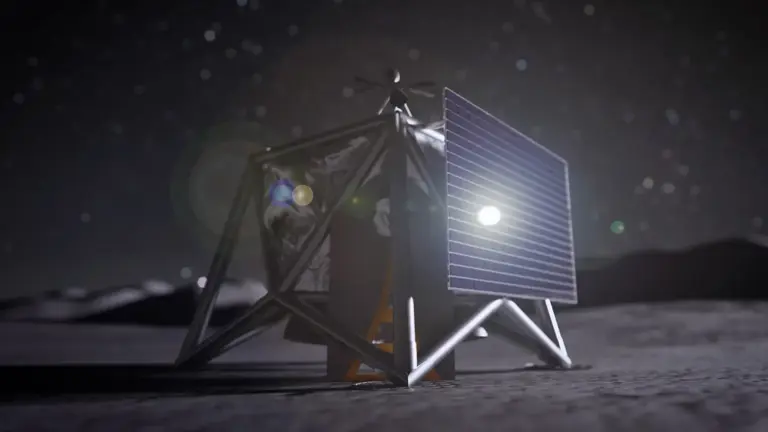
Two other landers are also due to launch in 2026 to deliver supplies and technology to the moon, including Astrobotic’s Griffin lander – which will also carry a rover to begin testing travel on the lunar terrain – and Intuitive Machines’ third Nova-C lunar lander.
"These missions are the first of more than a dozen missions that will be announced this year, each designed to generate operational data and reduce risk ahead of crewed Artemis surface activities," NASA said in a statement.
NASA Administrator Jared Isaacman, with acting Associate Administrator Lori Glaze and Moon Base Program Executive Carlos Garcia-Galan, holds a news conference May 26 at NASA headquarters in Washington, D.C. on updated plans for the agency’s Moon Base initiative for a long-term lunar presence.
A screen in the background shows the timeline for NASA's Moon Base initiative as Administrator Jared Isaacman and Associate Administrator Lori Glaze update the media May 26 during a news conference in D.C.
NASA Administrator Jared Isaacman, with acting Associate Administrator Lori Glaze and Moon Base Program Executive Carlos Garcia-Galan, holds a news conference May 26 at NASA headquarters in Washington, D.C. on updated plans for the agency’s Moon Base initiative for a long-term lunar presence.
A screen in the background depicts in artistic rendering of a lunar rover as NASA Administrator Jared Isaacman and acting Associate Administrator Lori Glaze applaud newly unveiled contracts with the private industry.
NASA Administrator Jared Isaacman participates in a news conference May 26 , at NASA headquarters in Washington, D.C. on updated plans for the agency’s Moon Base initiative for a long-term lunar presence.
NASA displays newly unveiled lunar base project models from Blue Origin, Lunar Outpost and other companies during a news conference on updated plans for the agency’s Moon Base initiative for a long-term lunar presence.
NASA Administrator Jared Isaacman, with acting Associate Administrator Lori Glaze and Moon Base Program Executive Carlos Garcia-Galan, holds a news conference May 26 at NASA headquarters in Washington, D.C. on updated plans for the agency’s Moon Base initiative for a long-term lunar presence.
NASA to send 2 lunar rovers ahead of humans
NASA further announced that it has awarded contracts to two companies to develop lunar rovers for astronauts to drive on the moon.
A sreen in the background depicts in artistic rendering of a lunar rover as NASA Administrator Jared Isaacman and acting Associate Administrator Lori Glaze applaud newly unveiled contracts with the private industry.
Colorado-based Lunar Outpost and Astrolab of Hawthorne, California, will each receive about $220 million to build vehicles capable of slowly navigating the moon's rough terrain.
The contract, made under NASA's Commercial Lunar Payload Services initiative (CLPS,) ensures a rover will be ready on the moon before astronauts return as early as 2028 under the Artemis IV mission.
Each rover – which NASA calls a lunar terrain vehicle, or LTV – will be designed for different objectives.
Astrolab's compact vehicle is designed to carry astronauts and cargo with a weight limit of up to 2,000 pounds and a top speed of 6 mph, NASA said. Lunar Outpost's rover, nicknamed Pegasus, is lighter and can travel about three mph faster.
The companies have about 18 months to ready their landers for launch, according to NASA. Blue Origin was also awarded a contract worth up to $468 million to transport the rovers to the moon.
Drones to survey Artemis landing sites
Artist’s rendering of a MoonFall drone operating near the lunar South Pole.
Before NASA puts boots back on the ground, the agency is planning in 2028 to send a fleet of four drones to survey the moon for safe landing sites for astronauts.
The mission, called Moonfall, would use the drones to literally hop from one place on the surface to the next to gather and transmit data back to Earth.
NASA‘s Jet Propulsion Laboratory in Southern California, which is designing the drones, has awarded Texas-based company Firefly Aerospace a $75 million contract build the spacecraft that will transport them from Earth orbit to the moon.
After the launch, Firefly's Elytra spacecraft will transport the drones to the moon and deploy them about 30 miles above the surface, the company said in a press release.
Artemis III astronauts to be announced
NASA also has plans to soon announce the four astronauts selected for the Artemis III mission.
The announcement will be made live at 11 a.m. ET Tuesday, June 9, at the agency’s Johnson Space Center in Houston, according to a press release.
Just like the Artemis II crew, the astronauts selected for the Artemis III mission will hitch a ride to Earth orbit aboard the Orion crew capsule, which will launch atop NASA's towering Space Launch System rocket from the Kennedy Space Center in Florida.
Eric Lagatta is the Space Connect reporter for the USA TODAY Network. Reach him at elagatta@usatodayco.com
A UFO and aerospace researcher's death is raising questions as the circumstances surrounding his final days remain a mystery months later.
Authorities in New Mexico said Martin Aidan Shaffer, 49, died while in police custody at the Torrance County Detention Facility in March 2026.
Shaffer had worked in the 'fringe science' community, collaborating with groups exploring advanced propulsion technology, including anti-gravity engines, which have been linked to UFO speculation for decades.
According to court records, the self-described inventor was being held on multiple charges, including arson and burglary, but the cause of his death has not been disclosed.
While alleged colleagues have claimed that Shaffer was suffering from mental health issues, the Taos, New Mexico resident's social media accounts revealed a much more disturbing story.
Shaffer had claimed that he was experimented on and had implants placed in his body, suggesting that he was being controlled by extraterrestrials. He even claimed without evidence that other researchers had tried to harm him.
A month before his death, he wrote on X: 'I want all these implants removed, I want to be free from my body mind which I do not control.'
Meanwhile, Shaffer's case has now been linked to another dead scientist in the recent string of deaths and disappearances across the US, Amy Eskridge, who was also working on anti-gravity research and had claimed her life was in danger.
UFO and aerospace researcher Martin Aidan Shaffer, 49, reportedly died while in police custody in New Mexico in March 2026
Shaffer had written several posts on social media appearing to be in mental health distress
Shaffer had written several posts on social media appearing to be in mental health distress
Prior to his death, Shaffer had been making a string of disturbing posts, claiming he had been repeatedly assaulted in his own home and showed images of small bruises where implants had allegedly been inserted.
In one post on December 30, 2025, Shaffer sent a message to Elon Musk's brain implant company, Neuralink, claiming that extraterrestrials, also known as Non-Human Intelligence (NHI), had implanted technology in him.
'There's something that I'm experiencing with having an NHI implant that pertains directly to the development of neural link,' Shaffer claimed.
'I wish I could remove the implants and undo what has been done to me,' he added in another post.
Shaffer had been connected to the Alternative Propulsion Engineering Conference, an online group of scientists, engineers and independent builders who discuss breakthrough theoretical aerospace technologies.
He also claimed to be the co-founder of Falcon Space, a New Jersey research startup working on creating advanced propulsion without relying on fuel-based rockets.
The host of the Liminality podcast on YouTube, who claimed she knew Eskridge, noted that Falcon Space was also founded by Mark Sokol, the late scientist's ex-boyfriend.
Eskridge publicly claimed that she had been attacked, drugged and threatened repeatedly by unknown assailants while she was working on anti-gravity engines and advanced security systems for the US Department of Homeland Security.
Shaffer claimed that he had received implants from NHI (Non-Human Inntelligence)
Amy Eskridge was a scientist researching anti-gravity technology before her death in 2022 at age 34
Eskridge, 34, reportedly died from a self-inflicted gunshot wound to the head in 2022. However, the young scientist, who also allegedly suffered from mental health issues had repeatedly told colleagues she was not suicidal.
Shaffer's troubling posts appeared to begin after his tenure at Falcon Space from 2021 to 2023.
Social media exchanges between him and Sokol also showed an apparent falling out, with Shaffer claiming in November 2025 that Sokol 'threw me into traffic.'
No police report for the alleged incident could be found. Falcon Space also does not list Shaffer as one of the company's co-founders.
Meanwhile, an X account for Falcon Space posted on May 21 that Shaffer allegedly 'died of a heart attack in police custody, arrested for burning down his ex girlfriends house who broke up with him for being delinquent and not contributing.'
The Daily Mail has reached out to authorities in New Mexico regarding the circumstances of Shaffer's death and the charges he was facing. The medical examiner's office has not revealed an official cause of death.
The events surrounding Shaffer's case became even stranger after his death, as an obituary online misspelled the scientist's name and did not list his date of birth. It is unclear who posted the memorial page or their connection to Shaffer.
Court documents from New Mexico revealed that Martin Aidan Shaffer died after being taken to the Torrance County Detention Facility
An online obituary for Shaffer did not list his date of birth or spell his name correctly
Shaffer's sudden death and ties to the same community of scientists Eskridge had associated with has thrust the growing number of cases involving missing and dead researchers working in America's nuclear, aerospace and defense sectors back into the spotlight.
Among the missing are retired Air Force General William Neil McCasland, government contractor Steven Garcia, and nuclear lab workers Melissa Casias and Anthony Chavez. All vanished without a trace under nearly identical circumstances over the last year.
Eskridge's suicide in 2022 was one of the earliest incidents now believed to be under scrutiny by members of Congress and the FBI.
Former British intelligence officer Franc Milburn has previously told the Daily Mail he believes Eskridge's death was murder and that advanced directed energy weapons were used against her to derail her work.
Since her death, multiple scientists tied to advanced propulsion research or NASA's Jet Propulsion Lab have been murdered or died under circumstances which have never been revealed to the public.
While there have been no definitive links made between all of the cases throughout the US, multiple members of Congress have told the Daily Mail that each of their ties to sensitive government secrets or research spark concerns that foul play and a foreign power may be involved.
The FBI has been tasked by the White House with investigating the matter, but the agency has not produced their report despite President Trump saying it would come in early May.
Whenever Steven Spielberg tackles the subject of alien life, we get all-time bangers. Close Encounters of the Third Kind, E.T., War of the Worlds. All great. Now, it looks like we can add the upcoming Disclosure DayOpens in a new tab to that list of alien-themed classics. In the final trailer for Spielberg’s latest U.F.O. epic, we hear the man himself talk about his feelings about the possibility of alien/human contact. And how he believes in it now even more than when he made Close Encounters fifty years ago. You can watch the final trailer for Disclosure Day, which stars Emily Blunt, Colin Firth, Josh O’Connor, and Colman Domingo, below:
DISCLOSURE DAY Official Final Trailer (2026) Emily Blunt, Steven Spielberg
This new trailer also shows us our first look at what the aliens look like. They appear to be pretty classic “Greys with big black eyes,” as reported by hundreds of U.F.O. abductees. This film also appears to play off the granddaddy of all conspiracy theories, which is that an alien ship crashed in Roswell, New Mexico, in 1947. And elements within the American government have beenhiding proof of extraterrestrial lifeOpens in a new tabfor nearly eighty years. The Roswell mythology (mythology?) has formed the basis for a metric ton of fiction in the last several decades. Everything fromThe X-Files,toIndependence Day, to the TV seriesRoswell.
Universal Pictures
Longtime Spielberg collaborator David Koepp, who wrote Jurassic Park, War of the Worlds, and Sam Raimi’s Spider-Man, wrote the screenplay for Disclosure Day. The film’s official tagline says, “If you found out we weren’t alone, if someone showed you, proved it to you, would that frighten you? This summer, the truth belongs to eight billion people. We are coming close to … Disclosure Day.”
It’s fitting that a film about government disclosure has its own conspiracy theories surrounding it. Over on Reddit and other places, people are convinced that Steven SpielbergOpens in a new tab is being tasked with using this film to prepare humanity for the real “Disclosure Day,” coming any minute now. Now, we don’t buy that, but it’s a fun theory. Looking at the world around us, we don’t think most of humanity is ready for such information. They can barely tie their shoes. But we’d love to be wrong!
The head of NASA says theUFOfiles expose years of unexplained encounters that government agencies failed to seriously investigate.
Jared Isaacman told FOX News that the declassified videos, photos and documents reveal strange objects captured by military sensors around the world.
'What's being surfaced isn't crashed ships or alien bodies, but real unexplained phenomena,' the NASA administrator said.
Isaacman said many of the cases remained buried inside government databases for decades until President Donald Trump ordered agencies to revisit old records, search classified archives and publicly release what they found.
Officials said additional releases from agencies, including the CIA, are expected in the coming weeks as pressure grows for greater transparency surrounding UFO investigations.
For decades, many UFO-related records remained locked away due to Cold War secrecy, national security concerns and fears about exposing sensitive military technology detected by radar and surveillance systems.
Critics have long argued that successive administrations avoided publicly acknowledging unexplained cases out of concern over public backlash, institutional embarrassment and growing conspiracy theories surrounding UFO investigations.
A video released in the first wave of UFO files appeared to show a glowing object resembling an 'eight-pointed star' with uneven arms moving across the sky
'I think the President has really got government agencies now taking this seriously, to go look at the files and bring the data to light, and he's putting it all out for everyone to analyze,' Isaacman told Fox News.
'This is citizen science right now. Take a look at our files, tell us what you think.'
He added that he is not aware of any files containing information about alien bodies or spaceships, but 'observations from decades past, from some of our adversaries and potentially some of our allies, essentially saying, "We saw something, we documented it, and we kept it buried in a file somewhere,’ are now being made public."'
Isaacman suggested the disclosures should be viewed less as evidence of extraterrestrials and more as a growing collection of unexplained incidents now open to public scrutiny, with modern cameras, military sensors and newly released records providing more data than ever before.
'Everybody’s got a camera phone, a doorbell camera. Every military aircraft flying has a million sensors,' he said.
'You're gonna pick up things. Pick up things that flew at a different angle, you know, across the lens that maybe if you had a better angle on, you'd be like, oh, that's a balloon, or that might be a missile in a combat region.
'But because we caught it at an angle, it's an unexplained phenomenon.'
Bill Clinton and Jimmy Carter promised to release UFO files while in office.
Other files revealed unexplained phenomena above the lunar surface during the Apollo moon missions
During his 1976 presidential campaign, Carter famously promised the public that he would release all classified government UFO information. However, after being elected, he ultimately chose not to disclose these files, citing 'national security concerns.'
The Clinton administration was heavily lobbied by the UFO 'disclosure movement' during the late 1990s.
In 1997, around the 50th anniversary of the Roswell Incident, Clinton publicly stated that he had ordered an official review of the 1947 event to see if the government was hiding the truth.
However, the subsequent findings maintained that the crash was merely a high-altitude weather balloon.
On Wednesday, President Trump held a Cabinet meeting where he said: 'We’re releasing a lot of information having to do with extraterrestrial terrestrial things and people are totally fascinated by it.
'It's literally trending number one, can you believe it?'
Steven Greer warns against calling aliens “Demons”
In a recent interview, Steven Greer responded to Vice President JD Vance after Vance controversially suggested that aliens could actually be demons. The remarks, made during an appearance on the Benny Johnson Show, drew concern from Greer, who warned that such statements could fuel hysteria and religious extremism surrounding the UFO phenomenon.
He stressed that highly advanced extraterrestrial technology may appear “magical” to humans, but should not automatically be interpreted as something supernatural or evil.
Referencing decades of involvement in UFO research — including private meetings with Vatican officials, Greer argued that portraying extraterrestrials as demonic blurs the line between spiritual belief and scientific investigation, potentially undermining credible research into the phenomenon.
He also criticized what he called “interstellar racism” within ufology, where beings are judged negatively based solely on their appearance, and urged public figures to approach the subject more responsibly.
Greer further claimed that certain hardline factions within intelligence communities continue to push extreme religious narratives about UFOs, which he believes could increase fear and division. As discussions around disclosure continue to grow worldwide, he emphasized the need to move beyond fear, superstition, and sensationalism when addressing the possibility of extraterrestrial encounters.
Obama Admitted Aliens Exist! Then They Shut Him Out | Dr Steven Greer
NASA has unveiled plans to construct a $20 billion moon base by 2032, giving humans their first permanent outpost on another celestial body.
But what will this 'city' on our lunar satellite look like?
The lunar outpost will initially be fairly basic, using a simple collapsible structure carried all the way from Earth.
However, as NASA's presence becomes more permanent, the small camp will soon expand into a sprawling modular metropolis.
Dr Simeon Barber, a lunar scientist from the Open University, told the Daily Mail that Antarctic research stations are a good comparison for NASA's moon base.
Just like a home on the moon, these remote habitats need to be self–sufficient, built with materials carried over long journeys, and to protect their inhabitants from harsh conditions.
But Dr Barber says that a moon base will also require 'specific requirements stemming from the unique circumstances at the moon'.
This means that NASA's moon base will probably end up as a widely spread collection of prefabricated modules, sprawling over hundreds of square miles.
As NASA unveils plans to construct a $20 billion moon base by 2032, experts reveal what this base would really look like. Pictured: A NASA render of its planned moon infrastructure
Between 2029 and 2032, the first humans will start to arrive, establishing basic infrastructure, habitation, and power supplies.
Finally, in 2032, NASA will move into the final stage of permanent occupation, establishing a full–time moon base with regular crew rotations and resupply landings.
Speaking at a press conference, Mr Isaacman identified the biggest challenge as the moon's astonishingly harsh conditions.
On the lunar surface, temperatures can swing from around 100°C (212°F) in the day to –100°C (–148°F) at night.
This is accompanied by the constant threat of radiation, impact from micrometeorites, and harmful clouds of choking lunar dust.
The first habitats to be sent to the moon would be simple, modular structures constructed on Earth. They may be parts of the spacecraft that took the astronauts to the surface.
Picutred: A NASA rendering of a modular habitat unit
Using modular parts will allow NASA to start very simple and expand the base as needed, adding more facilities and quarters for more crew
NASA's moon base timeline
Phase One: 2026 to 2029
* A major increase in lunar activity, with up to 25 missions, including 21 landings
* Early demonstrations of power, navigation, communications, and nuclear radioisotope heater unit technologies designed to endure the long lunar night.
Phase Two: 2029 to 2032
* Early habitation of human crews
* Delivery of up to 60 tons of cargo through as many as 24 landings
* Deployment of expanded solar power systems and initial nuclear surface power capabilities
Phase Three: 2032 onwards
* Permanent moon base established with routine crew rotations
* Delivery of up to 38 tons of cargo annually to sustain habitats, power systems, logistics operations
'There is no atmosphere to moderate these extremes,' added Mr Isaacman.
Given these conditions, the first requirement for a lunar base is that it offers enough protection for the astronauts living there.
Dr Barber says: 'It needs to provide a habitable environment. So, air to breathe, temperature control to tame the wild day–night changes at the Moon's surface, protection from radiation, and from the very fine, abrasive and toxic Moon dust.'
However, a moon base also needs to cater to astronauts' basic physical and psychological needs.
Astronauts will need space to wash and shower to keep infections at bay, as well as plenty of space to exercise to fight the muscle and bone loss which comes with living in reduced gravity.
'And not to forget, the explorers will be living in harsh and stressful conditions, so mental health will be important,' adds Dr Barber.
This means the crew will need somewhere to rest and relax after a hard day at work exploring the deadly lunar surface.
With so many different requirements, the most likely solution is to send prefabricated structures from Earth that can be assembled on the lunar surface.
Experts say that the first structures may be inflatable, packing down very small on Earth before expanding on the moon. Pictured: A NASA concept for inflatable lunar housing
These could be made from repurposed parts of the spacecraft that sends the astronauts to the moon in the first place, or simply using the lander itself.
NASA has also investigated using inflatable structures that could be packed up very small before expanding on the surface.
Professor Mahesh Anand, an expert on the lunar surface from the Open University, told the Daily Mail: 'The earliest habitable structure on the Moon will most likely be constructed largely from materials brought from Earth and, later, combined with materials derived from the landing region.
'A self–inflatable tent made of light, but mechanically very strong material, could be sited in a sheltered place in the vicinity of the lander, which would probably offer the least risk.'
Much like the International Space Station, modular options will allow the moon base to start simple before attaching more parts as needed.
Experts say that astronauts could then bury these early structures in lunar regolith, the loose soil of the moon's surface, to provide some basic protection from meteorites and radiation.
NASA has been working on small 40–kilowatt–class reactors that are designed to be launched inert from Earth and activated upon arrival.
NASA is already preparing small 40–kilowatt–class nuclear reactors that are designed to be launched inert from Earth and activated upon arrival
These nuclear reactors will need to be kept far from the moon base, or buried deep in the lunar regolith to protect astronauts from radiation. Pictured: A NASA rendering of a small nuclear reactor on the moon
Due to the radiation risk, astronauts would also need to place these far from their actual habitat or bury them deep within the lunar regolith.
However, once the astronauts have a steady supply of power, they will be able to start gathering and processing materials from the moon's surface, in a process called 'in situ extraction'.
Dr Barber explains: 'Earth's strong gravity field means a lot of energy is required to lift anything off Earth's surface and then land it on the Moon.
'So there is a strong argument for living off the land and making use of local resources.'
Recent research has shown that lunar regolith can be 'printed' using a laser, melting layers of dust to form highly durable structures.
These methods could be used to 3D print entire buildings that would be a more comfortable, permanent housing solution for the astronauts.
But this new industrial expansion would also shape the layout of the moon base.
Astronauts will start mining the lunar dust to process it into more advanced building materials, allowing for more complex structures. Pictured: A NASA rendering of a mining station on the moon
Unlike an Antarctic research station, which keeps everything tightly packed in one structure, a moon base would need to be spread out over miles.
The radiation from the nuclear reactor would need to be kept at a safe distance, as would the sites for excavating and processing the hazardous moon dust.
Likewise, some scientific instruments would need to be kept in a 'radio–quiet' location, far from any potential interference.
This means that the final moon base would look a lot less like an Earth–based research outpost and more like a sprawling collection of individual structures, dotted over a vast blank terrain.
Meer van UFO'S of UAP'S, ASTRONOMIE, RUIMTEVAART, ARCHEOLOGIE, OUDHEIDKUNDE, SF-SNUFJES EN ANDERE ESOTERISCHE WETENSCHAPPEN - DE ALLERLAATSTE NIEUWTJES


 3 UFOs turn into 2 Over Bowers Gifford, England May 20, 2026, Aliens 👽 UFO UAP Sighting News