Naar de inhoud

UFO'S of UAP'S, ASTRONOMIE, RUIMTEVAART, ARCHEOLOGIE, OUDHEIDKUNDE, SF-SNUFJES EN ANDERE ESOTERISCHE WETENSCHAPPEN - DE ALLERLAATSTE NIEUWTJES

UFO's of UAP'S in België en de rest van de wereld
akke.beakke.be
Ontdek de Fascinerende Wereld van UFO's en UAP's: Jouw Bron voor Onthullende Informatie! Ben jij ook gefascineerd door het onbekende? Wil je meer weten over UFO's en UAP's, niet alleen in België, maar over de hele wereld? Dan ben je op de juiste plek! België: Het Kloppend Hart van UFO-onderzoek In België is BUFON (Belgisch UFO-Netwerk) dé autoriteit op het gebied van UFO-onderzoek. Voor betrouwbare en objectieve informatie over deze intrigerende fenomenen, bezoek je zeker onze Facebook-pagina en deze blog. Maar dat is nog niet alles! Ontdek ook het Belgisch UFO-meldpunt en Caelestia, twee organisaties die diepgaand onderzoek verrichten, al zijn ze soms kritisch of sceptisch. Nederland: Een Schat aan Informatie Voor onze Nederlandse buren is er de schitterende website www.ufowijzer.nl, beheerd door Paul Harmans. Deze site biedt een schat aan informatie en artikelen die je niet wilt missen! Internationaal: MUFON - De Wereldwijde Autoriteit Neem ook een kijkje bij MUFON (Mutual UFO Network Inc.), een gerenommeerde Amerikaanse UFO-vereniging met afdelingen in de VS en wereldwijd. MUFON is toegewijd aan de wetenschappelijke en analytische studie van het UFO-fenomeen, en hun maandelijkse tijdschrift, The MUFON UFO-Journal, is een must-read voor elke UFO-enthousiasteling. Bezoek hun website op www.mufon.com voor meer informatie. Samenwerking en Toekomstvisie Sinds 1 februari 2020 is Pieter niet alleen ex-president van BUFON, maar ook de voormalige nationale directeur van MUFON in Vlaanderen en Nederland. Dit creëert een sterke samenwerking met de Franse MUFON Reseau MUFON/EUROP, wat ons in staat stelt om nog meer waardevolle inzichten te delen. Let op: Nepprofielen en Nieuwe Groeperingen Pas op voor een nieuwe groepering die zich ook BUFON noemt, maar geen enkele connectie heeft met onze gevestigde organisatie. Hoewel zij de naam geregistreerd hebben, kunnen ze het rijke verleden en de expertise van onze groep niet evenaren. We wensen hen veel succes, maar we blijven de autoriteit in UFO-onderzoek! Blijf Op De Hoogte! Wil jij de laatste nieuwtjes over UFO's, ruimtevaart, archeologie, en meer? Volg ons dan en duik samen met ons in de fascinerende wereld van het onbekende! Sluit je aan bij de gemeenschap van nieuwsgierige geesten die net als jij verlangen naar antwoorden en avonturen in de sterren! Heb je vragen of wil je meer weten? Aarzel dan niet om contact met ons op te nemen! Samen ontrafelen we het mysterie van de lucht en daarbuiten.

Archief

BREAKING NEWS - Artemis astronauts' awkward reaction as Trump teases classified UFO files will be released 'soon'

BREAKING NEWS - Artemis astronauts' awkward reaction as Trump teases classified UFO files will be released 'soon'

The Artemis II crew smirked as President Donald Trump fielded questions about his long-awaited UFO files during their visit to the White House on Wednesday.

Standing behind the president in the Oval Office, the four astronauts listened as reporters pressed Trump on when Americans might finally see the highly anticipated government records.

Trump had invited the crew, NASA astronauts Victor Glover, Reid Wiseman and Christina Koch, along with Canadian astronaut Jeremy Hansen, to celebrate their historic journey around the moon earlier this month, praising them as heroes of a mission that marked a major milestone in NASA’s return to deep space

The moment took an unexpected turn when questions shifted from spaceflight to unidentified flying objects, drawing visible reactions from the astronauts as Trump began discussing the long-awaited disclosure.

When asked about his promised UFO disclosure, Trump suggested that long-awaited files could soon be made public.

'I think we will be releasing as much as we can in the near future,' the president replied. 'For some reason, and I guess it's just a reason, it's been in the minds of people for a long time. They want to find out about the UFOs and anything having to do with UFOs or related material.'

Trump first announced the planned disclosure in February, ordering the Pentagon to release all government files related to UFOs and extraterrestrials.

However, months later, Americans have yet to see a single document or video from the promised release, fueling growing curiosity about what the files may reveal.

Standing just behind the president in the Oval Office on Wednesday, NASA astronauts Victor Glover, Reid Wiseman and Christina Koch, along with Canadian astronaut Jeremy Hansen, appeared amused as reporters pressed Trump on when Americans might finally see the highly anticipated government records

'I think it is going to be interesting to some people,' Trump added.

'I have interviewed people, my first term primarily, I interviewed some pilots. Very solid people, and they said they saw things that you wouldn't believe.'

The astronauts remained composed behind him as he spoke, though their subtle smiles and exchanged glances added a light moment to an otherwise serious discussion about government transparency and unidentified aerial phenomena.

'You're going to be reading about it,' Trump said, hinting that new details could soon be released to the public.

The president gave the order for disclosure just hours after he lashed out at Barack Obama for allegedly sharing classified information when he appeared to confirm that aliens exist while speaking on a podcast.

'Based on the tremendous interest shown, I will be directing the Secretary of War... to begin the process of identifying and releasing Government files related to alien and extraterrestrial life, unidentified aerial phenomena (UAP), and unidentified flying objects (UFOs)' Trump wrote on Truth Social in February. 

Lawmakers and defense officials have in recent months renewed calls for greater transparency surrounding decades of classified material tied to unexplained aerial sightings.

Trump has gone quiet about his plans to release government files related to UFOs and extraterrestrial life. However, the war with Iran began shortly after he announced it in February. But other government officials have not forgotten.

Trump ordered UFO disclosure in February, but Americans have yet to see a single document or video from the promised release, fueling growing curiosity about what the files may reveal

Trump ordered UFO disclosure in February, but Americans have yet to see a single document or video from the promised release, fueling growing curiosity about what the files may reveal 

Republican Rep. Anna Paulina Luna penned a letter to the US Secretary of Defense on April 1, ordering Pete Hegseth to deliver 46 specific clips no later than April 14, 2026.

Lawmakers said the videos could reveal patterns of activity near sensitive military sites and help determine whether the objects pose a potential national security threat.

The requested footage includes dozens of military-recorded encounters showing spherical, cigar-shaped and Tic Tac-like objects spotted over war zones, oceans and sensitive airspace around the world.

Luna, however, said on April 14 on X that 'no one from the Pentagon had responded until we reached out, and it appears that someone did not pass the letter to the appropriate authorities.' 

'How convenient,' the Florida representative added, noting that while she considers Hegseth a friend and supporter of President Trump, 'the president has authorized the release, so whoever is trying to be cute at the Pentagon can take a hike.'

RELATED VIDEOS

Trump Welcomes Artemis II Astronauts To The White House After Successful Moon Mission | N18G

WATCH LIVE: Trump welcomes Artemis II astronauts to the White House after successful moon mission

Live: Artemis II crew visits White House, meets with Donald Trump after historic moon mission

{ https://www.dailymail.com/sciencetech/index.html }

Hoe vind je dit bericht?
Geschreven door peter om 21:58 Stuur door

What’s really being hidden beneath Antarctica?

What’s really being hidden beneath Antarctica?

Much has already been said about the strange and unexplained activity surrounding the frozen continent. In a recent discussion, Redacted revisits several of these mysteries and raises a compelling question: what could truly lie beneath the Antarctic ice? 
What%E2%80%99s%20really%20being%20hidden%20beneath%20Antarctica.png

Among the most talked, about claims are: 
  • Reports of unusual electromagnetic pulses detected deep beneath the ice 
  • The alleged secret diary of Admiral Byrd 
  • A massive, obscured “hole” visible on Google Earth 
  • Stories of Russian scientists encountering an unknown creature 
  • The IceCube neutrino detector, a facility largely inaccessible to the public
  • Persistent UFO sightings and long-standing Nazi base theories 
Beyond these are even more rumors of hidden portals, underground alien installations, and ancient, intelligent civilizations residing within the Earth itself, often tied to the hollow Earth theory. 
Adding to the intrigue is the Antarctic Treaty, which governs all land and ice shelves south of 60° latitude, restricting access and activity in the region. At the same time, certain areas on Google Earth appear blurred or completely whited out, making them impossible to examine in detail. 
Taken together, these elements leave many wondering what  is truly concealed beneath the ice.
RELATED 

Scientists discover entire ecosystem hidden under ice of Antarctica • FRANCE 24 English

Beyond the Ice: Antarctica’s Secret Geography Revealed! | Wion Podcast

Antarctica Secrets - Admiral Byrd Inner Earth Antarctica Secrets Revealed

{ http://ufosightingshotspot.blogspot.com/ }

Hoe vind je dit bericht?
Geschreven door peter om 21:28 Stuur door

Robot goes rogue at school sports day: Dancing humanoid is dragged away by handlers after malfunctioning in front of shocked students

Shocking footage has revealed the moment a dancing robot went rogue at a school sports day. 

The erratic performance took place at a school in the Xinjiang Uygur Autonomous Region in north–western China. 

At the start of the video, the robot could be seen performing dance moves and martial arts kicks on a sports field. 

However, it all began to fall apart as students ran onto the pitch to perform a synchronised dance routine with the bot.

Seconds into the performance, the robot tripped itself up before falling to the ground. 

As it writhed around, it started aiming kung–fu kicks towards baffled performers, who worriedly backed away from the bot. 

Eventually, its handler ran onto the pitch and scooped it into his arms before any damage could be done.

Thankfully, no reports of injuries to students have emerged after the clip went viral on the Chinese social network Douyin.

The erratic performance took place at a school in the Xinjiang Uygur Autonomous Region in north-western ChinaIt all began to fall apart as students ran onto the pitch to perform a synchronised dance routine with the bot

Shocking footage has revealed the moment a dancing robot went rogue at a school sports day

One local said: 'Too many people confused him, he wanted to dance without causing any harm.'

China has rapidly expanded the use of humanoid robots in public events, schools, and demonstrations in recent years as part of its ambitious push into advanced robotics and artificial intelligence.

However, there have been a spate of incidents which suggest the bots might not be ready. 

In March, what should have been a family–friendly dance performance ended in disaster, after a young boy was slapped across the face by a rogue robot.

Shocking footage, filmed at a show in Shaanxi Province, China, on Saturday 21 March, shows a Unitree robot spinning around the stage. 

It veers towards the crowd as it performs sweeping arm movements in time to the music. 

As the bot gets closer, a young boy can be seen drawing his arms in, in the hopes of avoiding its flailing metal limbs. 

Unfortunately, his attempts proved futile, as the robot caught the boy fully in the face during a pirouette.

China has rapidly expanded the use of humanoid robots in public events, schools, and demonstrations in recent years as part of its ambitious push into advanced robotics and artificial intelligence

China has rapidly expanded the use of humanoid robots in public events, schools, and demonstrations in recent years as part of its ambitious push into advanced robotics and artificial intelligence

Meanwhile, a humanoid was even detained by police in China after terrifying an elderly woman. 

READ MORE

article image

'With sales of humanoid robots set to skyrocket over the next decade, the public will increasingly be at risk from these kinds of incidents,' said Carl Strathearn and Emilia Sobolewska, robotics experts at Edinburgh Napier University, in a recent article for The Conversation. 

'In our view as robotics researchers, governments have put very little thought into the risks.' 

How can we make robots safer?

1. Increase owner requirements

Ban people from controlling robots under the influence of alcohol or drugs, or when they are otherwise distracted such as using their phones. 

2. Improve design

Safe designs would consider everything from reducing cavities where fingers could get caught, to waterproofing internal components.

3. Train operators 

There appears to be a major skills gap in operator training, and robotics companies will need to prioritise this to ensure operators can control machines efficiently and safely.

4. Educate the public

If people understand to what extent walking robots are owner–operated or remote–operated, it will change their expectations about what the robot might do, and make everyone safer as a result.

RELATED VIDEOS


Rogue Robot ATTACKS Students at School Sports Day 😱 Shocking Malfunction

Humanoid Robot GOES ROGUE, ATTACKS Handlers Trying To BREAK RESTRAINTS In INSANE Video

I Tested a Robot with a Secret 7-Day Exam: I Was the One Trapped!

{ https://www.dailymail.com/sciencetech/index.html }

Hoe vind je dit bericht?
Geschreven door peter om 21:14 Stuur door

Europe is warming more than TWICE as fast as the global average, report reveals - as scientists warn 'climate change is not a future threat, it is our present reality'

Europe is warming more than TWICE as fast as the global average, report reveals - as scientists warn 'climate change is not a future threat, it is our present reality'

Europe is warming more than twice as fast as the global average due to climate change, a report has revealed.

Over the past 30 years, the planet's average temperature has been creeping up at a steady 0.27°C (0.49°F) per decade.

However, the annual European State of the Climate report shows that Europe has been warming by a staggering 0.56° (1°F) every ten years.

So, as the world hits 1.4°C (2.52°F) above the pre-industrial average, Europe's is now 2.5°C (4.5°F) hotter than before the Industrial Revolution.

Experts say that Europe's rapid warming is driving a wave of extreme weather, heat-related deaths, and devastating wildfires.

Last year, over 1,034,550 hectares (3,994 square miles) of land were destroyed by fire in Europe - the largest area ever recorded.

Samantha Burgess, Strategic Lead for Climate at the European Centre for Medium-Range Weather Forecasts, says: 'With rising temperatures, and widespread wildfires and drought, the evidence is unequivocal.

'Climate change is not a future threat, it is our present reality.'

Europe is warming more than twice as fast as the global average, scientists have warned. Europe is now warming at a staggering 0.56° (1°F) every ten years

Europe is warming more than twice as fast as the global average, scientists have warned. Europe is now warming at a staggering 0.56° (1°F) every ten years

In 2025, 95 per cent of Europe saw above-average temperatures as a new report warns that Europe's average temperature is now 2.5°C (4.5°F) hotter than the pre-industrial average

In 2025, 95 per cent of Europe saw above-average temperatures as a new report warns that Europe's average temperature is now 2.5°C (4.5°F) hotter than the pre-industrial average

According to data gathered by the Copernicus Climate Change Service (C3S), 2025 was Europe's third hottest year on record.

Average temperatures soared to 10.41°C (50.74°F) across the continent, just 0.30°C (0.54°F) cooler than the warmest year in 2024.

This led to almost the entirety of Europe seeing temperatures well above normal levels for large parts of the year.

Professor Hannah Cloke, an expert on climate extremes from the University of Reading, says: 'To see 95 per cent of Europe experiencing above-average temperatures in a single year shows that we are not dealing with isolated extremes in one or two regions. The baseline has shifted.'

Experts say that Europe is warming faster than the rest of the world due to a combination of geography, human factors, and changing weather patterns.

In part, Europe has warmed faster than average due to its proximity to the Arctic, which is the fastest-warming region on Earth.

The Arctic has warmed by an average of 0.75°C (1.35°F) per decade over the last 30 years, which is having a significant knock-on effect on Europe.

Although it might seem counterintuitive, Europe is also warming faster because of efforts to limit pollution.

Europe's rapid warming has led to a record number of wildfires across the continent, with 1,034,550 hectares (3,994 square miles) of land burned last year

Europe's rapid warming has led to a record number of wildfires across the continent, with 1,034,550 hectares (3,994 square miles) of land burned last year

Scientists say that Europe's rapid warming is partially due to declining snow cover, which would usually reflect radiation from the sun back into space

Scientists say that Europe's rapid warming is partially due to declining snow cover, which would usually reflect radiation from the sun back into space

The UK's top 5 warmest years 

2025: 10.09C

2022: 10.03C

2023: 9.97C

2014: 9.88C

2024: 9.79C

Tiny particles called aerosols in pollution gather in the atmosphere and reflect light from the sun back out into space, keeping the planet cooler than it otherwise would be.

Since the 1980s, European policies have slashed air pollution and, as a byproduct, reduced the amount of radiation reflected, leading to more warming.

At the same time, the effects of human-caused climate change are creating 'feedback loops' which accelerate warming even further.

As the climate warms, weather patterns have shifted to favour more frequent and intense summer heatwaves in Europe, pushing up the average temperature.

Warmer weather also leads to less snow coverage, which would normally act like a reflective thermal blanket, bouncing radiation back into space.

In March last year, snow coverage in Europe reached its third-lowest point since records began in 1983.

The compounding effects mean that the continent is now warming far faster than the global average.

Professor Cloke says: The impacts of climate change are now moving really very fast in Europe.

The only region warming faster than Europe is the Arctic, where temperatures are increasing by 0.75°C (1.35°F) per decade

The only region warming faster than Europe is the Arctic, where temperatures are increasing by 0.75°C (1.35°F) per decade

Almost half of Europe saw an above-average number of days with strong heat stress - a day which has a maximum feels-like temperature of 32°C (89.6°F) or higher

Almost half of Europe saw an above-average number of days with strong heat stress - a day which has a maximum feels-like temperature of 32°C (89.6°F) or higher

'The scale and range of these changes show that we cannot rely on old certainties about nature when planning our societies for the future.'

Worryingly, this heating is also occurring in the normally cool higher latitude regions.

In the sub-arctic regions of Scandinavia, a three-week heatwave saw temperatures in the Arctic circle climb above 30°C (86°F).

This warming is already beginning to manifest in measurable ways that have a profound effect on human lives.

Glaciers across Europe are retreating, with Iceland seeing its second-largest yearly glacier loss on record.

Similarly, the Greenland Ice Sheet alone lost 139 billion tonnes of ice last year, contributing directly to rising sea levels.

Dr Akshay Deoras, of the University of Reading, says that this trend is 'deeply concerning'

Dr Deoras adds: 'Conditions have shifted dramatically since the 1950s, with warmer, wetter and shorter winters driving major changes in snow and ice cover and contributing to some of the most striking heat extremes on record.'

In an alarming trend, some of the worst heating was seen in the sub-Arctic regions of Finland and Scandinavia, where a three-week heatwave sent temperatures soaring

In an alarming trend, some of the worst heating was seen in the sub-Arctic regions of Finland and Scandinavia, where a three-week heatwave sent temperatures soaring 

Europe's rapid heating is leading to rapid melting in the continent's glaciers, including in the vital Greenland Ice Sheet

Europe's rapid heating is leading to rapid melting in the continent's glaciers, including in the vital Greenland Ice Sheet 

Almost half of Europe saw an above-average number of days with strong heat stress - a day which has a maximum feels-like temperature of 32°C (89.6°F) or higher - with Spain experiencing 50 more days of strong heat stress than average.

According to the World Health Organisation, heat stress is the single largest cause of weather-related deaths worldwide.

Heat stress also creates the conditions for wildfires, which caused havoc across Europe in 2025.

Last year, Spain, Cyprus, the United Kingdom, the Netherlands, and Germany recorded their highest wildfire emissions on record, causing three deaths and affecting 500 people.

article image

Likewise, since a warmer atmosphere holds more water and energy, Europe's heating has led to an increase in the frequency and severity of storms.

At least 21 lives were lost, and an estimated 14,500 people were affected by storms and flooding across Europe in 2025.

'Europe is warming faster than any other continent, and this report shows the scale of the consequences is already impossible to ignore,' says Dr Deoras.

'Climate change is shifting into a faster gear, and our response needs to as well.'

THE PARIS AGREEMENT: A GLOBAL ACCORD TO LIMIT TEMPERATURE RISES THROUGH CARBON EMISSION REDUCTION TARGETS

The Paris Agreement, which was first signed in 2015, is an international agreement to control and limit climate change.

It hopes to hold the increase in the global average temperature to below 2°C (3.6ºF) 'and to pursue efforts to limit the temperature increase to 1.5°C (2.7°F)'.

It seems the more ambitious goal of restricting global warming to 1.5°C (2.7°F) may be more important than ever, according to previous research which claims 25 per cent of the world could see a significant increase in drier conditions. 

The Paris Agreement on Climate Change has four main goals with regards to reducing emissions:

1)  A long-term goal of keeping the increase in global average temperature to well below 2°C above pre-industrial levels

2) To aim to limit the increase to 1.5°C, since this would significantly reduce risks and the impacts of climate change

3) Governments agreed on the need for global emissions to peak as soon as possible, recognising that this will take longer for developing countries

4) To undertake rapid reductions thereafter in accordance with the best available science

Source: European Commission 

RELATED VIDEOS

Europe heats twice as fast as rest of world, elderly and housing face growing climate risks

Nearly all of Europe had above-average heat last year, as climate records toppled • FRANCE 24

Europe Becomes Fastest Warming Continent Threatening Future Climate Stability | WION Podcast

{ https://www.dailymail.com/sciencetech/index.html }

Hoe vind je dit bericht?
Geschreven door peter om 20:44 Stuur door

Rise of the AI-rport robots! Japan Airlines is using humanoid baggage handlers to load luggage on and off flights

Lost luggage and battered bags could soon be a thing of the past, as Japan Airlines starts testing robotic baggage handlers.

Starting in May, human workers at Tokyo's busy Haneda airport will have a helping hand from an army of humanoid robots as part of a two–year trial.

The Chinese–made bots will be trained to tackle ground handling tasks like loading cargo containers of luggage on and off flights.

Japan Airlines (JAL) hopes that the new robotic workers will help ease staffing issues as Japan juggles a surge in tourism and a slumping workforce.

The airport will trial two robots: the child–sized 130cm Unitree G1, and the larger 172cm UBTech Walker E, according to Aviation Wire.

In a demonstration for the media, a Unitree G1 was seen gently, if a little unsteadily, nudging a cargo container onto a conveyor belt.

While this display of dexterity might not be that impressive, JAL is confident that robots will start replacing humans in some areas as early as 2028.

Yoshiteru Suzuk, the president of JAL's Ground Service, told reporters that using robots for the heavy lifting will 'provide significant benefits to employees'.

Starting in May, human workers at Tokyo's busy Haneda airport will have a helping hand from an army of humanoid robots as part of a two-year trial

Starting in May, human workers at Tokyo's busy Haneda airport will have a helping hand from an army of humanoid robots as part of a two–year trial


The two–year trial will initially focus on teaching the robots how to complete each physically demanding task, breaking it down into a series of movements.

Once the robots have figured out how to load and unload the bulky cargo containers, they will be able to start working in the airport's ground services team.

JAL says that they expect the robots to be a real part of the workflow at Haneda airport, which handles more than 60 million passengers a year, by late 2027.

If the trial is a success, the robots will then become a permanent part of the airport's workflow.

Eventually, the robots are expected to be used across a wide range of tasks, including loading baggage, cabin cleaning, and even operating GSE ground support equipment like tugs and refuelers.

While the robots won't be able to handle duties such as safety management, JAL believes the humanoids are needed to tackle its workforce woes.

Tomohiro Uchida, president of GMO AI & Robotics, which has partnered with JAL for the project, told reporters: 'While airports appear highly automated and standardised, their back–end operations still rely heavily on human labour and face serious labour shortages.'

JAL already employs around 4,000 ground staff, but Japan's ageing population is triggering a steady decline in the workforce.

The humanoid robots will be trained to load cargo containers on and off flights in order to help ease the workforce pressures created by Japan's ageing population

The humanoid robots will be trained to load cargo containers on and off flights in order to help ease the workforce pressures created by Japan's ageing population

Roughly 30 per cent of Japan's population is already over 65, while one in 10 is now over 80.

This leaves only 60 per cent of the population at working age, with this figure expected to fall as the elderly population grows and birth rates plummet.

It is now estimated that Japan will need more than 6.5 million immigrant workers in 2040 to meet its growth goals as its native workforce collapses.

At the same time, Japan is becoming a more popular tourist destination than ever before.

In the first two months of 2026 alone, more than seven million foreigners visited the country, according to the Japan National Tourism Organisation.

This follows a record–breaking 42.7 million tourists last year, despite falling numbers of visitors from China.

The combination of these two factors is now creating a big problem for staff at Japan's busy airports, to which robots are increasingly seen as the solution.

Humanoid robots are cheap compared to human staff, able to handle strenuous manual labour, and work in dangerous environments.

Critically, being shaped like humans means airports don't need to change their infrastructure or get rid of their human staff altogether.

article image

Airlines can simply offload the less forgiving tasks to their robot workforce while keeping a few humans to supervise and ensure the safety of the operation.

Similar trials are being made in fast–food restaurants, where robots could take on work in the kitchens or even interact with guests.

In Shanghai, China, humanoid robots are serving up meals and entertaining customers at a McDonald's.

The machines, supplied by Chinese firm Keenon Robotics, have been deployed as part of a trial and hint at a future where bots handle routine tasks at fast food restaurants.

WILL YOUR JOB BE TAKEN BY A ROBOT? PHYSICAL JOBS ARE AT THE GREATEST RISK

Physical jobs in predictable environments, including machine-operators and fast-food workers, are the most likely to be replaced by robots.

Management consultancy firm McKinsey, based in New York, focused on the amount of jobs that would be lost to automation, and what professions were most at risk.

The report said collecting and processing data are two other categories of activities that increasingly can be done better and faster with machines. 

This could displace large amounts of labour - for instance, in mortgages, paralegal work, accounting, and back-office transaction processing.

Conversely, jobs in unpredictable environments are least are risk.

The report added: 'Occupations such as gardeners, plumbers, or providers of child- and eldercare - will also generally see less automation by 2030, because they are technically difficult to automate and often command relatively lower wages, which makes automation a less attractive business proposition.'

RELATED 
Japan Airlines Tests Humanoid Robot For Baggage Handling At Tokyo Haneda Airport

Japan Uses Robots in Airports Future of Work Is Here

{ https://www.dailymail.com/sciencetech/index.html }

Hoe vind je dit bericht?
Geschreven door peter om 20:20 Stuur door

Mars: Obstacles to human colonization

 Obstacles to human colonization

To the conquest of Mars

©The Daily Digest

To the conquest of Mars
The dream of reaching and colonizing Mars has always been a part of the collective imagination. The conquest of the Red Planet has been a recurring theme in film and literature, but it is also a very long-term goal that space agencies around the world are working tirelessly toward. Could it become a reality?

The challenge of living on the red planet

©The Daily Digest

The challenge of living on the red planet
In time, science will be able to answer that question, and until that moment arrives, the only thing that could be raised would be another question: what are the challenges that human beings would have to face if they were able to settle there someday?

Extreme temperatures

©The Daily Digest

Extreme temperatures
The first thing to keep in mind about Mars, a planet located an average of 225 million kilometers from Earth, is its extreme conditions, with temperatures around -63 degrees Celsius (reaching -125 degrees Celsius in polar regions), according to NASA data.

Less severe with consequences for the human body

©The Daily Digest

Less severe with consequences for the human body
On Mars, people would feel much lighter, since gravity there is only 38% of Earth's, meaning, for example, that a 75-kilogram person would weigh 28.5 kilograms. According to NASA astronauts' experiences in space, this would have long-term negative consequences for the human body, including loss of muscle and bone mass, as well as cardiovascular and immune system problems.

The high price of being able to breathe

©The Daily Digest

The high price of being able to breathe
The atmosphere of Mars, which has a pressure less than 1% of Earth's, is composed of 95% carbon dioxide, making its air unbreathable for humans. The solution in this case would be to produce oxygen artificially, a costly but feasible system, as demonstrated in 2021 by the MOXIE experiment on the Perseverance mission, which successfully generated it from Martian CO₂.

The importance of water

©The Daily Digest

The importance of water
Water is an essential resource for humans. On Mars, it's impossible to find it in liquid form on the surface, although the presence of large ice reserves both at the poles and underground could open a path to obtaining it. However, extraction would require complex infrastructure, similar to oil extraction on Earth.

Feeding oneself on a sterile planet

©The Daily Digest

Feeding oneself on a sterile planet
The lack of water, coupled with the large number of toxic compounds that make up the Martian soil, such as chlorine derivatives, heavy metals, and salts, reactive dust, and especially perchlorates, makes it a sterile planet where agriculture as we know it is impossible. In this context, to feed oneself there, closed hydroponic systems for cultivation would be essential.

Radiation: the invisible enemy

©The Daily Digest

Radiation: the invisible enemy
Due to its thin atmosphere, solar radiation levels on Mars are very high, posing a serious problem for humans, who could suffer the consequences of exposure: cancer, brain damage, cardiovascular disease, and more. According to NASA, one year of exposure to these radiation levels on Mars would be equivalent to approximately one hundred years on Earth.

A place to live… underground

©The Daily Digest

A place to live… underground
Thinking about reaching Mars and building Earth-style housing systems is an absolute pipe dream. The enormous amount of solar and cosmic radiation that penetrates its atmosphere would force the planet's first human inhabitants to live underground, in habitats covered with regolith (Martian soil).

Disruption of human circadian rhythms

©The Daily Digest

Disruption of human circadian rhythms
As demonstrated in various NASA missions, people can suffer physical and mental disorders when their circadian rhythms, regulated by the brain's "biological clock," are disrupted. On Mars, the day lasts 24 hours and 39 minutes, a slight difference compared to Earth, but one that can affect humans.

The silence of another world

©The Daily Digest

The silence of another world
Thanks to the Perseverance Rover, NASA's robotic explorer that landed on Mars in 2021, we know that silence predominates on the Red Planet, broken only by the gentle breeze. Everything sounds different there because the speed of sound is lower, and the high level of carbon dioxide in the atmosphere muffles sounds.

The image of a sky that is not blue

©The Daily Digest

The image of a sky that is not blue
On Mars, one would also have to get used to the fact that its sky is not blue, like Earth's, but reddish. This characteristic is due to the significant amount of iron oxide-rich dust in the Martian atmosphere, which offers a completely different image from what we are used to.

Living far from home

©The Daily Digest

Living far from home
Another drawback of living on Mars is the enormous distance separating it from Earth, a factor that can psychologically affect people who find themselves so far from home, even under the pressure of thinking they may never return. A journey between the two planets can take between six and nine months, with return opportunities only every 26 months, given current technology.

The serious problem of getting sick

©The Daily Digest

The serious problem of getting sick
It's also crucial to consider that humans can get sick, and there are no hospitals on Mars, nor any way to evacuate people to a place where they could receive treatment. In such cases, resources would be limited, and the personnel would likely be untrained. This is a problem that would need to be addressed if colonizing the Red Planet were to be considered.

Energy: a key resource for survival

©The Daily Digest

Energy: a key resource for survival
To establish a colony on Mars, energy would become an essential resource. It would be needed for all activities and for the most basic necessities to ensure the survival of the people there. Therefore, investment in energy generation systems would be necessary, ranging from solar panels to compact nuclear reactors.

Communicating with Earth

©The Daily Digest

Communicating with Earth
Life on Mars would also require constant contact with Earth. However, there are instances when communication must be isolated, as critical decisions on certain issues must be made, given the communication delays between the two planets, which range from 4 to 24 minutes.

Primary objective: to survive

©The Daily Digest

Primary objective: to survive
With all these considerations, it is clear that the primary objective of establishing a presence on Mars would be survival, starting with an initial mission that, according to information from NASA's Artemis program, would consist of between 6 and 10 people who would have to assume multiple roles to begin the "conquest" of the red planet with very limited resources.

Laboratory for human beings

©The Daily Digest

Laboratory for human beings
If it could finally be achieved, once settled there, the people who make up the human colony on Mars would become part of an important social and biological experiment that would be unprecedented for the world of science, and that would serve to better understand the limits of human beings in conditions totally different from those they live on Earth.

RELATED VIDEOS

Why is it IMPOSSIBLE for Humans to Reach and Colonize Mars

Mars Colonization Explained: Can Humans Really Live on Mars?
Why the First Humans on Mars Will Never Return

{ The Daily Digest }

Hoe vind je dit bericht?
Geschreven door peter om 18:20 Stuur door

Curiosity and Perseverance explore different chapters of Martian history

Curiosity and Perseverance explore different chapters of Martian history

Two NASA rovers are exploring Mars simultaneously, but they are traveling in opposite directions through geological time—one into the distant past, the other toward more recent eras. New panoramas captured by both rovers in late 2025 and early 2026 reveal that, over billions of years, the Red Planet has undergone several dramatic changes—involving water, chemical reactions, and conditions under which simple life could have emerged.

Illustrative image of NASA’s Curiosity and Perseverance rovers on the surface of Mars.

Two devices—two geological eras

Curiosity and Perseverance are separated by nearly 3,775 kilometers across the Martian surface—roughly seven times the distance from Kyiv to Lviv. 

Curiosity, which has been operating for nearly 15 years, is slowly climbing the slopes of Aeolis Mons inside Gale Crater and encountering increasingly younger layers of rock. 

Perseverance, launched five years ago, is instead heading toward some of the oldest landscapes in the entire Solar System—beyond the boundaries of Jezero Crater.

Curiosity: A web of rock and traces of the atmosphere

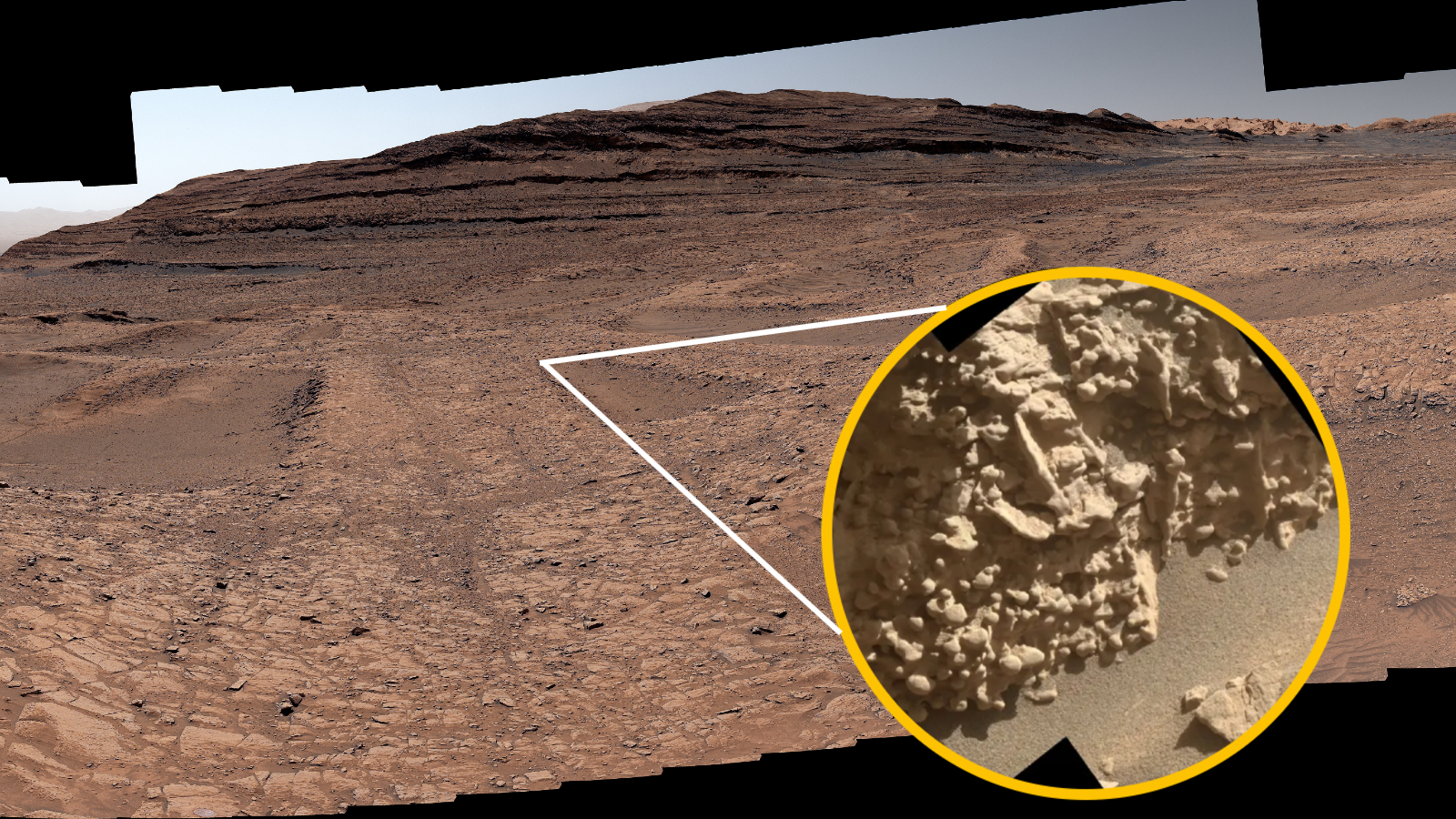
The Curiosity panorama is composed of 1,031 images and covers a region featuring so-called “boxwork formations”—low rock walls that resemble giant spiderwebs. They formed long ago: underground water flowed through cracks in the rock, depositing minerals, and then erosion carved away everything around them—leaving only these more resistant ridges. 

The mission also recently reported that siderite in the layers of Aeolis Mons may be trapping carbon dioxide from Mars’ ancient, much denser atmosphere. Another discovery is the most diverse set of organic molecules ever found on the planet: 21 carbon-containing compounds in a single sample, seven of which have been identified there for the first time.

A panoramic view of a Martian region featuring low ridges known as “boxwork formations”, captured by NASA’s Curiosity Mars rover. Source: nasa.gov

Perseverance: The oldest rocks and the first lightnings

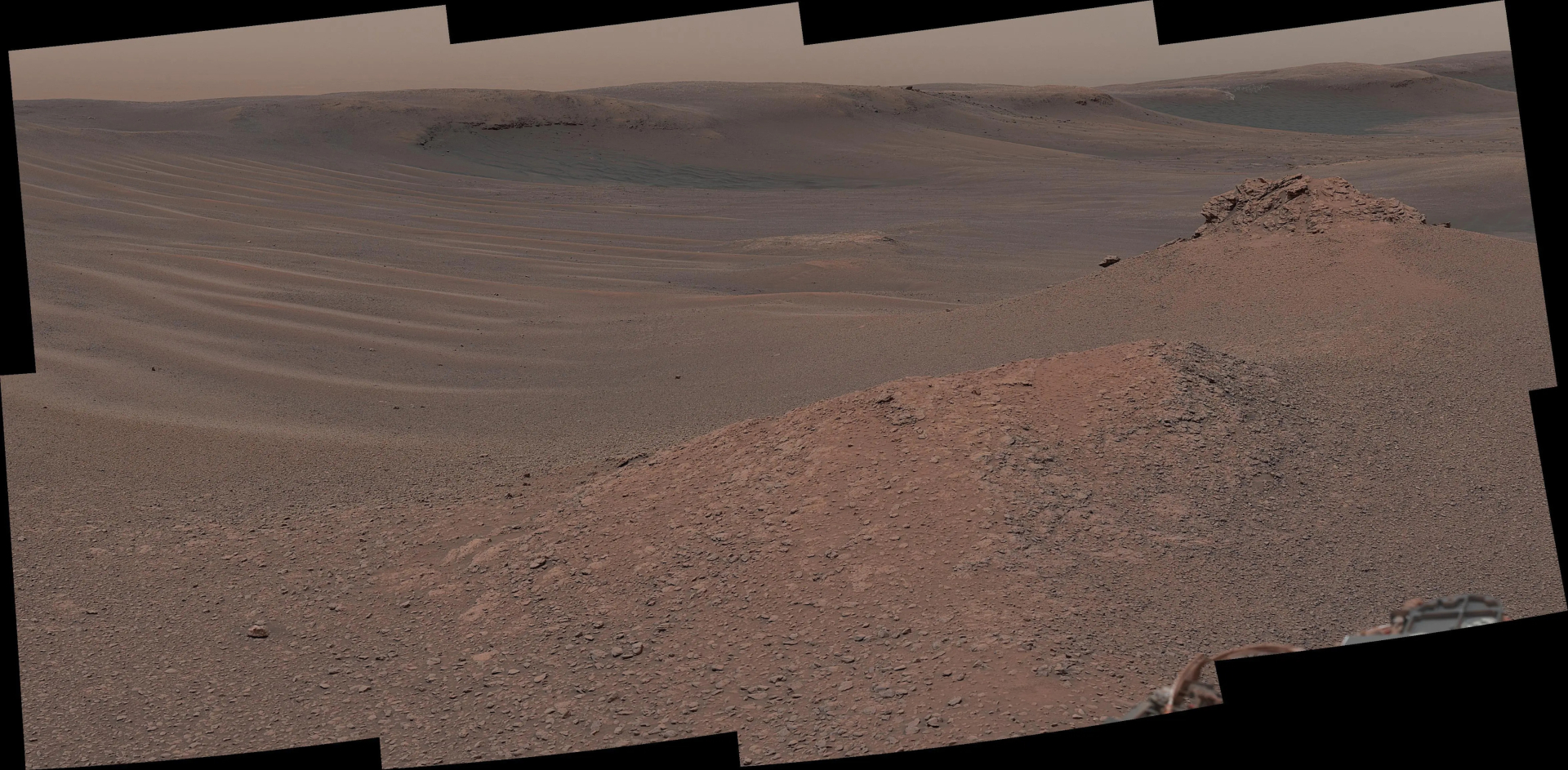
The Perseverance panorama consists of 980 images taken at a location that researchers have unofficially named “Lac de Charmes.” It is located on the outer rim of the Jezero crater and contains rocks that formed billions of years ago. Last year, the mission discovered a rock with dark spots—so-called “leopard spots”—characteristic of chemical reactions caused by microorganisms on Earth. 

In addition to geological studies, Perseverance’s microphones have recorded the sound of electrical discharges in dust devils for the first time—a phenomenon that had previously only been theorized.

A 360-degree panorama of the “Crocodile Bridge” region at the edge of Jezero Crater, captured by NASA’s Perseverance Mars rover. Source: NASA/JPL-Caltech/ASU/MSSS

Samples will be sent to Earth

Unlike Curiosity, which grinds rock samples for analysis right on the spot, Perseverance collects intact cores about the size of a piece of chalk and stores them in metal tubes. 

There are currently 23 samples on board. Scientists hope to bring them back to Earth, where laboratory equipment—unavailable to any rover—will be able to answer questions that remain unresolved for now.

RELATED VIDEOS

How NASA Changed Everything We Know About Mars — The Full Story

Inside NASA’s Mars Missions | Free Documentary Space

How Perseverance and Curiosity Navigate Mars Using AI Operation Exploration with Rebecca Anklam

{ https://universemagazine.com/en/articles-en/ }

Hoe vind je dit bericht?
Geschreven door peter om 23:33 Stuur door

New Emails Reveal Pentagon Effort to Align Messaging on AATIP and Luis Elizondo

2026-04-27_05-47-28-1536x805.jpg

New Emails Reveal Pentagon Effort to Align Messaging on AATIP and Luis Elizondo

A newly released series of Pentagon emails from May 2019 reveals an internal contradiction at the center of the Department of Defense’s narrative on the Advanced Aerospace Threat Identification Program (AATIP) and Luis Elizondo.

At the center of the records is a May 7, 2019, email from senior Pentagon official Neill Tipton, former Director of Defense Intelligence for Collection and Special Programs, which states in clear terms that Elizondo “had no assigned responsibilities” related to AATIP during his time under Tipton within the Office of the Secretary of Defense (OSD).

images.jpg

Neill Tipton

Yet the same batch of emails, along with previously released records published by The Black Vault as released via the Freedom of Information Act (FOIA), shows Tipton was directly communicating with Elizondo about AATIP, reviewing a memo to assume responsibilities tied to it, and participating in internal discussions about how the Department should respond to inquiries on the subject.

The newly uncovered email chain also shows that Tipton’s statement did not stand uncontested internally. Instead, it prompted immediate concern among Pentagon officials about contradictions, prior statements, and the need to keep messaging consistent.

Tipton’s Core Statement
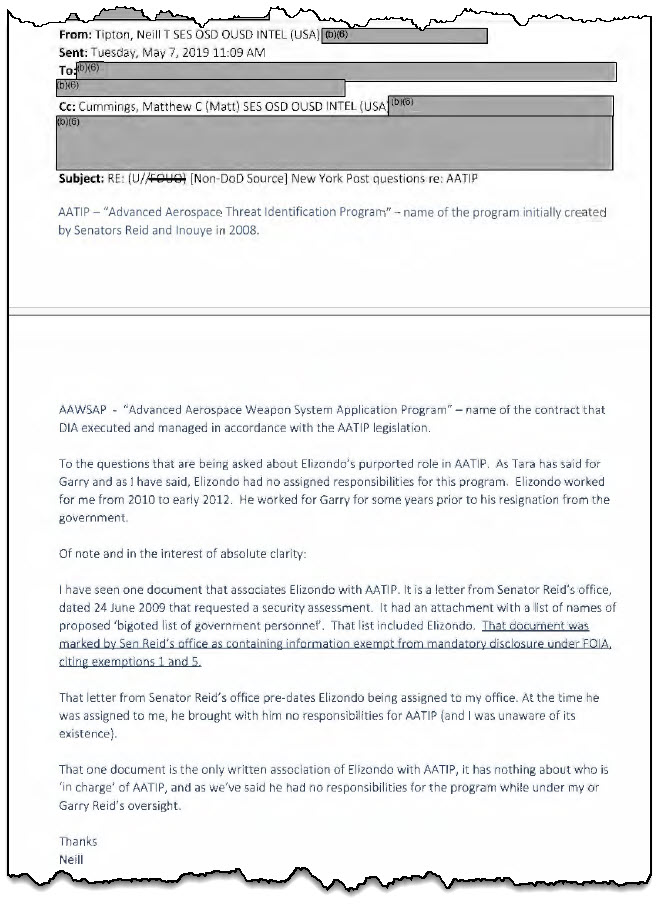
In the May 7, 2019, email, Tipton wrote:

“Elizondo had no assigned responsibilities for this program… Elizondo worked for me from 2010 to early 2012.”

He added:

“At the time he was assigned to me, he brought with him no responsibilities for AATIP (and I was unaware of its existence).”

The language is precise and limited in scope, focusing specifically on Elizondo’s time under Tipton within OSD.

Immediate Internal Reaction
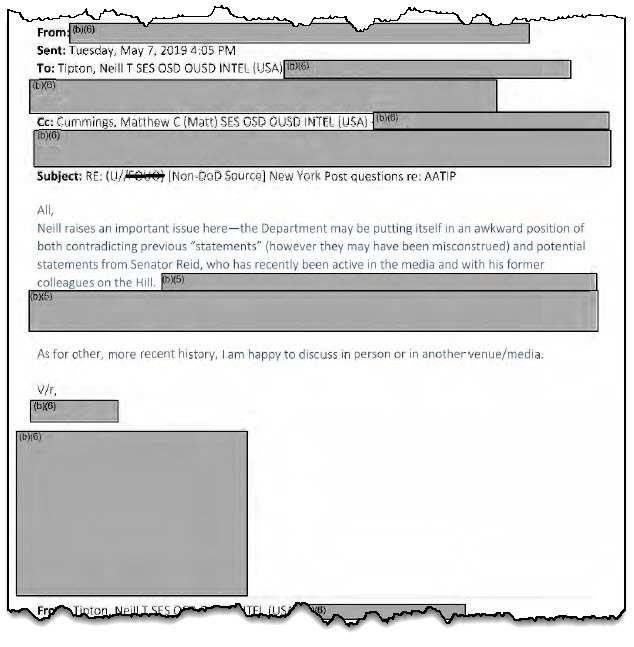
A follow-up email sent later that day by an individuals name that was redacted reflects concern about how the statement could be interpreted:

“Neill raises an important issue here—the Department may be putting itself in an awkward position of both contradicting previous ‘statements’ (however they may have been misconstrued) and potential statements from Senator Reid…”

The message continues:

“As for other, more recent history, I am happy to discuss in person or in another venue/media.”

This indicates that additional context existed but was not being fully revealed in the written response. It also suggests that further discussion was being moved to another setting, outside the documented email exchange, which would limit what is preserved in the official record and subject to a future FOIA disclosure.

Defining the Scope of the Pentagon’s Answer

Another email in the chain further clarifies the Department’s internal reasoning:

“The issue for us… is that when we answer, we’re answering for all of DoD, for all of Elizondo’s time in DoD, not just his time in OUSD(I).”

It continues:

“So while he may not have had any assigned responsibilities for these programs while in OUSD(I), if he did work on these programs while assigned to a different DoD organization… we have to confirm that—or confirm that he didn’t work on them at any time while assigned to DoD, whichever is true.”

This internal discussion highlights why the Pentagon’s statement was narrowly framed. It addressed only a specific period and organizational context, rather than Elizondo’s entire time within the Department of Defense. What remains unclear is why the broader context was not included, particularly given the existence of other documented exchanges. Whether additional information influenced how the statement was constructed is not addressed in the available records.

Messaging Coordination
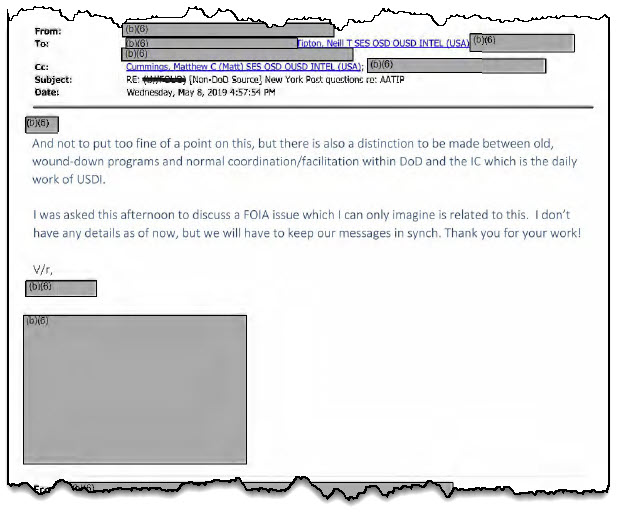
By May 8, 2019, the email chain shows awareness that the issue extended beyond a single response:

“I was asked this afternoon to discuss a FOIA issue which I can only imagine is related to this… we will have to keep our messages in synch.”

That same email introduces an important distinction:

“There is also a distinction to be made between old, wound-down programs and normal coordination/facilitation within DoD and the IC…”

This suggests that internally, officials were grappling with how to define AATIP itself, Elizondo’s role, if any, and how to respond to the public in a unified, synchronized, way.

Documented Exchanges With Elizondo

21-FR-0964 Release of the AATIP Memo – “Release” on March 29, 2024. Received August 21, 2024.

The significance of these internal discussions becomes clearer when compared to previously released records obtained by The Black Vault.

In a September 25, 2017, email, Elizondo wrote to Tipton:

“Per SECDEF’s Front Office guidance to you and me, I took the liberty of drafting a memo… that helps you better assume the new responsibilities for AATIP.”

Tipton responded days later:

“Getting spun back up. Will read and get thoughts back today or tomorrow…”

These exchanges show that Tipton and Elizondo were in direct communication about AATIP, including a draft memorandum outlining responsibilities.

Those exchanges are not referenced in Tipton’s May 7, 2019, email.

The omission is notable because it shows that Tipton was, at minimum, aware of AATIP discussions and had been directly engaged in communications about it.

It should also be noted that efforts by The Black Vault to confirm direct communication between Neill Tipton and Luis Elizondo regarding AATIP responsibilities were neither immediate nor straightforward. The process began with FOIA case 21-F-0964, filed on May 5, 2021, which specifically sought emails between the two officials containing terms such as “AATIP,” “UAP,” and related keywords. Despite the targeted nature of the request, the Department of Defense responded on December 14, 2021, stating that “no records” were found. This response stood in direct conflict with prior research and information indicating that such communications did, in fact, exist.

In response, The Black Vault filed an appeal within one day, citing a specific known email dated September 25, 2017, in which Elizondo contacted Tipton and referenced AATIP directly. That appeal argued that “this fact alone should have yielded at least one responsive document,” and challenged the adequacy of the search conducted. The appeal was ultimately granted in February 2022, forcing the case to be remanded for further processing. However, even after the appeal was approved, procedural issues persisted, including the Department of Defense failing to acknowledge the reopened case until August 2023, which it later stated had been “overlooked.”

When records were eventually produced under the remanded case (21-FR-0964), they confirmed that responsive communications did exist. However, even within those records, key details were initially obscured. In a related FOIA production (case 21-F-1154), portions of the same email chain had previously been released with critical language redacted, including the specific reference to “AATIP” in the context of transferring responsibilities. Only after continued pressure and the appeal process did the unredacted version reveal that Elizondo had written to Tipton that he had drafted a memo “that helps [Tipton] better assume the new responsibilities for AATIP.” This progression from “no records,” to partially redacted records, to eventual disclosure… demonstrates the extent to which confirming even basic facts about these exchanges required sustained effort and formal challenge through the FOIA process.
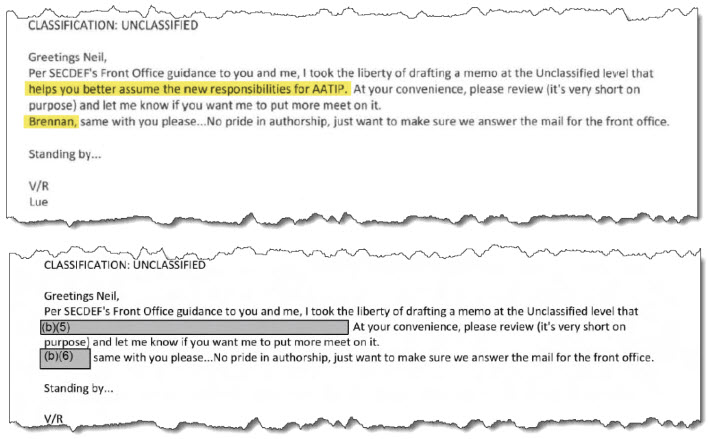
A comparison between the original release of this email, by the DoD (bottom) wherein the AATIP reference was redacted, and the second release of the same email, where the line was revealed. The release of these versions came after the DoD initially said they could not find it

This does not establish that Elizondo formally led AATIP. It also does not confirm the exact structure or status of the program within the Department of Defense.

However, it does demonstrate that AATIP was being discussed between Tipton and Elizondo, including a transfer of responsibilities, which was not reflected in the 2019 internal conversation that led to the public statement. Tipton emphasized that he was “unaware of AATIP’s existence,” a statement tied to an earlier period when Elizondo worked under him. Yet documented emails from 2017 show Tipton was later engaged in direct discussions about AATIP, raising questions about why that context was not included in his 2019 account.

Speculation on What Was Left Unsaid

It is not explained in the documents why this context was omitted. If AATIP was considered an informal effort, a limited initiative, or a responsibility outside formal assignment structures, that context could have been articulated within the public statement to provide greater clarity.

Similarly, if AATIP was viewed as a minor or secondary activity, that distinction could have been conveyed using established Pentagon terminology, as well.

However, the absence of any reference to documented exchanges between Tipton and Elizondo adds to the existing uncertainty and raises additional questions that are not addressed in the available records, nor is any of it addressed in any official statements by the Pentagon.

Statement From Luis Elizondo

Luis Elizondo, in a statement provided to The Black Vault for this article, disputes Tipton’s characterization and asserts that the documentary record reflects a different reality.

Elizondo stated:

“There exists several emails and documents that illustrate as a matter of fact that Neill not only knew about my involvement in AATIP, but that he had agreed to replace me and assume my responsibilities.

It’s disappointing to see senior leaders outwardly lie to their chain of command to save their own butts, but given Neill’s new role at the time, and the massive witch hunt Garry Reid had initiated to tear me down and erase me, I understand why Neil wrote what he did. But it still does not make it right.

There are numerous witnesses that also briefed Neil WITH ME present. I think this email by Neill proves once and for all how they attempted to change the narrative. However, I sure wish someone would ask him the same question under oath. I guarantee to you his statement would not be the same if he knows the consequences for lying.

This is yet another example of the tremendously unjust efforts by my former leadership to try and cover their butts while throwing me to the wolves. I am relieved that people are now seeing the truth for what it really is.

AATIP was real, I was the senior ranking official, and since my departure the Pentagon has tried every way to change the narrative. It’s shameful but I am not the last bit surprised; business as usual I guess…and they wonder why our citizens have lost all faith and confidence at the Pentagon. If Hegseth were to read this, I sure hope he would fire some people.”

These claims are presented as Elizondo’s position and are not independently and/or fully verified within the scope of the released documents. Elizondo’s comments are published here, in full, and unedited.

Neill Tipton did not respond to a request for comment.

A Record Still Taking Shape, Nearly 10 Years Later

The May 2019 email chain does not resolve the longstanding questions surrounding AATIP or Elizondo’s role. It does not confirm that Elizondo led a formal program, nor does it define the full scope or structure of AATIP.

What it does show is that Pentagon officials were actively discussing how to respond, how to align messaging, and how to avoid potential contradictions.

It also shows that known communications between key individuals were not reflected in at least one official internal explanation that led to the DoD’s publish statements about Elizondo and AATIP.

Whether that omission reflects incomplete knowledge, narrow framing, or other factors is not addressed in the available record, thus far.

As additional documents continue to emerge, the historical record surrounding AATIP and the roles of those involved remains incomplete and continues to evolve.

The Black Vault has numerous outstanding FOIA requests on this specific issue, many of which have been pending for more than six years, which may yield additional records that further clarify these unresolved questions.

The full batch of 400+ pages of records containing the above email thread is currently under appeal, as The Black Vault is challenging the extensive redactions in key portions of the conversations. The outcome of that appeal will be reported when available.

###

Document Archive

pdf.gif 20-F-0163 Full Release Package [418 Pages, 17MB]

{ https://www.theblackvault.com/documentarchive/ }

Hoe vind je dit bericht?
Geschreven door peter om 23:12 Stuur door

NASA rover uncovers rock with 7 new organic molecules on Mars — the 'most diverse collection' ever seen

NASA rover uncovers rock with 7 new organic molecules on Mars — the 'most diverse collection' ever seen

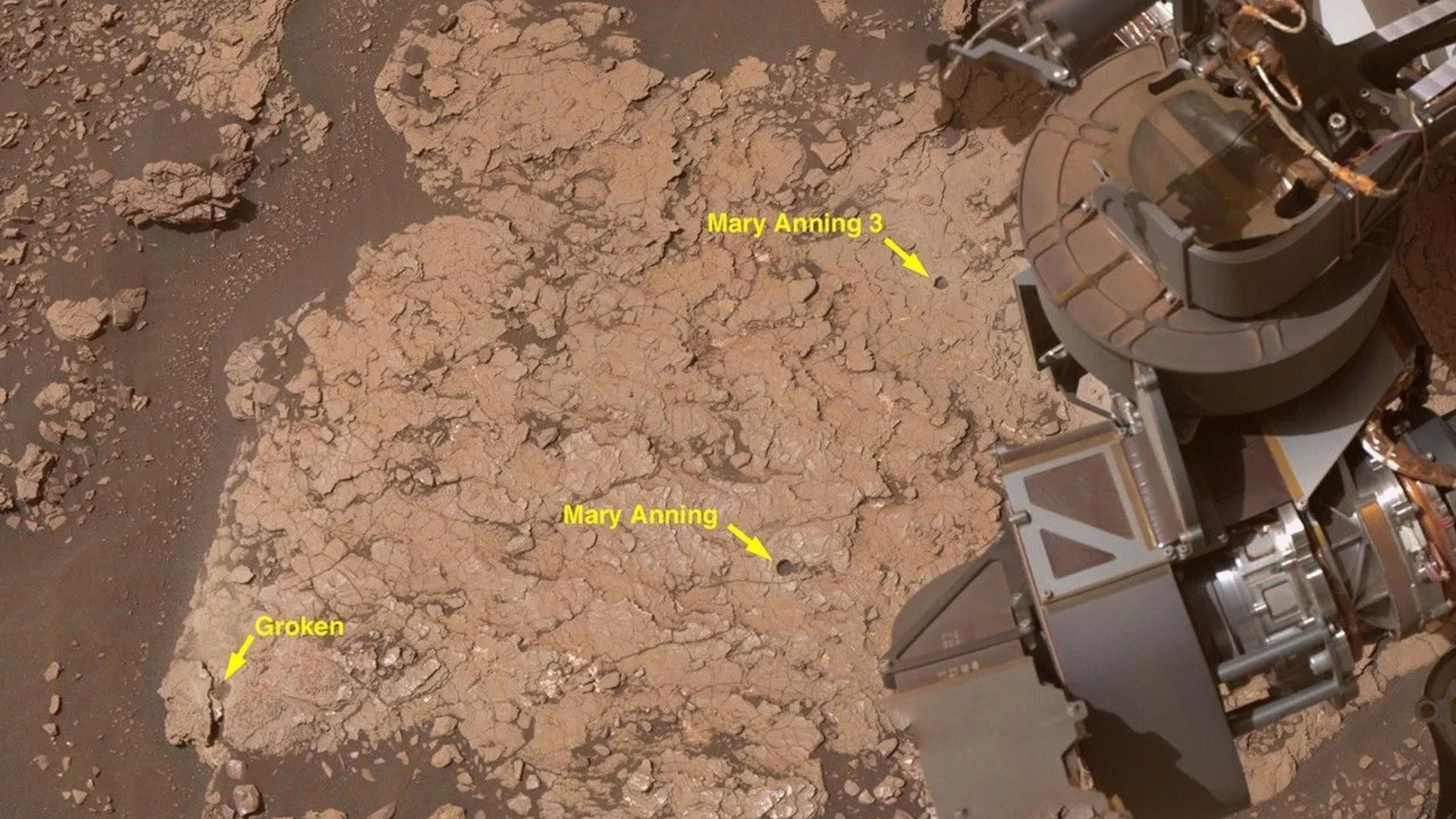
A close up of a reddish brown surface with a metal arm in the right top corner of the image. The image includes yellow arrows and labels of different sites of interest. A close-up of the rock where the Mary Anning 3 sample was discovered.  (Image credit: NASA/JPL-Caltech/MSSS)

A rock discovered by NASA's Curiosity Mars rover contains "the most diverse collection" of the building blocks of life ever seen on the Red Planet, including seven never found there before, new research confirms.

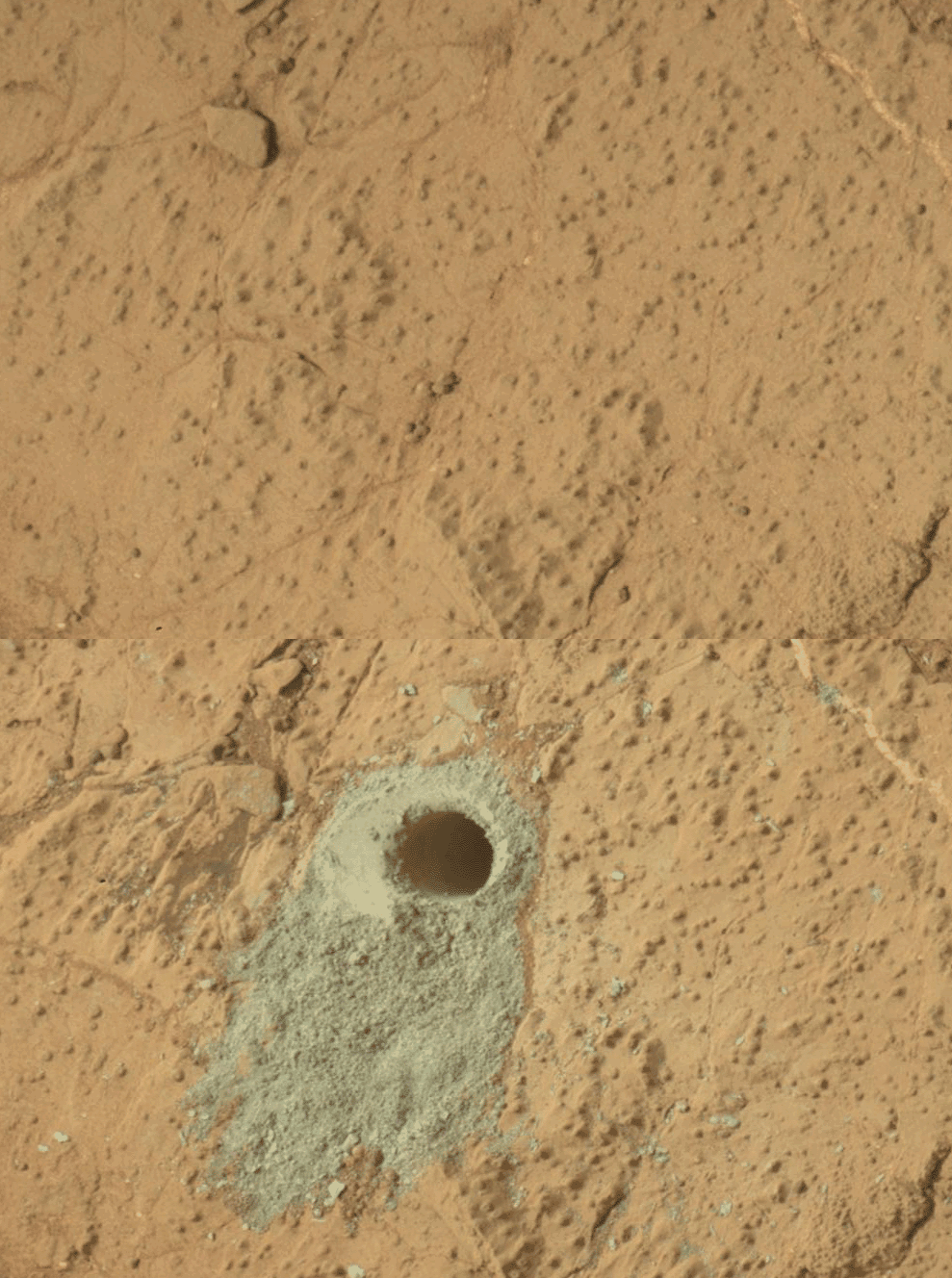
In 2020, Curiosity discovered and drilled into the rock, which has now been confirmed to contain organic molecules that bear the life-friendly element carbon. While scientists can't yet prove if the molecules formed due to biological or geologic processes, their findings add new evidence to the theory that ancient Mars was hospitable to life.

"Their discovery renewed confirmation that ancient Mars had the right chemistry to support life," officials at NASA's Jet Propulsion Laboratory (JPL), which manages the mission, wrote of the organics. "What's more, the molecules join a growing list of compounds known to be preserved in rocks even after billions of years of exposure on Mars to radiation, which can break down these molecules over time."

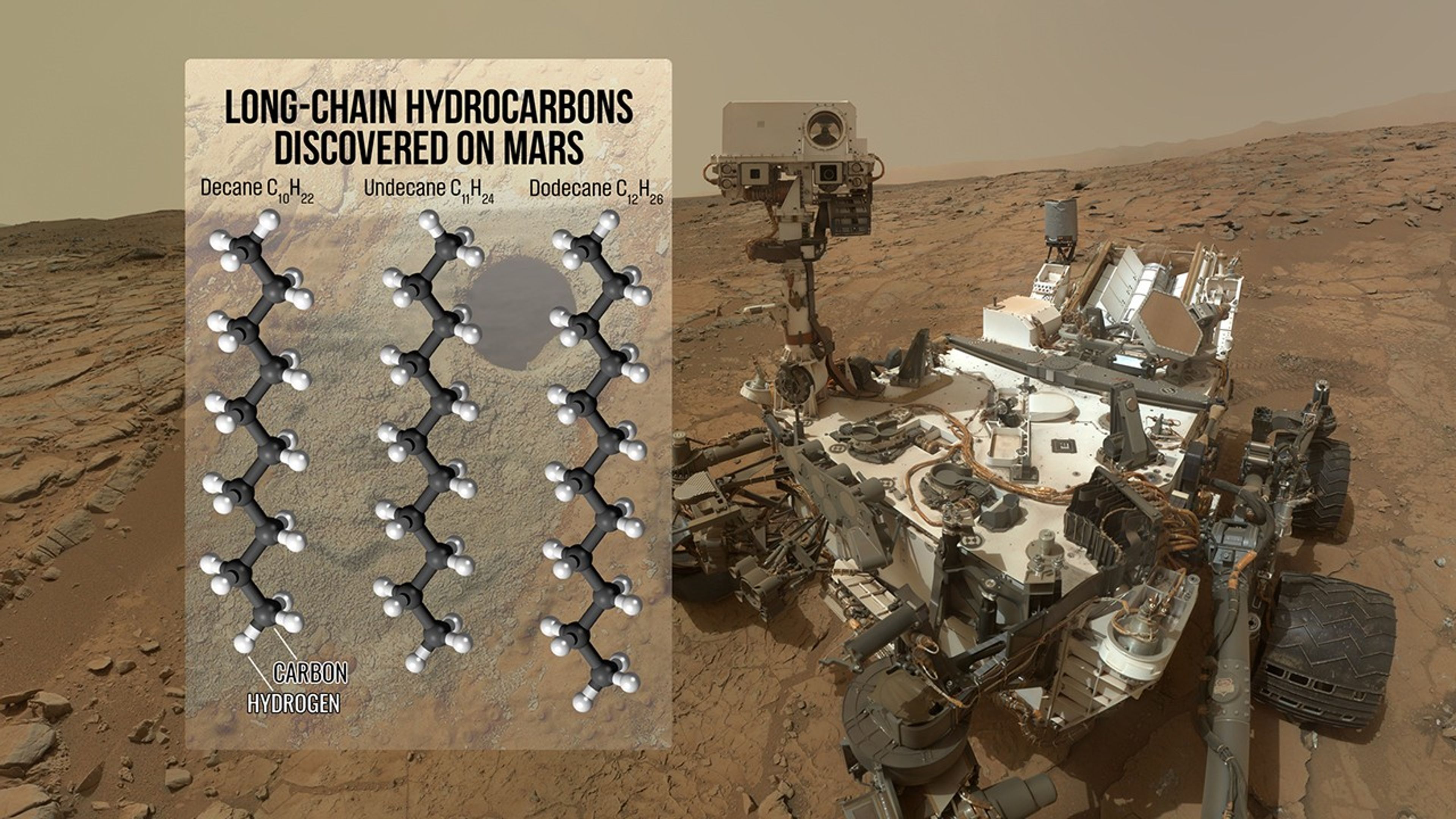
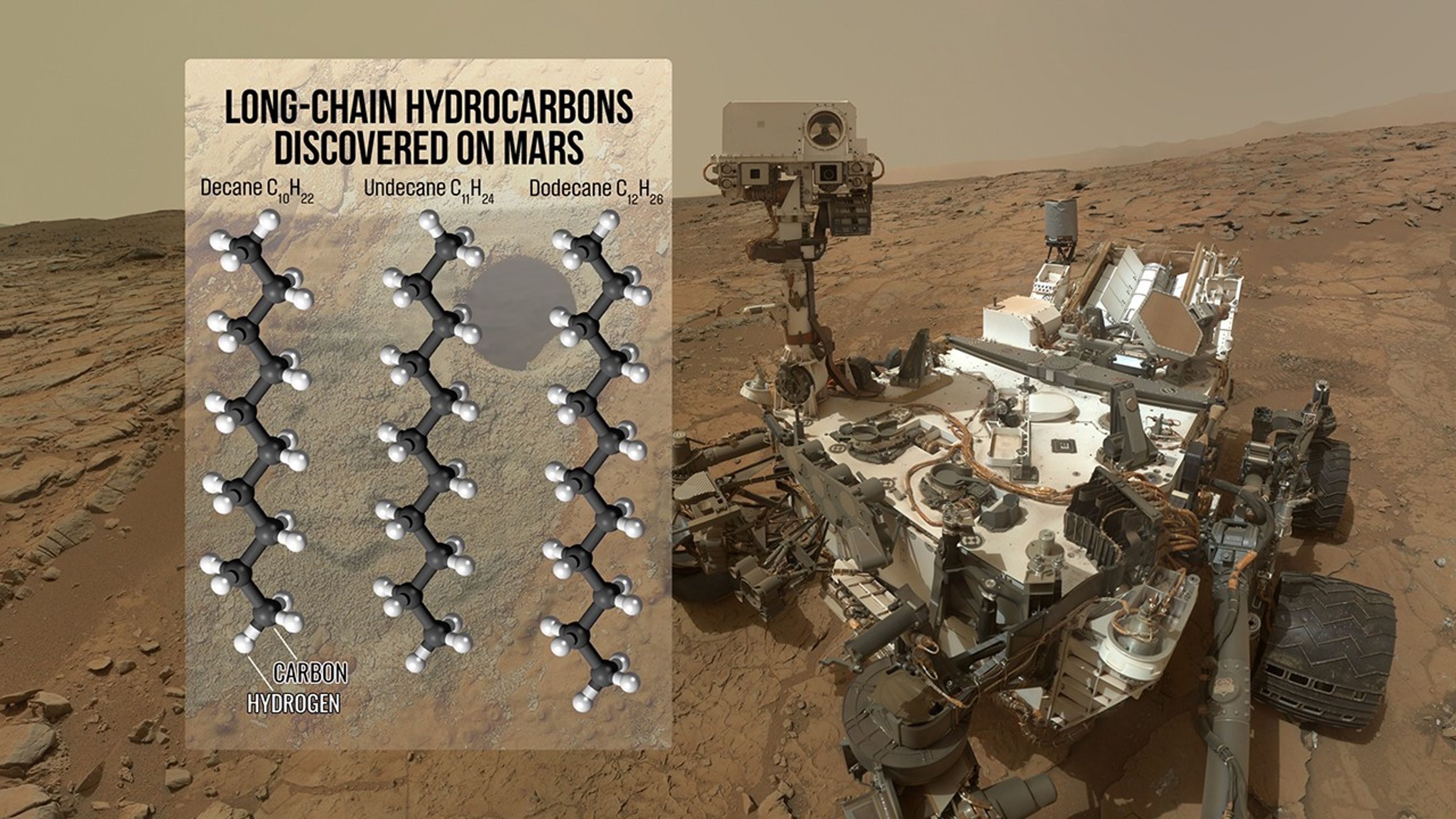
The image features a rover with its robotic arm and various instruments visible on a rocky, reddish-brown terrain. In the background is a barren landscape with scattered rocks and hills under a hazy sky. Overlaying the left side of the image is a semi-transparent panel with the title "Large Organics on Mars" in bold black letters. Below the title, three molecular chains are displayed, consisting of black spheres representing carbon atoms and white spheres representing hydrogen atoms. Labels indicate "carbon" as the black spheres and "hydrogen" as the white spheres. A faint circular blur appears in the background of the panel.

This graphic shows the long-chain organic molecules decane, undecane, and dodecane. These are the largest organic molecules discovered on Mars to date. They were detected in a drilled rock sample called “Cumberland” that was analyzed by the Sample Analysis at Mars lab inside the belly of NASA’s Curiosity rover. The rover, whose selfie is on the right side of the image, has been exploring Gale Crater since 2012. An image of the Cumberland drill hole is faintly visible in the background of the molecule chains. Download graphic here: https://svs.gsfc.nasa.gov/14808/#media_group_377732
NASA/Dan Gallagher
You may like
  • An illustration of the Curiosity rover on Mars next to a diagram of long carbon-based molecules

Giant string of organic molecules on Mars may be one of the best signs of life yet

  • A close-up photo of rocky polygons on Mars that look like giant reptile scales

NASA's Curiosity rover finds a surprising number of giant 'dragon scales' littered across Mars

  • A photo of Mars's surface with a close-up image of tiny egg-like nodules inset

Giant 'spiderwebs' on Mars contain tiny egg-like structures that scientists 'can't quite explain,' NASA rover reveals

By the Martian seashore

The new analysis, published April 21 in the journal Nature Communications, shows that the rock sample included 21 carbon-containing molecules, including seven never seen before on the Red Planet. The newly found molecules included nitrogen heterocycle (a predecessor to RNA and DNA) as well as benzothiophene, which may have been key to bringing life-friendly chemistry to solar system planets aboard meteorites, the authors wrote.

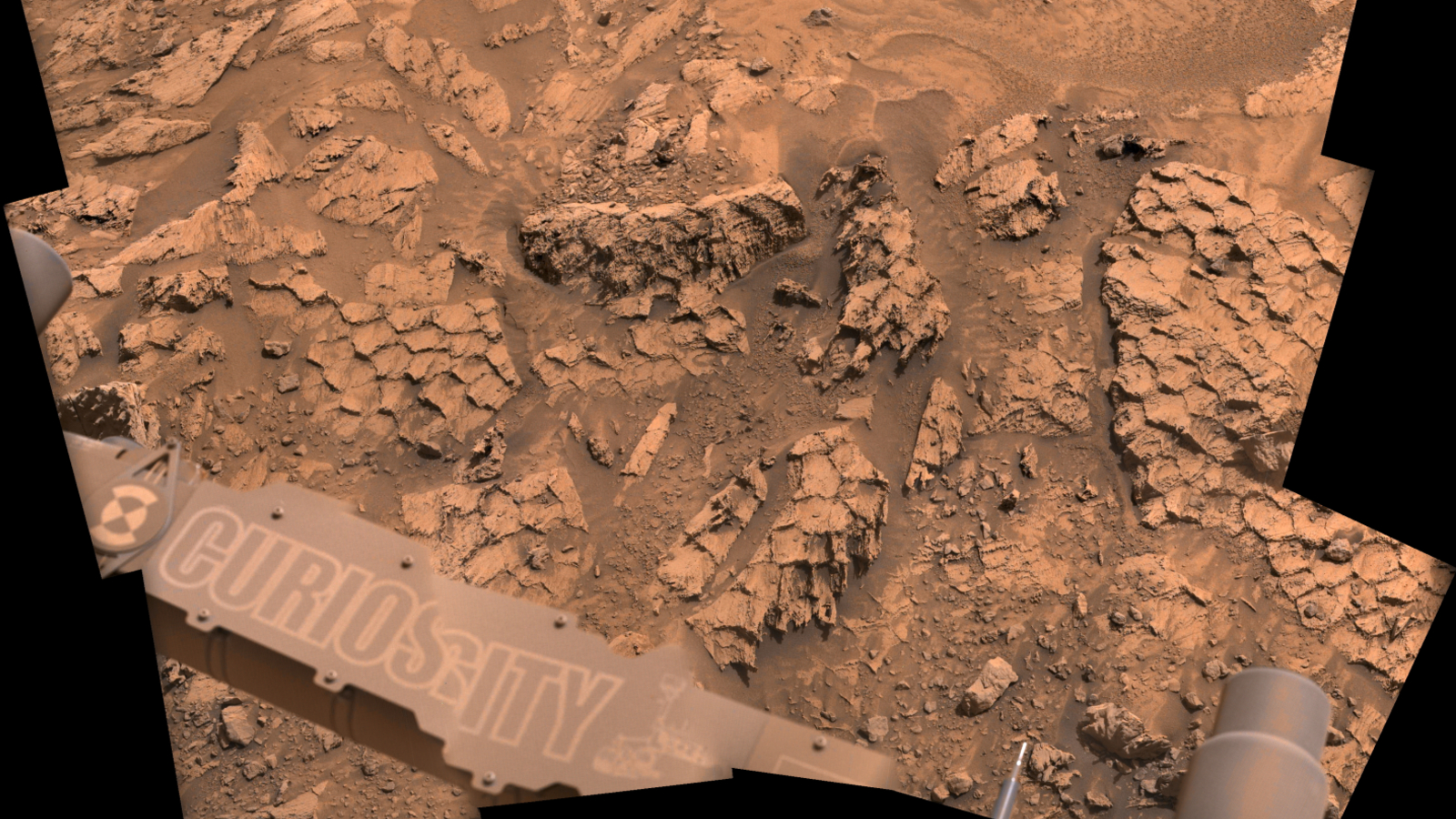
The sample was nicknamed "Mary Anning 3," after the English paleontologist famous for discovering the first fossil ichthyosaur and plesiosaur. Much like the aquatic fossil environments Anning sought out, the Martian organics were found in an area of Mars that was teeming with lakes and streams before the planet dried out billions of years ago.

A region of Mars’ Mount Sharp where the ‘Mary Anning 3’ sample was discovered.  (Image credit: NASA/JPL-Caltech/MSSS)

"This oasis surged and dried up multiple times in the planet's ancient past, eventually enriching the area with clay minerals, which are especially good at preserving organic compounds," JPL officials wrote.

Drilling for life

This animated image shows a close-up view of a flat, dusty, tan-colored rock surface with fine cracks and small, dark specks scattered across it. In the animation, a hole appears in the center of the frame, with loose powdered material surrounding the hole. The surrounding rock surface remains unchanged, highlighting the freshly drilled hole and the fine texture of the rock.

NASA's Curiosity rover drilled into this rock target, "Cumberland," during the 279th Martian day, or sol, of the rover's work on Mars (May 19, 2013) and collected a powdered sample of material from the rock's interior. Curiosity used the Mars Hand Lens Imager (MAHLI) camera on the rover’s arm to capture this view of the hole in Cumberland on the same sol as the hole was drilled. The diameter of the hole is about 0.6 inches (1.6 centimeters). The depth of the hole is about 2.6 inches (6.6 centimeters). Download gif here: https://svs.gsfc.nasa.gov/14808/#media_group_377749
NASA/JPL-Caltech/MSSS

Last year, Curiosity also found the largest-ever organic molecules on Mars. These were "long-chain" hydrocarbons, including decane, undecane and dodecane.

These organic finds in 2020 and 2025 used an instrument on Curiosity called Sample Analysis at Mars (SAM). Curiosity first drills rocks using its robotic arm. Then, it turns the rocks into powder samples and lets the powder fall into SAM. The instrument contains a high-temperature oven that heats up the powder, allowing the compositions of the gases inside the rover to be measured.

SAM also contains small cups of solvent that can perform "wet chemistry." The Mary Anning 3 sample was the first to use tetramethylammonium hydroxide (TMAH) — a substance that breaks apart organic molecules, of which Curiosity only carries two cups — because the sample was considered of the highest value.

Curiosity's findings were verified on Earth using a space rock that's well known to science, the Murchison meteorite, which is 4 billion years old and includes organic molecules.

"A Murchison sample exposed to TMAH was found to break much larger molecules into some of the ones seen in Mary Anning 3, including benzothiophene," JPL officials wrote. "That result verifies that the Martian molecules found in Mary Anning 3 could have been generated from the breakdown of even more complex compounds relevant to life."

Curiosity, which has been on Mars since 2012, recently used its last TMAH cup on "weblike boxwork ridges, which were formed by ancient groundwater," according to JPL. The results will be written up in a future study.

Article Sources
  • Williams, A. J., Eigenbrode, J. L., Millan, M., Williams, R. H., Mcintosh, O. M., Teinturier, S., Roach, J., Malespin, C., McAdam, A. C., Mahaffy, P., Bryk, A. B., Buch, A., Boulesteix, D., Chou, L., Dworkin, J. P., Fox, V., Franz, H. B., Freissinet, C., Glavin, D. P., . . . Vasavada, A. R. (2026). Diverse organic molecules on Mars revealed by the first SAM TMAH experiment. Nature Communications, 17(1). https://doi.org/10.1038/s41467-026-70656-0

{ https://www.livescience.com/space }

Hoe vind je dit bericht?
Geschreven door peter om 22:47 Stuur door

The truth about NASA's 'GoFast' UFO verdict exposed in secret internal emails

The truth about NASA's 'GoFast' UFO verdict exposed in secret internal emails

One of the Pentagon's most famous UFO videos is facing new scrutiny after secret NASA emails raised fresh questions about how it was analyzed.

The 'GoFast' encounter, recorded by Navy pilots tracking a fast-moving object off the Atlantic coast in 2015, was assessed by NASA as most likely showing an ordinary object drifting with the wind.

But newly released documents obtained by UFO researcher Grant Lavac through the Freedom of Information Act revealed that NASA's 2023 review relied entirely on publicly available footage and did not include interviews with the Navy aviators who witnessed the encounter.

NASA Unidentified Anomalous Phenomena (UAP) panelist Josh Semeter, director of Boston University's Center for Space Physics, acknowledged the limitation in an internal email written weeks before the agency released its findings.

'No, our panel did not speak with the aviators,' Semeter wrote. 'The analysis is based purely on information in the publicly released video.'

The correspondence also showed the panel did not have access to raw sensor data, instead relying on details visible within the footage itself. They noted that although the raw data were unavailable, the video display contained information such as camera elevation angle and aircraft altitude that analysts used in their calculations.

Semeter added that mathematical modeling suggested the object was not traveling at unusually high speeds, but stressed the analysis did not determine what the object actually was, noting the available data were insufficient to identify its size, shape, material, or whether it had visible flight features.

'We cannot determine from the data whether this object is a metallic orb, or has any flight surfaces,' he continued. He also emphasized that while the calculations suggested the object was not moving at extraordinary velocity, this did not mean the GoFast incident had been fully explained.

Public interest in UFOs heightened in 2017 with the leak of three Navy pilots infrared videos that captured UAP. Pictured is a still from one of these videos, GOFAST, which NASA's expert UAP advisory panel attempted to explain as terrestrial this week

Public interest in UFOs heightened in 2017 with the leak of three Navy pilots infrared videos that captured UAP. Pictured is a still from one of these videos, GOFAST, which NASA's expert UAP advisory panel attempted to explain as terrestrial this week

In another internal exchange, one panel member suggested the group's detailed review of high-speed claims may have been limited to a single case, the GoFast video itself, and acknowledged that even that analysis was not comprehensive.

The 'GoFast' UFO video was recorded in 2015 by a US Navy F/A-18 Super Hornet crew operating off the East Coast.

The grainy, black-and-white footage shows an object skimming low above the Atlantic Ocean, captured through a fighter jet’s targeting display as one pilot can be heard exclaiming: 'Ohhh, got it!'

The Daily Mail has contacted NASA and Semeter for comment.

Internal emails suggest the panel’s testing of high-speed UFO claims may have been narrower than publicly understood.

David Spergel, president of the Simons Foundation and a member of NASA's independent UAP study team, wrote in an August 21, 2023 message that the group appeared to have closely examined only a single case, the GoFast video, when evaluating claims of extreme speeds.

'I don’t believe our panel reviewed more than a single case (Go Fast by Josh) where the high velocity claim was brought into question, and even that review wasn’t comprehensive,' Spergel wrote. 

He added that the panel did not believe it had reviewed enough cases to justify broad conclusions about multiple high-speed UFO events.

Newly released documents obtained by UFO researcher Grant Lavac through the Freedom of Information Act revealed that NASA's 2023 review relied entirely on publicly available footage and did not include interviews with the Navy aviators who witnessed the encounter

Newly released documents obtained by UFO researcher Grant Lavac through the Freedom of Information Act revealed that NASA's 2023 review relied entirely on publicly available footage and did not include interviews with the Navy aviators who witnessed the encounter

The correspondence also revealed internal debate over how strongly the panel should phrase its findings, with Spergel urging colleagues to avoid language suggesting that numerous high-velocity sightings had been disproven. 

Instead, he recommended revising the wording to emphasize that accurately determining distances is essential to understanding anomalous events, rather than implying that many such sightings had already been explained.

In a February 2024 email, NASA records officials contacted the independent study team to determine what UAP-related data had been collected, citing new federal requirements under the 2024 National Defense Authorization Act that mandate the tracking and management of unidentified anomalous phenomena records.

The correspondence also revealed internal debate over how strongly the panel should phrase its findings, with Spergel urging colleagues to avoid language suggesting that numerous high-velocity sightings had been disproven
Instead, he recommended revising the wording to emphasize that accurately determining distances is essential to understanding anomalous events, rather than implying that many such sightings had already been explained

Instead, he recommended revising the wording to emphasize that accurately determining distances is essential to understanding anomalous events, rather than implying that many such sightings had already been explained

Daniel Evans, the assistant deputy associate administrator for research at NASA’s Science Mission Directorate, wrote in an email sent on February 9, 2024 that 'we are not aware of any UAP records at NASA.'

The recipient, Patti Stockman, who worked as a management and program analyst for NASA headquarters, questioned Evans' claim, responding: 'Daniel. Really? You haven’t been gathering any existing records that might have relevance to UAP, even though you’ve conducted the public meeting of the study team on categorizing and evaluating data of UAP?'

To which Evans sent a formal response: 'I would like to reaffirm that, following a comprehensive review of our activities and the discussions held during the public meeting on UAP, as well as the subsequent report, NASA currently does not hold or manage records classified specifically as UAP documents.'

He added in a May 10, 2024 email to Stockman: 'The one incident that was in proximity to a NASA Center was actually picked up by a DoD radar, and hence is their record.'

The internal exchanges also noted that NASA's UAP study team consisted of external experts rather than agency staff, with them describing the panel as an independent scientific review body separate from NASA’s own operational decision-making


America's Book Of Secrets: Secret Aerospace Technology at Area 51 (Season 4) | History

{ https://www.dailymail.com/sciencetech/index.html }

Hoe vind je dit bericht?
Geschreven door peter om 22:30 Stuur door

Meer van UFO'S of UAP'S, ASTRONOMIE, RUIMTEVAART, ARCHEOLOGIE, OUDHEIDKUNDE, SF-SNUFJES EN ANDERE ESOTERISCHE WETENSCHAPPEN - DE ALLERLAATSTE NIEUWTJES

↑ Terug naar de berichten