Naar de inhoud

UFO'S of UAP'S, ASTRONOMIE, RUIMTEVAART, ARCHEOLOGIE, OUDHEIDKUNDE, SF-SNUFJES EN ANDERE ESOTERISCHE WETENSCHAPPEN - DE ALLERLAATSTE NIEUWTJES

UFO's of UAP'S in België en de rest van de wereld
akke.beakke.be
Ontdek de Fascinerende Wereld van UFO's en UAP's: Jouw Bron voor Onthullende Informatie! Ben jij ook gefascineerd door het onbekende? Wil je meer weten over UFO's en UAP's, niet alleen in België, maar over de hele wereld? Dan ben je op de juiste plek! België: Het Kloppend Hart van UFO-onderzoek In België is BUFON (Belgisch UFO-Netwerk) dé autoriteit op het gebied van UFO-onderzoek. Voor betrouwbare en objectieve informatie over deze intrigerende fenomenen, bezoek je zeker onze Facebook-pagina en deze blog. Maar dat is nog niet alles! Ontdek ook het Belgisch UFO-meldpunt en Caelestia, twee organisaties die diepgaand onderzoek verrichten, al zijn ze soms kritisch of sceptisch. Nederland: Een Schat aan Informatie Voor onze Nederlandse buren is er de schitterende website www.ufowijzer.nl, beheerd door Paul Harmans. Deze site biedt een schat aan informatie en artikelen die je niet wilt missen! Internationaal: MUFON - De Wereldwijde Autoriteit Neem ook een kijkje bij MUFON (Mutual UFO Network Inc.), een gerenommeerde Amerikaanse UFO-vereniging met afdelingen in de VS en wereldwijd. MUFON is toegewijd aan de wetenschappelijke en analytische studie van het UFO-fenomeen, en hun maandelijkse tijdschrift, The MUFON UFO-Journal, is een must-read voor elke UFO-enthousiasteling. Bezoek hun website op www.mufon.com voor meer informatie. Samenwerking en Toekomstvisie Sinds 1 februari 2020 is Pieter niet alleen ex-president van BUFON, maar ook de voormalige nationale directeur van MUFON in Vlaanderen en Nederland. Dit creëert een sterke samenwerking met de Franse MUFON Reseau MUFON/EUROP, wat ons in staat stelt om nog meer waardevolle inzichten te delen. Let op: Nepprofielen en Nieuwe Groeperingen Pas op voor een nieuwe groepering die zich ook BUFON noemt, maar geen enkele connectie heeft met onze gevestigde organisatie. Hoewel zij de naam geregistreerd hebben, kunnen ze het rijke verleden en de expertise van onze groep niet evenaren. We wensen hen veel succes, maar we blijven de autoriteit in UFO-onderzoek! Blijf Op De Hoogte! Wil jij de laatste nieuwtjes over UFO's, ruimtevaart, archeologie, en meer? Volg ons dan en duik samen met ons in de fascinerende wereld van het onbekende! Sluit je aan bij de gemeenschap van nieuwsgierige geesten die net als jij verlangen naar antwoorden en avonturen in de sterren! Heb je vragen of wil je meer weten? Aarzel dan niet om contact met ons op te nemen! Samen ontrafelen we het mysterie van de lucht en daarbuiten.

Archief

Artemis II astronauts struggle to walk as gravity hits them after 'bullseye' Pacific Ocean splashdown following their historic moon mission

Video footage has shownhow the Airtems II astronauts struggled to walk after their fiery plunge to Earth and splashdown in the Pacific Ocean last night following their historic moon mission. 

The spacecraft reached blistering speeds of up to 25,000 miles per hour before making its 'bullseye' landing off the coast of San Diego, California at 8.07pm ET.

The four-person crew, NASA astronauts Reid Wiseman, Victor Glover and Christina Koch, along with Canadian astronaut Jeremy Hansen, wrapped up a ten-day mission that carried them around the moon and farther than any human had ever travelled into space before.

NASA officials called the Artemis II mission a total success, with the capsule splashing down exactly where the space agency had planned.

After being picked up from the Orion crew module and flown to the USS John P Murtha by helicopter, the history-making space explorers were greeted by cheering onboard crowds.

But as they exited the choppers, it was clear they struggled to walk normally due to their time spent in microgravity.

All four members of the team were supported by a person on each side, while a third assistant pushed a wheelchair behind them in case it was needed.

While a couple of the astronauts appeared to lean more heavily on the support than others, no wheelchair was required and one even walked unaided, waving triumphantly at staff on the ship.

All four members of the Artemis II crew were supported by a person on each side, while a third assistant pushed a wheelchair behind them in case it was needed, after arriving back from their moon mission
Christina Koch, Artemis II mission specialist, is supported to walk as she arrives aboard USS John P Murtha

Christina Koch, Artemis II mission specialist, is supported to walk as she arrives aboard USS John P Murtha

Jeremy Hansen, Artemis II mission specialist, is assisted off the flight deck after arriving aboard USS John P Murtha

Jeremy Hansen, Artemis II mission specialist, is assisted off the flight deck after arriving aboard USS John P Murtha

The astronauts were all able to walk under their own power, but struggled with balance and appeared to stagger slightly

The astronauts were all able to walk under their own power, but struggled with balance and appeared to stagger slightly

Astronaut Reid Wiseman, Artemis II commander, is assisted off the flight deck after arriving aboard USS John P Murtha

Astronaut Reid Wiseman, Artemis II commander, is assisted off the flight deck after arriving aboard USS John P Murtha

The crew appeared unsteady on their feet and staggered from the helicopters as their bodies adjusted to Earth's gravitational pull after a little over nine days in space.

But reassuringly for the world to see, all were able to proceed under their own power. 

Previous space flights, including the ten-month saga of stranded astronauts Butch Wilmore and Suni Williams, required medical personnel to carry the astronauts because they were unable to walk well from their time in microgravity. 

The longer someone spends in space, the harder it is for their brain to readapt to gravity upon their return to Earth.

In the first few hours, astronauts typically experience dizziness and even fainting spells, as well as balance issues and problems walking.

This is compounded by astronauts seeing their feet becoming more sensitive due to days spent without standing.

As the vestibular system - that of the inner ear - has become used to relative weightlessness, they also become nauseous, have motion sickness and a loss of sense of their limbs.

Longer term impacts including muscle mass and bone density loss are less likely to affect the Artemis II crew due to their relatively short time away from Earth. 

Victor Glover, left and Jeremy Hansen, right, after they and fellow crewmates were extracted from their Orion spacecraft after splashdown

Victor Glover, left and Jeremy Hansen, right, after they and fellow crewmates were extracted from their Orion spacecraft after splashdown

Victor Glover, left, and Christina Koch, right, after successfully splashing down following their historic moon mission

Victor Glover, left, and Christina Koch, right, after successfully splashing down following their historic moon mission

Pilot Victor Glover is assisted off the flight deck after arriving aboard USS John P. Murtha

Pilot Victor Glover is assisted off the flight deck after arriving aboard USS John P. Murtha 

Artemis II's Orion spacecraft splashed down in the Pacific Ocean on April 10 after a 'perfect' reentry, according to NASA officials

Artemis II's Orion spacecraft splashed down in the Pacific Ocean on April 10 after a 'perfect' reentry, according to NASA officials

Astronauts Victor Glover and Christina Koch were seen waving and hugging NASA chief Jared Isaacman after being pulled from the water

Astronauts Victor Glover and Christina Koch were seen waving and hugging NASA chief Jared Isaacman after being pulled from the water

NASA Administrator Jared Isaacman called the moon mission 'perfect' and declared America's intention to begin the work on a successful moon landing and construction of a lunar base by 2028.

Isaacman said: 'We are back in the business of sending astronauts to the moon. This is just the beginning.'

Following their recovery from the Orion crew module and transfer to the naval vessel John P Murtha, the astronauts were seen in good spirits, waving to cameras and hugging Isaacman before heading for a standard medical checkup after the flight.

The voyage home started just after 7.30pm ET Friday night, with the Orion crew module blasting away from the spacecraft's service module.

The separation exposed the craft's heat shield, which protected the four-member crew as they plunged through Earth’s atmosphere, experiencing temperatures of up to 3,000 degrees Fahrenheit.

As the capsule angled in for the perfect trajectory into the atmosphere, NASA lost contact with the spacecraft for six minutes just before 8pm as Orion collided with the upper atmosphere, causing what scientists called a 'plasma buildup.'

Once the radio blackout cleared as planned, Orion successfully deployed its parachutes and safely landed in the Pacific without incident.

A slight communications glitch between the astronauts waiting in the water and the US Navy recovery teams delayed the crew's exit from the craft, but once flight surgeons were able to board the capsule, they were able to give all four astronauts a clean bill of health.

Dr Lori Glaze, NASA's deputy administrator, said her team was 'thrilled' to have the four astronauts home safely.

'We accomplished what we set out to do,' added Shawn Quinn, manager of NASA's Exploration Ground Systems Program. 'It's good to be NASA, and it's good to be an American today.'

President Donald Trump added his congratulations Friday night and invited the crew to the White House, posting on Truth Social: 'I look forward to seeing you all at the White House soon. We’ll be doing it again and then, next step, Mars!'

Pictured: US Navy recovery crews arrived at the Orion space capsule minutes after the pod landed in the Pacific at 8.07pm ET

Pictured: US Navy recovery crews arrived at the Orion space capsule minutes after the pod landed in the Pacific at 8.07pm ET

US Navy personnel work to recover the NASA Orion capsule which returned the Artemis II crew to Earth

US Navy personnel work to recover the NASA Orion capsule which returned the Artemis II crew to Earth

Pictured: The NASA Artemis II crew, Mission Specialist Christina Koch, Mission Specialist Jeremy Hansen, Commander Reid Wiseman, and Pilot Victor Glover

Pictured: The NASA Artemis II crew, Mission Specialist Christina Koch, Mission Specialist Jeremy Hansen, Commander Reid Wiseman, and Pilot Victor Glover

Pictured: The Artemis II spacecraft seen returning to Earth from its ten-day mission to circle the moon and break the distance record for human space flight

Pictured: The Artemis II spacecraft seen returning to Earth from its ten-day mission to circle the moon and break the distance record for human space flight

The Artemis II mission began back on April 1 with a successful launch from the Kennedy Space Center in Florida.

A day later, the crew set off on a four-day trip to the moon, where they would travel around the dark side and break the decades-old record of Apollo 13 for the farthest distance from Earth humans have ever travelled.

While the Apollo crew travelled 248,655 miles from Earth in 1970, Artemis II reached a maximum distance of 252,756 miles on day six of their mission.

READ MORE 

article image

While conducting their lunar flyby, the astronauts also named two new craters discovered on the lunar surface, including naming one after the late wife of Artemis II mission commander Reid Wiseman, Carroll.

Amit Kshatriya, the associate administrator of NASA, said Artemis II was the 'most important human space exploration mission in decades'.

'Hopefully, history is kind to us,' he added.

NASA administrators confirmed that the Artemis II flight crew was 'happy and healthy' Friday night. They added that the astronauts would be headed to the NASA space center in Houston on Saturday before spending time with their families.

The space agency's focus will now turn to reviewing the data from Artemis II before beginning on the plans for Artemis III, which will also involve a lunar flyby but no landing.

Currently, NASA's revamped plan for the moon includes sending an additional space flight, Artemis IV, as soon as 2028. That mission is expected to land on the lunar surface for the first time since Apollo 17 in 1972.

According to Isaacman, that mission will also begin the work of building a permanent US moon base which will facilitate future human space travel and a manned mission to Mars.

{ https://www.dailymail.com/sciencetech/index.html }

Hoe vind je dit bericht?
Geschreven door peter om 21:55 Stuur door

Artemis II crew struggle to walk after historic Moon mission as Nasa admits 'price to pay' when exploring space

Artemis II crew struggle to walk after historic Moon mission as Nasa admits 'price to pay' when exploring space

By James Saunders

Astronauts needed the support of two aides after being airlifted onto the deck of a waiting US Navy vessel

The four Artemis II astronauts have been seen struggling to walk after their return to Earth from the Moon.

Reid Wiseman, Victor Glover, Christina Koch and Jeremy Hansen re-entered the atmosphere at speeds approaching 25,000mph on Friday afternoon.

Their capsule touched down gently at 19mph in the Pacific near San Diego at 5.07pm, local time.

After being pulled from the Orion module, the crew were transported by helicopter to the USS John P Murtha, an amphibious Navy vessel.

Each astronaut needed support from two aides while crossing the deck, with a wheelchair following close behind as a precaution.

Nasa quickly confirmed the astronauts were in "excellent shape" after landing.

Commander Wiseman reported all four crew members were "stable" and "green".

A day after splashdown, the crew appeared at Ellington Air Force Base in Houston, Texas to address the world for the first time since their record-breaking journey.

Nasa chief Jared Isaacman welcomed them home with an acknowledgement of the challenges involved in space travel.

"There is no doubt there is a price to pay when it comes to exploring the cosmos, but there is also a return, a return in the jobs that creates the technologies that improve life here on earth and the inspiration that sparks all those who choose to follow and to people all around the world who look up and dream about what is possible. The long wait is over," he said.

Nasa confirmed the astronauts were in 'excellent shape' after landing

NASA

Astronauts needed support from two aides while crossing the deck

NASA

"After a brief 53-year intermission, the show goes on, and Nasa is back in the business of sending astronauts to the moon and bringing them home safely."

Extended periods in microgravity can lead to health issues for returning astronauts.

These include inner-ear balance issues, nausea, immune system complications, sleep disruption and vision difficulties caused by blood pooling in the head and affecting the optic nerve.

Weightlessness can also lead to significant physical deterioration - which is why the lunar module carried a compact, 30-pound flywheel exercise device on board.

Muscle mass can drop by 20 per cent after just a fortnight in space.

An astronaut's muscle mass can drop by 20 per cent after just a fortnight in space

NASA

PICTURED: Reid Wiseman peers out of the Orion module over the Moon. He and his crewmates should avoid serious complications given their relatively brief 10-day mission

NASA

Astronauts also lose approximately two per cent of their bone density each month because their bodies no longer need skeletal support in a weightless environment.

The longer space travellers remain off-planet, the more vulnerable they become to gravity-related health issues upon return.

However, the Artemis II crew should avoid serious complications given their relatively brief 10-day mission.

The astronauts are scheduled to complete an "obstacle course" including ladder climbing to assess their readjustment to Earth's gravity and collect data for future missions.

Speaking on Saturday, Mr Wiseman joked that he had "absolutely no idea what to say" when addressing the crowd.

"Twenty-four hours ago, the Earth was that big out the window, and we were doing Mach 39, and here we are back at Ellington at home," he said.

He went on to described the bond between the four crew members as "forever".

The four astronauts made it to their feet to address crowds on Saturday

NASA

"It's a special thing to be human, and it's a special thing to be on planet Earth," he said, adding that he and his colleagues were now "bonded forever" before they embraced.

Mr Glover said he was still processing the experience, thanking God "because, even bigger than my challenge trying to describe what we went through, the gratitude of seeing what we saw doing what we did and being with who I was with, it's too big to just be in one body."

Mr Hansen thanked everyone who supported the crew and its mission.

"I don't think people will really ever fully comprehend how well supported and trained we were. It is almost unbelievable," he added.

Ms Koch, meanwhile, reflected on the personal moments that bookended the mission.

"Ten days ago, this journey started with our mission manager, Sean Duvall, knocking on my door in crew quarters and whispering: 'Christina, We're go for launch. Get up!' And it ended last night when my nurse on the ship put me to bed and said, 'Ma'am, can I get a hug?'"

{ https://www.gbnews.com/news/ }

Hoe vind je dit bericht?
Geschreven door peter om 20:53 Stuur door

Video Shows NASA Astronaut Struggling to Walk After Journey Around the Moon

Video Shows NASA Astronaut Struggling to Walk After Journey Around the Moon

"Guess I’ll be waiting a minute to surf again."
NASA astronaut Christina Koch, who traveled around the Moon and back, demonstrates that getting used to Earth's gravity isn't exactly easy.
Christina Koch via Instagram

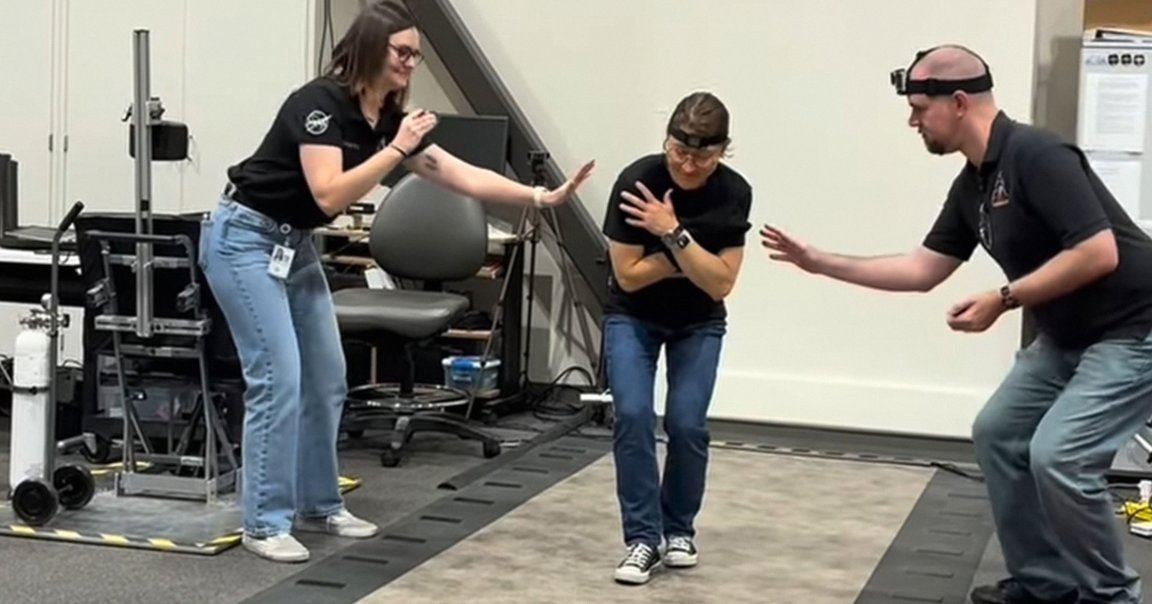
At a high level, returning to our home planet can also throw space travelers’ sense of balance completely out of whack. As NASA astronaut Christina Koch — who traveled around the Moon and back alongside her fellow crew members earlier this month — demonstrated in a recent video, getting used to Earth’s gravity again isn’t exactly easy.

The clip she shared on Instagram roughly a week after splashing down in the Pacific Ocean shows her visibly struggling to put one front in front of the other while her eyes are closed.

“Guess I’ll be waiting a minute to surf again,” she wrote in the caption.

Her stumbling is the result of the brain no longer being able to rely on the vestibular system within the inner ear for knowing which way is up and which is down. In other words, Koch likely would’ve fared much better with her eyes open.

“When people live in microgravity, the systems in our body that have evolved to tell our brains how we’re moving, the vestibular organs, don’t work correctly,” Koch explained. “Our brains learn to ignore those signals and so when we first get back to gravity, we are heavily reliant on our eyes to orient ourselves visually.”

“A tandem walk with eyes closed can be quite the challenge!” she admitted. “Learning about this can help inform how we treat vertigo, concussions and other neuro-vestibular conditions on Earth.”

Koch is no stranger to spending prolonged periods of time in space. While this month’s Artemis 2 mission took place over just ten days, the NASA astronaut has previously spent almost a year on board the International Space Station.

While astronauts spend significant portions of their time in space exercising to stave off the detrimental effects microgravity has on their physical health, we have yet to find an effective way to help them restore their sense of balance once they’re Earthside — other than Father Time, that is.

“With eyes closed, it was almost impossible to walk in a straight line,” European Space Agency astronaut Andreas Mogensen told NASA after his journey to the ISS last year.

“I felt wobbly for the first two days,” added fellow crew member NASA astronaut Jasmin Moghbeli. “My neck was very tired from holding up my head.”

In short, stumbling over your own two feet with your eyes closed seems like a small price to pay considering Koch’s spectacular journey around the Moon, which provided some genuinely breathtaking views.

More on Artemis 2:

{ https://futurism.com/ }

Hoe vind je dit bericht?
Geschreven door peter om 20:38 Stuur door

COLIBRE simulation: How cold gas and dust change our understanding of galaxies

COLIBRE simulation: How cold gas and dust change our understanding of galaxies

COLIBRE simulation panels: on the left—the cosmic web (gas and stellar density); on the right—two separate galaxies. Source: Schaye et al. (2026) MNRAS.

Why COLIBRE and where its predecessors failed

The COLIBRE project (COLd Ism and Better REsolution) is a set of hydrodynamic simulations of galaxy formation and evolution. The lead author of the study is Joop Schaye, a professor at Leiden University in the Netherlands, along with a large international team. 

Scientists have long known that most of the gas inside real galaxies is cold and dust-filled. It is from this gas that new stars form. However, previous large-scale simulations, including IllustrisTNG, were unable to fully reproduce this phase: they artificially set lower limits for the gas’s temperature and pressure. 

COLIBRE removes this limitation—the interstellar medium is modeled here without such simplifications. In addition, the simulation tracks the evolution of dust particles and incorporates updated feedback models from supernovae and active galactic nuclei (AGNs)—supermassive black holes that actively accrete matter and emit powerful jets.

Answer to James Webb’s riddle

The James Webb Space Telescope has detected black holes and galaxies in the early Universe that are more massive than predicted by the standard cosmological model—Lambda-CDM (Lambda-CDM with dark energy and cold dark matter). This has sparked a debate: should the fundamental theory be rewritten? COLIBRE offers a cautious answer: if physical processes are described more realistically, the standard theory is consistent with the observed data. 

“Some of the early results from the James Webb Space Telescope seemed to challenge the standard cosmological model,” says Evgenii Chaikin of Leiden University. “COLIBRE shows that, after a more accurate treatment of key physical processes, it matches what we observe.”

What was left out

However, the simulation was unable to solve all the mysteries. In particular, it does not reproduce the so-called “Little Red Dots”—unusual compact objects detected by the James Webb Space Telescope in the early Universe. Researchers believe that these may be the precursors to supermassive black holes. 

COLIBRE simply takes the existence of such black holes as a given, rather than simulating their formation. The authors also note that the structure of the molecular clouds from which stars form is not reproduced in sufficient detail in most of the galaxies included in the project.

Simulation with sound

In addition to its scientific value, COLIBRE has another unusual feature: its visualizations are accompanied by sound—every process in the galaxy has its own corresponding sound. James Trayford of the University of Portsmouth, who led the development of the audio component, explains that this approach can spark new scientific insights and make research more accessible to a wider audience. 

The project also offers interactive maps that anyone can use. Most of the simulations were completed in 2025,  }}}and the rest are expected to be finished after the summer of 2026.


Inside the QUIET Power Shaping Galaxies Through Their Central Black Holes

Cosmic Evolution of Star Formation, Gas, and Dust in Galaxies - Nick Scoville - 10/01/2025

{ https://universemagazine.com/en/articles-en/ }

Hoe vind je dit bericht?
Geschreven door peter om 20:23 Stuur door

Why are we so obsessed with UFOs? A history of flying saucers and why they continue to fascinate us

Why are we so obsessed with UFOs? A history of flying saucers and why they continue to fascinate us

A history of UFO sightings and the origins of the flying saucer craze

What exactly are UFOs? | Articles | CBC Kids

by Robert Pateman

Where did our obsession with UFOs begin?

Was there a time when we weren’t convinced that intelligent beings from the vastness of space are regularly visiting Earth?

Astrobiology and the search for extra-terrestrial intelligence is one thing, but what about tales of disc-shaped alien craft visiting Earth, and even in some cases allegedly abducting humans and bringing them onboard?

A brief history of flight

To answer these questions, we must go back to the conquest of flight – not by Wilbur and Orville Wright, but by the Montgolfier brothers over a century earlier.

In 1783, they amused King Louis XVI and Queen Marie Antoinette by sending their balloon Aerostat Réveillon, with a crew of a sheep, a duck and a rooster, on a short journey across the French countryside.

Only 50 or so years later, we were visualising a time of unlimited flight, with Edgar Allan Poe sending the hero of The Unparalleled Adventure of One Hans Pfaall (1835) to the Moon in a balloon. 

Yan' Dargent's illustration of 'The Unparalleled Adventure of One Hans Pfaall'. Credit: Yan' Dargent

Then, in the second half of the 19th century, science fiction’s favoured method of spaceflight changed, thanks to the development of more powerful artillery.

Howitzer guns were reaching the point where they could fire shells of over 1,000kg (2,200lb) for many kilometres – so in Jules Verne’s From the Earth to the Moon (1868), the astronauts were launched from a giant cannon. 

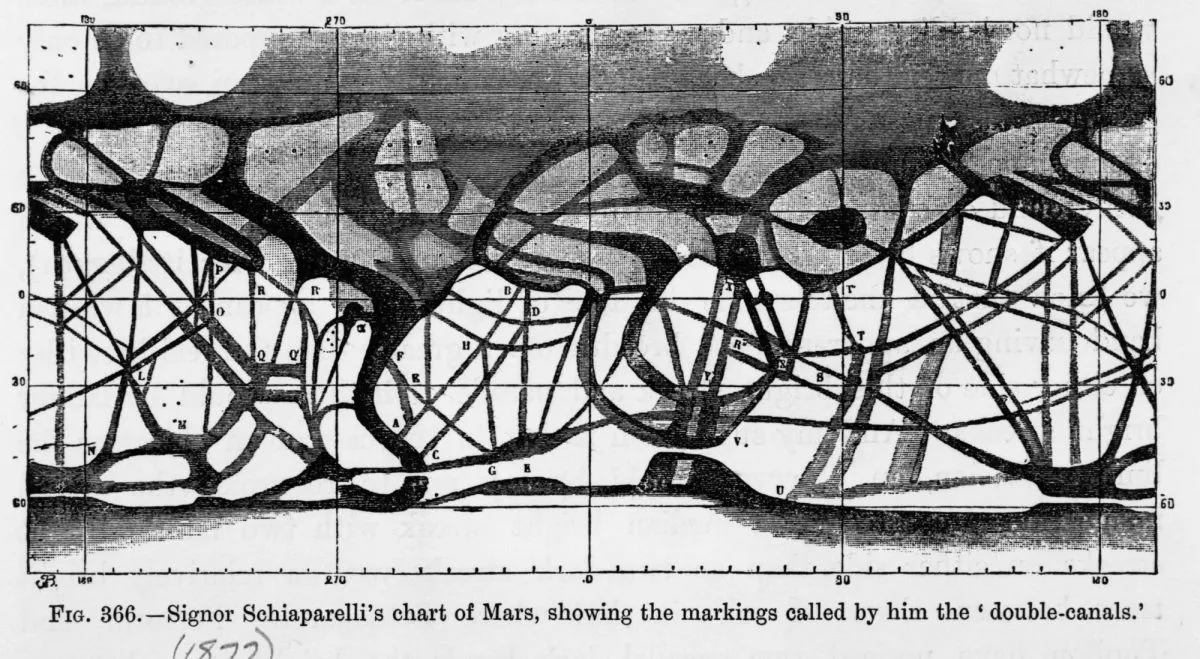
Signor Giovanni Schiaparelli's (1835-1910), chart of Mars showing the Signor Giovanni Schiaparelli's (1835-1910), chart of Mars showing the "double canals". Credit: Bettmann / Contributor / Getty Images

From canals to invasions

Around the same time, imagination and prediction combined with rather flimsy scientific argument in the writings of Camille Flammarion.

The French astronomer, author and conspiracy theorist speculated on the existence of extraterrestrial life in La Pluralité des Mondes Habités (1862).

Fifteen years later, in 1877, such beliefs appeared vindicated when Italian astronomer Giovanni Schiaparelli reported a network of ‘canali’ on the surface of Mars.

The word actually just means ‘channels’, but was duly mistranslated as ‘canals’ – fuelling speculation that Mars might be inhabited by aliens.

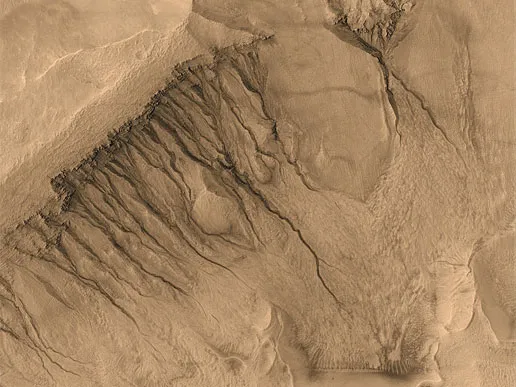
Gullies and channels on Mars. Credit: NASA Gullies and channels on Mars. Credit: NASA

Yet, at the time, there was no immediate interest in extraterrestrials visiting Earth.

When the Mexican astronomer José Bonilla not only saw but actually photographed strange objects (now thought to have been comet fragments) moving across the Sun in 1883, there was no speculation about these being visiting spaceships.

Even Flammarion, who published a report of Bonilla’s sightings in French magazine L’Astronomie, was sceptical, believing the objects to be birds, insects or even dust in front of the telescope. Humans were just not ready for visits from aliens… but we were getting there. 

In the mid-1890s, HG Wells put two ideas together – artillery-propelled spacecraft and intelligent life on Mars – to write the greatest science-fiction story of the era, The War of the Worlds. 

Its publication coincided with the airship wave of 1896–97, when numerous sightings were made of unidentified airships cruising the skies over the USA.

Most reports appeared in small-town newspapers, such as the Yates Center Farmer’s Advocate or the Table Rock Argus, with vague mentions of “anonymous but reliable” witnesses. 

Illustration of Martians attacking from a 1906 edition of The War of the Worlds by H.G. Wells. Credit: Bettmann / Getty Images Illustration of Martians attacking from a 1906 edition of The War of the Worlds by H.G. Wells. Credit: Bettmann / Getty Images

Speculation regarding the origin and construction of these airships, however, tended to centre not on aliens but on the concept of the ‘mad scientist’.

This reflected the sci-fi tropes of the day, including Jules Verne’s submarine Nautilus, the invention of the genius Captain Nemo, and HG Wells’s time machine, the work of one inventor-scientist. 

There was a single, isolated and rather tongue-in-cheek report of contact with aliens during this period: 1897’s Aurora UFO Incident.

The Dallas Morning News carried the story of an airship with a single crew member, a pilot who was “not of this world”.

The story’s authenticity has been debated, but the fact that the paper did not make it their lead story, affording it only a six-paragraph summary, is perhaps the most damning criticism.

What the Aurora story does show is that people were now aware of the possibility of the existence of extraterrestrial life. 

The original newspaper report on the Aurora UFO incident in 1897. By S. E. Haydon(Life time: fl. 1897) Public Domain, Wikipedia The original newspaper report on the Aurora UFO incident in 1897. By S. E. Haydon(Life time: fl. 1897) Public Domain, Wikipedia

Moving on to the early 20th century, 1919 saw the publication of The Book of the Damned by Charles Fort.

From 1906, Fort collected accounts of anomalies, a task that would take up most of his life.

His 1919 book detailed phenomena as diverse as objects falling from the sky, mythological creatures, spontaneous combustions and, of course, UFO sightings.

It is a difficult read, once described as “negotiating a literary assault course, but worth the bumpy ride”.

No doubt if Fort had not catalogued these anomalies, somebody else would have – but it was Fort’s research that would feed our interest in the unexplained 40 years later.

science wonder stories

Early unexplained sightings

Curiously, the period around 1930 to 1940 then saw a drop in reported UFO sightings, despite it being a golden period for science fiction, with the arrival of magazines such as Amazing Stories.

The magazine’s striking front covers reflect the vision of the time, with spaceships that were generally envisaged as metal versions of airships.

However, the 1929 cover of Science Wonder Stories featured a saucer-shaped craft that might well have influenced later UFO sightings. 

Then unexplained phenomena, mostly in the form of moving lights, became common during the Second World War.

With more aircraft flying under all weather extremes, and with nervous crews continually searching the sky for danger, there were too many sightings to be ignored.

This marked the start of a period of official investigations, leading to Project Blue Book, the code name for the US Air Force’s study into UFO reports. Started in 1952, it would not be terminated until 1969. 

UFO flying saucer. Credit: Ray Massey / Getty Images Credit: Ray Massey / Getty Images

The 'flying saucer' is born

The world of unexplained flying objects changed forever on 24 June 1947, when Kenneth Arnold, a businessman and aviator, reported seeing a group of “bat-like aircraft flying in formation at high speeds” near Mount Rainier in Washington State.

He didn’t describe them as saucer-shaped, but his remark that they were “moving like a saucer would if skipped across water” is widely believed to have been the origin of the term ‘flying saucers’. 

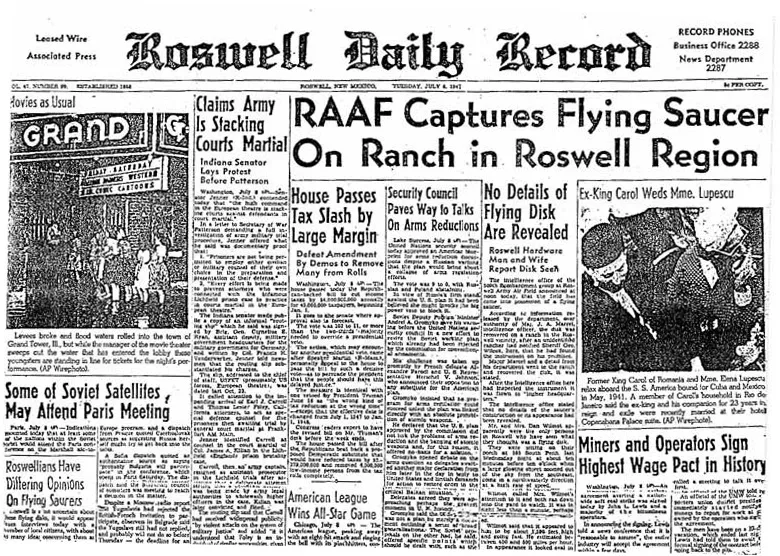
There followed a burst of UFO sightings over the next year, and on 8 July, the Roswell Daily Record led with the story ‘RAAF Captures Flying Saucer’.

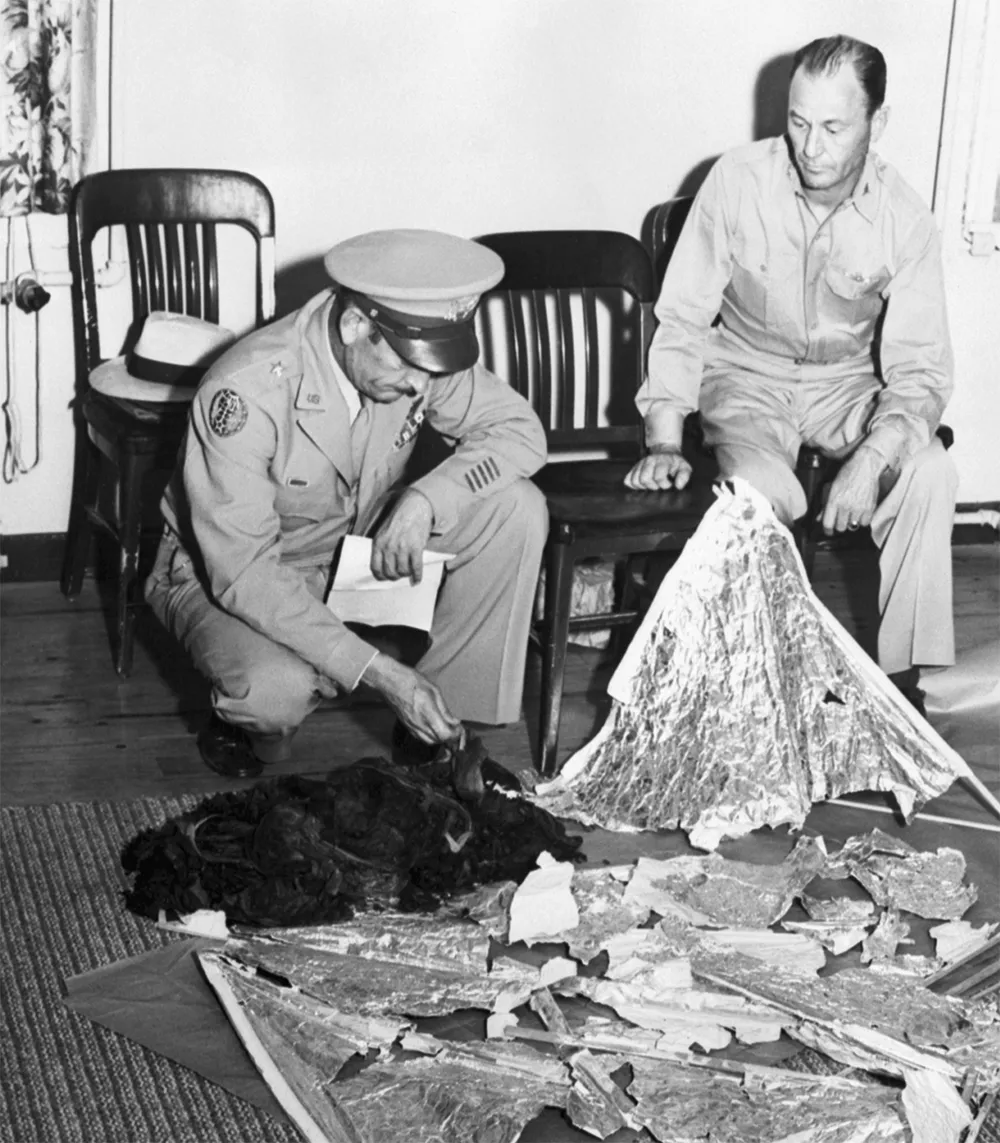
It was a dramatic headline, but that original story in a small local newspaper quickly faded from memory after the military identified the debris as nothing more than pieces of a weather balloon.

After that, Roswell would, for the time being, be forgotten. 

At Fort Worth Army Air Field on 8 July 1947, Brigadier General Roger M Ramey (left) and Colonel Thomas J Dubose, identify metallic fragments found at Roswell as pieces of a weather balloon. Credit: Bettmann / Getty Images At Fort Worth Army Air Field on 8 July 1947, Brigadier General Roger M Ramey (left) and Colonel Thomas J Dubose, identify metallic fragments found at Roswell as pieces of a weather balloon. Credit: Bettmann / Getty Images

In 1950, newspaper reporter Edward Van Winkle Jones wrote an article for the Miami Herald on “strange events”, in which he included the story of the disappearance of Flight 19.

In December 1945, a flight of five Avenger torpedo bombers had become disorientated, run out of fuel and ditched into the sea.

Matters got worse when a large flying boat sent out to search for the downed planes was also lost, most likely due to an in-flight explosion.

Neither incident caused any immediate excitement;  it had just been a bad day for the US Navy.

Jones’s article offered no explanation for the losses, and there was not a UFO in sight; his theme was that not everything in our world could be explained. 

But then in 1962, Allan W Eckert, a successful author of children’s novels, wrote ‘The Mystery of the Lost Patrol’ for the American Legion Magazine – marking the start of Flight 19 as a UFO legend.

The four-page article, with dramatic drawings of a shocked pilot staring at some unseen horror, was followed by a series of interviews in which pilots assured readers that sightings of unexplained flying objects happened all the time. 

The front page of the Roswell Daily Record from 9 July 1947. Credit: Roswell Daily Record The front page of the Roswell Daily Record from 9 July 1947. Credit: Roswell Daily Record

Magazines fan the flames

There were, of course, those who stepped forward to offer the opposite argument.

The Times, for example, carried a story from the US Office of Naval Research that linked UFO sightings to the testing of a new series of military balloons.

Despite the occasional voice of reason, the fascination with UFOs – as they were now known, thanks to Project Blue Book director Captain Edward J Ruppelt – remained undiminished. 

In an age before there was a television in every house, two forces drove this phenomenon.

The first was magazines, which in those days could be found in every doctor’s and dentist’s waiting room.

Magazines thrived on photographs, and with more and more people owning cameras, pictures of UFOs were bound to appear.

They were generally a pretty poor collection, but as UFO excitement spread, Life magazine reprinted the so-called ‘McMinnville UFO’ photographs, taken on a farm in Oregon in 1950.

Given the blessing of Life, these and other UFO images were printed in newspapers around the world.

One of the McMinnville UFO photographs. Credit: Paul Trent / Wiki Commons

As several hoaxes were exposed, more serious magazines began to shy away from UFO stories;
the gap was filled by the National Enquirer.

The magazine had always specialised in sensation and scandal, but in 1967, its owners – wanting to gain access to the supermarkets – switched from sex to UFOs.

Headlines such as ‘Crippled UFO Orbiting Earth’ and ‘Kidnapped by a UFO’ now boomed out at every American family doing their weekly shopping. 

In addition to magazines, this was the golden age of clubs and societies, with everyone from model-railway builders to ukulele players forming clubs to meet and discuss their passions.

Despite communication being largely by post, these societies had a remarkable ability to grow and expand.

In 1953, Denis Plunkett, a civil servant from Bristol, UK, answered an advertisement from the Connecticut, USA-based International Flying Saucer Bureau and was invited to found the British branch of what was becoming an international organisation.

At its height, the British Flying Saucer Bureau had 1,500 members and in a busy week might receive 30 reports of unusual objects in the sky.

By the 1950s, the French future Nobel Prize in Literature winner Annie Ernaux could note that conversations around a French village dinner table centred on Algeria, memories of the last war, and whether flying saucers were real.

What would happen if we made contact with aliens? Credit: KTSDesign/SCIENCEPHOTOLIBRARY/Getty Credit: KTSDesign/SCIENCEPHOTOLIBRARY/Getty

Cover-ups and conspiracies

The interest in UFOs attracted a huge number of authors, with Donald Keyhoe’s The Flying Saucers Are Real and Frank Scully’s Behind the Flying Saucers (both 1950) giving birth to the great age of UFO conspiracy theories.

Why did aliens only visit now? Well, the answer clearly was that we had recently developed atomic weapons.

Others argued that no, we had always been under scrutiny, and Erich von Däniken took UFO publishing in this direction with Chariots of the Gods? (1968).  

It was during this period that stories about both Roswell and Flight 19 began to resurface.

Charles Berlitz wrote The Bermuda Triangle in 1974. Playing fast and loose with the facts, it sold nearly 20 million copies, cementing Flight 19’s place in UFO legend.

The story would, of course, inspire the brilliant opening scene of Close Encounters.

Roswell was largely forgotten about until 1978, when the National Enquirer reprinted the original story, and Jesse Marcel, who had led the initial investigation, was interviewed by UFO ‘expert’ Stanton Friedman.

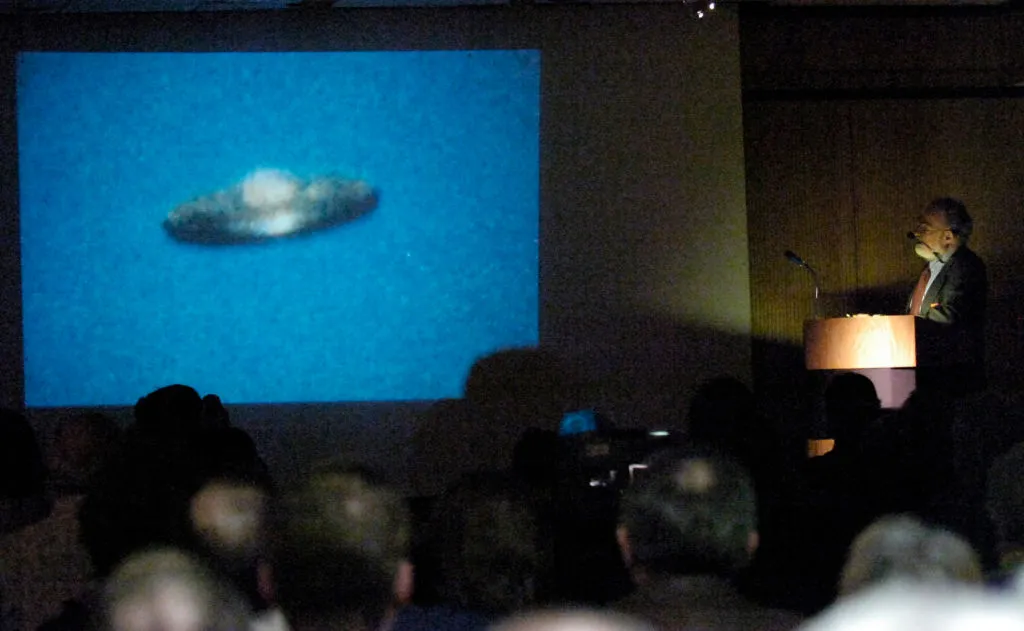
Nuclear physicist Stanton T. Friedman giving a talk about UFOs in 2007. Photo By Krissy Krummenacker/MediaNews Group/Reading Eagle via Getty Images Nuclear physicist Stanton T. Friedman giving a talk about UFOs in 2007. Photo By Krissy Krummenacker/MediaNews Group/Reading Eagle via Getty Images

When Marcel said he believed Roswell debris to have been extraterrestrial, Roswell became the centre of the UFO world, changing the nature of UFOlogy.

UFOs were no longer about advanced alien scouts spying out Earth for an invasion that was coming any day.

It was about a previous contact – perhaps involving a crashed spaceship – being covered up by the government.

In the shadow of the Kennedy assassination and Watergate, government cover-ups were something everybody could believe in.

Charles Berlitz, looking for a follow-up to his Bermuda Triangle success, jumped on the bandwagon with The Roswell Incident (1980).

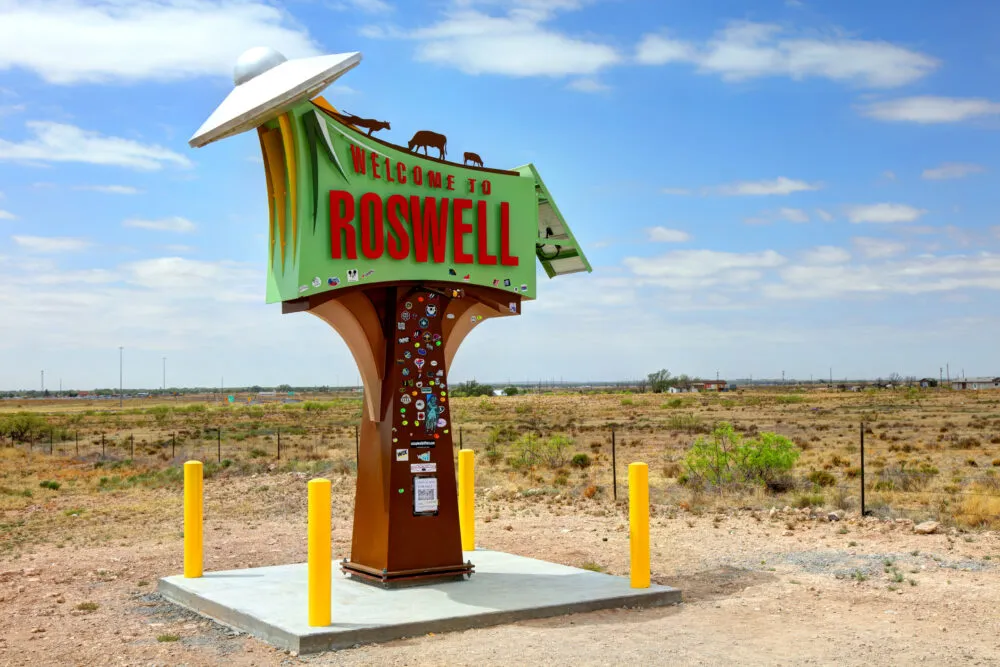
Roswell, New Mexico has fully embraced its credentials as the most famous city in UFO folklore. Credit: Denis Tangney Jr / Getty Images Roswell, New Mexico has fully embraced its credentials as the most famous city in UFO folklore. Credit: Denis Tangney Jr / Getty Images

The saucer craze fades

Yet UFO excitement was reaching its peak. Back in 1950, it seemed as if the aliens would be arriving any day, but by 1980, we had grown tired of waiting.

A public that watched the USS Enterprise boldly going where no one had gone before was finding 
the pictures of UFOs from the 1950s embarrassingly amateurish.

The debris from Roswell looked far more like the balloon that the military had said it was than it did a crashed spaceship.

Stories of alien abductions, or self-proclaimed UFO contactee George Adamski claiming to have hitched a lift around the Solar System, didn’t help. 

Douglas Adams nicely mocked it all in The Hitchhiker’s Guide to the Galaxy (1979) with his description of ‘Teasers’: bored rich kids that “land right by some poor unsuspecting soul whom no one’s ever going to believe and then strut up and down in front of him wearing silly antennas on their head and making beep beep noises”.

In 2001, the British Flying Saucer Bureau closed after 50 years of chronicling supposed UFO activities.

Nobody was coming to meetings in cold church halls any more; people were staring down at their computer screens rather than up at the sky.

Image of comet 3I/ATLAS over Egypt's Black Desert, captured by Osama Faithi, 29 November 2025, 03:00 local time. Equipment: Nikon Z6 astro-modified camera, RedCat telescope lens Image of comet 3I/ATLAS over Egypt's Black Desert, captured by Osama Faithi, 29 November 2025, 03:00 local time

Humans are still interested in UFOs, including a few ‘wow’ moments on the internet, such as pictures of statue-like rocks on Mars or, most recently, the fly-by of interstellar comet 3I/ATLAS.

And just as 19th‑century imaginations were fired by balloons and airships, 3I/ATLAS theories fit within our modern sense of what might be possible – hence several sci‑fi writers suggesting the idea of adapting asteroids as vessels for space travel.

So yes, we are still willing to believe in intelligent life on other worlds.

The movies may have moved on from UFOs landing in farm fields to the loud ‘here we are’ of Independence Day-style invasions, but until alien spaceships actually hover over the White House, UFOs can no longer command our ever-more fickle attention as they did in the 1950s. 

RELATED VIDEOS

A history of flying saucers and UFOs

UFO's Are Real | FULL MOVIE | Aliens Sci-Fi Documentary

Most Unbelievable UFO Encounters Ever | The Proof Is Out There | History

{ https://www.skyatnightmagazine.com/ }

Hoe vind je dit bericht?
Geschreven door peter om 18:25 Stuur door

7 Mile UFO Shots Past Sun, NASA Calls it Comet, But They Lie, UAP Paranormal Alien Sighting News.

7 Mile UFO Shots Past Sun, NASA Calls it Comet, But They Lie, UAP Paranormal Alien Sighting News.

Screenshot%202026-04-27%20at%2012.39.10%E2%80%AFPM.png

Screenshot%202026-04-27%20at%2012.37.28%E2%80%AFPM.png

Screenshot%202026-04-27%20at%2012.38.38%E2%80%AFPM.png
 
Date of discovery: April 26, 2026
Location of discovery: Earths sun
Source: Helioviewer.org
 
Guys check this out. I caught a 7-10 mile UFO disk shooting slowly across the NASA satellite view of our sun. The object is barely making a trail at all so that truly rules out comet. However NASA calls it a comet labeling as Comet R3 pan-starrs also called comet C/2025 R3. Take a look at the video yourself and you too will notice that there is barely any trail at all...that alone is enough because its flying near our sun and heat and radiation is hitting it at incredible rates, I asked ai...and it blew my mind. 

🔥 Result Heat (solar energy): ~400–500× stronger than at Earth Radiation (UV, X-rays, solar wind): also hundreds of times higher, and even worse due to proximity to the corona. 
 
Ok so now we know...and we see so little tail on this comet which is 100% evidence that this is a 7-10 mile UFO. 
 
Oh...I forgot to say, the Helioviewer site is malfunctioning however I used a back door, which has full functions. Coincidence that this happened at this moment in time???? I think not. 
Scott C. Waring - UFO Sightings Daily 

{ https://www.ufosightingsdaily.com/ }

Hoe vind je dit bericht?
Geschreven door peter om 17:41 Stuur door

Security Cam captures mysterious ‘Spiritual Being’ during violent robbery

Security Cam captures mysterious ‘Spiritual Being’ during violent robbery

spiritual%20being.jpg

As the two struggle, something strange appears to happen. A shadowy figure seems to detach from the victim’s body, as if emerging from him, and confronts the attacker. The presence of this figure appears to protect the victim during the altercation. 
The attacker, clearly bewildered by what he is witnessing, quickly flees the scene. Shortly after, the shadowy figure disappears. The victim then gets back on his feet and continues on his way, seemingly unaware of what just occurred. 
Some interpret this incident as possible evidence of unseen spiritual realms. The true nature of the shadowy figure remains unknown, but it has led to speculation that it could have been a spiritual guardian-like being. It is suggested that these beings protect individuals throughout their lives and intervene during critical moments.
  

{ http://ufosightingshotspot.blogspot.com/ }

Hoe vind je dit bericht?
Geschreven door peter om 17:35 Stuur door

Top 10: The Largest Asteroids in the Main Belt

Top 10: The Largest Asteroids in the Main Belt

People usually imagine asteroids as rocks several kilometers in diameter. And this is true for most of them. However, in the Main Belt between Mars and Jupiter, you can find true giants whose size is comparable to that of some countries on Earth. Here are the ten largest of them.

Ceres is the largest object in the asteroid belt, but it is not an asteroid. Source: www.space.com

The largest objects in the Main Asteroid Belt

The Main Asteroid Belt lies between the orbits of Mars and Jupiter. It contains millions of asteroids. Most of them remain unknown due to their size and distance from Earth. Therefore, their total number is an estimate based on statistical data.

After all, the first asteroids were discovered just over 200 years ago. However, all the truly large rocks in this part of the Solar System are already known to us. So, we can compile a list of the largest ones.

That said, one clarification is in order. The largest object in the Main Belt – and the first to be discovered by astronomers – is called Ceres. For many decades, this nearly perfect sphere with a diameter of 942 km was considered the largest asteroid. However, in 2006, astronomers revised the classification of celestial bodies and introduced the concept of a “dwarf planet.” Pluto is most often mentioned in this context, as it was “downgraded.” However, the same thing happened to Ceres, which, on the contrary, was “upgraded” to a dwarf planet due to its spherical shape. Therefore, it is not included in today’s list.

Vesta. Source: Wikipedia

1. Vesta

In the absence of Ceres, Vesta is the largest asteroid in the main belt. This object, named after the ancient Roman goddess of the hearth, was one of the first to be discovered, back in 1804.

Vesta has an irregular shape. Its dimensions are 578×560×458. If its shape were slightly less asymmetrical, it could be classified as a dwarf planet, just like Ceres. The debate over which category it belongs to continues to this day.

There are quite a few craters on Vesta. The largest of them – Rheasilvia – is located at the asteroid’s south pole. Its diameter ranges from 475 to 500 km, which means it is quite comparable in size to the planet itself. In the center of the crater is a peak with a diameter of 180 km and a height of 22 km. It is the highest mountain in the solar system after Olympus Mons.

Pallas. Source: Wikipedia

2. Pallas

The second-largest asteroid in the main belt after Vesta is Pallas. In fact, this celestial body, named after the goddess of victory, was the second to be discovered after Ceres. And for a long time, it was believed that it was slightly larger than Vesta.

In fact, Pallas has a diameter of 512 km. Its surface has a lower albedo than Vesta’s and is more heavily cratered than the two previously mentioned bodies. It is believed that it underwent gravitational segregation, meaning that all the heaviest elements are concentrated closer to the core, while the lighter ones are located near the crust.

It is also interesting to note that spectroscopic studies have revealed the presence of hydrated materials on Pallas’ surface. This suggests that at some point in its history, it came into contact with liquid water.

Hygiea’s orbit. Source: Wikipedia

3. Hygiea

The third-largest asteroid in the Main Belt is Hygiea, named after the ancient Roman goddess of health. This object has a diameter of 431 km. Its orbit lies slightly farther from the Sun than that of other large asteroids. The average distance from our star is 3.1 AU, compared to 2.3 AU for Vesta and 2.7 AU for Pallas.

Hygeia is nearly spherical in shape and is the largest of the carbonaceous asteroids. Its surface is quite dark and contains a large amount of carbon compounds. Because of its dark surface, Hygiea is difficult to observe from Earth, which is why it was discovered nearly 50 years after Ceres. It takes 5.56 Earth years to complete one orbit around the Sun.

4. Interamnia

No matter how inconspicuous Hygiea may seem, it is nowhere near Interamnia, which ranks fourth among the largest asteroids in the Main Belt. This object’s albedo is only 0.074, meaning it is essentially black.

One of the first photographs of the asteroid Interamnia. Source: Wikipedia

That is why Interaminia, which has an irregular shape and measures 349 × 339 × 274 km, was discovered much later than other large asteroids. Astronomers from the Italian city of Teramo did not discover it until 1910. The name itself is a reference to the ancient name of that city.

It is also interesting to note that the perihelion – that is, the point in Interamnia’s orbit closest to the Sun – lies on the opposite side of the Sun relative to the corresponding points in the orbits of Ceres, Vesta, Pallas, and Hygiea.

5. Europa

The fifth-largest asteroid in the Main Belt is Europa. It is named after the daughter of the Phoenician king who, according to myth, was abducted by Zeus, and is one of Jupiter’s largest moons. This can lead to confusion, especially since Jupiter’s moon is larger and was discovered much earlier.

The orbit of the asteroid Europa. Source: Wikipedia

The asteroid Europa has a diameter of 302 km. Its average distance from the Sun is 2.8 AU. It is a carbonaceous asteroid and may belong to the same family as Hygiea. Hydrated minerals have also been found on it.

6. Davida

The asteroid Davida was discovered in 1903 by the American astronomer Raymond Dugan and named after David Todd, a professor of astronomy at Massachusetts College. It measures 357 × 294 × 231 km and has an average distance from the Sun of 3.168 AU.

Davida is a dark, irregularly shaped asteroid. However, a giant crater with a diameter of 150 km has been identified on its surface. This massive rock is extremely dense, accounting for about 1.5% of the total mass of the Main Belt.

Davida Asteroid. Source: Wikipedia

7. Sylvia

The asteroid Sylvia, the seventh-largest in the Main Belt, measures 385 × 265 × 230 km. It was discovered in 1866. It is characterized by an extremely low density: 1.2 g/cm³. This suggests that there must be huge cavities inside it.

There are two different theories as to why this asteroid was named as it was. Some say that it was named after the wife of the famous astronomer and science popularizer Camille Flammarion. In reality, however, this space rock was named in honor of Rhea Silvia, the mother of Romulus and Remus, the mythical founders of Rome.

8. Cybele

Cybele is a dark, carbonaceous asteroid from the outer part of the asteroid belt. It has a fairly elongated orbit. Its average distance from the Sun is 3.4 AU. The dimensions of this irregularly shaped celestial body are 302 × 290 × 232 km.

Cybele was discovered in 1861. It was named after the Phrygian goddess of agriculture. In turn, this asteroid gave its name to an entire family of asteroids that share a common origin.

The largest asteroids in the Main Belt. Source: Wikipedia

9. Eunomia

Eunomia, which ranks 10th among the largest asteroids in the Main Belt, measures 357×255×212 meters. It was discovered in 1851 and named after one of the daughters of Zeus and Themis, the goddesses of law and order.

Eunomia was discovered relatively early because it is a fairly bright silicate asteroid with a high albedo. It is retrograde, meaning it rotates in the opposite direction to the Sun.

10. Juno

Juno rounds out the top ten largest asteroids in the Main Belt. In terms of when it was discovered, it is actually the third-largest after Ceres and Vesta. However, its actual dimensions – 320 × 267 × 200 km – are not all that impressive.

The reason Juno was discovered as early as the beginning of the 19th century is that it is a silicate asteroid with a relatively high albedo. It was named after Jupiter’s wife, the goddess of marriage.

RELATED VIDEOS

Size Comparison Of The 10 Biggest Asteroids In Our Solar System! | Orion SciGeo

What Are The Largest Asteroids In The Asteroid Belt? - Astronomy Made Simple

Giants of the Belt: Unveiling the Top 5 Asteroids of Our Solar System

{  https://universemagazine.com/en/articles-en/ }

Hoe vind je dit bericht?
Geschreven door peter om 23:23 Stuur door

Ex-CIA psychic spy claims humans can tap into 'infinite consciousness'... and reveals how to unlock it

Ex-CIA psychic spy claims humans can tap into 'infinite consciousness'... and reveals how to unlock it

A former director of a secret US government psychic program claims every person has the hidden ability to tap into what he describes as the infinite consciousness of the universe.

Dale Graff, who led the CIA's Project Stargate, a classified Cold War initiative that explored psychic spying, said humans possess natural abilities that modern technology may be interfering with.

He believes devices such as cell phones could disrupt humanity’s ability to access these intuitive skills, though such claims remain controversial among scientists.

Graff led Project Stargate, a secret US military program that trained individuals to mentally perceive distant locations from the early 1970s until 1995, a technique known as remote viewing- the alleged psychic ability to perceive hidden, distant, or future information, places, or objects using only the mind, without physical senses.

The program explored whether trained viewers could gather intelligence simply by focusing their minds on specific coordinates.

Graff was not just overseeing the effort, but also participated as a remote viewer himself, attempting to perceive distant events without leaving his desk.

'We all have the potential to develop and use our natural psi ability,' Graff said.

Psi refers to alleged psychic abilities such as sensing distant places, anticipating future events, or accessing information beyond traditional senses.

'The keys lie in accepting the possibility of your psi nature, following a consistent approach to exercising that talent, and seeking ways to apply,' he added.

A former director of a secret US government psychic program claims every person has the hidden ability to tap into what he describes as the infinite consciousness of the universe

A former director of a secret US government psychic program claims every person has the hidden ability to tap into what he describes as the infinite consciousness of the universe 

For Graff and other remote viewers in Project Stargate during the 1970s and 1980s, this often meant attempting to locate secret military bases or weapons linked to the Soviet Union.

In one early success, remote viewers working with Project Stargate reportedly helped locate a missing Soviet bomber, producing estimates that were considered more accurate than some field-based intelligence efforts.

Other tests involved individuals aboard a submarine selecting images from a book, while remote viewers on land attempted to visualize the same pictures, exercises Graff said demonstrated the mind's ability to access distant information.

Graff later documented many of these experiments in his book, Tracks in the Psychic Wilderness, where he described what he viewed as evidence of humanity's hidden mental potential.

He believes society is only now beginning to rediscover the possibility of using intuitive brain abilities, roughly three decades after the program ended.

Despite remote viewing being discontinued by the US government, Graff remains a passionate advocate for what he describes as the benefits of developing psychic awareness.

'I discovered that by exploring our psychic realm, we automatically become more creative and intuitive. We sense deeper aspects of our psyche. As we uncover our psychic talents, we can help others in ways that would not be possible otherwise,' he wrote.

Graff added that he believes these abilities may even allow people to influence healing, suggesting that mental focus could one day be used to support recovery from injuries at a distance.

Dale Graff was the former director of Project Stargate, a secret US military project that weaponized the ability to see distant targets around the world with the mind

Dale Graff was the former director of Project Stargate, a secret US military project that weaponized the ability to see distant targets around the world with the mind

However, Graff's work extended beyond drawing sketches of distant locations; he also claimed to foresee catastrophic events before they occurred.

He described one vivid, life-like dream in which he saw a mid-air collision unfolding near mountainous terrain, with one aircraft flying away safely while the other crashed with no survivors.

Graff added that he even recalled seeing what appeared to be a newspaper headline from The Denver Post reporting the disaster while still inside the dream.

About a week later, he claimed, a real mid-air collision occurred near Colorado Springs, involving two aircraft, one that continued flying and another that crashed.

'How could it happen?' Graff later recalled asking himself.

He believes the answer lies in the mental training he developed through years of practicing remote viewing and lucid dreaming techniques.

Graff said he intentionally trained himself to visualize distant objects, interpret mental impressions, and explore what he described as the ability to anticipate future events.

A physicist and aeronautical engineer by training, Graff first became involved in research into remote viewing and lucid dreaming at the Stanford Research Institute during the 1970s.

Graff's book Tracks in the Psychic Wilderness looks back on some of the amazing achievements by the remote reviewers of Project Stargate

Graff's book Tracks in the Psychic Wilderness looks back on some of the amazing achievements by the remote reviewers of Project Stargate

That research program, funded in part by US intelligence agencies, would later evolve into Project Stargate during the height of the Cold War.

Graff said he believes psychic ability is not limited to trained specialists but may exist in many people who learn how to develop it.

'We found over the years that even people that didn't have any inkling that they could do this, given the motivation, and given the right kind of atmosphere... many people even though they didn't have prior experience, could do some level of what we call high-quality remote viewing,' Graff told the Outer Limits Of Inner Truth Reborn podcast in January.

'We've come to the conclusion that most people have a latent ability to do something of this nature. We all can do this in varying degrees,' he continued.

In the 21st century, however, Graff warned that modern lifestyles may be limiting people's ability to tap into what he described as the infinite consciousness.

When asked about heavy smartphone use and social media addiction, Graff suggested that radiation emitted from wireless technology is 'definitely going to affect' a person's mental structures, a claim that remains debated among scientists.

'We are drifting away from our intuitive state of mind when we rely so much on these external aides,' Graff shared.

The Stargate project was officially shut down in 1995 after government officials questioned how reliable remote viewing was as an intelligence tool.

Despite the program's closure, Graff maintains that the experiments conducted during the Cold War revealed untapped capabilities of the human mind.

RELATED VIDEOS

The Mystery of PROJECT STARGATE : CIA’s Secret Remote Viewing Program

THIRD EYE SPIES 👁️ – Full Documentary | Project Stargate & Remote Viewing

Historic Sleep Stories - You are a Remote Viewer for Project Stargate, 1980's

{ https://www.dailymail.com/news/index.html } 

Hoe vind je dit bericht?
Geschreven door peter om 22:59 Stuur door

EXCLUSIVE - Inside Trump's bombshell UFO files drop: Investigator reveals all the bone-chilling incidents that may finally be explained

EXCLUSIVE -  Inside Trump's bombshell UFO files drop: Investigator reveals all the bone-chilling incidents that may finally be explained

Americans are waiting with bated breath for the official announcement of President Donald Trump's UFO disclosure, which an insider believes will reveal 'reality-bending secrets.'

Trump made the order in February, directing the Pentagon to release all government files on UFOs and extraterrestrials in a move that could finally pull back the curtain on decades of closely guarded mysteries.

Joshua Golembeske, a field investigator for one of the world's oldest civilian UFO research organizations, the Mutual UFO Network (MUFON), told the Daily Mail: 'This is significant. A sitting US president publicly calling for the release of UAP-related information is unprecedented.

'So the question is: what, if anything, is being withheld from the public and why? What reality-bending secrets or world-changing technologies could be sitting inside these programs? 

Golembeske suggested the release could include confirmation of certain events, such as the infamous Roswell crash, the 'Tic Tac' incident in 2004, as well as lesser-known cases like the 1978 Fort Dix encounter.

He also said the path to full disclosure would unfold in four stages, beginning with official acknowledgment that humans are not alone, followed by efforts to define exactly what the mysterious phenomena are.

That would then be followed by revelations about the nature of the beings involved, whether extraterrestrial, interdimensional or something else entirely, before addressing the technology and long-standing questions tied to the encounters.

'First comes acknowledgment that we are not alone… and then it gets weird,' Golembeske said, describing what he believes will be a slow and carefully managed rollout of information.

The UFO expert said Americans could learn the truth about the famous 2004 Tic-Tac incident. A screenshot from the video of a Navy pilot tracking the spacecraft over the Pacific. US military personnel in California believe they saw UFOs off the coast on November 14, 2004

The UFO expert said Americans could learn the truth about the famous 2004 Tic-Tac incident. A screenshot from the video of a Navy pilot tracking the spacecraft over the Pacific. US military personnel in California believe they saw UFOs off the coast on November 14, 2004

Trump's order covers records on 'alien and extraterrestrial life,' UFOs and 'any and all other information connected' to these subjects.

'Trump now has a group of lawmakers backing him, demanding answers and openly challenging what's often referred to as the 'legacy program,'' said Golembeske.

'That term describes a decades-long effort with three potential areas: crash retrieval of unknown technology, reverse engineering through private aerospace, and a coordinated disinformation layer.'

Secretary of War Pete Hegseth was tasked with leading the effort to produce these files, with some proponents suggesting this could force the acknowledgment of evidence. 

Less than a month later, on March 18, the White House registered the domain 'aliens.gov,' and weeks later, the website showed a sign of activity.

The federal domain aliens.gov, which previously appeared inactive, is now returning an SSL error, a technical signal that the address may be connected to a live server but is not yet fully configured for public access.

An SSL error typically occurs when a server is set up, but the digital certificate required to establish a secure connection has not been obtained.

This usually means the domain is no longer dormant and may be undergoing development, even if no visible content has been published.

Another famous UFO case that could be solved is the 1947 Rosewell incident. Pictured is a military official holding what was initially believed to be an alien craft

Another famous UFO case that could be solved is the 1947 Rosewell incident. Pictured is a military official holding what was initially believed to be an alien craft

The US Army initially reported as a 'flying disc' before quickly retracting the statement to nothing but a weather balloon.

The US Army initially reported as a 'flying disc' before quickly retracting the statement to nothing but a weather balloon.

article image

'We're already in disclosure, and something significant has already been found,' Golembeske said. 'The evidence is overwhelming that we are being visited, and the government knows it. 

'Too many military and public officials have come forward, too many large-scale studies, too many consistent sightings over decades, too many multi-radar, multi-witness events.'

He added that when it comes to well-known military cases, the public should not expect full disclosures, but may see confirmation that certain events were genuine encounters.

Those include the 1974 Roswell incident in New Mexico, where a rancher found unusual debris, which the US Army initially reported as a 'flying disc' before quickly retracting the statement to nothing but a weather balloon. 

Golembeske also suggested Americans could finally get the truth about the oblong 'Tic-Tac' object spotted going at incredible speeds by \Navy pilots off the California coast, which was also picked up on sonar underwater.

On November 14 2004, Top Gun fighter pilot David Fravor was flying a training exercise off the coast of San Diego when he was rerouted to investigate a strange object spotted on radar by warships protecting his aircraft carrier, the USS Nimitz.

The Phoenix Lights were a series of sightings on March 13, 1997, when thousands of people across Phoenix and surrounding areas reported seeing a massive V-shaped formation of lights moving silently across the night sky

The Phoenix Lights were a series of sightings on March 13, 1997, when thousands of people across Phoenix and surrounding areas reported seeing a massive V-shaped formation of lights moving silently across the night sky

He said he saw a roughly 40-foot white object with no windows or wings, shaped like a Tic-Tac, flitting about above the sea that was roiling below it, disturbed by something large submerged beneath the surface.

Fravor told Congress in 2023 that as he circled the object, it turned to mirror his movements, then shot off past him at thousands of miles per hour, somehow stopping a second later at a secret pre-designated rendezvous point 60 miles away, which only he and a handful of Navy staff on his ship were given ahead of their training exercise.

Disclosure about the 1978 Fort Dix encounter may also be released, according to Golembeske, which refers to reports that soldiers at the New Jersey base claimed to have seen a glowing unidentified object moving low over the base during a nighttime training exercise.

According to accounts circulated by UFO researchers, multiple personnel allegedly witnessed the object before it quickly disappeared from view. 

The incident remains controversial because there are no widely released official military records confirming it, and most details come from later retellings rather than contemporaneous reports. 

The UFO expert said he would be interested to see files on the 1980s Hudson Valley UFO sightings

The UFO expert said he would be interested to see files on the 1980s Hudson Valley UFO sightings 

The Hudson Valley UFO sightings refer to hundreds of reports between 1982 and 1986 of large, slow-moving triangular objects seen across parts of the Hudson Valley

The Hudson Valley UFO sightings refer to hundreds of reports between 1982 and 1986 of large, slow-moving triangular objects seen across parts of the Hudson Valley

'Personally, I'd be most interested in deeper insight into major UFO waves over the past 50 years, events like the Phoenix Lights and the Hudson Valley sightings, which involved large numbers of witnesses and still lack clear explanations,' Golembeske said.

The Phoenix Lights were a series of sightings on March 13, 1997, when thousands of people across Phoenix and surrounding areas reported seeing a massive V-shaped formation of lights moving silently across the night sky. 

Witnesses described the lights as part of a huge craft that appeared to hover before slowly drifting out of view. Military officials later said some of the lights were flares dropped during training exercises, but many witnesses have disputed that explanation. 

The Hudson Valley UFO sightings refer to hundreds of reports between 1982 and 1986 of large, slow-moving triangular objects seen across parts of the Hudson Valley. 

Witnesses, including police officers and residents, described formations of bright lights that moved silently at low altitude over highways and towns. 

Investigators later suggested some sightings may have been caused by groups of private pilots flying in formation, though many observers believed the objects remained unexplained. 

Golembeske said the release of these records and others would likely unfold in stages, beginning with limited confirmations before expanding into deeper revelations about what the government believes it has encountered. 

The first step, acknowledgement, would be followed by defining what the various phenomena actually are.

President Donald Trump announced the disclosure order in February, directing the Pentagon to release records on 'alien and extraterrestrial life,' UFOs and 'any and all other information connected' to these subjects

President Donald Trump announced the disclosure order in February, directing the Pentagon to release records on 'alien and extraterrestrial life,' UFOs and 'any and all other information connected' to these subjects

Golembeske was skeptical about whether Americans would be told the sightings are coming from spacefaring extraterrestrials from our galaxy, time-traveling humans or interdimensional entities outside our known reality.

He highlighted how Florida Congresswoman Anna Paulina Luna said she had seen evidence of 'interdimensional beings.'

In the next stage of release, he said he expects officials would reveal the technology that has been recovered. 

This phase would focus on what governments may have learned from alleged recovered materials, including whether any advanced technologies were reverse-engineered.

The final step would involve answering broader questions about why these encounters are happening, why many reported beings appear humanoid and whether there are historical or religious connections tied to the phenomenon.

'Once that's established, the real questions begin, the ones that could change everything,' he said.

RELATED

Trump on UFO Hearing LIVE | Donald Trump Orders Release of 'Alien Files' | Congress Hearing LIVE

Trump Orders Pentagon UFO Files Release Soon | WION Podcast

{ https://www.dailymail.com/news/index.html } 

Hoe vind je dit bericht?
Geschreven door peter om 22:41 Stuur door

Meer van UFO'S of UAP'S, ASTRONOMIE, RUIMTEVAART, ARCHEOLOGIE, OUDHEIDKUNDE, SF-SNUFJES EN ANDERE ESOTERISCHE WETENSCHAPPEN - DE ALLERLAATSTE NIEUWTJES

↑ Terug naar de berichten