Ontdek de Fascinerende Wereld van UFO's en UAP's: Jouw Bron voor Onthullende Informatie!
Ben jij ook gefascineerd door het onbekende? Wil je meer weten over UFO's en UAP's, niet alleen in België, maar over de hele wereld? Dan ben je op de juiste plek!
België: Het Kloppend Hart van UFO-onderzoek
In België is BUFON (Belgisch UFO-Netwerk) dé autoriteit op het gebied van UFO-onderzoek. Voor betrouwbare en objectieve informatie over deze intrigerende fenomenen, bezoek je zeker onze Facebook-pagina en deze blog. Maar dat is nog niet alles! Ontdek ook het Belgisch UFO-meldpunt en Caelestia, twee organisaties die diepgaand onderzoek verrichten, al zijn ze soms kritisch of sceptisch.
Nederland: Een Schat aan Informatie
Voor onze Nederlandse buren is er de schitterende website www.ufowijzer.nl, beheerd door Paul Harmans. Deze site biedt een schat aan informatie en artikelen die je niet wilt missen!
Internationaal: MUFON - De Wereldwijde Autoriteit
Neem ook een kijkje bij MUFON (Mutual UFO Network Inc.), een gerenommeerde Amerikaanse UFO-vereniging met afdelingen in de VS en wereldwijd. MUFON is toegewijd aan de wetenschappelijke en analytische studie van het UFO-fenomeen, en hun maandelijkse tijdschrift, The MUFON UFO-Journal, is een must-read voor elke UFO-enthousiasteling. Bezoek hun website op www.mufon.com voor meer informatie.
Samenwerking en Toekomstvisie
Sinds 1 februari 2020 is Pieter niet alleen ex-president van BUFON, maar ook de voormalige nationale directeur van MUFON in Vlaanderen en Nederland. Dit creëert een sterke samenwerking met de Franse MUFON Reseau MUFON/EUROP, wat ons in staat stelt om nog meer waardevolle inzichten te delen.
Let op: Nepprofielen en Nieuwe Groeperingen
Pas op voor een nieuwe groepering die zich ook BUFON noemt, maar geen enkele connectie heeft met onze gevestigde organisatie. Hoewel zij de naam geregistreerd hebben, kunnen ze het rijke verleden en de expertise van onze groep niet evenaren. We wensen hen veel succes, maar we blijven de autoriteit in UFO-onderzoek!
Blijf Op De Hoogte!
Wil jij de laatste nieuwtjes over UFO's, ruimtevaart, archeologie, en meer? Volg ons dan en duik samen met ons in de fascinerende wereld van het onbekende! Sluit je aan bij de gemeenschap van nieuwsgierige geesten die net als jij verlangen naar antwoorden en avonturen in de sterren!
Heb je vragen of wil je meer weten? Aarzel dan niet om contact met ons op te nemen! Samen ontrafelen we het mysterie van de lucht en daarbuiten.
Saw this a few minutes ago, Moab, Utah Oct 7, 2025 UFO UAP sighting news. Aliens
Date of sighting: Nov 7, 2025
Location of sighting: Moab, Utah, USA
Hey all, as you can see I recorded this in Moab, Utah last week. This was Nov 7, not Oct 7, thats my mistake. I uploaded it while still in the car. Amazing how UFOs disguise themselves as clouds in order to come closer to the ground.
Scott C. Waring
Saw this a few minutes ago, Moab, Utah Oct 7, 2025 UFO UAP sighting news. Aliens 👽
Collected by the MeerKAT radio telescope, the recent radio observations reveal distinctive hydroxyl absorption lines, which astronomers point to as only further solid evidence of cometary activity.
Lending additional clarification to the ongoing debate over the mysterious object and its unique natural properties, the new findings also help to dampen renewed interest in its possible technological origins generated in recent days, following the object’s apparent display of non-gravitational acceleration during its closest approach to the Sun last month.
Recent imagery of the interstellar comet 3I/ATLAS (Image Credit: Gianluca Masi / The Virtual Telescope Project)
Latest Data from MeerKAT
Comprised of an array of radio telescopes in the Northern Cape province of South Africa, MeerKAT made its recent detections on October 24, according to the South African Radio Astronomy Observatory.
The observations revealed OH absorption at 1665 and 1667 MHz, which refers to the process astronomers use involving the detection of the hydroxyl radical (OH) molecule, which absorbs very specific radio or infrared frequencies from background sources. This results in a “dip” that astronomers identify as an absorption line in the observed spectrum.
Hydroxyl radicals are a well-established tracer of cometary behavior, which are formed when ultraviolet radiation breaks down water vapor released during sublimation. Because of this, astronomers frequently rely on these spectral lines to study gassy areas in space like nebulae, star-forming regions across the galaxy, and, of course, the phenomenon of cometary outgassing.
The Hydroxyl Key
In the case of the recent MeerKAT observations, molecular signatures were detected in association with 3I/ATLAS that are just the sort astronomers would expect to be typically produced when a comet heats up near the Sun.
While the detection confirms ongoing sublimation and solar-driven outgassing—normal behavior for comets—researchers still say continued monitoring of 3I/ATLAS will help to further assess the object’s physical profile during the time we have for observation prior to its departure from our solar system.
In summary, while the idea of radio signals emanating from an unusual comet may sound a bit like the kind of “technosignature” astronomers would hope for in the search for evidence of alien technologies, it’s actually something that is commonly observed in comets (like this one) and other kinds of celestial objects.
The recent successful MeerKAT detections were the third attempt made using the observatory, following efforts on September 20 and 28 that produced no observable signals. Fortunately, scientists will have additional opportunities to make observations of 3I/ATLAS in the months ahead before it returns to interstellar space, and will likely never be observed again.
The sensitive MeerKAT radio telescope array, located in the Karoo semi-desert in South Africa
(Credit: SARAO)
Next March, the comet will pass within just 53 million kilometers of Jupiter, where NASA’s Juno spacecraft will engage in further attempts to detect any low-frequency radio emissions it might be producing, specifically those ranging from 50 hertz to 40 megahertz.
For now, though, the new MeerKAT data offers the latest reinforcement of the mainstream scientific consensus: 3I/ATLAS is acting like a comet, even if some of its behaviors are a little strange (at least when compared to comets that have existed in our solar system for very long periods).
With additional observations planned for the early months of next year—and with the object passing near one of the best-positioned spacecraft for close-range monitoring—the search for more definitive insights into 3I/ATLAS, its nature, and unique composition, is really just getting underway.
Micah Hanks is the Editor-in-Chief and Co-Founder of The Debrief. A longtime reporter on science, defense, and technology with a focus on space and astronomy, he can be reached atmicah@thedebrief.org. Follow him on X @MicahHanks, and at micahhanks.com.
On October 30, the InnoCube satellite performed a maneuver in Earth’s orbit. This event might have gone unnoticed, but it was controlled by artificial intelligence for the first time in history. The test was successful.
InnoCube satellite in the laboratory. Source: phys.org
As a real milestone on the path to autonomous space systems, a research team from Julius Maximilian University of Würzburg (JMU) has successfully tested an AI-based attitude control system for satellites directly in orbit — a world’s first experience. The test was conducted on board the 3U nanosatellite InnoCube.
During the satellite’s passage between 11:40 and 11:49 Central European Time on October 30, 2025, an AI agent developed at JMU performed a complete orbital orientation maneuver, fully controlled by artificial intelligence. Using reaction wheels, the AI brought the satellite from its current initial orientation to a predetermined target orientation. The AI then had several further opportunities to demonstrate its capabilities: in subsequent tests, it also successfully and safely maneuvered the satellite into the desired orientation. The LeLaR research team—Dr. Kirill Djebko, Tom Baumann, Erik Dilger, Professor Frank Puppe and Professor Sergio Montenegro—thus took a decisive step toward space autonomy.
LeLaR Project
The goal of the In-Orbit Demonstrator for Learning Attitude Control (LeLaR) is to develop the next generation of autonomous attitude control systems. The main focus is on the development, training, and in-orbit testing of an artificial intelligence-based attitude controller aboard the InnoCube nanosatellite.
Attitude controllers stabilize satellites in orbit and prevent them from spinning chaotically. They are also used to point the spacecraft in the desired direction. For example, to align cameras, sensors, or antennas toward a specific target.
What makes this work special is that the Würzburg controller was not created using traditional, fixed algorithms. Researchers applied deep reinforcement learning (DRL), a branch of machine learning in which a neural network autonomously learns the optimal control strategy in a simulated environment.
The key advantage of the DRL approach is its speed and flexibility compared to classical control system development. Traditional orientation controllers often require lengthy manual parameter tuning by engineers—sometimes taking months or even years. The DRL method automates this process. In addition, it opens up the possibility of creating controllers that automatically adapt to differences between expected and actual conditions, eliminating the need for lengthy manual readjustment.
Bridging the gap between simulation and reality
Before implementation, the AI controller was trained on Earth in a highly detailed simulation and then uploaded to the flight model of the satellite in orbit. One of the biggest challenges was overcoming the so-called simulation-to-reality gap (Sim2Real) — ensuring that the controller trained in simulation would also work effectively on a real satellite in space.
“This is a real breakthrough,” emphasizes Djebko from JMU. “We have achieved the world’s first practical confirmation that a satellite orientation controller trained using deep reinforcement learning can operate successfully in orbit.”
Trust in AI in space applications
By successfully demonstrating an AI-based controller in orbit, the Würzburg team has shown that artificial intelligence can be reliably used in space missions that are critical to safety. Puppe is convinced that “this will significantly increase the acceptance of AI methods in aeronautics and space research,” pointing to the important role of simulation models. Growing confidence in this technology is a crucial step toward future autonomous missions, such as interplanetary or deep space missions, where human intervention is impossible due to vast distances or communication delays. An AI-based approach could thus become vital for the survival of spacecraft.
Prospects for the application of AI for satellite platforms
This successful test in orbit establishes the University of Würzburg as a pioneer in the field of space systems controlled by artificial intelligence. The demonstrated AI-based controller is an important building block for future space exploration. The results of the LeLaR project could enable faster and more cost-effective development of new, complex AI-based controllers for a wide range of satellite platforms.
“The next goal is to build on this initial success,” says Djebko. “This is a big step toward complete autonomy in space,” adds Montenegro. We are at the beginning of a new category of satellite control systems: intelligent, adaptive, and capable of self-learning.
Zijn Aliens Mensen Uit De Toekomst? Controverse en Vraagstukken in het UFO-debat
Inleiding
Het fenomeen van ongedefinieerde luchtverschijnselen, beter bekend als UFO's (Unidentified Flying Objects) of UAP's (Unidentified Aerial Phenomena), blijft één van de meest intrigerende en controversiële onderwerpen in de moderne wetenschap en populaire cultuur. Jarenlang werd dit terrein beschouwd als pseudowetenschap of puur sciencefiction, maar de laatste decennia zien we een toenemende ernst onder onderzoekers, overheidsinstanties en zelfs militaire instanties die zich verdiepen in deze mysterieuze verschijnselen. Recentelijk heeft een nieuwe invalshoek het discours flink opgewaardeerd: de gedachte dat sommige UAP's niet van buitenaardse origine zouden kunnen zijn, maar dat ze mogelijk de aanwezigheid of het bestaan van toekomstige mensen, of zelfs ondergrondse of onderwaterlevensvormen op aarde, kunnen vertegenwoordigen.
Deze nieuwe benadering, die men ‘cryptoterrestrische hypothese’ noemt, is voor velen nog steeds controversieel maar wint langzaam aan terrein, vooral door de invloed van nieuwe onderzoeksgegevens, geavanceerde technologie en de openheid van sommige wetenschappers en ingewijden. In dit artikel onderzoeken we de achtergrond en de implicaties van deze theorieën, geïllustreerd met voorbeelden en getuigenissen, en proberen we de vragen te beantwoorden: Zijn die vreemde wezens en objecten die we zien echt buitenaards? Of zouden ze misschien meer met ons eigen toekomstperspectief te maken hebben? Of nog verdergaande mogelijkheden zoals het bestaan van ondergrondse beschavingen of tijdreizen?
De Waarom en Hoe van het UFO-debat
Het ontstaan van het moderne UFO-debat werd voornamelijk gemotiveerd door de talloze waarnemingen, vaak zonder verklaring, die sinds de jaren 1940 en 1950 zich opstapelen. Voorbeelden hiervan zijn de beroemde Roswell-incident uit 1947, waarbij een mysterieuze resten van een onbekend object werden gevonden, of de vele video-opnamen en getuigenverslagen van militaire en civiele piloten die objecten zagen die fysiek onmogelijk leken volgens de bekende natuurwetten.
Deze waarnemingen leiden vaak tot de aanname dat we te maken hebben met buitenaardse bezoekers, een idee dat populair werd door sciencefictionfilms en boeken. Maar ondertussen groeit ook de overtuiging dat we niet alles over de fenomenen weten en dat andere, minder gangbare theorieën zelfs veel plausibeler kunnen zijn. Eén van deze theorieën is de cryptoterrestrische hypothese, die stelt dat sommige UAP's mogelijk niet van buitenaardse afkomst zijn, maar dat ze gehost worden door wezens en vormen van leven die onder of op onze planeet wonen, of zelfs door toekomstige menselijke beschavingen die terug in de tijd reizen.
De Analyse van Dr. Michael Masters
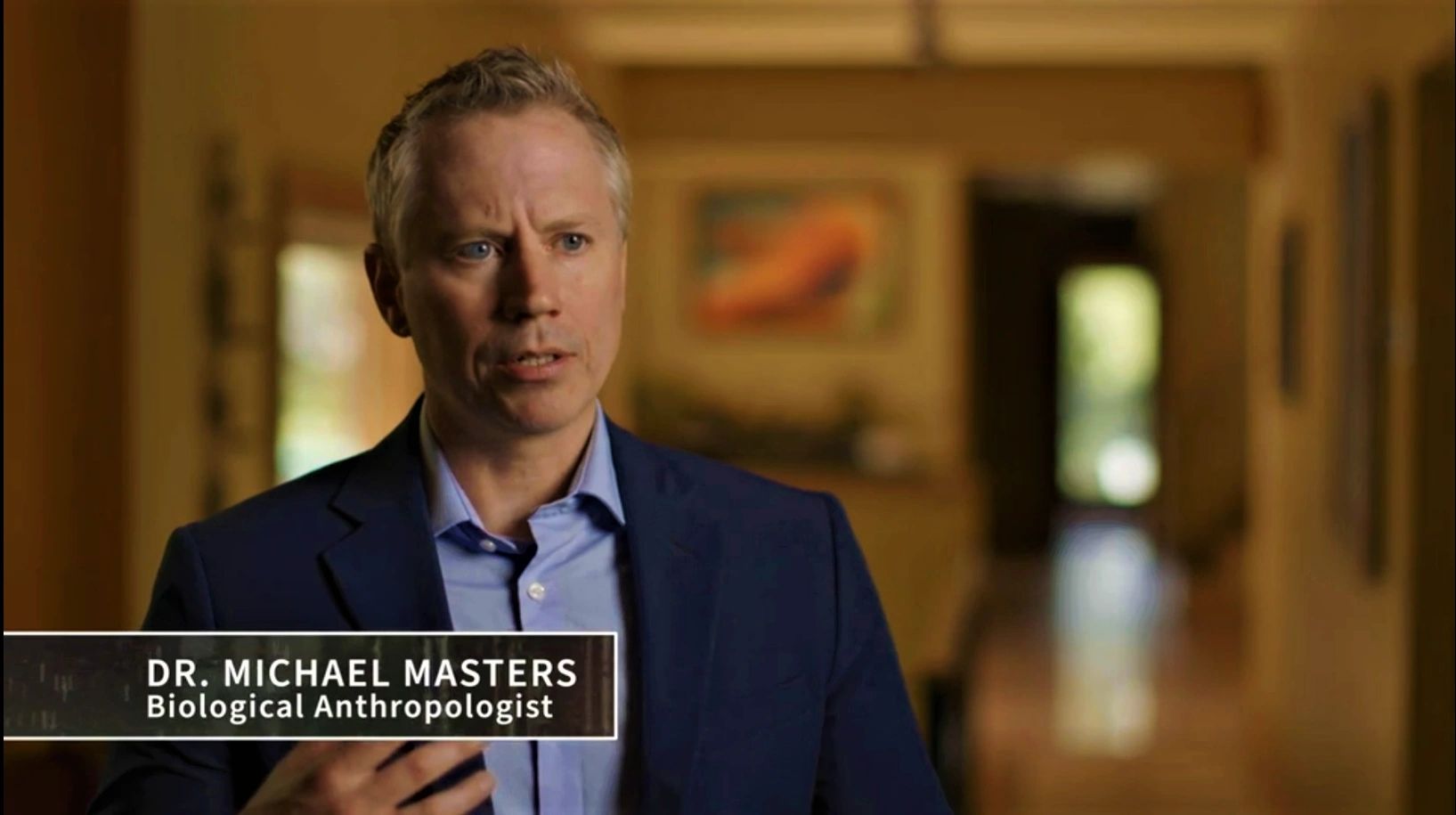
Een van de meest invloedrijke recente stemmen in dit debat is Dr. Michael Masters, een antropoloog verbonden aan Montana Tech University. In een interview met onderzoeksjournalist Ross Coulthart in juli 2024 besprak Masters zijn theorie dat veel van de herkenbare kenmerken van de ‘grijze aliens’, de mythologische wezens die algemeen worden afgebeeld in UAP-rapporten, misschien toch mensen van de toekomst kunnen zijn.
Volgens Masters worden deze verschijnselen vaak gekenmerkt door opvallend menselijke anatomische kenmerken, zoals de twee benen, twee armen, een grote hoofdvorm en grote ogen. Hij wijst hierbij op het concept van ‘synapomorfieën’, dat is een term uit de evolutionaire biologie die verwijst naar gedeelde afgeleide kenmerken die duiden op een gemeenschappelijke afstamming. Als deze kenmerken terug te voeren zijn op een evolutionaire lijn, dan zou dat kunnen betekenen dat deze wezens niet buitenaards zijn, maar van onze eigen soort of een verre afstammingslijn.
Masters vertelt bijvoorbeeld dat hij zich al van jongs af interesseerde voor de humanoïde vormen die beschreven worden in de bekende Amerikaanse roman ‘Communion’ van Whitley Strieber, en dat hij na diepgaand onderzoek erachter kwam dat veel van de kenmerken die in deze verhalen voorkomen, overeenkomsten vertonen met menselijke anatomie. Een verbluffend voorbeeld dat hij aanhaalt is het zien van schepselen met grote hoofden en juist grote ogen, die mogelijk een soort ’vergeestelijk whitemens’ zouden kunnen zijn die zich onder ons bevinden of in een ver verleden leefden en nog steeds ondergrondse of onderwaternetwerken gebruiken om zich te verbergen.
Cryptoterrestiële Hypothese en Alternatieven
Volgens Masters en andere voorstanders van de cryptoterrestrische theorie zouden deze ‘aliens’ of mysterieuze verschijnselen niet per se van buitenaardse herkomst zijn, maar kunnen ze ondergrondse of onderwaterlevensvormen betreffen, of zelfs intelligentie die afkomstig is uit het verleden of de toekomst. Het voorstel dat ondergrondse systemen—zoals de mysterieuze ‘Big Dig’ onder de Amerikaanse hoofdstad Washington of de ondergrondse steden in Turkije—plek bieden aan toch nog onbekende wezens, krijgt steeds meer aandacht.
Dr. Michael Masters
Ook het idee dat bepaalde figuren of verschijnselen niet uit de ruimte komen, maar mogelijk uit ‘cryptoveelanden’ die zich onder ons bevinden, wordt door sommige onderzoekers serieus genomen. Zo zijn er verhalen van militairen en bewoners die vreemde geluiden of lichtverschijnselen onder de grond melden, en dat deze wellicht het gevolg zouden kunnen zijn van levende organismen die zich niet op het zicht bevinden.
Bovendien is er het bewijs van geheime overheidsprogramma's en onderzoeksprojecten waarbij het gebruik van ondergrondse en onderwatergebieden een rol speelt. Sommige van deze projecten worden pas recentelijk openbaar, zoals het bekende ‘AQUARIUS’-programma dat zich richt op onderwaterspionage en ondergrondse bases. Het is voorstelbaar dat deze systemen gebruikt worden voor het verkennen of zelfs het bewonen van verborgen ecosystemen.
Voorbeelden hiervan zijn bijvoorbeeld de zogenoemde ‘UFO-raadsplaats’ in de Amerikaanse staat Nevada, waar militairen geluiden en lichtsignalen melden die niet van menselijke oorsprong konden zijn, en ook het rapport van whistleblower David Grusch, die verklaarde dat geheime overheidsprogramma’s al jaren bezig zijn met het verzamelen van artefacten en getuigenissen over ondergrondse beschavingen en tijdreizen.
De Rol van Tijdreizen en Futuristische Menselijke Beschavingen
Naast de cryptoterrestrische theorieën bestaan er ook ideeën dat sommige UAP's en ‘aliens’ symbolisch of daadwerkelijk het resultaat kunnen zijn van menselijke activity uit de toekomst, via zogenaamde tijdreizen. Op basis van de universele relativiteitstheorie en aanwijzingen uit kwantumfysica, bestaat de mogelijkheid dat geavanceerde beschavingen de technologie ontwikkeld hebben om door tijd te reizen.
Volgens deze theorie zouden de wezens die we waarnemen wellicht niet extraterrestrisch zijn, maar tijdreizende toekomstige mensen die beschikken over technologisch ver gevorderde middelen. Ze zouden terug in de tijd reizen om certain experimenten uit te voeren of om bepaalde kennis te verzamelen, vergelijkbaar met sciencefictionconcepten uit films zoals ‘Timeline’ of ‘The Terminator’.
Een voorbeeld dat vaak aangehaald wordt, is dat sommige UAP-solidaten geen duidelijke pilootfiguren of航tekeningen vertonen, maar zich gedragen als ‘onpersoonlijke’ entiteiten die door de lucht bewegen met onvoorstelbare snelheid en wendbaarheid. Dit zou kunnen wijzen op futuristische technologieën die wij momenteel niet begrijpen, maar die door een tijdreizende mensheid gebruikt worden.
Het bewijs voor deze theorie is nog zeer speculatief, maar sommige getuigenverhalen en geheime documenten lijken te suggereren dat tijdreizen mogelijk is op het niveau van de beschavingen die we nu nog enkel kunnen theoretiseren. Het “Haarlem Protocol”, dat mag worden gezien als een hypothetisch voorbeeld van tijdscommunicatie, wordt zelfs door sommige wetenschappers en ufologen aangehaald om de plausibiliteit te onderbouwen.
Voor- en Nadelen van de Cryptoterrestrische en Tijdreis-Hypothesen
De voorstanders van deze theorieën wijzen op de talrijke waarnemingen en aanwijzingen die niet passen binnen het klassieke buitenaardse scenario. Ze stellen dat het accepteren van deze alternatieven een bredere en meer inclusieve wetenschap zou stimuleren, en wellicht antwoorden biedt op eeuwenoude raadsels zoals de‘Verailles-codex’ of de mysterieuze ondergrondse tunnels bij Sao Paulo, Brazil.
Tegelijkertijd waarschuwen critici dat dergelijke theorieën te zeer gebaseerd zijn op speculatie en samenzweringstheorieën. Ze benadrukken dat het gebrek aan hard bewijs het moeilijk maakt om definitieve conclusies te trekken, en dat sommige onderzoekers te ver afdwalen in fantasieën die niet testbaar of falsifieerbaar zijn.
Toch blijft de discussie voortduren, vooral door recente onthullingen en de toenemende transparantie van overheden en defensie-instanties over UAP-dossiers. Het opkomende bewijs dat bepaalde fenomenen zich niet verdrijven met eenvoudige verklaringen, maakt dat de discussie over de ware aard van deze verschijnselen actueler is dan ooit.
Voorbeelden en Getuigenissen
Een treffend voorbeeld dat vaak aangehaald wordt, is de getuigenis van piloten van de Amerikaanse marine, die objecten zagen die zich onbegrijpelijk snel en zonder geluidsbarrière voortbewogen, en die geen mechanische of natuurlijke verklaring leken te hebben. In 2023 werden bijvoorbeeld video’s vrijgegeven waarin militaire piloten spreken over objecten met vormen en gedrag die het mogelijk maken dat ze niet van aardse origine zijn.
Daarnaast zijn er meldenissen van gewone burgers die vreemde lichtbollen boven hun huizen zagen zweven, of ondergrondse tunnels en bestratingen die niet inbegrepen waren in bestaande kaarten en theorieën. Sommige van deze getuigenissen werden geëxploreerd door cryptofysici en anonieme onderzoekers die concluderen dat het plausibel is dat ondergrondse of onderwater-ecosystemen samenhangen met de fenomenen.
Conclusie: De Grenzen van Wetenschap en Openheid
Het debat over de ware aard van UAP’s en de mogelijke rol van toekomstige of ondergrondse beschavingen vereist een open, multidisciplinaire aanpak die de cultuur, psychologie, biologie en natuurwetenschap integreert. We moeten voorzichtig zijn met te snel conclusies, maar tegelijkertijd niet blind blijven voor nieuwe ideeën die mogelijk onze perceptie van de werkelijkheid kunnen veranderen.
De recente theorieën over aliens als toekomstige mensen en cryptoterrestrische bewoning bieden een fascinerende blik op de diepere vragen: Wat betekent het om mens te zijn in een universum dat zo vol mysteries zit? Hoe kunnen we de mysterieuze verschijnselen interpreteren zonder in clichés te vervallen? En moeten we misschien onze blik naar buiten en naar binnen tegelijk richten, voor een vollediger begrip van het onbekende?
De toekomst brengt nieuwe technologische en wetenschappelijke doorbraken, en wellicht zullen we ooit in staat zijn om definitief te ontdekken of sommige UAP's wellicht niet buitenaards zijn, maar veeleer geheime spiegels van onze eigen evolutie, tijd, en ondergrondse werelden. Tot die tijd blijft het UFO-debat een fascinerende mix van wetenschap, mystiek en verbeelding, waarin alle mogelijke perspectieven hun plaats verdienen.
Wanneer we bedenken hoe de menselijke soort enorme technologische vooruitgangen en veranderingen doormaakt waarvan de effecten mogelijk pas na enkele/vele eeuwen of miljoenen jaren zichtbaar zijn, lijkt het inderdaad mogelijk dat toekomstige mensen er uit kunnen zien als buitenaardse wezens. Kijk naar het volgende:
Afname van het gebruik van menselijke ledematen, of het onvermogen van mensen om hun ledematen te gebruiken zoals wij dat nu doen. Kunstmatige ledematen kunnen echter helpen dat mensen meerdere handen, vingers, enz. hebben om veel meer te kunnen bereiken en sneller te multitasken dan met onze huidige twee handen met beperkte functies mogelijk is.
Vermogen of technologie om verloren ledematen of organen te laten teruggroeien.
Van nature zwakker/dunner skeletsysteem en zwakkere spieren. Maar met minder beweging en gebruik zullen toekomstige mensen zelfs geen sterke, broze botten en spieren nodig hebben. Of een kledingachtig soepel flexibel skelet of sterke botten van staal/plastic, beide zorgen ervoor dat ze hun botten niet zo gemakkelijk breken als wij.
Verminderd gebruik van normale menselijke hersenen. Er zullen intelligente computers en AI zijn om al het denken voor hen te doen. Dit zal hen helpen grote hoeveelheden informatie, feiten en cijfers en data en miljoenen (en miljarden) boeken en bestanden in hun hoofd op te slaan, die allemaal te allen tijde door hen toegankelijk zullen zijn.
Zwakker geheugen. Maar geïmplanteerde chips kunnen het natuurlijke geheugen en de hersenfuncties overbodig maken en mensen angstaanjagend intelligenter maken dan nu, met veel kunstmatig geheugen dat in staat kan zijn om toegankelijke informatie uit de afgelopen duizenden jaren op te slaan.
Constant staren naar lichtgevende schermen kan de normale oogfuncties beschadigen, maar implantaten kunnen mensen zelfs betere, scherpere ogen geven dan die we nu hebben, met veel meer functies dan een normaal oog, zoals het opnemen van live-evenementen, eidetic geheugen, functies om visies te verzenden, uit te zenden en te delen met meerdere mensen, ogen met een gezichtsveld van 360 graden, verbeterd gezichtsvermogen, natuurlijk nachtzicht enzovoort
Hetzelfde geldt voor oren. Verminderde natuurlijke auditieve capaciteit, maar mogelijk ook verbeterde auditieve capaciteit door kunstmatige oorimplantaten.
Verminderde capaciteit om persoonlijke relaties of vriendschappen te onderhouden, maar vergrote capaciteit om de relatie tussen baas en werknemer te onderhouden, in teamverband te werken, contractuele opdrachten te voltooien, missies uit te voeren enzovoort.
Of te veel seks te vroeg totdat men vrij oud is. Een droom die voor velen uitkomt! Of aseksueel uit mode.
Vergrote capaciteit om ouderdom en alle ouderdomssymptomen af te weren. Mensen zullen een glanzende, stralende, delicate, olijfkleurige huid ontwikkelen die zo sterk is dat deze niet scheurt, snijdt, bloedt of rimpels krijgt. Vroege lichamelijke rijping en vertraagde ouderdom. Daarbij komt ook een verhoogde menselijke levensduur.
Toegenomen onvermogen om zonlicht, buitenlucht (verse lucht), daglicht, weersomstandigheden, regen, onbehandeld water, aarde, enz. te verdragen.
Sterk vatbaar voor insulineresistentie, zwak hart, obesitas, infecties, hoge bloeddruk, kanker en vele nieuwe ziekten zoals kunstmatig geheugen-/ledemaat-/oog-/oor-/hersenfalen, datacorruptie in de hersenen, hersenhacking, AI-misdrijven, slaapcoma, enz. enz.
Toegenomen vermogen om veel te eten en te verteren. Of helemaal geen behoefte hebben aan voedsel dankzij de beschikbaarheid van microvoeding. Misschien zullen toekomstige mensen door een verhoogde gevoeligheid voor dieren- en plantensoorten helemaal stoppen met het telen van gewassen en vee, en zichzelf onderhouden via in het laboratorium gekweekte voedingsstoffen. Stel je voor, ze slikken een pil en kunnen 30 dagen zonder voedsel en water overleven…!
Mogelijk ook het vermogen om in water en de ruimte te bestaan.
Toenemende ontevredenheid over hun natuurlijke lichaam en toenemende pogingen tot aanpassingen zoals verandering van huidskleur, positie van ledematen, enz.
Aangezien het vinden van partners, het onderhouden van relaties, gezin en kinderen behoorlijk duur, moeilijk en enorm stressvol is, zullen toekomstige mensen mogelijk proberen een oplossing te vinden die partners en relaties volledig overbodig maakt. Misschien kunnen toekomstige mensen beide geslachten en alle functies van beide geslachten in één ontworpen geslacht opnemen en evolueren tot een volledig androgyne soort die geen externe partners nodig heeft.
De resulterende toekomstige mensen kunnen zwakke ledematen hebben, stijve nekken, met geheugen-/hersenen-/oor-/oogimplantaten, met zwak natuurlijk geheugen/visie/ouden/hersenen, seksueel overbelast of geen seks, single maar sociaal wereldwijd verbonden, langlevend, totaal ziek maar toch volledig gezond en volledig functioneel, ouderhatend, voortplantingshatend, medicijnen etend, drugs genietend, hardwerkende mensen.
Deze afbeelding kan goed van toekomstige mensen zijn. Let op de zwaar uitstekende grotere hersenomvang, het kleinere lichaam, de gebogen misvormde rug, de bredere langere ogen, afwezige oren, extra lange handen met extra lange vingers (nodig voor het indrukken van toetsen en multitasken), maar delicate onderontwikkelde benen en bijna afwezige tenen, zwakke ledematen, een bleke wasachtige huid die nooit zonlicht of lucht lijkt te hebben gezien, een holle maag en nauwelijks zichtbare geslachtsdelen.
Opmerking: Gezien de ongekende richtingen die de huidige menselijke fysieke schoonheid aannemen, zou het ons niet moeten verbazen als deze buitenaardse figuur daadwerkelijk het toppunt van menselijke schoonheid wordt.
Het ontbreken van alle kleding kan een bewuste modekeuze worden om aardse hulpbronnen te sparen, onnodig zwaar werk bij het maken en dragen van kleding te besparen, of vanwege speciale huid en afwezigheid van externe geslachtsdelen de behoefte aan kleding overbodig is geworden.
Eindwoord
In de zoektocht naar de waarheid over onontdekte fenomenen in ons luchtruim, blijft het cruciaal om open te staan voor onverwachte en onconventionele theorieën. Of het nu gaat om buitenaardse bezoekers, tijdreizende mensen, of verborgen ondergrondse beschavingen, het ontdekken van de ware aard van UAP's kan onze kijk op de werkelijkheid fundamenteel veranderen. Het is wachten op verdere bewijzen en het ontwikkelen van nieuwe technologieën die ons dichter bij het antwoord brengen. Tot die tijd blijft het UFO-debat een universeel mysterie dat ons allemaal uitdaagt onze verbeeldingskracht en wetenschappelijke nieuwsgierigheid te blijven inzetten.
The Alien Autopsy: A Sensation, A Cultural Phenomenon, A Hoax
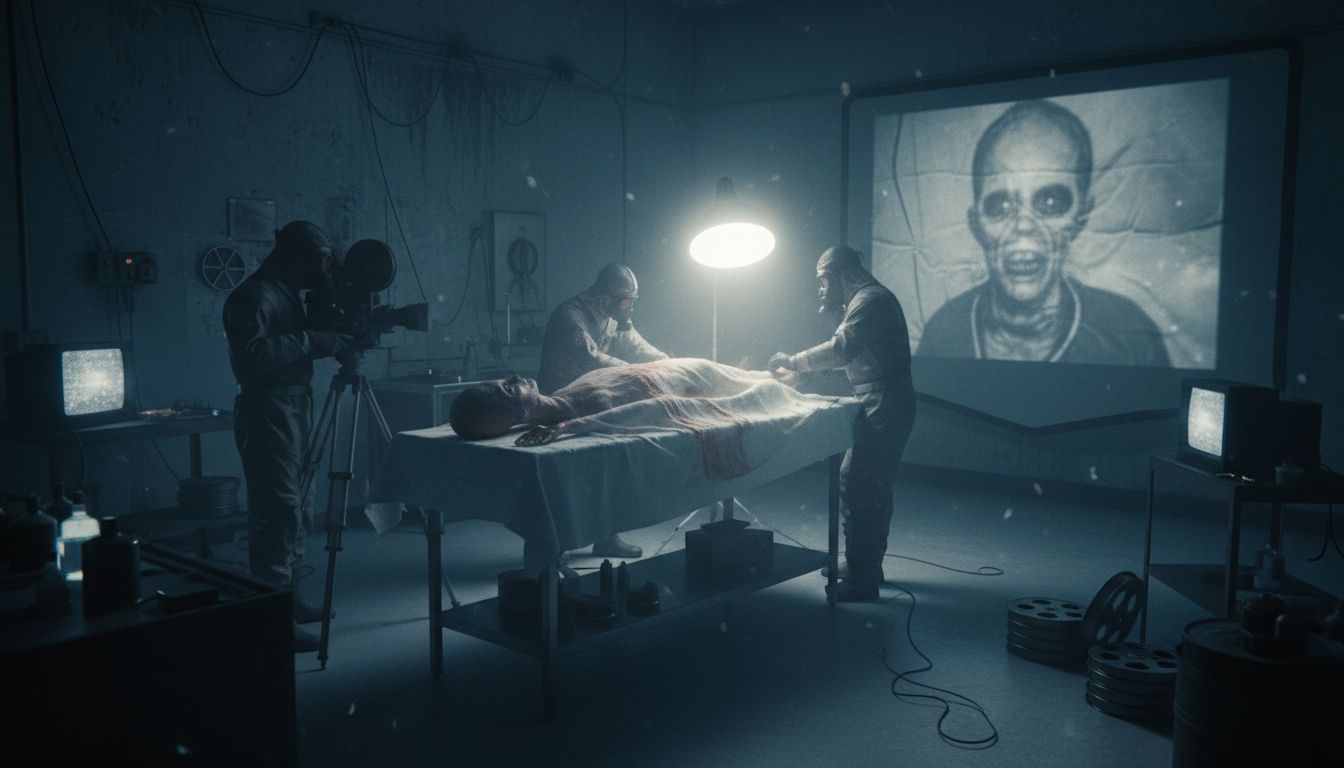
In the summer of 1995 a grainy, black‑and‑white reel surfaced that appeared to show a surgical team dissecting a small, gray‑skinned creature recovered after the 1947 Roswell incident. The footage was introduced to the public by Ray Santilli, a British entrepreneur who claimed the tape had been handed to him by a retired U.S. military cameraman who had witnessed an official “alien autopsy” at a secret base. Santilli’s press conference in London, broadcast on television networks across Europe and the United States, presented the clip as genuine evidence of a government cover‑up, and the image of a gloved hand pulling back a translucent membrane instantly entered the collective imagination of UFO enthusiasts and mainstream audiences alike.
The reaction was swift and massive. Within weeks, the clip was aired on major news programs, featured on late‑night talk shows, and spawned a flurry of newspaper headlines that ranged from “Proof of Extraterrestrials?” to “Government Lies Exposed.” Major publications such as *The New York Times* and *The Washington Post* ran investigative pieces questioning the tape’s provenance, while popular magazines like *Time* and *Newsweek* devoted full spreads to the cultural phenomenon it sparked. The footage also inspired a wave of creative output: a 1997 television drama titled *Alien Autopsy* (later adapted into a 2006 feature film), countless documentaries, and a surge in merchandise that turned the image into a recognizable pop‑culture icon.
Skepticism, however, emerged almost as quickly as the hype. In 1996, forensic analyst Dr. James E. Miller of the University of Arizona applied frame‑by‑frame analysis and identified several technical inconsistencies—most notably the use of a 16‑mm film stock that was not available to the U.S. military in the 1940s, and visible splices that suggested the footage had been edited. A subsequent investigation by the British Broadcasting Corporation (BBC) uncovered that the “military cameraman” could not be located, and that the alleged chain of custody was vague at best. In a 1997 interview, Santilli admitted that the original film had been damaged beyond repair and that the version shown to the public was a reconstruction using actors, prosthetics, and special effects, though he insisted the underlying event had indeed occurred.
Despite the admission, the “Alien Autopsy” continues to occupy a prominent place in discussions of unidentified aerial phenomena (UAP). Researchers at the National Archives and Records Administration (NARA) have cited the episode as a case study in how unverified media can shape public perception of governmental secrecy. A 2023 survey by the Pew Research Center found that 38 percent of Americans still believe some form of extraterrestrial recovery took place at Roswell, a figure that has remained relatively stable since the 1990s, underscoring the lasting impact of the hoax on collective belief. Moreover, the clip’s aesthetic—its stark, monochrome grain and clinical setting—has been repeatedly referenced in recent Pentagon‑released UAP videos, suggesting that the hoax has inadvertently set a visual template for how the public imagines secret government examinations of non‑human life.
The legacy of the 1995 film illustrates both the power and the peril of viral media in the UFO arena. While it undeniably fueled public interest and prompted a surge in scientific and journalistic inquiry into government transparency, it also demonstrated how easily a fabricated narrative can become entrenched in popular consciousness. As the U.S. Department of Defense continues to release declassified footage and as congressional hearings on UAPs gain traction, the “Alien Autopsy” serves as a cautionary reminder: extraordinary claims require extraordinary evidence, and the line between genuine disclosure and elaborate hoax can be perilously thin.
What Special Forces Found in Cambodia's Jungle: Ties to UAP and Human Abductions
A recent podcast has brought to light a chilling account from a former Special Forces operative who claims to have encountered inexplicable phenomena during a covert mission in Cambodia’s jungles. The veteran, whose name was withheld for privacy, recounted a mission in the Vietnam War era where his team was dispatched to locate a downed B-52 bomber near the Cambodian border. The objective was straightforward: assess the crash site, retrieve any sensitive equipment or documents, and recover dog tags from the crew. However, what the team allegedly discovered at the site defied conventional explanation and has since been linked in some circles to the ongoing discourse surrounding Unidentified Anomalous Phenomena (UAP) and human abductions.
According to the eyewitness, the team found the B-52 not in a state of wreckage, but rather resting intact as if it had been gently placed on the jungle floor. “There was no crash, there was no sign of a crash—no crash trail or anything like that,” the veteran described. Gaining entry through an emergency hatch, they were confronted with a gruesome scene: the entire crew remained strapped in their seats, but all had suffered mutilations eerily reminiscent of the so-called “cattle mutilations” reported in UFO lore. The details were disturbing—missing tongues, jaws “scraped clean,” and precision excisions of genitals and rectums, which the operative compared to the use of a “biscuit cutter.”
The team, shaken by the discovery and the absence of any signs of a conventional crash, proceeded to destroy the aircraft’s sensitive components. Charges were set throughout the B-52, and after collecting photographic evidence and crew dog tags, they detonated the explosives remotely from a safe distance. “We made it to our extraction point and were extracted back to headquarters in Saigon,” the witness stated. All evidence, including films and documents, was turned in to higher authorities. The operative noted that there was little follow-up apart from a stern warning: “You will die if you disclose any of this information, so keep your traps shut.”
The account, as discussed in the podcast, has fueled speculation about covert military encounters with non-human entities and technology. While details remain unverifiable and the official record is silent, the witness’s description aligns with numerous reports of mutilations—both animal and, more rarely, human—that some researchers have linked to UAP activity. The operative reflected on the psychological toll of the mission, noting that he was the only survivor of the original team, with the others killed in subsequent action. “There was a lot of PTSD involved at the time,” he admitted, adding that he was soon after discharged from the service.
Though the credibility of such accounts is always subject to scrutiny, this testimony adds a somber and unsettling layer to the ongoing discussion of UAPs and alleged human abductions. While official documentation of such incidents remains elusive, the narrative underscores the longstanding tension between military secrecy and the quest for answers about unexplained phenomena. As the U.S. government and global authorities increase their transparency on UAPs, stories like this one continue to raise questions about what remains hidden in the shadows of wartime operations and classified archives.
Is there a mysterious ninth planet in our solar system? New evidence shows that, far beyond Pluto, there may exist a hypothetical planet referred to as Planet X or Planet Nine. Astronomers predict that there is possibly a large, undiscovered planet with gravitational interaction in the Kuiper Belt. The existence of this mystery planet may explain unusual orbits and gravitational interactions of some dwarf planets and other objects in the Kuiper Belt region.
Curious to find out more? Read through the gallery!
Neptune It has been almost 200 years since astronomers discovered a new planet in our solar system. Neptune was found in just one night of planetary observation, when Johann Gottfried Galle and his student pointed a telescope in its direction back in 1846.
California Institute of Technology In 2016, astronomers from the California Institute of Technology (Caltech), Konstantin Batygin and Mike Brown, stated that their research provides evidence for the great possibility of a large planet in the outer solar system.
Strong evidence While the astronomers have not observed the planet, they provide strong theoretical evidence for its existence and information relevant to its potential impact.
Kuiper Belt This evidence looks at the potential relationship and influence of the hypothetical planet on dwarf planets and smaller objects in the Kuiper Belt.
Planet Nine The mystery planet, dubbed "Planet X" (x as in the letter, not the Roman numeral) or "Planet Nine," is thought to be 1.5 times the size of the Earth, sitting far beyond Pluto.
Mass 5-10 times larger than Earth The planet’s mass could be 5-10 times larger than Earth and it could orbit the Sun 20-30 times farther than Neptune. NASA notes that if this theory is accurate, it would take Planet Nine between 10,000-20,000 Earth years just to make one orbit around the Sun.
Unique orbits Astronomers say that the potential existence of this planet could explain certain gravitational patterns in the outer solar system, specifically the unique orbits of dwarf planets and icy objects in the Kuiper Belt.
Gerard Kuiper The Trans-Neptunian Region, more often called the Kuiper Belt, was named after astronomer Gerard Kuiper. It is sometimes referred to as the "third zone" of the solar system; a cold region located in the solar system beyond Neptune’s orbit.
Icy objects In addition to Pluto, astronomers believe that millions of icy objects lie in the Kuiper Belt, including compounds like ammonia and methane.
Edge of Neptune’s orbit Beginning at the edge of Neptune’s orbit, the Kuiper Belt extends nearly 1,000 AU (1 AU is equivalent to the distance from the Sun to Earth).
Over 2,000 objects discovered While astronomers have only identified around 2,000 objects in the Trans-Neptunian Region, it is likely that there are hundreds of thousands more undiscovered objects; often thought of as "leftovers" from the solar system’s formation.
Formation of solar system The theory about how this happened is that when the solar system was forming, because of shifts in Jupiter and Saturn’s orbits, Uranus and Neptune were required to orbit farther from the Sun.
Jupiter The gravity of Neptune’s orbit tossed these objects toward the Sun and big planets like Jupiter, while Jupiter then flung them either out of the solar system or to distant orbits.
Fragmented bits Neptune’s gravitational power pushed the remainder of the objects into the Kuiper Belt, where they sometimes collide and break into fragmented pieces.
Dwarf planets and objects clumped Astronomers who have been studying the Kuiper Belt notice that several of the smaller planets and some objects tend to pursue orbits that clump together.
Theory on Planet Nine It’s through the analysis of these orbits, namely gravitational interactions with a huge planet, that astronomers base their theory on the existence of Planet Nine.
Some researchers deny its existence Some naysayers in the scientific community downplay Planet Nine's potential existence. They argue that the observed orbits are merely due to the random distribution of objects along the belt.
All tools being used Scientists are desperately trying to find the planet to confirm its existence. Using a dedicated observatory, powerful telescopes, and citizen projects, astronomers are attempting to gather as much data as possible to locate the planet.
Complex computational simulations The current theory is based on complex computational simulations that take into account a number of conditions. The model that most closely aligns with observed orbital patterns is that which includes Planet Nine.
Vera C. Rubin Observatory Scientists are hoping that the new Vera C. Rubin Observatory, located in Chile, will help unlock some of the inquiries relevant to Planet Nine and other astronomical questions.
Detailed, time-lapse record Using innovative technology, the observatory will be able to provide an extensive, detailed record of the Universe over the span of a decade using the largest camera ever built.
Collected imagery The imagery collected by the observatory will be able to provide a more detailed understanding of the distribution of objects along the Kuiper Belt.
Why is it so complex to find the planet? Locating planets is quite challenging. Astronomers use the transit method to find planets in other solar systems.
Transit method Astronomers may be more likely to locate planets by observing a star’s movement. The computational model used to detect Planet Nine’s existence estimates a 99% probability of its existence.
Malena Rice Assistant Professor of Astronomy Malena Rice from Yale University stated that finding another planet “could completely reshape our understanding of the solar system and of other planetary systems, and how we fit into that context.”
Mysteries of the outer solar system Small black holes, potential alien worlds, additional dwarf planets, volcanic comets, and asteroids, among other possibilities, are just some of the mysteries that astronomers also seek to understand about the outer solar system.
The quest continues While the quest to find Planet Nine continues, some scientists are betting everything on indirect evidence of the planet’s existence, while others hold very skeptical positions.
First-ever radio signal from 3I/ATLAS detected—confirming typical comet activity
Story by Mahalekshmi P
First-ever radio signal from 3I/ATLAS detected—confirming typical comet activity
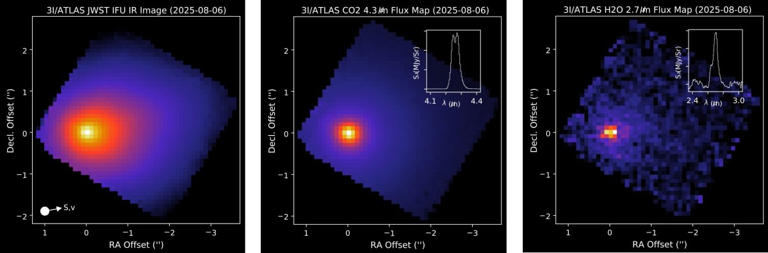
There has been much talk about the possibility of the interstellar comet 3I/ATLAS being an alien mothership or alien technology. However, the MeerKAT radio telescope, operated by the South African Radio Astronomy Observatory, came out with new evidence confirming that the object showed typical comet activity. Radio absorption lines by hydroxyl radicals, namely OH molecules, were detected from the interstellar object 3I/ATLAS. "OH absorption was detected on the 1665 MHz and 1667 MHz lines," explained a report by D.J. Pisano and collaborators posted onThe Astronomer’s Telegram, revealing the detection.
A view of comet 3I/ATLAS, as seen by NASA’s SPHEREx, which observed the interstellar object from 7–15 August 2025.
(Image Source: NASA | Photo by NASA / SPHEREx)
This signal was unlike spacecraft transmissions and was a radio-frequency pattern detected by 64 antennas, each with a 13.5-meter diameter. Lines of radio absorption by hydroxyl radicals, or OH molecules, are a pattern consistent with usual comet activity. Per WIRED, the lines appeared as absorption because 3I/ATLAS was very close to the sun, an observation vantage that favored absorption over emission. At the closest distance from the Sun, sublimation ejected more ice into space, receiving greater radiation, an aspect that also led to a change in its trajectory.
NASA’s Webb Space Telescope's image of Comet 3I/ATLAS.
(Image Source: NASA | James Webb Space Telescope.)
The hydroxyl radical (OH) is capable of absorbing or emitting radiation at particular frequencies from a transition in energy levels. In this case, the 1665 and 1667 MHz lines. OH spectral lines “glow” brightly under conditional radio frequencies and helped map star and water-born regions. These spectral lines have been previously detected in nebulae, comets, and star-forming regions.
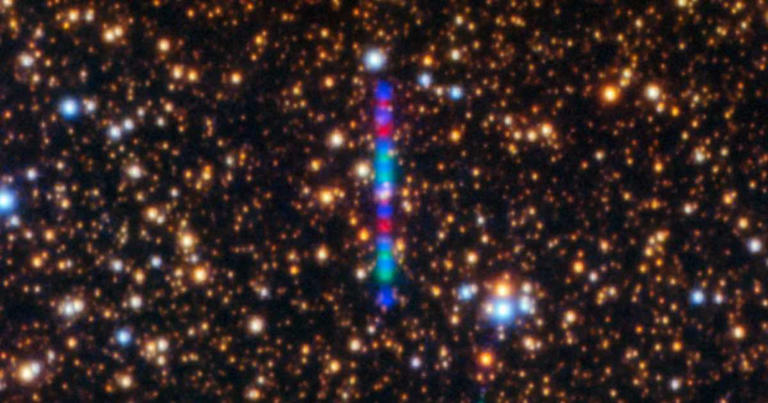
Interstellar comet 3I/ATLAS going past a dense star field
(Image Source: International Gemini Observatory/NOIRLab/NSF/AURA/K. Meech (IfA/U. Hawaii). Image processing: Jen Miller & Mahdi Zamani (NSF NOIRLab))
The observation by MeerKAT was made on October 24, 2025, when the angular separation of 3I/ATLAS from the Sun was 3.76 degrees. Attempts to detect these lines with the telescope were previously unsuccessful on September 20 and 28, 2025. On October 21, 2025, a few days before the observation, the object was close to the orbital plane of the Earth around the Sun, putting it at a solar conjunction relative to Earth.
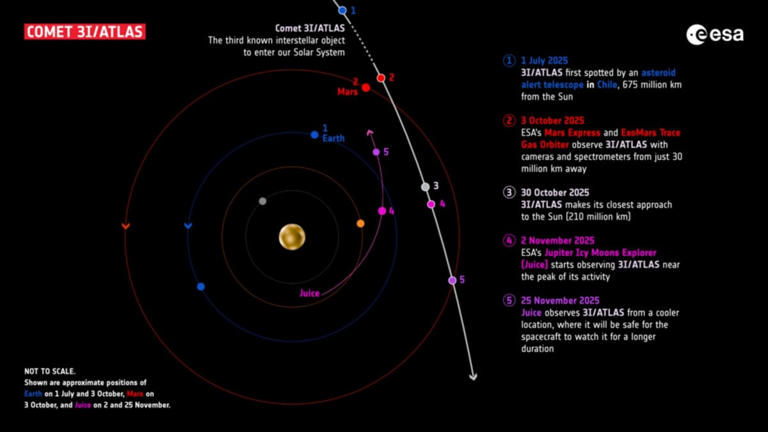
ESA’s Mars and Jupiter missions observe comet 3I/ATLAS
(Image Source: ESA)
“Five weeks ago, I encouraged radio observatories like MeerKAT to search for radio emission from 3I/ATLAS, given that the arrival direction of 3I/ATLAS coincided to within 9 degrees with the arrival direction of the Wow! Signal detected in 1977 at a frequency of 1.4204556 gigahertz,” Harvard astronomer Loeb mentioned in his Medium blog. “In response, I was assured that 3I/ATLAS will be monitored by radio observatories like MeerKAT,” he added. Continued monitoring of the object will identify whether the OH production is constant or intermittent.
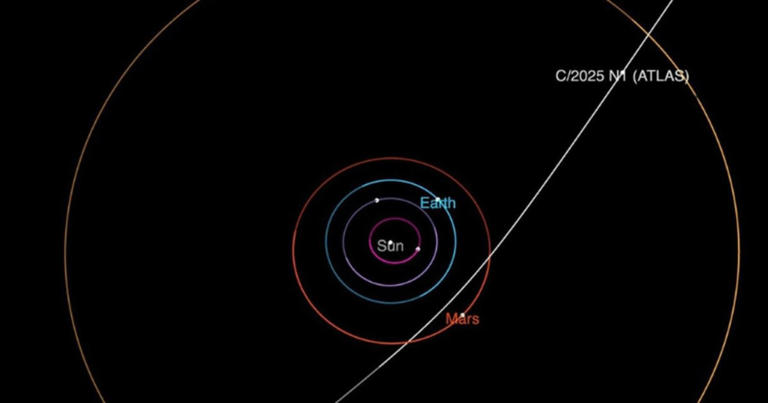
Image shows the trajectory of comet 3I/ATLAS as it passes through the solar system
(Image Source: NASA | JPL-Caltech)
There has been no other signal detected apart from the OH absorption signal, and the nature of this is also dependent on other factors. The extent and structure of the tail could be one such aspect, given its formation and reaction to radiation. The trajectory of the comet is being closely studied by experts, and on December 19, 2025, it will be at its closest point to Earth.
For the first time, astronomers have picked up a radio signal from the mysterious interstellar visitor as it speeds through our Solar System.
South Africa's MeerKAT radio telescope detected absorption lines from OH molecules, made of oxygen and hydrogen, around the object on October 24.
Harvard professor Avi Loeb, who has been studying 3I/ATLAS since the summer, said: 'These molecules leave a distinct radio signature that telescopes like MeerKAT can pick up.'
Previous attempts to detect these signals on September 20 and 28 had failed.
Analysis showed the OH molecules were moving at roughly 61 miles per second relative to Earth.
The widths of the absorption lines matched the expected thermal motion of molecules at the object's surface temperature of around -45°F. The detection came just days after 3I/ATLAS passed near the orbital plane of Earth, making it easier to observe.
Optical images captured on November 9 reveal that 3I/ATLAS is ejecting enormous jets of material both toward and away from the sun. The jets stretch nearly 600,000 miles sunward and almost 1.8 million miles in the opposite direction, roughly the diameter of the sun or the moon in the sky.
At its current distance of 203 million miles from Earth, these distances represent the first clear measurements of the vast size of 3I/ATLAS's activity.
Optical images captured on November 9 (pictured) reveal that 3I/ATLAS is ejecting enormous jets of material both toward and away from the sun
'Given that the anti-tail jets are only stopped at about 620,000 miles, their ram pressure exceeds that of the solar wind by a factor of a million,' Loeb noted.
The solar wind flows at roughly 250 miles per second, a thousand times faster than the outflow speed expected from a natural comet.
'This implies a mass flux of about 2.2 million pounds per second per million-square-mile section of the jet, adding up to a mass loss of 50 billion tons per month,' Loeb said.
Summing over the full area of the jets, the total ejected mass is comparable to the minimum mass of 3I/ATLAS itself.
'Assuming a solid density of 0.5 grams per cubic centimeter, the object must be at least three miles across, and if most of its nucleus survived perihelion, it could be six miles or larger,' Loeb added.
For comparison, the famous interstellar object 1I/'Oumuamua measured only a few hundred feet.
The extreme scale of 3I/ATLAS's jets raises fundamental questions. If the object were a natural comet, the jets should move much more slowly and require months to reach the observed distances.
Instead, the extraordinary mass, density, and collimation of the outflows suggest something unusual may be happening.
South Africa's MeerKAT radio telescope (pictured) detected absorption lines from OH molecules, made of oxygen and hydrogen, around the object on October 24
'The numbers are challenging for a natural comet explanation,' Loeb said. 'The required mass loss, the rapid perihelion brightening, and the size all point to anomalies.'
Spectroscopic observations from space telescopes like Hubble and Webb, planned as 3I/ATLAS approaches its closest point to Earth on December 19, will allow astronomers to measure the velocity, composition, and total mass of the jets.
These observations may help determine whether 3I/ATLAS is a conventional icy comet or perhaps powered by technological thrusters, which could produce similar jets with far less mass loss.
Meanwhile, the Juno spacecraft is scheduled to probe the object on March 16, 2026, when it passes 33 million miles from Jupiter, using its dipole antenna to search for low-frequency radio signals. Observatories around the world are also monitoring the object, partly because its trajectory aligns within 9 degrees of the direction of the famous 1977 'Wow!' Signal.
'3I/ATLAS is giving us a rare opportunity to study an interstellar object in real time,' Loeb said.
'The combination of radio and optical data shows it is shedding massive amounts of material, moving at incredible speeds, and behaving in ways that challenge our understanding of natural comets.'
World-Changing Confession: Brazilian Doctor Says He Studied and Spoke With a Live Alien
World-Changing Confession: Doctor Describes Studying Live Alien in Brazil’s “Roswell”
A groundbreaking revelation has emerged from Brazil, reigniting one of the most extraordinary UFO stories of all time – the 1996 Varginha incident, often called “The Roswell of Brazil.” In an updated version of his documentary Moment of Contact, filmmaker James Fox reveals an astonishing firsthand account from a Brazilian neurosurgeon who claims to have physically examined and telepathically communicated with a live alien being held in a hospital under military control.
The confession, coming nearly 30 years after the event, has been described by UFO investigators as one of the most compelling testimonies ever recorded – and potentially world-changing if verified.
The 1996 Varginha Crash: Brazil’s Roswell
The story begins on January 13, 1996, when a pilot named Carlos de Souza witnessed a strange cigar-shaped craft trailing vapor and losing altitude near Varginha, a small city in southeastern Brazil. The object eventually crashed in a nearby field, leaving debris that witnesses described as light, metallic, and self-healing – bending easily but returning to its original shape.
Military trucks soon arrived, cordoned off the area, and ordered civilians to leave at gunpoint. Within hours, the site was under complete military control. According to multiple eyewitnesses, the Brazilian army took over the wreckage, and several sources later claimed that American officials were also involved in the recovery and transport of the materials.
Face-to-Face with the Unknown
Just a few days later, on January 20, 1996, three young women – Lilian, Valkíria, and Kátia – were walking through a partially built neighborhood when they saw a strange creature crouched by a wall. It was small, about 1.5 meters tall, with oily brown skin, large red eyes, and three protruding lumps on its head.
When the being turned to look directly at them, the girls felt an intense psychic presence – as though it was silently asking for help. Terrified, they ran away and reported the encounter to their families. Within hours, the story spread throughout Varginha, drawing attention from the media and local police.
The Capture and Mysterious Death of a Policeman
That same evening, military police officer Marco Eli Chereze and his colleague responded to reports of another creature spotted nearby. When Chereze attempted to capture it, he reportedly wrestled the weak and frightened being into a car, sustaining a small scratch under his arm and coming into contact with a strange oily substance on its skin.
Days later, Chereze fell severely ill. His condition worsened rapidly, and despite extensive treatment, he died from a mysterious infection. The pathologists who examined his tissues later testified that the bacteria responsible behaved unlike anything known to science – resistant to every treatment and never observed before or since.
Dr. Italo Venturelli’s Shocking Confession
The most extraordinary revelation, however, came decades later from Dr. Italo Venturelli, the head neurosurgeon at the Regional Hospital of Varginha. In an emotional on-camera interview with filmmaker James Fox, Dr. Venturelli revealed that he had direct physical contact with one of the captured beings.
According to Venturelli, the creature was alive but injured and had been secretly brought to the hospital under heavy military guard. He described the being as pale-skinned, with large red eyes, small horn-like bumps, and a calm yet powerful presence.
In his words, “It communicated with me — not with words, but through thought. It was like speaking without speaking.”
He said that during the four minutes he spent with the alien, he sensed a deep intelligence and empathy, describing it as “angelic” and possessing a higher level of consciousness than humans.
Moments later, armed soldiers burst into the room, seized the being, and ordered everyone present to remain silent under threat. Venturelli and his colleagues were warned never to discuss the incident.
A Secret Buried – Until Now
Dr. Venturelli remained silent for nearly three decades. But after suffering a heart attack in 2024 and believing he might die, he decided he could not take the secret to his grave. “I’m doing this for my grandchildren,” he told Fox. “The world deserves to know the truth.”
He now stands by his testimony, offering to take a lie detector test and testify publicly before Congress or the Brazilian Parliament. His story is backed by hospital staff, pathologists, and local officials, many of whom confirm unusual activity that night – including the smell of ammonia throughout the hospital and the arrival of military trucks using the back entrance.
Fox’s investigation uncovered additional evidence of American military involvement. Former police chief Pedro Auar and other witnesses reported that U.S. helicopters and personnel were seen at nearby military bases, including ESA in Campinas, where the beings and debris were allegedly transported.
A U.S. Air Force plane reportedly landed in Brazil without official clearance, and a Freedom of Information request later revealed the event was classified as a national security matter by the CIA.
Local witnesses also reported being threatened and bribed by “men in dark suits” to retract their stories – with some told to claim that the alien was merely a “disabled homeless man.” Despite the pressure, none of the witnesses have ever retracted their accounts.
Anomalous Biology and Lingering Questions
Forensic experts who examined tissue samples from Officer Chereze’s infection reported that the bacteria was unlike any terrestrial strain, showing resilience to all known antibiotics. This discovery adds a biological dimension to the mystery – suggesting that the beings may carry completely foreign microbiology.
If confirmed, this would represent the first documented case of cross-species contamination from a non-human organism, raising both scientific and ethical implications for contact protocols.
Courage and the Push for Disclosure
Dr. Venturelli’s testimony is more than a medical account – it’s an act of moral courage. His emotional description of compassion for the captive being contrasts sharply with the secrecy and fear surrounding the case.
Filmmaker James Fox praises the doctor’s bravery, calling him “the kind of whistleblower humanity needs.” Fox reports that several other doctors and military officers are now considering coming forward to support Venturelli’s claims.
The revelations come amid a growing global movement for UAP disclosure, with U.S. scientists like Dr. Eric Davis calling for presidential action to waive secrecy agreements and allow officials to testify under oath about what they know.
A Turning Point for Humanity?
As Moment of Contact prepares for re-release in late 2025 – just before the 30th anniversary of the Varginha incident – anticipation is building worldwide. The film’s new footage, witness interviews, and government documents may finally bring the case into mainstream historical recognition.
Whether skeptics or believers, few can deny that Dr. Italo Venturelli’s confession marks a turning point. If his account holds true, it represents not only contact with an extraterrestrial intelligence — but also a profound test of humanity’s readiness for truth.
The Varginha incident stands as one of the most extraordinary and well-documented UFO encounters ever recorded. The confession of a respected neurosurgeon who studied a live alien being, coupled with corroborative military and medical testimony, pushes the case far beyond rumor into the realm of historical significance.
If verified, Dr. Venturelli’s encounter will not just rewrite the story of UFOs – it may redefine our understanding of life, intelligence, and consciousness in the universe.
Meer van UFO'S of UAP'S, ASTRONOMIE, RUIMTEVAART, ARCHEOLOGIE, OUDHEIDKUNDE, SF-SNUFJES EN ANDERE ESOTERISCHE WETENSCHAPPEN - DE ALLERLAATSTE NIEUWTJES


 Saw this a few minutes ago, Moab, Utah Oct 7, 2025 UFO UAP sighting news. Aliens