Ontdek de Fascinerende Wereld van UFO's en UAP's: Jouw Bron voor Onthullende Informatie!
Ben jij ook gefascineerd door het onbekende? Wil je meer weten over UFO's en UAP's, niet alleen in België, maar over de hele wereld? Dan ben je op de juiste plek!
België: Het Kloppend Hart van UFO-onderzoek
In België is BUFON (Belgisch UFO-Netwerk) dé autoriteit op het gebied van UFO-onderzoek. Voor betrouwbare en objectieve informatie over deze intrigerende fenomenen, bezoek je zeker onze Facebook-pagina en deze blog. Maar dat is nog niet alles! Ontdek ook het Belgisch UFO-meldpunt en Caelestia, twee organisaties die diepgaand onderzoek verrichten, al zijn ze soms kritisch of sceptisch.
Nederland: Een Schat aan Informatie
Voor onze Nederlandse buren is er de schitterende website www.ufowijzer.nl, beheerd door Paul Harmans. Deze site biedt een schat aan informatie en artikelen die je niet wilt missen!
Internationaal: MUFON - De Wereldwijde Autoriteit
Neem ook een kijkje bij MUFON (Mutual UFO Network Inc.), een gerenommeerde Amerikaanse UFO-vereniging met afdelingen in de VS en wereldwijd. MUFON is toegewijd aan de wetenschappelijke en analytische studie van het UFO-fenomeen, en hun maandelijkse tijdschrift, The MUFON UFO-Journal, is een must-read voor elke UFO-enthousiasteling. Bezoek hun website op www.mufon.com voor meer informatie.
Samenwerking en Toekomstvisie
Sinds 1 februari 2020 is Pieter niet alleen ex-president van BUFON, maar ook de voormalige nationale directeur van MUFON in Vlaanderen en Nederland. Dit creëert een sterke samenwerking met de Franse MUFON Reseau MUFON/EUROP, wat ons in staat stelt om nog meer waardevolle inzichten te delen.
Let op: Nepprofielen en Nieuwe Groeperingen
Pas op voor een nieuwe groepering die zich ook BUFON noemt, maar geen enkele connectie heeft met onze gevestigde organisatie. Hoewel zij de naam geregistreerd hebben, kunnen ze het rijke verleden en de expertise van onze groep niet evenaren. We wensen hen veel succes, maar we blijven de autoriteit in UFO-onderzoek!
Blijf Op De Hoogte!
Wil jij de laatste nieuwtjes over UFO's, ruimtevaart, archeologie, en meer? Volg ons dan en duik samen met ons in de fascinerende wereld van het onbekende! Sluit je aan bij de gemeenschap van nieuwsgierige geesten die net als jij verlangen naar antwoorden en avonturen in de sterren!
Heb je vragen of wil je meer weten? Aarzel dan niet om contact met ons op te nemen! Samen ontrafelen we het mysterie van de lucht en daarbuiten.
Vice President JD Vance has joined the list of high-ranking government officials wanting answers about UFOs and extraterrestrials.
In an interview released Wednesday, the vice president doubled down on his promise to 'get to the bottom of' the existence of alien life.
Vance happily declared himself a 'UFO lunatic' and was committed to taking some time during his term in office to examine the evidence he has access to regarding life from other planets.
His comments came nearly three months after he told the hosts of the Ruthless Podcast that he was 'obsessed with the whole UFO thing.'
At the time, Vance said he planned to use the time off during the August recess in Congress to do a 'deep dive' into the government's files on what the military now calls unidentified anomalous phenomenon (UAPs).
However, the vice president has amended his timeline for getting to the bottom of the alien mystery, telling Miranda Devine that it's going to take some time, but he intends to learn if UFOs are real before the next election.
'This is the crazy person inside of me. All of us put the tinfoil hat on from time to time. I can't allow myself to become so busy that I spend the next three years and I don't get to the bottom of this,' Vance said.
The vice president added that he wasn't the only member of the Trump Administration seeking answers about UFOs, noting that Secretary of State Marco Rubio and Director of National Intelligence Tulsi Gabbard want to know as well.
Vice President JD Vance (Pictured) said this week that he intends to examine the secret files linked to UFO and extraterrestrial encounters
'Marco's actually very interested in this, too. We talked about this a little. We talked about this back in our Senate days. So, yeah, there's certainly an interest there,' Vance said during the Pod Force One podcast.
However, the vice president added that what he might view as an angel or demon might be interpreted as an extraterrestrial by others.
Vance said he firmly believed that there were phenomena that humans simply can't explain, but was more open to other possibilities, such as a divine presence.
The vice president, who was raised an evangelical Christian and converted to Catholicism in 2019, explained that he believed in spiritual forces working in the physical world, which could be mistaken for alien encounters.
'Is it aliens or is it our guardian angel, or is it aliens or is it a not-so-guardian force that doesn't care about us, or in fact actively wishes us harm? I don't know the answer to that question,' Vance admitted.
Luna, who serves as the chairwoman for the House Oversight Committee on UFO disclosure, said that many witnesses have described what they saw as 'interdimensional' beings that had similarities to angels in the Bible.
'Then you look into texts that were removed from the Bible, like the book of Enoch, that actually specifically address technologies that were given to mankind or of entities not of human origin,' Luna said on the PBD podcast last week.
Vance noted that he was a 'UFO lunatic' but also believed some UFO encounters may have involved spiritual beings such as angels or demons (Stock Image)
Vance (left) said Secretary of State Marco Rubio (right) was also interested in finding out the truth regarding alien life
In August, Gabbard declared on Pod Force One that she did believe in the existence of both UFOs and extraterrestrials, but noted that her role in the intelligence community prevented her from saying anything else.
'We're continuing to look for the truth, uh, and share that truth with the American people,' the intelligence chief said.
However, Gabbard did add that she still had questions regarding the mysterious UFO swarms that invaded the US East Coast in 2024 and was not convinced they were harmless drones.
Despite the growing belief in extraterrestrial life, no verifiable physical evidence, such as artifacts or clear footage of these craft, has been publicly presented to confirm the existence of aliens.
Skeptics have argued that the reliance on anecdotal reports from military personnel and civilians and the lack of peer-reviewed scientific data cast significant doubt on the claims made during recent congressional hearings on UAPs.
However, a new documentary featuring both Luna and Rubio is set to be released in late November, which alleges that the US government has withheld information regarding UFOs and extraterrestrials from both the public and the White House.
'Even presidents have been operating on a need-to-know basis, but that begins to ramp out of control,' Rubio claimed in the film The Age of Disclosure.
Scientists have been left baffled after finding 'impossible' life thriving at the north pole.
The tiny microorganisms, invisible to the naked eye, live just beneath the frozen surface of the central Arctic Ocean.
Discovered by experts at the University of Copenhagen in Denmark, these bacteria survive on dissolved organic matter in the cold water.
They also need to convert nitrogen to survive, but bewilderingly, the gas is generally in short supply in the Arctic Ocean.
So how exactly the creatures are thriving in the water has left the scientists scratching their heads.
'[We] have discovered an important phenomenon beneath the Arctic sea ice that was previously thought impossible,' they say in a statement.
'This phenomenon could have implications for the food chain and the carbon budget in the cold north.'
The researchers also warn that there is less sea ice in the Arctic than there should be due to global warming, which may actually help the organisms to survive.
According to the researchers, the tiny organisms are officially known as 'non-cyanobacterial diazotrophs'. These microorganisms, primarily bacteria and archaea, can convert atmospheric nitrogen into a usable form, but do not photosynthesize like cyanobacteria
Researchers from the University of Copenhagen have discovered an important phenomenon beneath the Arctic sea ice that was previously thought impossible
According to the researchers, the tiny organisms are officially known as 'non-cyanobacterial diazotrophs'.
These are 'nitrogen-fixing' bacteria, meaning they need to convert atmospheric nitrogen into a usable form of nitrogen, such as ammonium, to stay alive.
Unlike other many other underwater bacteria, non-cyanobacterial diazotrophs (NCDs) do not photosynthesize.
The team's field work involved measurements of nitrogen fixation from water samples at 13 different Arctic locations from aboard the research ship RV Polarstern.
The experts found a surprising high nitrogen fixation rates, especially at the ice edge, where the ice melts most actively.
What's odd is that nitrogen is in relatively short supply in the Arctic Ocean, meaning nitrogen fixers shouldn't be able to thrive there.
'Until now, it was believed that nitrogen fixation could not take place under the sea ice,' said study author Dr Lisa W. von Friesen.
'It was assumed that the living conditions for the organisms that perform nitrogen fixation were too poor. We were wrong.'
The team's field work involved measurements of nitrogen fixation at several Arctic locations over two trips in 2021 and 2022
Pictured, researcher taking measurements of nitrogen fixation in water samples from the Arctic Ocean aboard German research vessel RV Polarstern
What is nitrogen fixation?
Nitrogen fixation is a process in which special bacteria convert nitrogen gas (N2) dissolved in seawater into ammonium.
Ammonium helps the bacteria to grow, but it also benefits algae and the rest of the food chain in the sea.
Researchers say there's levels of nitrogen fixation in their sampled areas of the Arctic 'previously thought impossible'.
This is due to 'non-cyanobacterial diazotrophs' - nitrogen-fixing' bacteria that don't photosynthesize.
In the Arctic Ocean, NCDs and other bacteria feed on dissolved organic matter released by algae, among other things.
In return, the bacteria release the 'fixed' nitrogen (ammonium), which helps algae in the surrounding water to grow.
Unfortunately, too much algae growth in the Arctic can be bad news as it can lead to out of control 'algal blooms' which are toxic and harmful to fish, shellfish, marine mammals and more.
According to Dr von Friesen, the results suggest the potential for algae production in the Arctic has been underestimated.
What's more, climate change is likely the ultimate cause of the observed changes.
In the Arctic, sea ice goes through a seasonal cycle each year, spreading in the autumn and winter and then receding in the spring and summer.
But due to climate change, temperatures are getting higher overall and the Arctic sea ice extent is getting lower on average.
Researchers warn that the Arctic is warming at rates up to four times faster than the global average, which has caused major declines in sea ice coverage, age, and thickness.
The researchers are the first to discover that the phenomenon of 'nitrogen fixation' occurs beneath sea ice even in the central Arctic Ocean
Measurements were taken at 13 different locations in the Arctic Ocean aboard the German research ship RV Polarstern
According to the researchers, areas of actively-melting sea ice generally have more nitrogen fixation compared with ice-covered parts of the Arctic.
It seems likely therefore that climate change is to blame for this elevated pattern of nitrogen fixation that they have observed.
Strangely, stretches of open water have similar levels of nitrogen as ice-covered areas, but the team aren't sure why this is.
The study, published in Communications Earth & Environment, is the first to show the phenomenon of nitrogen fixation occurs beneath sea ice even in the central Arctic.
Therefore, nitrogen fixation should be considered 'in the equation' when people try to predict what will happen to the Arctic Ocean in the coming decades as sea ice declines, the authors add.
Nitrogen (N) makes up almost 80 per cent of our atmosphere and is essential for plants and animals.
The carbon-nitrogen bond is one of the most abundant in organic chemistry.
Animals need it to to make proteins, which forms everything we need to live.
In plants it forms the basis of enzymes, proteins and chlorophyll.
Ecosystems need nitrogen and other nutrients to absorb carbon dioxide pollution and there is a limited amount available in plants and soil.
However, it is inert and most useful to life when turned into nitrates or nitrogen compounds.
The nitrogen cycle is the process by which the element is used and then fed back into the system.
Nitrogen (N) makes up almost 80 per cent of our atmosphere and is essential for plants and animals. The nitrogen cycle is the process by which the element is used and then fed back into the system
Nitrogen-fixing organisms convert nitrogen into the soil from the air.
Lightening is another way in which nitrogen reaches the soil from the air.
Nitrification is the process by which ammonia (a compound of nitrogen and hydrogen) that is in the soil is converted into nitrates by bacteria.
Plants then take up these nitrates through their roots.
When the plant dies this nitrogen is goes back into the soil.
Alternatively if the plant is eaten by an animal the nitrogen returns to the soil in their waste.
It might look a bit like a spaceship, but this small steel pod takes mankind one step closer to living at the bottom of the sea.
Designed to operate at a depth of 50m (164ft), it consists of a living chamber, a dive centre and a foundational base.
The habitat, named Vanguard, will allow up to four 'aquanauts' to live and work in the murky depths of the ocean.
Living there will give researchers the opportunity to dive for hours at a time, carrying out studies that would be otherwise impossible.
The main part of the pod, measuring 12 metres (40 feet) long by 3.7 metres (12 feet) wide, is where scientists would eat, sleep and work.
It comes equipped with individual bunks, a galley to cook food and a toilet. The dive centre, meanwhile, is where people can change into their dive gear and exit into the ocean through the 'moon pool'.
A surface support buoy provides air, water, waste removal, electricity and communications to the steel habitat, where visitors can stay for a week or more.
'Beneath the surface of the ocean lies a vast, largely unexplored frontier that has fascinated humans for centuries,' DEEP, the company behind the design, said.
Vanguard was unveiled this week in Miami, Florida, and will open up 'a whole new realm of science'
The underwater pod features a galley, seating area and table. 'Aquanauts' could live on board for a week or more
When the beds are 'down', they provide sofas for up to four people to sit, eat, socialise and work
'DEEP is setting out to change this by pioneering a new era of underwater living. Their ambitious mission – to make humans aquatic – begins with Vanguard and represents a major step forward in how people can live and work beneath the waves.'
Vanguard was unveiled this week in Miami, Florida, and will open up 'a whole new realm of science', experts said.
Currently, normal surface diving methods only allow humans to spend limited time deep in the ocean.
Spending time on Vanguard will mean divers will be able to explore at depth for hours on end before returning to the habitat, DEEP said.
By allowing teams to remain submerged for extended periods, the pod will enable more comprehensive research and real-time observation of marine life.
This could revolutionise areas such as coral reef restoration, climate monitoring and even astronaut training for future space missions.
DEEP said it has a larger vision – to have 'a global network of underwater habitats that could give humans a permanent presence in the ocean'.
For now, the pod is situated only 20 metres (65ft) underwater, but the prototype is designed to sit comfortably at 50m (164ft).
The dive centre (left) is where people can change into their equipment. The image on the right shows the toilet facilities on-board
The seating area can be easily transformed into a bedroom, with visitors having individual bunks
This artist's impression shows two people scuba diving next to the pod. The idea behind Vanguard is to allow for much longer diving expeditions and research
It has been designed with safety in mind, and has the capability of withstanding the subsurface effects of a category 5 hurricane.
Once all systems have been tested and approved, Vanguard will be properly deployed for the first time so engineers can run drills, operational and emergency procedures.
There is not yet a fixed date for when that will be, but DEEP say it will be revealed – along with the location - by the end of the year.
The company is also working on another design, a 'hotel-like' base called Sentinel, which is set to one day be located 200m (660ft) below the surface off the coast of Wales.
Vanguard: Key specs
12 metres (40 feet) long by 3.7 metres (12 feet) wide (living area)
50m (164ft) operating depth
All steel construction
Surface support buoy provides air, water, waste removal, electricity and communications
Capacity for four 'aquanauts' to live for seven days or more
A terrifying simulation has revealed how people might really behave as the end of the world approaches.
And it suggests that humanity's darkest instincts might reign supreme at the very end.
Just like in apocalyptic movies and TV shows such as Mad Max or Fallout, the study suggests that doomsday might encourage some people to go on killing sprees.
Researchers say this is because the impending end of days means that the penalties for violence 'lose all meaning'.
That lack of consequences may mean some individuals return to 'more savage tendencies'.
Even though the simulated world was only digital, the researchers say the results provide a terrifying glimpse at how people would react in a real-world apocalypse scenario.
'This finding raises interesting questions about human behaviour,' co-author Dr Haewoon Kwak, of Indiana University Bloomington, told Daily Mail.
'It forces us to consider which actions are controlled by external penalties and which are controlled by our own internal ethics or social norms.'
In a terrifying simulation, scientists predicted how people would behave as the end of the world approached and found that some people would be driven to go on killing sprees (stock image)
Surprisingly, this simulation took place in the online video game ArcheAge (pictured). Players knew that the game would be deleted after 11 weeks, so researchers watched how they behaved as the end approached to simulate a real-life doomsday scenario
The players were free to play as normal, but knew their digital world would come to an abrupt end in just 11 weeks
'An MMORPG is not just a game; it is a "living laboratory" where large numbers of players interact and conduct a wide variety of activities, including economic, social, and combat behaviours,' says Dr Kwak.
The researchers analysed 270 million records of behaviour in the game to see if it would change when players knew the end was near.
Their analysis revealed thatt, while most players simply got on with things, some 'outlier' players quickly turned violent.
Overall, the researchers were able to identify 334 individuals who committed murder within the final two weeks.
The data also showed that some players showed a quite rapid increase in murderous tendencies as the end of the world drew near.
Dr Kwak says that the most likely explanation for this is that the normal penalties for violence lost their sting when the world was already doomed.
Apocalyptic films, such as Mad Max (pictured), often imagine that the end of days would lead to violent outbursts. This study shows that these worries might be correct
The researchers found that 334 individuals, separated into four clusters, started showing increasingly violent behaviour towards the end. These graphs show how many other players were killed by each cluster of murderers
The five most likely causes of human extinction
Rogue AI
Nuclear war
Engineered bioweapons
Climate change
Natural disasters or asteroid strike
In ArcheAge, player-versus-player combat between two players of the same in-game race is classed as 'murder' and normally carries an in-game penalty.
However, when the end of the beta period approached, these penalties lost their meaning, and people's basicinstincts were given free rein.
In terms of what predisposed someone to turn violent, the researchers found that these players were commonly among the group known as 'churners' who voluntarily quit the game before the end of the beta.
This suggests that people may be more disposed towards anti-social behaviour once they lose their 'sense of responsibility and attachment'.
However, the researchers still aren't convinced that real people would be driven to bloody murder sprees in an actual apocalypse.
'An action inside a game, such as clicking a mouse, is fundamentally different from committing a physical act of violence in the real world,' says Dr Kwak.
At the same time, the researchers found that the biggest changes in people's behaviour might actually be a good deterrent against violence.
While there were a few violent outliers, most players actually showed a striking increase in social behaviour.
In ArcheAge, player-versus-player combat between two players of the same in-game race is classed as 'murder' and, unlike killing in battle, is met with in-game consequences. As the end approached, the number of deaths linked to murder increased as the consequences 'lost meaning'
However, unlike in the TV series 'Fallout' (pictured), the end of the world won't lead to total chaos. In fact, the researchers found most people increased their social behaviour and became significantly more friendly as doomsday loomed
As the end approached, players abandoned progressing in the game and gave up on activities like levelling up and completing quests.
Instead, playersmassively increased their social activity, and the researchers observed peaks in behaviours like sending mail or forming 'parties' for group play.
This suggests that a shared crisis may actually strengthen existing social relationships and encourage the formation of new ones.
In fact, this kind of behaviour is much more likely to be what we would see in a real-life doomsday scenario.
Dr Kwak says: 'This suggests that when faced with an "end times" scenario, players focused on what was truly important: their social relationships. It is very possible we would see this in real life.
'In times of crisis, people often come together to support one another, reinforcing the social bonds that connect them.'
The Doomsday Clock was created by the Bulletin, an independent non-profit organization run by some of the world's most eminent scientists.
It was founded by concerned US scientists involved in the Manhattan Project, which developed the world's first nuclear weapons during World War II.
In 1947, they established the clock to provide a simple way of demonstrating the danger to the Earth and humanity posed by nuclear war.
The Doomsday Clock not only takes into account the likelihood of nuclear Armageddon but also other emerging threats such as climate change and advances in biotechnology and artificial intelligence.
The Doomsday Clock was created by the Bulletin, an independent non-profit organization run by some of the world's most eminent scientists
It is symbolic and represents a countdown to possible global catastrophe.
The decision to move, or leave the clock alone, is made by the Bulletin of the Atomic Scientists, in consultation with the bulletin's Board of Sponsors, which includes 16 Nobel laureates.
The clock has become a universally recognised indicator of the world's vulnerability to catastrophe from nuclear weapons, climate change, and emerging technologies in life sciences.
In 2020, the Bulletin of the Atomic Scientists, an expert group formed in 1945, adjusted the Doomsday Clock 100 seconds to midnight, the closest we've ever come to total destruction - and it remained there in 2021.
That sent a message that the Earth was closer to oblivion than any time since the early days of hydrogen bomb testing and 1984, when US-Soviet relations reached 'their iciest point in decades.'
The Bulletin also considered world leaders response to the coronavirus pandemic, feeling it was so poor that the clock needed to remain in its perilously close to midnight position.
The closer to midnight the clock moves the closer to annihilation humanity is.
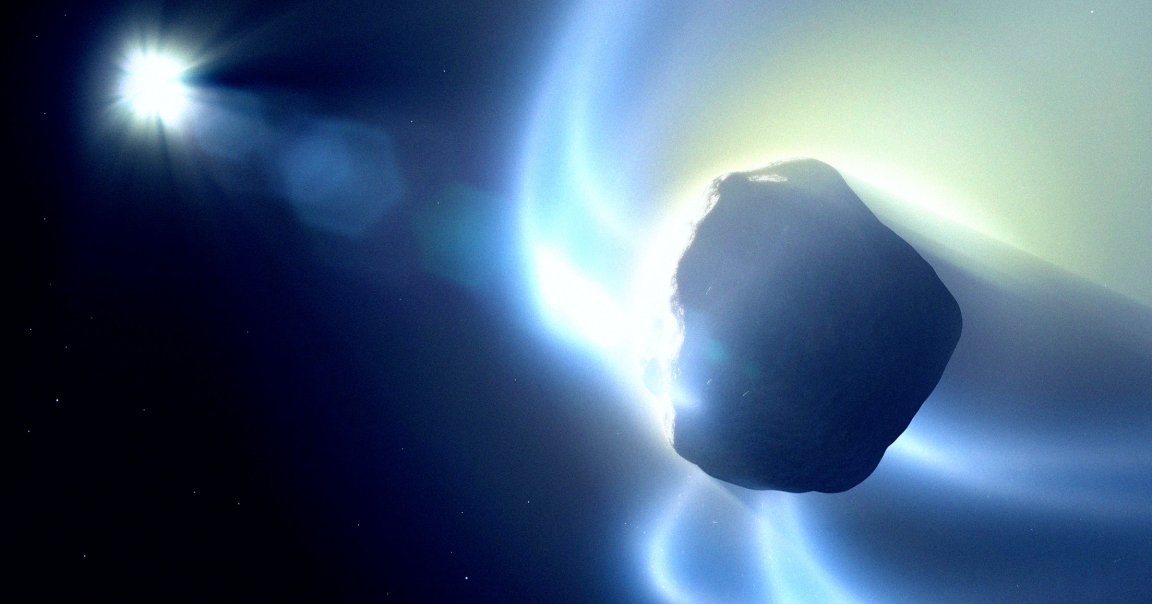
Since it was first spotted in early July, scientists have been fascinated by 3I/ATLAS — the third object in history to have been spotted cruising through our solar system from interstellar space.
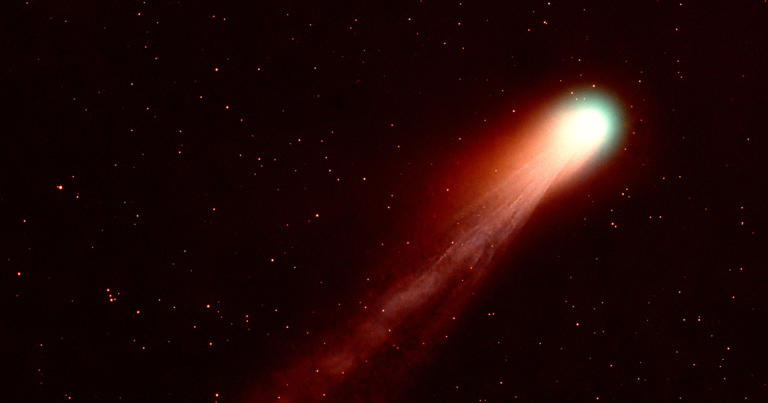
During that close approach, scientists were surprised to note that 3I/ATLAS brightened much faster than they anticipated. Comets commonly form a tail of gas and dust as they approach the Sun, as its radiation causes solid ice to sublimate into gas, causing material to be stripped from their surface that then reflects more light.
However, astronomers were caught off guard by how quickly 3I/ATLAS’ luminosity grew in observations by two solar observatories, NASA’s Solar Terrestrial Relations Observatory (STEREO), and the European Space Agency’s Solar and Heliospheric Observatory (SOHO), as well as the National Oceanic and Atmospheric Administration’s GOES-19 weather satellite.
Relying on these observatories is a stopgap measure, since Earth-based observatories won’t be able to track the object until it reemerges from behind the Sun in early December.
“The reason for 3I’s rapid brightening, which far exceeds the brightening rate of most Oort cloud comets at similar [radial distance], remains unclear,” Naval Research Laboratory astrophysicist Karl Battams and Lowell Observatory postdoctoral fellow Qicheng Zhang wrote in a yet-to-be-peer-reviewed paper about the “rapid brightening.”
However, they provided several theories as to why 3I/ATLAS may have lit up much faster than expected. For one, it could be the object’s immense speed. It’s been traveling at a speed of roughly 137,000 mph, significantly faster than either of the two previously discovered interstellar objects.
Or it could have something to do with the object’s composition itself.
“Oddities in nucleus properties like composition, shape, or structure — which might have been acquired from its host system or over its long interstellar journey — may likewise contribute [to the rapid brightening],” Zhan and Battams wrote.
The astronomers also found that 3I/ATLAS is “distinctly bluer than the Sun,” which is “consistent with gas emission contributing a substantial fraction of the visible brightness near perihelion.”
Yet many questions remain, and we’ll have to await future observations to shed more light on the matter.
“Without an established physical explanation, the outlook for 3I’s postperihelion behavior remains uncertain, and a plateau in brightness — or even a brief continuation of its preperihelion brightening — appears as plausible as rapid fading past perihelion,” the researchers added.
For now, astronomers will have to remain patient as 3I/ATLAS continues to be hidden from Earth’s view behind the Sun.
“Following its 2025 October 29 perihelion, 3I makes a return to twilight and subsequently dark, night skies over 2025 November–December,” the paper reads, which could allow us to once again “characterize the comet in far greater detail than possible with the data we have presented.”
While there’s been a wide consensus within the scientific community that we’re looking at a comet largely made up of carbon dioxide ice, Loeb maintains that there’s something incredibly unusual about the object.
On his blog, Loeb outlines nine “anomalies” that he says support his eyebrow-raising hypothesis that we could be looking at an “alien mothership” that could be releasing “mini-drones” as it passes behind the Sun — despite admitting that “3I/ATLAS is most likely a comet of natural origin.”
1. Its Trajectory Is Closely Aligned With the Solar System’s Planets
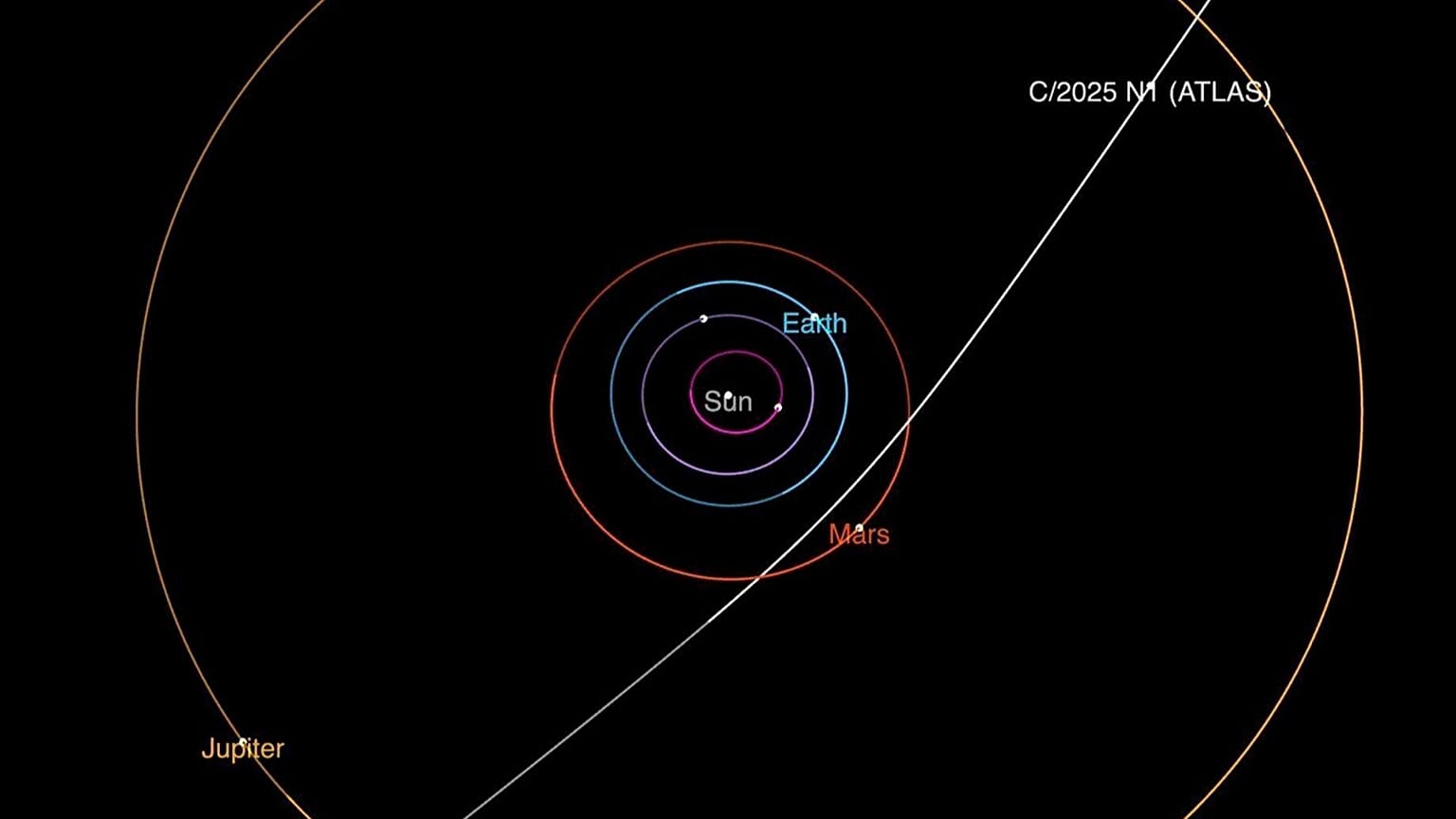
Loeb points out that the mysterious visitor’s trajectory falls within just five degrees of the Earth’s path around the Sun, or the ecliptic plane. He argues there’s only a 0.2 percent likelihood of this happening.
2. It Visited Several Planets
In addition to its near alignment with the ecliptic plane, 3I/ATLAS’ arrival times perfectly coincide with the orbits of Mars and Jupiter, a “remarkable fine-tuning of the object’s path,” per Loeb.
Earlier this month, the object passed by Mars close enough for two of the European Space Agency’s spacecraft orbiting the Red Planet to snap photos of it. It’s expected to come within just 33.3 million miles from Jupiter in March 2026, which could allow NASA’s Juno spacecraft to intercept its path, Loeb argues.
Astronomers have also observed 3I/ATLAS growing a second tail, which points in the direction of the Sun. Many other comets have been observed to have developed an “anti-tail,” an optical illusion resulting from our relative positioning as it passes between the Earth and Sun.
However, Loeb argues that 3I/ATLAS’s second tail is an outlier.
“This anomalous anti-tail, not a result of geometric perspective, had never been reported before for solar system comets,” Loeb wrote in a blog post.
“The ice fragments evaporate after some time but because of the enhanced mass loss in the Sun-facing side, more of the bigger fragments can reach a large distance,” Loeb told Futurism in an email earlier this month.
4. It Could Be Enormous
According to Loeb’s calculations, the “diameter of its solid-density nucleus must be larger than [3.1 miles],” a measurement he inferred from an estimated mass of more than “33 billion tons.”
That would make it “three to five orders of magnitude” more massive than either ‘Oumuamua and 2I/Borisov, the only two other interstellar objects to have ever been observed in our solar system.
“Given the limited reservoir of heavy elements, we should have discovered on the order of a hundred thousand interstellar objects on the 0.1-kilometer scale of 1I/’Oumuamua before finding 3I/ATLAS, yet we only detected two interstellar objects previously,” he argued in a September blog post.
5. It’s Nickel to Iron Ratios Are Off the Charts
Scientists have found that 3I/ATLAS shows an “extreme abundance ratio” of nickel and iron in its gas plume, making it a major outlier when compared to 2I/Borisov and other more familiar solar system comets.
“At the distances at which comets are observed, the temperature is far too low to vaporize silicate, sulfide, and metallic grains that contain nickel and iron atoms,” an international team of astronomers wrote in a yet-to-be-peer-reviewed paper. “Therefore, the presence of nickel and iron atoms in cometary coma is extremely puzzling.”
Loeb argues that the findings could indicate the presence of “industrially-produced nickel alloys.”
6. It’s Mostly Carbon Dioxide Ice
Researchers have concluded, by examining data from the Spectro-Photometer for the History of the Universe, Epoch of Reionization and Ices Explorer (SPHEREx), that 3I/ATLAS may be a mere four percent water by mass, bearing a much higher proportion of carbon dioxide gas than other comets.
While Loeb argues that this makes the object an outlier, scientists have argued the opposite.
“SPHEREx’s finding very large amounts of vaporized carbon dioxide gas around 3I/ATLAS told us it could be like a normal solar system comet,” Johns Hopkins University astronomer Carey Lisse told Space.com last month.
In a separate preprint paper, an international team of researchers suggested that it may contain “ices exposed to higher levels of radiation than Solar System comets,” or it could’ve “formed close to the CO2 ice line in its parent protoplanetary disk.”
7. It’s Extremely Negatively Polarized
The mysterious object has also shown “extreme negative polarization,” as detailed in a September paper, making it a major outlier.
“The combination of low inversion angle and extreme negative polarization is unprecedented among comets and asteroids, marking 3I/ATLAS the first object known with such polarimetric behavior and representing a previously unobserved population,” Loeb wrote in a blog post.
The findings suggest it has more in common with trans-Neptunian objects, minor planets, and other smaller objects orbiting the Sun beyond Neptune’s orbit, according to the authors of the September research paper.
8. It Could Be Behind the Famous “WOW! Signal”
Loeb has gone as far as to suggest that 3I/ATLAS may have emitted the “Wow! Signal,” a highly unusual narrowband radio signal that was first spotted by the Ohio State University’s Big Ear radio telescope in 1977. The signal led to widespread excitement about the possibility of having made contact with extraterrestrial life, and has remained a mystery for decades.
Loeb argues that “3I/ATLAS arrived from a direction coincident with the radio ‘Wow! Signal’ to within nine degrees, with a likelihood of 0.6 percent.”
9. It’s Much Bluer Than the Sun
This week, as 3I/ATLAS approaches its closest point to the Sun, or its perihelion, scientists observed a “rapid rise” in its brightness, appearing “distinctly bluer than the Sun,” Loeb wrote in a new blog post.
To the astronomer, it’s a “very surprising” finding. “Dust is expected to redden the scattered sunlight, and the surface of the object is expected to be an order of magnitude colder than the 5,800 degrees Kelvin at the photosphere of the Sun, resulting in it having a redder color than the Sun.”
“Does it employ a power source that is hotter than the Sun?” Loeb asked rhetorically.
If It Smells Like a Comet…
Whether these nine “anomalies” outlined by Loeb add up to make a convincing enough argument that 3I/ATLAS is “technological” in nature remains debatable.
NASA’s lead scientist for solar system small bodies, Tom Statler, told The Guardian last month that there’s plenty of evidence we’re not looking at evidence of an extraterrestrial rare — but an extremely rare visitor in the form of a comet from another star system.
“It looks like a comet,” he said. “It does comet things. It very, very strongly resembles, in just about every way, the comets that we know.”
“It’s a comet,” Statler concluded at the time.
Meanwhile, Loeb argued on his blog that “we have to collect as much data as possible to figure out the nature of this anomalous object” — especially considering its enormous suspected size.
“The implication of alien technology would be huge and therefore we must take this possibility seriously,” he added. “Our biggest rocket, [SpaceX’s] Starship, is a hundred times smaller than 3I/ATLAS, so in case 3I/ATLAS were technological — its senders would have mastered capabilities that go well beyond our technologies.”
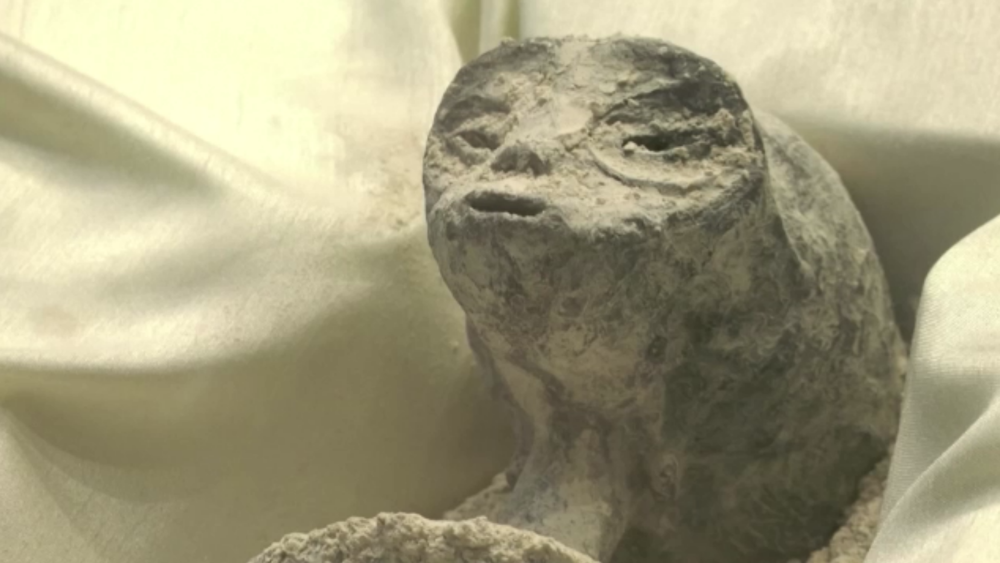
Wat we weten over de 'niet-menselijke' buitenaardse lichamen van Mexico Op 12 september 2023 presenteerde journalist en UFO-fan Jaime Maussan de stoffelijk overschotten van vermeende aliens voor de Mexicaanse autoriteiten. Zo'n congresgebeurtenis is ongekend en de wereld raakt er maar niet over uitgepraat. Maar wie zijn deze vermeende buitenaardse wezens? En hoe zijn ze in 2023 in Mexico terechtgekomen?
Klik door de volgende galerij van foto's en tekst om erachter te komen!
Wetgevers De lichamen werden aan de wetgevers van het land gepresenteerd tijdens de eerste openbare hoorzitting van het Mexicaanse Congres over dit onderwerp.
Hoe oud zijn ze? Koolstof-14 datering uitgevoerd door de Nationale Autonome Universiteit van Mexico schat de buitenaardse resten op 700 tot 1.800 jaar oud.
De eerste keer "Dit is de eerste keer dat het (buitenaards leven) in een dergelijke vorm wordt gepresenteerd en ik denk dat er een duidelijk bewijs is dat we te maken hebben met niet-menselijke exemplaren die niet verwant zijn aan andere soorten in onze wereld," vertelde Maussan voor het congres.
DNA-bewijs Jaime Maussan zei dat DNA-testen zouden bewijzen dat de lijken niet van onze planeet afkomstig waren, maar dergelijk bewijs werd niet geleverd.
Tests Bovendien vertelde José de Jesús Zalce Benitez, directeur van het Wetenschappelijk Instituut voor Gezondheid van de Mexicaanse marine, ook dat er röntgenfoto's en 3D-reconstructies waren gemaakt. Maar opnieuw werd er geen bewijs gepresenteerd.
Tests Het Nationaal Laboratorium voor Massaspectrometrie met Versnellers (LEMA) bracht een verklaring uit 2017 opnieuw uit waarin stond dat hun tests alleen bedoeld waren om de leeftijd van de monsters te bepalen, en dat ze dit deden aan de hand van monsters die door de klant waren aangeleverd en niet aan de hand van de monsters zelf.
Verklaring LEMA Het lab "distantieert zich van elk gebruik, interpretatie of latere verkeerde voorstelling van de resultaten die het levert", luidde de verklaring. "In geen enkel geval trekken we conclusies over de herkomst van deze monsters."
Niet de eerste Het blijkt dat dit niet de eerste keer is dat Jaime Maussan beweert 'niet-menselijke' overblijfselen te hebben ontdekt. In 2015 beweerde hij een gemummificeerde alien te hebben ontdekt in Nazca, Peru.
Veranderingen in de wet Tijdens de hoorzitting werd gedebatteerd over of de inhoud over UAP (Unidentified Aerial Phenomena) in de Aerial Space Protection Law moest worden aangepast. Als deze veranderingen worden goedgekeurd, wordt Mexico 'de eerste natie die formeel erkent dat er buitenaards leven op aarde bestaat'.
Amerikaanse inbreng Maussan werd vergezeld door Ryan Graves, de uitvoerend directeur van de organisatie Americans for Safe Aerospace. Graves is een voormalig piloot van de Amerikaanse marine die soortgelijke zorgen naar voren bracht in Washington.
Amerikaanse inbreng Graves vertelde Mexicaanse wetgevers: "Wij geloven dat UAP een dringende prioriteit vormen voor zowel de veiligheid van de luchtvaart als voor wetenschappelijk onderzoek," zei hij. "Onze focus ligt op het verbeteren van publieke voorlichting over UAP, het doorbreken van stigma's en het werken aan betere transparantie en openbaarmaking."
Een congreslid laat de deur open "We blijven achter met overpeinzingen, met zorgen en met de weg om hierover te blijven praten," aldus Congreslid Sergio Gutiérrez Luna.
Kritiek Maussans presentatie is door een aantal mensen in twijfel getrokken, waaronder een van Mexico's beste astrobiologen, Antígona Segura, die zei: "Deze conclusies worden simpelweg niet ondersteund door bewijs."
Kritiek De vermeende buitenaardse lichamen als bewijs werd ook bekritiseerd door Julieta Fierro, onderzoeker aan het Instituut voor Astronomie van de Nationale Autonome Universiteit van Mexico, die zei dat het "nergens op sloeg".
Kritiek "Maussan heeft vele wonderen beleefd Hij zegt dat hij met de Maagd van Guadalupe heeft gesproken", aldus Fierro. "Hij vertelde me dat buitenaardsen niet met mij praten zoals ze met hem praten, omdat ik er niet in geloof."
Het Roswell-incident Het Roswell-incident is misschien wel een van de beroemdste in de Amerikaanse ufologie. In 1947 beweerden twee mannen dat ze hadden gezien hoe Amerikaans legerpersoneel een buitenaards ruimteschip uit de woestijn haalde. Het Amerikaanse leger ontkent het incident tot op de dag van vandaag.
De waarneming door Jimmy Carter In 1973 rapporteerde de toenmalige gouverneur van Georgia dat hij een UFO had gezien, een feit dat pas bekend werd nadat Carter president van de Verenigde Staten was geworden.
De waarneming in Vancouver Op 20 februari 2011 meldden een aantal mensen in Vancouver, Canada, dat ze een object in de lucht zagen zweven dat licht uitstraalde. Beelden van de gebeurtenis werden bekeken en er werd geconcludeerd dat de UFO eigenlijk een vlieger was met LED-lampjes.
Het incident met kapitein William Schaffner Op 9 september 1970 vloog piloot William Schaffner van de Royal Air Force boven de Noordzee toen hij een vreemd object zag zweven. Een paar minuten later verloor hij de radiocommunicatie. Het vliegtuig werd later in zee gevonden, maar de kap van het vliegtuig was dicht en er was geen spoor van kapitein Schaffner.
De lichtjes van Lubbock Tussen augustus en september 1951 werden in Lubbock, Texas, verschillende ongewone lichtformaties waargenomen die in een V-patroon waren gerangschikt. De Amerikaanse luchtmacht stelde een onderzoek in en concludeerde dat de lichten waren veroorzaakt door een plevier (een kleine waadvogel).
De lichtjes van Rendlesham Forest Het Rendlesham Forest incident is een serie waarnemingen die plaatsvond in 1980 nadat een UFO vermoedelijk was geland in het Engelse Rendlesham Forest. Maar het Ministerie van Defensie beschouwde de gebeurtenis nooit als een bedreiging voor de nationale veiligheid, dus werd het nooit formeel onderzocht.
The discovery of 3I/Atlas in July 2025 has sparked widespread scientific intrigue due to its atypical behavior and composition, which challenge existing paradigms of interstellar objects (ISOs). Unlike previous interstellar visitors such as 1I/`Oumuamua and 2I/Borisov, Atlas exhibits a host of anomalies that suggest the possibility of a non-natural origin or even a form of extraterrestrial technology. This paper synthesizes current observational data, analyzes the peculiarities of 3I/Atlas, examines hypotheses regarding its nature, and considers implications for our understanding of interstellar objects and potential extraterrestrial interventions.
The strange behaviour of 3I/Atlas since it was first recorded entering the inner Solar System by the NASA-funded Asteroid Terrestrial-impact Last Alert System (ATLAS) in Río Hurtado, Chile, on July 1, 2025 sets it apart from the previous two interstellar objects spotted in our skies over the past decade. Its hyperbolic trajectory coinciding with the path of the planets, its scheduled rendezvous with three of them, its curious front-pointing anti-tail, its strange composition, and the unique polarization of light within its coma, all tell us we are dealing with an object not yet entirely understood by science.
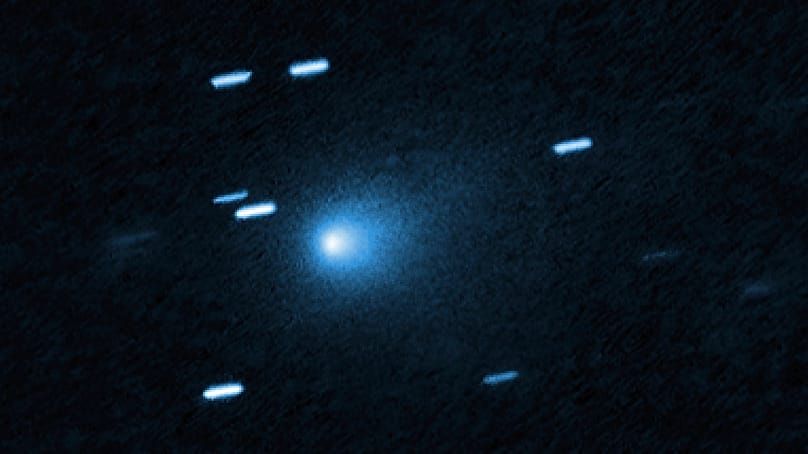
NASA's Hubble Space Telescope captures interstellar comet 3I/Atlas with unprecedented detail.
While to some 3I/Atlas is simply a weird-acting exocomet of unusual composition, others, such as Dr Avi Loeb of Harvard University, propose that we should consider the possibility that it is an example of alien technology. Indeed, the various anomalies identified in connection with 3I/Atlas place it at four on Avi’s newly rolled-out Loeb Scale where zero is a natural comet and ten is an unquestionable alien spacecraft of potential danger to life on Earth (with 1I/’Oumuamua, the first interstellar visitor from 2017 being at four on the Loeb Scale, and 2I/Borisov, the second interstellar from 2019, being at zero on the scale). As of October 2025, Loeb estimates a 30-40% chance that 3I/Atlas may not be entirely natural, based on eight anomalies.
Introduction
Since the first confirmed detection of an interstellar object traversing our Solar System in 2017, designated 1I/Oumuamua, astronomers have been captivated by these fleeting visitors from beyond our stellar neighborhood. Notably, 2I/Borisov in 2019 reaffirmed the existence of interstellar comets or asteroids, but both objects conformed broadly to natural expectations: 1I/Oumuamua was elongated and lacked a coma, leading to debates about its nature, while 2I/Borisov was a classical comet with a volatile-rich composition.
The arrival of 3I/Atlas in July 2025, however, appears to upend this pattern. Detected initially by the NASA-funded Asteroid Terrestrial-impact Last Alert System (ATLAS) in Río Hurtado, Chile, 3I/Atlas displayed behaviors and features that render its classification ambiguous. This article aims to evaluate whether 3I/Atlas is a typical interstellar comet or something more extraordinary—potentially an artifact of extraterrestrial engineering.
3I/ATLAS huge breakthrough: NASA detects Fingerprint of Water — Could it confirm life beyond Earth?
Observational Data and Anomalies
Discovery and Trajectory
On July 1, 2025, ATLAS registered a fast-moving object with a hyperbolic trajectory, indicative of an interstellar origin. The trajectory of 3I/Atlas coincided with the plane of the Solar System, a trait that distinguishes it from previous interstellar visitors, which often exhibit hyperbolic inclinations. Its precise orbital parameters suggest that it will have close approaches with three planets—Mars, Earth, and Venus—over the next two years, offering unparalleled opportunities for observation.
Copyright Credit: NASA/JPL-Caltech/AP
Physical Characteristics
Shape and Size
Initial imaging suggests a highly elongated body, roughly 400 meters in length, with a width-to-length ratio exceeding 5:1. Unlike the more rounded nucleus of 2I/Borisov or the elongated shape of `Oumuamua, Atlas's morphology appears more filamentary.
Surface and Composition
Spectroscopic analyses reveal an unusual mixture: a significant fraction of organic compounds, complex hydrocarbons, and refractory materials. This composition is atypical for classical comets, which are predominantly icy bodies, raising questions about its origin.
Coma and Tail
The object exhibits a curious "front-pointing anti-tail," a tail oriented opposite to the Sun, yet the effect is asymmetric and highly variable. Moreover, the coma shows an unusual polarization of light, with measurements indicating a polarization degree of approximately 25%, substantially higher than typical comets, which usually exhibit polarization between 10-15%.
Activity Pattern
Unlike the steady sublimation-driven activity observed in 2I/Borisov, 3I/Atlas demonstrates irregular outbursts, inconsistent with standard sublimation patterns, suggesting an alternative process—possibly structural breakdown or non-volatile activity.
This NASA/ESA image shows interstellar comet 3I/ATLAS, captured by Hubble on 21 July 2025, from 277 million miles away.
Credit: NASA/European Space Agency via AP
The Anomalies
Eight primary anomalies have been identified, each contributing to the debate about 3I/Atlas's nature:
Hyperbolic trajectory aligned with planetary orbits
Presence of a front-pointing anti-tail with asymmetric morphology
Unusual polarization levels within the coma
Irregular activity patterns not matching sublimation models
Composition rich in complex organics with refractory materials
Repeated close approaches potentially affecting observational data
Lack of expected volatile-driven activity during perihelion
Hypotheses and Interpretations
The anomalies observed in 3I/Atlas have led to diverse hypotheses, ranging from natural origin theories to more speculative, technologically driven explanations.
Natural Origin: A Peculiar Exocomet
Many astronomers posit that Atlas represents a highly unusual comet originating from another planetary system. Its atypical composition and dynamic behavior could result from its evolution under conditions different from those in our Solar System—such as exposure to intense stellar radiation or unique planetary formation processes.
However, the specific anomalies—like its polarization, anti-tail morphology, and irregular activity—are difficult to reconcile with purely natural bodies, prompting skepticism.
Artificial or Technological Origin: A Potential Artifact
Some researchers, including Harvard Professor Dr. Avi Loeb, hypothesize that 3I/Atlas might be an artifact of extraterrestrial technology, whether a probe, a fragment of a spacecraft, or an interstellar artifact deliberately or accidently released from another civilization.
Loeb's Loeb Scale assigns a value from 0-10 to objects based on their likelihood of being artificial:
- Zero (0): Natural celestial body, like a normal comet or asteroid
- Ten (10): Unquestionable alien spacecraft
In October 2025, Loeb estimates a 30-40% probability that Atlas is not entirely natural, primarily based on its anomalies, which he interprets as potential signs of intentional design or non-biological origin.
Key arguments supporting this hypothesis include:
- The anti-tail morphology resembles engineered features designed to manipulate light or confusion to observers.
- Polarization anomalies could be indicative of artificial surfaces or materials.
- The irregular activity may correspond to intentional modulation of energy emissions or structural self-maintenance.
Theoretical Support for Artificial Origin
The hypothesis of an interstellar probe or artifact is not unfounded within current scientific discourse. Historically, interpretations of 1I/`Oumuamua have included the possibility of artificial origin due to its acceleration unexplained by gravitational forces alone and its shape.
In the case of Atlas, its trajectory's alignment with planetary planes and the peculiar activity imply that it may have been designed or modified intentionally, perhaps as a "message in a bottle" or a reconnaissance device.
Consequences and Future Research
Scientific Significance
Confirming an artificial origin for 3I/Atlas would have profound implications:
- Extraterrestrial Intelligence (ETI): Evidence of engineering artifacts would indicate an advanced alien civilization exists or once existed.
- Interstellar Material Culture: Understanding the characteristics of such artifacts would inform models of interstellar object creation and propagation.
- Detection Strategies: New methodologies could be developed for identifying and analyzing potential alien objects.
Observational Campaigns and Data Collection
Upcoming planetary encounters will facilitate in-situ observations. High-resolution imaging using ground-based telescopes, and eventually space-based platforms, aim to resolve the body's size, shape, and surface features.
Spectroscopic measurements across multiple wavelengths will refine composition profiles, and polarization studies may help distinguish between natural and artificial materials.
Challenges
- Distinguishing Natural vs. Artificial: The detectability of engineered features could be limited by current technology.
- Potential Hazards:If the object is alien and exhibits intentional activity, there's a theoretical risk of encountering technologies beyond current understanding.
- Time Constraints:Close approaches happen rapidly, requiring swift mobilization of observational resources.
Discussion
The case of 3I/Atlas exemplifies the tension between naturalistic explanations and the possibility of extraordinary origins. While many anomalies can be explained via exotic natural processes, the accumulation of irregular behaviors and properties has revived debates about extraterrestrial technology.
The scientific community remains cautious. The data from current observations are compelling but not conclusively indicative of alien origin. Nonetheless, Atlas has invigorated the search for signatures of extraterrestrial technology and heightened awareness that interstellar visitors may sometimes be more than natural objects.
Conclusion
As of October 2025, 3I/Atlas remains an enigma—an interstellar object that challenges our understanding of planetary formation, cometary physics, and possibly, the existence of extraterrestrial technology. Its unique behavior, anomalous features, and trajectory position it as a candidate for future studies into alien artifacts. The coming months and years, with intensified observational campaigns, will be critical in deciphering whether 3I/Atlas is an extraordinary natural phenomenon or a technological relic from another civilization sent across the stars, possibly alive, possibly watching.
References
Loeb, A. (2021). Extraterrestrial objects: extraterrestrial or natural? Astrophysical Journal Letters, 910(2), L5.
Hughes, D. W. (2020). Interstellar visitors: The case of 1I/‘Oumuamua. Monthly Notices of the Royal Astronomical Society, 492(4), 842-850.
NASA Jet Propulsion Laboratory. (2022). The exploration of interstellar objects. NASA Technical Report.
Meech, K. J., et al. (2017). Additional observations of interstellar comet 2I/‘Oumuamua. Nature, 552(7685), 378–381.
Siraj, A., & Loeb, A. (2022). Number density of interstellar objects and their implications. Astrophysical Journal, 927(1), 5.
ESA Space Science Division. (2023). Future missions to interstellar objects. European Space Agency Report.
Morbidelli, A., & Nesvorný, D. (2020). Origins of interstellar objects. Annual Review of Astronomy and Astrophysics, 58, 451-487.
Jewitt, D., & Luu, J. (2019). Analysis of the physical properties of interstellar minor planets. Science Advances, 5(8), eaaw9776.
Bialy, S., & Loeb, A. (2018). ‘Oumuamua as an artificial object? Astrophysical Journal Letters, 868(2), L1.
International Astronomical Union (IAU). (2023). Official nomenclature and classifications of interstellar objects. IAU Circulars and reports.
On the occasion of Halloween, the European Southern Observatory (ESO) published an image taken by the VST telescope. It shows an object resembling a bat.
The RCW 94/95 nebula. Source: ESO/VPHAS+ team/VVV team
In fact, the VST image shows a large cloud of cosmic gas and dust known as RCW 94/95. It is located about 10,000 light-years from Earth between the southern constellations Circinus and Norma. If we could see it with the naked eye, it would cover an area in the sky equivalent to four full moons.
This nebula is a stellar nursery, where new stars are forming. Newborn stars emit enough energy to excite the hydrogen atoms around them, causing them to glow intensely with a characteristic red color.
As for the dark filaments, which resemble the outline of a bat’s skeleton, they are cold, dense clusters of gas and dust grains. We can see them because they block the light from more distant background stars.
The image of the nebula was obtained using the VLT Survey Telescope. It is part of the Paranal Observatory, located in the Atacama Desert. The telescope is equipped with a 268-megapixel OmegaCAM camera, which gives it the ability to capture vast areas of the sky.
The image of the nebula was created by combining images obtained through filters that transmit different colors or wavelengths of light. Most of the bat’s shape, including the red glow, was captured in visible light. Additional infrared data, which revealed the densest parts of the nebula and added color to the image, was obtained using the VISTA telescope.
Earlier, we reported on how the James Webb Telescope photographed an amazing nebula resembling a red spider.
October 30 marked the 87th anniversary of the most successful production of a science fiction work in history. Herbert Wells’ radio play “The War of the Worlds” was so carefully styled to resemble a real news report from the scene of events that many listeners believed in the reality of an alien invasion. You can laugh at this story, or you can think about how protected we are in today’s world of deepfakes, clip thinking, and crazy events in world politics from repeating this. Or, conversely, failing to respond to a genuine alien invasion.
Alien invasion
The War of the Worlds, 1938
Imagine the situation. It’s the eighth evening, and you’re doing your household chores. There’s an entertainment program on the radio, the hosts are joking, talking about some adaptation of a science fiction novel, announcing the weather forecast, and then music starts playing.
Suddenly, the concert is interrupted by breaking news. Astronomers report that several powerful flashes have been spotted on Mars. After that, pleasant music plays again, as if nothing has happened.
However, the music doesn’t play for long. Because the news comes back on. The reporter says that an unknown cylindrical object has fallen near a small town somewhere in your country. You look at the map and realize that the town is completely real and located exactly where the reporter says, and he continues to describe what is happening.
Would you believe reports of aliens landing? Source: evil.fandom.com
The cylinder unscrews and monsters with pike heads crawl out of it. The local police try to establish contact with them, but they start shooting with ray guns. The broadcast is interrupted and the announcer says something about technical problems. The music starts playing again, but soon reports come in about new attacks by strange creatures and fires.
It seems that an alien invasion has begun and something has to be done. According to radio reports, fighting is taking place in the capital, and your neighbors are knocking on your door in a panic. Some are packing an “emergency suitcase,” while others are cleaning their weapons.
Meanwhile, the nature of the broadcast changes and it begins to resemble a radio play. Soon it becomes clear that this is exactly what it is. You breathe a sigh of relief and say a few swear words to the radio station.
Looks like a new episode of Black Mirror? But no, this is a completely true story that took place in the United States in 1938. Theater director Orson Welles decided to stage a radio play based on the book The War of the Worlds by his famous namesake Herbert Wells. For this purpose, he moved the Martians’ landing from early 20th-century England to the United States in 1938. However, this was not enough for him, and he decided to stylize it as real news reports. He succeeded.
Orson Welles. Source: Wikipedia
The extent of the panic caused by people believing that the landing was real was greatly exaggerated by the newspapers at the time. However, the fact remains that thousands of people believed it, despite the fact that the hosts said at the very beginning of the broadcast that it was a staged event. People were really panicking and calling everywhere they could, and the police arrived at the radio station to force it to stop spreading panic.
The era of fake news
Here, one could laugh at the gullibility and inattentiveness, if we were even slightly different from those listeners. By 1938, radio listeners were already quite familiar with the story, and stylizing the production to resemble real events was not something completely new. Wells’ book was also well known. And none of this prevented people from, as we would say today, falling for the fake.
In the 87 years since that play, we have seen alien invasions many times in films and TV series. We know that it is not difficult to create not only audio but also video footage that, under certain conditions, will look like proof that someone has flown in to visit us. Especially if this video is posted on social media, where it will be flooded with comments and reposts and eventually reported in the news.
Nowadays, it is even possible to create a fake photo of the Pope embracing Madonna. Source: www.theguardian.com
Would you believe such a video? What about three videos depicting three different episodes of the invasion? Would you scrutinize the details, looking for signs of rubber tentacles and evidence that the flying saucer is painted? Especially if, on top of that, there is a comment from some “expert” explaining that this frame clearly shows the inhuman anatomy of the aliens, and that the “death rays” captured by the camera have no analogues among earthly developments.
And all this is the reality of the second decade of the 21st century, and we are already living in the third. Generating video using artificial intelligence has long been a reality. The modern Orson Welles simply did not get there first.
We should admit that we live in the age of fake news, and we are less protected from mistaking “entertainment content” for news from the scene than listeners of American radio in 1938. The arsenal of ways to deceive the neural network in our heads has grown incredibly.
As for aliens, we don’t even know why we should believe in them or not, because we’ve only seen them in movies. It is quite possible that they really do have six fingers on each hand. Or maybe they don’t have hands at all, and they simply flow from one form to another, in each of which we can see something like arms and legs, but woven together in such a combination that it immediately becomes obvious that it is the AI that drew it.
Who knows how many fingers aliens really have? Source: phys.org
International politics
When discussing the events of 1938 and considering whether something similar could happen again in 2025 or 2026, it is difficult not to mention the word “politics.” The fact is that many people who took the radio broadcast of The War of the Worlds for a real invasion thought that the Germans had attacked the United States. No, most Americans knew that Germans did not have tentacles, but the political situation in the world was rapidly spiraling toward the start of World War II, and people were already so hyped up by the news that they were ready to hear news of a landing, just not Martians.
In general, this is a very complex problem: we believe what we are prepared to believe. A large part of the population is capable of interpreting certain natural events as manifestations of what they believe in. In other words, if Orson Welles’ radio broadcast is successfully replicated, a certain number of people will start posting messages on social media saying that they personally have seen an alien spacecraft, attaching photos showing clouds or the planet Venus.
The overlay of all this with news that sounds no more optimistic than it did before World War II greatly contributes to the general expectation that some kind of invasion is bound to begin. Politicians sometimes make statements so strange that it’s hard not to suspect they’re being controlled by aliens. And high-tech invasions of one country by another have long since become a reality.
At night, drones are difficult to distinguish from UFOs. Source: nypost.com
We should not forget about the rapid development of unmanned aerial vehicles. In just one decade, they have evolved into aircraft that experts would have considered science fiction twenty years ago. At the same time, most military drones have never been seen by the general public, which is why they can easily be mistaken for UFOs at dusk.
A characteristic example here is the unidentified drones over the countries of Northern Europe, which have been terrorizing local airports and military bases over the past few months. Many believe that these are truly alien craft, and this claim interacts in a complex way with the assumption that, in reality, these drones belong to Russia.
Doesn’t this situation resemble the one in the late 1930s, when the Germans were about to invade somewhere? After all, no one would dare claim that aliens couldn’t have drones of their own. Which means that footage of one of the most advanced drones in action can easily be passed off as evidence of extraterrestrial existence — and many people would believe it.
But what if they actually arrive?
So far, we’ve been talking about how not to believe a fake about aliens. But, theoretically, the opposite problem is also possible: beings from other worlds could arrive and reveal themselves openly — yet no one would believe it, because everyone knows how easy it is to create a fake video.
When you flew in to make contact, and everyone thought you were fake. Source: phys.org
It’s one thing when it’s a real invasion. Whether it’s a laser beam or a missile — when it hits something near you, all doubts disappear. Of course, it would be nice to know that someone has attacked Earth before you experience it firsthand, but, let’s be honest, this problem is unsolvable even in earthly wars.
But the situation in which aliens arrive and stop somewhere beyond Neptune’s orbit, politely talking with world leaders while waiting to be invited to Earth, is much worse. Even if the aliens deliver a greeting to all the peoples of Earth and it is broadcast on every TV channel, it would still be less convincing than the 1938 radio adaptation of The War of the Worlds.
Because just as people believe what they’re ready to believe, they don’t believe what they’re not ready to perceive. So it’s easy to imagine a situation where humanity has been communicating with aliens for decades, dozens of videos featuring them are available online, thousands of people have met them in person — yet tens of millions keep insisting that it’s all fake.
Therefore, there are no universal tips on how to tell a fake about aliens from a real invasion. Except, perhaps, to listen carefully to the radio broadcast from the very beginning — they might mention there that it’s all just a dramatization.
Meer van UFO'S of UAP'S, ASTRONOMIE, RUIMTEVAART, ARCHEOLOGIE, OUDHEIDKUNDE, SF-SNUFJES EN ANDERE ESOTERISCHE WETENSCHAPPEN - DE ALLERLAATSTE NIEUWTJES


 JD Vance declares himself 'UFO' lunatic as he vows to pull back the curtain on government secrets