Naar de inhoud

UFO'S of UAP'S, ASTRONOMIE, RUIMTEVAART, ARCHEOLOGIE, OUDHEIDKUNDE, SF-SNUFJES EN ANDERE ESOTERISCHE WETENSCHAPPEN - DE ALLERLAATSTE NIEUWTJES

UFO's of UAP'S in België en de rest van de wereld
akke.beakke.be
Ontdek de Fascinerende Wereld van UFO's en UAP's: Jouw Bron voor Onthullende Informatie! Ben jij ook gefascineerd door het onbekende? Wil je meer weten over UFO's en UAP's, niet alleen in België, maar over de hele wereld? Dan ben je op de juiste plek! België: Het Kloppend Hart van UFO-onderzoek In België is BUFON (Belgisch UFO-Netwerk) dé autoriteit op het gebied van UFO-onderzoek. Voor betrouwbare en objectieve informatie over deze intrigerende fenomenen, bezoek je zeker onze Facebook-pagina en deze blog. Maar dat is nog niet alles! Ontdek ook het Belgisch UFO-meldpunt en Caelestia, twee organisaties die diepgaand onderzoek verrichten, al zijn ze soms kritisch of sceptisch. Nederland: Een Schat aan Informatie Voor onze Nederlandse buren is er de schitterende website www.ufowijzer.nl, beheerd door Paul Harmans. Deze site biedt een schat aan informatie en artikelen die je niet wilt missen! Internationaal: MUFON - De Wereldwijde Autoriteit Neem ook een kijkje bij MUFON (Mutual UFO Network Inc.), een gerenommeerde Amerikaanse UFO-vereniging met afdelingen in de VS en wereldwijd. MUFON is toegewijd aan de wetenschappelijke en analytische studie van het UFO-fenomeen, en hun maandelijkse tijdschrift, The MUFON UFO-Journal, is een must-read voor elke UFO-enthousiasteling. Bezoek hun website op www.mufon.com voor meer informatie. Samenwerking en Toekomstvisie Sinds 1 februari 2020 is Pieter niet alleen ex-president van BUFON, maar ook de voormalige nationale directeur van MUFON in Vlaanderen en Nederland. Dit creëert een sterke samenwerking met de Franse MUFON Reseau MUFON/EUROP, wat ons in staat stelt om nog meer waardevolle inzichten te delen. Let op: Nepprofielen en Nieuwe Groeperingen Pas op voor een nieuwe groepering die zich ook BUFON noemt, maar geen enkele connectie heeft met onze gevestigde organisatie. Hoewel zij de naam geregistreerd hebben, kunnen ze het rijke verleden en de expertise van onze groep niet evenaren. We wensen hen veel succes, maar we blijven de autoriteit in UFO-onderzoek! Blijf Op De Hoogte! Wil jij de laatste nieuwtjes over UFO's, ruimtevaart, archeologie, en meer? Volg ons dan en duik samen met ons in de fascinerende wereld van het onbekende! Sluit je aan bij de gemeenschap van nieuwsgierige geesten die net als jij verlangen naar antwoorden en avonturen in de sterren! Heb je vragen of wil je meer weten? Aarzel dan niet om contact met ons op te nemen! Samen ontrafelen we het mysterie van de lucht en daarbuiten.

Archief

3i/ATLAS…. What is it REALLY?

3i/ATLAS…. What is it REALLY?

By Marc D’Antonio, MUFON Chief Photo Analyst

WHAT IS 3i/ATLAS???

We have all heard and seen all these supposed images of the interstellar object known as 3i/ATLAS... In some images (all created by AI and borrowed from the Star Trek TV series) claims are being made that these are the "latest released images" and so forth...

Time to cut through all the false garbage that people create for clicks. This article is the DEFINITIVE statement of understanding that we have about 3i/ATLAS.

First, the most powerful telescope our civilization has ever made is in orbit 1 million miles away from Earth at a LaGrange point (like a parking spot in space) and has imaged 3i/ATLAS... Here are those images attached to this article below.

Notice it doesn’t look like some "alien spaceship".

Notice it doesn’t look like the Planet Killer from the Star Trek episode "The Doomsday Machine".

No... It STILL looks like a blob with NO detail AS EXPECTED for a small object....

So, what is it? Let’s explore, shall we?

What’s its size?

With the latest information, it now appears to be larger than we thought… Then again, it's

an interstellar comet coming in along the plane of our solar system. Current estimates are fuzzy due to the outgassing of materials blocking any visible nucleus. We know it could be larger than Oumuamua and comet Borisov, the only two previous interstellar objects. It can be as small as 0.2 miles in size, BUT as large as 28.5 miles in size....

So, you see, it’s NOT EASY to tell the size of an object that is surrounded by a cloud of outgassing gas and dust... once it gets a little closer, we can make a better estimate.

Current estimates put it closer to the upper limit on the hypothetical size. This larger-than-expected size could be due to a variety of reasons, not the least of which is that it originated from our galactic disk, an area known for its dusty and icy regions, which over billions of years could allow a comet to acquire more material and grow to a large size.

What’s its path?

One thing to understand is that the Solar System is inclined to our galactic plane by about 60-62 degrees… This means that the Sun is roughly centered on our galactic disk and orbits the galaxy with the planet plane at this 60-degree angle or greater. Thus, any object coming into our Solar System can come in from the galactic disk, considering the orientation of how the plane of the galaxy passes right through our Solar System. The illustration shows this arrangement.

c2274190-b643-46c3-9e13-8e251f672b35.jpg?rdr=true

What’s it made of?

Looking at its light spectra, we can identify different molecules and atoms in the "coma," which is the dust and gas that is hiding the nucleus itself from us. The object has a very high abundance of Carbon Dioxide (CO2), some water ice, water vapor, and Carbon Monoxide (CO). Finally, there is also some Carbonyl Sulfide (COS), a carbon atom with an oxygen and a sulfur atom, which looks similar to the Carbon Dioxide molecule, where one oxygen is replaced by a sulfur atom. Latest results show that Cyanogen is also present, which is a Carbon and Nitrogen atom bonded together with a second pair of the same atoms. So, it's C 2 N 2. This compound, along with carbon, produces a green glow which we now see. It is also sporting a small tail. NONE of this is unexpected for a comet, and ALL of it is unexpected for a SPACECRAFT. There is perhaps a nucleus made of similar components and chemistry, plus a rocky core like we see with many comets.

What’s its age?

It’s very, very old. This object entered the Solar System and came from the Milky Way's thick disk of stars, gas, and dust. This means it might be at least 7 BILLION years old.

The Sun is 4.6 billion years old for comparison. So, this object could be 1.5 times the age of our Solar System.

What’s its speed?

The speed is how we know that it is interstellar... if this object came from far beyond the cloud of icy cometary objects known as the Oort Cloud, then it would have a speed that is faster than any Oort Cloud object could achieve by falling into the Inner Solar System.

And this is what we see. It is moving at 137 thousand miles per hour (approx. 61 km/sec), much faster than an object falling in from the far-out Oort cloud could achieve.

What is its trajectory?

Because it is coming in along the galactic thick disk, it is coming it is somewhat aligned to the plane of our solar system. This means that it stands a chance of passing some of our planets. Right now, Mars (already passed), Venus, and Jupiter are the three planets that it will swing by as it passes through and then continues out of the solar system and back into interstellar space. Its fast speed means that it is not going to be gravitationally bound to the Sun. Planets move in roughly circular orbits around the sun and there are other objects that move in elliptical orbits around the sun. This object is on a trajectory that will take it in and out of our solar system and it is called a "hyperbolic" trajectory.

ff516deb-e9ab-4dfb-8379-9685bd39f988.jpg?rdr=true

Fig 2: Trajectory of 3i/ATLAS [bottom left]

What will be its closest approach to the planets?

  • Mars

Mars saw this object at its closest point on October 3, 2025, so just a few days before this writing. In fact, Mars is the FIRST planet in our Solar System to see this subject in a “close approach”.

That distance was actually 18 million miles.

  • Venus

Venus will see this object at its closest point to the planet on November 3, 2025. When it passes Venus, it will be 60 million miles from the planet.

  • Earth

The closest this object will ever get will be about 170 million miles or just shy of the distance to Mars. 3i/ATLAS will only approach to about 130 million miles of the sun which is 1.4 astronomical units. This closest approach will be on December 19, 2025.

  • Jupiter

In its final approach, 3i/ATLAS will pass its closest to the Jovian giant on March 16, 2026.

No planet, including Earth, will be seeing this object “close” so do not believe the internet garbage intended to get clicks.

So, there you have it! The truth about 3i/ATLAS. No baloney, no sensationalism, and most importantly no fake pictures to confuse and try to take control of a narrative for clicks. Enjoy the ACTUAL images of the interstellar visitor....

Below are images of 3i/ATLAS. The one with the small red box is one we took with our

SkyTour LiveStream Benson Arizona telescope system … The other is the James Webb image.

55c0b1b8-f9aa-4eb6-b66c-2b301251f115.jpg?rdr=true

2e0688e5-a568-4982-ad74-938cf771aa1c.jpg?rdr=true

To see more about Astronomy why not join our SkyTour LiveStream channel on YouTube and more social media locations! NO cost and we give you the photos for free!! Oh, and you might actually learn to enjoy the gorgeous night sky as we stream it Live in Real Time.

Find us here: 

and at 

RELATED VIDEOS


{ https://mufon.com/ }

Hoe vind je dit bericht?
Geschreven door peter om 21:33 Stuur door

Scientists discover a 'super–Earth' less than 20 light–years away – and it could have the perfect conditions for aliens

Scientists discover a 'super–Earth' less than 20 light–years away – and it could have the perfect conditions for aliens

Scientists have discovered a 'super–Earth' planet less than 20 light–years away, and it could have the right conditions for alien life.

The exoplanet, dubbed GJ 251 c, is at least four times larger than our own planet and is likely to be a rocky world.

However, what makes it truly special is that it sits within its star's Goldilocks Zone – the region where liquid water can exist on the surface.

According to an international team of researchers, this makes the nearby planet one of the best candidates to host alien lifeforms.

To find the alien world, scientists combed through over 20 years of data to find tiny 'wobbles' in distant stars created by the gravity of orbiting planets. 

While these wobbles don't tell us much about conditions on the planet's surface, they can reveal whether the planet is in the right location to support life. 

Scientists don't yet know whether GJ 251 c has an atmosphere, but new telescopes could reveal this within a decade.

Co–author Professor Suvrath Mahedevan, of Penn State University, told Daily Mail: 'This discovery represents one of the best candidates in the search for atmospheric signature of life elsewhere in the next five to 10 years.'

Scientists have discovered a 'super-Earth' (artist's impression) located less than 20 light-years from Earth, that could have the perfect conditions to support alien life

Scientists have discovered a 'super–Earth' (artist's impression) located less than 20 light–years from Earth, that could have the perfect conditions to support alien life  

Exoplanets – planets orbiting stars other than the sun – are so small, dim, and far away that astronomers aren't able to see them through normal means.

Instead, scientists find them by looking for the signs that something is disturbing the orbit of their host star. 

Professor Mahadevan explains: 'We are often taught in school that planets orbit their host stars, but in reality, planets and stars orbit the common centre of mass of the system.

'So the gravitational tug of the planet is also making the star go around this centre of mass, but this wobble is tiny – only about nine centimetres over a year for the Earth around the Sun.'

Since GJ 251 c is so much bigger than Earth and its star so much smaller, this wobble is large enough for modern telescopes to detect.

To find the exoplanet, Professor Mahadevan and his co–authors used a device called the Habitable–Zone Planet Finder (HPF), which is essentially a complex prism that breaks apart the signals from starlight.

Thanks to two decades of observations, scientists already knew that there was another planet, known as GJ 251 b, orbiting this star every 14 days.

But when they looked more closely using the HPF, they found that there was a stronger signal repeating every 54 days.

Scientists say that GJ 251 c (yellow line) likely orbits within its star's 'Goldilocks Zone', the region where liquid water can exist on the surface

Scientists say that GJ 251 c (yellow line) likely orbits within its star's 'Goldilocks Zone', the region where liquid water can exist on the surface 

Scientists found the planet using a device called the Habitable-Zone Planet Finder (pictured), which is essentially a complex prism that breaks apart the signals from starlight. This picked up the subtle 'wobble' created by the gravity of the orbiting planet

Scientists found the planet using a device called the Habitable–Zone Planet Finder (pictured), which is essentially a complex prism that breaks apart the signals from starlight. This picked up the subtle 'wobble' created by the gravity of the orbiting planet

The planets most likely to host aliens

Mars: NASA recently announced that it had found the best evidence yet that the Red Planet had been home to microbial life.

Enceladus: Saturn's sixth-largest moon has deep oceans that scientists recently found to contain complex molecules that could lead to life.

K2-18b: Located 124 light-years away, scientists found traces of dimethyl sulfide in this planet's atmosphere. On Earth, these are only produced by microbial life. 

GJ 251 c: This super-Earth planet is located in its star's habitable zone and is less than 20 light-years from Earth, making it a prime location to search for life.  

This suggested that there was a second planet in orbit - one that was significantly larger than its neighbour.

It can be extremely difficult to separate the faint signal of a distant planet from the natural activity of a star, but the researchers are confident their data proves GJ 251 c really exists.

Even more excitingly, their study, published in The Astronomical Journal, suggests that this planet is 'one of the best candidates' for alien life.

Professor Mahadevan says: 'GJ 251 c is at the right distance from its host star that liquid water could exist on its surface, given the right atmospheric conditions. This makes it a really interesting world to characterise further.

'What makes this target even more attractive is that it is less than 20 light–years away, making these characterisation efforts possible.'

Unfortunately, even though the planet is orbiting one of the 100 closest stars to the sun, Professor Mahadevan says it is too far for humans to visit with our current capabilities.

However, improved telescope technology here on Earth could allow us to answer the big questions about GJ 251 c without needing to climb into a rocket.

The researchers are already planning for when the next generation of 30–metre ground–based telescopes comes online.

Scientists are preparing for when the next generation of telescopes will be able to image the exoplanet. These simulations show what future telescopes should expect to find in different scenarios, including a 'Modern Earth Analogue' (far left) in which life exists

Scientists are preparing for when the next generation of telescopes will be able to image the exoplanet. These simulations show what future telescopes should expect to find in different scenarios, including a 'Modern Earth Analogue' (far left) in which life exists 

These telescopes will allow scientists to directly image rocky worlds in the habitable zones of nearby stars and to take measurements of their atmosphere.

The researchers have even created simulations of what GJ 251 c's atmosphere might look like under various conditions.

That raises the tantalising possibility of detecting an alien 'biosignature' in the atmosphere of an exoplanet within the next five to 10 years.

Co–author Dr Corey Beard, an exoplanet scientist from UC Irvine, says: 'We are at the cutting edge of technology and analysis methods with this system.

'We need the next generation of telescopes to directly image this candidate, but what we also need is community investment.'

How the Drake Equation is used to hunt aliens

The Drake Equation is a seven-variable way of finding the chance of active civilizations existing beyond Earth.

It takes into account factors like the rate of star formation, the amount of stars that could form planetary systems, the number potentially habitable planets in those systems.

The equation includes recent data from Nasa's Kepler satellite on the number of exoplanets that could harbor life.

Researchers also adapted the equation from being about the number of civilizations that exist now, to being about the probability of civilization being the only one that has ever existed.

Researchers found the odds of an advanced civilization developing need to be less than one in 10 billion trillion for humans to be the only intelligent life in the universe.

Unless the odds of advanced life evolving on a habitable planet are astonishingly low, then humankind is not the only advanced civilization to have lived. 

But Kepler data places those odds much higher, which means technologically advanced aliens are likely to have existed at some point.

RELATED VIDEOS

{ https://www.dailymail.co.uk/sciencetech/index.html }

Hoe vind je dit bericht?
Geschreven door peter om 20:55 Stuur door

Astronomers discover skyscraper-size asteroid hidden in sun's glare — and it's moving at a near-record pace

Astronomers discover skyscraper-size asteroid hidden in sun's glare — and it's moving at a near-record pace

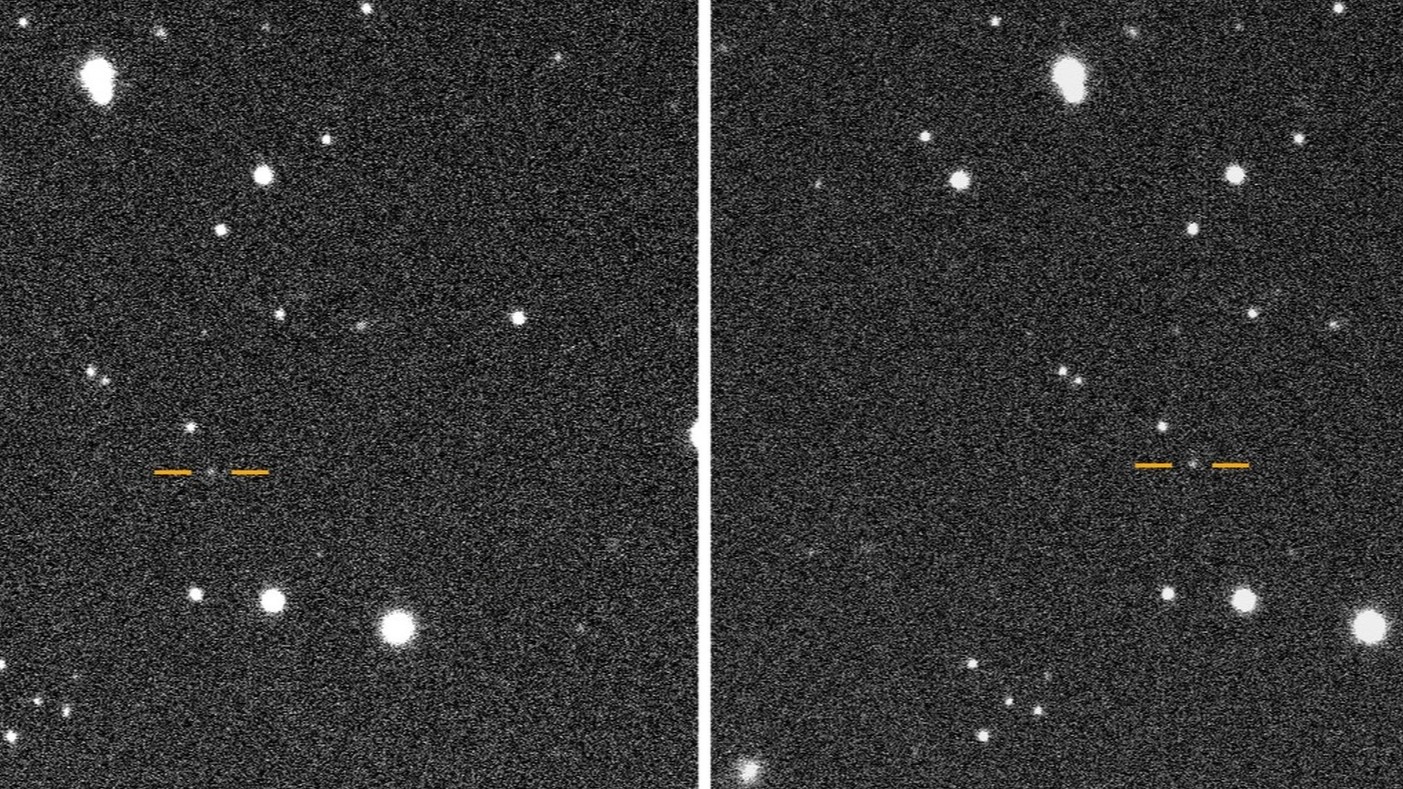
Two space photographs side by side, showing 2025 SC79's motion relative to background stars.
Astronomer Scott Sheppard discovered 2025 SC79, marked here in two images showing its motion relative to background stars. Image credit: Photographs courtesy of Scott S. Sheppard.)

Astronomers have discovered a 2,300-foot-wide (700 meters) asteroid hidden in the sun's glare, and it’s whizzing through our solar system at a near record-breaking pace.

The skyscraper-size asteroid, named 2025 SC79, loops around the sun once every 128 days, giving it the second-fastest asteroid orbit in the solar system. It is also only the second known space object that orbits entirely inside of Venus' orbit, occasionally even crossing the orbit of Mercury.

Scott Sheppard, an astronomer at the Carnegie Science research institute in Washington, D.C., first spotted 2025 SC79 on Sep. 27. The asteroid was obscured by the sun's glare, making it exceptionally difficult to observe, according to a statement released by Carnegie Science. Spotting hidden asteroids like 2025 SC79 is important to ensure that no potentially hazardous space rock sneaks up on our planet without us noticing.

You may like
  • An artist's illustration of an asteroid passing Earth at a large distance

Skyscraper-size asteroid previously predicted to hit us in 60 years will zoom past Earth on Thursday (Sept. 18) — and you can see it live

  • An illustration of a spacecraft approaching an asteroid with Earth in the background

Asteroid Apophis flyby will be 'once in a millennium' opportunity for skywatchers and scientists

  • An artist's illustration of an asteroid flying past Earth and the moon

Newly discovered bus-size asteroid will zoom close past Earth today — and will not return for exactly 100 years

where they are easiest to spot. But asteroids that lurk near the Sun can only be observed during twilight — when the Sun is just about to rise or set. If these 'twilight' asteroids approach Earth, they could pose serious impact hazards."

Asteroids like 2025 SC79 are definitely worth keeping an eye on. To put its 2,300-foot diameter in context, the so-called "city-killer" asteroid 2024 YR4 discovered earlier this year is only around 180 feet (55 meters) wide, and that has the potential to release 500 times more energy than the atomic bomb that destroyed Hiroshima if it were to hit Earth (don't worry, it almost certainly won't).

Sheppard discovered 2025 SC79 using the Dark Energy Camera on the National Science Foundation's (NSF) Blanco 4-meter telescope. The asteroid's existence was then confirmed with observations from the NSF's Gemini telescope and Carnegie Science's Magellan telescopes, according to the statement.

This is the second super speedy asteroid spotted by Sheppard and his colleagues in recent years, having also discovered the fastest known asteroid in 2021. That object, named 2021 PH27, orbits the sun in 113 days, making it just 15 days quicker than 2025 SC79. The only object in the solar system with a faster orbital period is the planet Mercury, which completes an orbit of the sun in 88 days.

RELATED STORIES

2025 SC79's orbit has now taken it behind the sun, so it won't be visible for several months. Researchers will attempt further observations in the future to learn more about the object, which is ultimately another piece of the galactic puzzle that helps astronomers understand how our solar system and its potential asteroid-shaped threats evolved.

"Many of the Solar System's asteroids inhabit one of two belts of space rocks, but perturbations can send objects careening into closer orbits where they can be more challenging to spot," Sheppard said. "Understanding how they arrived at these locations can help us protect our planet and also help us learn more about Solar System history."

RELATED VIDEOS

{ https://www.livescience.com/space }

Hoe vind je dit bericht?
Geschreven door peter om 20:27 Stuur door

Scientists find a perfectly preserved 70 MILLION-year-old dinosaur egg in Argentina

It looks like it could have been laid yesterday.

But believe it or not, this dinosaur egg, recently unearthed in Argentina, dates back 70 million years.

The ancient egg was discovered in Rio Negro in Patagonia and has left experts around the world stunned.

While it appears remarkably similar to an ostrich egg, it was likely laid by a member of the Bonapartenykus genus – a small, carnivorous therapod that prowled the region during the late Cretaceous period.

Although dinosaur eggs have been found in the area before, one this well preserved is rare.

It may even contain embryonic material, according to the archaeology team – who plan to carry out in–depth scans to find out. 

'It was a complete and utter surprise,' Gonzalo Muñoz, from the Bernardo Rivadavia Argentine Museum of Natural Sciences, told National Geographic.

'It's not uncommon to find dinosaur fossils, but the issue with eggs is that they are much less common.'

Although dinosaur eggs have been found in the area before, one this well preserved is rare and likely belonged to a small, carnivorous therapod

Although dinosaur eggs have been found in the area before, one this well preserved is rare and likely belonged to a small, carnivorous therapod

Pictures from the site show group leader Federico Agnolín stumble across the egg, which appeared to be resting on the surface of the dusty ground

Pictures from the site show group leader Federico Agnolín stumble across the egg, which appeared to be resting on the surface of the dusty ground

He explained that eggs from carnivorous dinosaurs are especially rare for several reasons.

'First, there are fewer carnivores than herbivores,' he said. 'But apart from that, their eggs are more avian–like since the carnivorous dinosaur lineage is the one that will give rise to birds.

'Therefore, they're going to be more delicate eggs, with much thinner shells more prone to destruction.

'Finding those types of eggs are more difficult. That's why this discovery is so exceptional and spectacular.'

The egg, along with other findings from the site, will be sent to the Argentine Museum of Natural Sciences to be studied.

He said he hopes the egg contains an embryo, but in–depth scans will be needed to determine if there is anything inside.

If traces of a developing dinosaur are found, it would mark one of the most important paleontological breakthroughs in South American history and provide new detail about how dinosaurs developed and hatched.

The Cretaceous Expedition I also uncovered mammal teeth and snake vertebrae, indicating the site was once a nesting ground.

Federico Agnolín proudly shows off the incredible fossilised egg. The team said they don't yet know if it holds embryonic material

Federico Agnolín proudly shows off the incredible fossilised egg. The team said they don't yet know if it holds embryonic material

Previous research suggests this is what Bonapartenykus may have looked like (artist's impression)

Previous research suggests this is what Bonapartenykus may have looked like (artist's impression)

A video taken at the site shows group leader Federico Agnolín stumble across the egg, which appeared to be resting on the surface of the dusty ground.

His excitement is palpable as he realises he has come across such a well–preserved specimen.

Other, broken eggs can also be seen in the vicinity, w=ith fragments held up to the camera.11

The caption on the video, shared to Instagram, reads: 'This is quite possibly the first discovery of its kind in South America.

'As you can see, this fossil is more than 70,000,000 years old and it was not alone – we found a cluster!'

HOW THE DINOSAURS BECAME EXTINCT AROUND 66MILLION YEARS AGO

Dinosaurs ruled the Earth around 66million years ago, but suddenly disappeared in what is known as the Cretaceous-Tertiary extinction.

It was believed for many years that the changing climate destroyed the food chain of the huge reptiles. 

However, in the 1980s paleontologists discovered a layer of iridium - an element that is rare on Earth but found in vast quantities in space.  

When this was dated, it coincided precisely with when the dinosaurs disappeared from the fossil record. 

A decade later, scientists uncovered the massive Chicxulub Crater at the tip of Mexico’s Yucatán Peninsula, which dates to the period in question. 

Scientific consensus now says that these two factors are linked and they were both probably caused by an enormous asteroid crashing to Earth.

With the projected size and impact velocity, the collision would have caused an enormous shock wave and is likely to have triggered seismic activity. 

The fallout would have created plumes of ash thought to have covered the whole planet, making it impossible for dinosaurs to survive. 

Other animals and plant species had a shorter time-span between generations which allowed them to survive.

There are several other theories as to what caused the demise of the dinos. 

One early theory was that small mammals ate dinosaur eggs and another proposes that toxic angiosperms (flowering plants) killed them off.  

RELATED VIDEOS

{ https://www.dailymail.co.uk/sciencetech/index.html }

Hoe vind je dit bericht?
Geschreven door peter om 18:29 Stuur door

Unearthed photos of 'Egypt's Area 51' expose underground complex sealed off by military for decades

Just three miles from the Giza Pyramids lies a mysterious site known as Zawyet El Aryan, nicknamed Egypt's Area 51, sealed off by the military for decades.

Archaeologist Alessandro Barsanti first excavated the site in the early 1900s, uncovering a colossal T-shaped pit carved into solid limestone, nearly 100 feet deep and lined with massive granite blocks. 

At the center of one chamber sits an oval vat with a fitted granite lid, which Barsanti reported contained traces of an unknown substance, now lost.

Many Egyptologists believe the site was intended as a pyramid that was never completed, though no superstructure was ever built above the pit. 

The site's true purpose remains a mystery, but graffiti discovered inside includes the word 'Seba,' interpreted by some researchers as the ancient Egyptian term for a 'gateway to the stars.' 

Independent researcher Derek Olsen discussed the mysterious structure on the Matt Beall Limitless podcast, suggesting this could indicate the structure was built as a vessel for cosmic travel or spiritual ascension. 

The shaft and chambers' dimensions and construction, massive granite floors, smooth limestone walls, and a sealed central vat have fueled speculation about advanced or ceremonial purposes. 

The mystery deepened when the Egyptian military seized control of the site in the mid-1960s, blocking all modern excavations and tours and leaving Barsanti’s early photographs as the sole detailed record of the complex. 

Archaeologist Alessandro Barsanti first excavated the site in the early 1900s, uncovering a colossal T-shaped pit carved into solid limestone, nearly 100 feet deep and lined with massive granite blocks

Archaeologist Alessandro Barsanti first excavated the site in the early 1900s, uncovering a colossal T-shaped pit carved into solid limestone, nearly 100 feet deep and lined with massive granite blocks

The Egyptian military took over the site in the 1960s, leading it to be called Egypt's Area 51

The Egyptian military took over the site in the 1960s, leading it to be called Egypt's Area 51

During Barsanti's original excavation, graffiti written in black and red ink was found on the walls, one inscription reading 'Seba-[unknown]-Ka.' 

While no one knows the full text or its meaning, it translates to 'star' and 'vital essence' or 'life force.' 

Olson believes it is the ancient Egyptian word for 'gateway to the stars,' suggesting the structure was built as a vessel for the ancient people to travel the cosmos.

However, mainstream scientists noted that it was likely the name of a builder or represented a figure of the time.

The T-shaped structure is carved directly into the natural bedrock, with walls that are smooth but were never covered with stones. 

The chamber at the end of the shaft was never completed, and only the floor was finished and covered with massive granite blocks, each measuring approximately 15 feet long and 8 feet thick, weighing up to 18,000 pounds.

The exact purpose remains a mystery, with many Egyptologists believing the site was the beginning of an unfinished pyramid complex from the 3rd or 4th Dynasties. 

While others think it served as an experimental foundation or ceremonial chamber that was never completed.

At the center of one chamber sits an oval vat with a fitted granite lid, which Barsanti reported contained traces of an unknown substance, now lost.

At the center of one chamber sits an oval vat with a fitted granite lid, which Barsanti reported contained traces of an unknown substance, now lost.

Egypt's Area 51 was a recent topic on the Matt Beall Limitless podcast, which features guest Derek Olsen (left)

Egypt's Area 51 was a recent topic on the Matt Beall Limitless podcast, which features guest Derek Olsen (left)

Olson explained that the massive granite blocks were moved to the site for the flooring. 

'Why would you need a 10-foot-tall granite block on the floor?' Beall asked, to which Olson said: 'Right, when it's naturally limestone [on the ground].' 

Olson added: 'How they fashion that the limestone walls are mindboggling.'

Beall quickly jumped in, saying: 'And why? What is the tub for? What would the original purpose of it be? Complete mystery, I guess, right?' 

Archaeologist Alessandro Barsanti first excavated the site in the early 1900s, uncovering a colossal T-shaped pit carved into solid limestone, nearly 100 feet deep and lined with massive granite blocks. His photos are the only view people have of the site

Archaeologist Alessandro Barsanti first excavated the site in the early 1900s, uncovering a colossal T-shaped pit carved into solid limestone, nearly 100 feet deep and lined with massive granite blocks. His photos are the only view people have of the site

The site is about three miles from the Giza pyramids

The site is about three miles from the Giza pyramids

The T-shaped structure is carved directly into the natural bedrock, with walls that are smooth but were never covered with stones

The T-shaped structure is carved directly into the natural bedrock, with walls that are smooth but were never covered with stones

The tub is approximately 10 feet long, 7 feet wide, and 5 feet deep. 

It was found sealed with a granite lid, suggesting it was intended to be a closed container. 

The archaeologists also claimed to have discovered a damaged dedication tablet bearing the name of King Djedefre, which could potentially link the pyramid to this Fourth Dynasty ruler.

 However, this tablet's authenticity and significance remain subjects of debate among scholars 

Olson highlighted similar ancient Egyptian structures with granite boxes, including the Great Pyramid, the Serapeum and the Saqqara pyramid. 

'We are seeing a theme of this huge granite floor and a lid-like structure,' he said.

RELATED VIDEOS

{ https://www.dailymail.co.uk/sciencetech/index.html }

Hoe vind je dit bericht?
Geschreven door peter om 18:10 Stuur door

Scientists baffled as interstellar visitor appears to reverse thrust before vanishing behind the sun

Scientists baffled as interstellar visitor appears to reverse thrust before vanishing behind the sun

Astronomers tracking the mysterious interstellar visitor 3I/ATLAS have revealed that the object has performed a dramatic tail reversal, now pointing away from the sun.

The change comes just months after Hubble Space Telescope images captured an unusual 'anti-tail,' a jet of particles streaming toward the sun instead of away from it.

New high-resolution observations from the Nordic Optical Telescope in the Canary Islands confirm that the anti-tail seen in July and August 2025 vanished and a new one formed in the opposite direction by September.

The shift occurred because the comet's dust and ice particles react differently to sunlight. 

Early on, large, slow-moving dust grains scattered light sunward, creating the anti-tail. But as 3I/ATLAS moved closer to the Sun, rising temperatures ejected more ice fragments and longer-lived dust particles, producing the tail that now points away.

Ground-based observations will be impossible through October as the object passes behind the Sun, hidden from Earth's view.

Researchers at the University of California and the University of Oslo found that 3I/ATLAS is shedding material at a rate proportional to the solar radiation striking its surface.

Meanwhile, NASA's space telescopes previously detected the comet losing about 330 pounds of material per second, made up of 87 percent carbon dioxide and nine percent carbon monoxide.

New high-resolution observations from the Nordic Optical Telescope in the Canary Islands confirm that the anti-tail seen in July and August 2025 transformed into a classic tail by September

New high-resolution observations from the Nordic Optical Telescope in the Canary Islands confirm that the anti-tail seen in July and August 2025 transformed into a classic tail by September

Harvard professor Avi Loeb and his colleague Eric Keto have developed a model that offers a possible natural explanation for the comet's strange behavior.

Their findings suggest that as 3I/ATLAS moves closer to the Sun, different types of ice on its surface sublimate, turning directly from solid to gas.

Farther from the sun, about 279 million to 372 million miles away, CO2 ice drives the unusual sunward jets. But as the comet gets nearer, water ice begins to dominate, changing how material is released and causing the tail to flip into the classic shape now observed.

Loeb shared the study in a Wednesday blog post, writing: 'The total amount of mass lost from 3I/ATLAS during July through October 2025 amounts to about two million tons. 

'This is less than 0.00005 of the comet's total mass, which is estimated at over 33 billion tons based on its stable trajectory.'

The gas cloud surrounding 3I/ATLAS could be produced by stripping away only a 1.6-inch-thick surface layer from a 3.1-mile-wide object, a ratio similar to the length of your palm compared to the length of Manhattan Island.

'Needless to say, we cannot infer the true nature of 3I/ATLAS from the skin layer it has shed so far,' Loeb added. 

'My colleague, Adam Hibberd, noted that if the object were an alien spacecraft slowing down, and the anti-tail represented braking thrust, this shift from anti-tail to tail would be entirely expected near perihelion.'

Unlike the first interstellar object, 1I/`Oumuamua, which showed no signs of gas or dust, and the second, 2I/Borisov, which behaved like a typical comet, 3I/ATLAS (pictured) exhibits unique features, including the anti-tail, extreme color changes and a massive coma

Unlike the first interstellar object, 1I/`Oumuamua, which showed no signs of gas or dust, and the second, 2I/Borisov, which behaved like a typical comet, 3I/ATLAS (pictured) exhibits unique features, including the anti-tail, extreme color changes and a massive coma

However, NASA and most scientists maintain that 3I/ATLAS is a natural comet, though one that originated outside our solar system.

Unlike the first interstellar visitor ʻOumuamua, which showed no signs of gas or dust, and the second, 2I/Borisov, which behaved like a normal comet, 3I/ATLAS displays unique features, including its anti-tail, extreme color changes, and a massive surrounding coma.

'As the surface of 3I/ATLAS is exposed to at least 33 gigawatts of solar radiation at perihelion, observations during its closest approach to Earth on December 19, 2025, will offer the most important clues about its nature,' Loeb said. 'If it continues to show all the features of a natural comet, that will confirm its origin.'

The Harvard professor issued a chilling warning as the object was set to move behind the sun on Tuesday.

The object, dubbed 3I/ATLAS, will be exactly on the opposite side of the sun relative to Earth, constituting a so-called `solar conjunction,' tomorrow, which Avi Loeb said would be 'an opportune time for technological action.'

Loeb explained that in space travel, the best time to speed up or slow down a spacecraft is when it's closest to a large object, since firing the engine at that point, known as the Oberth effect, gives the biggest change in speed.

'If 3I/ATLAS is a massive mothership, it will likely continue along its original gravitational path and ultimately exit the Solar system,' the professor shared in a Sunday blog post.

'In that case, the Oberth maneuver might apply to the mini-probes it releases at perihelion towards Solar system planets.'

3I/ATLAS will reach its best window for such Oberth maneuvers just eight days after it slips behind the sun, which will put it the closest to the sun at about 126 million miles away, he added.

While Loeb has floated the idea that 3I/ATLAS could be of extraterrestrial origin, NASA has long maintained that the object is simply a comet from a distant galaxy.

However, that conclusion has not stopped Loeb from calling for more data before the case is closed.

{ https://www.dailymail.co.uk/sciencetech/index.html }

Hoe vind je dit bericht?
Geschreven door peter om 17:25 Stuur door

NASA quietly deploys planetary defense tools after interstellar visitor shows odd light behavior

NASA quietly deploys planetary defense tools after interstellar visitor shows odd light behavior

NASA has quietly made a major move to defend the planet after the mysterious interstellar object displayed more strange and unexplainable behavior.

The supposed comet, dubbed 3I/ATLAS, has just been added to the list of threats tracked by a United Nations-endorsed group focused on planetary defense against near-Earth objects.

The International Asteroid Warning Network (IAWN) works alongside institutions across the world that detect, track, and study near-Earth objects (NEOs) to assess potential impact threats to Earth.

3I/ATLAS is the first interstellar object ever added to the list, triggering a worldwide drill aimed at improving detection skills for space rocks and preparing Earth for a potential incoming threat.

On Tuesday, officials with IAWN admitted that the object was causing 'unique challenges' for predicting its trajectory and decided to add 3I/ATLAS to the Comet Astrometry Campaign. 

The object has displayed several unusual features that defy the typical behavior of comets, including an 'anti-tail,' a jet of particles that points toward the Sun rather than away from it. 

According to the release, scientists will be running a special training exercise from November 27, 2025, to January 27, 2026. 

Telescopes and tracking systems around the world will focus on 3I/ATLAS to refine methods for pinpointing its exact location in the sky. 

Comet 3I/ATLAS streaks across a dense star field in this image captured by a telescope in Chile

The supposed comet, 3I/ATLAS, has become the first interstellar object added to the list of threats tracked by the International Asteroid Warning Network (IAWN)

The Two-Meter Twin Telescope in the Canary Islands captured an image showing a faint jet of particles from 3I'ATLAS pointing toward the sun, something comets don't normally do

The Two-Meter Twin Telescope in the Canary Islands captured an image showing a faint jet of particles from 3I'ATLAS pointing toward the sun, something comets don't normally do

'They're calling it 'a test of improved astrometry methods.' In other words, the object isn't behaving like it should,' one person wrote on X.

'When every telescope from Mauna Kea to Chile is being synced on one object, that's not a drill,' another X user posted.   

The Daily Mail reached out to NASA on Wednesday, but the agency maintained that the entire space program is 'currently closed' due to the ongoing government shutdown and did not comment further.

It is part of IAWN, along with the likes of the European Space Agency, which are all helping to organize this as a team effort to keep Earth safe from nearby asteroids and comets.

NASA isn't launching rockets to defend the planet from 3I/ATLAS, with the announcement treating this major event more like a tip-sharing exercise for stargazers everywhere to take better pictures of the supposed comet.

While scientists claimed they do not plan to begin the worldwide watch party until late November, 3I/ATLAS is just days away from making its closest approach to the sun, slipping out of view. 

Harvard scientist Avi Loeb has theorized that this shocking 'maneuver' is a telltale sign of a spacecraft using the gravity of a large star to change its speed and course. 

Before its recent strange behavior near the sun, 3I/ATLAS was scheduled to make its closest pass by Earth in December, but skeptics claim that activating the planetary warning system is proof that government officials fear this is no harmless comet.

NASA's James Webb Telescope spotted the interstellar visitor in August, which has since been discovered to be composed of strange materials including nickel

NASA's James Webb Telescope spotted the interstellar visitor in August, which has since been discovered to be composed of strange materials including nickel

READ MORE

Loeb explained that in space travel, the best time to speed up or slow down a spacecraft is when it's closest to a large object, since firing the engine at that point, known as the Oberth effect, gives the biggest change in speed.

3I/ATLAS will reach its best window for an Oberth maneuver in one week when it comes within 126 million miles of our sun.

Whether it's a comet or something sent by an intelligence elsewhere in the galaxy, astronomers have concluded that it could be gigantic, with a diameter of more than 28 miles.

'If 3I/ATLAS is a massive mothership, it will likely continue along its original gravitational path and ultimately exit the Solar system,' Loeb shared in a Sunday blog post.

The professor has previously suggested that 3I/ATLAS could be a nuclear-powered craft after the Hubble Space Telescope revealed a picture that appeared to show the object generating its own light this summer.

During its closest pass by Mars on October 3, space probes sent back images which seemed to suggest that 3I/ATLAS was a giant cylindrical object coated in nickel, causing it to glow green.

This has fueled even more speculation that the comet is an extraterrestrial probe, as human spacecraft use nickel in the same way to protect them from super-hot rocket exhaust.

{ https://www.dailymail.co.uk/sciencetech/index.html }

Hoe vind je dit bericht?
Geschreven door peter om 17:13 Stuur door

Top secret military firm confesses to sparking New Jersey drone hysteria that left America on edge

Top secret military firm confesses to sparking New Jersey drone hysteria that left America on edge

A private firm contracted by the United States military has taken responsibility for the mysterious objects seen flying above New Jersey last November.

The sightings sparked mass hysteria and concerns over the existence of UFOs after footage went viral of unidentified objects lighting up the night sky.

But a private contractor revealed at the Army's UAS and Launched Effects Summit at Fort Rucker in August that they had launched the objects to 'test out their capabilities,' according to NYPost.

'You remember that big UFO scare in New Jersey last year? Well, that was us,' an employee of the unnamed contractor allegedly told a crowd at the event.

According to a source at the summit, the employee went on to claim there was no need to disclose their work to the public because they had a private government contract.

The company reportedly offered a live demonstration of their manned aerial craft, which had an unconventional appearance.

Sharing details of the demonstration, which went for about 30 minutes above Fort Rucker in the controlled airspace, the source said:  'When it turned you almost completely lose sight of it.

'Which is why I think people were seeing this up in the sky and why there were reports of people seeing it and saying it disappeared.' 

The November sightings sparked mass hysteria and concerns over the existence of UFOs after footage went viral of unidentified objects lighting up the night sky

The November sightings sparked mass hysteria and concerns over the existence of UFOs after footage went viral of unidentified objects lighting up the night sky

In a short 13 second clip posted to social media in November 2024, a white light blinked in the sky before suddenly vanishing, leaving onlookers stunned. 

In the footage, which was shot close near Atlantic City, family members were heard discussing what they witnessed before the object suddenly disappears.

'It just vanished!' one said. 'I just watched it through the telescope.'

Some 964 sightings of flying objects were logged in the state between November 19 up until December 13, according to statistics collected by the state’s Office of Emergency Management.

Former CIA operations officer Laura Ballman had warned that the drones lighting up multi-state skies may be a 'classified exercise.' 

She told Fox News Live that the drone sightings were 'extremely unsettling,' and shared her theory that they may be part of a technology 'test' orchestrated by the federal government. 

Ballman said: 'Now in terms of who is behind this, seeing the statements that have been made by John Kirby, who has said that these objects are not operating illegally.

'Coupled with the several op-eds that have been out there in the last 24 hours about the need to look at our detection systems, [it] makes me think perhaps this is actually a classified exercise to test either evasion technology or detection technology in urban areas.'

Footage of the bizarre flying objects appeared to show them 'disappearing'
+4
View gallery

Footage of the bizarre flying objects appeared to show them 'disappearing'

At the time, there were suggestions that the aircrafts (pictured) were part of a classified project

At the time, there were suggestions that the aircrafts (pictured) were part of a classified project 

White House National Security spokesman John Kirby had confirmed the aircraft were not foreign.

'We have no evidence at this time that the reported drone sightings pose a national security or a public safety threat or have a foreign nexus,' Kirby said.

'The Department of Homeland Security and the FBI are investigating these sightings, and they're working closely with the state and local law enforcement to provide resources using numerous detection methods to better understand their origin.'

He said the agencies used 'very sophisticated electronic detection technologies' but  'have not been able to corroborate any of the reported visual sightings.'

'To the contrary, upon review of available imagery, it appears that many of the reported sightings are actually manned aircraft being operated lawfully,' he said.

{ https://www.dailymail.co.uk/sciencetech/index.html }

Hoe vind je dit bericht?
Geschreven door peter om 16:57 Stuur door

Amazing Explorers' Encounters With the Unexplained and the Supernatural

Amazing Explorers' Encounters With the Unexplained and the Supernatural

Amazing Explorers' Encounters With the Unexplained and the Supernatural

Ever since we have looked over the horizon and wondered what lies beyond, there have been those willing to trek off to find out. Exploration seems to be an innate feature of human nature, the need to shine a light on the dark corners of our understanding, a force that drives us to further penetrate realms we do not understand. Many of these travelers have, over the centuries, brought back amazing and mysterious tales from these faraway lands, and sometimes it is difficult to know what to make of them. Are they illuminating new places and things long immersed in shadow, or are they tall tales and flights of fancy? It can be sometimes hard to tell, but many tales have been brought back by explorers from the wilds of our world that involve all manner of mystery, bizarreness, and the supernatural. 

One such individual who had plenty of such stories to tell was an Ottoman explorer who traveled the ends of the earth to bring back many odd tales, including those of the decidedly supernatural. The Ottoman explorer, traveler, and writer Evliya Çelebi was born in 1611 in Constantinople, now Istanbul, Turkey, during the height of the Ottoman Empire, which was created by Turkish tribes in Anatolia (Asia Minor) and grew exponentially to be one of the most imposing and powerful states in the whole world during the 15th and 16th centuries. The son of the chief court jeweler, Celebi’s intelligence, wit, extensive knowledge of the Koran, and natural gift for music and languages, with him able to speak Arabic, Persian, Greek and Latin, captured the attention of the imam of Sultan Murad IV, and at just the tender age of twelve he was taken in as an apprentice to Sultan, excelling as a Koran reader and able to recite long passages perfectly from memory, by some accounts all of it. 

He did not start out as the intrepid traveler he would become; instead, he was absorbed in his studies of Arabic, calligraphy, and music at the Ottoman palace school, but at some point, he discovered his deep wanderlust when he began embarking on official travels that took him from Belgrade to Baghdad and from Crimea to Cairo. Even at this point, his ultimate goal was to be a member of the Imperial court; it was something his family also desperately wanted for him despite his urges to travel over the horizon, but one night, he was to have an epiphany that would change his life forever.

Evliya Çelebi

On the very night of his twentieth birthday, Celebi allegedly had a vision of the Prophet Muhammad, as well as His Companions and the four first caliphs of Islam in a vivid dream. In this dream, he was told to give up his designs of joining the court and rather spend his life traveling to the far corners of the world so that he might “compose a marvelous work” based on his adventures to far-flung exotic lands. The Prophet would tell him:

“Thou shalt travel through the whole world and be a marvel among men. Of the countries through which you will pass, of their castles, strongholds, wonderful antiquities, eatables and drinkables ... the extent of their provinces and the length of the days there, draw up a description which will be a monument worthy of thee.”

On the strength of this potent dream, Celebi decided to defy his parents’ wishes to be a member of the Imperial court and give up everything to follow what the Prophet had told him to do. And so he set off on a life of journeys that would span the next three decades, traveling with an entourage of mules, camels, travel companions, and up to a dozen slaves at any given time, on extensive travels that would take him from one end of the known world to the other, often returning to enthrall the court with tales of adventure and mystery. Along the way, Celebi would compile a vast, sprawling 10-volume tome of travel memoirs and notes called the Seyahatname, or the “Book of Travels,” also sometimes referred to as the Tarihi seyyah (“Chronicle of a Traveler”), which has been called “the longest and fullest travel account in Islamic literature, perhaps in world literature.” Within the many hundreds of pages of this vast masterpiece of travel literature are tales of strange customs and lands, exotic people and cultures, fantastical animals, and bloody battles and massacres, as well as the landmarks, ethnography, history, and geography of the lands he visited in Europe, Asia, Africa, and beyond, and all manner of bizarre and amazing tales of the things he had seen and done. It is an impressive and unique manuscript to be sure, with pages upon pages of amazing and spectacular adventures, but within these volumes, among the various exotic people, customs, and tales of far-flung lands beyond the understanding of the time are some stories that stand out as weirder than others, and here we get into all of the damn witches, vampires and zombies Celebi claims to have come across. 

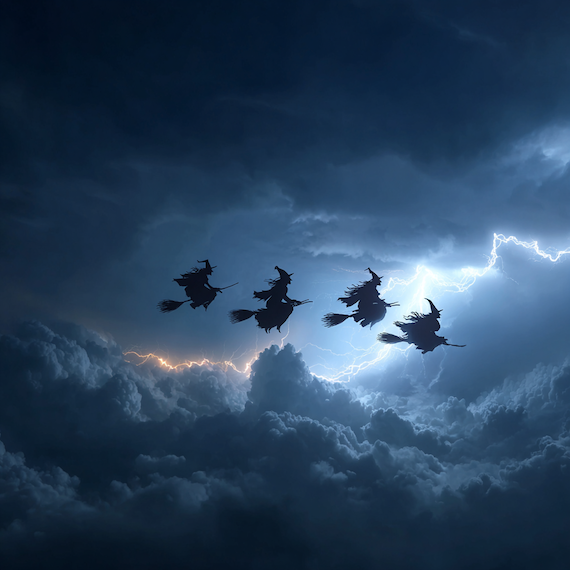
Throughout the pages of the Seyahatname, Celebi makes frequent mention of magic, sorcery, the supernatural, and metaphysical beings, and one prime example of this is an incident he claimed happened to him on the night of April 26, 1666, in the tiny Pedsi village of the Caucasus. He claimed that one dark, moonless evening, there had been a sudden, very intense flash of lightning outside that had roused him from his writings. These flashes continued, and when Celebi asked some of the villagers what was going on, they told him that once a year, there was a night during which Circassian witches and Abkhaz witches flew to the sky and engaged in battle in a great war. Astonished by this, Celebi then went outside to see for himself, where he was met by quite the bizarre sight. 

He claimed that when he looked up he saw “witches on large trees, cubes, boats, carriage wheels and many other similar objects fighting witches on horses, cattle, carrion and dead camels, with snakes, horses and camel heads in their hands,” all behind the backdrop of intermittent flashes and swaths of bright light across the sky, now obviously not from lightning, but rather through the magical might of their sorcery. At one point, there was an enormous, thunderous explosion, after which “felt, poles, cubes, doors and carriage wheels, and parts of humans and animals such as horses” fell from the sky, followed by seven Abkhazian witches and seven Circassian witches hurtling to the ground, where they continued to fight. According to the account, the Circassian witches killed the Abkhazian witches by sucking their blood, after which they hurled the lifeless bodies onto a bonfire. After this, there was the crowing of roosters, and the remaining witches took flight to disappear into the night. Celebi makes it a point to mention that he would have never believed such a thing possible if he had not seen it himself, and we are left to wonder what was going on here.
Celebi would write of other encounters with witches as well. In one incident, he was staying in the Çalıkkavak village of Bulgaria when he claimed to have come across an “old miserable woman with messy hair and an ugly face and seven children.” This woman and her children entered the non-Muslim house where he was staying and gathered around the fire, where the women gathered up some ashes and performed some kind of arcane spell. After this, the old hag and the children allegedly transformed into chickens right before the eyes of Celebi and other members of his expedition. Celebi would write of what transpired next:

“The next thing we knew, a heathen was peeing on chickens. At that moment, they all turned into human beings. Some other people grabbed the woman and the children by the arms and beat them. We went and saw that the church was where they arrived later. They handed the woman over to the priest, and the priest excommunicated her. My men swore an oath after this incident. They all saw this incident and witnessed that the chickens turned into humans. That night, my nosebleed did not stop out of fear. The bleeding stopped in the morning.”

His other stories of witches seem to imply something we would be more familiar with as vampires. Celebi claimed that the Caucasus region was particularly infested with such creatures. He told of bloodsucking witches prowling remote villages and drinking the blood of the terrified populace, after which any villager who was fed on in such a way would become sick, die, and then rise from the dead to do the same thing as some sort of undead abomination. These terrifying entities were said to return to sleep in the ground during the day, and according to Celebi, the villagers would sometimes unearth one to find it flushed and the eyes bloodshot from having fed. This “witch” would then be dispatched with a long stake of blackberries that was “nailed to her belly,” and her body then burned to ashes in a fire. If this were done, then any of the other blood-drinking revenants that the witch had spawned would supposedly revert to normal human form. On other occasions, a blood-drinking witch would be captured, put in chains, and forced to confess her black magic, after which she would be killed with a stake and immolated, but not before some of her blood was taken to rub it on her victims to cure them of their affliction. If some of the details here sound familiar, it is because such tales are considered to be some of the earliest vampire stories, and are even thought to have influenced Bram Stoker for his book Dracula.

Is any of this true? That is a tough question to answer. The veracity of anything written in the Seyahatname has long been debated, as while Celebi claims that his work is the will of Allah and an honest chronicle, it is peppered with numerous stories and claims that seem like they can’t possibly be true. Interspersed throughout the vast tome are countless embellishments, flourishes, and just stuff he made up, such as inaccurate geography or descriptions of places he had obviously never been to, battles that could not have possibly happened as described, and numerous fantastical animals, people, and plants, including giant avian monsters, humans with animal heads, chimeras, dragon-like beasts, giant waxen plants like nothing known, a strange yellow tree whose leaves miraculously cured syphilis, and many other strange anomalies. 

What makes it harder to weed out the fantasy, fairy tale elements is that there are also long passages that are actually incredibly accurate, matching up perfectly with what we now know about the places and people he encountered, as well as accurate and meticulous transcriptions of languages that were unknown at the time, while other stories are almost certainly tall tales and then there are those that incorporate elements of both. There could be an otherwise honest and sober, accurate depiction of history that will feature a jarring inclusion such as a cat freezing in midair as it jumps from roof to roof, a virgin woman giving birth to an elephant, or some other obvious flight of fancy. 

This has all posed a bit of a conundrum for historians, as it is sometimes nearly impossible to parse fact from fiction in this hodgepodge of the real and imagined, and reading it is akin to trying to solve a puzzle. Indeed, some experts have claimed that only about 50 percent of the entire text is factual, while the other is heavy exaggeration or pure bunk. Some passages are obvious truths, while others are obvious lies, but there are also large swaths in which the lies are not particularly obvious, a sort of blurring of the line between reality and fantasy, making it even harder to tell if what you are reading is true or not and hiding possible tantalizing insights into history behind a murky lense. Edward White, author of The Tastemaker: Carl Van Vechten and the Birth of Modern America, has said of it:

“In the Seyahatname, pages can whistle by without an honest word in sight, though Evliya emphasizes that he is upholding the will of Allah. Typically, “Evliya the unhypocritical” reminds us of his pious commitment to scrupulousness just before he launches into an obvious lie about, say, an encounter with a woman from the Black Sea who gave birth to an elephant, the rhinoceros-riding tribes of the Sudan, or the man-eating Buddhists of Kalmyia. “God is my witness that this took place,” he says before one such tale—cast-iron evidence that it didn’t. Historians debate whether these fairy-tale inventions are intended as satirical barbs at the hyperbolic travel writers or an homage to the fantastical stories of Arabian Nights on which Evliya had grown up. Likely, it was both. But it’s also pretty clear that every now and then he simply got bored with faithfully recording reality and decided to amuse himself by splicing the mundane with the phantasmagorical. The fun for the reader comes in trying to spot the moment when empirical truth ends and one of Evliya’s campfire yarns begins.”

If he is lying, then it seems strange, considering he was such a devout Muslim, to the point that he routinely referred to non-Muslims as "infidels" and "heathens," swearing to Allah that it was all true, that he would defy that faith to tell tall tales. Celebi would settle in Cairo near the end of his life, dying in 1684 to leave behind this fascinating and frustrating historical travel account, with no notes or indications from the author himself as to where reality ends and the tall tales begin. Indeed, as far as he was concerned, it was all a completely true and honest account of his travels; he insists so on many occasions, even swearing to Allah that it is so, and so we are left with this lengthy text that harbors tantalizing historical facts mixed in with a lot of question marks. Unfortunately for many who would study it, while the Seyahatname is very well-known in its native Turkey, it is more obscure in the West. Indeed, there currently is no complete English translation of the entire work, just certain parts, and the only other language it has been translated into to an appreciable degree is German, leaving much of it in the dark to those not up to speed on their Turkish. 

We are left with an epic piece of travel literature that has fascinated and puzzled historians right up to the present, perpetually stuck in a limbo of interpretation and debate. How much of these accounts is true and what is false? Did this explorer ever really come across the supernatural creatures he claims he did? What are we to make of all this? It seems that in the end, Evliya Çelebi and his strange texts on his mysterious travels and encounters will likely forever remain in the shadows, cryptic and misunderstood. 

Moving along, in the 19th century, the wealthy and eccentric English naturalist and explorer Charles Waterton traveled the world collecting an eclectic mix of specimens that he then used his formidable skills in taxidermy to create exhibitions for his estate, a sort of museum of the strange and macabre. He was, by all accounts, a rather odd individual, known for his remarkably eccentric behavior and myriad odd claims. For instance, he was known to prowl about his estate acting like a dog and biting strangers on their legs, dressing like a scarecrow and sitting in trees, pretending to be his own butler, and making a myriad of bizarre claims such as that he could “navigate the atmosphere,” but he was still nevertheless respected for his writings on natural history and conservation, which were groundbreaking at the time.

In 1804, Waterton made his way to the South American country of Guyana to take control of some of his uncle’s estates there, and he would branch out to explore and collect various specimens of the wildlife there as well, as he was wont to do. Between 1812 and 1824, he would make various journeys and expeditions out into the unexplored areas of the country, all the while collecting numerous specimens of wildlife, which he would put on display in his home, amassing an enormous menagerie of stuffed birds and animals in the process. He was known for his unique method of taxidermy, in which he would use a mercury-based chemical to harden the skins and make them hollow, yet very lifelike simulacrums of the animals they had been. One of the most famous of all of these was a curious little exhibition that concerned an anomalous head of a monkey-like creature that Waterton simply referred to as “The Nondescript.”

The origins of this peculiar specimen were written of in Waterton’s 1825 travel memoir Wanderings in South America, a fairly influential work which is said to have even captured the imagination of a young Charles Darwin, and turned out to date back to an expedition to the jungles of Guyana during which he came across a rather odd beast indeed. During the journey, the expedition allegedly came across a rather peculiar humanoid creature that was covered with thick hair and possessed a tail and a face with strikingly human features. The group did the human thing and promptly shot and killed it, after which Waterton claimed he had been forced to preserve merely the head and neck of the beast. Waterton would say of this:

“I also procured an animal which has caused not a little speculation and astonishment. In my opinion, his thick coat of hair and great length of tail, put his species out of all question; but then, his face and head cause the inspector to pause for a moment before he ventures to pronounce his opinion of the classification. He was a large animal, and as I was pressed for daylight, and moreover, felt no inclination to have the whole weight of his body upon my back, I contented myself with his head and shoulders, which I cut off, and have brought them with me to Europe.”

Since the weird specimen looked so incredibly human, albeit with a hairy body, there were all kinds of theories orbiting the find. One was that Waterton had actually shot, killed, and stuffed the corpse of a native tribesman, which he had then snuck into the country through bribing customs officials, which Waterton himself vehemently denied, claiming that it had been some sort of unidentified ape-like creature. Another theory was that the creature on display was exactly what Waterton claimed it to be: some sort of new type of primate.

The specimen itself was just the head and shoulders, with a strikingly human countenance with a hairless face and large eyes surrounded by a thick, red mane, sort of reminiscent of an orangutan. The specimen drew flocks of gasping, puzzled onlookers, but some were aware of Waterton’s skill with taxidermy and began to suspect that this was some sort of cleverly crafted fake. It was suggested that he had merely taken the corpse of a howler monkey, in particular its hindquarters, and modified it to make it more human in appearance. Indeed, he had already shown a propensity for using taxidermy for satire and to make a political point, such as using lizards to craft into likenesses of various famous Protestant figures (Waterton was a devout Roman Catholic), and he had indulged in creative taxidermy on many occasions before.

It was even pointed out that the “Nondescript” bore an uncanny resemblance to a customs official who had given Waterton some trouble on his return to England from Guyana. Apparently, when he had docked, there had been a customs inspector named Mr. Lushington, who had seen the mass of animal specimens and demanded that Waterton pay a premium tax on the haul. Waterton had fought the import tax, but had invariably been forced to pay it, which had apparently irritated him to no end.

The thing is, while with all of his other, more creative designs, he had readily admitted to the whole thing, with the Nondescript, he not only firmly denied any tampering with the specimen, but actually provided a full back story to capturing it. He always maintained that the specimen was real, and there were plenty of people who believed him. Why would he do such a thing? It has been suggested that he was trying to test his skill by presenting a hoax as real and seeing how well it stood up to scrutiny, or that it was even meant to be a beacon to try and draw more exploration to Guyana, or even a satirical jab at other naturalists of the time. Others think that this was just a long-running practical joke that he had thought up for the fun of it all, or merely a stubborn dis of the customs official who had irked him. To this day, the specimen is exhibited at the Wakefield Museum in England, and still generates controversy as to its origins and reality. In the end, it is unknown.

Finally, we get to the adventures of anthropologists. Like in any science, the anthropologist looks for studies of human activity through investigation of physical evidence, through stringent protocols, and fact-based research. Yet also, as in many sciences, the researcher sometimes hits a wall of bafflement in which they are no longer penetrating into the unknown, but groping along the edges of it, trying to make sense of it and find a way in. There have been a handful of these explorers and researchers who have come up against something they truly do not understand and which their training has not prepared them for, brushes with forces beyond their comprehension. So next up we will look at a selection of instances in which respected, highly seasoned scientific anthropologists in Africa had supernatural experiences that would challenge their beliefs and the very fundamentals of what reality is.

First off is American cultural anthropologist and professor of anthropology at West Chester University in West Chester, Pennsylvania, Paul Stoller, who is one of the most respected in his field, over his more than 30 years of field work earning many accolades, numerous academic awards, and grants from Wenner-Gren Foundation, Fulbright-Hays, the National Science Foundation, the American Philosophical Society, and the National Endowment for the Humanities, as well as receiving a prestigious John Simon Guggenheim Fellowship. The American Anthropological Association named him the recipient of the Robert B Textor Award for Excellence in Anthropology, and he has also won the coveted Anders Retzius Medal in Gold, given once every three years by the King of Sweden, for his scientific contributions to anthropology. He has written numerous ethnographies, biographies, memoirs, and novels, as well as countless articles, many of which have been nominated for various awards. He is highly respected in his field, and is also interesting in the fact that much of his fieldwork and studies relate to magic, sorcery and spirit possession.

Stoller was long interested in various ritual practices, specifically in Africa, and far from just sitting in his study reading about such things, he really went the whole hog. In the 1970s, he travelled to the Republic of Niger and Mali in order to live among the Songhay people and study their culture and linguistics. It was here that he would cultivate an interest in actual magic and sorcery, and he has said of the evolution of this interest in magic in the workshop, Weaving the World: Writing Evocative Ethnographies:

“I think that the topic chooses the anthropologist rather than the other way around. In Songhay they say that if you want to seek out sorcery or magic, you will never discover it. You might approach it, you might talk about it, you might meet some people, but it will never grab you. So, what happens according to them is, if you eat magic, which is, you eat the substances to transform yourself, then magic eats you. If you consume history, you are consumed by it. It is the larger force of things that focuses on you. In my case, my initial fieldwork was in linguistic anthropology and I was interested in Friday mosque sermons. I never sought out to learn about sorcery. But then – I described this in my book In Sorcery’s Shadow (1987) – there were these two birds living in a rafter of the house where I was living. They were pooping on my floor and I got all irritated with these birds so I would knock their nest down. They would fly away, but then build another nest and get closer and closer to where my desk was. So after a while I just stopped paying attention to them. One day one of the birds pooped on my head in the presence of a guy that I thought was a rice farmer. But he turned out to be a Songhay healer. He said, “I’ve seen a sign, you’ve been pointed out to me. Come to my house and begin to learn.” That is how I got into the topic of sorcery. For me at least, things have sought me out. I have stumbled into sorcery.”

Stoller would jump fully into the world of Songhay sorcery and magical practices, living in a hut and studying under a man named Adamu Jenitongo, considered to be one of the most knowledgeable and powerful Songhay sorcerers of his era, as well as under the apprenticeship of another sorcerer called Hamidou Salou. This took him into a murky world of strange powers, dark forces, and mysterious spirits that most outsiders have never even heard of, much less become a part of. Among his studies of various spells and rituals, he had some particularly odd experiences. One of these was a time he tried to help a friend bless his house, as it was apparently being terrorized by a powerful evil spirit called Dongo, which was greatly feared by the local people to the point that they did not dare even so much as invoke its name. The ritual involved the sacrifice of a black rooster, but Stoller apparently botched the spell and angered the spirit and causing it to plague him with misfortune. He would say of this:

“Things began to unravel a few days later. After a short trip to Tillaberi, Adamu Jenitongo’s village 75 miles north of Niamey, I returned to the capital city and was in a car accident, bruising my forehead when it slammed against the sun visor. The evening after the accident, I attended a wedding ceremony and developed a pounding headache, blurry vision, and a high fever – telltale signs of the onset of malaria. Complaining about my symptoms, his in-law, a physician, gave me sulfa drugs to teach the ‘malaria’. The drugs quickly produced an allergic reaction – a severe rash that spread over my torso and down my legs. I became more feverish and was soon too weak to walk. At night I had disturbing ‘malarial’ dreams, all of which were about my difficult death. After several days of suffering, I somehow gathered the strength to get out of bed, dress myself and hail a taxi, which I took to Hamidou’s hut. I told Hamidou my tale of transgression.”

His mentor chastised him, calling him a “foolish boy,” telling him that his attempt to banish Dongo had greatly angered the spirit, especially since he had tried it as just a lowly and unworthy apprentice. Stoller was sent on his way back to the United States to recuperate from his illness, along with a satchel of magical herbs, medicine, and resin to help him. Oddly, although he was very sick, doctors could find nothing physically wrong with him and no reason why he was ill. It wasn’t malaria or any other known disease; doctors were stumped. However, after burning the resin every day and taking the herbs and medicine he had been given by the sorcerer, he made a full recovery within a few days. Stoller would write several books on his experiences with the Songhay, including In Sorcery’s Shadow, The Burden of Writing the Sorcerer’s Burden: Ethnography, Fiction and the Future of Anthropological Expression, and Fusion of the Worlds: Ethnography of Possession Among the Songhay of Niger, the latter of which would be nominated for the prestigious J.I. Staley Prize. He continues to do anthropology work and fill halls for his numerous lectures, as well as blogging regularly on culture, politics, and higher education for The Huffington Post.

Another anthropologist who experienced some odd things during fieldwork in Africa was English anthropologist E. E. Evans-Pritchard, who was a pioneer in the development of social anthropology, President of the Royal Anthropological Institute of Great Britain and Ireland from 1949–51, Professor of Social Anthropology at the University of Oxford from 1946 to 1970, and also the recipient of numerous honors, including the Rivers Memorial Medal and of the Huxley Memorial Medal, and he was even knighted in 1971. In short, he was no quack. He is best known for his work on various religious practices among African tribes, particularly in Sudan and among the Azande people of the upper Nile in the 1920s. While studying their ways, he did much research on their magic and witchcraft, and although he mostly did this through a scientific lens, he reportedly had some strange experiences that he would not be able to easily explain. In his book Witchcraft, Oracles and Magic Among the Azande, he writes of one particularly odd incident:

“I have only once seen witchcraft on its path. I had been sitting late in my hut writing notes. About midnight, before retiring, I took a spear and went for my usual nocturnal stroll. I was walking in the garden at the back of my hut, amongst banana trees, when I noticed a bright light passing at the back of my servants’ huts towards the homestead of a man called Tupoi. As this seemed worth investigation I followed its passage until a grass screen obscured the view. I ran quickly through my hut to the other side in order to see where the light was going to, but did not regain sight of it. I knew that one man, a member of my household, had a lamp that might have given off so bright a light, but next morning he told me that he had neither been out late at night nor had he used his lamp. There did not lack ready informants to tell me that what I had seen was witchcraft. Shortly afterwards, on the same morning, an old relative of Tupoi and an inmate of his homestead died. This event fully explained the light I had seen. I never discovered [the light’s] real origin, which was possibly a handful of grass lit by someone on his way to defecate, but the coincidence of the direction along which the light moved and the subsequent death accorded well with Zande ideas.”

What was going on here? Finally, we have the English-American anthropologist Edith Turner, who, among the various far-flung people she studied, covering such places as Mexico, Israel, Japan, Brazil, India, Sri Lanka, and Korea, also spent much time doing fieldwork among the Ndembu of Zambia and the Bagisu of Uganda. She was known for her interest in the various rituals, shamanism, and especially the magical healing practices of these places, and it was during her time in Africa that she would allegedly witness this type of magic firsthand. In 1985, as she was living among the Ndembu people, she was invited to attend a spiritual healing ceremony for a woman named Meru. Leading the ritual was a witch doctor by the name of Singleton, who had deemed the woman’s sickness to be caused by possession by a malicious spirit called an ihamba. After covering the victim and others present with red clay to protect themselves from the ihamba jumping into their bodies and taking some herbal concoction, the bizarre ritual began with trying to guide the spirit out of the body, which would supposedly take the form of a tooth, and Turner would describe what unfolded next in her book Experiencing Ritual:

"Clap, clap, clap – Mulandu was leaning forward, and all the others were on their feet – this was it. Quite an interval of struggle elapsed while I clapped like one possessed, crouching beside Bill amid a lot of urgent talk, while Singleton pressed Meru’s back, guiding and leading out the tooth. Meru’s face in a grin of tranced passion, her back quivering rapidly. Suddenly Meru raised her arm, stretched it in liberation, and I saw with my own eyes a giant thing emerging out of the flesh of her back. An opaque ‘plasma’ might describe it. This thing was a large gray blob about six inches across, a deep gray opaque thing emerging as a sphere. I was amazed-delighted. I still laugh with glee at the realization of having seen it, the ihamba, and so big! We were all just one in triumph. The gray thing was actually out there, visible, and you could see Singleton’s hands working and scrabbling on the back, and then the thing was there no more. Singleton had it in his pouch, pressing it in with his other hand as well. The receiving can was ready; he transferred whatever it was into the can and capped the castor oil leaf and bark lid over it. It was done. I did not merely intuit the spirit form emerging from Meru’s back but saw it, saw it with my own eyes. This is different from intuition or imagination; it is nearer to seeing a ghost."

Rather oddly, Turner would claim to have psychic experiences and occasionally go into strange trances for the rest of her life. Such cases are curious because they come from trained scientific professionals and blur the line between the reality we know and the world beyond our normal senses. 

What is going on in these cases? These are people who have gone out to faraway places that most of us could never imagine going to, getting peeks into cultures far removed from our everyday lives, and although expecting to see the strange, coming across things that they were perhaps not ready for and which challenged their beliefs. Whatever they experienced out there on their travels, it just goes to show that in some ways, no matter how much our knowledge of the world has increased, there are still dark pockets of the unknown lying out in the shadows.


{ https://mysteriousuniverse.org/ }

Hoe vind je dit bericht?
Geschreven door peter om 16:31 Stuur door

Mysterious burning object in Australia turns out to be a Chinese rocket stage

Mysterious burning object in Australia turns out to be a Chinese rocket stage

The object discovered by miners in Western Australia on Saturday is of extraterrestrial origin. Experts identified it as a fragment of a Chinese Jielong-3 rocket stage. Its fall once again highlights the importance of solving the problem of space debris. 

Mysterious burning object in Australia. Source: phys.org

Mysterious burning object

On October 18, workers at a mine in the Pilbara region of Western Australia discovered a mysterious burning object lying on the ground. At first, it was assumed that it had fallen from space, so specialists from the Australian Space Agency arrived at the site. After inspection, they confirmed that the object was indeed connected to Earth’s orbit, but its origin turned out to be terrestrial.

To be more precise, the object turned out to be a fragment of a stage of the Chinese Jielong-3 rocket. Most likely the one that launched 12 communications satellites into orbit in September this year. More precisely, the space agency has determined with certainty that it is a fuel tank, while the rest are details that still need to be confirmed.

But if it is indeed a fragment of a Chinese rocket, then according to the international agreement on space, they have to be fully responsible for the consequences of its fall. But the debris should be returned to them.

Space debris

This time, the fuel tank crash in Australia did not have any consequences. But overall, this is a huge problem. The space around Earth is becoming increasingly crowded. There are more than 10,000 active satellites and possibly up to 40,000 pieces of space debris larger than 10 cm. By the end of this decade, approximately 70,000 satellites could be in low Earth orbit, at an altitude of less than 2,000 km.

And of all the space debris, fuel tanks and rocket stages are the most problematic. If satellites are initially designed to burn up completely in the atmosphere, then the tanks have to be made of a more heat-resistant material that can easily survive re-entry into the atmosphere, allowing them to reach the surface.

A report presented at the International Astronautical Congress in Sydney earlier this month lists the 50 most dangerous pieces of space debris in low Earth orbit, 88% of which are rocket bodies. 

Usually, to avoid problems with spent stages, enough fuel is left in them to ensure their descent into an uninhabited area over the Pacific Ocean. But the Chinese often fail to do so, resulting in their rocket stages falling in random locations.

RELATED VIDEOS


{ https://universemagazine.com/en/articles-en/ }

Hoe vind je dit bericht?
Geschreven door peter om 16:06 Stuur door

Meer van UFO'S of UAP'S, ASTRONOMIE, RUIMTEVAART, ARCHEOLOGIE, OUDHEIDKUNDE, SF-SNUFJES EN ANDERE ESOTERISCHE WETENSCHAPPEN - DE ALLERLAATSTE NIEUWTJES

↑ Terug naar de berichten