Ontdek de Fascinerende Wereld van UFO's en UAP's: Jouw Bron voor Onthullende Informatie!
Ben jij ook gefascineerd door het onbekende? Wil je meer weten over UFO's en UAP's, niet alleen in België, maar over de hele wereld? Dan ben je op de juiste plek!
België: Het Kloppend Hart van UFO-onderzoek
In België is BUFON (Belgisch UFO-Netwerk) dé autoriteit op het gebied van UFO-onderzoek. Voor betrouwbare en objectieve informatie over deze intrigerende fenomenen, bezoek je zeker onze Facebook-pagina en deze blog. Maar dat is nog niet alles! Ontdek ook het Belgisch UFO-meldpunt en Caelestia, twee organisaties die diepgaand onderzoek verrichten, al zijn ze soms kritisch of sceptisch.
Nederland: Een Schat aan Informatie
Voor onze Nederlandse buren is er de schitterende website www.ufowijzer.nl, beheerd door Paul Harmans. Deze site biedt een schat aan informatie en artikelen die je niet wilt missen!
Internationaal: MUFON - De Wereldwijde Autoriteit
Neem ook een kijkje bij MUFON (Mutual UFO Network Inc.), een gerenommeerde Amerikaanse UFO-vereniging met afdelingen in de VS en wereldwijd. MUFON is toegewijd aan de wetenschappelijke en analytische studie van het UFO-fenomeen, en hun maandelijkse tijdschrift, The MUFON UFO-Journal, is een must-read voor elke UFO-enthousiasteling. Bezoek hun website op www.mufon.com voor meer informatie.
Samenwerking en Toekomstvisie
Sinds 1 februari 2020 is Pieter niet alleen ex-president van BUFON, maar ook de voormalige nationale directeur van MUFON in Vlaanderen en Nederland. Dit creëert een sterke samenwerking met de Franse MUFON Reseau MUFON/EUROP, wat ons in staat stelt om nog meer waardevolle inzichten te delen.
Let op: Nepprofielen en Nieuwe Groeperingen
Pas op voor een nieuwe groepering die zich ook BUFON noemt, maar geen enkele connectie heeft met onze gevestigde organisatie. Hoewel zij de naam geregistreerd hebben, kunnen ze het rijke verleden en de expertise van onze groep niet evenaren. We wensen hen veel succes, maar we blijven de autoriteit in UFO-onderzoek!
Blijf Op De Hoogte!
Wil jij de laatste nieuwtjes over UFO's, ruimtevaart, archeologie, en meer? Volg ons dan en duik samen met ons in de fascinerende wereld van het onbekende! Sluit je aan bij de gemeenschap van nieuwsgierige geesten die net als jij verlangen naar antwoorden en avonturen in de sterren!
Heb je vragen of wil je meer weten? Aarzel dan niet om contact met ons op te nemen! Samen ontrafelen we het mysterie van de lucht en daarbuiten.
Now this is interesting. Not only did I find a face on Mars, but is of an alien species that I have never encountered before...I have found thousands of faces and yet...never this type of species. It's sitting upright so that it can look out over the land from the hillside. It has an extended forehead...with extends out to the back of the head in a sharp bumpy triangle. The ridges above the eyes are thick and primitive looking. Its ears are gills or small fins. ITs nose is very small like cats, its mouth has no lips and it has a long chin. This creature which once lived on Mars was...aquatic.
The Grays and the CIA’s hidden time travel program
New evidence and declassified CIA files suggest that the Grays, the mysterious gray aliens seen in UFO encounters, may not be extraterrestrials at all, but future humans traveling back in time to prevent their own extinction.
After the death of genius inventor Nikola Tesla in 1943, U.S. agents seized his private papers. Rumor has it that inside those files were detailed notes on space-time manipulation, blueprints for technology far beyond its era.
Not long after, both the CIA and DARPA quietly began experiments in what they called “quantum displacement.” These classified efforts eventually became known as Project Pegasus, a covert government program exploring teleportation and time travel.
Whistleblower Andrew Basiago, a former participant, claims that during the 1970s he was part of these top-secret trials. According to Basiago, the CIA used “chronovisors”, holographic portals capable of sending people through time. Even more extraordinary, he alleges the agency made contact with human beings (Grays) from the future during these experiments.
The shocking theory is that the Grays are us.
Many believe they could be the evolutionary result of humanity’s distant future, a time when we’ve advanced technologically, but lost our emotions, creativity, and ability to reproduce.
In this theory, the Grays are not invaders, they’re biologists and geneticists from the future, traveling back to collect human DNA. Their goal? To fix the genetic decline that threatens their existence.
That would explain why so many alleged abduction cases revolve around medical procedures, reproductive samples, and hybrid programs. They’re not attacking us, they’re trying to save themselves.
Leaked CIA files mention “non-terrestrial biological entities”, yet curiously never call them extraterrestrials. Some insiders suggest that’s because they were classified as “temporally displaced humanoids”, meaning, humans out of time.
If these beings are indeed our descendants, their presence could be a desperate cry for help. They may be returning to warn us of the path we’re on, a future of ecological collapse, over-reliance on artificial intelligence, and genetic decay that strips away what makes us human.
Maybe the Grays’ emotionless appearance isn’t alien… it’s a mirror of what we become if we don’t change course.
For decades, governments have hidden the truth behind UFOs. But what if those strange craft aren’t from another world, they’re time machines from our own?
If the CIA really did experiment with time travel through Project Pegasus, and if the Grays truly are future humans, then the question isn’t 'Where are the aliens? It’s 'What have we become?'
Perhaps every UFO sighting, every abduction, and every cover-up isn’t about extraterrestrials at all but about humanity’s struggle to save its own future.
The “Grays are Future Humans” theory may sound unbelievable, but so did time travel, teleportation, and quantum physics once.
If these beings truly are our descendants, then their message is clear: The future isn’t set in stone. It’s still ours to change.
New research from MIT suggests that brainwaves sweep across the cerebral cortex much like radar scans the sky, helping the brain detect unexpected visual anomalies.
Neuroscientists at MIT’s Picower Institute for Learning and Memory, led by Hio-Been Han in Professor Earl K. Miller’s lab, made the discovery while studying how the brain stores and processes visual information in the short term—a process known as visual working memory.
The Cortex
The cerebral cortex maps what the brain perceives in space. When we focus on our surroundings, theta-frequency waves sweep across them, searching for visual anomalies that might demand attention. Using animal subjects, the researchers sought to understand why performance in visual working memory tasks varies and why memory capacity appears limited.
Their work builds on previous studies identifying theta waves as being strongly correlated with attention—particularly during tasks requiring the brain to track multiple points at once. Miller’s earlier research supported the theory that different brainwave frequencies act as carriers for distinct forms of neural computation. The new study takes this a step further, revealing how those traveling waves may actively drive such computations.
“It shows that waves impact performance as they sweep across the surface of the cortex,”saidProfessor Miller, also of MIT’s Department of Brain and Cognitive Sciences. “This raises the possibility that traveling waves are organizing, or even performing, neural computation.”
Brainwaves and Video Games
For their experiments, the team trained animals to play a simple video game: an array of colored squares appeared briefly on-screen, followed by a second array in which one square had changed color. The animals’ task was to look at the altered square as quickly as possible. Researchers tracked their eye movements and reaction times while recording brainwave activity in the frontal eye fields—a region of the cortex responsible for mapping visual information from the retina.
After analyzing hundreds of trials, the researchers found that both theta brainwave activity and the vertical location of the changed square were strongly correlated with how accurately and quickly the animals detected changes. Certain horizontal bands of the cortex appeared tuned to specific theta frequencies, meaning that a subject’s performance depended on whether the brain’s internal rhythm aligned with the position of the visual change.
“The optimal theta phase for behavior varied by retinotopic target location, progressing from the top to the bottom of the visual field,” the researchers wrote in Neuron. “This could be explained by a traveling wave of activity across the cortical surface during the memory delay.”
Continuing to Understand Visual Scanning
From this data, the team concluded that the brain’s ability to spot visual changes follows a distinct rhythm. The closer a visual change occurred to a band’s optimal theta phase, the faster it was recognized. The team says continued research will be needed to understand how this rhythmic mechanism evolved.
The researchers also observed interactions among other frequency bands that reinforced their model of wave-driven computation. Earlier work from the Miller Lab showed that alpha waves help encode task context, while beta waves regulate how gamma waves encode sensory input. The new study adds that theta waves appear to modulate both beta and gamma, synchronizing neural activity across regions. When theta waves became excited, beta activity was suppressed and spikes in neural firing—associated with visual processing—peaked. As theta waned and beta strengthened, spiking decreased.
Going forward, the team is now developing a closed-loop analog feedback system designed to amplify specific brainwave frequencies. Their long-term goal is to enhance visual memory capacity by strengthening theta wave power.
Ryan Whalen covers science and technology for The Debrief. He holds an MA in History and a Master of Library and Information Science with a certificate in Data Science. He can be contacted at ryan@thedebrief.org, and follow him on Twitter @mdntwvlf.
A Harvard scientist tracking the interstellar visitor in our solar system has issued a warning about its move behind the sun on Tuesday.
The object, dubbed 3I/ATLAS, will be exactly on the opposite side of the sun relative to Earth, constituting a so-called `solar-conjunction,' tomorrow, which Avi Loeb said would be 'an opportune time for technological action.'
Loeb explained that in space travel, the best time to speed up or slow down a spacecraft is when it's closest to a large object, since firing the engine at that point, known as the Oberth effect, gives the biggest change in speed.
'If 3I/ATLAS is a massive mothership, it will likely continue along its original gravitational path and ultimately exit the Solar system,' the professor shared in a Sunday blog post.
'In that case, the Oberth maneuver might apply to the mini-probes it releases at perihelion towards Solar system planets.'
3I/ATLAS will reach its best window for such Oberth maneuvers just eight days after it slips behind the sun, which will put it the closest to the sun at about 126 million miles away, he added.
However, that conclusion has not stopped Loeb from calling for more data before the case is closed.
A Harvard scientist warned interstellar visitor could perform a 'technological action' eight days after moving behind the sun on Tuesday
'As of now, 3I/ATLAS appears most likely to be a natural comet,' Loeb shared on hist Medium post.
'But the remote possibility of an Oberth maneuver must be considered seriously as a black swan event with a small probability, because of its huge implications for humanity.'
The professor added that he has identified several anomalies that have suggested the object could be of alien origin.
The trajectory of 3I/ATLAS is aligned within five degrees of the ecliptic plane, which is the same plane in which the planets orbit the sun, he shared.
Unlike typical comets, it displayed a sunward jet, or anti-tail, that is not a mere optical illusion caused by viewing angle.
This stream of gas and dust is unusual because comet tails are typically pushed away from the sun by solar radiation and wind.
NASA's Hubble Space Telescope observed a similar phenomenon, capturing an extended glow aimed sunward in late July.
Loeb explained that the glow stretched roughly ten times longer than it was wide, forming what he described as the geometry of a jet directed at the sun, a pattern unlike any known comet.
NASA's James Webb spotted the interstellar visitor in August
The object is also far more massive than previous interstellar visitors, measuring about a million times heavier than 1I/'Oumuamua and a thousand times heavier than 2I/Borisov, while moving even faster than both, he explained.
Loeb also highlighted 3I/ATALS' arrival timing, allowing it to pass within tens of millions of miles of Mars, Venus and Jupiter, yet remain unobservable from Earth at perihelion.
Spectral data further showed that the gas plume surrounding 3I/ATLAS contains much more nickel than iron, similar to industrially produced nickel alloys, with a nickel-to-cyanide ratio far exceeding that of any known comet.
Loeb noted that it also contains only four percent water by mass, a striking contrast to the water-rich makeup of ordinary comets.
Adding to the mystery, 3I/ATLAS exhibits extreme negative polarization, a property never before seen in any comet, and it entered the solar system from a direction within nine degrees of the famous 'Wow! Signal' detected by radio astronomers.
'Gladly, we expect to get data on 3I/ATLAS shortly after perihelion. On November 4, 2025, ESA’s Jupiter Icy Moons Explorer (Juice) will pass within 40 million miles of 3I/ATLAS,' Loeb said.
'If 3I/ATLAS maintains a trajectory shaped by gravity alone, it will come closest to Earth on December 19, 2025, at a distance of 167 million miles.
'On March 16, 2026, 3I/ATLAS will pass within 34 million miles of Jupiter and be observable to sensors in the UV, infrared, and radio bands onboard the Juno spacecraft.'
Salomé told the Daily Mail US Secretary of War Pete Hegseth's gathering of around 800 of America's highest-ranking military officers on Tuesday 'revealed an imminent crisis or strategic urgency.'
Hegseth called the meeting last week, requiring high-ranking admirals and generals in the US and worldwide to attend at the Quantico base in Virginia, where he fired a direct message to America's generals: 'No more DEI, dudes in dresses, or gender delusion .... prepare for war.'
'This meeting could result in new alliances, unexpected cuts or even changes in the global order,' Salomé said.
'The next three months will be decisive in understanding whether we are facing merely an administrative reorganization or preparation for a much broader geopolitical transformation.'
He also suggested that the meeting was not routine, but 'a test of collective loyalty.'
Athos Salomé warned that the Pentagon is waiting for the right moment to act, and so officials are promoting a series of changes, including the emergency meeting called for this purpose
Pete Hegseth called the meeting last week, requiring high-ranking admirals and generals in the US and worldwide to attend at the Quantico base in Virginia
Hegseth said that there would be a male standard of fitness for all troops, stating that he was 'tired of seeing fat troops.' He also said these new rules are 'not about preventing women from serving.'
But he added that the physical standards needed to be gender neutral.
'If women can make it, excellent, if they cannot, then so be it ... it will also mean that weak men won't qualify. This is combat.'
The Secretary of War said standard training guidelines will be restored 'to what they should be — scary, tough disciplined,' and one where drill sergeants 'can put their hands on recruits.'
Hegseth slammed the political softening of the armed forces, including concerns over bullying and hazing, and wokeness.
'This event marks a historic turning point: it is not just a meeting, it is a test of obedience,' Salomé warned.
'Those who fall in line will remain; those who resist may fall. This means that the civil authorities are seeking to redefine the military chain of command, creating a new pact of loyalty.'
The location of the meeting also appeared as a warning, as 'Quantico is no ordinary address,' Salomé said.
Salomé believes the US Secretary of War Pete Hegseth (pictured) called the meeting to also see which of America's high-ranking generals and admirals are loyal, along with a way to set the stage for changes in the global order
'It's a base associated with special operations and intelligence, quite different from the traditional spaces where meetings of this size take place,' he added.
'This points to a sensitive topic, possibly linked to cybersecurity or the development of next-generation weapons.
The psychic also revealed key developments he foresaw following the meeting, including a mass purge in the Pentagon.
'After the meeting, there will be forced retirements, silent dismissals, and strategic replacements. It will be the largest purge of officers since World War II,' Salomé said.
He also believes a major shift is coming to the US, which will be less global presence in the Middle East, Europe, Asia, and a focus on domestic defense, borders, and the Western Hemisphere.
'It is the transformation of America into a continental fortress,' he warned.
However, the attendance of President Donald Trump at the event was 'the most symbolic gesture.'
The head of the War Department has offered no explanation for the surprise move
(stock)
'Trump in front of hundreds of generals. It's not just a speech. It's the construction of an image of absolute power over the Pentagon,' Salomé explained, adding that Hegseth was not seeking practicality, but visual impact.
'It is the first public rehearsal of collective submission by the military elite,' he added.
'The audiovisual recording will be proof of institutional loyalty to the government. This is the unprecedented element.'
The implications are significant, as internally, there is a risk of a civil–military rupture, with officers split between those who accept the new direction and those who resist quietly, he explained.
Externally, allies may fear the abandonment of international commitments, while rivals could interpret the move either as weakness or as a sign of internal hardening.
Politically, Trump and Hegseth are reinforcing their authority and promoting a narrative of discipline and cohesion, but this also fuels accusations of militarization and the cultivation of personal loyalty.
According to Salomé, the coming months may bring discreet purges and the symbolic use of images from the meeting, along with the announcement of command mergers and a new National Defence Strategy.
These steps would likely consolidate an aligned military elite while imposing tighter restrictions on transparency at the Pentagon.
Perhaps the most chilling theme in his quatrains is the specter of war, as one passage, referencing Mars ruling among the stars and sanctuaries stained with blood, has been linked by modern interpreters to the possibility of World War III.
Surveys from the Atlantic Council and RAND Corporation estimate up to a 30 percent risk of major global conflict by 2026.
Rising tensions in the Taiwan Strait, the ongoing war in Ukraine, and friction between NATO and Russia feed this narrative.
Nostradamus wrote: 'When Mars rules his path among the stars, human blood will sprinkle the sanctuary.
'Three fires rise from the eastern sides, while the West loses its light in silence.'
These lines have been linked to emerging powers in the East, while the West 'losing its light in silence' is interpreted as a decline in Western influence and stability.
The French astrologer also foresaw new wars, plagues, and a cosmic fireball falling from the sky, what some believe could be an asteroid or atomic bomb.
Nostradamus was a French physician, astrologer and reputed seer. He trained as a physician and gained experience treating plague victims, which gave him a reputation for medical knowledge
Mars, symbolizing war and aggression, suggests a period dominated by violence, while 'human blood will sprinkle the sanctuary' implies suffering even in sacred or protected spaces.
The 'three fires' rising from the East are often interpreted as conflicts or the emergence of powerful nations in Asia, while the West's fading light indicates weakening influence or power.
Nostradamus was a French physician, astrologer, and reputed seer.
Trained as a physician, he gained experience treating plague victims, which earned him a reputation for medical knowledge.
Later, he became known for astrology, divination and prophetic writings, most notably Les Prophéties, first published in 1555.
Les Prophéties is a collection of 942 poetic quatrains, written in a cryptic, allegorical style, covering war, natural disasters, political upheavals and societal changes.
Nostradamus is often cited for having 'predicted' major historical events, including the rise of Adolf Hitler, the French Revolution, and the assassination of John F. Kennedy, though these interpretations are largely retrospective.
His predictions for 2025 appear to be filled with war and bloodshed, but also warns of a cosmic fireball falling from Earth's sky
His writings have also been read as foreseeing a cosmic threat: 'From the cosmos, a fireball will rise, a harbinger of fate, the world pleads.
'Science and fate in a cosmic dance, the fate of the Earth, a second chance.'
Some interpret this as an asteroid or comet, while others suggest it could refer to an atomic bomb, the ultimate intersection of science and destiny.
He predicted that resources would run dry, a scenario eerily reflected in Ukraine's current situation, PennLive reported.
'Through long war all the army exhausted, so that they do not find money for the soldiers; instead of gold or silver, they will come to coin leather, Gallic brass, and the crescent sign of the Moon,' he wrote.
This year, reports confirmed that soldiers in ongoing conflicts are increasingly drained, making Nostradamus' vision of depleted resources eerily resonant.
After relying heavily on US aid since the war began, recent reductions have forced European allies to fill the gap, placing even greater strain on an already stretched coalition.
Nostradamus also foresaw that as one war ends, another could erupt in England, accompanied by a deadly plague: 'The kingdom will be marked by wars so cruel, foes within and without will arise.
'A great pestilence from the past returns, no enemy more deadly under the skies.'
Some interpret this as fallout from Brexit or potential conflict over the monarchy.
He even anticipated climate-related disasters in Brazil, home to the Amazon rainforest: 'Garden of the world near the new city, in the path of the hollow mountains: it will be seized and plunged into the Tub, forced to drink waters poisoned by sulfur.'
Another recurring motif is the rise of a 'mysterious leader' who may establish an 'aquatic empire,' possibly symbolizing shifting alliances or new centers of power in strategic maritime regions, especially relevant in today's unpredictable global landscape.
Investigators say the origin of an object that reportedly collided with a United Airlines aircraft last week, causing damage to its windshield and minor injuries to a pilot, remains unknown.
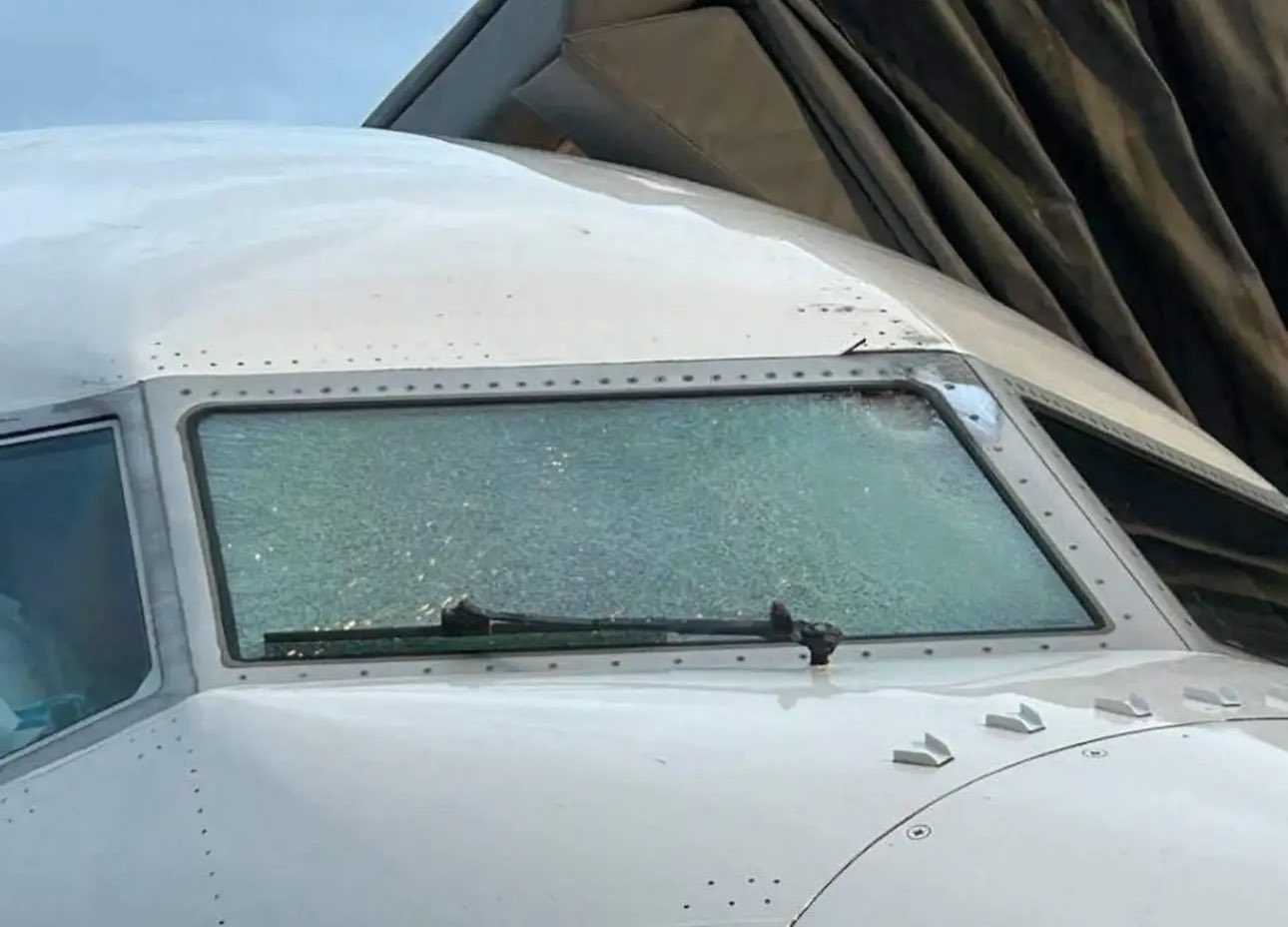
The harrowing incident occurred last week on Thursday October 16, 2025, at approximately 6:44 AM MDT. The aircraft, a Boeing 737 MAX 8, had been traveling from Denver to Los Angeles when members of the crew reported hearing a loud bang as an object apparently struck the front of the aircraft.
Damage was quickly observed on the right side of the aircraft’s windshield, prompting a diversion to Salt Lake City, where the aircraft safely landed approximately 50 minutes later.
“Unfortunately we have some bad news,” one of the pilots was heard saying over the aircraft intercom according to Heather Ramsey, a passenger aboard the flight at the time of the incident.
“The aircraft has collided with an object,” the pilot told passengers during the announcement.
Ramsey, who shared her account with Fox 11 Los Angeles, said she overheard one of the flight attendants warning other members of the crew to move to the back of the aircraft and to immediately stop in-flight service.
“It was really scary,” Ramsey said, adding that she and other passengers were “holding our breath until the very end.”
The 134 passengers on board the flight were transferred to another aircraft once they reached Salt Lake City, which carried them on to their destination in Los Angeles.
Shortly after the incident, the National Transportation Safety Board (NTSB) issued a statement saying the aircraft had safely made its way Salt Lake City, and that it was collecting information about the incident.
“The NTSB is investigating a cracked windscreen on a Boeing 737-8 during cruise flight near Moab, Utah, Thursday,” a portion of the statement read. “Operating as United flight 1093 from DEN to LAX, airplane diverted safely to SLC.”
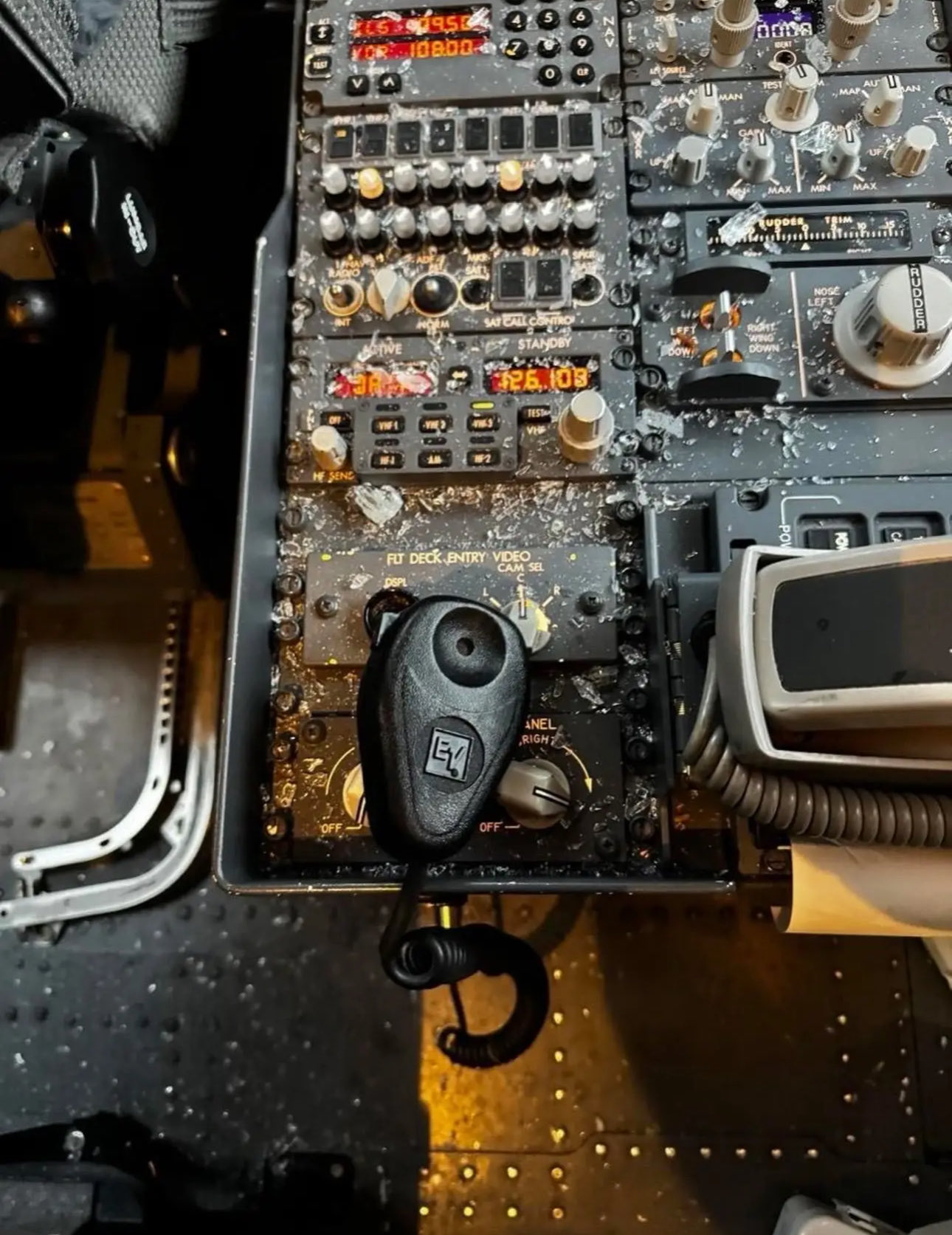
The cockpit of the Boeing 737 MAX after the collision.
Source: @aviationbrk
The NTSB also said that the damaged windscreen had been sent to a laboratory where it would be examined to try to determine what the object that struck the aircraft might have been, as speculations ensue about whether debris from a spacecraft reentry, or even a potential meteor impact, could have been involved.
“[P]eople are starting to discuss what this might have been, and the ‘space debris’ (whatever that ends up being) idea is most definitely -not- being dismissed as a possibility,” wrote user JonNYC in a posting about the incident on X.
However, Jonathan McDowell, an astronomer with the Harvard–Smithsonian Center for Astrophysics, told The Debrief in an email that there were “no known reentry matches” that link the incident to any spacecraft falling to Earth at the time.
In an update on his website, McDowell noted that there had been three objects that were successfully tracked during reentry last Thursday, involving a Starlink satellite and a pair of Chinese payloads.
The cockpit of the Boeing 737 MAX after the collision.
Source: @aviationbrk
“All are ruled out,” McDowell wrote, confirming none of these three objects had been near the location where the object struck the United Airlines flight last week.
While space debris has seemingly been ruled out for now regarding the United Airlines incident last week, McDowell has nonetheless raised concerns over the rise in Starlink satellite reentries, which he says are occurring on a daily basis.
The cockpit of the Boeing 737 MAX after the collision.
Source: @aviationbrk
In a statement provided to The Debrief earlier this month, McDowell said that “considering also non-Starlink reentries, there is a risk from reentering debris that I am not comfortable with,” adding that he believes “we should move to banning uncontrolled reentry from large (1 ton plus) space objects.”
Dr. Siamak Hesar, an expert on space debris reentries and CEO of Kayhan Space, similarly told The Debrief that while it is uncommon for space debris reentry to reach flight altitudes, such events are not unheard of, although it requires the debris to be fairly large.
“The material composition also plays a critical role, as objects made from heat-resistant materials have a much greater chance of partially surviving reentry,” Hesar told The Debrief. “Smaller fragments or components made of lighter materials typically disintegrate completely in the upper atmosphere before ever reaching air traffic altitudes.”
Hesar added that the odds of such incidents occurring “are gradually increasing due to the growing number of satellites and spacecraft being launched into orbit.”
“Both commercial and government operators are adding to this population, and most of these objects will eventually reenter Earth’s atmosphere,” Hesar told The Debrief. “As a result, we can expect to see a rising number of reentry events in the coming years.”
While there are no known reentry events that are believed to have coincided with last week’s concerning incident, that still does not rule out the possibility that a meteor could have caused the damage to the aircraft. However, investigators have revealed no evidence supporting this potential source, nor any other possible links to objects falling from space at this time.
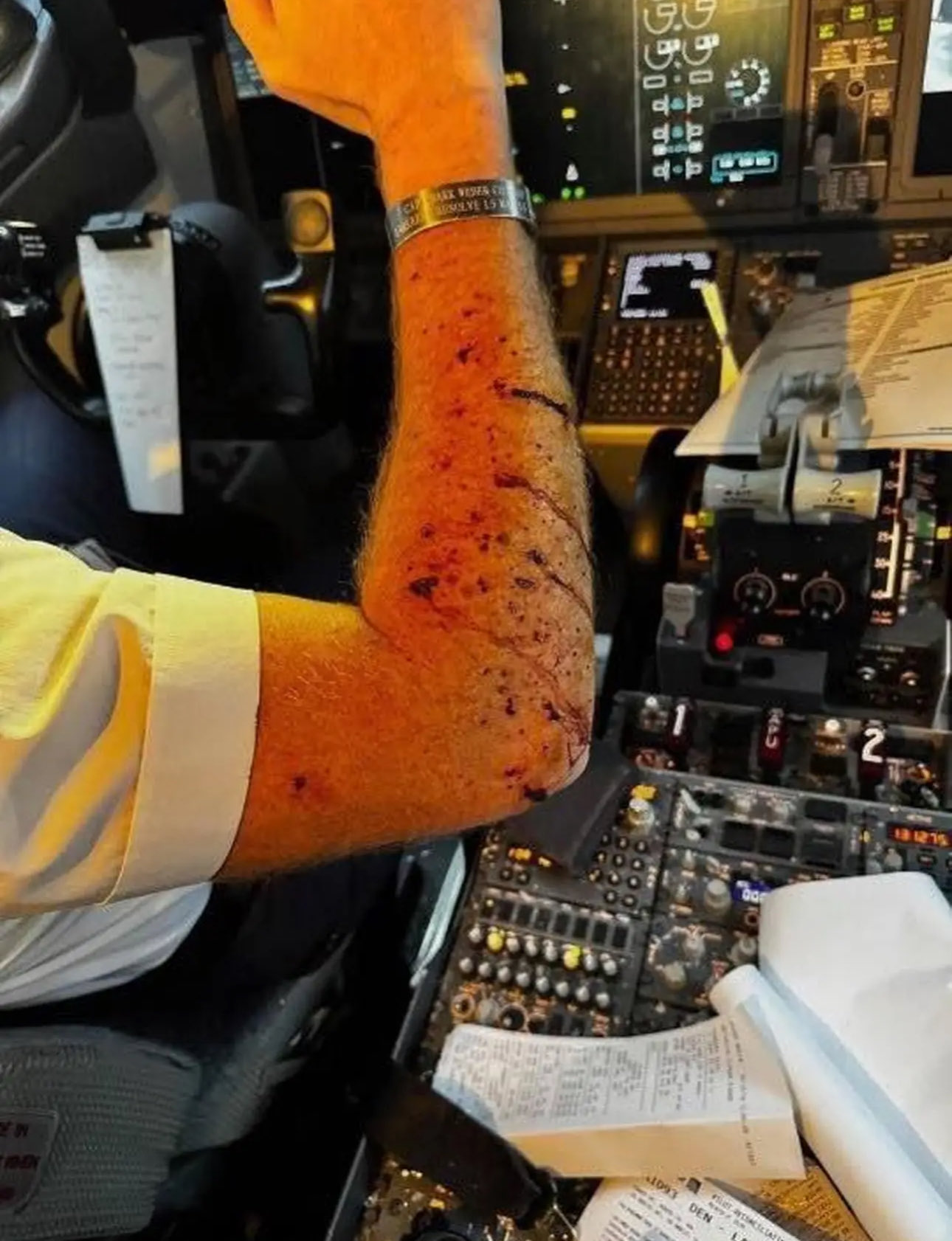
Following the incident, images circulated online which reportedly showed the arm of one of the pilots in the cockpit shortly after the collision with the object, revealing several lacerations caused by glass from the broken windshield.
According to a statement issued by United Airlines, the aircraft landed safely “without major injuries reported among passengers or crew,” which apparently confirmed the possibility that minor injuries had occurred during the incident.
Information made available in an incident report at the website of the Aviation Safety Network revealed that the aircraft windshield’s “laminated structure was severely shattered” and that the instrument panel and control surfaces within the cockpit “were contaminated with fine glass particles.”
“Visible impact damage was present on the external surface of the aircraft nose,” the report added.
Fortunately, the aircraft’s multilayer windshield is designed to be capable of remaining functional even in the event of damage being sustained to one or more of its layers.
Currently, while the investigation remains underway, the situation has been further complicated by the ongoing U.S. government shutdown, which has left many NTSB employees, as well as those employed with the Federal Aviation Administration, furloughed.
The NTSB says that it is “gathering radar, weather, [and] flight recorder data” in its ongoing investigation, but no additional details about the incident have been made available at this time.
Micah Hanks is the Editor-in-Chief and Co-Founder of The Debrief. A longtime reporter on science, defense, and technology with a focus on space and astronomy, he can be reached atmicah@thedebrief.org. Follow him on X @MicahHanks, and at micahhanks.com.
It's a question that has been asked since the beginning of time: does God really exist?
Traditionally, science has been the counterargument for the existence of a divine creator.
However, French mathematicians Olivier Bonnassies and Michel-Yves Bollore now say that science 'has become God's ally'.
In a new book, the duo have distilled insights from 62 Nobel Prize winners and more than 100 leading scientists to pinpoint the scientific discoveries that could prove God is real.
This includes everything from the Big Bang – the most widely accepted explanation for the origin of the universe – to DNA and the human genome.
'Until recently, believing in God seemed incompatible with science,' say the authors.
'Now, unexpectedly, science appears to have become God's ally.'
Ultimately, whether science disproves or supports the existence of God remains open to interpretation – but these scientific discoveries offer a tantalising glimpse at the possibility that our world is the result of design, not chance.
It's a question that has been asked since the beginning of time: does God really exist?
Traditionally, science has been the counterargument for the existence of a divine creator. However, French mathematicians Olivier Bonnassies (right) and Michel–Yves Bollore (left) now say that science 'has become God's ally'
The Big Bang
The Big Bang is the most widely accepted explanation for the origin of the universe, and posits that the universe exploded into existence from a single point about 14 billion years ago.
According to the theory, in an instant quicker than the blink of an eye, matter and energy, as well as space and time, were suddenly born.
But according to the authors, who are both Christians, such an action dictates there was some kind of higher being that could have triggered it.
In their book, the duo ask if 'it really such a leap to entertain the possibility of a creative act' behind the Big Bang.
'The Big Bang forces us into a corner,' they say in their book.
'To put it bluntly, it brings us face-to-face with the idea of God.
In the book, Bollore and Bonnassies distil insights from 62 Nobel Prize winners and more than 100 leading scientists
This timeline plots the expansion of space since the Big Bang; space, including hypothetical non–observable portions of the universe, is represented by the circular sections
The Big Bang theory
The Big Bang is a cosmological model, a theory used to describe the beginning and the evolution of our universe.
It says that the universe was in a very hot and dense state before it started to expand 13.7 billion years ago.
This theory is based on fundamental observations.
In 1920, Edwin Hubble observed that the distance between galaxies was increasing everywhere in the universe – meaning galaxies had to be closer to each other in the past.
'The fact that we cant really think about the time before the Big Bang, as the categories of time, space and matter simply do not apply, lends credence to the idea of a creative act.
'If there was mathematical information before the Big Bang, who is the incredible "programmer" behind such code?'
It was back in 1965 when two astronomers in New Jersey provided pivotal evidence confirming the theory of the Big Bang.
For the first time, they discovered cosmic microwave background (CMB) – the radiation left over from the birth of the universe, considered the Big Bang's leftover glow.
However, half a century later, there is still not an alternative theory that's supported by experimental observations, the French mathematicians point out.
'We wait in vain,' they add.
A fine–tuned universe
Life only exists on Earth due to a precise combination of factors – such as just the right temperatures, our planet's protective magnetic field and the proportion of oxygen in the atmosphere.
The Creation of Adam, a fresco painting by Michelangelo at the Sistine Chapel in Vatican City, shows the moment humanity was created through the hands of God – a new book by two French mathematicians claims science now backs up the idea of one creator
Other 'vital parameters' include the 'perfect' inclination of Earth's axis of rotation and the thickness of its ozone layer, protecting us from the sun's deadly radiation.
More broadly, everything in the universe is governed by essential forces – such as the strong force, the weak force and the electromagnetic force.
The researchers point out that these constants carry a series of numbers or values, calculated by some of the finest scientific minds such as German physicist Albert Einstein.
Either these 'fine–tuned' numbers are the 'result of chance' – one that is only infinitesimally unlikely – or they come from 'complex calculations of a highly intelligent creator God', say Bolloré and Bonnassies.
'For some of these numbers, a very slight variation by even a distant decimal point would have yielded an unrecognizable Universe, and we would not be here to talk about it,' they write.
This school of thought, known as the fine–tuned universe hypothesis, conjures the image of an almighty creator in the heavens twiddling dials and knobs.
While this image may be a leap of the imagination, the alterative belief that the universe 'is a purposeless accident' is less backed by the perfectly calibrated numbers.
DNA and the human genome
DNA forms part of a 'unique, sophisticated and coordinated coding system' that points to the existence of an 'intelligent designer'
Professor Stephen Hawking: 'There is no God'
Professor Stephen Hawking's last 'profound realisation'was that there is no afterlife or supreme being.
'We are each free to believe what we want, and it's my view that the simplest explanation is that there is no God,' he said.
'No one created the universe and no one directors out fate. This leads me to a profound realisation: there is probably no heaven and afterlife either. I think belief in the afterlife is just wishful thinking.
'There is no reliable evidence for it, and it flies in the face of everything we know in science. I think that when we die we return to dust.
'But there is a sense we live on, in our influence, and in the genes we pass to our children.'
Theoretically, Earth might have existed without harboring the wonderfully diverse range of plants and animals that it does today – but somehow life found a way.
Around four billion years ago, inert matter became the earliest primitive lifeforms and DNA mysteriously came into existence.
The improbability of the 'enormous leap' from inert matter to life is 'dizzying', the French mathematicians explain – and chance alone 'cannot explain the appearance of life'.
In 1953, the discovery of DNA's double–helix structure by Sir Francis Crick and James Watson revealed the existence of a single encoding language common to all lifeforms.
More recently, in 2003, scientists built on the work of Crick and Watson to map the human genome – the entire set of DNA instructions found in a cell.
Crick, himself an atheist, admitted a complex structure like DNA could not have appeared by chance' – and appeared to be 'almost a miracle'.
DNA forms part of a 'unique, sophisticated and coordinated coding system' that points to the existence of an 'intelligent designer'.
Bolloré and Bonnassies suggest life arose when it did due to natural laws set in place by God in the very beginning, or the result of a special intervention by the same creator.
Professor Stephen Hawking's last 'profound realisation'was that there is no afterlife or supreme being. Pictured: Professor Hawking in January 2007
Albert Einstein often recognised the necessity for an 'infinitely superior' being responsible for the creation of the world - although he never acknowledged any personal God or followed any particular religion
'In the last 50 years, we have discovered that the complexity of life surpasses anything we could have imagined,' they say. 'Today's leading figures in science have been humbled by this fact.'
Einstein's theory of relativity
Albert Einstein – who described himself as 'not an atheist' but didn't embrace religion either – developed the Theory of Relativity between 1905 and 1917.
The theory, which altered our understanding of physics, says time, space, matter and energy and interrelated and that no single one of them can exist without the other.
It says light, and specifically the speed of light, is the only 'constant' in the universe – and everything else is relative, even time.
Some Christians have interpreted the theory as proof that God exists by drawing comparisons between light and God – both unchanging constants.
Notably, the Bible says 'God is light' and repeatedly uses the word 'light' to describe an all–present God – such as 'I am the light of the world' and the 'Lord is my light and my salvation'.
The theory says time would stop if something was travelling at the speed of light – while comparably God is eternal, having no beginning and no end.
Albert Einstein's 'God letter'
Einstein penned his famous letter 'God letter' to religious philosopher Erik Gutkind in 1954 as a critical response to his book.
'The word God is for me nothing more than the expression and product of human weakness, the Bible a collection of honorable, but still purely primitive, legends which are nevertheless pretty childish,' he said in the letter.
He adds: 'No interpretation, no matter how subtle, can (for me) change anything about this.'
Although Einstein didn't present this religious interpretation as truth, aspects of his theory certainly support the belief that God exists.
Quantum mechanics
Of all the scientific discoveries in the 20th century, few have left scientists dumbstruck like quantum physics.
Classical models of physics cannot explain the world of quantum mechanics, which challenge our understanding of reality.
For example, a phenomenon called quantum entanglement describes two particles and their properties becoming linked without physical contact with one another.
In recent years, French physicist Alain Aspect, a Nobel prize winner, demonstrated quantum entanglement between two particles about 40 feet apart that were 'dialogued instantaneously' with each other.
Quantum experiments like that have made it clear 'that within the realm of physics there is another later of reality,' the duo say in the book.
'The twentieth–century discovery of the quantum nature of our world – which shows that it is indeterminate and radically subject to chance – is metaphysically essential,' they added.
Einstein penned his famous letter 'God letter' to religious philosopher Erik Gutkind in 1954 as a critical response to his book
'It provides indirect confirmation of the thesis that God exists while undermining the determinist positions held by atheist scientists of the nineteenth century.'
Overall, the authors insist that the evidence for God's existence is 'abundant, clear and rational', and their arguments are grounded in 'reason and careful analysis'.
'Traces of God's actions' in the universe are far more tangible than those of aliens, they add – but somehow scientists spend more effort to finding the latter.
'We are living in extraordinary times,' they conclude in the book.
'Although this shift has gone largely unnoticed by the general public, we are in the midst of an intellectual paradigm shift that fundamentally redefines our approach to the question of God's existence.'
The English–language version of 'God, the Science, the Evidence' has been published in paperback by Palomar
Professor Stephen Hawking's big questions - and his answers
1. Is there a God? 'There is no God. No one directs the universe.'
2. How did it all begin? 'In a hot Big Bang.'
3. Is there other intelligent life in the Universe? 'There are forms of intelligent life out there. We need to be wary of answering back until we have developed a bit further.'
4. Can we predict the future? 'No and yes. In principal the laws allow us to predict the future but in practice it is too difficult.'
5. What is inside a Black Hole? 'Falling into a black hole is definitely bad news. If it were a stellar mass black hole your would be made into spaghetti before reaching the horizon'
6. Is Time Travel Possible? 'Travel back in time can't be ruled out according to our present understanding'
7. Will we survive on Earth? 'The present world order has a future but it will be a very different one.'
8. Should we colonise space? 'I expect within the next hundred years we will be able to travel to anywhere in the Solar System'
9. Will Artificial Intelligence outsmart us? 'A super-intelligent AI will be extremely good at accomplishing goals and if those goals aren't aligned with ours we're in trouble.'
10. How do we shape the future? 'Remember to look up at the stars and not down at your feet.'
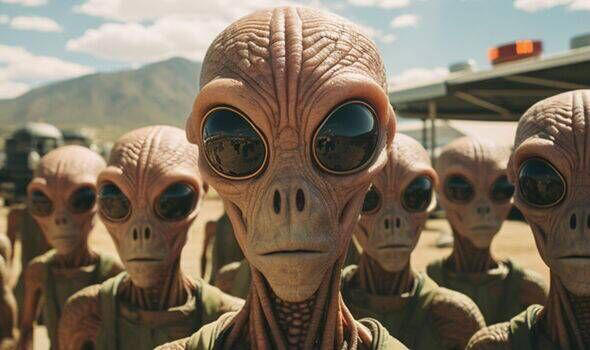
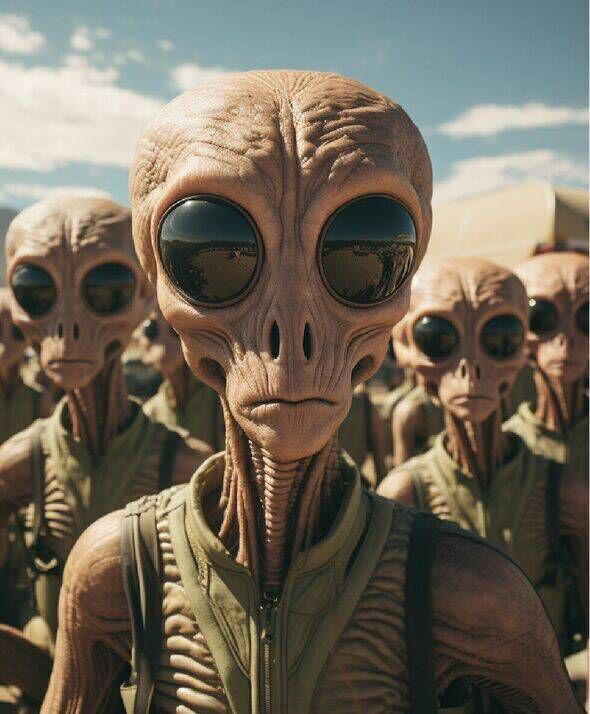
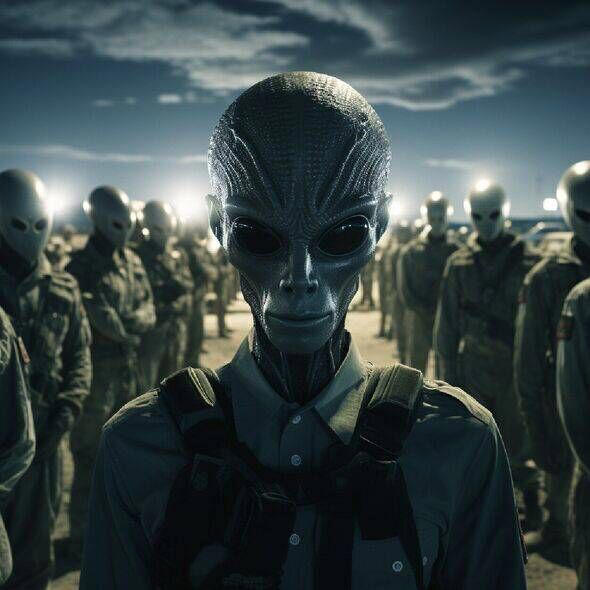
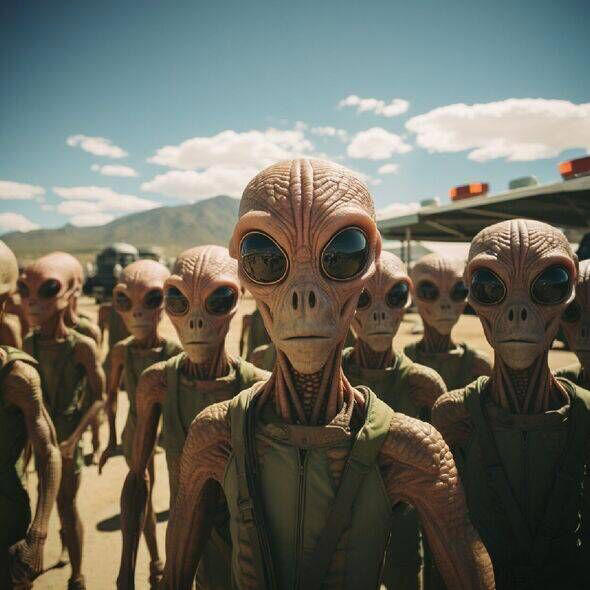
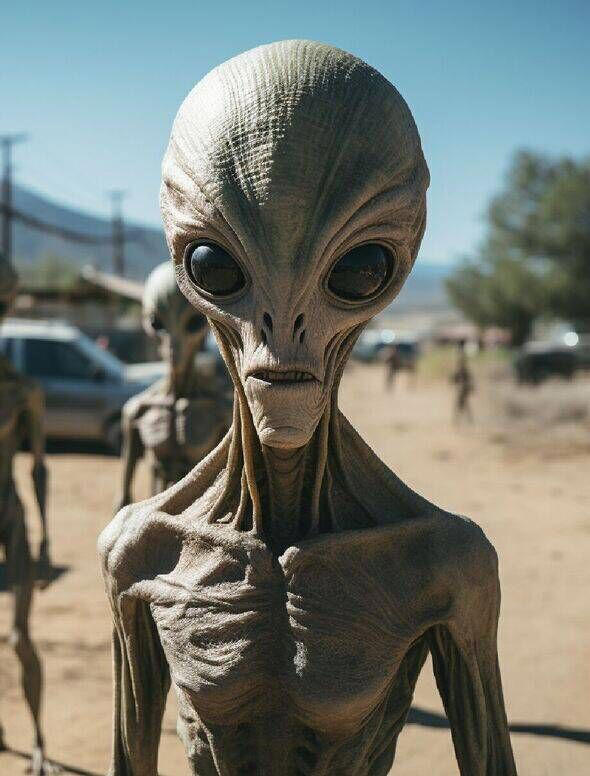
Thanks to advanced AI technology, we now have a glimpse into what the alleged aliens housed at the military base might look like.
The digitally rendered images depict various potential alien ethnicities, ranging from the traditional large-headed, big-eyed beings to more humanoid creatures from outer space. It comes after the mystery surrounding UFOs spotted over New Jersey was solved.
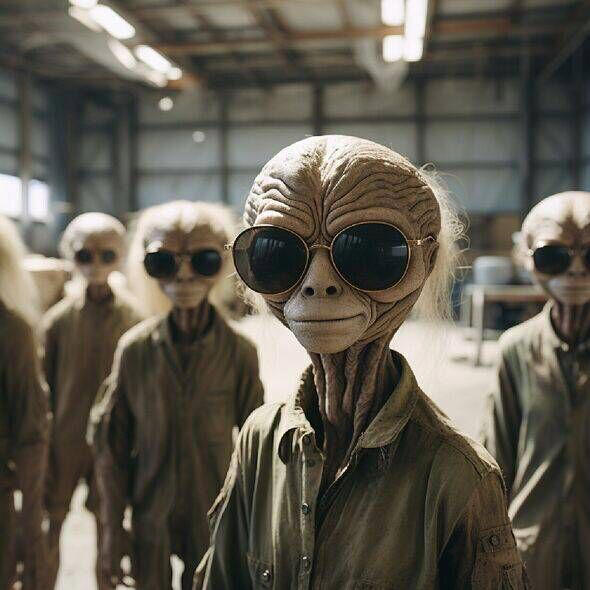
Interestingly, some of the AI interpretations even portray these extraterrestrials adopting earthly fashion trends, sporting popular aviator sunglasses to withstand the Nevada sun.
The Daily Express US is now helping believers visualize what the supposed alien inhabitants of Area 51 could potentially resemble.
Area 51, a site dedicated solely to top-secret research, has long been the focus of UFO enthusiasts hoping to spot signs of extraterrestrial life.
Despite the intense scrutiny, US Government officials have remained tight-lipped about the activities conducted at the Nevada base, which has been classified as top secret for decades.
The intrigue surrounding Area 51, officially known as Homey Airport, has firmly entrenched it in UFO folklore.
The facility, situated 83 miles northwest of Las Vegas, was procured by the US Air Force and CIA in 1955 to conduct flight tests on the Lockheed U-2 aircraft.
Despite the rumors swirling around military operations in the area, the CIA did not confirm the existence of the air base until 2014, following a Freedom of Information Act (FOIA) request that revealed details of its history.
However, the purpose of Area 51 and the origins of its infamous nickname have remained shrouded in mystery for nearly seven decades. Some speculate that the aliens housed within Area 51 bear a resemblance to humans and wear uniforms akin to those of the US Air Force.
Organizers humorously encouraged Facebook users to band together and raid the Nevada site in search of evidence of extraterrestrial life, believed to be hidden within the base, including actual aliens.
Despite the turnout of around 1,500 spectators for the event, officials' preparations in the days leading up to it successfully prevented any storming of Area 51.
The AI generator conjured up aliens with mid to long-white hair and aviator-style sunglasses.
One even bore an uncanny resemblance to a prominent US politician - let us know who you think it is in the comments section.
Located near what's now known as the Extraterrestrial Highway due to numerous UFO sightings, Area 51 is a must-visit for enthusiasts.
Starting just an hour and a half outside of Las Vegas in Crystal Springs, Route 375 takes alien enthusiasts north to Tonopah via the infamous town of Rachel.
This remote community is a must-visit for all UFO seekers, being the nearest populated area to Area 51.
Perhaps one day, a fortunate explorer might encounter a group of aliens resembling our AI-generated images enjoying some fresh air around the base.
Psychology professor David Ludden suggests that the enduring fascination with Area 51 stems from the secrecy that the US Government has unintentionally perpetuated over the years.
Ludden points out that the classified nature of the research conducted at the Nevada air base has even the most skeptical individuals curious about what might be hidden behind closed doors.
In an interview with Time, he revealed: "In one sense, it is a conspiracy, because it's a secret area.
"The government actually is doing something it doesn't want us to know about."
In a traditional interpretation of alien life, the AI depicted the extraterrestrial visitors at Area 51 looking rather surprised, as if they were caught strolling outside and enjoying pleasant weather.
Researchers from Johns Hopkins using powerful supercomputer simulations have determined that the most likely explanation for amysterious glow at the center of the Milky Way Galaxy involves collisions of dark matter, resulting in gamma ray emissions that cause the mysterious, diffuse glow.
While the simulations also suggest the phenomenon could be caused by spinning pulsars, the data best support the dark matter theory. If correct, the discovery could offer the first unequivocal proof of dark matter’s existence and provide scientists with a new approach to studying the enigmatic material that makes up a large portion of the universe’s mass.
“Our key new result is that dark matter fits the gamma ray data at least as well as the rival neutron star hypothesis,” the study’s lead author, Joseph Silk, a professor of physics and astronomy at Johns Hopkins and a researcher at the Institut d’Astrophysique de Paris and Sorbonne University, told The Debrief. “We have increased the odds that dark matter has been indirectly detected.”
Since the Fermi satellite, launched in 2008, first discovered the mysterious glow at the center of the Milky Way, several explanations have been proposed to explain its origin. The most promising theories propose that the light comes from either collisions of dark matter particles or from quickly spinning neutron stars.
While the second concept involves proven phenomena, the possibility that the glow is caused by dark matter is particularly intriguing to scientists. This is because dark matter itself is still purely theoretical and lacks definitive proof, as it does not interact with light and therefore cannot be “seen.” Instead, scientists have had to infer dark matter’s existence from its gravitational effects on ordinary matter, while continuing to explore new ways to prove its existence.
In a statement detailing the team‘s research, explained that dark matter “dominates the universe and holds galaxies together,” making its detection a major scientific priority for decades.
“It’s extremely consequential, and we’re desperately thinking all the time of ideas as to how we could detect it,” Professor Silk explained. “Gamma rays, and specifically the excess light we’re observing at the center of our galaxy, could be our first clue.”
In a series of simulations, the professor and an international research team used several supercomputers to create virtual “maps” of locations within the Milky Way that current theories predict dark matter to be located. The team notes that their simulations took into account how the galaxy was formed “for the first time in history,” resulting in an unprecedented level of detail in the final maps.
This critical component of the simulations involved modeling the movement of dark matter during the first billion years of the Milky Way’s existence. The research team said that’s because galactic formation theories predict that many smaller galaxy-like systems entered the Milky Way and became its “building blocks.” During this phase, dark matter particles gravitate toward the center of the galaxy and form clusters. This clustering would result in higher numbers of dark matter collisions, which could, in theory, produce the mysterious glow that still exists today.
According to the team’s statement, when they factored in “more realistic” dark matter collisions, their simulations produced maps that matched actual gamma ray maps previously captured by the Fermi Gamma-ray Space Telescope. The team said the matching simulated and real-world maps “round out a triad of evidence” supporting dark matter collisions as the cause of the mysterious glow at the center of the Milky Way Galaxy.
“Gamma rays coming from dark matter particle collisions would produce the same signal and have the same properties as those observed in the real world,” they explain, “though it’s not definitive proof.”
A second scenario considered in the team’s study involves reinvigorated, old, rapidly spinning neutron stars, known as millisecond pulsars, which could emit the gamma rays. Still, the team notes that the theory is “imperfect,” since their simulations would have to assume there are more millisecond pulsars than have been previously observed in the real world. Conversely, the dark matter collision simulated maps accurately match the real-world observations.
Up next, Professor Silk’s team is preparing follow-up experiments that could determine if the gamma rays causing the mysterious glow at the center of the Milky Way are high-energy rays or low-energy rays. If the experiments show the glow is composed of high-energy rays, the finding would support the millisecond pulsars as its cause. However, Silk notes, if the gamma rays turn out to be low-energy rays caused by dark matter collisions, it would be the first direct evidence for the existence of dark matter ever discovered.
“A clean signal would be a smoking gun, in my opinion,” the professor said.
The team said that figuring out when they will be able to perform these experiments may depend on the completion of the “huge” Cherenkov Telescope Array (CTA). Currently in the construction phase, the array is specifically designed to detect gamma rays of varying energies.
“The Cherenkov Telescope Array under construction in Chile is expected to be the first to provide the necessary sensitivity to test our dark matter hypothesis,” Professor Silk told The Debrief.
While awaiting the observatory’s completion, the team is already working on predictions on potential dark matter clusters within several dwarf galaxies that currently circle the Milky Way. Once the high-res data from Cherenkov is available and compared to the prediction maps, the professor said the team may find the proof of dark matter they are hoping for or support for the millisecond pulsar concept.
“Two possibilities are being considered,” the professor told The Debrief. “One is to look at the Galactic center excess at higher energies. The dark matter hypothesis has no signal because gamma ray energies are limited by the mass of the colliding particles.”
Conversely, the professor said that’s not the case with millisecond pulsars. He also pointed out that the new array will be capable of studying several nearby dwarf galaxies that are “known to consist mostly of dark matter.”
“Detecting the same signal Fermi found for the galactic center would confirm the DM hypothesis,” Silk told The Debrief.
Of course, given the unknown nature of dark matter and the mysterious nature of the galactic glow coming from the center of the Milky Way, the professor conceded that the results may hint at a cause they hadn’t even considered.
“It’s possible we will see the new data and confirm one theory over the other,” Silk explained. “Or maybe we’ll find nothing, in which case it’ll be an even greater mystery to resolve.”
The study, “Fermi-LAT Galactic Center Excess morphology of dark matter in simulations of the Milky Way galaxy,” was published in Physical Review Letters.
Christopher Plain is a Science Fiction and Fantasy novelist and Head Science Writer at The Debrief. Follow and connect with him on X, learn about his books at plainfiction.com, or email him directly at christopher@thedebrief.org.
Meer van UFO'S of UAP'S, ASTRONOMIE, RUIMTEVAART, ARCHEOLOGIE, OUDHEIDKUNDE, SF-SNUFJES EN ANDERE ESOTERISCHE WETENSCHAPPEN - DE ALLERLAATSTE NIEUWTJES


 Strange new species face discovered in Mars photo. It is an aquatic alien. UAP UFO Sighting News.