Ontdek de Fascinerende Wereld van UFO's en UAP's: Jouw Bron voor Onthullende Informatie!
Ben jij ook gefascineerd door het onbekende? Wil je meer weten over UFO's en UAP's, niet alleen in België, maar over de hele wereld? Dan ben je op de juiste plek!
België: Het Kloppend Hart van UFO-onderzoek
In België is BUFON (Belgisch UFO-Netwerk) dé autoriteit op het gebied van UFO-onderzoek. Voor betrouwbare en objectieve informatie over deze intrigerende fenomenen, bezoek je zeker onze Facebook-pagina en deze blog. Maar dat is nog niet alles! Ontdek ook het Belgisch UFO-meldpunt en Caelestia, twee organisaties die diepgaand onderzoek verrichten, al zijn ze soms kritisch of sceptisch.
Nederland: Een Schat aan Informatie
Voor onze Nederlandse buren is er de schitterende website www.ufowijzer.nl, beheerd door Paul Harmans. Deze site biedt een schat aan informatie en artikelen die je niet wilt missen!
Internationaal: MUFON - De Wereldwijde Autoriteit
Neem ook een kijkje bij MUFON (Mutual UFO Network Inc.), een gerenommeerde Amerikaanse UFO-vereniging met afdelingen in de VS en wereldwijd. MUFON is toegewijd aan de wetenschappelijke en analytische studie van het UFO-fenomeen, en hun maandelijkse tijdschrift, The MUFON UFO-Journal, is een must-read voor elke UFO-enthousiasteling. Bezoek hun website op www.mufon.com voor meer informatie.
Samenwerking en Toekomstvisie
Sinds 1 februari 2020 is Pieter niet alleen ex-president van BUFON, maar ook de voormalige nationale directeur van MUFON in Vlaanderen en Nederland. Dit creëert een sterke samenwerking met de Franse MUFON Reseau MUFON/EUROP, wat ons in staat stelt om nog meer waardevolle inzichten te delen.
Let op: Nepprofielen en Nieuwe Groeperingen
Pas op voor een nieuwe groepering die zich ook BUFON noemt, maar geen enkele connectie heeft met onze gevestigde organisatie. Hoewel zij de naam geregistreerd hebben, kunnen ze het rijke verleden en de expertise van onze groep niet evenaren. We wensen hen veel succes, maar we blijven de autoriteit in UFO-onderzoek!
Blijf Op De Hoogte!
Wil jij de laatste nieuwtjes over UFO's, ruimtevaart, archeologie, en meer? Volg ons dan en duik samen met ons in de fascinerende wereld van het onbekende! Sluit je aan bij de gemeenschap van nieuwsgierige geesten die net als jij verlangen naar antwoorden en avonturen in de sterren!
Heb je vragen of wil je meer weten? Aarzel dan niet om contact met ons op te nemen! Samen ontrafelen we het mysterie van de lucht en daarbuiten.
Pope Leo's bombshell alien claims as he makes 'life on other planets' statement
The Vatican has, since the dawn of Vatican time, stayed away from ever officially commenting on aliens and what officials known about them . . . until now, it seems
But nothing came of it, and rumours still persists that there are secret alien files in the Vatican's much-mysterious vault.
David Grusch, a US Air Force veteran has often made claims about the US Government's involvement in covering up the truth about aliens and UFOs and last year he brought the Vatican into the fold by claiming that it knows about aliens and was involved in a cover-up as far back as 1933.
However, nobody has ever really commented in any official capacity – until now.
Pope Leo XIV, who has only been in his role for a few months, has bucked the trend of silence and gone on record to claim that it's possible life does exists in other parts of the universe.
However, nobody has ever really commented in any official capacity – until now.
Pope Leo XIV, who has only been in his role for a few months, has bucked the trend of silence and gone on record to claim that it's possible life does exists in other parts of the universe.
Speaking during a reception held for participants of a summer course at the Vatican Observatory in June – but only just surfacing now – he said: “Thanks to this remarkable instrument, we are able for the first time to peer deep into the atmosphere of planets in other solar systems, where life could develop.
He was speaking at the Specola Vaticana
(Vatican Observatory) at Castel Gandolfo(Image: Getty Images)
“The new technology also makes it possible to trace the ancient light of distant galaxies, which tells us about the origins of our universe".
He then called on the participants of the course to use new telescopes and technology at the observatory to "deepen our knowledge of the cosmos, of which we are only a small but significant part”.
Despite this, it has often been claimed that if the Vatican were to open its vault doors and be honest about what it knows, it could do irreparable damage to itself.
But for now, the truth remains out there . . . somewhere.
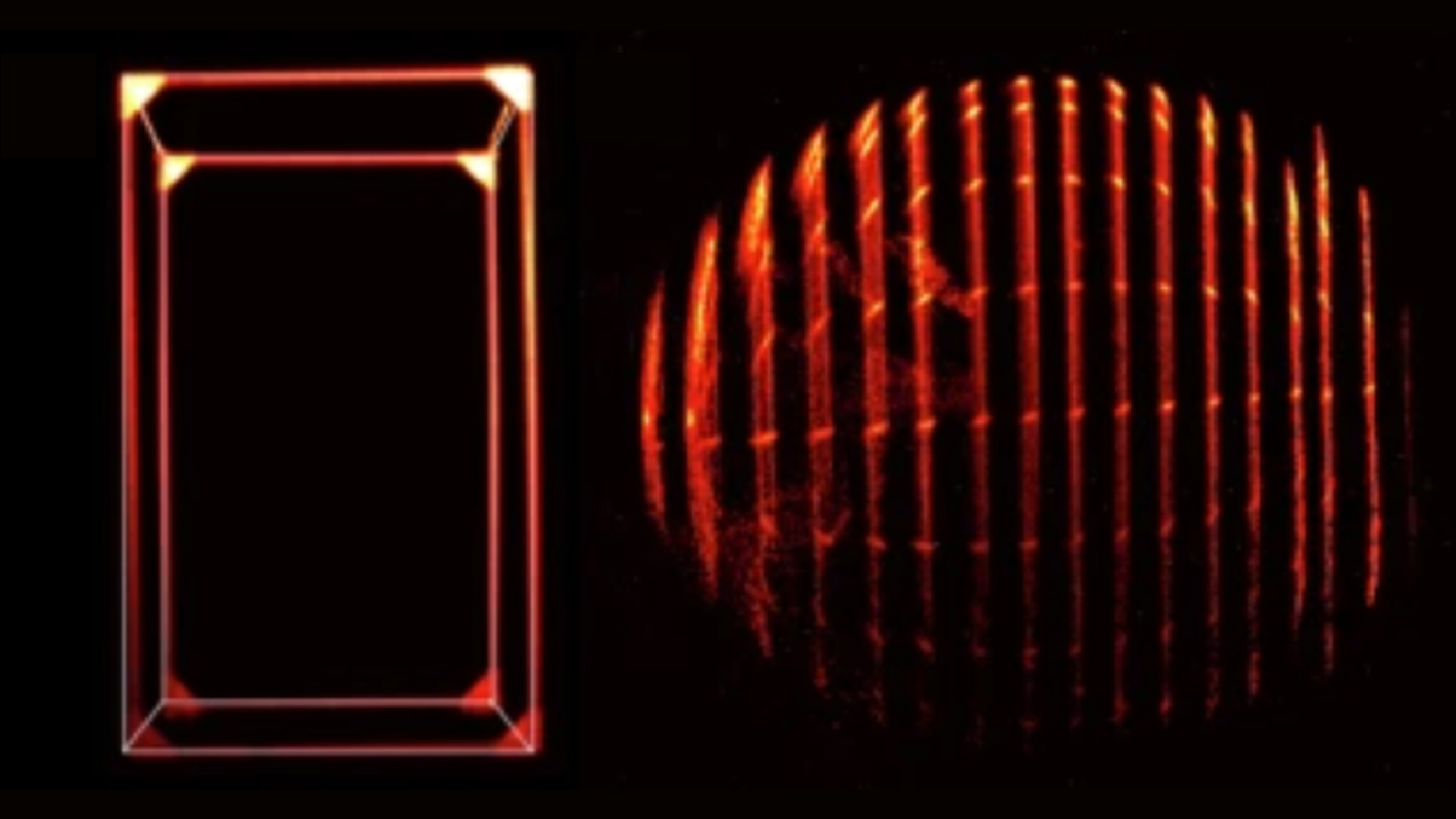
For the first time, physicists have simulated what objects moving near the speed of light would look like — an optical illusion called the Terrell-Penrose effect.
The Vienna team stitched together slices of light to create snapshots. At rest (left), the cube looks normal. But when simulated at 99.9% of light speed (right), a sphere still looks round but reveals parts of its far side.
Using ultra-fast laser pulses and special cameras, scientists have simulated an optical illusion that appears to defy Einstein's theory of special relativity.
One consequence of special relativity is that fast-moving objects should appear shortened in the direction of motion — a phenomenon known as Lorentz contraction. This effect has been confirmed indirectly in particle accelerator experiments.
But in 1959, mathematician Roger Penrose and physicist James Terrell pointed out that an observer with a camera wouldn't actually see a squashed object at all. Instead, because light from different parts of the object takes different times to reach the camera, it would appear rotated.
Although previous models have worked with this illusion, now called the Terrell-Penrose effect, this is the first time it has been done in a lab setting. The team described their results in the journal Communications Physics.
"What I like most is the simplicity," Dominik Hornof, a quantum physicist at the Vienna University of Technology and first author of the study, told Live Science. "With the right idea, you can recreate relativistic effects in a small lab. It shows that even century-old predictions can be brought to life in a really intuitive way."
Re-creating the illusion
In the new study, physicists used ultra-fast laser pulses and gated cameras to produce snapshots of a cube and a sphere "moving" at nearly the speed of light. The results showed snapshots of rotated objects. This proved the Terrell-Penrose effect to be true.
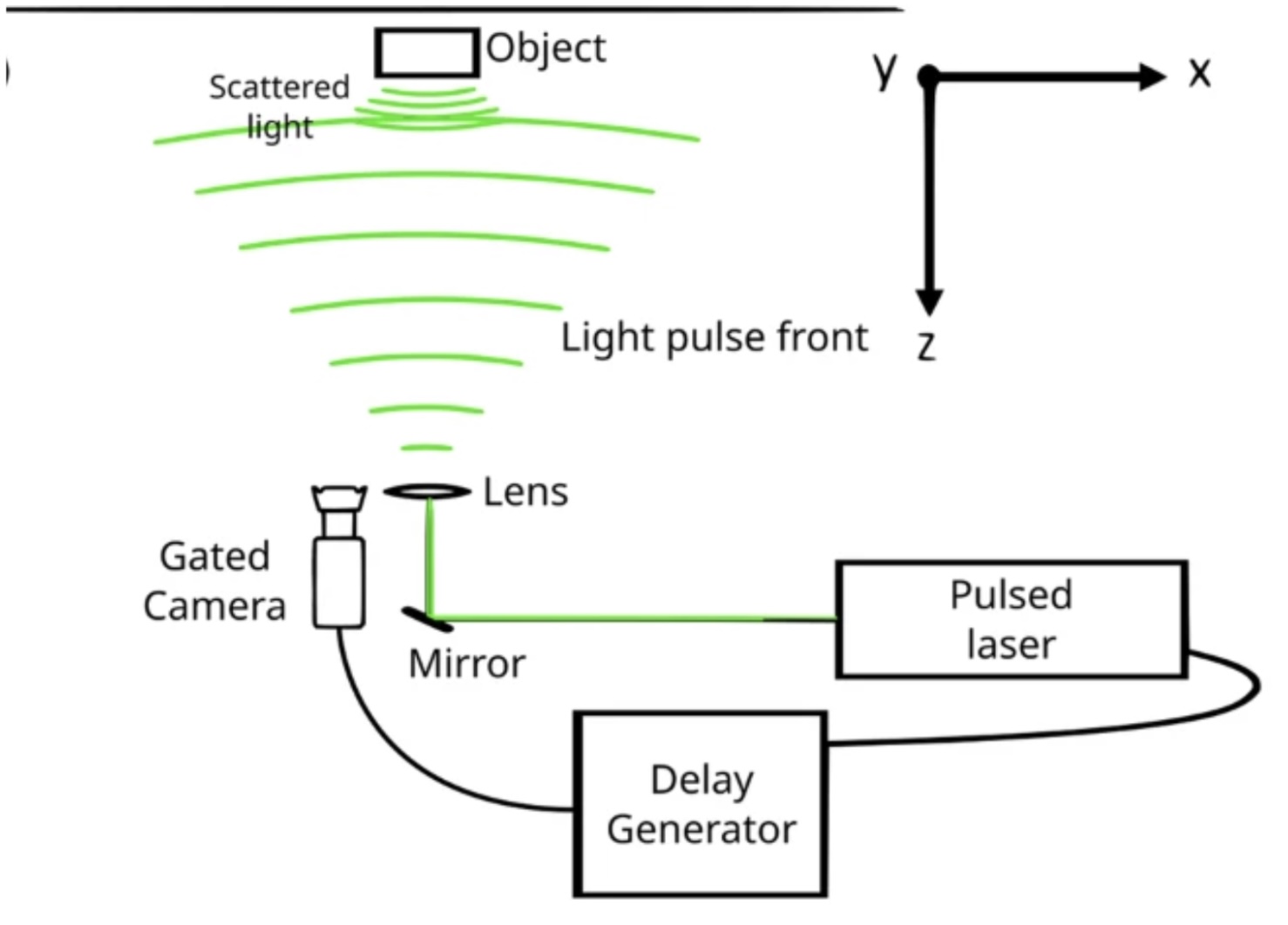
The researchers fired ultra-short laser pulses at their test object and then used a delay generator to tell the camera exactly when to open its shutter (for just billionths of a second). This camera captured single slices of light bouncing off the object. They repeated the process and shifted the object between shots. The team built up the illusion of an object racing at near light speed. (Image credit: Hornof et al., 2025; CC BY 4.0)
But like every study, this one also had its difficulties. Moving any object at or near the speed of light is currently impossible. "In Einstein's theory, the faster something moves, the more its effective mass increases. As you get closer to the speed of light, the energy you need grows by a lot," Hornof said. We cannot generate enough energy to accelerate something like a cube, and "that's why we need huge particle accelerators, even just to move electrons close to that speed. It would take a huge amount of energy."
So the team used a clever substitute. "What we can do is mimic the visual effect," Hornof said. They started with a cube of about 3 feet (1 meter) on each side. Then, they fired ultra-short laser pulses — each just 300 picoseconds long, or about a tenth of a billionth of a second — at the object. They captured the reflected light with a gated camera that opened only for that instant and produced a thin "slice" each time.
After each slice, they moved the cube forward about 1.9 inches (4.8 cm). That is the distance it would have traveled if it were moving at 80% the speed of light during the delay between pulses. Then, the scientists put all of these slices together into a snapshot of the cube in motion.
"When you combine all the slices, the object looks like it's racing incredibly fast, even though it never moved at all," Hornof said. "At the end of the day, it's just geometry."
They repeated the process with a sphere, shifting it by 2.4 inches (6 cm) per step to mimic 99.9% light speed. When the slices were combined, the cube appeared rotated and the sphere looked as if you could peek around its sides.
"The rotation is not physical," Hornof said. "It's an optical illusion. The geometry of how light arrives at the same time tricks our eyes."
That is why the Terrell-Penrose effect does not contradict Einstein's special relativity. A fast-moving object is physically shortened along its direction of travel, but a camera doesn't capture that directly. Because light from the back takes longer to arrive than light from the front, the snapshot shifts in a way that makes the object appear rotated.
"When we did the calculations, we were surprised how beautifully the geometry worked out," Hornof said. "Seeing it appear in the images was really exciting."
Recent archaeological discoveries at two pivotal biblical sites are transforming our understanding of early Christianity's expansion across the ancient Mediterranean world. In Turkey's ancient Lystra, excavators have uncovered a magnificent 100-foot basilica adorned with gold-gilded mosaics, while Israel's el-Araj site yields new evidence supporting its identification as biblical Bethsaida. These findings illuminate the sophisticated urban networks that supported the first Christian communities and help validate biblical accounts with tangible archaeological evidence.
The Lystra basilica, discovered near modern Hatunsaray in central Anatolia, provides concrete proof that the city mentioned eight times in the New Testament was indeed a thriving Christian center capable of supporting grand religious architecture. According to Assoc. Prof. İlker Mete Mimiroğlu of Necmettin Erbakan University, this discovery confirms biblical narratives describing Paul's miraculous healing of a lame man and the subsequent establishment of organized Christian communities in first-century Anatolia claims the Daily Mail report.
Lystra: From Miraculous Healing to Christian Center
Lystra achieved biblical fame during Paul and Barnabas's first missionary journey when Paul healed a man "lame from birth" who had "never walked." This miracle, recorded in Acts 14:8-10, caused local residents to mistake the apostles for gods Hermes and Zeus, leading to dramatic religious confrontations that became foundational to early Christian history.
The newly discovered basilica spans 100 feet (30 meters) and features sophisticated late antique craftsmanship with gold-gilded ceiling mosaics and richly ornamented walls.
Archaeological evidence suggests the basilica served dual functions as both worship center and administrative hub, reflecting the organizational structure of early Christian communities in Anatolia. The site also connected to Timothy, Paul's spiritual successor, who was appointed as one of the region's first bishops. Excavations reveal continuous use from late antiquity through the early medieval period, demonstrating Christianity's lasting impact in this strategic Lycaonian city explains Arkeonews.
Beyond its Christian significance, Lystra excavations reveal remarkable cultural continuity through the Seljuk period (12th-13th centuries). Archaeologists discovered turquoise-colored beads in children's graves alongside Seljuk coins, representing early forms of the nazar boncuğu (evil-eye bead) that remains central to Turkish culture today. These artifacts demonstrate peaceful coexistence between Christian populations and incoming Turkish rulers rather than complete cultural displacement.
"It shows that when the Seljuks came, the local Christian population did not disappear," explains Mimiroğlu. "They continued their lives under Seljuk rule, within an atmosphere of tolerance."
Parts of the Byzantine basilica were repurposed into smaller chapels, with one altar incorporating a Roman funerary stele, illustrating how successive civilizations adapted sacred spaces for new religious purposes while maintaining spiritual continuity.
Turquoise-colored beads in children's graves alongside Seljuk coins discovered at the basilica.
Parallel discoveries at Israel's el-Araj site continue building the case for its identification as biblical Bethsaida, hometown of apostles Peter, Andrew, and Philip. Recent excavations uncovered a Byzantine church containing a mosaic inscription referencing "the chief of the apostles" - widely interpreted as Peter. This finding, combined with geographic and stratigraphic evidence, provides the strongest archaeological support yet for locating New Testament Bethsaida at this Sea of Galilee site.
The el-Araj church inscription includes a donor named Constantine petitioning for St. Peter's intercession, demonstrating organized Christian veneration at this location by the 5th-6th centuries AD. Wildfire damage in 2025 unexpectedly revealed hundreds of small mounds across the site, potentially representing individual house foundations from the ancient fishing village where Jesus performed multiple miracles and called his first disciples.
Ruins revealed by wildfire boost Sea of Galilee site's claim as being the New Testament's Bethsaida.
These synchronized discoveries at Lystra and Bethsaida demonstrate how archaeological evidence can help bolster biblical historical accounts while revealing the sophisticated urban networks that enabled Christianity's rapid expansion across the first-century Mediterranean world. From Paul's miraculous healings to the establishment of lasting religious institutions, these ancient cities continue yielding tangible proof of Christianity's foundational period.
Top image: The archaeological excavations at the Roman Lystra site in Turkey.
Dark matter is one of the biggest mysteries of modern science, because we can’t see it, touch it or feel it with our current instruments, and yet, we know it’s there because we can see how it affects galaxies, and its presence is felt through its gravity. Light bends around it as it travels across the universe, and the distribution of dark matter is known because of the way galaxies and galaxy clusters move, and the universe itself evolved differently than it would have if dark matter weren’t present.
The following 10 facts are a summary of what scientists have learned about this invisible stuff.
It outweighs the stuff we can see, because scientists have taken data from a number of missions, including the European Space Agency’s Planck mission, to show that regular atoms make up only about 5 percent of the universe, while dark matter makes up about 26 percent, and dark energy about 69 percent, which means that everything we can see and touch is only a small fraction of the universe’s mass-energy budget.
It’s invisible to light, because dark matter doesn’t emit, absorb or reflect any electromagnetic radiation, so our telescopes can’t spot it directly, but we know it’s there from the gravitational pull it exerts on stars, planets and galaxies, and stars in the outer regions of galaxies move faster than the stars closer to the center, which wouldn’t be possible if all we could see was the total amount of mass in the universe.
It’s not a new idea, since in the 1930s, Swiss astrophysicist Fritz Zwicky noticed that galaxies were moving so fast within galaxy clusters that the clusters should be flying apart, unless there was some invisible mass holding them together, which he called “dunkle Materie” — dark matter, and in the 1970s, Vera Rubin and Kent Ford made the same discovery in the rotation curves of spiral galaxies, thus turning it from a hunch to a fact of modern cosmology.
The Big Bang afterglow agrees, because dark matter affects the cosmic microwave background, the afterglow of the Big Bang, and satellites like WMAP and Planck have mapped the tiny ripples of heat in the CMB in exquisite detail, which agree with models that include dark matter, and without it, galaxies would not have formed so quickly.
It’s not made of normal atoms, because if dark matter were made of protons, neutrons or electrons, we would see clear signatures of that in the cosmic microwave background and in the abundance of light elements created in the first few minutes after the Big Bang, but we don’t, so that means dark matter is some other kind of particle.
Top candidates for dark matter are WIMPs and axions, because weakly interacting massive particles (WIMPs) and axions are two of the top contenders, where WIMPs would be heavy and interact via gravity and the weak force, while axions would be extremely light, and several experiments, such as XENONnT, LUX-ZEPLIN and ADMX, are currently hunting for signs of WIMPs and axions.
It molds galaxies and clusters, because dark matter provides the gravitational scaffolding that keeps galaxies and galaxy clusters together, while it also warps light across the universe, according to Einstein, where mass warps space and bends light, an effect called gravitational lensing, which has been observed by the Hubble Space Telescope, the Atacama Cosmology Telescope and other observatories, that have seen distant galaxies that are stretched and warped by massive, invisible structures, and those distortions create maps of where dark matter is.
It might only feel gravity, because no lab has yet detected dark matter interacting with anything except gravity, and the lack of signals at the Large Hadron Collider and other facilities has led some researchers to explore other ideas, such as self-interacting dark matter and sterile neutrinos.
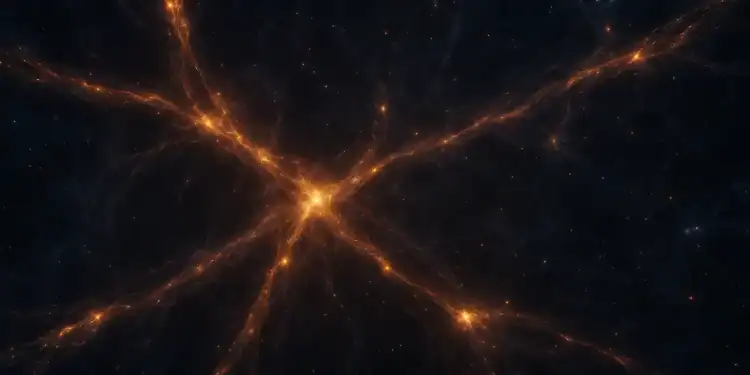
It draws the cosmic web, because on the largest scales, galaxies are arranged into a web of filaments and galaxy clusters, which matches the distribution of dark matter in both simulations and maps of gravitational lensing, and dark matter’s gravity drew normal matter into those structures, giving the universe its large-scale architecture.
The existence of dark matter is supported by a wide range of observations, from the rotation curves of galaxies to the cosmic microwave background, therefore, whether it turns out to be a new particle, a tweak to gravity, or something we haven’t yet imagined, solving this mystery is key to understanding the universe and what it’s really made of.
Artificial intelligence is starting to appear in unexpected places, including houses of worship and spiritual communities. Around the world, religious groups, artists, and technologists are experimenting with ways AI might help people reflect on faith, ethics, and belief.
In 2024, the small chapel at the Protestant church in Lucerne, Switzerland, housed the Deus in Machina installation, where visitors could sit across from an animated “AI Jesus” and pose their questions, and the machine had texts from the Bible and writings from Christian theologians at its disposal to answer their questions. Almost 900 people tried it out over the course of two months, and some found it fascinating, while others were outraged, because, according to the organizers of the project, they did not want to encourage worship, but rather curiosity, and they were exploring what happens when ancient questions of meaning meet a machine. The parish of Poznań in Poland even went a step further and installed an AI guide for questions on Catholicism, which quotes from the Bible and official Church documents, and the priest behind the project said the machine allows people to ask things that they would not dare ask a human priest.
These are small experiments, but they show how AI is already changing how people talk about theology and belief, and a new role for algorithms is emerging, because Artificial intelligence is being used in a few corners of religious life, such as a reader of scripture, where large language models can read religious texts at a scale no human can, comparing translations and tracking patterns across centuries of commentary. Researchers are also testing how well these systems can answer questions about doctrine and ethics, but the results are mixed, because they can synthesize information quickly, but they tend to lose nuance or introduce bias, and some critics say they confuse guidance and automation. AI is also being used as a listener, as some communities are testing AI chat companions for daily reflections, prayers, or emotional support, which offer privacy and 24/7 availability that people can’t always provide, however, some critics argue that they lack the human touch.
As the source of belief itself, a handful of people have argued that AI could be worshipped as a god, because, in 2017, engineer Anthony Levandowski started a short-lived organization called Way of the Future, with the aim of preparing for a world where superintelligent machines have surpassed human intelligence, although the group never attracted more than a handful of followers, but the idea remains in the corners of the net, that intelligence, even artificial, could one day be revered as a divine force.
Moral philosophy and theology
Moreover, religious ethicists are taking up positions in AI labs, arguing that centuries of moral philosophy and theology can inform how we design intelligent systems, and at Oxford, the Collaboration on Theology and Artificial Intelligence is exploring how faith traditions understand concepts of autonomy, responsibility, and conscience, which dovetail with debates over machine decision-making.
When faith meets data, some of these problems will not be solved by better code, because bias is one of the issues, as these models learn from human language, which means they pick up our prejudices and blind spots, and a system trained to talk about religion will repeat not just the sacred texts, but the cultural biases woven through them. Agency is another problem, because a machine can recite scripture, but it cannot pray, doubt, or feel remorse, and it lacks what many people of faith would call the heart of moral experience, as some theologians have put it, AI may talk about God, but it can’t talk to God. Furthermore, there’s the danger of reduction, because boiling faith down to data points and algorithms strips the communal and emotional richness that is essential to most religious traditions, such as rituals, silence, and shared space, which are all fundamental aspects of most religions, and no chatbot can replace them.
The psychological effects are complex, too, because a study published by the University of Chicago’s Booth School of Business found that reading about the capabilities of AI slightly decreased people’s reported belief in God, while another study, published by Duke University, found that thinking about God made people more likely to trust recommendations from AI, and the relationship between divine and machine authority appears to be a two-way street. Consequently, AI isn’t going to replace religion, but it’s going to change how we practice it, and it’s going to change how we interpret it, because, for some, AI is a new kind of mirror, reflecting our hopes, fears, and contradictions in sharp relief, while for others, it’s a threat to the authenticity of our belief. Therefore, the real test is how our communities choose to use it, as a tool for inquiry, or as a stand-in for faith, because the machines can help us organize our texts, translate our scripture, spark us to reflection, but the heart of religion, the experience of wonder, doubt, and relationship, is something only humans can offer, and as the machines grow more capable, those lines are going to matter even more. Ultimately, the future of faith may not depend on whether the machines can find God, but it depends on whether the humans remember why they started searching.
A strange tilt in the outer reaches of the Kuiper Belt has scientists wondering if the solar system is hiding another planet—a potential “Planet Y” that could soon join the family of known worlds.
The Kuiper Belt is an enormous ring of icy bodies that extends from the orbit of Neptune to a distance of close to 30 astronomical units (AU), or approximately 30 times the distance from Earth to the Sun. During recent investigations of this mysterious outer solar system region, a team of Princeton researchers uncovered a strange warpin its plane, which could mean that something is pulling on some of the icy objects beyond Neptune—possibly even an undiscovered planet.
Eying the Kuiper Belt
The Princeton team’s work began with a simple question: “Is the Kuiper Belt flat?” Despite some slight deviations, the planets in our solar system all lie on roughly the same plane, which should be reflected in the belt. However, the Kuiper Belt unexpectedly changes this orientation with a tilt of about 15 degrees. Despite the team’s best efforts, most potential explanations failed to account for the unusual warpage, save for one: the potential existence of an unknown body the researchers dub “Planet Y.”
While there has been no direct observation of this currently theoretical planet, the team believes that current data suggests the planet would be between the sizes of Earth and Mercury, positioned deep in the outer reaches of our solar system.
“This paper is not a discovery of a planet, but it’s certainly the discovery of a puzzle for which a planet is a likely solution,”the authors said when presenting their work in the Monthly Notices of the Royal Astronomical Society: Letters.
A New Addition to the Solar System?
This isn’t the first time a theoretical planet has been suspected to lurk in the Kuiper Belt, which once held a recognized planet until one of its largest residents, Pluto, was reclassified as a dwarf planet in 2006. The region remains mysterious due to difficulties in observing it at such great distances.
Earlier work sought what astronomer Percival Lowell dubbed “Planet X,” an attempt to explain away other anomalies by proposing a mysterious hidden planet. Those anomalies were in the orbits of the planets Neptune and Uranus, and even the 1930 discovery of Pluto didn’t prove to be enough to account for them.
However, the mystery resolved itself in a less dramatic way than expected when Voyager 2 probe data revealed Neptune’s mass to be less than speculated in the 1990s. The recognition of a less massive Neptune seemingly resolved the question of the irregularities without requiring the pull of an unknown body.
Planet Y and the Search for Planet Nine
However, the search for a mysterious planet reignited with a 2016 paper speculating on what was now being called “Planet Nine” instead of “Planet X.” However, this long-suspected outer-solar system planetary body differs considerably from what the recent Princeton University research proposes, as this planet would be much larger and farther out beyond Pluto.
There is a great deal of debate over what an undiscovered planet in our solar system might look like, but the Princeton team says that they are not mutually exclusive. In theory, a pair of undiscovered planets could coexist beyond the range of our present observations.
Pentetrating the mysteries of the Kuiper Belt may soon be on the horizon, though, as the Vera C. Rubin Observatory in Chile is about to launch its decade-long survey, which the researchers believe will likely detect any such planet in the Kuiper Belt within two to three years.
Hence, the Vera C. Rubin Observatory may soon be able to finally resolve the question of whether other worlds might exist in our planetary neighborhood, as well as which planetary category the Princeton team’s suspected “Planet Y” belongs to.
Ryan Whalen covers science and technology for The Debrief. He holds an MA in History and a Master of Library and Information Science with a certificate in Data Science. He can be contacted at ryan@thedebrief.org, and follow him on Twitter @mdntwvlf.
Chinese onderzoekers hebben een plastic ontwikkeld uit bamboe dat twee schijnbaar tegenstrijdige eigenschappen heeft: het materiaal is sterker dan veel kunststoffen die vandaag de dag worden gebruikt, maar breekt volledig af binnen 50 dagen wanneer het in de grond terechtkomt.
Het plastic is gemaakt uit bamboevezels die worden ontleed tot losse moleculen en vervolgens opnieuw worden samengesteld tot een nieuwe vorm van plastic. Het resultaat, volgens het onderzoek waar het materiaal in wordt beschreven, is een kunststof die sterker is dan polyethyleen en ABS. Dat zijn veelgebruikte plastics: polyethyleen zit in verpakkingen en zakjes, ABS wordt gebruikt voor speelgoed en elektronische behuizingen.
Het plastic bereikte bij testen een treksterkte van 110 megapascal. Dat is een maat voor hoeveel kracht nodig is om het materiaal kapot te trekken. Gewoon polyethyleen haalt ongeveer 30 megapascal, het populaire bioplastic PLA zit rond de 50 megapascal. Ook de stijfheid van het bamboemateriaal overtrof die van gangbare plastics fors. Het plastic bleef tijdens tests zijn vorm behouden bij temperaturen van 100 graden Celsius en zelfs bij min 30 graden, zonder te barsten of te vervormen. Deze eigenschappen zouden het materiaal geschikt moeten maken voor allerlei toepassingen, zoals onderdelen voor auto’s en meubelair.
Op 50 dagen volledig weg
Maar de belangrijkste troef is misschien wel dat het materiaal kan oplossen in de natuur, zonder dat er plasticafval achterblijft. Zodra het in contact komt met grond, beginnen schimmels en bacteriën de bamboevezels af te breken. Op 50 dagen tijd zijn ze volledig verdwenen. De onderzoekers testten dit door monsters te begraven, naast stukjes gangbare plastics zoals ABS en polystyreen. Na 50 dagen waren deze laatste nog volledig intact. Logisch, want deze materialen blijven honderden jaren aanwezig in de bodem. Belangrijk om te vermelden is dat het bamboeplastic het beter doet dan bestaande bioplastics, die vaak slechts gedeeltelijk afbreken, of die speciale industriële producten vereisen om af te breken.
Makkelijk te gebruiken
Het materiaal heeft nog een groot voordeel. Het kan net als gewone plastics makkelijk worden vervormd. Zo kan het bijvoorbeeld in mallen gegoten worden, waardoor je in feite elk soort product kan maken. De onderzoekers toonden dit aan door tandwielen, sterren en golfplaten te produceren in het laboratorium. Dit lukte met vroegere materialen uit plantenvezels moeilijk.
Volledig recyclebaar
Dat het plastic in de natuur oplost, is een troef. Natuurlijk blijft het wel handiger om het te recyclen. Volgens de onderzoekers kan dit nieuwe materiaal worden omgesmolten tot nieuw plastic. Gerecycled materiaal heeft nog altijd 90 procent van zijn sterkte, staat te lezen in de studie. Ook de gebruikte oplosmiddelen kunnen worden teruggewonnen en opnieuw worden gebruikt.
Kostenplaatje lijkt mooi
Een economische analyse van de onderzoekers toont aan dat de productie van het bamboeplastic ongeveer 2.300 dollar per ton zou kosten, omgerekend zo’n 2.000 euro. Dat ligt weliswaar hoger dan simpel polyethyleen, maar het vergelijkbaar met of zelfs lager dan andere hoogwaardige plastics. Bamboe groeit bovendien razendsnel. Per hectare kan elk jaar tot 78 ton worden gewonnen. Dat is ruim vier keer zoveel als gewoon hout.
Volgens de onderzoekers is het materiaal ten slotte bestand tegen verschillende oplosmiddelen en zuren en blijft het stabiel wanneer de luchtvochtigheid hoog is. Dat wil zeggen dat materialen die buitenshuis gebruikt worden, hiermee kunnen worden gemaakt.
Niet té optimistisch zijn
Hoewel de resultaten veelbelovend zijn, is dit nog geen reden om te juichen. Tot nu toe is het materiaal enkel in het laboratorium getest, onder gecontroleerde omstandigheden. Of het in de echte wereld even goed presteert, is nog koffiedik kijken. Ook is de economische analyse nog niet onafhankelijk onderzocht en is niet duidelijk of het proces op een betaalbare wijze kan worden opgeschaald. Ten slotte is het materiaal enkel in één soort grond getest, bij een temperatuur van 25 graden. Wat er gebeurt als het in de zee terechtkomt of hoe het zich gedraagt in extreme klimaten zoals woestijnen, blijft nog een onbeantwoorde vraag.
Sumer, or the ‘land of civilized kings’, flourished in Mesopotamia, now modern-day Iraq, around 4500 BC. Sumerians created an advanced civilization with its own system of elaborate language and writing, architecture and arts, astronomy and mathematics. Their religious system was a complex one comprised of hundreds of gods. According to the ancient texts, each Sumeriancity was guarded by its own god; and while humans and gods used to live together, the humans were servants to the gods.
The Tablet of Nippur: Discovering the Ancient Sumerian Texts
As one of the earliest known written creation stories, the Sumerian creation legend holds significant importance offering valuable insights into the religious, political, and cultural aspects of ancient Mesopotamia.
The Sumerian creation myth can be found on a tablet in Nippur, an ancient Mesopotamian city founded in approximately 5000 BC. The creation of Earth (Enuma Elish) according to the Sumerian tablets begins like this:
When in the height heaven was not named, And the earth beneath did not yet bear a name, And the primeval Apsu, who begat them, And chaos, Tiamut, the mother of them both Their waters were mingled together, And no field was formed, no marsh was to be seen; When of the gods none had been called into being, And none bore a name, and no destinies were ordained; Then were created the gods in the midst of heaven, Lahmu and Lahamu were called into being...
The texts mention that at some point the gods mutinied against their labor.
When the gods like men Bore the work and suffered the toll The toil of the gods was great, The work was heavy, the distress was much.
The figures can be identified as gods by their pointed hats with multiple horns. The figure with streams of water and fish flowing from his shoulders is Ea (Sumerian Enki), god of subterranean waters and of wisdom. Behind him stands Usimu, his two-faced vizier (chief minister). At the centre of the scene is the sun-god, Shamash (Sumerian Utu), with rays rising from his shoulders. He is cutting his way through the mountains in order to rise at dawn. To his left is a winged goddess, Ishtar (Sumerian Inanna). The weapons rising from her shoulders symbolise her warlike characteristics.
The Unity of God and Man: How the First Human Came into Existence
Anu, the god of gods, agreed that their labour was too great. His son Enki, or Ea, proposed to create man to bear the labour, and so, with the help of his half-sister Ninki, he did. A god was put to death, and his body and blood was mixed with clay. From that material the first human being was created, in likeness to the gods.
You have slaughtered a god together With his personality I have removed your heavy work I have imposed your toil on man. … In the clay, god and man Shall be bound, To a unity brought together; So that to the end of days The Flesh and the Soul Which in a god have ripened – That soul in a blood-kinship be bound.
This first man was created in Eden, a Sumerian word which means ‘flat terrain’. In the Epic of Gilgamesh, Eden is mentioned as the garden of the gods and is located somewhere in Mesopotamia between the Tigris and Euphrates rivers.
Adapa, the first human being in ancient Sumerian Texts failed to answer the question of “the bread and water of life” Anu.
Initially human beings were unable to reproduce on their own, but were later modified with the help of Enki and Ninki. Thus, Adapa was created as a fully functional and independent human being. This ‘modification’ was done without the approval of Enki’s brother, Enlil, and a conflict between the gods began. Enlil became the adversary of man, and the Sumerian tablet mentions that men served gods and went through much hardship and suffering.
Adapa, with the help of Enki, ascended to Anu where he failed to answer a question about ‘the bread and water of life’.
Opinions vary on the similarities between this creation story and the biblical story of Adam and Eve in Eden. While Adapa was granted great wisdom and knowledge by Enki, he unknowingly rejected the gift of immortality when offered the "bread and water of life. Adam and Eve were placed in the Garden of Eden and instructed not to eat from the Tree of the Knowledge of Good and Evil. However, they were tempted by the serpent and ate the forbidden fruit, leading to their expulsion from paradise.
Overall, the Sumerian creation myth holds significant importance as one of the earliest known written creation stories, offering valuable insights into the religious, political, and cultural aspects of ancient Mesopotamia.
Astronomers have observed stars that are accelerating through space at a shockingly rapid pace. Normally this is assumed to relate to gravitational forces in some way, or to the natural emissions of the stars that might be causing them to move at unusually fast rates.
But one researcher has a different idea about why some stars or star systems seem to be moving more rapidly than normally, presumably dragging their planets along with them as they go. According to Clement Vidal, a philosopher from Vrije University Brussels in Belgium who has an interest in astronomy, these traveling solar systems may have been converted into fast-moving “spaceships” by advanced alien civilizations looking to explore other areas of the Milky Way galaxy.
The Solar System as UFO
Assuming for a moment they developed the technology to actually accomplish such a thing, an alien civilization might have various motivations for propelling their entire solar system through space.
“Two universal evolutionary motivations will make interstellar travel a necessity to any long-lived civilization: survival and reproduction,” Vidal wrote in a non-peer-reviewed paper about his concept published through Cornell University.
Such a civilization might want to escape the vicinity of a nearby supernova that threatens their star system’s existence. Or they might be running out of resources on their home planet, and decide to move to another part of their galaxy where resources might be plentiful. Or they could simply be explorers driven by curiosity or a sense of adventure. They might even be forced to take such action as a response to attacks from other alien civilizations.
Rather than constructing ships that would carry just a few of them through space as astronauts, these aliens could take everyone along for the ride, with their solar system traveling through space on the ultimate voyage of discovery. While the journey to another solar system in a different part of the galaxy would be a long one, since the entire civilization was taking the trip together the passing of the time wouldn’t really be noticed.
Binary star system R Aquarii, located 700 light-years from Earth.
This is an astonishing proposal, but it is based on an idea that has been around for a long time. The idea of creating a “stellar engine” (a star that could be used to power space travel) was first conceived of by science fiction writer Olaf Stapledon in 1937, and the concept has always been considered sound—impractical perhaps, but not totally out of the realm of possibility.
In his theoretical study, Vidal proposes that binary star systems would make the best candidates to be converted into spaceships. The particular types of binary systems he identifies are known as spidar pulsars and redback pulsars, and each consists of a star that is smaller than our sun revolving around a dense neutron star with a powerful gravitational field.
In such systems the neutron stars create an enormous amount of energy. They do this through the combination of their rapid rotation (rapidly spinning stars are known as pulsars) and the gravitational forces they generate, the latter of which causes high-powered ejections of materials from their partner stars.
It is these forces, Vidal says, that could be controlled or redirected by an advanced alien civilization to actually propel an entire star system through space at a high rate of speed. The idea would be to take control of the pattern of ejections by the neutron’s companion star, and to point them in a specific direction. This would essentially turn that star into a massive rocket, propelling the solar system and all of its inhabitants toward the region of space they would like to explore. Making changes of direction in the material ejection patterns would allow the alien engineers to steer their moving solar systems, giving them total control over their final destination.
An alien civilization would have to be enormously advanced to have developed the technology necessary to manipulate stellar forces. But if they were, converting their entire solar system into a spaceship could be feasible and logical, Vidal argues, and in such a circumstance there would be no shortage of reasons why such a civilization might want to put this idea into practice.
Let the Investigation Begin!
It would be easy to dismiss an idea like this as 100-percent speculation, rooted in science fiction more than science reality. But it is an idea that can be investigated, which is really all that Clement Vidal is recommending that astronomers do.
In fact scientists have already looked closely at the anomalous movements of hypervelocity stars, strange objects that were apparently ejected from the center of the Milky Way after passing too close to a black hole. Astronomers have identified and analyzed 16 hypervelocity stars so far, but as Vidal readily admits none of them show movement patterns that would suggest they are under intelligent control.
Vidal is convinced, however, that binary star systems with the neutron star-small companion star arrangement would make the best stellar engines, because of their unique gravitational dynamics. In fact, he has already identified two candidates that match the characteristics of the solar systems he wants investigated. These are a “black widow” pulsar designated PSR J0610-2100, and a "redback" pulsar known as PSR J2043+1711. Both of these binary star systems are accelerating, and as of now there is no good explanation for that.
Illustration of star flying through space pulling planet along with it.
And just last year, Vidal notes, NASA’s Chandra X-ray Observatory spotted five more binary pulsar systems like these in the Omega Centauri globular cluster, a grouping of 10 million stars that are about 17,000 light-years from earth. Vidal’s idea is that the movement patterns of all of these binary star systems should be closely analyzed, to see if they show any signs of speeding up or slowing down, changing direction, moving faster than predicted, and so on.
“I see the highlighted spider stellar engine candidates and predictions as promising starting points and clues that require further attention, observation, modeling, and follow-up,” he wrote.
Should such evidence be observed, it would of course not prove these solar systems were being driven across the galaxy by aliens. But if any of them are, perhaps one day thousands of years in the future they will decide to park in orbit for awhile around our sun and stop in for a visit. Should this ever happen, the result would be the largest and most spectacular mass UFO sighting in world history, followed up by actual alien contact.
Top image: Illustration of binary pair of giant starts, accompanied by multiple planets.
Source: NOIRLab/NSF/AURA/J. da Silva M. ZamaniCC BY-SA 4.0.
Meer van UFO'S of UAP'S, ASTRONOMIE, RUIMTEVAART, ARCHEOLOGIE, OUDHEIDKUNDE, SF-SNUFJES EN ANDERE ESOTERISCHE WETENSCHAPPEN - DE ALLERLAATSTE NIEUWTJES


 Pope Leo's bombshell alien claims as he makes 'life on other planets' statement