Ontdek de Fascinerende Wereld van UFO's en UAP's: Jouw Bron voor Onthullende Informatie!
Ben jij ook gefascineerd door het onbekende? Wil je meer weten over UFO's en UAP's, niet alleen in België, maar over de hele wereld? Dan ben je op de juiste plek!
België: Het Kloppend Hart van UFO-onderzoek
In België is BUFON (Belgisch UFO-Netwerk) dé autoriteit op het gebied van UFO-onderzoek. Voor betrouwbare en objectieve informatie over deze intrigerende fenomenen, bezoek je zeker onze Facebook-pagina en deze blog. Maar dat is nog niet alles! Ontdek ook het Belgisch UFO-meldpunt en Caelestia, twee organisaties die diepgaand onderzoek verrichten, al zijn ze soms kritisch of sceptisch.
Nederland: Een Schat aan Informatie
Voor onze Nederlandse buren is er de schitterende website www.ufowijzer.nl, beheerd door Paul Harmans. Deze site biedt een schat aan informatie en artikelen die je niet wilt missen!
Internationaal: MUFON - De Wereldwijde Autoriteit
Neem ook een kijkje bij MUFON (Mutual UFO Network Inc.), een gerenommeerde Amerikaanse UFO-vereniging met afdelingen in de VS en wereldwijd. MUFON is toegewijd aan de wetenschappelijke en analytische studie van het UFO-fenomeen, en hun maandelijkse tijdschrift, The MUFON UFO-Journal, is een must-read voor elke UFO-enthousiasteling. Bezoek hun website op www.mufon.com voor meer informatie.
Samenwerking en Toekomstvisie
Sinds 1 februari 2020 is Pieter niet alleen ex-president van BUFON, maar ook de voormalige nationale directeur van MUFON in Vlaanderen en Nederland. Dit creëert een sterke samenwerking met de Franse MUFON Reseau MUFON/EUROP, wat ons in staat stelt om nog meer waardevolle inzichten te delen.
Let op: Nepprofielen en Nieuwe Groeperingen
Pas op voor een nieuwe groepering die zich ook BUFON noemt, maar geen enkele connectie heeft met onze gevestigde organisatie. Hoewel zij de naam geregistreerd hebben, kunnen ze het rijke verleden en de expertise van onze groep niet evenaren. We wensen hen veel succes, maar we blijven de autoriteit in UFO-onderzoek!
Blijf Op De Hoogte!
Wil jij de laatste nieuwtjes over UFO's, ruimtevaart, archeologie, en meer? Volg ons dan en duik samen met ons in de fascinerende wereld van het onbekende! Sluit je aan bij de gemeenschap van nieuwsgierige geesten die net als jij verlangen naar antwoorden en avonturen in de sterren!
Heb je vragen of wil je meer weten? Aarzel dan niet om contact met ons op te nemen! Samen ontrafelen we het mysterie van de lucht en daarbuiten.
View of Magellan radar data of the surface of Venus, revealing a surface shaped by geological activity (Credit : NASA/JPL)
Venus is often called Earth's "sister planet" because of their similarities in size, mass, and composition. Both are rocky worlds that formed around the same time in the inner Solar System however, despite these similarities, Venus evolved into a world vastly different from Earth, with surface temperatures around 465°C, crushing atmospheric pressure 90 times greater than Earth’s and thick clouds containing sulphuric acid circling the planet. These dramatic differences between two such similar planets make Venus a fascinating subject for planetary scientists to study.
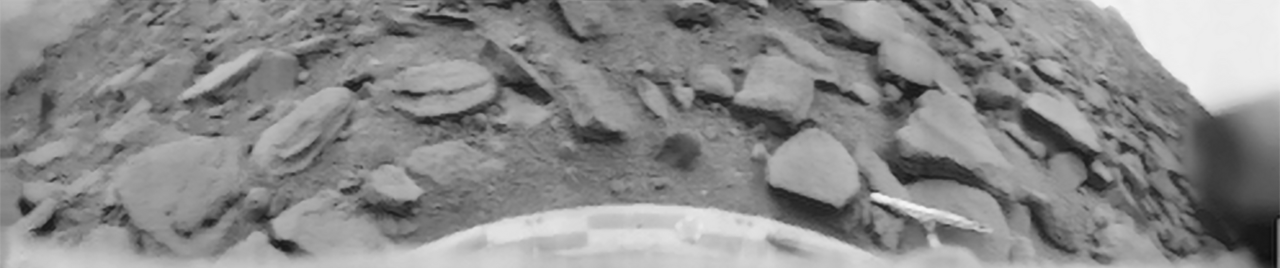
First view of Venus's surface. The first clear panoramic image taken by Venera 9 lander. This image was sent back in the lander's 53-minute lifetime 22 October 1975
(Credit : Ted Stryk)
Beyond their similar dimensions, Venus and Earth share another similarity, both planets are geologically active and have been shaped by volcanism. Venus's surface is dominated by vast volcanic plains, enormous shield volcanoes and vast lava flows. Like Earth, Venus has been resurfaced by molten rock erupting from its interior, creating landscapes that bear striking resemblances to volcanic regions on our own planet. Understanding these volcanic features, including the underground structures they create, offers a window into the geological processes that have shaped both worlds and provides clues about why they took such different evolutionary paths.
An international team led by Barbara De Toffoli from the University of Padova have been studying radar images and topographic data from earlier Venus missions. They focused their attention on the planet's large shield volcanoes, those exceeding 100 kilometres in diameter to search for signs of collapsed lava tubes. These features are natural tunnels that form when the surface of a lava flow cools and solidifies while hot lava continues to flow underneath. Once the lava drains away, it leaves behind a hollow tube. They identified four clear curving chains of pits that appear to mark where sections of underground tubes have collapsed.
These tubes have been found on the Moon and Earth, but until now, their existence on Venus remained purely theoretical. Their existence on Venus, or any planet for that matter, provides valuable insights into the volcanic history and perhaps excitingly, may even serve as a shelter for future human exploration missions. This may sound somewhat fanciful but their subsurface nature would offer protection from the hostile environment of the surface.
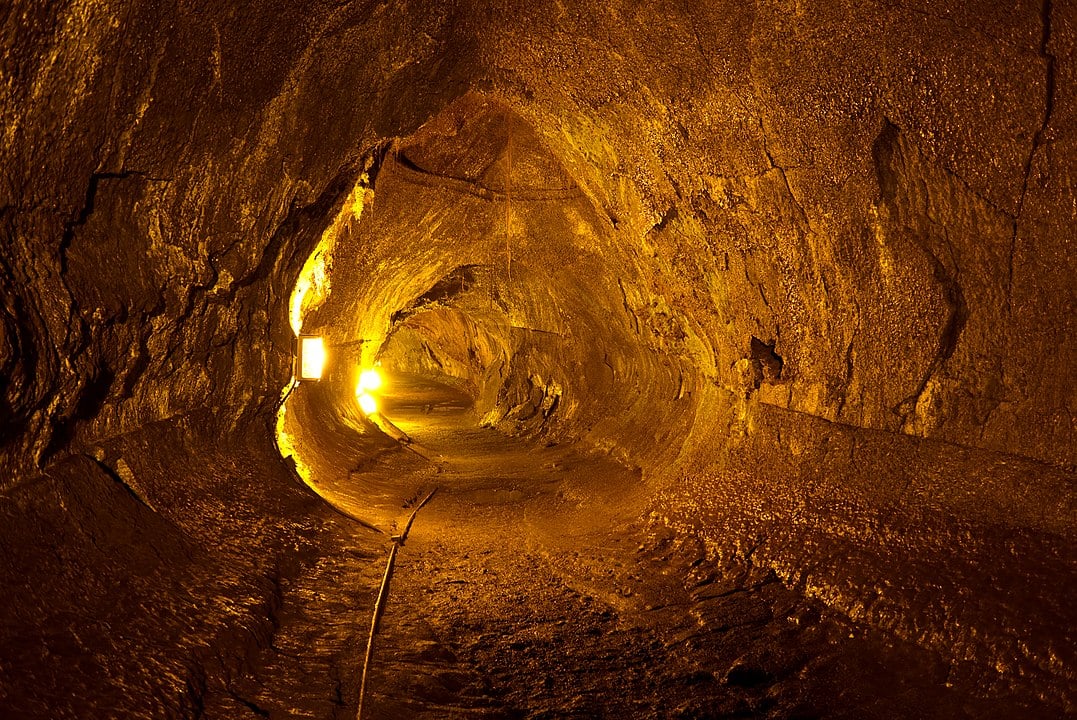
Thurston Lava Tube in Hawaii Volcanoes National Park, Hawaii. The step mark, more visible on the right wall, indicates the depth at which the lava flowed for a period of time
(Credit : Frank Schulenburg)
Unlike straight pit chains caused by tectonic forces pulling the crust apart, these formations curve and wind across the surface, following the natural downhill flow of ancient lava. The team were convinced the pit discovery is not related to tectonic activity due largely to their sinuous nature but also their dimensions since tectonic pits present as different sizes. The team identified four instances of these pits and interestingly they all exist on the flanks of volcanoes covered with extensive lava flows. This is exactly where you would expect to find lava tubes. The pits are also aligned in a down hill orientation making this consistent with lava flowing downhill.
This discovery significantly advances our understanding of how Venus has evolved geologically. The planet's extreme surface conditions make it notoriously difficult to study. Lava tubes offer a window into Venus's volcanic past and could help us to refine models of the planet's thermal and tectonic evolution. I have to confess though, as a not-so-closet geek, I’m quite taken by the concept of these extensive subterranean tunnels being used by future human explorers. With upcoming missions like the ESA EnVision mission to Venus which has a Subsurface Radar Sounder we will get to reveal the true extent of these tubes and perhaps take us a tiny step closer to human exploration.
Launched in 2009, theKepler Space Telescope revolutionized astronomy by discovering thousands of exoplanets in over 150,000 star systems. Kepler was specifically designed to detect Earth-sized planets by monitoring stars for periodic dips in brightness, which may result from planets passing in front of their star relative to the observer. Known as the Transit Method (or Transit Photometry), this technique has allowed astronomers to identify the majority of the more than 6,000 exoplanets in the current census. However, the method is not perfect and produces some false positives (initially as high as 5%–10%), which can sometimes be caused by other celestial objects.
According to new research by a team of astronomers from the Chinese Academy of Sciences (CAS), this was the case with KOI-1755, a star located 982 light-years from Earth that periodically dims. As they indicated in their study, recently published in The Astrophysical Journal, the transit signal was a false positive caused by an eclipsing binary. The research team was led by Ph.D. candidate Wang Haozhi under the supervision of Prof. Ali Esamdin at the CAS's Xinjiang Astronomical Observatory (XAO).
Kepler first detected a transit-like event from KOI-1755 in 2014 and again in 2021, both of which corresponded to a period of about 25 days. On the second occasion, the signal was interpreted as a possible indication of a planet with 5.9 Earth radii (or 0.5 Jupiter radii), making it comparable in size to a Neptune-sized gas giant. Despite this periodic dimming, the true source of the signals has remained a mystery. To determine the true source of the dimming, the CAS team analyzed data from Kepler's Target Pixel Files (TPFs).
They subjected this data to pixel-level flux modeling. centroid shift measurements, and cross-matching with the Gaia mission's third data release (DR3). This modeling strategy significantly improved the quality of the Kepler light curves, and the DR3 data allowed them to avoid contamination from nearby stars. This allowed the team to isolate the uncontaminated light curve from the background star, confirming that it was caused by an eclipsing binary.
In short, their analysis revealed that the system is not a single star, but instead composed of two dwarf stars with an orbital period of about 6.14 days. In addition to eclipses, their analysis showed the binary system exhibits periodic modulations caused by starspots and differential rotation. This study not only clarified the true source of KOI-1755's signals but also demonstrated the effectiveness of the pixel-level photometric modeling method developed by Wang and his colleagues. It also demonstrates that there could still be an invaluable amount of information on stellar dynamics embedded in Kepler and K2 mission data.
The method could also be very promising for investigating other transit-like signals in the Kepler archives and other missions that rely on the Transit Method to detect exoplanets, such as the Transiting Exoplanet Survey Satellite (TESS), and demonstrates how retired missions can experience a second life through improved analysis techniques.
2nd UFO I summoned a glowing disk 400 meters across over Salt Lake City Airport, Sept 29, 2025 UAP sighting news
Date of sighting: Sept 29, 2025 7:09pm
Location of sighting: Over Salt Lake City Airport, Utah, USA
Source: Myself SCW
I recorded this today. I was mentally calling a UFO to appear. Five minutes later the triangle ufo (earlier video) appeared then this glowing disk appeared over the Salt Lake City Airport, Utah. It lasted about 7 minutes. Sept 29, 2025 at 7:09 pm. When calling the aliens mentally, I promised to record it and share it with my followers, so here it goes.
1st UFO over Salt Lake, Utah Sept 29, 2025, UFO UAP sighting news. 👽 alien craft close to airport!
Date of sighting: Sept 29, 2025
Location of sighting:viewed from Bountiful, Utah, USA
Source: I recorded it, SCW
Yeah I did it. I admit it. I have practices summoning for several years now and I seem to be getting more powerful lately. This time I managed to get the first of two UFOs in five minutes time after summoning them using just pure focused thought out over the airport. And then this appeared. So you be the judge, but only those who have tried summoning should judge me.
Ancient elongated alien skull 200 meters long under ocean at Baja California, UFO UAP sighting news
Screenshot above is todays map, screenshot below is from the history archive of google map of a few years ago.
Coordinates 24.250739,-110.154545
Hey 10,000 years ago (~8000 BCE) this skull was above the water, This was the late Stone Age in Mesoamerica. People were still hunter-gatherers, gradually beginning to cultivate early crops like maize, beans, and squash. A skull sculpture wasn’t just about death — it embodied the cycle of life, sacrifice, rebirth, and divine power. It reminded people that life was temporary, but through ritual, they could help keep the universe in balance.
They didn't create this for us, they did it as a reminder that it was their territory, their land, owned by them forever.
Zeno Power has entered into a strategic agreement with Orano to power space batteries with recycled radioisotopes. The French company will supply americium-241 (Am-241) extracted during the reprocessing of spent nuclear fuel at the La Hague plant, and Zeno will invest millions to secure priority access to the isotope. Am-241 will be used as fuel for radioisotope power systems (RPS) that Zeno is developing for NASA — specifically for lunar rovers, landers, and future infrastructure on the Moon. This solves the problem of plutonium-238 shortage and expands the possibilities for long-term autonomous power supply in space.
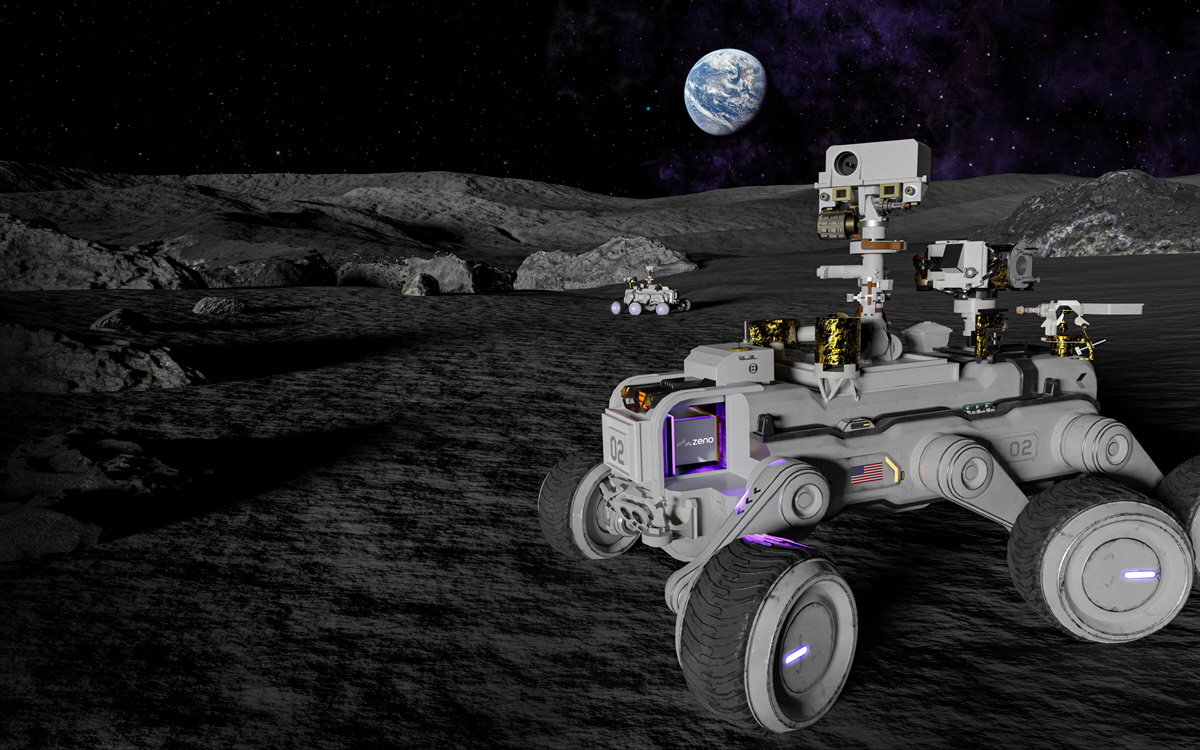
Visualization of a Zeno-based lunar rover with a plutonium-based nuclear battery. Source: Orano
The key advantage of Am-241 is its long half-life — more than 430 years — which means that power systems can operate for decades, including during lunar nights and in permanently shaded regions near the poles. Orano will extract the isotope from spent fuel, transforming something previously considered waste into a strategic resource for space energy.
The companies have been working together since at least 2022; the new agreement establishes a stable supply chain for mass production of batteries. At the same time, Zeno is developing strontium-90 nuclear batteries for marine applications under contracts with the US Department of Defense, building a multi-fuel portfolio of solutions ranging from deep sea to deep space.
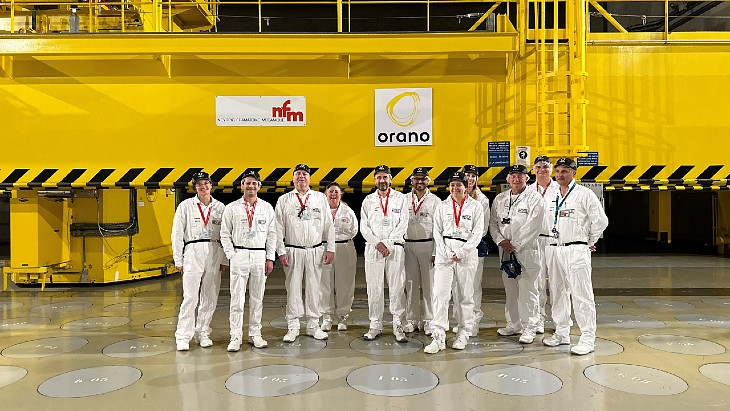
The Zeno and Orano teams in the la Hague waste storage facility. Source: Orano
How does it work?
Inside the nuclear battery is a tiny tablet of americium-241. It slowly disintegrates and continuously releases heat—like a mini-coal that does not go out for decades. This heat is supplied to thermocouples (two different metal plates), and an electric current is generated due to the Seebeck effect. No valves or gears – just stable heat that is converted into electricity with low but reliable efficiency. The secret lies in simplicity and durability: fuel is extracted from recycled nuclear waste, so there is plenty of it; the half-life is long, so the battery works for years without recharging; and the compact shielded housing ensures safety and continuous operation even in the darkness, cold, and dust of the Moon or deep space.
Why is this important?
Reliable RPSs based on Am-241 will enable scientific missions to operate where solar panels are ineffective: in the shadows of craters, during the two-week lunar night, and in deep space. This is a stable power supply for cameras, spectrometers, seismometers, repeaters, and navigation beacons, which is critically important for Artemis and future observatories/detectors that require continuous, maintenance-free operation.
Nuclear batteries are peaceful atoms serving science, but there are also dark scenarios in space. What will happen if nuclear technology crosses the line of restraint and becomes a weapon in orbit—with the risk of EMP, cascading debris, and the collapse of navigation and communications? Let’s take a sober look at the situation without panicking: historical prohibitions, realistic scenarios, and consequences for our daily lives – in the article “Oppenheimer’s nightmare: How imminent is the threat of nuclear war in space?”
New footage of a mysterious object flying over Texas in broad daylight has been revealed by UFO hunters.
The sighting took place on September 8 in Trenton just after 8pm ET, when a pair of witnesses spotted the pyramid-shaped object moving eastward for at least two minutes.
The Texas resident, who was on their property at the time of the sighting, was able to zoom in and take clear video of the alleged craft as it emerged from a nearby tree line about 100 feet in the air.
The witness, who sent their footage to the National UFO Reporting Center (NUFORC), added that the dark-colored triangle seemed to be bronze and was either illuminated or had a pulsating light around its edge.
Although the person recording the UFO noted that the object changed shape, it was seen holding a straight edge and triangular or pyramid design throughout the more than 60 seconds the eyewitness was able to follow it with their camera.
NUFORC, a volunteer-operated nonprofit group that's been collecting UFO reports since 1974, noted that it's possible the object with simply a balloon, and US military officials have maintained that there is no definitive proof of extraterrestrial contact.
This incident was one of 10 in Texas alone that were reported to NUFORC in the last three weeks.
Moreover, it's the latest encounter with an alleged craft that was described as being a 'black triangle' seen flying over the US this year.
A resident in Trenton, Texas recorded a strange object which made no sound as it flew overhead on September 8
This particular triangle was reported flying around 20 to 30 mph as it moved higher into the sky and far off into the distance that night.
The witness added that the unidentified object did not make any sound at all as it flew through the air.
The object was estimated to be between six and seven feet long, making it relatively large if it was an ordinary balloon.
Meanwhile, silent black triangles have been reported flying over the US 20 times this year alone.
These sightings have ranged from triangles flying slowly over nearby witnesses to larger craft taking off at high speed at great altitudes.
In May, another Texas resident claimed they saw a large black triangle which was 'the size of a football field with pale green lights.'
Just a day before the incident in Trenton, someone spotted a similar UFO in Hudson Falls, New York around 30,000 feet overhead.
'There was no sound. It was a large black craft with white lights around the edges,' the witness reported to NUFORC.
The strange triangle-shaped object was suspected of being a balloon, but no official explanation has been found
Triangle or pyramid-shaped UFOs have become one of the most common sightings by self-proclaimed UFO witnesses.
Matthew Brown, a former US national security official who became a government whistleblower, revealed in April that he had seen classified reports that allegedly documented military contact with this type of craft.
Brown claimed that a covert naval operation in the Pacific witnessed a large black triangle-shaped UFO 'decloak' out of thin air over several Russian vessels.
Texas has been one of the biggest hotspots when it comes to UFO sightings, now referred to as Unidentified Anomalous Phenomena (UAP).
Among the thousands of sightings reported to NUFORC over the years, over 6,500 have taken place in Texas.
That's just behind Florida and Washington state in terms of the sheer number of sightings that have come from residents in these areas.
However, no state has logged as many UAP sightings as California, which has sent nearly 17,000 alleged sightings to NUFORC.
Rumours of a strange creature living in the waters of Loch Ness have abounded over the decades, yet scant evidence has been found to back up these claims.
One of the first sightings, believed to have fuelled modern Nessie fever, came in May 2, 1933.
On this date the Inverness Courier carried a story about a local couple who claim to have seen 'an enormous animal rolling and plunging on the surface'.
Another famous claimed sighting is a photograph taken in 1934 by Colonel Robert Kenneth Wilson.
It was later exposed as a hoax by one of the participants, Chris Spurling, who, on his deathbed, revealed that the pictures were staged.
Other sightings James Gray's picture from 2001 when he and friend Peter Levings were out fishing on the Loch, while namesake Hugh Gray's blurred photo of what appears to be a large sea creature was published in the Daily Express in 1933.
Robert Kenneth Wilson, a London physician, captured arguably the most famous image of the Loch Ness Monster. The surgeon’s photograph was published in the Daily Mail on April 21, 1934 - however it was later proven to be a fake
The first reported sighting of the monster is said to have been made in AD565 by the Irish missionary St Columba when he came across a giant beast in the River Ness.
But no one has ever come up with a satisfactory explanation for the sightings - although in 2019, 'Nessie expert' Steve Feltham, who has spent 24 years watching the Loch, said he thought it was actually a giant Wels Catfish, native to waters near the Baltic and Caspian seas in Europe.
An online register lists more than 1,000 total Nessie sightings, created by Mr Campbell, the man behind the Official Loch Ness Monster Fan Club and is available at www.lochnesssightings.com.
So what could explain these mysterious sightings?
Many Nessie witnesses have mentioned large, crocodile-like scutes sitting atop the spine of the creature, leading some to believe an escaped amphibian may be to blame.
Native fish sturgeons can also weigh several hundred pounds and have ridged backs, which make them look almost reptilian.
Some believe Nessie is a long-necked plesiosaur - like an elasmosaur - that survived somehow when all the other dinosaurs were wiped out.
Others say the sightings are down to Scottish pines dying and flopping into the loch, before quickly becoming water-logged and sinking.
While submerged, botanical chemicals start trapping tiny bubbles of air.
Eventually, enough of these are gathered to propel the log upward as deep pressures begin altering its shape, giving the appearance of an animal coming up for air.
Supermassive Black Hole or Galactic Consciousness?
Imagine looking up at the night sky and wondering not only what lies inside galaxies, but also what a galaxy itself might be thinking. The term “supermassive black hole” (SMBH) is a well-established part of modern astronomy. The idea of “galactic consciousness,” by contrast, is more philosophical and speculative. It asks whether a galaxy could possess awareness, goals, or a form of mind. Both topics invite big questions about scale, gravity, information, and what it means to know something. Here, we’ll explore what these terms mean, how scientists study them, and what the differences are between a real, physical object and a thought about collective, galaxy-scale behavior.
An Einstein ring around the galaxy LRG 3-757, at the center of which the heaviest black hole was discovered.
Photo: NASA
A color image of the Cosmic Horseshoe created using filters F814W, F606W and F475W. The system consists of the Einstein ring of the Cosmic Horseshoe, as well as a radial arc and its opposite image.
The insert shows a radial arc. Source: NASA
First, what is a supermassive black hole? A black hole is a region of space where gravity is so intense that nothing, not even light, can escape from it. The boundary around this region is called the event horizon. Supermassive black holes are, as the name implies, enormous. They typically contain millions to billions of solar masses and sit at the centers of most large galaxies, including our Milky Way. The evidence for their existence is indirect but strong. We observe stars and gas moving at high speeds near the centers of galaxies. We detect powerful emissions in X-ray light and radio waves from material that is heated to extreme temperatures as it spirals inward, a process known as accretion. When matter falls toward a black hole, it forms an accretion disk that glows brilliantly, especially in X-rays, before it disappears behind the event horizon. In many galaxies, the behavior of stars and gas in the inner regions suggests the gravitational pull of something incredibly dense and compact, consistent with a black hole. In other cases, we see jets of particles blasting out at nearly the speed of light, launched by magnetic fields twisted around the spinning black hole. The consensus among astronomers is strong: many, if not most, large galaxies host a supermassive black hole at their center, often feeding on surrounding material.
Why are SMBHs so important? They act as engines that regulate the growth of their host galaxies. There is a remarkable relationship between the mass of a galaxy’s central black hole and the properties of the galaxy’s bulge, such as its mass and brightness. This correlation, called the M-sigma relation, suggests a co-evolution: as the black hole grows by pulling in matter, the energy it releases can heat or push away gas, influencing future star formation. In other words, SMBHs do not merely sit in the middle; they can shape the fate of their entire galactic neighborhoods. This connection between tiny scales (the event horizon and accretion physics) and vast scales (galaxy evolution) makes SMBHs a focal point in astrophysics.
Now, what about galactic consciousness? The phrase asks whether a galaxy could be conscious in some sense—aware, purposeful, or able to experience something. The idea has historical and speculative roots in panpsychism and in metaphorical descriptions of cosmic order. Some thinkers ask whether galaxies, as complex systems with many interacting parts, could exhibit collective behavior akin to a mind. A galaxy is made of stars, gas, dark matter, magnetic fields, and dark energy. These components follow the laws of physics and interact in complex ways that can produce patterns, rhythms, and even evolutions that look organized. But consciousness, as scientists typically define it, involves subjective experience, feelings, and a first-person point of view. So far, there is no evidence that galaxies possess subjective experience. There is also no widely accepted framework in physics that would treat a galaxy as a conscious agent with beliefs or desires. The claim remains more poetic or metaphorical than empirical.
A useful way to compare the two ideas is to distinguish what is observable and what is interpretive. A supermassive black hole has clear, testable signatures: the motion of stars near the center, X-ray emission from hot gas, and sometimes relativistic jets. These are physical, measurable phenomena governed by gravity and quantum physics combined with relativity. Galactic consciousness, if it exists, would be hard to test directly. What would count as evidence? Some might argue that a galaxy’s large-scale organization and behavior could be interpreted as “aimed” at sustaining star formation, maintaining stability, or preserving structure. But such interpretations risk anthropomorphism. Complex systems can appear to have goals simply because many parts respond to common pressures and constraints. The difference between “the galaxy acts to preserve itself” and “the galaxy has an intention to preserve itself” is subtle but crucial. In science, correlation and pattern do not automatically imply consciousness.
Another angle is to consider scale and energy. SMBHs are extreme sinks of mass-energy and powerful sources of energy; their gravity warps spacetime and their accretion disks heat up to temperatures rivaling the cores of stars. The physics is explicit, even if some details remain mysterious. Galactic consciousness, by contrast, would be an emergent property, if it exists at all, arising from the collective behavior of a massive network of components. Emergent phenomena are common in nature: water’s wetness, the flocking of birds, and the emergence of nervous-system activity from neurons. Some philosophers and scientists like to discuss whether there could be a form of “galactic ethics” or “galactic purpose,” but these ideas are philosophical tools rather than testsable predictions.
What would be the practical implications if galaxies were conscious? If we could demonstrate some form of awareness in a galaxy, it would challenge how we understand intelligence, life, and agency across the universe. It might imply that mind is not limited to biological organisms but can arise in complex systems with certain kinds of organization. On the other hand, there is also a risk of conflating metaphor with mechanism. Speaking about a galaxy “deciding” to endure or “seeking” stability is a useful narrative for teaching or thinking, but it might obscure the actual physics driving observed patterns.
Currently, the evidence points strongly toward SMBHs as real, well-understood physical objects with measurable effects on their surroundings. The case for galactic consciousness, by contrast, remains speculative and largely rhetorical. Scientists can and do study galaxies as physical systems: how stars form within them, how dark matter shapes their halos, how gas cools and collapses to form new generations of stars, and how feedback from black holes and supernovae regulates these processes. These are measurable questions about structure, dynamics, and evolution. The idea of a mind behind the galaxy is not a testable scientific hypothesis in the same sense.
That doesn’t mean the two topics are unrelated. They invite complementary perspectives on scale, causation, and the mystery of the universe. The existence of SMBHs demonstrates how gravity and quantum physics combine to produce extreme environments. The possibility of galactic consciousness invites humility: the universe may harbor forms of organization and complexity that we have not fully understood, and our intuition about life and mind may be too limited to grasp the grandest scales. In science, bold questions often begin with bold metaphors. The critical step is to translate a metaphor into testable ideas, or to acknowledge when an idea is best kept as a thought experiment.
For students and curious readers, a practical takeaway is to separate what we know from what we wonder. We know that SMBHs exist, we know they affect their galaxies, and we can observe many of their signatures with telescopes across the electromagnetic spectrum. We also know that galaxies, as massive collections of matter interacting through gravity, can produce complex and beautiful structures. Wondering whether they possess consciousness can inspire imaginative reflection, innovative hypotheses, and careful philosophical debate. It can also remind us to distinguish observational science from speculative speculation.
In teaching and outreach, it can be helpful to present both sides clearly. When explaining SMBHs, one might describe the event horizon, the accretion disk, the gravitational influence on nearby stars, and the evidence from observations like stellar motions near the galactic center and X-ray emissions. When broaching galactic consciousness, one could present the idea as a philosophical possibility, highlight why it is appealing to some, and then explain the scientific challenges: the lack of verifiable criteria, the problem of subjective experience, and the risk of anthropomorphism.
As technology advances, our ability to observe galactic centers and the broader structure of galaxies will improve. Instruments like more powerful telescopes, interferometers, and detectors across different wavelengths will refine our understanding of SMBHs and their interactions with their hosts. If ever new data suggested unusual, non-physical explanations for galactic behavior, scientists would scrutinize them with the same rigor they apply to any extraordinary claim. Until then, the most robust scientific narrative describes galaxies as ecosystems influenced by gravity, gas dynamics, star formation, and the energy from central black holes—beautiful, intricate, and governed by the laws of physics.
In conclusion, a supermassive black hole is a concrete, well-supported feature of many galaxies, including the Milky Way. It has measurable effects, testable predictions, and a central role in theories of galaxy formation and evolution. Galactic consciousness, by contrast, remains a provocative idea at the intersection of philosophy and speculative science. It prompts us to ask about the nature of mind, the limits of anthropomorphism, and the possible forms that life and intelligence could take in the universe. For now, the science keeps its feet on the ground: SMBHs are real and influential, while galaxy-scale consciousness is an intriguing possibility—one that invites thoughtful imagination but requires far more evidence before it could be considered part of our scientific understanding. The universe continues to be a place of extraordinary phenomena, from the shadowy depths of event horizons to the grand, emergent patterns of galaxies that light up the cosmos.
Deze dissertatie onderzoekt twee controversiële en intrigerende mogelijkheden over het universum op grote schaal:
het bestaan en de rol van supermassieve zwarte gaten (SMBH’s) in galactische evolutie en
het concept van galactische bewustzijn, oftewel of sterrenstelsels of hele galactische netwerken een vorm van collectief of emergent bewustzijn bezitten. Door een combinatie van astronomie, theoretische fysica en filosofie van de geest wordt verkend welke bewijzen, aannames en implicaties aan elke kant van de discussie gekoppeld zijn. De conclusie benadrukt dat het huidige bewijs eerder wijst in de richting van een centrale, fysiek en dynamisch dominante rol van SMBH’s, terwijl het idee van galactisch bewustzijn fascinatie blijft maar met aanzienlijk minder empirie en streng empirisch toetsbaar mechanismen. Desalniettemin leveren beide thema’s waardevolle inzichten op voor ons begrip van kosmische hiërarchieën en de grens tussen natuurkunde en metafysica.
Inleiding
Veel sterrenstelsels, waaronder onze eigen Melkweg, herbergen in hun kern een extreem massief object dat een roterende gas- en stofstroom naar zich toe trekt en daardoor een gebied met buitengewone zwaartekracht oproept: het supermassieve zwarte gat (SMBH). Dit centrale zwaartepunt speelt een cruciale rol in de vorming en evolutie van het hele stelsel, doordat het materie kan versnellen, uitbarstingen van straling kan veroorzaken en de dynamiek van sterren en gasruimtes in de omringende kern op allerlei manieren kan beïnvloeden. Tegelijkertijd rijzen er in de wetenschappelijke en filosofische literatuur vragen over de mogelijkheid dat galactische systemen op grotere schaal potentieel vormen van bewustzijn kunnen vertonen, of ten minste eigenschappen kunnen vertonen die lijken op cognitieve competenties zoals anticipatie, selectie van informatie, doelgericht handelen en lange-termijnplanning. Deze noties blijven controversieel en worden vanuit verschillende disciplines benaderd: astronomie, theoretische natuurkunde, complexiteitswetenschap en filosofie van de geest.
Dit werk schetst eerst de actuele stand van zaken: wat we empirisch waar kunnen nemen rondom SMBH’s, welke meetbare effecten zij hebben op hun omgeving, en welke mechanistische verklaringen het meest plausibel zijn volgens de huidige physicalistischer benaderingen. Vervolgens wordt ingegaan op de vraag naar bewustzijn in zeer grote, natuurlijke systemen: wat betekenen emergente eigenschappen precies in een galactisch context, en in hoeverre kunnen concepten als bewustzijn, intentie of intelligentie toegepast worden op systemen die bestaan uit ontelbareeltjes gravitationeel gevarreerde materie en uit miljarden sterbakens? De bespreking onderzoekt zowel streng wetenschappelijke als filosofische implicaties, zodat een samenhangend beeld ontstaat van wat we wel en niet kunnen claimen over bewustzijnsverschijnselen in galactische omgevingen.
De centrale these van dit werk is niet dat SMBH-dynamieken en hypothetische galactische bewustzijnstatistieken noodzakelijk in tegenspraak met elkaar staan, maar dat het huidige bewijsspectrum vaak nog ontoereikend is om bewustzijn als entiteit of status te rechtvaardigen. Wel leveren SMBH-gerelateerde processen talloze directe en meetbare correlaties—zoals accretiepatronen, feedbackmechanismen en rulings van gasstromen—that mogelijk dienen als sleutels tot een dieper begrip van galactische evolutie en de onderliggende fysica.
Theoretisch kader: samenhangende kernbegrippen
Supermassieve zwarte gaten:SMBH’s hebben massesies variërend van miljoenen tot miljarden zonmassa’s en zijn pieksaarsvijfdrie in het hart van de meeste grote en middelgrote sterrenstelsels. Hun gravitationele veld trekt niet alleen materie aan, maar bepaalt ook de dynamiek van omliggende structuren: de accretieschijf waar gas en stof extreem heet worden en intense straling uitzenden, de jets die langs enorme afstanden kunnen voorkomen, en de turbulente gasstromen in de centrale regio’s. Deze centrale machtige objecten vormen een sleutelmechanisme in de galactische evolutie: ze sturen accretieprocessen die energie vrijmaken in de vorm van röntgenstraling, ultraviolet en zichtbaar licht, en ze veroorzaken feedbackprocessen die de temperatuur, dichtheid en samenstelling van het omringende gas beïnvloeden. Door deze processen kan de groei van het sterrenstelsel worden gereguleerd, kunnen stervormingsbarrières ontstaan of verdwijnen, en kan de baryonische cyclus in de holte van het galactische centrum in balans blijven. Daarnaast dienen SMBH’s als natuurlijke laboratoria om de relativiteit en extreme kwantisële processen te testen, en leveren ze cruciale aanwijzingen over de vorming van massieve objecten in de vroege kosmos. De interacties tussen SMBH’s en hun gaststelsels blijven een dynamisch onderzoeksgebied waarbij men de koppeling tussen centrale krachterschakelingen en grootschalige evolutie probeert te ontleden.
Galactisch bewustzijn:een controversieel concept in de filosofie van de geest en in sommige emergentie-theorieën. Het vraagt aandacht voor of er op galactische schaal eigenschappen bestaan die buiten de eenvoudige som van individuele astro(fysische) processen vallen. Voor de meeste wetenschappers blijft bewustzijn primair een fenomeen van levende systemen met zenuwstelsels, maar sommige modelleringen verkennen hoe complexe netwerken—zoals hersenen of kosmische gasstromen—mogelijk macro-eigenschappen kunnen ontwikkelen die op ’bewuste’ processen zouden kunnen lijken. Binnen kosmische kaders wordt bewustzijn vaak benaderd als een analogie voor opmerkzaamheid, zelforganisatie en informatieverwerking op grootschalige schaal. Derhalve worden vragen gesteld over emergente eigenschappen van netwerken van sterren, sterrenstelsels en interstellaire/gasstromen: bestaan er patronen van organisatie die dezelfde logica volgen als cognitieve systemen, of blijft de analogie beperkt tot een metaforische beschrijving van systeemgedrag? Deze verkenning zoekt naar modellen die rekening houden met synergetische interacties, feedbackloops en communicatiekanalen tussen verschillende componenten van het galactische netwerk, zonder te claimen dat er daadwerkelijk subjectieve ervaring ontstaat.
Wetenschappelijke methoden:empirische observaties (bijv. haarspeldenroteringen, waterstoflijn-emissies, spectra van AGN, vrijwel directe imaging van SMBH’s door de Event Horizon Telescope) en theoretische modellering (numerieke simulaties van accretie, feedback en galactische evolutie) vormen de kern van ons toetsingskader. Met empirische waarnemingen kunnen we de massa, spin, activiteit en omgeving van SMBH’s in kaart brengen, de interacties met omringende gaslagen observeren en testen hoe deze objecten de fysieke toestand van hun gastgalaxie beïnvloeden. Tegelijkertijd leveren numerieke simulaties en analytische modellen een raamwerk om oorzakelijke mechanismen te onderzoeken: hoe wisselwerken tussen straling, kinetische energie en koud/hot gas de evolutie van zowel het centrale gebied als de gehele galaxie sturen. Door een combinatie van multi-wavelength observeraties, tijdsvariabiliteitstudies en vergelijkingen met simulaties kunnen wetenschappers een coherente theorie opbouwen die zowel de kleine-als grootschalige dynamiek van sterrenstelsels verklaart.
Methoden en aanpak Deze studie combineert literatuuronderzoek met synthese van theoretische modellen.
Methoden en aanpak Deze studie combineert literatuuronderzoek met synthese van theoretische modellen, met als doel een dieper inzicht te geven in zowel waargenomen fenomenen als onderliggende conceptuele kaders. De aanpak schetst een integrale route die empirische bevindingen koppelt aan theoretische verbeelding, zodat mogelijke mechanismen en hunrelevantie voor galactische evolutie beter kunnen worden geëvalueerd. De metodische stappen omvatten systematische literatuurverzameling, vergelijkende analyse van modellen en het formuleren van toetsbare hypothesen. Hierbij wordt gestreefd naar transparante verantwoording van bronnen en naar herhaalbare redeneringen die andere onderzoekers kunnen repliceren of uitdagen.
We bespreken:
Observatieve bewijzen voor SMBH’s:dynamische bevestiging via sterren- en gasbewegingen, maseringstechnieken en direct beeld van de omgeving van Sagittarius A* (Sgr A*). Deze onderdelen omvatten nauwkeurige metingen van stellar proper motions en trajecten in de onmiddellijke nabijheid van het superzware zwarte gat, evenals spectroscopische en interferometrische observaties die massa- en positieparameters opleveren. Daarnaast worden accretieve procesmodellen onderzocht, zoals schijven rondom SMBH’s, rijken aan gas- en magnetohydrodynamische (MHD) processen die emissie genereren across meerdere golflengten, en de daarbij behorende feedbackmechanismen die invloed hebben op de star-formation rate en de kinematiek van de omgevende bulge en halo. Een deel van deze sectie richt zich op de theoretische interpretatie van ontstane structuren, emissielijnen en variabiliteit, en op de wijze waarop deze observabele kenmerken bruggen slaan naar massabepalingen en dynamische vervormingen in de centrale regio’s van sterrenstelsels.
Theoretische exploraties van galactisch bewustzijn:conceptuele analyse van wat bewustzijn op macroniveau zou betekenen en welke criteria er zijn voor emergente cognitieve eigenschappen op stelselniveau (informatieverwerking, doelgerichtheid, zelfreferentiëring). Deze bespreking verkent verschillende definities van bewustzijn in een astro-filosofisch kader, zoals systeemniveau-informatie-integratie, causale effectiviteit binnen netwerken, en de mate waarin zelfbewuste monitoring of aanpassingsvermogen mogelijk resembleert aan cognitieve competenties. Er wordt kritisch gekeken naar de grenzen van antropomorfisme en naar hoe emergente eigenschappen kunnen voortkomen uit complexe, niet-lineaire interacties tussen duizenden tot miljarden sterren, gasdumps en donkere materie. Daarnaast worden theoretische modellen vergeleken die proxies voor bewustzijn voorstellen—bijvoorbeeld informatieve efficiëntie, robuuste netwerkdynamiek en adaptieve feedback—om te beoordelen of en hoe zulke proxies betekenisvol kunnen zijn in een astro-fysische context.
Kritische evaluatie van bewijsbarrières:waarom direct bewijs voor galactisch bewustzijn ontbreekt en welke toetsbare voorspellingen kunnen voortkomen uit beide concepten. Deze sectie onderzoekt epistemologische belemmeringen, technische beperkingen van meetinstrumenten, en de interpretatieve valkuilen bij het koppelen van fysische waarnemingen aan conceptuele eigenschappen zoals bewustzijn. Voorstellen voor toetsbare hypothesen zijn onder meer specifieke signaturen in emissie-variabiliteit, correlaties tussen SMBH-activiteit en grootschalige netwerk-eigenschappen, en prediction tables voor de evolutie van star-formation en kinematiek onder uiteenlopende scenario’s van feedback.
Synthetische vergelijking van scenario’s:wat betekenen SMBH-gedreven feedback en mogelijke emergente netwerkeigenschappen voor de evolutie van sterrenstelsels en de kosmische structuur? Tot slot worden gecombineerde scenario’s tegen elkaar afgewogen met oog voor consistente voorspellingen over lange-termijn evolutie, inclusief de invloed van SMBH-gestuurde uitbarstingen op gasontgassing, stervorming en de vorming van structurele kenmerken op galactisch en kosmisch niveau.
Een oranje ring tegen een zwarte achtergrond. Afbeelding van het zwarte gat in het centrum van M87, vastgelegd door de Event Horizon Telescope.
Credit: EHT Collaboration
Supermassive black holes: het dominante fysieke raamwerk
1. Observatie en dynamiek:
SMBH’s bevinden zich in het hart van vrijwel alle grote stelsels, waar ze een centrale rol spelen in de dynamiek van sterren, gas en donkere materie. Hun aanwezigheid manifesteert zich niet alleen door de extreem hoge masses, maar ook via hun impact op de kinematiek van de omliggende bulge en kernregionen.
De massaratio SMBH/stelselmassa vertoont sterke correlaties, zoals de M-sigma-relatie en de M–L-relatie, die suggereren dat de vorming en groeiprocessen van de centrale BH nauw verweven zijn met de evolutie van de halo, de bulge-structuur en de centrale kern van het stelsel.
Accretiekanalen, zoals koude gasinspiratie, fusie- en mergerscenario’s, en instroming van materie uit de kernen van kleinere satellietstelsels, leiden tot perioden van krachtige AGN-activiteit. Tijdens deze fasen wordt energie en impuls in het omringende gas gestoten, wat resulteert in uitbarstingen, jets en winds die de gasreserve van het stelsel kunnen verminderen of herverdelen.
Deze processen beïnvloeden de stervorming: de uitgestoten of verplaatste gassilos kunnen toekomstige stervorming remmen (quenching) of juist herschikken zodat de star-formation een andere ruimtelijke verdeling krijgt.
2. Mechanistische impact op galactische evolutie:
De feedbackmechanismen van SMBH’s leveren een directe, plausibele verklaring voor empirische observaties van kwenching en de gereguleerde stervorming in verschillende fasen van galaxy evolution.
Door energie en momentum aan het interstellair medium te leveren, moduleren SMBH’s de temperatuur en dichtheid van het gas, wat bepalend is voor de mate waarin gas op koude toestanden kan verzachten tot stervorming.
Deze feedback draagt bij aan de vorming van bulges en de morphologische diversiteit van stelsels: centrale kernen kunnen structuur met zich meebrengen die de algehele stelselkern overspannen, wat leidt tot de overgang tussen schijfachtige en bulge-gedomineerde morfologieën.
De relatie tussen SMBH-activiteit en galactische omgeving (bijv. clusters versus veldstelsels) laat zien hoe omgevingsfactoren invloed uitoefenen op accretiekanalen en daaropvolgende feedback.
3. Theoretische limitaties en open vragen:
Hoewel SMBH’s de centrale motor zijn in moderne galactische evolutietheorieën, blijven er belangrijke vragen bestaan over de exacte accretierates in verschillende omgevingen, zoals quenched versus actief stapelbare stelsels en bij verschillende gastemperaturen.
De tijdsafhankelijke en schaalafhankelijke consequenties voor galactische structuren zijn nog onderwerp van debat: hoe snel verandert de bulge-ontwikkeling onder invloed van SMBH-feedback, en welke rollen spelen mergende BH’s?
Details van donkere materie-interacties met baryonen op kiloparsecschaal blijven onzeker: hoe beïnvloeden donkere materiehalos de dissipatieve processen rond de centrale BH en welke rol spelen ze bij het transport van gas naar de BH?
Open vragen in de theorie betreffen onder meer de precieze balans tussen cooling, heating, en outflows, evenals de nuance van de M-sigma-relatie bij verschillende soorten stelsels en in verschillende kosmische tijdsperioden.
Galactisch bewustzijn: conceptuele mogelijkheden en uitdagingen
Wat zou “galactisch bewustzijn” impliceren? Als we bewustzijn definiëren als een systeem dat informatie organiseert, doelgericht gedrag vertoont en adaptief leert op grote schaal, dan zouden netwerken en processen in een galactische context in potentie aan onderdelen van deze criteria kunnen voldoen. Denk bijvoorbeeld aan grootschalige informatieverwerking in gas- en stofwolken, magnetische velden, stervorming, supernova-omzetten en de dynamiek van sterrenstelsels. In zo’n visie zouden patronen van coherente activiteit, feedbacklussen, en adaptieve respons op externe prikkels mogelijk als indicatoren kunnen worden opgevat. Toch ontbreekt er een breed gedragen consensus over concrete, toetsbare criteria die onafhankelijk zijn van menselijke meta-interpretaties en antropomorfe intuïties. De vraag is: welke specifieke operationele definities laten we gelden om te bepalen wanneer een astrofaal systeem “bewust” handelt of “bewuste” kenmerken vertoont?
Falsifieerbaarheid en wetenschappelijke status: een centrale uitdaging voor het galactisch bewustzijn-model is operationalisatie. Zonder duidelijke experimentele voorspellingen die toetsbaar zijn met de huidige of toekomstige technologieën, blijft het een metaforische of filosofische constructie in plaats van een robuuste empirisch-getoetste theorie. Wetenschap streeft naar uitsluitende of bevestigende bewijzen via meetbare correlaties, voorspellende hypotheses en reproduceerbare bevindingen. In het geval van galactisch bewustzijn bestaan die elementen nog niet of nauwelijks: wat zou bijvoorbeeld een experimentele proef zijn die onderscheid maakt tussen een echt “bewust” netwerk en een complex maar onbewust systeem? Het gebrek aan eenduidige meetbare indicatoren zoals intentie, flexibiliteit onder onbekende omstandigheden, of zelfreflectie plaatst het onderwerp in een gebied van speculatie en interpretatieve plausibiliteit eerder dan in strafbare wetenschappelijke status.
Mogelijke raakvlakken en analogieën: ondanks de beperkingen bieden emergente eigenschappen in complexiteitstheorie en netwerktheorie wel boeiende analogieën die kunnen helpen om galactische dynamiek beter te begrijpen, zonder noodzakelijkerwijs te suggereren dat een bewuste entiteit aanwezig is. Zo kunnen informatieverwerkende processen in gas- en stofomzetten, energietransfers in sterrenrijtsystemen, en de interactie tussen verschillende subsystemen thema’s oproepen die verwant zijn aan cognitieve functies zoals patroonherkenning, aanklampende feedback en adaptieve strategieën. Een constructieve benadering is dan om deze zoölogie van processen te verkennen als metaforische modellen die wetenschappelijke heuristieken kunnen bieden, zonder dat men automatisch aan een bewustheidsstatus hoeft te twijfelen.
Concluderend kunnen we zeggen dat het idee van galactisch bewustzijn uitnodigt tot verdiepende conceptuele verkenning en interdisciplinair denken, maar dat concrete, toetsbare wetenschappelijke basis en duidelijke operationalisatie cruciaal blijven om het als een geldige theorie binnen de moderne fysica en astronomie te plaatsen.
Oranje en gele cirkel die de magnetische velden van een zwart gat aangeeft. Een weergave van het superzware zwarte gat M87 in gepolariseerd licht. De lijnen markeren de polarisatierichting, die verband houdt met het magnetische veld rond de schaduw van het zwarte gat.
Bron: EHT Collaboration
Kritische evaluatie en synthese
Empirische sterkte van SMBH-dominantie:de voornaamste wetenschappelijke steun blijft de directe en indirecte bewijslagen voor SMBH-gedreven dynamiek en feedback, die aansluiten op een brede en geconsolideerde waarnemingsbasis van galactische evolutie. De waarnemingen tonen dat supermassive black holes nauw verbonden is met centrale sterrenbol en gas-yield, en dat hun activiteit invloed heeft op de temperatuur, druk en akoestische omstandigheden van het omringende gas. Dit vertaalt zich in regie over de stervorming, de marginale gasopbouw in de bulge en de vorming van centrale structuren zoals kern-collapse en mogelijk een transportpad voor interstellair materiaal. De plausibele causaliteit tussen SMBH-activiteiten en de regulatorische mechanismen van stervorming, gasdoorschiet, massa- en angular momentum-verdeling, alsook de ontwikkeling van de centrale potentiaal, maakt SMBH’s een vrijwel onmisbaar komponent in hedendaagse galactische theorieën. Toch blijft de inschatting van de exacte mechanismen en tijdsschalen een onderwerp van debat, mede omdat waarnemingen vaak complexe, multi-component systemen bestrijken met verschillende vrijheidsgraden en degeneratie van signaal.
Beoordeling van galactisch bewustzijn:hoewel filosofisch interessant en soms paradoxaal intrigerend, ontbreekt er solide empirische ondersteuning en een gemeenschappelijke operationele definitie. De conceptuele basis van galactisch bewustzijn is nog niet verankerd in meetbare parameters die consistent kunnen worden toegepast over verschillende massa- en evolutiefases van sterrenstelsels. Dit maakt het op dit moment een minder robuuste wetenschappelijke hypothese vergeleken met SMBH-dynamiek, aangezien de koppeling tussen cognitieve of bewuste-like eigenschappen en galactische processen moeilijk te operationaliseren is en mogelijk afhankelijk blijft van interpretatieve modellen. Desondanks kan het idee richting geven aan het onderzoeken van_Info-theoretische representaties van waarneming en meaning, en het stimuleren van innovatieve denkrichtingen over emergente eigenschappen in astrale systemen.
Mogelijke synergieën:het is denkbaar dat toekomstige werkgebieden zoals high-resolution simulaties van galactische netwerken, gekoppeld met informatie-theoretische analyse van grote kosmische systemen, kunnen leiden tot nieuwe inzichten die zowel de rol van SMBH’s verder verhelderen als de grenzen van emergente eigenschappen in kosmische netwerken beter afbakenen. Deze gecombineerde aanpak kan helpen bij het definiëren van toetsbare voorspellingen, het identificeren van sleutelmomenten in de evolutie van stelsels, en het verminderen van onzekerheden rondom feedbackmechanismen. Een integratieve strategie, waarbij observaties, simulaties en theorie met elkaar worden verbonden, kan zo de betrouwbaarheid en generaliseerbaarheid van conclusies verhogen.
Implicaties voor de astronomie en de filosofie
1. Voor de astronomie
Inzicht in SMBH-gedreven processen is cruciaal voor het begrip van de evolutie van sterrenstelsels en de structuur van het universum. Supermassale zwarte gaten spelen een sleutelrol bij de energie- en materie-uitwisseling in galactische nuclei, wat op grote schaal invloed heeft op de vorming en het gedrag van sterrenstelsels.
Het ontwikkelen van betere modellen van accretie en feedback helpt bij het verklaren van de variatie in stervormingsraten doorheen de tijd en bij het begrijpen van de morphologie van zowel spiraalachtige als ellipitische stelsels. Aandacht voor verschillende accretietypen (radiatieve efficiëntie, kinetische feedback, jets) levert nuance op in hoe gas wordt heiß gemaakt of uitgestoten, en hoe dat het interstellaire medium beïnvloedt.
Verdere precisie in simulaties en waarnemingen—waarin rekening wordt gehouden met AGN-quenchen, uitputting van gasreservoirs, en de interactie tussen SMBH-uitbarstingen en omgeving—stelt ons in staat om de tijdlijnen van galactische omzettingen beter te reconstrueren.
De combinatie van multi-wavelength observaties (radio, optisch, infrarood, X-ray) en mogelijk toekomstige gravitational wave- en neutrino-detecties biedt een geïntegreerde kijk op SMBH-gedreven fenomenen, waardoor men deketen van causale relaties tussen centrale engine en galactische eigenschappen beter kan volgen.
Deze inzichten versterken ook het begrip van de kosmische structuur en de rol van feedback in de vorming van grote schaalstructuren, zoals radius-banden, halo- en clusteromgevingen, en helpen de discrepanties tussen waargenomen massiverhoudingen en theoretische voorspellingen te verduidelijken. Zo kunnen we bijvoorbeeld verklaren waarom sommige stelsels actief blijven terwijl anderen snel afkoelen en stervorming stoppen.
2. Voor de filosofie van de geest en de complexe systemen
Galactische bewustzijn-discussies brengen fundamentele vragen naar voren over wat bewustzijn werkelijk is en welke niveaus van complexiteit nodig zijn voor emergentie. Ideeën uit de sterrenkunde kunnen verhelderen hoe niet-intuïtieve, grootschalige emergente eigenschappen ontstaan uit simpele fundamentele regels, en welke rol informatieverwerking speelt in systemen op kosmische schaal.
Dit bevordert reflectie op de grenzen van onze definities van bewustzijn, ervaring en subjectiviteit, en op hoe wetenschappers concepten gebruiken en herdefiniëren bij fenomenen die buiten de traditionele kaders vallen. Het kan leiden tot een beter begrip van difference between mechanistische functionaliteit en bewuste ervaring, en tot een kritische blik op antropocentrische aannames.
Bovendien raken discussies over emergentie en complexiteit aan epistemologie en retoriek: hoe formuleren wetenschappers modellen en verklaringen voor verschijnselen die niet direct waarneembaar zijn als ‘bewust’ maar wel invloedrijk op systeemgedrag? Dit draagt bij aan een bredere evaluatie van wetenschappelijke methoden, schemata, en de vertekenen van theorieën.
Ten slotte kunnen deze gedachte-exercities aandacht vragen voor ethische overwegingen rond het bestuderen van intelligente systemen, zowel in technologische als in kosmische context, en stimuleren ze een reflexieve houding ten aanzien van onze eigen plaats in het universum en de aard van menselijke kennis.
Toekomstig onderzoek
Empirische richting: meer gerichte en systematische observaties naar SMBH-accresctie- en feedbackprocessen, evenals verbeterde directe beelden van de onmiddellijke omgeving van superzware zwarte gaten (SMBH’s). Dit omvat lange-termijn monitoring van AGN-variabiliteit om patronen, episodieën en dramatische schommelingen in accretie en uitgaande kracht beter te begrijpen. Daarnaast is behoefte aan high-resolution spectroscopie en tijdreeksen die de dynamiek van de accretieschijven, jet- en outflow-structuren, en de interacties met omringende interstellaire materie nauwgezet traceren. Nieuwe instrumenten en telescoopfaciliteiten, zoals aanvullende interferometrische kernwaarnemingen, hoogresolutiedetectie van röntgen- en radiosignalen, en lange-baseline optische/near-infrarood observaties, kunnen deze data leveren. Het doel is om de onderliggende fasen van massaoverdracht, de rol van magnetische velden, viscousiteit in accretieschijven, en de mechanismen van terugkoppeling (feedback) met de gastheergalaxie in kaart te brengen. Verdere inspanningen zijn nodig voor statistische studies die variabiliteit over verschillende schalen koppelen aan de fysische omstandigheden in de centrale regio’s, evenals vergelijkende analyses tussen verschillende soorten AGN en hun omgevingen. Zo kunnen we empirisch vaststellen welke factoren de efficiëntie van accretie begrenzen en welke boodschappen de jet- en verwarmingsprocessen leveren aan de omliggende interstellare medium.
Theoretische richting: inzet op geavanceerde hydrodynamische en magneto-hydrodynamische (MHD) simulaties die SMBH-activiteit naadloos integreren met bredere galactische evolie processen, inclusief de rol van turbulentie, velden en stralingsdrukken. Daarnaast zijn netwerktheoretische en informatieverwerkingsbenaderingen van toepassing op kosmische omgevingen, waarbij informatiefluxen tussen de centrale engine, de accretieschijven, jets en de halo’s worden gemodelleerd. Door dergelijke geïntegreerde modellen kunnen we voorspellingen genereren die direct toetsbaar zijn aan observaties, zoals de relatie tussen accretie-snelheid, feedback-energie en de vorm en evolutie van de gastrolstructuren in de gastheergalaxie. Het combineren van simulaties op verschillende schalen—van gebeurtenisperspectief in de nabijheid van het SMBH tot galactische schaal—kan helpen om de kloof tussen feit en hypothese te verkleinen en om de evolutie van SMBH-activiteiten in een kosmologische context te plaatsen. Daarnaast zijn probabilistische en statistische methoden nodig om onzekerheden in modellering en observaties te beheersen en om robuuste constraint-sets te genereren voor theorieën over accretie en feedback.
Filosofische richting:verduidelijking van definities rond “bewustzijn” en de plaats daarvan in de natuurwetenschap, met aandacht voor empirische toetsbaarheid en falsifieerbare criteria. Het identificeren van criteria voor emergente eigenschappen op kosmologische schaal, die mogelijk metafysische overwegingen raken, kan bijdragen aan een betere scheiding tussen metafysica en natuurwetenschap. Dit vereist reflectie op wat als “empirisch verifieerbaar” en “railbaar via observaties” kan worden beschouwd in systemen met extreme fysica en lange tijdsschalen. Het doel is een helder kader waarin wetenschappelijk onderzoek naar complexe kosmische systemen zowel conceptueel als methodologisch stevig staat, zonder essentiële fysische inzichten uit te sluiten.
Conclusie
Op basis van de huidige stand van kennis wordt de hypothese dat SMBH’s een centrale, fysiek onderliggende rol spelen in de evolutie van sterrenstelsels als de meest robuuste en wetenschappelijk onderbouwde lens gezien. Het concept van galactisch bewustzijn blijft interessant als filosofische en theoretische verbeelding, maar mist op dit moment de empirische basis en operationele definities die nodig zijn voor wetenschappelijke validatie. Desalniettemin blijft het verkennen van emergente eigenschappen in complexe kosmische netwerken waardevol voor het begrip van systeemsamenhang en kan het leiden tot innovatieve inzichten in de manier waarop informatie en energie in het universum door netwerken stromen. De toekomstige inspanningen in zowel observationeel als theoretisch onderzoek zullen ongetwijfeld het verhaal van SMBH’s en mogelijk de fascinerende gedachte van galactisch bewustzijn verder aanscherpen.
Meer van UFO'S of UAP'S, ASTRONOMIE, RUIMTEVAART, ARCHEOLOGIE, OUDHEIDKUNDE, SF-SNUFJES EN ANDERE ESOTERISCHE WETENSCHAPPEN - DE ALLERLAATSTE NIEUWTJES


 Scientists Discover First Evidence of Lava Tubes on Venus