Ontdek de Fascinerende Wereld van UFO's en UAP's: Jouw Bron voor Onthullende Informatie!
Ben jij ook gefascineerd door het onbekende? Wil je meer weten over UFO's en UAP's, niet alleen in België, maar over de hele wereld? Dan ben je op de juiste plek!
België: Het Kloppend Hart van UFO-onderzoek
In België is BUFON (Belgisch UFO-Netwerk) dé autoriteit op het gebied van UFO-onderzoek. Voor betrouwbare en objectieve informatie over deze intrigerende fenomenen, bezoek je zeker onze Facebook-pagina en deze blog. Maar dat is nog niet alles! Ontdek ook het Belgisch UFO-meldpunt en Caelestia, twee organisaties die diepgaand onderzoek verrichten, al zijn ze soms kritisch of sceptisch.
Nederland: Een Schat aan Informatie
Voor onze Nederlandse buren is er de schitterende website www.ufowijzer.nl, beheerd door Paul Harmans. Deze site biedt een schat aan informatie en artikelen die je niet wilt missen!
Internationaal: MUFON - De Wereldwijde Autoriteit
Neem ook een kijkje bij MUFON (Mutual UFO Network Inc.), een gerenommeerde Amerikaanse UFO-vereniging met afdelingen in de VS en wereldwijd. MUFON is toegewijd aan de wetenschappelijke en analytische studie van het UFO-fenomeen, en hun maandelijkse tijdschrift, The MUFON UFO-Journal, is een must-read voor elke UFO-enthousiasteling. Bezoek hun website op www.mufon.com voor meer informatie.
Samenwerking en Toekomstvisie
Sinds 1 februari 2020 is Pieter niet alleen ex-president van BUFON, maar ook de voormalige nationale directeur van MUFON in Vlaanderen en Nederland. Dit creëert een sterke samenwerking met de Franse MUFON Reseau MUFON/EUROP, wat ons in staat stelt om nog meer waardevolle inzichten te delen.
Let op: Nepprofielen en Nieuwe Groeperingen
Pas op voor een nieuwe groepering die zich ook BUFON noemt, maar geen enkele connectie heeft met onze gevestigde organisatie. Hoewel zij de naam geregistreerd hebben, kunnen ze het rijke verleden en de expertise van onze groep niet evenaren. We wensen hen veel succes, maar we blijven de autoriteit in UFO-onderzoek!
Blijf Op De Hoogte!
Wil jij de laatste nieuwtjes over UFO's, ruimtevaart, archeologie, en meer? Volg ons dan en duik samen met ons in de fascinerende wereld van het onbekende! Sluit je aan bij de gemeenschap van nieuwsgierige geesten die net als jij verlangen naar antwoorden en avonturen in de sterren!
Heb je vragen of wil je meer weten? Aarzel dan niet om contact met ons op te nemen! Samen ontrafelen we het mysterie van de lucht en daarbuiten.
Several remarkable new photos reveal a flurry of so-called 'unidentified flying objects' in Headingley in Leeds, West Yorkshire.
Local resident and photographer Jesse Gallagher snapped the strange collection of unearthly bodies over several months using his iPhone.
The snaps, shared exclusively with the Daily Mail, were all taken after dark around midnight, making their ghostly light easier for the camera to detect.
And they certainly form an eerie motely crew of strange shapes and sizes, several deviating a lot from traditional depictions of a UFO.
'When zooming in, the orbs are either white or multi-coloured and can be seen pulsating,' Mr Gallagher told the Daily Mail.
'One recording has the moon as a backdrop which provides some interesting perspective.
'I have seen other videos of similar objects around the world.'
They make up an eerie motely crew of strange shapes and sizes, deviating a lot from traditional depictions of a UFO. Pictured, the spoon-shaped entity
Another entity in a deeper shade of blue seems to form a very rough sphere or orb and be emitting a faint ring of light
Mr Gallagher said his footage was captured around midnight in Headingley between August 2021 and November 2023.
Bizarrely, one of the UFOs with a ghostly slivery-blue tint resembles a spoon or a spade – with a narrow stream of light connecting a fainter circle.
Another entity in an even deeper shade of blue seems to form a very rough sphere or orb and be emitting a faint beams of light.
Meanwhile, the third snap shows a bright white ball of brilliant light, almost perfectly circular, with the moon as a tiny blob in the background.
But perhaps most intriguing photo shows a textured grey object with an unusual level of detail – a possible cone or horn, with what seems to be a hole in the middle.
Clues from its appearance suggest it could be a discarded piece of machinery or a fragment of disused spacecraft.
But, in such an instance, rules of physics surely dictate that it would hit the ground.
Philip Mantle, a British UFO researcher, said the images show some kind of 'distant light source that is out of focus'.
The third snap shows a bright white ball of brilliant light, almost perfectly circular, with the moon a tiny blob in the background
A piece of spacecraft? Perhaps most intriguing of the four pictures is this one, showing a textured grey object with an unusual level of detail
'The out of focus image makes the light look very different from what the naked eye would see,' he told the Daily Mail.
'They could well be simple lens flares as seen in the photo of the moon.'
But Mr Mantle stopped short of calling them 'UFOs' – a term that may or may not describe an object thought to have an extraterrestrial origin.
John Tunnah took about 10 or 12 photographs from his vantage point near the hills, but the object only appeared in one of them.
The object is remarkably similar to the classic UFO saucer shape depicted in popular culture, with a distinctive round and elongated shape.
Nick Pope, a UFO expert formerly with the UK's Ministry of Defence, offered a number of explanations for Mr Tunnah's photo.
'When photos show an anomaly that wasn't seen at the time, I suspect either a glitch with the camera, or a fast-moving object like a bird or an insect, close to the lens,' Mr Pope told the Daily Mail.
This bizarre saucer-shaped object was snapped with a Pentax Optio SVi camera by Yorkshire photographer John Tunnah
The man's attention was drawn by a perfectly formed arch of cloud over the trees (centre) - and only later did he notice the saucer-shaped object on the left
UFOs became a major subject of interest after World War II and were thought by some researchers to be intelligent extraterrestrial life visiting Earth.
In the US, the government's Department of Defense, commonly known as the Pentagon, now refrains from using the term UFO at all.
This is largely because it is commonly associated with wind up conspiracy theories and paranoia.
Instead, the Pentagon uses UAP – 'unidentified aerial phenomenon' – although in most places this has low usage and is yet to enter common parlance.
V-shaped UFO filmed hovering over Los Angeles as expert reveals incredible details of sighting
Clear and startling images of what appears to be a UFO were captured over Los Angeles, sparking fresh debate about what's flying over America's biggest cities.
The sighting went on for roughly 25 minutes, with the UFO flying south until the witnesses eventually lost sight of it around 11:38pm local time (2:38am ET).
The pair was able to capture both pictures and clear videos with a cellphone camera, zooming in to see nine white lights along the UFO's hull.
UFO researcher and filmmaker Mark Christopher Lee told the Daily Mail he believes the craft was not an alien spaceship, instead offering some alternate theories.
A respected congressman has claimed that advanced alien beings could be hiding out in 'five or six' underwater UFO bases right off the US coast.
Tennessee congressman Tim Burchett, a member of the House Oversight Committee overseeing UFO reports, drew massive attention on social media after saying that he believed there were alien 'entities' currently living in deep-water areas on Earth.
The September 17 clip posted on X has already been viewed more than 1.9 million times.
During the sidewalk interview with a UFO researcher and documentary filmmaker who goes by the pseudonym Red Panda Koala, Burchett suggested that advanced alien beings or civilizations may have been hiding in Earth's oceans for generations.
He added that there have been frequent sightings of unidentified craft around five or six specific deep-sea areas, which he found significant given how little is known about the ocean compared to the moon's surface.
The congressman also noted that US Navy personnel have reported chasing these underwater craft that move at extraordinary speeds and far surpass the abilities of current US military technology.
Despite these claims, no verifiable physical evidence, such as artifacts or clear footage of these underwater craft, has been publicly presented to confirm the existence of alien bases.
Skeptics have argued that the reliance on anecdotal reports from naval personnel and the lack of peer-reviewed scientific data casts significant doubt on the claims made during recent congressional hearings on UFO phenomena.
Tennessee congressman Tim Burchett (pictured) suggested in a viral clip online that there are alien beings in secret underwater bases near the US (Stock Image)
UFO researcher Dr Michael Salla said these bases are believed to be in a region of the Atlantic near the Bahamas
Following the explosive revelations, Dr Michael Salla, an author and researcher focused on extraterrestrial phenomena, revealed where it's believed these UFO bases may be, singling out a region of the Atlantic Ocean near the Bahamas.
He added that he's also spoken to credible whistleblowers, including senior military and executive branch officials, who confirm the existence of underwater bases and advanced craft.
Dr Salla highlighted that the US Navy operates a top-secret underwater facility he likened to Area 51 called AUTEC, which stands for the Atlantic Undersea Testing and Evaluation Center, right in this region of the Atlantic.
'Just to the right of it is Tongue of the Ocean, which is a very deep part of the ocean there in the Bahamas. It drops off immediately around 3,000 feet,' Salla said while appearing on the Redacted podcast on September 19.
'So that's ideal for a submarine, but it's also a place where people have seen many UFOs, many underwater craft coming into and leaving the water. So, there have been a lot of UFO sightings in that area,' he revealed.
The UFO researcher noted that he had interviewed two eyewitnesses who claimed that they had visited these secret bases, including one who was a US Army whistleblower who used the pseudonym 'JP.'
The whistleblower claimed he was on a mission where he was taken by a Blackhawk helicopter to an ocean platform, then boarded a high-tech submarine crewed by tall, Nordic-looking extraterrestrials.
The submarine, capable of space travel, took him to an underwater city under a dome, resembling Dubai, with a large white pyramid. The mission involved retrieving an artifact, but no physical evidence of this mission has ever been produced.
Congressman Eric Burlison of Missouri recently revealed video of a US military drone striking an orb-shaped UFO with a missile, which bounced off and did not stop the craft
Despite Burchett and Salla's lack of tangible evidence, there has been growing interest and testimony from credible sources, including military personnel at congressional hearings, suggesting that UFOs and extraterrestrial beings have visited Earth.
A recent congressional hearing on September 9 featured new whistleblowers who shared their experiences with UFOs, including a video showing an orb-like object surviving a missile strike and splitting into four parts they kept flying.
'We have naval personnel telling me we have these sightings, these underwater craft they're chasing that go hundreds of miles an hour, and the best we got is something that does maybe a little under forty miles an hour,' Burchett said in the interview posted on X.
One of the main mysteries that scientists want to solve in the Solar System is the existence of life on Mars – today or in the past. But why do scientists think there should be something there at all? The reasons for this are quite complex and interesting, because history and biology, physics and chemistry are intertwined.
Why are people searching for life on Mars? Source: www.thenewatlantis.com
Life on Mars and beyond
One of the topics that inevitably arises when discussing space exploration is life on Mars. One of the largest space programs currently being implemented by NASA is dedicated to discovering whether life exists there now or may have existed in the past. But why do scientists think that something can be found on Mars? Why not on some other planet?
The reason for this is primarily historical. In general, the idea that there may be living beings on other planets is relatively new. Back in the early 17th century, this statement, made by Giordano Bruno, was used to prove that he was a heretic. And when scientists finally got the chance to speak more freely, they immediately started talking about the possibility of life on absolutely all celestial bodies.
For example, intelligent beings were sought for quite a long time (and even claimed to have been found) on the Moon. Today, we could immediately come up with a whole bunch of scientific arguments, but it is worth remembering that in the 18th century, people were just beginning to learn about things such as the presence of oxygen in the atmosphere and its role in biological processes.
Life on the Moon, as imagined in the 19th century. Source: Wikipedia
Gradually, scientists realized how much life depends on the availability of certain substances and physical conditions, but even in the 19th century, Mars seemed to be a planet with changing seasons and fairly large bodies of water.
However, at the beginning of the 20th century, scientists realized that Martian canals were just an optical illusion, and that Mars itself was, at best, a dry steppe and, at worst, bare rock. However, it was at this time that the popularization of science and science fiction was born, so the public continued to believe in the existence of life on Mars.
Everything finally fell into place when, in 1965, Mariner 4 flew past Mars and photographed it from close range for the first time. Scientists were presented with a planet with a very thin atmosphere unsuitable for breathing, a weak magnetic field, and no trace of water or green foliage. So why have we not yet decided, once and for all, that there is no life there?
The surface of Mars does not resemble a place where life exists. Source: phys.org
What do you need to live?
One of the reasons why people are still searching for life on Mars is habit. People have believed for so long that there is a biosphere there that it is not so easy to give up on this idea. However, there are also purely scientific reasons not to stop searching.
First of all, we must remember what life is. Its general definition is rather vague, but it is quite possible to use the description of what it is on Earth. Life is a set of chemical processes involving complex carbon compounds that occur in an aquatic environment and ensure the ability of biological systems to reproduce themselves. Most often, these processes occur with the participation of oxygen.
It follows that the two main factors determining the possibility of life are the presence of carbon and water. Carbon is not a problem on Mars. The entire atmosphere consists of carbon dioxide, i.e., carbon monoxide. And there is plenty of carbonate rock on the surface.
The tricarboxylic acid cycle is what life really is. Source: Wikipedia
Water is not so simple. There is a lot of it in the form of ice on the surface of Mars, mainly concentrated in the ice caps at the poles, although it can also be found beneath the surface in temperate latitudes. However, for life to exist, water must be in a liquid state. On Mars, temperatures range from +20°C at the equator during the day to -153°C at the poles at night.
That is, at least somewhere it should be in a liquid state, but that would be true for Earth. On Mars, with its pressure 170 times lower than Earth’s, ice immediately turns into a gaseous state.
Oxygen is also essential for life, and there is plenty of it on Mars. It is the second component of carbon dioxide in the planet’s atmosphere, and the famous red color of its surface is due to iron oxides.
The polar cap of Mars. Source: Wikipedia
Thus, all the components necessary for life exist on the surface of Mars, and this is what makes it one of the best targets for the search for life beyond Earth. If only this planet were a little warmer and its atmosphere had higher pressure…
The Past of Mars
There were such periods in the history of Mars. We are talking about the Noachian period, which began about 4.1 billion years ago and ended 3.8 billion years ago. During this time, Mars had a primitive atmosphere of hydrogen, which gradually changed to a fairly dense carbon dioxide atmosphere. Scientists have found numerous traces of volcanism, which enriched the planet’s gas envelope with substances that caused the greenhouse effect.
During this period, Mars’ climate was warm enough for water to flow on its surface. Scientists know this for sure because they have found numerous riverbeds and former lakes, and at their bottoms – clay and other rocks that can only form in conditions of constant water presence.
Ancient Mars. Source: Wikipedia
At the same time, the water was of very different quality. At least in the beginning, volcanic geysers with acidic water played a major role. Later, they were replaced by colder reservoirs. The entire northern basin of the planet was occupied by the ocean.
At the same time, the atmosphere remained oxygen-free. Therefore, multicellular animals could not exist on Mars, but various anaerobic microorganisms could. And it is precisely on the search for their remains that scientists have focused in recent decades.
If life once existed on Mars, then it must first be sought in the sediments of that era. Structures resembling bacteria have been found in a meteorite that was once part of the Red Planet. However, scientists are still not entirely sure about their identification.
The river delta in the Jezero crater. Source: www.duluthnewstribune.com
The greatest hopes for finding traces of life on Mars are pinned on samples collected in the Jezero crater by the Perseverance rover. These are mainly fossilized clays, and they are the most likely place where the remains of microorganisms, if they ever existed on Mars, could have survived to this day. It is expected that in the next decade, these samples will be delivered to Earth laboratories, where they can be thoroughly studied.
Life on Mars today
The very discovery of ancient microorganisms could be a real sensation. After all, it would mean that life is indeed widespread throughout the universe. But it would be even more exciting if some of these bacteria could be brought back to life.
This scenario is one of the most popular among horror movie writers. Because our imagination immediately conjures up images of humanity dying out from an unknown disease. These fears are based on the fact that our immune system will not be ready to fight them.
However, they forget that all past cases of deadly epidemics are associated with viruses and bacteria that had been spreading for a long time in other human populations and among species relatively close to us.
The natural smallpox virus and its relatives have been infecting living creatures on Earth for hundreds of thousands of years. Source: phys.org
Ancient Martian life did not have millions of years of evolution to adapt to existence inside terrestrial multicellular organisms. Of course, there is a chance that it poses a danger to Earthlings, which is why research must be conducted in compliance with all safety requirements. However, it is equally likely that Martian organisms themselves will need much greater isolation in order not to perish in the Earth’s environment.
However, no one expects to find signs of life that existed on Mars billions of years ago. But if much younger samples are found on Mars, everything may turn out differently.
It is believed that in the middle of the era following the Noachian and Hesperian periods, the planet’s climate began to change rapidly, and soon it became what we know today: cold, dry, and virtually devoid of atmosphere. However, almost since the visit of Mariner 4, there has been an opinion that the current state of Mars has not lasted for hundreds of millions of years, but is a relatively temporary phenomenon, only a few tens of thousands of years.
Dark marks on the tops of some craters suggest that water still occasionally flows on the surface of Mars. Source: phys.org
In particular, in recent years, its concept as a geologically dead planet has been significantly revised. Earthquakes recorded by the InSight device on the surface indicate that liquid magma is hidden somewhere in the depths. This means that volcanic eruptions and geysers are entirely possible. Traces of such activity have been observed over the last 50 million years.
So the main question of whether life on Mars is possible now depends not so much on the conditions there as on our knowledge of what conditions living organisms can withstand in general. Already today, we can name species that could exist on the Red Planet even under the conditions it has.
At the same time, “surviving now” does not mean “surviving for billions of years.” We still know too little about evolution to claim that extremophile bacteria could have emerged even if they never had ancestors living in much more comfortable conditions. Moreover, no one can claim that isolated populations preserved in Mars’ glaciers throughout its existence can ensure global evolution.
However, it is still worth searching for life on Mars.
High-quality shot of the beautiful megalithic circle at the center of Gobekli Tepe, filled with pillars.
Credit: Shutterstock
The hill does not announce itself. From a distance it looks like any other rise in the dry country of southeastern Turkey. Up close, the ground opens into circles of towering T-shaped pillars, carved with foxes, birds, snakes, scorpions, and symbols that seem to speak a language we no longer understand. This is Göbekli Tepe, and it should not exist in the time it occupies.
Archaeologists date the main enclosures to the tenth millennium BC. That is twice as old as the first cities of Mesopotamia. Yet the site shows large-scale planning, heavy stonework, and an iconography that looks deliberate rather than improvised. If the latest interpretations hold, it may also contain the earliest solar calendar ever made.
The claim: a solar year, cut into stone
A study in Time and Mind, building on work by researchers from the University of Edinburgh, argues that certain repeated markings at Göbekli Tepe form a working calendar. One motif is a simple V. The team proposes that each V marks a single day. On at least one pillar they counted 365, the length of a solar year. The placement of a V on the neck of a bird-like figure is read as a sign for the summer solstice, a way of anchoring the count to a fixed point in the sky.
The proposal goes further. The carvings appear to encode both lunar and solar cycles. The authors suggest that the builders tracked changes in constellations through the seasons. If that is true, the people of Göbekli Tepe were precise observers who cared about regularities in the heavens long before written records.
This interpretation is contested, as any strong claim should be. But it is not casual speculation. It rests on counts, on placements, on comparisons across pillars and nearby statues where the same V sign appears at the neck of figures linked to time and creation.
The calendar reading connects to a larger idea. Several researchers argue that a major comet encounter around 10,850 BC helped trigger the Younger Dryas, a sharp cooling that followed the last ice age. In that view, witnessing a violent sky could have pushed people to watch it more closely. A carved scene at Göbekli Tepe has been read as a representation of the Taurid meteor stream, with a period of about twenty-seven days. If these readings are right, the site preserves not only ritual scenes but also a memory of an ancient impact.
Whether or not one accepts every link in this chain, the direction of the thinking matters. It suggests that Göbekli Tepe is not random decoration. It is pattern, tally, and sky knowledge, expressed in stone.
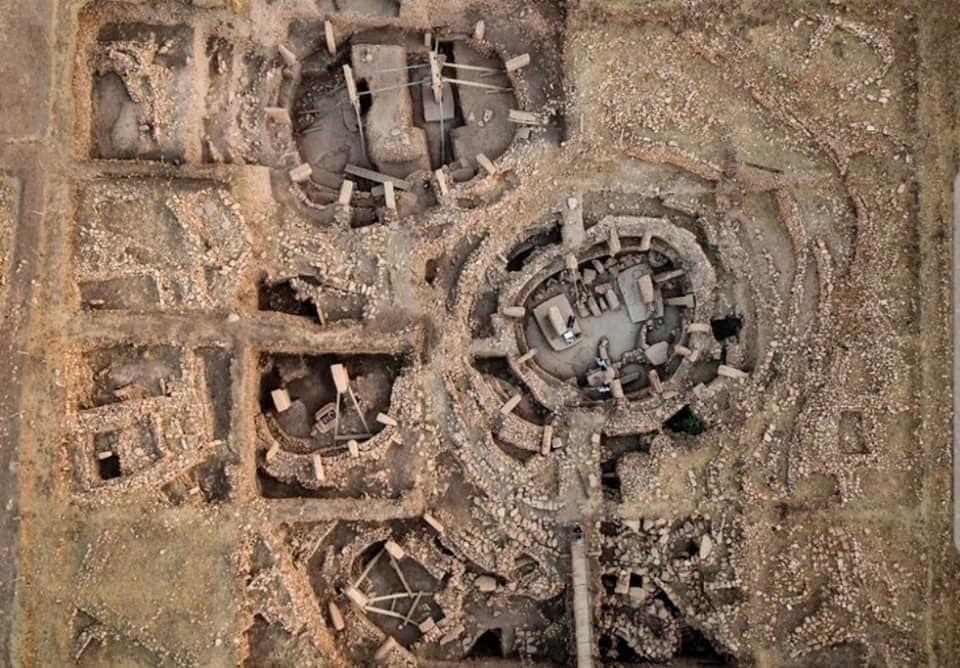
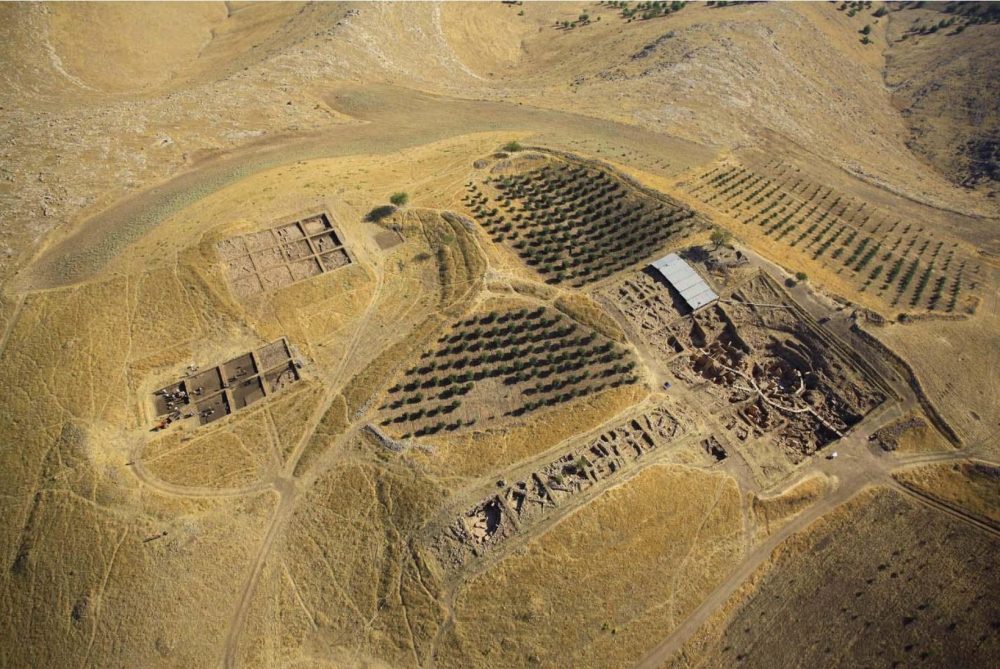
Aerial view of Gobekli Tepe. Credit: DAI, Gobekli Tepe Project
My position: this is not an isolated marvel
Here I must be clear. What follows is a working theory. It is not settled fact. It is where the evidence points me today.
Göbekli Tepe is not a lone anomaly. It is the visible edge of a deeper story. I do not see hunter-gatherers experimenting on a whim. I see trained builders, organizers, and skywatchers who already possessed methods, symbols, and a shared canon. I believe Göbekli Tepe is a remnant of a long-lost civilization that predates the Mesopotamian textbook beginning. I have said this out loud on many occasions.
Several lines support this view. Hear me out.
First, engineering. The pillars are up to six meters high and weigh many tons. They were quarried, shaped, moved, raised, and set into carefully prepared sockets. The enclosures are not piles. They are architectures with symmetry and recurrence. That implies logistics, leadership, and a labor force that could be coordinated.
Second, astronomy. If the calendar interpretation is even partly right, the builders observed and codified cycles of the Sun and Moon, recognized solstices, and related those cycles to figures that carried meaning. You do not arrive at that in one season. You inherit and refine it.
Third, context. Göbekli Tepe is not alone on the landscape. Karahan Tepe, Sayburç, and other sites on the Urfa plateau are revealing parallel stonework, similar T-pillars, and related artistic language. This looks like a cultural network, not a one-off project. The pieces fit together like tiles in a mosaic we are still uncovering.
Fourth, influence. Monumental stone building appears later in several regions. It is not proof, but it is reasonable to consider that practices and ideas diffuse. A culture that mastered ceremonial stone enclosures and sky timekeeping by 9500 BC could echo forward through memory, teaching, and migration. If so, Göbekli Tepe may be the earliest surviving root of the monumental impulse that later appears in ziggurats, pyramids, and stone circles.
Less than a tenth of Göbekli Tepe has been excavated. That is the detail most people miss. The hill was deliberately backfilled in deep antiquity. What we see are a few cleaned windows into a buried complex that extends under the surface. Dozens of enclosures may still wait below the soil. There could be sequences of pillars that show calendar variants, new constellations, or a ledger of seasonal rites. There could be tool marks that settle debates about quarrying and transport. There could be transitional rooms that show how the iconography evolved over time.
When a site is this large and this old, every new trench can reset the conversation. We should hold our models with a light grip and update them as the ground demands.
An Aerial/overhead view of An aerial photograph of the stone circles at Göbekli Tepe.
What mainstream critics will say, and why this still stands
Mainstream archaeology offers strong counterpoints. Farming, pottery, and permanent settlement are generally thought to precede large monuments. Elite organization is easier to sustain in villages and cities. By that logic, hunters and foragers should not be able to invest this much effort in stone architecture.
The counter to the counter is empirical. Göbekli Tepe exists. The pillars are real. The sockets are real. The enclosure walls and floors are real. The toolkits recovered on site show capability with stone. The coordination problem is a fair challenge, but it pushes us to consider seasonal congregation, ritual economies, and forms of leadership that do not mirror later city states. It expands the range of what early societies could do when purpose and memory aligned.
As for the calendar reading, healthy skepticism is necessary. Iconographic interpretation can go astray. But counts of marks, repeated placements, and cross-site recurrences are measurable. They can be tested as new areas are excavated. If future finds show different counts, or if the V signs appear in contexts that do not fit the calendar model, we adjust. If they continue to cluster around solstitial markers and time-linked figures, the case grows stronger.
It helps to picture the work as lived life rather than abstract pattern. Imagine the dawn at the hill, the line of workers moving up from the low ground, the craftspeople who know how to read flaws in the limestone, the carvers who have practiced the same fox outline so many times their hands can do it without a sketch. Someone keeps track of the days. Someone watches the place on the horizon where the Sun rises at midsummer. The V mark is not a symbol on a blackboard. It is cut with a stone blade by a person who believes it matters.
Ritual does not preclude measurement. In early societies the two often reinforce each other. If a community survives a period of cold and scarcity, and elders say the sky can warn us when risk returns, then counting becomes duty. Over time, duty becomes tradition. Tradition becomes art. The art encodes the count. That is one way a calendar is born.
Aerial view of Göbekli Tepe taken in 2013. Image Credit: DAI, Göbekli Tepe Project.
What this could mean if my theory is right
If Göbekli Tepe represents a true calendar culture and if it belongs to a network that predates the first cities by millennia, then the standard narrative needs expansion. The rise of civilization would no longer be a sudden Mesopotamian bloom but a long relay. Knowledge would have moved along corridors of ritual gathering, marriage ties, seasonal routes, and shared sanctuaries. Writing would still be a later invention, but its precursors would include tally marks, fixed points on the horizon, and a habit of making memory durable in stone.
That does not erase Mesopotamia. It deepens the preface. It invites us to treat the tenth millennium BC as a time of innovation rather than mere survival.
Three practical steps can test and refine this picture.
First, excavation. Careful, phased work at Göbekli Tepe, Karahan Tepe, and related sites will tell us whether the calendar pattern repeats and how the iconography changes across layers.
Second, high-resolution documentation. Systematic scanning of pillar surfaces can reveal faint marks and corrections. If carvers altered counts or added signs near solstices, those edits would be strong evidence for timekeeping.
Third, independent sky modeling. We can simulate the sky of southeastern Turkey across the relevant millennia and check whether proposed constellations align with the placements and orientations on the ground. A calendar should match the sky it claims to track.
The safest position is to wait for more data. The bolder position is to outline what the present evidence allows and to say what it might mean. I choose the second, with care. Göbekli Tepe looks like more than an early shrine. It looks like a coordinated project of builders and observers who counted days, watched cycles, and tried to make memory survive disaster.
If that is so, then this hill is not simply an ancient place. It is the echo of a culture that refused to forget. Most of it is still under our feet. The rest is in the sky, rising at the same points on the horizon that their carvers once watched.
KIJK. Amerikaans Congreslid geeft beelden vrij van incident met ufo: “Waarom wordt dit voor ons verzwegen?”
Er zijn voor het eerst beelden vrijgegeven van een incident op 30 oktober 2024, voor de kust van Jemen. Een Amerikaanse Hellfire-raket kwam toen in botsing met een ufo (ongeïdentificeerd vliegend voorwerp). Nadien zet de ufo z’n koers voort. Tot vandaag is nog steeds onduidelijk wat het object was.
Reaction to shocking video of U.S. missile bouncing off UFO
De video werd vrijgegeven door Congreslid Eric Burlison tijdens een hoorzitting van een subcommissie van het Huis van Afgevaardigden over Ongeïdentificeerde Anomale Fenomenen (UAP), wat de militaire term is voor ufo’s. Hij speelde de beelden, die volgens hem voor zich spreken, af tijdens de commissie. Op die beelden, die boven zee gefilmd zijn, is inderdaad een raket te zien. Niet veel later verschijnt er in de linkerbovenhoek een voorwerp dat recht op de raket afgaat. De twee komen in botsing, waarna de ufo onverstoord verder vliegt.
De beelden roepen veel vragen op, ook bij ufo-kenner en onderzoeksjournalist George Knapp. “Mensen moeten dit zien, maar krijgen dit niet te zien. Waarom weet ik niet”, vroeg Knapp zich luidop af. “Dit is een Hellfire-raket die tegen een ufo botst en die gaat gewoon door. Dat is heel vreemd, wat is dit in godsnaam?”
Jemen
De Verenigde Staten halen in die regio regelmatig raketten en drones van Houthi-rebellen neer. Dat zou een verklaring kunnen zijn voor het ongeïdentificeerde object, maar de Amerikaanse defensiedienst en het Pentagon willen niet verder ingaan op het incident.
UFO hearing: Witness claims we were "seconds away from WWIII" in shocking testimony
When I was growing up, I watched a lot of sci-fi movies about aliens that come to Earth. The extraterrestrials in popular culture, however, always looked so familiar that I found them far-fetched. What are the chances that E.T., the Predator, or ALF would develop arms and legs, a humanlike face, and opposable thumbs? Perhaps as a result, I associated alien life more with fantasy than with science, and I never gave much thought to what a visit would really look like. But my attitude started to change in 2020, when I read Liu Cixin’s “The Three-Body Problem” and its two sequels. In Liu’s books, creatures called Trisolarans send a scouting mission of supercomputers to spy on and subtly disrupt human affairs. Although Trisolarans could do seemingly impossible things, such as program protons, Liu’s rigor got me thinking about aliens from a scientific perspective. Suddenly, I could imagine a sophisticated civilization coming into contact with humanity, perhaps in ways that we don’t immediately understand.
Then, in 2021, the Office of the Director of National Intelligence released a report on unidentified anomalous phenomena (U.A.P.)—essentially a rebranding of U.F.O.s. Several Navy videos had been made public a few years prior. In the so-called GOFAST video, recorded off the coast of Florida in 2015, a Navy pilot with an infrared camera follows an object zooming above the water and asks, over the radio, “What the fuck is that?” Another clip, deemed GIMBAL—“Look at that thing, dude”—showed a similar shape above some clouds. A third video, known as FLIR, was taken in 2004 from an aircraft in California. Navy pilots in two planes saw what looked like a large Tic Tac hovering over the water; it seemed to zip away at thousands of miles per hour. Military whistle-blowers subsequently claimed that the government knew more than it was admitting, leading to congressional hearings in 2022, 2023, and 2024. Last month, House Representative Eric Burlison, a Republican, introduced the U.A.P. Disclosure Act of 2025, aimed at preserving and eventually releasing U.F.O. reports.
None of the government’s disclosures demonstrated that Earth had welcomed interstellar house guests. And yet, after the releases and hearings, it seemed more acceptable to explore the possibility. In 2022, roughly fifteen hundred university faculty members replied to a survey about U.F.O.s; a majority said that recent governmental and journalistic reports had increased the topic’s credibility, and three-quarters said that it was of average importance, very important, or essential for academics to conduct more research about it. Tyler Cowen wrote about U.F.O.s forBloombergand Ross Douthat wrote about them for theNew YorkTimes; they compared notes on Cowen’s podcast. On the prediction platform Polymarket,the oddsthat the U.S. will “confirm that aliens exist in 2025” have ranged between four and fourteen per cent. (The detection of aliens on a faraway planet would count.)
I started to ask myself, How likely is it that we’ve ever been visited by aliens or their technology? It seemed improbable yet plausible. I wondered how scientists, engineers, and other thinkers would approach the question. What would count as evidence, and what kinds of educated guesses could we make? I decided to call Adam Frank, an astrophysicist at the University of Rochester and the author of “The Little Book of Aliens,” which looks to differentiate between science and fiction.
Frank doesn’t put much stock in U.F.O. videos, and he told a story to explain why. In February, 2023, photographs of a Chinese spy balloon over Billings, Montana, prompted speculation about aliens. The Air Force eventually shot it down, but first the pilot of an American U-2 spy plane flew past and took a selfie that showed the balloon out the window. “You can see it in exquisite detail,” Frank told me. “Where are all those pictures? Every U.F.O. picture is a fuzzy blob. Everybody carries a high-resolution camera in their pocket now, and it’s always fuzzy blobs.”
There are potential answers to Frank’s question, but most of them raise questions of their own. Maybe there’s a coverup. But, if so, wouldn’t whistle-blowers have turned up something by now? “Color me extremely skeptical that any government could keep a secret like this effectively for a week, let alone decades,” Austin Carson, a political scientist at the University of Chicago who has written extensively about government secrecy, told me. Steven Aftergood, who directed the Project on Government Secrecy at the Federation of American Scientists, pointed me to a 1970 report produced by a government task force on secrecy: “It is unlikely that classified information will remain secure for periods as long as five years, and it is more reasonable to assume that it will become known to others in periods as short as one year.”
Maybe the aliens are coy and want to stay hidden. If that’s the case, though, why are we seeing them at all? Mark Rodeghier, the scientific director of the Center for U.F.O. Studies, which is headquartered in his basement, told me, “They’re actually trying to slowly acclimatize us to the idea that aliens, in fact, exist.” Robert Hampson, a neuroscientist at Wake Forest University who has written over a dozen science-fiction novels, speculated that, perhaps, “what we’re detecting are the alien equivalent of graduate students who have been given an assignment to go and watch the humans and report back.” Plenty of human graduate students have been tasked with researching other worlds—and they don’t always get the best equipment.
The elaborateness of these explanations, in Frank’s view, is a reason to be skeptical of them. “If you’ve got to go through all those contortions to make your story work, you’re not doing science anymore,” he said. He noted that, when humans send spacecraft into the solar system, they tend to land safely. Alien craft, in contrast, “would have managed to cross interstellar distances, and these things seem to crash every fifteen minutes. It’s like everybody’s sending us their 1987 Dodge Omnis.” The 2021 national-intelligence report on U.A.P.s said that it could not explain a hundred and forty-three U.F.O. reports, but that many were probably “airborne clutter,” weather, or terrestrial technology. “Sometimes they’re hard to explain because we just don’t have the data,” Frank said. In his opinion, high-quality data (high-resolution photography, for example) has never “showed us that anything required an extraterrestrial hypothesis.”
Our galaxy contains at least a hundred billion planets, and biology finds a way in extreme environments on Earth, so it’s not unreasonable to suppose that life thrives elsewhere in the Milky Way. But if aliens wanted to visit us they would have a long way to go. The closest star to the sun, Proxima Centauri, is roughly 4.2 light-years away. NASA’s Voyager 1 space probe would take more than seventy-five thousand years to get there, if it were headed in the right direction. The closest inhabited solar system could be much, much farther away. Could aliens, or at least their tech, survive that journey?
Avi Loeb, a Harvard astrophysicist, thinks they may have already. In 2014, military satellites observed a half-metre-long meteor in the sky near Papua New Guinea. Several years later, Loeb and a student, Amir Siraj, concluded that the meteor had been travelling too fast to be orbiting the sun, and that, therefore, it was interstellar. Loeb went on to argue, over the objections of many experts, that it may have been alien technology, and that debris he recovered on a Pacific expedition was from the meteor. “Think of it as Amazon delivery service, but from interstellar space,” he told me during the expedition, from a ship that was incidentally called the Silver Star. He and numerous collaborators wrote up their findings in Chemical Geology last year. (Cosmochemists questioned the claim that the debris was interstellar; one told Science, “I’m surprised anyone would take it seriously.”) Loeb currently leads the Galileo Project, which is erecting ground-based sensors to look for anomalous phenomena.
U.F.O.s could contain biological aliens or machines powered by artificial intelligence. Either way, they might travel much faster than Voyager 1—but that would require a lot of energy. Les Johnson, a retired chief technology officer at NASA who has written fiction and nonfiction books about interstellar travel, gave me an example. To accelerate a pineapple to just a tenth the speed of light, he said, would require the energy of seven Hiroshima explosions. You would need the same quantity of energy to decelerate at your destination. “Suddenly, you’ve got the energy of fourteen Hiroshima bombs on a pineapple,” he said. “So I look at that, and I think it just doesn’t pass the giggle test.” At that speed, a speck of space dust would also have the impact of T.N.T. “I’d love to think we’re in a ‘Star Trek’ universe,” Johnson said. “But I don’t know if we are.”
Logically speaking, the chance that aliens are here right now must be slimmer than the chance that they have been here at some point in the past. Garry Nolan, a biotech founder and an immunologist at Stanford, has a hunch that we’ve been visited by aliens—he had an eerie experience as a child—and speculates that they or their technology may have been on Earth for millions of years. “So the open question might be, Is this even our planet?” he asked me. As outlandish as his theory is, it’s tricky to firmly disprove. If they came long ago, and left or died, would we even know? In 2018, Frank and a co-author published a paper in the International Journal of Astrobiology titled “The Silurian Hypothesis.” (In “Doctor Who,” Silurians are advanced reptilian humanoids who predated us on Earth.)
“Would it be possible to detect an industrial civilization in the geological record?” Frank and his colleagues ask. Organisms can turn into fossils that last tens of millions of years, but most organisms don’t become fossils; metals and plastics might not stick around at all. And the planet’s surface constantly erodes and churns. “Our claim was that, after about a couple million years, anything on the surface is gone,” Frank said. “Even if some aliens came and built a pretty intense civilization, you wouldn’t have any evidence of it.” The best evidence one might hope for, he argued, was indirect: for example, an unusual proportion of certain isotopes at particular depths of rock. (In a 2019 paper, a physicist suggested that we should look for old probes, or “Lurkers,” on space rocks near Earth.) So far, humans haven’t found anything like that.
Science fiction often explains interstellar travel by imagining some kind of warp drive. Einstein said that nothing can travel faster than the speed of light, but, in 1994, the Mexican physicist Miguel Alcubierre found an exception: Einstein’s theory of general relativity actually allows for a craft to outpace light by squeezing space-time at its bow and stretching it at the stern. Nolan, who is a fan of this idea, likened the Alcubierre drive to “creating your own sub-universe, a warp bubble around yourself.” Of course, it is not at all clear that such a thing could be constructed. Alcubierre invoked what physicists call negative energy; later theorists thought that lots and lots of regular energy could be used instead. Nolan speculated that, maybe, sufficient energy could be harvested from space-time itself, using the zero-point field and quantum tunnelling. But he quickly admitted that “those are just fancy words that we throw at the unknown.” (On the plus side, a warp drive might quote-unquote explain the Navy’s U.F.O. videos; one paper estimated that the objects in the videos appeared to be pulling up to five thousand Gs, using no visible propulsion and leaving no wake. Stunt pilots max out at around ten Gs.) Other U.F.O. enthusiasts argue that aliens could reside in dimensions beyond the four that we know and love. Or maybe they’re time travellers.
I ran these notions by Arlan Andrews, a retired mechanical engineer and author who is the founder and director of SIGMA, a think tank of sci-fi writers that advises the government and N.G.O.s. He responded by throwing up his hands in exasperation. “If you start to do the woo-woo stuff with interdimensional and time travel, I can’t say they’re wrong, but there’s no place to start,” he told me. “As an engineer, I like to have a starting place.”
Acivilization that’s millions or billions of years ahead of us would probably know physics that we don’t yet comprehend. Its technology might seem like magic to us. In that case, practically anything is possible. A NASA report on U.F.O.s, released in 2023, acknowledges that “it is difficult to put physical constraints on them at present.” How would you turn something without constraints from woo-woo into science?
The Society for U.A.P. Studies (SUAPS) is a think tank attempting to define U.A.P. studies as a field. “Not only is there not a science but there’s no academic field,” Michael Cifone, a philosopher of science at St. John’s University and one of the group’s founders, said. “How do we study this phenomenon? Who’s involved? What are the methodological principles that should guide us?” He cares less about people’s out-there theories than about what steps should be taken to resolve U.F.O. cases. He wants to avoid “endless, unconstrained, undisciplined speculation.” In his view, we’re at “a crucial transition point between the older ‘ufology,’ ” akin to forensic investigation, and modern scientific methods.
The first step to making something a science usually involves data. NASA’s report focusses on the agency’s potential role in collecting data, and in using A.I. to analyze it. According to the report, the agency’s sensors could be supplemented with crowdsourced data from apps; one example is Enigma, which uses algorithms to rate the credibility of people’s sightings and triangulate objects using video recordings. UAPx, a Florida nonprofit, has developed a suite of sensors specifically for analyzing odd aerial phenomena. And then there’s the data contained in past reported sightings, which could be regularized and collated somehow. Ryan Graves, a former Navy pilot who testified about U.F.O.s in Congress, founded Americans for Safe Aerospace, which encourages pilots to report U.F.O.s. The group vets the cases and has brought them to Congress; the All-domain Anomaly Resolution Office (AARO), which is part of the Department of Defense; and, lately, to an F.B.I. working group. But, as some argue, the plural of anecdote is not data. “I don’t trust pilots’ sightings,” Matt Mountain, the president of the Association of Universities for Research in Astronomy, told me. “They’re on a mission, not doing scientific exploration.” We should keep in mind, Mountain told me, that most criminal convictions that are overturned by DNA evidence were based in part on eyewitness testimony.
Graves said that he was agnostic about aliens. “I’m not jumping to conclusions,” he told me. “But I want to figure it out, damn it.” Still, he seemed skeptical of expert analysis. In November, 2024, AARO announced that it considered the GOFAST video mystery resolved; the object’s altitude, it said, gave it an exaggerated appearance of speed. “Through a very careful geospatial intelligence analysis and using trigonometry, we assess with high confidence that the object is not actually close to the water, but is rather closer to 13,000 feet,” the agency’s director told CBS. Graves wasn’t satisfied with that explanation. “Some of these cases aren’t quote-unquote debunked or no longer of interest,” he has said.
When I spoke to people who supported an alien hypothesis, I was often struck that relatively patchy evidence—what Frank had described as fuzzy blobs—had inspired such in-depth theories. I’m as puzzled by the U.F.O. videos as the next guy, but, as far as I can tell, nothing in them requires us to accept the existence of warp drives or time travel. Until someone produces high-definition videos of flying saucers and little green men, the evidence might not be extraordinary enough to demand such extraordinary explanations. And to the extent that U.F.O.s do need explanations it’s worth asking whether aliens are the best one. People have seen weird stuff in the sky for thousands of years, and only in the last eighty have flying saucers been a popular interpretation. Before that, we tended to credit the supernatural.
After all my conversations, I thought the odds that aliens or their tech had visited Earth were probably south of five per cent. Most U.F.O.s. are likely balloons, airplanes, weather events, visual illusions, or technical glitches. Even so, there are enough unknowns, and unknown unknowns, that the margin of error seemed enormous. A person who thinks the odds are much higher, I’d argue, shouldn’t be met with ridicule.
One more question: Why would aliens even visit us? Coming up with an answer forces us to speculate about alien motives. “I’ve always said that aliens are going to alien,” Andrews, the sci-fi writer who founded SIGMA, told me. “We have no idea what an alien person or being or intelligence or machine would be motivated by. . . . We don’t know what motivates the Kremlin, for God’s sake.” Extraterrestrials, he suggested, could be as different from us as we are from centipedes. (That could be an understatement.) Robert Powell, a chemist who serves on the board of the Scientific Coalition for U.A.P. Studies, has argued that some U.F.O.s are intelligently controlled and do not come from Earth. But, in his view, we shouldn’t try to study extraterrestrials as if they’re lab rats. “We’re the rat, and we’re trying to figure out what the doctor is doing,” he said.
It’s reasonable to think that there would be commonalities among intelligent species. One is the drive for self-preservation, which motivates the Trisolarans in “The Three-Body Problem.” Hampson, the neuroscientist and sci-fi writer, didn’t think that was a very good reason to come to Earth. “If they’re after resources, there are easier ways to get them,” he said. “Why would you go to an already inhabited world?” Meanwhile, a warlike species would probably just wipe us out. “If the idea is conquest, then I think we would already know,” he said. But he could imagine another reason: curiosity.
Nick Pope, who ran the U.F.O. program at the U.K.’s Ministry of Defense from 1991 to 1994, told me that the ministry had considered three main motives for alien visits: military reconnaissance, scientific study, and tourism. It’s not a given that aliens would enjoy travel. Maybe we’ve never met them because they’re homebodies. Still, what kind of intelligent life form wouldn’t want to see a sunrise on another world? “This might be the only place in the universe to see an elephant,” Pope said. “How many planets have a Stonehenge or a Machu Picchu or a Great Pyramids?” Aliens might want to survey the galaxy for all life forms—including us. They might even be having the same debate we are. Are we alone in the universe? The truth—whatever it may be—is still out there.
archieffoto van Amerikaans ministerie van Defensie van een ongeïdentificeerd vliegend voorwerp
"VS verbergt informatie over buitenaards leven": ex-officieren getuigen voor Amerikaans Congres in "UFO-hoorzitting"
In de VS heeft een luchtmachtveteraan tijdens een hoorzitting in het parlement herhaald dat de Amerikaanse overheid al decennialang een onderzoeksprogramma naar UFO's verbergt voor de bevolking. Volgens de voormalige majoor David Grusch is het Pentagon in het bezit van bewijsmateriaal van buitenaards leven. Het Amerikaanse ministerie van Defensie heeft die beweringen met klem ontkend.
In 2022 bevestigde het Amerikaanse ministerie van Defensie dat er een onderzoek loopt naar een 400-tal geheimzinnige waarnemingen in het luchtruim van de voorbije twee decennia. Dat onderzoek wordt gevoerd door de speciale afdeling die onderzoek doet naar UAP's (ongeïdentificeerde verschijnselen in de lucht of unidentified aerial phenomena).
Vanmiddag hebben drie klokkenluiders die voor de Amerikaanse Defensie hebben gewerkt, getuigd in een hoorzitting in het Amerikaanse parlement over "ongeïdentificeerde abnormale verschijnselen in de lucht".
Hun getuigenissen roepen meer vragen dan antwoorden op. Ze beweerden over veel meer informatie te beschikken, maar wilden of konden die niet delen op de hoorzitting.
De voormalige inlichtingenofficier David Grusch verklaarde dat Defensie in het bezit is van bewijsmateriaal van buitenaards leven en UFO's, maar concrete informatie gaf hij niet. Grusch had het over "niet-menselijk biologisch materiaal". De overheid zou die informatie volgens Grusch bewust verbergen voor de bevolking.
Grusch kon niet antwoorden op vragen in de hoorzitting omdat hij gehouden is aan een geheimhoudingsplicht (non-disclosure agreement of NDA). Hij gaf mee dat hij wel meer antwoorden kan geven in een gesloten commissie.
De drie getuigen, Ryan Graves, David Grusch en David Fravor leggen de eed af voor de hoorzitting
Onderzoek naar onverklaarbare waarnemingen
Het Pentagon heeft altijd ontkend dat er geheime onderzoeksprogramma's lopen naar UFO's en buitenaards leven. Er wordt wel onderzoek verricht naar onverklaarbare waarnemingen.
Volgens Defensie is het in het belang van de strijdkrachten om de oorsprong van de fenomenen te achterhalen, omdat ze mogelijk gevaar kunnen opleveren voor piloten. Het valt evenmin uit te sluiten dat het om tot dusver onbekende systemen of tuigen gaat van vijandelijke mogendheden.
Adjunct-directeur Inlichtingen van de Marine Scott Bray meldde eerder dat zijn diensten "niet over materiaal beschikten of stralingen hadden opgepikt die zouden suggereren dat het om iets van buitenaardse oorsprong zou gaan". Geen bewijs van buitenaards leven dus, maar Defensie
Het Rosswell incident
Radars van het Amerikaanse leger kunnen niet altijd bepalen wat er in de lucht wordt waargenomen. Dat bleek begin dit jaar nog toen ongeïdentificeerde vliegende objecten werden neergeschoten door het leger, na het incident met de Chinese spionageballon.
Amerika is ook altijd in de ban geweest van het Roswellincident, de vermeende crash van een UFO in het plaatsje Roswell in New Mexico. Het was in de zomer van 1947 groot nieuws in de VS en is nog altijd het bekendste UFO-incident. Sindsdien doen er om de zoveel tijd allerhande beweringen over bewijs van buitenaardse wezens de ronde, maar nooit is dat bewezen.
The U.S. Government’s Top UFO Scientist Has an Open Mind about Alien Visitation
Have you seen something inexplicable in the sky? Jon Kosloski, director of the U.S. Department of Defense’s All-Domain Anomaly Resolution Office, wants to hear from you
Video footage of an Unidentified Anomalous Phenomenon (UAP) event, captured by an infrared sensor onboard a U.S. Customs and Border Protection aircraft over the Rafael Hernandez Airport near Aguadilla, Puerto Rico on April 26, 2013. In the full footage, the UAP seems to move at high speed, split into two objects, and fly into and out of the ocean. A subsequent assessment by the U.S. Department of Defense’s (DOD) All-Domain Anomaly Resolution Office (AARO) found that the event can be explained as a trick of perspective, in which two slow-moving objects traveling linearly near to each other only appear to be a single object splitting in two, and do not enter the sea at any point. The appearance of U.S. DOD visual information does not imply or constitute DOD endorsement.
U.S. Department of Defense
Whether captured in declassified military footage or insmartphone videos uploaded to social media, UFOs are swarming Earth’s skies and demonstrating capabilities so astonishing that they must represent technologies that are advanced beyond any available on Earth. Clearly, these sightings point to the involvement of space aliens—or perhaps just a global cabal of nefarious humans with ultraspiffy, above-top-secret flying machines that routinely break the known laws of physics.
At least, that’s what modern-day folklore would have you believe, no matter how many times skeptics convincingly debunk sensational UFO sightings as mere misidentifications of conventional aircraft, sensor artifacts or natural phenomena.
Regardless of what one personally believes about all this, what’s certain is that claims of mysterious trespassers in American airspace are taken very seriously by the U.S. government for reasons of national security. That’s why, at Congress’s behest, the U.S. Department of Defense established its All-Domain Anomaly Resolution Office (AARO) in July 2022. This office investigates reports of UFOs under the more generic rebranding of unidentified anomalous phenomena (UAPs).
AARO’s work, however, isn’t really about chasing down extraterrestrial invaders so much as it involves standardizing reporting methods, curating and analyzing datasets and assessing possible threats posed by UAPs. Think less Men in Black and more “Pentagon desk jockeys with advanced degrees and highly classified résumés.”
The office’s current director Jon Kosloski, who took over in August 2024, after the departure of his predecessorSean Kirkpatrickin December 2023, is a good example of the archetype. His professional past is punctuated by National Security Agency research in networking and computing, optical light communications and cryptography, as well as his invention of an advanced language-agnostic search engine for the DOD.
Dr. Jon Kosloski serves as the director of the U.S. Department of Defense’s All-domain Anomaly Resolution Office (AARO).
U.S. Department of Defense
Kosloski spoke with Scientific American about his vision and agenda for AARO—and, of course, his thoughts on the “extraterrestrial hypothesis” for unexplained UAPs.
[An edited transcript of the interview follows.]
What milestones and directions do you and AARO foresee as you assess the UAP situation?
We have quite a lot going on in the office. We’re working diligently to make our AARO website available to the public so they can report an incident. We want to have a semiautomated processing chain to quickly bring those cases in and then look for correlations with other cases from government sources.
We’re also working on machine-learning and artificial intelligence tools so that we can look for correlations at a larger scale. AARO is also looking at better utilization of the whole fabric of U.S. government sensors that are available. That will help our case resolutions, but it also poses the potential challenge of looking at an awful lot of data.
A last big push is for increased transparency—to find more efficient ways to share information with the public and the scientific community to help us in some of our investigations. Standardizing the UAP data is an initiative—to make it better suited for data science. As we do that, we’d like having both the raw data as well as postprocessing data available to as wide of an audience as possible. But we need to respect the sensitivities of the sources and methods used to gather those data.
Last November you testified before the Senate Committee on Armed Services’ Subcommittee on Emerging Threats and Capabilities. One point you raised was the importance of removing the stigma of reporting a UAP event. How much of a problem is that?
It seems to have diminished quite a bit, thankfully, through a variety of public endeavors. I think it does persist, for example, with local law enforcement and some military members, however. They have experienced some pushback themselves from discussing events that they’ve been a part of but have come forward and shared that information with AARO. So maybe the stigma is reduced but not completely gone. Good progress is being made, but probably there’s a little ways to go.
AARO has reportedly deployed the Gremlin System—a multisensor networked system for detecting, tracking and characterizing UAPs—in an undisclosed location. What is the status of this project?
Gremlin is envisioned to be a test bed for sensor evaluations and sensor fusion. We expect it to be a “living” system, always evolving. We will be swapping in and out new sensors and algorithms for various approaches. We want to document what we learn and share that with the public and other organizations inside the government. The hope is they can take what we have learned and replicate that.
Gremlin itself is going quite well and is very robust. It has been running out in the wild for several months now, gathering data using radar, electro-optical and infrared cameras and some electromagnetic sensors. Gremlin is pulling all that in and detecting events in real time. We haven’t found anything particularly interesting yet.... But there are a few interesting sightings that are worth investigation.
What does “a few interesting sightings” mean, exactly?
Interesting from our perspective. It is not obvious what the object is. It is unidentified. It has some anomalous characteristics. And in these cases, the object appears to be [moving] rather quickly. But it doesn’t appear to [be using] standard aircraft beacons. There could be multiple explanations for that, so we’re not jumping to any conclusions. But they are worthy of further investigation.
UFO groups continually demand “full disclosure,” by which they mean more than transparent data sharing—namely, the full disclosure of putative secret evidence that Earth has been visited by some form of alien intelligence. For AARO, if you come up with a head-scratcher of an unknown phenomenon, how would you disclose that fact?
There are two things we have to consider. One is the owner of the data. We would need to work with the data owner to make sure that we are not revealing sensitive information about sources and methods.
But putting that aside, there is nothing inherently classified about an anomalous event or phenomenon. So we would work with our leadership to document that well, study it and then produce a product that can be shared widely with the community. There is no inherent reason why we would sit on these anomalies, if we did come across something truly perplexing.
Given that many full-disclosure advocates would insist that the absence of evidence for alien visitation just further confirmed a government cover-up, it seems like any push you could make for transparency as leader of AARO would, in some respects, be doomed to failure. So why take on the assignment in the first place?
I love difficult scientific challenges. In general, I enjoy the chase of trying to understand the mystery and solving puzzles. UAPs, by their very nature, are rare events. [That means] data acquisition is difficult, and there’s a sensor design challenge. I think getting the data we need has been somewhat neglected.
There are groups, such as Avi Loeb’s Galileo Project, that are working on better data acquisition—which is fantastic. But we in the U.S. government could do better. As a mathematician and data scientist, I enjoy poring through the data, looking for the subtle correlations and teasing out the threads to identify hypotheses and get the scientific method started.
Doing that with a well-qualified group—with experts from inside AARO, as well as from across the U.S. government, and hopefully partnering with academia, too—was just too good of an opportunity to pass up.
How does AARO engage academia?
Right now we are primarily focused on a few key partnerships with University Affiliated Research Centers [UARCs]. [Editor’s Note: UARCs are DOD-supported research organizations that are affiliated with a university and offer specialized expertise.] For example, AARO worked with the Georgia Tech Research Institute [a nonprofit applied research organization at the Georgia Institute of Technology] to develop the Gremlin System. As a UARC, the Georgia Tech Research Institute partnered with AARO. Because of the nature of the contractual relationships, we can share the data that we have. In broader engagements with academia, there is the key step of downgrading classification to ensure we can release the information. We are working on that. Also, an important partnership is with the National Laboratories—Oak Ridge National Laboratory, for instance, has assisted AARO with some of its material analysis. But right now the focus has been on those few key UARCs.
Is it really accurate to say you’re being “transparent” while also dealing with sensitive, classified data?
It’s a challenge. AARO should be as transparent as possible, and we are working in that direction. At the same time, we need to respect the sensitivities of the sources and methods used to gather the information that is relevant to UAPs. Ultimately, we are also working with our partners to release as much information as possible about the full context in which that data was gathered.
It is a time-consuming process. But there are reasons why the U.S. government needs to protect those sources and methods so that we don’t put them at risk.
Recent reports of mysterious drones over New Jersey and elsewhere sparked a lot of public interest and discussion—and I’m sure you and your AARO colleagues were paying close attention, too. What’s your take on that situation?
Misidentification does account for a number of UAP sightings. AARO has been working on educational materials about common misunderstandings, such as Starlink flaring, as we call it, or [confusing visual] phenomena such as parallax. We’re sharing that with the public so that they understand what they are looking at.
Specifically, with the New Jersey incidents, none of those were reported to AARO as being anomalous. Certainly, many of them were unidentified, whether they were drones or airplanes or other objects. They weren’t behaving in a way that was identified by the people at the time as being anomalous, so we didn’t take the lead on any of those investigations. But we were in contact with a number of federal organizations, offering our support.
Do you have any advice for true believers who are convinced that aliens are visiting Earth’s skies?
I don’t have advice per se. I don’t want to be the thought police. I think everyone is welcome to approach this topic however they like. As I came into this subject, however, I tried to approach it without bias in either direction. I’m open to any possibility. Sometimes an unusual event is just a sensor artifact, sometimes just a balloon.
We do have some events in our holdings that are really peculiar, and I don’t know yet what’s behind those. But because we don’t know what’s behind them, we also can’t attribute them to anything in particular. And that includes extraterrestrial sources.
Any closing thoughts on your primary objectives for AARO? And how do you feel about the big, daunting question “Are we alone?”
I’m impatient and, being a data scientist, I am also a data hog. I want more data, and I want it quicker so that we can get to the heart of these problems. It boils down to asking ourselves, “What type of data is it going to take to prove to the scientific community, beyond a shadow of a doubt, that this anomalous phenomenon was not a sensor artifact and is, indeed, something truly peculiar?”
And I feel that’s going to require multiple sensors gathering the same event from different perspectives at the same time.
My goal is for AARO to be able to enhance our national security by increasing domain awareness, ensuring that we understand everything that is operating in space, in the air and maritime environments, as well as those trans-medium objects [UAPs that seemingly slip between, say, the sky and the sea].
I think it’s plausible that there’s life out there. I haven’t yet seen the substantial evidence I need to convince me that extraterrestrial life has found its way to Earth as yet, but I am open to anything.
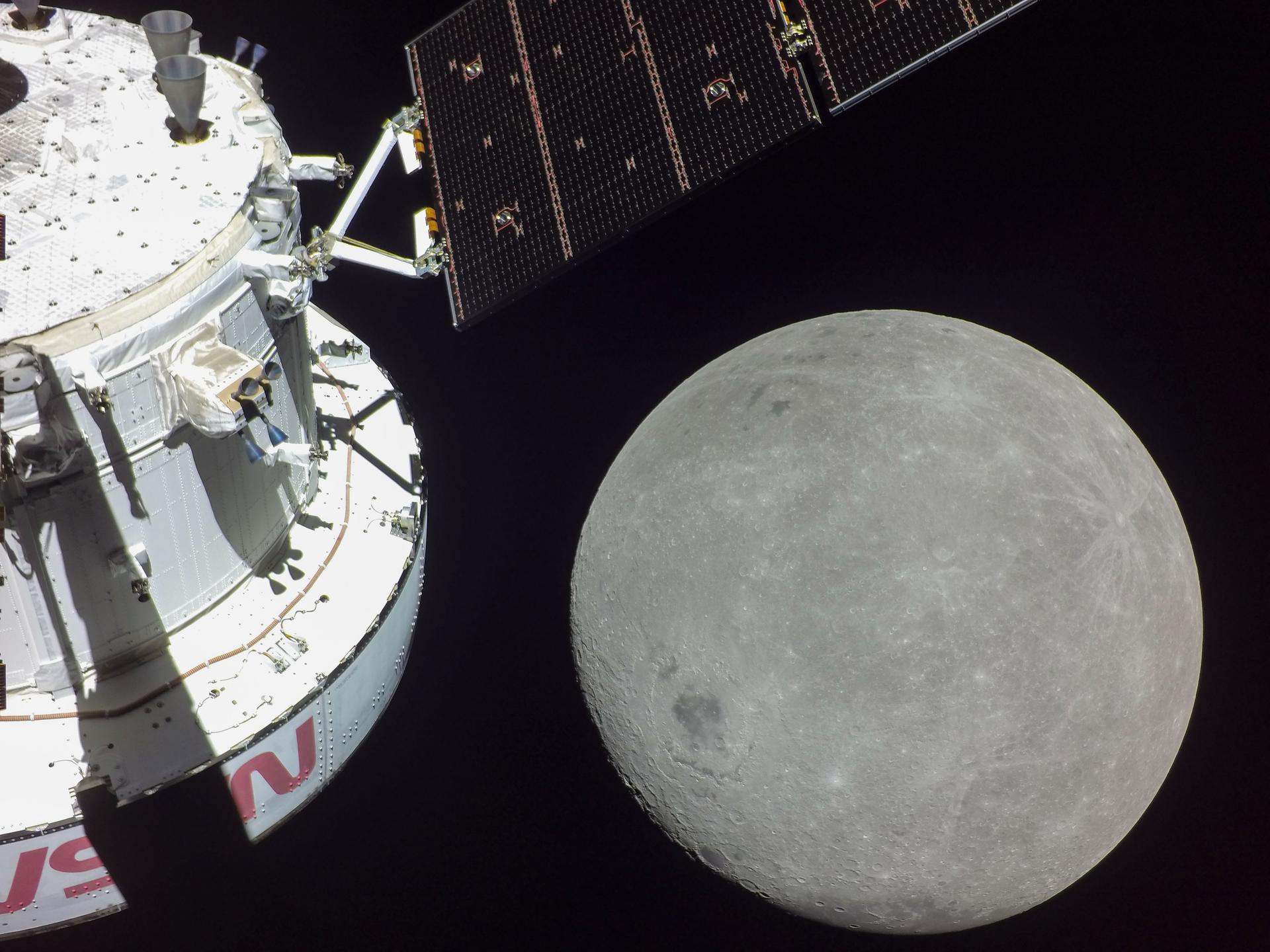
The Artemis I spacecraft on approach to the Moon. Credit: NASA
NASA is preparing to send crewed missions to the Moon for the first time since the end of the Apollo Era over fifty years ago. With the success of Artemis I, which sent an uncrewed Orion spacecraft on a circumlunar flight and set a new distance record for a crew-capable spacecraft, NASA is gearing up for Artemis II. This mission, which NASA is now targeting for no sooner than February 5th, 2026 (and no later than April), will transport a four-person crew around the Moon without landing and return them home ten days later. The announcement was made during a news conference on September 23rdat NASA's Johnson Space Center (JSC).
The core and upper stage of the Space Launch System (SLS) that will launch the Artemis II mission were stacked between March and May 2025, while the solid rocket boosters were completed in February. The Orion spacecraft is in the final stages of preparation and will be integrated with the SLS later this year. In early 2026, the fully stacked rocket and spacecraft will roll out to their launch site at the Kennedy Space Center in preparation for their February launch window. After a "wet dress rehearsal," where the launch system will be fully-fuelled and a mock countdown conducted, the Artemis II mission will be ready for launch.
The Artemis II mission will evaluate all of the systems and mission architecture used to transport astronauts to the Moon with Artemis III. This mission is currently scheduled for no earlier than mid-2027 and will see two astronauts transfer to a Human Landing System (HLS) provided by SpaceX in lunar orbit, then descend to the surface. The entire mission is expected to last about 30 days and will be the first time astronauts have walked on the Moon since the Apollo 17 astronauts did in 1972.
Artemis II astronauts visit the Artemis launch team inside Firing Room 1 in the Launch Control Center at NASA's Kennedy Space Center in Florida.
Credit: NASA
However, during a meeting that took place on September 19th, members of the Aerospace Safety Advisory Panel (ASAP) expressed doubt that the Starship HLS will be ready in time. Paul Hill, the Former Director of Mission Operations at NASA JSC, summarized NASA's concerns, saying: "The HLS schedule is significantly challenged and, in our estimation, could be years late for a 2027 Artemis 3 moon landing." Another issue is the cryogenic propellant transfer, which SpaceX must successfully demonstrate to meet its contractual obligations.
Nevertheless, the ASAP members also expressed confidence in SpaceX's ability to deliver, citing their "high manufacturing" and "flight tempo."
In related news, NASA announced that the Artemis II crew had named their spacecraft "Integrity." The announcement was made at a news conference on September 24th, inside the Launch Control Center at NASA's Kennedy Space Center. According to a NASA statement:
The name Integrity embodies the foundation of trust, respect, candor, and humility across the crew and the many engineers, technicians, scientists, planners, and dreamers required for mission success. The name is also a nod to the extensive integrated effort – from the more than 300,000 spacecraft components to the thousands of people across the world – that must come together to venture to the Moon and back, inspire the world, and set course for a long-term presence at the Moon. Integrity is rooted in a shared core value of NASA, the agency's astronaut office, and the CSA (Canadian Space Agency).
During the ASAP meeting, the members also expressed concerns about the future of NASA's lunar exploration plans beyond Artemis III, describing it as "uncertain and a little murky." Nevertheless, the agency and the Artemis crew are prepped and on track to launch the Artemis II mission sometime next year. The success of this mission will usher in a new era of space exploration, paving the way for regular missions to the Moon and a "sustained program of lunar exploration and development."
Meer van UFO'S of UAP'S, ASTRONOMIE, RUIMTEVAART, ARCHEOLOGIE, OUDHEIDKUNDE, SF-SNUFJES EN ANDERE ESOTERISCHE WETENSCHAPPEN - DE ALLERLAATSTE NIEUWTJES


 Yorkshire resident spots mysterious collection of ghostly UFOs near Leeds – including one that looks like a SPOON