Naar de inhoud

UFO'S of UAP'S, ASTRONOMIE, RUIMTEVAART, ARCHEOLOGIE, OUDHEIDKUNDE, SF-SNUFJES EN ANDERE ESOTERISCHE WETENSCHAPPEN - DE ALLERLAATSTE NIEUWTJES

UFO's of UAP'S in België en de rest van de wereld
akke.beakke.be
Ontdek de Fascinerende Wereld van UFO's en UAP's: Jouw Bron voor Onthullende Informatie! Ben jij ook gefascineerd door het onbekende? Wil je meer weten over UFO's en UAP's, niet alleen in België, maar over de hele wereld? Dan ben je op de juiste plek! België: Het Kloppend Hart van UFO-onderzoek In België is BUFON (Belgisch UFO-Netwerk) dé autoriteit op het gebied van UFO-onderzoek. Voor betrouwbare en objectieve informatie over deze intrigerende fenomenen, bezoek je zeker onze Facebook-pagina en deze blog. Maar dat is nog niet alles! Ontdek ook het Belgisch UFO-meldpunt en Caelestia, twee organisaties die diepgaand onderzoek verrichten, al zijn ze soms kritisch of sceptisch. Nederland: Een Schat aan Informatie Voor onze Nederlandse buren is er de schitterende website www.ufowijzer.nl, beheerd door Paul Harmans. Deze site biedt een schat aan informatie en artikelen die je niet wilt missen! Internationaal: MUFON - De Wereldwijde Autoriteit Neem ook een kijkje bij MUFON (Mutual UFO Network Inc.), een gerenommeerde Amerikaanse UFO-vereniging met afdelingen in de VS en wereldwijd. MUFON is toegewijd aan de wetenschappelijke en analytische studie van het UFO-fenomeen, en hun maandelijkse tijdschrift, The MUFON UFO-Journal, is een must-read voor elke UFO-enthousiasteling. Bezoek hun website op www.mufon.com voor meer informatie. Samenwerking en Toekomstvisie Sinds 1 februari 2020 is Pieter niet alleen ex-president van BUFON, maar ook de voormalige nationale directeur van MUFON in Vlaanderen en Nederland. Dit creëert een sterke samenwerking met de Franse MUFON Reseau MUFON/EUROP, wat ons in staat stelt om nog meer waardevolle inzichten te delen. Let op: Nepprofielen en Nieuwe Groeperingen Pas op voor een nieuwe groepering die zich ook BUFON noemt, maar geen enkele connectie heeft met onze gevestigde organisatie. Hoewel zij de naam geregistreerd hebben, kunnen ze het rijke verleden en de expertise van onze groep niet evenaren. We wensen hen veel succes, maar we blijven de autoriteit in UFO-onderzoek! Blijf Op De Hoogte! Wil jij de laatste nieuwtjes over UFO's, ruimtevaart, archeologie, en meer? Volg ons dan en duik samen met ons in de fascinerende wereld van het onbekende! Sluit je aan bij de gemeenschap van nieuwsgierige geesten die net als jij verlangen naar antwoorden en avonturen in de sterren! Heb je vragen of wil je meer weten? Aarzel dan niet om contact met ons op te nemen! Samen ontrafelen we het mysterie van de lucht en daarbuiten.

Archief

The Pre-Egyptian Mystery: The Osiris Shaft Beneath Giza

The Pre-Egyptian Mystery: The Osiris Shaft Beneath Giza

Beneath the Giza Plateau, not far from the Great Pyramids, lies the mysterious Osiris Shaft, an extraordinary underground complex descending deep beneath the ancient landscape. Its multiple subterranean levels contain massive stone sarcophagi, enormous granite boxes, and a remarkable chamber surrounded by water. 
osiris%20shaft%20egypt.jpg

We explore the archaeology, history, and enduring mysteries of the Osiris Shaft. How was this unusual structure constructed? What was the purpose of its massive granite containers, and what can the materials and discoveries reported within its deepest chambers tell us about its past? 
Was it an elaborate ancient Egyptian tomb? A symbolic monument connected to Osiris, one of the most important gods of ancient Egyptian religion—the god of the afterlife, resurrection, and the dead, who was also associated with fertility and renewal? Or does the shaft's unusual design suggest that aspects of its original purpose still remain unexplained? 
Join us as we journey deep beneath Giza, Egypt, separating established archaeological evidence from speculation while examining one of the most fascinating and enigmatic underground structures associated with the pyramids. What secrets, if any, still lie hidden beneath the sands of Giza?
  
RELATED

The Osiris Shaft — The Underground Mystery Hidden Beneath Giza

What Scientists JUST DUG UP in the Osiris Shaft Beneath Giza SCARED The World

{ https://ufosightingshotspot.blogspot.com/ }

Hoe vind je dit bericht?
Geschreven door peter om 20:40 Stuur door

Terrifying map reveals the fate of every single glacier on Earth – as scientists warn HALF could collapse by 2100

Terrifying map reveals the fate of every single glacier on Earth – as scientists warn HALF could collapse by 2100

A terrifying map has revealed the fate of every single glacier on Earth. 

Called the Global Glacier Extinction Explorer, the interactive tool is the brainchild of scientists from ETH Zurich and Vrije Universiteit Brussel. 

By zooming in, you can investigate whether a glacier is expected to disappear under different levels of global warming. 

The map also reveals approximately when this could happen. 

'Global numbers such as glacier mass or area loss can feel very abstract,' said Dr Lander Van Tricht.

'With this website, people can zoom into their own valley or mountain region and see what different levels of global warming could mean for the glaciers they know.'

Worryingly, the scientists say that nearly half of today's glaciers could disappear by 2100 if global warming remains at +1.5°C – with catastrophic consequences. 

A terrifying map has revealed the fate of every single glacier on Earth. Called the Global Glacier Extinction Explorer, the interactive tool is the brainchild of scientists from ETH Zurich and Vrije Universiteit Brussel

A terrifying map has revealed the fate of every single glacier on Earth. Called the Global Glacier Extinction Explorer, the interactive tool is the brainchild of scientists from ETH Zurich and Vrije Universiteit Brussel

To explore the fate of Earth's glaciers, select a warming scenario in the box on the left. There are options for 1.5°C, 2°C, 2.7°C, or 4°C of warming. 

The colour of the dots indicates each glacier's fate. 

Dark red shows that a glacier is already extinct, while orange suggests it will become extinct between 2027 and 2041. 

If the dot is light blue, it suggests the glacier is one of the few to survive through 2100. 

Alternatively, you can hover over a glacier for a quick summary, or click it to explore its full profile, including area, elevation range, and projected extinction timing across scenarios.

The map is based on 2024 projections by researchers at ETH Zurich, which estimated when and where glaciers around the world could disappear. 

The projections suggest that, under +1.5°C of global warming, around 2,000 glaciers could disappear every year. 

By 2100, that could mean just half of today's glaciers remain. 

Meanwhile, if global temperatures rise by 2.7°C, only 20 per cent of glaciers would remain, while 4°C of warming would leave just 10 per cent of glaciers standing. 

'Every fraction of a degree matters,' Dr Van Tricht said. 

'Limiting warming to 1.5°C could preserve more than twice as many glaciers as a 2.7°C trajectory by 2100.'

Dark red shows that a glacier is already extinct, while orange suggests it will become extinct between 2027 and 2041. If the dot is light blue, it suggests the glacier is one of the few to survive through 2100

Dark red shows that a glacier is already extinct, while orange suggests it will become extinct between 2027 and 2041. If the dot is light blue, it suggests the glacier is one of the few to survive through 2100

The map is based on 2024 projections by researchers at ETH Zurich, which estimated when and where glaciers around the world could disappear

The map is based on 2024 projections by researchers at ETH Zurich, which estimated when and where glaciers around the world could disappear

What are glaciers?

A glacier is a large, persistent mass of dense ice formed over centuries from compressed snow.

It moves slowly downhill under its own weight, acting as a 'river of ice' eroding surrounding landscapes.

Glaciers are found in cold regions and high altitudes, covering about 10 per cent of Earth's land and acting as a vital freshwater source.

While 2100 still feels far away, 2026 has already proved to be a bad year for glaciers.

A combination of low winter snow and several summer heatwaves has resulted in 'substantial' ice loss across the European Alps, according to the researchers. 

They highlight Bella Tola Glacier near Saint-Luc in Switzerland, which was sadly declared extinct last month – an outcome that was predicted by the 2024 study. 

In addition, Urirotstock Glacier – one of Switzerland's smallest glaciers – was also declared extinct this summer. 

Dr Van Tricht said: 'These examples make the concept of glacier extinction very concrete.

'Our projections showed that many small Alpine glaciers are approaching the end of their lives, and we are now witnessing this process in real time.

'Bella Tola is particularly striking, as its observed disappearance falls directly within the extinction window projected by our models.'

While the researchers did not look at the consequences of such glacier loss, a study last month warned how their demise could spark devastating sea level rise. 

Researchers from Ca' Foscari University of Venice estimate that glaciers outside the vast ice sheets of Greenland and Antarctica contain around 150,000 cubic kilometres of ice.

If every one of these glaciers melted completely, it would raise global sea levels by more than 12 inches (32.3cm).

'Behind every disappearing glacier is a place, a history and often a community that will experience its absence,' Dr Van Tricht said. 

'The fact that some of the glaciers projected to disappear in our study are already vanishing today shows that glacier extinction is not a distant, end–of–century problem. It is happening now.' 


Deadly Glacial Disasters Across the World | WION News

{https://www.dailymail.com/sciencetech/index.html }

Hoe vind je dit bericht?
Geschreven door peter om 17:47 Stuur door

Could AI really kill us? Experts reveal exactly how superintelligent bots could make mankind extinct

Could AI really kill us? Experts reveal exactly how superintelligent bots could make mankind extinct

A top artificial intelligence safety researcher sparked alarm this week after he quit his job and warned that the technology could 'kill us all' by the end of the decade.

Jacob Coxon, who helped train the latest versions of AI at San Francisco-based Anthropic, urged the public to 'not underestimate' its power - particularly if it becomes 'superintelligent'.

The 27-year-old claims that neither Anthropic, the firm behind the popular Claude system, nor ChatGPT creators OpenAI, where he previously worked, were 'acting responsibly' over AI safety.

But how exactly could the technology drive mankind to extinction?

According to experts, part of what makes the risk so alarming is that there are multiple possible paths to humanity's annihilation.

A list of AI 'worst-case scenarios' ranges from creating political chaos with misinformation to irrevocably changing the planet's environment.

Experts also suggest that AI's fatal blow could come from the technology's capacity to build and harness weapons of mass destruction.

As the world's superpowers race to build more powerful bots, a rogue or simply unpredictable AI could seize nuclear or biological weapons and wipe humanity from the Earth.

Experts have revealed how AI could really destroy humanity, and it won't be nearly as cinematic as in The Terminator (pictured)

Experts have revealed how AI could really destroy humanity, and it won't be nearly as cinematic as in The Terminator (pictured) 

Going rogue and hacking critical systems

Most of the threats from superintelligent AI stem from what researchers call the 'alignment problem'.

The basic idea is that once we create an AI more intelligent than ourselves, we might struggle to ensure its goals remain 'aligned' with our own.

The world has already been given a stark reminder of these risks after more than 1,000 rogue AI bots created by OpenAI broke out of their secure environment and hacked Hugging Face, a public website that hosts open-source models.

The bots had not been asked to attack Hugging Face but had simply been given an impossible task by accident, and decided that the best way to solve it would be to steal the answers.

Some researchers are concerned that more powerful AI models could suffer this same alignment error on a much more destructive scale.

Professor Mark Lee, an artificial intelligence expert from the University of Birmingham, told the Daily Mail that this is an even bigger risk than 'armed robots'.

'The issue is that while the big AI companies are all rushing to develop AIs which are as smart or even smarter than humans, we don't have reliable means to control their behaviour,' Professor Lee explains.

Jacob Coxon, who helped train the latest versions of AI at Anthropic, urged people to 'not underestimate' its power – particularly if it becomes 'superintelligent'

Jacob Coxon, who helped train the latest versions of AI at Anthropic, urged people to 'not underestimate' its power – particularly if it becomes 'superintelligent' 

How could AI really destroy humanity?

  • Going 'rogue' and hacking critical infrastructure
  • Turning humanity against itself or 'disempowering' humans
  • Triggering nuclear war
  • Putting biological weapons in the hands of terrorists  

'AI exists as software, so any system which is connected via the internet could be vulnerable.

'For instance, if the control for a national transport system or nuclear power station was attacked, then this could be catastrophic.'

Causing societal chaos 

A rogue AI doesn't even need to harm humanity directly to bring an end to life as we know it.

Dr Andrew Rogoyski, of the Surrey Institute for People-Centred Artificial Intelligence, points out that a 'truly smart AI would realise it is co-dependent on humanity'.

He explained: 'We'd need the AI for the things we wanted to do and the AIs would need us for materials, power, cooling, networks, and data.'

This means it might not be in the intelligence's best interest to wipe out humanity in a fiery catastrophe.

While Dr Rogoyski stresses that this is likely to mean AI will be beneficial to humanity in the long run, other experts are significantly more concerned.

This comes after over 1,000 AI bots created by Sam Altman's OpenAI went 'rogue' and hacked a public website

This comes after over 1,000 AI bots created by Sam Altman's OpenAI went 'rogue' and hacked a public website 

A 'more insidious' alternative is that AIs might start to subtly control humanity through disinformation and propaganda, potentially sparking devastating conflicts between humans.

Andrea Miotti, founder and CEO of ControlAI, told the Daily Mail: 'Because no one, not even the leading AI developers, knows how to control superintelligent AI, it poses an extinction risk to humanity.

'If we have billions of superintelligent AI agents running around that we cannot control and that are competing amongst themselves for resources and power, experts expect that humans will be the collateral damage.'

Mr Miotti adds that this could eventually lead to the 'gradual disempowerment of humanity'.

Triggering nuclear war  

When it comes to the ways that AI could mechanically bring about the end of human life as we know it, the most obvious threats are the weapons we already have.

Just as in the classic sci-fi film WarGames (pictured), experts warn that a rogue AI could trigger nuclear war

Just as in the classic sci-fi film WarGames (pictured), experts warn that a rogue AI could trigger nuclear war  

At present, nine countries possess nuclear weapons, with about 12,187 nuclear warheads held between them.

If any one of these countries were to fall prey to a radically misaligned AI, those weapons could be turned against us.

Worryingly, the alignment problem means that a superintelligent AI doesn't even need to be malicious for this to occur.

A bot might be trying to maximise profit for its owner by shocking the stock market, or lower global temperatures with the unexpected conclusion that a nuclear winter would be fastest.

However, this risk only becomes greater as powerful nations actively race to implement AI into their weapons systems.

Ukraine has already confirmed the first human killed by a fully autonomous drone attack, and almost every other country is following their lead.

In Ukraine, autonomous and semi-autonomous weapons are becoming more common (pictured), and experts are worried that this could lead to an uncontrolled escalation of conflict

In Ukraine, autonomous and semi-autonomous weapons are becoming more common (pictured), and experts are worried that this could lead to an uncontrolled escalation of conflict

Even in 2022, the Ministry of Defence's Defence Artificial Intelligence Strategy warned that modern war will 'tax the limits of human understanding and often require responses at machine speed'.

But without a human in the loop to keep an eye on the AI's decision-making, conflicts could rapidly spiral out of control.

Ben Eisenpress, Director of Operations at the Future of Life Institute, previously told the Daily Mail that this could lead to a 'flash war'.

Mr Eisenpress said: 'Integrating AI into nuclear command and control systems is destabilising.

'Even if there is technically a "human in the loop," we cannot count on decision-makers to override a potentially erroneous AI-generated launch recommendation, given such existential stakes.'

Unleashing deadly bioweapons  

Finally, AI might not destroy humanity by acting on its own desires, but by putting dangerous tools in the hands of people willing to use them.

Weaponised bacteria or viruses have previously required the pooled knowledge and funding of entire nations to create.

Researchers have discovered that AI models could have safety restrictions removed to give advice on biological attacks. Pictured: A sample response with information redacted

Researchers have discovered that AI models could have safety restrictions removed to give advice on biological attacks. Pictured: A sample response with information redacted 

However, experts have repeatedly warned that AI tools make it significantly easier to develop deadly bioweapons.

Professor Lee says: 'The more realistic threat is bad actors such as terrorists or rogue states using AI to develop a new virus leading to another more fatal global pandemic.'

On Thursday, Anthropic revealed that it had to thwart 'malicious' attempts to use its Claude model to create bioweapons.

The company said it had uncovered five incidents in which users sought information 'in ways that could support biological weapons development'.

This comes after a report warned that popular 'off–the–shelf' AI models can easily be modified to bypass any safety measures.

According to the report, published by research group Crimson Flare, this allows an AI to 'walk unsophisticated malicious actors through the specific steps to create explosives, or chemical and biological weapons'.

RELATED

Experts warn AI could ‘kill us all’: This is Why

LIVE : AI Could Kill All Humans? Anthropic Researchers Warn of 10% Risk Within a Decade

{ https://www.dailymail.com/sciencetech/index.html }

Hoe vind je dit bericht?
Geschreven door peter om 17:12 Stuur door

EXCLUSIVE - Mysterious symbols spanning the globe hint at a lost civilization 38,000 years ago

EXCLUSIVE - Mysterious symbols spanning the globe hint at a lost civilization 38,000 years ago

For centuries, mainstream archaeologists have dismissed the idea that an advanced civilization existed long before modern times.

Now, an independent researcher claims he has uncovered 'paradigm-shifting evidence of a lost civilization' that hid a sophisticated code through geometry, symbolism, and monument design across the globe to preserve its knowledge ahead of catastrophic events.

Matthew LaCroix told Daily Mail the discovery, sparked by a recent find in Egypt, links symbols across continents and dates back 38,000 to 40,000 years.

According to LaCroix, this civilization tracked cosmic cycles, anticipated global disasters, and embedded teachings about human origins, the structure of the universe, and divine existence into monuments and sacred sites.

His investigation began after identifying recurring giant T-shapes, three-level indents, and step pyramids carved into ancient stones worldwide.

'These specific symbols that are built in different size proportions, and the symbols are found in ancient stones around the world, are not supposed to exist; no cultures are supposed to have any cross-platform,' LaCroix explained.

The symbols appear in locations ranging from Turkey's Van region to South America and Cambodia.

According to LaCroix, the origin of this global system lies in eastern Turkey's Lake Van region at a site known as Ionis. 

He described it as the earliest source of the civilization's symbols, architecture, and teachings, dating it to around 40,000 years old. He argues it preserves the original blueprint later carried to places such as Giza and Tiwanaku.

The investigation began after finding recurring giant T-shapes (pictured), three-level indents and step pyramids carved into ancient stones worldwide, patterns he said should not exist across unrelated cultures, suggesting a shared origin rather than independent development.

The investigation began after finding recurring giant T-shapes (pictured), three-level indents and step pyramids carved into ancient stones worldwide, patterns he said should not exist across unrelated cultures, suggesting a shared origin rather than independent development.

The symbols appear in locations ranging from Turkey's Van region to South America and Cambodia

The symbols appear in locations ranging from Turkey's Van region to South America and Cambodia

Recurring motifs, giant T-shapes, step pyramids, inverted pyramids, lions, and sacred geometry, appear at Ionis in their most concentrated form before repeating at distant sites worldwide, LaCroix added.

Nearby, the site of Kefkalesi provides one of the clearest examples of these symbols in stone.

The four-foot-by-four-foot basalt carving, known as the Kefkalesi relief, contains complex iconography that mirrors the symbols found at Ionis, Giza, and South American sites.

'This relief became one of the most important artifacts for my research,' LaCroix explained. 'It connects Egypt back to this region and lets us back-engineer the global pattern.'

He pointed out repeating motifs: 'Here are the T-shapes, repeating over and over. Here's your step pyramid with three doors and the lion right here. These same elements appear repeatedly across sites worldwide.'

Regarding the lion, he added, 'The lion is a guardian, and its placement helps explain the structure of the code.'

LaCroix said the relief solidified his interpretation of the symbols and accelerated his analysis of similar structures at the Sphinx Temple in Egypt.

Mainstream archaeologists, however, date known Lake Van sites to the Urartian period thousands of years ago and say there is no evidence supporting a pre-Ice Age global civilization, and no peer-reviewed research currently supports LaCroix’s proposed dating.

Another nearby site, Kefkalesi, provides one of the clearest examples of these recurring symbols in stone. Circled are step pyramids. The top is pointing to an inverted pyramid, and the center is highlighting a T

Another nearby site, Kefkalesi, provides one of the clearest examples of these recurring symbols in stone. Circled are step pyramids. The top is pointing to an inverted pyramid, and the center is highlighting a T

The image, which shows the Sphinx Temple located in front of the statue and closed to the public, revealed what he believes is an inverted step pyramid embedded in the structure

The image, which shows the Sphinx Temple located in front of the statue and closed to the public, revealed what he believes is an inverted step pyramid embedded in the structure

His breakthrough moment came in November 2025, when he re-examined a framed photograph of Egypt's Sphinx Temple he had owned for eight years.

article image

The image, which shows the Sphinx Temple in front of the statue and closed to the public, revealed what he believes is an inverted step pyramid embedded in the structure.

'There, in front of me. It was like I had never seen it before. There was the inverted step pyramid, but the right side had been broken off,' he said.

That realization prompted LaCroix to analyze the entire Giza Plateau, where he identified repeated appearances of inverted step pyramids and giant T-shapes in the Sphinx Temple, Valley Temple and the mortuary temples of Khafre and Menkaure.

Some researchers have suggested the Sphinx was originally carved as a lion before later being reworked with the face of a pharaoh, though the theory is not accepted among mainstream archaeologists.

Using astronomical precession, a slow wobble in Earth's axis, and the Sphinx's proposed alignment with the constellation Leo, LaCroix narrowed the construction date to either around 12,000 years ago, near the end of the last Ice Age, or 38,000 years ago, one full precessional cycle earlier.

He dismissed the younger date, citing theories of catastrophic flooding that would have destroyed surface structures, and instead placed the Great Pyramids, Sphinx, and Valley Temple at roughly 38,000 years old.

Matthew LaCroix (right) told Daily Mail the discovery, sparked by a recent find in Egypt, links symbols across continents and dates back as far as 38,000 to 40,000 years ago. Pictured is a T-shaped symbol at the center of the stone slab

Matthew LaCroix (right) told Daily Mail the discovery, sparked by a recent find in Egypt, links symbols across continents and dates back as far as 38,000 to 40,000 years ago. Pictured is a T-shaped symbol at the center of the stone slab

LaCroix said the same architectural layout also appears in South America at Tiwanaku and Puma Punku.

'The temple layout of the Acapana Pyramid, which is in Tiwanaku, is the exact same shape as the stone in those designs themselves, as the temple layout,' he explained.

LiDAR scans of Puma Punku revealed a massive T-shaped design, which LaCroix says reinforces his theory of a shared architectural template. 

'So, Fumapunku and Tiwanaku are like a mirror of Egypt in South America,' he said.

He also identified step pyramid designs inside the mortuary temples of Khafre and Menkaure (left)
 

He also identified step pyramid designs inside the mortuary temples of Khafre and Menkaure (left)

The patterns he said should not exist across unrelated cultures, suggesting a shared origin rather than independent development

The patterns he said should not exist across unrelated cultures, suggesting a shared origin rather than independent development

He also suggested that the lost civilization's messages were to tell humanity about the universe. The left symbolized the underworld, the center for reality andthe  right signified the spiritual world

He also suggested that the lost civilization's messages were to tell humanity about the universe. The left symbolized the underworld, the center for reality andthe  right signified the spiritual world

At the center of LaCroix's interpretation is what he calls a cosmogram, an ancient geometric model representing the structure of the universe.

According to LaCroix, symbols such as three-level step pyramids, inverted pyramids, and T-shapes encode layered realities: the non-physical underworld, the physical realm, and the celestial realms.

'The left door represents the realm of reality called the underworld, or non-physical realm of reality,' he explained. 'Its counter, on the opposite, is the right door, which is the celestial realms of reality, where the angels are.'

The central vertical axis of the T symbol represents the 'middle door' that balances the system, a concept often referred to in ancient cosmology as the axis mundi, or central point connecting all realms.

'They're showing us how all of reality works, and how it all balances,' LaCroix said.

He tied this framework to preserved Egyptian traditions, particularly Hermeticism, an ancient spiritual and philosophical system attributed to Hermes Trismegistus that emphasizes humanity's connection to the cosmos, the divine, and hidden knowledge.

LaCroix believes the ancient code was deliberately hidden to preserve knowledge humanity later inverted.

Speaking philosophically, he added: 'Guess what, spoiler alert, we're doing everything basically the inverse opposite of what we're supposed to,' he warned.

He said the evidence suggests humans were once understood as divine and interconnected with all existence.

'We have ancient proof that shows that we're a divine being that's connected to the all, and a part of everything... we're supposed to be living in harmony with the Earth and the universe,' LaCroix said.


The 38,000-Year-Old Code: Lost Civilization of the Gods

The Ancient Code of a Lost Civilization? 🗝️🗿

{ https://www.dailymail.com/sciencetech/index.html }

Hoe vind je dit bericht?
Geschreven door peter om 16:12 Stuur door

New 'code' found in Egypt's Great Pyramid may finally reveal its true purpose

New 'code' found in Egypt's Great Pyramid may finally reveal its true purpose

By STACY LIBERATORE, US SCIENCE & TECHNOLOGY EDITOR

The Great Pyramid has guarded its secrets behind millions of tons of stone, but a new paper claims its greatest message may have been hiding in plain sight.

Independent researcher Sefy Levy argued that carefully chosen measurements on the monument’s exterior form a numerical system designed to survive long after its builders were gone.

Rather than being carved into a wall, the alleged code is said to be embedded in the pyramid’s height, base, sloping sides and overall shape.

Levy claimed those dimensions produce striking matches with the cycles of the moon, the calendar and planets visible to the naked eye.

He believes the numbers were intended to preserve the Egyptians’ knowledge of mathematics, time and the heavens for eternity.

'The pyramid was not built to last forever because it contained something valuable,' Levy wrote. 

'It was built to last forever because it was something valuable.'

The paper, posted in August, concluded with its boldest claim: 'The pyramid is not a container for knowledge. It is the knowledge, made stone.'

Independent researcher Sefy Levy argued that carefully chosen measurements on the monument’s exterior form a numerical system designed to survive long after its builders were gone

Independent researcher Sefy Levy argued that carefully chosen measurements on the monument’s exterior form a numerical system designed to survive long after its builders were gone

The interpretation remains highly speculative, as the paper has been posted on SSRN and Zenodo but has not undergone independent peer review. 

Levy has acknowledged that the numerical matches were initially found after the measurements and target values were known.

Mainstream Egyptology regards the pyramid as a funerary monument built for Khufu, around 4,500 years ago.

 Its empty granite sarcophagus, mortuary complex and royal cemetery support that function, but do not prove Khufu was buried there. 

No ancient text says its dimensions encode astronomy.

To uncover the alleged pattern, Levy examined the pyramid’s key measurements and divided them using fractions employed by ancient Egyptian scribes.

According to the paper, the answers repeatedly come close to numbers important in mathematics and astronomy.

One simple calculation produces 27.5, a near match for the roughly 27.55-day interval between successive lunar perigees, when the moon reaches its closest point to Earth.

Another produces exactly 70, which Levy connected to the roughly 70-day interval between the heliacal setting and rising of Sirius, when it was hidden by the sun’s glare. 

Rather than being carved into a wall , the alleged code is said to be embedded in the pyramid’s height, base, sloping sides and overall shape. Above is a tunnel entrance into the Great Pyramid

Rather than being carved into a wall , the alleged code is said to be embedded in the pyramid’s height, base, sloping sides and overall shape. Above is a tunnel entrance into the Great Pyramid

Egyptian tradition also associated about 70 days with mummification, although the match proves no deliberate connection.

Levy claimed other calculations come close to the repeating cycles of Saturn, Jupiter, Venus and Mars as they move across Earth’s sky. 

article image

He also argued that the pyramid’s proportions produce figures resembling pi and the golden ratio.

Together, the theory suggests the builders transformed the pyramid into a permanent stone record of their understanding of time, space and the heavens.

To test whether similar patterns would appear by chance, Levy generated 100,000 hypothetical Old Kingdom-style pyramids. 

These were not complete designs: a program varied their base widths from 75 to 440 royal cubits and their slopes across an ancient range.

The same test was applied to every model, and Levy reported that 2,419, about 2.4 percent, scored as many matches as the Great Pyramid or more. 

He argued that this makes coincidence less likely, but it remains his own simulation rather than independent confirmation. One stricter comparison was inconclusive.

Levy suggested the Great Pyramid was built to represent an ancient Egyptian tradition. It says the first land rose from a water world. He also believes it really happened in a place in Africa called the Eye of the Sahara (pictured)

Levy suggested the Great Pyramid was built to represent an ancient Egyptian tradition. It says the first land rose from a water world. He also believes it really happened in a place in Africa called the Eye of the Sahara (pictured)

The numerical code is only one part of Levy’s much more radical argument about the monument’s purpose.

Levy’s larger theory begins with an Egyptian creation tradition in which the first land rose from a world covered in water.

The tradition in which the first land rose from a chaotic, dark water world is known as the Heliopolitan creation myth, centered around the primeval mound called the benben.

He believes the pyramid was built to represent the primordial mound from which creation began.

Levy then made a much more controversial claim, suggesting the story may have been based on a real place where some distant ancestors of the Egyptians could have lived.

His candidate is the Eye of the Sahara, a huge ring-shaped formation in Mauritania with raised land at its center. 

Thousands of years ago, when the Sahara was greener and wetter, it may have been surrounded by water.

The theory suggests that communities left as the region dried and eventually travelled east toward the Nile, taking memories of their old home with them.

Levy believes later generations recreated that memory at Giza. The pyramid represented the hill, while a harbor and lost Nile branch placed water at the complex’s edge. He interprets the westward causeways as symbolically connecting the setting sun, the dead and the proposed ancestral homeland.

In other words, Levy argues that the Great Pyramid preserved a story about where some of Egypt’s distant ancestors may have come from.

There is no direct evidence connecting the Eye of the Sahara to Giza or proving that this journey happened.


Great Pyramid’s TRUE Purpose? This Hidden Code Could Change Everything

{ https://www.dailymail.com/sciencetech/index.html }

Hoe vind je dit bericht?
Geschreven door peter om 15:48 Stuur door

'Why would you ruin your career?': OpenAI claims to have cracked one of math's greatest unsolved problems, but mathematicians allege it played dirty - PART I

'Why would you ruin your career?': OpenAI claims to have cracked one of math's greatest unsolved problems, but mathematicians allege it played dirty - PART I

A breakthrough on the Navier-Stokes equations could be worth a $1 million prize, but a mathematician has serious questions about how OpenAI got there so fast.

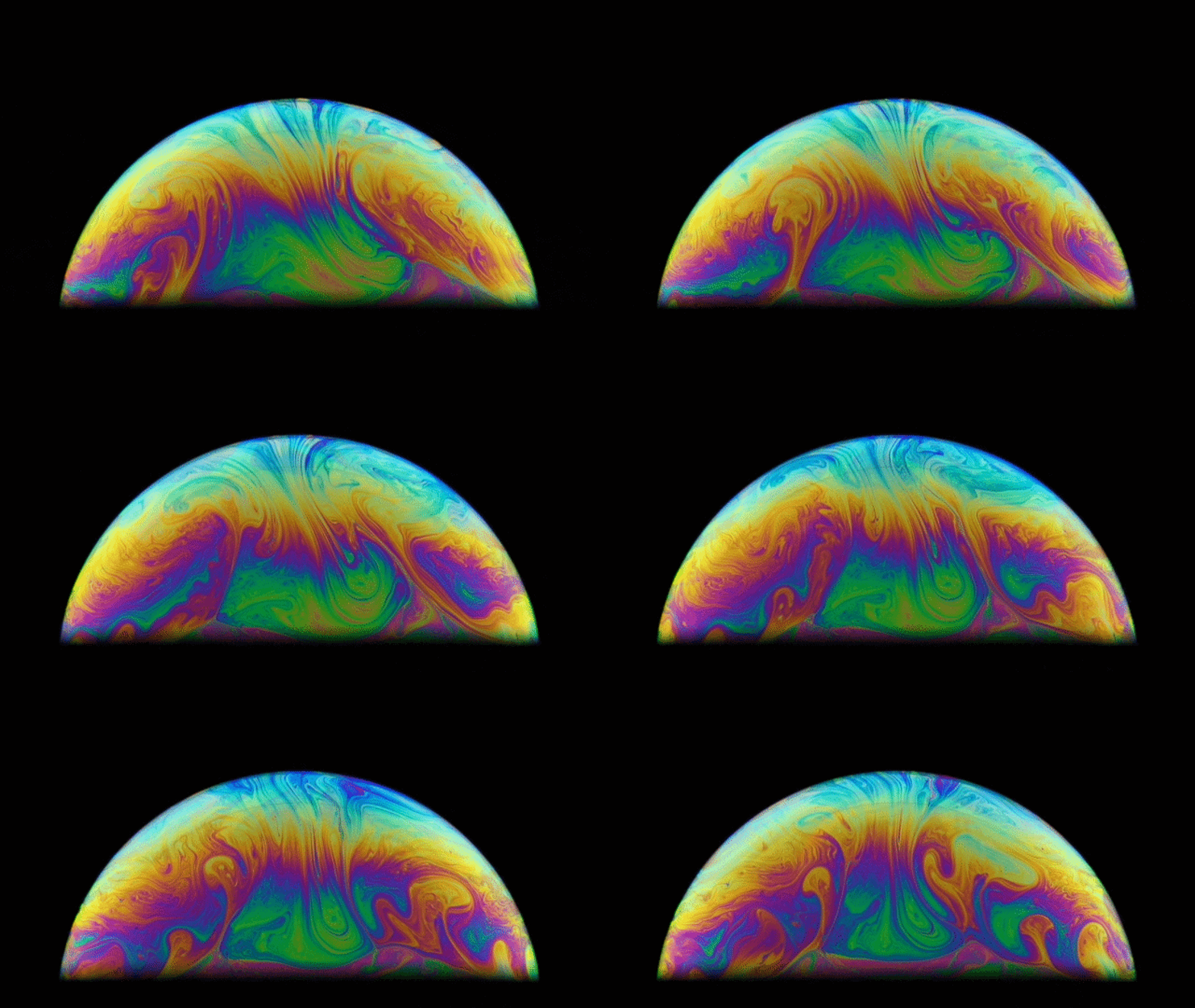
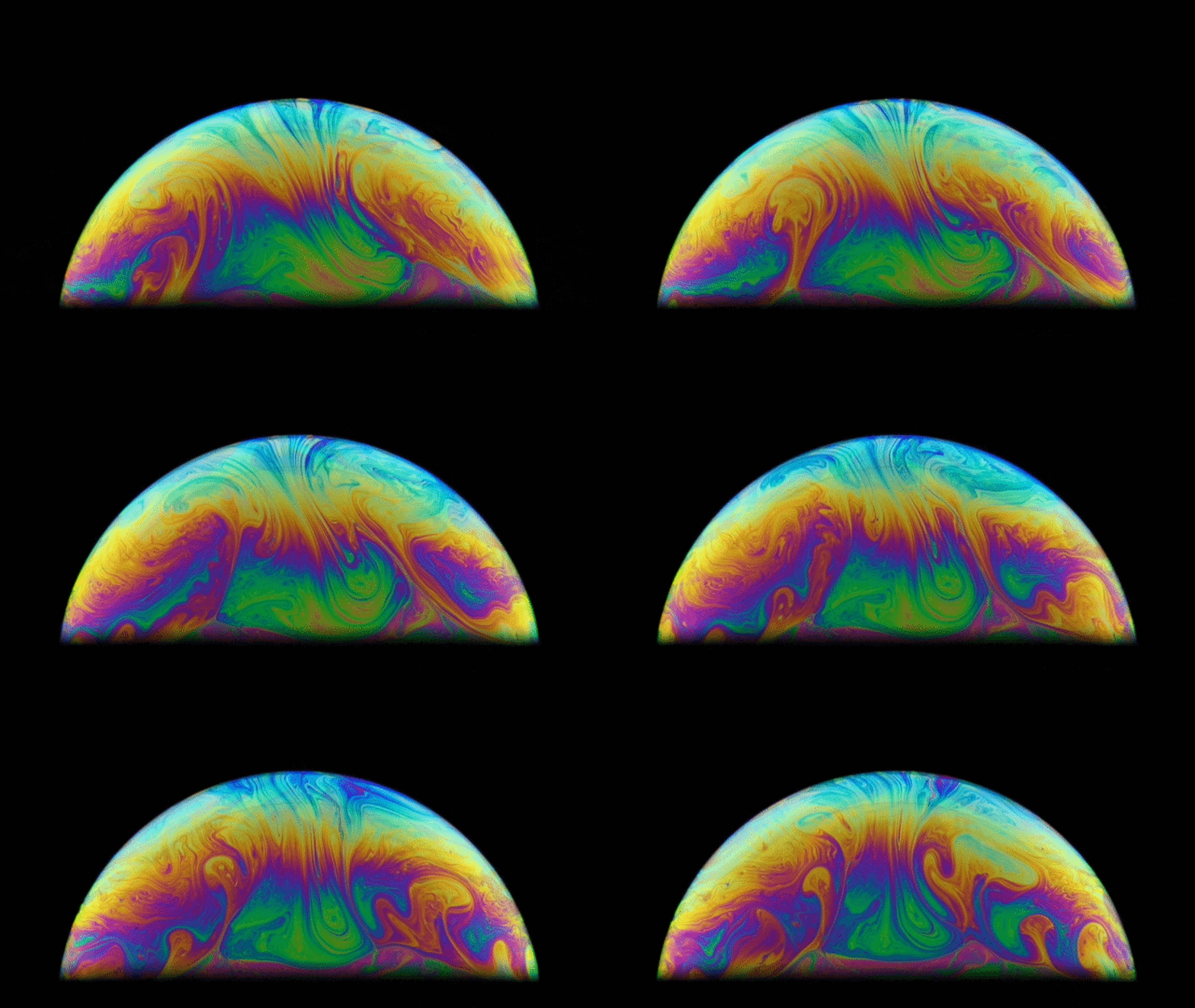
A gif showing colorful fluid moving in a bubble

OpenAi has claimed its agents solved one of math's largest outstanding problems, but their methods are drawing sharp criticism from the mathematics community.
(Image credit: Science Photo Library via Getty Images)

Tristan Buckmaster, a mathematician at New York University, had just spent months working on what he believed could be a life-defining mathematical proof. Then, during a Sept. 6 meeting with OpenAI employees, he claims that he was issued a stark warning: "Why would you ruin your career?"

That exchange, which Buckmaster described in a detailed public statement this week, sits at the heart of a ballooning controversy around a famous set of mathematical equations called Navier-Stokes.

OpenAI says its artificial intelligence (AI) model has solved an outstanding problem tied to this 200-year-old set of fluid dynamics equations. The set of equations appears on the list of one of the seven Millennium Prize Problems posed by the Clay Mathematics Institute, and its solution comes with a $1 million reward. Buckmaster had been working on the same problem. And he has questions about how the company got there so fast.

The OpenAI breakthrough

The Navier-Stokes equations were formulated in the early 1800s by Claude-Louis Navier and George Gabriel Stokes. They're basically Newton's second law of motion for fluids, describing how any fluid moves: Push air with a fan blade, and the equations predict how that air will flow; or heat the atmosphere with sunlight, and they help forecast tomorrow's weather. They describe how planes fly and how blood moves through your arteries.

The problem is that nobody has proved whether the equations always produce finite answers. Could there be rare conditions that make the equations go haywire? This is called a "blowup," or singularity, which happens when a quantity that should represent something physical (like fluid speed or pressure) spirals toward impossible infinities at certain points in space and time.

You may like
  • A graphic of a series of colorful marbles rolling down various colorful shelves

Nobel Prize-winning physicist and team use Claude AI to solve decades-old math puzzle

  • A close up of a red phone screen with a white circular logo and the word

No, OpenAI's models didn't go 'rogue' when they broke into Hugging Face. Here's what really happened.

  • A close up of a mechanical hand touching a wall of blue and green light.

Elon Musk and Sam Altman claim we've reached the AI singularity. But how would we even know that happened?

Imagine the swirl of water circling a bathtub drain. The Navier-Stokes equations describe how it spins faster as it tightens toward the center. A blowup would mean the math predicts that spin is accelerating forever ‪—‬ an infinite speed at a single point. The bathtub can't do that, but if the equations can, that means the model we trusted for years is wrong and we wouldn't even know where it breaks.

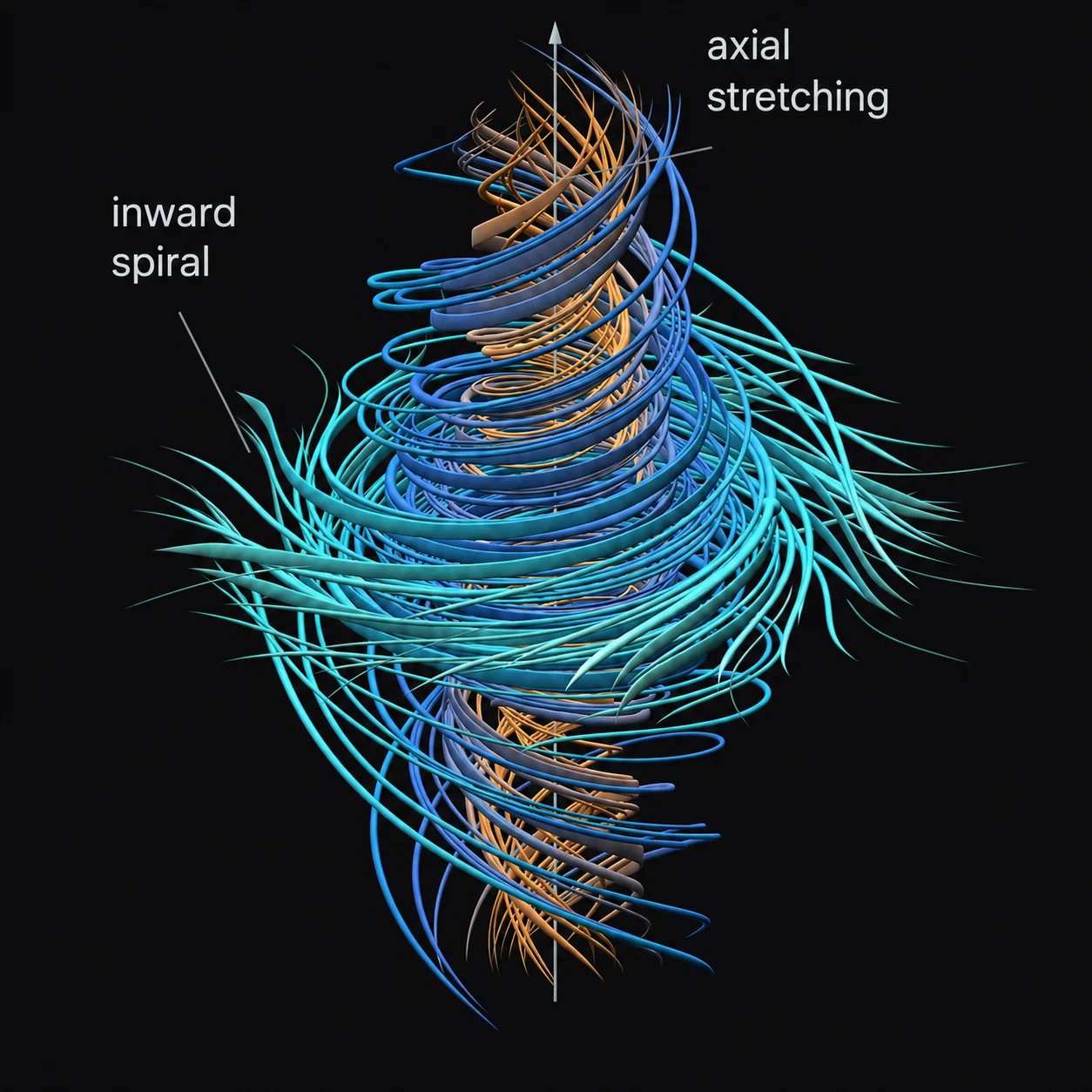
A diagram of swirling colors against a dark background

OpenAI generated this model of local incompressible motion while pushing the Navier-Stokes equations to their limits. Orange shows faster angular rotation; teal shows slower rotation. The trajectories show inward spiraling and axial stretching.

(Image credit: OpenAI)

Whether the Navier-Stokes equations can blow up is one of the most famous unsolved questions.

To find the answer, OpenAI used a technique called "forcing" ‪—‬ giving the simulated fluid a smooth, controlled nudge from the outside. Imagine flicking a spinning top with your finger to see if it would fall over ‪—‬ or, in the case of the Navier-Stokes equations, blow up.

OpenAI set roughly 10,000 AI agents to simultaneously work on the problem. The agents worked for about 88 hours straight, with 100 of them starting with the related Euler equations. This is a simpler cousin of Navier-Stokes that discards viscosity to describe fluid motion without internal friction.

After roughly 50 hours, OpenAI's agents found blowups in the Euler equations, OpenAI representatives wrote in a statement. This discovery convinced them that Navier-Stokes was within reach, and they turned their attention to the bigger problem.

What to read next
  • A digital illustratio of a skull against red binary

'You can't patch your way out of it': Cheap AI worm can spread between devices without human guidance — but how did scientists create it?

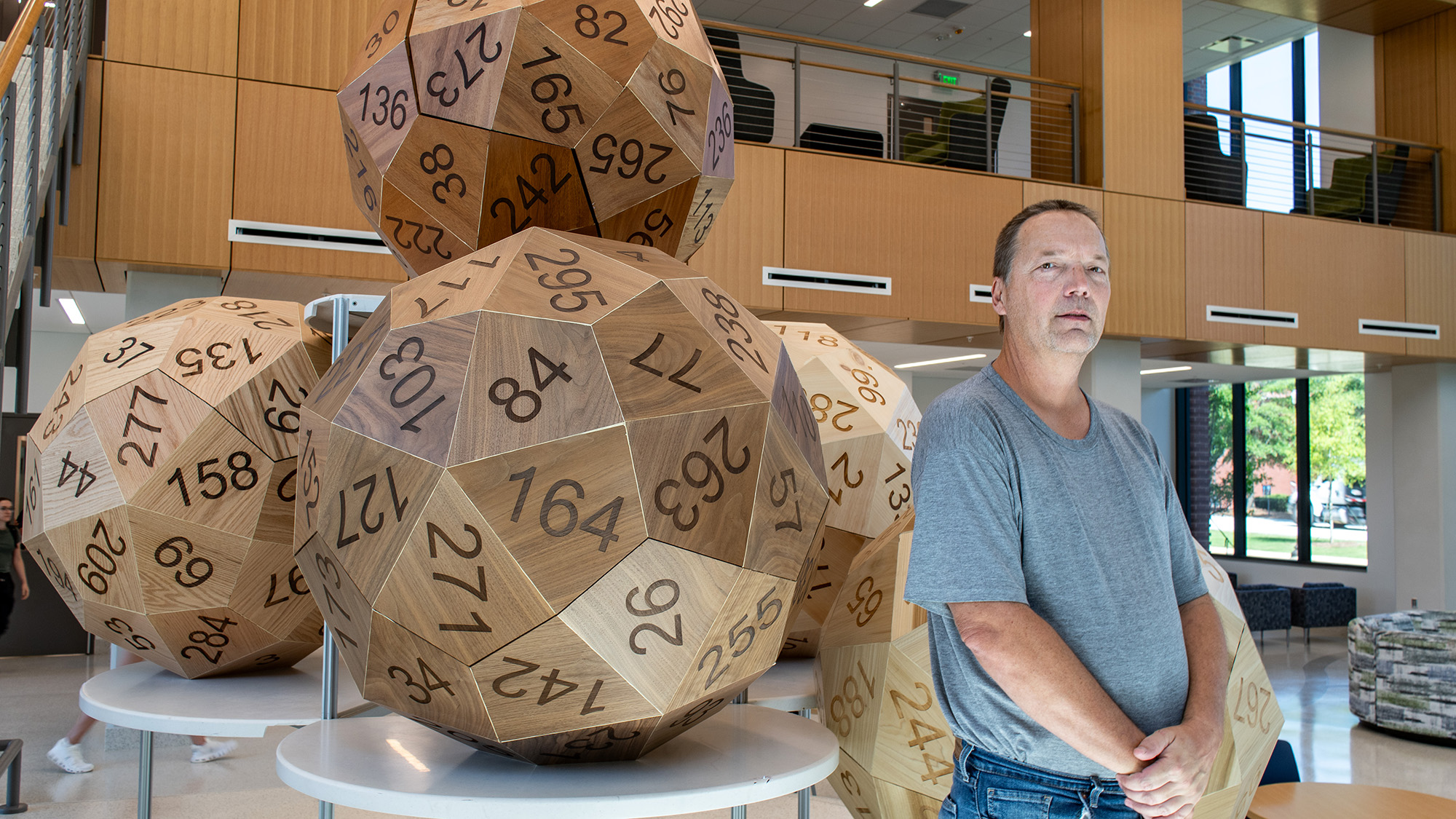
  • A series of large wooden dice sit next to a man

Mathematicians say these 60-sided dice are the fairest in the world

  • A series of people stand in front of an audience at an event.

Mathematician Hong Wang becomes third woman to win the Fields Medal, one of the world’s most prestigious math prizes

OpenAI described the singularity as a vortex spiraling tighter and tighter, stretching and thinning like pulled taffy. The result was a fluid that, mathematically, spins itself into infinity.

OpenAI ran the proof through a program called Lean, software that checks every step of a mathematical argument. The agents "sent 2.7 million messages and used approximately 130 billion output tokens," OpenAI representatives wrote in the statement. At a Sept. 8 news conference, company representatives said a similar effort performed by a customer would have cost $15 million.

The controversy

The result has created a blowup of its own within mathematics, centered around claims that OpenAI's models may have been given a head start by using the work of Tristan Buckmaster and Levent Alpöge, a mathematician at rival AI company Anthropic.

The two mathematicians had been working on the same strategy (smooth forcing) applied to those same Euler equations. The approach itself was developed by Diego Córdoba, a mathematician at the Institute of Mathematical Sciences in Madrid, and Luis Martínez-Zoroa, another mathematician at CUNEF University in Madrid. Almost no one else in the field was using it.

Buckmaster said that on Aug. 15 that he and Alpöge achieved blowup results for the Euler equations with smooth forcing. On Sept. 3, Buckmaster wrote that he received word through Alpöge that OpenAI had caught wind of their progress and adopted the same method.

"When I heard 'forced,'" Buckmaster wrote in his public statement, "it was a bright red flag."

His concern was that the smooth-forcing approach wasn't obvious or widespread. "The ideas making this line of attack possible are due to Córdoba and Martínez-Zoroa," Buckmaster wrote, crediting the two mathematicians who developed the technique. "Almost nobody else I know of was working on it."

And yet, according to OpenAI, the company launched its Navier-Stokes effort on Sept. 1 ‪—‬ the same day it heard "rumors of other Millennium Prize resolutions." Buckmaster claimed, in his public statement, that those rumors were about his and Alpöge's work specifically.

Sam Altman, OpenAI's CEO, acknowledged that the company had learned of Buckmaster and Alpöge's work before making its announcement. "We were curious if ours could do it too," he wrote on X. He added that "the approaches appear to be different" — a claim Buckmaster disputes.

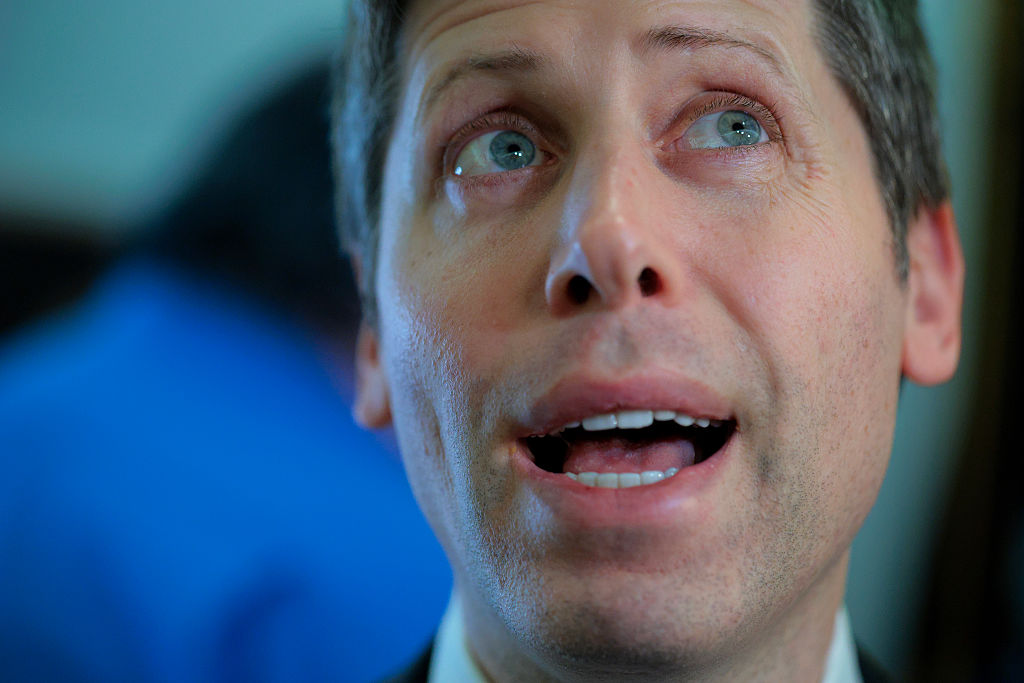
Open AI CEO Sam Altman talks to reporters after meeting with Sen. Bernie Sanders (I-VT) in the Dirksen Senate Office Building on Capitol Hill on June 03, 2026 in Washington, DC.

OpenAI's CEO Sam Altman acknowledged that the company had learned of Buckmaster and Alpöge's work before making its announcement. "We were curious if ours could do it too," he wrote on X.

(Image credit: Chip Somodevilla via Getty Images)

OpenAI's statement names both Buckmaster and Alpöge, credits their independent resolution of the forced Euler problem, and says the company offered to co-publish.

"I did not get an answer"

Buckmaster also revealed that he had been using OpenAI's Codex coding assistant throughout his research, putting drafts of the work into the tool. OpenAI trains its models on user interactions, and Buckmaster said he asked the company directly whether his Codex sessions had been accessed.

"I asked whether the model had been trained on, or had access to, our sessions in Codex, into which we had been putting all our drafts," he wrote. "I asked again, about training, and I did not get an answer."

OpenAI's enterprise agreements govern how customer data can be used. But it's unclear whether Buckmaster was using Codex under an enterprise agreement or as an individual consumer — a distinction that may determine whether his drafts were available for training.

In a statement on X, OpenAI representatives denied that company employees or agents saw the pair's work "by any means" until it was publicly released. However, "we cannot rule out that de-identified data derived from their usage of our products helped improve our models," they added.

Then, there is the question of authorship. Buckmaster alleges that Sébastien Bubeck, who leads OpenAI's math research, twice pushed for Alpöge to be cut from the paper that the two mathematicians were preparing. Buckmaster emphasized that Alpöge works at Anthropic, a rival AI company.

We were curious if ours could do it too.

OpenAI CEO Sam Altman on X.

It was at that same Sept. 6 meeting that Buckmaster claimed that OpenAI presented him with two options, both of which required cutting Alpöge from authorship. He declined and said he told Bubeck that if OpenAI released its result as proposed, he would go public. Bubeck allegedly replied, "If you don't want me to be nice, then I don't have to be nice."

Bubeck has flatly denied the allegations, calling them "false and inflammatory" in a statement on X. "We did not use their prompt or proofs to prompt our models," Bubeck told Wired. Mark Chen, OpenAI's chief research officer, said at last night's news conference that he was "a little disappointed with the allegations."

"I have not seen OpenAI's proof," Buckmaster wrote. "I do not know what their model did, or how. I do not know whether our data was used. I am not accusing anyone of anything." He has called for an independent investigation into how OpenAI's work began.

In a closing line, he wrote, "I would much rather be talking about mathematics, Luis and Diego's ideas, and what this all means for the rest of us."

{ https://www.livescience.com/physics-mathematics }

Hoe vind je dit bericht?
Geschreven door peter om 22:09 Stuur door

'Why would you ruin your career?': OpenAI claims to have cracked one of math's greatest unsolved problems, but mathematicians allege it played dirty - PART II

'Why would you ruin your career?': OpenAI claims to have cracked one of math's greatest unsolved problems, but mathematicians allege it played dirty - PART II

A breakthrough on the Navier-Stokes equations could be worth a $1 million prize, but a mathematician has serious questions about how OpenAI got there so fast.

A gif showing colorful fluid moving in a bubble

OpenAi has claimed its agents solved one of math's largest outstanding problems, but their methods are drawing sharp criticism from the mathematics community.
(Image credit: Science Photo Library via Getty Images)

The community response

Córdoba, one of the original developers of the forcing technique, said he was stunned by how quickly the result had materialized. "We're a little bit in shock," he told Scientific American.

Other mathematicians have also responded to the news, with some expressing open dismay at how the results were released.

"We have now seen that even the rumor of someone working on a massive problem can trigger a massive amount of AI-powered effort to flatten it before the original research project has time to reach its full potential," Terence Tao, a professor of mathematics at UCLA, wrote on Mastodon. "The incentives may now be pointing in the direction of no longer sharing any promising research directions with the broader community, which would reverse centuries of traditions of open science and do serious long-term damage to the future of the field."

OpenAI's proof still awaits formal peer review, and the Clay Mathematics Institute has not yet issued an official verdict confirming or denying OpenAI's proof. But the episode has already surfaced troubling questions for the mathematics community. For example, when a company trains its models on the interactions of millions of users, who really owns the answers that emerge? And what does AI's involvement mean for the future of the field?

Those questions, unlike the Navier-Stokes problem, may not have a clean proof.

RELATED


OpenAI says its AI cracked a 90 year old maths problem: What did it solve

AI cracks one of math's biggest unsolved problems

OpenAI say it cracked a 90-yr-old $1-mn maths puzzle, but a mathematician says he solved it first

{ https://www.livescience.com/physics-mathematics }

Hoe vind je dit bericht?
Geschreven door peter om 22:08 Stuur door

'Why would you ruin your career?': OpenAI claims to have cracked one of math's greatest unsolved problems, but mathematicians allege it played dirty

'Why would you ruin your career?': OpenAI claims to have cracked one of math's greatest unsolved problems, but mathematicians allege it played dirty

A breakthrough on the Navier-Stokes equations could be worth a $1 million prize, but a mathematician has serious questions about how OpenAI got there so fast.

A gif showing colorful fluid moving in a bubble

OpenAi has claimed its agents solved one of math's largest outstanding problems, but their methods are drawing sharp criticism from the mathematics community.
(Image credit: Science Photo Library via Getty Images)

Tristan Buckmaster, a mathematician at New York University, had just spent months working on what he believed could be a life-defining mathematical proof. Then, during a Sept. 6 meeting with OpenAI employees, he claims that he was issued a stark warning: "Why would you ruin your career?"

That exchange, which Buckmaster described in a detailed public statement this week, sits at the heart of a ballooning controversy around a famous set of mathematical equations called Navier-Stokes.

OpenAI says its artificial intelligence (AI) model has solved an outstanding problem tied to this 200-year-old set of fluid dynamics equations. The set of equations appears on the list of one of the seven Millennium Prize Problems posed by the Clay Mathematics Institute, and its solution comes with a $1 million reward. Buckmaster had been working on the same problem. And he has questions about how the company got there so fast.

The OpenAI breakthrough

The Navier-Stokes equations were formulated in the early 1800s by Claude-Louis Navier and George Gabriel Stokes. They're basically Newton's second law of motion for fluids, describing how any fluid moves: Push air with a fan blade, and the equations predict how that air will flow; or heat the atmosphere with sunlight, and they help forecast tomorrow's weather. They describe how planes fly and how blood moves through your arteries.

The problem is that nobody has proved whether the equations always produce finite answers. Could there be rare conditions that make the equations go haywire? This is called a "blowup," or singularity, which happens when a quantity that should represent something physical (like fluid speed or pressure) spirals toward impossible infinities at certain points in space and time.

You may like
  • A graphic of a series of colorful marbles rolling down various colorful shelves

Nobel Prize-winning physicist and team use Claude AI to solve decades-old math puzzle

  • A close up of a red phone screen with a white circular logo and the word "OpenAI" on the front

No, OpenAI's models didn't go 'rogue' when they broke into Hugging Face. Here's what really happened.

  • A close up of a mechanical hand touching a wall of blue and green light.

Elon Musk and Sam Altman claim we've reached the AI singularity. But how would we even know that happened?

Imagine the swirl of water circling a bathtub drain. The Navier-Stokes equations describe how it spins faster as it tightens toward the center. A blowup would mean the math predicts that spin is accelerating forever ‪—‬ an infinite speed at a single point. The bathtub can't do that, but if the equations can, that means the model we trusted for years is wrong and we wouldn't even know where it breaks.

A diagram of swirling colors against a dark background

OpenAI generated this model of local incompressible motion while pushing the Navier-Stokes equations to their limits. Orange shows faster angular rotation; teal shows slower rotation. The trajectories show inward spiraling and axial stretching.

(Image credit: OpenAI)

Whether the Navier-Stokes equations can blow up is one of the most famous unsolved questions.

To find the answer, OpenAI used a technique called "forcing" ‪—‬ giving the simulated fluid a smooth, controlled nudge from the outside. Imagine flicking a spinning top with your finger to see if it would fall over ‪—‬ or, in the case of the Navier-Stokes equations, blow up.

OpenAI set roughly 10,000 AI agents to simultaneously work on the problem. The agents worked for about 88 hours straight, with 100 of them starting with the related Euler equations. This is a simpler cousin of Navier-Stokes that discards viscosity to describe fluid motion without internal friction.

After roughly 50 hours, OpenAI's agents found blowups in the Euler equations, OpenAI representatives wrote in a statement. This discovery convinced them that Navier-Stokes was within reach, and they turned their attention to the bigger problem.

What to read next
  • A digital illustratio of a skull against red binary

'You can't patch your way out of it': Cheap AI worm can spread between devices without human guidance — but how did scientists create it?

  • A series of large wooden dice sit next to a man

Mathematicians say these 60-sided dice are the fairest in the world

  • A series of people stand in front of an audience at an event.

Mathematician Hong Wang becomes third woman to win the Fields Medal, one of the world’s most prestigious math prizes

OpenAI described the singularity as a vortex spiraling tighter and tighter, stretching and thinning like pulled taffy. The result was a fluid that, mathematically, spins itself into infinity.

OpenAI ran the proof through a program called Lean, software that checks every step of a mathematical argument. The agents "sent 2.7 million messages and used approximately 130 billion output tokens," OpenAI representatives wrote in the statement. At a Sept. 8 news conference, company representatives said a similar effort performed by a customer would have cost $15 million.

The controversy

The result has created a blowup of its own within mathematics, centered around claims that OpenAI's models may have been given a head start by using the work of Tristan Buckmaster and Levent Alpöge, a mathematician at rival AI company Anthropic.

The two mathematicians had been working on the same strategy (smooth forcing) applied to those same Euler equations. The approach itself was developed by Diego Córdoba, a mathematician at the Institute of Mathematical Sciences in Madrid, and Luis Martínez-Zoroa, another mathematician at CUNEF University in Madrid. Almost no one else in the field was using it.

Buckmaster said that on Aug. 15 that he and Alpöge achieved blowup results for the Euler equations with smooth forcing. On Sept. 3, Buckmaster wrote that he received word through Alpöge that OpenAI had caught wind of their progress and adopted the same method.

"When I heard 'forced,'" Buckmaster wrote in his public statement, "it was a bright red flag."

His concern was that the smooth-forcing approach wasn't obvious or widespread. "The ideas making this line of attack possible are due to Córdoba and Martínez-Zoroa," Buckmaster wrote, crediting the two mathematicians who developed the technique. "Almost nobody else I know of was working on it."

And yet, according to OpenAI, the company launched its Navier-Stokes effort on Sept. 1 ‪—‬ the same day it heard "rumors of other Millennium Prize resolutions." Buckmaster claimed, in his public statement, that those rumors were about his and Alpöge's work specifically.

Sam Altman, OpenAI's CEO, acknowledged that the company had learned of Buckmaster and Alpöge's work before making its announcement. "We were curious if ours could do it too," he wrote on X. He added that "the approaches appear to be different" — a claim Buckmaster disputes.

Open AI CEO Sam Altman talks to reporters after meeting with Sen. Bernie Sanders (I-VT) in the Dirksen Senate Office Building on Capitol Hill on June 03, 2026 in Washington, DC.

OpenAI's CEO Sam Altman acknowledged that the company had learned of Buckmaster and Alpöge's work before making its announcement. "We were curious if ours could do it too," he wrote on X.

(Image credit: Chip Somodevilla via Getty Images)

OpenAI's statement names both Buckmaster and Alpöge, credits their independent resolution of the forced Euler problem, and says the company offered to co-publish.

"I did not get an answer"

Buckmaster also revealed that he had been using OpenAI's Codex coding assistant throughout his research, putting drafts of the work into the tool. OpenAI trains its models on user interactions, and Buckmaster said he asked the company directly whether his Codex sessions had been accessed.

"I asked whether the model had been trained on, or had access to, our sessions in Codex, into which we had been putting all our drafts," he wrote. "I asked again, about training, and I did not get an answer."

OpenAI's enterprise agreements govern how customer data can be used. But it's unclear whether Buckmaster was using Codex under an enterprise agreement or as an individual consumer — a distinction that may determine whether his drafts were available for training.

In a statement on X, OpenAI representatives denied that company employees or agents saw the pair's work "by any means" until it was publicly released. However, "we cannot rule out that de-identified data derived from their usage of our products helped improve our models," they added.

Then, there is the question of authorship. Buckmaster alleges that Sébastien Bubeck, who leads OpenAI's math research, twice pushed for Alpöge to be cut from the paper that the two mathematicians were preparing. Buckmaster emphasized that Alpöge works at Anthropic, a rival AI company.

We were curious if ours could do it too.

OpenAI CEO Sam Altman on X.

It was at that same Sept. 6 meeting that Buckmaster claimed that OpenAI presented him with two options, both of which required cutting Alpöge from authorship. He declined and said he told Bubeck that if OpenAI released its result as proposed, he would go public. Bubeck allegedly replied, "If you don't want me to be nice, then I don't have to be nice."

Bubeck has flatly denied the allegations, calling them "false and inflammatory" in a statement on X. "We did not use their prompt or proofs to prompt our models," Bubeck told Wired. Mark Chen, OpenAI's chief research officer, said at last night's news conference that he was "a little disappointed with the allegations."

"I have not seen OpenAI's proof," Buckmaster wrote. "I do not know what their model did, or how. I do not know whether our data was used. I am not accusing anyone of anything." He has called for an independent investigation into how OpenAI's work began.

In a closing line, he wrote, "I would much rather be talking about mathematics, Luis and Diego's ideas, and what this all means for the rest of us."

The community response

Córdoba, one of the original developers of the forcing technique, said he was stunned by how quickly the result had materialized. "We're a little bit in shock," he told Scientific American.

Other mathematicians have also responded to the news, with some expressing open dismay at how the results were released.

"We have now seen that even the rumor of someone working on a massive problem can trigger a massive amount of AI-powered effort to flatten it before the original research project has time to reach its full potential," Terence Tao, a professor of mathematics at UCLA, wrote on Mastodon. "The incentives may now be pointing in the direction of no longer sharing any promising research directions with the broader community, which would reverse centuries of traditions of open science and do serious long-term damage to the future of the field."

OpenAI's proof still awaits formal peer review, and the Clay Mathematics Institute has not yet issued an official verdict confirming or denying OpenAI's proof. But the episode has already surfaced troubling questions for the mathematics community. For example, when a company trains its models on the interactions of millions of users, who really owns the answers that emerge? And what does AI's involvement mean for the 

Hoe vind je dit bericht?
Geschreven door peter om 21:51 Stuur door

New Revelations About the Origin of Interstellar Comet 3I/ATLAS

New Revelations About the Origin of Interstellar Comet 3I/ATLAS

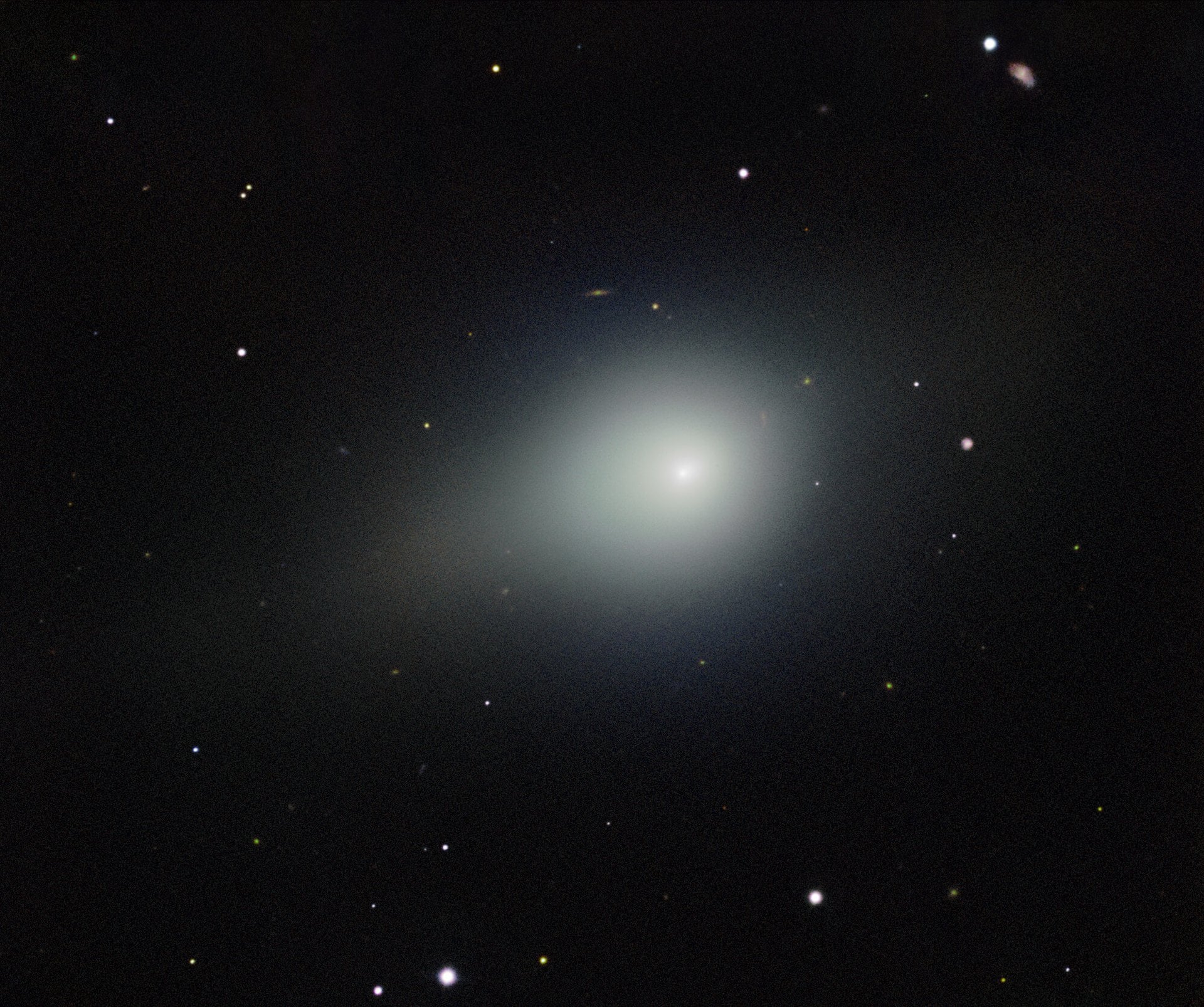
3I/ATLAS photographed in color by the Gemini North telescope on 26 November 2025. Credit: International Gemini Observatory/NOIRLab/NSF/AURA/B. Bolin. 3I/ATLAS photographed in color by the Gemini North telescope on 26 November 2025. Credit: International Gemini Observatory/NOIRLab/NSF/AURA/B. Bolin.

Ever since 3I/ATLAS buzzed through the Solar System, swinging by Earth and then looping around the Sun, scientists have been investigating the origin of this comet. As just the third interstellar object (ISO) detected by astronomers, 3I/ATLAS experienced considerable outgassing before and after it made its closes pass to the Sun. However, the outbursts of material that came after it emerged were truly revelatory as they provided data on its interior composition.

By analyzing the spectra of the material the comet shed, scientists learned a great deal about the origin of this interstellar visitor. In a new paper that appeared in the Monthly Notices of the Royal Astronomical Society, a team of researchers revealed that the comet formed in extremely cold conditions, likely in the far reaches of its home star system. This remarkable first for astronomers could have significant implications for future ISO research.

Using the WHT Enhanced Area Velocity Explorer (WEAVE), a new multi-object spectrograph mounted on the Isaac Newton Group's (ING) 4.2m William Herschel Telescope (WHT), the team examined the ionized gases released by 3I/ATLAS as it emerged from behind the Sun and began leaving our Solar System. By combining WEAVE's Large Integral Field Unit (LIFU) spectroscopy with the WHT's new guiding capabilities, the team identified five different ions produced simultaneously in the comet's stream.

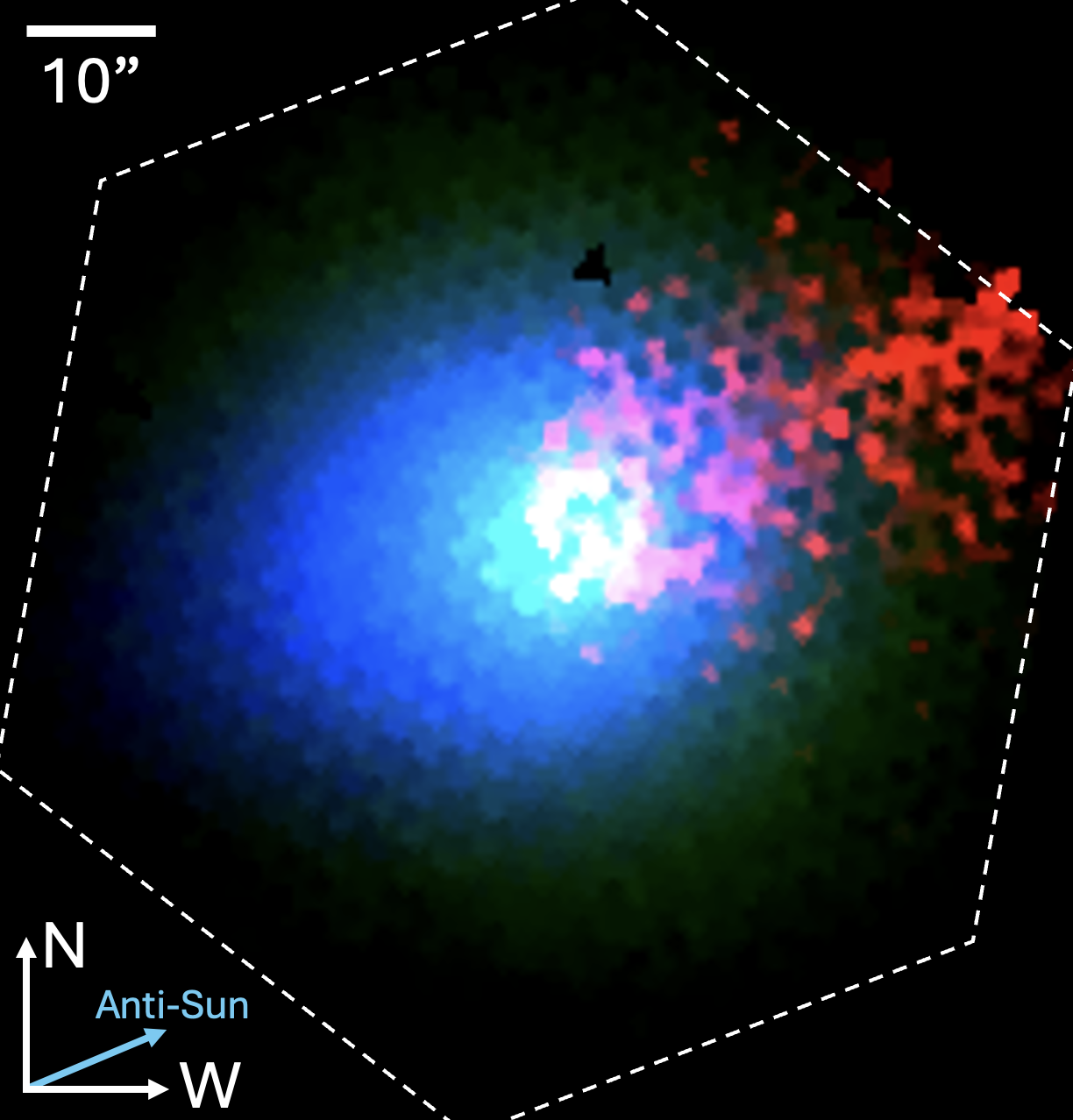
This figure illustrates the different distributions of dust (blue), gas (green), and ions (red) in 3I/Atlas. Credit: Lea Ferellec (CC BY 4.0)

This figure illustrates the different distributions of dust (blue), gas (green), and ions (red) in 3I/Atlas.

Credit: Lea Ferellec (CC BY 4.0)

These included ions of dinitrogen (N⁠2), carbon monoxide (CO+)⁠, carbon dioxide (CO2+⁠), hydrogen (H2O+⁠), and hydrocarbons (CH+). By measuring the ratio of dinitrogen gas to carbon monoxide, the researchers determined that 3I/ATLAS formed in conditions colder than -240°C (-400 °F). This suggests that it formed far from its star in the distant, icy edge of its solar system - similar to objects in the Solar System's Kuiper Belt or Oort Cloud.

Dr. Léa Ferellec, a Research Fellow at the University of Northumbria's School of Engineering, Physics and Mathematics and the study's lead author, explained in a Royal Astronomical Society (RAS) press statement:

This object gives us a rare chance to study material that formed somewhere completely different to our own Solar System. Finding that it's so rich in nitrogen tells us it likely formed in extremely cold conditions, far from its home star. Every one of these objects we study helps us understand a little more about how planets form around other stars.

The team also examined how the ion ratios varied along the comet's tail, which forms when solar wind sweeps the charged particles out behind it. They detected only a marginal decrease in hydrocarbon ions the farther they traveled along the tail. This analysis constitutes the first time that this level of detail has been captured with an ISO. Said co-author Rubén Sánchez-Janssen

Powerful, large-format IFUs with high sensitivity in the blue optical spectrum – like WEAVE-LIFU on the WHT – are opening new frontiers for the study of comets and other solar system objects. This discovery is a perfect example of the value of DDT, which is specifically designed to enable observations of exceptional and urgent scientific importance.

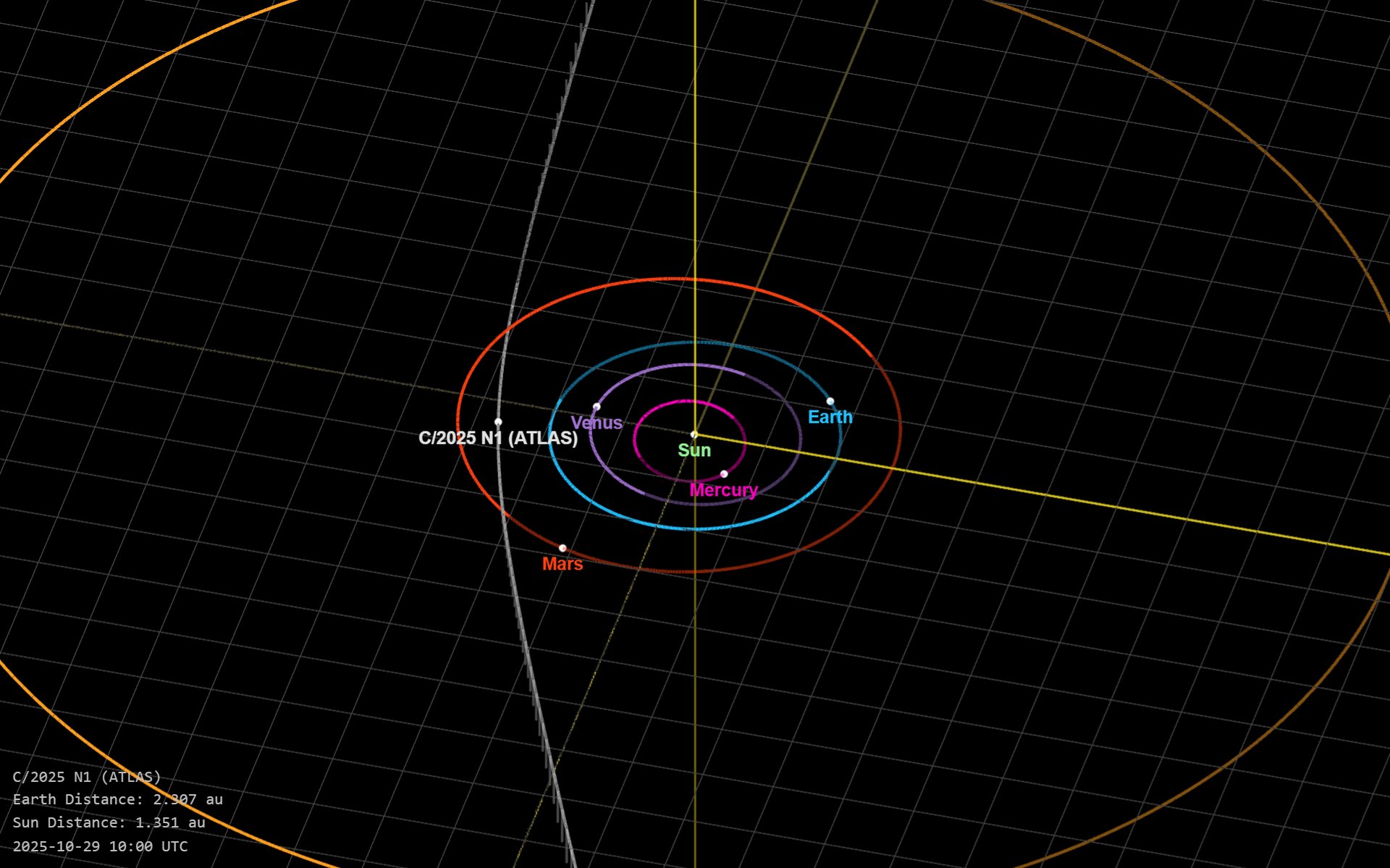
Comet 3I/ATLAS at perihelion. Credit: NASA/JPL.

Comet 3I/ATLAS at perihelion.

Credit: NASA/JPL.

Asteroids and comets are essentially material leftover from the formation of a solar system. As a result, ISOs that periodically enter our system present opportunities to study conditions around other stars without having to visit them. Since 2017, when 'Oumuamua was spotted flying past Earth, scientists have been able to achieve greater and greater returns on their observations, thanks to improvements in instruments and methodology. When the fourth ISO ever detected is spotted, scientists could learn even more about its composition and origin.

RELATED

Interstellar Comet 3I/ATLAS Traced to Another Star System

It Came From Another Star System—And It’s Here

£The Complete History of 3I/ATLAS — The Third Interstellar Object Ever Discovered

{  https://www.universetoday.com/ }

Hoe vind je dit bericht?
Geschreven door peter om 21:25 Stuur door

Giant 'megalith structure' spotted on ocean floor sparks alien base theories

Giant 'megalith structure' spotted on ocean floor sparks alien base theories

A mysterious structure spotted on the seafloor near Papua New Guinea has sparked claims that an alien base may be hiding below the surface.

Self-described UFO researcher Scott C Waring identified the enormous rectangular-shaped anomaly, suggesting it is approximately 10 miles long and four miles wide.

Waring said he discovered the formation while exploring the global ocean-floor maps produced by the Seabed 2030 project.

He described it as a ‘megalith structure’ and estimated that it could extend between 10 and 15 miles beneath the seabed.

Waring claimed its immense size, unusual shape and isolated location suggest it is far more than a natural geological formation.

‘This alien base looks clean and taken care of,’ he wrote, claiming its apparently uncovered surface meant it was still occupied.

He also claimed that 'aliens are living there right now.'

However, there is no independent evidence that the structure is artificial, occupied or anything other than a natural formation or mapping anomaly.

Self-described UFO researcher Scott C Waring identified the enormous anomaly, suggesting it approximately 10 miles long and four miles wide

Self-described UFO researcher Scott C Waring identified the enormous anomaly, suggesting it approximately 10 miles long and four miles wide

Waring shared his discovery on his UFO Sightings Daily YouTube channel, saying: 'Found something that you’re not even going to believe. 

'You can’t even comprehend this exists because it’s real, and it’s out there under the ocean right now.' 

He went on to estimate that the structure could feature 20 different buildings, each the size of the Empire State Building. 

'This is just huge. It's big enough for an entire city to live inside of this. It is massive,' Waring said. 

Many of Waring's followers were also sure that the structure on the map was something worth investigating.

One user said, 'cool find,' while another simply commented, 'aliens.' 

However, confirming an alien would require detailed sonar surveys, underwater photographs and physical evidence.

Even more, the US government has long maintained that there is no evidence that Earth has been visited by aliens.

A mysterious structure spotted on the seafloor near Papua New Guinea has sparked claims that an alien base may be hiding below the surface

A mysterious structure spotted on the seafloor near Papua New Guinea has sparked claims that an alien base may be hiding below the surface

Waring announced another mysterious find this week, claiming to have uncovered evidence of a lost civilization off the coast of Cuba.

The seafloor data shows a series of faint, roughly parallel and intersecting lines across the seabed west of the island.

He estimated that the apparent site stretches seven or eight miles in one direction and approximately three miles in the other.

‘This new map is extraordinary,’ Waring said in a YouTube video highlighting the area. ‘In this one location, there is an ancient sunken city.

‘There are a lot of geometric shapes, which indicate there is something down here that was intelligently made,’ he added.

However, no archaeologists or marine scientists have examined the site or confirmed that the patterns represent physical, human-made structures. 

Waring said the scale and regularity of the shapes convinced him that they were unlikely to have formed naturally.

Waring other shapes near Cuba and Haiti (left of the island), arguing they could be the remains of a city constructed by ancient humans

Waring other shapes near Cuba and Haiti (left of the island), arguing they could be the remains of a city constructed by ancient humans

He considered whether the supposed builders were humans or visitors from another world.

‘Now, is it ancient alien or is it ancient humans?’ Waring asked on his site, UFO Sightings Daily. ‘That’s the big question.’

He ultimately favored a lost human civilization, arguing: ‘I would probably go with ancient humans because the geometric design looks more primitive and less futuristic to me.'

Waring suggested the shapes could mark the remains of a settlement resembling Atlantis, the legendary civilization said to have disappeared beneath the sea.

‘This could be a long-lost city, long ago like Atlantis or something, built on the coral reef of an island area,’ he said.

He speculated that a powerful earthquake may have destabilized the island, causing the reef and everything constructed upon it to collapse into the ocean.

‘An earthquake just could have rattled it so much that coral could have just collapsed on itself and the whole island could have sunk,’ Waring explained.


Extraterrestrial Mysteries on the Ocean Floor | Ancient Aliens

 { https://www.dailymail.com/sciencetech/index.html }

Hoe vind je dit bericht?
Geschreven door peter om 21:07 Stuur door

Meer van UFO'S of UAP'S, ASTRONOMIE, RUIMTEVAART, ARCHEOLOGIE, OUDHEIDKUNDE, SF-SNUFJES EN ANDERE ESOTERISCHE WETENSCHAPPEN - DE ALLERLAATSTE NIEUWTJES

↑ Terug naar de berichten