

Naar de inhoud

UFO'S of UAP'S, ASTRONOMIE, RUIMTEVAART, ARCHEOLOGIE, OUDHEIDKUNDE, SF-SNUFJES EN ANDERE ESOTERISCHE WETENSCHAPPEN - DE ALLERLAATSTE NIEUWTJES

UFO's of UAP'S in België en de rest van de wereld
akke.beakke.be
Ontdek de Fascinerende Wereld van UFO's en UAP's: Jouw Bron voor Onthullende Informatie! Ben jij ook gefascineerd door het onbekende? Wil je meer weten over UFO's en UAP's, niet alleen in België, maar over de hele wereld? Dan ben je op de juiste plek! België: Het Kloppend Hart van UFO-onderzoek In België is BUFON (Belgisch UFO-Netwerk) dé autoriteit op het gebied van UFO-onderzoek. Voor betrouwbare en objectieve informatie over deze intrigerende fenomenen, bezoek je zeker onze Facebook-pagina en deze blog. Maar dat is nog niet alles! Ontdek ook het Belgisch UFO-meldpunt en Caelestia, twee organisaties die diepgaand onderzoek verrichten, al zijn ze soms kritisch of sceptisch. Nederland: Een Schat aan Informatie Voor onze Nederlandse buren is er de schitterende website www.ufowijzer.nl, beheerd door Paul Harmans. Deze site biedt een schat aan informatie en artikelen die je niet wilt missen! Internationaal: MUFON - De Wereldwijde Autoriteit Neem ook een kijkje bij MUFON (Mutual UFO Network Inc.), een gerenommeerde Amerikaanse UFO-vereniging met afdelingen in de VS en wereldwijd. MUFON is toegewijd aan de wetenschappelijke en analytische studie van het UFO-fenomeen, en hun maandelijkse tijdschrift, The MUFON UFO-Journal, is een must-read voor elke UFO-enthousiasteling. Bezoek hun website op www.mufon.com voor meer informatie. Samenwerking en Toekomstvisie Sinds 1 februari 2020 is Pieter niet alleen ex-president van BUFON, maar ook de voormalige nationale directeur van MUFON in Vlaanderen en Nederland. Dit creëert een sterke samenwerking met de Franse MUFON Reseau MUFON/EUROP, wat ons in staat stelt om nog meer waardevolle inzichten te delen. Let op: Nepprofielen en Nieuwe Groeperingen Pas op voor een nieuwe groepering die zich ook BUFON noemt, maar geen enkele connectie heeft met onze gevestigde organisatie. Hoewel zij de naam geregistreerd hebben, kunnen ze het rijke verleden en de expertise van onze groep niet evenaren. We wensen hen veel succes, maar we blijven de autoriteit in UFO-onderzoek! Blijf Op De Hoogte! Wil jij de laatste nieuwtjes over UFO's, ruimtevaart, archeologie, en meer? Volg ons dan en duik samen met ons in de fascinerende wereld van het onbekende! Sluit je aan bij de gemeenschap van nieuwsgierige geesten die net als jij verlangen naar antwoorden en avonturen in de sterren! Heb je vragen of wil je meer weten? Aarzel dan niet om contact met ons op te nemen! Samen ontrafelen we het mysterie van de lucht en daarbuiten.

Archief

The mysterious orbs pilots keep seeing — and no one can explain

The mysterious orbs pilots keep seeing — and no one can explain

The objects in question are not blurry lights on a horizon. They are often visible to the naked eye and confirmed through advanced sensors and radar systems.

An illustration of a UFO probe contorlled by superadvanced AI.

Across oceans, cities, and open skies, U.S. military pilots continue to encounter something unusual. Not discs or flashing lights, but smooth, fast-moving metallic orbs. These objects appear without warning, hover motionless, or shift direction abruptly, then vanish in seconds. Encounters have occurred during routine patrols, combat missions, and training flights alike. Some have been recorded on infrared cameras, others tracked by radar or logged in official reports. Despite years of observation, there is still no clear explanation for what these objects are or where they come from.

What pilots are actually seeing

The objects in question are not blurry lights on a horizon. They are often visible to the naked eye and confirmed through advanced sensors and radar systems. Pilots describe them as metallic spheres, about the size of a basketball, moving at speeds and with precision unmatched by conventional aircraft.

There are no wings, no control surfaces, no visible propulsion. Some hover motionless in high winds. Others accelerate abruptly or reverse direction without turning. Most leave no heat signature. These are not assumptions based on guesswork. They are observed, filmed, and reported by aviators trained to identify every known type of airborne vehicle.

Encounters tend to occur near restricted airspace. They disrupt training exercises and, in some cases, have nearly caused mid-air collisions. These are not casual or recreational observations. They are events documented in flight logs and analyzed by military intelligence.
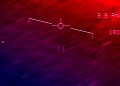
Gimbal UFO: a turning point in official recognition

One of the most famous incidents occurred in 2015 and was made public in 2017 as part of a leak that changed the U.S. government’s approach to unidentified aerial phenomena. Captured by an F/A-18 Super Hornet using a forward-looking infrared system (FLIR), the object shown in the video became known as the Gimbal UFO.

The video shows a disc-like craft flying at high altitude off the U.S. East Coast. What made it unusual was not just its speed or shape, but its behavior. The object rotated in mid-air while maintaining a consistent trajectory, something that defied known aerodynamic principles. Pilots speaking on the video can be heard expressing shock and confusion. There were no wings, no exhaust, and no clear method of propulsion. Radar also confirmed its presence.

This was not an isolated case. The Gimbal UFO was one of several objects tracked over days. Military personnel were told to report the sightings, but no explanation was ever given. The craft moved against the wind and changed direction abruptly, traits shared by other spherical and orb-like UAPs encountered around the same period.

The Tic Tac UFO: maneuverability beyond known physics

Perhaps the most analyzed incident involving a spherical or elliptical object occurred off the coast of Southern California in 2004. Referred to as the Tic Tac UFO, it was encountered by pilots from the USS Nimitz Carrier Strike Group during a routine training operation.

Commander David Fravor and Lieutenant Commander Jim Slaight were among those who visually confirmed the object. They described it as a smooth, white, oblong shape, about 40 feet long, with no wings or exhaust. It hovered at 80,000 feet, then dropped to sea level in under a second.

When Fravor attempted to intercept, the object responded with what appeared to be intelligent maneuvering. It mirrored movements, accelerated instantly, and disappeared from sight. The encounter was also tracked by the Princeton’s SPY-1 radar and captured by targeting cameras. The performance was beyond what any known drone or aircraft could accomplish.

This case stood out not only for its technical data but for the credibility of the witnesses. Multiple pilots, radar operators, and camera systems all observed the same object at the same time. The flight characteristics could not be replicated, and the incident remains unexplained to this day.

Pentagon confirmation and video evidence

In 2023, the Pentagon officially released new footage recorded by a Reaper drone over the Middle East. The object, clearly spherical, darted across the screen in a way that ruled out conventional drones or balloons. It showed no means of lift, no exhaust trail, and no thermal emissions.

The Department of Defense has now acknowledged multiple videos as authentic. Among them are the Gimbal, GoFast, and FLIR1 recordings (above). Each shows an unidentified craft exhibiting extraordinary behavior. The spherical shape is particularly common. It presents minimal drag and is difficult to track by radar, but the speed and control are what truly stand out.

These objects are not streaking meteors or atmospheric illusions. They maintain altitude, respond to nearby aircraft, and sometimes linger in restricted airspace for long durations. Intelligence reports confirm that these sightings are not isolated to one region or mission. They occur globally, across different climates and altitudes.

Historical sightings long before the headlines

Though public interest in orbs has grown in the last decade, pilots have seen them for nearly a century. During World War II, U.S. and Allied pilots reported glowing spheres that followed their aircraft. Dubbed Foo Fighters, these objects were considered advanced enemy tech — yet neither side ever claimed them.

During the Cold War, similar sightings occurred over U.S. and Soviet nuclear installations. In some cases, the objects disabled weapons systems or triggered alerts. Files declassified in recent years reveal that these events were taken seriously. Teams were dispatched to investigate. The patterns were tracked. No conclusions were reached.

The continuity of sightings — from WWII to 2023 — suggests something persistent and physical, not a trend of misperceptions or radar errors.

What they might be — and what they are not

Several explanations have been offered. Some say they are drones, possibly foreign or classified domestic technology. Others suggest weather balloons, optical illusions, or rare electromagnetic phenomena. Each theory has limits.

Drones do not hover without noise or heat. Balloons do not change direction abruptly or remain stable in strong winds. Optical illusions do not appear on multiple sensors and radar simultaneously. No known system can match the agility, speed, and endurance shown in the verified videos.

Photograph taken by Charles Morose showing a coast guard plane chasing a UFO. Image credit: Charles Morose/Sun. Photograph taken by Charles Morose showing a coast guard plane chasing a UFO. Image credit: Charles Morose/Sun.

What is more troubling is the absence of any confirmed origin. No government has claimed ownership. No fragments have been found. Despite hundreds of documented cases, there is no traceable launch site, signature, or manufacturer. The U.S. government, after years of denial, now openly states that many of these objects remain unexplained.

Speaking personally, I don’t believe there are little green men piloting these things. Traveling across interstellar distances is an enormous challenge, even for a hypothetical advanced civilization. But if these craft are not ours, and not from here, then what we may be seeing is something else entirely — something like autonomous probes. Highly advanced, possibly guided by artificial intelligence far beyond anything we’ve developed. That, to me, seems far more plausible than crewed ships. It would make sense for an alien civilization to send machines ahead of itself, long before arriving in person — if arriving at all.

Why the military is treating it as a serious threat

The response to these encounters has evolved. What was once quietly dismissed is now being discussed in congressional hearings. In 2022, the Department of Defense formed the All-domain Anomaly Resolution Office (AARO). Its mission is to investigate reports of unidentified aerial, underwater, and transmedium objects.

Military pilots have testified under oath about near-collisions and routine sightings. Some report being discouraged from speaking up in the past. That is changing. The focus is not on proving extraterrestrial origins. It is on identifying unknown technology that could pose risks to aircraft or infrastructure.

Air safety is a driving concern. When fast-moving, unidentified objects appear in restricted airspace, the risk is not just hypothetical. It is immediate. Pilots cannot react to something they cannot identify. Commanders cannot defend against something they cannot track.

Closing reflection

So, what’s my take? The mysterious orbs pilots keep seeing aren’t stories or secondhand accounts. They’re real, they’re recorded, and they’re showing up on sensors across different platforms. Pilots from different squadrons and different years keep describing the same thing. Small, fast, spherical objects that move in ways we don’t understand.

They don’t follow the rules of conventional flight. They don’t give off heat, don’t have wings, and they move in ways that don’t make sense with current technology. And they keep showing up where they’re not supposed to be. That alone should be enough to take them seriously.

What’s encouraging is that this isn’t being shrugged off anymore. Pilots are speaking publicly. Congress is listening. And scientists are getting involved. One of them is Avi Loeb, a professor at Harvard. He’s behind the Galileo Project, a scientific effort to gather hard data on unidentified objects in Earth’s skies, oceans, and even space. His team is building instruments to detect and track them. They’re also analyzing physical materials from unexplained sources, like the fragments recovered off Papua New Guinea’s coast. Instead of waiting for answers to fall into our laps, they’re going out and looking for them.

And personally, I don’t think we’re seeing aliens flying around in these orbs. Traveling across the galaxy isn’t easy, and I doubt beings are hopping out of these things. If these are from somewhere else, what we might be seeing are autonomous probes. Machines, not crewed ships. That makes more sense to me. An advanced civilization would probably send AI long before it sent itself.

The important part is, this isn’t fringe anymore. These sightings are documented. They’re happening. And for the first time, people are actually paying attention.

{ https://curiosmos.com/category/alien-theories/ }

Hoe vind je dit bericht?
Geschreven door peter om 21:00 Stuur door

New Algorithm Details the Most Extreme Particle Storm Known to Science

New Algorithm Details the Most Extreme Particle Storm Known to Science

the-most-extreme-solar.jpg Model of the SOCOL:14C-Ex system understanding the C-14 data in tree rings. Credit - K Golubenko et al / Earth and Planetary Science Letters

Extreme solar storms are a relatively rare event. However, as more and more of our critical infrastructure moves into space, they will begin to have more and more of an impact on our daily lives, rather than just providing an impressive light show at night. So it's best to know what's coming, and a new paper from an international team of researchers led by Kseniia Golubenko and Ilya Usoskin of the University of Oulu in Finalnd found a massive Extreme Solar Particle Event (ESPE) that happened 12350 years ago, which is now considered to be the most energetic on record. 

During an ESPE, the Sun releases a stream of particles that collide with Earth's atmosphere. This type of event isn't the same as probably the most famous "solar storm" of all time, the Carrington Event, which set fire to telegraph stations worldwide in 1859. The Carrington Event was a geomagnetic storm caused by a coronal mass ejection (CME) that directly interacted with Earth's magnetic field. It didn't have as much effect on the Earth's atmosphere, especially compared to the ancient ESPE.

ESPEs, as their name suggests, are caused by a massive influx of particles from the Sun. These particles interact directly with the Earth's atmosphere, and, importantly for the purposes of dating, have a noticeable impact on Carbon-14 levels. Specifically, the amount of C-14, as it's commonly known in chemistry, is increased dramatically compared to a baseline. Since living things like trees sequester carbon, we can tell when events like this happen to measure the amount of C-14 embedded in those previously living things using a technique called radiocarbon dating.

Fraser talks through the Carrington event and how it impacts our engineering designs now.

The paper does not describe new data—the tree rings they used to capture the 12350 BC event were found in southwestern Europe and described in a paper in 2023. The new work done in this paper was to apply a climatic model known as SOCOL:14C-Ex and use it to understand the impact the environment at the time had on the capture and sequestration of the C-14 isotopes from the ESPE. 

When the ESPE hit, the Earth was in an entirely different geological age, known as the Late Glacial period, at the end of the last Ice Age, as compared to the Holocene period that has existed for the last 10,000 years. That means there were pretty massive geological differences that could play a role in how the C-14 was captured in the rings.

The Earth had weaker geomagnetic shielding in 12350 BC, allowing more particles to enter the atmosphere than a similarly-sized event would have in the modern day. However, it also had lower CO2 levels, meaning there was less Carbon-12 (a more stable isotope) to be transmuted into C-14. The climate itself was different, and while it could have impacted the C-14 levels by changing the efficacy of carbon sinks or increasing how the C-14 particles moved about the atmosphere, the study found that it had a relatively limited impact on the differences between modern-day and the carbon levels back then.

Solar storms can get pretty bad, as Fraser explains.

To prove what "modern day" would have been like, the researchers used one of eight other known extreme ESPEs found in other tree rings. This one occurred in 775 and was previously the most intense ESPE known to science. Plenty of other tree rings from Germany, New Zealand, Argentina, the US, and elsewhere already had known C-14 levels that could be used as a calibration, in this case, a proof of concept.

The researchers tested SOCOL:14C-Ex to estimate the storm's intensity in 775 and proved the model worked then. They then adjusted some of the parameters based on the above considerations to calculate the ESPE intensity in 12350 BC. They found that it was about 18% stronger than the event in 775, making it the strongest known ESPE yet found.

Understanding how the Sun's extremes can affect us will continue to play a central role as we move more and more of our infrastructure off-planet. Engineers will have to plan for these extremes, and knowing the limits will only help us understand what we need to design. And who knows, there may be even more extreme events in the fossil record that SOCOL:14C-Ex will eventually find.

Learn More:

RELATED VIDEOS


{ https://www.universetoday.com/ }

Hoe vind je dit bericht?
Geschreven door peter om 20:37 Stuur door

Mysterious streak of light appears over the U.S.

Mysterious streak of light appears over the U.S.

On the night of Friday, May 16, something extraordinary lit up the skies over the American Southwest. A brilliant, fast-moving streak of light that captivated onlookers from Arizona to Colorado. 
streak%20of%20light%20mystery%20US.png

Witnesses in towns such as Safford, Fountain Hills, and Payson, as well as regions of New Mexico and Colorado, were left asking the same question: What exactly did we just see? 
Speculation spread rapidly. Some suggested a Chinese rocket launch earlier that day could be responsible, possibly placing satellites into orbit. Others floated more exotic theories: perhaps STEVE, a rare atmospheric light phenomenon similar to the aurora borealis, or even a “light pillar,” formed when light reflects off high-altitude ice crystals. 
Attempts to reach officials at Luke Air Force Base near Phoenix, Davis-Monthan Air Force Base in southern Arizona, and Kirtland Air Force Base in Albuquerque have so far yielded no response. 
streak%20of%20light%20mystery%20US.jpg

What if it wasn’t a rocket plume from a Chinese launch at all? What if something entirely different passed near our planet, like a comet or UFO, or perhaps it was a test of a space-based weapon or a directed-energy system? 
Whatever it may have been, it remains a strange phenomenon, leaving many to wonder what truly streaked across the sky.
  

RELATED VIDEOS

{ http://ufosightingshotspot.blogspot.com/ }

Hoe vind je dit bericht?
Geschreven door peter om 20:23 Stuur door

Drie ogen, enorme scharen en een bek vol scherpe tanden: maak kennis met de 506 miljoen jaar oude Mosura fentoni

Drie ogen, enorme scharen en een bek vol scherpe tanden: maak kennis met de 506 miljoen jaar oude Mosura fentoni

Drie ogen, enorme scharen en een bek vol scherpe tanden: maak kennis met de 506 miljoen jaar oude Mosura fentoni
© Scientias.nl

Het lijkt op de foto een gruwelijk beest, de pas ontdekte Mosura fentoni. Gelukkig is hij maar zo groot als je wijsvinger (en al heel lang uitgestorven). Die drie ogen en enorme scharen worden dan toch iets minder angstaanjagend.

Het zijn paleontologen van het Canadese Royal Ontario Museum die het 506 miljoen jaar oude roofdier hebben gevonden. Ze troffen fossielen van het beestje aan op de beroemde vindplaats de Burgess Shale in Yoho National Park en schreven erover in een artikel in het tijdschrift Royal Society Open Science.

De radiodonten
De Mosura fentoni heeft een ronde bek met tanden en een lichaam met zwemvliezen aan de zijkant. Het dier maakte deel uit van een uitgestorven groep uit het Cambrium, de radiodonten. Ook de veel beroemdere meterslange grote broer Anomalocaris canadensis behoort daartoe.

  • Bekijk hier beelden van de Anomalocaris canadensis, het meest iconische lid van de radiodonten. Hij kon wel een meter lang worden en is voor het eerst beschreven in 1892.
Maar Mosura heeft ook een uniek kenmerk dat geen enkele andere radiodont heeft: een buikachtig lichaamsdeel aan de achterkant, dat uit meerdere segmenten bestaat.

“Mosura heeft zestien dicht op elkaar zittende segmenten met kieuwen aan de achterkant van zijn lichaam. Dit is een mooi voorbeeld van evolutionaire convergentie met moderne groepen, zoals degenkrabben, pissebedden en insecten, die ook een aantal segmenten hebben met ademhalingsorganen aan de achterkant van het lichaam”, legt onderzoeksleider Joe Moysiuk uit. Hij is conservator paleontologie en geologie in het Manitoba Museum. Waarom de Mosura dit heeft, is nog niet helemaal duidelijk, maar het heeft vermoedelijk te maken met een voorkeur voor een bepaalde habitat of gedragskenmerken, die een efficiëntere ademhaling vereisten.

Het gevonden fossiel met links zijn kop en rechts zijn staart. Afbeelding: Jean-Bernard Caron © ROM

De zeemot
Het roofdier heeft als bijnaam ‘de zeemot’. Door de brede zwemvliezen in het midden en het smalle achterlijf lijkt hij enigszins op een mot. Het heeft zelfs geleid tot de officiële naam. Die verwijst namelijk naar een fictief dier uit het Japanse filmgenre kaiju (letterlijk: vreemd beest), waar de Mothra er eentje van is. De Mosura is echter slechts in de verte verwant aan echte motten en vertoont net zo goed gelijkenissen met spinnen, krabben en miljoenpoten. Het dier behoort tot een veel diepere tak in de evolutionaire stamboom van deze dieren, die gezamenlijk bekendstaan als geleedpotigen.

“Radiodonten waren de eerste groep geleedpotigen die zich vertakten in de evolutionaire stamboom, dus ze bieden belangrijke inzichten in de voorouderlijke eigenschappen van de hele groep. De nieuwe soort laat zien dat deze vroege geleedpotigen al verrassend divers waren en zich op een vergelijkbare manier aanpasten als hun verre moderne verwanten”, zegt medeonderzoeker Jean-Bernard Caron, curator bij ROM.

Unieke anatomische details
De fossielen leveren nog meer interessante informatie op over de Mosura. Zo laten ze details zien van de inwendige anatomie, waaronder elementen van het zenuwstelsel, de bloedsomloop en het spijsverteringskanaal. “Er zijn maar heel weinig fossiele vindplaatsen op de wereld die op dit niveau inzicht bieden in de zachte anatomie. We zien sporen van zenuwen in de ogen die betrokken waren bij de beeldverwerking, net als bij levende geleedpotigen. De details zijn verbazingwekkend”, aldus Caron.

Open bloedsomloop
In plaats van slagaders en aders zoals wij die hebben, had Mosura een ‘open’ bloedsomloop, waarbij het hart bloed in grote inwendige lichaamsholten pompte die lacunae worden genoemd. Deze lacunae zijn bewaard gebleven als reflecterende vlekken die het lichaam vullen en doorlopen tot de zwemvliezen in de fossielen.

“De goed bewaarde lacunae van de bloedsomloop in de Mosura helpen ons bij het interpreteren van vergelijkbare, maar minder duidelijke kenmerken die we eerder in andere fossielen hebben gezien”, voegt Moysiuk toe. “Het blijkt dat deze structuren op grote schaal bewaard zijn gebleven, wat de oeroude oorsprong van dit type bloedsomloop bevestigt.”

Reconstructie van de Mosura. Afbeelding: Art by Danielle Dufault, © ROM

61 fossielen
De 61 fossielen van Mosura zijn op een na allemaal tussen 1975 en 2022 door het ROM verzameld, voornamelijk in de Raymond Quarry in Yoho National Park. “Museumcollecties, oud en nieuw, zijn een bodemloze schat aan informatie over het verleden. Als je denkt dat je alles gezien hebt, hoef je alleen maar een museumlade open te trekken”, besluit Moysiuk.

Titanokorys gainesi.

De Burgess Shale
De Burgess Shale is een wereldberoemde fossiellocatie in Canada, bekend om zijn uitzonderlijk goed bewaarde fossielen uit het Cambrium, meer dan 500 miljoen jaar geleden. Het ligt in de Rocky Mountains van British Columbia en werd in 1909 ontdekt door de Amerikaanse paleontoloog Charles Doolittle Walcott. Het bijzondere aan de fossielen is dat ook zacht weefsel, zoals spieren, ingewanden en voelsprieten bewaard zijn gebleven. Eerder schreven we al over een andere nieuwe radiodont die daar is gevonden, de Titanokorys gainesi. Die is niet zo groot als zijn beroemde soortgenoot, maar met een geschatte lengte van een halve meter nog altijd reusachtig voor zijn tijd. “Dit is één van de grootste dieren uit het Cambrium ooit gevonden”, aldus onderzoeker Jean-Bernard Caron destijds.

Bronmateriaal

GERELATEERDE VIDEO'S

{ https://scientias.nl/nieuws/natuur-klimaat/ }

Hoe vind je dit bericht?
Geschreven door peter om 23:22 Stuur door

Pulsating, Hexagon-Shaped UFO Captured On Camera Over California Desert

Pulsating, Hexagon-Shaped UFO Captured On Camera Over California Desert

by Douglas Charles

ufo-hovering-in-the-night-sky

iStockphoto

A mysterious new video has the UFO community trying to figure out exactly what one person witnessed while he was staying in a remote cabin in Twentynine Palms, California. The pulsating, hexagon-shaped UFO appeared in the night sky near the Mojave Desert at around 9:30 p.m. local time and was visible for at least 15 minutes.

According to the witness who filed a report with the National UFO Reporting Center (NUFORC), the shape of the UFO appeared to change over time and moved at a slow, irregular speed.

“The object was rough around the edges, huge moving in a jerky fashion with no clear trajectory all over the sky,” the witness who shot the video wrote in his report. “The object (there was only one) appeared suddenly.

“Tonight is the new moon – so it was definitely not the moon, and in any case was much brighter than even a full moon. It was much larger in appearance than the stars.

“The striking thing was its great brightness and irregular shape and path,” he continued. “It seemed to move arbitrarily with no clear path. The movements were jerky and at varying speeds. It covered the breadth of the sky in its path during the time it was visible.

“I have clear vision and had not used any mind altering substances. During the time I watched it, it began to take on a more circular shape, with an empty space in the middle.”

NUFORC noted in the report, “Possibly the SpaceX rocket launch seen widely but time seems off by an hour?” However, DailyMail.com reported that the Falcon 9 actually took off from Florida three hours earlier.

“This is a unique UFO,” UFO expert Scott Waring wrote on his website. “The object is a six sided hexagon and it has a black disk within its center. The black area of the disk is likely to be the dome of the disk and would be transparent to the pilots within.

“Amazing colors and yes, UFOs do have lights! So many people say UFOs don’t have lights…so lets think about that…intelligent beings from across the universe who are probably from a planet that’s anywhere from 1-10 billion years older than our own…of course they discovered lights somewhere in their culture. If they came from across the universe they also have light speed, which also means the ability to time travel. Funny how some people think.”

Indeed.

{ https://brobible.com/ }

Hoe vind je dit bericht?
Geschreven door peter om 22:29 Stuur door

Whistleblower Claims Pentagon Has Secret UFO Program; Has Personally Seen Video Of A Flying Disc

Whistleblower Claims Pentagon Has Secret UFO Program; Has Personally Seen Video Of A Flying Disc

by Douglas Charles

UFO-saucer-flying-disc

iStockphoto

UFO whistleblower Matthew Brown, who authored the “Immaculate Constellation” report that was submitted to Congress a few months ago, says the Pentagon has a secret program that collects and compiles images and videos of UFOs. He knows this, he claims, because he has personally seen some of this visual evidence.

According to other whistleblowers, this secret Pentagon UFO data retrieval program has been hidden from Congressional oversight since 2017. It is, according to one government source, known as an “Unacknowledged Special Access Program,” or USAP.

Brown recently spoke to the Weaponized podcast about what he knows from his days working as a Department of Defense and State Department analyst.

In 2024, an enigmatic term began to percolate among a small group of UAP investigators. The name was “Immaculate Constellation.” Anyone who dared to even utter that term would put their own lives at risk, according to persons familiar with the program. “ImCon”, the abbreviated version of the term, was brought to the attention of Congress. Members were told it was a cover term for an Unacknowledged Special Access Program housed within the executive branch, specifically under the control of the White House. ImCon was supposedly a highly secretive program that relied on artificial intelligence to secretly scour classified servers used by the U.S. military and its intelligence agencies to search for and snatch images of UAP encounters.

A report about ImCon, written by an unknown policy advisor, was provided to Congress by Jeremy Corbell months prior to the start of a 2024 public hearing before a House subcommittee. The anonymous author of the report, who had been surreptitiously introduced to key House members by Corbell, had indicated he was willing to testify if requested to do so. A very curious series of events unfolded at the hearing, but in the end, the source of the Immaculate Constellation report was largely ignored, and the origin of the report itself was grossly distorted by members. A spokesperson for the Pentagon denied that any program by that name had ever existed within the Department of Defense.

In describing one video of a flying disc to Weaponized, Matthew Brown tells the show’s hosts, Jeremy Corbell and George Knapp, that the UFO that he saw footage of floats into the frame, but then appears to be “startled” and tries to maneuver out of camera range.

“What do you mean it looked ‘startled’ — what does that mean?” Corbell asked Brown.

“It’s just looking at an area over the ocean,” Brown replied. “This thing just comes trundling along, from underneath the cloud cover. It comes up, and then right when it’s almost center frame, it scoots off to the side and, like, tries to get out of being observed.”

While Brown did not share the video with Weaponized, Corbell told Elizabeth Vargas Reports that he too has seen it.

“I’ve seen it a long time ago, way before I ever met Matthew,” Corbell said. “That is a piece of footage that, within the intelligence community, if they have access to the servers, is kind of famous.”

Matthew Brown also told Weaponized that based on what he has witnessed, there have been UFOs on Earth for “most of recorded history” and that “they’re both just as powerful as we think, but also less.”

He also said at one point in the interview, “I’ve seen videos and read reports of engagements, but not like, we’re not shooting them, but engagements where we are trying to intercept something. Read lots of reports on that and from other countries as well trying to intercept these things. Each report will have its own shape that they’re chasing.

“There’s an example in there off the east coast of what would be classed as an engagement where we’re up there protecting our airspace and encountering these things and interacting with them in a way that we would consider hostile. If it was anything else, if we had a Russian bomber patrol that had a fighter escort and they tried to box our fighters out, force them down from the wash, the the jet wash, that would be a hostile engagement. But for whatever reason we’re not describing it that way internally.”

The full interview with Matthew Brown on Weaponized can be viewed below…

{ https://brobible.com/ }

Hoe vind je dit bericht?
Geschreven door peter om 21:41 Stuur door

Giant Glaciers Reshaped Earth’s Surface and Paved Way for Complex Life

Giant Glaciers Reshaped Earth’s Surface and Paved Way for Complex Life

By chemically analyzing crystals in ancient rocks, scientists from Curtin University, the University of Portsmouth and St. Francis Xavier University discovered that as glaciers carved through the landscape after the Neoproterozoic ‘snowball Earth’ events, they scraped deep into the Earth’s crust, releasing key minerals that altered ocean chemistry. This process had a profound impact on the Earth’s composition, creating conditions that allowed complex life to evolve.

An artist’s impression of a ‘Snowball Earth.’ Image credit: NASA.

An artist’s impression of a ‘Snowball Earth.’

Image credit: NASA.

“Our study provides valuable insights into how Earth’s natural systems are deeply interconnected,” said Curtin University Professor Chris Kirkland, lead author of the study.

“When these giant ice sheets melted, they triggered enormous floods that flushed minerals and their chemicals, including uranium, into the oceans.”

“This influx of elements changed ocean chemistry, at a time when more complex life was starting to evolve.”

“This study highlights how Earth’s land, oceans, atmosphere and climate are intimately connected- where even ancient glacial activity set off chemical chain reactions that reshaped the planet.”

The research also offers a new perspective on modern climate change.

It shows how past shifts in Earth’s climate triggered large-scale environmental transformations.

“This research is a stark reminder that while Earth itself will endure, the conditions that make it habitable can change dramatically,” Professor Kirkland said.

“These ancient climate shifts demonstrate that environmental changes, whether natural or human-driven, have profound and lasting impacts.

“Understanding these past events can help us better predict how today’s climate changes might reshape our world.”

  • The findings were publsihed in the journal Geology.
  • C.L. Kirkland et al. The Neoproterozoic glacial broom. Geology, published online February 25, 2025; doi: 10.1130/G52887.1

{ https://www.sci.news/news/astronomy }

Hoe vind je dit bericht?
Geschreven door peter om 21:29 Stuur door

The Deepening Mystery Around the JWST's Early Galaxies

The Deepening Mystery Around the JWST's Early Galaxies

1338px-little_red_dot_galaxy_stamps_20_unlabeled.jpg When the JWST found Little Red Dot galaxies, astronomers were puzzled. They appeared to be brighter, and more massive, than galaxies should be in the very early Universe. New research is deepening this mystery. Image Credit: Matthee et al. 2024, The Astrophysical Journal. CC BY 4.0

When the JWST came to life and began observations, one of its first jobs was to gaze back in time at the early Universe. The Assembly of Galaxies is one of the space telescope's four main science themes, and when it observed the Universe's first galaxies, it uncovered a mystery. Some of them appear to have supermassive black holes (SMBH) in their centers that are fuelling active galactic nuclei (AGN). However, they're not emitting X-rays, which is one of the hallmarks of AGN.

Little Red Dot (LRD) galaxies are small, red galaxies that formed about 600 million years after the Big Bang. The JWST has found more than 300 of them, but they remain a mystery collectively. Their brightness indicated they're more massive and swollen with stars than they should be at an early age. Our models suggest there wasn't enough time for them to grow so massive.

Astronomers then discovered AGN signatures that could explain the excess light. Rather than only stars, the LRD's excess light came from AGN. That would mean that the LRDs wouldn't need to be so massive to emit all that light, and their size wouldn't challenge our galaxy evolution models.

Unfortunately, that potential conclusion causes another problem. AGN emit powerful X-rays as the material swirling around in their accretion disks heats up. However, according to new research, LRDs appear to emit no X-rays.

The new research, titled "Chandra Rules Out Super-Eddington Accretion For Little Red Dots," has been submitted to The Astrophysical Journal. The authors are Andrea Sacchi and Akos Bogdan, both from the Harvard and Smithsonian Centers for Astrophysics. The paper is currently available at arxiv.org.

"A key feature of LRDs is their extreme X-ray weakness: analyses of individual and stacked sources have yielded non-detections or only tentative, inconclusive X-ray signals, except for a handful of individual cases," the authors write.

The lack of X-rays winds everything backward. If there are no X-rays, there can't be AGN with accretion disks. If there are no accretion disks, then LRD's powerful brightness can't come from SMBHs. If it can't come from SMBHs, it has to come from stars. Then we're back to square one: trying to explain how early galaxies were so massive and swollen with stars.

55-lrd-chandra.jpg

This Chandra image from the research shows the 55 LRDs in the Chandra Deep Field South in the 0.3 − 7 keV X-ray band. This range encompasses both soft X-rays and a good portion of the hard X-ray band. It's a broad and informative band for astrophysical observations, yet it turned up no X-ray detections.

Image Credit: Sacchi and Bogdan, 2025, The Astrophysical Journal.

Some researchers have suggested another solution. They say that the SMBHs are experiencing super-Eddington accretion rates.

SMBH black hole accretion is governed by the Eddington limit. The Eddington limit is a fundamental concept in astrophysics that explains the maximum brightness and accretion rates for astrophysical objects like SMBH. An object reaches the Eddington limit when two forces are balanced: outward radiation and inward gravitation. If one of these forces is too powerful, the object either expels its outer layers or ceases further accretion.

Astrophysicists know that the Eddington limit influences SMBH growth. However, they've proposed what's called super-Eddington accretion to explain how these massive objects became so massive so early in the Universe. Objects can exceed the Eddington limit for periods of time and experience super-Eddington accretion. Can that explain why LRDs are so bright while also being so weak in X-rays?

The authors point out that the only other explanation for the lack of X-rays is obscuration, and that explanation hasn't held up.

"As the most natural explanation, high obscuration, is disfavored by JWST spectroscopic evidence, several authors have suggested that the X-ray weakness of LRDs is intrinsic, due to super-Eddington accretion rates," the authors write. "In this work, we test that scenario by stacking X-ray data for 55 LRDs in the Chandra Deep Field South, accumulating a total exposure time of nearly 400 Ms."

400 megaseconds is the cumulative observing time for the 55 LRDs combined, not the total telescope observing time. That's an impressive depth of observation for the 55 objects. If super-Eddington accretion were occurring, that would explain the lack of X-rays.

Super-Eddington accretion still creates X-rays. However, those photons can get trapped in the accretion flow. They can also be absorbed or scattered by outflows and winds, or obscured by the thick disk or envelope around the SMBH. Current models show that super-Eddington accretion still emits X-rays, but as lower-energy soft X-rays. 400 megaseconds of stacked X-ray observations should detect them.

However, they didn't.

chandra-observatory-drawing.jpg

The Chandra X-ray Observatory is the world's most powerful X-ray telescope. It has eight times greater resolution and can detect sources more than 20 times fainter than any previous X-ray telescope. 400 megaseconds of stacked observing time should've detected X-rays if they were being emitted.

Image Credit: NASA/CXC & J. Vaughan

"Despite reaching unprecedented X-ray depths, our stack still yields a non-detection," the authors write. "The corresponding upper limits are deep enough to rule out current super-Eddington accretion models, and are compatible only with extremely high levels of obscuration."

The authors say we're left with only one explanation: "To explain the X-ray weakness of LRDs, we therefore speculate that the SMBHs in these systems are neither as massive nor as luminous as currently believed. " Other researchers have also suggested this.

So what's going on if observations show no X-rays, and if the JWST shows that dust obscuration is responsible?

"If the bolometric luminosities are overestimated by an order of magnitude, much lower levels of obscuration can hide the X-ray emission from accreting SMBHs without invoking super-Eddington accretion," the authors conclude.

The JWST has fulfilled its promise by revealing the Universe's earliest galaxies. That the results go against our models isn't surprising. Every new mission and telescope delivers some surprises, and scientists often look forward to surprising results.

For now, the LRD galaxies are unexplained. In fact, the mystery has deepened.

{ https://www.universetoday.com/ }

Hoe vind je dit bericht?
Geschreven door peter om 21:14 Stuur door

Meteor Impacts on Mars Can Excavate its Secrets

Meteor Impacts on Mars Can Excavate its Secrets

mars_express_spies_an_ancient_triple_crater_on_mars_pillars.jpg A triple crater in the ancient martian highlands viewed by the ESA's Mars Express. Credit: ESA/DLR/FU Berlin

Examine just about any extraterrestrial body in the Solar System, and you will find that they all have the same thing in common: a long history of impacts. Whether it is the Moon, Mercury, Mars, or virtually all of the icy moons of the outer Solar System, the surface of these objects is pockmarked with craters. These craters tell a story about the evolution of these bodies and the kinds of forces that shaped them. Now, a team of researchers led by Brown University has determined that craters can be used to determine a body's subsurface composition.

The team was led by Aleksandra Sokolowska, a UKRI Fellow with the Department of Earth Science and Engineering (DESE) at Imperial College London. She was joined by Gareth S. Collins, a DESE Professor at Imperial, Ingrid J. Daubar, an Associate Professor with the Department of Earth, Environmental and Planetary Sciences (DEEPS) at Brown University, and Dr. Martin Jutzi, a Privatdozent with the Physics Institute at the University of Bern. Their research was published in the Journal of Geophysical Research: Planets. 

For decades, scientists have examined the size and shape of craters on extraterrestrial bodies to learn about what lies beneath the surface. According to Sokolowska's research, the rock layers and other ejecta produced by an impact can vary in size depending on the composition of materials beneath the impact point. Several factors play a role in altering a crater's characteristics, including the strength of the subsurface material and its porousness. This allows scientists to study planetary interiors from orbit without having to land and take drill samples.

Side view of the crater Moltke taken from Apollo 10. Credit: NASA

Sokolowska performed the work with Dauba as a postdoctoral researcher at Brown University. This technique could allow scientists to spot patches of subsurface ice on Mars and other bodies based on data collected by orbiting missions. As Sokolowska indicated in a Brown University news release:

“Historically, researchers have used the size and shape of impact craters to infer the properties of materials in the subsurface. But we show that the size of the ejecta blanket around a crater is sensitive to subsurface properties as well. That gives us a new observable on the surface to help constrain materials present underground.”

For their study, Sokolowska and her colleagues sought to determine if crater ejecta could provide another source of information. This consisted of running models co-developed by Collins that simulate the physics of planetary impacts. The simulations also allowed them to vary the characteristics of the materials beneath the surface (single, layered, mixed) and the materials themselves (bedrock, sediment, loose rock with ice, solid glacial ice). The simulations showed that these characteristics produced a wide range of ejecta patterns.

The team then tested their results by examining two fresh impact craters on Mars, which were already known to have taken place over bedrock and subsurface ice. Since the ejected materials were young, they had not yet eroded much, making it easy to measure their distance from the impact site. They found that the ejecta pattern over the bedrock site was much larger than the one over subsurface ice. This was consistent with model predictions, confirming that differences in ejecta radius reflect subsurface properties. 

On the right is an image of a fresh Martian impact crater taken by NASA's HiRISE instrument. On the left is the extent of an ejecta blanket according to computer simulations of impacts. Credit: Brown University/NASA JPL-Caltech

"The differences in ejecta radius can be quite large, and we predict that they could be measured from orbit with the HiRISE camera onboard Mars Reconnaissance Orbiter." Said Sokolowska. "Once the method is thoroughly tested, it could become a promising new tool for investigating subsurface properties. Turning this proof-of-concept work into a tool is the subject of my current fellowship at Imperial."

The team indicates that this method could be useful for current and future missions as they continue to explore Mars for clues about its past and where crewed missions could land someday. However, the team's findings have applications in the study of other astronomical bodies in the Solar System. This includes the double asteroid system Didymos, which the ESA's Hera spacecraft will rendezvous with in February 2026. In September 2022, NASA's Double Asteroid Redirect Test (DART) conducted the first kinetic impact test with Dimorphos, the small satellite that orbits Didymos.

When it arrives, Hera will examine the crater created by the impact to learn more about the asteroid's interior. Sokolowska said that examining the ejecta pattern could assist in this objective: "Our work suggests that ejecta that did not escape from the asteroid and blanketed its surface could hold valuable information about the asteroid's interior."

Further Reading: 

RELATED VIDEOS


{ https://www.universetoday.com/ }

Hoe vind je dit bericht?
Geschreven door peter om 21:03 Stuur door

Astronauts Could See Auroras on Mars with their Eyes

Astronauts Could See Auroras on Mars with their Eyes

iss042e033478.jpg ESA astronaut Samantha Cristoforetti took this picture of aurora borealis from the ISS on Dec. 9, 2014. Credit:

On March 15th, 2024, the Sun released a powerful solar flare that coincided with a heightened period of solar activity. This was accompanied by a coronal mass ejection (CME), a massive cloud of solar energetic particles (SEP) that led to auroras all across the Solar System. This included Mars, where NASA's Perseverance rover made history by capturing a visible light image of the event with its Mastcam-Z instrument. This was the first time that an aurora was witnessed from the surface of another planet.

On Earth, auroras are a common phenomenon that occurs whenever solar particles interact with the global magnetic field. This field channels these energetic particles towards the poles, where they interact with atmospheric gases to produce the famous Northern Lights (Aurora Borealis) and Southern Lights (Aurora Australis). While Mars does not have a global magnetic field like Earth, it has localized magnetic fields and a very thin atmosphere by comparison (less than 1% of the atmospheric pressure).

On Earth, the most common color associated with auroras is green, which is caused by the excitation of oxygen atoms. For years, scientists predicted that Mars might also experience green light auroras, except they would be far fainter and more difficult to image. Hence why all previous observations of auroras on Mars have been by orbiters in ultraviolet wavelengths. This includes NASA's Mars Atmosphere and Volatile EvolutioN (MAVEN), which observed an SEP aurora from orbit in 2014.

The first visible-light image of green aurora on Mars (left), taken by the Mastcam-Z instrument on NASA’s Perseverance Mars rover. Credit: NASA/JPL-Caltech/ASU/MSSS/SSI

Consequently, capturing this image required serious coordination and timing. Elise Knutsen, a postdoctoral researcher at the University of Oslo in Norway, was the lead author of the study that reported the detection, which recently appeared in Science Advances. Since SEPs typically occur during solar storms, especially during the peak of the Sun's eleven-year solar cycle (aka solar maximum), Knutsen and her team planned their observations to coincide with the peak of the Sun's current solar cycle.

They also created models that determined the optical angle for the Perseverance rover's SuperCam spectrometer and Mastcam-Z camera to observe it. The next step consisted of waiting for the right type of CME to happen. This task fell to NASA's Moon to Mars (M2M) Space Weather Analysis Office and the Community Coordinated Modeling Center (CCMC) at NASA's Goddard Space Flight Center. The former provides real-time analysis of solar eruptions to the CCMC, which uses the data to run simulations of CMEs and determine if they could impact NASA missions.

When their simulations predict a potentially hazardous CME, the M2M team sends out of alert. As Knutsen explained in a NASA press release:

"The trick was to pick a good CME, one that would accelerate and inject many charged particles into Mars' atmosphere. When we saw the strength of this one, we estimated it could trigger [an] aurora bright enough for our instruments to detect. This exciting discovery opens up new possibilities for auroral research and confirms that auroras could be visible to future astronauts on Mars' surface."

The team included researchers from Colorado's Laboratory for Atmospheric and Space Physics (LASP), UC Berkeley, NASA's Goddard Space Flight Center, and Jet Propulsion Laboratory, which collaboratively oversee NASA's MAVEN mission. By coordinating Perseverance's observations with measurements from MAVEN's SEP instrument, the teams helped determine that the light detected was the same emission line as green auroras on Earth.

Artist's impresion of solar wind interacting with Mars' atmosphere. Credit: NASA/JPL-Caltech

"Perseverance's observations of the visible-light aurora confirm a new way to study these phenomena that's complementary to what we can observe with our Mars orbiters," said Katie Stack Morgan, acting project scientist for Perseverance at NASA's Jet Propulsion Laboratory. "A better understanding of auroras and the conditions around Mars that lead to their formation are especially important as we prepare to send human explorers there safely."

What's more, future astronauts are likely to be able to see this type of aurora from the Martian surface. While most will be difficult to see, mission crews could spend up to a year on the surface,

Further Reading: 

{ https://www.universetoday.com/ }

Hoe vind je dit bericht?
Geschreven door peter om 20:53 Stuur door

Meer van UFO'S of UAP'S, ASTRONOMIE, RUIMTEVAART, ARCHEOLOGIE, OUDHEIDKUNDE, SF-SNUFJES EN ANDERE ESOTERISCHE WETENSCHAPPEN - DE ALLERLAATSTE NIEUWTJES

↑ Terug naar de berichten