Ontdek de Fascinerende Wereld van UFO's en UAP's: Jouw Bron voor Onthullende Informatie!
Ben jij ook gefascineerd door het onbekende? Wil je meer weten over UFO's en UAP's, niet alleen in België, maar over de hele wereld? Dan ben je op de juiste plek!
België: Het Kloppend Hart van UFO-onderzoek
In België is BUFON (Belgisch UFO-Netwerk) dé autoriteit op het gebied van UFO-onderzoek. Voor betrouwbare en objectieve informatie over deze intrigerende fenomenen, bezoek je zeker onze Facebook-pagina en deze blog. Maar dat is nog niet alles! Ontdek ook het Belgisch UFO-meldpunt en Caelestia, twee organisaties die diepgaand onderzoek verrichten, al zijn ze soms kritisch of sceptisch.
Nederland: Een Schat aan Informatie
Voor onze Nederlandse buren is er de schitterende website www.ufowijzer.nl, beheerd door Paul Harmans. Deze site biedt een schat aan informatie en artikelen die je niet wilt missen!
Internationaal: MUFON - De Wereldwijde Autoriteit
Neem ook een kijkje bij MUFON (Mutual UFO Network Inc.), een gerenommeerde Amerikaanse UFO-vereniging met afdelingen in de VS en wereldwijd. MUFON is toegewijd aan de wetenschappelijke en analytische studie van het UFO-fenomeen, en hun maandelijkse tijdschrift, The MUFON UFO-Journal, is een must-read voor elke UFO-enthousiasteling. Bezoek hun website op www.mufon.com voor meer informatie.
Samenwerking en Toekomstvisie
Sinds 1 februari 2020 is Pieter niet alleen ex-president van BUFON, maar ook de voormalige nationale directeur van MUFON in Vlaanderen en Nederland. Dit creëert een sterke samenwerking met de Franse MUFON Reseau MUFON/EUROP, wat ons in staat stelt om nog meer waardevolle inzichten te delen.
Let op: Nepprofielen en Nieuwe Groeperingen
Pas op voor een nieuwe groepering die zich ook BUFON noemt, maar geen enkele connectie heeft met onze gevestigde organisatie. Hoewel zij de naam geregistreerd hebben, kunnen ze het rijke verleden en de expertise van onze groep niet evenaren. We wensen hen veel succes, maar we blijven de autoriteit in UFO-onderzoek!
Blijf Op De Hoogte!
Wil jij de laatste nieuwtjes over UFO's, ruimtevaart, archeologie, en meer? Volg ons dan en duik samen met ons in de fascinerende wereld van het onbekende! Sluit je aan bij de gemeenschap van nieuwsgierige geesten die net als jij verlangen naar antwoorden en avonturen in de sterren!
Heb je vragen of wil je meer weten? Aarzel dan niet om contact met ons op te nemen! Samen ontrafelen we het mysterie van de lucht en daarbuiten.
Glowing Craft Over Roswell, New Mexico April 12, 2025, UFO UAP Sighting News.
Date of sighting: April 12, 2025
Location of sighting: Roswell, New Mexico, USA
Source: Email report at scwaring @ yahoo.com
Wow something over Roswell caught the attention of some people last week. The object was glowing and moving fast, but then suddenly ejected itself from the glowing sphere and a long craft exits outward but continues to travel the same direction. Now this almost looks like a rocket launch, but there are no launches near Roswell, also aliens themselves may have thought about hiding from humans by disguising their ships to mimic rocket launches. It's not redicuoulous, it's actually ingenious of them. You see, UFOs have been known to change shape, sometimes from a disk into a plane and have even been seen creating a cloud around itself to disappear. Aliens pride themselves on being smarter than humans, but the truth is...they are not. They only have greater tech advantages. This is a UFO disguising itself as a rocket where no rocket launches exist. Aliens logic is flawed.
This just in. Some UFO lights were seen over Phoenix a few days ago and wow, one of them is so big! I was just in the CIA files yesterday and they noted UFO often having up to four different flashing colors, so bright that the hull of the craft could not be seen by the jet pilots intercepting them. This video shows similar UFOs and one of them is massive is size and looks to me to be 100 meters across. This is 100% proof that the aliens that caused the Phoenix lights...never left, they live there in an underground base about 5 miles below the surface.
Now I made a short clip of a close up and another similar but in a different color which I did in order to help the viewers truly see the shape of the alien craft.
Scott C. Waring - Utah...email me your reports.
Eyewitness states:
We saw blinking lights circling each other, and they started forming a triangle; and then stopped mid-air! I ran in to get my phone to record it, and one had moved away. You can still see two blinking dots… when one, out of nowhere, gets SUPER bright! No idea why?
For decades, scientists have searched the sky, scanned radio signals, and sent probes across the solar system in hopes of answering a haunting question: Why haven’t we found alien life? Given the sheer number of planets orbiting distant stars, it seems unlikely that Earth is the only place where life emerged. So what’s going on?
This mystery, known as the Fermi Paradox, is named after physicist Enrico Fermi who famously asked, “Where is everybody?” While the universe should be teeming with life, the silence remains unbroken. Today, researchers have proposed several compelling ideas that could explain why we still haven’t made contact.
The Great Filter: Are We Already Past It, or Is It Still Ahead?
One of the most unsettling explanations is the Great Filter. This theory suggests that somewhere along the path from simple chemistry to advanced space-faring civilizations, there is a step that’s incredibly unlikely. If the filter is behind us — perhaps the leap from single-celled to complex organisms — that’s good news. It would mean life is rare, but we’ve already overcome the hardest part.
But if the filter lies ahead — say, in the form of self-destruction through war, climate collapse, or runaway artificial intelligence — then humanity might be racing toward a wall that most civilizations never survive.
Simulation Hypothesis: Are We Living in a Construct?
So why haven’t we found alien life? Another popular idea is the simulation hypothesis, which argues that we might not be living in the base reality at all. If an advanced civilization could simulate consciousness, they might create entire digital worlds — including ours. In that case, we wouldn’t find alien life simply because the simulation wasn’t designed to include it.
This theory has gained traction in philosophical circles and among some physicists, but it opens up more questions than answers. Who created the simulation? Could we break out of it? And what would finding extraterrestrial life mean in such a scenario?
Dazzling Pictures Celebrate Hubble Space Telescope's 35 Years in Orbit
By Alan Boyle
The Hubble Space Telescope's 35th-birthday presents include pictures of Mars, the Rosette Nebula, planetary nebula NGC 2899 and the barred spiral galaxy NGC 5335. Credits: NASA, ESA, STScI; Image Processing: Joseph DePasquale (STScI), Alyssa Pagan (STScI)
This week brings the Hubble Space Telescope's 35th birthday — but instead of getting presents, the Hubble team is giving out presents in the form of four views of the cosmos, ranging from a glimpse of Mars to a glittering picture of a far-out galaxy.
It’s the latest observance of a tradition that goes back decades, in which NASA and the Space Telescope Science Institute release pictures to celebrate the anniversary of Hubble’s launch into Earth orbit aboard the space shuttle Discovery on April 24, 1990.
“Hubble opened a new window to the universe when it launched 35 years ago,” Shawn Domagal-Goldman, acting director of the Astrophysics Division at NASA Headquarters, said today in an image advisory marking the occasion.
“The fact that it is still operating today is a testament to the value of our flagship observatories, and provides critical lessons for the Habitable Worlds Observatory, which we plan to be serviceable in the spirit of Hubble.”
Hubble didn’t get off to a smooth start. After the 24,000-pound observatory was deployed, scientists discovered that its nearly 8-foot-wide mirror had a manufacturing flaw. In 1993, during the first of five servicing missions, astronauts installed hardware that greatly improved the sharpness of Hubble’s images.
All those discoveries, and all those images, endeared Hubble to the general public. The loss of the shuttle Columbia and its crew in 2003 led NASA to suspend plans for much-needed repairs, but because of the resulting outcry over the telescope’s potential demise, the space agency agreed to a final servicing mission that took place in 2009.
At the time, NASA expected the telescope to provide dazzling views for an additional five or 10 years. Once again, Hubble exceeded expectations, racking up 16 years of operation without on-orbit repairs.
The images released today illustrate the breadth of Hubble’s range:
Pictures of Mars were captured between last Dec. 28 and 30, near the time when Mars came closest to Earth in its orbit. The images show the planet’s bright orange Tharsis plateau and its dormant volcanoes, the north polar ice cap and wispy water-ice clouds.
Another Hubble image from last December focuses on a small portion of the Rosette Nebula, a huge star-forming region 5,200 light-years from Earth. Dark clouds of gas, laced with dust, are silhouetted across the image. The Hubble team also released a wider-scale image of the nebula to add cosmic context.
In January, Hubble snapped a picture of the planetary nebula NGC 2899, seemingly fluttering like a cosmic moth 4,500 light-years from Earth. The colorful clouds of dust and gas have been shaped by the radiation and stellar winds blasting out from the star at the image’s center.
Hubble produced a new view of the spiral galaxy NGC 5335 in March. The picture reveals a bar-shaped structure that slices across the galaxy and channels gas inward toward the center, fueling the production of new stars. Patchy streamers of star formation swirl around the edges of the galaxy.
Mars near opposition. Image: NASA, ESA, STScI; Image Processing: Joseph DePasquale (STScI)
Planetary nebula NGC 2899.
Image: NASA, ESA, STScI; Processing: Joseph DePasquale (STScI)
Spiral galaxy NGC 5335.
Image: NASA, ESA, STScI; Image Processing: Alyssa Pagan (STScI)
Clouds in the Rosette Nebula.
Image: NASA, ESA, STScI; Processing: Joseph DePasquale (STScI)
In recent years, Hubble has been experiencing periodic hiccups, and it's only a matter of time before a glitch puts it out of commission permanently. Meanwhile, the spotlight has been shifting to NASA's James Webb Space Telescope, which was launched in 2021 and has seven times as much light-gathering capability as Hubble does.
Unlike Hubble, JWST sees the universe primarily in infrared light. It doesn't have Hubble's capability to make observations in a wide spectrum ranging from infrared to ultraviolet. And because JWST is positioned at a gravitational balance point a million miles from Earth, it can't be serviced in space, as Hubble was.
In contrast, the Habitable Worlds Observatory would study the universe in visible and ultraviolet light, producing images that would be significantly sharper than Hubble's views. A major goal of that future mission would be to identify potentially habitable Earthlike planets orbiting distant stars. The HWO would also be designed with robotic servicing in mind.
Ever wanted to have better descriptions of the UFOs? Well this CIA file has them and they seem to be similar to some to the things we have seen over the last few months around the world, and they include UFOs partly making clouds to hide in, editing different color lights that will blow your mind...too many naive people think such colors of lights flashing are always planes...but no...this CIA document counters that with so much truth its a little hard to swallow, but wow, I just love it! So here are those ten UFO sightings summarized with the details of the shape, color, etc of the craft.
Scott C. Waring - UFO Sightings Daily
🛸 UFO Report Summary – China (1965–1980)
📍 Scope
Covers ~100 eyewitness reports from 15 provinces and cities in China.
Data collected between 1976–1980, with some historic cases back to 1965.
📅 Key Sightings and Dates
13 Nov 1978 – Wuhan, Hubei Province
Orange-red glowing object, size of full moon.
Slowly drifting west-northwest with cloud around its top.
Silent, visually intense, observed for ~10 minutes.
9 Sept 1976 – Yichun, Jiangxi Province
Disk-shaped, like two cymbals joined.
Rotating, emitted silver vapor, ~2000m altitude.
Seen flying E to NW over 5 minutes.
9 Sept 1979 – Jianli County, Hubei Province
Round object, red/yellow light, blue outer ring.
Emitted an awl-shaped tail, rapidly flying NE to SW.
1976 Tehran Diamond UFO Dropped Probe, Landing Site And Probe Found! Based On CIA Documents and Google Maps, UAP Drone Sighting News.
After analyzing CIA declassified documents and following a 150° magnetic bearing from Tehran’s Mehrabad Air Base — I found it. The exact landing site of the UFO involved in the 1976 Tehran incident.
Location: 34°27'4.62"N, 51°20'33.65"E Size of Object:29 meters across Surface: Dry lake bed in the middle of nowhere, perfectly flat — except for one massive, dark, oval-shaped anomaly.
The object is partially embedded, casting shadows, and appears metallic or possibly scorched. There's no road to it, no buildings, no signs of construction. It’s the only thing in the entire basin.
This perfectly matches what the Iranian F-4 pilots reported: an object that glowed, knocked out their weapons and comms, then landed gently without an explosion. Days later, a U.S. debrief confirmed this—back when we were still pretending UFOs were just "weather balloons."
Now we’ve got the coordinates. We've got visual proof. And we’ve got a crater in the middle of Iran that doesn’t belong to anything man-made or natural.
This was not a crash. This was a controlled landing. And whatever came down in 1976... it wanted to be found, but it's been sitting there for 49 years in the desert partly buried in the dry lake bed floor! The object which looks visible and is the size of a wingspan of a Boeing 737 could contain all answers to all the questions in the universe.
Scott C. Waring, UFO Sightings Daily
📌 Location:
Meteorite?
But there’s no recorded impact of that size in the area.
Lack of explosion or ejecta rules that out.
Man-made?
Unlikely. Nothing in Iran's known infrastructure justifies placing a 29-meter object in the center of a dried lake.
UFO Landing Site?
Fits the Tehran incident description exactly:
Landed softly
Emitted light over 2–3 km
Caused UHF, radar, weapons, and inertial navigation failure
Interacted with nearby home electronics/beeper
Pilot visually confirmed the landing
Coordinates: 34°27'4.62"N, 51°20'33.65"E
A remote dry lake bed east of Qom, perfectly aligned with the 150° magnetic bearing from Mehrabad Air Base
Inside the Tehran FIR (Flight Information Region), the same airspace the F-4 pilots patrolled
🪨 The Object:
Roughly 29.3 meters across (that’s nearly the wingspan of a Boeing 737)
Isolated, no other objects nearby
Appears metallic or composite, with light reflection on part of the surface
Possibly half-buried or partially melted into the surface
Surrounded by a slight depression or impact ring, resembling what you'd expect from a controlled landing or soft crash
🔬 Possible Explanations:
Meteorite?
But there’s no recorded impact of that size in the area.
Lack of explosion or ejecta rules that out.
Man-made?
Unlikely. Nothing in Iran's known infrastructure justifies placing a 29-meter object in the center of a dried lake.
UFO Landing Site?
Fits the Tehran incident description exactly:
Landed softly
Emitted light over 2–3 km
Caused UHF, radar, weapons, and inertial navigation failure
CIA File Says NASA Apollo Missions Spied On Countries! UFO UAP Sighting News.
CIA documents say NASA Apollo Missions Spied On China and Russia, UFO UAP Sighting News. 🚀🚀🚀 I would bet money SpaceX is spying too. 🤣 I found these documents and made this video, please hit like and share...link here, 4 page doc.
De veranderende vorm van de binnenkern van de aarde
In februari 2025 publiceerde een groep geofysici een onderzoek dat suggereert dat er veranderingen gaande zijn in de binnenkern van de aarde. In 2023 kwamen we er al achter dat de draairichting van de binnenkern van onze planeet rond 2009 veranderd of zelfs omgekeerd kan zijn. Het nieuwe onderzoek suggereert echter dat niet alleen de rotatie van de aardkern aan verandering onderhevig is. De vorm van de binnenste laag van de aarde staat misschien ook niet vast.
Recent onderzoek Begin februari 2025 publiceerden onderzoekers een studie in het tijdschrift Nature die suggereert dat de vorm van de mysterieuze binnenkern van de aarde mogelijk aan het veranderen is.
Eerder onderzoek Wetenschappers ontdekten al in 2023 dat ongeveer 15 jaar daarvoor de rotatie van de binnenkern van de aarde zo sterk vertraagde dat deze mogelijk is gepauzeerd of zelfs omgekeerd.
Kennis uitbreiden De meest recente studie bouwt voort op dat onderzoek en suggereert dat als het gaat om de binnenkern van de aarde, niet alleen de draairichting kan veranderen, maar ook de vorm.
Geen directe waarnemingen Gezien de extreme omstandigheden in het centrum van de aarde is het natuurlijk niet mogelijk om deze veranderingen direct te observeren en te volgen.
Hoe de waarnemingen worden gedaan Wetenschappers gebruiken daarom aardbevingsgolven om aannames te doen over wat er in het binnenste van de aarde gebeurt.
De verschillende lagen van onze planeet Van alle aardlagen weten wetenschappers het minst over de binnenste kern. Het is zelfs de meest afgelegen laag en daarom het moeilijkst te observeren.
Massieve bol van metaal Wat we wel weten is dat de binnenkern van de aarde een massieve bol van metaal is en dat deze een straal heeft van ongeveer 1.221 kilometer.
Veranderende staat Lange tijd geloofden wetenschappers dat de binnenste kern in een permanente staat verkeerde. Maar deze overtuiging komt nu door dit onderzoek op losse schroeven te staan.
De Zuidelijke Sandwicheilanden Meestal gebruiken ze golven van aardbevingen die plaatsvinden op de Zuidelijke Sandwicheilanden bij Antarctica en door de planeet naar Alaska reizen.
Van Antarctica tot Alaska De golven reizen door de aarde zoals sonargolven door water en sommige golven passeren de kern van de aarde op hun reis naar Alaska.
Veranderingen detecteren Om veranderingen in het binnenste van de aarde betrouwbaar te kunnen detecteren, vergelijken wetenschappers aardbevingen van vergelijkbare grootte die op dezelfde plaats maar op verschillende tijdstippen plaatsvinden.
Belangrijke opmerking Bij het bekijken van tientallen jaren aan gegevens hebben wetenschappers echter opgemerkt dat sommige doubletten in de Zuidelijke Sandwicheilanden andere golfvormen genereren in Alaska.
De resultaten interpreteren Dit suggereert dat er iets aan de binnenkern van de aarde is veranderd in de periode vóór de eerste en tweede beving van het doublet.
Openbaringen van 2023 In 2023 rapporteerden wetenschappers echter dat het draaien van de binnenkern zo sterk was vertraagd dat het leek alsof het volledig stopte of zelfs omkeerde.
Ongeveer 200 paar bevingen Voor het onderzoek dat in februari 2025 werd gepubliceerd, keken onderzoekers naar gegevens van ongeveer 200 paar aardbevingen die plaatsvonden tussen 1991 en 2024.
Subtiele verschillen waargenomen Ze namen subtiele verschillen waar in 10 doubletten en concludeerden dat de eenvoudigste verklaring een vervorming van de ondiepe binnenkern zou zijn.
Hoe de veranderingen kunnen plaatsvinden Wat betreft de manier waarop de binnenkern verandert, zijn er twee mogelijkheden. De eerste is dat de hele binnenkern wordt vervormd.
Kleine vlekken De andere mogelijkheid is dat kleine stukjes van de binnenkern van de aarde opzwellen en samentrekken. Als dit het geval is, zou de metaforische rugbybal dezelfde algemene vorm hebben, maar hij zou ook verschillende kleine deuken en bulten hebben.
Aansturen van de veranderingen Als het gaat om de oorzaak van deze veranderingen, denken wetenschappers dat het de zwaartekracht van de mantel kan zijn of materiaal dat in de buitenste kern stroomt.
«Presque de la science-fiction»… les scientifiques estiment que la forme du noyau interne de la Terre change
Les chercheurs qui avaient récemment découvert l’inversion de la rotation du noyau interne de la Terre ont mis en lumière un autre phénomène surprenant : des changements dans la forme de ce noyau.
Depuis longtemps, il était supposé que cette partie de la Terre se déforme lentement pendant sa rotation. Cette nouvelle étude, basée sur des données sismiques collectées entre 1991 et 2023, offre la première preuve de ces modifications. Les scientifiques ont constaté des variations dans les ondes sismiques, indiquant des déformations à la surface du noyau interne.
Le noyau interne est une sphère métallique solide et chaude, entourée d’un noyau externe liquide. Ces déformations pourraient fournir des informations sur les « forces profondes » à l’intérieur de la Terre, responsables de notre champ magnétique. Si ce mouvement cessait, la Terre deviendrait une planète morte, comme Mars, qui a perdu son champ magnétique.
Les chercheurs précisent que ces modifications de la forme du noyau interne sont difficiles à observer directement. Cependant, l’étude apporte une nouvelle perspective aux recherches sur la dynamique terrestre, en complément des découvertes récentes concernant la rotation du noyau. Les experts estiment que ces déformations pourraient être plus fréquentes qu’on ne l’imagine, mais il reste difficile de savoir si elles représentent une anomalie ou une caractéristique normale.
Cette découverte des changements de forme du noyau interne ouvre de nouvelles pistes de réflexion sur des propriétés physiques encore inconnues, comme la viscosité de ce noyau. De telles recherches approfondissent notre compréhension des processus internes de la Terre et des forces qui la façonnent, avec des implications importantes pour notre compréhension de la géodynamique.
The oldest structures on Earth were built before history began — And they don’t match the history books
Before cities or writing, ancient builders carved massive stone sites with cosmic precision. Some are over 10,000 years old—and they don’t match the history books.
Long before the birth of cities, kings, or written language, someone was carving monuments out of stone with uncanny precision. These weren’t simple shelters or scattered rocks. They were massive, organized, astronomically aligned structures—built by hands we still don’t understand. And in many cases, long before we were supposed to be capable of building anything at all. In this article, I will take you across some of the oldest structures on Earth.
What we’ve found at sites like Göbekli Tepe, Karahantepe, Nabta Playa, Gunung Padang, and the deepest layers of Baalbek doesn’t align with the timeline printed in textbooks. If the dates are correct—and mounting evidence suggests they are—then our timeline of civilization is off by thousands of years. Despite this overwhelming evidence, history is not being corrected or updated. We continue to tach the same outdated information in school. Despite physical evidence that suggests that history as we know it is far more complex than what we believed only a couple o decades ago. In this article, I will take you across some of my favorite ancient sites and explain why they don’t match history as we are being told.
Göbekli Tepe Was Buried on Purpose—But Why?
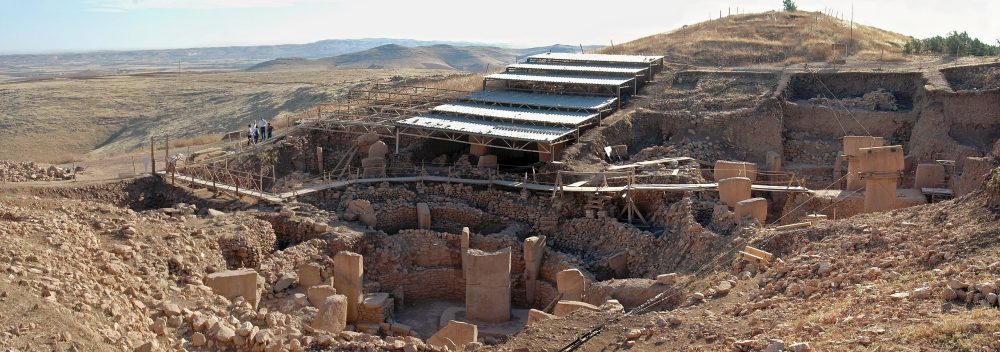
A view of the megalithic stones at Göbekli Tepe. Most of the site still remains buried beneath the surface. 7Image Credit: Wikimedia Commons.
Tthis is, I think, one of my favorite ancient sites and literally one of the oldest strcutres on Earth, and I have written about it on various oacacions where I have outlined why this site is such a history breaker. Tucked beneath a dusty hill in southeastern Turkey, Göbekli Tepe stunned the archaeological world when it was first excavated in the 1990s. Carbon dating placed the site at least 11,500 years old, making it not only older than the pyramids, but older than agriculture, pottery, or any form of writing.
Carved T-shaped megaliths, each weighing up to 20 tons, stand in circular formations. They’re decorated with reliefs of wild animals, abstract symbols, and possibly mythological beings. The stonework is not rough or experimental—it’s precise. Intentional. Studies have demonstrated that he builders of this ancient site used advanced geometrical reasoning. And then there’s the strangest part: the entire complex was deliberately buried in antiquity. Someone not only built it—they entombed it. No one knows why.
What purpose did it serve? A temple? A place of ritual gathering? A sky-watching observatory? Nothing about Göbekli Tepe fits the narrative of primitive nomads just learning how to sow seeds. Tis site breaks history because sites like it should not have been possible according to mainstream experts. Yet there it is. Göbekli Tepe is truly a history changer and not many people know about it.
Karahantepe Adds Depth—Literally and Figuratively one of the Oldest Strcutures on Earth
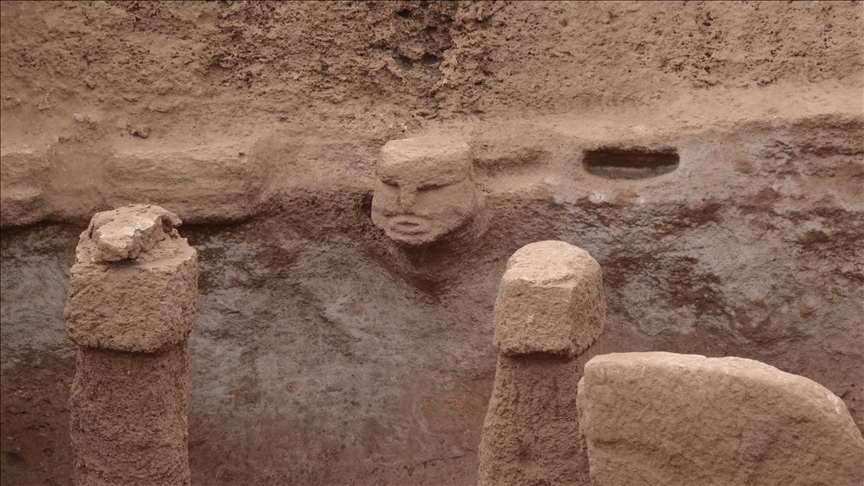
Human depictions and 3D sculptures in the 11,000-year-old Karahantepe complex. Credit: Anadolu Agency
And a short distance away from Göbekli Tepe we have another shocker.
Just 35 kilometers from Göbekli Tepe lies Karahantepe, a site of the same age that may be even more complex. Unlike Göbekli’s open-air circles, Karahantepe includes deep, carved chambers—entire rooms built into the bedrock. More than 250 stone pillars have been uncovered so far, along with stylized human heads and abstract sculptures embedded in the walls. Who could have built these gigantic strcutres over 11,000 years ago? Where they really hunter-gatherers as mainstream experts suggest, or is there something more complex about these ancient people?
The complexity and site of this site was not a one-off anomaly. I believe that whoever built Göbekli Tepe was part of a broader cultural world—possibly a network of sacred or ceremonial sites. Karahantepe expands the story, suggesting the region was teeming with early symbolic architecture. And yet, just like Göbekli, it appears and disappears with no clear lineage, no gradual development, and no evolutionary trail. It’s as if it came from nowhere.
Nabta Playa May Have Tracked the Stars Before Egypt Had a Name
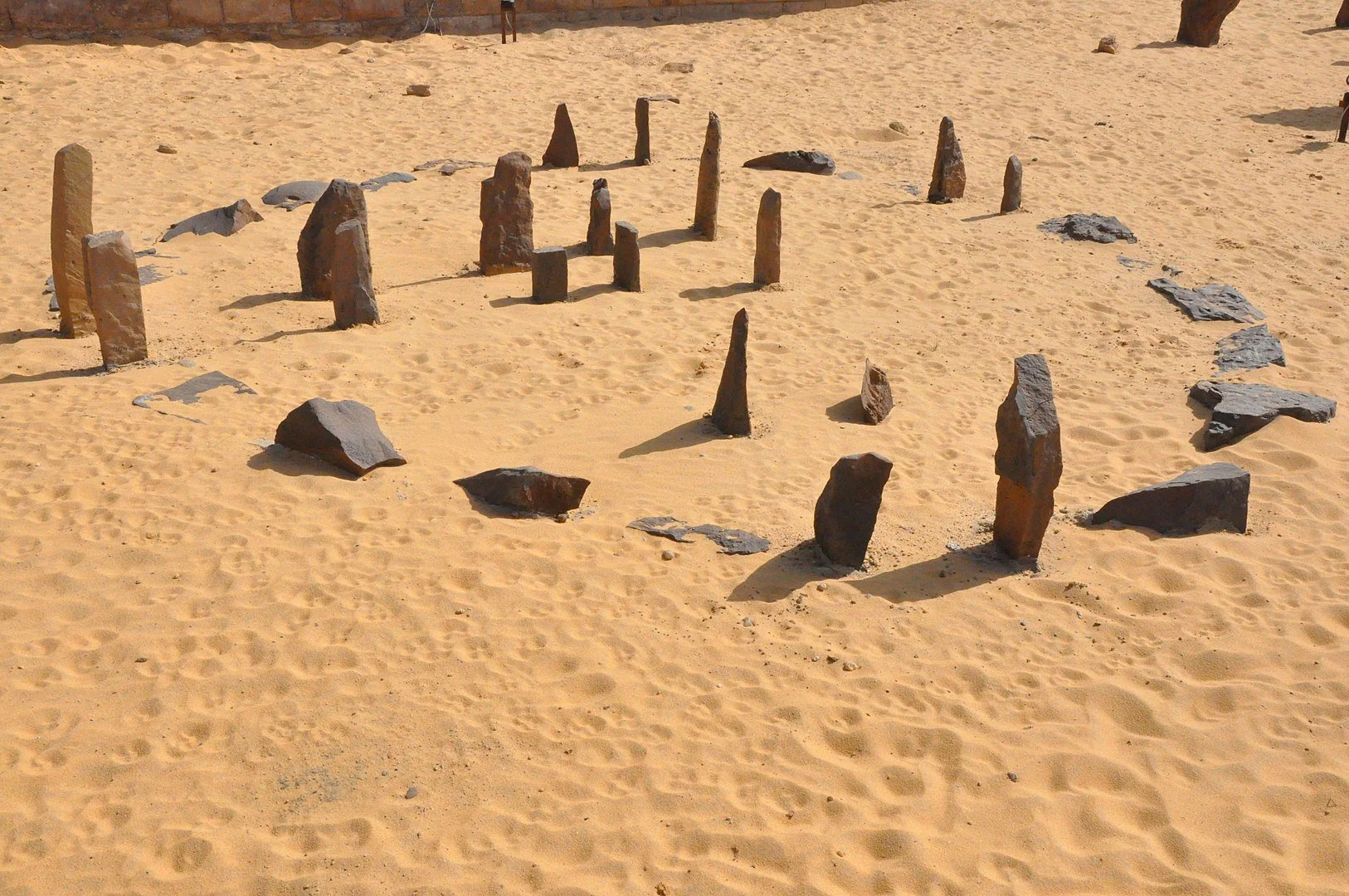
This is what some of the stone cricles of Nabta Playa look like. Reddit.
We cannot go through an article mentioning the oldest structures on Earth without mentioning this incredible acient site. In the Nubian Desert of southern Egypt, Nabta Playa looks at first like a scatter of rocks in the sand. But its alignment tells another story. Dating back 7,000 to 9,000 years, the stones were arranged to mark the rising of Sirius, the brightest star in the night sky—an event that would later become central to Egyptian calendar systems.
Long before pharaohs, this site may have served as both a ceremonial ground and a celestial clock. Buried cattle remains suggest ritual sacrifice, possibly tied to early pastoralist religion. This hints at a connection between astronomy, myth, and seasonal survival long before formal religion or kingdoms took shape. Though smaller in scale than Göbekli or Karahantepe, Nabta Playa reveals something similar: a deep concern with time, sky, and cosmic order. All from people we call “prehistoric.”
Gunung Padang Could Be the Oldest of Them All
The top of Gunung Padang. This ancient site is one of the most controversial. Credit: Wikimedia Commons.
Indonesia’s Gunung Padang might be the most controversial site on this list—but it could also be the most astonishing. On the surface, it looks like a stepped hill made of volcanic stone. But excavations in the last decade have revealed terraces, chambers, and layers of construction that extend 20 meters deep. Some geologists argue the deepest layers could date to as early as 20,000 BCE—a time when the Earth was still in the grip of the last Ice Age.
If proven true, it would be the oldest known human-built structure on Earth by a wide margin. But mainstream archaeologists remain skeptical. The core question is whether the deeper layers are artificial or natural. The debate is ongoing. Regardless of the final verdict, the site challenges our assumptions. At the very least, it shows human activity at the site far earlier than previously believed. At most, it suggests a lost chapter of human development buried—literally—beneath layers of time and earth.
Baalbek’s Megastones Hint at a Forgotten Foundation
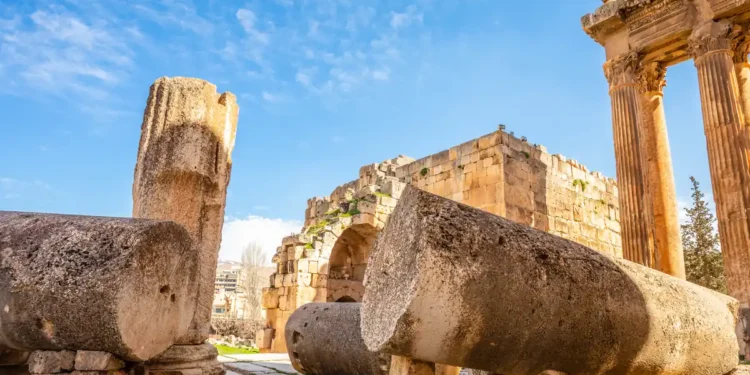
Another one of my favorite sites.
High in the Bekaa Valley of Lebanon, the ruins of Baalbek are often credited to the Romans, who built temples to Jupiter and Bacchus atop its massive stone platform. But beneath those classical columns lies a deeper mystery—one that predates Roman engineering by millennia. At the heart of the platform are the Trilithon stones: three limestone blocks each weighing over 800 tons. Nearby, an unfinished stone known as the Stone of the Pregnant Woman weighs more than 1,000 tons. Even with today’s technology, moving and placing these megaliths would be a challenge.
No one knows how they were transported, lifted, or aligned with such precision—and the builders left no inscriptions, no clear cultural fingerprints. Some researchers argue the deepest layers of Baalbek’s foundation could stretch back to the pre-pottery Neolithic, possibly linked to the same horizon as Göbekli Tepe and Karahantepe. If that’s true, then Roman temples were built atop something far older—a platform whose origins remain undocumented. Baalbek’s base may not yet be as precisely dated as the others on this list, but it raises the same unsettling question: Who built the foundation—and when?
Why Were They Building at All?
This is the question that lingers. Why were people with no cities, no writing, no metallurgy, and supposedly no organizational complexity carving massive stones and aligning them to the stars? Some researchers believe these were spiritual centers. Others think they were calendars—designed to track the solstices, lunar cycles, or stellar movements crucial to seasonal survival. Still others suggest they were gathering places where ideas, stories, and collective memory were shared in symbolic form.
But here’s the problem: none of this fits with how we define “prehistory.” We were taught that humans built monuments after developing agriculture and complex societies. These sites flip that script. Maybe, just maybe, the desire to build came first—and everything else followed.
If even one of these sites is as old as the evidence suggests, then the timeline of human history needs serious revision. The builders were capable of organizing labor, understanding celestial cycles, and shaping stone on a massive scale. These weren’t scattered efforts. They show patterns — of intent, of knowledge, and of memory we no longer share. There’s still too much we don’t know. But it’s clear we’ve been starting the story too late.
Meer van UFO'S of UAP'S, ASTRONOMIE, RUIMTEVAART, ARCHEOLOGIE, OUDHEIDKUNDE, SF-SNUFJES EN ANDERE ESOTERISCHE WETENSCHAPPEN - DE ALLERLAATSTE NIEUWTJES


 Glowing Craft Over Roswell, New Mexico April 12, 2025, UFO UAP Sighting News.




 Mars near opposition. Image: NASA, ESA, STScI; Image Processing: Joseph DePasquale (STScI)