Ontdek de Fascinerende Wereld van UFO's en UAP's: Jouw Bron voor Onthullende Informatie!
Ben jij ook gefascineerd door het onbekende? Wil je meer weten over UFO's en UAP's, niet alleen in België, maar over de hele wereld? Dan ben je op de juiste plek!
België: Het Kloppend Hart van UFO-onderzoek
In België is BUFON (Belgisch UFO-Netwerk) dé autoriteit op het gebied van UFO-onderzoek. Voor betrouwbare en objectieve informatie over deze intrigerende fenomenen, bezoek je zeker onze Facebook-pagina en deze blog. Maar dat is nog niet alles! Ontdek ook het Belgisch UFO-meldpunt en Caelestia, twee organisaties die diepgaand onderzoek verrichten, al zijn ze soms kritisch of sceptisch.
Nederland: Een Schat aan Informatie
Voor onze Nederlandse buren is er de schitterende website www.ufowijzer.nl, beheerd door Paul Harmans. Deze site biedt een schat aan informatie en artikelen die je niet wilt missen!
Internationaal: MUFON - De Wereldwijde Autoriteit
Neem ook een kijkje bij MUFON (Mutual UFO Network Inc.), een gerenommeerde Amerikaanse UFO-vereniging met afdelingen in de VS en wereldwijd. MUFON is toegewijd aan de wetenschappelijke en analytische studie van het UFO-fenomeen, en hun maandelijkse tijdschrift, The MUFON UFO-Journal, is een must-read voor elke UFO-enthousiasteling. Bezoek hun website op www.mufon.com voor meer informatie.
Samenwerking en Toekomstvisie
Sinds 1 februari 2020 is Pieter niet alleen ex-president van BUFON, maar ook de voormalige nationale directeur van MUFON in Vlaanderen en Nederland. Dit creëert een sterke samenwerking met de Franse MUFON Reseau MUFON/EUROP, wat ons in staat stelt om nog meer waardevolle inzichten te delen.
Let op: Nepprofielen en Nieuwe Groeperingen
Pas op voor een nieuwe groepering die zich ook BUFON noemt, maar geen enkele connectie heeft met onze gevestigde organisatie. Hoewel zij de naam geregistreerd hebben, kunnen ze het rijke verleden en de expertise van onze groep niet evenaren. We wensen hen veel succes, maar we blijven de autoriteit in UFO-onderzoek!
Blijf Op De Hoogte!
Wil jij de laatste nieuwtjes over UFO's, ruimtevaart, archeologie, en meer? Volg ons dan en duik samen met ons in de fascinerende wereld van het onbekende! Sluit je aan bij de gemeenschap van nieuwsgierige geesten die net als jij verlangen naar antwoorden en avonturen in de sterren!
Heb je vragen of wil je meer weten? Aarzel dan niet om contact met ons op te nemen! Samen ontrafelen we het mysterie van de lucht en daarbuiten.
The Baghdad Battery Still Sparks Debate About Ancient Electricity and Unexplained Knowledge
There is no written record of the battery’s function. No accompanying tools. No diagrams. No mention of electricity in Parthian texts. Just the artifact itself — and the implications it suggests, without ever confirming them.
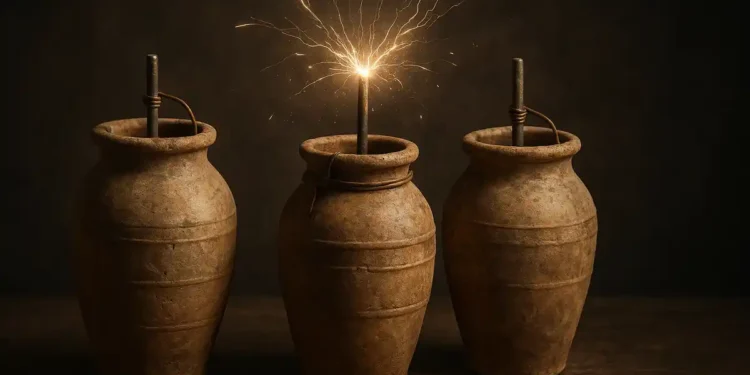
Illustration of Baghdad Batteries producing sparks.
Credit: Curiosmos.
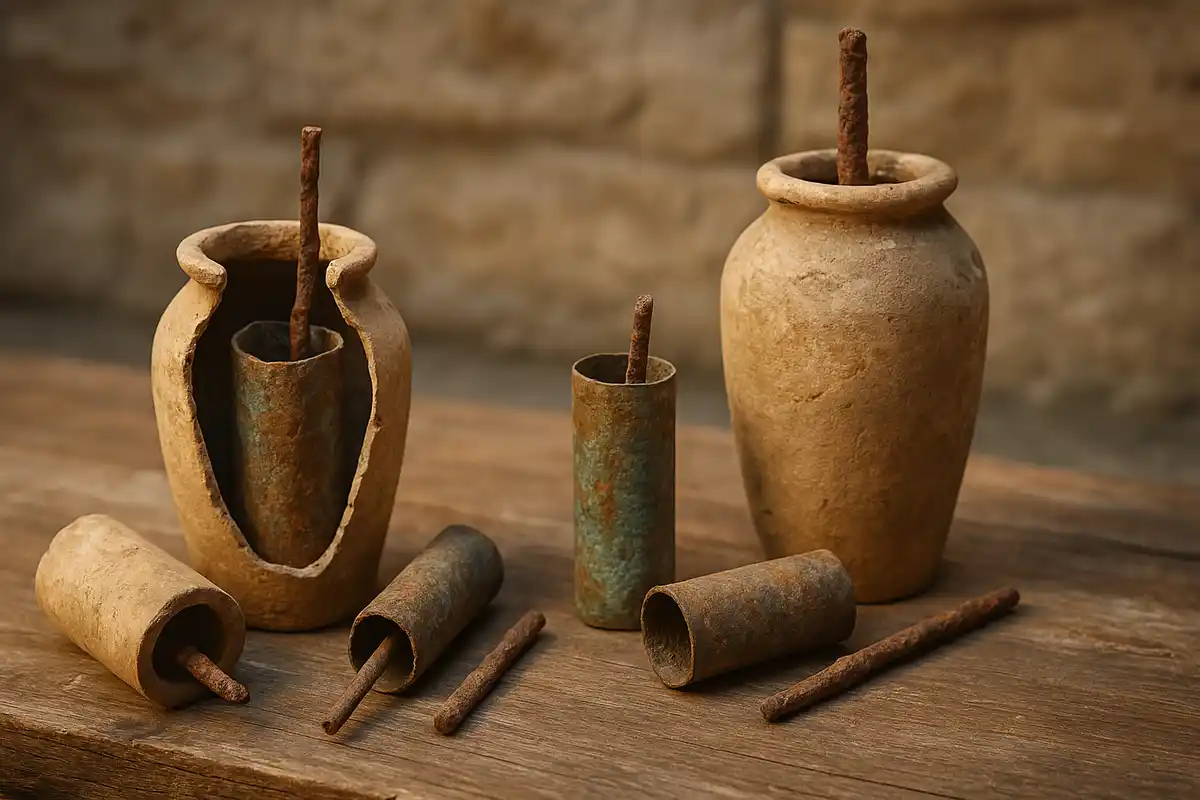
In the mid-20th century, a clay jar pulled from the ruins near Baghdad quietly entered the world of archaeological anomalies. It didn’t glow. It didn’t hum. But inside the jar, researchers found something unexpected: a copper tube, an iron rod, and traces of organic residue. The components, when reconstructed, behaved like a simple galvanic cell — a primitive form of battery. Since then, the artifact now known as theBaghdad Battery has stood at the crossroads of science, history, and unanswered questions.
What was it really for? Was it evidence of ancient electrical experimentation — or just a misunderstood relic of everyday life?
The debate continues, and not just among fringe theorists. Even mainstream archaeologists agree: we still don’t know the full story. But let’s face it, there is a lot of stuff we can’t explain from ancient times.
What the Baghdad Battery Looks Like
An illustration of the Baghdad Batteries. Credit: Curiosmos.
The object was first described in 1939 by Wilhelm König, then director of the National Museum of Iraq. It had been found years earlier at Khujut Rabu, a Parthian-era site dating back to between 250 BCE and 250 CE.
Residue that could indicate an acidic liquid, such as vinegar or fermented grape juice
König was struck by the object’s similarity to modern galvanic cells, which can generate a small electrical current when filled with an acidic electrolyte. He proposed something radical: that this wasn’t storage or ritual ware — it was an ancient battery.
Subsequent reconstructions of the Baghdad Battery have proven the concept. When built using comparable materials, and filled with acidic liquids, the device produces between 0.5 and 1.5 volts — enough to cause a tingle or power a very small device.
But here’s where the mystery deepens.
There is no written record of the battery’s function. No accompanying tools. No diagrams. No mention of electricity in Parthian texts. Just the artifact itself — and the implications it suggests, without ever confirming them. But here is another great point I would like to make: there are also no blueprints or descriptions of the construction of the Great Pyramids. There are no markings that suggest the Egyptian pyramids were tombs. Yet most experts in the field undoubtedly think so. So a lack of written documentation or texts does not point to one way or the other.
Could Ancient People Have Used Electricity Without Understanding It?
The central debate is not whether the Baghdad Battery can function as a battery. It can — that’s been proven. The real question is whether it was ever intended to.
One theory suggests the batteries were used for electroplating — depositing a layer of metal like gold or silver onto another object. This process requires a direct current and acidic solution, which the Baghdad Battery could theoretically provide. Experiments have shown this is technically feasible, though extremely slow and inefficient.
Another idea is that it may have been used in ritual settings — to deliver a mild shock as a religious or symbolic experience. The surprise or sensation might have been interpreted as divine or mystical.
But these remain speculative. There is no direct evidence of electroplated objects from the same region and period. Nor are there any references to electroshock rituals in Parthian religious texts.
Skeptics argue that the Baghdad Battery is more likely a coincidence of form and function — a storage vessel, perhaps used for holding scrolls, sacred oil, or medicinal compounds. The presence of metal and organic residue may simply reflect non-electrical uses.
Yet that explanation, while conservative, doesn’t fully settle the question. If it was just a container, why was it engineered so precisely, with metal components that — accidentally or not — mirror modern battery design? If it were really a breakthrough technology from the past, why wasn’t it replicated in much greater numbers? Why aren’t we digging up hundreds of these? You would assume that word of such a technology would have spread rapidly across the ancient world, meaning that we would be finding many similar items all across the wide region.
The Baghdad Battery’s Enduring Mystery
The Baghdad Battery has become more than an object. I kind of see it like a case study in how we interpret the past. Because it is not the only such artifact we have discovered. We have found many artifacts of the ancient world that defy explanation, and one example of that is the Antikythera Mechanism. Oh and by the way, we also only found ONE Antikythera Mechanism. Just like with the Baghdad Battteries.
When we encounter ancient technologies that resemble modern tools, we are faced with a difficult choice: assume coincidence, or entertain the possibility that ancient civilizations experimented with principles they may not have fully understood. There’s of course that it was aliens theory, but I highly doubt aliens would have given such a lousy blueprint for a battery, right?
Having that said, there are many other examples of artifacts that sometimes we refer to to as out-of-place artifacts, including stones or ancient drilled cores, and to be honest, these raise similar questions about what knowledge may have existed — and what was lost. I firmly believe that a lot of our history is still hidden from sight. And when I say that, I do not mean Aliens. I just think that there are many secrets of our ancient past waiting to be discovered.
However, I do believe that if the Baghdad Battery were real, then it would challenge the narrative that human technological advancement has always moved in a straight line. As I have written in previous articles, I have said that history is like a puzzle, and we are far from completing it. I think that history is full of gaps, and sometimes the objects that survive don’t tell the whole story. These objects, we could argue, are just a small puzzle of a much bigger story.
Today, the battery remains on display in museums, including reconstructions in institutions like the Museum of the History of Science in Oxford. It continues to feature in documentaries, academic debates, and speculative fiction. But most of all, it continues to inspire the same question Wilhelm König asked nearly a century ago:What if? What if there is more to this artifact than meets the eye? What if ancient civilizations were far more advanced than we credit them for?
I mean, look at Göbekli Tepe. As I have written previously, this site literally breaks history and the historical timeline we have been taught in school.
Without making bold claims or unsupported leaps, I can say this: the Baghdad Battery is an object whose purpose has not been fully explained. It exists, it functions, and it refuses to be forgotten. What’s more, it tells us that there are things out there that are far from ordinary. There are artifacts from the ancient past that still await discovery. Our history is far from being understood, and I guess that is the beauty of it. The more we dig, the more we find. The more questions we ask, the fewer answers we provide. Oh, how I love history.
Watch this amazing catch made not by a human but by a doorcam. The glowing object is only seen twice in the video but you can clearly see it has a powerful glow, the person said it was seen only twice and just suddenly appeared over a space of several hours. Strange and bizarre catch here. The cam is in infrared mode, which is the same mode that all the US Gov UFO video have been recorded in so we know this cam can catch a cloaked UFO. I leave this up to you. Whats your thoughts on this one?
De Vergeten Beschaving: Lijdt Onze Beschaving aan Amnesie?
Inleiding
De geschiedenis van de mensheid is rijk en divers, gevuld met beschavingen die opbloeiden en uiteindelijk in de vergetelheid raakten. Dit artikel onderzoekt de vraag: Lijdt onze huidige beschaving aan amnesie? Herinneren we ons de intelligente beschavingen uit het verre verleden, of zijn ze simpelweg vergeten? We zullen verschillende voorbeelden onderzoeken, van de verloren stad Atlantis tot de geavanceerde kennis van de Maya's en de oude Mesopotamiërs, en de implicaties van deze vergetelheid voor onze moderne samenleving.
Herhaaldelijk komen er ontdekkingen aan het licht die onze kennis van de menselijke geschiedenis uitdagen, maar mainstreaminstellingen negeren of verwerpen ze vaak. Een voorbeeld hiervan is Gunung Padang in Indonesië en Göbekli Tepe in Turkije.
Gunung Padang, een enorme megalithische structuur in West-Java, bevindt zich bovenop een uitgedoofde vulkaan. Nieuw onderzoek suggereert dat het wel eens de oudste piramide ter wereld zou kunnen zijn, daterend van 25.000 tot 14.000 jaar geleden, diep in de laatste ijstijd. Als dit juist is, zou dit het tientallen duizenden jaren vóór de Egyptische piramides plaatsen en ouder zijn dan Göbekli Tepe, de 12.000 jaar oude site in Turkije die al bekend staat om het weerleggen van de conventionele geschiedenis.
Geavanceerde scans hebben meerdere lagen van constructie onthuld, waarvan sommige mogelijk tot 27.000 jaar oud zijn, met ondergrondse kamers die nog grotendeels onverkend zijn. En toch, ondanks de baanbrekende implicaties, blijft Gunung Padang omhuld in stilte. Opgravingen zijn vertraagd. Toegang is beperkt. Nog vreemder is dat wereldwijde beleidsorganisaties zoals het "Global Shapers"-initiatief van het World Economic Forum banden hebben met het toezicht op de site. Waarom zou een economisch denktank betrokken zijn bij een oude archeologische opgraving?
Het mysterie gaat dieper dan steen. Het raakt aan macht, controle en narratief. Als de mensheid geavanceerde structuren bouwde tijdens of vóór de ijstijd—lang voordat de landbouw begon, herschrijft dat alles wat we denken te weten: Wie we zijn - Waar we vandaan komen - Wat we werkelijk kunnen.
Het accepteren hiervan zou een totale herziening van leerboeken, academische modellen en levenslange aannames vereisen. Instellingen verzetten zich hiertegen niet uit kwade opzet, maar uit zelfbehoud. Er is een diepere reden: dat bepaalde kennis opzettelijk wordt onderdrukt om controle te behouden, verstoring te vermijden en oude technologieën verborgen te houden.
Want als oude beschavingen, uiteindelijk met de hulp van geavanceerde buitenaardse rassen, ooit geavanceerde structuren bouwden, schone energie bereikten, wereldwijde samenwerking of kosmisch inzicht verkregen en het vervolgens verloren, dan zijn wij niet de top van de vooruitgang. Als kennis macht is, dan is het beheersen van de geschiedenis de ultieme macht, die ons in het duister houdt over onze oorsprong, als een beschaving die lijdt aan amnesie.
De Conceptualisering van Amnesie in de Geschiedenis
Amnesie, in de context van beschaving, verwijst naar het verlies van historische kennis en culturele herinneringen. Dit kan voortkomen uit verschillende factoren, waaronder oorlog, kolonisatie, natuurlijke rampen en sociale veranderingen. De term 'historische amnesie' wordt vaak gebruikt om situaties te beschrijven waarin belangrijke historische feiten of culturele inzichten worden vergeten of genegeerd.
Voorbeeld 1: De Val van de Romeinse Beschaving
De val van het West-Romeinse Rijk in 476 n.Chr. is een duidelijk voorbeeld van historische amnesie. Na deze gebeurtenis volgde een periode van chaos en verval, vaak aangeduid als de 'Donkere Eeuwen'. Gedurende deze tijd gingen veel teksten en kennis verloren, wat leidde tot een stagnatie van de wetenschap en cultuur in Europa. Het was pas in de Renaissance dat deze kennis opnieuw werd herontdekt en gewaardeerd.
Voorbeeld 2: De Legende van Atlantis
Een van de meest intrigerende verhalen van een vergeten beschaving is dat van Atlantis, een mythische eilandbeschaving die door de Griekse filosoof Plato werd beschreven. In zijn dialogen 'Timaeus' en 'Critias' schildert Plato een beeld van een geavanceerde beschaving die uiteindelijk ten onder ging door haar eigen morele en ethische afbraak. De legende van Atlantis heeft eeuwenlang de verbeelding van mensen gevangen. Veel onderzoekers en avonturiers hebben geprobeerd de locatie van Atlantis te vinden, wat de vraag oproept of deze beschaving ooit echt heeft bestaan of slechts een allegorie is voor de gevaren van hubris en morele degeneratie. De fascinatie voor Atlantis weerspiegelt onze hunkering naar verloren kennis en de mogelijkheid dat er ooit een beschaving was die verder gevorderd was dan de onze.
Voorbeeld 3: De Maya's: Een Geavanceerde Beschaving
Een andere opmerkelijke beschaving die vaak vergeten of verkeerd begrepen wordt, is die van de Maya's. De Maya's, die floreerden in Meso-Amerika van ongeveer 2000 v.Chr. tot 1500 n.Chr., waren uitermate geavanceerd op het gebied van astronomie, wiskunde en architectuur.
Astronomie en Kalenders
De Maya's ontwikkelden een complexe kalender en hadden een diepgaand begrip van astronomische cycli. Hun kennis stelde hen in staat om de bewegingen van de planeten met ongelooflijke nauwkeurigheid te voorspellen. Dit is een voorbeeld van hoe een beschaving, die door veel mensen als primitief wordt gezien, in werkelijkheid uiterst geavanceerd was.
Het Verlies van Kennis
De ondergang van de Maya-beschaving, die wordt toegeschreven aan een combinatie van milieuverandering, oorlog en interne conflicten, leidde tot een verlies van kennis. Veel van hun archieven, waaronder boeken en inscripties, gingen verloren, wat resulteerde in wat sommigen beschouwen als een vorm van culturele amnesie.
Voorbeeld 3: Mesopotamië: De Wieg van de Beschaving
Mesopotamië, vaak aangeduid als de 'wiege van de beschaving', is een ander voorbeeld van een vergeten verleden. Deze regio, gelegen tussen de Tigris- en de Eufraat-rivieren, was de thuisbasis van enkele van de vroegste beschavingen, waaronder de Sumeriërs, Akkadiërs, Babyloniërs en Assyriërs.
Innovaties en Bijdragen
Mesopotamië was de plaats waar vele belangrijke innovaties plaatsvonden, zoals het schrift (cuneiform), het wiel en de eerste vormen van georganiseerde religie. De Sumeriërs ontwikkelden ook uitgebreide systemen van irrigatie en landbouw, wat cruciaal was voor hun overleving en groei.
Vergetelheid door Tijd
Ondanks hun belangrijke bijdragen aan de menselijke geschiedenis, zijn veel mensen zich niet bewust van de rijkdom aan kennis en cultuur die in deze regio is ontstaan. De vergetelheid van deze beschaving kan worden toegeschreven aan de tijd en de vele invallen en veroveringen die de regio heeft doorgemaakt.
De Gevolgen van Historische Amnesie
De gevolgen van een collectieve amnesie zijn verstrekkend. Wanneer we belangrijke lessen uit het verleden vergeten, lopen we het risico dezelfde fouten opnieuw te maken. Dit kan leiden tot sociale, politieke en ecologische crises in de toekomst.
Voorbeeld 1: Het Milieu
De Maya's zijn een voorbeeld van een beschaving die, ondanks hun geavanceerde kennis, niet in staat was om duurzaam om te gaan met hun natuurlijke omgeving. De ondergang van hun beschaving biedt belangrijke lessen over de noodzaak van ecologische verantwoordelijkheid en het belang van duurzaamheid. De vernietiging van hun ecosystemen leidde tot een onomkeerbare schade die hun samenleving verzwakte en uiteindelijk leidde tot hun ineenstorting.
Voorbeeld 1: Politieke Amnesie
Politieke amnesie kan ook verwoestende gevolgen hebben. Wanneer samenlevingen vergeten welke ideologieën of regimes tot onderdrukking hebben geleid, lopen ze het risico vergelijkbare systemen opnieuw te omarmen. Dit benadrukt het belang van geschiedkundige educatie en het behoud van cultureel erfgoed. De herhaling van fouten uit het verleden kan leiden tot nieuwe conflicten en sociale onrust.
Het Herinneren van het Verleden: Een Verantwoordelijkheid
Het is cruciaal dat we ons verleden herinneren en de lessen die daaruit voortkomen, in ons huidige leven integreren. Dit houdt in dat we actief moeten streven naar het behoud van historische kennis en culturele waarden.
Educatie en Bewustwording
Educatie speelt een sleutelrol in het voorkomen van historische amnesie. Scholen en educatieve instellingen moeten de nadruk leggen op de geschiedenis van verschillende beschavingen, inclusief die welke vaak over het hoofd worden gezien. Dit kan helpen bij het bevorderen van een breder begrip van de menselijke ervaring en de diversiteit van culturele bijdragen. Het is essentieel dat leerlingen leren over de successen en mislukkingen van eerdere beschavingen, zodat ze beter voorbereid zijn op de uitdagingen van de toekomst.
Het Belang van Archeologie
Archeologie is een ander belangrijk aspect van het behoud van ons verleden. Door de resten van verloren beschavingen te bestuderen, kunnen we waardevolle inzichten krijgen in hun leven, cultuur en bijdragen aan de mensheid. Het herstel van deze kennis kan ons helpen om beter te begrijpen waar we vandaan komen en hoe we ons kunnen ontwikkelen. Archeologische ontdekkingen kunnen niet alleen bijdragen aan ons begrip van de geschiedenis, maar ook aan ons gevoel van identiteit en verbondenheid.
Vooruitblikken: De Toekomst van Onze Geschiedenis
Als we vooruitkijken, is het belangrijk om na te denken over hoe we ons verleden kunnen gebruiken om een betere toekomst te bouwen. Dit vereist een actieve betrokkenheid bij zowel het behoud van ons culturele erfgoed als het bevorderen van een breed begrip van de geschiedenis in de samenleving.
De Rol van Technologie
De rol van technologie in de archeologie en ons begrip van het verleden is essentieel en heeft de manier waarop we historische sites en beschavingen bestuderen ingrijpend veranderd. Een voorbeeld is het gebruik van satellieten, waarmee archeologen vanuit de lucht verborgen structuren en opgravingen kunnen detecteren. Deze technologie maakt het mogelijk om grote gebieden te verkennen en zelfs ondergrondse ruïnes te identificeren die anders onopgemerkt zouden blijven.
Daarnaast speelt laser-scanning, zoals LIDAR (Light Detection and Ranging), een cruciale rol. Met deze techniek kunnen onderzoekers dichte bossen en andere natuurlijke obstakels doorbreken om verborgen archeologische sites in kaart te brengen. Hierdoor zijn onder andere de indrukwekkende Maya-steden in Centraal-Amerika opnieuw ontdekt, wat ons inzicht heeft gegeven in hun omvang en complexiteit.
Ook digitale archieven zijn van groot belang. Ze bieden toegang tot historische documenten en artefacten voor een breed publiek, waardoor meer mensen betrokken raken bij de studie van geschiedenis.
Verder stelt 3D-modellering ons in staat om reconstructies van historische sites en objecten te maken, waardoor we visueel inzicht krijgen in hoe deze er in hun gloriejaren uitzagen. Virtuele realiteit (VR) voegt hieraan toe door gebruikers de mogelijkheid te bieden om op een interactieve manier door deze reconstructies te navigeren, wat een diepere connectie met ons verleden creëert.
Samengevat, technologie biedt ons innovatieve middelen om ons verleden te verkennen, te begrijpen en te delen met een breder publiek.
Samenwerking tussen Disciplines
Interdisciplinaire samenwerking is cruciaal voor het begrijpen van onze geschiedenis. Historici kunnen bijvoorbeeld context en chronologie bieden, terwijl archeologen materieel bewijs aanleveren dat archeologische opgravingen onthullen. Een voorbeeld is de studie van de Romeinse tijd, waarbij archeologen artefacten zoals munten en gebouwstructuren analyseren, terwijl historici deze in verband brengen met schriftelijke bronnen. Antropologen kunnen daarnaast sociale structuren en culturele praktijken bestuderen die niet altijd in geschreven documenten worden vastgelegd. Door deze verschillende disciplines te combineren, ontstaat een completer beeld van de Romeinse invloed en de ontwikkeling van lokale samenlevingen. Dit gezamenlijke onderzoek kan ons begrip van de interacties tussen verschillende culturen in die tijd verdiepen, wat leidt tot nieuwe inzichten over de dynamiek van beschavingen en hun evolutie.
Het Belang van Culturele Diversiteit
Culturele diversiteit is een belangrijke pijler voor een genuanceerd begrip van ons verleden. Het erkennen van verschillende culturele stemmen helpt ons te ontsnappen aan een eenzijdig historisch narratief. Bijvoorbeeld, de geschiedenis van de kolonisatie in Amerika wordt vaak verteld vanuit het perspectief van de kolonisten, terwijl de verhalen van inheemse volkeren vaak onderbelicht blijven. Door deze verhalen te integreren, kunnen we de gevolgen van kolonialisme beter begrijpen en de veerkracht van inheemse culturen waarderen. Dit inclusieve perspectief stelt ons niet alleen in staat om de complexiteit van historische gebeurtenissen te doorgronden, maar bevordert ook empathie en respect tussen diverse gemeenschappen in het heden. Het waarderen van culturele diversiteit in de geschiedenis is dus essentieel voor het bouwen aan een inclusieve toekomst.
Conclusie
De vraag of onze beschaving lijdt aan amnesie is een complexe en uitdagende. Terwijl we ons bewust zijn van enkele van de meest prominente beschavingen, blijven veel anderen in de schaduw van de geschiedenis. Het is van cruciaal belang dat we ons verleden blijven onderzoeken, herinneren en waarderen, om te voorkomen dat we dezelfde fouten herhalen en om de rijke diversiteit van menselijke ervaring te omarmen. Door ons verleden te respecteren en te leren van de lessen die het biedt, kunnen we een betere toekomst creëren voor onszelf en de komende generaties. De verantwoordelijkheden die we hebben ten opzichte van ons verleden zijn niet alleen een kwestie van geschiedenis, maar ook van de richting die we kiezen voor onze toekomst. We moeten ons inzetten voor het behoud van onze collectieve kennis en ervoor zorgen dat toekomstige generaties de lessen van het verleden begrijpen en waarderen.
De tijd is gekomen om de vergetelheid te doorbreken en onze geschiedenis te omarmen. De lessen van oude beschavingen bieden ons niet alleen inzichten in ons verleden, maar ook richtlijnen voor een duurzame en rechtvaardige toekomst. Laten we de weg vooruit verlichten met de kennis van degenen die ons zijn voorgegaan, zodat we niet alleen een beschaving van het heden zijn, maar ook een erfenis van wijsheid voor de toekomst kunnen achterlaten.
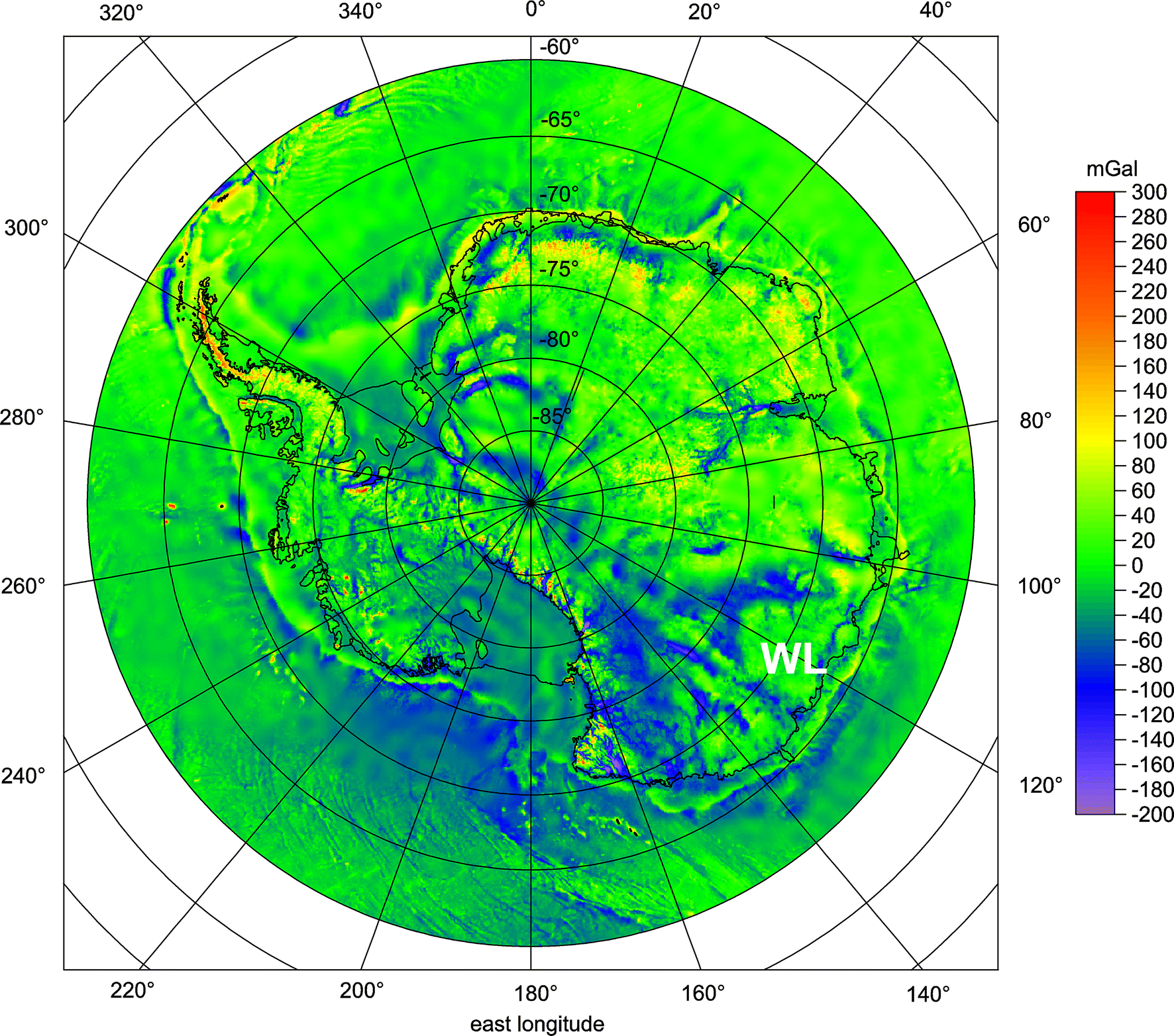
Researchers have proposed many origins for a gravity anomaly in Wilkes Land, East Antarctica, but the latest evidence suggests the subglacial hole is an impact crater measuring 315 miles across.
Because it is buried beneath the Antarctic ice sheet, the Wilkes Land crater can only be seen through gravity and other forms of mapping. In this map, the crater is located in the bottom right corner and forms a light-colored U-shape surrounded by darker areas.
(Image credit: Klokočník, Kostelecký & Bezděk. Earth Planets Space (2018). Reshared under the terms of Creative Commons (CC BY 4.0))
Why it's incredible: Evidence suggests it could be the greatest known impact crater on Earth.
The Wilkes Land crater is a hole in the bedrock beneath East Antarctica's ice sheet measuring 315 miles (510 kilometers) across. Researchers have been trying to explain its existence since the 1960s, and the most recent evidence suggests it was born from a cataclysmic meteorite impact.
The crater was first detected as a huge dent in Earth's gravitational field. Initial ground-based seismic and gravity surveys already indicated that the crater was huge — around 150 miles (240 km) across — but newer techniques reveal that it is likely more than double this size.
The Largest Impact Crater on the Planet; Hidden in Antarctica & 300 Miles Wide
According to a 2018 study, the Wilkes Land crater sits about 1 mile (1.6 km) beneath the surface of Antarctica's ice sheet. The study showed the crater in more detail than ever before and examined its potential link with southern Australia, which was connected to East Antarctica until around 35 million years ago. While the origin of the crater remains uncertain, the results of the study suggest the event that created the hole likely occurred before the continents separated.
Researchers have proposed several explanations for the Wilkes Land crater, including that it could be a volcanic structure, a sedimentary basin, a deeply eroded valley or a meteor impact crater, according to a 2015 paper. For that paper, scientists used satellite remote sensing techniques to map the crater and determine its physical characteristics. In the middle of the hole in Earth's gravitational field, known as a negative gravity anomaly, they found a positive gravity anomaly, with the ice sheet filling the gap around this central peak like a huge, frosty donut.
The central peak is likely a structure known as a mass concentration, or a "mascon," according to the study. Mascons can occur within meteor impact structures due to the meteor crashing through Earth's crust and affecting the mantle beneath. Following the impact, the mantle may recoil and form a dense plug, resulting in a positive gravity anomaly, the study authors wrote.
A map of Antarctica showing gravity data across the frozen continent. Wilkes Land is situated in the bottom right corner of the map. A patch resembling a U-shape surrounded by dark blue is the Wilkes Land crater. (Image credit: Klokočník, Kostelecký & Bezděk. Earth Planets Space (2018). Reshared under the terms of Creative Commons (CC BY 4.0))
The Wilkes Land crater and its mascon aren't perfectly circular and instead form a U-shape, according to the 2018 study, whose results support the conclusion that the crater was caused by a meteor impact. The northern side of the crater is fragmented, perhaps as a result of tectonic processes that ripped Australia and Antarctica apart, the authors noted. Parts of the crater are clearly visible in southern Australia, they added.
If the Wilkes Land crater is an impact crater, then it "would be the greatest impact crater known" on Earth in terms of its size, the authors wrote.
In the 2015 study, researchers found that the crater's diameter matches the speed and size of space rocks that regularly crashed into Earth during its early history between 4.1 billion and 3.8 billion years ago. "The WLA [Wilkes Land Anomaly] could have been created by such bolides," they wrote in the study.
"Nonetheless, because of the constraints imposed by the overlying continental ice sheet, [...], we believe that the other explanations for the subglacial structure remain viable," they added.
Discover more incredible places, where we highlight the fantastic history and science behind some of the most dramatic landscapes on Earth.
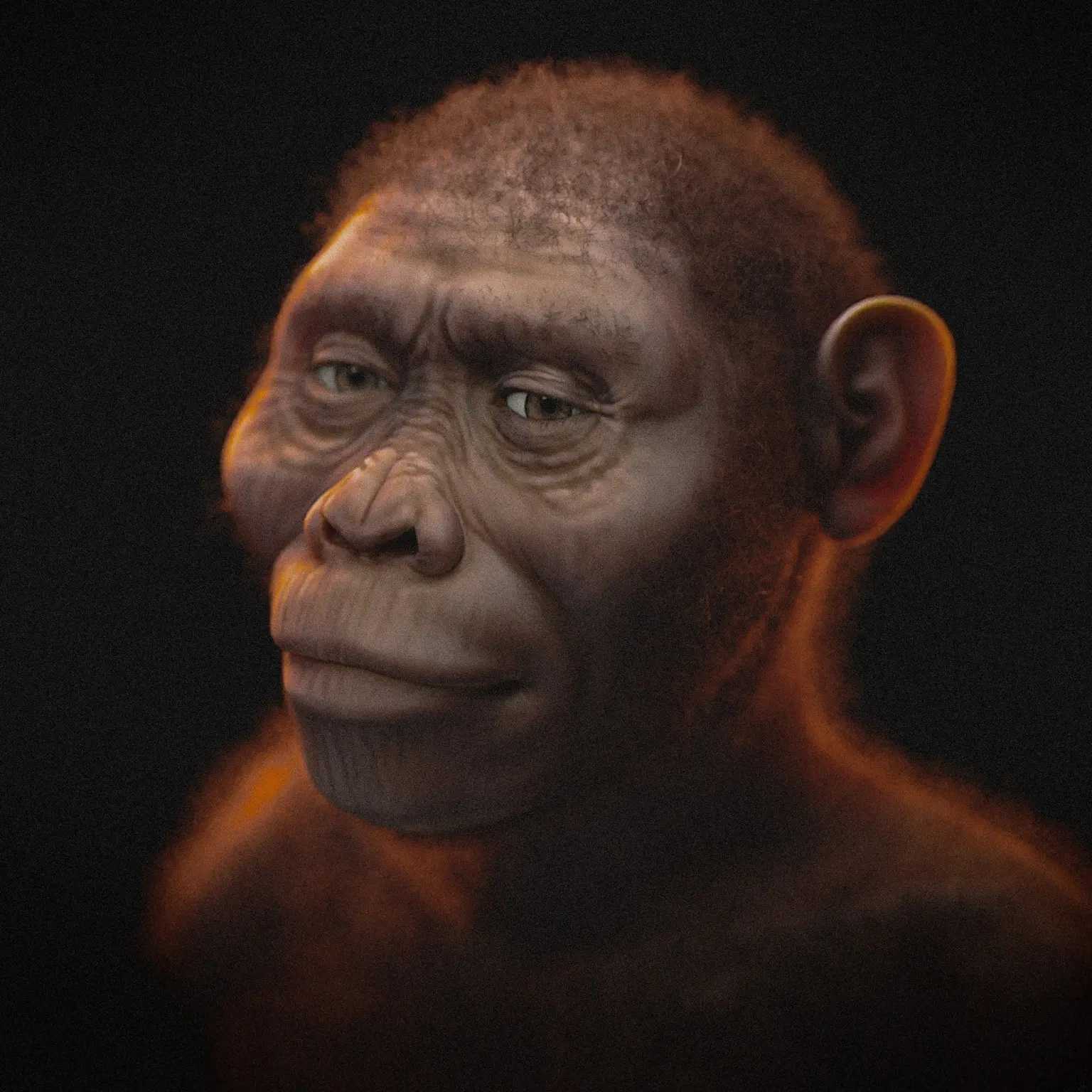
This is a new image representation of the face of Lucy, our human ancestor from 3 million years ago, whereas the second image shows a modern blonde female. In 1975, an American scientist named Donald Johanson found a skeleton in Ethiopia. It was of a small female, only about 3.5 feet tall. The skeleton showed that early human ancestors were already walking on two legs around 3 million years ago.
The skeleton was given the name “Lucy,” inspired by the Beatles song “Lucy In The Sky With Diamonds.” She was part of a species called Australopithecus afarensis. Lucy is one of the best-preserved skeletons of early human ancestors that scientists have ever found.
The reconstruction, blending science and art, allows us to imagine what she might have looked like 3.2 million years ago, enriching both public and scientific understanding of our ancestors,” said Moraes.
There’s a big conspiracy theory that the shift from Image A to Image B isn’t evolution at all—but genetic manipulation by a more advanced race.
If you are into the controversial stories of Zecharia Sitchin, then according to him, the Anunnaki were intellectually superior beings who shared a wide range of knowledge with the ancient Sumerians, including arithmetic, geometry, calculus, medicine, and metalworking, and taught them writing. Sitchin believed that current Homo Sapiens was the result of genetic manipulation and that the Anunnaki created the Sumerians by mixing the DNA of a hominid with theirs.
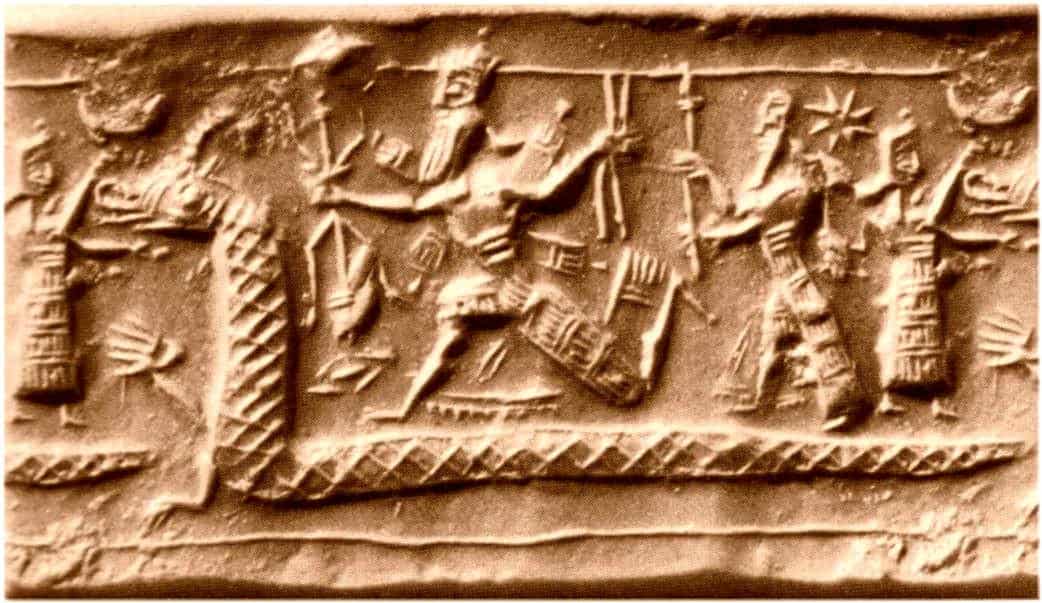
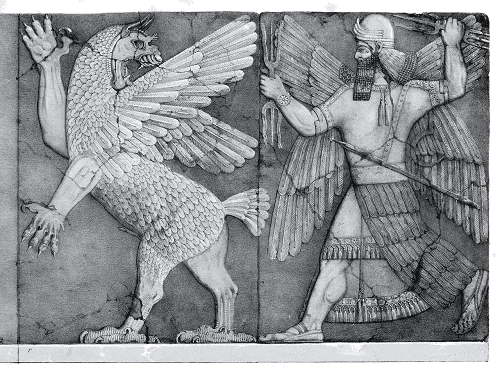
Neo-Assyrian cylinder seal impression from the eighth century BCE identified by several sources as a possible depiction of the slaying of Tiamat from the Enūma Eliš. Image credit: Wikimedia Commons
The Enuma Elish tells the story of the great god Marduk’s victory over the forces of chaos and his establishment of order at the world’s creation. The story begins like this:
“When in the height heaven was not named, And the Earth beneath did not yet bear a name, And the primeval Apsu, who begat them, And chaos, Tiamut, the mother of them both Their waters were mingled together, And no field was formed, no marsh was to be seen; When of the gods none had been called into being, And none bore a name, and no destinies were ordained;
Then were created the gods in the midst of heaven, Lahmu and Lahamu were called into being….”
Note:All creation myth tablets can be found in the Ashur, Kish, and Ashurbanipal libraries at Nineveh. Intriguingly, imprints on the tables indicate copies of much older versions of the narrative that date back to well before the fall of Sumer around 1750 BCE.
According to the cuneiform tablets, human-like gods governed the Earth initially. When they first landed on Earth, they made it habitable by cultivating the soil and extracting the minerals. The passage also mentions the revolution between the gods and their workers.
“When the gods like men
Bore the work and suffered the toll
The toil of the gods was great,
The work was heavy, the distress was.”
It is said that before humans, the Anunnaki (ancient Sumerian, Akkadian, Assyrian, and Babylonian deities) used the Igigi (sometimes also spelled “Igigu”), the young generation of Ancient Astronaut Gods, as their servants to mine gold on Earth. However, when humans rebelled against the Annunaki, the Igigi were replaced by humans.
The ancient Mesopotamians believed that heaven consisted of three domes. The lowest dome of heaven housed the stars, while the intermediate dome housed the Igigi, the younger gods. The farthest and highest dome of heaven was personified as An, the sky god.
A bas-relief, thought to be of Marduk and Tiamat, from the temple of Ninib at Nimrud. Image credit: Wikimedia Commons
In addition, most academics agree that the Igigi are the Sumerian deities of myth. They say the Igigi were servants of the powerful Anunnaki who rose against Enlil, and his regime.
Ancient Origins writes: “Anu, the god of gods, agreed that their labor was too great. His son Enki, or Ea, proposed to create man to bear the labor, and so, with the help of his half-sister Ninki, he did. A god was put to death, and his body and blood were mixed with clay. From that material, the first human being was created, in likeness to the gods.
You have slaughtered a god together With his personality I have removed your heavy work I have imposed your toil on man. … In the clay, god and man Shall be bound, To a unity brought together; So that to the end of days The Flesh and the Soul Which in a god have ripened – That soul in a blood-kinship be bound.
This first man was created in Eden, a Sumerian word that means ‘flat terrain.’ In the Epic of Gilgamesh, Eden is mentioned as the garden of the gods, located somewhere in Mesopotamia, between the Tigris and Euphrates rivers.”
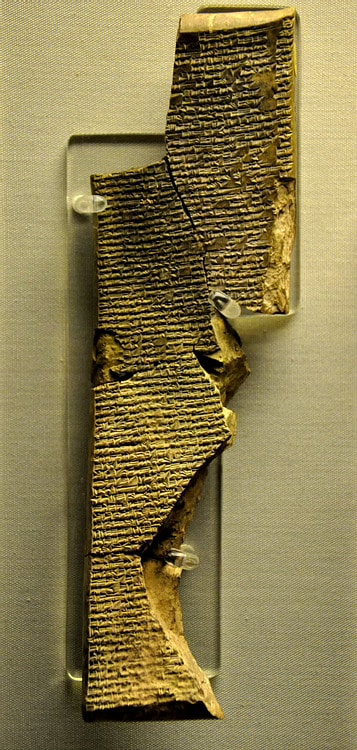
This clay tablet is one of the episodes of the epic of creation. It narrates how god Anshar summons the gods together for a banquet. They celebrate god Marduk’s appointment as champion; Marduk defeated Tiamat in the primeval chaos. From the library of Ashurbanipal at Nineveh (modern-day Ninawa Governorate, Iraq), northern Mesopotamia. Neo-Assyrian period, 7th century BCE. (The British Museum, London).
According to cuneiform texts, Adapa was the first successful human. The entire species’ lineage was called Adamu. In this instance, the parallels to the Bible are startling. In the 19th century, a tablet was discovered in the ruins of the ancient Babylonian city of Nippur by a team from the University of Pennsylvania. It tells the story of destroying the world through a great flood and an immortal man named Utnapishti, who builds a massive boat to save his family and all types of animals
This clay tablet is one of the episodes of the epic of creation. It narrates how god Anshar summons the gods together for a banquet. They celebrate god Marduk’s appointment as champion; Marduk defeated Tiamat in the primeval chaos. From the library of Ashurbanipal at Nineveh (modern-day Ninawa Governorate, Iraq), northern Mesopotamia. Neo-Assyrian period, 7th century BCE. (The British Museum, London).
Stanford Professor Dr. Gary Nolan stated in an interview with Event Horizon that Life may have started elsewhere and came here according to some models. He gives examples of atoms of elements present here that actually originated from explosions of other stars/meteorites etc. He states that life in the universe may be based on DNA if the theory of panspermia is correct.
[Interestingly, he is stating this because the verified CIA individual John Ramirez claimed several months ago in an interview that we are related to the ETs and are a result of a genetic manipulation. Luis Elizondo (the official CIA head of the UAP program, currently the contractor for the actual US Space Force) has indicated this thought in his interviews as well, and this ties into his comment that from their understanding, we are part of “mankinds” in plural, multiple forms of humanity present either here, extratemporally (time travelers), or in the cosmos].
According to a study published in 2018, Double Helix, dubbed as i-motif, a new form of DNA was discovered. This paper represents a very early stage of figuring out what the i-motif DNA actually does in human cells. One idea depicts that the i-motif DNA regulates some cell function, as indicated by the fact that it seemed to blink on and off in their observations. (Source)
“We think the coming and going of the i-motifs is a clue to what they do. It seems likely that they are there to help switch genes on or off, and to affect whether a gene is actively read or not,” said Mahdi Zeraati, the lead researcher.
In the same year, scientists published their findings on ‘dark matter’ DNA, which is long, winding strands of DNA with no obvious functions, but it is early identical across all vertebrates, from humans, mice, to chickens. Before, scientists used to think that less than 2 percent of our DNA actually codes for humans, and the rest 98.5 percent of DNA sequences is so-called “junk DNA” that is useless. (Source)
Though science is still evolving and trying to understand the purpose of our DNA, some studies seem to show that intracellular, environmental, and energetic influences can change DNA. In biology, epigenetics is the study of heritable phenotype changes that do not involve alterations in the DNA sequence.
Some researchers suggest we can change our DNA through intention, thoughts, and emotions. Maintaining positive thoughts and effectively overcoming stress can help in getting emotional well-being. It may also maintain our very DNA. On the other hand, a study conducted in 2015 found evidence that depression does not just change our brain, it can also alter our DNA and the way our cells generate energy.
Science Alert wrote: “A team from the Wellcome Trust Centre for Human Genetics investigated the genomes of more than 11,500 women, with the hopes of finding genes that might contribute to the risk of depression. But instead, they stumbled across a signature of metabolic changes in their cells that appears to have been triggered by the disease.
After going back over their results, the researchers also found that the women with stress-related depression had shorter telomeres than the healthy women. Telomeres are the caps at the end of our chromosomes that naturally shorten as we age, and the team began to question whether this process had been sped up by stress.”
According to a Forbes article, “Russian quantum biologist Dr. Vladimir Poponin and his colleague Peter Gariaev through a series of experiments tried to prove that human DNA has a direct effect on the physical world through a field of energy that connects the two. They first recorded the presence of photons in an otherwise empty tube, and noted that the photons were scattered randomly across the tube. Next, they dropped a sample of human DNA in the tube, and found that the photons arranged themselves distinctly in a pattern. Finally, when they removed the DNA from the tube, they expected the photons to go back to being randomly scattered, but to their surprise, they found that the photons remained in a pattern. This behavior of photons in the presence of DNA has come to be known as The DNA Phantom Effect. Other research also points to the strong possibility that human emotions can affect DNA, even at a distance.”
These ideas sound strange to many people, but the reality is often stranger than fiction. Likewise, mainstream scientists and skeptics have long believed the questions of ancient astronaut theorists to be absurd.
Silver Sphere In Clouds Over Florida, April 2025, UFO UAP Drone Sighting News.
Date of sighting: April 2025
Location of sighting: Key West, Florida, USA
Source: email report
Watch this strange craft seen from an aircraft window over Florida last week. The eyewitness saw it for almost a whole minute so this craft was going almost as fast as the plane, just a different direction. The plane was moving at about 350 mph or so most travel at 350-450mph. So this UFO is moving fast enough to keep up and overtake, passing below the aircraft. This has a silvers hue and seems almost jellyfish in nature. This one is very intriguing and being a silver sphere, falls into an area of the most common UFO shape seen since the Biblical age. More orbs are seen in Florida than anywhere else in the USA. This must have a connection to the alien base that goes under Florida out into the Bermuda Triangle.
Scott C. Waring - Utah
Below are seven orbs of the same color and size seen over Florida that I found on Google Earth Map.
Test completed. Results in about the ai fake vs the real UFO video, UAP Sighting News.
I ran a test and had a real UFO video I posted from an email report ten hours ago, and I posted an ai fake video an hour ago...and the ai fake passed the real video in just 45 minutes. This is nuts. How are real UFO researchers going to compete against those researchers deliberately posting fakes?
This ai area is going to cause large amounts of disinformation to be spread, so much so that even news agencies are going to jump in and declare fake ai videos real. This might be the end of a generation of authentic UFO and alien researchers worldwide. Not only are the fakes high quality but they are also more interesting and more amazing...so much so that real research will be left far behind. As I have said, in the last 6 months ai video had made massive jumps forward in ai video. In the next 6 months. All interest in real UFO sightings will crash to an all time low. Even if all websites post labels saying they are ai generated...people will still choose them over real sightings due to the quality, closeness of subject and fast, too the point subjects. Watch and see.
Time is ticking, 6 months before ai video is so real, it fools everyone except some experts, UFO UAP Sighting News.
So AI is here and guess what, fakes are getting so good, that it's going to start fooling the experts. I already see a lot of people in comments of other peoples ai video ask if its real or not. The public is turning and fake ai videos are of such high quality, the public watches them more and comments, likes and shares them more than real UFO videos. Within 6 months ai will be so good, it will run most UFO researchers right out town. I'm currently researching people's reactions to AI-generated video versus real video content to understand how viewers perceive authenticity in the age of artificial intelligence. With the rise of deepfakes, AI avatars and synthetic media, it’s becoming increasingly difficult for the average viewer to distinguish between what’s real and what’s created by machines. I’m conducting this study by posting a series of AI vs real video experiments on social media, particularly on TikTok and YouTube and analyzing viewer comments, likes, shares, and watch time. My goal is to uncover how AI video content influences trust, emotional engagement and user interaction compared to authentic footage. Through this research, I’m also exploring key concepts such as AI realism machine learning in media, audience perception digital storytelling and AI content ethics. I’m using popular platforms because they offer real-time feedback and diverse demographics. People’s reactions help me identify patterns in skepticism, belief and emotional responses triggered by AI-enhanced visuals. This includes everything from AI face-swaps voice synthesis and AI actors to realistic CGI-enhanced footage. This research helps shine light on how artificial intelligence is reshaping the future of content creation and viewer psychology. As AI technology evolves, understanding how people react to it becomes more important for content creators, educators, and digital artists.
UFO Over Central West, NSW, Australia, April 10, 2025, UAP Drone Sighting News.
Date of sighing: April 10, 2025
Location of sighting: Central West, Australia
Source: Email report scwaring @yahoo.com
Guys I'm getting a lot of email reports this month, so keep sending them in, I will respond to each and every one.
This glowing craft was caught over Australia last night and it moving across the sky smoothly, but it does't have mediatory aircraft lights and its color fluctuates green, white, red but I do not see any wings of this craft and I do not hear any aircraft around. This is a good one! Australia is a hotspot for UFO sightings and it's nice to get one with such clear video proof of that.
Scott C. Waring - Utah
Eyewitness states:
At first, I assumed it was a satellite based on how fast it was moving, but then I noticed it was flying below and even passing through the clouds. I couldn’t identify what it was, there were no nearby flights on radar and the object made no sound. It was heading east.
Mysterious UFO Sighting Over Argentina Captured on Video – April 2025
Location:Plaza Huincul, Neuquén, Argentina Date & Time:April 11th, 2025 – 20:11 hours
A stunning new video has emerged from Plaza Huincul, Argentina, showing what appears to be two glowing red lights hovering silently in the night sky. The witness, who recorded the phenomenon from their backyard, described the lights as “looking like car tail lights in the sky” – but without any obvious structure or sound.
What makes this sighting particularly strange is the synchronized movement of the lights. Unlike conventional aircraft or satellites, these lights remained steady and equally spaced, showing no signs of blinking, flickering, or rapid movement. Could this be a military drone? Secret technology? Or something not from this world?
🎥 Watch the full video below and see for yourself. Join the growing number of sky watchers who believe we’re not alone.
🛸 Theories From the UFO Community
As with most UFO sightings, the online community has chimed in with theories ranging from:
Starlink satellites (unlikely, due to red color and fixed spacing)
High-altitude military drones
Unidentified advanced technology
Or possibly… extraterrestrial visitors?
The witness even commented, “I don’t think my country has the technology to put something like this in the sky.”
👽 What Do You Think?
This is just one of many UFO sightings reported around the world in 2025. If you’ve seen something similar, share your story in the comments!
Meer van UFO'S of UAP'S, ASTRONOMIE, RUIMTEVAART, ARCHEOLOGIE, OUDHEIDKUNDE, SF-SNUFJES EN ANDERE ESOTERISCHE WETENSCHAPPEN - DE ALLERLAATSTE NIEUWTJES


 The Baghdad Battery Still Sparks Debate About Ancient Electricity and Unexplained Knowledge