Ontdek de Fascinerende Wereld van UFO's en UAP's: Jouw Bron voor Onthullende Informatie!
Ben jij ook gefascineerd door het onbekende? Wil je meer weten over UFO's en UAP's, niet alleen in België, maar over de hele wereld? Dan ben je op de juiste plek!
België: Het Kloppend Hart van UFO-onderzoek
In België is BUFON (Belgisch UFO-Netwerk) dé autoriteit op het gebied van UFO-onderzoek. Voor betrouwbare en objectieve informatie over deze intrigerende fenomenen, bezoek je zeker onze Facebook-pagina en deze blog. Maar dat is nog niet alles! Ontdek ook het Belgisch UFO-meldpunt en Caelestia, twee organisaties die diepgaand onderzoek verrichten, al zijn ze soms kritisch of sceptisch.
Nederland: Een Schat aan Informatie
Voor onze Nederlandse buren is er de schitterende website www.ufowijzer.nl, beheerd door Paul Harmans. Deze site biedt een schat aan informatie en artikelen die je niet wilt missen!
Internationaal: MUFON - De Wereldwijde Autoriteit
Neem ook een kijkje bij MUFON (Mutual UFO Network Inc.), een gerenommeerde Amerikaanse UFO-vereniging met afdelingen in de VS en wereldwijd. MUFON is toegewijd aan de wetenschappelijke en analytische studie van het UFO-fenomeen, en hun maandelijkse tijdschrift, The MUFON UFO-Journal, is een must-read voor elke UFO-enthousiasteling. Bezoek hun website op www.mufon.com voor meer informatie.
Samenwerking en Toekomstvisie
Sinds 1 februari 2020 is Pieter niet alleen ex-president van BUFON, maar ook de voormalige nationale directeur van MUFON in Vlaanderen en Nederland. Dit creëert een sterke samenwerking met de Franse MUFON Reseau MUFON/EUROP, wat ons in staat stelt om nog meer waardevolle inzichten te delen.
Let op: Nepprofielen en Nieuwe Groeperingen
Pas op voor een nieuwe groepering die zich ook BUFON noemt, maar geen enkele connectie heeft met onze gevestigde organisatie. Hoewel zij de naam geregistreerd hebben, kunnen ze het rijke verleden en de expertise van onze groep niet evenaren. We wensen hen veel succes, maar we blijven de autoriteit in UFO-onderzoek!
Blijf Op De Hoogte!
Wil jij de laatste nieuwtjes over UFO's, ruimtevaart, archeologie, en meer? Volg ons dan en duik samen met ons in de fascinerende wereld van het onbekende! Sluit je aan bij de gemeenschap van nieuwsgierige geesten die net als jij verlangen naar antwoorden en avonturen in de sterren!
Heb je vragen of wil je meer weten? Aarzel dan niet om contact met ons op te nemen! Samen ontrafelen we het mysterie van de lucht en daarbuiten.
A sunken 'pyramid' near Taiwan may rewrite everything we thought we knew about the ancient world.
Sitting just 82 feet below sea level near the Ryukyu Islands of Japan, a mysterious object called the Yonaguni monument continues to stump and astonish researchers since its discovery in 1986.
This giant structure with sharp-angled steps stands roughly 90 feet tall and appears to be made entirely of stone, leading many to believe it was man-made.
However, tests of the stone show it to be over 10,000 years old, meaning that if a civilization built this pyramid by hand, it would have taken place before this region sank under water - more than 12,000 years ago.
That would place it further back in history than most other ancient structures by several thousand years, including the Egyptian pyramids and Stonehenge.
Currently, scientists believe that the ability for ancient humans to construct large structures like temples and pyramids evolved alongside the development of agriculture 12,000 years ago.
If an advanced society was already building giant step pyramids long before this time, however, it could change the history books forever and reveal another lost tribe of humans - just like the myths of Atlantis.
In fact, Yonaguni monument is often called 'Japan's Atlantis,' but skeptics continue to poke holes in the theory that this structure was actually built by human hands.
Yonaguni monument was discovered by divers nearly 40 years ago, roughly 60 miles to the east of Taiwan
Although skeptics say it's a natural rock formation, Yonaguni monument has a pyramid shape with shockingly straight steps that appear carved
The site recently gained widespread attention after scientists sparred over its origins on the Joe Rogen Experience podcast.
Graham Hancock, an author focused on lost civilizations and archaeologist Flint Dibble debated over the pictures of Yonaguni monument, with Dibble refusing to concede that any of the structures found by divers could have been made by humans.
'I've seen a lot of crazy natural stuff and I see nothing here that to me reminds me of human architecture,' Dibble said while a guest on Rogan's podcast last April.
'To me, Flint, it's stunning that you see that as a totally natural thing, but I guess we've just got very different eyes,' Hancock countered.
Hancock added that photographs from dives at the site clearly show human-made arches, megaliths, steps, terraces, and what seem to be a carved rock 'face.'
If Yonaguni monument really was built by a mysterious civilization over 10,000 years ago, it would add it to the growing list of puzzling structures that should have been impossible to construct that long ago.
Built around the same time period, Yonaguni monument could potentially join the man-made ancient structure of Göbekli Tepe in Turkey as evidence of lost civilizations.
This archaeological site in Upper Mesopotamia is believed to have been inhabited from around 9500 BC to at least 8000 BCE, during the Pre-Pottery Neolithic Era.
That's over 5,000 years before the Egyptian pyramids were built and roughly 6,000 before Stonehenge.
The sandstone slabs of Yonaguni monument have convinced many researchers into ancient civilizations that an advanced society built a pyramid before the end of the last Ice Age
Göbekli Tepe in Turkey was constructed around the same time as researchers believe Yonaguni monument would have been built in Asia
Meanwhile, another ancient structure in Indonesia could predate Göbekli Tepe and Japan's Atlantis by a staggering amount of time.
Gunung Padang, first re-discovered by Dutch explorers in 1890, is said to be the world's oldest pyramid.
Studies show that the 98-foot-deep 'megalith' submerged within a hill of lava rock dates back more than 16,000 years.
In 2023, scientists said the structure promises to upend the conventional wisdom on just how 'primitive' hunter-gather societies actually were - revealing the true 'engineering capabilities of ancient civilizations.'
According to Dr Masaaki Kimura, the case surrounding Japan's Atlantis is very much still open for debate. Kimura is the scientist who tested the sandstone's age, finding that the rocks date back more than 10,000 years.
At this point in history, the structure would have still been on dry land, before the melting of massive ice sheets caused global sea levels to rise at the end of the last Ice Age.
Studies show that at the peak of the Ice Age, roughly 20,000 years ago, sea levels were approximately 400 feet lower than they are today.
In 1999, however, Dr Robert Schoch of Boston University tried to throw cold water on the theory of an Atlantis in the Pacific, arguing that geology could prove the pyramid and surrounding "city" was a natural rock formation.
Gunung Padang, referred to as the world's oldest pyramid, is believed to date back more than 16,000 years to the peak of the last Ice Age
Schoch noted in his report that Yonaguni monument shares a number of features with other nearby geological formations.
Moreover, it sits in an earthquake-prone region, 62 miles east of Taiwan, suggesting that the fractures and flat faces making up the 'steps' are just normal features of sandstone rocks breaking and splitting.
'When viewing photographs of the Yonaguni Monument, many people immediately have the impression, due to the regularity of the stone faces of the steps and the sharp angles made by the rock, that this is an artificial structure,' Dr Schoch admitted in his paper.
Schoch said that the rocks have also been coated with layers of marine life over the centuries, covering up much of the natural sandstone features and giving Yonaguni monument the appearance of being much more uniform than it really is.
'I think it should be considered a primarily natural structure until more evidence is found to the contrary. However, by no means do I feel that this is an absolutely closed case,' he added.
It may sound like the outlandish plot of a poorly conceived science-fiction flick.
But some scientists now claim that humanity, the Earth, and everything else in the universe are really part of a giant holographic projection.
While this might sound all too familiar to fans of The Matrix, this bold idea could solve some of physics' most challenging questions.
From what happens if you fall into a black hole to what the universe was like right after the Big Bang, thinking of ourselves as holographic might just provide the answer.
According to Professor Marika Taylor, a theoretical physicist from the University of Birmingham, the universe is actually two-dimensional.
However, just like when you watch a 3D movie on a flat screen, the images on that 2D surface appear to have depth because of how they are projected onto it.
So, while you might see the world around you as a complex three-dimensional structure, Professor Taylor claims this is only an illusion.
That doesn't mean our lives or the universe are any less real, but it does mean that the cosmos might be a lot stranger than we had previously thought.
It might sound eerily familiar to fans of The Matrix (pictured), but some scientists believe our three-dimensional reality is an illusion because the universe is actually a hologram
What is the holographic universe theory?
When you think of the universe being a hologram, you might imagine the projected images from Star Wars or ABBA Voyage.
Although this is the right basic idea, it's not quite the same type of hologram that physicists are thinking of.
The idea that the universe is a hologram doesn't have anything to do with light or projectors as the name might suggest.
In scientific language, a hologram is a two-dimensional surface which appears to have a third dimension - like the holographic images on some credit cards.
Since holograms appear three-dimensional you can move around them and see different parts of the image as if there were a real object there.
However, if you reached out to touch one your hand would find only a flat surface.
Scientists like Professor Taylor argue that the whole universe is just like this - a two-dimensional surface that just looks like it has three dimensions.
A hologram, like those used in ABBA Voyage, is a two-dimensional object that looks like it has an extra third dimension. According to the holographic principle, this is the fundamental structure of the universe - the universe is two-dimensional but looks like it is 3D
What is the holographic principle?
According to the holographic principle, the real structure of the universe is a two-dimensional surface.
This surface has no gravity and no depth, only quantum and atomic forces.
What appears to be the 3D structure of the world we can observe is just an illusion created by this 2D surface.
This is like a hologram which appears to have depth when it is really just an image projected onto a flat screen.
The holographic principle is that we can describe everything about the universe, including gravity and depth, by talking about whats happening on the 2D surface.
Instead of the universe being like a solid block, Professor Taylor says we should think of it as more like a hollow ball.
Our solar systems and galaxies are contained inside the '3D' space inside the ball, but the actual surface structure of the universe only has two dimensions.
According to the 'holographic principle', we can describe the gravitational movements of the planets and stars within the ball just by talking about what's happening on the two-dimensional surface.
Although that might seem utterly bonkers, scientists maintain that turning our world on its head isn't necessarily a problem.
Professor Taylor says: 'It is very hard to visualise this. However, it is also quite hard to visualise what happens inside an atom.
'We learned in the early twentieth century that atoms follow quantum rules, which are also quite different from our everyday reality.
'Holography takes us into an even more extreme world, where not only are the forces quantum in nature, but the number of dimensions is different from our perceived reality.'
Does this mean the universe isn't real?
Even if we are living in a holographic universe, this doesn't mean that our world or our lives are any less real
Although the holograms we are familiar with are always projected by someone and can be turned on or off at will, that isn't what scientists are saying about the universe.
Professor Taylor says: 'The Matrix movies are very thought-provoking but probably don't quite capture all the ideas in holography.'
Likewise, Fermilab, a United States Department of Energy particle physics laboratory, says that the notion of the universe as a 'simulation' can be misleading.
Fermilab writes: 'The notion that our familiar three-dimensional universe is somehow encoded in two dimensions at the most fundamental level does not imply that there is anybody or anything "outside" the two-dimensional representation, "projecting" the illusion or "running" the simulation.'
That means we don't need to worry about being in any kind of Matrix-like simulation even if the universe is holographic.
Similarly, one of the consequences of the holographic principle is that features of the universe like the third dimension and gravity aren't a fundamental part of reality.
Unlike in The Matrix, there's no one on the outside projecting our holographic universe. This is just a different way of understanding how the laws of physics work
While some people believe that we are living in a virtual simulation, holographic theory doesn't suggest that this is the case
Instead, physicists say that gravity and the higher dimensions are 'emergent' properties.
Professor Kostas Skenderis, a mathematical physicist from the University of Southampton, says you can think about this in the same way as temperature.
If we look at any individual atom it doesn't have a temperature, just a position and a velocity.
But if there are enough atoms all moving and bumping into one another, we can say that they collectively have a temperature.
'Temperature is not an intrinsic property of elementary particles. It rather emerges as a property of a collection of them. This does not make temperature less real. It rather explains it,' says Professor Skenderis.
Likewise, gravity and the third dimension emerge when parts of the 2D universe interact in certain ways.
And, just like knowing that temperature is simply atoms moving doesn't make your tea any less hot, this doesn't make gravity or depth any less real.
Why do scientists think the universe is a hologram?
The reason scientists believe in holographic theory is to avoid a paradox which suggests black holes, like the one at the centre of the Milky Way (illustrated), break the laws of physics
The information paradox
According to the laws of physics, information cannot be destroyed.
However, three-dimensional black holes don't seem to follow this rule.
When something falls into a black hole, the black hole gains more mass.
Over time black holes evaporate by emitting a type of energy called Hawking Radiation, and will eventually vanish.
However, Hawking Radiation isn't related to the things which fall in.
So, when the black hole evaporates, information about what fell in has been removed from the universe.
This suggests that black holes violate the laws of physics.
Although this might sound like an interesting mathematical exercise, you might wonder why scientists bother trying to explain everything in two dimensions in the first place.
You might have heard the law of physics which says that matter can't be created or destroyed.
In the same way, a law of quantum physics is that 'information' can't be created or destroyed.
Professor Taylor says: 'The information paradox is that black holes seem to lose memory of what has been thrown inside them.'
Imagine writing a message out on a piece of paper and then tearing it into tiny pieces.
You might think you've destroyed that information but no matter how small you made the pieces someone could always put them back together and read it.
However, if you threw that note into a black hole there's nothing you could ever do to piece that information back together.
To avoid this paradox, scientists say that black holes must be two-dimensional. This means when information falls in, it isn't destroyed but rather smeared across the two-dimensional surface of the black hole
(stock image)
What scientists began to realise in the late 1970s was that you could get around this problem, but only if you think of black holes as two-dimensional.
On this view, when you throw your note into a black hole the information is smeared across the two-dimensional boundary of the black hole rather than being destroyed.
This is the view that Stephen Hawking, who discovered the Information Paradox, came to adopt in the final years before his death.
If that is hard to picture, don't worry; even physicists are still working to get their heads around exactly what that might mean.
The important thing to understand is that looking at the world in two dimensions makes it easier for physicists to work out what's going on in certain cases.
This is particularly useful when we want to understand what happens when gravity is extremely strong like during the first few seconds after the Big Bang or inside a black hole.
And, if this works for the densest, wildest objects in the universe it should work for everything else in existence.
As Professor Skenderis puts it: 'Black hole physics suggests that we only need information in 2D space to describe the 3D universe.'
Stephen Hawking (pictured), who discovered this paradox, came to adopt the holographic theory about black holes in the last years before his death
Do we have any evidence for this?
One of the biggest challenges for the holographic theory is that it's really hard to prove.
As yet, Professor Taylor says scientists haven't found any 'smoking gun evidence' for the holographic nature of the universe.
However, this isn't stopping physicists from trying to find the subtle differences that holographic theory predicts.
Professor Craig Hogan, an astrophysicist from the University of Chicago and director of the Fermilab Center for Particle Astrophysics, says this radiation should preserve 'holographic noise'.
Professor Hogan says: 'The CMB, and all large-scale structures, are supposed to come from quantum-gravitational noise.
'If it’s holographic, the CMB pattern shows signs of that. It preserves an image of the process that made.'
Scientists say the best evidence that the universe is a hologram should be preserved in the Cosmic Microwave Background (CMB), the leftover energy from the Big Bang
Pictured is a timeline of the holographic universe. Time runs from left to right. The far left denotes the holographic phase. At the end of this phase (shown by the black fluctuating ellipse) the Universe enters a geometric phase. Scientists believe we should still be able to see the structure from this holographic phase in the large-scale structures of the universe
Although these changes might be small on the planetary scale, scientists warn they could cause havoc for satellite navigation.
As the Earth turns on its axis, changes in the oceans, atmosphere, and deep within the molten mantle cause the planet to wobble like a spinning top.
While most of the planet's wobbles are regular and predictable, scientists from ETH Zurich have found that human-caused changes will soon outweigh the natural shifts.
Since satellites and deep space telescopes work out their position by referring to the Earth's axis of rotation, any change in the North Pole could cause serious issues.
Lead author Dr Mostafa Kiani Shahvandi, now at the University of Vienna, told MailOnline this could cause inaccuracies 'from a few metres to hundreds of metres'.
Earth's North Pole is on the move and could shift by as much as 90 feet (27 metres) by 2100, according to scientists
Like anything spinning on its axis, big changes in the Earth's distribution of mass cause it to shift on its axis.
Most of the time this is a normal and predictable process caused by factors such as regular cycles of ocean currents.
However, as the planet's ice sheets and glaciers melt, this is causing a more rapid redistribution of weight than scientists have observed in the past, which is causing the pole to shift.
Dr Shahvandi and his co-author measured the movement of the poles between 1908 and 2000 and compared this with projections of ice melt to see how far they might move in the future.
In the worst-case scenario, in which greenhouse gas emissions are not reduced, the dramatic melting of the ice sheets will have moved the poles 89 feet between 1900 and 2100.
In a more optimistic scenario in which greenhouse gas emissions are reduced, the North Pole will still move as much as 39 feet (12 metres).
For now, human-caused effects aren't moving the poles as much as natural causes.
As the ice caps melt in the warming climate, Earth's weight is redistributed around the planet. Like a spinning top, this shift alters the axis about which the Earth spins and moves the geographical North Pole
In the worst-case scenario (red) climate change could trigger the pole to move 89 feet between 1900 and 2100. In a more optimistic scenario (green) in which greenhouse gas emissions are reduced, the North Pole will still move as much as 39 feet (12 metres)
During the ice age, the Earth's crust sunk down under the weight of glaciers and has risen up since they melted, redistributing the planet’s weight.
Even though the last ice age ended over 10,000 years ago, the rebound effects can still be seen in the natural shift of the North Pole.
However, in the near future the scientists say that human-caused climate change will overtake the ice age rebound as the biggest contributor.
Dr Shahvandi says: 'Currently, the natural processes dominate polar motion, but if climate change continues and ice sheets melt more and more, then in the last decades of the 21st century the human-induced climate change will certainly dominate.'
Arctic sea ice covered an area six per cent smaller than average, marking the fourth month in a row when sea ice extents have seen record-breaking lows.
Likewise, Antarctic sea ice hit its fourth lowest monthly extent for March, standing 24 per cent lower than average.
The biggest contributors to the shift were the Antarctic ice sheet and the Greenland Ice Sheet (pictured) which is melting at an accelerating rate
This graph shows how much the melting of the Greenland Ice Sheet could shift the pole on the X (top) and Y (bottom) axes by 2100. The red line shows the worst-case scenario in which emissions do not reduce and the blue line shows the more optimistic scenario
This could cause serious problems for satellite navigation and for space-based telescopes like the James Webb Space Telescope (pictured) which use the Earth's axis as a reference point for navigation. This could cause errors on the scale of kilometres
The researchers discovered that the biggest sources of polar shift are the melting of the Greenland Ice sheet and the Antarctic Ice sheet.
If this change continues, it is likely to cause issues for the sensitive navigation systems of satellites and space telescopes such as the James Webb Space Telescope.
In their paper, published in the journal Geophysical Research Letters, the researchers write: 'Since prediction of polar motion is crucial for applications such as spacecraft navigation and orientation of deep-space telescopes, the reduced predictability of polar motion under climate change might impact the operational accuracy of such applications.'
That would be bad for navigation systems here on Earth but even more perilous for spacecraft since it will become harder to work out their exact location.
Dr Shahvandi says this could create errors of 'kilometres' for spacecraft probing distant planets.
Global sea levels could rise as much as 1.2 metres (4 feet) by 2300 even if we meet the 2015 Paris climate goals, scientists have warned.
The long-term change will be driven by a thaw of ice from Greenland to Antarctica that is set to re-draw global coastlines.
Sea level rise threatens cities from Shanghai to London, to low-lying swathes of Florida or Bangladesh, and to entire nations such as the Maldives.
It is vital that we curb emissions as soon as possible to avoid an even greater rise, a German-led team of researchers said in a new report.
By 2300, the report projected that sea levels would gain by 0.7-1.2 metres, even if almost 200 nations fully meet goals under the 2015 Paris Agreement.
Targets set by the accords include cutting greenhouse gas emissions to net zero in the second half of this century.
Ocean levels will rise inexorably because heat-trapping industrial gases already emitted will linger in the atmosphere, melting more ice, it said.
In addition, water naturally expands as it warms above four degrees Celsius (39.2°F).
Every five years of delay beyond 2020 in peaking global emissions would mean an extra 8 inches (20 centimetres) of sea level rise by 2300.
'Sea level is often communicated as a really slow process that you can't do much about ... but the next 30 years really matter,' said lead author Dr Matthias Mengel, of the Potsdam Institute for Climate Impact Research, in Potsdam, Germany.
None of the nearly 200 governments to sign the Paris Accords are on track to meet its pledges.
Is the Universe a Hologram? Incredibly, Many Physicists Think So
Could our entire universe, including the planet we live on and the lives we lead, actually be a highly complex holographic illusion? A number of respected physicists are proposing exactly that, and not as a metaphor, but as a serious framework for understanding the cosmos.
This radical concept is gaining support as a possible solution to some of the biggest mysteries in modern physics. These include paradoxes surrounding black holes, the strange mechanics of quantum particles, and even the nature of the universe moments after the Big Bang (although the Big Bang itself may be an illusion). Seen through the lens of holography, some of these puzzles might finally begin to make sense.
One of the leading voices in this field is Professor Marika Taylor, a theoretical physicist at the University of Birmingham. She suggests that what we perceive as a vast, three-dimensional universe might actually be a projection originating from a two-dimensional surface. Similar to how 3D visuals are created from a flat cinema screen, our experience of depth and space could be an illusion created by the underlying physics.
“In reality, the universe could be fundamentally two-dimensional,” Taylor explained in an interview published in the Daily Mail. “However, it appears three-dimensional to us due to the way it is projected.”
This doesn’t mean the universe or our experiences are somehow false, Taylor added. Instead, it points to a cosmos far more complex and counterintuitive than we've imagined, one where we have to take the information we collect from our own senses with a grain of salt.
The Holographic Principle: Reality Is Not What It Seems
To understand what scientists mean by a “holographic universe,” it’s helpful to look past everyday uses of the word "hologram." In physics, a hologram is a two-dimensional surface that stores and displays three-dimensional information. Think of the reflective images on some credit cards, where the image shifts as you tilt it. Although it appears to have depth, it’s ultimately flat.
Some physicists propose that our universe works the same way. Instead of existing in true 3D space, howeer, all of reality might be encoded on a distant 2D boundary, with everything we perceive—including galaxies, stars, planets, and even people—emerging as a projection from this surface.
Professor Taylor describes the universe as more like a hollow ball than a solid object. All the familiar structures—solar systems, star clusters, nebulae—reside inside the apparent 3D volume of the ball. But the true source of this structure, according to the theory, lies on the ball’s 2D outer surface.
According to what's known as the holographic principle, you don’t need to describe every detail of the three-dimensional space to understand the universe. Alternatively, all the information can be thought of as residing on this two-dimensional shell. The way planets move and gravity behaves inside the “ball” can be calculated purely based on what's happening on its 2D border.
“It is very hard to visualise this. However, it is also quite hard to visualise what happens inside an atom,” Taylor points out.“We learned in the early twentieth century that atoms follow quantum rules, which are also quite different from our everyday reality. Holography takes us into an even more extreme world, where not only are the forces quantum in nature, but the number of dimensions is different from our perceived reality.”
This view can seem disorienting, especially to those who have seen Hollywood depictions like The Matrix that are essentially dystopian in nature . But Taylor emphasizes that such comparisons can be misleading. “The Matrix movies are very thought-provoking but probably don't quite capture all the ideas in holography,” she said.
Fermilab, a leading particle physics lab in the United States, agrees. While the idea of the universe as a kind of projection may sound like simulation theory, that’s not what scientists are claiming. “The notion that our familiar three-dimensional universe is somehow encoded in two dimensions at the most fundamental level does not imply that there is anybody or anything ‘outside’ the two-dimensional representation, ‘projecting’ the illusion or ‘running’ the simulation,” Fermilab states.
This means we don’t have to see ourselves as characters in someone’s computer program in order to accept that we’re living in a hologram—although perhaps there really is a programmer at the top, and scientists just find that idea too unsettling to contemplate.
The Black Hole Puzzle and the Origins of Holographic Thinking
A major driving force behind the holographic universe theory is the need to resolve a long-standing problem in physics: the black hole information paradox. Originally proposed by Stephen Hawking, this paradox challenges one of the core tenets of quantum mechanics—namely, that information can’t be destroyed.
Matrix imagery, the production of 3D visual images encoded digitally in ones and zeros.
Professor Taylor elaborates: “The information paradox is that black holes seem to lose memory of what has been thrown inside them.”
Imagine you write a note, shred it into tiny pieces, and toss the confetti into a trash bin. Technically, someone could reassemble the scraps to recover the original message. But if you throw that shredded note into a black hole, it appears that the information vanishes entirely. That’s a big problem for physicists because it implies a fundamental law of the universe is being broken. However, some researchers believe that if we think of black holes as two-dimensional surfaces instead of deep, 3D pits, this problem can be sidestepped. In this version of reality, any information that falls into a black hole becomes encoded on its surface, not lost inside it. Even Hawking, who first posed the paradox, began to support this solution in the years leading up to his death.
The implications of this idea go beyond black holes. They suggest that aspects of reality like gravity and the third dimension aren’t basic ingredients of the universe, but instead are “emergent properties”—features that arise only when the underlying structure behaves in certain ways.
Professor Kostas Skenderis, a mathematical physicist from the University of Southampton, offered a useful analogy: “Temperature is not an intrinsic property of elementary particles. It rather emerges as a property of a collection of them. This does not make temperature less real. It rather explains it.”
In the same way, gravity and spatial depth may emerge when components of a 2D universe interact. They’re real, but not fundamental.
“Black hole physics suggests that we only need information in 2D space to describe the 3D universe,” said Skenderis, which represents the sort of simplicity that many scientists find attractive.
Searching for the Universal Truth
Proof of the holographic theory is elusive. Despite strong theoretical support, there’s no definitive “smoking gun” evidence that the universe is holographic. But that hasn’t stopped researchers from searching.
Professor Taylor acknowledges that conclusive proof could be challenging to find. But promising clues may be found in the oldest light in the universe: the Cosmic Microwave Background (CMB), which is a faint afterglow left behind from the Big Bang.
Map of the Cosmic Microwave Background radiation, imprinted on the sky when the universe was 370,000 years old, with colors representing temperature variations.
Professor Craig Hogan, director of the Fermilab Center for Particle Astrophysics, believes this ancient radiation could contain hints of the universe’s holographic structure.
“The CMB, and all large-scale structures, are supposed to come from quantum-gravitational noise,” he explained. “If it’s holographic, the CMB pattern shows signs of that. It preserves an image of the process that made [it].”
In fact, research conducted by Skenderis and his team found that holographic models can accurately describe the tiny variations in the CMB. “We tested the predictions of holographic models against the observed properties of CMB, finding excellent agreement,” he said. “This is the only direct observational test of holography to date.”
While scientists continue to investigate the holographic nature of the cosmos, one thing is clear: if true, this theory doesn’t reduce the universe to a trick of the light and shadow. Instead, it reveals a richer and stranger reality—one where dimensional depth, gravity, and even time might be side effects of a deeper, more abstract truth. And in that reality, what we see isn’t false—it’s just not the whole story.
Top image: Artist’s conception of a spinning black hole, warping reality as predicted by Einstein’s theory of relativity.
Five Pyramids Outside Egypt That Will Blow Your Mind
Pyramids are far more than Egyptian monuments—they are found all over the world, built by civilizations separated by vast distances and time periods. From the scorching deserts of Sudan to the ancient cities of Mexico, these massive structures show how different cultures, with no apparent connection, were drawn to the same design.
The Great Pyramid of Cholula remains largely unexcavated.
Shutterstock.
When you think of pyramids, Egypt’s towering monuments to the pharaohs likely come to mind first. But what if I told you that pyramids are far from exclusive to Egypt? These awe-inspiring structures are a global phenomenon, built by civilizations spanning thousands of years and continents, each leaving behind massive stone enigmas that defy time. Some hide beneath dense jungles, others rise from vast deserts, and a few stand where you’d least expect them. Their purposes range from tombs to temples to lost cities, and some still guard mysteries waiting to be unraveled.
From the shadowy ruins of Mesoamerica to the windswept sands of Sudan, these five incredible pyramids challenge everything you thought you knew about the ancient world.
1. The Pyramid of the Sun – Mexico
Located in Teotihuacán, this massive pyramid is one of the largest in the world. Built around 200 CE by a civilization whose origins remain mysterious, the Pyramid of the Sun stands 65 meters tall and dominates the landscape of this ancient city. Unlike Egypt’s tombs, Teotihuacán’s pyramids were part of a sprawling urban center that once housed over 100,000 people. Climbing to the top offers breathtaking views of the surrounding ruins, including the nearby Pyramid of the Moon.
Image Credit: Teotihuacan Museum / Wikimedia Commons.
2. The Great Pyramid of Cholula – Mexico
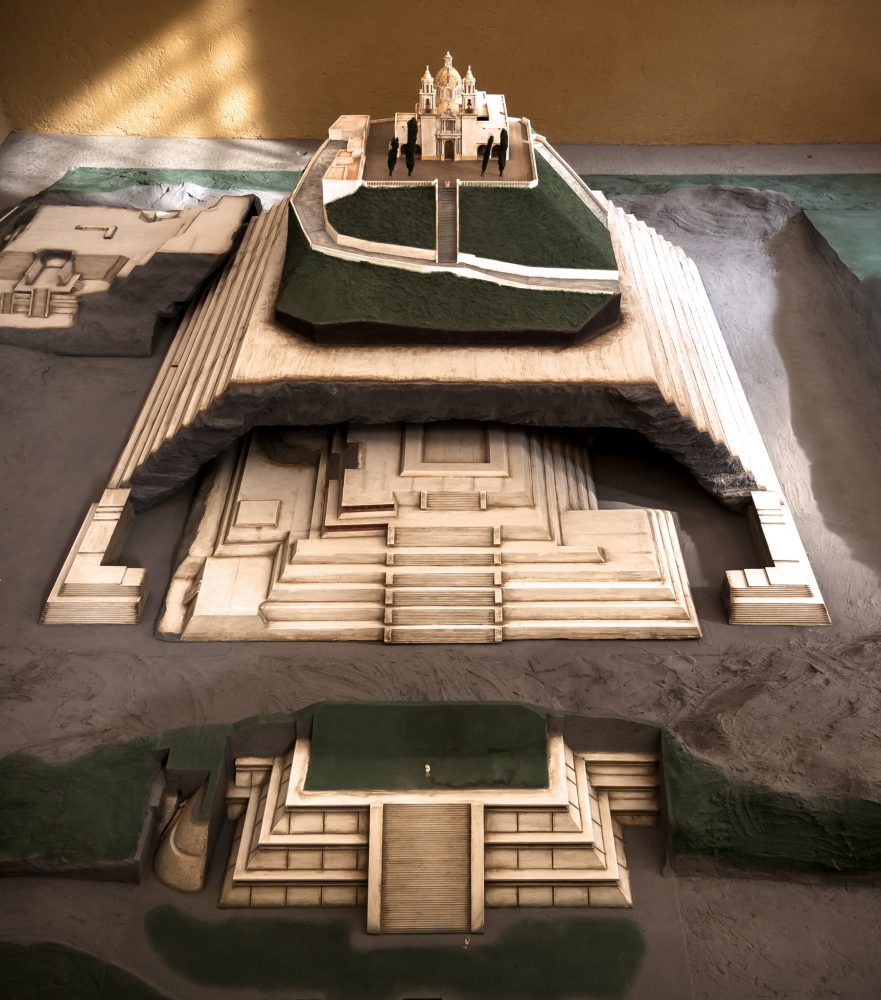
While it may not look like a traditional pyramid at first glance, this structure is actually the largest pyramid by volume on Earth. Hidden beneath what appears to be a natural hill, the Great Pyramid of Cholula was built over centuries by the indigenous peoples of Mesoamerica. It dwarfs even the Great Pyramid of Giza in sheer size. Today, a Spanish church sits atop the ancient structure, a striking blend of pre-Columbian and colonial history.
A model of the Great Pyramid of Cholula. Shutterstock.
3. The Nubian Pyramids – Sudan
The Pyramids of Meroe, located north of Khartoum in Sudan. Shutterstock.
Egypt’s southern neighbor is home to over 200 pyramids—more than Egypt itself. The Nubian pyramids of Meroë, built by the Kingdom of Kush, are smaller and steeper than their Egyptian counterparts but no less impressive. Constructed between 300 BCE and 350 CE, these pyramids served as royal tombs and stand as a testament to the long-lasting influence of ancient Egyptian culture in Africa. Their remote desert location adds to their mystique, making them a must-visit for history enthusiasts.
4. The Pyramids of Guimar – Canary Islands, Spain
Many of the older locals claim that there were many more pyramids in Tenerife that were destroyed. Credit: Pixabay
The Canary Islands hold an unexpected archaeological mystery—stepped pyramids made of lava stone. While some argue that these structures were built relatively recently for agricultural purposes, others believe they could be linked to ancient transatlantic travel. Some researchers suggest a connection between the pyramids of Guimar and those found in the Americas, fueling speculation about pre-Columbian oceanic voyages.
5. The Pyramid of Cestius – Italy
The Pyramid of Cestius. Wikimedia Commons.
Unlike other pyramids on this list, the Pyramid of Cestius is not a temple or tomb for a powerful civilization—it’s the final resting place of a single Roman. Built in the first century BCE for the Roman magistrate Gaius Cestius, this white-marble pyramid stands in the heart of Rome, blending Egyptian influence with Roman architectural style. It’s a rare example of how Egyptian culture fascinated the Romans and shaped their architectural ambitions.
Pyramidomania
Pyramids are far more than Egyptian monuments—they are found all over the world, built by civilizations separated by vast distances and time periods. From the scorching deserts of Sudan to the ancient cities of Mexico, these massive structures show how different cultures, with no apparent connection, were drawn to the same design. Whether used as tombs, temples, or ceremonial sites, pyramids represent a deep human instinct—to build something that lasts, something that reaches toward the sky.
What makes pyramids so fascinating is that they weren’t just a random architectural choice. Their shape provided stability, allowing them to stand for thousands of years, but their significance ran much deeper. Some cultures aligned them with the stars, others used them as places of worship, and in some cases, their true purpose is still a mystery. How did so many civilizations arrive at the same idea? Was it purely practical, or is there something more to the story?
No matter where they are, pyramids remind us that ancient builders had knowledge and ambition far beyond what we often give them credit for. As we explore five incredible pyramids outside Egypt, we step into a world of lost cities, forgotten rituals, and unanswered questions—proof that history is always waiting to surprise us.
This artist's concept of a lake at the north pole of Saturn's moon Titan illustrates raised rims and rampart-like features as seen by NASA's Cassini spacecraft (Credit : NASA/JPL-Caltech)
Saturn's largest moon Titan, stands out as one of the most Earth-like worlds in our Solar System. With its dense nitrogen atmosphere, a cold surface featuring methane lakes and rivers, and complex organic chemistry, this moon which is nearly the size of Mercury has been of great interest. The Cassini-Huygens mission revealed a landscape of mountains, dunes, and hydrocarbon seas, and even suggested there could be subsurface liquid water ocean beneath its icy crust, making Titan a prime target in the search for potential extraterrestrial habitats.
Saturn's moon Titan
(Credit : NASA/JPL-Caltech/SSI/Kevin M. Gill)
A further study of the moon by an international research team led by Antonin Affholder from the University of Arizona and Peter Higgins from Harvard University has investigated the possibility of life. The team used bioenergetic modelling and focused on Titan's unique organic content and deep subsurface ocean, which could potentially support microorganisms. Their findings, published in The Planetary Science Journal, suggest that while simple microscopic life might exist within Titan's estimated 482 kilometre deep ocean, the total biomass would likely amount to only a few kilograms. Comparing it to the Earth’s complex ecosystem, Titan’s is likely to be very limited.
The research leader Affholder challenges oversimplified estimates about potential Titan life, noting that despite abundant organic molecules, not all would constitute viable food sources, and limited exchange occurs between the organics rich surface and the vast ocean below. The research team modelled potential Titan life based on the fermentation process (a fundamental metabolic process requiring only organic molecules without oxidants like oxygen) as the most plausible biological pathway in Titan's environment.
A hydrothermal vent at the bottom of the Atlantic Ocean where life has evolved
(Credit : P. Rona / OAR/National Undersea Research Program (NURP); NOAA)
It’s likely that a process like this evolved early in Earth's history too and the team highlight that it doesn’t require any previously unknown or speculative mechanisms to be a viable theory. The team investigated whether microbes similar to Earth's earliest life forms could exist in Titan's subsurface ocean by feeding on organic compounds from the moon's atmosphere and surface. They specifically focused on glycine, the simplest amino acid, chosen because of its universal presence throughout the Solar System in primordial matter, asteroids, comets, and even in particle clouds that form stars and planets.
Computer simulations revealed that only a small fraction of Titan's organic material could support microbial life, with microbes depending on limited glycine delivery through meteorite created "melt pools" in the ice shell. This supply could sustain only a minimal biomass, perhaps only a few kilograms total, less than one cell per litre throughout Titan's vast ocean. This finding challenges assumptions about Titan's habitability, suggesting that despite its rich organic inventory, future missions would face extremely low detection odds unless alternative biological potential exists beyond surface organic content.
Artist's illustration of Enceladus's plumes. (Credit: NASA)
What kind of mission would be best suited to sample the plumes of Saturn’s ocean world, Enceladus, to determine if this intriguing world has the ingredients to harbor life? This is what a recent study presented at the 56th Lunar and Planetary Science Conference hopes to address as a team of researchers investigated the pros and cons of an orbiter or flyby mission to sample Enceladus’ plumes. This study has the potential to help scientists, engineers, and mission planners design and develop the most scientifically effective mission to Enceladus with the goal of determining its potential habitability.
Here, Universe Today discusses this incredible research with Dr. Morgan Cable, who is a research scientist in the Laboratory Studies group at the NASA Jet Propulsion Laboratory, regarding the motivation behind the study, significant takeaways, how this proposed mission will compare to Cassini, next steps for developing such a mission, and what forms of life we might find on Enceladus. Therefore, what was the motivation behind the study?
“Enceladus is unique in that material from its subsurface ocean can be accessed without the need to dig, drill or even land,” Dr. Cable tells Universe Today. “This is not something you can do on other planetary bodies, and it’s all thanks to the plume emanating from four giant fissures in the south pole. A spacecraft doing a flythrough of the plume, either from Saturn orbit or via Enceladus orbit, could collect both gas and ice grains and perform measurements to better constrain the habitability of the subsurface ocean and potentially search for evidence of life.”
For the study, the researchers discussed the motivation and variety of reasons why sampling Enceladus’ plumes would produce the most valuable science for studying this ocean world. This included the benefits of a plume-focused mission as opposed to a lander or other type of scientific mission how data obtained by NASA’s Cassini spacecraft contributed to recent discoveries regarding Enceladus. Finally, they discussed the benefits of a flyby verses Enceladus orbiter and the challenges of performing such a daring mission.
The discussion was complemented by the researchers presenting models from previous studies that estimated the salt content of the grains that could potentially be sampled from Enceladus’ plumes. While one study estimated collecting salt-rich grains, the other study estimated collecting grains with less salt. By combining the two studies, the researchers of this recent study concluded that 100 times more material will need to be collected than previously estimated to obtain sufficient data regarding the contents of Enceladus’ subsurface ocean. Therefore, what are the most significant takeaways from this study?
“Enceladus is the only confirmed body in the solar system where we have access to fresh material from a habitable subsurface ocean,” Dr. Cable tells Universe Today. “We also at a point for the first time in human history where we have developed instruments that can fit on spacecraft and are sufficiently sensitive that, even if there is a single alien microbe entrained within an ice grain in the plume, we could detect it. While we certainly started the journey to search for life elsewhere with the Viking missions to Mars, we now may be embarking on the golden era of the search for life in our own cosmic backyard.”
While Cassini was technically designated as an orbiter since it orbited Saturn several times while conducting countless flybys of its many moons, including 11 of Enceladus, it did not enter Enceladus’ orbit to conduct an in-depth analysis of the ocean world and its surface. The only other missions that briefly explored Saturn and its moons were Pioneer 11 and Voyager 1 & 2, all of which conducted flybys of the Saturn system.
As noted, this study builds off data collected by NASA’s Cassini mission that conducted groundbreaking science for over 13 years (2004 to 2017) while orbiting Saturn and its many moons. During this time, Cassini discovered Enceladus’ plumes and even flew through them several times, obtaining data regarding the chemical compositions and grain sizes. While these plume samples revealed the presence of organic materials, carbon monoxide, carbon dioxide, water vapor, and volatile gases, Cassini’s instruments were not equipped to conduct an in-depth analysis of ice grains. Therefore, how will this proposed orbiter/flyby mission compare to Cassini’s results when it flew through Enceladus’ plumes?
“Cassini’s instruments were state-of-the-art at the time that spacecraft was built and launched; those instruments were also not meant to search for biosignatures or complex organic chemistry,” Dr. Cable tells Universe Today. “With modern instrumentation, we can better identify both small molecules and complex organics, even up to biomolecules such as lipids, polypeptides, DNA or RNA. This is because modern instruments have better mass range and resolution, as well as sensitivity (so even if the molecules are dilute, we can detect them) and the ability to more robustly handle interferents.”
NASA missions typically take several years to go from a concept to launch and often several more years before finally collecting valuable science. For example, while Cassini was launched in 1997, it was actually introduced in 1982 by a working group between the National Academy of Sciences and the European Science Foundation, hence why Cassini was a joint mission between NASA, the European Space Agency (ESA), and the Italian Space Agency.
The next several years consisted of further discussions and some political bumps as the U.S. Congress came close to canceling the project, but NASA persuaded them to stay the course. After launching in 1997, Cassini spent close to seven years traveling to Saturn before officially entering orbit in 2004, followed by spending until 2017 collecting groundbreaking science about Saturn and its many moons. Therefore, what are the next steps for developing this potential orbiter/flyby to sample Enceladus’ plumes?
Dr. Cable tells Universe Today, “The recent Planetary Science and Astrobiology Decadal Survey recommended that Enceladus be included as a potential destination through the New Frontiers Program and also recommended that an Enceladus Orbilander follow Uranus Orbiter and Probe (UOP) as the next-priority flagship mission. So, I imagine one or more mission concept proposals may be submitted to the next New Frontiers call to explore Enceladus, and if selected, that would be very exciting. If not, there is significant community support for a flagship, but after UOP.”
Enceladus is one of the most intriguing and mysterious worlds in our solar system with its plumes of water ice being ejected from its subsurface ocean via cracks in its south pole. But it’s this subsurface ocean that causes the greatest amount of intrigue, as Earth demonstrates liquid water is one of the key ingredients for life as we know it, providing millions of aquatic species of all shapes and sizes.
An Earth analogy for what scientists could find on Enceladus are hydrothermal vents, which are found near regions of volcanic activity at the bottom of the ocean. These vents often consist of black smokers and white smokers, with each discharging their own respective set of minerals and ecosystems. Some examples of life found at hydrothermal vents include crabs, shrimp, tube worms, and mussels. Therefore, what forms of life do Dr. Cable think we could find in Enceladus?
“Based on our understanding of the amount of energy available in the ocean, it’s not likely that the density of life is very high,” Dr. Cable tells Universe Today. “In Earth’s oceans, where sunlight (our primary energy source) is abundant, we see cell densities on the order of 100,000-1,000,000 cells per milliliter of ocean water, which can support organisms as large as fish, sharks and whales. In energy-limited environments, such as the ice-covered lakes of Antarctica (which don’t have access to sunlight), we tend to see cell densities on the order of 100-1000 cells per milliliter.”
Dr. Cable continues, “And that I think is more likely at Enceladus, as sunlight won’t be an option in the ocean underneath the ice shell; the primary energy source is likely to be hydrothermal energy at the seafloor. But that doesn’t mean necessarily we’ll only see microbes. On Earth, at hydrothermal vents at our seafloor, we see diverse communities that include shrimp, octopods and other multicellular organisms, so we can’t rule that out! I think we’ll be excited no matter what we find.”
Other ocean worlds of intrigue include Saturn’s largest moon, Titan; Jupiter’s moons, Europa, Ganymede, and Callisto; Uranus’ moons, Ariel, Umbriel, Oberon, and Titania; Neptun’s moon, Triton; and even dwarf planets Pluto and Ceres. Europa is being visited by NASA’s Europa Clipper to examine its subsurface ocean while NASA’s Juno continues to study Europa and the other Galilean moons. For Titan, NASA is slated to launch its Dragonfly quadcopter in 2028 with an estimated arrival at Titan in 2034.
For now, a future Enceladus mission continues to be on the drawing board with the Enceladus Orbilander being the most anticipated mission to explore Enceladus and its subsurface ocean while researchers continue to ponder whether life as we know it, or even as we don’t know it, could exist within its watery depths.
Dr. Cable tells Universe Today, “One of the most interesting parts of my research is the opportunity to work and interact with people from a multitude of different disciplines, ranging from chemistry and geophysics to marine biology and oceanography. So, I think it’s important to realize that you can study something pretty far-removed from astrophysics or astronomy and still potentially join a mission team to explore big questions about our Universe!”
What type of mission will be designed to explore Enceladus’ plumes in the coming years and decades? Only time will tell, and this is why we science!
This is one fascinating orb. It changes color very fast and was not too far over the guys condo when it was recorded. Being an amateur astronomer he knows what he saw. May people believe UFOs don't have lights...but many people are also wrong about that belief because all UFOs have lights, most the time they don't use them. We know less than 1% of 1% of the knowledge about UFOs. We have much to learn, but we know this. They do exist, they are real and they fly in Earths skies daily worldwide.
Scott C. Waring - Utah
Eyewitness states:
No sound, white orb. Just floated. Venturing outdoors with my telescope, I endeavored to observe the Andromeda galaxy. However, my attention was diverted by an unidentified orb traversing approximately 500 feet above my residence. Remarkably, this celestial body emitted no audible sound. Subsequently, I captured footage using my iPhone 16 Pro Max. Upon magnification and slowed playback, the video reveals intricate shapes and hues, leading me to believe it may be an extraterrestrial egg. I possess another video from my back porch that captures the orb slowing moving away…
Russia is, in many ways, still a mysterious land that many in the West consider to be rather murky and misunderstood. Buried within the files of the strange and paranormal, there are numerous cases from Russia and the former Soviet Union that, for whatever reasons, have managed to slip through the cracks and remain forgotten conundrums that few people have ever even heard of, and some of these revolve around UFO crashes. With the famed secrecy of this nation further compounding our understanding, these are cases that are not only bizarre but perhaps doomed to stay behind locked doors forever, the answers eluding us until the end of time.
An earlier account of an apparent UFO crash into a body of water comes to us from November of 1928, at remote Lake Vedlozero, near Shuknavolok, in Russia’s Yaroslavl province. One evening, an incandescent object spewing flames was seen to crash into the lake, and while this may sound like it surely must have been a meteor, there would be a series of very strange sightings that suggested otherwise. Shortly after this object came down, people would begin to report seeing what they called “water goblins” in the lake or wandering along the shore, described as dwarfish beings with hairless, rounded heads and long, thin arms and legs. In some reports, they were described as wearing metallic shiny one-piece suits of some sort. It is possible that these were misidentifications of the seals that occasionally appear in the lake, but with very little other information on this case, it is hard to say.
One very intriguing and spectacular account supposedly occurred in 1959 in what was then Soviet-controlled Poland. In February of that year, several witnesses in the area of a place called Gdynia observed a glowing light fall from the sky to plunge into the frigid waters of the harbor, which was choked up with ice floes at the time. It apparently created quite a commotion at the time, and thinking that perhaps an aircraft had gone down, there was a search and rescue effort launched with a team of divers. It was there, down through the icy waters in the muck at the bottom, that the divers would allegedly uncover a piece of shiny metal that had not rusted and was assumed to be part of whatever it was that had come down out of the heavens.
According to the account, this metal piece was turned over to the Polish Navy, who made a preliminary examination of it before sending it off to the Polytechnic University of Gdynia, where it vanished into the mists of time. In the meantime, the Navy closed the whole area down and restricted access, but the weirdness was only just beginning. A few days after the object had come down into the harbor, it was reported that several military personnel came across what was described as a “strange silhouette humanoid” that appeared to be wearing a uniform of some sort and was injured, with burns on its face and crawling along the beach in exhaustion, wet and seeming to have crept out of the water. The soldiers tried to communicate with the strange humanoid, which appeared to be male, but they were not familiar with the language he spoke. As he was obviously seriously injured, it was arranged to bring this being to the hospital, where it would get even stranger still.
Once at the hospital, it was immediately clear that this humanoid was weirder than anyone had thought. His uniform was made of some sort of strange metallic material that no one recognized, and no matter what the medical staff did, they seemed to be unable to remove it. The uniform had no discernible buttons, zippers, or any way to put it on or take it off, and the material it was constructed of apparently could not be cut or torn. In overall appearance, he appeared to be almost identical to a human being, although there were anomalies, such as extra digits on his fingers and toes, and other minor differences that marked him as not human. Doctors tended as well as they could to the burns on the being’s face, but when they removed an armband on the uniform, he apparently went into some sort of cardiac arrest and died.
The body was sent in for an autopsy, and they purportedly needed specialized equipment to remove that odd uniform. When the body was examined, the humanoid was purportedly found to have a completely different circulatory system than human beings, as well as different organs. Unbelievably, there was another of these creatures found on the same beach in the meantime, and this one apparently fell into a coma-like state and was placed in some sort of frozen stasis, the body whisked away and hidden somewhere. What happened to these two bodies and that piece of what is assumed to be their crashed ship? No one seems to know. The case has been picked up by UFOlogists over the years and has been written of at length by UFO researcher Arthur Shuttlewood and others, but there seems to be very little to verify the story, no witnesses that have been interviewed, and it has the feel of being almost urban legend rather than anything else. However, one does wonder just what happened here, if anything.
In the summer of 1966, a Russian geologist by the name of Oleg Ivanovich was on an expedition to a thickly forested region northwest of Topolovka. The remote area made progress slow, and they faced their fair share of difficulties. At one point, their horse got badly stuck in the mosquito-infested muck of a swamp, and they decided to camp out for the night, having no idea of the weirdness that was to follow.
During the night, the entire camp was awoken by a deafening roar that sent them jumping out of their tents into the night to see what was going on. According to the report, all around them, the forest was illuminated and ablaze with fire, producing a wave of heat so intense that the expedition members retreated to a small nearby river to get away from it. The forest continued to smolder and burn all night, with some trees still in flames even when the morning arrived. It seemed like only one area was charred and burning, so they assumed that some sort of explosion had occurred, and they hiked off to see what it might be.
As they walked along, sometimes choking on the thick smoke, they noticed that their compasses and radio were going haywire, and that they all had a sort of brain fog and “sense of powerlessness.” They also noticed that the trees seemed to be bent, leaning towards one direction, and that the tops were missing, as if they had been chopped off with a cleaver. It was all pretty eerie, but they nevertheless continued slogging through the swampy mud until they reached a large, smoldering object that looked like “two washbasins set face to face,” the whole of it colored with flashing lights. They could also make out an opening on the side of the object that was belching out smoke from within, and upon closer inspection, they saw what they claimed to be “a tentacle” protruding out from the gloom beyond the barrier.
The team tried to get even closer, but the swampy terrain was too unforgiving and dangerous for them to get any nearer, and they also realized that the more they approached the object, the more they were filled with nausea and dread. They would also report that their vision seemed to be getting blurry, so thinking it was perhaps from radiation, they withdrew to a safer distance. It was around this time that the sounds of the night were punctuated by the thumping of what sounded like helicopter blades. This proved to be true when, moments later, they could see five unmarked helicopters come into view over the treetops, seemingly converging on the site where that strange object had been seen. The next morning, they would go back to find no trace of the object, nor any sign of debris at all.
It would later turn out that there were other witnesses to the previous night’s mysterious events. One witness, Anna Egoronovna, had been awakened in the middle of the night by a loud roar and found the walls of the house shaking, and when she had looked outside, it had seemed to be as bright as day. She also had seen “a great glowing light as bright as the sun” hurtling down towards the forest, followed by a boom and a blast of wind. Also a man named Michael Kuzmich, a 79-year old hunter, had been fishing in the area late at night when suddenly he heard a tremendous noise, a sort of “howling,” followed by the trees bursting into flame and a thunderous clap and shockwave that was powerful enough to send him sprawling to the ground.
It is a curious case, in that it is totally unknown what happened after this, or where that mysterious object had come from, or where it had gone. Another case comes from 1969, from the state of Sverdlovsk, which was formerly Yekatrinburg of the USSR. In March of that year, a fiery object came down to smash into the earth, and allegedly, the site was secured by the Russian military, and one dead alien was found in the wreckage. The remains of the craft and the alien were purportedly brought to a secure location, and the alien's body autopsied. Interestingly, there were supposedly reams of photographs and film taken, not only of the crash site, but also of the alien autopsy.
The whole case comes from the so-called “Secret KGB Files,” which were reportedly smuggled out of the former Soviet Union for a sum of $10,000, and the photos were aired on a TV program called The Secret UFO Files of the KGB. The special aired on the TNT network and features Roger Moore, veteran actor and former James Bond, who discusses other UFO events as well, along with interviews with UFO experts, CIA agents, and other important people in the field. As far as the footage goes, an analysis on UFOCasebook says of it:
“The footage at the crash site does seem to be authentic at least on several points. The truck in the film is a circa 1950 model ZIS151, which has not been used by the military for quite some time, and the truck would have been difficult to find to stage a hoax with. Other elements of the film do not exhibit any obvious signs of a hoax, as to the movement of the soldiers, the timing of the film as to shadows, and the UFO itself.
There are also several documents shown to verify the event itself, and an eyewitness to the event who swears that the recovery mission did occur. The footage of the autopsy film shows personnel without caps and gowns, which seemed odd to me at first, but after some research I found that this was commonplace for that era in Russia.
The furnishings in the room are acceptable, and in Russia have probably not changed much today. Three men in their 20’s and 30’s are performing the procedure, and one woman is taking notes. The note taker is identified as KGB stenographer O. A. Pshonikina. The alien’s torso and arm are lying together on the table as the autopsy is performed, and there are documents shown to support the autopsy.
Although the USA-Russia relationship is much improved over a few years ago, it still lacks. Any information received is subject to translation, and oftentimes there are problems with interpretation. It is sad there is not more cooperation between the two countries. The case of the 1969 retrieval and autopsy are difficult to assess. Until more information is uncovered, it will remain unsubstantiated.”
From 1986, there is a strange case from the cold wilds. The small mining town of Dalnegorsk, Russia, is a rather bleak, stark, and frigid place. Indeed, the name Dalnegorsk literally means “far in the mountains,” and the unforgiving landscape here is fitting for such a name. It is a remote, rugged place of near-perpetual cold, just a speck on the map and unknown to most of the outside world. Yet this forgotten place has one claim to fame, as it was once supposedly the site of a UFO that crashed to earth, which would then spawn stories of conspiracies and cover-ups, as well as usher in a whole series of UFO phenomena and strangeness.
In the cold, dark morning hours of January 29, 1986, hundreds of locals had their attention drawn skyward by an unusual sight. Streaking across the sky was seen a glowing reddish ball, travelling in a parallel, controlled manner at a speed of around 120 mph, described as being about the size of “half of the moon’s disc” and with a metallic surface like “hot stainless steel.” The object was obviously no meteor, as it appeared to slow down to a speed of only around 50 mph as it approached Izvestkovaya Mountain, also called “Height 611.” It was thought at first that this was perhaps something from the military base nearby, but whatever it was did not make the slightest sound as it flew over at a height of around 700 feet. As the villagers looked on in astonishment, the object suddenly jerked and dipped sharply, before plummeting to earth behind the trees and hitting the mountain beyond in a ball of flame, producing a blindingly bright flash, yet there was oddly no expected boom of an explosion. For several hours, the glow of what looked from a distance like a forest fire could be seen emanating from where the mysterious object had gone down, yet no one dared approach.
It would not be until a few days later that anyone would arrive at the remote site to check it out, when a team from the Academy of Sciences came to investigate the odd reports. They discovered a circular spot in the forest that had been charred, and to their amazement, there were numerous shards of metal, mesh fragments, beads, and an anomalous black film over everything. There were some odd magnetic readings at the site, an unidentifiable chemical odor lingering everywhere, and a certain charge to the air like static electricity, yet no abnormal radiation was detected. Some reports say that those who examined the area experienced various health issues such as nose bleeds, headaches, nausea, and blood pressure fluctuations, and inexplicably, all photos taken of it would later come out completely blank. Samples of the materials were gathered, and things would get stranger still.
Scientists allegedly found that the beads were composed of lead, silicon, gold, nickel, and iron, but when melted down, their composition anomalously changed into such elements as titanium and molybdenum. The mesh-like material was found to also have many oddities. For one, its structure was bizarre to say the least, made of microscopic twisted fibers of carbonic and metal threads only 17 microns wide, beyond anyone's capabilities to make at the time. Some of the fragments featured an incredibly high density of gold, inconsistent with the surrounding area. The mesh also proved to be well-nigh indestructible, unable to be damaged by soaking in strong acids or solvents, and only able to be cut with the hardest diamond cutting tools. Scientists were apparently dumbfounded by all of this, but rather than explain it as aliens, it was thought to perhaps be from an American satellite or aircraft displaying some unknown advanced technology, although the United States would later deny having anything to do with it. In later years, some of these fragments made their way to the United States, and some would even be displayed. One such exhibit of some of these alleged fragments was shown at the National Atomic Testing Museum in Las Vegas, and the description at the exhibition reads:
Three Soviet academic centers and 11 research institutes analyzed the objects from this UFO crash. The distance between atoms is different from ordinary iron. Radar cannot be reflected from the material. Elements in the material may disappear and new ones appear after heating. One piece disappeared completely in front of four witnesses. The core of the material is composed of a substance with anti-gravitational properties.
In the days after the Dalnegorsk incident, the area, and in particular Height 611, would allegedly become ground zero for intense waves of UFO sightings, with dozens of subsequent instances of mysterious objects in the sky. On some occasions the objects were reported as hovering over the mountain and illuminating the forest below with beams, as if looking for something, and such reports would carry on into the following year and beyond, given by people from all walks of life, including traditionally reliable witnesses such as doctors, policemen, officials, and military personnel. In some instances, people even claimed to have found more of the mysterious fragments in the area, as well as patches of a strange oil-like substance.
Although it is all a rather spectacular tale, the Dalnegorsk incident managed to be sort of brushed under the carpet, hidden away by what was then the Soviet Union, and it was not until years later that outside ufologists would begin uncovering the tale and making its existence known through articles and TV shows such as a notable segment on a 1995 episode of Sightings. Unfortunately, there does not seem to be much remaining in the way of corroborating evidence, and the vast majority of the supposed material from the crash has gone missing over the decades. While it is all very intriguing and seems promising on some levels, with plenty of eyewitnesses and potential physical evidence, we are forced to relegate it to the files of other cases that have been lost to history, with no way of proving them true or not, one way or the other. What happened at that cold, lonely mountain? We may never know.
In the spring of 1989, Soviet Navy personnel purportedly observed a glowing object enter the sea off the coast of the Dalniy Vostok area, outside of Vladivostok, in Far East Russia. According to the account, a recovery operation was immediately initiated and a device described as egg-shaped and 6 meters long, with a matte grey exterior and 6 oval structures like dark portholes encircled the lower part of the object, which was retrieved from the seabed by divers and brought ashore. There, they tried to open the object with blowtorches and other cutting instruments, but they could not even put a scratch on the surface.
The object was later transported to Vladivostok and then to Moscow, where they were equally unsuccessful at accessing the interior of the weird object. It was only after they found a minuscule crack in the hull that they were able to use a laser to slowly widen the opening to the point that they were able to penetrate the object. The first of three levels of the object was a disaster area, with exploded consoles and a reactor that had apparently self-destructed or had been destroyed by an explosion. On the second level, they would supposedly find three dead alien bodies, with two of them sitting in chairs and another sprawled out on the floor.
The aliens were about 1.3 – 1.5m in height, with one being slightly taller, about 1.6-1.7 m. They had large hairless heads encased in helmets, 6 fingered extremities, and gray-brown colored skin, large round eyes, which were covered with black eye lenses, and small ears. They were dressed in tight-fitting metallic silver colored suits with a violet tint, with belts and what appeared to be circles on their chest area. They also wore elbow-length gloves. The suits were removed with extreme difficulty, and also the silver-greenish boots and gloves. One body was grievously damaged, apparently by the hard impact of the crash. An autopsy would later reveal that they had a thick, viscous black liquid for blood. The object was later transported inside a mountain beyond the Polar Circle on Novaya Zemlya Island, and after that, no one really knows what happened to it or its unfortunate crew. Is there any truth to this story at all? Who knows?
Moving into 1989, there is a rather spectacular series of events that played out in the skies of Zastrahovka, which seems to involve a group of UFOs shooting another one down. In September of that year, six circular, silver, flying saucers ganged up and fought a seventh, golden saucer, with all of them pulling incredible aerial maneuvers and exchanging blasts with what appeared to be light beams. This was all seen by hundreds of witnesses in the area, and it would later be claimed that the intense UFO dogfight caused a blackout in the city. The outnumbered golden UFO eventually was overwhelmed by repeated strikes from the energy beams, and apparently lost altitude to come down into a crash as it’s antagonists sped off into the clouds.
According to the report, the outgunned loser came down right into a bog on a military test range. A military team had then descended on the boggy area to conduct a full search and rescue operation, although it is unclear what they actually found. Eventually, all activities at the military range were shut down and the base put under heavy guard, so it seems unlikely that we will ever know what happened here.
Also from 1989 is a report from Prohladnyi, Russia, where at approximately 11:00 AM on August 10, 1989, military radar units detected an unidentified flying object. All attempts to communicate with the unidentified object were met with silence, and so the decision was made to label it as hostile. Defense systems were put on the highest alert, with the utilization of surface-to-air missiles, and the deployment of MiG-25s that were ordered to intercept and engage the intruder. A ground-to-air missile reportedly hit the UFO, causing it to veer off over the Caucasian Mountains and come down somewhere in the wilderness.
When a retrieval team was sent, they supposedly found a disc-like object measuring 6.9 meters long and 3.0 meters high, and “shaped like a cockleshell.” The craft had left a huge rut in the dirt and was very badly damaged, with debris everywhere. More extraordinarily, three aliens were found inside, with two dead and one heavily injured but still alive. A medical team attempted to keep the alien alive, but their efforts failed. All of these beings were described as standing about 1.0-1.2 meters tall, with a whitish gray outer cover that revealed blue-green reptilian skin beneath. The other worldly beings also had hairless heads, large black eyes, almost round, which were covered by a protective lid, and three webbed fingers at the end of their inhumanly long, slender arms. These aliens would be moved into glass cylinders and put away in a top-secret facility east of Solnechnogorsk. Once again, there is no further news on what happened after that.
These are bizarre cases to be sure, but perhaps not quite as much so as what happened to a Russian submariner and diver named Nikolay M., as he was diving one day in 1997 in the Bay of Finland, in the Saint Petersburg region of Russia. Nikolay allegedly was diving in shallow water when he saw an elongated object on the bottom, which was reminiscent of a cucumber. He at first took it to be a part of some sort of wreckage and tried to get it to the surface by tying some old rope around it, but he was ultimately unable to budge the odd object. Undeterred, he decided to haul it out with his car, which was on shore and not that far away. He retrieved a pneumatic drill to drill holes in the thing to attach a sling to it, but when he started drilling into the object, it began to issue forth streamers of a thick, dark liquid like oil, which crept out into the water. Despite this startling development, he kept pressure on the drill to go deeper, after which it stopped upon hitting something within. At this point, the object reportedly split open to regurgitate a bubble containing a humanoid creature with porcelain white skin and a bleeding wound where the drill had hit it.
The creature did not seem pleased and fixed the diver with a malevolent gaze, after which it lashed out with taloned hands to grab his arm and cut into his flesh. Nikolay then supposedly used the drill to bore into his attacker, after which it let go and he lost consciousness. The next thing he knew, he was being dragged from the water by rescuers. It was found that he had sustained deep cuts on his arm and lost a piece of his hand, but there was no sign of the strange cucumber object or its bizarre, unearthly occupant. What did this man see? Was it some sort of cocoon? If so, for what? Nobody knows.
Secrecy is, of course, the eternal obstacle to getting to the bottom of cases that we have looked at here, and it is not something wholly unique to Russia in that the United States and other countries have also long been said to keep their own UFO crashes under wraps. Yet at times it seems that Russia is an even more impenetrable fortress of secrecy that we will never gain access to on these matters, and we can only wonder about what these cases really entailed.
Summoning UFOs?Skywatcher Group Draws Pentagon’s Eye with Bold New Claims
A new wave of intrigue has surged through the UFO research community following recent revelations on NewsNation, where investigative journalist Ross Coulthart reported that a private group known as Skywatcher is claiming consistent, measurable contact with unidentified aerial phenomena (UAPs) through unconventional means. Even more surprising is the acknowledgment that the Pentagon’s All-domain Anomaly Resolution Office (AARO) has observed their operations in person.
Who Is Skywatcher?
Skywatcher is a private UAP research team led by Air Force veteran Jake Barber. The group has garnered attention by claiming they can summon UAPs using an “electromechanical whistle” — a signaling device similar in concept to a dog whistle, but presumably emitting frequencies or pulses detectable by unknown aerial objects. Barber asserts that their method yields a 100% success rate, meaning a UAP-like event occurs every time they use their system under the right conditions.
Pentagon’s Quiet Involvement
While the U.S. Department of Defense officially maintains that there is no conclusive evidence of extraterrestrial contact, Coulthart revealed that the Pentagon’s UFO investigation unit, AARO, has visited Skywatcher’s testing range. The range remains classified, but it’s described as a controlled site where repeated experiments take place.
Although not officially partnering with or endorsing Skywatcher, the Pentagon’s willingness to observe their operations marks a shift in how private initiatives are being acknowledged. Coulthart emphasized that this reflects a more open attitude within the defense establishment — potentially hinting at the inevitability of future disclosures.
Nine Types of UFOs on Video?
One of the most anticipated aspects of this development is a forthcoming video release by Skywatcher. According to Coulthart, the group claims to have captured footage of nine distinct shapes of UFOs, which include:
The well-known “Tic Tac” and “Egg”-shaped crafts,
And a bizarre “Jellyfish”-like object, reportedly with a metallic top and what appears to be fluid, tentacle-like extensions.
The footage has not yet been made public, but Coulthart expects it to surface soon. He notes that Skywatcher’s team is working to finalize the material, which could potentially shake up the ongoing debate around UAPs and their origins.
Implications for UFO Disclosure
Coulthart points out a growing discrepancy between the Pentagon’s public denials and private interest in such cases. He believes Skywatcher may be demonstrating what government and defense agencies have allegedly explored in secret for decades: the controlled engagement — or even summoning — of unknown aerial craft.
While skeptics may view these claims as speculative or fringe, the involvement of credible military personnel and the interest of a government office like AARO lend a surprising level of legitimacy to the story.
What Comes Next?
The coming weeks could be crucial. If Skywatcher releases their video as promised — and if the footage is verifiable — it might not just support their extraordinary claims but also force a broader public and institutional conversation about what we know (or don’t know) about UAPs.
In the meantime, Ross Coulthart continues to investigate the story further on his Reality Check podcast and through NewsNation. Whether this leads to mainstream acknowledgment or remains another mysterious chapter in the UAP saga depends heavily on the evidence Skywatcher delivers.
Meer van UFO'S of UAP'S, ASTRONOMIE, RUIMTEVAART, ARCHEOLOGIE, OUDHEIDKUNDE, SF-SNUFJES EN ANDERE ESOTERISCHE WETENSCHAPPEN - DE ALLERLAATSTE NIEUWTJES


 Mysterious underwater 'pyramid' believed to be 12,000 years old reshapes history