Ontdek de Fascinerende Wereld van UFO's en UAP's: Jouw Bron voor Onthullende Informatie!
Ben jij ook gefascineerd door het onbekende? Wil je meer weten over UFO's en UAP's, niet alleen in België, maar over de hele wereld? Dan ben je op de juiste plek!
België: Het Kloppend Hart van UFO-onderzoek
In België is BUFON (Belgisch UFO-Netwerk) dé autoriteit op het gebied van UFO-onderzoek. Voor betrouwbare en objectieve informatie over deze intrigerende fenomenen, bezoek je zeker onze Facebook-pagina en deze blog. Maar dat is nog niet alles! Ontdek ook het Belgisch UFO-meldpunt en Caelestia, twee organisaties die diepgaand onderzoek verrichten, al zijn ze soms kritisch of sceptisch.
Nederland: Een Schat aan Informatie
Voor onze Nederlandse buren is er de schitterende website www.ufowijzer.nl, beheerd door Paul Harmans. Deze site biedt een schat aan informatie en artikelen die je niet wilt missen!
Internationaal: MUFON - De Wereldwijde Autoriteit
Neem ook een kijkje bij MUFON (Mutual UFO Network Inc.), een gerenommeerde Amerikaanse UFO-vereniging met afdelingen in de VS en wereldwijd. MUFON is toegewijd aan de wetenschappelijke en analytische studie van het UFO-fenomeen, en hun maandelijkse tijdschrift, The MUFON UFO-Journal, is een must-read voor elke UFO-enthousiasteling. Bezoek hun website op www.mufon.com voor meer informatie.
Samenwerking en Toekomstvisie
Sinds 1 februari 2020 is Pieter niet alleen ex-president van BUFON, maar ook de voormalige nationale directeur van MUFON in Vlaanderen en Nederland. Dit creëert een sterke samenwerking met de Franse MUFON Reseau MUFON/EUROP, wat ons in staat stelt om nog meer waardevolle inzichten te delen.
Let op: Nepprofielen en Nieuwe Groeperingen
Pas op voor een nieuwe groepering die zich ook BUFON noemt, maar geen enkele connectie heeft met onze gevestigde organisatie. Hoewel zij de naam geregistreerd hebben, kunnen ze het rijke verleden en de expertise van onze groep niet evenaren. We wensen hen veel succes, maar we blijven de autoriteit in UFO-onderzoek!
Blijf Op De Hoogte!
Wil jij de laatste nieuwtjes over UFO's, ruimtevaart, archeologie, en meer? Volg ons dan en duik samen met ons in de fascinerende wereld van het onbekende! Sluit je aan bij de gemeenschap van nieuwsgierige geesten die net als jij verlangen naar antwoorden en avonturen in de sterren!
Heb je vragen of wil je meer weten? Aarzel dan niet om contact met ons op te nemen! Samen ontrafelen we het mysterie van de lucht en daarbuiten.
Where it is: 142 million miles (228 million kilometers) from the sun, on average
How big it is: 4,222 miles (6,795 km) wide, about half the diameter of Earth
How long a day lasts: 24.6 hours
How long a year lasts: 669.6 Martian days (sols), or 687 Earth days
Atmosphere: Extremely thin, about 95% carbon dioxide
Temperature: Minus 225 to 70 degrees Fahrenheit (minus 143 to 20 degrees Celsius)
Mars, the fourth planet from the sun, is a dry, rocky world. Its famous red color has earned it the nickname the Red Planet. Mars has fascinated people throughout history, and today, it is one of the most explored places in the solar system, with many rovers and orbiters searching the planet for evidence of past or present life.
Mars orbits at an average distance of 142 million miles (228 million km) from the sun. Its orbit is about 1.5 times the size of Earth's. Sunlight takes about 13 minutes to get to Mars, while it takes around 8 minutes to reach our planet.
Past missions from Earth to the Red Planet have taken anywhere from 128 to 333 days, depending on how far apart the planets were in their orbits at the time. While many robotic missions have visited Mars, no human has ever set foot there. Various missions by the world’s space agencies plan to change this in the coming decades.
5 fast facts about Mars
The name Mars comes from the ancient Roman god of war. Romans could see the planet in the night sky, and its red color reminded them of blood, according to NASA.
Mars is red because the dust that covers the planet's surface is full of iron oxides — in other words, rust.
It's not just rusty, it's also dusty. Mars experiences planet-wide dust storms every few years, and enormous cyclones of dust called "dust devils" on Mars can tower more than a mile above the planet's surface.
Mars is home to the tallest mountain in the solar system, Olympus Mons, which is like three Mount Everests stacked on top of each other.
"Martians" (aliens from Mars) aren't real, but scientists used to think they were. Researchers once thought the dark spots they saw on Mars were canals that hinted that there could be advanced cities and intelligent life on Mars.
Everything you need to know about Mars
Is Mars bigger than Earth?
Mars is smaller than Earth. It has a diameter of roughly 4,222 miles (6,794 km) — about half Earth's diameter, according to the European Space Agency (ESA).
The Red Planet is rocky, much like Earth. The inside structure of Mars is also similar to Earth's, NASA rovers have revealed. Mars' outer crust is 6 to 30 miles (10 to 50 km) thick and is composed mainly of iron, magnesium, aluminum, calcium and potassium, according to NASA. Below that is a rocky mantle that's 770 to 1,170 miles (1,240 to 1,880 km) thick, which surrounds a dense core that's made of iron, nickel and sulfur and has a radius of 930 to 1,300 miles (1,500 to 2,100 km).
A composite image showing the comparable sizes of Earth and Mars. Earth's diameter is roughly twice that of Mars. (Image credit: NASA/JPL)
Does Mars have a moon?
Mars has two small, potato-shaped moons, called Phobos and Deimos. These moons are named for two sons of the Greek god of war, Ares, which the Romans called Mars. The names Phobos and Deimos mean "fear" and "panic."
The innermost moon, Phobos, has lots of craters and is roughly 13.8 miles (22.2 km) in diameter. In about 50 million years, it is expected to break up or crash into Mars.
Deimos orbits 2.5 times farther from Mars than Phobos does and is half the size — about 7.8 miles (12.6 km) across. Both moons are made mostly from rock and iron and may have once been asteroids that got captured by Mars' gravitational pull.
A composite image showing Mars and its two moons, Phobos and Deimos. (Image credit: NASA/JPL-Caltech/GSFC/Univ. of Arizona)
Is there life on Mars?
NASA scientists think life may have once been plentiful on Mars, as there is a lot of evidence that the planet used to be much warmer and wetter billions of years ago. Whether there is anything alive today on Mars is not known.
However, scientists can make some educated guesses about the kind of life that might be there or might have lived there in the past. If there is life on Mars today, it is probably microscopic — teeny-tiny organisms living beneath the Martian soil.
NASA's Perseverance rover has spent years drilling into Martian rocks to collect samples, in hopes that scientists can one day test them for signs of life. Scientists are working on plans to bring those samples back to Earth.
Is there water on Mars?
Although Mars is a dry planet today, lots of evidence suggests there were once oceans and rivers all over Mars. Lines carved into rocks show where water once flowed, and there may have even been sandy beaches like we have on Earth today. However, sometime in the past 2 billion years or so, Mars' water dried up.
Some satellites have found signs of water in the form of frost at the top of Mars' tallest volcanoes and in buried frozen lakes deep below the planet's surface. But for now, no liquid water has been spotted on the Red Planet.
A composite image showing some of the NASA vehicles that have explored Mars. Clockwise from top left: Perseverance rover and Ingenuity Mars Helicopter, InSight lander, Odyssey orbiter, MAVEN orbiter, Curiosity rover and Mars Reconnaissance Orbiter. (Image credit: NASA/JPL-Caltech)
Have humans explored Mars?
Humans have never been to Mars, but we've been studying it for hundreds of years — starting with British astronomer William Herschel, who watched the Red Planet through an early telescope in the late 1700s.
The first spacecraft to successfully reach Mars was NASA's Mariner 4 probe, in July 1965. Flying without any humans aboard, the probe soared past Mars and sent back photos of the planet's surface, according to NASA.
In 1971, NASA's Mariner 9 became the first mission to successfully orbit Mars. The Viking 1 and 2 landers were the first human-made objects to make it to the Red Planet's surface and survive for more than a few minutes, when they touched down in 1976, according to The Planetary Society. From the surface, they took photos and conducted the first search for life on the planet.
The current group of robots on Mars includes NASA's Curiosity and Perseverance rovers, both of which have made incredible scientific discoveries. Perseverance carried Ingenuity, the first helicopter to fly on Mars, which took many incredible images before several of its rotor blades broke during a rough landing in 2024. China's Zhurong rover successfully landed on Mars in 2021, and it has sent back beautiful pictures, and even sounds from the surface.
Many other missions, both past and present, have revealed amazing insights about the planet's history, and future planned missions should help continue this progress. NASA aims to send humans to explore the Red Planet in the 2030s, though there is no specific plan to do so yet.
Mars pictures
(Image credit: NASA/JPL/USGS)Mars from spaceA global view of Mars from orbit, showing one of the planet's frosty polar ice caps on top.
(Image credit: NASA/JPL/Malin Space Science Systems)Snow on MarsA close-up of one of Mars' polar ice caps, covered in white frost.
(Image credit: NASA/JPL-Caltech/Univ. of Arizona)A Martian dust devilA satellite image of a dust devil raging across the surface of Mars. These cyclones of dust can tower a mile high and are visible from orbit.
(Image credit: NASA/JPL)The surface of MarsThe rocky, dusty surface of Mars photographed by NASA's Viking lander.
(Image credit: NASA/JPL/Cornell)Meteor on MarsA NASA rover snapped this photograph of an iron meteorite sitting on the Martian surface.
(Image credit: ESA/DLR/FU Berlin)Martian volcanoes, and the tallest mountain ever knownFour Martian volcanoes seen by the European Space Agency's Mars Express orbiter. The top volcano is Olympus Mons, the tallest mountain in the solar system.
Discover more about Mars
See how NASA is currently exploring Mars, as well as the agency's plans for Mars exploration, on this website dedicated to Martian probes.
Dive into this stunning map of different regions on the Red Planet, courtesy of the U.S. Geological Survey.
Browse even more amazing images from NASA's Mars missions on the agency's multimedia page.
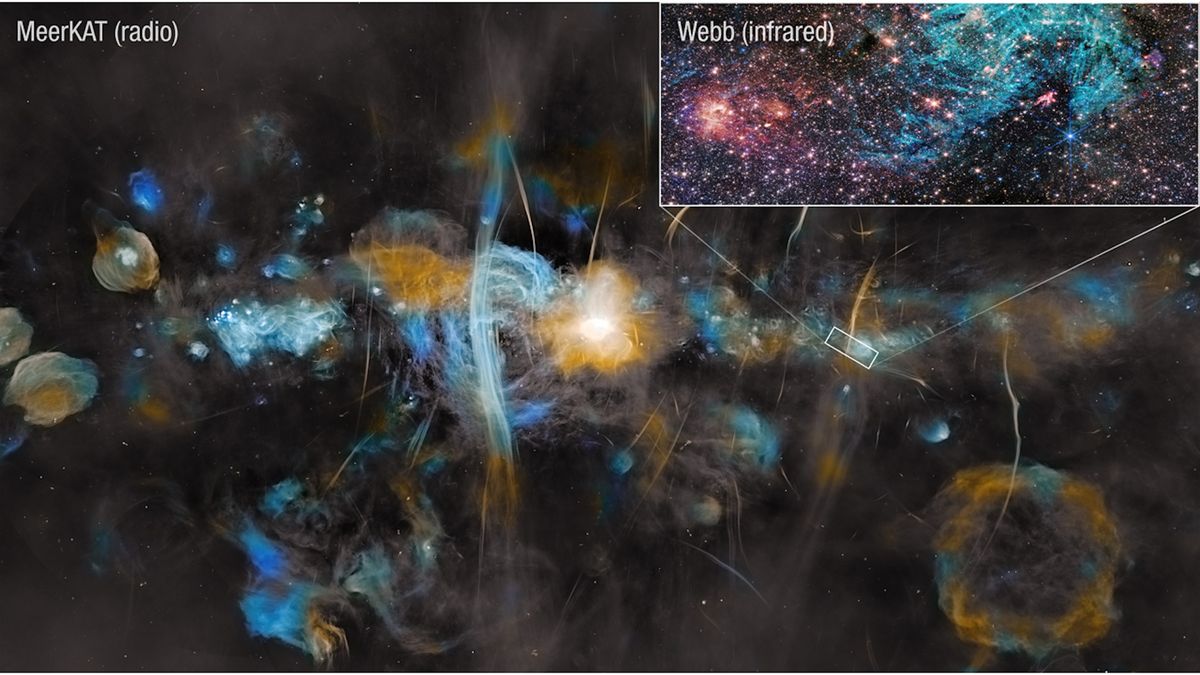
The James Webb Space Telescope (JWST) has teamed up with the MeerKAT radio telescope array to explore how magnetic fields affect star formation at the chaotic center of the Milky Way.
The Milky Way captured by the MeerKAT radio telescope array, with the James Webb Space Telescope's image inset.
(Image credit: NASA, ESA, CSA, STScI, SARAO, Samuel Crowe (UVA), John Bally (CU), Ruben Fedriani (IAA-CSIC), Ian Heywood (Oxford))
What it is:Sagittarius C (Sgr C) region of the Milky Way.
Where it is: 25,000 light-years from the solar system in the constellation Sagittarius.
When it was shared: April 2, 2025
Why it's so special: The Milky Way often appears as a reddish, pinkish and bluish-white arc across the night sky, but this new super-long exposure image from South Africa's ground-based MeerKAT radio telescope shows our home galaxy in a completely new way.
Colored in blue, cyan, yellow and white, the main image — whose many bubbles of color are remnants of supernovas — span 1,000 light-years of the Milky Way.
The new radio image helps to put in context the inset infrared image by the James Webb Space Telescope from 2023 of Sagittarius C (Sgr C). This is a 44 light-year-wide region about 200 light-years from the Milky Way's central supermassive black hole, Sagittarius A*, where stars are being formed.
JWST's image revealed more than 500,000 stars, but in this Central Molecular Zone — an extreme environment — stars are not being formed as quickly as astronomers expect. One reason may be the strong magnetic fields around that supermassive black hole, which are shaping the filaments seen by MeerKAT and JWST. These magnetic fields may also be strong enough to resist the gravity that causes dense clouds of gas and dust to collapse to create stars, thus suppressing star formation in Sgr C.
"A big question in the Central Molecular Zone of our galaxy has been, if there is so much dense gas and cosmic dust here, and we know that stars form in such clouds, why are so few stars born here?" said John Bally, an astrophysicist at the University of Colorado Boulder and one of the principal investigators of a related paper published April 2 in The Astrophysical Journal. "Now, for the first time, we are seeing directly that strong magnetic fields may play an important role in suppressing star formation, even at small scales," Bally said in a NASAstatement.
MeerKAT is a radio telescope made up of 64 dishes in South Africa's Karoo region. It will eventually form part of a far larger radio telescope called the Square Kilometre Array, the world's largest and most sensitive radio telescope that will also use more than 130,000 Christmas tree-shaped antennas on the traditional lands of the Wajarri Yamaji, in Murchison, Western Australia.
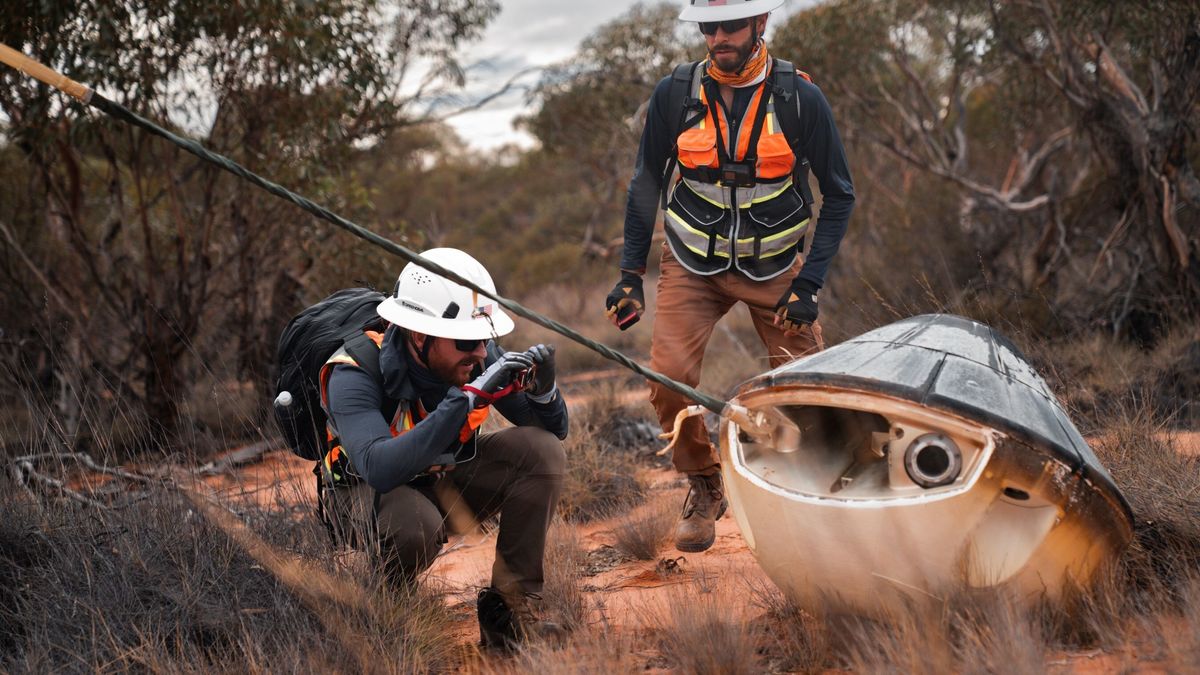
Varda Space Industries' W-2 space capsule reentered Earth's atmosphere and touched down in the Australian outback last month, becoming the first commercial spacecraft to land Down Under.
Varda's W-2 capsule is the first commercial spacecraft to land in Australia.
(Image credit: Photo by William Godwin, Courtesy Varda Space Industries.)
A saucer-like space capsule touched down in the Australian outback last month, marking the first time a commercial spacecraft has landed Down Under.
Varda Space Industries' Winnebago-2 (W-2) space capsule reentered Earth's atmosphere and dropped down in South Australia on Feb. 28. In doing so, W-2 also set a world first by becoming the first commercial spacecraft to return to a commercial spaceport, according to a statement released by the Australian Space Agency.
The successful return of W-2 was a "landmark moment for the Australian space sector," Australian Space Agency representatives wrote in the statement.
The company behind W-2, Varda, is an American startup based in California. W-2 originally left Earth from California on a SpaceX Falcon 9 rocket on Jan. 14 as part of the Transporter-12 rideshare mission — the Transporter carries satellites from various customers into space. W-2 then spent 45 days in orbit, carrying payloads from the U.S. Air Force and NASA before dropping down to the Koonibba Test Range, run by Australian aerospace company Southern Launch.
W-2 weighed 265 pounds (120 kilograms) and had various technologies onboard to advance space research. For example, W-2 carried Varda’s expanded pharmaceutical reactor, which allows for the production of medicine in space, according to a statement released by Southern Launch.
The space capsule was also equipped with a heatshield developed with NASA and a spectrometer built by the U.S. Air Force Research Laboratory. The spectrometer, known as Optical Sensing of Plasmas in the ReEntry Environment (OSPREE), measured the environment around the capsule as it reentered at speeds exceeding Mach 25, which is 25 times the speed of sound, or around 19,000 miles per hour (31,000 kilometers per hour), according to a statement released by Varda.
The W-2 space capsule re-entering Earth’s atmosphere last month.(Image credit: Photo by William Godwin, Courtesy Varda Space Industries.)
"We are ecstatic to have W-2 back on our home planet safely and are proud to support significant reentry research for our government partners as we continue building a thriving foundation for economic expansion to low Earth orbit," Varda CEO Will Bruey said in the statement.
The Southern Launch team watched the W-2 reentry from the ground with advanced tracking telescopes and led the recovery operations, which included representatives from the Far West Coast Aboriginal Corporation, the traditional owners of the land where the capsule landed, according to the Southern Launch statement.
"For Australia, this mission ushers in a new era of space capabilities for the nation," Southern Launch representatives wrote in its statement. "The W-2 mission was the first time a commercial space craft re-entry was granted under Australian legislation and is just the first of many scheduled to return to the Koonibba Test Range."
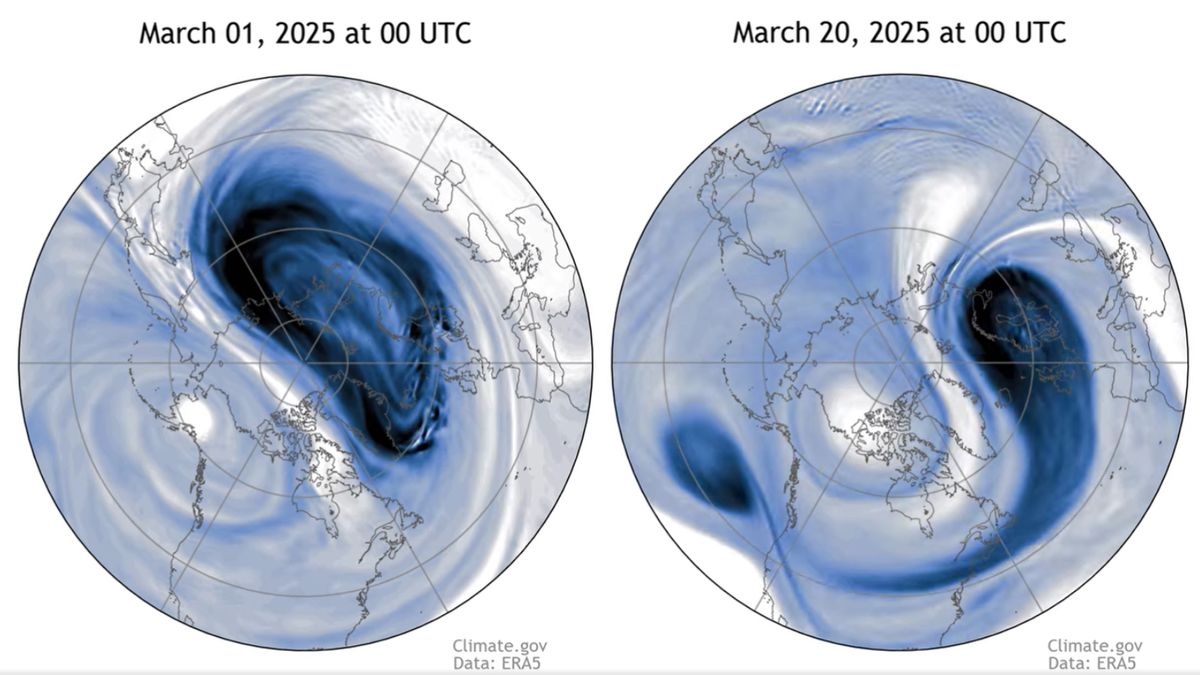
A sudden stratospheric warming event reversed the winds that make up the northern polar vortex on March 9. A new animation shows the vortex also moved away from the Arctic towards Europe.
Between March 1 and March 20, the polar vortex traveled from above the Arctic to above Northern Europe.
(Image credit: NOAA Climate)
A major disruption to the Arctic polar vortex has bumped the ring of wind that circles the North Pole off its perch and towards Europe, a new animation shows.
The migration could trigger colder-than-average temperatures in parts of the continent and across the eastern U.S. over the coming week, climate scientists say.
The polar vortex started wandering off course March 9, when its high winds suddenly switched from blowing west to east to blowing in the opposite direction. This switch normally happens each year, but it tends to occur in mid-April — meaning this year's reversal struck unusually early, according to a blog post published April 3 by the National Oceanic and Atmospheric Administration (NOAA).
"For much of this winter season, the polar vortex has been strong," NOAA officials wrote in the blog post. "But like a true atmospheric diva, the polar vortex had one last trick up its sleeve, breaking down in a spectacular fashion and bringing some cold air with it."
The Arctic polar vortex is a circle of strong, cold winds that picks up every winter over the North Pole. The vortex is always present, but it strengthens in the winter due to a redistribution of heat from the tropics. During the winter, the winds that make up the polar vortex blow from west to east. In spring, as Earth's tilt changes and the North Pole receives more sunlight, the direction of the winds changes to blow from east to west. The winds also become weaker as a result of less heat wafting from the tropics to the pole.
These winds are located in the stratosphere — a layer of the atmosphere that extends between around 6 and 31 miles (10 to 50 kilometers) above Earth's surface.
Occasional "sudden stratospheric warming" events can disrupt the polar vortex. These events happen when large-scale atmospheric waves, called Rossby waves, get pushed into the stratosphere from below, triggering sudden spikes in temperature. Like ocean waves,Rossby waves can "break"on top of the polar vortex, weakening it and — in extreme cases — reversing the direction of its winds.
Last year, a sudden stratospheric warming event hit the polar vortex and reversed its winds in early March, but the vortex recovered. This time, "the vortex does not seem likely to gain a foothold again," NOAA officials wrote.
The switch in wind direction doesn't mean the polar vortex will immediately drop off for the summer, however. The reversed polar vortex has simply "moved off the pole, meandering around over Northern Europe," officials wrote.
NOAA's latest forecasts suggest the polar vortex is unlikely to wander back to its normal position over the North Pole. It probably won't regain its wintertime strength either, officials said, so the likelihood is that it will dissipate and eventually "enter hibernation" over Northern Europe.
As it dissipates, the polar vortex will bring below-average temperatures to Northern Europe, parts of Asia and the eastern U.S., NOAA officials wrote. "Temperatures for the last week of March were pretty normal across the eastern U.S., but the latest forecasts do predict increased chances of below-normal temperatures for the next week," they wrote.
A Glimpse of the Stunning Full Image Image Credit: NASA, ESA, Benjamin F. Williams (University of Washington), Zhuo Chen (University of Washington), L. Clifton Johnson (Northwestern University);
Image Processing: Joseph DePasquale (STScI).
The Andromeda Galaxy, our closest large galactic neighbor, has just revealed its breathtaking secrets in an image so detailed it feels like stepping into the cosmos itself. Captured through over a decade of meticulous observations by the Hubble Space Telescope, this 2.5-billion-pixel masterpiece isn’t just a pretty picture—it’s a cosmic treasure map exposing Andromeda’s dramatic past and chaotic evolution.
A Visual Marvel That Took Over 10 Years to Create
The monumental task of creating this image required stitching together data from 600 individual views, forming a mosaic of unparalleled clarity. Spanning an incredible 2.5 billion pixels, this image allows astronomers to analyze approximately 200 million stars, each shining brighter than our Sun.
While this is just a small fraction of Andromeda’s estimated trillion stars, the data has unlocked a deeper understanding of the galaxy’s structure and history. Ben Williams, the project’s lead scientist, explained, “With Hubble, we can examine the entire disk of the galaxy in extraordinary detail. No other galaxy this large offers such an opportunity.”
The image also uncovered a tumultuous story. Hubble detected streams of stars and a unique stellar population that indicate Andromeda has endured cosmic collisions, likely with neighboring galaxies.
Andromeda as We’ve Never Seen It Before Image Credit: NASA, ESA, Benjamin F. Williams (University of Washington), Zhuo Chen (University of Washington), L. Clifton Johnson (Northwestern University); Image Processing: Joseph DePasquale (STScI).
“Andromeda looks like it’s been through a massive event—like a train wreck,” said Daniel Weisz of the University of California, Berkeley. “This collision triggered intense star formation but then shut down quickly afterward.”
One prime suspect in this intergalactic drama is Messier 32, a small satellite galaxy. Researchers believe Andromeda siphoned Messier 32’s gas, fueling the formation of countless stars before transitioning into its current, less active state.
A Cosmic Puzzle Waiting to Be Solved
Andromeda now sits in a transitional phase, straddling the line between a vibrant, star-forming spiral galaxy and an elliptical galaxy dominated by aging stars. Its central bulge glows with the light of older stars, while its outer regions show surprisingly limited star formation.
Hubble’s decade-long mission not only provides insights into Andromeda’s chaotic history but also offers a roadmap for understanding how galaxies like our own might evolve. “Every resolved star tells us more about the galaxy’s history of mergers and interactions,” Williams added.
This astonishing image is available to view in full resolution, and experts recommend experiencing it on the largest screen possible.
Amazing Jellyfish UFO Over Spain On March 25, 2025, UAP Drone Sighting News.
Date of sighting: March 25, 2025
Location of sighting: Andalusia, Spain
Sources: Email report send to scwaring @yahoo.com
This UFO was seen over Spain last week and it's not a typical UFO, but a jellyfish type UFO. Its lower bottom like tentacles glow as it moves through the sky. Very strange, like a living creature less like an intelligently made UFO. Is it possible that some entities can travel through space and enter atmospheres of planets flying around...existing and then moving to the next planet? Yes, the answer is yes, there are thousands, maybe millions of living animals existing in the cold vacuum of space. Surprised? Well, ask ai about the possibilities of it.
TicTac UAP Over South Florida, April 4, 2025, UFO Drone Sighting News.
Date of sighting: April 4, 2025
Location of sighting: South Florida, USA
Source: Email report at scwaring @yahoo.com
Hey all check this out. This is an actual tictac UFO seen over South Florida. The object is seen moving out of cloud over some people and they debate about what it could be. Now Florida actually has a base under it that extends from the Gulf to the Bermuda Triangle. I know, I know, how would you know Scott? Well, two decades of hard core research and a mass of UFO sightings in Florida that outnumber any other state in the US by far. I believe Dr Steven Greer would agree with me on this one.
I was searching a Mars photo on Gigapan when I encountered something really good. I found ancient alien writing on a Mars
mountain side. There are three distinct characters so it's three different words. Sadly not even the NSA could decipher an alien language with only three words, however we are left to imagine what it might have said. Perhaps to make a powerful tribe which once ruled this area, or a royal family who owned the land. We may never know, but that okay, because not knowing is what keeps us seeking the truth.
Martian dust devil captured by NASA's Mars Reconnaissance Orbiter. Credit: NASA/JPL-Caltech/Univ. of Arizona
Mars is well known for its seasonal dust storms, which occur when the southern hemisphere experiences summer. Periodically, these storms grow to engulf the entire planet and can last for months, wreaking havoc on robotic missions. Smaller regional storms are far more common on Mars, as are swirling columns of air and dust (aka. dust devils). NASA's Perseverance rover recently took pictures of several dust devils on the rim of the Jezero crater. Some of these images were stitched together to create a short video of a larger dust devil consuming a smaller one.
These images were taken by the rover's navigation camera on January 25th when the rover was exploring the location called "Witch Hazel Hill." The rover was about 1 km (0.6 mi) from the two dust devils, the larger of which was approximately 65 m (210 ft) wide, while the smaller, trailing dust devil was roughly 5 m (16 ft). The captures were part of an imaging experiment conducted by Perseverance's science team to learn more about the planet's atmospheric dynamics. Two other dust devils can also be seen in the background at the left and center of the video (shown below).
Like dust devils on Earth, these weather patterns are formed by rising and rotating air columns. They begin close to the ground, where the air is heated by contact with the warmer ground, then rises through the cooler air above. Meanwhile, cooler air moves in to occupy the space near the surface, which causes the rising air to rotate and pick up speed. This process also kicks up dust from the surface, creating the swirling columns of dust and air that meteorologists call "convective vortices" or dust devils.
Mark Lemmon, a Perseverance scientist at the Space Science Institute (SSI), explained in a NASA press release:
"Convective vortices — aka dust devils — can be rather fiendish. These mini-twisters wander the surface of Mars, picking up dust as they go and lowering the visibility in their immediate area. If two dust devils happen upon each other, they can either obliterate one another or merge, with the stronger one consuming the weaker. If you feel bad for the little devil in our latest video, it may give you some solace to know the larger perpetrator most likely met its own end a few minutes later. Dust devils on Mars only last about 10 minutes.”
Martian dust devils were first photographed from space by NASA's Viking orbiters, which studied Mars in the 1970s. The Pathfinder mission, consisting of a lander and the Sojourner rover,was the first to image a dust devil on the surface. Subsequent orbiters and rovers, like the Spiritand Opportunityrovers and theMars Reconnaissance Orbiter (MRO), have taken images of these weather patterns from the surface and space. The Curiosity rover also took multiple images of dust devils in the Gale Crater, some of which were used to create a video.
Since landing in the Jezero Crater in 2021, Perseverance has also observed dust devils and even recorded what they sound like using its SuperCam microphone. Said Katie Stack Morgan, a project scientist for the Perseverance rover at NASA's Jet Propulsion Laboratory:
"Dust devils play a significant role in Martian weather patterns. Dust devil study is important because these phenomena indicate atmospheric conditions, such as prevailing wind directions and speed, and are responsible for about half the dust in the Martian atmosphere."
Learning more about these swirling columns of air is vital to understanding the dynamics of Mars' atmosphere. It could also lead to predictive models, allowing scientists to know where they might occur in advance. Capturing these features is presently a matter of luck and timing, which is why Perseverance routinely monitors in all directions for them.
The analysis examined 149,000 sighting entries from the Reporting Center's database, along with social media reports to determine how many encounters are experienced per capita in each state.
Coming in first, Californians have recorded a staggering 36,286 reported UFO sightings since 1974.
This makes it officially America's alien hotspot with one sighting for every 1,075 residents.
California's clear night skies and dense population have created perfect conditions for UFO sightings.
In fact, just last month, the harrowing call a US Air Force pilot made to air traffic control was released after they described 'three orange-like lights' hovering silently above Los Angeles.
The unknown craft came as close as 10 feet of the pilot's wing, reaching supersonic speeds, as the US Air Force craft was conducting a secret mission over California.
New data from the National UFO Reporting Center has revealed exactly where these eerie sightings are most common
The pilot, who identified as 'Troy 21,' told local air traffic control (ATC) in Los Angeles: 'This is going to sound weird, but I just had something pass underneath my wing, maybe a football-sized object right underneath my wing.'
During the September 17, 2024, incident, ATC can be heard asking Troy 21 if he thought it was a drone, but the stunned pilot couldn't give an answer.
Troy 21 replied that his sensor operator was looking for the UFO on the plane's cameras, adding that it was a 'dark gray cylindrical object' no bigger than a football.
The pilot quickly informed ATC that they had spotted the UFO again about 60 miles from where it first buzzed Troy 21's plane.
Later in the recording, another air traffic controller in Los Angeles could be heard on the radio dismissing the incident, saying that 'there was UFO reported here, but that's all taken care of now. So you don't have to worry about it... it's gone.'
Former FBI agent Ben Hansen told NewsNation the mysterious object must have be traveling at Mach 2, or twice the speed of sound, to get so far away so fast.
The state to come in second in terms of the appearance Unidentified Aerial Phenomena (UAPs) was Washington.
The Pacific Northwest has long attracted those seeking the unexplained, with Washington recording 7,125 UFO sightings.
The strange object then moved off at high speed and was seen minutes later 60 miles away from the aircraft
That's approximately one for every 1,093 residents.
From 1948 to 1952, as America's production of atomic weapons first ramped up, waves of UFO sightings began cropping up over Washington state's Hanford nuclear production complex, as well as Los Alamos, New Mexico, and other sites for the Manhattan Project.
Meanwhile, Florida was ranked third with more than 11,000 reported encounters.
That's roughly one sighting for every 1,144 Floridians.
As recently as this past December, a flight attendant flying off the coast of the Sunshine State managed to capture a mysterious spherical object flying above the plane she was working on, thousands of feet above the Bahamas.
Cassandra Martin, a flight attendant for private air service Surjet, was flying with two pilots in an empty jet on December 23 when Miami air traffic control alerted them to a 'foreign object' as they were flying back to Fort Lauderdale.
The eerie footage showed a rounded blur of white light that faded into a green color, with a circular halo surrounding the object.
Coming in fourth is Oregon, which had one UFO sighting per 1,156 residents.
Cassandra Martin, a flight attendant for private air service Surjet, was flying with two pilots in an empty jet on December 23 when air traffic control alerted them to a 'foreign object'
'It had capabilities just to zigzag and change color, so that was a little daunting, to the say the least, but you know, it's also something fascinating that I was able to see and capture with my phone,' Martin said
One of the reports came from an air ambulance pilot, who described seeing a bright light streaking toward his aircraft before abruptly reversing course and heading back toward the Pacific Ocean on the evening of December 7.
'Red in color - moving at extreme speeds. I don't even know how to describe how fast it was moving,' the pilot told air-traffic controllers.
On the next night, a United Airlines pilot also noted unusual lights in the Eugene area.
'We're seeing three or four targets. They're all altitudes. Up and down. It's pretty crazy,' the pilot reported to air-traffic controllers, who confirmed there was no military activity in the area.
The air ambulance pilot additionally noted one light moving in a 'corkscrew pattern,' which appeared on the aircraft's collision avoidance system.
'You are cleared to maneuver as necessary - left or right to avoid the UFO out there,' an air-traffic controller responded, according to an audio clip of the exchange
Short video clips taken by pilots and crew showed lights in the night sky, but the dark conditions made it difficult to discern specific details.
At least four commercial pilots reported spotting mysterious lights darting through the skies over Oregon
Meanwhile, New York rounds out the top five with one sighting per 1,301 people.
Harvard physicist, Avi Loeb, wrote that the mysterious orb was created by 'a bright spot from reflection of sunlight as the camera gradually changed its orientation relative to the sun and the ground.
Loeb continued to explain that if the orb was a real object, it would have been moving at the speed of sound, not anything extraordinary.
A segment during 'Good Day New York' featured a mysterious orb that appeared to zoom over the Hudson River
Those hoping to avoid extraterrestrial encounters should consider staying in Louisiana, where residents experience the fewest UFO encounters nationwide - just one sighting for every 3,815 people.
Even safer is North Dakota, which recorded only 282 total sightings - approximately 0.0004 per capita - making it statistically the state where you are least likely to have an encounter of the third kind.
Meer van UFO'S of UAP'S, ASTRONOMIE, RUIMTEVAART, ARCHEOLOGIE, OUDHEIDKUNDE, SF-SNUFJES EN ANDERE ESOTERISCHE WETENSCHAPPEN - DE ALLERLAATSTE NIEUWTJES


 Mars: Facts about the Red Planet, its moons, and possibilities for life