Naar de inhoud

UFO'S of UAP'S, ASTRONOMIE, RUIMTEVAART, ARCHEOLOGIE, OUDHEIDKUNDE, SF-SNUFJES EN ANDERE ESOTERISCHE WETENSCHAPPEN - DE ALLERLAATSTE NIEUWTJES

UFO's of UAP'S in België en de rest van de wereld
akke.beakke.be
Ontdek de Fascinerende Wereld van UFO's en UAP's: Jouw Bron voor Onthullende Informatie! Ben jij ook gefascineerd door het onbekende? Wil je meer weten over UFO's en UAP's, niet alleen in België, maar over de hele wereld? Dan ben je op de juiste plek! België: Het Kloppend Hart van UFO-onderzoek In België is BUFON (Belgisch UFO-Netwerk) dé autoriteit op het gebied van UFO-onderzoek. Voor betrouwbare en objectieve informatie over deze intrigerende fenomenen, bezoek je zeker onze Facebook-pagina en deze blog. Maar dat is nog niet alles! Ontdek ook het Belgisch UFO-meldpunt en Caelestia, twee organisaties die diepgaand onderzoek verrichten, al zijn ze soms kritisch of sceptisch. Nederland: Een Schat aan Informatie Voor onze Nederlandse buren is er de schitterende website www.ufowijzer.nl, beheerd door Paul Harmans. Deze site biedt een schat aan informatie en artikelen die je niet wilt missen! Internationaal: MUFON - De Wereldwijde Autoriteit Neem ook een kijkje bij MUFON (Mutual UFO Network Inc.), een gerenommeerde Amerikaanse UFO-vereniging met afdelingen in de VS en wereldwijd. MUFON is toegewijd aan de wetenschappelijke en analytische studie van het UFO-fenomeen, en hun maandelijkse tijdschrift, The MUFON UFO-Journal, is een must-read voor elke UFO-enthousiasteling. Bezoek hun website op www.mufon.com voor meer informatie. Samenwerking en Toekomstvisie Sinds 1 februari 2020 is Pieter niet alleen ex-president van BUFON, maar ook de voormalige nationale directeur van MUFON in Vlaanderen en Nederland. Dit creëert een sterke samenwerking met de Franse MUFON Reseau MUFON/EUROP, wat ons in staat stelt om nog meer waardevolle inzichten te delen. Let op: Nepprofielen en Nieuwe Groeperingen Pas op voor een nieuwe groepering die zich ook BUFON noemt, maar geen enkele connectie heeft met onze gevestigde organisatie. Hoewel zij de naam geregistreerd hebben, kunnen ze het rijke verleden en de expertise van onze groep niet evenaren. We wensen hen veel succes, maar we blijven de autoriteit in UFO-onderzoek! Blijf Op De Hoogte! Wil jij de laatste nieuwtjes over UFO's, ruimtevaart, archeologie, en meer? Volg ons dan en duik samen met ons in de fascinerende wereld van het onbekende! Sluit je aan bij de gemeenschap van nieuwsgierige geesten die net als jij verlangen naar antwoorden en avonturen in de sterren! Heb je vragen of wil je meer weten? Aarzel dan niet om contact met ons op te nemen! Samen ontrafelen we het mysterie van de lucht en daarbuiten.

Archief

Could Gravity Be the Hidden Architect of Time?

Could Gravity Be the Hidden Architect of Time?

The fundamental laws that govern everything from atomic interactions to planetary motion remain indifferent to the flow of time.

The concept of time is deeply ingrained in our daily experience—we move forward, never backward, with the past forever fixed and the future an unfolding mystery. Yet, physics presents a paradox: the fundamental laws that govern everything from atomic interactions to planetary motion remain indifferent to the flow of time. They work just as well whether time runs forward or in reverse.

So why does time seem to have a preferred direction? While conventional theories point to entropy as the key driver of time’s arrow, a radical new idea suggests that gravity itself might be responsible for shaping our perception of time’s progression.

Rethinking Time and Gravity

For over a century, physicists have relied on the second law of thermodynamics to explain time’s direction. This law states that in a closed system, entropy—a measure of disorder—always increases. From a neatly stacked deck of cards becoming shuffled to a pristine room inevitably turning messy, our everyday experiences align with this principle. However, this explanation raises a fundamental problem: for entropy to define the arrow of time, the universe must have started in an extremely ordered, low-entropy state—an assumption that clashes with our chaotic understanding of the Big Bang.

In 2014, theoretical physicist Julian Barbour and his team introduced a groundbreaking idea that seeks to resolve this paradox. Rather than relying on entropy, they proposed that gravity itself naturally generates the forward flow of time. Their approach, based on an alternative framework called Shape Dynamics, challenges Einstein’s view of spacetime and suggests that the universe’s evolution is driven by the relationships between objects rather than the fabric of space and time itself.

The Emergence of Time’s Arrow

Barbour’s work demonstrated that if a system of particles is governed solely by gravity, a natural time asymmetry emerges. His simulations showed that these particles tend to form highly ordered structures before progressing toward a state of increasing complexity—mirroring the rise of entropy but without assuming an initial low-entropy condition.

This finding is intriguing because it implies that the arrow of time might not be a byproduct of entropy at all, but rather an intrinsic feature of gravitational interactions. Even though the equations of gravity are time-reversible, the very way matter interacts could give rise to time’s directional flow without requiring any special initial conditions.

The Challenges Ahead

Despite its promise, Barbour’s model simplifies reality. It assumes a universe composed solely of gravitationally interacting particles, ignoring the complexities of quantum mechanics, electromagnetism, and nuclear forces. Expanding Shape Dynamics to accommodate a broader range of interactions remains an open challenge.

Additionally, while Shape Dynamics produces results that align with some aspects of General Relativity, it predicts different mathematical behaviors in extreme scenarios—such as black holes. Whether these deviations discredit the theory or hint at new physics is still under investigation.

A Glimpse Into the Future

In recent years, researchers have explored whether the principles behind Shape Dynamics could apply to quantum systems or even the early universe. Some findings suggest that time’s arrow could emerge in a broader range of physical scenarios without relying on entropy. However, a fully developed Shape Dynamics-based model of the universe remains out of reach, as only a small number of scientists are currently exploring the idea.

Although the theory has yet to reach mainstream acceptance, its core premise is fascinating: the relentless forward march of time might not be an illusion or a statistical quirk of entropy, but a natural consequence of how the universe fundamentally works. If true, this perspective could reshape our understanding of time, gravity, and the very fabric of reality.

RELATED VIDEOS

Mysterious Places on Earth Where Gravity Defies All the Laws of Nature

Is the strength of gravity really CONSTANT? | Solving the crisis in cosmology

GRAVITY - The Key To Understanding The Universe | SPACETIME - SCIENCE SHOW

{ https://curiosmos.com/ }

Hoe vind je dit bericht?
Geschreven door peter om 23:21 Stuur door

How Humans Can Reinvent Themselves to Live on Other Worlds

How Humans Can Reinvent Themselves to Live on Other Worlds

Robert Pattinson playing a double role as Robert Pattinson plays two "expendable" space travelers in "Mickey 17." ( Credit: Warner Bros. Entertainment)

Let’s face it: Space is a hostile environment for humans. Even on Mars, settlers might have a hard time coping with potentially lethal levels of radiation, scarce resources and reduced gravity.

In “Mickey 17” — a new sci-fi movie from Bong Joon Ho, the South Korean filmmaker who made his mark with “Parasite” — an expendable space traveler named Mickey (Robert Pattinson) is exposed over and over again to deadly risks. And every time he’s killed, the lab’s 3D printer just churns out another copy of Mickey.

“He’s dying to save mankind,” the movie’s poster proclaims.

While it’s possibly to create 3D-printed body parts for implantation, the idea of printing out a complete human body and restoring its backed-up memories is pure science fiction. Nevertheless, Christopher Mason, a Cornell University biomedical researcher who studies space-related health issues, is intrigued by the movie’s premise.

“If you could 3D print a body and perfectly reconstruct it, you could, in theory, learn a lot about a body that’s put in a more dangerous situation,” he says in the latest episode of the Fiction Science podcast. “I think the concept of the movie is actually quite interesting.”

Mason explores the ways in which the human body can be optimized for living in space in a book titled “The Next 500 Years: Engineering Life to Reach New Worlds.” He argues that it’s up to us humans to ensure the long-term future of life in the universe by taking the tools of evolution into our own hands.

Even if we’re able to avoid blowing ourselves up, or succumbing to the effects of climate change, we have only about a billion years before the sun reaches a level of activity that would make Earth unlivable.

“I want to think about preserving life, which necessitates us going to other planets and eventually other stars,” Mason says. “Because humans are the only species with an awareness of extinction, this gives us a unique duty toward life … what I call a deontogenic sort of principle, the genetic duty toward all life.”

Christopher Mason in lab

Christopher Mason studies beneficial genetic changes.

(Credit: Weill Cornell Medicine)

The good news is that we can adjust to many of the rigors of spaceflight, at least temporarily. Mason and other researchers saw that when they monitored the health of NASA astronaut Scott Kelly during his nearly yearlong stint on the International Space Station in 2015-2016. They compared Kelly’s physical and genetic profile with that of his twin brother, Mark Kelly, who was monitored down on Earth.

The NASA-sponsored Twins Study found that Scott Kelly experienced changes in the ways that his genes and his immune system worked while he was in space — possibly because of radiation exposure and other space-related stresses.

“More than 90% of these changes really seemed to come back to normal within a few months being back on Earth,” Mason said. But some of the changes were longer-lasting.

“There’s this nagging question of this small percentage of genes and functions that were perturbed that we’re still studying to this day in other crews, with SpaceX and other commercial providers,” he said.

The stresses of the space environment are likely to become more concerning as explorers and settlers go beyond Earth orbit and our planet’s protective magnetic shield. Which gets us back to the things that can kill Mickey 17 and other earthly life forms.

Radiation is the top concern. The studies done to date suggest that astronauts could be exposed to cancer-causing levels of radiation during a three-year mission to Mars and back. Thick shielding could reduce the risk, but Mason suggests using genetics as well.

“For example, tardigrades are these water bears that can survive even the vacuum of space and heavy doses of radiation,” he says. “We’ve made cells in my laboratory that can actually take a tardigrade gene and use it in a human cell, and have this increase of radiation resistance — an 80% decrease in the [DNA] damage that we observe.”

If scientists could use CRISPR-style gene-editing tools to insert the tardigrade gene into Mickey’s genome, that might head off one of his deaths. In his book, Mason lists other genetic techniques that could improve the vision of space travelers, boost their immune response, or make it easier for them to “hibernate” during a long trip.

“The simplest one, I think, includes the ability to make all of your own amino acids and vitamins,” Mason says. “The gene to make vitamin C, for example, is still embedded in all of our DNA. It’s just been degraded, and it’s no longer functional. But with a few small modifications, you can make your own vitamin C.”

As scientists learn more about health-related genes in humans and other species, and improve their gene-editing techniques, Mason thinks the challenges of spaceflight will become less daunting — not only for professional astronauts, but for the rest of us as well.

“You could imagine a case where you can ethically and responsibly and safely modify someone to get them into space,” Mason says. “That’s not that far away.”

And if space travelers run into unexpected challenges on another world — for example, alien microbes on Mars — they wouldn’t have to handle it on their own.

“I talk a bit in the book about a ‘point-to-point biology’ concept, where weird things might appear on Mars, but there’s not a lot of resources there to do high-throughput screening, or high-dimensional characterization of the organisms,” Mason says.

In that case, the alien microbe’s genetic code could be sequenced on site, using a next-generation version of equipment that’s already been tested on the International Space Station. Then the DNA data could be transmitted back to lab researchers on Earth.

“They could synthesize it and then study it there with more resources, and send updates back to Mars,” Mason says. “You could imagine this idea of a virtuous cycle of observation, interrogation, study, transfer of data, repeat in a place with more resources — and then send back that knowledge and help the organisms adapt.”

That’s a world where Mickey wouldn’t have to die every day.

— ● —

“The Next 500 Years” isn’t Mason’s only book. In collaboration with WorldQuant CEO Igor Tulchinsky, Mason has written a book delving into the rapid rise of artificial intelligence and big data, titled “The Age of Prediction: Algorithms, AI and the Shifting Shadows of Risk.” Now he’s working on a book about efforts to revive extinct and rare species, drawing upon his experience as an adviser to Colossal Laboratories & Biosciences. Check out the Mason Lab’s website to learn more about the researcher and his team at Weill Cornell Medicine.

My co-host for the Fiction Science podcast is Dominica Phetteplace, an award-winning writer who is a graduate of the Clarion West Writers Workshop and lives in San Francisco. To learn more about Phetteplace, visit her website, DominicaPhetteplace.com.

Check out the original version of this report on Cosmic Log for bonus reading recommendations from Mason, and stay tuned for future episodes of the Fiction Science podcast via Apple, Spotify, Player.fm, Pocket Casts and Podchaser. Fiction Science is included in FeedSpot’s 100 Best Sci-Fi Podcasts. If you like Fiction Science, please rate the podcast and subscribe to get alerts for future episodes.

{ https://www.universetoday.com/ }

Hoe vind je dit bericht?
Geschreven door peter om 21:38 Stuur door

The Area 51 Caller Mystery: Real Panic or an Elaborate Hoax?

The Area 51 Caller Mystery: Real Panic or an Elaborate Hoax?

Area 51 Caller

The famous Area 51 caller incident remains one of the most intriguing moments in paranormal radio history. It all began on September 11, 1997, when a panicked caller dialed into Art Bell’s Coast to Coast AM, a popular late-night talk show known for its discussions on UFOs, conspiracy theories, and unexplained phenomena. The caller claimed to be a former employee of Area 51, the highly classified U.S. Air Force facility long associated with alien technology and government cover-ups. However, decades later, people still debate whether the call was a genuine warning or an elaborate hoax.

The Mysterious Call

Art Bell had invited employees or former employees of Area 51 to share their experiences. The unexpected happened when a man called in, sounding deeply distressed, claiming that extraterrestrial beings were not what they seemed. His voice trembled, and he repeatedly stated that aliens were actually extradimensional beings that had infiltrated the military. He also warned about impending disasters that the U.S. government allegedly knew about but kept secret from the public.

Then, something unusual occurred—the broadcast was suddenly cut off. The show’s satellite transmission was mysteriously disrupted, leading many to speculate that the government or a secret organization had intentionally shut it down to prevent the caller from revealing sensitive information.

The Follow-Up Call and Hoax Claims

A week after the original call, a man identifying himself as Brian called into Art Bell’s show, claiming that he was the Area 51 caller and that his previous call had been a hoax. However, many listeners remained skeptical of his confession. Unlike the original caller, Brian lacked the intense emotional distress that made the first call so believable. His tone was more controlled, and some felt he was simply mimicking the voice.

Remote Viewing Investigation

Years later, paranormal researchers John Vivanco and Rob Counts from Metaphysical decided to analyze the event using remote viewing, a technique believed to allow individuals to perceive distant or hidden objects psychically. Their findings suggested that the original caller was not the same person as Brian, and the call had been orchestrated by an external source. Their investigation also indicated that the satellite failure during the original broadcast might not have been a mere technical glitch.

Art Bell’s Role and the Hoax Theory

Art Bell himself was a legendary radio host known for blending entertainment with investigative journalism. Some have speculated that he might have had a hand in orchestrating the call for entertainment purposes. Remote viewing data suggested that the original call may have been staged, either as an independent hoax or with Bell’s knowledge, as he was known for creating compelling radio moments.

Even if the call was a hoax, the information it conveyed about extraterrestrial beings, government cover-ups, and impending disasters still aligns with many existing theories about UFOs and Area 51. Some argue that the call was a mix of fabricated drama and genuine conspiracy theories, which kept the mystery alive for years.

The Legacy of the Area 51 Caller

More than two decades later, the Area 51 caller mystery remains a topic of discussion among conspiracy theorists and UFO researchers. The incident serves as a prime example of how paranormal storytelling, mass media, and unexplained phenomena intertwine to create lasting legends. Whether the call was real or a hoax, it continues to captivate audiences worldwide, reminding us of the enduring fascination with the unknown.

As technology advances and new investigations emerge, perhaps one day we will uncover the full truth behind that eerie phone call on Art Bell’s legendary radio show.

RELATED VIDEOS


The Town Next To Area 51 | Area 51 Documentary | Bob Lazar | TUU

Experts Reveal What Really Happened (Full Episode) | Area 51: The CIA's Secret

The Real Stories Of Area 51 You Need to Know Before Sept 20th

Area 51 From the Inside Full Documentary

Area 51 Full Documentary

{ https://www.latest-ufo-sightings.net/ }

Hoe vind je dit bericht?
Geschreven door peter om 21:15 Stuur door

Earth’s oldest meteorite crater found in outback WA

Earth’s oldest meteorite crater found in outback WA

By Tim Johnson, Chris Kirkland, and Jonas Kaempf – Curtin University 
 
Earth’s oldest meteorite impact crater was just found in WA’s Pilbara region – exactly where geologists hoped it would be.

We have discovered the oldest meteorite impact crater on Earth, in the very heart of the Pilbara region of Western Australia. The crater formed more than 3.5 billion years ago, making it the oldest known by more than a billion years. Our discovery is published in Nature Communications.

Curiously enough, the crater was exactly where we had hoped it would be, and its discovery supports a theory about the birth of Earth’s first continents.

The very first rocks

The oldest rocks on Earth formed more than 3 billion years ago, and are found in the cores of most modern continents. However, geologists still cannot agree how or why they formed.

Nonetheless, there is agreement that these early continents were critical for many chemical and biological processes on Earth.

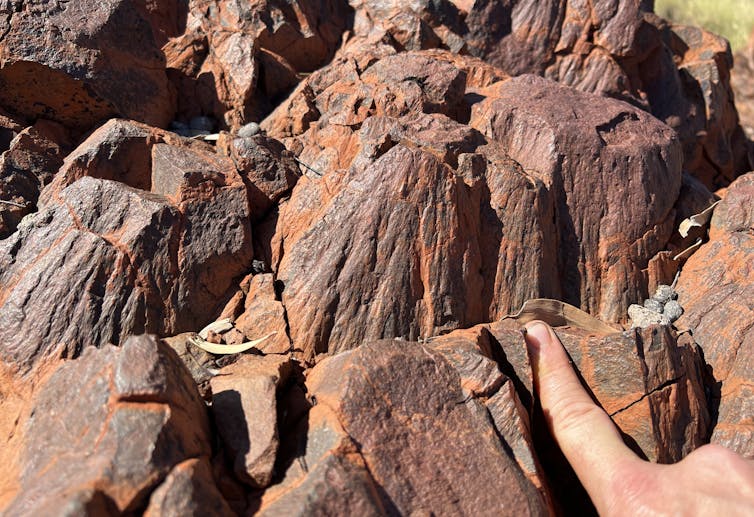
Shatter cones formed by the impact in the Pilbara.  Image credit: Tim Johnson

Many geologists think these ancient rocks formed above hot plumes that rose from above Earth’s molten metallic core, rather like wax in a lava lamp. Others maintain they formed by plate tectonic processes similar to modern Earth, where rocks collide and push each other over and under.

Although these two scenarios are very different, both are driven by the loss of heat from within the interior of our planet.

We think rather differently.

A few years ago, we published a paper suggesting that the energy required to make continents in the Pilbara came from outside Earth, in the form of one or more collisions with meteorites many kilometres in diameter.

A wide view of a ruddy landscape under a blue sky with several 4WDs in the distance. On the hunt for shatter cones in a typical Pilbara landscape with our trusted GSWA vehicles.  Image credit: Chris Kirkland

As the impacts blasted up enormous volumes of material and melted the rocks around them, the mantle below produced thick “blobs” of volcanic material that evolved into continental crust.

Our evidence then lay in the chemical composition of tiny crystals of the mineral zircon, about the size of sand grains. But to persuade other geologists, we needed more convincing evidence, preferably something people could see without needing a microscope.

So, in May 2021, we began the long drive north from Perth for two weeks of fieldwork in the Pilbara, where we would meet up with our partners from the Geological Survey of Western Australia (GSWA) to hunt for the crater. But where to start?

A serendipitous beginning

Our first target was an unusual layer of rocks known as the Antarctic Creek Member, which crops out on the flanks of a dome some 20 kilometres in diameter. The Antarctic Creek Member is only 20 metres or so in thickness, and mostly comprises sedimentary rocks that are sandwiched between several kilometres of dark, basaltic lava.

A dirt track winding up the side of a hill. Large hut-like shatter cones in the rocks of the Antarctic Creek Member at the discovery site. The rocks on the hilltop farthest left are basalts that lay directly over the shatter cones.  Image credit: Tim Johnson

However, it also contains spherules – droplets formed from molten rock thrown up during an impact. But these drops could have travelled across the globe from a giant impact anywhere on Earth, most likely from a crater that has now been destroyed.

Conical red rocks in a ruddy landscape with hills in the distance. An approximately one metre tall shatter cone ‘hut’, with the rolling hills of the Pilbara in the background.  Image credit: Chris Kirkland

After consulting the GSWA maps and aerial photography, we located an area in the centre of the Pilbara along a dusty track to begin our search.

We parked the offroad vehicles and headed our separate ways across the outcrops, more in hope than expectation, agreeing to meet an hour later to discuss what we’d found and grab a bite to eat.

Remarkably, when we returned to the vehicle, we all thought we’d found the same thing: shatter cones.

Shatter cones are beautiful, delicate branching structures, not dissimilar to a badminton shuttlecock. They are the only feature of shock visible to the naked eye, and in nature can only form following a meteorite impact.

Little more than an hour into our search, we had found precisely what we were looking for. We had literally opened the doors of our 4WDs and stepped onto the floor of a huge, ancient impact crater.

Frustratingly, after taking some photographs and grabbing a few samples, we had to move on to other sites, but we determined to return as soon as possible. Most importantly, we needed to know how old the shatter cones were. Had we discovered the oldest known crater on Earth?

It turned out that we had.

There and back again

With some laboratory research under our belts, we returned to the site in May 2024 to spend ten days examining the evidence in more detail.

Shatter cones were everywhere, developed throughout most of the Antarctic Creek Member, which we traced for several hundred metres into the rolling hills of the Pilbara.

Our observations showed that above the layer with the shatter cones was a thick layer of basalt with no evidence of impact shock. This meant the impact had to be the same age as the Antarctic Member rocks, which we know are 3.5 billion years old.

We had our age, and the record for the oldest impact crater on Earth. Perhaps our ideas regarding the ultimate origin of the continents were not so mad, as many told us.

Close-up of a red rock with lines across its surface. Delicate shatter cones within rocks typical of the Antarctic Creek Member.  Image credit: Tim Johnson

Serendipity is a marvellous thing. As far as we knew, other than the Traditional Owners, the Nyamal people, no geologist had laid eyes on these stunning features since they formed.

Like some others before us, we had argued that meteorite impacts played a fundamental role in the geological history of our planet, as they clearly had on our cratered Moon and on other planets, moons and asteroids. Now we and others have the chance to test these ideas based on hard evidence.

Who knows how many ancient craters lay undiscovered in the ancient cores of other continents? Finding and studying them will transform our understanding of the early Earth and the role of giant impacts, not only in the formation of the landmasses on which we all live, but in the origins of life itself.


Earth's Oldest Known Meteor Crater Discovered in Australia

{ https://www.australiangeographic.com.au/ }

Hoe vind je dit bericht?
Geschreven door peter om 00:00 Stuur door

The Devil’s Bible: A Massive Medieval Manuscript of Mystery

Codex Gigas, open to pages that show the Devil and the Heavenly City.

The Devil’s Bible: A Massive Medieval Manuscript of Mystery

There are three major questions about the Codex Gigas, known more famously as ‘The Devil’s Bible, and they are: who wrote it, why, and why is it so big?

Some say the Codex was inspired by Satan himself. Others say the mega-sized book has been misunderstood, and that its real purpose is to warn people about the Devil’s evil purpose. Both sides say its immense size is meant to capture people’s attention, so they will pay closer attention to its message.

The Devil’s Bible is famous for two features – its size and it unique full-page representation of the Devil. It became known as the Codex Gigas, ‘giant book,’ due to its immensity. It is so large that it took more than 160 animal skins to make it and it is so heavy that two people are needed to lift it. It measures 36 inches (91 cm) tall, 20 inches (50.5 cm) wide, and almost nine inches (22.86 cm) thick. It weighs 165 lbs. (74.8 kg). It is so huge that it is probably more accurate to say it was constructed, like some sort of medieval monument, rather than just written.

The Codex Gigas in 1906.

(National Library of Sweden)

Legendary Origins of the Codex Gigas

According to legend, the medieval manuscript was made out of a pact with the Devil, which is one reason why it is sometimes referred to as the Devil’s Bible. The uniformity of the writing suggests that it was written by one scribe and stories say he was under immense pressure when he created the book.

The legend behind the making of Codex Gigas is that it was the work of one monk, sometimes named as Herman the Recluse, who was sentenced to death by being walled up alive for breaking his monastic vows. As a last gasp for survival he made a deal that he would create a book filled with the world’s knowledge in return for his life. His proposal was accepted, but his freedom from death would only be granted if the monk managed to complete the monumental manuscript in one night.

The only way the monk could see himself completing the insurmountable task was with the help of the Devil. After selling his soul, the scribe was able to generate the frenetic and unholy energy necessary to fulfill the order and gain his freedom.

Supposedly, this pact with the Devil explains why the Prince of Darkness is depicted in such a prominent way in the codex. But the origin of this myth is unknown, and there is really no evidence to suggest the writer of the book meant to glorify Satan in any way (the author’s depiction of the Devil portray’s him as a salivating and bloodthirsty monster).

Enhanced version of the image of the Devil from the Codex Gigas.

(RootOfAllLight/CC BY-SA 4.0).

How Was the Codex Gigas Actually Made?

Although the story of a pact with the Devil is rather far-fetched, analysis of the level of uniformity of the Latin text does suggest that it was written by just one scribe. That person may not have been Herman the Recluse, but it was likely a 13th century monk who lived in Bohemia, a part of modern Czech Republic.

According to the National Geographic , it would take one person working continuously, day and night, five years to recreate the contents of Codex Gigas by hand (excluding the illustrations). Therefore, realistically it would have taken at least 25 years for the scribe to create the codex from scratch. Yet, all this time, the writing retained an incredible uniformity from start to finish, not wavering at all becaue of age or bad health. This may be the inspiration for the legend that says the monk wrote it in just one day.

Originally, the Devil’s Bible was comprised on 320 vellum pages created with the skin of 160 donkeys, but at some point in its history, ten pages were removed. It is believed that those pages were the Rule of St. Benedict – a guide to living the monastic life in the 6th century.

What is the Devil’s Bible Really About?

Codex Gigas contains a complete vulgate Latin translation of the Bible as well as five other major texts. It begins with the Old Testament and continues with ‘Antiquities of the Jews’ by Flavius Josephus (1st century AD; ‘ Encyclopedia Etymologiae ’ by Isidore of Seville (6th century AD); a collection of medical works of Hippocrates, Theophilus and others; the New Testament; and ‘The Chronicle of Bohemia’ by Cosmas of Prague (1050 AD) - the first history of Bohemia.

Page of the Codex Gigas which may represent Flavius Josephus. This is the only portrait of a person in the codex.

(National Library of Sweden)

Smaller texts are also included in the manuscript, with the most famous ones including writings on exorcism, magic formulas, and a calendar with a list of saints and Bohemian people of interest and the days on which they were honored.

As it is an illuminated manuscript, there are illustrations and decoration found throughout the Codex Gigas. Many of the drawings are impressive, but the most famous are the full page drawings of the Devil and the Heavenly City, which are juxtaposed to each other.

Detail of the Devil portrait in the Codex Gigas. 

(National Library of Sweden)

The Devil is depicted as a large, monstrous figure taking up the entirety of Hell. He is drawn with large claws at the tips of outstretched arms, red-tipped horns, small red eyes, a green head and two long red tongues. He’s shown crouching between two large towers and is wearing and ermine loin cloth. This material was usually used by royalty and it may be a nod to the Devil as the Prince of Darkness. Even though portraits of the Devil were a common occurrence in medieval art, his depiction in the Codex Gigas stands out for presenting him all alone on a large page.

Across from the Devil is a full-page representation of the Heavenly City. It is shown in tiers of buildings and with towers behind red walls. Towers also project from the walls and the Heavenly City is bordered with two larger towers, like the Devil’s portrait. This image probably was meant to inspire the ideas of hope and salvation and contrast with the evil nature of the Devil.

Taken together, the portrait and city probably were meant to be a reflection on what would await you if you lived a good or bad life. The text before the Heavenly City refers to penitence and the text after the Devil is about exorcisms. Notably, the Devil and the Heavenly City are the only illustrations occupying full pages in the Codex Gigas, so it is clear that the author’s intended message here, whatever it was, was seen as vitally important.

The Heavenly City in the Codex Gigas.

(National Library of Sweden)

The Known History of the Codex Gigas

As noted above, the true origins of the Codex Gigas are unknown. In the text, there is a note stating that the manuscript was pawned by the monks of Podla¸ice in the monastery at Sedlec in 1295. From there it was located in the Břevnov near Prague. Since the monasteries associated with the early history of the Codex Gigas were located in Bohemia and the text refers to that area’s history, it is generally accepted that it was created in Bohemia too.

The next mention of the Codex Gigas is when Rudolf II took it to his castle in Prague in 1594. It stayed there until the Swedish siege of Prague at the end of the Thirty Years’ War in 1648. The Swedish army looted the city and one of the treasures they took was the medieval manuscript. That’s how it ended up in Stockholm.

In 1877 the Codex Gigas became part of the collection of the National Library of Sweden in Stockholm, where it is still kept today. Stories and legends say that the Codex Gigas was cursed and brought disaster or illness on whoever possessed it during its history. Fortunately, the National Library appears immune to the curse of the codex, as it remains a popular exhibit that draws in many visitors.

The Codex Gigas.

(Sharon Hahn Darlin/CC BY 2.0)

For those who can’t make it to Sweden to see the book, it is possible to view its digitalized pages online. So be sure to read it for yourself, soon … if you dare.

  • Top Image: Codex Gigas, open to pages that show the Devil and the Heavenly City. 
  • Source: Kungl. biblioteket/Public Domain.

By Alicia McDermott

RELATED VIDEOS


The Devil's Bible (Codex Gigas): Unveiling the Largest Medieval Manuscript

The Devil’s Bible | Forbidden History

This Is Why The Codex Gigas Was Banned (The Devil's Bible)

 { https://www.ancient-origins.net/history-archaeology }

Hoe vind je dit bericht?
Geschreven door peter om 22:28 Stuur door

Scientists Discover the World’s Largest Cloned Organism Thriving in the Baltic Sea

Scientists Discover the World’s Largest Cloned Organism Thriving in the Baltic Sea

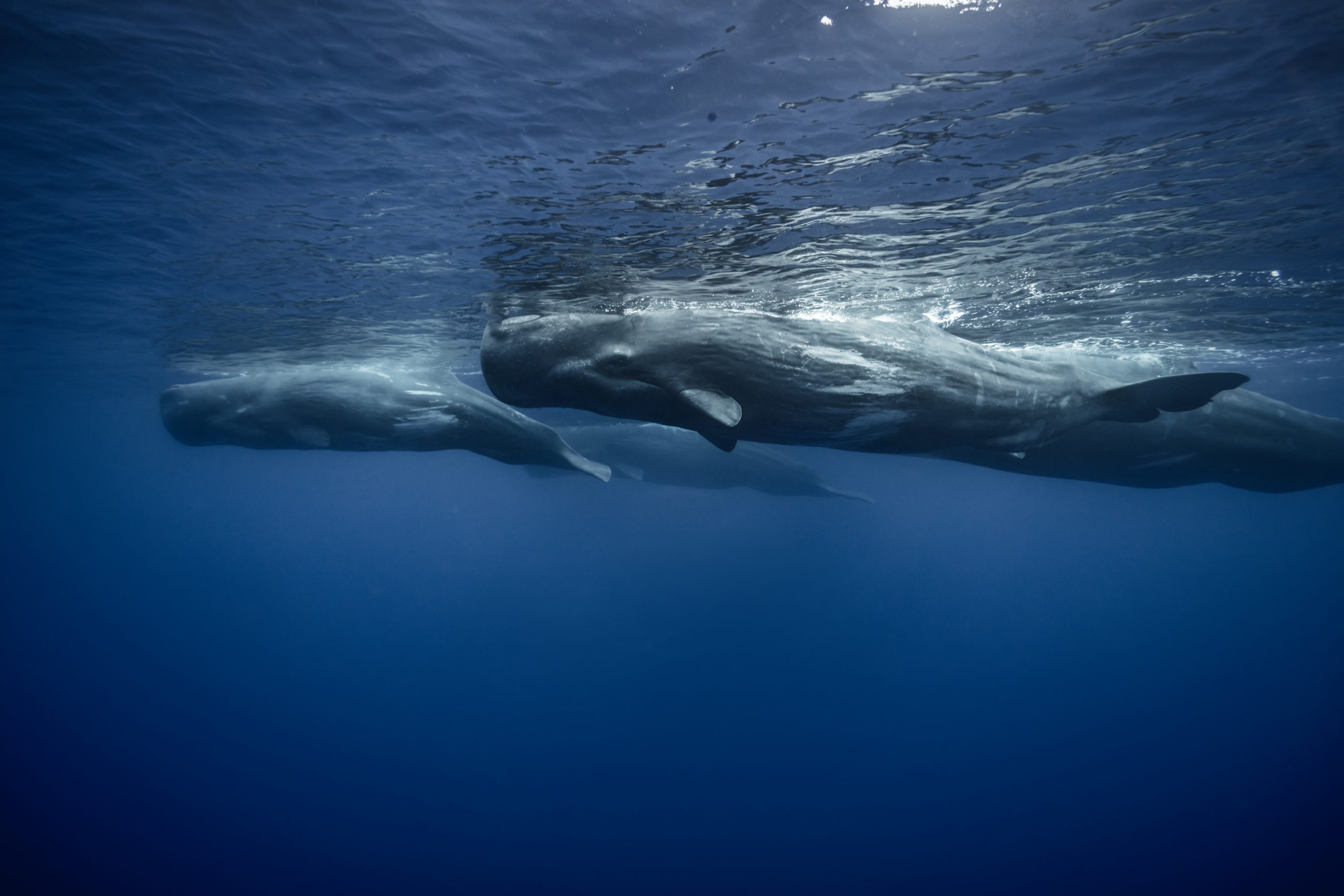
While this massive organism typically reproduces sexually, the conditions of the Baltic Sea have favored an unusual survival strategy—cloning.

Marine researchers have uncovered what could be the most expansive cloned organism ever documented—an enormous seaweed specimen stretching over 300 miles along Sweden’s Baltic coast. This massive clone, identified as a “super female” of Fucus vesiculosus, better known as bladderwrack, has reshaped what scientists understand about marine ecosystems and genetic survival.

A Hidden Giant Beneath the Waves

At first, DNA analysis led researchers to believe they had identified a different species of seaweed, but closer examination confirmed that this vast organism is, in fact, bladderwrack. This discovery is remarkable because bladderwrack is a foundational species in the Baltic, forming underwater forests that serve as critical habitats for snails, crustaceans, and other marine life.

Unlike its counterparts in saltier oceans, this particular Fucus vesiculosus has adapted to the Baltic’s lower salinity levels, allowing it to spread extensively. While bladderwrack typically reproduces sexually, the conditions of the Baltic Sea have favored an unusual survival strategy—cloning. This means that rather than mixing genetic material, the organism has been duplicating itself, producing an immense network of genetically identical individuals.

The clone of bladderwrack in the Baltic Sea was long assumed to be a separate species, which was called narrow seaweed.

The Role of Climate in Bladderwrack’s Future

With climate change affecting ocean temperatures and salinity, the future of this record-breaking seaweed is uncertain. “The Baltic Sea is entering a period of warmer and possibly even fresher seawater,” explained marine biologist Kerstin Johannesson, co-lead author of the study published in Molecular Ecology. “Every species must adapt to these changes, including the dominant bladderwrack.”

Although its cloning ability has allowed it to thrive, this very mechanism might also be its greatest vulnerability. Without genetic diversity, the massive clone may struggle to withstand environmental shifts, leaving it at risk of disease or habitat changes.

Bladderwrack seaweed.

A Super Clone With an Uncertain Fate

Despite these challenges, the bladderwrack “super female” remains a crucial part of the Baltic ecosystem. “This clone comprises millions of individuals,” said study co-author Ricardo Pereyra. “In some areas, it is completely dominant, while in others, it coexists with sexually reproduced bladderwrack.”

While other large clones have been identified in the Baltic, none compare to the scale of this one. Its longevity and dominance highlight the complexity of marine ecosystems and raise new questions about how cloned organisms might survive in a rapidly changing world.

For now, the world’s largest clone continues to shape the Baltic’s underwater landscape, providing shelter and stability for marine life. Whether it can endure future environmental shifts remains to be seen.

{ https://curiosmos.com/ }

Hoe vind je dit bericht?
Geschreven door peter om 21:30 Stuur door

And Then There Were Three: NASA Shuts Down More Voyager 2 Science Instruments

And Then There Were Three: NASA Shuts Down More Voyager 2 Science Instruments

1_voyager_artist_concept.webp This artist’s illustration depicts one of NASA’s Voyager probes. NASA is continuing to shut down Voyager 2 science instruments to conserve energy. Image Credit: NASA/JPL-Caltech

In an effort to conserve Voyager 2's dwindling energy and extend the spacecraft's mission, NASA has shut down another of its instruments. They did it with the Plasma Spectrometer in October 2024, and it won't be the last. In March, Voyager 2's Low-Energy Charged Particle instrument will be powered down.

What does this mean for the durable spacecraft?

"If we don’t turn off an instrument on each Voyager now, they would probably have only a few more months of power before we would need to declare end of mission." - Suzanne Dodd, Voyager Project Manager, JPL

Things have changed a lot since the pair of Voyager spacecraft were launched in 1977. Our planet is hotter, the human population has ballooned, and Battlestar Galactica came and went—twice.

Voyager 1 and 2 have surprised us all with their longevity. When they were launched, their planned mission length was a mere five years. Now, almost 50 years after their launch date, they've both reached interstellar space, a remarkable achievement.

voyager-2-launch-aboard-titan-centaur-rocket.avif

This image shows Voyager 2 blasting off on a Titan-Centaur rocket from Cape Canaveral on August 20th, 1977.

Image Credit: NASA

Though both spacecraft have proven to be durable, nothing lasts forever, not even plutonium. When they were launched, they both carried about 13.5 kg of plutonium-238 in their Radioisotope Thermoelectric Generators (RTGs). RTGs generate electricity by running the heat from the decaying plutonium through a thermocouple. However, as the plutonium decays, its power output is reduced. That necessitates lowering the spacecraft's power demands.

That's where NASA is at with both Voyagers. They've had to sequentially shut down systems that are no longer providing much scientific benefit. Fortunately, some of the spacecraft's instruments were aimed at planetary science and are less critical in interstellar space.

"The Voyagers have been deep space rock stars since launch, and we want to keep it that way as long as possible," said Suzanne Dodd, Voyager project manager at JPL. "But electrical power is running low. If we don’t turn off an instrument on each Voyager now, they would probably have only a few more months of power before we would need to declare end of mission."

Each Voyager spacecraft carries the same payload of 10 science instruments. NASA has shut down different instruments on each one at different times to achieve the best science outcomes.

In October 2024, NASA turned off Voyager 2's Plasma Spectrometer. On March 24th, NASA will shut down Voyager 2's Low-Energy Charged Particle Instrument (LECP), leaving it with only three active instruments: the Triaxial Fluxgate Magnetometer (MAG), the Cosmic Ray Subsystem (CRS), and the Plasma Wave Subsystem (PWS).

Those three instruments still allow Voyager 2 to gather valuable scientific data.

vg2_p21714.gif

Voyager 2 captured this image of Jupiter and Io when it was 24 million km away.

Image Credit: NASA/JPL

Voyager 2's MAG instrument measured the magnetic fields of Uranus and Neptune and how the solar wind interacted with their magnetospheres. It also played a vital role in determining exactly when Voyager 2 crossed the heliopause into interstellar space. Now that the spacecraft is in interstellar space, MAG is measuring the strength of interstellar magnetic fields and how they interact with the Sun's magnetic fields.

The CRS instrument helped scientists measure energetic particles inside the magnetospheres of the outer planets. It also provided irreplaceable data on the composition, energy, and distribution of cosmic rays. By measuring cosmic ray nuclei, it helped scientists understand how these rays are accelerated and propagated. By measuring cosmic ray flux in interstellar space, the CRS revealed some of the details about the ISM.

The PWS measured the density of electrons near the Solar System's planets. Early in the Voyager missions, the instrument detected lightning storms on Jupiter and other giant planets, a significant development in understanding these planets. In interstellar space, it's measuring the density of the interstellar plasma. Its measurements are critical to understanding the interstellar medium (ISM).

Throughout its mission, the LECP instrument has told scientists about the energy of charged particles and the dynamics of the Sun's solar wind. It has also shown how some particles can leak out of the heliosphere into interstellar space. As Voyager 2 continues its journey into interstellar space, the LECP will tell us more about the heliopause and how particles behave differently in the heliosphere and interstellar space.

"Every minute of every day, the Voyagers explore a region where no spacecraft has gone before." - Linda Spilker, Voyager project scientist at JPL

The LECP instrument will be shut down later this month, reducing Voyager 2 to only three instruments. Nothing illustrates Voyager's longevity and robustness more than the LECP. It's only being shut down because of energy constraints, not because of degraded performance.

Voyager 2 uses a stepped motor to rotate the instrument 360 degrees and provides a 15.7-watt pulse every 192 seconds. During development and testing, the motor was tested to 500,000 steps. That was enough to see it through until the spacecraft encountered Saturn in August 1980. However, the motor will have completed more than 8.5 million steps by the time it's deactivated later this month.

Like other facets of the Voyager program, the LECP has lasted so long that its principal investigator, Stamatios Krimigis, is now 86 years old and has retired into an honorary position. He's now Emeritus Head of the Space Exploration Sector of the Johns Hopkins Applied Physics Laboratory (APL). Maybe both the man and the instrument will fully retire at the same time.

Voyager 1 and 2 are our first interstellar probes, though they were never intended to be. Everything they're showing us about interstellar space is bonus knowledge. Many of the people behind the program are gone now, but both spacecraft live on. There's a poignancy to that that goes beyond science, charged particles, and the details of the interstellar medium. They're humanity's first unintentional envoys into interstellar space and are starting to outlast their creators.

"The Voyager spacecraft have far surpassed their original mission to study the outer planets." - Patrick Koehn, Voyager Program Scientist

20191106_image1_lg.jpg

This graphic from 2019 shows the locations of both Voyage probes in relationship with the heliosphere.

Image Credit: NASA/JPL-Caltech/Johns Hopkins APL

However, the Voyagers are scientific missions, and they're still stubbornly fulfilling those missions.

"The Voyager spacecraft have far surpassed their original mission to study the outer planets," said Patrick Koehn, Voyager program scientist at NASA Headquarters in Washington. "Every bit of additional data we have gathered since then is not only valuable bonus science for heliophysics but also a testament to the exemplary engineering that has gone into the Voyagers — starting nearly 50 years ago and continuing to this day."

NASA is determined to milk the Voyager spacecraft for as much data as possible. Once Voyager 2's LECP is turned off later this month, both Voyagers should be able to operate for another year before another instrument will need to go dark. For Voyager 1, this means it will lose its LECP. Voyager 2's CRS will be shut off in 2026.

NASA engineers say that their power conservation program should let both spacecraft operate into the 2030s, albeit with a single instrument each. However, they have been operating in deep space for almost 50 years, and it's not a benign environment. It's only rational to expect some other problems to crop up.

It's easy to gloss over the success of the Voyager program now that space missions launch every month, powerful rovers explore Mars, and high-resolution cameras deliver a steady stream of yummy images to our hungry browsers. It's also easy to forget that they've both travelled more than 20 billion km. In fact, when Voyager 2 sends us a signal, it takes 19.5 hours to reach us. For Voyager 1, the signal travel time is even greater: 23.5 hours. Those signal travel times will only grow as the spacecraft continue their journeys. And every kilometre of their journeys is a new frontier for humanity.

"Every minute of every day, the Voyagers explore a region where no spacecraft has gone before," said Linda Spilker, Voyager project scientist at JPL. "That also means every day could be our last. But that day could also bring another interstellar revelation. So, we’re pulling out all the stops, doing what we can to make sure Voyagers 1 and 2 continue their trailblazing for the maximum time possible."


{ https://www.universetoday.com/ }

Hoe vind je dit bericht?
Geschreven door peter om 20:54 Stuur door

The Athena Lunar Lander Also Fell Over on its Side

The Athena Lunar Lander Also Fell Over on its Side

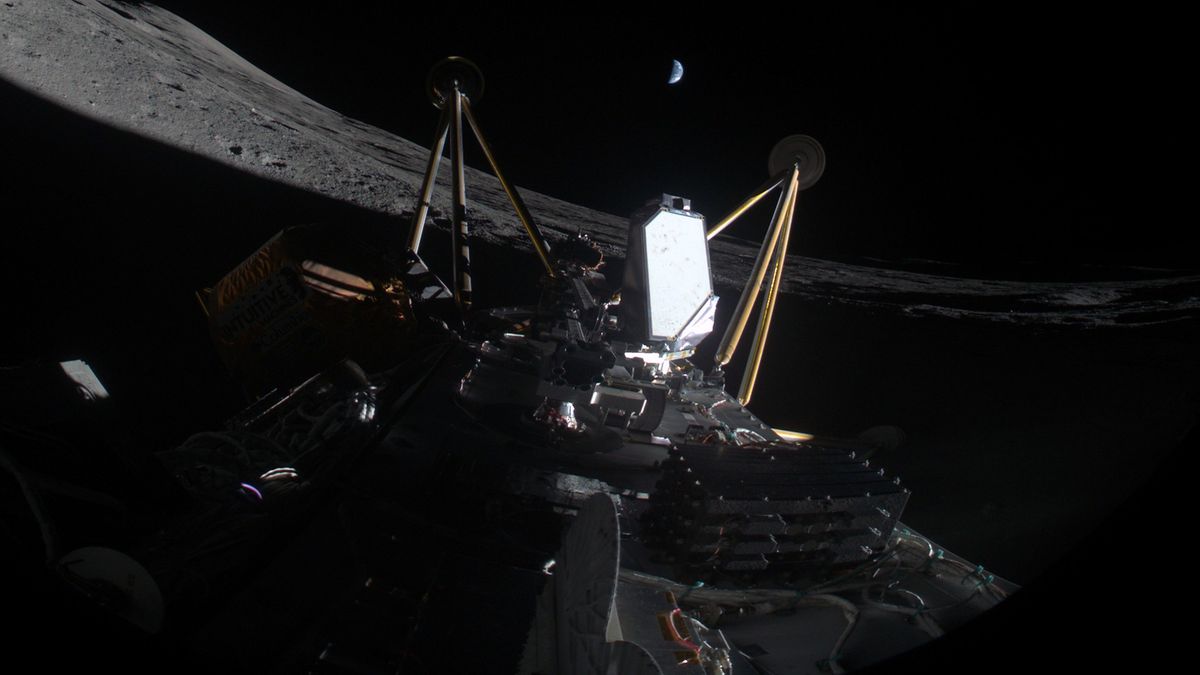
Image of the IM-2 mission laying on its side in a lunar crater with Earth in the distance.Credit: Intuitive Machines

The Athena lunar lander (IM-2) has been declared dead after it failed to stick the landing on the surface of the Moon. The second commercial lander launched by Texas-based aerospace company Intuitive Machines attempted to reach the lunar surface on March 6th. However, it ended up in a crater near the lunar south pole, where it then fell on its side. The company confirmed that the mission was dead this morning in a statement.

Per that statement, Intuitive Machines declared that while the lander was no longer operational, the mission was not a total write-off:

"[T]he IM-2 mission lunar lander, Athena, landed 250 meters from its intended landing site in the Mons Mouton region of the lunar south pole, inside of a crater. This was the southernmost lunar landing and surface operations ever achieved. Images downlinked from Athena on the lunar surface confirmed that Athena was on her side. After landing, mission controllers were able to accelerate several program and payload milestones, including NASA’s PRIME-1 suite, before the lander’s batteries depleted."

"With the direction of the sun, the orientation of the solar panels, and extreme cold temperatures in the crater, Intuitive Machines does not expect Athena to recharge. The mission has concluded and teams are continuing to assess the data collected throughout the mission."

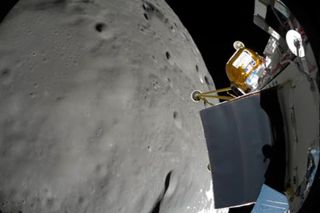
IM-2 mission approaching the lunar surface on March 6th, 2025. Credit: NASA

A fisheye view of the moon with a spacecraft to the right of it. There is a yellowish gold box on the craft.

Intuitive Machines' Athena lander captured this view of the moon during its touchdown on March 6, 2025.  (Image credit: NASA TV)

The lander launched on February 27th, 2025, atop a SpaceX Falcon 9 rocket from Launch Complex 39A (LC39A) at NASA's Kennedy Space Center. The payload includes the Polar Resources Ice Mining Experiment 1 (PRIME-1), which consists of the TRIDENT Drill and MSolo mass spectrometer, designed to probe up to one meter (3.3 feet) beneath the lunar surface to search for volatiles like water and carbon dioxide (CO2) - which are critical to the Artemis Program and NASA's proposed crewed missions to the Moon.

According to NASA, mission controllers did manage to activate Trident and rotate the drill to prove it worked while a companion science instrument collected some data. Intuitive Machines also stated that several other mission objectives were accelerated. Athena's other payloads include Intuitive Machines' Micro Nova Hopper (aka. Grace), which is designed to explore craters up to 2 km (1.24 mi) from the lander.

It also carried the Nokia Lunar Surface Communications System (LSCS), a 4G/LTE system to test high-speed, long-range communications. These and other payloads were sent as part of NASA's Commercial Lunar Payload Services (CLPS) initiative, which has contracted with multiple U.S. companies to deliver science and technology experiments to the lunar surface. While Grace and two rovers provided by private companies did not make it off the lander and explore the South Pole-Aitken Basin as planned, Intuitive Machines confirmed that they were able to activate these and other science experiments before the lander lost power.

The IM-2 mission joins its predecessor, the Odysseus mission (IM-1), which attempted to land on the lunar surface last year but also fell on its side shortly after touching down. In both cases, the problem was attributed to a last-minute failure with the lander's prime laser navigation system. However, IM-1 was the first NASA mission to land on the Moon since the Apollo 17 mission over 50 years ago. This time, the lander also survived longer before its batteries lost power. The IM-2 lander also has the distinction of getting closer to the Moon's south pole than any previous mission, landing just 160 km (100 mi) away.

Artists impression of the IM-4 mission on the lunar surface. Credit: NASA

On March 2nd, Firefly Aerospace successfully reached the northern hemisphere on the Moon's near side with its Blue Ghost lander. As part of the CLPS initiative, this mission carried 10 NASA experiments and is expected to remain operational for another week until lunar night descends and it can no longer draw power from its solar panels.

two legs of a moon lander jutting up with the earth half-lit overhead

The two legs of Intuitive Machines' private Athena moon lander jut up to the sky, with a half-lit blue Earth above, after the probe fell over during a landing attempt near the lunar south pole on March 6. 2025. 

(Image credit: Intuitive Machine)

Meanwhile, Intuitive Machines is contracted to deliver two NASA payloads to the Moon with their IM-3 and IM-4 landers. These missions are reportedly scheduled to launch no sooner than late October 2025 and 2027, respectively.


NASA's Athena Lunar Lander Launch with SpaceX Falcon 9! 

{ https://www.universetoday.com/ }

Hoe vind je dit bericht?
Geschreven door peter om 20:28 Stuur door

What are these mysterious entities flying through our skies

What are these mysterious entities flying through our skies

EBANI stands for "Unidentified Anomalous Biological Entity," referring to a mysterious class of airborne phenomena that may be biological rather than mechanical in nature. These entities are often described as elongated, flexible, and tubular, moving through the sky in a serpentine or twisting manner. 

ebani%20entities%20skies%20(3).jpg

They exhibit advanced flight capabilities, including high-speed travel, precise control, and even self-illumination. Some have been observed rendering themselves invisible, raising questions about their energy sources and possible technological origins. 

Recent observations have revealed formations of translucent spheres in red, white, and blue, challenging conventional classifications of both biology and aerodynamics. 

ebani%20entities%20skies%20(1).jpg

Some of these entities have a massive structure composed of thousands of clustered spheres. These entities appear to function as an aircraft carrier, releasing these smaller spheres into Earth's atmosphere for an unknown purpose. 
While some researchers propose that EBANIs are natural organisms evolving in Earth's upper atmosphere under unfamiliar physical laws, others speculate they may be advanced artificial (eventually biological) constructs, potentially extraterrestrial probes or surveillance devices, given the presence of large structures expelling numerous smaller spheres. 

ebani%20entities%20skies%20(2).jpg

Are they living UFOs, advanced biological organisms that function autonomously within the spheres, without the need for pilots?
  

{ https://ufosightingshotspot.blogspot.com/  }

Hoe vind je dit bericht?
Geschreven door peter om 19:52 Stuur door

Director of Groundbreaking UFO Doc Says What He Learned Left Him 'Rattled': 'Things Could Get Really Bad, Really Fast'

Director of Groundbreaking UFO Doc Says What He Learned Left Him 'Rattled': 'Things Could Get Really Bad, Really Fast'

"I've tried to make a serious, credible, eye-opening movie that brings out as much of the truth as possible," says 'The Age of Disclosure' director Dan Fara

'The Age of Disclosure' movie

An image from the so-called “Gimbal” video recorded by a U.S. Navy F/A-18F Super Hornet fighter pilot off the coast of Jacksonville, Fla., during a 2015 encounter with a UAP. . Photo:  Farah Films/YouTube
  • Disclosure details what is being called an 80-year cover-up of the existence of non-human intelligence and secret efforts to reverse engineer technology of non-human origin
  • 34 high-ranking members of the U.S. government, military and intelligence community share never-before released information on UFOs and their potential impact on humanity
  • Director Dan Farah tells PEOPLE he worked in secret on Disclosure for two and a half years because 'there's a lot of people who would try and stop this movie from getting made if they had the opportunity'

By his own calculation, Dan Farah watched Steven Spielberg’s Close Encounters of the Third Kind and E.T. The Extra-Terrestrial close to "a thousand times" before he turned 15. So it’s hardly surprising that the 45-year-old Hollywood producer yearned to one day create a film that picked up where Spielberg’s two fictional movies about alien visitations and government coverups left off.

“I wanted to make a movie,” says Farah, “that I always wished existed, a documentary that did an unprecedented job at seriously and credibly exploring what is actually known about UAPs [Unidentified Anomalous Phenomena, aka UFOs]  and non-human intelligence by people who have direct knowledge of it as a result of working with the U.S. government.”  

Anyone who has gotten a chance to watch a screening of Farah's groundbreaking documentary The Age Of Disclosure (and, as of publication time, only a handful have) and pondered some of the film’s jaw-dropping revelations will tell you that the 45-year-old first-time director pretty much nailed it.

Over the course of his 1-hour-and-49-minute-long documentary, Farah speaks with 34 senior members of the U.S. government, military and intelligence community who all paint a disturbing portrait of what they claim is an 80-year-long cover-up regarding the existence of non-human intelligent life that has been visiting our planet for decades.

Those interviewed detail what they claim has been a decades-long top-secret campaign to reverse engineer the technology from spacecraft of non-human origin that has been retrieved from crash sites by scientists from our government and those of other nations.

This has resulted, they say, in what has essentially become a top-secret arms race with China and Russia — where each nation is vying to be the first to find a way to harness this other-worldly advanced technology. The downside, warn many of the officials who appear in Disclosure, is that keeping this information secret and compartmentalized within the government and the military industrial complex could result in an intelligence failure exponentially worse than what happened with 9/11.

“We interviewed dozens of very high-level, credible officials who said these unknown threats [posed by UAPs] could basically destroy our way of life forever,” Farah tells PEOPLE. “Things could get really bad, really fast. Learning that left me rattled.”

If true, the impact of these revelations — some of which were discussed in a series of bi-partisan congressional hearings over the past few years — has the potential to alter the future of humanity. That's why, explains Farrah, that he was able to get so many heavy hitters to speak on camera about this once-taboo topic.

“I ask people to think about why would any of these extremely high-level people like our Secretary of State [Marco Rubio] have to gain by participating in this film and shedding light on this?” he says. “They're doing it because they feel an obligation to bring out the truth as much as they legally can.”

'The Age of Disclosure' movie, Marco Rubio
Marco Rubio. 

Farah Films/YouTube

Rubio — who confesses that this issue “keeps me up at night” in the doc — has a number of memorable scenes in the film where he discusses just how gravely important this topic is and the risks involved by our leaders’ continued reluctance to take it seriously.

“I think,” says Farah, “one of the best lines in the film is when Secretary Rubio says, ‘At the heart of every blunder in intelligence is a lack of imagination — the idea that an adversary can't do something or won't do something because it hadn't been done before. And that leads to strategic surprise and sometimes strategic surprise changes the course of human history.' ”

Those interviewed in the film include retired Air Force Lieutenant General (and former Director of National Intelligence) James Clapper, Admiral (and former Navy Chief Oceanographer) Tim Gallaudet and former Department of Defense official (and one-time member of the Government’s Advanced Aerospace Threat Identification Program) Lue Elizondo.

Their first-hand accounts — such as those from Jay Stratton, the former director of the government's Unidentified Aerial Phenomena Task Force — are both spellbinding and disturbing. “I have seen with my own eyes non-human craft and non-human beings,” Stratton says in the film.

Farah — who produced Spielberg’s 2018 sci-fi action feature Ready Player One — worked on the film in secret for two and a half years. “The truth is,” he says, “there’s a lot of people who would try to stop this movie from getting made if they had the opportunity.”

Dan Farah attends the European Premiere of 'Ready Player One' at Vue West End on March 19, 2018 in London, England.
Dan Farah. 

Karwai Tang/WireImage

Lining up officials to speak on the record proved to be a long and difficult process. “A number of people, specifically intelligence officials, were actually concerned that their lives would be in danger if they participated and ultimately decided not to,” he says.

Disclosure — which is currently in search of a distributor — will premiere at South by Southwest Film Festival on March 9. Farah says he’s been buoyed by the “unprecedented” number of views — 18 million as of publication time — that the trailer has racked up on various platforms.

“The response has been really validating and rewarding,” adds Farah. “I think it speaks volumes to the universal appeal of this topic. I always knew that I couldn’t be the only person who wished that a movie like this existed.”

  • The Age of Disclosure premieres at SXSW on Sunday.

{ https://people.com/ }

Hoe vind je dit bericht?
Geschreven door peter om 00:00 Stuur door

Meer van UFO'S of UAP'S, ASTRONOMIE, RUIMTEVAART, ARCHEOLOGIE, OUDHEIDKUNDE, SF-SNUFJES EN ANDERE ESOTERISCHE WETENSCHAPPEN - DE ALLERLAATSTE NIEUWTJES

↑ Terug naar de berichten