Ontdek de Fascinerende Wereld van UFO's en UAP's: Jouw Bron voor Onthullende Informatie!
Ben jij ook gefascineerd door het onbekende? Wil je meer weten over UFO's en UAP's, niet alleen in België, maar over de hele wereld? Dan ben je op de juiste plek!
België: Het Kloppend Hart van UFO-onderzoek
In België is BUFON (Belgisch UFO-Netwerk) dé autoriteit op het gebied van UFO-onderzoek. Voor betrouwbare en objectieve informatie over deze intrigerende fenomenen, bezoek je zeker onze Facebook-pagina en deze blog. Maar dat is nog niet alles! Ontdek ook het Belgisch UFO-meldpunt en Caelestia, twee organisaties die diepgaand onderzoek verrichten, al zijn ze soms kritisch of sceptisch.
Nederland: Een Schat aan Informatie
Voor onze Nederlandse buren is er de schitterende website www.ufowijzer.nl, beheerd door Paul Harmans. Deze site biedt een schat aan informatie en artikelen die je niet wilt missen!
Internationaal: MUFON - De Wereldwijde Autoriteit
Neem ook een kijkje bij MUFON (Mutual UFO Network Inc.), een gerenommeerde Amerikaanse UFO-vereniging met afdelingen in de VS en wereldwijd. MUFON is toegewijd aan de wetenschappelijke en analytische studie van het UFO-fenomeen, en hun maandelijkse tijdschrift, The MUFON UFO-Journal, is een must-read voor elke UFO-enthousiasteling. Bezoek hun website op www.mufon.com voor meer informatie.
Samenwerking en Toekomstvisie
Sinds 1 februari 2020 is Pieter niet alleen ex-president van BUFON, maar ook de voormalige nationale directeur van MUFON in Vlaanderen en Nederland. Dit creëert een sterke samenwerking met de Franse MUFON Reseau MUFON/EUROP, wat ons in staat stelt om nog meer waardevolle inzichten te delen.
Let op: Nepprofielen en Nieuwe Groeperingen
Pas op voor een nieuwe groepering die zich ook BUFON noemt, maar geen enkele connectie heeft met onze gevestigde organisatie. Hoewel zij de naam geregistreerd hebben, kunnen ze het rijke verleden en de expertise van onze groep niet evenaren. We wensen hen veel succes, maar we blijven de autoriteit in UFO-onderzoek!
Blijf Op De Hoogte!
Wil jij de laatste nieuwtjes over UFO's, ruimtevaart, archeologie, en meer? Volg ons dan en duik samen met ons in de fascinerende wereld van het onbekende! Sluit je aan bij de gemeenschap van nieuwsgierige geesten die net als jij verlangen naar antwoorden en avonturen in de sterren!
Heb je vragen of wil je meer weten? Aarzel dan niet om contact met ons op te nemen! Samen ontrafelen we het mysterie van de lucht en daarbuiten.
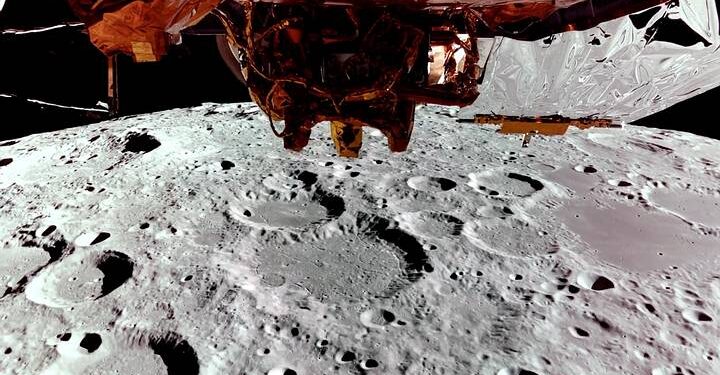
The Blue Ghost lunar lander is currently 100 km above the Moon as it prepares for its descent. It is scheduled to land in Mare Crisium, on the near side of the Moon, on March 2, no earlier than 3:34 a.m. ET (08:34 UTC).
Credit: Firefly Aerospace.
For the first time in history, three separate landers are simultaneously on their way to the Moon, marking a major milestone in lunar exploration. These missions, launched by different space agencies and private companies, are setting the stage for future human presence on the lunar surface.
On February 26, 2025, the Athena lunar lander successfully lifted off aboard a SpaceX Falcon 9 rocket from Kennedy Space Center in Florida. This mission, developed by Intuitive Machines, is part of NASA’s Commercial Lunar Payload Services (CLPS) program, an initiative designed to support robotic exploration and resource scouting for future crewed missions.
Athena joins two other landers currently en route: Blue Ghost, launched by Firefly Aerospace on January 15, 2025, and RESILIENCE, a mission led by Japanese company ispace. If all goes according to plan, Blue Ghost will touch down on March 2, followed by Athena on March 6, while RESILIENCE is expected to reach the Moon in May after a slower trajectory.
Following Footsteps
Athena follows in the footsteps of Odysseus, the first lander built by Intuitive Machines, which successfully reached the Moon on February 22, 2024. Despite landing at an angle due to a last-minute navigation issue, Odysseus functioned for one week, transmitting valuable data before shutting down. It was the first American spacecraft to perform a controlled Moon landing since the Apollo era.
Now, Athena aims to land at Mons Mouton, a region near the Moon’s south pole that is of high scientific interest. This area is believed to contain water ice, a crucial resource for future lunar missions. To explore its surroundings, Athena carries:
Two robotic rovers to analyze the surface
A “hopping” lander designed to move across different locations
A drill to extract samples from beneath the lunar surface
The success of these missions will not only provide new scientific insights but also lay the groundwork for sustained human exploration of the Moon, supporting upcoming Artemis missions and the long-term goal of establishing a lunar base.
With Athena, Blue Ghost, and RESILIENCE all approaching the Moon, this is one of the most active periods in lunar exploration since the Apollo program. These robotic landers will test new technologies, scout for resources, and help answer key questions about the Moon’s potential to support human life. As space agencies and private companies ramp up their efforts, one thing is clear: the next chapter of lunar exploration is already underway.
RELATED VIDEOS
Blue Ghost 1 enters lunar orbit as Resilience flies by the moon
Blue Ghost and RESILIENCE head to the Moon.
IM-2 'Athena' moon lander captures stunning views of Earth and Falcon 9 upper stage
A groundbreaking battery design could revolutionize the way we utilize radioactive waste, turning a major environmental hazard into a useful energy source. Researchers from Ohio State University have unveiled a small battery that harnesses nuclear radiation to generate electricity, opening new possibilities for power generation in extreme environments.
The Challenge of Nuclear Waste and Energy
Nuclear power plays a significant role in global energy production, providing a substantial portion of electricity with minimal carbon emissions. However, one of its biggest drawbacks is the long-term storage of radioactive waste, which can remain hazardous for thousands of years. Finding ways to repurpose this waste could offer a dual solution: reducing environmental risks while extracting valuable energy.
How the Radiation-Powered Battery Works
The team at Ohio State has created a compact device, measuring just four cubic centimeters, that converts radiation into electricity. Unlike conventional nuclear batteries, this innovation does not contain any radioactive materials within the device itself, making it safe to handle.
Scintillator Crystals– These special crystals emit light when exposed to ionizing radiation.
Solar Cells – They capture the emitted light and convert it into electricity.
By placing the battery in environments with high levels of radiation, such as nuclear waste storage sites, it can continuously generate power without the need for external fuel sources or frequent maintenance.
Experimental Results Show Promise
The prototype battery was tested using two radioactive sources commonly found in nuclear waste: cesium-137 and cobalt-60. The results showed varying power outputs:
Cesium-137: Generated288 nanowattsof power.
Cobalt-60: Produced 1.5 microwatts, enough to power small sensors.
Though these energy levels are far from sufficient to power homes or large systems, researchers believe scaling up the technology could significantly increase output.
Potential Applications and Future Prospects
The immediate applications for this technology are in high-radiation environments where traditional batteries would fail. Possible use cases include:
Nuclear Waste Management– These batteries are placed in storage pools to generate power while helping monitor waste conditions.
Space Exploration – Providing long-term energy sources for probes and landers in deep-space missions.
Deep-Sea Operations – Powering sensors in oceanic trenches where conventional energy sources are impractical.
The next phase of research will focus on increasing efficiency by optimizing the design of the scintillator crystals. Larger and more refined crystal structures could absorb more radiation and enhance power output.
While this technology remains in its early stages, researchers are optimistic about its potential. Scaling up the design to produce greater energy levels will require further investment and development, but the concept has already demonstrated its feasibility.
According to Ibrahim Oksuz, one of the study’s co-authors, the approach holds significant promise for both energy production and sensor technologies. “There is still room for improvement, but we believe this innovation could carve out a valuable niche in the energy sector.”
As efforts to manage nuclear waste continue, this battery offers a glimpse into a future where radioactive materials are not just a disposal challenge but a potential energy resource.
RELATED VIDEOS
Unlimited Power for Decades: The Rise of Micro Nuclear Batteries
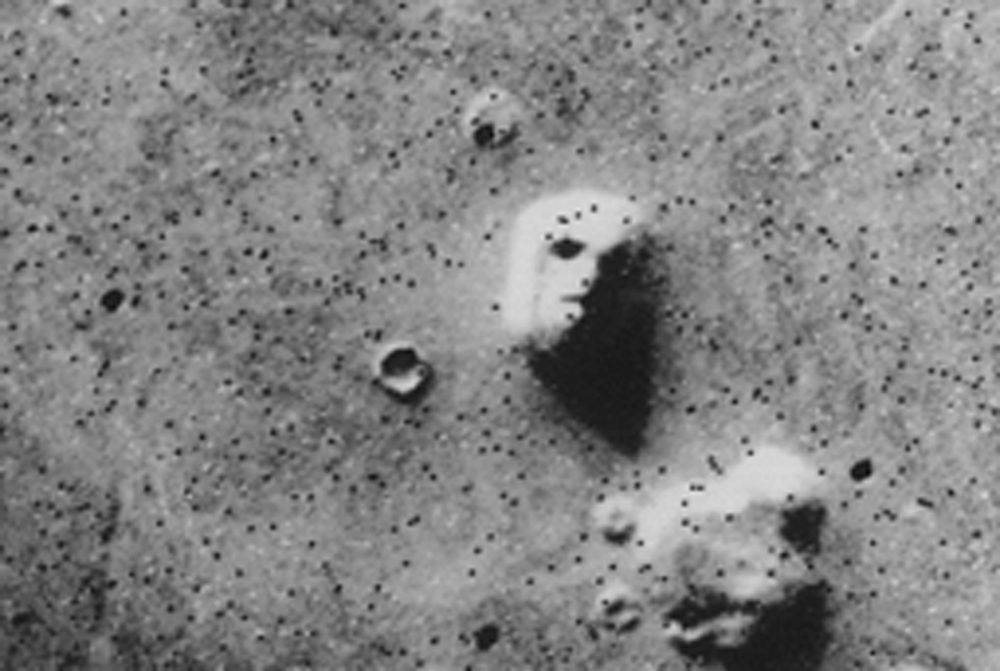
The famous face of Mars. Image taken by the Viking 1 orbiter on July 25, 1976...
Image Credit: NASA/JPL.
Who doesn’t love a good mystery? Especially when that mystery is also packed with logic, science and a touch ofstrangeness.
In 1976, NASA’s Viking 1 Orbiter captured an image that would ignite decades of speculation, mystery, and even conspiracy theories. The photo, taken over a region of Mars known as Cydonia, revealed a peculiar landform resembling a human face. With deep-set “eyes,” a prominent “nose,” and a distinct “mouth,” the so-called Face on Mars seemed like a relic of an ancient extraterrestrial civilization. The first time I saw it I was “convinced” that there was something on Mars that we were not seeing entirely. I firmly believed that it was possible that something artificial could indeed exist on Mars. But…
NASA was quick to dismiss the idea, explaining that the eerie formation was nothing more than a trick of light and shadow. Despite this, the image spread like wildfire, and many weren’t ready to accept such a mundane explanation. Was this really just an illusion, or was there something more to the story?
The Birth of a Martian Myth
At a time when humanity was just beginning to explore the Red Planet, the Face on Mars fueled imaginations across the globe. Some saw it as undeniable proof that an intelligent civilization once inhabited Mars, leaving behind monumental structures like those of ancient Egypt. Others believed it was part of a broader cover-up by space agencies to hide the truth about extraterrestrial life.
The theories didn’t stop there. Enthusiasts pointed to nearby formations in Cydonia, claiming they resembled pyramids and city ruins, further supporting the idea of an ancient Martian civilization. For decades, these beliefs persisted, bolstered by grainy, low-resolution images that left plenty of room for speculation.
But as technology advanced, so did our understanding of Mars.
A Closer Look: Science vs. Pareidolia
A Bear Face on Mars. This is a clear example of pareidolia. Image Credit: NASA/JPL-Caltech/UArizona.
Fast forward to the 21st century, and the Face on Mars underwent a major reality check. In 2006, NASA’s Mars Reconnaissance Orbiter equipped with the High-Resolution Imaging Science Experiment (HiRISE) camera revisited Cydonia, capturing images with unprecedented clarity. The result? The face seemingly vanished.
What was once thought to be an alien monument was revealed to be a natural mesa—an elevated, flat-topped landform shaped by erosion. This geological feature, common on both Earth and Mars, was sculpted over millions of years by wind and possibly water. The original Viking image, taken at just the right angle under specific lighting conditions, had simply exaggerated the shadows, creating the illusion of facial features.
More Than Just a Face: A Window Into Mars’ Wet Past
While the Face on Mars itself turned out to be an illusion, the region where it sits remains of great scientific interest. Mars was once a much wetter world, with evidence suggesting that an ancient ocean once covered much of its northern hemisphere—including Cydonia.
Recent studies have revealed that mesas in this region contain clay minerals, indicating prolonged interactions with water. This supports the theory that Mars had a more Earth-like past, with rivers, lakes, and possibly even life. The European Space Agency’s upcoming Rosalind Franklin rover is set to explore nearby terrain, potentially unlocking further secrets about the Red Planet’s ancient climate.
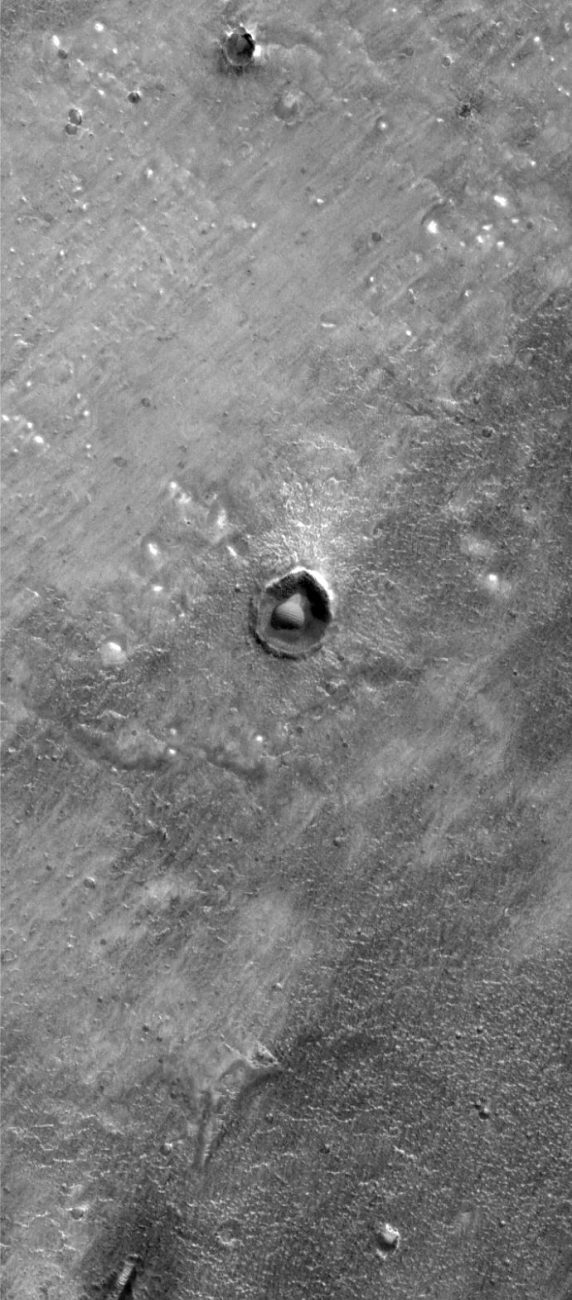
The surface of Mars taken by Mars Global Surveyor. In this image, we see a mysterious “sphere” buried in the surface. Image Credit: NASA / Wikimedia Commons.
Why the Face on Mars Still Matters
Even though we now understand that the Face on Mars is a simple geological formation, its story remains a fascinating chapter in space exploration history. It serves as a powerful reminder of how human perception—particularly pareidolia, our tendency to see familiar shapes in random patterns—can fuel incredible myths and mysteries.
More importantly, the region itself is far from a dead end. Scientists continue to study the Cydonia mesas, uncovering new clues about Mars’ past. The “face” might not be a relic of an ancient civilization, but what lies beneath it could still rewrite what we know about the Red Planet.
So, while the dream of a Martian city might have faded, the search for answers is far from over. Could the remnants of an ancient ocean still hold traces of past life? Future missions may finally give us an answer. And maybe, just maybe, one day we will discover something on Mars that only a few saw coming.
RELATED VIDEOS
Is There Life on Mars? We Asked a NASA Scientist
JPL and the Space Age: The Changing Face of Mars
The Proof Is Out There: Top 4 MIND-BLOWING Mysteries on Mars
Detection of a Space Capsule Entering Earth’s Atmosphere with Distributed Acoustic Sensing (DAS)
On December 3rd, 2018, NASA’s Origins, Spectral Interpretation, Resource Identification, and Security-Regolith Explorer(OSIRIS-REx) successfully rendezvoused with the Near-Earth Asteroid (NEA) 101955 Bennu. Over the next two years, the mission collected rock and regolith samples from the asteroid’s surface. By September 24th, 2023, the mission’s sample return capsule (SRC) entered Earth’s atmosphere and was collected by NASA scientists. Analysis of these samples is already providing insight into what conditions were like during the early Solar System.
According to a recent study, the known trajectory and timing of the SRC’s return provided a rare opportunity to record geophysical signals produced by the capsule using a new method. Because it was traveling at hypersonic speeds as it flew through the atmosphere, the SRC’s return produced a sonic boom that impacted the ground. Using distributed acoustic sensing (DAS) interrogators and surface-draped fiber-optic cables, the team carried out the first reported recording of an SRC reentry with distributed fiber-optic sensing technology.
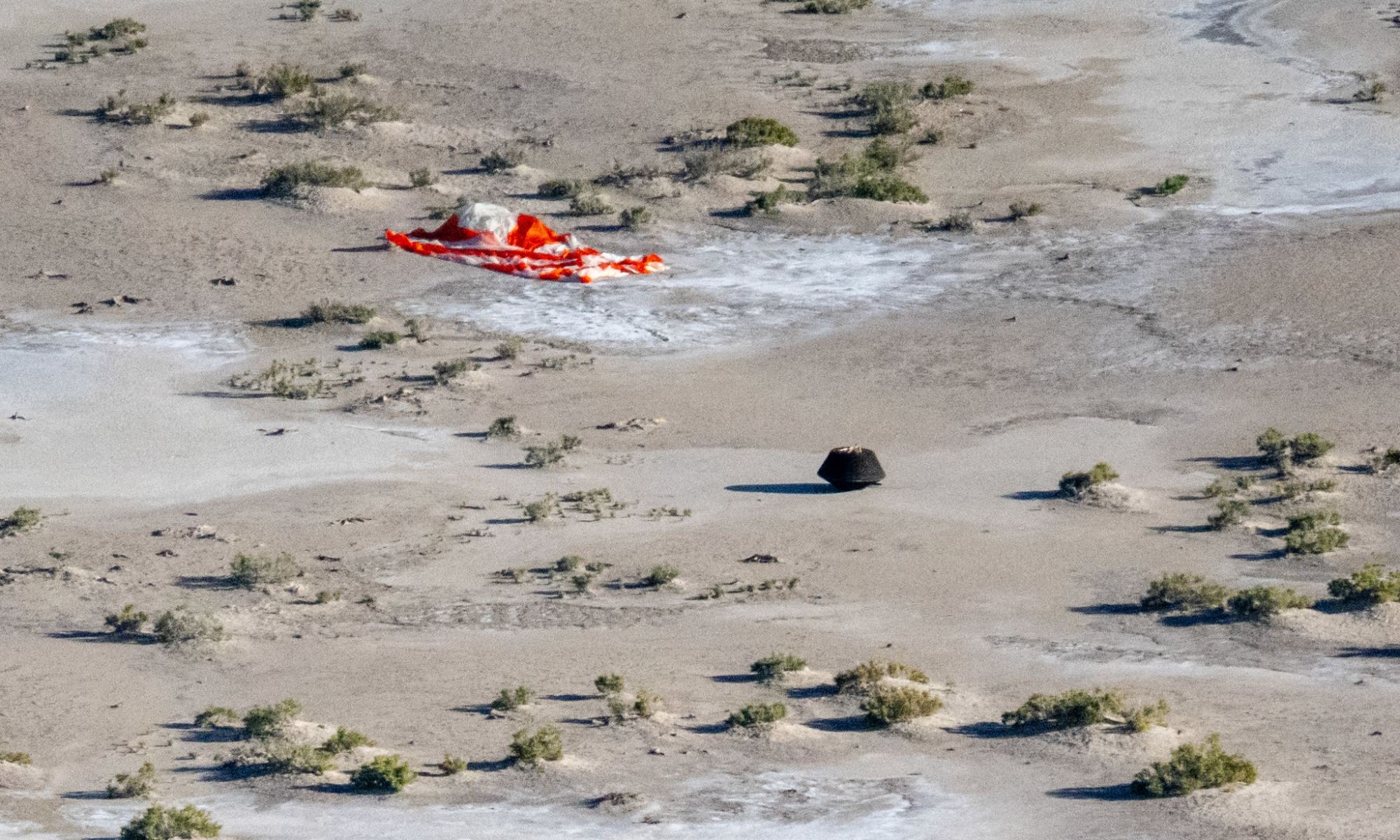
The sample return capsule from the OSIRIS-REx mission is seen shortly after touching down in the Utah desert on September 24th, 2023. Credit: NASA/Keegan Barber
Since the end of the Apollo Era, scientists have studied sample return capsules re-entering Earth’s atmosphere. These studies have helped scientists develop safe and effective methods for sample-return missions and provided insight into the atmospheric entry of meteoroids and asteroids. Until now, these studies employed infrasound and seismic sensors to record the resulting geophysical signals. However, Dr. Donahue and her team saw an opportunity since the trajectory and timing of the OSIRIS-REx mission’s SRC were known in advance.
As Dr. Donahue told Universe Today via email, the reentry was a chance for them to test DAS systems with fiber optic cables to record the geophysical effects produced by the sonic boom. “DAS systems interrogating an optical fiber are still relatively rare,” she said. “Knowing ahead of time the precise trajectory gave us the scarce opportunity to situate multiple DAS interrogators near the point of highest heating and capture the sonic boom as it impacted the ground.”
The team rapidly deployed two DAS interrogators and more than 12 km (7.45 mi) of surface-draped fiber-optic cables. Their network included six collocated seismometer-infrasound sensor pairs, all spread across two sites near the town of Eureka in the Nevada Desert. As Dr. Donahue described:
“Once the team got the hang of rolling out the 4 spools of optical fiber that each weighed over 100 kgs, installing and retrieving the fiber took less time than setting up the six co-located seismic and infrasound stations. Approximately 5 km of the optical fiber was located at the local Eureka airport, along with many other teams deploying sensors such as infrasound, seismic, and GPS. The other 7 km of fiber was located along a remote dirt road in Newark Valley.”
With the help of this network, the team obtained a stunning profile of the sonic boom as it struck the ground. The DAS interrogators recorded an impulsive arrival with an extended coda that had similar features to those recorded by the seismometers and infrasound sensors. Whereas traditional sensors only measure sonic booms at one point, Dr. Donahue said that her team’s data revealed how the boom’s wavefront transformed as it impacted the irregular terrain of the Nevada landscape.
In addition to being the first time these methods were used to record an SRC reentry, the results of this test could have significant implications when it comes to predicting potential meteor and asteroid strikes. Said Dr. Donahue:
“By having an extremely dense array of sensors, DAS has the possibility of better characterizing the trajectory and size of a meteor. The topology (e.g., hills) of the ground is known to have an influence on wavefront recorded at the surface of the earth. By having a dense line of sensors that span over the changes in the earth’s elevation, these effects could be better accounted for to produce a more accurate characterization of a meteor’s trajectory.”
Following the completion of its primary mission, the OSIRIS-REx, NASA prepped the spacecraft for the next phase of its mission. In 2029, the spacecraft – renamed the OSIRIS-APEX (Apophis Explorer) – will rendezvous with the Near-Earth Asteroid 99942 Apophis and collect another sample.
How Distributed Acoustic Sensing (DAS) from Sensonic works
Top UFO Crash Retrieval Expert on CIA Alien Files & Majestic 12 - Ryan Wood (Video)
In this 10 December 2024 video, host Julian Dorey talks with Ryan Wood, regarded as a leading authority on the Top Secret classified Majestic-12 intelligence documents and the 1941 Cape Girardeau, Missouri UFO Crash amongst others. He is the author of MAJIC EYES ONLY: Earth’s Encounters with Extraterrestrial Technology, a landmark synthesis of over 100 UFO crash retrievals along with authenticity discussions of many of the majestic documents.
00:00 – Richard Dolan (UFO Crash Retrieval Program), Meeting Stanton Friedman & Father’s Interest (1967) 08:39 – Brian Scott Abduction Cases, Danny Sheehan, Government Disclosure Confusion, Anti-Gravity Secret 19:21 – Alien Abduction (Male to Female Ratio) Issues, Historical Mount Ararat UFO Story, Burying Alien Story 27:35 – Jim Mars UFO Investigative Reporter, UFO Dex AI Tool 32:11 – Majestic 12 Breakdown, James Forrestal 41:47 – Majestic 12 Debunk or Truth? 55:03 – National Archives Hiding UFO Information, Tim Cooper UFO Leaks 01:04:21 – Vernon Bowman Encyclopedia UFO Files, Liquid Chromatography, Roswell Crash Parts 01:13:01 – Ryan’s Dad Theory on UFOs, AI Alien Theories 01:23:31 – Cape Girardeau UFO Case, Joe McMonagle Stargate Program, Hieroglyphics in UFO 01:37:29 – UFO Mexico Crash (Kill People), Simulating UFO Abductions 01:50:21 – UFOs & Nukes, James Erwin Astronaut, Einstein Posed w/ Alien Colonization 02:02:31 – Government’s Massive Secret (Manipulate Gravity), Theories on Aliens 02:09:47 – Skunk Works, Men in Black Recovering Crashed UFOs 02:18:03 – CIA Level 7 (Alien Convos), David Grusch Coming Forward 02:26:11 – Hitler Germany & UFOs Tied to Foo Fighters, DARPA Connections (Dr. Brandenburg) 02:32:11 – Transmedium UFOs Crashes, What is Next? 02:40:37 – Nuclear Fusion, Israel UFO Confirmation of Alien Life 02:49:07 – Belief in God
UFO Coverup: Pentagon Is Hiding Holy Grail Evidence - James Fox & Jason Sands (Video)
In this 15 January 2025 video, host Jukian Dorey welcomes back James Fox for the third time on Julian Dorey Podcast to discuss his latest Documentary, “The Program” which goes behind the Congressional hearings to leave skeptics astounded by new assertions from a growing chorus of high-level insiders who insist there is definitive proof we are not alone.
Jason Sands is a new UFO whistleblower, who has recently come forward with claims about his involvement in a 20-year black budget program and a surreal Alien encounter.
00:00 – James Fox from The Phenomenon to ‘The Program’, D.C. Investigation 10:01 – James Disastrous Film Company Lawsuit, 26:54 – Most Satisfying UFO Documentary (Devastating Setbacks) 31:21 – Pivotal UFO Interview Moments, Disclosure vs UFO Evidence 38:51 – Reads Congressional Source Document, Photographs & Evidence 46:31 – Intel Agency Individuals & Obfuscation, Evidence Behind Jason Sands Encounter 52:03 – Telepathic Communication Residue, Devil’s Advocate & Possibly Being Lied Too 01:00:30 – Why Does Jason Sand’s Have Immunity vs Coworkers, Top Secret Information SCIF (James Fox) 01:10:45 – Special Access Programs & How Information is Controlled & Not Leaked, Black Budget Programs 01:21:21 – Hearing Craziest Stories During Black Budget Program
UFO Historian Richard Dolan on the Drone Mystery and Disclosure in 2025 (Video)
In this 17 January 2025 video, WatchMjo dives back into the topic of UAPs or Unidentified Anomalous Phenomena with UFO researcher and historian Richard Dolan. Richard has over 30 years of experience studying UFOs and he joins us to talk about the ongoing drone mystery over the Northeastern seaboard of the United States. He also shares some insights into possible disclosures that could happen in 2025 as well as some of the broader implications of a non-human intelligence being revealed to the general public.
Diana Pasulka - Religious History, UFO Phenomena and the Ancient Mysteries of Purgatory (Video)
In this 5 February 2025 video, host Shawn Ryan talks with Diana Walsh Pasulka, a professor of religious studies at the University of North Carolina Wilmington who specializes in Catholic history and the intersection of religion, technology, and UFO beliefs. Pasulka’s research focuses on how belief in UFOs and extraterrestrial life has influenced traditional religions and modern culture. Her notable works include “Heaven Can Wait,” “American Cosmic: UFOs, Religion, Technology,” and “Encounters: Experiences with Non-Human Intelligences”. She holds a B.A. from the University of California, Davis, an M.A. from Graduate Theological Union, Berkeley, and a Ph.D. from Syracuse University.
Pasulka’s ongoing research explores the religious aspects of UFO phenomena and non-human intelligence encounters. She has collaborated with prestigious publishing houses, appeared on high profile media platforms, and consulted for films about religious supernatural themes. Pasulka is currently leading a translation project of Saint Joseph of Copertino’s canonization records in cooperation with the Vatican Apostolic Archive. Her work continues to bridge the gap between academic religious studies and contemporary beliefs in extraterrestrial phenomena, solidifying her position as a leading expert in this unique field of study.
00:00 Introduction 02:51 Diana’s Early Religious Experience 09:21 Academic Journey and Purgatory Research 33:37 Ezekiel’s Vision and Mystical Traditions 50:57 Exploring Non-Psychedelic Paths to Higher Realms 59:27 Introduction to UFO Studies 01:06:18 The Vatican Archives and UFO Research 01:14:30 The New Mexico Crash Site 01:27:35 The Vatican Trip 01:37:49 Exploring the Spiritual and Material Aspects of UFOs 01:45:04 Historical and Modern Perspectives on UAP and Spiritual Experiences 01:58:03 The Impact of Technology on Society and Cognitive Sovereignty 02:07:55 Philosophical and Religious Insights on Reality and Control 02:19:37 Conspiracies, Space Programs, and Rituals
The effects of Climate Change on Earth’s living systems have led to a shift in biological studies, with attention now being focused on the boundaries within which life can survive. Studying life forms that can thrive in extreme environments (extremophiles) is also fundamental to predicting if humans can live and work in space for extended periods. Last, but not least, these studies help inform astrobiological studies, allowing scientists to predict where (and in what form) life could exist in the Universe.
In a recent study, a team of Italian researchers used brine shrimp (Artemia franciscana) in the earliest stage of development (nauplii) and subjected them to Mars-like pressure conditions. Their results indicate that while the nauplii experienced physiological changes, their development remained largely unchanged. This not only demonstrates that extremophiles show great adaptability and can survive in Mars-like conditions. It also indicates that similar life forms could be found elsewhere in the Universe, representing new opportunities for astrobiological research.
Brine Shrimp Artemia franciscana. Credit: Wikipedia
On Earth, extremophiles belong to all three domains of life (Archaea, Bacteria, and Eukarya). They are characterized by their ability to withstand pressure, acidity, temperatures, and other conditions that would be fatal to other organisms. After Earth, Mars is considered the most habitable planet after Earth in the Solar System, hence why most of humanity’s astrobiology efforts are focused there. In addition to the low atmospheric pressure (1/100th of Earth’s at sea level), the surface is subject to extreme temperature variations and is contaminated by perchlorites and toxic metals.
Scientists speculate that if life exists on Mars today, it will likely take the form of microbes living in high-salinity briny patches beneath the surface. As Tomajoli told Universe Today via email, this makes extremophiles (like Artemia franciscana) ideal test subjects for predicting what life is like in similar planetary environments:
“The definition of life is crucial, especially when searching for traces of it on other planetary bodies (e.g., Mars), where life might not exist as we traditionally imagine it. Artemia cysts present an interesting case: in their dormant state, they cannot be classified as living but rather as potential life. Studying organisms with such characteristics helps broaden the perspective in astrobiological research.”
In particular, extremophiles present opportunities for researching species adaptation, which has become a major focus of scientific research due to anthropogenic Climate Change. Worldwide, rising carbon emissions and increasing temperatures are leading to changes in weather patterns, increased ocean acidity, drought, wildfires, and the loss of habitats. As a result, countless marine and terrestrial species are forced to adapt to conditions that are becoming more extreme.
In this April 30, 2021, file image taken by the Mars Perseverance rover and made available by NASA, the Mars Ingenuity helicopter, right, flies over the surface of the planet. Credit: NASA/JPL-Caltech/ASU/MSSS
“In the context of climate change, life conditions are shifting toward extreme boundaries, making survival more challenging for many organisms,” Tomajoli added. “Extremophiles, which thrive in Earth’s most remote environments, are valuable models for understanding metabolic adaptations. Their apparent simplicity is, in fact, an advantage, allowing them to adapt better than more complex organisms to extreme environmental constraints.”
Tomajoli and her colleagues chose Artemia franciscana for their study, a species of brine shrimp known to thrive in high-salinity environments. The eggs they produce, known as cysts, are dormant and can be stored indefinitely, making them extremely useful for aquaculture and scientific research. As Tomajoli indicated, they have also been used in previous space missions, including the Biostack experiment on the Apollo 16 and 17 missions and the ESA’s EXPOSE platform mounted on the International Space Station’s (ISS) exterior.
These experiments all tested the resilience of certain life forms and their progeny to cosmic rays. However, as Tomajoli added, no further studies have been conducted regarding the physiological adaptations of Artemia franciscana, and there is currently no scientific literature available on the topic:
“In particular, Artemia brine shrimps are considered halophiles (literally “salt-loving” organisms) and thrive in environments that can be considered Mars analogs (or laboratories for Mars studies) such as temporary lakes that undergo frequent evaporation, prompting Artemia to produce cryptobiotic cysts. Additionally, Artemia is an easily cultivable model, making it suitable for biological and astrobiological experiments. A recent article by Kayatsha et al., 2024 also showed that Artemia franciscana was among all the microinvertebrates that were tested, the more resistant one to perchlorates salts present in the regolith of simulated martian soil.”
Artist’s impression of water under the Martian surface. Credit: ESA
For their experiment, Tomajoli and her colleagues placed dormant cysts in Mars-like pressure conditions. Once they hatched into nauplii, the team analyzed their aerobic and anaerobic metabolism, mitochondrial function, and oxidative stress. As indicated in their paper, brine shrimp born in Martian pressure conditions managed to adapt quite well. They further share how these results could lead to further studies to evaluate the metabolic adaptations of the cysts to longer exposure times, combinations of different Mars-like conditions, or studies of the adaptations of the nauplii in other stages of development:
“Artemia franciscana showed an exciting potential for physiological adaptations, enabling organisms to cope with the environmental challenges they encounter in space… Nauplii’s cells appear to activate responses to avoid mitochondrial dysfunction and continue their growth processes. These adaptation mechanisms highlight Artemia franciscana’s resilience and ability to thrive in hostile environmental conditions. The results reported in this study further support the potential use of Artemia franciscana for astrobiological purposes, highlighting the animals’ metabolic and redox state changes as a response to adaptation to an extreme condition mimicking the space.”
The implications of this research are far-reaching, embracing astrobiology, human space exploration, and mitigating the effects of Climate Change. Not only could it help point the way toward potential life on Mars, in the interior oceans of icy bodies, and other extreme environments. It could also inform future missions to Mars and other deep-space destinations, where astronauts will need to rely on closed-loop bioregenerative life support systems (BLSS), grow their own food, and conduct research into the effects of exposure to lower gravity, elevated radiation, and other harsh conditions.
At home, the study of extremophiles and adaptation mechanisms could provide insight into climate resilience and adaptation, consistent with the goals outlined in the Sixth Assessment Report (AR6) by the Intergovernmental Panel on Climate Change (IPCC). As they summarize in their paper:
“Understanding the mechanisms of Artemia franciscana adaptations to space-simulated conditions could provide new insights into the study of the limits of life, as well as contribute to the search for biosignatures—traces of past life on other planetary bodies. Additionally, it could offer a viable solution for the long-term survival of human space missions, helping establish self-sustaining populations in confined environments. Artemia could serve as a renewable food source for astronauts, given its richness in essential nutrients, including proteins, lipids, and vitamins.”
Tomajoli and her colleagues have also conducted simulations with a full Mars-like atmosphere for longer periods of time. The paper describing this experiment will be released soon. In the meantime, the search for life on Mars and beyond continues. Knowing it can exist out there and under what conditions will help narrow that search and encourage us to keep investigating.
Meer van UFO'S of UAP'S, ASTRONOMIE, RUIMTEVAART, ARCHEOLOGIE, OUDHEIDKUNDE, SF-SNUFJES EN ANDERE ESOTERISCHE WETENSCHAPPEN - DE ALLERLAATSTE NIEUWTJES


 Three Lunar Missions Are Heading to the Moon at the Same Time