Naar de inhoud

UFO'S of UAP'S, ASTRONOMIE, RUIMTEVAART, ARCHEOLOGIE, OUDHEIDKUNDE, SF-SNUFJES EN ANDERE ESOTERISCHE WETENSCHAPPEN - DE ALLERLAATSTE NIEUWTJES

UFO's of UAP'S in België en de rest van de wereld
akke.beakke.be
Ontdek de Fascinerende Wereld van UFO's en UAP's: Jouw Bron voor Onthullende Informatie! Ben jij ook gefascineerd door het onbekende? Wil je meer weten over UFO's en UAP's, niet alleen in België, maar over de hele wereld? Dan ben je op de juiste plek! België: Het Kloppend Hart van UFO-onderzoek In België is BUFON (Belgisch UFO-Netwerk) dé autoriteit op het gebied van UFO-onderzoek. Voor betrouwbare en objectieve informatie over deze intrigerende fenomenen, bezoek je zeker onze Facebook-pagina en deze blog. Maar dat is nog niet alles! Ontdek ook het Belgisch UFO-meldpunt en Caelestia, twee organisaties die diepgaand onderzoek verrichten, al zijn ze soms kritisch of sceptisch. Nederland: Een Schat aan Informatie Voor onze Nederlandse buren is er de schitterende website www.ufowijzer.nl, beheerd door Paul Harmans. Deze site biedt een schat aan informatie en artikelen die je niet wilt missen! Internationaal: MUFON - De Wereldwijde Autoriteit Neem ook een kijkje bij MUFON (Mutual UFO Network Inc.), een gerenommeerde Amerikaanse UFO-vereniging met afdelingen in de VS en wereldwijd. MUFON is toegewijd aan de wetenschappelijke en analytische studie van het UFO-fenomeen, en hun maandelijkse tijdschrift, The MUFON UFO-Journal, is een must-read voor elke UFO-enthousiasteling. Bezoek hun website op www.mufon.com voor meer informatie. Samenwerking en Toekomstvisie Sinds 1 februari 2020 is Pieter niet alleen ex-president van BUFON, maar ook de voormalige nationale directeur van MUFON in Vlaanderen en Nederland. Dit creëert een sterke samenwerking met de Franse MUFON Reseau MUFON/EUROP, wat ons in staat stelt om nog meer waardevolle inzichten te delen. Let op: Nepprofielen en Nieuwe Groeperingen Pas op voor een nieuwe groepering die zich ook BUFON noemt, maar geen enkele connectie heeft met onze gevestigde organisatie. Hoewel zij de naam geregistreerd hebben, kunnen ze het rijke verleden en de expertise van onze groep niet evenaren. We wensen hen veel succes, maar we blijven de autoriteit in UFO-onderzoek! Blijf Op De Hoogte! Wil jij de laatste nieuwtjes over UFO's, ruimtevaart, archeologie, en meer? Volg ons dan en duik samen met ons in de fascinerende wereld van het onbekende! Sluit je aan bij de gemeenschap van nieuwsgierige geesten die net als jij verlangen naar antwoorden en avonturen in de sterren! Heb je vragen of wil je meer weten? Aarzel dan niet om contact met ons op te nemen! Samen ontrafelen we het mysterie van de lucht en daarbuiten.

Archief

700 miljoen jaar geleden veranderde de Aarde in een gigantische ijsbal. Eindelijk weten onderzoekers waarom

700 miljoen jaar geleden veranderde de Aarde in een gigantische ijsbal. Eindelijk weten onderzoekers waarom

Je hebt ijstijden en ijstijden en die van ruim 700 miljoen jaar geleden was me er eentje. De Aarde veranderde in één grote ijzige bol, zelfs de oceanen waren dichtgevroren. Tot nu toe begrepen onderzoekers niet goed hoe dat kon, maar nu hebben ze een verklaring: de vulkanen stootten extreem weinig CO2 uit.

“Stel je voor dat de Aarde compleet bevroren is, want dat is wat er zo’n 700 miljoen jaar geleden gewoon is gebeurd. De planeet was bedekt met ijs van de polen tot de evenaar en de temperaturen doken naar beneden”, zegt hoofdonderzoeker Adriana Dutkiewicz. “Wat dit heeft veroorzaakt, was tot nu toe echter een open vraag.”

Maar ze denkt dat het mysterie van de zogenoemde Sneeuwbalaarde nu is opgelost. “Waarschijnlijk was er een historisch lage uitstoot van vulkanische CO2 in combinatie met de verwering van een enorme berg vulkanisch gesteente in wat nu Canada heet, een proces waarbij de basaltstenen CO2 uit de atmosfeer absorberen.” Dat werkt als volgt: regen slaat CO2 op uit de lucht. Die regen reageert met het verpulverde basalt, die de CO2 opslaat.

Inspiratie uit het zuiden van Australië
De Australische geologen werden geïnspireerd door overblijfselen uit de ijstijd, die geweldig goed te zien zijn in de Flinders Ranges in Zuid-Australië. Een recente trip daarheen, bracht de wetenschappers op het idee om met behulp van een supercomputer van de University of Sydney tektonische plaatmodellen te bestuderen om te achterhalen wat de oorzaak is van de extreem lange en hevige ijstijd. De studie helpt bovendien om de natuurlijke thermostaat van de Aarde beter te begrijpen, die voorkomt dat onze planeet oververhit raakt. Het toont ook aan hoe gevoelig ons klimaat is voor de hoeveelheid CO2 in de atmosfeer.

Gletsjerafzettingen uit de ijstijd in de Flinders Ranges. Foto: professor Dietmar Müller/University of Sydney

Aan de slag met de computer
De extreme ijstijd duurde van ongeveer 717 tot 550 miljoen jaar geleden. In die tijd bestond er geen complex leven. “Er zijn verschillende oorzaken genoemd voor het begin en het einde van deze ijstijd, maar het meest mysterieuze is waarom hij tientallen miljoenen jaren duurde, een lengte die wij ons nauwelijks kunnen voorstellen”, aldus Dutkiewicz.

De onderzoekers wendden zich tot een tektonisch plaatmodel dat de evolutie van continenten en oceanen laat zien in de periode na het uiteenvallen van supercontinent Rodina. Dat verbonden ze met een computermodel dat de CO2-ontgassing van onderwatervulkanen berekende langs de breuklijnen waar de tektonische platen uit elkaar drijven en nieuwe oceaanbodem ontstaat.

Kalme vulkanen
Zo zagen ze al snel dat het begin van de ijstijd precies overeenkwam met een ongezien dieptepunt aan vulkanische CO2-uitstoot. Daarbij bleef de uitstroom van CO2 relatief laag gedurende de hele ijstijd. “In die tijd waren er geen meercellige dieren of landplanten op Aarde. De broeikasgasconcentratie in de atmosfeer werd bijna volledig bepaald door de CO2-uitstoot van vulkanen en de CO2-opslag van verpulverd vulkanisch gesteente.”

Met andere woorden, vulkanen bepaalden het klimaat op Aarde. “We denken dat de ijstijd begon door een dubbele klap: een opschudding van de tektonische platen bracht de ontgassing van vulkanen tot een minimum, terwijl tegelijkertijd een vulkanische provincie in Canada begon te eroderen. Die sloeg dus een enorme berg CO2 op”, legt professor Dietmar Müller van de University of Sydney uit. “Het gevolg was dat het CO2-niveau in de atmosfeer zo laag werd dat de ijstijd begon. De schatting is dat dit gebeurt bij minder dan 200 CO2-deeltjes per miljoen, minder dan de helft van wat er nu in de atmosfeer zit.”

De toekomst
Het onderzoek roept interessante vragen op over de toekomst van de Aarde. Volgens een recente theorie zou onze planeet in de komende 250 miljoen jaar kunnen evolueren tot Pangea Ultima, een supercontinent, dat zo heet is dat zoogdieren mogelijk uitsterven.
De CO2-uitstoot van vulkanen wordt echter op de lange termijn minder is de verwachting, dus misschien verandert Pangea Ultima ook weer in een ijsbal. “Wat de toekomst ook brengt, het is belangrijk om te weten dat geologische klimaatverandering, zoals we die hier beschrijven, extreem langzaam gaat. Volgens de NASA gaat door mensen veroorzaakte klimaatverandering tien keer sneller dan we tot nu toe hebben gezien”, klinkt het tot besluit.

Bronmateriaal

VIDEO'S

How Snowball Earth Leveled Mountains and Created the Great Unconformity

From Ice Age to Snowball Earth: Our Frozen Planet's History

How Volcanoes Froze the Earth (Twice)

{ https://scientias.nl/ }

Hoe vind je dit bericht?
Geschreven door peter om 00:21 Stuur door

December 2024 MUFON eNewsletter- with the Monthly Sighting Statistics!

December 2024 MUFON eNewsletter- with the Monthly Sighting Statistics!

COUNTRIES OF THE WORLD

UNITED STATES 432

CANADA 30

UNITED KINGDOM 28

FRANCE 7

GERMANY 6

AUSTRALIA 6

SOUTH AFRICA 5

BRAZIL 5

IRELAND 5

SPAIN 4

NETHERLANDS 4

ITALY 4

MEXICO 4

TURKEY 3

PUERTO RICO 2

KENYA 2

ESTONIA 2

AUSTRIA 2

PORTUGAL 2

SWEDEN 1

COLOMBIA 1

PERU 1

MOLDOVA 1

UZBEKISTAN 1

MOROCCO 1

FINLAND 1

POLAND 1

BELGIUM 1

GREENLAND 1

SAINT KITTS AND NEVIS 1

IRAN 1

BOLIVIA 1

BELIZE 1

GREECE 1  

TOTAL: 568

SHAPE

Circle 112

Sphere 70

Other 52

Unknown 44

Triangle 42

Disc 37

Star-like 35

Oval 24

N/A 17

Cigar 15

Square/Rectangular 11

Cylinder11

Tic Tac9

Fireball8

Diamond8

Saturn-like6

Boomerang6

Chevron3

Flash2

Cone2

Bullet/Missile2

Teardrop2

Blimp1

Egg1

STATES OF THE USA

California 45

Florida 33

Texas 26

New York 21

Michigan 20

Arizona 19

Ohio 17

Missouri 16

Washington 15

Indiana 14

Illinois 13

Pennsylvania 13

Oregon 12

Virginia 12

Colorado 10

Oklahoma 10

Massachusetts 9

New Jersey 9

North Carolina 9

Maryland 8

Wisconsin 8

Nevada 7

Minnesota 7

Arkansas 6

Alabama 6

South Carolina 5

Iowa 5

Georgia 5

Idaho 4

West Virginia 4

Kansas 4

Utah 4

New Hampshire 3

Connecticut 3

Tennessee 3

Kentucky 3

Maine 3

South Dakota 2

Wyoming 2

Delaware 2

North Dakota 2

Louisiana 2

Montana 2

Alaska 2

Nebraska 2

Vermont 2

Mississippi 1

DISTANCE

< 100 ft 70

101-500 ft 68

501 ft - 1 Mile 72

Over 1 Mile 106

Unknown 137

NO VALUE 34

ERT

Most impressively there were 20 Landings, Hovering, or Takeoffs reported, and 15 Entities observed.


{ https://mufon.com/ }

Hoe vind je dit bericht?
Geschreven door peter om 21:57 Stuur door

New details about impact of massive asteroid that hit the US revealed

New details about impact of massive asteroid that hit the US revealed

Scientists have revealed new details about the impact of a massive asteroid that hit the US roughly 35 million years ago. 

The asteroid, between three and five miles wide, created a giant 25-mile-wide crater in what now lies beneath Chesapeake Bay, with the center located at the southern end of Northampton County near Cape Charles, Virginia.

While slightly smaller than the event that killed the dinosaurs 66 million years ago, researchers expected it to alter Earth's global climate similarly.

Instead, they found 'our planet seemed to carry on as usual,' according to study co-author Bridget Wade with University College London (UCL).

What's more, the researchers found another giant asteroid collided with what is now Russia some 25,000 years prior and only disrupted Earth's climate for a brief period. 

That impact left a 60-mile-wide crater - known today as the Popigai crater - in northern Siberia.  

These two asteroid strikes formed the fourth and fifth largest known craters on Earth, and yet, they did not trigger any measurable climate changes over the following 150,000 years, the researchers concluded. 

'However, our study would not have picked up shorter-term changes over tens or hundreds of years, as the samples were every 11,000 years,' Wade explained.

'Over a human time scale, these asteroid impacts would be a disaster. They would create a massive shockwave and tsunami, there would be widespread fires, and large amounts of dust would be sent into the air, blocking out sunlight.' 

Roughly 35 million years ago, an enormous asteroid slammed into the ocean off the eastern coast the North American continent, but didn't cause climactic changes (STOCK)

Roughly 35 million years ago, an enormous asteroid slammed into the ocean off the eastern coast the North American continent, but didn't cause climactic changes (STOCK)

The asteroid, between three and five miles wide, created a giant 25-mile crater in what now lies beneath Chesapeake Bay, with the center located at the southern end of Northampton County near Cape Charles, Virginia

The asteroid, between three and five miles wide, created a giant 25-mile crater in what now lies beneath Chesapeake Bay, with the center located at the southern end of Northampton County near Cape Charles, Virginia

Evidence of the asteroid impacts were found in tiny droplets of silica, which appeared like small balls of glass. 

The formations were created by the intense heat released as the asteroid impacts vaporized rocks on. 

The team inferred what Earth's climate looked like after the asteroid strikes by analyzing carbon and oxygen isotopes in more than 1,500 fossils of shelled, single-celled organisms called foraminifera.

These tiny sea creatures lived near the ocean surface or on the sea floor between 35.5 and 35.9 million years ago, and served as a record of how warm Earth's oceans were at that time. 

The fossils were found embedded within 10 feet of a rock core drilled from underneath the Gulf of Mexico by the scientific Deep Sea Drilling Project. 

The researchers found shifts in isotopes 100,000 years prior to the two asteroid impacts that suggested the ocean surface warmed 3.6 degrees Fahrenheit, and the deep ocean cooled 1.8 degrees Fahrenheit. 

But they did not find evidence of any climactic shifts around the time of the impacts or afterwards.  

Another giant asteroid that collided with what is now Russia some 25,000 years prior similarly did not disrupt Earth's climate for more than a brief period

Another giant asteroid that collided with what is now Russia some 25,000 years prior similarly did not disrupt Earth's climate for more than a brief period

article image

'What is remarkable about our results is that there was no real change following the impacts,' Wade said in the statement.

'We expected the isotopes to shift in one direction or another, indicating warmer or cooler waters, but this did not happen.'

The researchers published their findings in the journal Communications Earth & Environment today. 

The isotope samples collected were over intervals of 11,000 years, and therefore do not reflect the short-term affects of these massive asteroid impacts, which would have been a 'disaster' over a human time scale, Wade said. 

The Chicxulub impact, for example, caused a shift in climate on a much smaller timescale of less than 25 years. But it was so extreme that it triggered the extinction of the dinosaurs.

'So we still need to know what is coming and fund missions to prevent future collisions,' Wade said.

NASA's Planetary Defense Coordination Office (PDCO) is developing strategies and protocols to prevent a catastrophic asteroid strike.

Evidence of the asteroid impacts were found in tiny droplets of silica, which appeared like small balls of glass. The formations were created by the intense heat released as the asteroid impacts vaporized rocks on

Evidence of the asteroid impacts were found in tiny droplets of silica, which appeared like small balls of glass. The formations were created by the intense heat released as the asteroid impacts vaporized rocks on

The PDCO's primary mission is finding, tracking and better understanding asteroids that could pose a threat to Earth. But it also launched the Double Asteroid Redirection Test (DART) mission in November 2021. 

This mission rammed a spacecraft into the near-Earth asteroid Dimorphos to alter its trajectory - a strategy NASA could one day use to save the planet from an oncoming asteroid. 

Even though Wade and Cheng's study did note capture the more immediate affects of the strikes, they did create a more precise timeline of climactic change, as previous studies used fossils samples over intervals longer than 11,000 years. 

What's more, using fossils that lived at different ocean depths provided a more complete picture of how the oceans responded to the asteroid strikes. 

'It was fascinating to read Earth's climate history from the chemistry preserved in microfossils,' Cheng said.


Asteroids: Deadly Impact ☄💫 (Documentary) ♦NatGeo♦

The most devastating asteroid to hit Earth - Sean P. S. Gulick

{ https://www.dailymail.co.uk/ }

Hoe vind je dit bericht?
Geschreven door peter om 21:01 Stuur door

Listen to baffled pilots report UFOs 'moving real quick' above their planes in Texas

The conversation of baffled pilots tracking 'super bright' UFOs 'moving real quick' above their planes in Texas has been revealed.

The short audio heard flight crews on American Airlines and Spirit planes speaking with air traffic control (ATC) on the night of November 30, as they were both flying into the Dallas-Fort Worth airport.

The American Airlines pilot was the first to contact ATC, saying: 'We are following these two lights that are up above us that are kind of jogging back-and-forth, left and right, for the past, like, half hour.'

A Spirit Airlines pilot was then heard describing a similar experience, noting their flight crew was 'watching them for about an hour or two in the northwest sky.'

He continued to explain that he saw the same phenomenon a week earlier.

ATC relayed that nothing was showing up on the radar, adding more mystery to what was seen in the skies above Texas.

The American Airlines pilot, flying from Louisville, Kentucky to Dallas-Fort Worth, said that the odd lights were above his cruising altitude of 34,000 feet.

'The lights were quite a bit above us on the horizon,' the pilot later explained.

'My first thought was satellites, but they kept getting super bright and [going] away over and over.'

Fort Worth ATC checked in with the US Air Force about possible activity over two, nearby 'military operations areas' (MOAs) — at the pilot's behest — but neither MOA had craft in the skies that night, as confirmed on radar.

Baffled pilots with American Airlines and Spirit tracked two unexplained, 'super bright' UFOs 'kinda jogging back and forth, left and right,' over Dallas, Texas. And at least one motorist in the Dallas-Fort Worth area also noted the UFOs that night, posting video to TikTok (pictured above)

Baffled pilots with American Airlines and Spirit tracked two unexplained, 'super bright' UFOs 'kinda jogging back and forth, left and right,' over Dallas, Texas. And at least one motorist in the Dallas-Fort Worth area also noted the UFOs that night, posting video to TikTok (pictured above)

The video (screencapture above), taken near Dallas Fort Worth International Airport on November 30th, appears to corroborate the two aircrew reports, based on the poster's independent account. 'They would disappear and reappear in different formations,' the TikToker wrote

The video (screencapture above), taken near Dallas Fort Worth International Airport on November 30th, appears to corroborate the two aircrew reports, based on the poster's independent account. 'They would disappear and reappear in different formations,' the TikToker wrote

'It's gonna sound a little weird,' the pilot about the American Airlines aboard flight ENY3413 can be heard telling Fort Worth air traffic control (ATC) in real time, 'but [...] they get super bright and then go completely dim also.'

While the pilot for the budget passenger airliner Spirit on flight NKS1757 did not mention a change in brightness, he did report getting a much longer look at the two mysterious aerial lights up to two hours of flight time. 

And, he explained, the UFOs were moving 'real quick' and about '100 miles out in space.'

The Spirit pilot also added that the odd lights appeared to be independent of each other, not fixed to one object, whether it was terrestrial aircraft, alien flying saucers or something else.

'They split positions,' he told ATC. 'It's the first time I've seen them change relative position.'

The American Airlines pilot explicitly asked ATC whether or not the US military had activity in the Rivers, Oklahoma 'military operations area' (MOA) to the north, which is used by the Air Force's 138th Fighter Group.

'I asked if the RIVERS MOA was hot and they said 'no' with nobody on radar,' the pilot told the YouTube flight-tracking channel VISAviation. 

'Do you know if the Rivers MOA is hot? You got anybody messing around over there?' the pilot of AA flight ENY3413 can be heard asking on radio.

'It is cold,' ATC replied. 'I am curious why you ask?'

The American Airlines pilot, who was flying from Louisville, Kentucky that night, said that the odd UFO lights were above his own cruising altitude of 34,000 feet: 'The lights were quite a bit above us on the horizon [...] they kept getting super bright and [going] away over and over'

The American Airlines pilot, who was flying from Louisville, Kentucky that night, said that the odd UFO lights were above his own cruising altitude of 34,000 feet: 'The lights were quite a bit above us on the horizon [...] they kept getting super bright and [going] away over and over' 

Another Tik Tok user in the area, who posts as @godandtruth777, might have also captured the UFOs on film (above), commenting: 'Seen in DFW! And they didn't look like planes!'Another still from Tik Tok user @godandtruth777

Another Tik Tok user in the area, who posts as @godandtruth777, might have also captured the UFOs on film (above), commenting: 'Seen in DFW! And they didn't look like planes!'

article image

The pilot also enquired about Shirley MOA north of Little Rock, Arkansas, used by Arkansas Air National Guard's 188th Fighter Wing, but this MOA was 'cold' that night as well.

'Nobody on the radar,' the pilot noted. 'It was super odd because they were high and fast and kept with us for a long time.'

'They kept the same 1-2 o'clock position on us for about 250 miles,' as he wrote in his email to VASAviation.

'And would be moving in formation, sometimes really fast on the horizon.'

After their half-hour long UFO encounter, this American Airlines flight landed in Dallas-Fort Worth around 9:42pm local time.

A third passenger jet, American Airlines flight AA2800, was also nearby in the sky that night but it is unclear whether anyone on board also caught a glimpse of the strange, blinking and fast-moving lights. 

And at least one motorist in the Dallas-Fort Worth area also captured UFOs in the sky that night, posting video to TikTok under her handle @laurenallison45 — and claiming 'No they arent airplanes. Positive of that!'

'I've lived here my entire life, and I have never seen anything like this,' Lauren Allison said in her post. 'What is that?!' she can be heard wondering in her clip.

The citizen video, taken near Dallas Fort Worth International Airport on November 30, appears to corroborate the two aircrew reports, based on the poster's independent account.

'They would disappear and reappear in different formations,' the TikToker noted, identifying a distinct feature of the UFO lights that were also reported by the American Airlines pilot flying in from Louisville aboard flight ENY3413. 

Another Tik Tok user in the area, who posts as @godandtruth777, might have also captured the UFOs on film, commenting: 'Seen in DFW! And they didn't look like planes!'

People are hooked on finding out what is going on in the sky. So far, answers remain limited, and the government has admitted it has zero explanation for some sightings.

Listen to the audio below, and let me know your thoughts at David.Hookstead@outkick.com.

{ https://www.dailymail.co.uk/ }

Hoe vind je dit bericht?
Geschreven door peter om 20:27 Stuur door

Researchers Create Smallest Walking Robot Yet

Researchers Create Smallest Walking Robot Yet

A team of researchers at Cornell University has created a new class of magnetically controlled microscopic robots (microbots) that operate at the visible-light diffraction limit. Termed diffractive robots, these microbots can interact with waves of visible light and still move independently, so that they can maneuver to specific locations to take images and measure forces at the scale of some of the body’s smallest structures.

A diffractive robot. Image credit: Smart et al., doi: 10.1126/science.adr2177.

A diffractive robot.

Image credit: Smart et al., doi: 10.1126/science.adr2177.

Diffractive robotics connects, for the first time, untethered robots with imaging techniques that depend on visible light diffraction — the bending of a light wave when it passes through an opening or around something.

The imaging technique requires an opening of a size comparable to the light’s wavelength.

For the optics to work, robots must be on that scale, and for the robots to reach targets to image, they have to be able to move on their own.

This shows the researcher holding the robot.

Credit: Jason Koski/Cornell University

Itai Cohen, professor of physics, in his lab in the Physical Sciences Building.

Controlled by magnets making a pinching motion, the robots can inch-worm forward on a solid surface. They can also ‘swim’ through fluids using the same motion.

The combination of maneuverability, flexibility and sub-diffractive optical technology create a significant advance in the field of robotics.

“A walking robot that’s small enough to interact with and shape light effectively takes a microscope’s lens and puts it directly into the microworld,” said Cornell University’s Professor Paul McEuen.

“It can perform up-close imaging in ways that a regular microscope never could.”

“These robots are between 2 and 5 microns. They’re tiny. And we can get them to do whatever we want by controlling the magnetic fields driving their motions.”

Tiny Robotic Crab

A magnified view of the tiny crab robot, standing on the edge of a coin.

Credit: Northwestern University

“I’m really excited by this convergence of microrobotics and microoptics,” said Cornell University’s Dr. Francesco Monticone.

“The miniaturization of robotics has finally reached a point where these actuating mechanical systems can interact with and actively shape light at the scale of just a few wavelengths — a million times smaller than a meter.”

To magnetically drive robots at this scale, the team patterned the bots with hundreds of nanometer-scale magnets that have an equal volume of material but two different shapes — long and thin, or short and stubby.

1202_robots1.jpg?itok=Rlxk0Q_9

Itai Cohen, center, professor of Physics and Design Tech, works with Melody Lim, left, and Zexi Liang, right, at Cohen’s lab in the Physical Sciences Building.

“The long, thin ones need a larger magnetic field to flip them from pointing one way to pointing the other, while the short, stubby ones need a smaller field,” said Cornell University’s Professor Itai Cohen.

“That means you can apply a big magnetic field to get them all aligned, but if you apply a smaller magnetic field, you only flip the short, stubby ones.”

To create the robots, the authors combined this principle with very thin films.

“One of the main optical engineering challenges was figuring out the most suitable approach for three tasks — tuning light, focusing, and super-resolution imaging — for this specific platform, because “different approaches have different performance trade-offs depending on how the microrobot can move and change shape,” Dr. Monticone said.

“There’s a benefit to being able to mechanically move the diffracting elements in order to enhance imaging,” Professor Cohen said.

The robot itself can be used as a diffraction grading, or a diffractive lens can be added. In this way, the robots can act as a local extension of the microscope lens looking down from above.

The robots measure forces by using the same magnet-driven pinching motion that enables them to walk to push against structures.

“These robots are very compliant springs. So as something pushes against them, the robot can squeeze,” Professor Cohen said.

“That changes the diffraction pattern, and we can measure that quite nicely.”

Force-measurement and optical abilities can be applied in basic research, as in explorations of the structure of DNA; or they might be deployed in a clinical setting.

“Looking to the future, I can imagine swarms of diffractive microbots performing super-resolution microscopy and other sensing tasks while walking across the surface of a sample,” Professor Monticone said.

“I think we are really just scratching the surface of what is possible with this new paradigm marrying robotic and optical engineering at the microscale.”

  • The study was published in the journal Science.
  • Conrad L. Smart et al. 2024. Magnetically programmed diffractive robotics. Science 386 (6725): 1031-1037; doi: 10.1126/science.adr2177

{ https://www.sci.news/ }

Hoe vind je dit bericht?
Geschreven door peter om 18:47 Stuur door

China Plans to Retrieve Mars Samples by 2031

The launch of the Tianwen-1 mission, Wenchang City, south China's Hainan Province, July 23, 2020. Credit: CFP

China Plans to Retrieve Mars Samples by 2031

China’s growing presence in space has been undeniable since the turn of the century. Between sending the first “taikonaut” to space in 2003 (Yang Liwei), launching the first Chinese robotic mission to the Moon (Chang’e-1) in 2007, and the deployment of their Tiangong space station between 2021-2022, China has emerged as a major power in space. Accordingly, they have bold plans for the future, like the proposed expansion of their Tiangong space station and the creation of the International Lunar Research Station (ILRS) by 2035.

In their desire to become a space power that can rival NASA, China also has its sights on Mars. In addition to crewed missions that will culminate in a “permanent base,” they intend to conduct a sample-return mission in the near future. This will be performed by the Tianwen-3 mission, which is currently scheduled to launch in 2028 and return samples to Earth by 2031. In a recent article, the Tianwen-3 science team outlined their exploration strategy, including the methods used to retrieve the samples, the target locations, and how they’ll be analyzed for biosignatures that could indicate the presence of past life.

Zengqian Hou was the article’s lead author, a geologist with the Deep Space Exploration Laboratory (DSEL) and the Chinese Academy of Geological Sciences (CAGS), and the mission team supervisor. His fellow team members included the mission’s chief designer, Liu Jizhong, and colleagues from the DSEL, the Lunar Exploration and Space Engineering Center, the Chinese Academy of Sciences (CAS), and the University of Science and Technology of China (USTC). The article was recently published in the November edition of National Science Review.

This image was taken by a small camera jettisoned from China’s Tianwen-1 spacecraft to photograph the spacecraft in orbit above the Martian north pole. Credit: CNSA/PEC

This mission is the third in China’s Tianwen (Chinese for “questions to heaven”) exploration program. The previous mission (Tianwen-1) included an orbiter, a lander, and the Zhurong rover, which reached Mars in February 2021. The successful deployment of this mission made China the third nation (after the Soviet Union and the U.S.) to land on Mars. Highlights of the mission include the mapping of the entire Martian surface by the orbiter and the discovery of hydrated minerals by Zhurong, further confirming that Mars once had liquid water on its surface.

News of this latest mission was first shared by Jizhong at the 2nd International Deep Space Exploration Conference, which took place from September 4th to 7th in Huangshan City, China. However, few details were shared at the time, though a concurrently published paper suggested that the mission could include a helicopter similar to NASA’s Ingenuity. According to the latest from Jizhong, the Tianwen-3 will consist of two launches sometime in 2028 using the Long March 5 (CZ-5) rocket. While one CZ-5 will send the orbiter/return vehicle, the second will send the lander/ascent vehicle. As Liu told the state-owned news agency Xinhua:

“China has retrieved the first-ever samples from the far side of the moon with the Chang’e-6 mission this year. Since Mars is much farther away than the moon, it will take two launches to carry out the Mars sample-return mission due to the limited carrying capacities of our current rockets. Two Long March-5 carrier rockets will be used for the mission.”

Other details include the 86 potential landing sites proposed by the team, which are primarily concentrated in the ancient Chryse Planitia and Utopia Planitia regions. These areas are considered good places to search for potential biosignatures that could be preserved remains of ancient life. This includes features that indicate the presence of past water, including delta fans, lake beds, and the coastline, suggesting the presence of a past ocean in the Northern Lowlands. The team also stated that Tianwen-3 will carry payloads developed with international partners.

A wireless camera took this ‘group photo’ of China’s Tianwen-1 lander and rover on Mars’ surface. Credit: CNSA

They also stressed the necessity for new instruments specifically designed to detect biosignatures. To this end, they have developed a 13-phase mission plan that leverages in-situ and remote-sensing detection technologies. Liu also disclosed that the mission will rely on multi-point surface sampling, fixed-point in-depth drilling, and in-flight vehicle sampling to obtain diverse samples. They also state that China will conduct joint research with scientists worldwide on Mars samples and detection data.

What is clear from this latest news is that China intends to preempt NASA and the ESA’s proposed Mars Sample Return (MSR) mission. Due to budget cuts announced earlier this year, this mission is currently stuck in the design phase. Similarly, China has indicated that the Tianwen-4 mission will explore the Jupiter system to learn more about its moons and their evolutionary history. This mission is scheduled to launch in September 2029 and will follow on the heels of NASA’s Europa Clipper and the ESA’s JUpiter Icy Moons Explorer (JUICE).

This is in keeping with China’s pattern of following in NASA’s footsteps, catching up with them and surpassing them as the leader in space exploration. If they manage to return Martian samples to Earth before either NASA or the ESA, they will have accomplished a task no other space agency has. However, given the scientific value of these samples and the international cooperation that will go into their analysis will be to the benefit of all.

Further Reading: 

VIDEOS
China unveils plans to return samples from Mars around 2028

China's Plan to Conquer the Moon, Mars and More | WSJ

China's Mars Rover Zhurong Has Completed Its Primary Mission, Reaches New Milestone

{ https://www.universetoday.com/ }

Hoe vind je dit bericht?
Geschreven door peter om 17:56 Stuur door

Astronauts on Long Missions Will Need Personal AI Assistants

Astronaut Megan McArthur uses a HoloLens head-mounted display (HMD) during Expedition 65 onboard the International Space Station. (Credit: NASA)

Astronauts on Long Missions Will Need Personal AI Assistants

How can artificial intelligence (AI) help astronauts on long-term space missions? This is what a recent study presented at the 2024 International Astronautical Congress in Milan, Italy, hopes to address as an international team of researchers led by the German Aerospace Center introduce enhancements for the Mars Exploration Telemetry-Driven Information System (METIS) system and how this could help future astronauts on Mars mitigate the communications issues between Earth and Mars, which can take up to 24 minutes depending in the orbits. This study holds the potential to develop more efficient technology for long-term space missions beyond Earth, specifically to the Moon and Mars.

Here, Universe Today discusses this incredible research with Oliver Bensch, who is a PhD student at the German Aerospace Center regarding the motivation behind the study, the most significant results and follow-up studies, the significance of using specific tools for enhancing METIS, and the importance of using AI-based technology on future crewed missions. Therefore, what was the motivation behind this study regarding AI assistants for future space missions?

“Current astronauts rely heavily on ground support, especially during unexpected situations,” Bensch tells Universe Today. “Our project aims to explore new ways to support astronauts, making them more autonomous during missions. Our focus was to make the great amount of multimodal data, like documents or sensor data easily, and most importantly, reliably available to astronauts in natural language. This is especially relevant when we think about future long-duration space missions, e.g., to Mars where there is a significant communication latency.”

For the study, the researchers improved upon current METIS algorithms since current Generative Pretrained Transformer (GPT) Models and are known for producing errors based on specific environments where they are deployed. To combat this, the researchers incorporated GPTs, Retrieval-Augmented Generation (RAG), Knowledge Graphs (KGs), and Augmented Reality (AR) with the goal of enabling more autonomy for future astronauts without the need for constant communication with Earth ground stations.

The goal of the study was to develop a system that can improve astronaut autonomy, safety, and efficiency in conducting mission objectives on long-duration space missions to either the Moon or Mars. As noted, communication delays between the Earth and Mars can be as high as 24 minutes, so astronauts being able to make on-the-spot decisions could mean the difference between life and death. Therefore, what were the most significant results from this study?

“In our project we aim to integrate documents, like procedures, with live sensor data and other additional information into our Knowledge Graph,” Bensch tells Universe Today. “The stored and live updated information is then displayed in an intuitive way using augmented reality cues and natural language voice interaction, enhancing the autonomy of the astronauts. Reliable answers are ensured by backlinks to the Knowledge Graph, enabling astronauts to verify the information, something that is not possible when just relying on large language model-based assistants as they are prone to generating inaccurate or fabricated information.”

Regarding follow-up studies, Bensch tells Universe Today the team is currently working with the MIT Media Lab Space Exploration Initiative and aspires to work with astronauts at the European Space Agency’s European Astronaut Centre sometime in 2025.

As noted, the researchers integrated Generative Pretrained Transformer (GPT) Models, Retrieval-Augmented Generation (RAG), Knowledge Graphs (KGs), and Augmented Reality (AR) with the goal of enabling more autonomy for astronauts on future long-term space missions. GPTs are designed to serve as a framework for generative artificial intelligence and was first used by OpenAI in 2018.

RAGs help enhance generative artificial intelligence by enabling the algorithm to input outside data and documentation from the user and are comprised of four stages: indexing, retrieval, augmentation, and generation. KGs knowledge bases responsible for enhancing data through storing connected datasets and the term was first used by Austrian linguist Edgar W. Schneider in 1972. AR is a display interface that combines the elements of the virtual and real world with the goal of immersing the user with a virtual environment while still maintaining the real-world surroundings. Therefore, what was the significance of combining RAGs, KGs, and AR to produce this new system?

“Traditional RAG systems typically retrieve and generate responses based on a single matching document,” Bensch tells Universe Today. “However, the challenges of space exploration often involve processing distributed and multimodal data, ranging from procedural manuals and sensor data to images and live telemetry, such as temperatures or pressures. By integrating KGs, we address these challenges by organizing data into an interconnected, updatable structure that can accommodate live data and provide contextually relevant responses. KGs act as a backbone, linking disparate sources of information and enabling astronauts to access cohesive and accurate insights across multiple documents or data types.”

Bensch continues, “AR enhances this system by offering intuitive, hands-free interfaces. By overlaying procedures, sensor readings, or warnings directly onto the astronaut’s field of view, AR minimizes cognitive load and reduces the need to shift focus between devices. Additionally, voice control capabilities allow astronauts to query and interact with the system naturally, further streamlining task execution. Although each technology provides some benefit individually, their combined use offers significantly greater value to astronauts, especially during long-duration space missions where astronauts need to operate more autonomously.”

While this study addresses how AI could help astronauts on future space missions, AI is already being used in current space missions, specifically on the International Space Station (ISS), and include generative AI, AI robots, machine learning, and embedded processors. For AI robots, the ISS uses three 12.5-inch cube-shaped robots named Honey, Queen, and Bumble as part of NASA’s Astrobee program designed to assist ISS astronauts on their daily tasks. All three robots were launched to the ISS across two missions in 2019, with Honey briefly returning to Earth for maintenance shortly after arriving at the orbiting outpost and didn’t return until 2023.

Each powered by an electric fan, the three robots perform tasks like cargo movement, experiment documentation, and inventory management, along with possessing a perching arm to hold handrails for energy conservation purposes. The long-term goal of the program is to help enhance this technology for use on lunar crewed missions and the Lunar Gateway. But how important is it to incorporate artificial intelligence into future crewed missions, specifically to Mars?

“Astronauts are currently supported by a team during training and their missions,” Bensch tells Universe Today. “Mars missions involve significant delays, which makes ground support difficult during time critical situations. AI assistants that provide quick, reliable access to procedures and live data via voice and AR are essential for overcoming these challenges.”

How will AI assistants help astronauts on long-term space missions in the coming years and decades? Only time will tell, and this is why we science!

As always, keep doing science & keep looking up!

{ https://www.universetoday.com/ }

Hoe vind je dit bericht?
Geschreven door peter om 17:28 Stuur door

Former NASA Scientist Says UFO Pilots Could Be Living Beneath Earth’s Oceans In Secret Bases

Former NASA scientist says aliens 'could have secret base beneath Earth ...

Former NASA Scientist Says UFO Pilots Could Be Living Beneath Earth’s Oceans In Secret Bases

For years, NASA whistleblowers have been claiming that they saw evidence of extraterrestrials. They believe Earth is in regular contact with intelligent beings of other worlds. How true are these claims? Are there really artificial structures on Moon, secret colonies on Mars, Apollo 11 alleged UFO encounter, etc.? Well, these conspiracies shaped the field of UFOlogy which have come to an extent that now NASA officially joined hands in the UFO investigation. The agency finally admitted the gravity of the situation.

Moreover, a big revelation on UFOs and extraterrestrial life was made by former NASA research scientist Kevin Knuth in 2018 on his personal blog that probably went unnoticed. Knuth shared the UFO evidence he collected in his professional career that intentionally was covered by the government around the world.

Note: Kevin Knuth is an Associate Professor in the Department of Physics at the University at Albany. He is the Editor-in-Chief of the journal Entropy. He is a former NASA research scientist having worked for four years at NASA Ames Research Center in the Intelligent Systems Division.

Kevin Knuth NASA alien coverupKevin Knuth. Image credit: Altpropulsion

Kevin Knuth described two personal stories about the speculation of extraterrestrials. The first one came at a 2002 NASA Contact Conference, which focused on serious speculation about extraterrestrials. During the meeting, a concerned participant said loudly in a sinister tone, “You have absolutely no idea what is out there!” The silence was palpable as the truth of this statement sunk in.

His second story is from 1988. During his graduation from Montana State University, his physics professor told the class that he had colleagues working at Malmstrom Air Force Base in Great Falls, Montana, where they were having problems with UFOs shutting down nuclear missiles. This very news was later confirmed when Knuth saw a recording of the press conference featuring several former US Air Force personnel, with a couple from Malmstrom AFB, describing similar occurrences in the 1960s

Professor Knuth firmly believes in the alien life and non-terrestrial nature of UFOs. He is inspired by the theory given by nuclear physicist Enrico Fermi about contact with intelligent civilizations. Fermi estimated there were about 300 billion stars in the galaxy, many of them billions of years older than the Sun, with a large percentage of them likely to host habitable planets. Even if intelligent life developed on a very small percentage of these planets, then there should be a number of intelligent civilizations in the galaxy. Depending on the assumptions, one should expect anywhere from tens to tens of thousands of civilizations.

In 1961, American scientist Frank Drake took the first steps to quantify the field by developing the now-famous “Drake Equation,” a simple algebraic expression that provides an estimate for the number of communicating civilizations in the Milky Way.

Professor Knuth estimated that it would take somewhere around 5 and 50 million years for a civilization like us to colonize the Milky Way. According to him, this should have happened in the history of our galaxy. But where is the evidence? This discrepancy between the expectation that there should be evidence of alien civilizations or visitations and the presumption that no visitations have been observed has been dubbed the Fermi Paradox.

Governments’ cover-up

Professor Knuth said that the topic of UFOs is considered taboo in the scientific community, with many organizations finding excuses for various UFO sightings. For example, there are times when the weather or human activities are excuses for alien sightings. The result is that UFOs are largely not included as a possibility for scientific study and discussions.

Further, he stated, the situation is worsened by the fact that many governments around the world have covered up and classified information about such encounters. But there are enough scraps of evidence that suggest that the problem needs to be open to scientific study (which has already begun).

Strong UFO evidence from the past

Professor Knuth says there have been documented cases of UFO sightings, including through telescopes. He said that sightings go all the way back to the 1700s which are well-documented in the book “Wonders in the Sky” by Jacques Vallée. He discussed one study performed by an astrophysicist at Stanford University named Peter Sturrock, when the professor found out that 5 percent of UFO sightings were never explained.

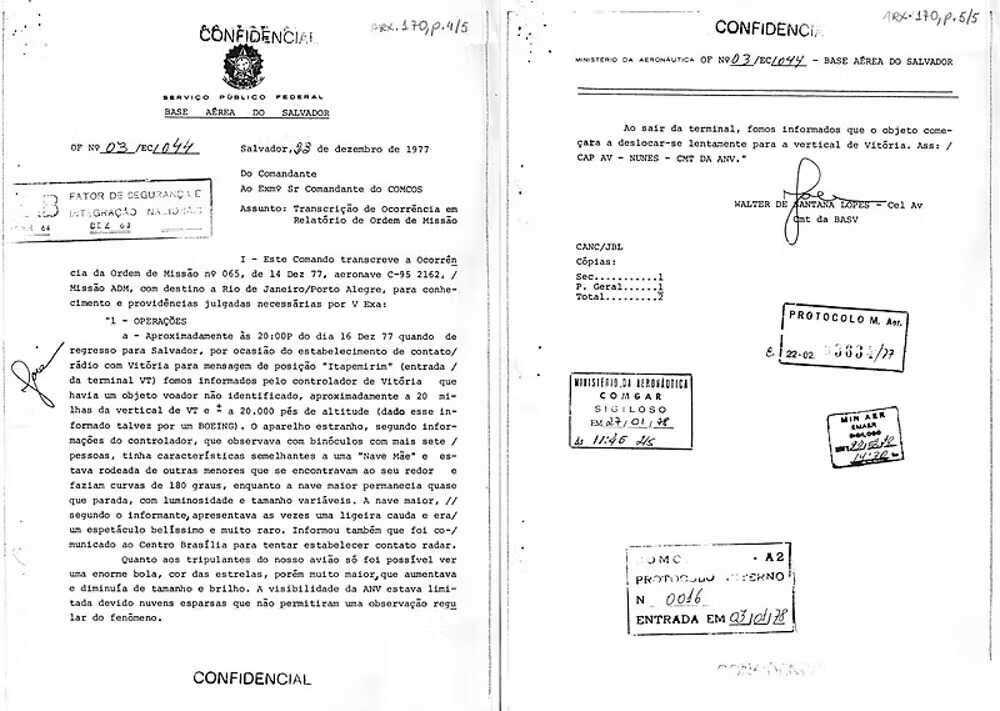
Kevin Knuth NASA alien coverup Declassified document describing a sighting of a UFO in December 1977, in Bahia, a state in northern Brazil.  Arquivo Nacional Collection

He also said that numerous countries had declassified UFO files, including Canada, France, Ecuador, and the United Kingdom. There are cases when the United States even funded alien probes, but some findings have not been declassified yet. Knuth argues that these cases should encourage scientific research.

Read also:

He considered the footage released by the Chilean government in 2017 as the most convincing observations that came from government officials. Former NASA research scientists asked the scientific community to begin investigation on UFOs four years earlier, which hints at how much the scientists lost as the UFO topic was taboo for them.

Alien life underwater

Professor Knuth believes the pilots of UFOs could be living underneath our oceans. In 2021, he provided a logical reason behind this theory in this informative interview on Theories of Everything with Curt Jaimungal.

Curt asked Professor Knuth if he thought aliens might be hiding in places like our oceans. Knuth thought it could be possible. He said that oceans cover most of Earth, making them a good hiding spot. Kevin also said that if aliens came from a place with lots of water, living in Earth’s oceans would be easy for them.

“If you live in an ocean, going to another planet with an ocean is actually a pretty good thing,” Knuth explained. He detailed how water, being non-compressible, would provide consistent pressure, and the temperature variations in aquatic environments on different planets would be relatively moderate compared to the extreme conditions on planetary surfaces.

“If you come from an aquatic environment, aquatic environments on planets are going to be much better to live in than atmospheric environments. Atmospheres have a low heat capacity, so the temperature varies a lot …you get huge temperature variations…And then going from planet to planet, you have huge temperature variations in the atmosphere: go to Mars, and you’re looking at 100 degrees below zero Fahrenheit. You go to Venus, and you’re looking at 800 degrees Fahrenheit. It’s dramatic. And the air pressure is dramatically different, too, from planet to planet.”


The interview got even more interesting when they talked about where these aliens might live. Curt wondered if they were hiding underground or in small spaceships. Knuth thought it depended on how many aliens there were. He said, “Depends on how many people you have in there.”

Curt shared that he wasn’t usually into wild stories or mysteries. But this topic was too interesting to ignore. He wondered if maybe humans are just an experiment by these aliens. Knuth had a thought about this. He said, “If they’re DNA-based… then it’s hard to imagine that we’re not related in some way.” He meant that if aliens are like us in some biological ways, then maybe we’re connected somehow.

What if these aliens are so different from us that meeting them could be dangerous? Knuth mentioned a scientist named Stuart Kaufman who had ideas about this. He said, “You wouldn’t want to come in contact with their organic molecules because you don’t know what kind of reactions you’d have.” In simpler terms, if aliens have different chemicals in their bodies, touching them might not be safe for us.

Considering Professor Knuth’s speculations on underwater alien life. There are numerous recorded incidents of spotting UFOs going in and out of oceans.

In 2021, a retired British police officer Gary Heseltine who is the vice president of the new International Coalition for Extraterrestrial Research (ICER) told The Sun that UFOs may not be coming from space – but rather from beneath the sea amid a string of strange encounters involving US warships.

“That sounds crazy but if you think about it we only know 5 percent of the ocean, we know more about the surface of the moon or Mars than our own oceans – so that would seem to me why UFOs are seen regularly coming in and out of water.”

Drawing together the nuclear and underwater theories, Mr Heseltine said: “If you think about it if there was World War 3 and we made toxic all the water then that would affect their habitat. “That’s why I think there’s a correlation with water – they have bases and we only know 5% of the ocean.”

Scientist Bob McGwier has provided great insight into underwater UFO sightings. He disclosed two incidents about underwater UFOs or USOs, that he saw while performing covert operations. This claim was made several months after a video had been made public by the United States military, in which it appeared to show an unidentified flying object moving from the sky into the water in the year 2019. (Click here to read the full article)

{ https://howandwhys.com/ }

Hoe vind je dit bericht?
Geschreven door peter om 23:23 Stuur door

A Glimpse into Catastrophic Disclosure – Webinar Highlights

A Glimpse into Catastrophic Disclosure – Webinar Highlights

On February 03, 2024 Dr. MIchael Salla held his first webinar for 2024 that analyzed the consequences of the failed UAP Disclosure Act of 2023. The “Controlled Disclosure” initiative contained in the Act was gutted. In the webinar Dr Salla presents a compelling case for Catastrophic Disclosure and prepares us for what lies ahead for the Earth Experience. The following highlights offer a glimpse into the webinar.

Watch on YouTube, Rumble, & Odysee

Audio Podcast on Apple, Spotify, or Google

The full version (without Q&A)  is available on Vimeo at:

The full version (with Q&A)  is available on Crowdcast at: 

{ https://exopolitics.org/ }

Hoe vind je dit bericht?
Geschreven door peter om 22:58 Stuur door

Jacques Vallee On Footage Of UFO Landing At Holloman AFB: Occupant Carried Vertical Staff With Spiral Antenna

Jacques Vallee On Footage Of UFO Landing At Holloman AFB

Jacques Vallee On Footage Of UFO Landing At Holloman AFB: Occupant Carried Vertical Staff With Spiral Antenna

Holloman Air Force Base is infamous for the most debated UFO landing footage that was in the possession of the United States Air Force as claimed by Robert Emmenegger and Allan Sandler. The director of “Moment of Contact” James Fox has recently discussed the Holloman AFB UFO/alien controversy on a podcast, adding valuable information to the legendary case.


The Original Footage Of UFO Landing At Holloman Air Force Base | Holloman UFO Footage

Interestingly, there are other credible people in the UFO community who have given credence to the authenticity of this case. There is more to the Holloman AFB UFO story. Joe Murgia, an avid UFO researcher revealed that Dr. Eric Davis (a former Pentagon physicist) met with George Bush Sr. to talk about Holloman AFB Incident.

The UFO phenomenon has long been a subject of fascination and controversy, with countless reports of sightings and encounters over the years. However, the truth behind these mysterious incidents has remained elusive, with government agencies often accused of covering up information and discrediting witnesses.

According to Murgia, on March 26, 2004, he met Hal Putoff (an American physicist who has co-authored several books on gravitational and paranormal research) at the Fiesta Rancho Casino Hotel, Las Vegas after taking an early flight to the airport. Upon meeting, Hal wasted no time and shared with him the story of Dr. Eric Davis. It turns out that Dr. Davis was the one who conducted the interview with Wilson at the EG&G parking lot. Dr. Davis had reached out to the admiral about his project to revive a local chapter of AFIO (Association of Former Intelligence Officers) in Las Vegas, but the conversation eventually shifted to the topic of ufology.(Source)

Wilson davis UFO document

Astrophysicist Eric Davis during an interview with New York Post.

Murgia stated that Former President George Bush Sr. had taken an interest in Dr. Davis’ discussion and spoke to him twice on the phone, expressing his belief that the German secrets had been filed away and not used as a cover for anything else. However, he did show interest in pursuing the topic and requested Dr. Davis’ recent physics papers.

During the second phone call, Bush revealed that he was aware of the Holloman film, which Hal, Dr. Davis, and Murgia were fixated on. “The former President was aware of it. Was it a training film, a special ops exercise? No, he replied, ‘it was “the real thing.”’ There was a secret project, and the security was obscene,” writes Joe Murgia.

Moreover, the Holloman AFB UFO landing incident was also discussed by Dr. Jacques Vallée in his book “Forbidden Science – Volume II.” He writes:

Kit [Green] just left, along with Hal, Russell and two of his kids. We had a long discussion after a demo of my landing catalogue. Kit has dropped out of Sams’ covert “Group of Twelve.”

Emenegger tells me that Colonel Bill Coleman, who represented the Air Force in the film, had been retired for three weeks when he got the job. For nine years he’d served as the Air Force’s spokesman and had been intimately linked to the UFO question. More games: One of his men, a Captain Horner, confiscated the Holloman movie just before Sandler could get his hands on it.

The Holloman sequence is based on a bluff by Emenegger. He couldn’t find anyone on the Base who recalled such an event. There was only a rumor that in 1971 a helicopter had filmed three objects, one of which landed.

Three occupants had supposedly come out. They had Assyrian noses, a rope twisted on their head for a hat, bluegreen skin, eyes like ping-pong balls with a hole in the middle. One of them had a wire in one ear and carried a vertical staff with a spiral antenna. The Aliens were taken to Building 830, then to building 930 on Mars Avenue. They remained there two or three years, allegedly “helping the United States decode space messages from another Alien civilization.”

A biologist named Alfred Lorenzo is supposed to have worked with them. None of this makes any sense. When Allan was here I asked him if he still had his clearance. He said yes, theoretically he did, but he didn’t think it was active, yet Kit has found Allan’s clearances active. “Do you know there are 800 reports of foreign UFOs in the CIRCOL files?” he asked. “Why didn’t Hynek ever look into that?”

He warned me that a new experimental device was being tested. It is known lovingly as a “flying bathtub.” It is a flying triangle with a rounded front, but it could look strikingly like a saucer when seen from the side, and will surely be mistaken for one.

On Julian Dorey Podcast, Mr. Fox recounted a phone call from Allan Sandler, who claimed to have seen three unidentified flying objects (UFOs) escorted by a military jet. Sandler said that two of the UFOs peeled away while one wobbled to the ground, and he witnessed the beings with unique features emerge from the grounded UFO before the footage abruptly cut off.

Read also:

Paul Shartle, an official at Norton Air Force Base, allegedly confirmed that the object was not of Earth origin. Mr. Fox did not make any claims about the veracity of the story, only reporting what he had been told.

During a recent Reddit AMA, journalist Christopher Sharp expressed interest in finding more information about the number of alien species visiting Earth. He mentioned that he had heard from multiple sources that the visitation at Holloman Air Force Base was real, but was unsure if the beings were extraterrestrial, interdimensional, or ultra-terrestrial. Sharp shared a link to the interview with Grant Cameron for further information.

In 1974, Robert Emenegger released his documentary “UFOs: Past, Present, and Future,” which was nominated for a Golden Globe. While he had originally been granted permission to use real footage, the Department of Defense later withdrew that permission.

Emenegger was forced to add animated footage of the alleged Holloman UFO landing. He claimed that some frames from the original footage were used in the reconstruction during editing, which was authorized by the USAF. Viewers spotted a genuine bright disc coming down slowly in the distance against the backdrop of Holloman’s surrounding landscape.

The documentary was re-released in 1979, with additional footage and narration by Dr. Vallée, who discussed ancient astronaut theory.

VIDEOS

The Best Kept Secret in UFOlogy with Jacques Vallee

UFOS THE BEST EVIDENCE: The Visitors, George Knapp, Jacques Vallee, David Jacobs, Stanton Freidman

Archives Of The UFO phenomenon With Jacques Vallée

{ https://howandwhys.com/ }

Hoe vind je dit bericht?
Geschreven door peter om 22:50 Stuur door

Meer van UFO'S of UAP'S, ASTRONOMIE, RUIMTEVAART, ARCHEOLOGIE, OUDHEIDKUNDE, SF-SNUFJES EN ANDERE ESOTERISCHE WETENSCHAPPEN - DE ALLERLAATSTE NIEUWTJES

↑ Terug naar de berichten