Ontdek de Fascinerende Wereld van UFO's en UAP's: Jouw Bron voor Onthullende Informatie!
Ben jij ook gefascineerd door het onbekende? Wil je meer weten over UFO's en UAP's, niet alleen in België, maar over de hele wereld? Dan ben je op de juiste plek!
België: Het Kloppend Hart van UFO-onderzoek
In België is BUFON (Belgisch UFO-Netwerk) dé autoriteit op het gebied van UFO-onderzoek. Voor betrouwbare en objectieve informatie over deze intrigerende fenomenen, bezoek je zeker onze Facebook-pagina en deze blog. Maar dat is nog niet alles! Ontdek ook het Belgisch UFO-meldpunt en Caelestia, twee organisaties die diepgaand onderzoek verrichten, al zijn ze soms kritisch of sceptisch.
Nederland: Een Schat aan Informatie
Voor onze Nederlandse buren is er de schitterende website www.ufowijzer.nl, beheerd door Paul Harmans. Deze site biedt een schat aan informatie en artikelen die je niet wilt missen!
Internationaal: MUFON - De Wereldwijde Autoriteit
Neem ook een kijkje bij MUFON (Mutual UFO Network Inc.), een gerenommeerde Amerikaanse UFO-vereniging met afdelingen in de VS en wereldwijd. MUFON is toegewijd aan de wetenschappelijke en analytische studie van het UFO-fenomeen, en hun maandelijkse tijdschrift, The MUFON UFO-Journal, is een must-read voor elke UFO-enthousiasteling. Bezoek hun website op www.mufon.com voor meer informatie.
Samenwerking en Toekomstvisie
Sinds 1 februari 2020 is Pieter niet alleen ex-president van BUFON, maar ook de voormalige nationale directeur van MUFON in Vlaanderen en Nederland. Dit creëert een sterke samenwerking met de Franse MUFON Reseau MUFON/EUROP, wat ons in staat stelt om nog meer waardevolle inzichten te delen.
Let op: Nepprofielen en Nieuwe Groeperingen
Pas op voor een nieuwe groepering die zich ook BUFON noemt, maar geen enkele connectie heeft met onze gevestigde organisatie. Hoewel zij de naam geregistreerd hebben, kunnen ze het rijke verleden en de expertise van onze groep niet evenaren. We wensen hen veel succes, maar we blijven de autoriteit in UFO-onderzoek!
Blijf Op De Hoogte!
Wil jij de laatste nieuwtjes over UFO's, ruimtevaart, archeologie, en meer? Volg ons dan en duik samen met ons in de fascinerende wereld van het onbekende! Sluit je aan bij de gemeenschap van nieuwsgierige geesten die net als jij verlangen naar antwoorden en avonturen in de sterren!
Heb je vragen of wil je meer weten? Aarzel dan niet om contact met ons op te nemen! Samen ontrafelen we het mysterie van de lucht en daarbuiten.
Odysseus continues its voyage to the lunar surface.
Odysseus landing on the Moon
Odysseus lunar lander’s first images of the Moon
Update for 7 pm ET: Touchdown! Intuitive Machines reports that its IM-1 lander Odysseus has landed on the moon and is transmitting a faint, but definite, signal. "Houston, Odysseus has found his new home," mission director Tim Crain said. See our full landing story, video and photos.
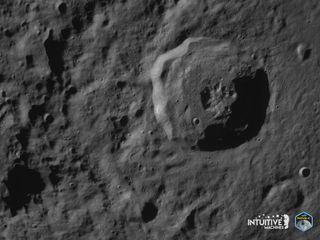
The Odysseus lander from Intuitive Machines obtained this picture of the Bel’kovich K crater on Feb. 21, 2024. (Image credit: Intuitive Machines/X)
Hours ahead of its moon landing, Odysseus snapped a picture of a lunar crater.
The Intuitive Machines lander beamed home an image of the Bel’kovich K crater, a roughly 31-mile (50-kilometer) divot in the moon's northern equatorial highlands. Mountains in the center were "made when the crater was formed," officials wrote Wednesday (Feb. 21) on X, formerly Twitter.
Odysseus successfully entered lunar orbit on Wednesday following a crucial engine burn, and is slated to touch down near the moon's south pole on Thursday afternoon (Feb. 22) no earlier than 6:24 p.m. EST (2324 GMT). You can tune in to the landing live here at Space.com, courtesy of NASA, or directly via the space agency. Coverage will begin at 5:00 p.m. EST (2300 GMT).
1st image of Odysseus on the moon released after historic landing
If Odysseus makes it, the lander will be the first private machine to successfully soft land on the moon and the first American vehicle overall to do so since the crewed Apollo 17 mission achieved the feat in 1972. You can watch the attempt here at Space.com.
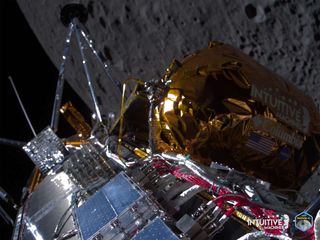
Intuitive Machines' Odysseus lander beams home a selfie in lunar orbit on Feb. 21, 2024. (Image credit: Intuitive Machines)
The mission launched on Feb. 15 on a SpaceX Falcon 9 rocket, bringing along 12 payloads for lunar investigations. Six of those experiments are from NASA and associated with the agency's Commercial Lunar Payload Services program, or CLPS.
NASA aims to use CLPS missions for science investigations ahead of the agency's Artemis program, which itself plans to put astronauts back on the moon in the 2020s and eventually establish a permanent base at the lunar south pole. The region is rich in water ice, which is useful for fueling and machinery.
One CLPS mission has already tried to reach the moon, but it didn't make it. Astrobotic's Peregrine lunar lander launched in January atop the first United Launch Alliance's Vulcan Centaur rocket. Peregrine, however, developed a fuel leak and instead was steered into Earth's atmosphere on Jan. 18.
Other private missions before Odysseus' IM-1 endeavor did indeed achieve lunar orbit before. Examples include Israel's Beresheet and Tokyo's Hakuto-R landers. Both missions, however, saw their spacecraft crash: Beresheet in April 2019 and Hakuto-R in April 2023.
This story was updated at 2:34 p.m. Feb. 22 with the updated landing time.
New Images of Odysseus On The Moon Have Been Released!
SpaceX deploys Intuitive Machines lunar lander in amazing view from space
Freek Vonk ontdekt nieuw soort reuzenslang in de Amazone: verschillen zijn genetisch gezien enorm
Jeannette Kras
Een hoogtepunt in zijn carrière noemt Freek Vonk het. Samen met veertien andere biologen heeft hij in het Amazoneregenwoud een nieuwe reuzenslang ontdekt, de noordelijke groene anaconda genaamd.
Het maakt eens te meer duidelijk dat we nog lang niet alles weten over de natuur. En dat we er zuinig op moeten zijn. Volgens de wetenschappers uit acht landen wordt het ecosysteem van de pas ontdekte anaconda namelijk ernstig bedreigd.
De groene anaconda is een indrukwekkend dier. Hij kan meer dan 7 meter lang worden en weegt wel 250 kilo. Een groot vrouwtje kan een omtrek hebben van een meter. Als volwassene pas je er dus makkelijk in. Veel dieren (en ook mensen) zijn dan ook doodsbang voor de slang, die vooral in de regenwouden van Zuid-Amerika voorkomt. De anaconda jaagt op herten, kaaimannen en soms zelfs jaguars.
Enorme genetische verschillen Dat er nu een nieuwe soort is ontdekt van zo’n enorm dier is groot nieuws. Hoogleraar aan de VU en onderzoeker bij Naturalis, Freek Vonk, was de enige Nederlander, die bij de ontdekking betrokken was. Vonk vertelt in het persbericht hoe bijzonder dat is: “Het komt wel vaker voor in de natuur dat twee soorten er voor mensen op ’t oog hetzelfde uitzien, maar toch tot verschillende soorten behoren. Maar dat dit bij de grootste slang ter wereld ook het geval was, dat had ik nooit verwacht!’’
Zelfs experts kunnen het verschil niet zien tussen de beide anaconda’s. “Toch zijn de verschillen genetisch gezien enorm”, vertelt medeonderzoeker Bryan Fry van de University of Queensland. “Het genetische verschil is 5,5 procent. Ter vergelijking: mensen verschillen maar 2 procent van chimpansees.”
Moeilijk te vinden Tot die spectaculaire ontdekking komen de biologen, nadat ze bloed en weefsel hebben verzameld van anaconda’s in Ecuador, Venezuela en Brazilië. Ook bestudeerden ze de dieren van dichtbij om de schubben te tellen en andere fysieke kenmerken te vinden die duiden op evolutionaire verschillen. Na de genetische data te hebben bestudeerd, vonden ze een duidelijke scheiding tussen de anaconda’s in het noorden en het zuiden van het continent. Daarop besloten ze de slangen die ze in het noorden vonden een nieuwe naam te geven: de noordelijke groene anaconda, oftewel officieel Eunectes akayima. Deze komt vooral in Venezuela, Suriname en Guyana voor. Akayima betekent in de inheemse talen in de regio ‘grote slang’. De zuidelijke groene anaconda blijft E. murinus heten.
Het is niet makkelijk om anaconda’s van dichtbij te bestuderen. Ze zijn niet alleen gigantisch en levensgevaarlijk, maar ze verstoppen zich ook het grootste deel van de tijd in moerassen en modderige poelen.
Leefgebied onder druk De vondst is bijzonder nuttig voor het behoud van de soort, legt Vonk uit. Nu kunnen de onderzoekers per anaconda bekijken wat nodig is om te overleven. Erg belangrijk in een tijd waarin het slecht gaat met de regenwouden van Zuid-Amerika. Door klimaatverandering en ontbossing staat het leefgebied van de anaconda zwaar onder druk. “Dit is een belangrijke ontdekking, omdat de nieuw beschreven noordelijke groene anaconda een veel kleiner leefgebied heeft dan de zuidelijke variant en dus veel kwetsbaarder is”, aldus Fry.
En niet alleen het leefgebied van de anaconda wordt bedreigd, benadrukt Vonk. “De ontdekking van deze nieuwe soort anaconda is natuurlijk heel erg opwindend, maar tegelijkertijd is het van essentieel belang om te onderstrepen hoe belangrijk het is dat niet alleen bedreigde dieren maar ook het bedreigde Amazonewoud verder wordt onderzocht, en natuurlijk ook zoveel mogelijk wordt beschermd.”
Sleutel en slot De studie roept ondertussen veel vragen op. Hoe zijn de noordelijke en zuidelijke groene anaconda bijvoorbeeld op verschillende evolutionaire sporen beland? De twee soorten leefden immers in Frans Guyana nog samen. Ze zijn zelfs aan twee kanten van dezelfde rivier gespot, zegt Fry. En toch is er in hun genen geen bewijs gevonden dat ze met elkaar paarden. Daarom wil de onderzoeker kijken of de genitaliën van de slangen verschillen, omdat veel slangensoorten als een sleutel en een slot in elkaar passen. Als twee soorten niet langer in elkaar passen, is het logischer dat ze evolutionair uit elkaar gaan lopen. “Voor elke vraag die we beantwoorden, komen er zeven interessantere bij”, besluit Fry.
Wetenschappers hebben ontdekt dat de Kuipergordel mogelijk bijna twee keer zo groot is als eerder werd gedacht. Niet alleen dat: het zou zelfs zo kunnen zijn dat er sprake is van een tweede gordel.
De ruimtesonde New Horizons heeft weer een nieuwe ontdekking gedaan: het zou zomaar kunnen zijn dat de Kuipergordel miljarden kilometers verder reikt dan de huidige modellen voorspellen. De ruimtesonde is inmiddels aangekomen op een afstand van 60 AU, wat betekent dat deze zestig keer verder verwijderd is van de zon dan onze eigen planeet: AU staat voor Astronomical Unit en is gelijk aan de afstand tussen de zon en de aarde, wat ongeveer 150 miljoen kilometer is. Op de huidige afstand van 9 miljard kilometer vanaf de zon vangt New Horizons een hoop meer stof is dan de bedoeling is, wat mogelijk betekent dat de Kuipergordel een stuk verder reikt dan eerder werd gedacht. Wetenschapper Alex Doner heeft meegewerkt aan het onderzoek. Hij laat weten: “New Horizons is momenteel bezig met de eerste directe metingen van interplanetair stof – ver voorbij Neptunus en Pluto. Op deze afstand kan elke kleine observatie leiden tot een grote ontdekking. Het idee dat we wellicht een verlenging hebben ontdekt van de Kuipergordel is een stap vooruit in het ontrafelen van de mysteries van het zonnestelsel.” Het onderzoek is gepubliceerd in het blad Astrophysical Journal Letters.
De Kuipergordel Als je vanaf de zon door ons zonnestelsel reist, kom je eerst de planeet Mercurius tegen. Vervolgens Venus, de aarde, Mars, Jupiter, Saturnus, Uranus en Neptunus. Tussen Mars en Jupiter bevindt zich dan ook nog de planetoïdengordel: een gebied met een grote hoeveelheid planetoïden. En voorbij Neptunus bevindt zich dan de Kuipergordel, bestaande uit miljarden komeetachtige – uit steen en ijs bestaande – objecten. Sommige van die objecten zijn groot – zoals Eris en Pluto – andere zijn juist aanzienlijk kleiner.
Ruimtestof De wetenschappers hebben de ontdekking kunnen doen omdat New Horizons zich momenteel dus door de Kuipergordel beweegt en hierbij stof tegenkomt. Dit stof wordt vervolgens gedetecteerd, waardoor er uiteindelijk een dichtheid bepaald kan worden. Die dichtheid is momenteel een stuk hoger dan deze zou moeten zijn. De verwachting is namelijk dat de buitenste ring van de Kuipergordel een lagere stofdichtheid heeft dan de regionen binnenin. Aangezien New Horizons vooralsnog geen lagere dichtheden heeft gemeten is het dan ook waarschijnlijk dat deze de buitenkant van de Kuipergordel nog niet heeft bereikt. Mede-wetenschapper Alan Stern licht toe: “Deze nieuwe bevindingen betekenen dat New Horizons waarschijnlijk het eerste ruimtevaartuig is dat een nieuwe verzameling hemellichamen heeft ontdekt. Ik ben dan ook erg nieuwsgierig om te zien tot hoever de hoge stofdichtheid zal reiken.”
IJsdeeltjes De metingen van New Horizons komen op het perfecte moment. Zo hebben wetenschappers van het New Horizons-team met behulp van observatoria zoals de Subaru Telescope in Hawaii eerder een aantal objecten gevonden die ver buiten het gebied liggen dat traditioneel gezien als de Kuipergordel wordt aangemerkt. En New Horizons lijkt nu dus ook ter plekke te bevestigen dat de buitengrens van de Kuipergordel op grotere afstand ligt dan gedacht. Zo werd eerst gedacht dat deze grens zich rond een afstand van 50 AU bevond, terwijl nu wordt gedacht aan een afstand van 80 AU. Concreet betekent dit een verlenging van 4,5 miljard kilometer. Het team van Doner is naarstig op zoek naar een mogelijke verklaring. Zo stelt Doner: “Het zou goed kunnen zijn dat New Horizons nu kleine ijsdeeltjes detecteert die niet dichter bij de zon kunnen komen. Een ander verklaring zou kunnen zijn dat kleine stofdeeltjes van de Kuipergordel door stralingsdruk een stuk verder worden geduwd dan voorheen werd gedacht. Dit laatste idee is niet heel waarschijnlijk, maar het zou kunnen.”
Het is ongetwijfeld niet de laatste keer dat New Horizons vanuit de buitenste regionen van ons zonnestelsel van zich laat horen; vooralsnog heeft de ruimtesonde nog meer dan genoeg brandstof. De verwachting is namelijk dat de ruimtesonde tot aan 2050 kan blijven werken, waarbij deze een afstand zal overbruggen van meer dan 100 AU. Het is trouwens ook niet de eerste keer dat New Horizons een opzienbarende ontdekking doet. Zo heeft de ruimtesonde in het verleden foto’s gemaakt van Pluto en is deze zeer dicht in de buurt gekomen van Arrakoth. Wil je meer weten over New Horizons? Kijk dan eens hier.
Recently-Discovered Active Asteroid is in Fact Main-Belt Comet, Astronomers Say
456P/PANSTARRS, an active, main-belt asteroid first spotted in 2021, is recurrently active, and activity is likely driven by the sublimation of volatile ice, according to new observations from the Magellan-Baade telescope and the Lowell Discovery Telescope.
Images of 456P/PANSTARRS taken with the Magellan-Baade telescope in Chile on October 3, 2024, and the Lowell Discovery Telescope in Arizona on October 26, 2024, where the head, or nucleus, of the comet is at the center of each image, and the tail extends to the right.
Image credit: Scott S. Sheppard / Carnegie Institution for Science / Audrey Thirouin, Lowell Observatory / Henry H. Hsieh, Planetary Science Institute.
“Main-belt comets are icy objects found in the asteroid belt between Mars and Jupiter — rather than the cold outer Solar System where icy bodies are typically expected,” said Planetary Science Institute senior scientist Henry Hsieh and colleagues.
“They sport comet-like features, like tails extending away from the Sun or fuzzy clouds as the Sun’s heat vaporizes their ice.”
These objects were first discovered in 2006 at the University of Hawaii by Dr. Hsieh and his then-doctoral advisor, Professor David Jewitt.
“Main-belt comets belong to a larger group of solar system objects known as active asteroids, which look like comets, but have asteroid-like orbits in the warm inner Solar System,” the astronomers said.
“This larger group includes objects whose clouds and tails are made of ejected dust produced after an impact or as they quickly rotate, rather than just those that eject dust due to vaporized ice.”
“Both main-belt comets and active asteroids in general are still relatively rare, but scientists are discovering them at a growing clip.”
456P/PANSTARRS was discovered as P/2021 L4 (PANSTARRS) from observations on June 9 and 14, 2021, by Pan-STARRS1, and Canada-France-Hawaii Telescope observations on June 14, 2021.
Dr. Hsieh and co-authors observed the object twice using the Magellan Baade Telescope and Lowell Discovery Telescope in October 2024 to establish its status as a main-belt comet.
“This object is not just an asteroid that experienced a one-off event that caused it to show activity one time, but is an inherently active, icy body similar to other comets from the outer Solar System,” Dr. Hsieh said.
If 456P/PANSTARRS’s activity were due to something other than ice vaporization, then its tail would be expected to appear only once randomly, and not repeatedly appear when it was close to the Sun.
An icy object, on the other hand, heats up every time it approaches the Sun, and the vaporized ice drags dust out along with it.
When the object moves farther from the Sun and cools, the activity stops.
Observations of repeated dust ejection activity during close approaches to the Sun are currently considered the best and most reliable way to identify main-belt comets.
“There are still very few confirmed main-belt comets known,” Dr. Hsieh said.
“We want to build up the population so we can get a clearer idea of what their broader properties are — such as their sizes, activity duration and distribution within the asteroid belt, for example — so that they can be better used to trace ice in the Solar System in general.”
The findings were published in the Research Notes of the American Astronomical Society.
Henry H. Hsieh et al. 2024. Confirmation of Recurrent Activity of Main-Belt Comet 456P/PANSTARRS (P/2021 L4). Res. Notes AAS 8, 283; doi: 10.3847/2515-5172/ad90a6
This article is a version of a press-release provided by the Planetary Science Institute.
Asteroid Samples Returned to Earth Were Immediately Colonized by Bacteria
We’ve known for a while that complex chemistry occurs in space. Organic molecules have been detected in cold molecular clouds, and we have even found sugars and amino acids, the so-called “building blocks of life,” within several asteroids. The raw ingredients of terrestrial life are common in the Universe, and meteorites and comets may have even seeded Earth with those ingredients. This idea isn’t controversial. But there is a more radical idea that Earth was seeded not just with the building blocks of life but life itself. It’s known as panspermia, and a recent study has brought the idea back to popular science headlines. But the study is more subtle and interesting than some headlines suggest.
Panspermia became popular in the 1800s and 1900s when it became clear that life arose surprisingly early on Earth. On a geologic scale, cellular life appears almost as soon as Earth cooled enough to support it. Given the complexity of DNA and living cells, how could such a thing have evolved so quickly? In the panspermia model, life evolved either in space or on some distant world, and was carried to Earth within asteroids or comets. We know that some living things can survive the harsh vacuum of space, so perhaps we have some alien, extraterrestrial origin.
But there are reasons to be skeptical. For one, the transition from organic to biological chemistry may be remarkably adaptive. While life appears to have appeared suddenly on Earth, that may be precisely what you’d expect. Without an example of extraterrestrial life, we simply don’t know. And while life can survive in space for a limited time, it’s not likely to survive for the millions of years it would take for an asteroid to traverse the solar system, much less the billions of years it would take to travel between star systems. Still, one step toward proving panspermia would be to gather material from an asteroid and find out it has life, and that’s exactly what this latest study found.
The Hayabusa2 mission, launched in 2014, landed on a small asteroid named Ryugu in 2018 and returned a sample of material to Earth in 2020. The sample was kept sterile the whole time, hermetically sealed for the journey back, and only opened in a pure nitrogen clean room using sterilized equipment. The sample was as clean and uncontaminated as we could get. When the team prepared a sample and looked at it under an electron microscope, they found rods and filaments of organic matter consistent with microbial life. In other words, the team found life on an asteroid.
Except they likely didn’t.
The size distribution is consistent with terrestrial life. Credit: Genge, et al
One thing to keep in mind is that microbial life is incredibly robust. It exists everywhere and spreads rapidly. You can find the stuff in the cores of nuclear power plants, in hot thermal vents, and in the cleanest clean room. And even if you sterilize something, microbial life will find a way. When the team found life on their sample, the first thing they did was to look for evidence of contamination, and there was plenty of evidence to be found. To begin with, the size distribution of the organic rods and filaments found in the sample is consistent with those commonly deposited by terrestrial life. Their data also found evidence of a growth and decline period of about five days, which is also consistent with Earth life. If the Ryugu samples had truly evolved beyond Earth, they would be genetically separated from us by millions or billions of years. Their size and growth rate wouldn’t match those of our common microbes. So the best explanation is that the sample became contaminated despite our best efforts.
While the study doesn’t support the panspermia model, it does tell us two important things. The first is that our sterilization procedures are likely inadequate. We may have already spread life to the Moon and Mars inadvertently. The second is that asteroids have organic materials that could sustain terrestrial life. That’s good news if we want to establish ourselves elsewhere in the solar system. Earth life may not have begun in space, but it could very well end up there.
Water and Carbon Revealed in NASA's Ancient Asteroid Samples
OKEANOS – A Mission That Would Have Retrurned Samples From the Trojan Asteroids
Getting a mission to the point of officially being accepted for launch is an ordeal. However, even when they aren’t selected for implementation, their ideas, and in some cases, their technologies, can live on in other missions. That was the case for the Oversize Kite-craft for Exploration and AstroNautics in the Outer Solar system (OKEANOS) project, originally planned as a Japanese Aerospace Exploration Agency (JAXA) mission. Despite not receiving funding to complete its entire mission, the project team released a paper that details the original plan for the mission, and some of those plans were incorporated into other missions that are still under development.
OKEANOS sought to build on JAXA’s success in returning samples from asteroids to Earth. Its most well-known mission in that regard was Hayabusa-2, which returned samples from the asteroid Ryugu in 2020 and has been the subject of dozens of scientific papers since. Ryugu is a near-earth asteroid, which means its origins in the solar system are dramatically different from those of other asteroids farther out from the Sun, which is where OKEANOS came in.
The original plan for OKEANOS was to launch a sample return mission to one of the Jupiter Trojan asteroids that sit in the Lagrange points in front of and behind Juptier and its orbital path. Scientists believe these asteroids originated outside of Neptune’s orbit in the Kuiper belt but were brought closer to the Sun due to gravitational fluctuations caused by the migration of the gas giant planets. Since they would hold clues to the early solar system, astronomers are interested in their composition, and some space exploration enthusiasts are interested in the materials they hold for in-situ resource utilization purposes. But so far, no missions have visited them yet.
A solar panel, like the one shown in the video, would have been a key component of the OKEANOS missions. Credit – The Japan Times YouTube Channel
That is about to change, though, with Lucy, a NASA mission that launched in 2021 to visit them. However, Lucy will simply do remote observations and lacks the equipment to sample them directly, let alone return a sample back to Earth. The project team had hoped OKEANOS would do just that.
Several novel technologies would be used to enable OKEANOS’ scientific objectives. One of the most interesting was a combination solar sail and ion drive known as a solar power sail. A solar power sail combines the solar pushing power of a solar sail with flexible photovoltaic solar collectors that can collect a significant amount of energy while deployed in a sail-like configuration. JAXA has also successfully tested a similar system with its IKAROS mission, demonstrating the technology in 2010.
Since solar sails have tiny thrust out near Jupiter, OKEANOS relies entirely on an ion engine and simply deploys its “sails” to deploy the solar panels that collect energy to power the ion drive. But once it reached its destination, it would utilize its second interesting technology—a lander.
Fraser talks about Lucy, the first mission to explore the Trojan asteroids.
The two main asteroid sample return missions – OSIRIS-REx and Hayabusa-2 – directly touched down on the surface of their respective asteroids. However, there have been deployed landers that have at least attempted to land on an asteroid before – Philae, the lander that accompanied ESA’s Rosetta mission, is probably the most famous. But never before has a mission attempted to land a lander, collect a sample, and return it to a “mothership” that would then transport that sample back to Earth. Doing so out at the Trojan asteroids would add a new difficulty level of having significant communications lag time, making it difficult to troubleshoot any problems with the mission.
Given JAXA’s track record, it seemed likely that they could pull off that technical challenge. However, the mission was never fully funded due to a “cost issue,” according to the paper. JAXA selected a project known as LiteBIRD to study the cosmic microwave background as its large-class mission for this decade instead. Despite that, the technical details of some of the instrumentation have been described in other papers, and the project team feels confident that future asteroid sample return missions will adopt at least some of them. We’ll be sure to see more of those in the future as interest grows in understanding the roots of our solar system and how we might utilize the readily available resources on asteroids.
A prototype of a robot designed to explore subsurface oceans of icy moons is reflected in the water’s surface during a pool test at Caltech in September. Conducted by NASA’s Jet Propulsion Laboratory, the testing showed the feasibility of a mission concept for a swarm of mini swimming robots. Credit: NASA/JPL-Caltech
Europa, one of the four Galilean satellites of Jupiter is one of the most intriguing locations in the Solar System to search for life. However, its subsurface oceans are buried beneath thick layers of ice making exploration difficult. To explore its oceans, scientists have suggested using small swimming robots capable of penetrating the icy shell. Recently, NASA engineers tested prototypes designed to operate as a swarm, enabling them to explore the mysterious sub-ice oceans on Europa and other icy worlds in the Solar System.
Along with the other three Galilean satellites orbing Jupiter, Europa was discovered just over 400 years ago by Galileo. It is the smallest of the four measuring just 3,120 km across. It orbits Jupiter at a distance of 671,000 km in an almost circular orbit. In comparison to our own Moon, Europa is a little smaller but that is where the similarities end. Europa is made of a silicate rock and has a thick water ice crust below which is thought to be a liquid water ocean and it is this which has captured the interest of scientists.
The Galilean moons of Jupiter: Io, Europa, Ganymede, and Callisto. (Credit: NASA/JPL-Caltech)
The deep oceans of Europa may well harbour forms of aquatic life. Consider the deepest parts of the oceans of Earth where whole eco-systems thrive off thermal vents. At these depths, no light from the Sun penetrates so the organisms and creatures living at these depths take all their energy from the heat escaping from inside the planet. It is this which tantalisingly suggests that maybe such life could have evolved in the oceans of Europa too.
A black smoker hydrothermal vent discovered in the Atlantic Ocean in 1979. It’s fueled from deep beneath the surface by magma that superheats the water. The plume carries minerals and other materials out to the sea. Courtesy USGS.
The exploration of Europa is already underway with NASA’s Europa Clipper expected to arrive in 2030. It will explore Europa with a powerful set of scientific instruments over a total of 49 flybys. Each pass will see the instruments search for signs that the ocean under the thick icy crust could sustain life. This will just be a flyby mission with Europa being probed from high above its surface. NASA are already shaping up their next mission to include even more complex robots that could survey the depths of the sub-surface oceans of Europa.
Artist’s concept of a Europa Clipper mission. Credit: NASA/JPL
This is where NASA’s new mission called SWIM ‘Sensing With Independent Micro-swimmers’ comes in. The concept at least, is simple…a swarm of self-propelled robots that can swim around in the underground oceans having been deployed by the ice piercing cryobot. Once underway, the swimming robots, which are about the size of a mobile phone, would hunt for chemical and temperature signals that might indicate life.
The swimming robots are not just on the drawing board. Engineers have already used 3D printers to create prototypes that have already been tested in a 23 metre pool. The devices which are propelled along by two propellers, with flaps for steering were able to stay on course. These prototypes however were a little larger than those destined to make it into space measuring about three times larger.
The results of the test were very promising but much more work is needed before they are ready for launch. Meanwhile the robots are likely to be trialled here on Earth to support oceanographic research before being sent on their way to Europa.
India's Kudankulam Nuclear Power Plant has become a UFO hotspot after a police officer reported seeing odd aerial lights above it more than 10 times last summer.
Indian Police Service investigator Syed Abdul Kader shared two videos exclusively with DailyMail.com, which track the bright lights making 'zigzags' above the facility.
Fearing the craft was not manmade, Kader turned to his nation's leading UFO expert, who in 2019 filed a petition to the Supreme Court of India with the backing of former Pentagon officials and US Air Force vets — urging the south Asian nation to take all the unexplained sightings near its nuclear facilities more seriously.
While the shape, size and speed of Kader's mystery objects are difficult to discern, his footage shows them making unusual movements at the altitude of an airplane.
'It's shaking when it's moving! It's going up and down,' the confused cop narrates in one video, watching the UFO's bizarre and apparently non-aerodynamic maneuvers.
'The way it's moving,' he opines in the video, 'this could never be an airplane.'
India's Kudankulam Nuclear Power Plant has become a UFO hotspot after a police officer reported seeing odd aerial lights above it more than 10 times last summer
Roughly a dozen or so incidents last summer all involved apparent airborne craft loitering near the Kudankulam Nuclear Power Plant (pictured above) at the southern tip of the subcontinent - as well as the Madras Atomic Power Station near Kalpakkam, along the country's east coast
'It's in a southern direction,' Kader told his wife during the August 8th sighting.
'It's standing [or hovering] in the direction of the Koodankulam Nuclear Power Plant.'
'It is always coming in at this time, when it is not too dark, nor too bright,' Kader's wife can be heard saying. 'I've seen this many times.'
While it is difficult for an outside observer to discern if the UFO is moving, or if Kader's camera is unsteady, DailyMail.com can report that some common prosaic explanations can likely be ruled out.
Such sightings have turned out to be distant planets, like Venus that is the third brightest object in the sky, after the sun and moon.
And the bright 'dog star,' Sirius, as well as the planets Jupiter and Mercury have also been occasionally misreported as UFOs.
However, in Kader's August 8 video, filmed at dusk (7:30PM local time), the eastern direction of the UFO at sunset refutes the notion that a common bright planet or star could explain the mystery's eerie aerial glow.
While the shape, size and speed of Kader's mystery objects are difficult to discern, his footage shows them making unusual movements at the altitude of an airplane
Syed Abdul Kader shared two of the videos exclusively with DailyMail.com, which show bright lights whizzing up and down above the facility
Police sub-inspector Syed Abdul Kader (right), assigned to the technical wing of the Tirunelveli office - one hour's drive north of the Kudankulam nuclear plant - told UFO expert Sabir Hussain (left) that he filmed two videos of these unusual aerial phenomena or UAP
A sky map for that night and time, geolocated to the Kaders' hometown of Tirunelveli via TheSkyLive.com shows that Venus was completely obscured, below the western horizon and below the sunset.
Most other bright stars and planets were also not in the eastern sky at that moment.
At another point in the video, Kader's wife exclaims, 'It's so close. How come no one else is seeing this?'
To which Kader replies, 'No, that's why the DGP [Director General of Police] he, himself, has seen it [the UFOs]. And that's why everybody's talking about this.'
India made history by becoming the first nation to land a spacecraft on the moon's south pole August 23, 2023
Kader's mysterious UFO videos were first secured by one of India's foremost UFO investigators, Sabir Hussain, director of the Indian Society for UFO Studies (INSUFOS) based in Chennai.
It was Hussain who petitioned the Supreme Court of India in 2019 warning that casually dismissing reports of UFO activity near the nation's sensitive atomic power sites could risks an unintentional nuclear war between India and its uneasy neighbor Pakistan.
His efforts came with letters endorsing his petition, by former US counterintelligence official and Pentagon UFO investigator Lue Elizondo, US Air Force veteran Robert Salas, and other UFO experts from America and Europe.
'Syed came to my house,' Hussain told DailyMail.com. 'I debriefed him.'
'He told me that most of the time, [the UFO] was either coming from the direction of Kudankulam Nuclear Power Plant, going towards it, or stationary in that direction.'
Officer Kader, Hussain told DailyMail.com, also stated that the UFOs were sometimes spotted hovering above the nearby Indian Space Research Organization's (ISRO) Propulsion Complex.
Nestled alongside the mountainous Mahendragiri hill in the state of Tamil Nadu, the ISRO Propulsion Complex tests cryogenically stored rocket fuel among its other space program duties.
The ISRO facility is also approximately one hour's drive south of the Kaders' home, which is in the city of Tirunelveli in Tamil Nadu.
A vocal advocate on the UFO issue, Hussain once voiced his suspicion that alleged alien occupants of such craft cut communications between ISRO and its Chandrayaan-2's Vikram lander in 2019 — for the south Asian nation's own good.
'The extra-terrestrials have sent a message to the Indian government to get rid of your nukes before you explore other worlds,' Hussain told the Deccan Chronicle.
'You will not be allowed to land on the moon unless "they" decide to allow you.'
The fate of ISRO's Vikram lander aside, Hussain's new UFO witnesses, sub-inspector Kader and his wife, can at least be heard in their videos discussing the mysterious aerial phenomena's consistent apparent interest in the Kudankulam nuclear plant.
Kader's video-taped sightings, as Hussain told DT Next, 'happened just 10 days after former DGP [Director General of Police] Prateep V. Philip took pictures of a UFO on [the] Muttukadu sea shore near Chennai.'
Philip's rank of DGP is the highest position attainable in the Indian Police Service.
A sky map for that night and time (above), geolocated to the Kaders' hometown of Tirunelveli via TheSkyLive.com, shows Venus was completely obscured, below the western horizon and sunset. Most other bright stars and planets were also not in the eastern sky at that moment
The Kaders' sightings to the south overlapped with weeks of sightings in July and August up the eastern coast, along the Neelankarai-Mahabalipuram shoreline. That region, near the city of Chennai, is home to the Madras Atomic Power Station (MAPS) in Kalpakkam (above)
Hypothetical extraterrestrial interest in the Kudankulam nuclear plant, if correct, would join decades of active protests against the plant by concerned local civilians.
Thousands of local residents faced teargas shelling, imprisonment and prosecution under both terrorism and sedition charges by local police for speaking out against the nuclear energy plant. Even children with the protestors faced sedition charges.
In September of 2019 the Kudankulam nuclear plant was discovered to be infected with malware, which one cyber security analyst with CSO attributed to 'a false flag operation using stolen North Korean code to muddle attribution.'
Hussain told DailyMail.com that the plant has faced corruption charges and safety concerns since before it first became operational a decade ago.
'Kudankulam, which is a focus of our attention,' Hussain said, 'came online only in 2013 after Fukushima disaster happened.'
'Ever since it came online, it has been shutting down once every two months,' he added. 'They are working only to 30 percent of their capacity. So you do the math.'
DailyMail.com has reached out to the Indian government's Nuclear Power Corporation of India, Ltd., which runs the plant, for comment.
US Air Force ICBM launch officer Robert Salas (pictured left, and as a young man, right) told of his encounter with an orange flying disc that turned off 10 warheads at Malmstrom Air Force Base, Montana in 1967
An email shows AARO staff contacted former US Air Force ICBM launch officer Robert Salas to gather information about his encounter. He tweeted his thank you email from AARO
This time last year, two Air Force veterans revealed to DailyMail.com's Josh Boswell that they had just testified to the Pentagon's UFO-hunting All-domain Anomaly Resolution Office (AARO) about their experiences witnessing UFOs interfere with US nuclear missiles.
One email showed AARO staff contacting former US Air Force ICBM launch officer Robert Salas to gather information about his chilling encounter with an orange flying disc that inexplicably turned off 10 warheads at Malmstrom Air Force Base, Montana in 1967.
Another former officer, Dr. Robert Jacobs, also briefed AARO, testifying to a 35mm film he shot for the Air Force in 1964, which allegedly caught a flying saucer shooting a test missile out of the sky.
Although Salas described those early interactions with AARO officials as 'very magnanimous,' this month the disappointed Air Force veteran described the Pentagon office's most recent UFO report as 'a 'Steaming pile of ...'
'I gave AARO a two hour PowerPoint presentation on the Malmstrom AFB incidents where twenty ICBMs were disabled during UFO encounters,' Salas said on the social media site X, speaking to incidents at the base beyond 1967.
'The USGOV owes us, the informed public, much more respect on this subject,' he concluded, 'than offered by AARO's steaming pile of insults.'
UFO Sightings at Nuclear Bases (Full Episode) | UFOs: Investigating the Unknown
'I'm sorry. Did I say something wrong?' Captain Robert Salas joked after delivering the blunt opinion to Congresswoman Nancy Mace during an episode of the podcast Total Disclosure.
At the height of the Cold War, a then 26-year-old USAF Lieutenant Salas was underground while overseeing Malmstrom Air Force Base's nuclear equipped intercontinental ballistic missiles (ICBMs) in Montana.
He claimed an eerie red glowing UFO above the base's front gate temporarily disabled 10 ICBMs on the night of March 24, 1967.
'They knew exactly how our systems worked. Exactly,' Capt Salas told South Carolina Representative Mace, speaking about the UFO's mysterious pilots.
Capt Salas was grilled by Rep Mace about what he thought the UFO's pilots were trying to convey.
''WTF!? You have nuclear weapons,'' he said, paraphrasing these appalled, pacifist aliens. 'That's what I think [they meant] .Of course, it's just my opinion.'
Retired US Air Force Captain Robert Salas personally witnessed a UFO deactivate 10 nuclear missiles in 1967 at a US Air Force base in Montana. He spoke to South Carolina Congresswoman Nancy Mace, after this month's shocking UFO hearing on November 13
Above, a missile combat crew member at Captain Salas' old post - Malmstrom Air Force Base - prepares to close a three-foot thick door inside a nuclear launch control center 70-feet underground
Both Rep Mace and Capt Salas spoke on the podcast Total Disclosure for an episode released online November 24, 2024.
In his analysis of the Malmstrom AFB incidents, the retired official was adamant the nonviolent, nondestructive nature of the UFOs interactions might be a clue as to the potentially extraterrestrial occupants' peaceful intent.
'No equipment was fried. Nothing was damaged,' Capt Salas told Rep Mace.
'It was simply intermittent electrical pulse that was delivered to a particular part of the guidance system, called the logic coupler,' he explained.
'And this was proven by Boeing. Boeing did a test of this so-called logic coupler.'
'Without that piece of equipment working properly, the guidance system would not properly work,' he continued. 'So, the missile shut itself down.'
'The missiles were all brought back up on alert within 24 hours,' he noted.
Both Representative Mace (above) and USAF Captain Salas spoke on tape for an episode of the podcast Total Disclosure - for an episode published online November 24, 2024
'No equipment was fried. Nothing was damaged,' Capt Salas told Rep Mace. 'It was simply intermittent electrical pulse that was delivered to a particular part of the guidance system.' Above an ICBM nuclear missile at Malmstrom AFB which is home to the 341st Missile Wing
Air Force veterans have repeatedly testified about their experiences of UFOs interfering with US nuclear missiles - some occurred at Malmstrom Air Force Base, Montana (pictured)
At the time of the 1967 UFO incursions, Capt Salas said he was also told the incident had been classified and that he was forbidden from speaking about it.
'I signed a non-disclosure agreement,' he said. 'Didn't start talking about it 'til 1996.'
The veteran later learned that his crew commander had dealt with a unnerving and virtually identical UFO episode on the nuclear base just eight days prior to his own.
Capt Salas, who has long advocated for government transparency on UFOs, told Rep Mace that he has published a recent book digging into '13 similar cases that happened all over the world, including Russia.'
'In none of those incidents was any significant damage done,' as he emphasized to the congresswoman this month.
'To me, that says they're sending us a message about nuclear weapons.'
In March 2023, Salas and another Air Force veteran told DailyMail.com that they had taken their testimony to the Pentagon's UFO-hunting All-domain Anomaly Resolution Office (AARO) expressing concern over UFOs ability to interfere with US nukes.
One now public email confirms that AARO staff contacting former Salas to gather information about his chilling encounter with the orange-red glowing 'disc' that inexplicably turned off 10 warheads at Malmstrom AFB.
US Air Force ICBM launch officer Robert Salas (pictured left, and as a young man, right) told of his encounter with an orange flying disc that turned off 10 warheads at Malmstrom Air Force Base, Montana in 1967
Although Salas described those early interactions with AARO officials as 'very magnanimous,' he has since told the media that he's disappointed in the office.
'I gave AARO a two hour PowerPoint presentation on the Malmstrom AFB incidents where twenty ICBMs were disabled during UFO encounters,' Salas said on the social media site X, speaking to incidents at the base beyond 1967.
'The USGOV owes us, the informed public, much more respect on this subject than offered by AARO's steaming pile of insults,' he concluded.
Astronauts aboard the International Space Station(ISS) were sent into a panic after a cargo ship arrived with a 'toxic smell' and 'possible contamination hazard in the form of droplets.'
The Progress 90 docked with the Russian Poisk module at 9:31am ET on Saturday and Roscosmos cosmonauts identified a smell immediately after opening the hatch.
The Russian crew quickly strapped into protective equipment and activated an extra air-scrubbing system aboard their segment of the ISS for about 30 minutes.
NASA astronaut Don Pettit also reported some 'spray paint-like' smell in the Node 3 module of the US Segment, but it was not immediately clear if it had originated from Progress.
'Space station air scrubbers and contaminant sensors monitored the station's atmosphere following the observation, and on Sunday, flight controllers determined air quality inside the space station was at normal levels,' NASA shared in a statement.
The agency continued to explain that there are no concerns for the crew as of Sunday afternoon, but the hatch between the Russian modular and cargo craft is still closed.
The Progress 90 arrived at the Russian Poisk module at 9:31am, delivering three tons of food, fuel and supplies for members of the Expedition 72 crew on board the ISS.
The Progress 90 docked with the Russian Poisk module at 9:31am ET and Roscosmos cosmonauts identified a smell immediately after opening the hatch. NASA said the crew has yet to reopen the hatch
NASA reported that the US side of the orbiting laboratory also activated its own air-scrubbing system, while the hatch to Russia’s Poisk module remained closed.
While Russian outlets reported a toxic smell, NASA told a different story.
'After opening the Progress spacecraft’s hatch, the Roscosmos cosmonauts noticed an unexpected odor and observed small droplets, prompting the crew to close the Poisk hatch to the rest of the Russian segment,' the agency shared on X.
Progress 90 is scheduled to stay docked for about six months before returning to Earth.
The 'toxic smell' comes just months after a report revealed space agency and its Russian counterpart, Roscomos, are tracking 50 'areas of concern' related to a growing leak aboard the station.
Although officials have been aware of the issue since 2019, the exact source of the leak is still unknown.
All potential cracks have been covered with 'a combination of sealant and patches' but NASA warned that the leak reached its fastest rate yet in April this year.
Both the US and Russian side of the ISS activated its air-scrubbing systems after the toxic smell was identified
Concerns over the station's safety are now so high that NASA has negotiated with Roscomos to only open the hatch when necessary and to keep it sealed in the evenings.
And that's not the only cause for concern, as the space agency has warned that the ISS is at risk of being pelted with micro-meteors and space debris.
In 2019, it was noted that the module had begun to leak a small amount of air through an unidentified crack.
However, despite efforts to seal the module, the amount of air escaping the station has only increased over the last five years.
In February this year, NASA was forced to hold a press conference on the issue as the amount of air escaping temporarily increased from 0.2 lbs per day (0.09 kg) to 2.4 lbs (1.08 kg) per day.
A report published in September by NASA's Office of the Inspector General (OIG) confirmed that the leak hit record rates in April - losing 3.7 lbs (1.68 kg) of air every day.
This has prompted the space agency to escalate the threat rating to the highest level and consider evacuation plans.
In May and June, NASA officials traveled to Russia to discuss 'heightened concerns' over the seemingly growing leak.
Speaking to the Washington Post, NASA associate administrator Jim Free says: 'We have conveyed the seriousness of the leaks multiple times, including when I was in Russia earlier this year.
'We've come to a compromise that they close it in the evening.'
The OIG report states: 'The Service Module Transfer Tunnel leak is not an immediate risk to the structural integrity of the Station, and there are no current concerns of long-term impacts to the overall structure.'
Likewise, ISS program manager Joel Montalbano told a press conference in February that the leak was 'not an impact right now on the crew safety or vehicle operations, but something for everybody to be aware of.'
Astronaut Chris Hadfield Debunks Space Myths | WIRED
Meer van UFO'S of UAP'S, ASTRONOMIE, RUIMTEVAART, ARCHEOLOGIE, OUDHEIDKUNDE, SF-SNUFJES EN ANDERE ESOTERISCHE WETENSCHAPPEN - DE ALLERLAATSTE NIEUWTJES


 Intuitive Machines moon lander sends home a haunting crater picture ahead of touch down today