Naar de inhoud

UFO'S of UAP'S, ASTRONOMIE, RUIMTEVAART, ARCHEOLOGIE, OUDHEIDKUNDE, SF-SNUFJES EN ANDERE ESOTERISCHE WETENSCHAPPEN - DE ALLERLAATSTE NIEUWTJES

UFO's of UAP'S in België en de rest van de wereld
akke.beakke.be
Ontdek de Fascinerende Wereld van UFO's en UAP's: Jouw Bron voor Onthullende Informatie! Ben jij ook gefascineerd door het onbekende? Wil je meer weten over UFO's en UAP's, niet alleen in België, maar over de hele wereld? Dan ben je op de juiste plek! België: Het Kloppend Hart van UFO-onderzoek In België is BUFON (Belgisch UFO-Netwerk) dé autoriteit op het gebied van UFO-onderzoek. Voor betrouwbare en objectieve informatie over deze intrigerende fenomenen, bezoek je zeker onze Facebook-pagina en deze blog. Maar dat is nog niet alles! Ontdek ook het Belgisch UFO-meldpunt en Caelestia, twee organisaties die diepgaand onderzoek verrichten, al zijn ze soms kritisch of sceptisch. Nederland: Een Schat aan Informatie Voor onze Nederlandse buren is er de schitterende website www.ufowijzer.nl, beheerd door Paul Harmans. Deze site biedt een schat aan informatie en artikelen die je niet wilt missen! Internationaal: MUFON - De Wereldwijde Autoriteit Neem ook een kijkje bij MUFON (Mutual UFO Network Inc.), een gerenommeerde Amerikaanse UFO-vereniging met afdelingen in de VS en wereldwijd. MUFON is toegewijd aan de wetenschappelijke en analytische studie van het UFO-fenomeen, en hun maandelijkse tijdschrift, The MUFON UFO-Journal, is een must-read voor elke UFO-enthousiasteling. Bezoek hun website op www.mufon.com voor meer informatie. Samenwerking en Toekomstvisie Sinds 1 februari 2020 is Pieter niet alleen ex-president van BUFON, maar ook de voormalige nationale directeur van MUFON in Vlaanderen en Nederland. Dit creëert een sterke samenwerking met de Franse MUFON Reseau MUFON/EUROP, wat ons in staat stelt om nog meer waardevolle inzichten te delen. Let op: Nepprofielen en Nieuwe Groeperingen Pas op voor een nieuwe groepering die zich ook BUFON noemt, maar geen enkele connectie heeft met onze gevestigde organisatie. Hoewel zij de naam geregistreerd hebben, kunnen ze het rijke verleden en de expertise van onze groep niet evenaren. We wensen hen veel succes, maar we blijven de autoriteit in UFO-onderzoek! Blijf Op De Hoogte! Wil jij de laatste nieuwtjes over UFO's, ruimtevaart, archeologie, en meer? Volg ons dan en duik samen met ons in de fascinerende wereld van het onbekende! Sluit je aan bij de gemeenschap van nieuwsgierige geesten die net als jij verlangen naar antwoorden en avonturen in de sterren! Heb je vragen of wil je meer weten? Aarzel dan niet om contact met ons op te nemen! Samen ontrafelen we het mysterie van de lucht en daarbuiten.

Archief

Voor het eerst een close-upfoto van een ster buiten onze Melkweg gemaakt

Voor het eerst een close-upfoto van een ster buiten onze Melkweg gemaakt

Vivian Lammerse

WOH-G64--954x603_1.jpg

Astronomen zijn er voor de eerste keer in geslaagd gedetailleerde beelden te maken van een verre ster die zich in de laatste fasen van zijn leven bevindt.

“Voor het eerst is het gelukt om een ingezoomd beeld te maken van een ster die sterft in een sterrenstelsel buiten onze Melkweg.” Aan het woord is hoofdauteur Keiichi Ohnaka, een astrofysicus van de Universidad Andrés Bello in Chili. De foto markeert een belangrijke mijlpaal. Want hoewel astronomen al zo’n twee dozijn close-upbeelden van sterren in ons eigen sterrenstelsel hebben gemaakt, zien we nu pas voor het eerst een ster die verder weg ligt, van heel dichtbij.

Ster WOH G64
Dankzij de eerdere foto’s van sterren in onze Melkweg hebben we al veel geleerd over hun eigenschappen. Maar er bevinden zich ook talloze andere sterren in verre sterrenstelsels die zo ver weg zijn, dat het tot nu toe bijna onmogelijk was om zelfs maar één van hen in detail te observeren. Maar daar hebben onderzoekers nu verandering in gebracht. Op een verbluffende afstand van 160.000 lichtjaar van ons vandaan werd de ster WOH G64 vastgelegd, mogelijk gemaakt door de indrukwekkende scherpte van de Very Large Telescope Interferometer (VLTI) van de Europese Zuidelijke Sterrenwacht (ESO).


The New Largest Star in the Universe 2024! WOH G64

De foto
De foto is hieronder te bewonderen. De betreffende ster ligt in de Grote Magelhaanse Wolk, een van de kleine sterrenstelsels die de Melkweg omcirkelen. Astronomen kennen deze ster al decennialang en hebben haar de toepasselijke bijnaam ‘behemoth ster’ gegeven. Met een omvang die zo’n 2000 keer die van onze zon is, wordt WOH G64 geclassificeerd als een rode superreus.

De betreffende close-upfoto van de ster WOH G64, gemaakt met het GRAVITY-instrument op de VLTI van de ESO. Het is de eerste close-upfoto van een ster buiten onze eigen Melkweg. De ster bevindt zich in de Grote Magelhaanse Wolk, op meer dan 160.000 lichtjaar afstand. Het heldere ovaal in het midden van de afbeelding is een stoffige cocon die de ster omhult. Een zwakker ellipsvormig ring rondom de cocon zou de binnenrand van een stoffige torus (een ringvormige structuur van stof en gas die de ster omringt) kunnen zijn. Afbeelding: ESO/K. Ohnaka et al.

Het team was al jaren gefascineerd door deze behemoth ster. In 2005 en 2007 gebruikten ze de VLTI om meer te leren over haar eigenschappen en sindsdien hebben ze haar continu bestudeerd. Toch bleef een echte afbeelding van de ster tot nu toe buiten bereik. Voor de gewenste foto moest het team namelijk geduldig wachten op de ontwikkeling van een belangrijk tweede-generatie-instrument van de VLTI: GRAVITY.

Supernova
De nieuwe waarnemingen onthullen een ster die gas en stof uitblaast, vlak voor het moment dat het een supernova wordt, zo beschrijven de onderzoekers in het vakblad Astronomy & Astrophysics. “We ontdekten een ei-vormige cocon die de ster strak omhult”, vertelt Ohnaka. “We zijn enthousiast, omdat dit mogelijk verband houdt met de enorme uitstoot van materiaal door de ster voordat hij explodeert als een supernova.”

Verandering
Toen ze hun nieuwe bevindingen vervolgens vergeleken met eerdere waarnemingen van WOH G64, waren ze verrast te ontdekken dat de ster de afgelopen tien jaar ingrijpende veranderingen heeft doorgemaakt. “Dit biedt ons een zeldzame kans om het leven van een ster in real-time te volgen”, zegt Gerd Weigelt, mede-auteur van de studie. In hun laatste levensfasen verliezen rode superreuzen zoals WOH G64 hun buitenste lagen van gas en stof, een proces dat duizenden jaren kan duren. “Deze ster is een van de meest extreme in zijn soort”, stelt mede-auteur Jacco van Loon, die de ster al sinds de jaren 1990 observeert. “Elke drastische verandering kan hem dichter bij een explosief einde brengen.”

Links: de allereerste close-upfoto van een ster buiten ons sterrenstelsel. Op de afbeelding is een grote ei-vormige stofwolk te zien. Rechts is een artistieke impressie die de geometrie van de structuren rondom de ster reconstrueert, inclusief het heldere ovale omhulsel en een zwakkere, stoffige torus. Het bevestigen van de aanwezigheid en vorm van deze torus zal aanvullende waarnemingen vereisen. Afbeelding: ESO/K. Ohnaka et al., L. Calçada

Zwakker
Eén van de veranderingen die WOH G64 heeft doorgemaakt, is dat de ster de afgelopen tien jaar veel zwakker is geworden. Het team vermoedt dat het uitgeblazen materiaal zowel de verduistering als de onverwachte vorm van de stofwolk rond de ster veroorzaakt. De nieuwe afbeelding toont zoals gezegd een uitgestrekte cocon, wat de wetenschappers verraste, omdat ze op basis van eerdere waarnemingen en computermodellen een andere vorm hadden verwacht. Het team denkt dat de ei-vormige structuur van de cocon verklaard kan worden door de uitstoot van de ster zelf, of mogelijk door de invloed van een nog onontdekte metgezelster.

Hoewel het maken van de nieuwe beelden een uitdaging was, opent het nieuwe mogelijkheden voor het bestuderen van verre sterrenstelsels. Bovendien levert het waardevolle inzichten op in de ingewikkelde processen die plaatsvinden tijdens de laatste levensfasen van een ster. Naarmate WOH G64 verder vervaagt, wordt het overigens wel steeds moeilijker om nieuwe close-upfoto’s te maken, zelfs met de VLTI. Toch zullen de geplande updates van de telescoop, zoals de toekomstige GRAVITY+, daar binnenkort verandering in kunnen brengen. “Vervolgwaarnemingen met ESO-instrumenten zullen cruciaal zijn om te begrijpen wat er met de ster gebeurt,” besluit Ohnaka.

Bronmateriaal

Hoe vind je dit bericht?
Geschreven door peter om 22:01 Stuur door

New Supercomputer Simulation Explains How Mars Got Its Moons

Computer simulation showing the origin of the Martian moons. Credit: NASA's Ames Research Center

This new model proposes an interesting middle way. Rather than an impact or direct capture, the authors propose a near miss by a large asteroid. If an asteroid passed close enough to Mars, the tidal forces of the planet would rip the asteroid apart to create a string of fragments. Many of those fragments would be captured in elliptical orbits around Mars. As computer simulations show, the orbits would shift over time due to the small gravitational tugs of the Sun and other solar system bodies, eventually causing some of the fragments to collide. This would produce a debris ring similar to that of an impact event, but with a greater distance range, better able to account for both Phobos and Deimos.

While this new model appears to be better than the capture and impact models, the only way to resolve this mystery will be to study samples from the Martian moons themselves. Fortunately, in 2026 the Mars Moons eXploration mission (MMX) will launch. It will explore both moons and gather samples from Phobos. So we should finally understand the origin of these enigmatic companions of the Red Planet.

Reference: 

VIDEOS

How Did Mars Get Its Moons?

New Supercomputer Simulation Sheds Light on Moon’s Origin

Supercomputer Simulation of the Moon's Origin (Wide-Orbit Cross Section)

{ https://www.universetoday.com/ }

Hoe vind je dit bericht?
Geschreven door peter om 21:19 Stuur door

Gaze at New Pictures of the Sun from Solar Orbiter

The Solar Orbiter has captured the highest resolution images of the Sun ever during a recent close encounter. The detail is extraordinary. Image Credit: ESA - European Space Agency

Gaze at New Pictures of the Sun from Solar Orbiter

74 million kilometres is a huge distance from which to observe something. But 74 million km isn’t such a big deal when the object is the Sun.

That’s how far away from the Sun the ESA/NASA Solar Orbiter was when it captured these new images.

The Solar Orbiter was launched in 2020 to investigate the Sun. It’s studying the mechanism behind the Sun’s solar wind, the complex dynamics of its magnetic field, and eruptions like solar flares and coronal mass ejections. That’s just a sampling of its science goals.

One item on the mission’s long list of objectives is high-resolution images of the Sun’s surface. For that, the spacecraft carries different imagers that operate in different wavelengths. This allows the spacecraft to almost peel back the Sun’s layers and uncover relationships between them.

The ESA has released four new images of the Sun, each one giving us a different look at our star: visible light, magnetic, plasma, and UV. These images were captured with the Polarimetric and Helioseismic Imager (PHI-German contribution) and Extreme Ultraviolet Imager (EUI-Belgian contribution) instruments in March 2023. Each image is a composite of 25 images, all captured on the same day. They’re the highest resolution images of the Sun ever taken.

The images are remarkable for their detail. This image shows sunspots, regions that are darker and cooler than their surroundings. They appear where magnetic field lines are concentrated. The magnetic flux inhibits convection. Image Credit: ESA The images are remarkable for their detail. This image shows sunspots, regions that are darker and cooler than their surroundings. They appear where magnetic field lines are concentrated. The magnetic flux inhibits convection. Image Credit: ESA

According to Daniel Müller, Solar Orbiter’s Project Scientist, the Sun’s magnetic field is key to understanding the star.

“The Sun’s magnetic field is key to understanding the dynamic nature of our home star from the smallest to the largest scales. These new high-resolution maps from Solar Orbiter’s PHI instrument show the beauty of the Sun’s surface magnetic field and flows in great detail. At the same time, they are crucial for inferring the magnetic field in the Sun’s hot corona, which our EUI instrument is imaging,” Müller said.

This magnetic map of the Sun from the Solar Orbiter shows how magnetic field lines and sunspots are correlated. Image Credit: ESA. This magnetic map of the Sun from the Solar Orbiter shows how magnetic field lines and sunspots are correlated. Image Credit: ESA.

The Solar Orbiter’s PHI instrument also gives us a map of how plasma is moving around on the Sun’s surface. Blue regions are moving toward the Orbiter, while red regions are moving away.

The map of plasma movement clearly reflects the rotation of the Sun, with blue regions moving toward the orbiter and red regions moving away. However, it also shows how material is disoriented around the sunspots. Image Credit: ESA The map of plasma movement clearly reflects the rotation of the Sun, with blue regions moving toward the orbiter and red regions moving away. However, it also shows how material is disoriented around the sunspots. Image Credit: ESA

The ultraviolet image of the Sun from the Solar Orbiter’s EUI instrument is probably the most visually stunning. It shows what’s happening above the photosphere, where glowing plasma extends out from sunspots. The plasma is superheated and follows the same magnetic lines that encourage the sunspots.

The Sun's superheated plasma follow magnetic field lines and extends beyond the photosphere in the same regions the sunspots occur. Image Credit: ESA The Sun’s superheated plasma follow magnetic field lines and extends beyond the photosphere in the same regions the sunspots occur. Image Credit: ESA

The Solar Orbiter’s images are truly extraordinary. It’s easy to lose yourself in them, and to wonder about Life, the Universe, Nature, Evolution, How Everything Came to Be, and your own mortality in the face of it all.

Go ahead and lose yourself in these images for a while. The economy won't grind to halt if you take a few moments. Image Credit: ESA Go ahead and lose yourself in these images for a while. The economy won’t grind to halt if you take a few moments. Image Credit: ESA

Now, back to your cubicle.

OTHER VIDEOS

2023 November 19 - Space Station, Solar Prominences, Sun

Sun's corona seen in 'exquisite detail' in new Solar Orbiter view

The Deepest We Have Ever Seen Into the Sun | SDO 4K

{ https://www.universetoday.com/ }

Hoe vind je dit bericht?
Geschreven door peter om 21:06 Stuur door

Are Fast Radio Bursts Caused by Interstellar Objects Crashing Into Neutron Stars?

This magnetar is a highly magnetized neutron star. This artist's illustration shows an outburst from a magnetar. Neutron stars that spin rapidly and give out radiation are called pulsars, and specific pulsars are rare in the core of the Milky Way. Credit: NASA/JPL-CalTech

Are Fast Radio Bursts Caused by Interstellar Objects Crashing Into Neutron Stars?

Every now and then, astronomers will detect an odd kind of radio signal. So powerful it can outshine a galaxy, but lasting only milliseconds. They are known as fast radio bursts (FRBs). When they were first discovered a couple of decades ago, we had no idea what might cause them. We weren’t even sure if they were astronomical in origin. FRB’s were so localized and so short-lived, it was difficult to gather data on them. But with wide-field radio telescopes such as CHIME we can now observe FRBs regularly and have a pretty good idea of their source: magnetars.

Magnetars are neutron stars with immensely powerful magnetic fields. Now that we can localize FRBs, we have been able to match a few of them to the region of a neutron star. While most FRBs occur in distant galaxies, in 2020 we observed one within the Milky Way. The magnetar source also happened to be a pulsar, and astronomers were able to show that the FRB [correlated with a glitch in the pulsar’s rotation,](https://briankoberlein.com/blog/power-of-magnetism/) thus confirming the source. So we are fairly certain that FRBs are caused by neutron stars, but we are still uncertain about the exact mechanism.

One popular idea is that fast radio bursts are caused by magnetic realignments. This is what drives flares on the Sun. Over time, the Sun’s magnetic field lines can get twisted up until they snap into realignment, releasing energy. If a similar effect occurs on magnetars, the resulting snap would be much faster and more powerful. One difficulty with this idea is that FRBs are so short-lived that they are almost too fast for magnetic field lines to realign. So astronomers keep looking for new ideas, and one recently proposed argues that they are caused by impact events.

distribution.jpg

Distribution of FRB duration and ISB sizes compared. Credit: Pham, et al

Collisions have long been known as the source of high-energy events. For example, some supernovae are caused by the collisions of neutron stars. We also know that comets and asteroids occasionally impact the Sun, so we would expect similar impacts to occur on neutron stars. In this new work, the authors propose that FRBs are caused when an interstellar body collides with a neutron star. The impact would trigger a powerful electromagnetic burst. To support their argument, the authors looked at the distribution of FRBs arranged by duration. The timing of FRBs follows a distribution similar to the distribution of solar system bodies. Not only that, the duration of an FRB seems to match the hypothetical duration of an impact event based on an object’s size.

While the data does seem to support the idea of impact-based FRBs, the study doesn’t solve all the mysteries surrounding these powerful bursts. We know, for example, that some FRBs are repeaters, meaning they occur multiple times from the same source. Some studies have shown that repeating FRBs are quasi-periodic, which would be difficult to explain through random collisions. It’s possible that repeating and non-repeating FRBs are caused by different mechanisms, though the data is still inconclusive on that point.


What Are Fast Radio Bursts? With Dr. Duncan Lorimer

Reference: 

{ https://www.universetoday.com/ }

Hoe vind je dit bericht?
Geschreven door peter om 20:46 Stuur door

Is the Government Hiding Alien Technology? Unveiling the UFO Mystery

Is the Government Hiding Alien Technology? Unveiling the UFO Mystery

Is the Government Hiding Alien Technology? Unveiling the UFO Mystery

The question of whether the government is hiding alien technology has fueled countless debates, conspiracy theories, and investigations for decades. From the Roswell incident to recent Congressional hearings on Unidentified Aerial Phenomena (UAP), the topic remains shrouded in mystery and intrigue. This article explores the history, evidence, and implications of these allegations.

A History of Conspiracies and UFO Sightings

The modern fascination with UFOs began in 1947 with the infamous Roswell Incident. Initial reports claimed that a flying saucer had crashed in New Mexico, sparking global speculation about extraterrestrial visitors. Although the U.S. military later attributed the wreckage to a weather balloon, conspiracy theories persisted, especially after they revised their explanation to a downed nuclear surveillance balloon decades later.

Roswell set the stage for an influx of UFO sightings. In response, the U.S. Air Force launched Project Blue Book in the 1950s. This program investigated thousands of cases, dismissing most as natural phenomena or misidentifications. However, 701 cases remained officially unexplained, fueling speculation that the government was withholding crucial information.

Majestic 12: Fact or Fiction?

One of the most contentious claims surrounding government secrecy is the existence of Majestic 12, an alleged covert group established in the late 1940s to recover and study alien technology. Documents reportedly revealing its existence emerged in the 1980s but were dismissed by many as hoaxes. Despite skepticism, believers argue that this secrecy aligns with broader governmental efforts to conceal evidence of extraterrestrial contact.

The Mystery of Area 51

Area 51, a highly classified U.S. Air Force facility in Nevada, is synonymous with UFO lore. Officially, it is a testing site for advanced aviation technologies. However, whistleblower Bob Lazar claimed in 1989 that he worked at a secretive lab within Area 51, reverse-engineering alien technology. According to Lazar, the recovered materials featured advanced anti-gravity propulsion systems, suggesting technology far beyond human capabilities.

Zeta Reticuli and Alien Origins

Speculation about the origin of alleged alien visitors often points to Zeta Reticuli, a binary star system 39 light-years from Earth. The system gained attention during the 1961 Barney and Betty Hill abduction case, where the Hills described being taken aboard a spacecraft and shown a star map resembling Zeta Reticuli. These claims, while unverified, add a layer of cosmic intrigue to the discussion.

Modern UFO Revelations

In recent years, the U.S. government has shifted its terminology from UFOs to UAPs (Unidentified Aerial Phenomena), perhaps signaling a more serious approach to the subject. In 2017, the Pentagon confirmed the authenticity of leaked military videos showing UAPs performing seemingly impossible maneuvers. These incidents, dubbed “Gimbal,” “GoFast,” and “Tic Tac,” reignited public interest and led to further revelations.

Whistleblowers like David Grusch, a U.S. Air Force veteran, have alleged the existence of a multi-decade program aimed at recovering and reverse-engineering alien technology. Grusch also claimed knowledge of “non-human biologics” linked to UAP crashes. His testimony during Congressional hearings in 2023 underscored the gravity of these allegations.

Immaculate Constellation: A Secret Database?

In 2024, journalist Michael Shellenberger reported on an alleged ultra-classified program known as Immaculate Constellation, described as a hidden repository of UAP sightings and evidence. Whistleblowers suggested that this database contains records of alien technology and encounters. If true, it indicates that knowledge of extraterrestrial technology is accessible to only a select few, raising concerns about government transparency and accountability.

The Debate Over Disclosure

Congressional hearings in 2024 and 2025 highlighted increasing demands for transparency regarding UAPs. Witnesses, including experts like former NASA contractor Michael Gold, emphasized the need for scientific investigation into these phenomena. However, allegations of a disinformation campaign to suppress whistleblowers and stigmatize UAP reports suggest systemic resistance to disclosure.

What Lies Ahead?

The evidence remains inconclusive. While some whistleblowers and experts present compelling claims, others argue that much of the speculation is fueled by misunderstanding, misinformation, or deliberate hoaxes. However, the recurring theme of secrecy suggests there is more to the story than meets the eye.

As the conversation around UAPs evolves, one question persists: if the government truly possesses alien technology, what could it mean for humanity? Would such revelations revolutionize science and technology, or would they only deepen societal divisions? Until the government provides definitive answers, the truth remains elusive, buried beneath layers of redacted documents and classified files.

What do you think? Is the government hiding alien technology, or are these stories just elaborate myths? The debate continues, leaving us to wonder: is the truth really out there?

VIDEOS


Ancient Aliens: UFO Secrets Hidden by the Government?! (Special)

Is The Government Hiding Proof Of UFOs And God? | Unveiled XL Documentary

UFO whistleblower tells Congress the US government is hiding evidence of 'non-human intelligence'

Is The Government Secretly Hiding Alien Contact?

Alien Tech? Government Coverups? | What's Hiding Along the 37th Parallel?

{ https://www.latest-ufo-sightings.net/ }

Hoe vind je dit bericht?
Geschreven door peter om 20:36 Stuur door

Inside America’s UFO Cults: A Look at Manipulation and Misinformation in the UFO Counterculture

misinformation UFO Cult

(Pixabay/AI Generated)

Inside America’s UFO Cults: A Look at Manipulation and Misinformation in the UFO Counterculture 

In the perplexing counterculture of UFO beliefs, individuals with cult-like followings and frequent claims associated with dubious “whistleblowers” aren’t uncommon. But how can you separate genuine voices from those leveraging UFO lore for personal or financial gain?

In a new documentary, Dark Alliance: The Inside Story of the Cosmic Con, filmmaker Darcy Weir dives into one section of the UFO counterculture, narrowing in on two well-known figures: David Wilcock and Corey Goode, presenting them as case studies in manipulation and the spread of misinformation within the UFO community and its associated areas of belief. 

In Dark Alliance, Weir takes his viewers on a journey of exploration into how these two controversial figures came to fool not only the community they serve, but also some of the people who brought them to the top.

However, the cautionary tale Weir presents is far from new: the events he chronicles echo the actions of cults and similar groups from over the years, many of which bear a resemblance to some of today’s alleged UFO whistleblowers, self-proclaimed insiders, and cult leaders.

UFO Cults Through the Years 

According to psychologist Dr. Steve Eichel, there may be up to 10,000 cults currently operating in America, ranging from those focused on religion, to political groups, and even doomsday cults.

UFO-themed cults, while fewer in number, have nonetheless also been a prevalent fixture in American culture since the years after World War II. Among these, William A. Ferguson founded a religious cult called the Cosmic Circle of Fellowship, elements of which were detailed in his 1947 book My Trip to Mars. In it, Ferguson states that he teleported to Mars and was greeted by “celestial beings who indicated the Martians are ready to help mankind pass through a great crisis.” Ferguson also claimed he could instruct others on how to achieve interdimensional travel through deep relaxation. With time, Ferguson’s claims would become even more wild as he began manufacturing a device he called the Zerret Applicator, which he professed could cure various ailments or diseases through what he called “z-rays,” a concept created by Ferguson and later disproven by the FDA.

In 1954, fresh out of prison after a two-year sentence for selling his “Martian-inspired” medical devices, Ferguson turned his life around in a way that was truly out of this world: he released a quirky, 13-page pamphlet detailing his journey to Mars, sharing several of his curious insights and the teachings he claimed to have received from his Martian associates.

Although similar cults have cropped up throughout the years, few that involved unfounded belief in visitors from beyond Earth have managed to capture so much public attention as Heaven’s Gate, a new religious movement in the United States whose members committed mass suicide in a San Diego suburb called Rancho Santa Fe in 1997. There, a group of 39 dedicated followers of the cult, led by mastermind Marshall Applewhite, died believing that Comet Hale–Bopp was being followed by an alien spacecraft, and only through their death by ritual suicide could they could eventually join it. 

More recently, an online subculture referred to as The Alien Cult has emerged on TikTok, centered around themes involving aliens and UFOs. Originating from a popular meme, the group has rapidly grown, showing up en masse in comment sections and sharing mostly humorous content, though some members have been known to spread misinformation at times, while at others debunk outlandish claims.


Another group, the “Starseeds,” believes they are beings from other dimensions meant to guide humanity. While these groups largely seem harmless, their structure—especially when leaders are idolized—can lead to risks of manipulation and echo chambers that discourage critical thinking and individual growth.

The “Whistleblower” Claims of David Wilcock and Cory Goode

In recent years, former Gaia television hosts and on-camera personalities David Wilcock and Corey Goode have created a veritable tidal wave of misinformation within various sections of the UFO counterculture. Among the claims made by Wilcock, in the past he has asserted that a mass ascension would happen on Earth after 2012, and suggested in his book, The Ascension Mysteries, that Earth’s role is to be a battleground in a 500,000-year conflict between positive and negative extraterrestrial forces. For Wilcock’s followers, of course, ascension could be obtained for the low price of $333.

In one YouTube livestream with over 1 million views, Wilcock told his audience that the “Illuminati Deep State” was responsible for the COVID-19 pandemic. A week later, Wilcock’s associate Corey Goode joined in with claims that a government insider told him COVID-19 was engineered as a “biological weapon from an American university” and smuggled into China by a student to act as a population control tool. 

Wilcock, over time, became a best-selling author telling such fantastical tales, while Goode first appeared onscreen in 2015 during his initial interview on Gaia TV’s popular show Cosmic Disclosure, hosted by Wilcock. Goode has since claimed to possess knowledge of a “Secret Space Program” involving hidden technologies and collaborations between humans and non-humans.

Amid a Racketeer Influenced and Corrupt Organizations Act (RICO) lawsuit between Gaia and Goode, Goode has recently claimed that his extravagant assertions were based on his creative intellectual property (IP) and has expressed a desire for Hollywood to one day adopt these ideas. This claim was made in a legal deposition video leaked by Leon Isaac Kennedy, Goode’s former lawyer, who had his case dismissed after Goode failed to substantiate his allegations.

Seeking to clarify matters, Jay Weidner, former head of content at Gaia TV, decided to share his perspectives on-camera during an appearance in Weir’s documentary. Weidner recounts his first encounter with Wilcock, explaining that he was initially drawn to Wilcock’s essays on 2001: A Space Odyssey.

“He was a very charming guy, very articulate,” Weidner told Weir, adding that Wilcock “is good at taking ideas from alternative science and explaining them well” although noting that Wilcock possessed “an ego the size of the Empire State Building.”
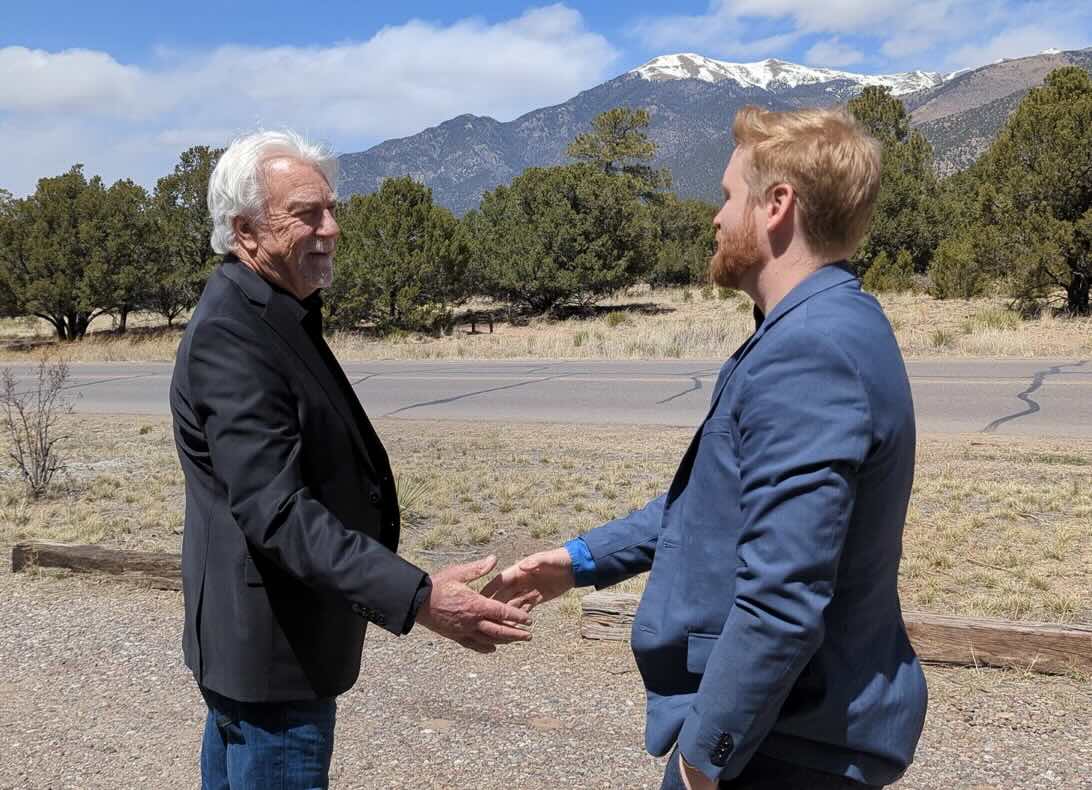
misinformation

Jay Weidner (left) meets Darcy Weir while filming Dark Alliance  (Credit: Darcy Weir).

While working at Gaia and developing Cosmic Disclosure with Goode and Wilcock, Weidner shares that Wilcock introduced Goode as a prospective co-host, advocating for the show’s focus on Goode’s claims. “This was strictly David and Corey coming up with the content. I’m not paid to vet people,” he explains. “I was just trying to make it look good and credible,” adding that the content being put forward by Goode and Wilcock was nothing he “hadn’t seen on the internet already.”

With time, Weidner says a darker reality beyond just the pair’s extraordinary claims began to become apparent.

“When you’ve been conned, you don’t want to admit it,” Weidner tells Weir. “That’s the truth of the matter. I mean, I’m admitting that I got conned. But that is really painful to admit. I was totally taken by this guy, and a lot of other people were too.”

Weir, who has spent the last four years creating this documentary, explained to The Debrief what inspired him to tell this story.

“I’ve been chasing down tales from the UFO community since 2009, and let me tell you, it’s been a wild ride,” Weir recounts. “When I first heard about blue alien bird people and David Wilcock’s ‘new star’ Corey Goode, they were lighting up the screen on Gaia TV, dishing out a story that was, well, beyond this world.”

“Back then, I was friends with Kerry Cassidy (I still am), who runs Project Camelot—a site where conspiracy theories are born and go to thrive. The idea of a secret space program with child recruits? People living a life in space fighting aliens and then coming back to live a regular life? My mind was blown.”

“Over the last decade, I kept an eye on David and Corey, and in 2021, I knew it was time to dive in and document the whole story,” Weir told The Debrief. “To get the full picture for audiences to understand, I had to start at the beginning with David Wilcock at Gaia, where he worked under Jay Weidner, then head of production. David’s rise, Gaia’s role in making him a household name in, you know, certain UFO and New Age spiritual households, and the introduction of Corey Goode.”

“That narrative seemed like a natural flow of how things progressed. Essential to understanding the wild twists of this story,” Weir says.

In a recent podcast interview with The Debrief, Weidner claims Goode and Wilcock both exhibited “cult leader” behavior. “I learned a lot about cults through this. If you watch the last 20 minutes of Cosmic Secret, their last movie, they’re [Goode and Wilcock] laying out how to make their cult,” Weidner says.

Weidner further describes working on Cosmic Disclosure, saying that team members were “naive and hopeful,” likening it to “almost like a cult.”

“After the three-hour talk, we were chosen by the Secret Space Program to present all of this information to the world. We were chosen. We were the ones,” Weidner recounts of how Goode convinced him and the team that they were the “chosen” insiders.

misinformation

Jay Weidner (left) appears on camera speaking with Darcy Weir while filming Dark Alliance (Credit: Darcy Weir).

Weidner also shared with The Debrief that Goode at times displayed violent tendencies behind the scenes. “Corey was consistently talking about violence, constantly talking about how to hurt people. Gave me a whole exposition on how to kill someone with our iPhone.”

  • technosignatures

“No one would listen to me,” Weidner said when asked if these behaviors were ever reported. “I did go to Gaia and said that Corey Goode is radioactive, and I got laughed at.”

Real Whistleblowers vs Questionable Claims

Weir’s documentary presents a cautionary tale detailing how Wilcock and Goode promoted baseless claims that, for most viewers, would seem nonsensical, and yet gained significant traction among their audiences. Despite such concerns, Weir nonetheless cautions against lumping all alleged whistleblowers into the same category.

“Whistleblowers are real, and they’re out there,” Weir told The Debrief. “We’ve got real-deal cases like those of Chelsea Manning, Edward Snowden, Lue Elizondo, and David Grusch, who had access to high-security clearance info during their time with high-level U.S. defense or intelligence agencies.”

However, not everyone who makes sensational claims should be taken seriously simply because they claim to be a whistleblower, Weir concedes.

“Some of these, let’s call them creative storytellers, have ended up with quite a megaphone. And in the right hands, like the extensive subscriber base reach of Gaia’s UFO-friendly streaming network, even the most out-there claims have caught fire,” says Weir.

“Now, I do believe the Defense and Intelligence communities have some big secrets on UFOs stashed away. Whether it’s non-human interaction or something equally mind-bending, the truth seems to not be fully disclosed to mainstream media. But sometimes, when a story gets hot, certain folks decide they just have to be part of the action, blue alien bird people and all,” Weir says.

Weir told The Debrief that one of the challenges revealed to him while creating the new documentary had been that even when information seems obviously outlandish, it can still be difficult to distinguish simple lies and bad information from genuine cult activities.

“Recognizing cult-like behavior is tough, especially for those caught up in it,” Weir told The Debrief.“Cult leaders often keep followers hooked using a blend of fear and love. They introduce fears of doomsday scenarios like catastrophic solar events, then ease these anxieties by offering salvation—of course, with a catch: true transcendence requires financial commitment through classes, workshops, or other paid programs.”

Cults and certain whistleblower communities often share similar characteristics that foster dependency and obedience among followers, frequently using manipulative tactics to control beliefs and behavior. Leaders within these groups often project themselves as charismatic figures with “exclusive” knowledge, claiming insights only they possess. They discourage trust in mainstream information and promote isolation, suggesting that science, media, and government cannot be trusted. Members are discouraged from questioning group beliefs under threat of punishment or exclusion, while the leader’s authority is portrayed as absolute, often invoking apocalyptic or fear-based messaging that intensifies loyalty by positioning the group as the only path to safety.

These leaders may also create a sense of urgency and dependency by portraying themselves as “chosen” or uniquely connected to higher intelligence, often introducing extreme or even violent rhetoric to maintain control. This environment fosters extreme beliefs, restricts followers’ access to outside information, and manipulates members into donating significant portions of their income, all under the guise of supporting the group’s mission. In many cases, these strategies culminate in a closed ecosystem where followers are expected to support the leader’s vision without question, creating an echo chamber that hinders critical thinking and facilitates emotional or even physical abuse.

“Historically, this pattern seems all too common,” Weir told The Debrief.

In contrast to the assurances of “truth,” secret insider knowledge, and freedom that such individuals often promise their followers, for Weir advocates for asking questions, critically thinking, and not following those who appear to display a desire to exploit others for their own personal gain. 

“You know what they say about truth,” Weir adds. “It sets you free.”

{ https://thedebrief.org/category/uap/ }

Hoe vind je dit bericht?
Geschreven door peter om 23:57 Stuur door

“We Do Have Some Very Anomalous Objects,” New Director of Pentagon’s UAP Investigations Tells Lawmakers

Jon Kosloski

Dr. Jon Kosloski, Director of the All-domain Anomaly Resolution Office

(Senate Armed Services Committee)

“We Do Have Some Very Anomalous Objects,” New Director of Pentagon’s UAP Investigations Tells Lawmakers

The new director of the Pentagon’s All-domain Anomaly Resolution Office (AARO) confirmed to lawmakers on Tuesday that the U.S. is investigating what he characterized as “some very anomalous objects,” while providing an update on the Defense Department’s ongoing investigations into unidentified anomalous phenomena (UAP).

Dr. Jon Kosloski, who assumed the role of Director of AARO in August, made the comments during a hearing held by the Senate Armed Services Subcommittee on Emerging Threats and Capabilities overseen by U.S. Senator Kirsten Gillibrand (D-NY).

In his opening statements, Kosloski pledged that his office would continue to share information about AARO’s findings at the unclassified level, discussing several UAP cases his office has investigated, including a series of incidents which AARO says have now been resolved.

One of these, referred to as “The Puerto Rico Object,” involved a video of a purported UAP filmed in April 2013 from a U.S. Customs and Border Protection aircraft near Aguadilla, Puerto Rico. The video has been been a subject of independent public investigation and debate now for many years.

A still from a video captured by a U.S.-operated drone in 2018 while flying above Mt. Etna appears to show an anomalous object, but the Pentagon's UFO chief says his office was able to solve the case. (Image credit: AARO/DOD)

A still from a video captured by a U.S.-operated drone in 2018 while flying above Mt. Etna appears to show an anomalous object, but the Pentagon's UFO chief says his office was able to solve the case.

(Image credit: AARO/DOD)

Kosloski told lawmakers the object in the video was assessed with high confidence by his office not to display any evidence of anomalous speeds or flight characteristics, and was “likely a pair of balloons or sky lanterns,” which Kosloski said had been “floating at about seven knots over the airport.”

Examples of AARO’s resolved reports also included a now-famous U.S. Navy video commonly known as “Go Fast” that first came to public knowledge in 2017, which Kosloski says represents an example of parallax.

“Through a very careful geospatial and intelligence analysis using trigonometry, we assess with high confidence that the object is not actually close to the water, but is rather closer to 13,000 feet,” Kosloski said.

“A trick of the eye called parallax makes it look like the object is moving much faster,” Kosloski added, referencing a report on parallax previously uploaded to AARO’s official website.

Another resolved UAP case, filmed in the Mediterranean from a drone observing the eruption of Mount Etna in 2018, appears to show a small object passing through the plume of superheated gas and ash produced by the volcano.

“This was a rather difficult case to resolve,” Kosloski said. “Through very detailed 3D modeling and pixel by pixel analysis of the object as it’s traversing across the clouds, the assess that the object was actually 170 meters away from the plume, and not flying through it.”

However, while many cases have been resolved by AARO, Dr. Kosloski cautioned against any perception that his office does not find at least some of the reports it receives genuinely anomalous.

A still from a video reportedly showing a "transmedium" UAP that appears to travel between air and water and split in half. During testimony on Nov. 19, the head of the Pentagon's UFO office says it actually shows an infrared camera's inability to tell two objects' temperature apart from the ocean behind them. (Image credit: AARO/DOD)

A still from a video reportedly showing a "transmedium" UAP that appears to travel between air and water and split in half. During testimony on Nov. 19, the head of the Pentagon's UFO office says it actually shows an infrared camera's inability to tell two objects' temperature apart from the ocean behind them.

(Image credit: AARO/DOD)

“To be clear, AARO does not believe that every object is a bird, a balloon, or a UAV,” Kosloski said, adding that “we do have some very anomalous objects.”

Kosloski also said that his office has worked to ensure that U.S. personnel with information related to UAP or alleged U.S. government programs associated with such phenomena feel comfortable coming forward and speaking to AARO.

“We take that responsibility and those authorities very seriously,” Kosloski said, adding that he and his staff “have been reaching out to the broader community, encouraging folks who had talked to AARO personnel in the past, and maybe felt uncomfortable to come back to us.”

Prior to Kosloski’s appointment as AARO Director, the office’s investigations were led by Dr. Sean Kirkpatrick, who is currently the Chief Technology Officer for Defense and Intelligence Programs within the National Security Sciences Directorate (NSSD) at Oak Ridge National Laboratory.

It was unclear during Tuesday’s hearing whether Kosloski’s references to past instances where U.S. personnel may have felt uncomfortable speaking with AARO investigators had occurred during Kirkpatrick’s tenure. However, Kosloski told lawmakers that AARO has recently been “making great progress,” adding that several firsthand witnesses his office had spoken to about their UAP sightings “do feel comfortable coming back to us.”

Asked by Senator Gillibrand about UAP cases that merit further investigation, Kosloski explained that while some cases with insufficient data are placed into an active archive, there are others involving reportedly anomalous objects that AARO deems to be worthy of additional analysis.

One particularly intriguing unresolved case that Kosloski described involved a large orange orb or sphere observed floating several hundred feet above the ground by a law enforcement officer in the Western United States. As the officer approached the location believed to be directly beneath the object, he observed another object described as “blacker than black” and roughly the size of an automobile.

“As he got 40 to 60 meters away from the object, it tilted up about 45 degrees and then it shot up vertically,” Kosloski said, “and then it shot up vertically, he says 10 to 100 times faster than any drone he’s ever seen before.

“And it did that without making a sound, as far as he could tell from inside his vehicle,” Kosloski said. The object reportedly emitted very bright red and blue lights as it departed the scene, which illuminated the inside of the officer’s vehicle.

Another unresolved case involved a stationary cylinder that was observed for a short period hovering over a U.S. facility in the American southwest before abruptly disappearing. The object, observed by U.S. government contractors who were leaving the facility at that time, was described as being comparable in size to a commercial airplane, and was accompanied by a very bright white light.

“Obviously, an object that large [and] stationary—unless it’s a blimp—is unusual,” Kosloski said. “But then disappearing, we can’t explain how that would happen.”

In another instance, an aircraft flying parallel to another aircraft while filming it captured imagery of a much smaller object that appears to have passed between them at high speed.

Kosloski said AARO may be nearing a resolution with one of these three cases, but added that there are several others that are still currently under analysis by his office.

Asked by U.S. Senator Joni Ernst (R-IA) what the U.S. needs to be doing about UAP and what precautions should be taken by U.S. officials, Kosloski warned about stigmas that have long prevailed against the subject, which he said “opens the opportunity for an adversary… to come in and conduct some activity.”

“We need to do that, and we need to have more persistent monitoring,” Kosloski also told lawmakers of the challenges AARO faces with regard to collecting information about UAP, adding that in particular, monitoring at high security facilities should be a main priority.

“Whether it is a UAP, or it is a counter-UAS issue, that we need to have that complete domain awareness around our national security facilities,” Kosloski said.

Next year, Kosloski said AARO plans to roll out a public reporting mechanism at AARO’s website where members of the general public can download a reporting form and submit details about possible UAP sightings, along with attachments such as imagery. This simple reporting interface, Kosloski said, was chosen due to its cost effectiveness, in addition to being a system that he said could ensure the privacy of those members of the public who file reports.

“I think that the authorities that we have are remarkable,” Kosloski said at the conclusion of the short public session, thanking Gillibrand and other lawmakers, and adding that he believes AARO to be “well-resourced as an office.”

“The only ask that I would have is that you continue to champion us, particularly with witnesses,” Kosloski said. “Encourage them to come forward and report to us so we that we can have a more fulsome investigation of the potential historic or ongoing legacy programs,” Kosloski said.

Tuesday’s hearing followed the release of an annual report on AARO’s findings by Kosloski’s office last Thursday, just one day after a separate congressional hearing that also addressed the UAP topic.

Speaking with members of the media on a call last week following the release of AARO’s new report, Kosloski said that his office currently has “several particularly interesting cases.”

“We’re working on within the office, working with our partners to downgrade several of those cases, so we can talk about them publicly,” Kosloski said during the call.

“But there are interesting cases that I, with my physics and engineering background and time in the IC, I do not understand.”

“And I don’t know anybody else who understands them either,” Kosloski added.

VIDEOS

'I do not have an explanation': Pentagon official shows video of unidentified object

UFO hearing: Eyewitnesses describe encounters with "non human" entities to Congress | FULL

Luis Elizondo discusses new book "Imminent" and the Pentagon's UAP investigations

 { https://thedebrief.org/category/uap/ }

Hoe vind je dit bericht?
Geschreven door peter om 23:20 Stuur door

UFO whistleblowers tell Congress 'we are not alone in the cosmos'

UFO whistleblowers tell Congress 'we are not alone in the cosmos'

UFO whistleblower tells Congress the US government is hiding evidence of 'non-human intelligence'

UFOs came to Washington again last week.

The U.S. House of Representatives' Committee on Oversight and Accountability held a hearing titled "Unidentified Anomalous Phenomena: Exposing the Truth" at the Rayburn House Office Building in Washington, D.C. at 11:30 a.m. EST (1530 GMT) on Wednesday, Nov. 13. Unidentified anomalous phenomena (UAP) is a relatively new catch-all term that includes sightings of unexplained objects or events that take place in the air, underwater, in space, or that travel between those domains.

Like previous congressional UFO hearings, the event featured testimony from current U.S. military personnel who claim the American government has for decades hidden evidence of advanced technologies and otherworldly visitors from the public. A multitude of anecdotes were presented about flying orbs coming out of the ocean, disc-shaped objects, and craft "exhibiting flight and structural characteristics unlike anything in our arsenal." While such claims are nothing new, what is noteworthy about the hearing are the pedigrees of some of the whistleblowers who testified, including a former U.S. counterintelligence officer, a retired U.S. Navy rear admiral and a former NASA associate administrator. All of them stressed the need for more government transparency, less stigma about the UFO topic and new policies to bring UAP data out of the "black" classified world and into the public domain.

a white dot in front of the dark ocean

A still from a video titled "Go Fast" recorded by a U.S. Navy aircraft reportedly showing a UAP that was discussed in the U.S. House of Representatives' Committee on Oversight and Accountability hearing titled "Unidentified Anomalous Phenomena: Exposing the Truth" on Wednesday (Nov. 13).  (Image credit: U.S. Dept. of Defense)

This isn't the U.S. government's first attempt to investigate the recent wave of UFO claims that began in 2017. A similar hearing was held last year, in which a whistleblower told Congress the U.S. government is hiding evidence of 'non-human intelligence.'

The Pentagon also created the All-Doman Anomaly Resolution Office (AARO) in 2022 to investigate UAP reports and government data about UFOs, but critics, including some government officials, are skeptical of the office's aims and methods.

Related: 

"AARO is unable, or perhaps unwilling, to bring forward the truth about the government's activities concerning UAPs," Representative Nancy Mace (R-South Carolina) said during the hearing's opening remarks. "I'm disturbed that AARO itself lacks transparency; even its budget is kept from the public. So if there is no 'there' there, then why are we spending money on it? And by how much? Why the secrecy?"

Other representatives stressed the need for transparency and data analysis, a common theme of other recent UAP studies. "We have evidence that what we are detecting things, and we know that we don't understand them, and this is worth investigating," Rep. Robert Garcia (D-CA) said. "I believe we can always be more transparent. To me, this hearing and others are simply about the truth and getting to the facts of what these UAPs actually are."

Luis Elizondo, a former U.S. counterintelligence officer who has been vocal about such claims in recent years, told the assembled representatives at the hearing that "excessive secrecy has led to grave misdeeds against loyal civil servants, military personnel and the public — all to hide the fact that we are not alone in the cosmos."

We are "in the midst of a multi-decade, secretive arms race  — one funded by misallocated taxpayer dollars and hidden from our elected representatives and oversight bodies," Elizondo stated during his testimony.

Elizondo, who claims to have previously investigated UFOs as part of a secret Pentagon program, suggested that the U.S. government create a "whole-of-government" approach to studying UAP, create a national UAP strategy and offer protections so that whistleblowers who are "desperate to do the right thing can come forward without fear."

During questioning, Elizondo was asked if some of the "advanced technologies" that have been seen monitoring sensitive military installations around the globe could be operated by aliens or private companies. "Maybe both," Elizondo replied.

Elizondo also stated point-blank to Rep. Mace's questioning that the U.S. government has programs to retrieve crashed UAP and reverse-engineer them, but avoided giving any specifics in an unclassified public setting such as the hearing.

Rep. Jared Moskowitz (D-FL) then questioned Elizondo, asking the former counterintelligence agent about a document he signed that limits him from speaking publicly about crash retrieval programs. "The document said you can't talk about crash retrieval. Well, you know, you can't talk about Fight Club if there's no Fight Club, correct?"

Like other witnesses, Elizondo stated that the alleged excessive government secrecy around UFOs harms national security. In response to questioning from Rep. Tim Burchett (R-TN), Elizondo stated that, if UAP sightings turned out to be technologies operated by adversarial nations, it would be "an intelligence failure eclipsing 9/11 in order of magnitude."

a still from footage shot by an MQ-9 reaper drone showing an unidentified spherical object soaring through the air

A still from footage shot by an MQ-9 reaper drone showing an unidentified spherical object soaring through the air shown to the United States Senate Committee on Armed Services during an April 2023 hearing.  (Image credit: U.S. Dept. of Defense)

Retired U.S. Navy rear admiral Tim Gallaudet offered similar testimony as Elizondo. "We know from last year's UAP hearing and recent statements and publications by credible whistleblowers that UAP, NHI [non-human intelligence], and their technology of unknown origin (TUO) represent a new realization that we are not the only advanced intelligence in the universe," Gallaudet said on Wednesday, according to his published remarks.

"Unelected officials in the U.S. government do not have an exclusive right to this knowledge about the nature of reality. The American people have a right to that knowledge," Gallaudet said. The retired rear admiral also stressed the national security and airspace safety concerns related with UAP sightings, calling them "extensive."

When Rep. Garcia asked Gallaudet and other witnesses what UAP might represent, the retired rear admiral said he believes they are evidence of a "non-human higher intelligence."

Former NASA Associate Administrator for Space Policy and Partnerships Michael Gold also testified at the hearing, and previously served on NASA's UAP study team. Gold's testimony was more grounded; for example, he stressed the need for NASA to contribute its authority and expertise toward analyzing what UAP data it might already possess and helping dispel the stigma associated with the UFO topic.

"Our best tool for unlocking the mystery of UAP is science, but we cannot conduct a proper inquiry if the stigma is so overwhelming that just daring to be part of a NASA search team elicits such a vitriolic response," Gold said during the hearing. "Therefore, one of the most important actions that can be taken, relative to exposing the truth of UAP, is to combat the stigma, and this is where I believe that NASA can be eminently helpful."

Gold added that NASA has a massive archive of data that could possibly contain evidence of UAP, and suggested that artificial intelligence/machine learning algorithms could help sort through the agency's trove of data to help shine light on the UFO phenomenon. In addition, the former NASA associate administrator said the agency should develop specialized instruments that might be able to gather useful data about UAP.

UFO whistleblower says U.S. recovered nonhuman "biologics" from crash sites

Journalist Michael Shellenberger also testified, telling the representatives that there's a "growing body of evidence that the government is not being transparent about what it knows about unidentified anomalous phenomena (UAP), formerly called UFOs, and that elements within the military and IC [intelligence community] are in violation of their Constitutional duty to notify Congress of their operations."

Shellenberger stated that there is a secret program within the U.S. government known as "Immaculate Constellation" whose sole purpose is to collect UFO and UAP reports from military personnel and sensor data and quarantine them away from the rest of the government and military. While he noted that a Pentagon spokesperson has stated no such program exists, Shellenberger recounted prior examples in which the Department of Defense has initially denied knowledge of UAP-related information only to later change its stance and either admit the information exists or release it to the public.

"The U.S. government appears to know significantly more about UAPs than it is revealing," Shellenberger said at the hearing. "But even those who believe the U.S. government has revealed all that it knows should have no objection to Congressional demands for greater transparency."

To conclude the meeting, Rep. Mace asked each of the witnesses to define what non-human biologics or non-human intelligence mean to each of them.

"I don't think it's a stretch, when you look at the diversity of life on this planet and the size of this universe, to think that there will be more diverse, higher-order, non-human intelligence throughout the universe, and that's probably what's visiting us," Gallaudet said.

Elizondo stated he would take a scientific approach: "The definition would be the ability to react to a stimulus in a manner that requires an intellectual thought process."

Gold, meanwhile, questioned whether non-human intelligence necessarily implies life, suggesting sophisticated artificial intelligence might be responsible for some UAP encounters. Shellenberger simply stated he did not know what they might be.

In the hearing, as in other UFO hearings, there was a lot of telling and not a lot of showing. One of the core tenets of these whistleblower testimonies is that much of the credible UFO data is classified and can't be revealed to the public based on the military capabilities that some of that data could reveal.

Whistleblowers have attested for years that, because advanced or classified sensors and satellites sometimes capture footage or photos of unexplained phenomena or advanced craft, those photos or videos are likewise classified by the U.S. government in order to not reveal America's full surveillance or sensing capabilities.

Such was the case in 2023 when U.S. military aircraft shot down a mysterious object off the coast of Alaska. The American government has yet to release any imagery from the event, but a Canadian freedom of information request unveiled a photograph earlier this year of a balloon-like object.

Those incidents and others like it, such as a weeks-long drone incursion above Langley Air Force Base in Washington, D.C., were discussed in the hearing. "The origin of these drones and their operators remains a mystery," Rep. Glenn Grothman (R-Wis.) said. "This incident and other sightings near sensitive military installations highlights the complexity of the UAP challenge facing our intelligence, defense and homeland security committees."


What does the US Know About UFOs and Aliens? | Vantage with Palki Sharma

Live: Congress holds hearing on UFOs after whistleblowers claim government kept information secret

{ https://www.livescience.com/ }

Hoe vind je dit bericht?
Geschreven door peter om 22:44 Stuur door

Starship’s Booster (and Donald Trump) Make a Splash With Sixth Flight Test

SpaceX's Starship lifts off from its Texas pad for the launch system's sixth flight test. (Credit: SpaceX)

Starship’s Booster (and Donald Trump) Make a Splash With Sixth Flight Test

SpaceX’s Starship launch system went through its sixth flight test today, and although the Super Heavy booster missed out on being caught back at its launch pad, the mission checked off a key test objective with President-elect Donald Trump in the audience.

Trump attended the launch at SpaceX’s Starbase complex in the company of SpaceX CEO Elon Musk, who has been serving as a close adviser to the once and future president over the past few months. In a pre-launch posting to his Truth Social media platform, Trump wished good luck to “Elon Musk and the Great Patriots involved in this incredible project.”

Starship is the world’s most powerful rocket, with 33 methane-fueled Raptor engines providing more than 16 million pounds of thrust at liftoff. That’s twice the power of the Saturn V rocket that sent Americans to the moon in the 1960s and early ’70s. The two-stage rocket stands 121 meters (397 feet) tall, with a 9-meter-wide (30-foot-wide) fairing.

Super Heavy had an on-time launch at 4 p.m. CT (22:00 UTC) and was set up to fly itself back to the launch tower to be caught by the giant “Mechazilla” arms that were successfully used during last month’s flight test. But four minutes after liftoff, mission controllers said the booster had to be diverted instead to make a soft splashdown in the Gulf of Mexico.

In a recap of the flight, SpaceX said that “automated health checks of critical hardware on the launch and catch tower triggered an abort of the catch attempt.”

“It was not guaranteed that we would be able to make a tower catch today,” launch commentator Kate Tice said during today’s webcast. “So, while we were hoping for it … the safety of the teams and the public and the pad itself are paramount. We are accepting no compromises in any of those areas.”

While the booster settled majestically into the Gulf, the Starship second stage — known as Ship for short — continued on a track that sent it as high as 190 kilometers (120 miles). A plush banana was placed in Ship’s cargo bay as a zero-gravity indicator, and Tice wore a T-shirt bearing the words “It’s Bananas!” to play off the lighthearted theme.

Ship successfully relit one of its methane-fueled Merlin engines while in space, which was a key objective for today’s suborbital test. Relighting the engines under such conditions will be required in the future for Ship’s orbital maneuvers.

A little more than an hour after launch, Ship’s engines fired for a final time to make a controlled splashdown in the Indian Ocean. The daylight visuals, plus other data collected during the flight, will help SpaceX’s team fine-tune Starship’s design for future tests.

SpaceX plans to use Starship to accelerate deployment of its Starlink broadband satellites, as well as to fly missions beyond Earth orbit. The company has a $2.9 billion contract from NASA to provide a version of Starship that’s customized for lunar landings, starting as early 2026. And Musk has said Starship could take on uncrewed missions starting that same year — with the first crewed mission set for launch in 2028 if everything goes right.

NASA Administrator Bill Nelson referred to those future flights in a message on Musk’s X social-media platform:

Check out these other postings tracking the progress of the flight test:

{ https://www.universetoday.com/ }

Hoe vind je dit bericht?
Geschreven door peter om 17:00 Stuur door

What a Misplaced Meteorite Told Us About Mars

The Lafayette Meteorite was chipped off the surface of Mars and then sped through space for roughly 11 million years. It eventually found its way into a drawer at Purdue University in 1931 and has since been teaching scientists about Mars. (Photo provided by Purdue Brand Studio.)

What a Misplaced Meteorite Told Us About Mars

11 million years ago, Mars was a frigid, dry, dead world, just like it is now. Something slammed into the unfortunate planet, sending debris into space. A piece of that debris made it to Earth, found its way into a drawer at Purdue University, and then was subsequently forgotten about.

Until 1931, when scientists studied and realized it came directly from Mars. What has it told them about the red planet?

11 million years ago, the Himalayas were rising on a warmer, more humid Earth. Early ape species made their home in an Africa covered by tropical forests. Diverse mammal species roamed the continents.

At the same time, on Mars, the frigid wind blew across a desiccated, forlorn world. The planet’s thin atmosphere is a weak barrier to meteorites, and the planet’s cratered surface bears witness to its nakedness. Some impacts were powerful enough to launch debris into space beyond the planet’s gravitational pull. The meteorite in the drawer is one such piece of debris.

“Many meteoroids are produced by impacts on Mars and other planetary bodies, but only a handful will eventually fall to Earth.”

Marissa Tremblay, Purdue University

The meteorite was long forgotten in its storage place until 1931. Scientists identified it as a piece of Mars, and now new research is uncovering clues about Mars’ past hidden in the 800-gram piece of rock.

This image shows a page from an article published in Popular Astronomy in 1935. Image Credit: Popular Astronomy. This image shows a page from an article published in Popular Astronomy in 1935. Image Credit: Popular Astronomy.

11 million years ago is not a long time in geological and planetary terms, and the number fits neatly into most people’s imaginations. But rock has deep temporal roots, and the meteorite that reached Earth is an igneous rock that dates back 1.4 billion years. That much time is more difficult to understand, but science is at its best when it opens human minds to a more fulsome understanding of nature.

The meteorite, named “Lafayette” after the city in Indiana that’s home to Purdue University, is the subject of new research published in Geochemical Perspectives Letters. It’s titled “Dating recent aqueous activity on Mars,” and the lead author is Marissa Tremblay. Tremblay is an assistant professor with the Department of Earth, Atmospheric, and Planetary Sciences (EAPS) at Purdue University.

There’s ample evidence that some minerals on Mars formed in the presence of water. Though Lafayette itself is an igneous rock 1.4 billion years old, some of the minerals it contains are younger.

“Dating these minerals can therefore tell us when there was liquid water at or near the surface of Mars in the planet’s geologic past,” Tremblay said. “We dated these minerals in the Martian meteorite Lafayette and found that they formed 742 million years ago. We do not think there was abundant liquid water on the surface of Mars at this time. Instead, we think the water came from the melting of nearby subsurface ice called permafrost, and that the permafrost melting was caused by magmatic activity that still occurs periodically on Mars to the present day.”

Lafayette is one of the Nakhlite meteorites, an igneous rock that formed from basaltic lava around 1.4 billion years ago. Scientists think these rocks formed in one of Mars’ large volcanic regions: Elysium, Syrtis Major Planum, or the largest one, Tharsis, which is home to the three shield volcanoes, Tharsis Montes.

A colourized image of the surface of Mars taken by the Mars Reconnaissance Orbiter. The line of three volcanoes is the Tharsis Montes, with Olympus Mons to the northwest. Valles Marineris is to the east. The researchers think that the Lafayette meteorite came from the Tharsis volcanic region, or one of Mars' other, smaller volcanic regions. Image: NASA/JPL-Caltech/ Arizona State University A colourized image of the surface of Mars taken by the Mars Reconnaissance Orbiter. The line of three volcanoes is the Tharsis Montes, with Olympus Mons to the northwest. Valles Marineris is to the east. The researchers think that the Lafayette meteorite came from the Tharsis volcanic region, or one of Mars’ other, smaller volcanic regions. Image: NASA/JPL-Caltech/ Arizona State University

Ancient rocks and their embedded minerals contain information about Mars’ ancient past. The history of Mars’ hydrological cycle is a key objective in our ongoing study of Mars. This research is focused on a particular mineral in Lafayette called iddingsite. It forms when basalt is weathered in the presence of water.

The difficulty with meteorites and the clues they contain about ancient Mars is that they’ve been exposed to and potentially altered by the heat of the initial impact and the heat of entry into Earth’s atmosphere. The chemical signals inherent in rock can become muddied. But Lafayette is different. It’s clear that it was blasted off of Mars 11 million years ago.

“We know this because once it was ejected from Mars, the meteorite experienced bombardment by cosmic ray particles in outer space that caused certain isotopes to be produced in Lafayette,” Tremblay says. “Many meteoroids are produced by impacts on Mars and other planetary bodies, but only a handful will eventually fall to Earth.”

“The age could have been affected by the impact that ejected the Lafayette Meteorite from Mars, the heating Lafayette experienced during the 11 million years it was floating out in space, or the heating Lafayette experienced when it fell to Earth and burned up a little bit in Earth’s atmosphere,” Tremblay said. “But we were able to demonstrate that none of these things affected the age of aqueous alteration in Lafayette.”

Study co-author Ryan Ickert is a senior research scientist in Purdue’s EAPS. Ickert uses heavy radioactive and stable isotopes to study geological processes over time. He showed how isotope data used to date water-rock interactions on Mars were problematic and that the data had likely been polluted by other processes. According to Ickert, he and his colleagues got it right this time.

“This meteorite uniquely has evidence that it has reacted with water. The exact date of this was controversial, and our publication dates when water was present,” he says.

This figure from the research shows a cross-section of the Lafayette meteorite. Ol is an olivine grain surrounded by augite crystals (Px). Iddingsite (Id) is present in veins that travel through the rock. Though Lafayette formed over 1.3 billion years ago, the Iddingsite veins formed later, about 742 million years ago, when water seeped through the cracks. Image Credit: Tremblay et al. 2024. This figure from the research shows a cross-section of the Lafayette meteorite. Ol is an olivine grain surrounded by augite crystals (Px). Iddingsite (Id) is present in veins that travel through the rock. Though Lafayette formed over 1.3 billion years ago, the Iddingsite veins formed later, about 742 million years ago, when water seeped through the cracks. Image Credit: Tremblay et al. 2024.

The researchers used a novel technique involving the isotopes Argon 40 and Argon 39 to date Lafayette’s exposure to water and its formation of Iddingsite. That showed them that the exposure occurred 742 million years ago. Their explanation is that magmatic activity melted subsurface ice, and the water subsequently found its way into cracks in the igneous rock, altering some of the olivine into Iddingsite.

All this from a meteorite that was lost in a drawer.

The Solar System is a puzzle. It’s an artifact of Nature’s ordered complexity, but at the same time, it’s shaped by Nature’s steadfast chaos. Each molecule, each tiny piece of rock, including the Lafayette meteorite, is a part of it. Each piece holds a clue to the puzzle.

“We can identify meteorites by studying what minerals are present in them and the relationships between these minerals inside the meteorite,” said Tremblay. “Meteorites are often denser than Earth rocks, contain metal, and are magnetic. We can also look for things like a fusion crust that forms during entry into Earth’s atmosphere. Finally, we can use the chemistry of meteorites (specifically their oxygen isotope composition) to fingerprint which planetary body they came from or which type of meteorite it belongs to.”

Dating these rocks, these pieces of the puzzle, is difficult. However, this research has made progress by developing a novel way to date minerals in the Lafayette meteorite.

“We have demonstrated a robust way to date alteration minerals in meteorites that can be applied to other meteorites and planetary bodies to understand when liquid water might have been present,” Tremblay concluded.


Mysterious and rare meteorite from Mars at the Smithsonian

Mighty Martian meteorite lands at the Museum | Natural History Museum

{ https://www.universetoday.com/ }

Hoe vind je dit bericht?
Geschreven door peter om 16:29 Stuur door

Meer van UFO'S of UAP'S, ASTRONOMIE, RUIMTEVAART, ARCHEOLOGIE, OUDHEIDKUNDE, SF-SNUFJES EN ANDERE ESOTERISCHE WETENSCHAPPEN - DE ALLERLAATSTE NIEUWTJES

↑ Terug naar de berichten