Ontdek de Fascinerende Wereld van UFO's en UAP's: Jouw Bron voor Onthullende Informatie!
Ben jij ook gefascineerd door het onbekende? Wil je meer weten over UFO's en UAP's, niet alleen in België, maar over de hele wereld? Dan ben je op de juiste plek!
België: Het Kloppend Hart van UFO-onderzoek
In België is BUFON (Belgisch UFO-Netwerk) dé autoriteit op het gebied van UFO-onderzoek. Voor betrouwbare en objectieve informatie over deze intrigerende fenomenen, bezoek je zeker onze Facebook-pagina en deze blog. Maar dat is nog niet alles! Ontdek ook het Belgisch UFO-meldpunt en Caelestia, twee organisaties die diepgaand onderzoek verrichten, al zijn ze soms kritisch of sceptisch.
Nederland: Een Schat aan Informatie
Voor onze Nederlandse buren is er de schitterende website www.ufowijzer.nl, beheerd door Paul Harmans. Deze site biedt een schat aan informatie en artikelen die je niet wilt missen!
Internationaal: MUFON - De Wereldwijde Autoriteit
Neem ook een kijkje bij MUFON (Mutual UFO Network Inc.), een gerenommeerde Amerikaanse UFO-vereniging met afdelingen in de VS en wereldwijd. MUFON is toegewijd aan de wetenschappelijke en analytische studie van het UFO-fenomeen, en hun maandelijkse tijdschrift, The MUFON UFO-Journal, is een must-read voor elke UFO-enthousiasteling. Bezoek hun website op www.mufon.com voor meer informatie.
Samenwerking en Toekomstvisie
Sinds 1 februari 2020 is Pieter niet alleen ex-president van BUFON, maar ook de voormalige nationale directeur van MUFON in Vlaanderen en Nederland. Dit creëert een sterke samenwerking met de Franse MUFON Reseau MUFON/EUROP, wat ons in staat stelt om nog meer waardevolle inzichten te delen.
Let op: Nepprofielen en Nieuwe Groeperingen
Pas op voor een nieuwe groepering die zich ook BUFON noemt, maar geen enkele connectie heeft met onze gevestigde organisatie. Hoewel zij de naam geregistreerd hebben, kunnen ze het rijke verleden en de expertise van onze groep niet evenaren. We wensen hen veel succes, maar we blijven de autoriteit in UFO-onderzoek!
Blijf Op De Hoogte!
Wil jij de laatste nieuwtjes over UFO's, ruimtevaart, archeologie, en meer? Volg ons dan en duik samen met ons in de fascinerende wereld van het onbekende! Sluit je aan bij de gemeenschap van nieuwsgierige geesten die net als jij verlangen naar antwoorden en avonturen in de sterren!
Heb je vragen of wil je meer weten? Aarzel dan niet om contact met ons op te nemen! Samen ontrafelen we het mysterie van de lucht en daarbuiten.
The ASKAP radio telescope in Australia first detected this extraordinary signal, officially designated as ASKAP J1935+2148. What sets this signal apart is its clockwork-like precision, repeating every 53.8 minutes. However, the true mystery lies in its three distinct emission states :
Bright flashes lasting 10 to 50 seconds with linear polarization
Weak pulses with circular polarization, lasting a mere 370 milliseconds
Periods of complete silence
Dr. Manisha Caleb, the lead author of the study, emphasizes the uniqueness of this discovery : “What is intriguing is how this object displays three distinct emission states, each with properties entirely dissimilar from the others.” The MeerKAT radio telescope in South Africa played a crucial role in confirming that these varied signals originated from the same celestial source.
As scientists grapple with explaining this phenomenon, they’ve narrowed down the potential sources to two prime suspects : neutron stars and white dwarfs. Both are remnants of deceased stars, but their properties differ significantly. Here’s a comparison of these celestial objects :
While neutron stars are known for emitting radio waves, their typical rotation speeds are much faster than the observed 54-minute cycle. On the other hand, white dwarfs could potentially rotate this slowly, but scientists are unaware of any mechanism that would allow them to produce such complex radio signals.
Exploring potential explanations and implications
The scientific community is abuzz with theories attempting to explain this celestial oddity. Some researchers speculate that the signal could be produced by interactions between a neutron star’s strong magnetic field and complex plasma flows. However, this explanation falls short when considering the unusually slow rotation rate.
Another intriguing possibility is the existence of an elusive “white dwarf pulsar,” a hypothetical object that combines properties of both white dwarfs and pulsars. This concept, while theoretically possible, has yet to be confirmed observationally.
The implications of this discovery extend far beyond this single celestial object. Dr. Caleb suggests that it might prompt a reconsideration of our long-held understanding of neutron stars and white dwarfs, including :
The mechanisms behind their radio wave emissions
The diversity of their populations within the Milky Way galaxy
Potential new subclasses of these stellar remnants
This isn’t the first time a repeating radio signal has baffled scientists. A previous discovery of an 18-minute looping signal also defied explanation, but this new 54-minute cycle adds another layer of complexity to the cosmic puzzle.
Future research and the quest for answers
As astronomers continue to probe the depths of space, the hunt for answers intensifies. The ASKAP and MeerKAT radio telescopes will undoubtedly play crucial roles in future observations of this mysterious object. Additionally, other advanced instruments like the Square Kilometre Array (SKA) and the Very Large Array (VLA) may be enlisted to gather more data and potentially unravel this cosmic enigma.
While the possibility of extraterrestrial intelligence is always a tantalizing thought, scientists emphasize that natural astrophysical phenomena are far more likely explanations. Nevertheless, this discovery underscores the vast unknowns that still exist in our universe and the exciting potential for groundbreaking discoveries that challenge our understanding of cosmic physics.
As we continue to push the boundaries of astronomical research, one thing remains clear : the universe never fails to surprise us with its complexity and wonder. This hourly repeating radio signal serves as a reminder of the countless mysteries that await discovery in the depths of space, inspiring future generations of scientists to explore the cosmos and unravel its secrets.
As Congress is striving to “pull back the curtain” on their research into UFOs and unsealing documents, experts have created maps revealing the US locations most likely to receive extraterrestrial visitors.
The hearing, dubbed "Unidentified Anomalous Phenomena: Exposing the Truth," featured expert testimonies and witness accounts. The panel of experts included government employees and a NASA’s UAP Independent Study Team member.
Though the experts have recently revealed that most' UAPs' are drones, plenty of objects can be considered extraterrestrial. The National UFO Reporting Center has a map anyone can use to track sightings in their area.
This comes a day after House lawmakers called for greater government transparency during a hearing on unidentified anomalous phenomena, or UAPs — the government’s term for UFOs.
Michael Gold, an ex-NASA associate administrator of space policy and partnerships and a member of the UAP study team, informed the hearing that "the vast majority of UAPs are drones."
However, he acknowledged some anomalies require further investigation and conceded that some of the observed UAPs "can move faster" than US submarines and "are being intelligently controlled.
3 UFOs That Science Still Can't Explain
Luis Elizondo, an author and former Department of Defence official, asserted that "advanced technologies not made by our government - or any other government - are monitoring sensitive military installations around the globe." He emphasized: "Let me be clear. UAP are real."
The inquiry, co-chaired by Nancy Mace and Glenn Grothman, was the second to examine the UAP phenomenon. "Americans deserve to understand what the government has learned about UAP sightings and the nature of any potential threats these phenomena pose," the co-chairs declared in a statement.
The hearing followed a long-awaited report release. NASA conducted a study last year that examined previous UFO (or UAP) sightings. The study did not find any definitive evidence of extraterrestrial life, but the possibility was not entirely ruled out.
According to the British spotter group UFO Identified, there were 395 documented sightings in the UK in 2023, a 20% decrease from the 497 sightings in 2022 and lower than the numbers recorded in 2021 (413) and 2020 (484). The North West region had the highest number of sightings last year, with 41, followed by the South East (40) and then the South West (39).
The review includes hundreds of cases of misidentified balloons, birds and satellites as well as some that defy easy explanation, such as a near-miss between a commercial airliner and a mysterious object off the coast of New York. While it isn’t likely to settle any debates over the existence of alien life, the report reflects heightened public interest in the topic and the government's efforts to provide some answers.
Stunning expert witness testimonies that UFOs exist were heard on Capitol Hill at a public Congressional hearing of the Committee on Oversight and Accountability.
Dr. Tim Gallaudet, a retired Rear Admiral U.S. Navy, was the first of four witnesses making the extraordinary statements Wednesday at the hearing called Unidentified Anomalous Phenomena (UAP): Exposing the Truth.
The Admiral said that information from whistleblowers about UAPs (formerly known as UFOs) indicated that their technology represents a "new realization that we are not the only advanced intelligence in the universe."
"As a former science agency leader, I have always sought the truth in human knowledge and thought. Now that we know UAP are interacting with humanity, and these include unidentified submerged objects (USOs) in the ocean, we should not keep our heads stuck in the sand but boldly face this new reality and learn from it."
What was the USS Theodore Roosevelt incident?
"Confirmation that UAPs are interacting with humanity came for me in January 2015 when I was serving as the Commander of the Naval Meteorology and Oceanography Command," the Admiral said.
"At the time, my personnel were participating in a pre-deployment naval exercise off the U.S. East Coast that included the USS Theodore Roosevelt Carrier Strike Group. This exercise was overseen by the United States Fleet Forces Command, led by a four-star admiral who also served as my superior officer."
"During this exercise, I received an email on the Navy's secure network from the operations officer of Fleet Forces Command. The email was addressed to all subordinate commanders, and the subject line read in all capital letters: URGENT SAFETY OF FLIGHT ISSUE."
"The text of the email was brief but alarming, with words to the effect: "If any of you know what these are, tell me ASAP. We are having multiple near-midair collisions, and if we do not resolve it soon, we will have to shut down the exercise.""
"Attached to the email was what is now known as the "Go Fast" video, captured on the forward-looking infrared sensor onboard one of the Navy F/A-18 aircraft participating in the exercise. The now declassified video showed an unidentified object exhibiting flight and structural characteristics unlike anything in our arsenal."
Luis Elizondo, an author and a former Department of Defense Official, was the second witness to make a statement before the committee.
"Let me be clear: UAP are real. Advanced technologies not made by our government—or any other government—are monitoring sensitive military installations around the globe," said Elizondo.
"Furthermore, the U.S. is in possession of UAP technologies, as are some of our adversaries. I believe we are in the midst of a multi-decade; secretive arms race—one funded by misallocated taxpayer dollars and hidden from our elected representatives and oversight bodies."
Newsweek has emailed the Defense Department for comment
People should be encouraged to come forward with information about UAPs, said Michael Gold, the third witness, a former NASA Associate Administrator of Space Policy and Partnerships; a member of the NASA UAP Independent Study Team.
"Instead of vilifying or ridiculing those who dare to study the phenomena, NASA and the scientific community as a whole should seize this singular opportunity to engage the public in a high-profile demonstration of the scientific method," said Gold.
"Information should be gathered, results should be studied, hypotheses made, and conclusions tested."
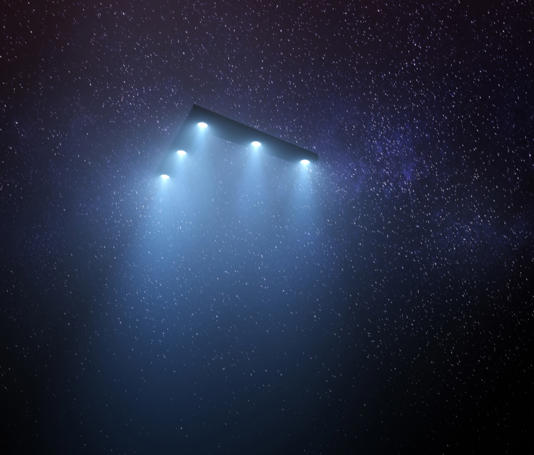
An illustration of triangular shaped (UAP) Unidentified Anomalous Phenomena similar to the kind reported by many eyewitnesses who saw the Phoenix Lights over Arizona and Nevada on March 13, 1997. ktsimage
Michael Shellenberger, an investigative journalist presented a 12-page document to the Committee—before the hearing—which detailed a classified UAP crash-retrieval program known as Immaculate Constellation, given to him by a whistleblower he said was a current or former U.S. government official.
"The executive branch has been managing UAP issues without congressional knowledge, oversight, or authorization for some time, possibly decades," said Shellenberger who was asked, but refused to divulge the source of his information.
"While UAPs remain mysterious, it's clear that the U.S. government is not being straight with the American people. This is all the more alarming following a series of incursions by unknown objects around sensitive military assets, including nuclear missile silos, in recent years."
"Beyond exhibiting seemingly advanced technology, the objects appeared to put on a display of impunity by flying with bright flashing lights and flying in formation."
President-Elect Donald Trump and former President Barack Obama have said that the government has information about UAPs that it has not released, said Shellenberger.
"In 2020, during a podcast with his son, Donald Trump, Jr, Trump said, 'I won't talk to you about what I know about it, but it's very interesting'."
"In 2021, former CIA Director John Brennan said, 'I think some of the phenomena we may be seeing continue to be unexplained and might be some type of phenomenon that results from something that we don't yet understand and could involve some type of activity that some might say constitutes a different form of life'," said Shellenberger.
Officials at the space agency's Jet Propulsion Laboratory (JPL) and and Center for Near-Earth Object Studies (CNEOS) estimated that the space rock is between 28 and 62 feet wide, and will shoot past our planet at a speed of roughly 29,300 mph.
It will come within 273,000 miles of Earth. By comparison, the average distance between our planet and the moon is roughly 238,900 miles.
The close encounter is expected to take place in the early morning hours, but the asteroid poses no threat to Earth.
The space rock, called 2024 VK3, is just one of five asteroids that will fly by our planet this weekend.
Three are as roughly big as commercial airplanes and one is about the size of a house, according to NASA JPL.
The next-closest encounter will be made by the airplane-sized asteroid 2024 VZ2, which will come within 790,000 miles of our planet.
The others will maintain distances of over a million miles away with house-sized asteroid 2024 UC5 being 2,580,000 miles away at its closest point to Earth.
NASA is keeping a close eye on a bus-sized asteroid that is expected to skim past Earth tomorrow morning at a distance only slightly father away than the moon
All of these asteroids are considered Near Earth Objects (NEOs) because they are within approximately 30 million miles of our planet.
NASA has observed, documented and classified around 36,000 objects in the solar system as NEOs.
The space agency tracks NEOs primarily to identify asteroids that could potentially collide with Earth, and assess the threat they pose.
NASA uses a variety of methods to survey nearby space rocks, including both ground-based and space-based telescopes.
One key tool is the Near-Earth Object Surveyor, an infrared space telescope used to discover and characterize Potentially Hazardous Asteroids (PHAs).
PHAs are asteroids that have a high probability of making a close approach to Earth and are large enough to cause significant damage if they made impact.
Technically, that means any space rock that comes within 0.05 astronomical units - or roughly 4,647,790 miles - of Earth's orbit, and has an absolute brightness of 22.0 or less.
Absolute brightness is an indirect measurement of an asteroid's size. Lower values of magnitude indicate greater brightness, and thus larger objects.
In 2021, NASA's Planetary Defense Office launched the DART mission, which slammed a spacecraft into the asteroid Dimorphos and changed the space rock's trajectory (STOCK)
None of the asteroids that will fly by Earth this weekend are considered PHAs.
But NASA is preparing for the unlikely event that a PHA hurtles towards our planet in the future.
The agency's Planetary Defense Coordination Office (PDCO) is developing technologies and strategies that could safe Earth from a catastrophic asteroid impact.
Established in 2016, PDCO is tasked with the mission of finding, tracking and better understanding asteroids and comets that could pose an impact hazard to Earth.
In 2021, the office launched the Double Asteroid Redirection Test (DART), which slammed a spacecraft into the asteroid Dimorphos and successfully changed the space rock's orbital trajectory.
This mission was a test of the 'kinetic impact' asteroid deflection strategy, which could one day be used to redirect a PHA on a collision course with Earth.
In October, the European Space Agency launched the second phase of this mission, called Hera.
The Hera spacecraft is currently on its way to Dimorphos to perform a detailed post-impact survey of Dimorphos. This will help experts solidify kinetic impact into a well-understood and repeatable planetary defense technique.
Police in Canada collected debris after an unidentified object was shot down over Lake Huron in February 2023.
According to documents obtained through a freedom of information request to Canada's Department of National Defence, "wreckage" was found on "the shoreline of Lake Huron" just weeks after search efforts were officially suspended by the Royal Canadian Mounted Police (RCMP). The new discovery was never made public.
"Following reports of unidentified aerial objects observed in the Great Lakes area and elsewhere in North America, multiple searches were conducted by the RCMP with the support of the Canadian Armed Forces," an RCMP spokesperson said in a brief statement to CTVNews.ca. "Debris has been recovered from the shores of Lake Huron but after careful analysis, it was determined not to be of national security concern."
The RCMP oversaw a brief winter search that also involved both the American and Canadian coast guards. In a Feb. 16, 2023, statement, the RCMP announced search efforts were being suspended "due to several factors including deteriorating weather and the low probability of recovery."
According to partially redacted emails obtained by CTVNews.ca through the information request, the RCMP collected "both material and a module" when debris was discovered "along the shores of Lake Huron" in early March 2023, approximately three weeks after the object was shot down.
"The module is from a company who sells weather monitoring equipment," a senior RCMP member told a Canadian military brigadier-general in a March 13, 2023, email. "It will be analyzed to determine if there is anything unusual with it but I suspect not given the size. Whether or not it is from the shoot down is uncertain."
The RCMP would not answer specific questions from CTVNews.ca, including if the wreckage was ever positively linked to the Lake Huron object. Canada's Department of National Defence declined to comment. The U.S. Department of Defense did not respond to emailed questions.
"The RCMP confirms that debris was recovered from the shores of Lake Huron; and we continue to work in close collaboration with our domestic and international partners in furthering the investigation," an RCMP spokesperson said in a new statement Friday afternoon. "As the investigation is ongoing, additional details cannot be provided at this time."
Newly released documents show the Royal Canadian Mounted Police collected wreckage after an unidentified object was shot down over Lake Huron in February 2023.
(Department of National Defence via access to information request)
What was the Lake Huron object?
The three unidentified objects shot down over Alaska, Yukon and Lake Huron in February 2023 were reportedly much smaller than the towering Chinese balloon.
"We don't yet know exactly what these three objects were, but nothing right now suggests they were related to China's spy balloon program, or they were surveillance vehicles from any other country," U.S. President Joe Biden said following the incidents. "The intelligence community's current assessment is that these three objects were most likely balloons tied to private companies, recreation or research institutions, studying weather or conducting other scientific research."
A "secret" Royal Canadian Air Force document obtained by CTVNews.ca suggests the Lake Huron object could have been a "weather balloon" launched from a U.S. National Weather Service radar station in Michigan.
Iain Boyd is a professor of aerospace engineering and director of the Center for National Security Initiatives at the University of Colorado Boulder. Boyd speculates that the continued lack of information on these cases could be because the U.S. and Canadian governments were embarrassed after shooting down objects that weren't really national security threats.
"To have expended significant military time and resources to shoot down benign objects does not look good, even though there may have been many factors we are still unaware of," Boyd told CTVNews.ca. "I am not surprised that the Canadian government did not share more information about the Lake Huron debris."
CTVNews.ca previously published the first confirmed image of the object shot down over the Yukon on Feb. 11, 2023, which was obtained through an access to information request. The RCMP also oversaw Yukon search efforts, which were called off without success on Feb. 18, 2023. The RCMP is Canada's federal police force.
In documents reviewed by CTVNews.ca, the three objects shot down over North America are frequently referred to as "UAP," which typically stands for "unidentified aerial phenomena." The term "UAP" has largely replaced "UFO" and "unidentified flying object" in official circles.
Newly released documentshave revealed that Canadian police collected debris of a UFO that was shot down over Lake Huron last year.
The object was taken down on February 12, 2023 by a US F-16 fighter jet, marking the third such incident over North America that month.
Witnesses described the object as 'octagonal' with strings hanging off it before the jet fired two missiles, striking the UFO that then slowly descended into Canadian waters.
Documents obtained by CTVNews.ca stated that 'wreckage' was found on 'the shoreline of Lake Huron' weeks after search efforts were suspended.
The Royal Canadian Mounted Police (RCMP) partnered with the American and Canadian Coast Guard to conduct a brief search following the incident.
By February 16, it was called off due to 'deteriorating weather and the low probability of recovery, according to an RCMP statement.
But the partially redacted emails acquired by CTVNews.ca revealed that the RCMP collected 'both material and a module' from the site of the incident roughly three weeks after the object was shot down.
National security officials have criticized the effort for a 'lack of transparency.'
Newly released documents have revealed that Canadian police collected debris after an unidentified object was shot down over Lake Huron on February 12 2023
'The module is from a company who sells weather monitoring equipment,' a senior RCMP member told a Canadian military brigadier-general in an email sent on March 13, 2023, according to CTVNews.ca.
'It will be analyzed to determine if there is anything unusual with it but I suspect not given the size. Whether or not it is from the shoot down is uncertain,' the email continued.
An RCMP spokesperson further confirmed the debris collection in a statement to CTVNews.ca.
'The RCMP confirms that debris was recovered from the shores of Lake Huron, and we continue to work in close collaboration with our domestic and international partners in furthering the investigation,' the spokesperson said Friday.
'As the investigation is ongoing, additional details cannot be provided at this time.'
The RCMP would not confirm whether the debris was ever definitively linked to the Lake Huron object, and Canada's Department of National Defense also declined to comment, CTVNews.ca reported.
Iain Boyd, director of the Center for National Security Initiatives at the University of Colorado Boulder, said that the lack of transparency could be because the US and Canadian governments were embarrassed of shooting down objects that did not pose national security threats.
The object was taken down by a US F-16 fighter jet, and was the third unidentified object to be shot out of the sky over North American that month
The incident occurred just days after the downing of a Chinese surveillance balloon on February 4, which garnered widespread media attention.
'To have expended significant military time and resources to shoot down benign objects does not look good, even though there may have been many factors we are still unaware of,' he speculated to CTVNews.ca.
'I am not surprised that the Canadian government did not share more information about the Lake Huron debris.'
The incident, and three others that month, occurred just days after the downing of a Chinese surveillance balloon on February 4, which garnered widespread media attention.
The other two were downed in Alaska and Yukon, Canada.
All three were reported to be smaller than the Chinese balloon, which measured 200 feet tall, according to US General Glen D. VanHerck.
The balloon carried an underslung payload described as a 'technology bay' that was roughly the size of two to three school buses.
It flew across North America from January 28 to February 4, 2023, passing over Alaska, western Canada and the contiguous US before it was shot down by the US Air Force off the coast of South Carolina.
Analysis of the debris determined that the balloon carried intelligence-gathering equipment, but it did not appear to have sent information back to China.
The three UFO incidents that followed did not appear to be related to the Chinese balloon, and there was no evidence to suggest that they were surveillance vehicles from any other country, President Joe Biden stated on February 16.
OTHER VIDEOS
'Octagonal' object shot down by military aircraft over Lake Huron, US officials confirm
US on high alert after military shoots down another UFO
Shot down UFOs: What we know and what Canadians are waiting to learn
The whistleblower report on the US government's top-secret UFO data retrieval program has revealed shocking evidence of Non-Human Intelligence (NHI) on Earth.
The report details the findings of 'Immaculate Constellation,' an Unacknowledged Special Access Program (USAP) established to 'detect' and 'quarantine' the military's best UFO imagery, videos, eyewitness testimonies and electronic sensor evidence.
The public-version of the report also discusses how infrared satellites captured footage of a massive 400-foot-wide saucer-shaped UFO soaring out of a dense cloud.
'This behavior was evasive in nature and implied that the saucer-shaped UAP had become aware that it was under observation by a space-based collection platform,' reads the report.
The program was discussed at a Congressional hearing about UAPs on Wednesday and shortly after, Representative Nancy Mace (R-S.C.) made the 11-page document available to the public.
Michael Shellenberger, a sworn witness of the hearing, told the court that Immaculate Conception has captured thousands of 'high-resolution imagery' of UAPs.
'The American people need to know that the US military is sitting on a huge amount of visual and other information, still photos, video photos or sensor information, and have for a very long time,' he said.
The whistleblowers claimed that the investigation 'was in response to urgent and credible threats to the good and safety of the United States of America,' while claiming that the Executive Branch has been managing UAP and NHI issues without Congressional knowledge.
A bombshell report on the US government's top-secret UFO data retrieval program has revealed shocking evidence of Non-Human Intelligence (NHI) on Earth. Above, a still from a previously released unclassified US government video appears to show a UAP.
UFO encounter puts personnel in a 'trance'
An active flight deck personnel working night duty on a CVN - or a nuclear-powered aircraft carrier - in the Pacific experienced a close encounter with a spherical UAP of medium-large size, the report states.
The personnel described the UFO as a 'small, orange-red sphere' that emitted a soft light that 'bizarrely, did not illuminate the ocean or the flight deck of the CVN despite the visual appearance of intense luminosity.'
They observed the surface of the UFO to be 'dynamic,' saying that it was 'roiling like the surface of the sun.'
The strange object maneuvered at high altitude above the CVN, then rapidly dropped to a position directly above the flight deck shortly after the witnesses spotted it.
The UFO maintained altitude and kept pace with the CVN for 'an uncertain period,' and 'observing personnel reported altered perceptions of time during the close encounter,' the report states.
After some time, the UFO 'suddenly shot into the air, disappearing at a point high above the CVN.'
'Observing personnel felt as if they ‘snapped out of a trance’ and a sense of profound unease.'
'Eyestrain, headaches and dread' induced by UFO
Ground personnel at a military airfield located on the Eastern Seaboard reported a 'lengthy, low-altitude intrusion' by a small spherical UFO late at night, according to the report.
The witnesses described the object as a 'blurry sphere around which light was distorted or ‘bent,' which gave the appearance of a heat-haze or misty volume of distorted light.'
Personnel first spotted the UFO as it was slowly crossing the runway and moving in the direction of a 'sensitive area.'
Once across, it 'hovered above a grouping of ground equipment, before floating further towards a building within the sensitive area.'
The UFO then suddenly disappeared.
While observing this 'dark sphere,' personnel reported 'eyestrain, headaches, and a feeling of unease or dread.' They estimated that the encounter lasted between 10 and 15 minutes, though they weren't certain.
12 metallic orbs perform 'rapid and agile maneuvering'
Orbs are among the most common UFO morphologies. Above, a metallic-looking orb flies over an Iraqi city, caught on video by a US spy plane (pictured). The image was captured in 2016
The report details video and infrared footage of a formation of roughly 12 metallic orbs 'skimming the ocean surface at high-speed before dispersing in multiple directions.'
'The rapid and agile maneuvering of the metallic orbs were incompatible with known aerospace vehicles,' the report reads. The objects and were 10-20 feet in diameter.
In the infrared footage, the orbs registered 'white-hot' against the 'black-cold' ocean surface, and each one created a faint 'atmospheric distortion both around itself and as a heat-shimmer ‘contrail.''
At the start of the video, the orbs flew in a 'tight 'cuboid' formation,' having assembled into 'three vertical-square formations of ~4 orbs each, arranged in a three-pronged configuration, creating the illusion of a cube shape at distance.'
'The metallic orbs moved in this cube formation over the ocean for some time before rapidly breaking formation as pairs,' the report reads.
As most of the orbs gained speed and altitude, the sensor platform lost track of them. But it maintained observation of one pair that 'continued the original trajectory of the larger formation.'
400-foot-wide flying saucer emerges from cloud
Infrared satellites captured footage of a massive saucer-shaped UFO emerging from within a dense cloud formation.
The saucer's circumference was estimated to be between 650 and 1,300 feet, which would place its diameter between roughly 200 and 400 feet.
It also 'displayed symmetrical concavities on the upper surface,' the report reads.
The saucer registered hot in the infrared footage, and created visible 'atmospheric disturbances.'
The object emerged from the cloud formation at a shallow angle and travelled upwards toward the outer atmosphere.
After breaking above the cloud cover, the saucer suddenly reversed its direction and descended partially back into the cloud cover.
It then accelerated rapidly out of frame, remaining partly obscured by the cloud tops, according to the report.
'Jellyfish' UFO crosses US-Mexico border
In January, leaked infrared footage showed a 'jellyfish' shaped UFO that was not visible to the naked eye flying over a US military base
The report also described infrared footage of a 'jellyfish' or 'floating-brain' shaped UFO with 'hanging appendages' that flew across the southern border.
In the footage, the surface of the UFO appeared 'mottled' with both hot and cold spots, and it 'flew against the wind with no visible means of propulsion,' the report reads.
As it moved, it 'maintained an unnatural ‘rigidity’ in its movements and flight path,' and kept a low altitude relative to geographic features.
'In appearance and behavior, footage of this UAP violating the airspace of the southern border resembled the same class of UAPs observed near DoD facilities in Iraq and Afghanistan,' the report states.
Whistleblower alleges 'decades' of conspiracy
These accounts and others detailed in the report show that UFOs are 'operating around the globe, often in close proximity to sensitive foreign assets and locations,' the report states.
If proven to be legitimate, Immaculate Constellation and the information that this program allegedly contains would show that the US government is sitting on a mountain of UFO data and intelligence.
What's more, the report alleges that 'the Executive Branch has been managing UAP/NHI issues without Congressional knowledge, oversight, or authorization for some time, quite possibly decades.'
'This criminal conspiracy keeps the elected government of the United States and its citizens ignorant to profound discoveries and dire threats,' the report reads, 'originating from the existence of UAP, NHI, and their technologies,' the report adds.
Reporting in defense publication Jane's Defense first revealed the existence of USAPs decades ago, showing that government officials were authorized to lie publicly to deny their existence.
While the full report was only released this week, details from it were published by Public after the document was leaked to journalist Michael Shellenberger in October.
The report was posted online the same night as a Congressional UFO hearing during which lawmakers heard testimony from four sworn witnesses on America's weird and troubling UFO phenomena
In response, a Pentagon spokesperson denied the existence of the program, telling reporters: 'The Department of Defense has no record, present or historical, of any type of SAP [Special Access Program] called 'IMMACULATE CONSTELLATION.''
The full document was posted online the same night as a Congressional UFO hearing during which lawmakers heard testimony from four sworn witnesses on America's weird and troubling UFO phenomena.
The expert witnesses included two former military officers.
Discussion raised questions about alien intelligence and military research using alien technology, as well as concerns that foreign powers may be using secret aircraft to spy on US military installations.
During the hearing, Government Cybersecurity and Innovation Chairwoman Nancy Mace (R-S.C.) - who released the eleven-page report - asked: 'How would you define non-human intelligence, non-human biologics? What are we actually talking about.'
House Oversight Panelist Mike Gold, a NASA legal and policy specialist who now works in the private aerospace sector, asserted that we must re-examine the idea with modest assumptions, but noted that an advanced visiting intelligence may not actually be biological.
When pressed about what 'non-biological intelligence' means,' Gold replied: 'Artificial intelligence, ML, machines.'
The public's interest in this topic was apparent from the sheer volume of private citizen attendance at the hearing, DailyMail.com's Matthew Phelan reported live from the event.
Lawmakers said the many questions about UAPs show the need for the government to closely study the issue and share their findings with the American public.
'There is something out there,' said Republican Rep. Andy Ogles of Tennessee. 'The question is: Is it ours, is it someone else's, or is it otherworldly?'
Minerals in Lafayette Meteorite Were Exposed to Martian Liquid Water 742 Million Years Ago: Study
An asteroid struck Mars 11 million years ago and sent pieces of the planet hurtling through space; one of these chunks eventually crashed into the Earth. During early investigations of this object, named Lafayette meteorite, scientists discovered that it had interacted with liquid water while on Mars. Now, researchers from the United States and the United Kingdom have determined the age of the minerals in the meteorite that formed when there was liquid water.
The Lafayette meteorite was chipped off the surface of Mars and then sped through space for roughly 11 million years. It eventually found its way into a drawer at Purdue University in 1931 and has since been teaching scientists about Mars.
Image credit: Purdue Brand Studio.
Meteorites are solid time capsules from planets and celestial bodies from our Universe.
They carry with them bits of data that can be unlocked by geochronologists.
They set themselves apart from rocks that may be found on Earth by a crust that forms from its descent through our atmosphere and often form a fiery entrance visible in the night’s sky.
“We can identify meteorites by studying what minerals are present in them and the relationships between these minerals inside the meteorite,” said Dr. Marissa Tremblay, a researcher at Purdue University.
“Meteorites are often denser than Earth rocks, contain metal, and are magnetic.”
“We can also look for things like a fusion crust that forms during entry into Earth’s atmosphere.”
“Finally, we can use the chemistry of meteorites (specifically their oxygen isotope composition) to fingerprint which planetary body they came from or which type of meteorite it belongs to.”
According to the authors, some Martian meteorites, such as a 0.8-kg nakhlite meteorite called the Lafayette meteorite, contain minerals that formed through interaction with liquid water while still on Mars.
“Dating these minerals can therefore tell us when there was liquid water at or near the surface of Mars in the planet’s geologic past,” Dr. Tremblay said.
“We dated these minerals in the Martian meteorite Lafayette and found that they formed 742 million years ago.”
“We do not think there was abundant liquid water on the surface of Mars at this time.”
“Instead, we think the water came from the melting of nearby subsurface ice called permafrost, and that the permafrost melting was caused by magmatic activity that still occurs periodically on Mars to the present day.”
The researchers demonstrated that the age obtained for the timing of water-rock interaction on Mars was robust and that the chronometer used was not affected by things that happened to the Lafayette meteorite after it was altered in the presence of water.
“The age could have been affected by the impact that ejected the Lafayette meteorite from Mars, the heating Lafayette experienced during the 11 million years it was floating out in space, or the heating Lafayette experienced when it fell to Earth and burned up a little bit in Earth’s atmosphere,” Dr. Tremblay said.
“But we were able to demonstrate that none of these things affected the age of aqueous alteration in Lafayette.”
“This meteorite uniquely has evidence that it has reacted with water,” said Dr. Ryan Ickert, also from Purdue University.
“The exact date of this was controversial, and our publication dates when water was present.”
“We know this because once it was ejected from Mars, the meteorite experienced bombardment by cosmic ray particles in outer space, that caused certain isotopes to be produced in Lafayette,” Dr. Tremblay said.
“Many meteoroids are produced by impacts on Mars and other planetary bodies, but only a handful will eventually fall to Earth.”
The findings were published this month in the journal Geochemical Perspective Letters.
M.M. Tremblay et al. 2024. Dating recent aqueous activity on Mars. Geochemical Perspectives Letters 32; doi: 10.7185/geochemlet.2443
Mysterious and rare meteorite from Mars at the Smithsonian
50 Meteorites in 17mins! ☄️ (50 Shades of Space Rocks Compilation #4) Meteorite Examples Identified
A binary star system called R Aquarii undergoes violent eruptions that blast out huge filaments of glowing gas in this Hubble Space Telescope image. Image Credit: NASA, ESA, Matthias Stute , Margarita Karovska , Davide De Martin (ESA/Hubble), Mahdi Zamani (ESA/Hubble)
It Takes Very Special Conditions to Create This Bizarre Stellar Spectacle
A stellar odd couple 700 light-years away is creating a chaotically beautiful display of colourful, gaseous filaments. The Hubble captured the pair, named R Aquarii, and their symbiotic interactions. Every 44 years the system’s violent eruptions blast out filaments of gas at over 1.6 million kilometers per hour.
R Aquarii consists of two dramatically different types of stars: a white dwarf and a particular type of variable star.
The white dwarf is a stellar remnant. It’s what remains of a main sequence star that’s reached the end of its life of fusion. It shines only because of its remnant heat. White dwarfs are extremely dense, so even though they’re about the same size as Earth, they have a mass similar to the Sun. That means for such a small volume object, they exert a powerful gravitational pull.
The variable star is a type of red giant called a Mira-type variable. It’s a complete opposite to its companion star. Rather than extremely compact and dense, the red giant is bloated and red. It’s more than 400 times larger than the Sun. It’s a pulsating giant star that’s more at home atop Sauron’s Dark Tower than it is in a catalogue of stars. As it pulses, it changes temperature and luminosity. Over an approximately 390-day period, its brightness changes by a factor of 750.
That means that when the star is at its peak brightness, it’s more than 5,000 times as bright as our Sun.
This image of R Aquarii is from the SPHERE planet-hunting instrument on the ESO’s Very Large telescope in 2018. It was captured while the instrument was being tested, and astronomers were able to capture dramatic details of the turbulent stellar relationship with unprecedented clarity. This image is from the SPHERE/ZIMPOL observations of R Aquarii, and shows the binary star itself, as well as the jets of material spewing from the stellar couple. Image Credit: By ESO/Schmid et al. – https://www.eso.org/public/images/eso1840a/, CC BY 4.0, https://commons.wikimedia.org/w/index.php?curid=75014181
The powerful pulsing of this massive red star is enough to be a spectacle in itself. But it’s relationship with its binary partner creates an even more spectacular display. As the two orbit, the dense white dwarf draws hydrogen gas away from the red giant. The hydrogen accumulates on the white dwarf until the star can’t take it anymore. Then the hydrogen explodes in nuclear fusion on the surface of the small, dense star.
The nova explosion ejects the material into space in gaseous filaments. But the region around white dwarfs is dominated by the star’s powerful magnetic fields, which can be millions of times stronger than Earth’s. The force of the nuclear explosion and the magnetic fields twist the gaseous hydrogen filaments into trails and streamers, and eventually, they loop back on themselves and form spiral patterns.
We can only see this nebula of gaseous filaments because the radiation from both stars strips electrons from the hydrogen, turning it into ionized gas. The ionized hydrogen glows brightly and creates a beautiful natural display.
The central binary star’s brightness changes over time because of the pulsing of the red giant. The gas appears red to us, but not because of the red giant. R Aquarii is in a dusty region, and the dust absorbs all the blue light, with only red reaching us.
A Hubble timelapse consisting of five images of R Aquarii from 2014 to 2023 helps bring the dynamic interplay to life.
Looking at these images, it’s easy to misunderstand the scale of the stars, the nebula, and the brightly-lit, filaments of ionized hydrogen. However, the material blasted into space reaches as far as 400 billion kilometers (248 billion miles). For comparison, that’s about 24 times greater than our Solar System’s diameter.
R Aquarii was first observed by German astronomer Karl Ludwig Harding in 1810, when he was a colleague of Carl Friedrich Gauss at Gottingen Observatory. It’s one of the nearest symbiotic stars, and is an object that astronomers are very interested in observing. In the 20th century, Edwin Hubble and others studied it and recognized its complex interactions and the resulting nebula. R Aquarii and its brethren can teach astronomers a lot about stellar winds, accretion, and ionized nebula.
Scientists Develop Technique to Create 3D Models of Cosmic Structures
For decades, astronomers have used powerful instruments to capture images of the cosmos in various wavelengths. This includes optical images, where visible light is observed, and images that capture non-visible radiation, ranging from the radio and infrared to the X-ray and Gamma-ray wavelengths. However, these two-dimensional images do not allow scientists to infer what the objects look like in three dimensions. Transforming these images into a 3D space could lead to a better understanding of the physics that drives our Universe.
In a recent study, an international team of researchers led by the Minnesota Institute for Astrophysics (MIfA) at the University of Minnesota announced the development of a new technique for radio astronomy. This first-ever technique reconstructs radio images into three-dimensional “Pseudo3D cubes” that allow astronomers to get a better idea of what cosmic structures look like. This technique could lead to an improved understanding of how galaxies, massive black holes, jet structures, and the Universe work.
The study was led by Lawrence Rudnick, a Professor Emeritus at the Minnesota Institute for Astrophysics. he was joined by colleagues from the Research School of Astronomy and Astrophysics at the Australian National University, National Radio Astronomy Observatory (NRAO), the Institute for Radio Astronomy and Astrophysics, National Autonomous University of Mexico, the Jodrell Bank Centre for Astrophysics, University of Manchester, and the Kavli Institute for Particle Astrophysics and Cosmology.
Researchers used a new technique to transform 2D radio images into a 3D model to better understand phenomena in our Universe. Credit: Lawrence Rudnick/MeerKAT Radio Telescope
To develop their 3D modeling tool, the team looked at polarized radio light, which vibrates in a specific direction. The research team then factored in the effect called “Faraday rotation,” where the the polarization of light rotates along the direction of propagation in proportion to the projection of a magnetic field. Named after Michael Faraday, this effect was the first experimental evidence that light and electromagnetism are related. In the case of radio waves, the rotation depends on how much material they have passed through.
With this technique, the team examined various radio image samples obtained by the Australian Square Kilometer Array Pathfinder Telescope (ASKAP) and MeerKAT radio telescopes. They found they could estimate how far each part of the radio light had traveled, enabling them to create a 3D model of phenomena happening millions of light-years away. This technique also allowed the team to demonstrate, for the first time, how the line-of-sight orientation of relativistic jets can be determined.
They also examined the supermassive black hole (SMBH) at the heart of the M87 galaxy. Using their technique, the team was able to show how material ejected interacts with cosmic winds and space weather and also analyzed the structures of the jet’s magnetic fields in space. As Rudnick said in a recent University of Minnesota press release:
“We found that the shapes of the objects were very different from the impression that we got by just looking at them in a 2D space. Our technique has dramatically altered our understanding of these exotic objects. We may need to reconsider previous models on the physics of how these things work. There is no question in my mind that we will end up with lots of surprises in the future that some objects will not look like we thought in 2D.”
The team recommends using this technique to reevaluate all previous analyses of polarized light sources. They also hope this technique will be applied to images taken by next-generation telescopes around the world. This includes the new Square Kilometer Array (SKA-Phase2) project, which will extend the facility to about 2000 dishes, making it 50 times more sensitive and 10,000 times faster than any other radio telescope in the world.
Daily Space News: Scientists Develop Technique to Create 3D Models of Cosmic Structures
Meer van UFO'S of UAP'S, ASTRONOMIE, RUIMTEVAART, ARCHEOLOGIE, OUDHEIDKUNDE, SF-SNUFJES EN ANDERE ESOTERISCHE WETENSCHAPPEN - DE ALLERLAATSTE NIEUWTJES


 Mysterious hourly radio signal from space baffles scientists, challenging current astrophysical theories