Naar de inhoud

UFO'S of UAP'S, ASTRONOMIE, RUIMTEVAART, ARCHEOLOGIE, OUDHEIDKUNDE, SF-SNUFJES EN ANDERE ESOTERISCHE WETENSCHAPPEN - DE ALLERLAATSTE NIEUWTJES

UFO's of UAP'S in België en de rest van de wereld
akke.beakke.be
Ontdek de Fascinerende Wereld van UFO's en UAP's: Jouw Bron voor Onthullende Informatie! Ben jij ook gefascineerd door het onbekende? Wil je meer weten over UFO's en UAP's, niet alleen in België, maar over de hele wereld? Dan ben je op de juiste plek! België: Het Kloppend Hart van UFO-onderzoek In België is BUFON (Belgisch UFO-Netwerk) dé autoriteit op het gebied van UFO-onderzoek. Voor betrouwbare en objectieve informatie over deze intrigerende fenomenen, bezoek je zeker onze Facebook-pagina en deze blog. Maar dat is nog niet alles! Ontdek ook het Belgisch UFO-meldpunt en Caelestia, twee organisaties die diepgaand onderzoek verrichten, al zijn ze soms kritisch of sceptisch. Nederland: Een Schat aan Informatie Voor onze Nederlandse buren is er de schitterende website www.ufowijzer.nl, beheerd door Paul Harmans. Deze site biedt een schat aan informatie en artikelen die je niet wilt missen! Internationaal: MUFON - De Wereldwijde Autoriteit Neem ook een kijkje bij MUFON (Mutual UFO Network Inc.), een gerenommeerde Amerikaanse UFO-vereniging met afdelingen in de VS en wereldwijd. MUFON is toegewijd aan de wetenschappelijke en analytische studie van het UFO-fenomeen, en hun maandelijkse tijdschrift, The MUFON UFO-Journal, is een must-read voor elke UFO-enthousiasteling. Bezoek hun website op www.mufon.com voor meer informatie. Samenwerking en Toekomstvisie Sinds 1 februari 2020 is Pieter niet alleen ex-president van BUFON, maar ook de voormalige nationale directeur van MUFON in Vlaanderen en Nederland. Dit creëert een sterke samenwerking met de Franse MUFON Reseau MUFON/EUROP, wat ons in staat stelt om nog meer waardevolle inzichten te delen. Let op: Nepprofielen en Nieuwe Groeperingen Pas op voor een nieuwe groepering die zich ook BUFON noemt, maar geen enkele connectie heeft met onze gevestigde organisatie. Hoewel zij de naam geregistreerd hebben, kunnen ze het rijke verleden en de expertise van onze groep niet evenaren. We wensen hen veel succes, maar we blijven de autoriteit in UFO-onderzoek! Blijf Op De Hoogte! Wil jij de laatste nieuwtjes over UFO's, ruimtevaart, archeologie, en meer? Volg ons dan en duik samen met ons in de fascinerende wereld van het onbekende! Sluit je aan bij de gemeenschap van nieuwsgierige geesten die net als jij verlangen naar antwoorden en avonturen in de sterren! Heb je vragen of wil je meer weten? Aarzel dan niet om contact met ons op te nemen! Samen ontrafelen we het mysterie van de lucht en daarbuiten.

Archief

MUFON OCTOBER 2024 UFO Sightings Report


MUFON OCTOBER 2024  UFO Sightings Report

COUNTRIES OF THE WORLD

UNITED STATES 391

CANADA 27

UNITED KINGDOM 23

AUSTRALIA 8

FRANCE 7

SPAIN 5

GERMANY 3

SWEDEN 2

IRELAND 2

MEXICO 2

ISRAEL 2

AUSTRIA 2

COSTA RICA 1

TURKEY 1

GREECE 1

THAILAND 1

SINGAPORE 1

PHILIPPINES 1

NORWAY 1

POLAND 1

ANGUILLA 1

ARGENTINA 1

NETHERLANDS 1

CROATIA 1

PUERTO RICO 1

PANAMA 1

HUNGARY 1  

TOTAL: 489

SHAPE

Circle 77

Sphere 66

Other 48

Unknown 36

Triangle 34

Disc 31

Square/Rectangular 26

Star-like 24

Oval 23

N/A 14

Cylinder 14

Tic Tac 14

Cigar 11

Fireball 9

Diamond 8

Boomerang 5

Egg 4

Flash 4

Saturn-like 3

Chevron 3

Cone 2

Teardrop 2

Bullet/Missile 1

Blimp 1

Cross 1

STATES OF THE USA

California 35

New York 34

Pennsylvania 23

Florida 20

Texas 18

Washington 17

Michigan 16

Arizona 14

Minnesota 14

Indiana 13

Ohio 12

Illinois 11

Colorado 11

Kentucky 10

Missouri 10

North Carolina 8

Tennessee 8

Nevada 8

Georgia 7

Maryland 7

Oregon 7

New Jersey 7

South Carolina 7

Oklahoma 6

Massachusetts 6

Connecticut6

Montana 5

Alabama 4

Maine 4

Arkansas 4

New Hampshire 4

Virginia 4

Wisconsin 4

New Mexico 3

Kansas 3

Wyoming 2

Louisiana 2

North Dakota 2

Hawaii 2

Idaho 2

Vermont 2

Alaska 1

Nebraska 1

Utah 1

Iowa 1

West Virginia 1

Delaware 1

Mississippi 1

South Dakota 1

DISTANCE

< 100 ft 55

101-500 ft 46

501 ft - 1 Mile 81

Over 1 Mile 109

Unknown102

NO VALUE 29

ERT

Most impressively there were 4 Landings, Hovering, or Takeoffs reported, and 4 Entities observed.

{ https://mufon.com/ }

Hoe vind je dit bericht?
Geschreven door peter om 23:39 Stuur door

Mystery as four NASA astronauts are rushed to hospital without explanation after returning from space

Mystery as four NASA astronauts are rushed to hospital without explanation after returning from space

A crew of four NASA astronauts was recently hospitalized without explanation after returning to Earth on SpaceX's Dragon capsule. 

After spending more than 200 days on the International Space Station (ISS), the Crew-8 astronauts splashed down off the coast of Florida in the early morning hours of October 25.

The Crew-8 astronauts appear inside the SpaceX Dragon Endeavour spacecraft shortly after having landed Friday in the Gulf of Mexico off Pensacola, Florida. From left: Roscosmos cosmonaut Alexander Grebenkin and NASA astronauts Michael Barratt, Matthew Dominick and Jeanette Epps. 
Joel Kowsky/NASA/Getty Images

NASA revealed that one astronaut received medical care following the return, but on Monday it was found that all members had been taken to the hospital.

One crewmember was kept overnight, but was said to be 'in stable condition under observation as a precautionary measure.'

NASA has not released any details about why the crew was hospitalized, which astronaut had to complete an overnight stay, or whether the medical issues were related to their return to Earth. 

Following the mysterious incident, a NASA safety panel told SpaceX to focus on crew safety as they prepare for future crewed missions to the ISS.

During a meeting of the Aerospace Safety Advisory Panel on October 31, former astronaut and committee member Kent Rominger listed a series of 'recent issues' with SpaceX's Falcon 9 rocket and Dragon spacecraft. 

He said the mishaps serve as a reminder to remain vigilant as the company increases the pace of its missions. 

'Both NASA and SpaceX need to maintain focus on safe Crew Dragon operations and not take any 'normal' operations for granted,' he said.

All four of the Crew-8 astronauts were hospitalized following their return to Earth, but NASA has not released any details about the reason, or reasons, why

All four of the Crew-8 astronauts were hospitalized following their return to Earth, but NASA has not released any details about the reason, or reasons, why

The Crew-8 mission launched toward the ISS on March 3, and the crew was initially expected to return to Earth in August. 

But a series of delays pushed the return flight to early October, extending what was supposed to be a 180-day stay on the ISS into a 235-day stay. 

A typical long-term stay on the ISS lasts six months, or roughly 182 days.  

Living on the ISS does take a toll on astronauts' health, and the longer they stay, the more servere these health issues can become. 

Following long-term space missions, astronauts are known to suffer from bone and muscle loss, vision problems, kidney stones, cardiovascular issues and other health conditions. 

NASA has not released any information about why the Crew-8 astronauts were hospitalized, so it is not clear whether their extended stay on the ISS was the cause. 

It's also possible (but not confirmed) that something went awry during Crew Dragon's return to Earth. 

The incidents that Rominger referenced include observations of the Crew Dragon parachutes during the Crew-8 splashdown, such as 'lagging' behavior that caused one of the four main chutes to open slower than the others, SpaceNews reported.   

He also cited several issues with SpaceX's Falcon 9, such as the July launch failure that grounded the rocket for about two weeks. 

In August, Falcon 9 launches were briefly halted after one of the rocket's boosters was lost during a drone ship landing. 

The Crew-8 astronauts splashed down on the SpaceX Dragon Endeavor on October 25, following a 235-day mission

The Crew-8 astronauts splashed down on the SpaceX Dragon Endeavor on October 25, following a 235-day mission 

And in September, another mishap with the Falcon 9's upper-stage engine occurred during a deorbit burn following the launch of the Crew-9 mission.

As a result, the second stage landed outside the target zone, and the rocket was grounded for another two weeks, except for one mission.

Even as recently as Sunday, SpaceX scrubbed a Starlink satellite launch scheduled for this weekend due to a helium leak.

article image

'When you look at these recent incidents over the last handful of weeks, it does lead one say that it's apparent that operating safely requires significant attention to detail as hardware ages and the pace of operations increases,' Rominger said.

He added that both NASA and SpaceX will have to 'guard against letting the high pace of operations from clouding their judgement' to ensure that missions are conducted with the appropriate level of attention, time and resources. 

Elon Musk's SpaceX has been a trusted NASA partner for years, and the company has been particularly busy this year. 

The commercial spaceflight leader has already launched over 100 rockets in 2024, including several crewed missions. Musk has set an ambitious goal to achieve a total of 148 before the year is over.

This would beat the 98 launches SpaceX achieved in 2023. 

But the company's focus on maintaining a fast-paced mission schedule, and thus its leading position in the commercial space industry, could come at the cost of astronaut health and safety. 

VIDEOS


SpaceX crew successfully returns to Earth, astronaut hospitalized

SpaceX Crew-8 Astronaut Hospitalized After Splashdown: Latest Updates from NASA

SpaceX Crew-8 Astronaut Hospitalized After Dangerous Reentry – What Went Wrong?

{ https://www.dailymail.co.uk/ }

Hoe vind je dit bericht?
Geschreven door peter om 23:30 Stuur door

Have We Already Found Alien Life?

Have We Already Found Alien Life?
 
Multiple pieces of evidence exist that we may someday recognize as the first proof we’re not alone.
Hoe vind je dit bericht?
Geschreven door peter om 18:09 Stuur door

Space Force's mysterious X-37B begins 'aerobraking' to lower orbit. Here's how it works (video)

Space Force's mysterious X-37B begins 'aerobraking' to lower orbit. Here's how it works (video)

'The U.S. military's highly secretive X-37B space plane just got a little less mysterious.

In a rare show of openness about the space plane's operations, Boeing and the U.S. Space Force released a statement last month explaining that the X-37B would soon begin a series of "aerobraking" maneuvers to begin lowering its orbit and safely disposing of unnecessary hardware before it comes down for a landing on Earth.

This week, Boeing Space released a video detailing how the aerobraking procedure will work and why the X-37B is performing it. In the video, a Boeing representative said the maneuver will help Boeing change the X-37B's altitude and "safely dispose of the service module components in accordance with recognized standards for space debris mitigation."

a spacecraft with two stubby wings flies above a blue-and-white planet with an orange glow surrounding it

Artist rendering of the U.S. Space Force's robotic X-37B conducting an aerobraking maneuver using the drag of Earth’s atmosphere.  (Image credit: Boeing Space)

Typically, when satellites change orbit, they execute one or more burns using their onboard thrusters. This requires propellant, however, meaning each satellite can only perform a limited amount of burns before needing to be refueled or brought out of orbit. Aerobraking, on the other hand, uses the friction of Earth's atmosphere to help guide a spacecraft to a new orbit.

"When we aerobrake, we utilize atmospheric drag to effectively step down our apogee one pass at a time until we get to the orbital regime that we want to be in," said John Ealy, a Boeing engineer, in the company's video explaining the X-37B's aerobraking. "When we do this, we save enormous amounts of propellant, and that's really why aerobraking is important."

Boeing's video about the aerobraking maneuver shows the aircraft-like X-37B changing its attitude, or the direction in which it faces relative to its orbital direction, so that its flat "belly" points forward as it orients its nose up, facing away from Earth below it.

In the animation, the broader, flatter underside of the space plane glows orange from the heat generated as it encounters the drag (a type of friction) produced by Earth's atmosphere, which slows it down.

a spacecraft with two stubby wings flies above a blue-and-white planet with an orange glow surrounding it

An animation released by Boeing Space detailing how the X-37B space plane will perform an aerobraking maneuver.  (Image credit: Boeing Space)

U.S. Space Force leadership praised the X-37B team for attempting such a novel maneuver. "This first of a kind maneuver from the X-37B is an incredibly important milestone for the United States Space Force as we seek to expand our aptitude and ability to perform in this challenging domain," U.S. Chief of Space Operations Gen. Chance Saltzman said in a statement last month. "The success is a testament to the dedication and perseverance of the team."

The X-37B's most recent mission, known as OTV-7 (for "Orbital Test Vehicle-7"), saw the space plane launch atop a SpaceX Falcon Heavy rocket for the first time, which put the space plane on a highly elliptical (or oval-shaped) orbit at an unknown altitude.

Like all other X-37B flights, little is known about the OTV-7 other than that the flight is testing the effects of space radiation and "space domain awareness" technologies, presumably meaning new tech to help the U.S. Space Force keep an eye on orbital traffic and what other spacecraft are doing in Earth orbit.

"X-37B missions have continuously advanced our nation's space capabilities by testing new technologies that reduce risk and inform our future space architectures. Mission seven is no different," Holly Murphy, program director for Boeing's Experimental Systems Group, said in the video.

VIDEOS


Everything We Know About The US Air Force's Secret Space Plane - The X-37B

Meet The X-37B: NASA's Most Extreme Aircraft

{ https://www.space.com/ }

Hoe vind je dit bericht?
Geschreven door peter om 17:52 Stuur door

NASA's Parker Solar Probe makes 1st-of-its-kind observation within a coronal mass ejection

NASA's Parker Solar Probe makes 1st-of-its-kind observation within a coronal mass ejection

A grey scale rectangle moves around a black screen following the motion of a camera in space as particles fly by.

Image credit: U.S. Naval( Research Laboratory)

Every so often, the sun's simmering magnetic field burps colossal clouds of plasma out into the space beyond. These are called coronal mass ejections (CMEs). If one CME strikes Earth, for example, the result can be spectacular auroras — and, just-as-spectacular disruptions of electrical grids and satellites.


Now, NASA's Parker Solar Probe has gotten a first-ever peek inside a CME as it erupted from the sun. And what lies inside appears to be a treasure trove for solar physicists. The probe's visible-light-detecting, Wide-field Imager for Parker Solar Probe (WISPR) instrument caught clear, turbulent eddies within the CME.

The eddies are what physicists call Kelvin-Helmholtz instabilities (KHI). Physicists think KHI events occur whenever one patch of fast-moving fluid interacts with another. On Earth, KHI occurs in clouds when the wind speed at one end of the cloud is different from that at the other end.

Close Encounter with a CME (Coronal Mass Ejection)

Related: 

Solar physicists have inferred that KHI exist in CMEs, as plasma in a CME moves at odds with the background solar wind. But they have never had the proper equipment, in the proper place, to observe the phenomena.

"The turbulence that gives rise to KHI plays a fundamental role in regulating the dynamics of CMEs flowing through the ambient solar wind," said Evangelos Paouris, a solar physicist at George Mason University, in a statement. "Hence, understanding turbulence is key in achieving a deeper understanding of CME evolution and kinematics."

Parker Solar Probe’s 21st orbit included a perihelion that brought the spacecraft within 4.51 million miles of the Sun

Parker Solar Probe’s 21st orbit included a perihelion that brought the spacecraft within 4.51 million miles of the Sun. 

Credit: NASA/Johns Hopkins APL/Steve Gribben

The Parker Solar Probe launched on Aug. 12, 2018. Since then, the probe's elliptical orbit has allowed it to enter the sun's corona closer than ever before — in essence, becoming the first human-made object to enter the sun's outer atmosphere, just 11.5 solar radii from the sun's surface.

An illustration of Parker Solar Probe's orbit shows the spacecraft's eighteenth solar encounter on Dec. 28, 2023, at 4.51 million miles from the Sun.
Parker Solar Probe’s 18th orbit included a perihelion that brought the spacecraft within 4.51 million miles of the Sun.
Credit: NASA/Johns Hopkins APL/Steve Gribben
Related Stories:

And, even now, Parker Solar Probe has not entered its final orbit. The probe has repeatedly flown past Venus in order to use the planet's gravity to boost its speed and tighten its orbit around the sun. In November of this year, the probe will fly past Venus a seventh time, tightening its loop about the sun yet again — allowing it to pass within just 9.5 solar radii from the sun in 2025 and beyond.

{ https://www.space.com/ }

Hoe vind je dit bericht?
Geschreven door peter om 16:14 Stuur door

Sky-watcher films flashing anomaly traveling through space near the Orion Nebula

Sky-watcher films flashing anomaly traveling through space near the Orion Nebula

While observing the Orion Nebula with his 12-inch Dobsonian telescope, a sky-watcher noticed an unusual flashing object. As stars appeared to drift due to Earth's rotation, this particular object while flashing approximately every 20 seconds clearly travels through deep space. 
flashing%20anomaly%20ufo%20orion%20nebula%20space.jpg

The observer wonders whether it might be a rotating satellite or not. However, this isn’t the first sighting of cigar-shaped UFOs or other mysterious objects traveling through space near the Orion Nebula, so it is quite possible that it could be an interstellar craft. 
Over the years, I have shared several articles, complete with images and videos, documenting similar UFO sightings around the Orion Nebula. You can explore these under the tag: Orion Nebula. 
Interestingly, these sightings have all occurred between November and February, suggesting there may be a seasonal pattern to these observations.
  

{ https://ufosightingshotspot.blogspot.com/ }

Hoe vind je dit bericht?
Geschreven door peter om 12:52 Stuur door

Scientists Have Figured out why Martian Soil is so Crusty

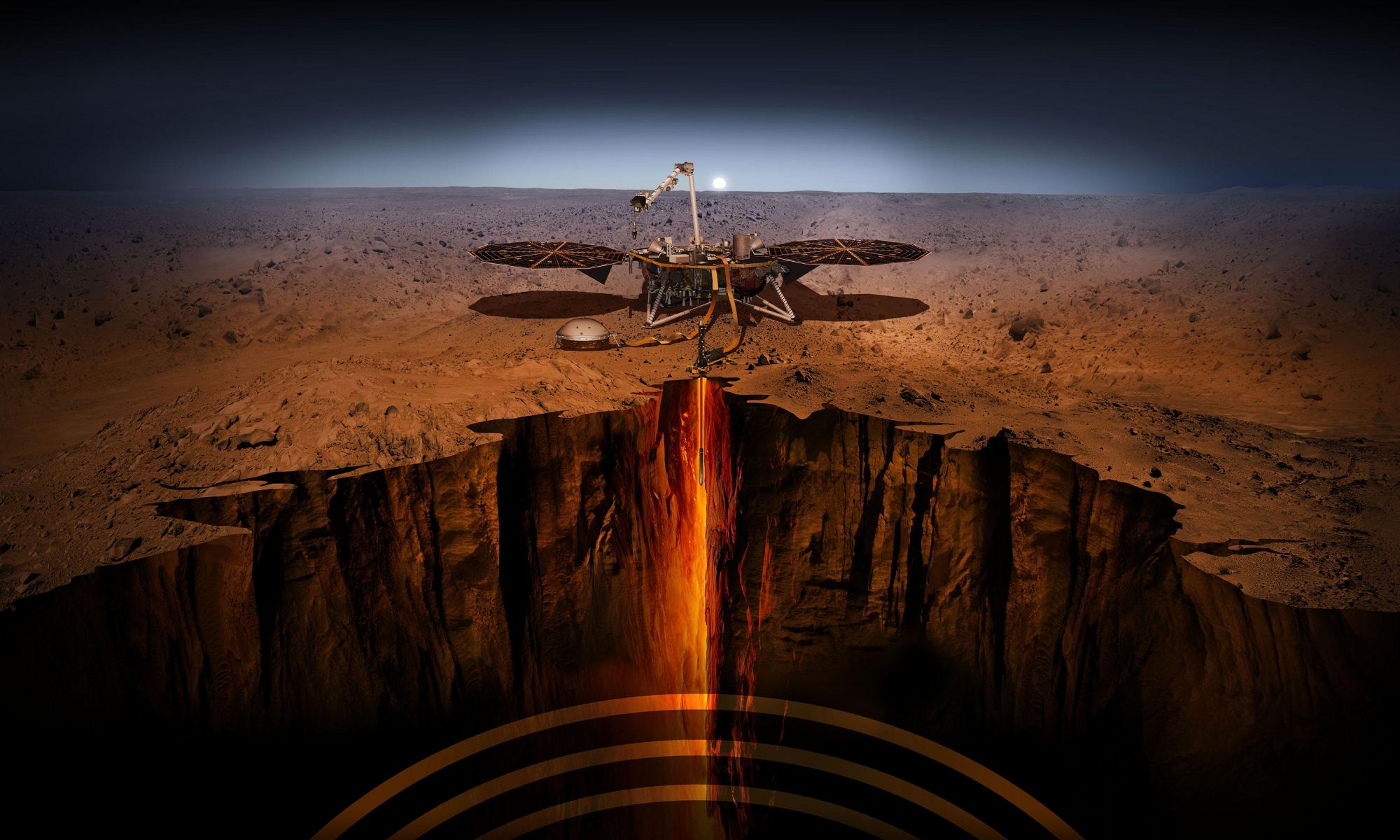
Artist's concept of InSight "taking the pulse of Mars". Credit: NASA/JPL-Caltech

Scientists Have Figured out why Martian Soil is so Crusty

On November 26th, 2018, NASA’s Interior Exploration using Seismic Investigations, Geodesy, and Heat Transport (InSight) mission landed on Mars. This was a major milestone in Mars exploration since it was the first time a research station had been deployed to the surface to probe the planet’s interior. One of the most important instruments InSight would use to do this was the Heat Flow and Physical Properties Package (HP3) developed by the German Aerospace Center (DLR). Also known as the Martian Mole, this instrument measured the heat flow from deep inside the planet for four years.

The HP3 was designed to dig up to five meters (~16.5 ft) into the surface to sense heat deeper in Mars’ interior. Unfortunately, the Mole struggled to burrow itself and eventually got just beneath the surface, which was a surprise to scientists. Nevertheless, the Mole gathered considerable data on the daily and seasonal fluctuations below the surface. Analysis of this data by a team from the German Aerospace Center (DLR) has yielded new insight into why Martian soil is so “crusty.” According to their findings, temperatures in the top 40 cm (~16 inches) of the Martian surface lead to the formation of salt films that harden the soil.

The analysis was conducted by a team from the Microgravity User Support Center (MUSC) of the DLR Space Operations and Astronaut Training Institution in Cologne, which is responsible for overseeing the HP3 experiment. The heat data it obtained from the interior could be integral to understanding Mars’s geological evolution and addressing theories about its core region. At present, scientists suspect that geological activity on Mars largely ceased by the late Hesperian period (ca. 3 billion years ago), though there is evidence that lava still flows there today.

image-1000-feb1f445714ec5375b4d52d8089f4c94.jpeg

The “Mars Mole,” Heat Flow and Physical Properties Package (HP³). Credit: DLR

This was likely caused by Mars’ interior cooling faster due to its lower mass and lower pressure. Scientists theorize that this caused Mars’ outer core to solidify while its inner core became liquid—though this remains an open question. By comparing the subsurface temperatures obtained by InSight to surface temperatures, the DLR team could measure the rate of heat transport in the crust (thermal diffusivity) and thermal conductivity. From this, the density of the Martian soil could be estimated for the first time.

The team determined that the density of the uppermost 30 cm (~12 inches) of soil is comparable to basaltic sand – something that was not anticipated based on orbiter data. This material is common on Earth and is created by weathering volcanic rock rich in iron and magnesium. Beneath this layer, the soil density is comparable to consolidated sand and coarser basalt fragments. Tilman Spohn, the principal investigator of the HP3 experiment at the DLR Institute of Planetary Research, explained in a DLR press release:

“To get an idea of the mechanical properties of the soil, I like to compare it to floral foam, widely used in floristry for flower arrangements. It is a lightweight, highly porous material in which holes are created when plant stems are pressed into it... Over the course of seven Martian days, we measured thermal conductivity and temperature fluctuations at short intervals.

“Additionally, we continuously measured the highest and lowest daily temperatures over the second Martian year. The average temperature over the depth of the 40-centimetre-long thermal probe was minus 56 degrees Celsius (217.5 Kelvin). These records, documenting the temperature curve over daily cycles and seasonal variations, were the first of their kind on Mars.”

NASA’s In­Sight space­craft land­ed in the Ely­si­um Plani­tia re­gion on Mars on 26 Novem­ber 2018. Credit: Credit: NASA-JPL/USGS/MOLA/DLR

Because the encrusted Martian soil (aka. “duricrust”) extends to a depth of 20 cm (~8 inches), the Mole managed to penetrate just a little more than 40 cm (~16 inches) – well short of its 5 m (~16.5 ft) objective. Nevertheless, the data obtained at this depth has provided valuable insight into heat transport on Mars. Accordingly, the team found that ground temperatures fluctuated by only 5 to 7 °C (9 to 12.5 °F) during a Martian day, a tiny fraction of the fluctuations observed on the surface—110 to 130 °C (230 to 266 °F).

Seasonally, they noted temperature fluctuation of 13 °C (~23.5 °F) while remaining below the freezing point of water on Mars in the layers near the surface. This demonstrates that the Martian soil is an excellent insulator, significantly reducing the large temperature differences at shallow depths. This influences various physical properties in Martian soil, including elasticity, thermal conductivity, heat capacity, the movement of material within, and the speed at which seismic waves can pass through them.

“Temperature also has a strong influence on chemical reactions occurring in the soil, on the exchange with gas molecules in the atmosphere, and therefore also on potential biological processes regarding possible microbial life on Mars,” said Spohn. “These insights into the properties and strength of the Martian soil are also of particular interest for future human exploration of Mars.”

What was particularly interesting, though, is how the temperature fluctuations enable the formation of salty brines for ten hours a day (when there is sufficient moisture in the atmosphere) in winter and spring. Therefore, the solidification of this brine is the most likely explanation for the duricrust layer beneath the surface. This information could prove very useful as future missions explore Mars and attempt to probe beneath the surface to learn more about the Red Planet’s history.


At Last! NASA Found What it Was Looking For on Mars | InSight Probe Supercut

Further Reading: 

{ https://www.universetoday.com/ }

Hoe vind je dit bericht?
Geschreven door peter om 12:44 Stuur door

Terrifying UFO Encounters: Lost Hours and Blinding Lights Haunt Witnesses

Terrifying UFO Encounters: Lost Hours and Blinding Lights Haunt Witnesses

ngcb1

Each year, about a million UFO sightings are reported worldwide. While most can be explained, a small percentage remain a mystery. Such was the case for two different groups—three Brazilian men who lost hours after encountering eerie lights, and a young boy in Quebec, Canada, who was temporarily blinded by a strange object with a powerful searchlight. Here’s a closer look at these spine-chilling experiences.

The Brazilian Fishermen’s Strange Encounter with Lost Time

In a remote part of southeastern Brazil, three friends, two of whom were off-duty police officers, set out on a covert fishing trip. Trespassing on private property, they intended to retrieve fish from nets they’d placed the night before. But the calm night was soon interrupted by an inexplicable light.

At first, the men assumed the glow was from a flashlight, perhaps carried by a security guard. However, as the light drew closer, it defied their expectations. Hovering above the treetops, this intense ball of light moved in a way no human could control. They immediately felt a chilling sense of danger. Local folklore had warned them about “The Mother of Gold,” a terrifying legend of glowing orbs that drain the blood and vitality of their victims.

Men Lose Hours After UFO Encounter with Glowing Lights | Close Encounters 208

Their initial response was to hide, but soon, more orbs appeared. Driven by fear, they jumped into the lake, seeking refuge underwater. But the glowing lights grew bolder, moving closer to where they were submerged. The men believed these objects were not of this world and felt their lives were truly at risk.

When the lights finally disappeared, the men tried to start their boat to return to safety. However, the engine wouldn’t start, and they discovered they had no fuel left. Exhausted and terrified, they made their way to town on foot. However, when they arrived, they found themselves in disbelief: what felt like mere minutes of horror had somehow spanned four hours. The men couldn’t explain this missing time, a detail that would haunt them.

In the following days, all three men experienced unsettling physical symptoms. One of them developed severe fevers, breathing difficulties, and even began to lose hair and show discoloration on his skin. Yet, medical checks found no explanation. Theories about their experience circulated, with some locals attributing it to low-flying aircraft, though a nearby pilot confirmed seeing similar lights on numerous occasions.

Blinding Light Strikes a Young Boy in Quebec

Hundreds of miles away in a small town in Quebec, 13-year-old Ivan Gendong had a startling encounter of his own. Left in charge of his younger sisters one evening, he noticed a strange noise outside—a loud buzzing, almost like an electrical surge. As he investigated, Ivan saw an intense light shining from the bathroom window. Peering out, he discovered the light’s source: a strange object hovering about 15 feet above the ground, partially obscured by the trees.

Initially, Ivan thought he was seeing things, but then a blinding light beamed directly into his face, leaving him temporarily sightless and overwhelmed by a piercing headache. Disoriented and terrified, he regained his vision only after several minutes. The object still loomed nearby but appeared surrounded by a strange, transparent dome of light, unlike anything he’d seen before.

The next day, Ivan’s parents returned home to find him visibly shaken. He experienced eye pain and even ringing in his ears for several days after the incident. Investigators later discovered damage to trees near where the object had hovered, adding credence to Ivan’s story. More locals reported similar sightings over the following months, describing mysterious bright lights in the area, lending further mystery to Ivan’s already strange encounter.

Unresolved Mysteries

Both of these experiences are among the 5% of UFO sightings that remain unexplained. They share elements often seen in reports of extraterrestrial encounters: missing time, physical symptoms, and strange lights with behavior defying conventional explanations. The Brazilian fishermen and the young boy in Quebec were left with lingering questions and physical aftereffects that would take time to heal—if they ever did. Whether or not these were genuine encounters with otherworldly beings, they serve as reminders of how little we know about what might be lurking beyond our understanding.

VIDEOS

Top 5 SCARIEST Alien Encounters | UFO Witness | Travel Channel

TERRIFYINGLY Graphic Witness Account of Alien Abduction | UFO Witness | Travel Channel

The Most Shocking UFO Reports With Chilling EVIDENCE | The Alaska Triangle

25 Undeniable Alien and UFO SIGHTINGS Caught on Camera | Shocking Footage!

{https://www.latest-ufo-sightings.net/ }

Hoe vind je dit bericht?
Geschreven door peter om 12:28 Stuur door

'Overlooked' clue on Tutankhamun's death mask that could re-define the boy-king's death

'Overlooked' clue on Tutankhamun's death mask that could re-define the boy-king's death

King Tutankhamun's death mask is one of the most iconic Egyptian relics, but researchers claim it may not have been intended for the late pharaoh. 

A team from the University of York in the UK say the holes in the ears of the mask suggest the mask was actually intended for a high status female or child rather, possibly King Tut's stepmother whose body has never been found.

They hypothesize that Tutankhamun's sudden death at 18 may have saw the shape of his face grafted on top of the true owner of the mask.

Professor Joann Fletcher said: 'This mask was not made for an adult male pharaoh when the gold was compared, [they found] the face is made of completely different gold to the rest.' 

The researchers arrived at the new theory after re-examining the historical records of the 1922 excavation, finding mentions of body modifications that did not align with ancient Egyptian tradition. 

One document in particular, caught the attention of Professor Fletcher, which read: 'Honed in on one long-overlooked feature... the decidedly pierced ears [on the death mask.'

While pharaohs wore earrings, the modifications were not carried over to the death mask. Piercings have only been on those made for the masks of queens and children. 

Professor Fletcher made the revelations in a newly released History Hit documentary, saying she was sure the death mask was not specifically designed for King Tut.

King Tutankhamun's death mask has pierced ears and is made of a type of gold that wasn't typically used for rulers

The mask was likely made for someone else and was re-molded to more closely resemble Tut. It was found in his tomb in the Valley of Kings in 1922

The idea, however, was first proposed in 2015 by Egyptologist Nicholas Reeves who claimed the gold face covering was originally made for Queen Nefertiti - the young king's stepmother. 

Nefertiti married Akhenaten, Tutankhamun's father, but her tomb has yet to be discovered.

King Tutankhamun ascended to the Egyptian throne at just nine years of age and ruled from 1332 BC to 1323 BC.

In 1922, British archaeologist Howard Carter discovered the mask in Tut's lavish tomb in the Valley of the Kings on the west bank of the Nile River.

A death mask was made for both pharaohs and the everyday person to honor the deceased and establish a connection with the spiritual world.

However, a pharaoh's mask was made of gold or silver, while lesser people's were fashioned from wood or clay.

They were created in the likeness of the person's face to help the deceased's soul return to their body so they could be judged by the Egyptian god Anubis.

In 1922, British archaeologist Howard Carter discovered the mask in Tut's lavish tomb in the Valley of the Kings on the west bank of the Nile River

In 1922, British archaeologist Howard Carter discovered the mask in Tut's lavish tomb in the Valley of the Kings on the west bank of the Nile River

Tut's mask featured a broad collar made of semiprecious stones and colored beads were inlaid throughout, and Tut was given a false beard made of gold.

Professor Joann Fletcher combed through Carter's burial records of King Tut to see if more discoveries could be made more than a century later.

The ear piercings caught her attention immediately as she is an Egyptologist who has been studying the ancient civilization for decades.

Famed pharaohs like King Tut's great-grandfather, Amenhotep III, and Ramses II were also found buried in death masks, but neither featured ear modifications.

And none of their statues were found with the piercings.

However, placement for the jewelry has been found etched in statues of queens, such as Nefertiti, and the death mask of Sobekneferu.

Professor Fletcher suggested that the clues on the mask meant King Tut's burial was rushed.

The young pharaoh was plagued with health issues due to Akhenaten marrying his sister who gave birth to the boy king.


Black blotches were found on the walls of the tomb, indicating that the paintings were rushed because of the pharaoh's untimely death

Black blotches were found on the walls of the tomb, indicating that the paintings were rushed because of the pharaoh's untimely death

King Tutankhamun died at just 19 years old from an infection that researchers believe stemmed from a broken leg

King Tutankhamun died at just 19 years old from an infection that researchers believe stemmed from a broken leg

While not proven, King Tut was believed to have a club foot, cleft palate, bone disease and scoliosis. 

article image

Some experts have suspected he was murdered, while others believe the health issues took a toll. 

Not only are there clues in the death mask about a rushed burial, archaeologists have documented blotches of paint on the wall that suggested it hadn't dried when the tomb was quickly sealed.

The size of the lavish burial was also much smaller than what was expected for a pharaoh of Tut's stature. 

'This is the tomb that was intended for Tutankhamun, the tomb of Ay,' Prof Fletcher explained.

'To deepen the enigma, dark spots are scattered across the walls of King Tut's tomb marks that scores of experts point to as a sign the paint was still wet when the tomb was sealed, hinting at the hurried nature of its completion.'

VIDEOS

Archaeologists discover incredible 'overlooked feature' on Tutankhamun's death mask

What is the mystery of the Tutankhamun’s Death Mask?

The first ever view inside Tutankhamun's tomb in Egypt | BBC Global

{ https://www.dailymail.co.uk/ }

Hoe vind je dit bericht?
Geschreven door peter om 23:32 Stuur door

Mysterious 'donut' structure is discovered hidden inside Earth's core - and it could unlock the secrets of our planet's protective magnetic field

Mysterious 'donut' structure is discovered hidden inside Earth's core - and it could unlock the secrets of our planet's protective magnetic field

  • Researchers discovered a donut-shaped region at the ceiling of the outer core 
  • This lighter region helps stir the liquid metal which generates the magnetic field  

Scientists have uncovered a vast donut-shaped structure buried thousands of miles beneath our feet.

Researchers from the Australian National University used seismic waves generated by earthquakes to peer into the Earth's mysterious molten core.

By tracing the path of these waves through the planet, the researchers found a region a few hundred kilometres thick where they travelled two per cent slower than normal

This donut-like structure runs parallel to the equator in a ring around the edge of the liquid outer core, and could be responsible for driving our planet's protective magnetic field.

Professor Hrvoje Tkalčić, lead author of the study, says: 'The magnetic field is a fundamental ingredient that we need for life to be sustained on the surface of our planet.'

Scientists have discovered a previously undetected donut-shaped region buried within the Earth which could be responsible for helping generate Earth's magnetic field (stock image)

Scientists have discovered a previously undetected donut-shaped region buried within the Earth which could be responsible for helping generate Earth's magnetic field (stock image)

Researchers found a region hundreds of kilometres thick and thousands of kilometres deep which wraps around the equator in a torus shape (labelled 'low velocity donut')

Researchers found a region hundreds of kilometres thick and thousands of kilometres deep which wraps around the equator in a torus shape (labelled 'low velocity donut')

article image

The Earth is made up of four major layers: the surface crust, the semi-molten mantle, a liquid metal outer core, and a solid metal inner core.

When the movement of tectonic plates in the crust creates earthquakes, these produce vibrations that spread out through all the other layers of the Earth.

Using the worldwide network of seismographic stations, researchers can see how the waves spread and make predictions about the conditions below the surface.

Scientists usually only look at the big, powerful wavefronts which travel around the world in the first hour or so after an earthquake.

However, Professor Tkalčić and his co-author Dr Xiaolong Ma were able to detect this structure by studying the faint traces left behind by waves many hours after the initial tremor.

This method revealed that seismic waves travelling near the poles were moving faster than those near the equator.

The donut was detected by using measurements of seismic waves triggered by earthquakes around the world (pictured top) by analysing this data the researchers found a speed difference between the waves travelling by the poles (bottom left) and those travelling by the equator (bottom right)

The donut was detected by using measurements of seismic waves triggered by earthquakes around the world (pictured top) by analysing this data the researchers found a speed difference between the waves travelling by the poles (bottom left) and those travelling by the equator (bottom right) 

By comparing their results to different models of the Earth's interior, Professor Tkalčić and Dr Ma found that this was best explained by the presence of a vast underground 'torus', or donut-shaped, region.

They predict that this region is only found at low latitudes and runs parallel to the equator near the ceiling of the outer core where the liquid section meets the mantle.

'We don't know the exact thickness of the doughnut, but we inferred that it reaches a few hundred kilometres beneath the core-mantle boundary,' Professor Tkalčić says.

Thanks to this region's critical role, their discovery may also have profound implications for the study of life on Earth and other planets.

Earth's outer core has a radius of around 2,160 miles (3,480km) - making it slightly larger than Mars.

The best explanation for this data was the presence of an area of low-density material (pictured in red) sitting near the surface of the Earth's liquid outer core

The best explanation for this data was the presence of an area of low-density material (pictured in red) sitting near the surface of the Earth's liquid outer core 

The Earth's inner and outer cores are responsible for generating the planet's magnetic field, without which no life on Earth would be possible

The Earth's inner and outer cores are responsible for generating the planet's magnetic field, without which no life on Earth would be possible 

article image

Mainly made of hot nickel and iron, convection currents coupled with the Earth's rotation force the liquid metal in this layer into long vertical vortices running in a north-south direction, like giant waterspouts.

It is the swirling currents of these liquid metals which act like the dynamo, powering the Earth's magnetic field.

Since this donut region has 'floated' to the top of the liquid outer core, it suggests that it could be rich in lighter elements like silicon, sulphur, oxygen, hydrogen or carbon.

Professor Tkalčić says: 'Our findings are interesting because this low velocity within the liquid core implies that we have a high concentration of light chemical elements in these regions that would cause the seismic waves to slow down.

The researchers believe that the donut -shaped region might be partially responsible for stirring the liquid metal in the outer core into the waterspout-like vortexes which generate the planet's magnetic field

The researchers believe that the donut -shaped region might be partially responsible for stirring the liquid metal in the outer core into the waterspout-like vortexes which generate the planet's magnetic field 

The Earth's magnetic field (pictured) deflects the charged particles carried by solar wind which can destroy the DNA of living creatures

The Earth's magnetic field (pictured) deflects the charged particles carried by solar wind which can destroy the DNA of living creatures 

article image

'These light elements, alongside temperature differences, help stir liquid in the outer core.'

Without that stirring motion to drive the planet's interior dynamo, the Earth's magnetic field might not have formed.

Without the magnetic field, the planet's surface would be exposed to a constant bombardment of charged particles from the sun which can destroy the DNA of living creatures.

This donut-shaped region, therefore, might be a critical piece of the puzzle which explains why life has developed on Earth and what we might look for in habitable planets elsewhere.

Dr Tkalčić concludes: 'Our results could promote more research about the magnetic field on both Earth and other planets.'

EARTH'S LIQUID IRON CORE CREATES THE MAGNETIC FIELD

Our planet's magnetic field is believed to be generated deep down in the Earth's core.

Nobody has ever journeyed to the centre of the Earth, but by studying shockwaves from earthquakes, physicists have been able to work out its likely structure.

At the heart of the Earth is a solid inner core, two thirds of the size of the moon, made mainly of iron. 

At 5,700°C, this iron is as hot as the Sun's surface, but the crushing pressure caused by gravity prevents it from becoming liquid.

Surrounding this is the outer core there is a 1,242 mile (2,000 km) thick layer of iron, nickel, and small quantities of other metals. 

The metal here is fluid, because of the lower pressure than the inner core.

Differences in temperature, pressure and composition in the outer core cause convection currents in the molten metal as cool, dense matter sinks and warm matter rises.

The 'Coriolis' force, caused by the Earth's spin, also causes swirling whirlpools.

This flow of liquid iron generates electric currents, which in turn create magnetic fields.

Charged metals passing through these fields go on to create electric currents of their own, and so the cycle continues.

This self-sustaining loop is known as the geodynamo.

The spiralling caused by the Coriolis force means the separate magnetic fields are roughly aligned in the same direction, their combined effect adding up to produce one vast magnetic field engulfing the planet.

VIDEOS

Mysterious 'Donut' Structure Found Inside Earth's Core!

Scientists Uncover Mysterious Doughnut Structure in Earth’s Outer Core!

Mysterious 'Donut' Structure Found Hidden Inside Earth's Core!

{ https://www.dailymail.co.uk/ }

Hoe vind je dit bericht?
Geschreven door peter om 23:14 Stuur door

Meer van UFO'S of UAP'S, ASTRONOMIE, RUIMTEVAART, ARCHEOLOGIE, OUDHEIDKUNDE, SF-SNUFJES EN ANDERE ESOTERISCHE WETENSCHAPPEN - DE ALLERLAATSTE NIEUWTJES

↑ Terug naar de berichten