Naar de inhoud

UFO'S of UAP'S, ASTRONOMIE, RUIMTEVAART, ARCHEOLOGIE, OUDHEIDKUNDE, SF-SNUFJES EN ANDERE ESOTERISCHE WETENSCHAPPEN - DE ALLERLAATSTE NIEUWTJES

UFO's of UAP'S in België en de rest van de wereld
akke.beakke.be
Ontdek de Fascinerende Wereld van UFO's en UAP's: Jouw Bron voor Onthullende Informatie! Ben jij ook gefascineerd door het onbekende? Wil je meer weten over UFO's en UAP's, niet alleen in België, maar over de hele wereld? Dan ben je op de juiste plek! België: Het Kloppend Hart van UFO-onderzoek In België is BUFON (Belgisch UFO-Netwerk) dé autoriteit op het gebied van UFO-onderzoek. Voor betrouwbare en objectieve informatie over deze intrigerende fenomenen, bezoek je zeker onze Facebook-pagina en deze blog. Maar dat is nog niet alles! Ontdek ook het Belgisch UFO-meldpunt en Caelestia, twee organisaties die diepgaand onderzoek verrichten, al zijn ze soms kritisch of sceptisch. Nederland: Een Schat aan Informatie Voor onze Nederlandse buren is er de schitterende website www.ufowijzer.nl, beheerd door Paul Harmans. Deze site biedt een schat aan informatie en artikelen die je niet wilt missen! Internationaal: MUFON - De Wereldwijde Autoriteit Neem ook een kijkje bij MUFON (Mutual UFO Network Inc.), een gerenommeerde Amerikaanse UFO-vereniging met afdelingen in de VS en wereldwijd. MUFON is toegewijd aan de wetenschappelijke en analytische studie van het UFO-fenomeen, en hun maandelijkse tijdschrift, The MUFON UFO-Journal, is een must-read voor elke UFO-enthousiasteling. Bezoek hun website op www.mufon.com voor meer informatie. Samenwerking en Toekomstvisie Sinds 1 februari 2020 is Pieter niet alleen ex-president van BUFON, maar ook de voormalige nationale directeur van MUFON in Vlaanderen en Nederland. Dit creëert een sterke samenwerking met de Franse MUFON Reseau MUFON/EUROP, wat ons in staat stelt om nog meer waardevolle inzichten te delen. Let op: Nepprofielen en Nieuwe Groeperingen Pas op voor een nieuwe groepering die zich ook BUFON noemt, maar geen enkele connectie heeft met onze gevestigde organisatie. Hoewel zij de naam geregistreerd hebben, kunnen ze het rijke verleden en de expertise van onze groep niet evenaren. We wensen hen veel succes, maar we blijven de autoriteit in UFO-onderzoek! Blijf Op De Hoogte! Wil jij de laatste nieuwtjes over UFO's, ruimtevaart, archeologie, en meer? Volg ons dan en duik samen met ons in de fascinerende wereld van het onbekende! Sluit je aan bij de gemeenschap van nieuwsgierige geesten die net als jij verlangen naar antwoorden en avonturen in de sterren! Heb je vragen of wil je meer weten? Aarzel dan niet om contact met ons op te nemen! Samen ontrafelen we het mysterie van de lucht en daarbuiten.

Archief

Remember that “Alien Signal” Sent by the ExoMars Orbiter Last Year? It’s Just Been Decoded

The Sign in Space message has finally been decoded. Credit: A Sign in Space

Remember that “Alien Signal” Sent by the ExoMars Orbiter Last Year? It’s Just Been Decoded

In May 2023, the ESA’s Exomars Trace Gas Orbiter (TGO), currently in orbit around Mars, sent a signal to Earth to simulate a possible extraterrestrial transmission. As part of the multidisciplinary art project “A Sign in Space,” the purpose was to engage citizen scientists in helping to decode it. The campaign was inspired by Cosmicomics by Italian writer/journalist Italo Calvino, a series of short stories exploring various scientific principles. The project is partnered with the SETI Institute, the Green Bank Observatory, the European Space Agency (ESA), and the Istituto Nazionale di Astrofisica (INAF).

After three radio astronomy observatories on Earth intercepted the message, the challenge was to extract the message from the raw data of the radio signal and then decode it. After ten days, more than 5000 citizen scientists worldwide gathered online and used their combined resources to extract the signal. After a year of attempts, two U.S. citizens – the father-daughter team of Ken and Keli Chaffin – managed to crack the code after days of simulations. They discovered that the message consisted of five clusters of white dots and lattices against a black background, suggesting cellular formation and life!

The project was founded by Daniela de Paulis, a media artist and licensed radio operator currently serving as the Artist in Residence at the SETI Institute and the Green Bank Observatory. Daniela and a small group of astronomers and computer scientists crafted the message with support from the ESA, the SETI Institute, and the Green Bank Observatory. On June 7th, 2024, she received the decoded image, which depicted five amino acids—the very building blocks of life—in a retro-like format.

Ken Chaffin included the following message with the solution he and his daughter submitted:

“My decoded message is a simple image with 5 amino acids displayed in a universal (hopefully) organic molecular diagram notation and a few single pixel points that appear between the clusters and molecular diagrams. I used a Margolus reversible 2×2 block cellular automata (BCA) with the simplest reversible rule, which is called ‘single point (CCW) rotation,’ acting only on 2×2 cells that contain only a single point or pixel per the header instructions, conserving pixel or point count, 625 pixels in and 625 out. The starmap image appears to have the molecular forms encoded in a 3D local degree of freedom set of basis vectors (also shown in the header).

“The CA effectively transforms and projects this 3D info onto a 2D plane. I can run my Unity game engine based simulator forwards (CCW rotation) and backwards (CW rotation) in time and transform the starmap representation to the amino acid diagrams in 6625 generations and reverse the rotation process to transform the amino acid diagrams back to the starmap image in 6625 generations. I say starmap but I really read from the binary message file each run. The decoded image is only visible for 1 frame lasting about 1/10th of a second, but I can pause and manually step as well as reverse my CA engine…Here is a screen capture of my decoded image [see below].

“The ‘blocks’ have 1, 6, 7, or 8 ‘pixels’ representing the atomic number of hydrogen, carbon, nitrogen, and oxygen. Single and double bonds are designated as single and double lines. C-H bond angle is indicated with a caret ^ sign. These signs were produced by the CA. I have not edited the image in any way. It’s absolutely obvious to me what this is, as well as to my chemist friend I ran this by. It is amazing to watch all of the CA gliders or spaceships carry the binary bits of the message all over the ‘galaxy’ and then suddenly come together in coherence and meaning…”

The image shows the Chaffis solution. Credit: A Sign in Space

Now that the tasks of extracting and decoding the message are complete, Daniela and her colleagues are taking a step back to observe how citizen scientists are shaping the challenge. The next step is to interpret the message and determine what it was meant to convey, a task that currently remains open. According to the project team, there are several ways for the public to engage, which include using the description and solution provided by the Chaffins to conduct independent analysis and post the results on the project’s Discord channel.

Participants must include a description of the method they used so that their approach can be replicated and verified. The possibilities are endless, ranging from an attempt at communication, cultural exchange, or a threat of invasion. Ultimately, this exercise aims to determine whether or not humanity is ready to make first contact with an alien civilization.

Further Reading: 

{ https://www.universetoday.com/ }

Hoe vind je dit bericht?
Geschreven door peter om 21:56 Stuur door

China’s ‘Thousand Sails’ Joins Starlink as the Latest Mega-Satellite Constellation in Orbit

Sails

China’s ‘Thousand Sails’ Joins Starlink as the Latest Mega-Satellite Constellation in Orbit

With ‘Thousand Sails,’ China joins the race to fill up Low Earth Orbit with mega-satellite constellations.

It’s getting crowded up there in Low Earth orbit (LEO). By now, flocks of Starlinks have become a familiar sight, and the bane of astrophotographers as the ‘vermin of the skies.’ Now, several new competitors have joined the fray, with more waiting in the wings.

Perhaps, you’ve seen one of these curious-looking ‘satellite trains,’ and wondered what they were. Certainly, the advent of satellite trains courtesy of Starlink have added to the annals of purported UFO videos shot via smartphone across YouTube. Now, more agencies worldwide are getting into the game in 2024, assuring that the next ‘star’ you wish on at dusk may, in fact, be an artificial satellite.

Approaching An Artificial Sky

Streaks and trails due to the increasing number of Starlinks in orbit have also become a standard feature in modern deep sky images. While techniques to remove these have been pioneered by astrophotographers, these will continue to impact deep sky astronomy. This impact extends to sky surveys soon set to come online such as the Vera Rubin Observatory, set to see first light early next year in 2025.

Nick James The first batch of Thousand Sails satellites in orbit, shortly after launch. Credit: Nick James.

SpaceX has implemented mitigation plans in response, including use of sun visors on first generation satellites, diffuse ‘dielectric mirror’ material on newer Version 2 (V2) platforms, and angling solar arrays. These have seen some success. Certainly, spotters have noted that the new Version 2’s have a bluer tint, and seem to shine at magnitude +7 once they’re boosted into their respective orbital slots. This is near the +7 magnitude threshold called for by the National Science Foundation (NSF) and the International Astronomical Union (IAU).

Radio noise from these new communications satellite constellations is also an issue that astronomers now have to contend with. LOFAR (The Netherlands Institute for Astronomy’s Low Frequency Array) notes that “new observations with the LOFAR radio telescope…have shown that the second generation ‘V2-mini’ Starlink satellites emit up to 32 brighter unintended radio waves than satellites from the previous generation.”

Enter China’s ‘Thousand Sails’ Initiative

China also recently joined the competition in LEO, with the launch of a Long March-6 rocket from Taiyuan Satellite Launch Center with 18 satellites for Shanghai Spacecom Satellite Technology (SSST). This is part of the company’s ‘Thousand Sails’ initiative.

Sails The first batch of Thousand Sails satellites head to orbit. Credit: CNSA.

Dubbed China’s answer to Starlink, This will see an initial 1,296 satellites for the constellation placed in orbit by 2027. The company also has plans to expand the network to 12,000 satellites into the 2030s. This first batch went into a polar (sun-synchronous) orbit, and the resulting satellite train was spotted in orbit shortly after launch.

1000 Sails The Long March 6A booster fuel dump from the first Thousand Sails deployment, shortly after launch. Credit: Dan Bush/Missouri Skies.

And there’s more in store. China also launched a Long March 6 rocket on September 5th, with 10 new satellites for Geely Group Automotive. These are part of the company’s effort to build a communication network for autonomous vehicles.

Geegly Group An artist’s impression of Geely Group satellites in orbit. Credit: Geely Group.

As a follow-on this month, China also launched a Long March-6 rocket on October 15th with another batch of 18 satellites headed into a polar orbit. This group is also part of the Thousand Sails constellation. Satellite spotters have already tracked these in orbit, with an estimated brightness of up the +4th magnitude when near the zenith on a visible pass. Keep in mind, China isn’t beholden to any obligations to mitigate the impact that satellite constellations might have on the night sky…nor do any formal international standards exist.

More Mega Satellite Constellations to Come

Not to be outdone, SpaceX is putting up more than just Starlink. Last month, SpaceX launched a Falcon 9 rocket on September 12th, with the first five Bluebird satellites. These are ASTMobile’s follow-on to the BlueWalker-3 test satellite, still in orbit. With a phased-array antenna 10-meters across when deployed, BlueWalker-3 reaches magnitude 0. The company plans to put 110 of these potentially brilliant Bluebirds in orbit over the next few years.

BlueWalker 3 A Bluewalker antenna unfolded on Earth. Credit: ASTMobile.

OneWeb is also still putting satellites in orbit. The ongoing Russia-Ukraine War has forced the company to forego Soyuz launches. Instead, OneWeb now relies on competitor SpaceX to get into orbit.

The OneWeb satellite constellation currently hosts 660 satellites in orbit, right around the initial target number set by the company Eutelsat-OneWeb for nominal operation. The company began offering services through residential providers last year, including Hughesnet, Viasat and ironically, Starlink.

Starlink’s current status is 7,125 satellites in orbit, with 23 more planned tonight with the launch of Starlink Group 6-61 from the Cape. 12,000 satellites in orbit are planned for in the coming years, and the constellation could extend to a total of 34,400 satellites in future years.

Not to be outdone, the Unites States’ Department of Defense is putting its own dedicated satellite constellation in space. Dubbed Starshield, the network already has 73 satellites in orbit, and a total of more than a 100 are planned. As expected, the DoD is already shaping up to be Starlink’s (and SpaceX’s) biggest customer.

Hunting Satellite Trains

Other bright reflectors are making themselves seen in the night sky as well. ACS-3 (the Advanced Composite Solar Sail System) was launched this past April on a Rocket Lab Electron rocket. The mission successfully unfurled this summer on August 29th. ACS-3 is the latest in a batch of satellites to attempt to test solar sail technologies in orbit. Mission planners could use this tech on future missions for maneuvering, propulsion or reentry disposal. Previous missions, including NanoSail-D2 and Planetary Society’s Light Sail have struggled with this tech, demonstrating just how difficult it’s turning out to be.

ACS-3 is definitely tumbling: we’ve seen it flare up to 0 magnitude (as bright as Vega) on a good pass. This seems to be very angle dependent.

You can track these missions and more on Heavens-Above. The leaders for the first two batches of respective Thousand Sail groups are 2024-140A and 2024-145A. Plus, Heavens-Above tracks Starlink batches (which are once again going up at a furious rate) on a dedicated page. We saw the most recently launched Starlink Group Batch 8-19 this past weekend… and that was from under the bright lights of downtown Bristol, Tennessee.

The Promise and Peril of Mega-Sat Constellations

To be sure, we’re a huge consumer of roaming WiFi. If we can continue our career and online exploits from a remote basecamp, then that’s a good thing… but there also needs to be oversight when it comes to what we’re collectively doing to our night sky as a resource.

Are we headed towards a future where artificial stars in the night sky outnumber real ones? Perhaps, the best thing that amateur satellite trackers can do now, is to chronicle what’s happening, as the Anthropocene era leaves its mark on a brave new night sky.

{ https://www.universetoday.com/ }

Hoe vind je dit bericht?
Geschreven door peter om 21:53 Stuur door

Did Some of Earth’s Water Come from the Solar Wind?

The Sun releases a steady stream of charged particles called the Solar Wind. When it strikes unprotected surfaces like asteroids or the Moon, it can change the chemistry and even create water molecules. Image Credit: NASA’s Goddard Space Flight Center/Mary Pat Hrybyk-Keith

Did Some of Earth’s Water Come from the Solar Wind?

The source of Earth’s water is an enduring mystery that extends to exoplanets and the notion of habitability. In broad terms, Earth’s water was either part of the planet from the beginning of its formation in the solar nebula or delivered later, maybe by asteroids and comets.

New research suggests that the Sun’s relentless solar wind could’ve played a role.

Scientists have worked hard to understand how Earth has so much life-giving water. There’s lots of research supporting the asteroid/comet delivery scenario. There’s also evidence that it accumulated water as it grew. During its accretion phase, it may have absorbed water-rich planetesimals.

To try to understand how Earth’s water fits into the history of the planet and the Solar System, researchers examine the isotope ratio on Earth and in meteorites. The isotopic composition of Earth’s water is most similar to primitive meteorites. On the other hand, it’s different from that of comets and nebular gas.

This implies that Earth’s water came from the same cosmochemical reservoir that is also the source of primitive meteorites.

It’s a complicated issue. Maybe Earth’s water has multiple sources. Maybe some of it was created in space long after Earth and the rest of the Solar System formed, and then delivered to Earth.

New research in The Astrophysical Journal explores how water can be created by the solar wind as it strikes surfaces holding oxygen-containing minerals. It’s titled “Stellar Wind Contribution to the Origin of Water on the Surface of Oxygen-containing Minerals.” The lead author is Svatolpuk Civiš from the J. Heyrovský Institute of Physical Chemistry at the Czech Academy of Sciences in Prague.

The solar wind is a steady stream of charged particles—mostly protons and electrons—that come from the Sun. H+ ions, which are simply protons, are the most abundant particles in the solar wind. They make a big contribution to the solar wind’s properties. Could the wind trigger the creation of water molecules?

The researchers performed laboratory experiments to find out. They tested 14 oxygen-containing minerals. “To investigate the process of water formation on the surface of oxidic materials and water abundances, we used the technique of surface bombardment with hydrogen or deuterium atoms and ions,” the authors write in their paper.

The list of materials tested in the laboratory. Note that two of the samples are meteorites and that one of the samples, TiO2 P25 anatase, did not produce water in its discharge. Image Credit: Civiš et al. 2024. The list of materials tested in the laboratory. Note that two of the samples are meteorites and that one of the samples, TiO2 P25 anatase, did not produce water in its discharge. Image Credit: Civiš et al. 2024.

The experiments had two phases: the first tested whether the minerals would produce water when exposed to the solar wind, and the second tested their adsorption capacity. Separate from absorption, adsorption is the adhesion of a sample to a surface.

The team produced water and then measured it using two methods: a microwave (MW) discharge experiment and sputter gun irradiation. They tested the results with a type of spectrometry analysis called Fourier-transform infrared spectrometry (FTIR) and temperature-programmed desorption (TPD) analysis.

“Both these experiments include a mineral sample bombarded by hydrogen/deuterium ions, which, among other possibilities, react with surface oxygens in the mineral lattice and form water molecules,” the authors write.

This figure illustrates the two types of laboratory tests. The left panel shows the MW discharge method and the right panel shows the Ion sputter gun method. Image Credit: Civiš et al. 2024.

This figure illustrates the two types of laboratory tests. The left panel shows the MW discharge method and the right panel shows the Ion sputter gun method. Image Credit: Civiš et al. 2024.

The oxide material samples were not only exposed to the strong current of H, H+ and molecular hydrogen that mimic the solar wind. They were also exposed to intense visible and UV radiation generated in the hydrogen discharge.

“The stellar wind irradiation of rocky oxygen-containing minerals results in a reaction between H+ ions and silicate minerals to produce water and OH, which could explain the presence of water in the regoliths of airless worlds such as the Moon, as well as the water abundances in asteroids,” the authors write.

Previous research has established that a chemical reaction occurs between hydrogen ions and silicate minerals when rocky materials are exposed to solar wind irradiation. Some researchers have observed the formation of OH (hydroxide) and water, while others have only found OH. This research goes deeper by testing the rocky materials for water adsorption.

The researchers tested the samples’ water adsorption capacity. Then, they calculated how much material would need to reach Earth to account for the amount of water on contemporary Earth.

“Besides material acquired by the Earth during accretion, the solar wind origin of water and its delivery to Earth could have gone on even during post-accretional bombardment,” the authors write. Here, they’re referring to the hypothetical Late Heavy Bombardment.

Previous research shows that ” asteroid and comet impacts during the classical Late Heavy Bombardment would bring in about ?1020 kg of material,” the authors write. “If that material’s surface was fully saturated with adsorbed water as composed of one of our minerals, our calculations suggest that at least one ocean equivalent of water could have been brought in.”

This schematic from the research shows how the solar wind can create water molecules on rocky bodies like asteroids. The water is adsorbed into a thin film and adheres to the asteroid. Eventually, some of this water is delivered to Earth by impacts. Image Credit: Civiš et al. 2024.

This schematic from the research shows how the solar wind can create water molecules on rocky bodies like asteroids. The water is adsorbed into a thin film and adheres to the asteroid. Eventually, some of this water is delivered to Earth by impacts. Image Credit: Civiš et al. 2024.

There’s not much doubt about the results of these tests and the ability of the solar wind to create water.

“The results of the experiments summarized in this work, focused on surface bombardment with hydrogen atoms, clearly confirm the theory of the interaction of excited hydrogen or deuterium Rydberg atoms and ions with the surface oxygens of oxide minerals,” the authors explain. “Our experiments attempt to explain the origin of water in the areas of oxygen-containing solid material (e.g., dust, meteoroids, asteroids, comets) exposed to a stream of charged particles close to a parent star.”

Earth’s atmosphere and magnetosphere shield it from the solar wind, so there’s no way the wind could’ve created water right on Earth’s surface. However, as the study shows, the wind can create water on the surface of other bodies like asteroids, and the water can be adsorbed and held firm, then delivered to Earth via impacts.

“This scenario is also applicable to the origin of water on Earth,” the authors write. “Due to this effect, a water molecule can be adsorbed on the surface of oxygen-containing particles and then transported over long distances and times,” the researchers write.

This study won’t be the end of the ongoing effort to account for Earth’s water. In a fascinating roundabout way, this research brings us back to asteroids and meteorites delivering Earth’s water. If it can happen here, it can happen on exoplanets elsewhere in the galaxy.

{ https://www.universetoday.com/ }

Hoe vind je dit bericht?
Geschreven door peter om 21:40 Stuur door

Add Astronaut Nutrition to the List of Barriers to Long-Duration Spaceflight

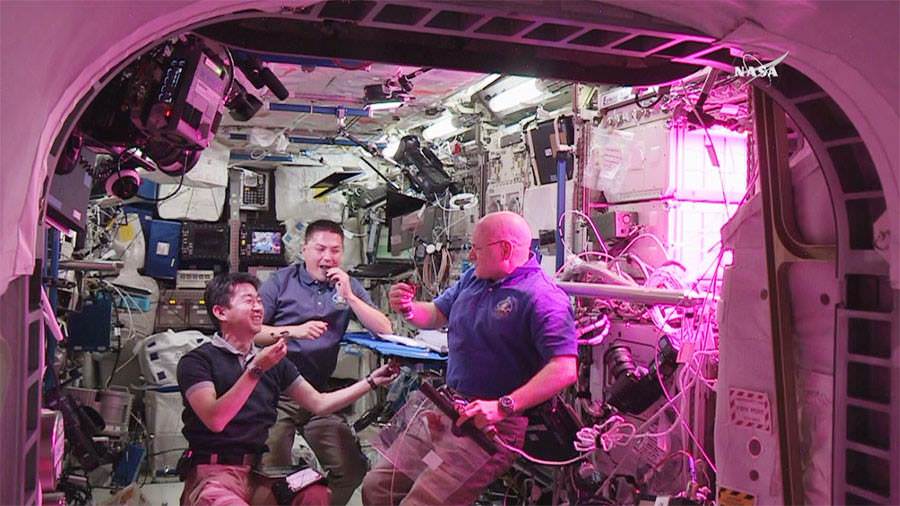
NASA Astronauts Kjell Lindgren (center) and Scott Kelly (right) and Kimiya Yui (left) of Japan consume space grown food for the first time ever, from the Veggie plant growth system on the International Space Station in August 2015. Credit: NASA TV

Add Astronaut Nutrition to the List of Barriers to Long-Duration Spaceflight

Though there are no firm plans for a crewed mission to Mars, we all know one’s coming. Astronauts routinely spend months at a time on the ISS, and we’ve learned a lot about the hazards astronauts face on long missions. However, Mars missions can take years, which presents a whole host of problems, including astronaut nutrition.

Nutrition can help astronauts manage spaceflight risks in the ISS, but long-duration missions to Mars are different. There can be no resupply.

In physiological terms, low gravity and radiation exposure are the two chronic hazards astronauts face on the ISS. Low gravity can lead to muscle loss and bone density loss, and radiation exposure increases the risk of developing cancer and other degenerative diseases. When astronauts make the trip to Mars, each leg of the journey can take 6 or 7 months, and they may stay on Mars for 500 days.

This dwarfs the eight days that the Apollo 11 astronauts spent in space. These long trips will tax astronauts’ health and NASA is working to understand what role nutrition can play in helping astronauts stay healthy and manage the risks.

Their current work on astronaut nutrition is a freely available PDF book titled “Human Adaptation to Spaceflight: The Role of Food and Nutrition—2nd Edition.” Its four authors are all researchers working in nutrition, biochemistry, biomedical research, space food systems, and preventative health.

“The importance of nutrition in exploration has been documented repeatedly throughout history, on voyages across oceans, on expeditions across polar ice, and on treks across unexplored continents,” the authors write.

Scientists have learned a lot about nutrition since the age of sailing and exploration, but the authors write that “a key difference between past journeys and space exploration is that astronauts are not likely to find food along the way.” This means that understanding astronaut nutritional requirements and food system requirements on long journeys is “as critical to crew safety and mission success as any of the mechanical systems of the spacecraft itself.”

The book examines the unique challenges astronauts face and presents data from multiple studies that are analogous to those challenges. For example, nutrition research from Antarctica duplicates the isolation and lack of sunlight astronauts can face on long missions, and head-down tilt-bed rest duplicates the musculoskeletal disuse they must endure.

This figure shows how HDT bed rest is used as an analogue for astronauts during long-duration microgravity spaceflight. Image Credit: Hargens AR et al. 2016. This figure shows how HDT bed rest is used as an analogue for astronauts during long-duration microgravity spaceflight. Image Credit: Hargens AR et al. 2016.

Astronauts face a long list of health risks on long-duration spaceflights. Radiation exposure and its cancer risk and microgravity and its effect on muscle and bone are the most well-known risks. But there are other lesser-known risks, too.

Astronauts can suffer from neuro-ocular syndrome, their immune systems can be weakened, and their gut biota can change. All of these conditions are linked with nutrition. While scientists don’t have a complete understanding of how everything works, it’s clear that nutrition plays a role. The book outlines the types of research being done and what the current understanding is. But the authors are clear about one thing: the system of providing astronauts with proper nutrition needs work.

ISS astronauts, except for Russians, get part of their food in Crew Specific Menu (CSM) containers that each astronaut orders. They provide between 10% and 20% of their food. They also receive a small supply of fresh foods and limited shelf-life foods on each re-supply mission. This has increased the variety of foods for astronauts and helped with nutrition, but astronauts still say they’d like more CSM and fresh foods.

Here in the developed world on Earth, it’s fairly straightforward to meet nutritional needs. Most of us have access to supermarkets and/or farmer’s markets where we can buy fresh produce and other healthy foods. That same variety simply isn’t available in space. ISS astronauts have done some experimental “farming” and have successfully grown a few food plants like lettuce, kale, and cabbage. However, that’s a long way away from growing enough food to help with nutrition, especially on a Mars mission, where presumable space and payload will be at a premium.

Crops successfully grown in Veggie include lettuce, Swiss chard, radishes, Chinese cabbage and peas. Image Credit: NASA

Crops successfully grown in Veggie include lettuce, Swiss chard, radishes, Chinese cabbage and peas. Image Credit: NASA

One obvious question about astronaut nutrition is whether supplements can replace nutritious food. The authors present evidence that discredits that idea. “Many previous studies have shown that the complex synergistic benefits provided by whole foods cannot be replicated by supplements,” they write. In fact, in some instances, supplements can be dangerous. “Recent studies have also found that supplementation with certain antioxidants such as vitamin E and vitamin A can increase risks of cancer and all-cause mortality,” the authors explain.

The need for a space food system goes beyond nutrition. There are social and well-being benefits, too. Knowing that you have access to a variety of healthy foods keeps morale up. The ability to share or trade high-value food items with your fellow astronauts can create goodwill and a desire to cooperate. Think of sharing a meal with friends or family and all the social connection it provides.

According to the authors, there’s currently no solution to the nutrition roadblock for Mars missions. In fact, there’s currently no system designed to supply astronauts with the needed nutrition for any long-duration spaceflight. “Currently, no food system exists to meet the nutrition, acceptability, safety, and resource challenges of extended exploration missions, such as a mission to Mars,” the authors write.

However, the researchers say it’s critical that we develop one. Without it, long-duration missions and the astronauts who crew them will suffer and possibly face catastrophic failure.

“A space food system, developed and provisioned to deliver all the defined nutritional requirements, should be available on every human mission as an essential countermeasure to health and performance decrements,” the authors write.

{ https://www.universetoday.com/ }

Hoe vind je dit bericht?
Geschreven door peter om 21:28 Stuur door

“Een kosmische structuur zo groot als 140 Melkwegen, dat is onvoorstelbaar”: nooit eerder spuwde superzwaar zwart gat zo'n gigantische stralen uit

HLN-wetenschapsexpert  Martijn Peters geeft meer uitleg over het ontdekte superzwaar zwart gat.
PREMIUM
HLN-wetenschapsexpert Martijn Peters geeft meer uitleg over het ontdekte superzwaar zwart gat.  © Martijn Oei/Dylan Nelson/IllustrisTNG Collaboration / Gregory Van Gansen / Photo News

“Een kosmische structuur zo groot als 140 Melkwegen, dat is onvoorstelbaar”: nooit eerder spuwde superzwaar zwart gat zo'n gigantische stralen uit

Diep in de kosmos hebben astronomen de grootste straalstromen ooit waargenomen, afkomstig uit een ‘superzwaar zwart gat’. Ze zijn liefst 140 keer groter dan onze Melkweg en dat slaat wetenschappers met verstomming, want ze dachten dat zoiets fysisch onmogelijk was? Tot nu, dus. Wat hebben ze precies ontdekt? Hoe hebben ze dat gedaan? En wat maakt dit zo uitzonderlijk? HLN-wetenschapsexpert Martijn Peters geeft de antwoorden.

{ https://www.hln.be/ }

Hoe vind je dit bericht?
Geschreven door peter om 20:58 Stuur door

Pentagon left baffled after mysterious drones flying above secret military base

Pentagon left baffled after mysterious drones flying above secret military base

Story by Holly Bishop
 
Pentagon left baffled after mysterious drones flying above secret military base
© GB News (CA)

Pentagon officials have been left perplexed by a swarm of mystery drones that flew over Langley Air Force base for 17 consecutive nights.

The flock of drones flew in a specific pattern over the base in east Virginia, with one or two-fixed wing drones flying over 100ft in the air, as smaller quadcopters flew below them.

General Mark Kelly, a commander at the airbase, said the drones were almost impossible to catch.

Despite flying across large areas around the base for more than a fortnight in December 2023, the Air Force could not shoot them down due to strict federal laws that stop the military from shooting them down unless they pose a threat.

94th Fighter Squadron F-22As approaching Langley Air Force Base

94th Fighter Squadron F-22As approaching Langley Air Force Base
© GB News (CA)

Some suspect the drones may have originated from Russia or China in an attempt to test American responses.

In a statement, the US Air Force confirmed the breaches but played down the potential threat.

“The number of UASs [uncrewed aerial systems] fluctuated and they ranged in size/configuration," the US Air Force said.

“None of the incursions appeared to exhibit hostile intent but anything flying in our restricted airspace can pose a threat to flight safety. The FAA was made aware of the UAS incursions.”

Analysts noted that the quadcopters did not utilise frequencies typically associated with commercial drones, suggesting they were not operated by hobbyists.

LATEST DEVELOPMENTS:

Due to the sensitive military location, as well as the prolonged nature of the incursions, analysts contacted the White House to help formulate an effective response.

Officials grappled with various options to combat the potential surveillance threat, although all choices have so far been rejected.

One suggestion involved using electronic signals to disrupt the drones' navigation systems, but this was dismissed due to the risk of interfering with Wi-Fi networks and emergency response systems.

Another proposal considered the use of directed energy weapons, an emerging military technology, to shoot down the drones.

However, the Federal Aviation Authority raised concerns about the potential danger to commercial aircraft during the holiday season.

A third option explored was the deployment of nets by the US Coast Guard to capture the drones.

This idea was also rejected due to questions over legal authority and the practical challenges of tracking the swift-moving aircraft.

While the investigation into the Langley incident continues, a potential lead emerged in January when a Chinese student was arrested for unlawfully photographing naval installations.

Fengyun Shi, who was studying at the University of Minnesota, was apprehended whilst attempting to fly back to China.

Langley Air Force Base

Langley Air Force Base
© GB News (CA)

Shi was caught flying a drone near a shipyard operated by HII, a company responsible for constructing nuclear submarines and the latest Ford Class aircraft carriers.

The student's drone, which had crashed into a tree, contained photos of Navy vessels in dry dock taken around midnight.

During a federal court appearance, Shi's attorney stated: "If he was a foreign agent, he would be the worst spy ever known."

However, the connection between this incident and the Langley drone sightings remains unclear.

The Langley incident is not isolated, as drones have been spotted at other sensitive US military sites.

Just two months prior, the Energy Department's Nevada Nuclear Security Site outside Las Vegas detected five drones over three days.

This location is used for testing nuclear weapons, underscoring the potential security risks posed by such incursions.

These events follow the high-profile Chinese spy balloon incident over Malmstrom Air Force base in Montana, where nuclear assets are stored.

On February 4 last year, the US Air Force responded by dispatching an F-22 fighter jet armed with an AIM-9X Sidewinder missile to take down the balloon over water.

Mystery drones flew over US military bases for 17 days
 

{ https://www.msn.com/en-us/ }

Hoe vind je dit bericht?
Geschreven door peter om 00:46 Stuur door

Mysterious US spaceship executing unprecedented maneuvers above Earth: ‘National security missions in space’

Mysterious US spaceship executing unprecedented maneuvers above Earth: ‘National security missions in space’

A secretive US spaceship is about to attempt unprecedented flight maneuvers above Earth.

The X-37B Orbital Test Vehicle (OTV-7) is an experimental space plane operated by the United States Space Force (USSF).

th?id=OVFT.9rRCIapdv4OOewnle7bH4i&pid=News&w=300&h=186&c=14&rs=2&qlt=90&dpr=1.5

Although little has been revealed about the purpose of the vehicle, an official painting of the X-37B unveiled last year depicted the futuristic vehicle intercepting an adversary satellite positioning to disable a friendly satellite.

The US Space Force’s X-37B Orbital Test Vehicle at Kennedy Space Center on Nov. 12, 2022. U.S Space Force/Boeing / SWNS

The US Space Force’s X-37B Orbital Test Vehicle at Kennedy Space Center on Nov. 12, 2022.
U.S Space Force/Boeing / SWNS
A rendering of the X-37B conducting an aerobraking maneuver. Courtesy Boeing Space / SWNS
A rendering of the X-37B conducting an aerobraking maneuver.
Courtesy Boeing Space / SWNS

USSF have now announced the X-37B will begin executing a series of “novel maneuvers” called aerobraking.

This sees a number of passes using the drag of Earth’s atmosphere to change its orbit around Earth while expending minimal fuel.

If successful, it will allow the X-37B to safely dispose of its service module components in accordance with recognized standards for space debris mitigation.

A rendering showing the spacecraft intercepting an adversary satellite. John Ayre/Space Force / SWNS
A rendering showing the spacecraft intercepting an adversary satellite. 
John Ayre/Space Force / SWNS
The X-37B seen at Kennedy Space Center on Oct. 27, 2019. U.S Space Force/Boeing / SWNS

Since December 2023, USSF, supported by the Air Force Rapid Capabilities Office, has conducted radiation effect experiments and has been testing Space Domain Awareness technologies in a “Highly Elliptical Orbit.”

Once the aerobrake maneuver is complete, USSF say the X-37B will “resume its test and experimentation objectives until they are accomplished,” at which time the vehicle will de-orbit and execute a safe return as it has during its six previous missions.

Chief of Space Operations Gen. Chance Saltzman praised the team for its efforts. “This first of a kind maneuver from the X-37B is an incredibly important milestone for the United States Space Force as we seek to expand our aptitude and ability to perform in this challenging domain. The success is a testament to the dedication and perseverance of the team.”

Mysterious US Spaceship Executing Unprecedented Maneuvers Above Earth: National Security in Space!

Mystery spaceship returns to Earth

Beyond these experiments, very little is known about the X-37B's capabilities and purpose. However, during the Aspen Security Forum in 2019, former U.S. Air Force (USAF) Secretary Heather Wilson explained how the X-37B capabilities allow it to avoid detection, saying:

"[The X-37B is] fascinating [because it] can do an orbit that looks like an egg and, when it's close to the Earth, it's close enough to the atmosphere to turn where it is. Which means our adversaries don't know – and that happens on the far side of the Earth from our adversaries – where it's going to come up next. And we know that that drives them nuts. And I'm really glad about that."

As Jonathan McDowell – an astronomer and astrophysicist at the Harvard-Smithsonian Center for Astrophysics – told Military.com in an interview at the time:

"[Wilson's comments may shed light on] a previously secret orbit-related capability. The dip into the atmosphere causes a change in the timing of when it next comes overhead. So [trackers'] predictions are off, and [they] have to search for it all over again. Even a timing change makes more work for [adversaries] than just being able to use the existing orbital prediction."

Once the aerobrake maneuver is complete, the X-37B will resume its tests and experiments until they are fulfilled. As the USSF indicated before the launch of the OTV-7 mission, these tests include operating in new orbital regimes, experimenting with future SDA technologies, and investigating the radiation effects on plant seeds provided by NASA – the "Seeds-2" experiment.

{ https://www.sciencealert.com/ }

Hoe vind je dit bericht?
Geschreven door peter om 00:28 Stuur door

Strange Group Of UFOs Appears Over Air Force Base In Indiana, Alarming Local Citizens

Strange Group Of UFOs Appears Over Air Force Base In Indiana, Alarming Local Citizens

Video taken near Kokomo, Indiana on October 7th has got many people scratching their heads as it appears as though a group of orb-shaped UFOs were flying in formation over Grissom Joint Air Reserve Base.

Multiple civilian witnesses have reported seeing the at least half a dozen glowing UFOs darting about in the dark sky that night.

“Alright, it’s October the 7th, 2024 and this is what we’re seeing over Kokomo, Indiana: crazy lights,” a person can be heard saying in a now viral TikTok video of the incident.

“I think those are UFOs and I really don’t feel comfortable going to sleep tonight,” another witness said in a TikTok video.

Some suggested that the glowing orbs (which are commonly seen near military bases and often go unexplained, even by NASA) were merely flares.

However, a public affairs representative for Grissom Joint Air Reserve Base told Daily Mail, “Grissom has KC-135 Stratotankers [a large, Boeing-made, aerial refueling tanker aircraft], and they don’t have flares.”

The 122nd Fighter Wing of Indiana’s Air National Guard did say they were conducting night-flying operations on Oct 7, 2024, near Kokomo, Indiana.

The UFOs spotted that night in Indiana possibly just being military flares doesn’t explain what happened the next day though.

The Daily Mail reports that the day after this sighting another one occurred nearby in Rochester, Indiana: “The person stated that a brief incursion on doppler weather radar showed what looked like a large rectangle UFO speeding nearby, estimated to be about half as big as Disney World.”

That witness said about the UFO sighting, “I’ve seen many easily explained radar anomalies over the years, but never a huge rectangle with a clearly defined vapor shock wave and trail.

“Judging by the image size, rectangle would be approximately 20 miles in length.

People were interested in these podcasts

{ https://brobible.com/ }

Hoe vind je dit bericht?
Geschreven door peter om 23:40 Stuur door

Earth to Pass Through the Same Taurid Meteor Stream in 2032 That May Have Triggered a Mass Extinction 12,800 Years Ago

Taurid meteor stream in 2032

Earth to Pass Through the Same Taurid Meteor Stream in 2032 That May Have Triggered a Mass Extinction 12,800 Years Ago

Earth will travel right in front of the same Taurid meteor stream in 2032 that caused a mass extinction and worldwide flood ~12,800 years ago, plunging Earth into a mini-Ice Age for 1,300 years. Graham Hancock was right all this time but we did not listen to him.

Our solar system is a dangerous place, and every month Earth inches closer to one of its riskier places, the “Taurid swarm” of meteors. Our planet is predicted to pass directly through the “Taurid swarm” in November 2032.

An ancient monument found in Turkey might be more than just a monument—it could be the world’s oldest solar calendar. Researchers from the University of Edinburgh studied symbols carved on the pillars of Göbekli Tepe, a large, ancient site in southern Turkey. They think these carvings were used to track days, seasons, and years, like a calendar. (Source)

The team noticed that each “V” shape carved on the pillars might represent one day. One pillar even had 365 “V”s, the same number as days in a year. They also found that a special “V” around the neck of a bird-like figure could represent the summer solstice—the longest day of the year. This might explain why the “V” symbol shows up on many other statues in the area, often around the necks of figures connected to time and creation.
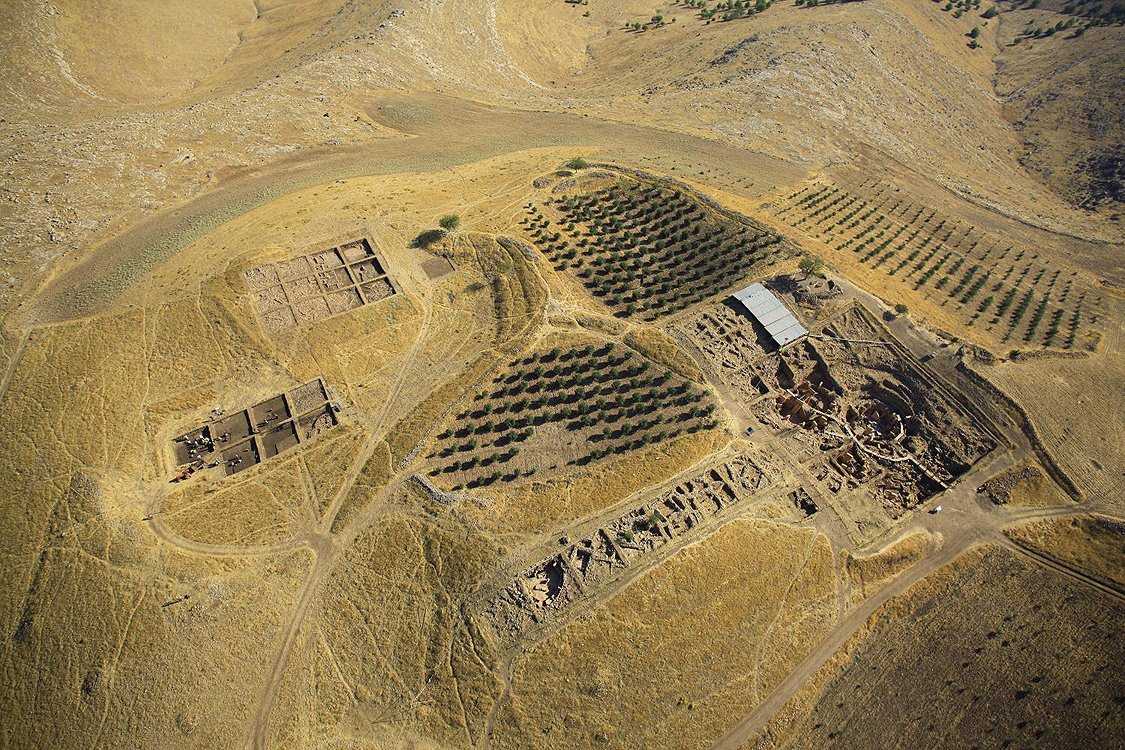
Göbekli Tepe

Göbekli Tepe aerial view

Mini Ice Age

The ancient calendar focused on tracking day, night, and seasonal changes, which might have become more important after a major comet hit Earth around 10,850 B.C. This event likely caused a mini-ice age that wiped out many species. According to Martin Sweatman, a researcher from the University of Edinburgh, the people at Gobekli Tepe were careful observers of the sky, possibly because the comet strike had changed their world.

This disaster may have sparked the beginning of civilization by starting new religious beliefs and pushing people to develop agriculture to survive the colder climate. Their carvings might be some of the earliest attempts at writing. These carvings also tracked the cycles of the Moon and Sun, long before similar calendars were made. They may have even shown for the first time that comet strikes are more likely to happen when Earth crosses the path of comet fragments, something that modern scientists have confirmed.

To help support this theory, the team points to another pillar at the site appearing to picture the Taurid meteor stream lasting 27 days, which was quite possibly the source of the ancient comet strike. The researchers believe that the temple carvings show the ancient civilization was recording dates precisely, noting how the movement of constellations across the sky differed based on the time of the year. This would be 10,000 years before Hipparchus of ancient Greece documented the wobble in the Earth’s axis in 150 BC, making this newfound calendar well ahead of its time.

The Younger Dryas boundary (YDB) cosmic-impact hypothesis suggests that around 12,800 years ago, Earth was hit by pieces of a large comet, which broke apart as it entered the inner solar system. This event likely caused a chain reaction, leading to an “impact winter” (a period of intense cold) and a climate change episode called the Younger Dryas (YD). (Source)

The collision is also believed to have caused massive wildfires, the extinction of large animals like mammoths, and changes in human cultures and population decline. Evidence of this impact includes unusually high levels of platinum found at 26 sites across the Northern Hemisphere, including in ice cores from Greenland, which show platinum deposits over a 21-year period.

The start of the Younger Dryas also shows an increase in dust and chemicals linked to wildfires, like ammonium and other burning aerosols, found in ice cores from Greenland, Antarctica, and Russia. These signs point to one of the biggest wildfire events in over 120,000 years, with about 9% of Earth’s forests burned, covering 10 million square kilometers.

This large-scale burning and the cooling effect of the impact may have triggered the Younger Dryas climate change, according to the theory.

A 2021 study (Taurid complex smoking gun) found that 88 near-Earth asteroids, hidden in the debris that creates the Taurid Meteor Shower, likely came from the breakup of a single comet about 20,000 years ago. Astronomers at the University of Antioquia in Colombia studied the ‘Taurid complex’ to learn more about where these objects came from.

In the 1980s, scientists William Napier and Victor Clube noticed large asteroids in the Taurid stream. They suggested these asteroids had the same origin as Comet Encke, which orbits the Sun every three years. However, some asteroids are over a mile wide, meaning they couldn’t have come from Comet Encke itself. Scientists Ignacio Ferrín and Vincenzo Orofino reviewed old research and measured light reflected from the larger asteroids.

They found more evidence that both Comet Encke and the big asteroids came from the breakup of a huge ice comet, 62 miles wide, about 20,000 years ago. The team warned that these asteroids could be dangerous to Earth, and others from the ancient comet might have already hit our planet in the past. Every year, Earth passes through a stream of debris, causing shooting stars to appear in October in the southern hemisphere and November in the north.

Comet Encke, first seen in 1786, left a trail of debris as it got closer to the sun, like other comets. This trail, made up of rocks, dust, and debris, sometimes comes close to Earth, leading to lots of scientific study. Some studies focus on larger asteroids.

Experts think impacts from the Taurid stream may have contributed to the extinction of ancient cultures and global cooling during the Younger Dryas period. The 1908 Tunguska event, where a small asteroid exploded above Russia, destroying millions of trees, is believed to be connected to this debris stream.

In 2013, the Chelyabinsk meteor, which injured over 1,500 people in Russia, may have also come from the Taurid stream. In 2005, NASA astronomer Rob Suggs observed a flash from a meteor hitting the moon, which was part of the Taurid meteor shower.

A team of Colombian researchers, along with astronomers from Italy’s University of Salento, reviewed many studies on space impacts. They confirmed that a group of space objects contains up to 88 large pieces. Using a method called secular light curves, they noticed changes in the brightness of these objects and found that 67% showed signs of “comet-like” activity. This supported the idea that these objects came from a common origin.

Napier, another scientist, supported their findings. He said that these asteroids, which have orbits like Comet Encke, could either be affected by unknown forces or are pieces of a larger, older comet that lost its gases. This original comet may have been a “rubble pile” – a mix of rocks and other materials held together by ice. Over time, this pile could have broken apart, possibly due to forces from the Sun or another object, creating smaller fragments.

One asteroid, Oljato, is an example of a rubble pile. It’s still held together by ice, which gives it comet-like activity, but it’s much smaller than its parent. Bigger inactive objects like Morpheus are similar, but their ice is trapped inside. Smaller objects, like 2006 SO198, might be the original rocky pieces. The team explained that even if an object looks like a regular asteroid, it could still have a comet-like origin.

Taurid meteors, part of this group, are usually larger than normal meteors. They shine brightly and go deeper into the Earth’s atmosphere, sometimes creating fireballs. While this is mostly harmless, the discovery of larger asteroids in one “dangerous” part of the meteor stream could be a real threat.

Earth passes through this risky area every few years, leading to more shooting stars and possibly large objects hitting Earth instead of burning up in the atmosphere. Future encounters are expected in 2022, 2025, 2032, and 2039.

In 2021, David Asher, Armagh Observatory astronomer predicted that in 2032 and 2036 we are likely to pass through the centre of the Taurid complex, where there will be a ‘noticeable enhancement of fireballs.’ According to study [Taurid complex smoking gun] authors Ignacio Ferrín and Vincenzo Orofino, outgassing from comet-like objects within the complex could be hiding smaller, but still potentially dangerous, asteroids that might hit the Earth.

‘The Tunguska cosmic body was 60 to 90 meters in diameter,’ he told Discover Magazine, adding that we ‘now believe the complex may contain many more objects of that size. It is not the tame, simple and innocent complex we thought it was.’

OTHER VIDEOS

The TAURID Meteor Stream: A Tale of Fireballs and Extinction Level Impacts

EARTH TO PASS THROUGH TAURID METEOR STREAM IN 2032

The TAURID Meteor Stream: A Tale of Fireballs and Extinction Level Impacts

Taurid Meteor Stream - [ The 3 potential future threats] | Amaxiom

{ https://howandwhys.com/ }

Hoe vind je dit bericht?
Geschreven door peter om 22:15 Stuur door

Legendary Film Director Claimed His Soundman Heard President/CIA Director George Bush Sr. Say Aliens Are Real & He Saw a Dead One

filmmaker David Hoffman on aliens

Legendary Film Director Claimed His Soundman Heard President/CIA Director George Bush Sr. Say Aliens Are Real & He Saw a Dead One

In 2020, filmmaker David Hoffman released a video on his YouTube channel, which now has over 1 million subscribers, where he shared an unusual experience from when he directed a political interview with George Bush during Bush’s vice-presidential campaign alongside Ronald Reagan.

Hoffman describes being on an airplane with George Bush Sr. served as CIA director from January 30, 1976, to January 20, 1977, who was drinking heavily, and his soundman, Nigel, who had placed a wireless microphone on Bush to capture the conversation.

“I am not a documentary filmmaker who believes in conspiracy theories. And I am not a scientist or an astronomer. I made this video for my subscribers because I do believe that unidentified flying objects (UFOs) and aliens are real because of what happened to me.” — filmmaker David Hoffman

Before filming began, Nigel suddenly stopped recording and told Hoffman that he had overheard Bush say something startling: “Hey, you know those little green people? They’re real. I saw one dead.” This statement appeared to refer to aliens, specifically the stereotypical “little green men” associated with extraterrestrial life.

Though the moment wasn’t captured on tape, Hoffman and his soundman were both struck by what Bush allegedly said, and they never forgot the incident. Hoffman seems to suggest that it’s possible Bush could have seen a dead alien, although the story remains unverified and relies on the soundman’s word. (Source)

Now I wonder what happened to Jimmy Carter. Former NASA researcher Ed Harris claims that the story of President Carter crying after being briefed on classified UFO information is true. Even Richard Dolan writes about this in his book.

After being repeatedly stonewalled, Carter was given “the talk,” which reportedly left him deeply sobbing and visibly disturbed for weeks. He was told that major religions, including Christianity, were created by extraterrestrials to prevent humans from destroying themselves while they ran experiments on us, and that they made us. Carter, a deeply religious man who had witnessed a UFO with six other people, realized that releasing such information could cause tremendous economic and social upheaval.

Below you can read Ed Harris’ statement on the subject that he wrote on Quora:

Yes, the incident of Jimmy Carter crying after being briefed about classified information regarding UFO’s is largely believed to be true by the serious researchers on the subject. As a forewarning, the following information is very unsettling and will explain why Carter never “kept his promise” of revealing classified UFO information to the public.

According to the story that was corroborated by more than one witness, U.S. presidents are only given a cursory overview of the subject. Apparently, the CIA runs the program, only provide information to the President on a need to know basis, and do not consider presidential curiosity as sufficient need to know. This was implemented after Kennedy, and all presidents after him have been given only summary briefings (some presidents for unknown reasons were given more than others).

Okay on to your question. President Carter is a deeply religious man who had also witnessed a UFO with 6 other people. Everyone thought that he would be the one to f inally release UFO info to the public but as the story goes, he was repeatedly stonewalled. Eventually, the CIA had “the talk” with him, and afterward it was reported that he sunk his head in his hands and not only began to deeply sob, but was visibly disturbed for some weeks afterward.

What was he told and shown?

He was told that the major religions including Christianity were programs created by extraterrestrials to prevent us from destroying ourselves while they ran their experiments on us – and that they made us. At this moment it became clear to Carter that such information could cause tremendous economic and social upheaval. I should add that I am not only a Christian but a clergyman, so I am in no way attempting to promote atheism here. In fact, how God fits into this might be an interesting separate post. Nevertheless, these are the facts as I know them to be.

Author and world’s leading UFO researcher Richard Dolan also writes about this incident in his book “UFOs and the National Security State: The Cover-Up Exposed.” According to his book, there are claims that President Carter was given a UFO briefing at the White House on June 14, 1977, which he was then bound to secrecy about. (Click here to read the full article)

Cordell Hull saw Aliens in Glass Containers, 1939

Roswell UFO crash started a lot of alien conspiracies, but do you know that many years before that incident, dead alien bodies had been stored in a container in the basements of the Capitol Building, Washington DC? (Source)

This story first came into the limelight in 2002, when Willian Jones, a director of the Ohio branch of MUFON received an interesting letter from a woman named Lucile Andrew, the daughter of Reverend Turner Hamilton Holt.

The letter held the top-secret information told by Holt to his daughter about one of his meetings with his cousin Cordell Hull who had been the US Secretary of State from 1933 to 1944 and was also elected as US Senator from 1931 to 1937. He had also received the Nobel Peace Prize and was one of the people who established the United Nations.

Read also:

The letter contained the information that Hull would never want to come out until he was alive but at the same time, he could not stop himself from sharing it with his cousin Holt who served at the Shenandoah Christian Church in Greenwich, Ohio.

According to the letter, one day when Holt was in Washington D.C., he was contacted by Hull who wanted to show him something extremely secret and asked him to never disclose it to anybody. Holt agreed, and Hull took him to a place under the Capitol Building where he showed him an amazing sight. There is no exact information about the time frame of this secret but Hull served under the presidency of Franklin D. Roosevelt until his resignation in 1944.

It was a huge room with four glass containers. In each container, there were bodies of dead humanoids in a special liquid (presumably formaldehyde), about which Holt and Hull had no idea. According to the description of their body structure, they were clearly not humans. There also was a “wrecked round craft” in the adjoining room.

“My father wanted my sister and I to make this information known long after he and Cordell were dead because he felt it was a very important bit of information,” Lucile wrote. “We have researched your group (MUFON) and feel it is the most reliable group in the country. We hope that you will research and search for this information. The jars with creatures in formaldehyde and the wrecked craft are somewhere!

Cordell said they were afraid that they would start a panic if the public found out about it. Sincerely, Lucile Andrew, Ashland, Ohio.”

The letter said that the incident happened in 1939, years before the stories of UFOs and alien encounters hit the newspapers. There is no doubt that Cordell Hull was one of the greatest politicians in US history and according to his credibility, it is difficult not to believe his story. Holt married a woman named Vina May Clark and they both had three daughters. Two daughters claimed that Holt had told them about the creatures but he had never said where they came from. “He said the color of this material wasn’t a color that he had seen before, but for the lack of a better word he used “silver.” Reverend Holt was not the sort of person to make up such a wild story and, the sisters feel that by telling the story they are following their father’s wishes.”

Below is the video where two sisters from Ohio tell the story of how their father was taken to the sub-basement of the capitol and shown what appears to have been alien bodies and a craft.

Barbara A. Wolanin, the curator U.S. Capitol building said: “She had never heard about these creatures being stored at the Capitol, but she did confirm there was a sub-basement that was divided into storage rooms back then.” When Hull left his job, he wrote his memoirs, but there is no mention of this story in his papers in the Library of Congres

{ https://howandwhys.com/ }

Hoe vind je dit bericht?
Geschreven door peter om 20:58 Stuur door

Meer van UFO'S of UAP'S, ASTRONOMIE, RUIMTEVAART, ARCHEOLOGIE, OUDHEIDKUNDE, SF-SNUFJES EN ANDERE ESOTERISCHE WETENSCHAPPEN - DE ALLERLAATSTE NIEUWTJES

↑ Terug naar de berichten