Mysterious dark pillar appears in the sky over Ubon Ratchathani, Thailand

Mysterious dark pillar appears in the sky over Ubon Ratchathani, Thailand

Mysterious dark pillar appears in the sky over Ubon Ratchathani, Thailand

Paraglider captures unexpected visitor at the top of the Great Pyramid of Giza
Project Blue Beam: Fact or Fiction? 'The Fake Alien Attack Conspiracy'
Haunting silhouette of a demon caught during thunderstorm

Unveiling UFO Secrets: Lue Elizondo’s Revelations on UAPs and Government Secrecy
Lue Elizondo, a former U.S. intelligence officer and the director of the Pentagon’s Advanced Aerospace Threat Identification Program (AATIP), has played a critical role in bringing unidentified aerial phenomena (UAP) to the forefront of public discussion. Known for his work in UFO investigations, Elizondo’s revelations have sparked global intrigue, fueling the belief that humanity is not alone in the universe. Through his interviews, Elizondo has shed light on some of the most compelling UFO secrets, revealing both astonishing claims and uncomfortable truths about UAPs and their impact on national security.
In his interview, Elizondo discusses the two possible realities surrounding UAP sightings: either they represent non-human entities visiting Earth, or we are witnessing a form of mass hysteria on an unprecedented scale. What makes this dilemma so significant is the credibility of those reporting UAP encounters, such as military generals, nuclear technicians, and trained pilots with high-level security clearances. These individuals are responsible for critical national security tasks, which raises serious concerns if their sightings are to be dismissed as mere psychological phenomena.
The discussion emphasizes the existence of advanced aerial objects, like the Tic Tac-shaped craft or black cubes and triangular craft, that seem to outperform the best of human-made technology. Elizondo describes these objects as more advanced than any known aircraft, leaving experts baffled by their speed, maneuverability, and ability to defy conventional physics.
One of the key revelations Elizondo touches on is the deep-rooted secrecy in the U.S. government regarding UFOs. He explains that while parts of the government remain hostile toward public UFO disclosure, significant efforts have been made behind the scenes to bring the truth to light. His work, alongside colleagues like former deputy assistant secretary of defense Chris Mellon, led to the declassification of three key UAP videos in 2017, which were then shared with the public through a New York Times article. These videos showed UAPs displaying flight characteristics that defied explanation.
Elizondo’s role in UFO investigations also involves navigating the complexities of classified programs. For example, he hints at the possibility of reverse-engineering UFO technology in secretive government projects. According to Elizondo, there have been longstanding “legacy UFO programs” that involve studying non-human intelligence and possibly even crash retrievals. However, he admits that much of this information is still classified, and full disclosure remains elusive.
Another alarming connection highlighted by Elizondo is the apparent interest UAPs have in nuclear capabilities. This includes sightings over nuclear facilities and military bases, which raises concerns about the potential threat they pose to national security. Elizondo draws parallels between UAP observations and the Serengeti, where predators like cheetahs observe their prey. He suggests that these entities could be studying human nuclear capabilities with similar intent.
The recurring presence of UAPs near nuclear sites across the world, from the U.S. to Russia and China, lends credence to the idea that these phenomena are more than random sightings. Elizondo reveals that many military personnel, from missile operators to radar technicians, have reported UAP sightings near nuclear facilities, further intensifying the mystery surrounding these objects.
A particularly intriguing aspect of Elizondo’s interview is his discussion on remote viewing, a practice associated with psychic espionage. He describes his own involvement in a CIA experiment in which he and colleagues attempted to remote view a high-value detainee in a secure facility. According to Elizondo, their remote viewing efforts were successful enough to produce startling results, which included the detainee experiencing strange phenomena, such as visions of five white figures shaking his bed. This episode underscores the possibility that human consciousness could play a role in perceiving or interacting with UAPs in ways that conventional science has yet to fully understand.
Elizondo also notes that this practice of remote viewing was not unique to the U.S. The Russians and other foreign powers engaged in similar programs, exploring the potential for using the mind as a tool for intelligence gathering. While he cautions that remote viewing is still not fully understood, the data collected through these programs suggest there is more to the human mind than we currently comprehend.
Throughout the interview, Elizondo emphasizes that UAP investigations require a scientific approach, one that goes beyond conventional thinking. He touches on theories involving the manipulation of space-time and gravity to explain how UAPs achieve their extraordinary flight capabilities. These craft may create a “space-time bubble” around them, allowing them to traverse great distances in short periods by warping the fabric of reality itself.
Elizondo points out that the material science behind UAPs could be far more advanced than what is currently understood by mainstream science. He references scientific models that support the idea of manipulating gravity as a field variable, something that could provide the key to unlocking the propulsion systems of these craft. This, however, is not widely accepted within the traditional scientific community, and Elizondo highlights the need for new frameworks in physics to fully comprehend UAP phenomena.
One of the most profound questions Elizondo raises in his interview is whether humanity is truly ready to accept the truth about UAPs. He notes that while the public has a right to know about these phenomena, the implications of full disclosure could be both transformative and destabilizing. The technology behind UAPs, if revealed, could lead to massive shifts in global power dynamics and military capabilities. There is also the potential for misuse of such technology if it falls into the wrong hands.
Elizondo believes that careful consideration must be given to how information is disseminated and who controls the narrative. He expresses hope that the next generation will be able to handle the truth in a responsible manner, ensuring that the knowledge of UAPs can benefit humanity rather than sow further division or conflict.
Lue Elizondo’s interview sheds light on some of the biggest UFO secrets, revealing the complexities of UAP encounters and the challenges of disclosing such information to the public. His insights suggest that UAPs are not just a phenomenon of curiosity but have real-world implications for national security, science, and our understanding of the universe.
As Elizondo points out, the conversation about UAPs needs to be had—sooner rather than later. The future may depend on how we approach these phenomena, not only from a scientific standpoint but also from a collective, ethical perspective. Whether we are dealing with visitors from other worlds, future versions of ourselves, or something even more mysterious, it is clear that the truth about UAPs could change everything.
Aliens Among Us: Unraveling the Mystery of Who They Really Are
Aliens have long captivated the human imagination. Whether through books, movies, or whispered rumors, the concept of extraterrestrial beings has been the source of fascination and speculation. But what if the beings we call “aliens” are not from distant star systems at all? What if they have been sharing our planet with us for thousands of years, living right beneath our feet? This theory challenges everything we think we know about UFOs, extraterrestrial life, and even human history. Let’s dive into the compelling argument behind “Aliens – Who They Are.”
The skies have always been a stage for mysterious visitors, with UFO sightings reported throughout history. According to the UFO Reporting Center, over 150,000 sightings have been cataloged in the United States alone. From bright lights in the sky to objects moving at impossible speeds, UFOs have baffled witnesses, leaving many to wonder: Who is piloting these strange craft?
The idea that UFOs are flown by extraterrestrials from far-off star systems has been the prevailing theory for decades. However, the sheer frequency of sightings, sometimes thousands a year, has cast doubt on the idea that these craft are traveling across vast interstellar distances just to visit Earth.
One of the more intriguing theories suggests that these beings might not be coming from outer space at all. Instead, they could be coming from beneath the Earth’s surface. There have been numerous reports of UFOs emerging from oceans, lakes, and even mountains, leading some researchers to believe that these crafts are not coming from “up there,” but from “down here.”
This theory proposes that a technologically advanced civilization has been living underground for thousands of years, possibly since a major cataclysm around 13,000 years ago. This underground civilization, which some call the “intraterrestrials,” may have been forced to retreat beneath the Earth due to a catastrophic event, such as a comet impact. The idea is that these beings, once part of the human race, have developed advanced technology far beyond our current capabilities.
The concept of a “breakaway civilization” is a central idea in this theory. It suggests that a group of humans split off from the rest of humanity and developed in isolation, leading to the evolution of advanced technology. These beings, who might be the pilots of the UFOs we see today, are not aliens but rather a branch of the human race that has remained hidden from the surface world for millennia.
Supporters of this theory point to historical records, such as ancient Sumerian texts, which describe advanced beings known as the Anunnaki. Some believe these texts hint at an advanced civilization that once existed on Earth, possibly the ancestors of the so-called intraterrestrials.
Many UFO sightings describe encounters with different types of beings, such as the “Grays” and the “Nordics.” The Grays, with their large black eyes and grayish skin, are often portrayed as the classic image of an alien. However, some researchers believe that these beings are not aliens but humans who have evolved after living underground for thousands of years. The theory is that the lack of sunlight and other environmental factors caused them to develop different physical characteristics.
In contrast, the Nordics are often described as tall, blond, and human-like. According to some accounts, these beings are our “cousins,” who might have emerged from underground at some point and blended in with surface humans. In fact, it is speculated that these beings have been influencing human history for centuries, posing as gods or extraterrestrial visitors.
There are also tales of hidden underground worlds, such as those described by Admiral Richard E. Byrd, an American explorer. Byrd allegedly encountered a hidden world beneath the ice of Antarctica, where he met advanced beings with incredible technology. While this story is hotly debated, it has become a cornerstone for many UFO theories, adding fuel to the idea that an advanced civilization exists beneath the Earth’s surface.
Reports of strange phenomena around certain locations, such as heat signatures in areas where UFOs have been seen entering and exiting the Earth, lend credence to the idea that there are hidden underground bases. These bases, some believe, could be the home of the intraterrestrials, who have mastered the ability to travel between their world and ours.
The involvement of governments in UFO phenomena is another major aspect of this theory. Since the infamous Roswell incident in 1947, there have been persistent rumors that governments around the world are aware of these beings and their advanced technology but are keeping it secret. According to some sources, President Eisenhower even had a secret meeting with Nordic extraterrestrials in the 1950s, where they allegedly warned him about the dangers of nuclear weapons.
More recently, the U.S. government has begun to acknowledge the existence of UFOs or UAPs (Unidentified Aerial Phenomena), with the Pentagon releasing declassified videos showing objects performing maneuvers that defy the laws of physics. While the government has stopped short of confirming the existence of extraterrestrial life, these admissions have opened the door to further speculation about what UFOs really are and where they come from.
The most startling aspect of this theory is the idea that these beings are not aliens at all but are our “cousins.” The intraterrestrials have been here all along, sharing the planet with us and possibly influencing our history from the shadows. According to this theory, they may have played the role of gods in ancient times, guiding humanity’s development and ensuring their own survival.
These beings may not want us to know that they exist, as human beings tend to react with fear to the unknown. However, as our technology advances and we begin to uncover more about the mysteries of UFOs, it is becoming harder for them to remain hidden.
The theory that aliens are not extraterrestrial but intraterrestrial beings reshapes how we view UFOs and the idea of extraterrestrial life. If true, it means that we are not alone on this planet, and that a breakaway civilization has been living among us, hidden from view, for thousands of years. Whether they are friend or foe remains to be seen, but one thing is clear: the mystery of who they are is only just beginning to unfold.
This theory offers an alternative to the popular narrative of aliens as visitors from distant galaxies. Instead, it proposes that they are part of our own history, deeply connected to humanity in ways we are only beginning to understand.
Hessdalen Lights: Real UAP Evidence Caught on Camera?
The Hessdalen Lights, a mysterious phenomenon witnessed in a remote valley in Norway, continue to baffle scientists, locals, and UFO enthusiasts alike. These strange, pulsating lights in the sky have sparked debates, theories, and numerous investigations over the years. In a recent expedition, retired F-16 pilot and UAP (Unidentified Aerial Phenomenon) investigator Chris Leos, along with fellow YouTuber Carl Crusher, ventured into Hessdalen to capture the elusive lights on camera. Their journey raises the question: could these lights be real evidence of UAPs, or is there a more conventional explanation?
Chris Leos and Carl Crusher traveled to Hessdalen, a place long known for its unexplained light phenomena, to record and analyze these events. Hessdalen Lights have been reported as flashing, glowing orbs that hover in the sky or move erratically, disappearing and reappearing at random. Upon setting up camp, the duo witnessed several flashes, which they successfully caught on camera, prompting speculation about their origin.
The expedition took place in Hallin, Norway, a region famous for such sightings. As the team watched the sky through night-vision equipment, they saw bright flashes in the otherwise clear sky. The flashes were distinctive because they lacked the rhythmic patterns typical of aircraft or satellite lights. Chris, initially suspecting an airliner, quickly dismissed the idea due to the absence of clouds and the irregularity of the lights.
During their stay, the team had a surprise encounter with a French media crew filming a documentary about UAP hunters. It was during this encounter that Carl Crusher, using his night-vision camera, captured one of the bright flashes. Chris and Carl both witnessed the flash in real time, sparking further discussions about whether the light could be a UAP or something more ordinary, like a satellite flare.
Despite their high-tech equipment and sharp observational skills, neither Chris nor Carl could conclusively identify the lights. The flashes did not conform to the typical characteristics of aircraft or satellite lights, and there were no visible clouds that could account for the phenomenon. This raised the possibility of the lights being UAPs or some other unexplained atmospheric event.
One intriguing aspect of the investigation was the introduction of the CE5 (Close Encounter of the Fifth Kind) meditation technique, a method used by UAP enthusiasts to initiate communication with extraterrestrial intelligence. This practice involves meditative exercises that aim to call down UFOs or UAPs by focusing thoughts and intentions on them.
During the expedition, a local man named Eric shared a personal story. His wife, despite never having seen orbs before, felt an intuitive urge to go outside and look at the sky during a CE5 meditation session. To her surprise, she witnessed a mysterious orb after doing so. This anecdote added another layer of intrigue, suggesting a possible link between human consciousness and the appearance of the Hessdalen Lights.
While some remain skeptical of CE5 techniques, believers argue that the lights may be reacting intelligently, even telepathically, to observers. The idea that these lights could have some form of consciousness behind them continues to spark debate.
Although the flashes observed by Chris and Carl were impressive, the question remains: what exactly are they? The most common hypothesis is that the Hessdalen Lights may be related to satellites. However, Chris was quick to point out that the flashes didn’t resemble typical satellite behavior. A possible explanation is a satellite flare, a phenomenon where sunlight reflects off a satellite’s surface, causing a sudden, bright flash in the sky. Yet, the flashes seen in Hessdalen were unusual, appearing multiple times without the characteristic steady movement of satellites.
Other potential explanations include atmospheric phenomena, such as unusual magnetic or electrical anomalies, which could create the illusion of lights. However, many of these theories fail to fully explain the lights’ erratic behavior, or their apparent responsiveness to human observation, as some witnesses have claimed.
Despite the advanced technology and numerous investigations, the Hessdalen Lights remain largely unexplained. Chris Leos emphasized the need for further data analysis and detailed investigations to understand the lights’ true nature. He mentioned ongoing research efforts, including the use of automatic anomaly detection systems and satellite-based monitoring, to gather more concrete evidence.
While the lights could potentially be explained by natural phenomena or man-made objects, the possibility of UAPs continues to intrigue researchers and enthusiasts. The fact that Chris and Carl were able to capture these lights on camera adds weight to the argument that something extraordinary may be happening in Hessdalen.
The Hessdalen Lights continue to captivate the imaginations of those who witness them. Whether they are the result of UAP activity, satellite flares, or some other natural phenomenon, the lights remain an enduring mystery. The investigation by Chris Leos and Carl Crusher adds to the growing body of evidence, but also raises more questions than it answers.
For those interested in the search for UAPs or simply curious about unexplained phenomena, Hessdalen remains one of the most intriguing hotspots. As technology improves and more data is collected, the hope is that one day, the true nature of these lights will be revealed.
In the meantime, adventurers and researchers continue to flock to Hessdalen, hoping to catch a glimpse of these enigmatic flashes in the sky. Could they be UAPs? Only time, and further investigation, will tell.
UAP Research Gains FBI Attention: Nightcrawler Researchers Unveil Astonishing UFO Footage

In recent years, the growing interest in Unidentified Aerial Phenomena (UAP), commonly referred to as UFOs, has drawn attention from both the public and government agencies. Among the noteworthy contributors to this research is Nightcrawler Research, a group spearheaded by twin brothers Gerry and John Tedesco, both of whom are electrical engineers. Their work, initially rooted in studying cancer clusters on Long Island, has taken an unexpected turn toward UAP research, ultimately catching the eye of the FBI and other federal agencies.
The Tedescos’ foray into UAP research began in an unexpected way. Originally, the brothers were focused on analyzing cancer clusters on Long Island, prompted by the loss of friends and a desire to use their scientific expertise to investigate environmental contaminants. Equipped with a mobile laboratory filled with detection gear and cameras, they sought to uncover any correlation between pollutants and the rise of cancer cases in the region.
However, their direction shifted when the Director of National Intelligence released a landmark report on UAPs in 2021. Intrigued by the findings, Gerry and John turned their research toward the skies, leveraging their engineering skills and high-tech equipment to capture unprecedented footage of these mysterious aerial phenomena.
One of the defining aspects of Nightcrawler Research’s work is their use of advanced technology. The brothers have invested a significant portion of their personal savings into acquiring state-of-the-art equipment. This includes hyperspectral cameras, which are capable of capturing light spectrums beyond what the human eye can perceive. This technology has proven invaluable in detecting and filming objects that are invisible under normal conditions, further strengthening their case for the existence of UAPs.
During their research along the flight routes near Long Island, particularly in areas where aircraft approach and depart from JFK International Airport, the Tedescos managed to record a series of astonishing encounters with UAPs. One notable example includes footage of a cylindrical object—referred to as a “Tic-Tac”—that appeared to fly perilously close to a passenger aircraft. The clarity of these images, particularly when viewed in slow motion, has caught the attention of aviation safety authorities due to its potential implications for air traffic safety.
The work of the Tedesco brothers has not gone unnoticed. Their methodical, data-driven approach has attracted the interest of not only UAP enthusiasts but also government bodies. Recently, they accomplished what few UAP researchers have managed to do: they had a peer-reviewed paper on UAPs published in a prominent scientific journal. This achievement brought their research to the forefront, and soon after, federal agencies, including the FBI and Homeland Security, began to take notice.
The government’s interest is likely tied to national security concerns, as many of the UAPs the Tedescos captured were found in close proximity to commercial aircraft. The risk these objects pose to flight safety has raised alarm bells, particularly given their unknown origins and capabilities. As more footage and data have surfaced, the FBI has begun engaging with the researchers, possibly signaling a broader federal inquiry into UAPs beyond what has been publicly acknowledged.
What sets Nightcrawler Research apart is not just their impressive technological setup but also their dedication to approaching the UAP phenomenon scientifically. As trained engineers, Gerry and John Tedesco are able to scrutinize their findings with a critical eye, ensuring that what they present is backed by data. Their use of hyperspectral imaging has allowed them to film objects that otherwise would have gone unnoticed, expanding our understanding of what might be out there.
While much of the UAP conversation has been shrouded in mystery and skepticism, the Tedescos’ work brings a level of credibility and scientific rigor to the field. By documenting their findings through peer-reviewed research, they are helping to shift the dialogue surrounding UAPs from fringe theory to mainstream scientific inquiry.
Nightcrawler Research’s work is a testament to the power of scientific curiosity and technological innovation in exploring the unknown. What began as a local investigation into cancer clusters has transformed into a significant UAP research project, one that has captured the attention of federal agencies like the FBI. As concerns about national security and flight safety grow, it is likely that researchers like the Tedescos will play an increasingly important role in unraveling the mystery of UAPs. Their groundbreaking footage and data have already provided a clearer glimpse into the phenomenon, and as their work continues, we may soon find more answers to the questions that have puzzled humanity for decades.
3 weken geen updates wegens vakantie - 3 weeks no updates due to vacation on this blog. -aucune mise à jour sur ce blog depuis 3 semaines en raison des vacances.Beste bezoekers,
3 weken geen updates wegens vakantie op deze blog. Vanaf 27 oktober as ben ik terug en zal ik asap het laatste nieuws terug op mijn blog plaatsen.
Alvast bedankt voor jullie begrip en bezoek
Peter2011
Dear visitors,
3 weeks no updates due to vacation on this blog. From October 27th I will be back and I will post the latest news on my blog asap.
Thanks in advance for your understanding and visit
Peter2011
Chers visiteurs,
aucune mise à jour sur ce blog depuis 3 semaines en raison des vacances. Je serai de retour à partir du 27 octobre et publierai les dernières nouveautés sur mon blog dès que possible.
Merci d'avance pour votre compréhension et visite.
Peter2011
The Air Force Asked This Man to Investigate UFOs—Then Pushed Him Away After What He Found

His job was to uncover secrets from the unknown. But his curiosity opened doors that the government preferred to keep closed.
Do you think the U.S. government is hiding, and possibly reverse-engineering, extraterrestrial technology? Think again. Or better yet, don’t think about it at all. Nothing to see here.
That’s the underlying message of a report released last month by the Department of Defense. The 63-page “Report on the Historical Record of U.S. Government Involvement with Unidentified Anomalous Phenomena (UAP)” concludes that the DoD’s All-Domain Anomaly Resolution Office (AARO) “found no evidence that any [U.S. Government] investigation, academic-sponsored research, or official review panel has confirmed that any sighting of a UAP represented extraterrestrial technology.”
The AARO, as The Guardian summarizes, is “a government office established in 2022 to detect and, as necessary, mitigate threats including ‘anomalous, unidentified space, airborne, submerged and transmedium objects’.”
This report comes on the heels of, and in contradiction to, what was arguably the most high-profile hearing on UAPs—formerly known as unidentified flying objects, or UFOs—in decades: the August 2023 testimony of “whistleblower” Dave Grusch.
In the bombshell hearing, Grusch, a former member of the Pentagon’s UAP Task Force, claimed that he had been made aware of a “multi-decade UAP crash retrieval and reverse engineering program.” But his claims were never substantiated, and while the new report never mentions Grusch by name, it does offer plausible explanations for the phenomena he described in his testimony.
This is hardly the first government report to debunk stories about little green men and their strange flying saucers. So, why do Americans keep clinging to conspiracy theories about extraterrestrial visitors? Blame science fiction, the AARO report says:
“A consistent theme in popular culture involves a particularly persistent narrative that the USG—or a secretive organization within it—recovered several off-world spacecraft and extraterrestrial biological remains, that it operates a program or programs to reverse engineer the recovered technology, and that it has conspired since the 1940s to keep this effort hidden from the United States Congress and the American public.
AARO recognizes that many people sincerely hold versions of these beliefs which are based on their perception of past experiences, the experiences of others whom they trust, or media and online outlets they believe to be sources of credible and verifiable information. The proliferation of television programs, books, movies, and the vast amount of internet and social media content centered on UAP-related topics most likely has influenced the public conversation on this topic, and reinforced these beliefs within some sections of the population.”
The X-Files and the internet helped guide curious people toward the fringes of ufology. But to fully understand the ongoing public skepticism regarding the government-provided explanations about aliens, we must consider the man who was once responsible for upholding these “official” stories—and examine his stunning evolution from a fellow skeptic to the world’s leading UFO advocate.

Josef Allen Hynek, who was born on May 1, 1910, developed an interest in the cosmos following an episode of illness during his childhood. The sickness steered his curiosity away from following in the footsteps of his mother and father—a schoolteacher and cigar manufacturer, respectively—and toward the universe. Biography writes:
“An introduction to the stars came after Hynek was bedridden with scarlet fever at age seven: Having run through their supply of children's books to read, his mom turned to textbooks, with a high school edition on astronomy capturing the boy’s attention.”
From an early age, Hynek’s passion for science was mixed with a penchant for mystery and a pursuit of philosophical thought. He had “an interest in more esoteric subjects, particularly the works of the Rosicrucian secret societies and hermetic philosopher Rudolf Steiner,” according to Biography.
In 1934, as a doctoral student, Hynek contributed to observations of the Nova Herculis supernova at Perkins Observatory in Ohio. By 1936, he joined Ohio State University’s Physics and Astronomy Department. His research over the next 12 years culminated in his appointment as director of the university’s McMillin Observatory.
And that’s when the U.S. government came calling—with an unusual request.
In the waning days of World War II, American fighter pilots reported seeing aircraft that were unlike any previously encountered in combat. Some described “orange, flowing lights,” while another pilot “saw a red-ish, wingless, cigar-shape object.”
These accounts reached the media, and a population exhausted by war both wondered and worried about the tales of the strange aircraft. But the occurrences were ultimately attributed to “electrostatic or electromagnetic phenomena.”
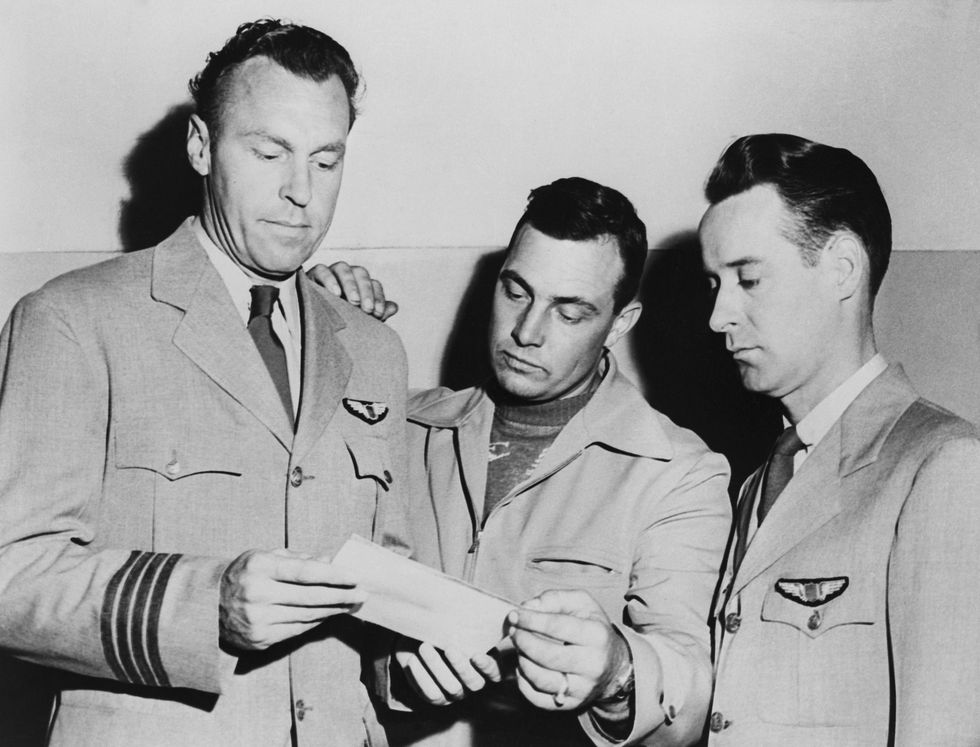
The incident involving pilot Kenneth Arnold on June 24, 1947, however, wasn’t as readily explained—and, more crucially, it wasn’t as easily dismissed. As PopMech previously summarized:
“While searching for a Marine Corps C-46 transport plane, experienced pilot Kenneth Arnold diverted from his original flight path to help search the southwest slope of Mount Rainier. During the search, Arnold observed nine “peculiar-looking” and possibly “completely round” objects flying in a formation that reminded him of geese. It was later estimated they were flying in excess of 1,000 miles per hour. When he reported it (and assuming they were a new type of jet or experimental military aircraft), the Army Air Corps dismissed it as a mirage or hallucination.”
When Arnold believed the Army dismissed his claims too lightly, he reached out to the press. His discussion with Bill Bequette from the East Oregonian newspaper resulted in Bequette creating the term “flying saucers” to describe the unusual objects Arnold reported seeing.
America’s intelligence apparatus was still nascent at the time; the Office of Strategic Services (OSS) dissolved in 1945, and its successor, the Central Intelligence Agency (CIA), wouldn’t form until three months after Arnold reported his sighting. If there were mysterious objects flying in America’s airspace, the U.S. didn’t know where they could be coming from: The USSR? Enemies abroad? Aliens from another world?
It was crucial, then, to investigate whether these claims had any truth to them, and just as important to reassure a nervous American public that there was no cause for alarm (even if that might not have been true).
The U.S. Air Force enlisted Hynek to serve as an “astronomical consultant” for “Project Sign,” its initiative dedicated to examining the multitude of reports. Throughout Project Sign, Hynek meticulously analyzed each account of unusual aerial occurrences and categorized them accordingly. Per Biography:
“There were those which were simply astronomical observations, like the appearance of a meteor, those explained by meteorology, like an unusually shaped cloud, and those which captured accounts of man-made objects, like balloons. That left about 20 percent with no clear explanation...”
Hynek’s later writings suggest that he had hoped for additional investigations to address the questions posed by the remaining 20 percent of unexplained cases. However, the U.S. government, apprehensive about public fears during the Cold War and the potential for those fears to be manipulated, preferred to make such questions go away. And so, Project Sign evolved into “Project Grudge.”
“The staff,” the Report on the Historical Record of U.S. Government Involvement with Unidentified Anomalous Phenomena summarizes, “especially those who seemed to lean towards belief in the ‘interplanetary’ origin of UFOs, were reportedly purged from the organization.”
Project Grudge released only one report, in August 1949. “There is no evidence that objects reported upon are the result of an advanced scientific foreign development; and, therefore they constitute no direct threat to the national security,” the report determined. It concluded by recommending that “the investigation and study of reports of unidentified flying objects be reduced in scope.”
Hynek, disillusioned with the direction the investigations took, characterized Project Grudge as a “public relations campaign.”
Project Grudge’s conclusions failed to quell concerns about what people now referred to as “unidentified flying objects,” or UFOs. So the Air Force resumed its investigations once more, this time in its most famous form: “Project Blue Book.”
The Air Force again brought in Hynek for Project Blue Book, permitting him to actually conduct field investigations into these phenomena himself. Hynek’s perspective on the extraterrestrial theories regarding the unexplained sightings evolved from his days with Project Sign. As Biography observes:
“While he had harbored plenty of skepticism the first time around, he found his assumptions challenged by the rational recollections of witnesses, and began thinking about the legitimate scientific study of these 'Unidentified Flying Objects' or 'UFOs.'”
However, Hynek quickly realized that he was seen more as an instrument to dismiss alien speculation than as a scientist tasked with exploring such possibilities. As Biography notes, “By the 1960s, Hynek found himself in conflict with the restrictive supervision of the Air Force.”
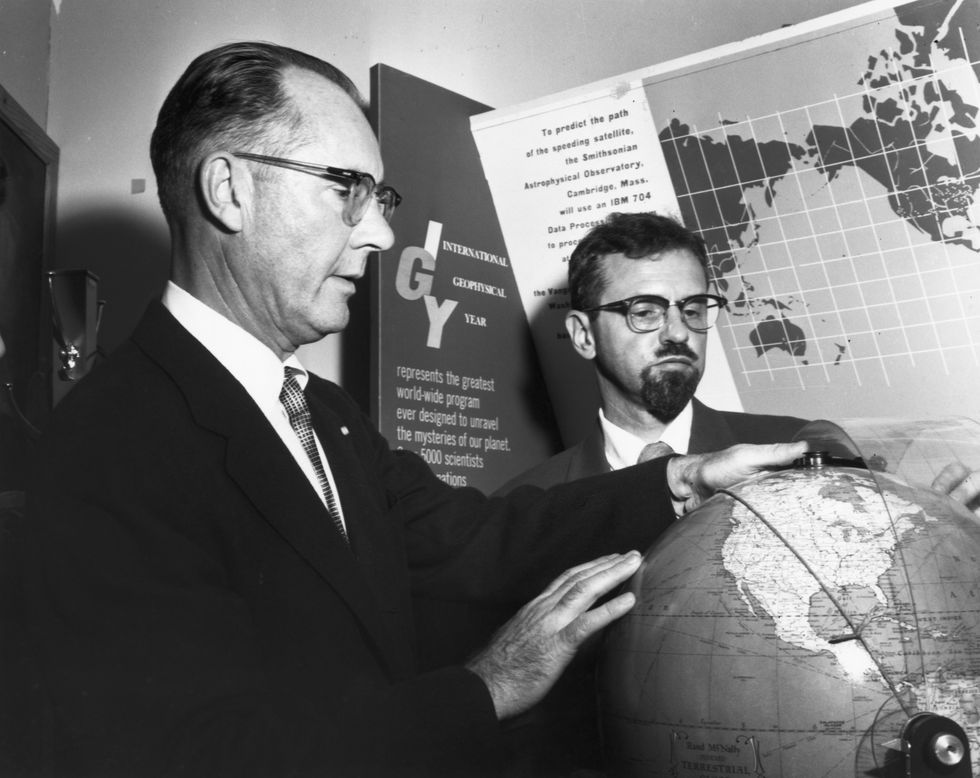

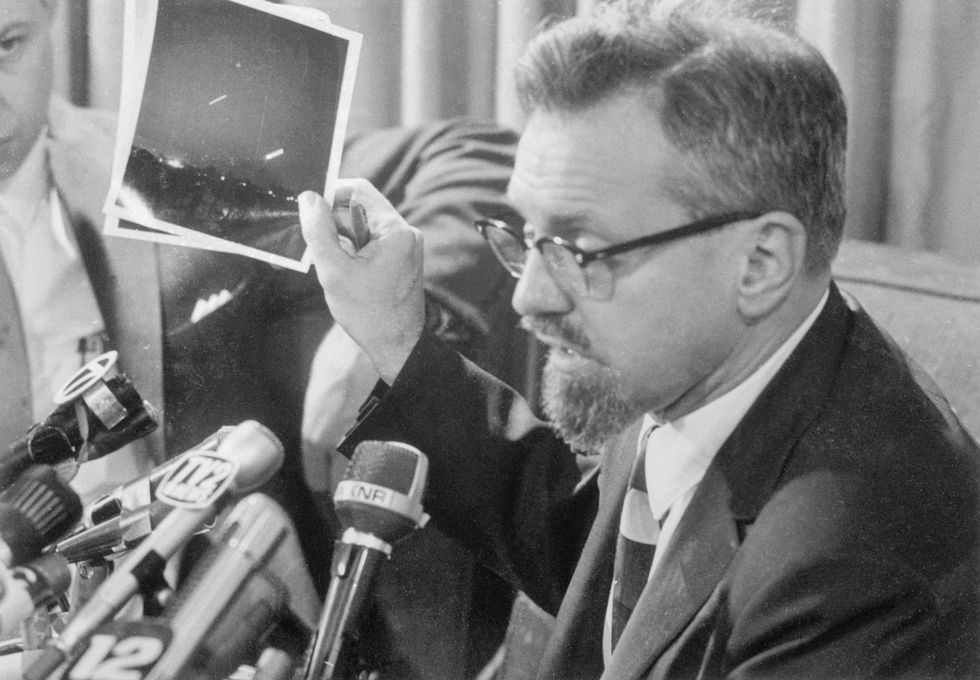
The term “swamp gas” became a proto-meme of the mid-60s, and House Minority Leader (and future president) Gerald Ford demanded answers for the seemingly shoddy investigation. “Called to testify,” Biography notes, “Hynek used the occasion to argue for an extensive, transparent study of UFOs.”
Hynek broke from the directives of the Air Force, and just three years later, Project Blue Book was completely terminated. But that didn’t stop the astronomer.
Freed from the constraints of the Air Force, Hynek initiated a public campaign to promote the rigorous scientific investigation of what he called “ufology.” This effort first materialized as his 1972 book, The UFO Experience: A Scientific Inquiry.
Hynek wrote about his philosophy on the study of UFOs, his observations from decades working on Project Sign and Project Blue Book, and his scale for classifying UFO sightings, which involved both distant and close encounters. He classified distant observations as either “nocturnal lights,” “daylight discs,” or for those not seen directly by human eyes, “radar/visuals.”
The other observations—“close encounters”—also broke down into three categories. HISTORY summarizes:
“Close Encounters of the First Kind meant UFOs seen at a close enough range to make out some details. In a Close Encounter of the Second Kind, the UFO had a physical effect, such as scorching trees, frightening animals or causing car motors to suddenly conk out. In Close Encounters of the Third Kind, witnesses reported seeing occupants in or near a UFO.”
That final category inspired the title of the classic 1977 Steven Spielberg film, Close Encounters of the Third Kind. Hynek was reportedly paid for the use of the title and for his role as a consultant on the movie, and he also made a brief appearance in the Best Picture nominee. Hynek also appeared on shows like “The Dick Cavett Show” and “In Search Of...,” spoke on the university lecture circuit, and even presented on UFOs to the United Nations. His life’s work inspired a two-season TV series that aired in the 2010s, aptly named Project Blue Book.
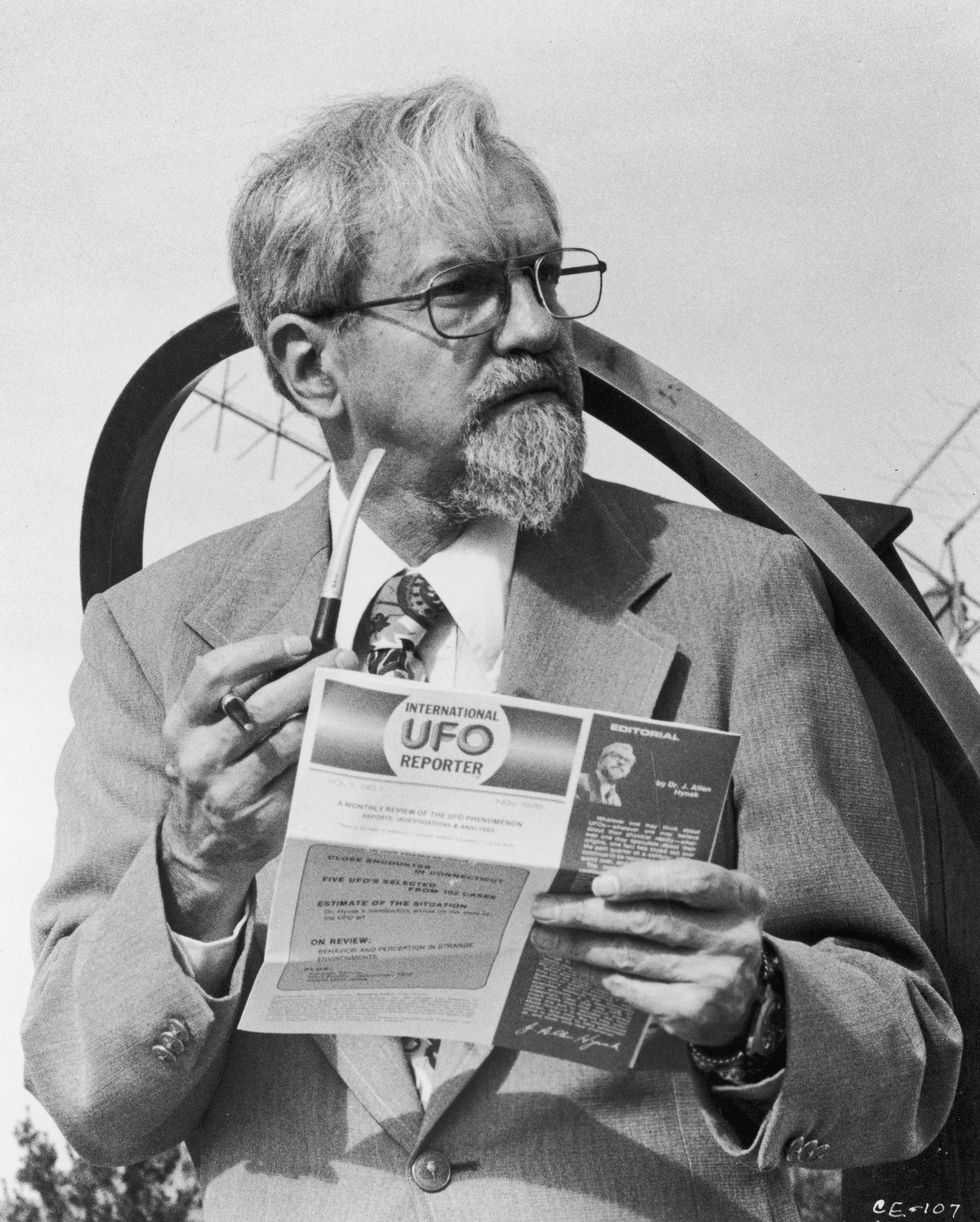
Crucially, while Hynek openly discussed the limitations he faced during his tenure with the Air Force and was forthright about its apparent lack of genuine interest in investigating the possibility of alien encounters, his written work never fully embraced conspiracy theories. That wouldn’t be true for those who came after him.
In 1986, the year Hynek died, conspiracy theorist George C. Andrews published Extra-Terrestrials Among Us, a book that incorporated ideas of ufology into existing ideas of government conspiracies and secret organizations. In Andrews’ grand vision of a global conspiracy, he claimed extraterrestrials were behind the killing of President John F. Kennedy.
In 1991, conspiracy theorist Bill Cooper incorporated Andrews’ theories into his manifesto, Behold a Pale Horse, one of the more widely read books of fringe political conspiracies. Where Hynek kept his speculations scientific, The New Republic noted that Cooper’s co-opting of ufology was “...the tip of a spear asserting that the number one thing we had to fear was not little green men, but the government that colluded with them, appropriating their technology against us.”
Hynek’s legacy risks being overshadowed by the extreme and politically charged theories of self-proclaimed ufologists that emerged in his wake. His ambition was for ufology to gain recognition as a legitimate scientific field; however, the proliferation of conspiracy theories that came after him provided the government with further justification to dismiss the subject entirely.
The new AARO report states that during the time Hynek was working with Project Blue Book, “about 75 percent of Americans trusted the [US government] ‘to do the right thing almost always or most of the time.’” But, the report notes, since 2007, that number has never risen above 30 percent. “This lack of trust probably has contributed to the belief held by some subset of the U.S. population that the USG has not been truthful regarding knowledge of extraterrestrial craft.”
Ultimately, the Air Force’s efforts to stifle Hynek—pressuring him to offer the public standard responses to questions he wasn’t even allowed to ask—appears to have backfired.
Ironically, the Air Force’s attempts to quiet suspicions only fueled them, leading to more conspiracy theories and distrust. People came to believe that the government was hiding the truth, contrary to Hynek’s actual revelation: that, in reality, the people at the top may not care much about finding the answers after all.