Naar de inhoud

UFO'S of UAP'S, ASTRONOMIE, RUIMTEVAART, ARCHEOLOGIE, OUDHEIDKUNDE, SF-SNUFJES EN ANDERE ESOTERISCHE WETENSCHAPPEN - DE ALLERLAATSTE NIEUWTJES

UFO's of UAP'S in België en de rest van de wereld
akke.beakke.be
Ontdek de Fascinerende Wereld van UFO's en UAP's: Jouw Bron voor Onthullende Informatie! Ben jij ook gefascineerd door het onbekende? Wil je meer weten over UFO's en UAP's, niet alleen in België, maar over de hele wereld? Dan ben je op de juiste plek! België: Het Kloppend Hart van UFO-onderzoek In België is BUFON (Belgisch UFO-Netwerk) dé autoriteit op het gebied van UFO-onderzoek. Voor betrouwbare en objectieve informatie over deze intrigerende fenomenen, bezoek je zeker onze Facebook-pagina en deze blog. Maar dat is nog niet alles! Ontdek ook het Belgisch UFO-meldpunt en Caelestia, twee organisaties die diepgaand onderzoek verrichten, al zijn ze soms kritisch of sceptisch. Nederland: Een Schat aan Informatie Voor onze Nederlandse buren is er de schitterende website www.ufowijzer.nl, beheerd door Paul Harmans. Deze site biedt een schat aan informatie en artikelen die je niet wilt missen! Internationaal: MUFON - De Wereldwijde Autoriteit Neem ook een kijkje bij MUFON (Mutual UFO Network Inc.), een gerenommeerde Amerikaanse UFO-vereniging met afdelingen in de VS en wereldwijd. MUFON is toegewijd aan de wetenschappelijke en analytische studie van het UFO-fenomeen, en hun maandelijkse tijdschrift, The MUFON UFO-Journal, is een must-read voor elke UFO-enthousiasteling. Bezoek hun website op www.mufon.com voor meer informatie. Samenwerking en Toekomstvisie Sinds 1 februari 2020 is Pieter niet alleen ex-president van BUFON, maar ook de voormalige nationale directeur van MUFON in Vlaanderen en Nederland. Dit creëert een sterke samenwerking met de Franse MUFON Reseau MUFON/EUROP, wat ons in staat stelt om nog meer waardevolle inzichten te delen. Let op: Nepprofielen en Nieuwe Groeperingen Pas op voor een nieuwe groepering die zich ook BUFON noemt, maar geen enkele connectie heeft met onze gevestigde organisatie. Hoewel zij de naam geregistreerd hebben, kunnen ze het rijke verleden en de expertise van onze groep niet evenaren. We wensen hen veel succes, maar we blijven de autoriteit in UFO-onderzoek! Blijf Op De Hoogte! Wil jij de laatste nieuwtjes over UFO's, ruimtevaart, archeologie, en meer? Volg ons dan en duik samen met ons in de fascinerende wereld van het onbekende! Sluit je aan bij de gemeenschap van nieuwsgierige geesten die net als jij verlangen naar antwoorden en avonturen in de sterren! Heb je vragen of wil je meer weten? Aarzel dan niet om contact met ons op te nemen! Samen ontrafelen we het mysterie van de lucht en daarbuiten.

Archief

Alien Visitation Claims Are Widespread Societal Problem, Researcher Says

Alien Visitation Claims Are Widespread Societal Problem, Researcher Says

Around a fifth of U.K. citizens believe Earth has been visited by extraterrestrials, and an estimated 7% believe that they have seen a UFO. The figures are even higher in the U.S. — and rising. The number of people who believe UFO sightings offer likely proof of alien life increased from 20% in 1996 to 34% in 2022. Some 24% of Americans say they’ve seen a UFO. In his new paper in the Proceedings of the International Astronomical Union, Dr. Tony Milligan of King’s College London argues that the belief in alien visitors is no longer a quirk, but a widespread societal problem.

The idea that aliens may have visited our planet is becoming increasingly popular. Image credit: Fernando Ribas.

The idea that aliens may have visited our planet is becoming increasingly popular.

Image credit: Fernando Ribas.

The belief is now rising to the extent that politicians, at least in the U.S., feel they have to respond.

The disclosure of information about claimed UAPs (Unidentified Anomalous Phenomena) from the Pentagon has got a lot of bi-partisan attention in the country.

Much of it plays upon familiar anti-elite tropes that both parties have been ready to use, such as the idea that the military and a secretive cabal of private commercial interests are keeping the deep truth about alien visitation hidden.

That truth is believed to involve sightings, abductions and reverse-engineered alien technology.

Belief in a cover-up is even higher than belief in alien visitation. In 2019, a Gallop poll found that a staggering 68% of Americans believed that the US government knows more about UFOs than it is telling.

This political trend has been decades in the making. Jimmy Carter promised document disclosure during his presidential campaign in 1976, several years after his own reported UFO sighting. Like so many other sightings, the simplest explanation is that he saw Venus.

Hillary Clinton also suggested she wanted to ‘open Pentagon files as much as I can’ during her presidential campaign against Donald Trump.

Trump suggested he’d need to ‘think about’ whether it was possible to declassify the so-called Roswell documentation.

Former president Bill Clinton claimed to have sent his chief of staff, John Podesta, down to Area 51, a highly classified US Air Force facility, just in case any of the rumors about alien technology at the site were true. It is worth nothing that Podesta is a long-time enthusiast for all things to do with UFOs.

The most prominent current advocate of document disclosure is the Democratic Senate leader Chuck Schumer.

His stripped back 2023 UAP disclosure bill for revealing some UAP records was co-sponsored by three Republican senators.

Pentagon disclosure finally began during the early stages of Joe Biden’s term of office, but so far there has been nothing to see. Nothing looks like an encounter. Nothing looks close.

Still, the background noise does not go away.

This artist’s impression shows the first interstellar asteroid -- 1I/2017 U1 (’Oumuamua). Image credit: M. Kornmesser / ESO.

This artist’s impression shows the first interstellar asteroid — 1I/2017 U1 (’Oumuamua).

Image credit: M. Kornmesser / ESO.

Problems for Society

All this is ultimately encouraging conspiracy theories, which could undermine trust in democratic institutions.

There have been humorous calls to storm Area 51.

And after the storming of the Capitol in 2021, this now looks like an increasingly dangerous possibility.

Too much background noise about UFOs and UAPs can also get in the way of legitimate science communication about the possibility of finding microbial extraterrestrial life.

Astrobiology, the science dealing with such matters, has a far less effective publicity machine than UFOlogy.

History, a YouTube channel part owned by Disney, regularly delivers shows about ‘ancient aliens.’ The show is now in its 20th season and the channel has 13.8 million subscribers.

The NASA astrobiology channel has a hard won 20,000 subscribers. Actual science finds itself badly outnumbered by entertainment repackaged as factual.

Alien visitation narratives have also repeatedly tried to hijack and overwrite the history and mythology of indigenous people.

The first steps in this direction go back to Alexander Kazantsev’s science fiction tale Explosion: The Story of a Hypothesis (1946). It presents the 1908 Tunguska meteorite impact event as a Nagasaki-like explosion of an alien spacecraft engine.

In Kazantsev’s tale, a single giant black female survivor has been left stranded, equipped with special healing powers. This led to her adoption as a shaman by the indigenous Evenki people.

NASA and the space science community do support efforts such as the Native Skywatchers initiative set up by the indigenous Ojibwe and Lakota communities to ensure the survival of storytelling about the stars. There is a real and extensive network of indigenous scholarship about these matters.

But UFOlogists promise a far higher profile for indigenous history in return for the mashing together of genuine indigenous stories about life arriving from the skies with fictional tales about UFOs, repackaged as suppressed history.

The modern alien visitation narrative has not, after all, emerged out of indigenous communities. Quite the opposite.

It emerged in part as a way for conspiracy-minded thinkers in a Europe torn apart by racism to ‘explain’ how complex urban civilizations in places like South America could have existed prior to European settlement.

Squeezed through a new age filter of 1960s counterculture, the narrative was flipped to value indigenous people as having once possessed advanced technology.

Once upon a time, according to this view, every indigenous civilization was Wakanda, a fictional country appearing in American comic books published by Marvel Comics.

If all of this stayed in its own box, as entertaining fiction, then matters would be fine. But it doesn’t, and they aren’t. Visitation narratives tend to overwrite indigenous storytelling about sky and ground.

This is a problem for everyone, not just indigenous peoples struggling to continue authentic traditions. It threatens our grasp of the past. When it comes to insight into our remote ancestors, the remnants of prehistoric storytelling are few and precious, such as within indigenous storytelling about the stars.

Take the tales of the Pleiades, which date back in standard forms to at least 50,000 years ago.

This may be why these tales in particular are heavily targeted by alien visitation enthusiasts, some of whom even claim to be Pleiadeans.

No surprises, Pleiadeans do not look like the Lakota or Ojibwe, but are strikingly blond, blue-eyed and Nordic.

It is increasingly clear that belief in alien visitation is no longer just a fun speculation, but something that has real and damaging consequences.

  • Tony Milligan. 2024. Equivocal encounters: alien visitation claims as a societal problem. In Proceedings of the International Astronomical Union: IAUS (387). Cambridge University Press
  • Author: Tony Milligan, a research fellow at King’s College London.
  • This article was originally published on The Conversation.
Alien Encounters in America | UFOs and Extraterrestrial Visitations

What Are Governments Hiding About Aliens? | The UFO Conclusion | Absolute Documentaries

{ https://www.sci.news/ }

Hoe vind je dit bericht?
Geschreven door peter om 22:22 Stuur door

Een ster ontdekt, die uit de Melkweg zou kunnen “ontsnappen”: hij raast door de ruimte met ruim 1,6 miljoen kilometer per uur

Een ster ontdekt, die uit de Melkweg zou kunnen “ontsnappen”: hij raast door de ruimte met ruim 1,6 miljoen kilometer per uur

Janine imagedoor Janine

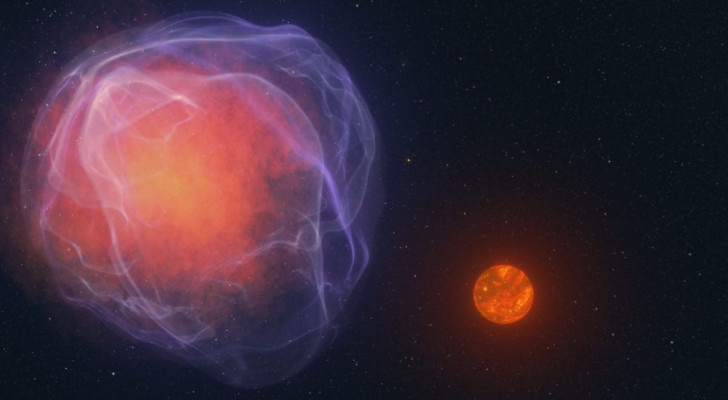
Potentieel binair systeem tussen witte dwerg en bruine dwerg dat leidde tot de verdrijving van CWISE J1249 na een supernova

W. M. Keck Observatory/Adam Makarenko

Gewoonlijk draaien sterren rond het centrum van een sterrenstelsel, bijvoorbeeld de Melkweg: dit is het geval voor de zon en de meer dan 200 miljard sterren in ons sterrenstelsel... op één na. Sommige wetenschappers hebben een object gezien dat zo groot en zwaar is als een ster en dat zich met meer dan 1,6 miljoen kilometer per uur voortbeweegt, een snelheid die zo hoog is dat het aan de zwaartekracht van de Melkweg ontsnapt... vroeg of laat. Laten we eens kijken hoe dit mogelijk is!

Er is een ster ontdekt die op de vlucht is uit de Melkweg

We bevinden ons in het project Backyard Worlds: Planet 9, dat tot taak heeft nieuwe planeten en bruine dwergen in de omgeving van ons zonnestelsel te ontdekken, ook met de hulp van amateurs. Door de beelden te bestuderen die zijn gemaakt door de Wide Field Infrared Explorer of WISE-missie en latere missies, hebben sommige amateurwetenschappers een nooit eerder gezien object gezien, een hemellichaam dat veel te snel door de ruimte beweegt, alsof het ontsnapt uit de Melkweg. Dit zijn de woorden van een van de ontdekkers, die samen met anderen een studie publiceerde in Astrophysical Journal Letters:

Ik kan het niveau van opwinding niet beschrijven. Toen ik voor het eerst zag hoe snel het bewoog, was ik ervan overtuigd dat het al was gemeld.

Het hemellichaam, CWISE J124909.08+362116.0 genaamd maar kortweg CWISE J1249 genoemd, heeft zo'n lage massa dat het moeilijk te classificeren is. Volgens onderzoekers zou het desondanks een kleine ster of een bruine dwerg kunnen zijn. Maar waarom beweegt hij zo snel?

Waarom zo'n hoge snelheid?

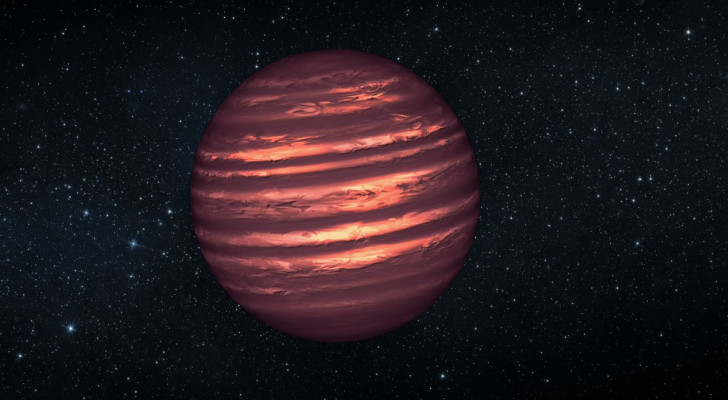
Weergave van een bruine dwerg

NASA/JPL-Caltech

Alleen al binnen het project Backyard Worlds: Planet 9 zijn er al meer dan 4000 bruine dwergen geïdentificeerd, hemellichamen die het midden houden tussen een gasvormige planeet zoals Jupiter en een ster zoals de zon. Geen van hen beweegt echter met zo'n hoge snelheid dat ze zouden kunnen ontsnappen aan de zwaartekracht van de Melkweg. Bovendien heeft CWISE J1249 een andere samenstelling dan de andere bruine dwergen en sterren in ons melkwegstelsel, omdat hij minder ijzer en andere metalen bevat: hij zou deel kunnen uitmaken van de eerste generatie sterren in de Melkweg. 

Over zijn snelheid hebben wetenschappers twee hypotheses bedacht. Aan de ene kant kan de bruine dwerg deel hebben uitgemaakt van een binair systeem met een witte dwerg, die op een gegeven moment explodeerde als supernova en zo de ontsnapping van CWISE J1249 in gang zette. Aan de andere kant zou de snelheid veroorzaakt kunnen zijn door een ontmoeting met een binair systeem gevormd door twee zwarte gaten, waarvan de interacties de bruine dwerg de ruimte in zouden hebben geslingerd. En uit de Melkweg.

Het belang van Backyard Worlds: Planet 9

De ontdekking van CWISE J1249 en zijn ontsnapping aan de zwaartekracht van de Melkweg is slechts het laatste succes van Backyard Worlds: Planet 9. Het project bevordert de samenwerking tussen duizenden astronomen wereldwijd en heeft het mogelijk gemaakt om enorme hoeveelheden astronomische gegevens te analyseren. Het project bevordert de samenwerking tussen duizenden liefhebbers van de astronomie over de hele wereld en heeft het mogelijk gemaakt om enorme hoeveelheden astronomische gegevens te analyseren, vergelijkbaar met het project Black Hole Finder voor het zoeken naar zwarte gaten. Terwijl Backyard Worlds: Planet 9 ook uitgaat van het idee van het bestaan van een negende planeet in het zonnestelsel voorbij Neptunus, is het een initiatief dat heeft geleid tot de ontdekking van vele bruine dwergen en andere hemellichamen in ons melkwegstelsel.

In dit opzicht is het project een perfect voorbeeld van hoe wetenschap en passie voor de astronomie tot buitengewone resultaten kunnen leiden. Waaronder de ontdekking van een ster die ontsnapt uit de Melkweg, het eerste voorbeeld van een hemellichaam met zo'n hoge snelheid dat het ontsnapt aan de galactische zwaartekracht, maar niet aan onze ogen.

It's Moving At 1.6 Milion Km/h: CWISE J1249, Fastest Brown Dwarf In The Universe?

Galactic Speedster: The Fastest 'Failed Star' Ever Found! #universe #space #shorts

{ https://www.curioctopus.nl/ }

Hoe vind je dit bericht?
Geschreven door peter om 21:49 Stuur door

De geheimen rond de Bermudadriehoek

De geheimen rond de Bermudadriehoek

Artikel door Stars Insider
 

De geheimen rond de Bermudadriehoek

©Shutterstock

De geheimen rond de Bermudadriehoek
De wateren rond Bermuda, dat Brits grondgebied is, hebben van meer dan 1.000 mensen het leven geëist. Veel schepen en vliegtuigen zijn op onverklaarbare wijze verdwenen in het gebied dat ligt tussen Bermuda en Miami. Door veel piloten zijn verhalen verteld over kompassen die niet meer werkten.

Mysterieuze verdwijningen en bizarre verhalen hebben geleid tot talloze complottheorieën en er heerst een akelig gevoel omtrent de Bermudadriehoek. Bekijk deze galerij om enkele van de meest intrigerende onverklaarde mysteries rond het eiland en zijn wateren te ontdekken.

George Somers

©Getty Images

George Somers
In 1609 ging de Engelse zeeheld George Somers op reis naar de nieuwe Engelse kolonie Jamestown in de Amerikaanse staat Virginia.

George Somers

©Shutterstock

George Somers
Hij vertrok vanuit Plymouth in Engeland met een vloot van zeven schepen. Zijn vlaggenschip, de Sea Venture, bracht kolonisten, voedsel en goederen met zich mee.

George Somers

©Getty Images

George Somers
De vloot kwam in een zware storm terecht en de schepen werden van elkaar gescheiden. Na een aantal dagen begon de Sea Venture vol met water te lopen en in een poging van wanhoop voer de uitgeputte kapitein het schip naar de riffen van wat Bermuda bleek te zijn.

George Somers

©Getty Images

George Somers
Gelukkig hebben alle 150 passagiers die aan boord waren het overleefd. Ze verbleven tien maanden op het eiland en stichtten de eerste nederzetting van Bermuda.

Georgetown

©Shutterstock

Georgetown
De nederzetting kreeg de naam Georgetown, vernoemd naar de admiraal George Somers.

Bermuda

©Getty Images

Bermuda
Volgens het toerismebureau Bermuda Attractions liggen er meer dan 300 scheepswrakken op de zeebodem rond het eiland. Waarom er zoveel schepen zijn gezonken in de wateren rond Bermuda blijft een raadsel.

Flight 19

©Getty Images

Flight 19
In 1945 vloog een groep bommenwerpers van de Amerikaanse marine boven Bermuda voor een routinematige trainingsmissie.

Flight 19

©Getty Images

Flight 19
In een groep van vijf vliegtuigen waren er in totaal veertien man aan boord, waaronder de ervaren luitenant Charles C. Taylor. Ze verdwenen allemaal spoorloos. Naar verluidt zei een van de piloten via de radio: "beide kompassen werken niet meer en ik probeer Fort Lauderdale in Florida te vinden."

Flight 19

©Getty Images

Flight 19
Een opsporingsteam doorzocht in vijf dagen ruim 300.000 vierkante kilometer grondgebied. Helaas zijn er nooit overblijfselen van Flight 19 gevonden. Een boot met een zoekteam van dertien mensen verdween ook toen het op zoek was naar de vliegtuigen.

Christoffel Columbus

©Getty Images

Christoffel Columbus
Toen Christopher Columbus zich tijdens zijn eerste reis door het Caribisch gebied baande, voer hij door de Bermudadriehoek.

Christoffel Columbus

©Shutterstock

Christoffel Columbus
Naar verluidt schreef hij in een van zijn memoires dat hij een vuurvlam in de zee zag slaan en dat er een paar dagen later in de verte een vreemd licht verscheen.

Christoffel Columbus

©Shutterstock

Christoffel Columbus
Columbus zei ook dat de wijzers van zijn kompas flink begonnen te draaien in het gebied.

Mary Celeste

©Getty Images

Mary Celeste
Het Amerikaanse handelsschip Mary Celeste vertrok op 5 november 1872 uit New York.

Mary Celeste

©Getty Images

Mary Celeste
Kapitein Benjamin Spooner Briggs, zijn vrouw, zijn dochtertje en acht extra bemanningsleden waren aan boord van het schip.

Mary Celeste

©Shutterstock

Mary Celeste
Volgens Bermuda Attractions werd het schip drijvend in de Atlantische Oceaan aangetroffen terwijl er niemand aan boord was. Er bestaan complottheorieën rondom het mysterie van de Mary Celeste die gaan van ontvoeringen tot buitenaardse wezens, natuurrampen en zelfs paranormale activiteiten.

USS Scorpion

©Getty Images

USS Scorpion
De USS Scorpion was een kernonderzeeër van de Amerikaanse marine. Hij vertrok op 15 februari 1968 uit Norfolk, gelegen in de Amerikaanse staat Virginia, voor een operatie van drie maanden en had een 99-koppige bemanning

USS Scorpion

©Getty Images

USS Scorpion
Volgens History Net, een Amerikaanse uitgever van tijdschriften die artikelen publiceren over onderwerpen uit de geschiedenis, werd er een zoekteam ingezet toen de onderzeeër niet terugkeerde naar zijn thuishaven. De 76,5 meter lange onderzeeër verdween spoorloos.

USS Scorpion

©Getty Images

USS Scorpion
Het wrak van de onderzeeër werd in de Atlantische Oceaan voor de kust van de Azoren gevonden, maar complotdenkers hebben het mysterie van de USS Scorpion in verband gebracht met de Bermudadriehoek.

Carroll A. Deering

©Public Domain

Carroll A. Deering
De achterlating van het schip Carroll A. Deering is een van de meest beschreven mysteries van de 20e eeuw.

Carroll A. Deering

©Getty Images

Carroll A. Deering
In 1921 voer het schip door de Bermudadriehoek voordat het verlaten werd aangetroffen.

Carroll A. Deering

©Getty Images

Carroll A. Deering
Volgens Bermuda Attractions was er een lichtschip in staat om via de radio met de Carroll A. Deering te communiceren. De kapitein van het lichtschip hoorde een bemanningslid zeggen dat ze hun ankers waren kwijtgeraakt en dat dit aan het hoofdkwartier doorgegeven moest worden, maar de Carroll A. Deering stopte niet en voer langs het lichtschip.

Complot

©Shutterstock

Complot
Er bestaan verschillende complottheorieën rond mysteries van schepen die in omringende wateren van het eiland verdwijnen.

USS Cyclops

©Getty Images

USS Cyclops
In 1918 raakte de USS Cyclops, dat meer dan 300 mensen aan boord had, zoek in de Bermudadriehoek.

US Air Force KC-135 Stratotanker

©Getty Images

US Air Force KC-135 Stratotanker
In 1963 kwamen naar verluidt twee KC-135-vliegtuigen van de Amerikaanse luchtmacht met elkaar in botsing en stortten ze neer in de Atlantische Oceaan. Ze werden echter gevonden op twee verschillende locaties die ruim 260 kilometer uit elkaar lagen.

De Ellen Austin

©Getty Images

De Ellen Austin
De Ellen Austin was een schip dat regelmatig tussen Londen en New York door de Bermudadriehoek voer. Tijdens een van haar reizen in 1881 kwam de Ellen Austin een ander schip tegen waarop niemand aan boord was.

De Ellen Austin

©Getty Images

De Ellen Austin
In een poging het verlaten schip te redden stuurde de kapitein van de Ellen Austin enkele van zijn bemanningsleden. Twee dagen lang zeilden de schepen zij aan zij totdat ze door een storm van elkaar werden gescheiden. Het verlaten schip en de nieuwe bemanning zijn nooit gevonden.

Niet opgelost en onverklaard

©Shutterstock

Niet opgelost en onverklaard
Ondanks dat er ruim duizend mensen om het leven zijn gekomen, blijven de wateren rond Bermuda een van de drukst bevaren plekken ter wereld. Zou dit de illusie kunnen wekken dat er hier meer incidenten plaatsvinden of is er echt iets mysterieus aan de hand?

{ https://www.msn.com/nl-be/ }

Hoe vind je dit bericht?
Geschreven door peter om 21:03 Stuur door

Saturn's majestic rings will vanish in just six months from now

Saturn's majestic rings will vanish in just six months from now

Story by Eric Ralls
 

Saturn's majestic rings will vanish in just six months from now

Saturn's majestic rings will vanish in just six months from now

Most people consider Saturn's awe-inspiring system of rings that encircle the gas giant to be the most fascinating and iconic celestial feature in our solar system.

Back in the 17th century, Italian astronomer Galileo Galilei first spied Saturn through his ancient telescope. He compared the planet's appearance to having "ears" due to the limitations of his device.

The diligent work of scientists like Galileo Galilei has laid the foundation for our modern-day ability to explore the incredible wonders of our universe.

Over the years, advances in technology and innovative techniques have empowered astronomers, such as Dr. Lucy Jones from the esteemed Harvard-Smithsonian Center for Astrophysics (CfA), to delve deeper into the enigmas surrounding celestial bodies.

Through cutting-edge research and observations, they have unraveled the intricate mysteries of Saturn's rings, revealing their composition and the dynamic processes that shape them.

Cosmic vanishing act

A fast-approaching and significant cosmic event will soon dramatically alter our view of this magnificent planet. Come March 2025, Saturn's majestic rings will become virtually invisible to earth-based observers.

This phenomenon occurs due to the unique tilt of Saturn's axis, which will position the rings edge-on to our line of sight.

Related video: 

  • Saturn and the moon to join side by side on Aug. 20 (Dailymotion)

As a result, this is a rare opportunity for citizens and astronomers alike to witness this celestial transformation, while also reminding us of the ever-changing nature of our universe.

Thankfully, this isn't a permanent change. It's a fleeting cosmic event that recurs every 29.5 years, which is how long it takes Saturn to orbit the Sun. After March 2025, Saturn's axial tilt will bring the rings back into view, then vanish again in November 2025.

So, the rings are not really disappearing but rather playing a celestial game of hide and seek. At their reappearance, we can also enjoy an accentuated view of Saturn's moons.

Saturn's ring structure

So, what are Saturn's rings really made of? Mostly, they consist of ice particles, rocky debris, and cosmic dust, creating a stunning spectacle visible from Earth with a telescope.

Picture a bustling city with buildings of all sizes. Similarly, the ring particles vary from tiny grains, about the size of sand, to huge chunks as big as houses or even school buses. This mix gives the rings their intriguing look.

Saturn's rings aren't just one solid structure. They're made up of several distinct sections, including the A, B, and C rings, along with the fainter D, E, F, and G rings that are harder to see.

These sections are separated by gaps, like the well-known Cassini Division between the A and B rings, which is around 4,800 kilometers wide. The shapes and setups of these rings are mainly shaped by gravitational interactions with Saturn's many moons.

Some of these moons, dubbed "shepherd moons," hang out near the edges of the rings and help keep things in shape by pulling on the ring particles with their gravity.

As for how Saturn's rings came to be, that's still a hot topic among astronomers. There are plenty of theories, from being the leftovers of a destroyed moon or comet that got torn apart by Saturn's strong gravity to materials left over from when Saturn formed over 4 billion years ago.

Each theory has its own fascinating ideas, and ongoing research keeps revealing new insights about these amazing structures that orbit the planet.

Importance of the Cassini-Huygens Mission

The Cassini-Huygens mission was an amazing collaboration between NASA, the European Space Agency (ESA), and the Italian Space Agency (ASI).

This ambitious journey to uncover the cool mysteries of Saturn and its stunning rings started when the spacecraft arrived at Saturn in 2004, kicking off a thorough 13-year exploration that wrapped up in 2017.

Throughout its journey, the Cassini-Huygens mission brought us a treasure trove of information about Saturn and its complex system. One of the coolest finds was discovering gaps in the rings, especially the Cassini Division, which is the noticeable space between the A and B rings.

This division is shaped by the gravitational pull of Saturn's moons, showcasing how dynamic and ever-changing the ring system really is.

The mission also gave us deeper insights into Saturn's many moons, revealing their unique compositions and geological features. For example, Enceladus, one of Saturn's icy moons, has geysers that shoot out water vapor and organic materials, hinting at the possibility of subsurface oceans.

Thanks to the Cassini-Huygens mission, scientists gained valuable insights into the intricate dance of moons and rings around Saturn, completely transforming our understanding of the planet and its unique traits.

Saturn's moons and magnetic field

There is much more to Saturn than just those incredible rings. In fact, Saturn boasts a minimum of 145 moons, each with its own unique characteristics and mysteries.

Among these, Titan, the second-largest moon in the Solar System, truly steals the show with its thick atmosphere and intriguing surface. Interestingly, Titan has a magnetic field that, while weaker than Jupiter's, is stronger than Earth's, indicating complex interactions with Saturn's magnetic environment.

Titan radiates powerful radio waves, particularly from its spectacular auroras at the poles, which can provide valuable insights into both Titan's atmosphere and the overall dynamics of Saturn's magnetic field. The upcoming Dragonfly mission will search for life on Titan.

That said, Titan's mysteries pale in comparison to what we might find on Enceladus. Cassini discovered the presence of vital components for life on this icy Saturnian moon. 

Based on this data, experts have identified crucial organic compounds and a potent energy source, hinting at the moon's potential to support life.

"Not only does Enceladus seem to meet the basic requirements for habitability, we now have an idea about how complex biomolecules could form there, and what sort of chemical pathways might be involved," explains Jonah Peter, a doctoral student at Harvard University who conducted the research while working at NASA's Jet Propulsion Laboratory.

Stargazers, Saturn, and those magnificent rings

To sum it all up, as Saturn's rings prepare to vanish from view in March 2025, stargazers have a unique opportunity to witness this fleeting cosmic event.

The rings will align edge-on with Earth, making them virtually invisible and highlighting the dynamic nature of celestial objects.

For now, Saturn remains a captivating target for those with telescopes or high-powered binoculars. The planet's stunning rings, composed of countless ice particles and rocky debris, offer a glimpse into the complex and beautiful structure of our solar system.

{ https://www.msn.com/en-us/ }

Hoe vind je dit bericht?
Geschreven door peter om 23:57 Stuur door

ESA lanceert nieuwe satelliet die waterkwaliteit, natuurrampen en methaanuitstoot beter in kaart kan brengen

ESA lanceert nieuwe satelliet die waterkwaliteit, natuurrampen en methaanuitstoot beter in kaart kan brengen

Artikel door Michaël Torfs

De lancering maakt deel uit van ESA's Sentinel 2-programma, een project dat in samenwerking met de Europese Commissie loopt. De Sentinel-2C zal de Sentinel-2A vervangen. Die was gelanceerd in juni 2015 en intussen staan we heel wat verder, wat voor een grote verbetering zal zorgen in de aangeleverde data. Dat zegt Inge Jonckheere van de ESA in een gesprek met VRT NWS.

Jonckheere werkt als directeur van de Green Solutions Division bij ESA die satellietdata gebruikt voor alle mogelijke wetenschappelijke en maatschappelijke toepassingen, specifiek dan voor het observeren van de aarde, het milieu en het klimaat. 

Over de missie

De Sentinel 2-missie telt 2 identieke satellieten, Sentinel 2A (gelanceerd in 2015) en Sentinel 2B (2017), die in dezelfde baan vliegen maar 180 graden uit elkaar om de dekking en de revisit-tijd te optimaliseren. De satellieten draaien elke 100 minuten in een baan om de aarde en bestrijken elke 5 dagen alle landoppervlakken, grote eilanden, binnenwateren en kustwateren.

Eenmaal in een baan om de aarde zal Sentinel-2C zijn voorganger Sentinel-2A vervangen, terwijl Sentinel-2D later Sentinel-2B zal vervangen om de continuïteit van gegevens na 2035 te waarborgen.

Sneller data, en een goed oog

De combinatie met de nog actieve Sentinel-2B wordt voortaan beter. Er zullen vaker data binnenlopen, wetenschappers zullen zowat om de week een update krijgen van wat er op de grond gebeurt. 

"We zullen met deze satellietcombinatie elke 5 tot 10 dagen beeld hebben van een specifiek gebied, afhankelijk van de breedtegraad - tegenover ongeveer tweewekelijks met 1 satelliet - waardoor de tijdsresolutie preciezer wordt", zegt Jonckheere.   

"We krijgen daardoor bijna continu een aanvoer van data. En hoe meer data je hebt, hoe beter de opvolging van natuurlijke processen en extreme events."

En er is meer. De nieuwe optische satelliet heeft ook een relatief scherp oog. "Je moet rekenen op een grondresolutie van 10 tot 30 meter, wat relatief gezien behoorlijk nauwkeurig is. Sommige satellieten die gebruikt worden voor het klimaat hebben amper een paar kilometer resolutie."

Het is wel zo dat wolken de observatie kunnen verstoren, maar net daarvoor is het zo belangrijk dat de omlooptijd door het gebruik van de 2 satellieten nu een stuk korter gaat worden. 

Van methaan tot algenbloei in het water

De nieuwe satelliet heeft toepassingen voor landbouw, waterkwaliteit, natuurrampen en de uitstoot van het sterke broeikasgas methaan. 

  • Landbouw/bosbouw: "We kunnen opvolgen hoe vochtig het is in een bepaalde regio en hoe goed de Green Index is, die ook een aanwijzing geeft over hoe gezond een stuk land is. Zo kan je bijvoorbeeld de landbouw helpen", schetst Jonckheere. Ze verwijst naar het World Cereal-project dat geleid wordt door de Vlaamse Instelling voor Wetenschappelijk Onderzoek VITO en gewassen als granen en maïs wereldwijd in kaart brengt.  
  • Waterkwaliteit: onderzoekers kunnen zien hoeveel water (of niet) er is in een bepaald gebied en hoe dat evolueert. Het is ook interessant om waterkwaliteit in kaart te brengen, bijvoorbeeld wat betreft het bloeien van bepaalde algen. Onderzoekers kunnen een soort kwaliteitsindex van het rivierwater opmaken, of onder meer ook afval op zee in beeld brengen. 
  • Natuurrampen: na pakweg een zware bosbrand kan de satelliet in kaart brengen of en hoe snel een gebied zich herstelt, en waar moet worden bijgestuurd. Of hoe groot de impact van overstromingen is, of hoe snel gletsjers wegsmelten.  
  • Methaan: de methaanuitstoot is de jongste jaren naar historische hoogtes gestegen. Voor een deel is dat rechtstreeks het gevolg van bijvoorbeeld olie- of gaswinning met lekkend methaan. Dat moet nog beter in kaart worden gebracht, ook al om landen die zeggen inspanningen te doen goed te kunnen opvolgen. Dat is belangrijk voor het klimaat, want methaan zou momenteel voor ongeveer 30 procent van de klimaatopwarming verantwoordelijk zijn (na CO₂). 
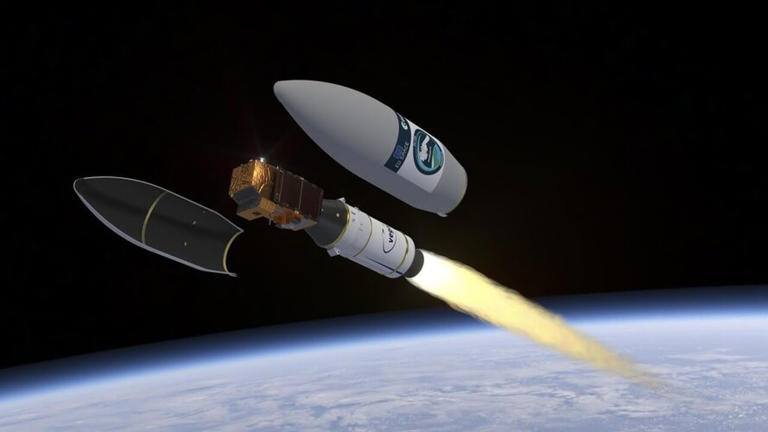
De ESA gaf deze illustratie vrij van de lancering van de Sentinal-2C.
© Foto: ESA

Zoveel mogelijk op eigen benen staan in tijden van AI (en fake data)

De lancering is niet enkel van belang voor meer en betere data. Het gaat er ook om dat Europa zelf zoveel mogelijk op eigen benen wil staan wat betreft datagaring. Momenteel is er voor zulke aardobservatie- programma's veel samenwerking met bijvoorbeeld de Amerikaanse ruimtevaartorganisatie NASA en/of met China, en worden veel data samengelegd.

Maar wat als Trump verkozen raakt als VS-president en het programma afbouwt, of wat als China geld vraagt? "Hoe meer ownership Europa zelf heeft, hoe beter", onderstreept Jonckheere. 

Bovendien kan Europa de eigen garing 100 procent betrouwen: "We zien dat er door artificiële intelligentie (AI) valse satellietdata circuleren via deep fakes. Bij eigen garing heb je de garantie dat het wel degelijk om authentieke data gaat."

De Sentinel-data zijn open en worden met iedereen gedeeld, zoals ook de NASA dat doet. Ze zullen onder meer gebruikt worden door de Europese klimaatdienst Copernicus. 

'Fingers crossed' (want het ging al eens verkeerd)

Hoe veelbelovend de nieuwe satelliet ook klinkt, ze moet komende nacht eerst nog met succes naar de ruimte worden gestuurd. De ESA wacht toch met een beetje spanning de lancering in Kourou, Frans-Guyana, af. 

Sentinel-2C wordt de ruimte ingestuurd door de Vega-draagraket, waarvoor het overigens de laatste vlucht wordt. De Vega-raket heeft geen vlekkeloze reputatie. Zo gingen er in december 2022 2 kostbare satellieten verloren toen een lancering mislukte.

Geld op het spel, maar vooral continuïteit

Anderzijds ging het vaak wel goed, zoals in oktober vorig jaar toen Vega enkele Belgische instrumenten meenam van de Vlaamse Instelling voor Technologisch Onderzoek (VITO). De lancering is voorzien voor 3.50 uur vannacht, maar uitstel is altijd mogelijk als het weer zou tegenzitten. 

Bij ESA schuiven ze toch wat zenuwachtig heen en weer op hun stoel. Een satelliet zou tussen de 50 en 100 miljoen euro kosten, de lancering zelf 20 miljoen. Maar het zou vooral jammer zijn voor de opeenvolging van data, zegt Jonckheere. "Dan zou er geen datacontinuïteit verzekerd zijn, wat net een van de grote troeven is van het programma." 

{ https://www.msn.com/nl-be/ }

Hoe vind je dit bericht?
Geschreven door peter om 23:39 Stuur door

Belief in aliens visiting Earth is skyrocketing – Is that dangerous for society?

Belief in aliens visiting Earth is skyrocketing – Is that dangerous for society?

alien-4868331

Image credit: _freakwave_ @ pixabay.com

The idea that aliens may have visited the Earth is becoming increasingly popular. Around a fifth of UK citizens believe Earth has been visited by extraterrestrials, and an estimated 7% believe that they have seen a UFO.

The figures are even higher in the US – and rising. The number of people who believe UFO sightings offer likely proof of alien life increased from 20% in 1996 to 34% in 2022. Some 24% of Americans say they’ve seen a UFO.

This belief is slightly paradoxical as we have zero evidence that aliens even exist. What’s more, given the vast distances between star systems, it seems odd we’d only learn about them from a visit. Evidence for aliens is more likely to come from signals from faraway planets.

In a paper accepted for publication in the Proceedings of the International Astronomical Union, I argue that the belief in alien visitors is no longer a quirk but a widespread societal problem.

The belief is now rising to the extent that politicians, at least in the US, feel they have to respond. The disclosure of information about claimed Unidentified Anomalous Phenomena (UAPs rather than UFOs) from the Pentagon has got a lot of bi-partisan attention in the country.

Much of it plays upon familiar anti-elite tropes that both parties have been ready to use, such as the idea that the military and a secretive cabal of private commercial interests are keeping the deep truth about alien visitation hidden. That truth is believed to involve sightings, abductions, and reverse-engineered alien technology.

Belief in a cover-up is even higher than belief in alien visitation. In 2019, a Gallop poll found that a staggering 68% of Americans believed that “the US government knows more about UFOs than it is telling”.

This political trend has been decades in the making. Jimmy Carter promised document disclosure during his presidential campaign in 1976, several years after his own reported UFO sighting. Like so many other sightings, the simplest explanation is that he saw Venus. (That happens a lot.)

Hillary Clinton also suggested she wanted to “open [Pentagon] files as much as I can” during her presidential campaign against Donald Trump. As seen in the video below, Trump suggested he’d need to “think about” whether it was possible to declassify the so-called Roswell documentation (relating to the notorious claimed crash of a UFO and the recovery of alien bodies).


Former president Bill Clinton claimed to have sent his chief of staff, John Podesta, down to Area 51, a highly classified US Air Force facility, just in case any of the rumors about alien technology at the site were true. It is worth noting that Podesta is a long-time enthusiast for all things to do with UFOs.

The most prominent current advocate of document disclosure is the Democratic Senate leader Chuck Schumer. His stripped back 2023 UAP disclosure bill for revealing some UAP records was co-sponsored by three Republican senators.

Pentagon disclosure finally began during the early stages of Joe Biden’s term of office, but so far there has been nothing to see. Nothing looks like an encounter. Nothing looks close.

Still, the background noise does not go away.

Problems for society

All this is ultimately encouraging conspiracy theories, which could undermine trust in democratic institutions. There have been humorous calls to storm Area 51. And after the storming of the Capitol in 2021, this now looks like an increasingly dangerous possibility.

Too much background noise about UFOs and UAPs can also get in the way of legitimate science communication about the possibility of finding microbial extraterrestrial life. Astrobiology, the science dealing with such matters, has a far less effective publicity machine than UFOlogy.

History, a YouTube channel part owned by Disney, regularly delivers shows about “ancient aliens”. The show is now in its 20th season and the channel has 13.8 million subscribers. The NASA astrobiology channel has a hard won 20,000 subscribers. Actual science finds itself badly outnumbered by entertainment repackaged as factual.

Alien visitation narratives have also repeatedly tried to hijack and overwrite the history and mythology of indigenous people.

The first steps in this direction go back to Alexander Kazantsev’s science fiction tale Explosion: The Story of a Hypothesis (1946). It presents the 1908 Tunguska meteorite impact event as a Nagasaki-like explosion of an alien spacecraft engine. In Kazantsev’s tale, a single giant black female survivor has been left stranded, equipped with special healing powers. This lead to her adoption as a shaman by the indigenous Evenki people.

NASA and the space science community do support efforts such as the Native Skywatchers initiative set up by the indigenous Ojibwe and Lakota communities to ensure the survival of storytelling about the stars. There is a real and extensive network of indigenous scholarship about these matters.

But UFOlogists promise a far higher profile for indigenous history in return for the mashing together of genuine indigenous stories about life arriving from the skies with fictional tales about UFOs, repackaged as suppressed history.

The modern alien visitation narrative has not, after all, emerged out of indigenous communities. Quite the opposite. It emerged in part as a way for conspiracy-minded thinkers in a Europe torn apart by racism to “explain” how complex urban civilizations in places like South America could have existed prior to European settlement.

Squeezed through a new age filter of 1960s counterculture, the narrative was flipped to value indigenous people as having once possessed advanced technology. Once upon a time, according to this view, every indigenous civilization was Wakanda, a fictional country appearing in American comic books published by Marvel Comics.

If all of this stayed in its own box, as entertaining fiction, then matters would be fine. But it doesn’t, and they aren’t. Visitation narratives tend to overwrite indigenous storytelling about sky and ground.

This is a problem for everyone, not just indigenous peoples struggling to continue authentic traditions. It threatens our grasp of the past. When it comes to insight into our remote ancestors, the remnants of prehistoric storytelling are few and precious, such as within indigenous storytelling about the stars.


Who Are The Pleiadians?

Take the tales of the Pleiades, which date back in standard forms to at least 50,000 years ago.

This may be why these tales in particular are heavily targeted by alien visitation enthusiasts, some of whom even claim to be “Pleiadeans”. No surprises, Pleiadeans do not look like the Lakota or Ojibwe, but are strikingly blond, blue-eyed, and Nordic.

It is increasingly clear that belief in alien visitation is no longer just a fun speculation, but something that has real and damaging consequences.

Tony Milligan is a research fellow in the Philosophy of Ethics at King’s College London.

This article is republished from The Conversation under a Creative Commons license. Read the original article.

{ https://studyfinds.org/ }

Hoe vind je dit bericht?
Geschreven door peter om 23:08 Stuur door

Ganymede Was Struck by Giant Asteroid 4 Billion Years Ago, New Research Suggests

Ganymede Was Struck by Giant Asteroid 4 Billion Years Ago, New Research Suggests

Jupiter’s moon Ganymede has an ancient impact structure called a furrow system. This system is the largest impact structure in the outer Solar System, and the impact should have significantly affected Ganymede’s early history.

Distribution of furrows and location of the center of the furrow system shown in the hemisphere that always faces away from Jupiter (top) and the cylindrical projection map of Ganymede (bottom). The gray regions represent geologically young terrain without furrows. Furrows (green lines) exist only on geologically old terrains (black regions). Image credit: Naoyuki Hirata, doi: 10.1038/s41598-024-69914-2.

Distribution of furrows and location of the center of the furrow system shown in the hemisphere that always faces away from Jupiter (top) and the cylindrical projection map of Ganymede (bottom). The gray regions represent geologically young terrain without furrows. Furrows (green lines) exist only on geologically old terrains (black regions).

Image credit: Naoyuki Hirata, doi: 10.1038/s41598-024-69914-2.

Ganymede is the largest satellite in the Solar System and has many unique features, including tectonic troughs known as furrows.

Furrows are the oldest surface features recognized on Ganymede because they are crosscut by any impact craters with diameters exceeding 10 km. They can provide a window into the early history of this moon.

Furrows have been proposed to be fragments of multiring impact basin structures, similar to those of the Valhalla or Asgard basins on Callisto.

The largest furrow system is present across Galileo and Marius Regios — the so-called Galileo-Marius furrow system — and it is the remnant of an ancient giant impact, which extends concentrically from a single point of Ganymede.

“The Jupiter moons Io, Europa, Ganymede and Callisto all have interesting individual characteristics, but the one that caught my attention was these furrows on Ganymede,” said Kobe University planetologist Naoyuki Hirata, author of a paper published in the journal Scientific Reports.

Gigantic asteroid impact shifted the axis of Solar System's biggest moon

Kobe University HIRATA Naoyuki was the first to realize that the location of an asteroid impact on Jupiter's moon Ganymede is almost precisely on the meridian farthest away from Jupiter. This implied that Ganymede had undergone a reorientation of its rotational axis and allowed Hirata to calculate what kind of impact could have caused this to happen.

Credit: HIRATA Naoyuki

“We know that this feature was created by an asteroid impact about 4 billion years ago, but we were unsure how big this impact was and what effect it had on the moon.”

First, Dr. Hirata realized that the purported location of the impact is almost precisely on the meridian farthest away from Jupiter.

“Drawing from similarities with an impact event on Pluto that caused the dwarf planet’s rotational axis to shift and that we learned about through NASA’s New Horizons spacecraft, this implied that Ganymede, too, had undergone such a reorientation,” he said.

According to the study, an asteroid that hit Ganymede probably had a diameter of around 300 km — about 20 times as large as the Chicxulub asteroid that hit Earth 65 million years ago and ended the age of the dinosaurs — and created a transient crater between 1,400 and 1,600 km in diameter.

Only an impact of this size would make it likely that the change in the distribution of mass could cause the moon’s rotational axis to shift into its current position. This result holds true irrespective of where on the surface the impact occurred.

“I want to understand the origin and evolution of Ganymede and other Jupiter moons,” Dr. Hirata said.

Gigantic asteroid impact shifted the axis of Solar System's biggest moon

On large parts of its surface, the Jupiter moon Ganymede is covered by furrows (right) that form concentric circles around one specific spot (left, red cross), which led researchers in the 1980s to conclude that they are the results of a major impact event.

Credit: HIRATA Naoyuki

Gigantic asteroid impact shifted the axis of Solar System's biggest moon

Distribution of furrows and the location of the center of the furrow system shown in the hemisphere that always faces away from Jupiter (top) and the cylindrical projection map of Ganymede (bottom). The gray regions represent geologically young terrain without furrows. Furrows (green lines) exist only on geologically old terrains (black regions).

Credit: HIRATA Naoyuki

“The giant impact must have had a significant impact on the early evolution of Ganymede, but the thermal and structural effects of the impact on the interior of Ganymede have not yet been investigated at all.”

“I believe that further research applying the internal evolution of ice moons could be carried out next.”

  • N. Hirata. 2024. Giant impact on early Ganymede and its subsequent reorientation. Sci Rep 14, 19982; doi: 10.1038/s41598-024-69914-2

{ https://www.sci.news/ }

Hoe vind je dit bericht?
Geschreven door peter om 22:25 Stuur door

Kurt Russell’s Shocking UFO Encounter: Reporting Six UFOs Over Phoenix, Arizona

Kurt Russell’s Shocking UFO Encounter: Reporting Six UFOs Over Phoenix, Arizona

Kurt Russell Reports SIX UFOs Flying Above Pheonix In Arizona

In the realm of UFO sightings, one of the most intriguing and well-documented incidents is the “Phoenix Lights” event, which occurred on March 13, 1997. Among the many witnesses to this mysterious phenomenon was Hollywood actor Kurt Russell, who later revealed that he was the pilot who first reported the unusual lights in the Arizona skies. Russell’s account adds a unique and personal perspective to the ongoing fascination with UFOs and extraterrestrial life.

The Phoenix Lights Incident

The Phoenix Lights incident is one of the most significant UFO sightings in the United States. On that night in 1997, thousands of people across Arizona reported seeing a massive, V-shaped formation of lights silently moving across the sky. The phenomenon was visible for hours and was witnessed by people in various locations, including Phoenix, Tucson, and the Sonoran Desert. Despite numerous eyewitness accounts, the lights’ origin remains a mystery, leading to widespread speculation and debate.

Kurt Russell’s Encounter

Kurt Russell’s involvement in the Phoenix Lights incident was not widely known until he discussed it years later during an interview. At the time of the sighting, Russell was flying a private plane into Phoenix’s Sky Harbor Airport with his son. As they approached the airport, they noticed six bright lights in a row, hovering in the sky in a formation that defied conventional explanation.

Concerned about the unusual sight, Russell contacted air traffic control to report what he was seeing. Interestingly, air traffic control informed him that no other planes were in the vicinity, and there were no military exercises or activities scheduled that could account for the lights. Russell’s report to the authorities is now recognized as one of the first official accounts of the Phoenix Lights.

The Aftermath and Speculation

Following the sighting, the Phoenix Lights incident gained national attention, with media coverage and investigations by both civilian and military organizations. While some officials claimed the lights were simply flares dropped by military aircraft during training exercises, many witnesses, including Kurt Russell, remain unconvinced by this explanation. The lack of definitive answers has only fueled speculation about the true nature of the lights.

Kurt Russell’s account adds a significant layer to the story because of his credibility as a public figure and his background as a licensed pilot. His detailed description of the six UFOs and his proactive approach in reporting the sighting make his story one of the most compelling aspects of the Phoenix Lights phenomenon.

Legacy of the Phoenix Lights

Over two decades later, the Phoenix Lights incident remains one of the most discussed and analyzed UFO sightings in history. It has inspired documentaries, books, and countless theories about extraterrestrial life and government cover-ups. Kurt Russell’s revelation that he was the pilot who reported the sighting has only added to the intrigue, cementing his place in UFO lore.

Russell himself has expressed a mix of curiosity and bewilderment about the incident. In interviews, he has admitted that the experience was strange and unexplainable, leaving him with more questions than answers. For many, his testimony is a reminder that even the most grounded and skeptical individuals can encounter phenomena that challenge their understanding of the world.

VIDEO:

  • Kurt Russell Reports SIX UFOs Flying Above Pheonix In Arizona | UFO Witness


Kurt Russell Shares UFO "Phoenix Lights" Experience | UFO Witness

Kurt Russell’s report of six UFOs over Phoenix, Arizona, is a fascinating chapter in the larger story of the Phoenix Lights incident. His experience as a pilot and a public figure adds credibility and intrigue to an event that continues to captivate those interested in UFOs and unexplained aerial phenomena. Whether or not the Phoenix Lights were of extraterrestrial origin, the mystery remains unsolved, leaving room for ongoing speculation and wonder.

{ https://www.latest-ufo-sightings.net/ }

Hoe vind je dit bericht?
Geschreven door peter om 22:08 Stuur door

Black Hole in a Planet's Orbit Could Indicate an Advanced Civilization

Black Hole in a Planet's Orbit Could Indicate an Advanced Civilization

Story by Nicole McFadden

Black Hole in a Planet's Orbit Could Indicate an Advanced Civilization

©Sources: Graphic Created using Canva, Pixabay / geralt, NASA CC0 Images via Canva

Black Hole in a Planet's Orbit Could Indicate an Advanced Civilization
An English mathematical physicist and Nobel-prize winner named Roger Penrose hypothesized how energy could be extracted from a rotating black hole in 1971. He proposed constructing a harness around the black hole's accretion disk—where infalling matter reaches near-light speeds—which would trigger an enormous release of energy across multiple wavelengths.

Since then, several scientists have proposed that advanced civilizations might use this idea—dubbed the Penrose Process—to power their technology. This technological possibility suggests just one interesting technosignature that scientists looking for life beyond Earth could search for in outer space.

Following Hypotheses

©Unsplash / Aman Pal

Following Hypotheses
Building upon this idea, scientist John M. Smart has proposed the Transcension Hypothesis. In this hypothesis, he suggested that advanced intelligence may migrate to regions surrounding black holes. There, they could take advantage of the energy available.

The latest idea based on the Penrose Process comes from Harvard Professor Avi Loeb. His paper where he poses his latest findings and ideas, "Illumination of a Planet by a Black Hole Moon as a Technological Signature," was recently published in the scientific journal Research Notes of the AAS.

Avi Loeb’s Paper

©Wikimedia Commons / Cmichel67

Avi Loeb’s Paper
Professor Avi Loeb is an extremely accomplished scientist. He is the Frank B. Baird Jr. Professor of Science at Harvard University, the Director of the Director of the Institute for Theory and Computation at the Harvard-Smithsonian Center of Astrophysics (CfA), the founding Director of the Black Hole Initiative (BHI), and the head of the Galileo Project.

In his latest paper, he proposed that advanced civilizations could rely on a "Black Hole Moon" to provide their home planet with power indefinitely. He argues that the way a black hole would light up the planet it orbits could serve as a potential technosignature for future SETI surveys. (SETI stands for Search for Extraterrestrial Intelligence.)

Stephen Hawking’s Theory

©Stephen Hawking in the 1980s / Wikimedia Commons / NASA

Stephen Hawking’s Theory
In 1975, Stephen Hawking theorized that black holes emit photons, neutrinos, and some larger particles. These theoretical larger particles have been called "Hawking Radiation." Since then, proposals for harnessing black holes as an energy source typically fall into one of two categories.

Some scientists believe in the possibility of the Penrose Process, which involves capturing the energy from angular momentum of black hole accretion disks. Similarly, some believe that capturing the heat and energy generated by black hole hypervelocity jets would be possible, perhaps in the form of a Dyson Sphere. On the other hand, some believe that these black-hole-civilizations would have to feed matter into the black hole they rely on and harness the resulting Hawking Radiation in order to create power.

An Orbiting Black Hole Engine

©Unsplash / NASA Hubble Space Telescope

An Orbiting Black Hole Engine
In his recent paper, Loeb proposed that an advanced alien civilization could rely on the latter process by engineering a black hole to orbit their home planet. This black hole would be relatively very small, weighing just one hundred thousand tons (10-11 g). (Yes, this sounds like a lot, but it is not in terms of black holes.)

However, without any sort of maintenance, this black hole would evaporate in just a year and a half through the emission of Hawking Radiation. Loeb explained that, luckily for any potential civilization, a black hole could be sustained by giving it small amounts of matter—about 4.85 lbs (2.2 kg) per second. In return, the black hole would offer a continuous supply of power.

Powerful and Efficient

©Unsplash / NASA Hubble Space Telescope

Powerful and Efficient
“This black hole system is the most efficient engine that I ever thought about,” Loeb explained. “The fuel is converted to energy with the perfect efficiency of 100%, because the mass falling into the black hole is ultimately coming out as Hawking Radiation. I have not seen this idea discussed before and had a ‘Eureka moment’ when I realized it a few weeks ago.”

According to Loeb, the amount of antimatter needed is currently beyond humanity’s capabilities—a civilization more advanced than our own would have to figure that out. However, Loeb's proposed 10-11 g black hole could continuously supply 40 quadrillion Watts of power, which is certainly enough to power a planet.

Using Waste for Energy

©Unsplash / NASA Hubble Space Telescope

Using Waste for Energy
"The global energy use is a few terra-Watts, ten thousand times less than the power supply of this black hole," Loeb explained. Another benefit is that a black hole can use any type of matter as fuel, including the waste generated by a civilization. In this way, a black hole engine could address an advanced civilization's waste disposal issues while simultaneously offering a limitless source of energy.

"The other advantage of this black hole engine is that it can use any form of matter as fuel,” Loeb said. “It could be trash. There is no better way to recycle trash than convert it into clean energy with 100% efficiency."

Possible for Advanced Civilizations

©Canva / Riddhima's Images

Possible for Advanced Civilizations
Humans produce roughly 1.92 billion metric tons of waste annually. This is having a severe impact on our planet Earth. However, this would be enough to feed a black hole of Loeb’s proposed size for more than 437 million years.

According to Loeb, a black hole engine that uses waste as its energy source would be much simpler than other proposed alien energy sources. Theoretically, it would be technology that a Type II civilization could engineer (for reference, Earth is only _almost_ a Type I civilization).

A Technosignature on Earth

©Pixabay / GuillaumePreat

A Technosignature on Earth
“This is the big challenge,” Loeb said. “Any production line of a 10-11 g black hole requires compressing matter or radiation to a mass density that is 60 orders of magnitude above the density of solid iron. The density of atomic nuclei or neutron stars is only 15 orders of magnitude above solid density. This was possible to achieve in the cosmic radiation density less than a femtosecond after the Big Bang."

In another recently written paper by Loeb, he argued that, based on the theory of General Relativity, black holes could be made out of light. According to his theories, this proposed black hole engine would be detectable light-years away, which might be most interesting about his hypothesis. This would make black hole engines viable technosignatures that would indicate the existence of a far-away advanced civilization to scientists.

Potential Extraterrestrial Power

©Unsplash / NASA Hubble Space Telescope

Potential Extraterrestrial Power
As with many proposed technosignatures—such as science-fiction-like Dyson Spheres and other megastructures—the idea of a black hole engine remains speculative and theoretical. However, as Freeman Dyson noted, if something is within the realm of our imagination and the underlying physics are valid, a sufficiently advanced civilization might already be employing it.

Loeb speculated, “The black hole engine could be discovered as a rogue rocky planet that is illuminated by a gamma-ray moon with no stellar-mass companion. If we ever find evidence for such an engine, we would need to consider the possibility that the source was created or trapped as a primordial black hole by a highly advanced technological civilization. There is no better marker of technological innovation than creating a furnace out of spacetime curvature in the form of a mini black hole.” Loeb’s hypothesis is another interesting theory posed by scientists that could help to confirm life beyond our Earth.

{ https://www.msn.com/en-us/} 

Hoe vind je dit bericht?
Geschreven door peter om 23:31 Stuur door

NASA Learns the Ugly Truth About UFOs

NASA Learns the Ugly Truth About UFOs

Talking about mysterious sightings in the sky can be a nasty business.

A short animation of a UFO, in the shape of a flying saucer, skipping around the sky

Video by The Atlantic. Source: Sobli / RDB / ullstein bild / Getty.

At a meeting in NASA headquarters yesterday, the public had some blunt questions about UFOs, or, as the government now calls them, “unexplained anomalous phenomena.” A NASA spokesperson summarized them aloud: “What is NASA hiding, and where are you hiding it? How much has been shared publicly? Has NASA ever cut the live NASA TV feed away from something? Has NASA released all UAP evidence it has ever received? What about NASA astronauts—do they have an NDA or clearance that does not allow them to speak about UAP sightings? What are the science overlords hiding?” In short: Are you guys lying to everyone?

There was some gentle laughter among the panelists, whom NASA had convened on the subject. No, NASA “has never intentionally cut a live feed to hide anything,” a senior agency official said. A retired astronaut who worked at NASA for 20 years chimed in: “There was never any formal or informal discussions at all about UAPs or UFOs or anyone reporting anything that would suggest something from beyond our planet.” An astrobiologist—the kind of scientist whose job revolves around finding extraterrestrial life—said that scientists are a “rebellious” type, and if someone told him to keep a secret as big as this, he’d want to spill.

The group had spent the past several months examining reports of strange sightings in the sky, and yesterday’s hours-long event was its first (and only) public meeting. The NASA-organized committee, a mix of scientists and industry experts, did not make any dramatic pronouncements. The main takeaway was what we’ve heard all along. “Many events have conventional explanations,” David Spergel, an astrophysicist who chairs the committee, told reporters. (See: balloons.) “There remain events that we do not understand,” he said, “but these events tend to be characterized by poor-quality, limited data.” Ultimately, the group found UAP data “insufficient to provide conclusive evidence about the nature and origin of every UAP event,” Spergel said.

But in doing this work, NASA has discovered a different truth: Talking about UFOs can be a nasty business. If you publicly investigate, contemplate, or even breathe about UFOs, you will probably be harassed on the internet. Several of the panelists “have been subjected to online abuse due to their decision to participate on this panel,” Dan Evans, the NASA official assigned to the committee, said at the outset of the meeting. “A NASA security team is actively addressing this issue.’ (Evans later told me that there were “specific attacks on the character of individuals.”) And then there are the accusatory questions and distrust from the public. The agency has finally opened the doors to serious discussions about UFOs, and what it’s gotten instead is seriously toxic.

Recommended Reading

NASA has historically steered clear of anything involving UFOs, leaving the matter up to other federal agencies, which operated clandestine UFO programs for military and national-security purposes. The world’s top space agency was more concerned with searching for alien life far beyond Earth’s atmosphere—around planets orbiting other stars, for example—than weird things in our own sky. But UFOs have been popping up in the news quite a bit in recent years, thanks to newspaper reports on those secret government programs and the resulting congressional hearings. But last year, NASA’s administrator, Bill Nelson, seemed to succumb to the pull of UFOs and directed the agency to form a panel of experts.

Spergel and the other members of the committee stressed that their goal was not to conduct an exhaustive investigation of every frame of grainy footage but to provide a “roadmap” for NASA that details how the agency could contribute to the future study and analysis of UFOs. The panel did not have access to any classified data either. That approach was bound to provoke those who believe that some reported UFOs have extraterrestrial origins, and that the government—and perhaps now NASA too—is hiding that fact.

Despite the high emotions surrounding UFOs, nearly all public meetings on the subject are quite anticlimactic, and distinctly lacking in someone unfurling a giant sign from the ceiling that declares, once and for all, WE FOUND THE ALIENS. I’ve covered the space industry for years, and to me, the most surprising result was how absorbed NASA seemed to be in the discussion. Last year, a NASA official said a dedicated UAP-research effort would pose a “reputational risk” for the agency. But yesterday, this committee was advising NASA to approach UFOs in a way that the agency has not done in its nearly 65-year existence. Instead of opting out, the panelists said that NASA should help reduce the stigma surrounding UFOs; one expert from the Federal Aviation Administration said that the agency should “leverage its brand image” to do so. Evans, the NASA official, was also on board, saying, “It’s now our collective responsibility to investigate these occurrences with the rigorous scientific scrutiny that they deserve.”

The NASA panel must now draw up a formal report to deliver to agency leaders this summer. One panelist said that NASA should set up its own UFO office, a modest but dedicated force, to collect and archive data alongside other, more serious programs in the Defense Department. But first, NASA would probably like everyone to stop getting worked up over aliens. Nicola Fox, NASA’s associate administrator for science missions, said yesterday that “harassment only leads to further stigmatization of the UAP field, significantly hindering scientific progress and discouraging others to study this important subject matter.” Indeed, the road to understanding the nature of UFOs will be paved with abuse and, as NASA now knows, an ungodly number of emails. “I think every one of the 16-strong panel, plus myself, receives emails on a daily basis of all sorts concerning this subject,” Evans told me. Some of them are terrible, and, unfortunately, there’s nothing anomalous about that.

{ https://www.theatlantic.com/ }

Hoe vind je dit bericht?
Geschreven door peter om 22:53 Stuur door

Meer van UFO'S of UAP'S, ASTRONOMIE, RUIMTEVAART, ARCHEOLOGIE, OUDHEIDKUNDE, SF-SNUFJES EN ANDERE ESOTERISCHE WETENSCHAPPEN - DE ALLERLAATSTE NIEUWTJES

↑ Terug naar de berichten