Naar de inhoud

UFO'S of UAP'S, ASTRONOMIE, RUIMTEVAART, ARCHEOLOGIE, OUDHEIDKUNDE, SF-SNUFJES EN ANDERE ESOTERISCHE WETENSCHAPPEN - DE ALLERLAATSTE NIEUWTJES

UFO's of UAP'S in België en de rest van de wereld
akke.beakke.be
Ontdek de Fascinerende Wereld van UFO's en UAP's: Jouw Bron voor Onthullende Informatie! Ben jij ook gefascineerd door het onbekende? Wil je meer weten over UFO's en UAP's, niet alleen in België, maar over de hele wereld? Dan ben je op de juiste plek! België: Het Kloppend Hart van UFO-onderzoek In België is BUFON (Belgisch UFO-Netwerk) dé autoriteit op het gebied van UFO-onderzoek. Voor betrouwbare en objectieve informatie over deze intrigerende fenomenen, bezoek je zeker onze Facebook-pagina en deze blog. Maar dat is nog niet alles! Ontdek ook het Belgisch UFO-meldpunt en Caelestia, twee organisaties die diepgaand onderzoek verrichten, al zijn ze soms kritisch of sceptisch. Nederland: Een Schat aan Informatie Voor onze Nederlandse buren is er de schitterende website www.ufowijzer.nl, beheerd door Paul Harmans. Deze site biedt een schat aan informatie en artikelen die je niet wilt missen! Internationaal: MUFON - De Wereldwijde Autoriteit Neem ook een kijkje bij MUFON (Mutual UFO Network Inc.), een gerenommeerde Amerikaanse UFO-vereniging met afdelingen in de VS en wereldwijd. MUFON is toegewijd aan de wetenschappelijke en analytische studie van het UFO-fenomeen, en hun maandelijkse tijdschrift, The MUFON UFO-Journal, is een must-read voor elke UFO-enthousiasteling. Bezoek hun website op www.mufon.com voor meer informatie. Samenwerking en Toekomstvisie Sinds 1 februari 2020 is Pieter niet alleen ex-president van BUFON, maar ook de voormalige nationale directeur van MUFON in Vlaanderen en Nederland. Dit creëert een sterke samenwerking met de Franse MUFON Reseau MUFON/EUROP, wat ons in staat stelt om nog meer waardevolle inzichten te delen. Let op: Nepprofielen en Nieuwe Groeperingen Pas op voor een nieuwe groepering die zich ook BUFON noemt, maar geen enkele connectie heeft met onze gevestigde organisatie. Hoewel zij de naam geregistreerd hebben, kunnen ze het rijke verleden en de expertise van onze groep niet evenaren. We wensen hen veel succes, maar we blijven de autoriteit in UFO-onderzoek! Blijf Op De Hoogte! Wil jij de laatste nieuwtjes over UFO's, ruimtevaart, archeologie, en meer? Volg ons dan en duik samen met ons in de fascinerende wereld van het onbekende! Sluit je aan bij de gemeenschap van nieuwsgierige geesten die net als jij verlangen naar antwoorden en avonturen in de sterren! Heb je vragen of wil je meer weten? Aarzel dan niet om contact met ons op te nemen! Samen ontrafelen we het mysterie van de lucht en daarbuiten.

Archief

Een "oceaan" van vloeibaar water gevonden in de diepten van Mars: de ontdekking na de NASA-missie

Een "oceaan" van vloeibaar water gevonden in de diepten van Mars: de ontdekking na de NASA-missie

door JanineJanine image
Een afbeelding van de missie InSight Lander die aardbevingen op Mars bestudeerde

NASA/JPL-Caltech

Mars is al geruime tijd een van de doelstellingen van de ruimteverkenning, waarbij de interesse niet beperkt blijft tot de zoektocht naar buitenaards leven, maar ook de geologische en klimatologische geschiedenis ervan omvat. Tegenwoordig weten we dat Mars ooit vloeibaar water op het oppervlak had, dat tegenwoordig niet meer aanwezig is. Toch hebben onderzoekers onlangs ontdekt dat de rode planeet mogelijk nog steeds vloeibaar water onder het oppervlak heeft. Maar hoe is dit mogelijk? En wat betekent dit voor onderzoek naar andere organismen? Laten we het samen ontdekken!

f46c626a-f271-11e8-abcc-02b7b76bf47f.jpg

Illustratie: NASA

9e444e28-a994-11e7-bbe7-02b7b76bf47f.jpg

InSight landde in 2018 op Mars en verzamelde een schat aan data.

Afbeelding NASA/JPL-Caltech

De erfenis van NASA's Mars InSight Lander-missie

De studie van Mars zou onmogelijk zijn zonder de sondes die verschillende ruimtevaartorganisaties op de rode planeet hebben gelanceerd. De bekendste zijn natuurlijk de Curiosity en Perseverance rovers, of de Ingenuity drone, maar ze zijn niet de enige. De ontdekking van een echte wateroceaan in de diepten van Mars is een gevolg van NASA's Mars InSight Lander-missie, die in 2018 landde met als taak seismische gebeurtenissen op Mars te bestuderen. En in feite heeft de sonde vier jaar lang gegevens verzameld over de geologie van de rode planeet... maar niet alleen.

Hoewel InSight Lander nu is beëindigd, zijn onderzoekers doorgegaan met het bestuderen van de verzamelde gegevens, die de aanwezigheid van vloeibaar water op diepten tussen 10 en 20 kilometer onder het aardoppervlak lijken te bevestigen. Kortom, zo beweren wetenschappers in een studie gepubliceerd in het tijdschrift PNAS, er zou nog steeds water in vloeibare vorm aanwezig zijn op Mars.

De analyse van seismische golven op Mars en de aanwezigheid van vloeibaar water

NASA

Mars InSight Lander verzamelde meer dan 1300 opnames van seismische trillingen die plaatsvonden op de rode planeet, en met deze gegevens konden onderzoekers de aard van de materialen ontdekken die door de golven werden doorkruist. Dit is een techniek die al op aarde wordt gebruikt om te zoeken naar hulpbronnen die in de diepte aanwezig zijn, zoals olie of gas, maar ook water. Dit laatste lijkt op grote diepten in de korst van Mars aanwezig te zijn, een verder bewijs dat Mars ooit rijk was aan rivieren en meren.

De afgelopen drie miljard jaar heeft de rode planeet bijna zijn hele atmosfeer en daarmee ook zijn oppervlaktewater verloren. Het lijkt er echter op dat een deel van het water van Mars binnen de planeet bleef, een beetje zoals wat er op aarde gebeurt, waar er hele oceanen in de korst en mantel zouden zitten. Waarom zou Mars anders zijn?

e18ec444-2849-4261-8eee-22881eda680c.png

James Tuttle Keane en Aaron Rodriquez

Scripps Institute of Oceanography

Water en leven

De ontdekking van waterreserves in de diepten van Mars opent nieuwe onderzoeksperspectieven die in twee verschillende richtingen gaan. Aan de ene kant kunnen onderzoekers beter begrijpen hoe het systeem van rivieren en meren op de Rode Planeet werkte. Aan de andere kant is vloeibaar water gekoppeld aan de oude droom van de verkenning van Mars, de zoektocht naar buitenaardse levensvormen: waar water is, kan ook leven zijn, weten we, en niets weerhoudt hen ervan om ook in de korst van Mars te bestaan.

Helaas zijn deze reservoirs niet gemakkelijk toegankelijk vanwege hun diepte van tussen de 10 en 20 kilometer. Pas onlangs is een project gelanceerd dat tot doel heeft het aardoppervlak uit te graven en een diepte van 11 kilometer te bereiken: dit op een andere planeet doen zou een buitengewone uitdaging zijn. Zoals echter vaak gebeurt bij ruimteverkenning, zijn wat aankomstpunten lijken slechts startpunten voor nieuwe doelstellingen en nieuwe ontdekkingen. Kortom, de ontdekking van vloeibaar water op Mars, in de vorm van verzadigde sedimenten of aquifers, kan de geschiedenis van de ruimteverkenning herschrijven. En misschien zelfs zijn toekomst.

PIA17944-MarsCuriosityRover-AfterCrossingDingoGapSanddune-20140209.jpg

Foto: NASA

{ https://www.curioctopus.nl/ }

Hoe vind je dit bericht?
Geschreven door peter om 20:57 Stuur door

The UFO Event That Transformed Dr. Kevin Knuth into a UAP Researcher

The UFO Event That Transformed Dr. Kevin Knuth into a UAP Researcher

The UFO Event That Shocked Dr. Knuth.

Dr. Kevin Knuth, a former NASA research scientist and a respected physicist, was initially a curious observer rather than an active researcher in the field of Unidentified Aerial Phenomena (UAPs). His journey into serious UAP research began in 2010 after attending a press conference that fundamentally altered his views on the subject. This event, organized by Robert Hastings at the National Press Club in Washington, D.C., featured retired U.S. military officers who provided compelling testimonies about their encounters with UAPs at nuclear weapons sites. This marked a significant turning point in Dr. Knuth’s career, transforming him from a bystander to a committed investigator of these phenomena.

The Press Conference That Changed Everything

The 2010 press conference hosted by Robert Hastings was not just another event in the UFO community—it was a game-changer. Hastings, a well-known figure in UAP research, brought together seven former U.S. Air Force officers to share their experiences with UAPs. These officers provided detailed accounts of UAP incidents at various nuclear weapons facilities, including missile sites and storage areas.

One of the most striking aspects of the conference was the consistency of the testimonies. The witnesses described UAPs as disc-shaped, cylindrical, or spherical objects capable of hovering silently or moving at high velocities. What made these sightings particularly alarming was the apparent ability of these UAPs to interfere with nuclear weapons, rendering them inoperative. This connection between UAPs and nuclear facilities has been a recurring theme in UAP research, raising concerns about the potential implications for national security.

Dr. Knuth’s Initial Skepticism

Dr. Knuth’s interest in UAPs dates back to 1988 when he was a graduate student. He recalled a conversation with one of his professors, who mentioned strange incidents involving UAPs at Malmstrom Air Force Base in Montana. According to the professor, UAPs were reportedly disabling intercontinental ballistic missiles (ICBMs) at the base. At the time, Dr. Knuth and his peers dismissed the story as implausible, finding it difficult to believe that such a significant event could occur without widespread attention.

For years, this story remained a humorous anecdote in Dr. Knuth’s mind, something he and his fellow students would joke about. However, it wasn’t until 2010 that he encountered similar accounts, which made him reconsider the validity of his professor’s story.

The Pivotal Moment

In 2010, while preparing lectures on astrobiology at the University at Albany, Dr. Knuth stumbled upon the press conference organized by Robert Hastings. During the conference, he heard testimonies from several military officers, including Robert Salas, who had witnessed UAPs at Malmstrom Air Force Base—the very location his professor had mentioned years earlier.

VIDEO:

  • Chris Lehto – The UFO Event That Shocked Dr. Knuth.

One of the most impactful testimonies came from Robert Salas, a retired U.S. Air Force captain. Salas described an incident at Malmstrom Air Force Base in 1967, where a bright red UAP was seen hovering above the front gate of the facility. Shortly afterward, ten nuclear missiles went offline, becoming inoperable. This account, corroborated by other military personnel, struck a chord with Dr. Knuth, as it matched the story he had heard decades earlier.

Realizing the credibility of these witnesses and the potential implications of their testimonies, Dr. Knuth’s perspective on UAPs shifted dramatically. He began to take the issue seriously, recognizing the need for scientific investigation into these phenomena.

The Broader Implications

The 2010 press conference highlighted a pattern of UAP encounters at nuclear facilities, with multiple witnesses providing corroborating accounts. Among the speakers were military officers such as Colonel Charles Halt, who had witnessed UAPs at RAF Bentwaters in England, and Lieutenant Robert Jacobs, who described a UAP encounter during a missile test in 1964.

These testimonies suggested that UAPs have a specific interest in nuclear weapons, raising questions about their intentions and the potential risks they pose. For Dr. Knuth, the realization that credible military personnel were reporting these incidents—and that they were being largely ignored by the public and the scientific community—was alarming. He saw the lack of attention to these events as dangerous and felt compelled to take action.

Dr. Knuth’s New Mission

Motivated by the testimonies he had heard, Dr. Knuth decided to shift his focus to UAP research. As a physicist with expertise in astrophysics, machine learning, and the foundations of physics, he recognized the need for a scientific approach to studying UAPs. He became an advocate for serious research into these phenomena, calling for greater transparency and investigation.

Dr. Knuth’s journey from skepticism to advocacy underscores the importance of credible witness testimonies in shaping our understanding of UAPs. His experience highlights the need for the scientific community to engage with this issue and for the public to recognize the potential significance of UAP encounters, particularly those involving nuclear weapons.

In conclusion, the 2010 press conference that shocked Dr. Kevin Knuth serves as a powerful reminder of the potential implications of UAPs. It not only transformed his career but also contributed to a growing movement calling for greater scrutiny and research into these mysterious phenomena. As more information comes to light, Dr. Knuth’s story may inspire others in the scientific community to take UAPs seriously and to explore the mysteries that still surround them.

LINKS UFOS

{ https://www.latest-ufo-sightings.net/ 

Hoe vind je dit bericht?
Geschreven door peter om 20:37 Stuur door

Titan’s Liquid Landscapes Decoded in New Findings from Cassini-Huygens

Cassini gets new views of Titan's land of lakes - The Archaeology News ...

(NASA/JPL/Space Science Institute)

Titan’s Liquid Landscapes Decoded in New Findings from Cassini-Huygens

The latest data analysis from the Cassini-Huygens space probe has further illuminated the mysterious seas of Titan, Saturn’s largest moon.

Bistatic radar returns from the moon are providing scientists with greater insight into Titan’s northern seas behavior and composition, according to a new study spearheaded by Cornell University, released on Tuesday in the journal Nature Communications.

Collecting Data on Titan

The Cassini-Huygens mission involves a space probe launched in an international cooperative effort between NASA, the European Space Agency, and the Italian Space Agency. Its goal is to collect data regarding the planet Saturn itself, as well as its surrounding rings and moons.

Two implements were used to conduct the mission: the Cassini space probe orbiting Saturn and the Huygens lander that set down on Titan. Cassini orbited the planet from 2004 until it burned up in Saturn’s atmosphere in 2017. Huygens landed on Titan in January 2005, but contact was lost a little over an hour after it touched down due to a communications problem not identified until after launch.

Novel Data Collection Methods

The difference between the new bistatic method of observation and the previous monostatic method is that the new data comes from a polarized reflection. This means that the reflection is viewed from two perspectives, both the sending spacecraft and a receiver back on Earth. Previous monostatic data was returned only to the spacecraft itself.

Valerio Poggiali, lead author of the new study, says the result of the bistatic method “is a more complete dataset and is sensitive to both the composition of the reflecting surface and to its roughness.” While the bistatic data set does provide dynamic new information, the old mono static data is still relied upon for context. Even this new data set has some limitations, as the radar returns are limited to the surface level of bodies and are incapable of providing depth-sounding information.

The data collection for the recent study actually began a decade ago, as the probe collected measurements when it came into its closest proximity to Titan and again when it moved away. These ingresses and egresses occurred on May 17, June 18, and October 24, 2014, and over two years later on November 14, 2016. The team focused on data collected during the egress portions of the flybys, as only on the egress phase did the radar return cross one of the bodies that the team was honed in on, the Kraken Mare, Ligeia Mare, and Punga Mare polar seas.

The Seas of Titan Show to be Quite Different Than Those of Earth

The differences that emerged between the seas corresponded to the sea’s latitude and location. Proximity to other features, such as rivers and estuaries, impacted the seas’ composition. Titan’s tranquil seas only show minor 3.3-millimeter waves, raising to 5.3 mm near regions where bodies of water meet, such as coasts, estuaries, and interbasin straits. This suggests the existence of tidal currents on the moon. On Earth, we typically measure waves in meters, not millimeters. So, while there is some variation, the surface is remarkably calm from our perspective.

Saturn's moon Titan Artist’s concept of a lake at Titan’s north pole (Credit: NASA/JPL; University of Arizona; University of Idaho).

Another significant variance with Earth is the dialectic constant of Titan’s liquid bodies. Dielectric constant refers to the ability of a material to store electrical energy instead of conducting it. The water bodies of Earth have a high dielectric constant of about 80. In contrast, the methane seas of Titan have a dramatically lower value of around 1.7, falling even lower in rougher coastal areas and estuaries. That is only a bit higher than air on Earth, which registers about a 1. This impacts the bistatic radar returns because a higher value leads to a more accurate reading from a stronger signal.

The Data Meets Our Predictions, But Discoveries Still Lay Ahead

Although their composition appears to be much different, the seas on Titan appear to be behaving quite similarly to the ones on Earth in certain other respects. On Earth, we are dealing with water and salt, but the methane and ethane existent in liquid form on Titan appear to flow quite similarly. Earth’s freshwater streams pour into salty oceans. On Titan, pure methane rivers flow into oceans mixed with ethane.

The new findings “fit nicely with meteorological models for Titan,” according to the study’s co-author, Philip D. Nicholson, an astronomy professor at Cornell. As predicted, it appears that Titan receives a rain comprised of methane and nitrogen.

However, the team has not concluded its work. Poggiali says, “This is only the first step.” With 13 years in orbit, Cassini has collected a mountain of data that still needs to be sifted. In short, our overall understanding of Titan and its seas is still only beginning.

  • jailbreak AI

The new study was made possible by international backing from NASA and the Italian Space Agency. While Cornell led the effort, contributors included the Massachusetts Institute of Technology, California Institute of Technology, NASA Jet Propulsion Laboratory, and Università di Bologna.

The study, titled “Surface Properties of the Seas of Titan as Revealed by Cassini Mission Bistatic Radar Experiments,” appeared in Nature Communications on July 16, 2024. 

  • Ryan Whalen is a writer based in New York. He has served in the Army National Guard and holds a BA in History and a Master of Library and Information Science with a certificate in Data Science. He is currently finishing an MA in Public History and working with the Harbor Defense Museum at Fort Hamilton, Brooklyn.

{ https://thedebrief.org/category/space/ }

Hoe vind je dit bericht?
Geschreven door peter om 23:53 Stuur door

NASA Just Transmitted a Hip Hop Song by Missy Elliot to Venus

XPWv8b9Q?format=jpg&name=900x900

NASA Just Transmitted a Hip Hop Song by Missy Elliot to Venus

Hip-hop has officially been transmitted into deep space. Earlier this week, the popular 1997 song, “The Rain” (Supa Dupa Fly), by rapper Missy Elliot was transmitted from the DSN’s Goldstone complex to Venus, about 158 million miles (254 million kilometers) away.

The lyrics from Elliott’s hip-hop song “The Rain (Supa Dupa Fly)” were beamed to the second planet from the Sun via NASA’s Deep Space Network in a transmission sent by the agency’s Jet Propulsion Laboratory in Southern California at 10:05 a.m. PDT on Friday, July 12.

So why is NASA broadcasting hip-hop into space? In recent years, the space agency has integrated pop culture and space exploration to attract the masses and make space digestible and reachable for everyone. Space exploration, in other words, is not just for astronauts and people who enjoy nerding out over planets and distant star systems; it’s for all of us. Branching out and reaching a larger audience showcases the diversity of our planet, which parallels the diversity of the universe and the many cosmic mysteries it holds. 

“I still can’t believe I’m going out of this world with NASA through the Deep Space Network when ‘The Rain (Supa Dupa Fly)’ becomes the first ever hip-hop song to transmit to space!” Elliott said. “I chose Venus because it symbolizes strength, beauty, and empowerment and I am so humbled to have the opportunity to share my art and my message with the universe!”

Missy Elliot Missy Elliot (Wikimedia Commons CC 4.0)

“Super Dupa Fly” went super dupa far, traveling 158 million miles (254 million kilometers) from Earth to Venus. The transmission was made by the 34-meter (112-foot) wide Deep Space Station 13 (DSS-13) radio dish antenna, located at the DSN’s Goldstone Deep Space Communications Complex near Barstow, California. Coincidentally, DSS-13 is also nicknamed Venus.

“Both space exploration and Missy Elliott’s art have been about pushing boundaries,” said Brittany Brown, director of the Digital and Technology Division, Office of Communications at NASA Headquarters in Washington, who initially pitched ideas to Missy’s team to collaborate with the agency. “Missy has a track record of infusing space-centric storytelling and futuristic visuals in her music videos, so the opportunity to collaborate on something out of this world is truly fitting.”

The Deep Space Network (DSN) has an assortment of giant radio antennas that are used to track spacecraft, send commands, and receive scientific data from the Moon and beyond.  

  • artificial intelligence
    See Also

“Risk of Extinction” From Artificial Intelligence Prompts Concerning New Warning From AI Experts

The DSN has transmitted only one other song into space, The Beatles “Across the Universe” in 2008. The recent transmission of Elliott’s song marks another groundbreaking moment, this time for for hip-hop culture. 

{ https://thedebrief.org/category/space/ }

Hoe vind je dit bericht?
Geschreven door peter om 23:42 Stuur door

Ret. NASA Astronaut Claimed To Have Seen Snake-Shaped UFOs During Two Missions In Space

Snake-Shaped UFOs

Ret. NASA Astronaut Claimed To Have Seen Snake-Shaped UFOs During Two Missions In Space

Space is not what we see at night or what NASA has shown us for years. Amid stars, planets, and other celestial bodies, there are much more vivid, bizarre, and strange things hidden from our eyes. Several astronauts strongly believe in the existence of extraterrestrial civilizations including Gordon Cooper, Buzz Aldrin, and Story Musgrave.

Many conspiracy theorists believe that NASA knew that Buzz Aldrin and Neil Armstrong had an encounter with aliens, which is why they erased 40 rolls of film from the Apollo 11 mission. It was claimed by Bob Dean, a United States Army Command Sergeant Major.

Story Musgrave The crew Of Sts-80, Seated (From Left-to-right) Kent V. Rominger, Pilot; Kenneth D. Cockrell, Commander. Standing (Left To Right) Mission Specialists Tamara E. Jernigan, F. Story Musgrave, And Thomas D. Jones. Photo Credit: Nasa

According to a report shared by Gaia, there is a transcript between Aldrin and Armstrong where the two had witnessed extraterrestrial activities on the Moon during the Apollo 11 mission.

Apollo 11: “Those are giant things. No, no, no, this is not an optical illusion. No one is going to believe this.”

NASA: “What… what…. what? What the hell is happening What’s wrong with you?”

Apollo 11: “They’re here, under the surface.”

Apart from this, what former NASA astronaut Franklin Story Musgrave said about his experience in space would shock anyone. He claimed to have seen an 8-foot-long snake, white in color, floating through space. It is hard to explain how a snake could reach space, but Musgrave has never denied it.

Read also:

Here is Musgrave’s quote from the TV series “Sightings, ” Sunday, April 9, 1995:

“On two of my missions, and I still don’t have an answer, um, I have seen, a snake out there, six seven eight feet long. It is rubbery because it has internal waves in it and it follows you for a rather long period of time. The more you fly in space the more you see an incredible amount of things out there and THAT sorta brings to you, really a certainty, that other living creatures are out there. Some incredibly primitive, more primitive, some just ah just proteins coming together, amino acids and some just single-cell organisms and other civilizations that have been around for a million years that are doing unimaginable kinds of things.”

1-1.jpg

 Fig 1: Alleged Photograph of snake-like UFO captured during NASA STS-61 mission

2-1.jpg

There is even a video (see below) where a snake-like creature is floating in the Earth’s stratosphere. Musgrave said: “Some are incredibly primitive – some just proteins coming together, amino acids, and some just single-celled organisms. And other civilizations have been around for millions of years that are doing unimaginable kinds of things.”

Musgrave (85) is also a retired colonel of the United States Marine Corps, physician, and mathematician, holds six academic degrees, and is simply a legendary figure in US history. He spent a total of 1,281 hours, 59 minutes, and 22 seconds during his six space shuttle missions in space including 27 hours of spacewalk. Besides, he developed a spacesuit for space shuttle astronauts.

This is not the end of strange anomalies watched by the astronauts in space. Retired astronaut Leroy Chiao, a commander of Expedition 10, along with his crew members witnessed a set of bright lights in the formation of an upside-down tick mark in space.

The description of an unknown snake-like creature or craft given by Musgrave was also spotted in March 2019, when one of the passengers on a commercial airline flight from Phoenix to Portland captured two long dark objects, having long tails or tentacles. Some viewers compared it with the squid lime sentinels from the Matrix series, while others believe that it was possibly something from another dimension that slipped through momentarily.

Similarly, the New York Post shared a video of a UFO in 2018, shot by a passenger while cruising over the Aegean Sea that also shows a creature with a long tail. The opinions were divided into two groups, where people from one group believed it was just a hoax while others also witnessed the same encounter while flying in the plane.

{ https://www.howandwhys.com/ }

Hoe vind je dit bericht?
Geschreven door peter om 23:26 Stuur door

Explore an Apollo-era mission gone wrong in sci-fi mystery game 'Lifeless Moon' (video)

Explore an Apollo-era mission gone wrong in sci-fi mystery game 'Lifeless Moon' (video)

an astronaut on an alien beach with a green star in the distance
A scene from Serenity Forge's "Lifeless Moon." 
(Image credit: Serenity Forge)

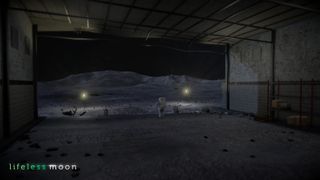
With an eerie "The Twilight Zone" vibe and surreal cosmic elements, Stage 2 Studios and Serenity Forge's sci-fi video game called "Lifeless Moon" has arrived and we've got the odd launch trailer to share that highlights its immersive old-school storyline.

It's appears to be a trippy 3D action adventure release designed with platform stages that combine logic and puzzle-solving skills, where a pair of Apollo-era astronauts encounter a strangely familiar desert town during a dream-like expedition to the Moon. 

"Lifeless Moon" and its blurred realities was just launched July 9, 2024 for Xbox One/X/S, PlayStation 4 and 5, Epic Games Store, and Steam.

A scene from Serenity Forge's "Lifeless Moon."  (Image credit: Serenity Forge)

Here's the official synopsis:

"What secrets will be unearthed on the moon?

"You cannot fathom what will come next in 'Lifeless Moon'. Reality itself unravels as the mysteries unfold, adding chaos to an already monumental mission. After stumbling upon a town on the moon that is eerily similar to one back on Earth, you are thrown into the middle of a much larger conspiracy. Venture through strange environments as you collect clues and decipher puzzles. The town is only the beginning of an unforgettable adventure across time and space.

"A sandy boardwalk, a cabin in the woods, and an ominous floating city in the sky are just a few of the peculiar stops along the way. Your surroundings may appear familiar, but nothing is as it seems. Reveal the truth behind these unique locations through environmental puzzle-solving and platforming. Gather documents and information in your journal during your lunar travels and piece together the origin of the many strange phenomena you encounter.

"You've uncovered a cryptic mystery on the moon. Confront a strange phenomenon, tap into its extraordinary powers, and overcome psychological challenges to reveal the truth."

A scene from Serenity Forge's "Lifeless Moon."  (Image credit: Serenity Forge)

"Lifeless Moon" acts as sort of a spiritual successor to Serenity Forge's "Lifeless Planet" from 2014,  and its "Lost"-style narrative design was influenced by classic science fiction literature and films where lunar explorers face inexplicable anomalies in time and space. It's also a throwback to TV series like "The Outer Limits," which often depicted astronauts or test pilots facing disorienting situations, psychological experiments, and dangerous discoveries while on routine missions.

Serenity Forge's "Lifeless Moon" is available now on your favorite gaming platform.

{ https://www.space.com/ }

Hoe vind je dit bericht?
Geschreven door peter om 23:12 Stuur door

Former US Army Colonel Warns Of Catastrophic UFO Disclosure That May Spark Social Unrest

Former US Army Colonel Warns Of Catastrophic UFO Disclosure That May ...

Former US Army Colonel Warns Of Catastrophic UFO Disclosure That May Spark Social Unrest

Are we on the verge of a catastrophic UFO disclosure? The year 2023 has witnessed significant progress in bringing the UAP (Unidentified Aerial Phenomena) matter to the attention of the United States Congress. Pentagon whistleblower David Grusch has dominated discussions throughout the year. His testimony before Congress has raised numerous questions about the secrets the U.S. government has allegedly kept since the dawn of UFO sightings. Grusch is convinced that the world has been kept in the dark about this phenomenon for the past 80 to 90 years.

In November 2023, the Daily Mail published a bombshell story discussing the impending UAP Disclosure. Retired US Army Colonel Karl E. Nell was invited to a Stanford University conference to present a “campaign plan” aimed at achieving greater transparency. He also discussed a “Manhattan project,” dedicated to reverse-engineering recovered UFOs/UAPs.

During the conference, Nell showcased slides indicating his hope for disclosure by October 1, 2030. In the slides, he argued his plan, if achieved, would see “Proper Oversight Restored,” “Catastrophic Disclosure Avoid,” and “Scientific Understanding Advanced.” More specifically, Nell advocated for “restoration of proper Federal government oversight over all UAP legacy (and ongoing) program efforts” and “transformative” research and technology programs.

Daily Mail information was based on the first-ever symposium of the new nonprofit Sol Foundation, a group that wants serious research into UFOs and their effects on the world. In 2004, in response to the Defense Intelligence Agency’s decision not to release classified information about UFOs due to the perceived threat to national security, the Sol Foundation was formed.

At this meeting, both Colonel Nell and a former CIA scientist named Hal Puthoff spoke. Puthoff said that in 2004, these important groups chose not to share information about UFO research with the public. Among the Sol Foundation’s other speakers were former U.S. Air Force veteran David Grusch, who testified before Congress earlier this year under oath that “the U.S. government is operating with secrecy—above Congressional oversight” over UAP.

Grusch told the symposium: “Let us advocate for transparency, not for ourselves, but for the generations to come, as we embark on a journey toward a more enlightened and interconnected world.”

Catastrophic UFO Disclosure

At the Sol Foundation UFO symposium, Karl Nell called for a ‘UAP campaign plan’ to compel transparency as well as ‘a Manhattan Project’ to more successfully reverse-engineer recovered UAP craft

Grusch has the support of many individuals in authority who believe he is an authentic person. In the June 2023 edition of the Debrief, authors Leslie Kean and Ralph Blumenthal mention Karl Nell, the retired Army Colonel and aerospace executive who worked with David Grusch and characterized Grusch as “beyond reproach.” Nell speaks highly of Grusch’s integrity and credibility in his role as the Army’s liaison for the UAP Task Force from 2021 to 2022.

Grusch left the government on April 7, 2023, in order, he said, to advance government accountability through public awareness. He remains well-supported within intelligence circles, and numerous sources have vouched for his credibility.

“His assertion concerning the existence of a terrestrial arms race occurring sub-rosa over the past eighty years focused on reverse engineering technologies of unknown origin is fundamentally correct, as is the indisputable realization that at least some of these technologies of unknown origin derive from non-human intelligence,” Karl Nell said.

Ross Coulthart’s insights into UAP disclosure present a compelling narrative, suggesting that there’s more to this phenomenon than meets the eye. With mounting pressure from various quarters, including politicians and the media, the quest for truth regarding UAPs seems poised to intensify in the coming days.

The urgency for UAP disclosure has persisted for a very long time. Roscoe Hillenkoetter, the third CIA director, wrote to Congress in 1960, pleading for UFO disclosure. This confirmed a cover-up and a government disinformation campaign aimed at ridiculing and stigmatizing the topic. (Source)

Perhaps Hillenkoetter’s best-known statement on the subject was in 1960 in a letter to Congress, as reported in The New York Times: “Behind the scenes, high-ranking Air Force officers are soberly concerned about UFOs. But through official secrecy and ridicule, many citizens are led to believe the unknown flying objects are nonsense.”

In his interview with NewsNation, journalist Ross Coulthart shed light on the Office of Global Access (OGA), a key entity where much of the coordination regarding the retrieval of unidentified crafts seems to be happening. He emphasized the seriousness of the matter, stating, “You’ve got to have an office to coordinate the retrieval of these craft.” While some may dismiss these claims as mere  science fiction, his recent interactions with credible intelligence sources have solidified his stance that operations related to UAPs are steered from within the CIA and OGA.

However, the scale of this phenomenon might be more extensive than what has been previously reported. Ross refuted claims that the U.S. only possesses nine such crafts. “I’m told that the United States has far more than nine craft,” he remarked, indicating that not all of them are intact. He further elaborated that JSOC (Joint Special Operations Command) operators, primarily sourced from t he US Air Force special forces, are actively involved in retrieval missions.

A significant revelation from Ross’ sources is the recovery of what he terms as “biologics” — in simpler terms, Non-human Bodies. He shared, “We have recovered what David Grush euphemistically referred to as biologics. Alien bodies, non-human bodies.” This raises pressing concerns about the extent of knowledge the U.S. government possesses regarding non-human life forms.

Read also:

Ross expressed fears of a potential “catastrophic disclosure” if the government remains tight-lipped. He believes that withholding such crucial information from the public and Congress might lead to unforeseen consequences. He stated, “I think it’s incumbent on the president and members of the executive to start thinking seriously,” emphasizing the urgency of the matter.

When posed with alternate explanations, like the involvement of foreign adversaries, Coulthart was quick to debunk such theories. He clarified that the evidence and statements from government officials indicate that these phenomena are not associated with known foreign technologies. This assertion raises eyebrows and places the focus squarely on what exactly the U.S. government knows but is not sharing.

Ross pointed out the notable shift in stance by certain senior Republican politicians. He questioned their motivations behind opposing legislation that seeks transparency regarding non-human intelligence technology. Coulthart’s skepticism was evident when he questioned, “If this is all nonsense, why would somebody of the incredible reputation and seniority of Chuck Schumer and Marco Rubio, associate themselves with legislation that specifically talks over 20 times about NHI nonhuman intelligence technology?”

Danny Sheehan has been publicly pushing for the disclosure or revelation of information related to UAPs. In other words, he believes that there should be more transparency from governments or other relevant authorities about these unidentified phenomena.

In his other interview with James Landoli on “Engaging The Phenomenon,” Sheehan, who was a former Chief Council for the United States Jesuit order, revealed intriguing details about his conversations with the head of the Vatican archives regarding the Vatican’s knowledge of extraterrestrial life. Sheehan shed light on his involvement in a groundbreaking initiative to address the theological and philosophical implications of the discovery of extraterrestrial intelligence.

During the interview, James raised the topic of David Grusch‘s claim that the Vatican possessed knowledge of extraterrestrial phenomena. Sheehan discussed his access to the classified files of the Project Blue Book, where he encountered photos of UFO crash retrievals and concrete evidence of non-human piloted vehicles.

He proposed the formation of a task force involving all 54 major religious denominations to address the issue from a theological perspective. However, at that time, there was insufficient consensus, and the proposal was declined. Sheehan is currently working through his New Paradigm Institute to organize a global summit conference involving world religious leaders to discuss the recent recovery of an extraterrestrial spacecraft.

“The United States government is in possession of biological evidence and has actually taken into custody alive an extraterrestrial person. They’re keeping this secret, interrogating the being, and distorting the information to justify massive expenditures on weapon development under the guise of a perceived threat.” 

Daniel Sheehan.

Sheehan highlighted the Vatican’s acknowledgment of the possibility of extraterrestrial life. He referenced a formal statement issued by the Catholic Church on November 10, 2009, authorized by Pope Benedict. The statement, issued by Father Jose Gabriel Alfuz, a director of the Pontifical Observatory in Rome, recognized the increasing discovery of exoplanets and called for a global discussion on the philosophical and theological implications of the imminent discovery of extraterrestrial life.

Sheehan disclosed that the government was telepathically interrogating the extraterrestrial biological entity (EBO) in custody. Despite acknowledging the bizarre nature of the revelation, Sheehan stood by the credibility of the information, having interviewed individuals directly involved in the process. The EBO allegedly conveyed that a coalition of star systems in our galaxy monitors the evolution of life on different planets, including Earth.

“Pope Benedict had a formal statement issued by the Catholic Church, saying that with the discovery of more exoplanets, it has become clear that we will be discovering life elsewhere in the universe. This prompted the need for a global discussion on the philosophical and theological questions posed by the discovery of extraterrestrial life.” 

Daniel Sheehan.

Meanwhile, Lue Elizondo expresses support for efforts to increase transparency around UAPs. He indicates that there are ongoing efforts behind the scenes to achieve this transparency and that even if certain official channels face challenges or opposition, there are alternative methods and backup plans in place for disclosure. Elizondo emphasizes the importance of understanding the vulnerabilities and challenges faced in these efforts, suggesting a comprehensive strategy is in play.

{ https://www.howandwhys.com/ }

Hoe vind je dit bericht?
Geschreven door peter om 22:59 Stuur door

How Would Humans React to Contact with Extraterrestrials? UK Researchers Seek Answers in New Survey

96StQfKH?format=jpg&name=900x900

(Unsplash)

How Would Humans React to Contact with Extraterrestrials? UK Researchers Seek Answers in New Survey

The question of whether humans are alone in the universe and whether we may one day make contact with extraterrestrials has tantalized philosophers and scientists for centuries.

Astronomers continue to scour the cosmos for signs of biosignatures in far-distant atmospheres that could reveal the planetary home of simple lifeforms or possibly even technosignatures that would indicate an intelligent extraterrestrial civilization not unlike us. Meanwhile, some also speculate that signs of extraterrestrials—particularly in the form of their technologies—might be discovered far closer to home than most would ever expect and that perhaps the search for alien technosignatures should include studies of nearby asteroids, planets, Earth’s Moon, and even sightings of unusual phenomena that occasionally occur within our own atmosphere.

Now, a new survey being conducted by researchers in the United Kingdom is asking the public for answers about people’s attitudes toward the idea that humans could one day contact intelligent extraterrestrials or even the controversial notion that some form of contact might have already occurred.

The survey, led by Professor Michael Bohlander, Chair in Global Law and SETI Policy at Durham Law School in the United Kingdom, along with Dr. Andreas Anton, also a Research Fellow at Durham Law School, in cooperation with Dr John Elliott, Honorary Research Fellow in the School of Computer Science at the University of St Andrews, aims to gauge participants’ attitudes toward the Search for Extraterrestrial Intelligence (SETI), as well as reports in recent years involving what the United States military now calls Unidentified Anomalous Phenomena (UAP), or what have traditionally been known as UFOs.

Bohlander and the team hope to learn how participants would react to such a contact event and what its global societal implications would be for humankind.

While the idea of contact with extraterrestrials has long been an area of focus in both science fiction as well as astronomers’ ongoing search for signs of intelligent life elsewhere in the universe, Bohlander recently told The Debrief that he and his colleagues hope to learn more about the human side of the question of alien life: namely how people would likely react to such an event, and therefore how scientists can better prepare for what Bohlander and his colleagues view as the eventuality of some form of contact.

“Such an event would likely pose an existential risk to humanity, regardless of whether the contact were to be hostile or peaceful,” Bohlander said in an email to The Debrief. “In the words of former NASA chief historian Steven J. Dick, we need to work on a unilateral metalaw to determine by which principles humanity should be guided in the process.”

Bohlander says the survey aims to collect data that ranges from the ethical and moral to political, religious, and even legal perspectives from people in all parts of the world on questions related to the prospect of contact with extraterrestrials. Primarily, the questions contained within the survey will aim to inform what Bohlander describes as “the coming debate about the foundations for such a globally accepted metalaw.”

“It actively addresses the traditional geopolitical imbalance of the SETI and UAP debate,” Bohlander told The Debrief, “where the voices of the so-called Global South, or of Earth’s Eastern Hemisphere are not routinely heard.”

Unlike many past surveys that have looked at people’s attitudes or beliefs toward the possible existence of alien life, Bohlander and his colleagues also incorporated the recent interest in unidentified anomalous phenomena (UAP) into the questions they ask of participants, although he notes that they approach the topic from a slightly different angle than the standard questions involving whether we are alone in the universe.

“The UAP/UFO aspect is of a slightly different nature,” Bohlander explains. “Apart from all the recent controversies about cover-ups and conspiracies, about crash site retrievals or reverse engineering, as well as political and constitutional issues of the public’s right to disclosure versus national or indeed global security, UAP/UFOs represent a fait accompli.”

The revelation that some UAP sightings could be related to extraterrestrials, if ever proven, would mean that humankind could soon face an unexpected development of historic proportions. Currently, the Pentagon’s All-domain Anomaly Resolution Office (AARO) maintains there is still no evidence that is suggestive of any links between UAP and off-planet technologies, but for Bohlander and his team, the question alone is worthy of addressing from an academic perspective.

“If some of them are of extraterrestrial origin, then humanity is for all intents and purposes unprepared,” Bohlander told The Debrief. “This is especially the case given the apparent massive difference in technological capacities in some of the observed objects.”

Also, given the recent advancements in artificial intelligence that have seen a sudden surge in recent years, many researchers have begun to question whether intelligence from off-planet, if it were to be encountered, would necessarily even be biological life as we know it. For Bohlander, whatever the nature or form any prospective non-human intelligence may take, the biggest question for humanity has to do with its intentions.

“There is, however, still the question of how to deal with the intelligence behind them—biological or AI—once they reveal themselves,” Bohlander said. “Questions of negotiations and possibly armed response do remain,” he added.

Prospective participants can find the team’s survey, “Contact with Extraterrestrial Intelligence: A study of projected perceptions and reactions among the world’s societies,” available at the website of Durham University’s Durham Law School.

{ https://thedebrief.org/category/space/ }

Hoe vind je dit bericht?
Geschreven door peter om 22:17 Stuur door

Airline Pilots Capture Video Of Encounter With UFOs That Didn’t Appear On Radar

Airline Pilots Capture Video Of Encounter With UFOs That Didn’t Appear On Radar

Hoe vind je dit bericht?
Geschreven door peter om 22:06 Stuur door

Study: Asteroid Psyche Originated beyond Solar System’s Snow Line and Later Migrated to Main Belt

Study: Asteroid Psyche Originated beyond Solar System’s Snow Line and Later Migrated to Main Belt

Planetary scientists using spectral data from the NASA/ESA/CSA James Webb Space Telescope have confirmed the detection of hydroxyl molecules on the surface of the metallic asteroid Psyche. The presence of hydrated minerals suggests a complex history for Psyche.

Jarmak et al. used Webb, shown in the bottom right corner of this illustration, to confirm the presence of hydrated minerals on the surface of Psyche. Image credit: Southwest Research Institute.

Jarmak et al. used Webb, shown in the bottom right corner of this illustration, to confirm the presence of hydrated minerals on the surface of Psyche.

Image credit: Southwest Research Institute.

Psyche, a metal asteroid about 226 km (140 miles) in diameter, is one of the most intriguing targets in the main asteroid belt.

The object orbits the Sun between the orbits of Mars and Jupiter at a distance ranging from 378 to 497 million km (235-309 million miles) from the Sun.

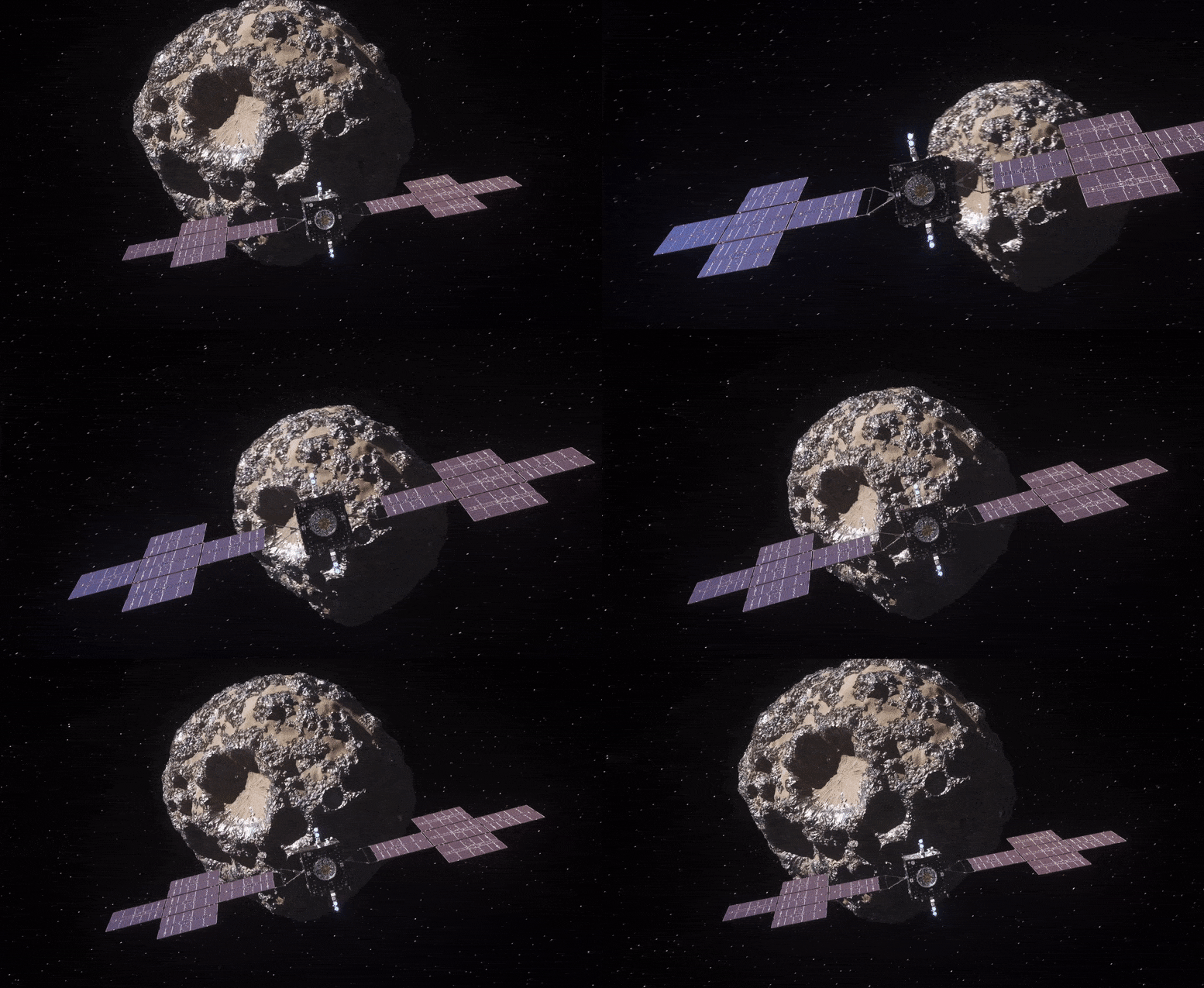
A box-shaped spacecraft with large solar wings swoops in toward a metal-looking asteroid in space.

An artist's visualization video showing the Psyche spacecraft getting closer to the asteroid. 

(Image credit: NASA/JPL-Caltech/ASU)

Psyche takes about five Earth years to complete one orbit of the Sun, but only a bit over four hours to rotate once on its axis.

Unlike most other asteroids that are rocky or icy bodies, planetary scientists think Psyche is comprised mostly of metallic iron and nickel similar to Earth’s core.

On October 13, 2023, NASA launched the Psyche spacecraft, which is traveling 3.5 billion km (2.2 billion miles) to arrive at the asteroid in August 2029.

“Our understanding of solar system evolution is closely tied to interpretations of asteroid composition, particularly the M-class asteroids that contain higher concentrations of metal,” said Dr. Stephanie Jarmak, a researcher at the Harvard & Smithsonian’s Center for Astrophysics.

“These asteroids were initially thought to be the exposed cores of differentiated planetesimals, a hypothesis based on their spectral similarity to iron meteorites.”

The Webb data point to hydroxyl and perhaps water on Psyche’s surface. The hydrated minerals could result from external sources, including impactors

If the hydration is native or endogenous, then Psyche may have a different evolutionary history than current models suggest.

“Asteroids are leftovers from the planetary formation process, so their compositions vary depending on where they formed in the Solar Nebula,” said Dr. Anicia Arredondo, a researcher at Southwest Research Institute.

“Hydration that is endogenous could suggest that Psyche is not the remnant core of a protoplanet.”

“Instead, it could suggest that Psyche originated beyond the ‘snow line,’ the minimum distance from the Sun where protoplanetary disk temperatures are low enough for volatile compounds to condense into solids, before migrating to the outer main belt.”

However, the authors found the variability in the strength of the hydration features across the observations implies a heterogeneous distribution of hydrated minerals.

This variability suggests a complex surface history that could be explained by impacts from carbonaceous chondrite asteroids thought to be very hydrated.

Understanding the location of asteroids and their compositions tells us how materials in the Solar Nebula were distributed and have evolved since formation.

How water is distributed in our Solar System will provide insight into the distribution of water in other planetary systems and, because water is necessary for all life on Earth, will drive where to look for potential life, both in our Solar System and beyond.

“Using telescopes at different wavelengths of infrared light, the Southwest Research Institute-led research will provide different but complementary information to what the Psyche spacecraft is designed to study,” said Dr. Tracy Becker, a researcher at Southwest Research Institute.

Stephanie G. Jarmak et al. 2024. Estimate of water and hydroxyl abundance on asteroid (16) Psyche from JWST data. Planetary Science Journal, in press; doi: 10.3847/PSJ/ad66b9

  • This article is based on a press-release provided by Southwest Research Institute.

{ https://www.sci.news/ }

Hoe vind je dit bericht?
Geschreven door peter om 21:57 Stuur door

Meer van UFO'S of UAP'S, ASTRONOMIE, RUIMTEVAART, ARCHEOLOGIE, OUDHEIDKUNDE, SF-SNUFJES EN ANDERE ESOTERISCHE WETENSCHAPPEN - DE ALLERLAATSTE NIEUWTJES

↑ Terug naar de berichten