Naar de inhoud

UFO'S of UAP'S, ASTRONOMIE, RUIMTEVAART, ARCHEOLOGIE, OUDHEIDKUNDE, SF-SNUFJES EN ANDERE ESOTERISCHE WETENSCHAPPEN - DE ALLERLAATSTE NIEUWTJES

UFO's of UAP'S in België en de rest van de wereld
akke.beakke.be
Ontdek de Fascinerende Wereld van UFO's en UAP's: Jouw Bron voor Onthullende Informatie! Ben jij ook gefascineerd door het onbekende? Wil je meer weten over UFO's en UAP's, niet alleen in België, maar over de hele wereld? Dan ben je op de juiste plek! België: Het Kloppend Hart van UFO-onderzoek In België is BUFON (Belgisch UFO-Netwerk) dé autoriteit op het gebied van UFO-onderzoek. Voor betrouwbare en objectieve informatie over deze intrigerende fenomenen, bezoek je zeker onze Facebook-pagina en deze blog. Maar dat is nog niet alles! Ontdek ook het Belgisch UFO-meldpunt en Caelestia, twee organisaties die diepgaand onderzoek verrichten, al zijn ze soms kritisch of sceptisch. Nederland: Een Schat aan Informatie Voor onze Nederlandse buren is er de schitterende website www.ufowijzer.nl, beheerd door Paul Harmans. Deze site biedt een schat aan informatie en artikelen die je niet wilt missen! Internationaal: MUFON - De Wereldwijde Autoriteit Neem ook een kijkje bij MUFON (Mutual UFO Network Inc.), een gerenommeerde Amerikaanse UFO-vereniging met afdelingen in de VS en wereldwijd. MUFON is toegewijd aan de wetenschappelijke en analytische studie van het UFO-fenomeen, en hun maandelijkse tijdschrift, The MUFON UFO-Journal, is een must-read voor elke UFO-enthousiasteling. Bezoek hun website op www.mufon.com voor meer informatie. Samenwerking en Toekomstvisie Sinds 1 februari 2020 is Pieter niet alleen ex-president van BUFON, maar ook de voormalige nationale directeur van MUFON in Vlaanderen en Nederland. Dit creëert een sterke samenwerking met de Franse MUFON Reseau MUFON/EUROP, wat ons in staat stelt om nog meer waardevolle inzichten te delen. Let op: Nepprofielen en Nieuwe Groeperingen Pas op voor een nieuwe groepering die zich ook BUFON noemt, maar geen enkele connectie heeft met onze gevestigde organisatie. Hoewel zij de naam geregistreerd hebben, kunnen ze het rijke verleden en de expertise van onze groep niet evenaren. We wensen hen veel succes, maar we blijven de autoriteit in UFO-onderzoek! Blijf Op De Hoogte! Wil jij de laatste nieuwtjes over UFO's, ruimtevaart, archeologie, en meer? Volg ons dan en duik samen met ons in de fascinerende wereld van het onbekende! Sluit je aan bij de gemeenschap van nieuwsgierige geesten die net als jij verlangen naar antwoorden en avonturen in de sterren! Heb je vragen of wil je meer weten? Aarzel dan niet om contact met ons op te nemen! Samen ontrafelen we het mysterie van de lucht en daarbuiten.

Archief

NASA deleted original link again: Alien Base On Mars THAT LOOKS NEW! FOUND IT LAST NIGHT July 2, 2011, UFO Sighting News.

NASA deleted original link again: Alien Base On Mars THAT LOOKS NEW! FOUND IT LAST NIGHT July 2, 2011, UFO Sighting News.

UFO,%20UFOs,%20sighting,%20sightings,%20alien,%20aliens,%20base,%20building,%20buildings,%20NASA,%20ESA,%20W56,%20uredda,%20CTR,%20Akrij,%20W56,%20biology,%20science,%20lifebaac5bab-730e-4981-a682-7c3426178a75172.jpg
UFO,%20sighting,%20,%20Mars,%20building,%20base,%20aliens,.png

Mars,%20building,%20base,%20aliens,.png

 Updated links July 6, 2024: 

https://planetarydata.jpl.nasa.gov/w10n/mer2-m-pancam-5-xyz-ops-v1.0/mer2po_0xxx/browse/sol1353/edr/2p246479365effavpbp2408l7m1.img.jpg

+++++
Date of discovery: July 2, 2011 
Location of discovery: Mars 
Discovered By: Scott C. Waring 
 
Original post states:  
Yeah I found another structure on Mars. You know the old saying, where theres smoke theres fire, well I found a few so I keep looking in hopes of finding more. Tonight I found these two unusual photos. I know, the last thing you want to see is another Mars building, but aren't you curious a little bit what alien buildings looks like? The first has the framework of what looks like an ancient wooden ship whose ribs are the only thing left, but this could also be the frame of an ancient building or the rib bones of an animal that died.
+++++
Updated July 6, 2024:
Guys this is getting ridiculous. NASA literally has change most my links. So often you will see reposts with new URLs here. Thats so other researchers can make videos, tiktoks, ect and help spread the world. 
SCW
Screenshot%202024-07-06%20at%203.17.15%E2%80%AFPM.png

{ https://www.ufosightingsdaily.com/ }

Hoe vind je dit bericht?
Geschreven door peter om 23:55 Stuur door

NASA deleted original link, but I found it today again. Alien Face Discovered Near Mars Rover Feb 2014, UFO Sighting News.

NASA deleted original link, but I found it today again. Alien Face Discovered Near Mars Rover Feb 2014, UFO Sighting News.

UAP,%20%E0%A4%89%E0%A4%AB%E0%A5%8C%20,%20%E0%A6%87%E0%A6%89%E0%A6%8F%E0%A6%AB%E0%A6%93,%20%C4%91i%CC%83a%20bay,%20MUFON,%20%E7%9B%AE%E6%92%83%E3%80%81%E3%82%A8%E3%82%A4%E3%83%AA%E3%82%A2%E3%83%B3,%20%20UFO,%20UFOs,%20%D0%9D%D0%9B%D0%9E%20,%20NLO,%20sighting,%20sightings,%20alien,%20aliens,%20ET,%20anomaly,%20anomalies,%20ancient,%20astrobiology,%20vreemdelinge,%20%203%20copy%205.png


Old link 404 error: 
New working link:
 
Now I just wanted to share this with you all. NASA deleted the original link which now gets a 404 error, click it above to see old link vs new. And I wanted to put this new link up so that other researchers could make videos, posts and so on about it. NASA tries to change the links in order to prevent such amazing and important discoveries from staying. It's a sneaky trick and something that the NSA or CIA must have taught them. I do this for everyone, so it's available for you all and exists for future generations. 

Scott C. Waring - Utah

{ https://www.ufosightingsdaily.com/ }

Hoe vind je dit bericht?
Geschreven door peter om 23:47 Stuur door

Nieuw wezen ontdekt in de Golf van Alaska: het heeft meer dan 200 poten en een zeer belangrijke rol

Nieuw wezen ontdekt in de Golf van Alaska: het heeft meer dan 200 poten en een zeer belangrijke rol

Janine image Door Janine

Freepik

Er is een nieuw wezen ontdekt in de diepten van de oceaan in de Golf van Alaska, voor de westkust van Canada. Laten we samen zijn merkwaardige eigenschappen en de sleutelrol die het in de diepten speelt ontdekken.

Nieuwe soort zeekomkommer ontdekt

Een nieuw waterdier, dat leeft op de bodem van de Stille Oceaan in de Golf van Alaska, is ontdekt door een team mariene biologen. Het is een soort met merkwaardige eigenaardigheden: het heeft tweehonderd poten en zijn kleur is roze. Het team, bestaande uit onderzoekers Francisco Solís Marín, Andrea Caballero Ochoa en Carlos Conejeros-Vargas, professoren aan het Instituut voor Oceaanwetenschappen en Limnologie in Mexico, presenteerde de ontdekking en beschreef het als een nieuw wezen dat over de zeebodem kruipt.

Maar wat is de naam van dit wezen wat nog nooit gezien was? Het is een onbekende variant van de zeekomkommer, paarsroze en bleek van kleur, met een lang, slijmerig lichaam uitgerust met 214 poten die in een zigzagpatroon zijn geplaatst en op kleine buisjes lijken. De wetenschappelijke naam in de studie gepubliceerd in Biodiversity Data Journal is Synallactes, maar de eenvoudigere bijnaam is McDaniel zeekomkommer.

De McDaniel zeekomkommer speelt een belangrijke rol voor de oceaan

De nieuwe soort zeekomkommer

Biodiversity Data Journal

De meer onofficiële naam werd geïnspireerd op Neil McDaniel, een deskundige natuuronderzoeker uit Canada die zich toelegt op de studie van zeedieren zoals koralen, anemonen, sponzen en zeekomkommers. Net als de andere exemplaren van zijn soort brengt de McDaniel zijn bestaan kruipend door op zoek naar voedsel. Deze wezens zijn te vinden op dieptes variërend van ongeveer 21 tot 426 meter. Om zich te voeden gebruiken ze hun talrijke tentakels, waarmee ze sedimenten van de zanderige zeebodem verzamelen, waaronder algen en verschillende soorten afval.

Hun activiteit, zo ontdekten de onderzoekers, blijkt zeer nuttig te zijn: zeekomkommers dragen over het algemeen aanzienlijk bij aan het mariene ecosysteem, omdat ze de onbetwiste "schoonmakers" zijn van afval dat in de diepte aanwezig is. Wat ze binnenkrijgen, wordt gefilterd en uitgestoten in de vorm van schoner zand: juist hun dieet zorgt er dus voor dat de zeebodem minder vervuild en vrij is van residuen. De vertering van zeekomkommers zorgt bijvoorbeeld voor een toename van calciumcarbonaat, wat nuttig is voor het gedijen en gezond blijven van koralen.

Kenmerken van de McDaniel zeekomkommer

De nieuwe soort McDaniel, met zijn zachte maar over het algemeen stevige en ruwe lichaam, is tussen de 22 en 30 cm lang, waarbij het onderste deel van het lichaam iets lichter van kleur is. Wat hem onderscheidt van andere zeekomkommers is het aantal papillen op zijn rug. Twee zigzaggende rijen van elk 62 buisvoeten en twee andere van elk 45 poten bevinden zich op het onderste deel van het lichaam en helpen hem om zich te verplaatsen over zanderige en rotsachtige oppervlakken in het noordoosten van de Stille Oceaan.

Het totale aantal zeekomkommers, die ook voorkomen in de Marianentrog, neemt af, maar biologen hopen dit tegen te gaan door meer bekendheid te geven aan het belang van deze wezens in oceaanecosystemen. Hun werk is weliswaar belangrijk, maar niet genoeg om het probleem van de onderwateromgeving op te lossen, maar een grote gemeenschap kan zeker een sleutelrol spelen in het welzijn van dit leefgebied.

oo_1011878.jpg

Synallactes mcdanieli sp. nov. Holotype RBCM 995-00131-001. Ossicles of dorsal papillae A tri-, quadri- and pentaradiate tables; B spiny rods, with the lateral spines (sometimes branched); C long, thin, smooth, straight or curved rods with perforated ends.

  Part of: Solís Marín F, Caballero Ochoa A, Conejeros-Vargas C (2024) Synallactes mcdanieli sp. nov., a new species of sea cucumber from British Columbia, Canada and the Gulf of Alaska, USA (Holothuroidea, Synallactida). Biodiversity Data Journal 12: e124603. https://doi.org/10.3897/BDJ.12.e124603 

{ https://www.curioctopus.nl/ }

Hoe vind je dit bericht?
Geschreven door peter om 18:45 Stuur door

JACQUES VALLÉE: PURSUING UNIDENTIFIED AERIAL PHENOMENA AND ‘IMPOSSIBLE FUTURES’

A6sJazjU?format=jpg&name=900x900

JACQUES VALLÉE: PURSUING UNIDENTIFIED AERIAL PHENOMENA AND ‘IMPOSSIBLE FUTURES’

ON APRIL 17, 2013, attendees at an independently organized TEDx event in Geneva, Switzerland, were offered a glimpse at a seemingly impossible future.

Presented under the theme of “eCulture 360° and Wikinomics”, the event offered something unique even to a gathering of some of the most renowned international speakers on science and technology: the organizers billed it as a “TEDx with the opportunity to meet Jacques Vallée, one of the founder[s] of ARPANET, the first version of the Internet.”

Vallée’s lecture at the event, titled “The Age of Impossible: Anticipating Discontinuous Futures,” dealt with how the speed at which modern technology accelerates has resulted in events that would have seemed impossible to many people only years before they transpired. With examples ranging from the collapse of General Motors in 2009 to Bernie Madoff’s role in the financial crisis of 2007-2008, Vallee presented what he called a “Typology of the Impossible” that hinged on four main kinds of scenarios: events that escalated too quickly, convergences of “low-p scenarios,” events that appear to violate current cultural norms, and finally, scenarios that involve the appearance of a “completely alien concept within a particular culture.”

“There are many things in our culture today that fit that model,” Vallée said at one point during the talk, as he described historical instances where things that seemed unimaginable at one time later became technological norms. Such things, Vallee said, “are possible, but we cannot imagine them. The public is not aware that they can be done. History provides many examples, and the internet itself is an example of something that was unimaginable.”

After discussing his own part in helping create ARPANET, Vallée went on to share several more examples from recent history where unforeseen scientific advancements occurred, seemingly out of the blue.

“And finally,” the scientist said, never evincing a change in his measured tone and demeanor, “the Pentagon could not imagine that fast, erratic, mobile, oval objects in the sky were anything other than mental illusions, and they…” After a brief pause, Vallée cryptically added, “and you can fill out the answers in the next few years.”

Despite his success as a venture capitalist and “co-creator of the Internet”, most of the attendees at the 2013 TEDx event in Geneva were likely aware of what Vallée is best known for: his decades of involvement with the study of unidentified aerial phenomena. As a young computer scientist and astronomer in the 1960s, Vallee not only worked alongside Northwestern University astronomer J. Allen Hynek, the official scientific advisor to the U.S. Air Force’s Project Blue Book but also authored Anatomy of a Phenomenon, one of the earliest popular books written on the UFO subject by a professional scientist. Though he never uttered any of the popular names or abbreviations for the phenomenon, it was obvious what Vallee had been alluding to during this brief, passing reference to “oval objects” during his talk.

At least at that time, what had not been so obvious had been why Vallée specifically referenced the Pentagon’s relationship to UAP, nor why a series of seemingly impossible future events might come to pass involving this subject “in the next few years.”

THE CALL FROM DR. VALLÉE came through earlier than I expected.

The scientist’s voice, softened by age yet still resonant with the French he learned as a youth in Pontoise before emigrating to America many decades ago, was unmistakable to me, having heard it in many interviews and documentaries over the years. Vallée, now 83, is a man whose work in the study of unidentified aerial phenomena is only one finger on the glove of his impressive resume, spanning decades of work in astronomy, physics, computer science, and venture capitalism.

As evidenced by his billing at the TEDx event in 2013, one could indeed argue that Vallée is partly responsible for the creation of the Internet, although the affable Frenchman is modest on this point, nearly to a fault. This much was evident almost immediately as we began our discussion, and I wasted no time in bringing up the talk in Geneva and some of the intriguing hints he had dropped at that time.

“I’ve seen the development and the unfolding of a number of technologies,” Vallée told me during our call. “Very often what happens is that a discovery is made, and everyone agrees that it is important, and people write papers, and so on. And then it disappears.” 
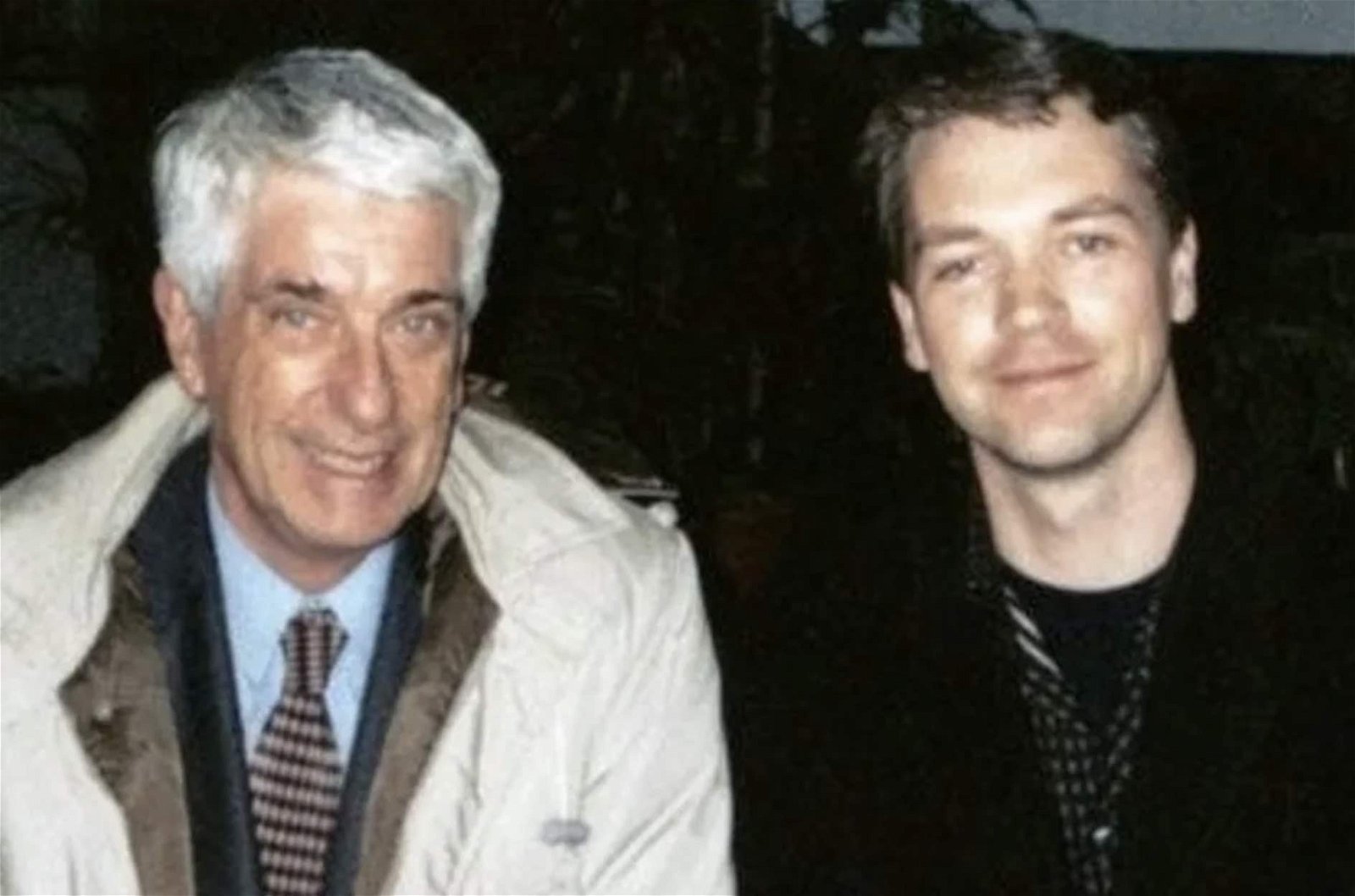
Vallée Vallée with collaborator and fellow author Chris Aubeck (Credit: Chris Aubeck).

“You know, the Arpanet was essentially dead for a while,” Vallée recalls from his years working on the project decades ago. “Until [the] National Science Foundation picked up the funding, thinking that there would be several internets.” Initially a simple matter of accounting, the NSF initially believed it would be easier to fund three separate projects that looked at using networks through which computers could connect for purposes of communication.

“And then they picked it up from the DOD, and it became the Internet, as we know it now.”

Vallée offered several similar examples of predecessors to the Internet—not all of them American innovations—a point which Vallée emphasized as he shifted back to our subject of greater mutual interest: UAP.

“When I watched the meetings in Congress recently, all they talk about is American cases,” Vallee said. “And among American cases, all they talk about is military cases.”

“I can tell you, having developed a lot of databases over the years, the U.S. is less than 2% of the habitable surface of the Earth,” Vallée said.

“So, if this is extraterrestrial, what about the other 98%?

THE PATH THAT BROUGHT Vallée into the tempest that is the study of unidentified aerial phenomena is a long one, which stems back to his early years in Pontoise at an age when the world was still at war.

“There are things you don’t forget,” Vallée said during our call, describing his memories of seeing American aircraft being shot down over his town when he was five years old.

“I remember seeing the crew dropping out in parachutes and the Germans shooting at them.”

By 1945, the war had ended, although fears of a return to conflict lingered throughout parts of Europe. To the north, reports of ghostly “rockets” over countries like Sweden in the summer of 1946 kept many guessing whether the Soviets were conducting tests, perhaps with a form of secret new aerial weapon they had captured from the Germans. The following year, an all-new kind of paranoia would erupt across the Atlantic, as American newspapers were flooded with stories of “flying saucers” seen careening through the skies, especially in airspace around sites of importance to U.S. national security.

By the Autumn of 1954, as the wave of sightings of strange objects was cresting over North America, France was having its own torrent of reports of similar phenomena. Major newspapers like L’Aurore and France-Soir were carrying stories about unidentified flying objects almost daily, and Vallée began collecting clippings of stories like those of Marius Dewilde, a railroad worker who described his observation of a pair of diminutive “robots” next to a dark machine resting on the train tracks.

The reports seemed incredible, and very well might have remained so had it not been for what occurred the following year in May 1955, when Vallée had his own sighting.

“My mother saw it first,” he would later recall of the incident. She had been working in the garden when Vallée, sixteen at the time, heard her screaming for him and his father. Vallée made his way from the attic where his father’s woodworking shop was located, and down three flights of stairs just in time to observe a metallic disc-shaped object “with a clear bubble on top” as it hovered over the nearby church of Saint-Maclou.
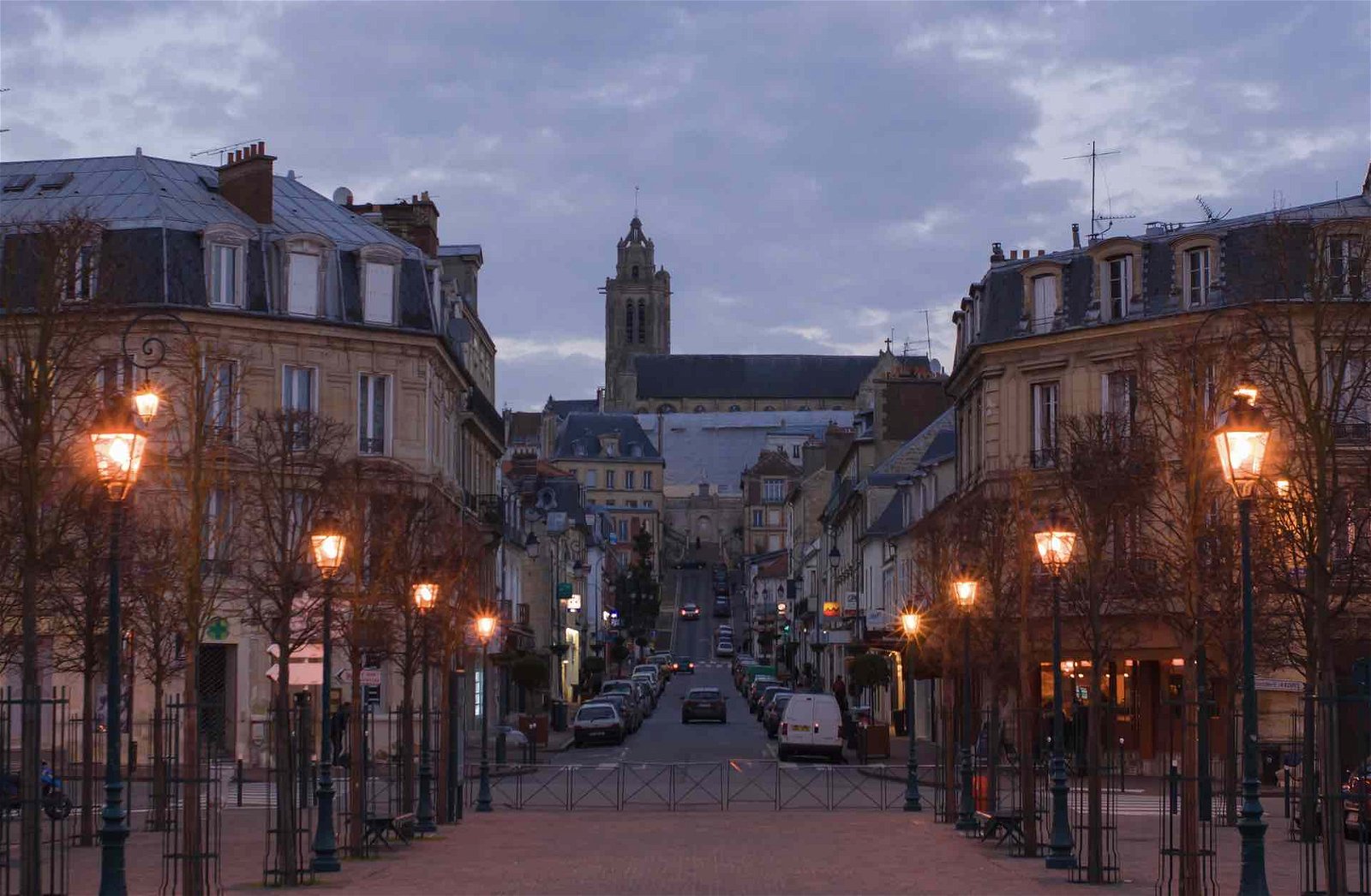
Pontoise A modern view of Pontoise with the Cathédrale Saint-Maclou visible in the distance (Credit: Rozinante/CC BY-SA 4.0).

The object reminded them of the parachutists the family had watched descending from the skies during the war. His mother, who continued watching it, recalled how it sped away, leaving only a few wisps of white vapor where the object had been. Vallée would later learn that a schoolmate nearby had also noticed the object, observing it through binoculars.

Despite his father’s disapproval, Vallée maintained his interest in these unusual aerial objects. “I realized,” he would later write in his journal, “that I would forever be ashamed of the human race if we simply ignored ‘their’ presence.” The young Frenchman began to educate himself on the topic by reading the works of Aimé Michel, one of the earliest serious French researchers to undertake the study of unusual aerial phenomena. It was an interest he maintained through his college years, completing his degree in mathematics at the University of Paris in 1959 and going on to receive his M.S. from the University of Lille Nord de France two years later. By 1961, Vallée was employed at the Paris Observatory as an astronomer with its artificial satellite service, tracking space objects through theodolites by night.

“Naively, I started work here with great enthusiasm, assuming that we would be engaged in genuine research,” Vallée would recall of his years at the observatory. “That is not what I found.” In July of 1961, he and the other astronomers recalled a few instances where they observed objects passing overhead that they could not identify. “The next morning,” he recalled of one incident, his superior “simply confiscated the tape and destroyed it.” Vallée inquired as to why they hadn’t sent this seemingly important information along with their normal Telex tape dispatches to U.S. Navy officials in Paris.

“The Americans would laugh at us,” his superior scoffed.

Having his fill of the prevailing attitudes in Paris, by 1962, Vallée had emigrated to the United States, first working at the University of Texas, Austin, as a research associate in astronomy, and thereafter for a short stint at the McDonald Observatory, where he helped to compile the first informational map of the planet Mars with fellow French astronomer Gérard de Vaucouleurs. However, by the summer of 1963, Vallée was looking ahead at new opportunities, one of which arrived following a meeting in September with astronomer J. Allen Hynek, chair of Northwestern University’s astronomy department, who helped the young scientist find work as a systems analyst on campus. Hynek, at the time the scientific advisor to the U.S. Air Force’s Project Blue Book UFO investigation, was a natural ally; not only would he serve as a mentor to Vallée, who went on to receive his Ph.D. from the institution in 1967, but for years thereafter the two would remain close colleagues in the pursuit of their mutual interest.
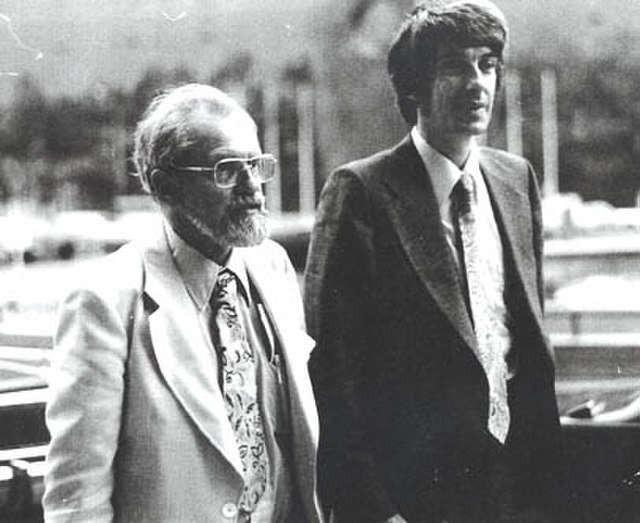
Hynek-and-Vallee.jpeg
An undated photo of astronomer J. Allen Hynek and Jacques Vallée
(public domain).

However, by the late 1960s, it seemed evident that scientific opinions on the UFO subject in the United States had finally begun to sour, despite the efforts of Hynek, Vallée, and a close network of like-minded scientists looking into the problem. By the end of 1968, the University of Colorado UFO Project, a U.S. Air Force-funded study headed by physicist Edward U. Condon, had delivered its findings; in an introductory summary to the lengthy report, Condon wrote that “nothing has come from the study of UFOs in the past 21 years that has added to scientific knowledge,” adding that “further extensive study of UFOs probably cannot be justified in the expectation that science will be advanced thereby.”

Vallée, musing over the Condon study during our call, remembered his incredulity at the time he first heard about its conclusions.

“That’s an interesting chapter in science,” he said. “Or the failure of science.”

By then, Vallee had already returned to France. As he, his wife Janine, and their son, Oliver, were acclimating to life in Europe again, Vallée was quietly readjusting his approach to the UFO question.

“Once I was back in France, in a way, it served to give me the space to rethink what we had done,” Vallée told me. “I mean, I knew the Condon Committee was a joke… and that science was somewhere else. So it forced me to ask some fundamental questions that I would not have asked if I had stayed at Northwestern.”

“So I thought, where does all this come from, anyway?”

Vallée began haunting the old Paris bookshops, acquiring rare historical texts and early treatises on the sciences. An interesting question had begun to form in his mind, as he recorded in a journal entry on October 29, 1967: What about the forgotten accounts of Little People, of Elementals, of Leprechauns? If these beings are part of the same phenomenon we see now, what does that mean for their nature? Are we necessarily dealing with extraterrestrials?

“I found that the phenomenon has always been there,” Vallée says of his years spent mining observations of unusual aerial phenomena from texts that date back to classical antiquity. “Of course, they are describing it in the language of the time,” he notes, “but they are describing something that’s very, very much like what I get from witnesses today.”

The fruits of such musings culminated in Vallée’s seminal 1969 effort, Passport to Magonia, widely regarded as one of his most influential early works and, paradoxically, the effort that cast him as a pariah in the eyes of many of his ufological peers.
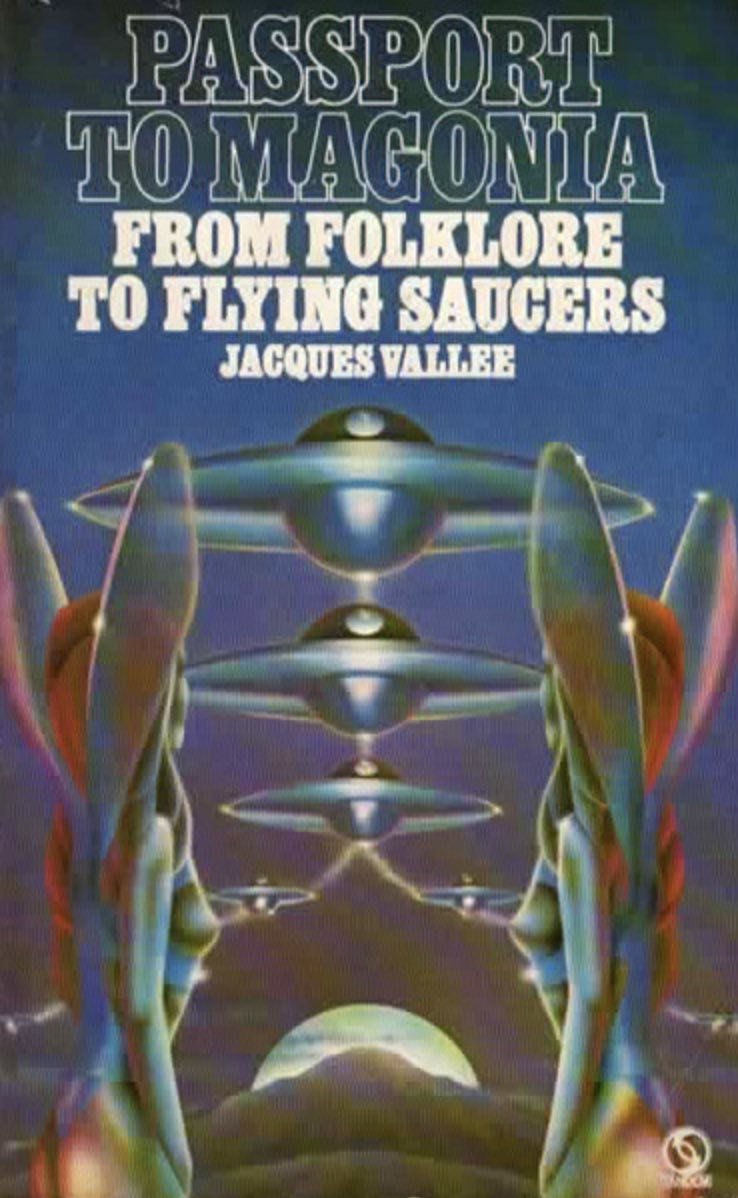
Magonia

Mass market paperback edition of Passport to Magonia

(Credit: Archives for the Unexplained).

“At first, it was completely rejected.” he says, recalling one UFO magazine that featured his likeness shortly after Magonia was published, accompanied by the headline, “Vallée has gone off the deep end.” Today, Vallée laughs about the chiding he received from his peers, and I note a hint of nostalgia about those early works behind the dry chuckle that emerges.

“Maybe the truth was in the deep end.”

OVER THE COURSE OF the ensuing decades, Vallée would continue to challenge the extraterrestrial hypothesis favored particularly among American UFO researchers. Parallel to this effort, his professional career brought him into work with the Institute for the Future in the mid-1970s, where he worked as principal investigator on the National Science Foundation computer networking project that gave rise to one of the earliest iterations of the ARPANET conferencing system. In the following decade, Vallée would become involved in venture capitalism, first as a partner at Sofinnova, then moving on to become a general partner in multiple different Silicon Valley funds, including his involvement in private investments today.

As his professional career flourished, Vallée never lost sight of his fascination with strange aerial phenomena. He authored a string of follow-ups to Magonia on the topic of UFOs throughout the 1970s and 80s, each continuing to build on the premise that the phenomenon could be far more complex than conventional opinions on UFOs would offer. His pioneering work continued to garner attention along the way, even serving as the inspiration for Claude Lacombe, a French scientist portrayed by actor François Truffaut in Stephen Spielberg’s classic film Close Encounters of the Third Kind. 
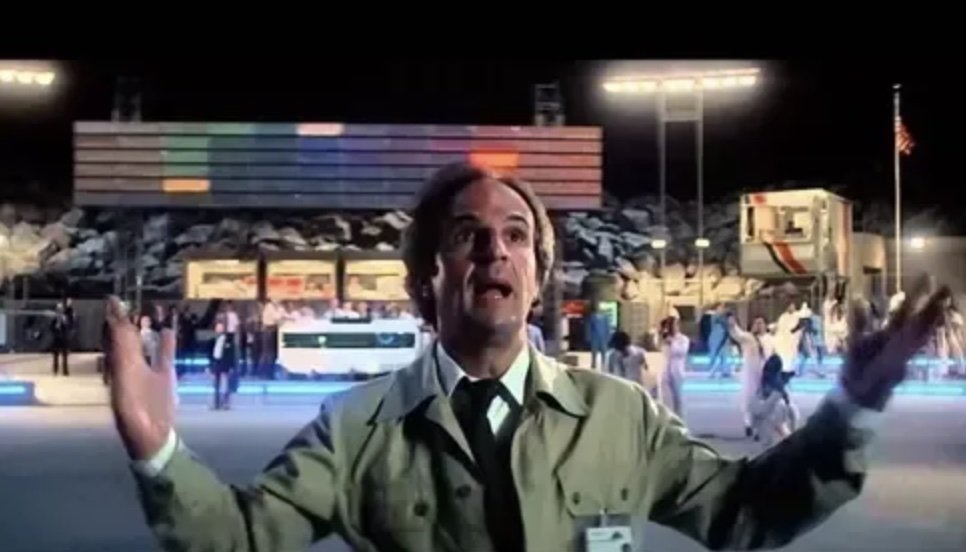
Lacombe Actor François Truffaut in Stephen Spielberg’s Close Encounters of the Third Kind  (fair use).

In the 1990s, Vallée authored a trilogy of books that focused on the prospects of alien contact. However, he always maintained a healthy distance from drawing conclusions about what any exotic technologies behind UFOs might represent. It was also during this period that Vallée began working with real estate developer Robert Bigelow’s National Institute for Discovery Science (NIDS), a privately funded scientific research effort that looked at UFOs and related phenomena.

In July 2014, Vallée presented a paper at the GEIPAN International Workshop in Paris, France, titled “Unidentified Aerial Phenomena: A Strategy for Research,” offering both a snapshot of what he had learned about the complexities of the phenomenon over several decades of study, as well as what he believed might be a path toward more fruitful future research.

“After years of ideological arguments based on anecdotal data the field of UAP research appears ready to emerge into a more mature phase of reliable study,” Vallée wrote in the paper’s abstract. Citing the mounting scientific interest in UAP around the world, based in part on documents conveying an official military interest in these phenomena, the scientist argued that the path forward would require the analysis of hard data, paired with intelligently informed theoretical studies.

“Without pre-judging the origin and nature of the phenomena, a range of opportunities arise for investigation,” Vallée wrote, warning that “such projects need to generate new hypotheses and test them in a rigorous way against the accumulated reports of thousands of observers.”

The problem was that in 2014, despite the existence of several notable independent catalogs containing information on historical incidents, there was no single collection of reliable UAP reports—a centralized database, in other words—upon which such studies could rely. This had been part of what prompted Vallée to assemble such a database for NIDS, work that would later carry over as Bigelow’s efforts moved out of the private sector and into the official world as part of the Defense Intelligence Agency’s Advanced Aerospace Weapons Systems Application Program (AAWSAP).
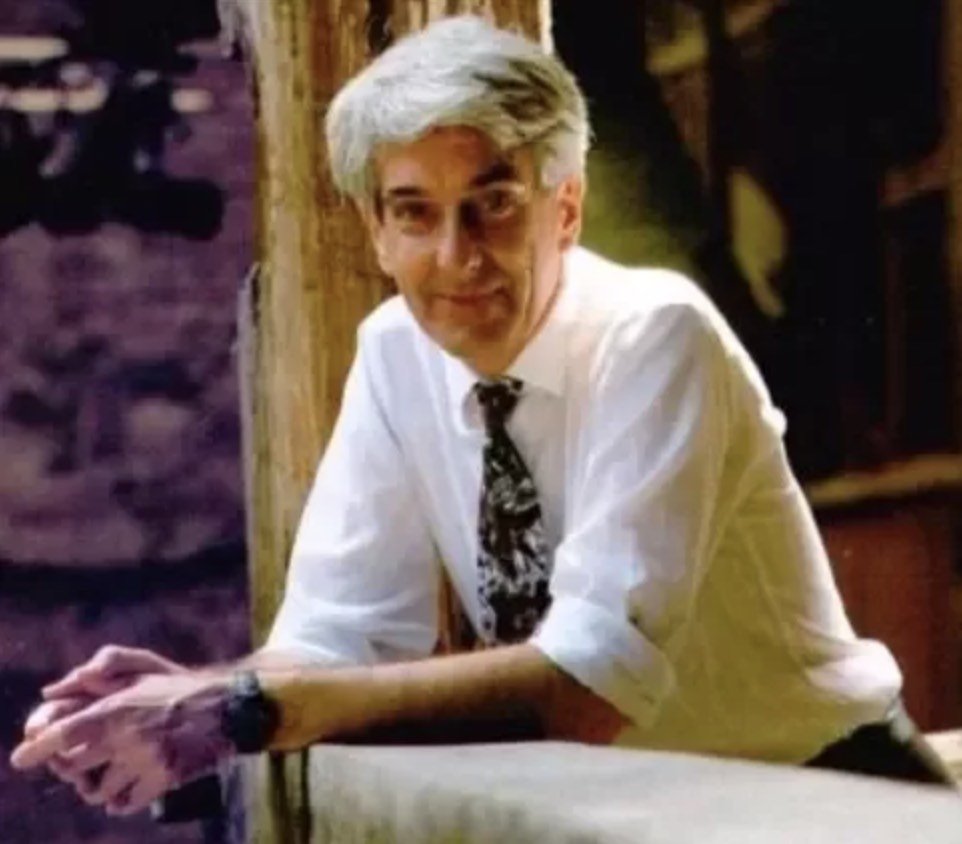
Vallée

(Credit: Jacques Vallée/fair use)

“In the United States the National Institute for Discovery Science (“NIDS”) and the Bigelow Aerospace Corporation have initiated a series of special catalogues to safeguard their own reports from public sources and from their staff,” Vallée wrote in his 2014 paper, adding that he had been asked to develop a UAP data warehouse containing 11 individual databases.

“The project is known as ‘Capella,’” it stated.

According to slides accompanying Vallée’s 2014 presentation, the Capella project focused on several areas that ranged from patterns emerging from UAP data to possible physics underlying the phenomenon and its impact on humans.

During our call, Vallée spoke candidly about the project and what he hopes it might still be used to achieve.

“There is such a database. It is the one we built as part of the AATIP/BAASS project in Las Vegas,” Vallée told me. Comprising roughly 260,000 cases from countries around the world, the scientist said during our call that the Capella database had been one of the major focal points of the program.

“Contrary to what people believe, [Capella] is the largest part of the budget that was spent on the classified project,” Vallée said. This included paying for translations of incident reports from Russian, Spanish, Portuguese, and several other languages into English, and providing funding for teams that conducted additional research on-site.

“It was a large effort for two years, Vallée said, though he added that in reality, “probably close to fifty or sixty years of work went into the database.” Although Capella constitutes what is arguably the most extensive database containing information on UAP ever built, don’t expect to see it any time soon; it remains classified as a part of the data developed under the DIA’s AAWSAP program managed by James Lackatski between 2008 and 2010.

“The database is still classified, to my knowledge,” Vallée said during our call, prompting me to ask whether such a vast amount of historical information on the UAP subject shouldn’t be made publicly available.

Speaking with The Debrief in December 2021, Mark Rodeghier, Ph.D., director of the J. Allen Hynek Center for UFO Studies and a longtime colleague of Vallée, expressed frustration over previous statements made by Colm Kelleher, Ph.D., another of the scientists who worked on the AAWSAP program, who noted that much of the AAWSAP data will likely remain classified.

“I mean, isn’t that discouraging, disappointing, [and] ridiculous,” Rodeghier told The Debrief. “It’s not work on how we can get a hypersonic missile. It’s UFO investigations. How can that be classified at this point? And the answer, of course, is that it shouldn’t be classified now.”

During our call, Vallée expressed similar sentiments to Rodeghier’s, although he also defended Capella’s current classified status on account of some of the information it protects.

“You make a good point,” Vallée told me. “That’s the kind of thing that should be accessible to science,” although adding that “it will be accessible to very highly competent people who can continue to look at it under the proper classification.”

“I think it’s properly classified,” Vallée added, “because it contains a lot of medical data that should be private.” However, he said that he thinks that over time, perhaps portions can be “sanitized” for release to the public, “so that we don’t invade the privacy of individuals who have reported those things, especially their medical data.”

“It’s not classified for any military or intelligence reason as far as I know,” Vallée said. “But I’m not part of the project anymore.” Vallée noted that even he no longer has access to Capella, although several longtime colleagues of his who still work in government do.

“I’m very proud to have worked on that,” Vallée said. “It’s probably the high water mark in the computer study of UFOs so far.”

“But as we know, the high water mark is going to go even higher after this.”

DESPITE HIS OWN LEVEL of involvement with government UAP studies, as well as the level of interest generated by videos of unidentified objects collected by the U.S. military—the existence of which Vallée himself hinted at in Geneva as early as 2013—the 83-year-old scientist still doesn’t necessarily hold military UAP data in higher regard than that collected by civilians.

“The military cases in the databases I know of are less than ten percent in every country,” Vallee said during our call. “They are really good because the military has radar. They have, of course, planes that can chase the objects… pilots who are very well trained and very well positioned to give a description.”

“Those are excellent reports,” Vallée concedes. “But what about the farmer in the field, who sees [an object] close to him, and has traces, and has materials? Who has felt physiological reactions?”

“What about those cases?” he asks. “They are full of information.”

Vallée’s appreciation for UAP information collected from non-governmental sources is particularly evident in his latest book, Trinity: The Best-Kept Secret, coauthored with Italian journalist Paola Leopizzi Harris. In it, they unravel the story of two men, Jose Padilla and Reme Baca, who claim to have witnessed the crash of an unusual aircraft near San Antonito, New Mexico, in August 1945. Padilla, who went on to become a State Trooper in Rowland Heights, California, maintained that as children, he and Baca had seen a large, dull-gray avocado-shaped object—along with its frantic occupants—where it had apparently crashed near his family’s ranch. The object, they say, was later recovered by the military.
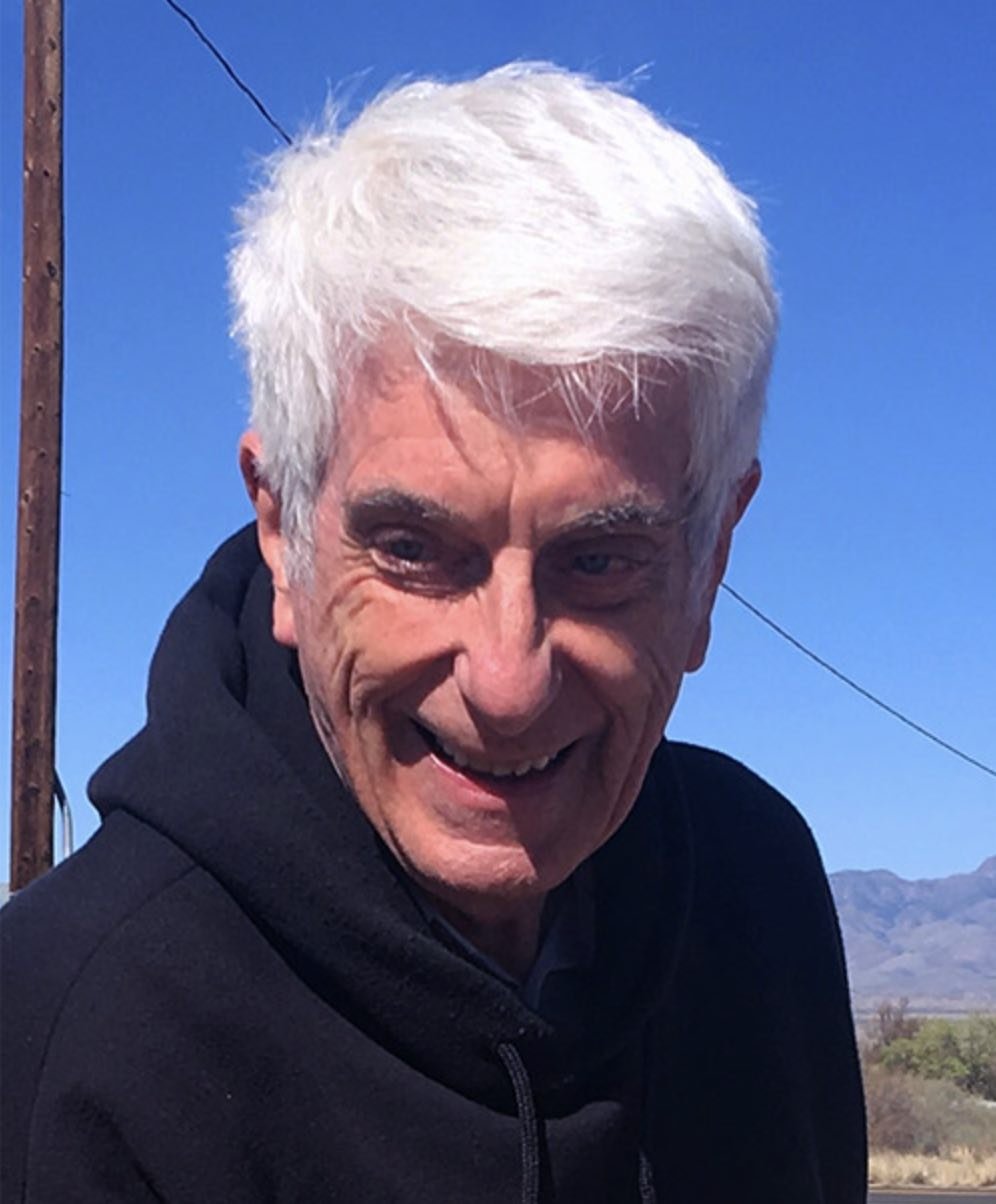
Vallée Vallée while conducting field research in New Mexico in advance of the publication of Trinity: The Best-Kept Secret  (Credit: Jacques Vallée).

In a newly updated second edition of the book, Vallée and Harris present additional witness testimony they have gathered about the alleged incident, which includes an observation of the crash remembered by the family of Lt. Colonel William J. Brothy, who at the time had been piloting a B-25 on a training mission. According to Brothy, he and his crew had flown over the site and recalled, “There were a lot of pieces.”

In Trinity, Vallée emphasizes what he believes are undeniable similarities between descriptions of the 1945 incident and a UAP landing in New Mexico observed by police officer Lonnie Zamora in 1964. Then, the following year another strikingly similar incident occurred near Valensole, France, involving the close observation of a landed craft and its apparent pilot or occupant.

“There is a case in Valensole, in France, and the case in Socorro. The object is identical to the Trinity object,” Vallée said. “And the [occupants] are identical to the creatures that Mr. Padilla is describing to me at Trinity, that he saw.”

“I was involved in Socorro, and I was involved in Valensole. Those are cases I know very well,” Vallée said, adding that Trinity contains new information on the Socorro case, once referred to by Hector Quintanilla, director of the U.S. Air Force’s Project Blue Book at the time of the incident, as being “the best documented case on record.”

Today, much of Vallée’s research is focused on the collection and study of material samples believed to have been collected from UAP. Compared with his earlier work, which challenged popular notions about extraterrestrials being associated with UAP, this might surprise longtime followers of the scientist’s work. For Vallée, however, it is only the next phase in the many decades he has spent working toward resolving the mystery.

“It’s all one thing,” Vallée said during our call. “The first book I wrote was Anatomy of a Phenomenon, which… I took as a study of extraterrestrial intelligence in general, and how it was I thought UFOs illustrated the idea of life elsewhere and intelligence elsewhere… that’s definitely the place from which we started.”

“Then, when I started working with Dr. Hynek, and I started working with—in those days, it was just called ‘computer catalogs,’ it wasn’t dignified as databases or data warehouses—but those catalogs held thousands of cases. My first complete catalog was donated to the Condon Committee at the University of Colorado, when they did the study funded by the Air Force.”

“Which,” Vallée notes, “to my surprise, concluded the problem didn’t exist. So, we’ve come a long way from that.”

Given his level of involvement in working to resolve the UAP question—an effort now spanning more than six decades, including his involvement in official government UAP investigations in several countries and having authored some of the most popular books ever written on the subject—perhaps the most surprising thing expressed by Vallée during our discussion had been his predictions about how he thinks his own work will be remembered by future generations.

“I think everything I’ve done, and everything my contemporaries have done, is going to be forgotten,” he said, mirroring his observations of the invention, and subsequent reinvention, of so many other innovations in science over time, not least among them the World Wide Web.

“And then in a few years, it’s going to be reinvented by, you know, great people at Stanford and Harvard in a new way,” he tells me, accompanied by the distinctive chuckle I had by now come to expect after one of his witty responses.

“That’s always the way science works.”

  • Micah Hanks is Editor-in-Chief and Co-Founder of The Debrief. Follow his work at micahhanks.com and on Twitter: @MicahHanks. 

{https://thedebrief.org/category/science/ }

Hoe vind je dit bericht?
Geschreven door peter om 18:29 Stuur door

Speeding Towards a Crucial Tipping Point

Speeding Towards a Crucial Tipping Point

Here's why the old models got it so wrong.

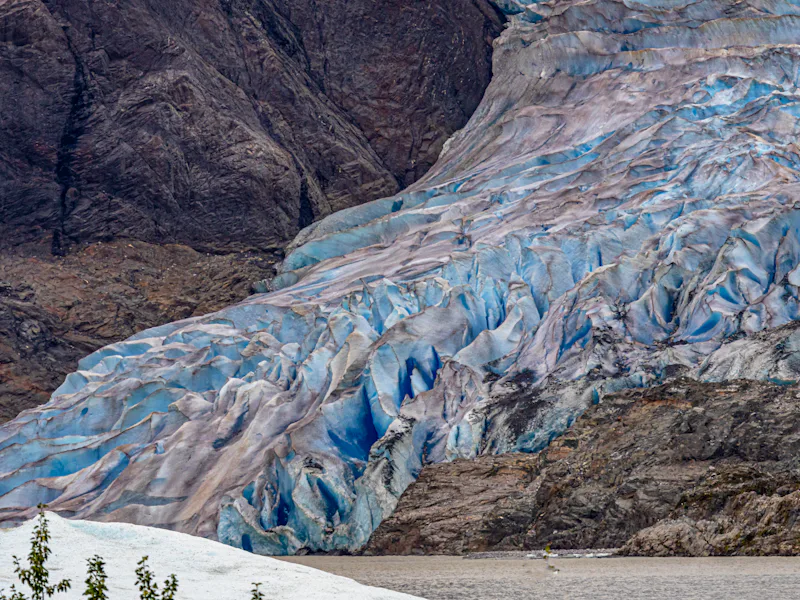
The Mendenhall Glacier near Juneau, Alaska, has been retreating due to climate change.
Moelyn Photos/Moment/Getty Images

Human-caused climate change is transforming the world at a lightning pace. New research reveals exactly what that means for Alaska’s glaciers and icefields. These critical bodies of frozen water are shrinking much faster than current models predict, and the rate of ice loss is accelerating rapidly, according to a study published July 2 in the journal Nature Communications. The science suggests icefields in Alaska and similar regions could soon reach a tipping point past which no amount of climate mitigation or greenhouse gas emissions could stop their decline, with unsettling implications for sea level rise.

“It’s incredibly worrying,” said Bethan Davies, lead study author and a glaciologist at Newcastle University in England in a statement. “The feedback processes this sets in motion [are] likely to prevent future glacier regrowth, potentially pushing glaciers beyond a tipping point into irreversible recession.”

More than 20 percent of global sea level rise results from mountain glaciers and ice cap melt and Alaska’s glaciers are already the largest single contributor among that portion. The new findings indicate that the state’s future contributions to rising tides may soon be baked-in, and impossible to prevent.

Davies and her co-authors combined historical aerial photographs, geologic data on the most recent glacial maxima, and satellite images to specifically quantify volume and area loss at one site, which likely carries implications for others. They focused their analysis on Juneau Icefield, a sprawling expanse composed of about 1,000 glaciers covering about 1,500 square miles on the Alaska/British Columbia border, and assessed how the formation changed between 1770 and 2020.

The scientists found some alarming trends. Following the end of the “Little Ice Age” that spanned from about 1300 to 1750, ice loss was relatively consistent between 1770 and 1979. During that period, Juneau Icefield lost between .65 and 1.01 cubic kilometers (0.16 to 0.24 cubic miles) of ice each year. Between 1979 and 2010, that rate increased to 3.08 to 3.72 cubic kilometers of ice loss annually. From 2010 to 2020, the rate of ice loss doubled in just a decade, rising to about 5.91 cubic kilometers per year. Zooming in on a narrower and more recent time period, losses accelerated even further between 2015 and 2020.

All of this has unfolded against the backdrop of increasing atmospheric greenhouse gas concentrations and rising average temperatures. Summer temperatures at Juneau Icefield were about 1 degree Celsus warmer, on average, from 2001 to 2020 than they were from 1941 to 1970. The mean winter temperature for the same time period is up more than 2 degrees C, lengthening the annual period of melt.

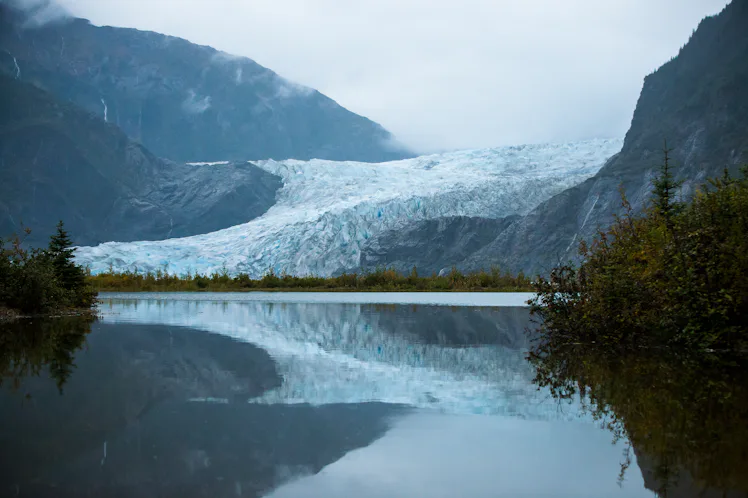
Mendenhall Glacier during an overcast day with reflection on the lake

More than 20 percent of global sea level rise results from mountain glaciers and ice cap melt and Alaska’s glaciers are already the largest single contributor among that portion.

DAVID MARANO PHOTOGRAPHY/MOMENT/GETTY IMAGES

As of 2019, 100 percent of the glaciers mapped at Juneau Icefield were receding and 108 had disappeared completely. The total ice loss since the Little Ice Age maximum is estimated to be about 24.25 percent of the icefield’s volume. In addition to the loss of ice volume and area, the remaining ice field is becoming increasingly fragmented and vulnerable.

As the melt eats away at the ice field and its glaciers, several knock-on processes are triggered which can lead to feedback loops that, in turn, produce more melting. For one, Juneau Icefield (as with many Alaskan icefields) is relatively flat, so it’s losing volume all over. As this happens, it becomes less thick and, over time, the surface of the ice gets closer to sea level. At lower elevations, the air is warmer, and melting increases.

Another feedback loop occurs when fresh snow accumulation is reduced at lower altitudes, as the icefield surface gets farther away from the snowline. With less fresh snow, the icefield surface becomes dirtier and less reflective. These darker surfaces absorb more heat and additional melting ensues. Fragmentation that exposes rocks and gravel also reduces the reflectivity (or “albedo”) of the icefield, and enables hotter air to penetrate deeper into glaciers.

Each of these processes individually is “destabilizing”, write the study authors, and together they are even worse news. Scientists rely on mathematical and computer models to try to predict how ice losses are set to unfold under climate change. However, existing icefield models often don’t consider these sorts of feedback loops and fail to capture the depth, breadth, and speed of planetary modification underway.

Currently, models suggest that Juneau Icefield should be losing ice linearly through 2040, with losses only accelerating after 2070, but the new study indicates those models are flawed. “Current glacier projections may be too small and underestimate glacier melt in the future,” Davies said. If we want to understand what the coming decades hold, we’ll have to pay closer attention to the past.

{ https://www.inverse.com/ }

Hoe vind je dit bericht?
Geschreven door peter om 16:14 Stuur door

UFO Sighting Alert! 🚨 Unexplained Lights Over Roswell, NM Captured on Video!

UFO Sighting Alert! 🚨 Unexplained Lights Over Roswell, NM Captured on Video!

On the evening of May 14, 2024, the skies over Roswell, New Mexico, once again played host to a bewildering spectacle that has left both skeptics and believers scratching their heads. A recent UFO sighting, documented by an everyday traveler, has reignited the ever-intriguing debate on unidentified flying objects.

The Sighting

A recent road trip took a couple through the iconic UFO hotspot of Roswell. They decided to camp out at an OHV area approximately 20 miles northeast of the city, on one of the region’s distinctive plateaus. As they set up camp and began preparing their evening meal, something unusual caught their eye.

The witness described seeing flares of light appearing in the valley below, seemingly at eye level with their elevated position. Despite being 20 miles away from the main city and situated in rough ranchland, these lights did not align with any known sources or activities.

Witness Account

According to the witness, the lights appeared to break through the clouds on the horizon, but closer examination revealed they were well below the clouds and away from the horizon. These flares, looking somewhat like fireworks, had no visible source. The video, recorded at 9:25 PM, captures these sporadic lights appearing and fading out, adding to the mystery.

The lights were observed in an area without major industrial buildings or populated zones, making their origin even more perplexing. Despite the video quality being low due to the zoom and lighting conditions, the mysterious nature of the lights is evident.

What Did They See?

In the video accompanying this report, you can observe sporadic bursts of light, seemingly emerging from nowhere and disappearing just as quickly. These lights, reminiscent of fireworks, had no discernible origin, a detail that further deepens the mystery. The witness has confirmed that the lights were far from the horizon and not within the clouds, adding another layer of intrigue to this enigmatic event.

Seeking Answers

The witness has reached out to various communities, including Reddit, in hopes of finding a natural explanation or encountering others who have experienced similar phenomena. The video quality, though not perfect, captures the eerie beauty of these unexplained lights. As this sighting gains traction, it poses the age-old question: Are we truly alone, or is there something more to these mysterious lights in the sky?

VIDEO:

This UFO sighting in Roswell, New Mexico, adds to the long list of unexplained phenomena that have captivated human curiosity for decades. As we continue to seek answers, the skies over Roswell remain a canvas of mystery, urging us to look up and wonder.

Stay tuned for more updates on UFO sightings and other unexplained phenomena. Don’t forget to watch the video and share your thoughts in the comments below!

{ https://www.latest-ufo-sightings.net/ }

Hoe vind je dit bericht?
Geschreven door peter om 16:04 Stuur door

Unveiling the Hidden Kingdom: Secrets Beneath Antarctica’s Icy Surface

Unveiling the Hidden Kingdom: Secrets Beneath Antarctica’s Icy Surface

ALIEN CHRONICLES

The documentary “ALIEN CHRONICLES – ANTARCTIC WORLDS BELOW | The Hidden Kingdom” offers a compelling exploration into the mysteries surrounding Antarctica, particularly focusing on the theory of a hidden kingdom beneath its icy surface. This sci-fi documentary presents a series of intriguing claims, historical anecdotes, and modern-day scientific findings that invite viewers to reconsider conventional understandings of Earth’s structure and the possibility of hidden realms within our planet.

The Hollow Earth Theory

At the heart of the documentary is the Hollow Earth theory, which posits that Earth might not be a solid mass but could instead have vast, habitable cavities within. This idea, although not widely accepted by the mainstream scientific community, has persisted throughout history. The documentary traces this theory back to prominent figures such as Edmund Halley and Leonhard Euler. Halley, famous for Halley’s Comet, proposed in the 17th century that Earth consists of a hollow shell with multiple inner layers, each capable of supporting life. Euler, in the 18th century, suggested that the center of Earth houses a small sun, providing light and warmth to inner civilizations.

Historical and Mythological References

The documentary delves into various historical texts and mythologies that seem to support the Hollow Earth theory. Ancient Buddhist texts speak of a race of superhumans living in subterranean realms, accessible through tunnels guarded by monks. Similarly, Hindu texts describe the legendary kingdom of Shambala, located deep within the Earth. These stories, while mythical, resonate with the idea of hidden, advanced civilizations beneath our feet.

Admiral Richard Byrd’s Expeditions

One of the most captivating segments of the documentary focuses on Admiral Richard Byrd’s Antarctic expeditions. In 1947, Byrd led Operation Highjump, a major military expedition to Antarctica. According to his reported accounts, during a flight over the South Pole, Byrd encountered lush green landscapes and prehistoric creatures, including mammoths, suggesting the existence of a verdant, hidden world. Byrd claimed that he was taken into this subterranean realm by advanced beings concerned about humanity’s use of nuclear weapons.

Modern Scientific Insights

The documentary also incorporates modern scientific findings to bolster its claims. For instance, recent satellite data and 3D maps have revealed complex geological formations beneath Antarctica’s ice, including ancient cratons and orogens that resemble the structures of other continents. These discoveries have reignited interest in Antarctica’s potential hidden features and the possibility of ancient civilizations.

Controversies and Conspiracies

Despite the fascinating narrative, the documentary does not shy away from the controversies surrounding its claims. It touches on conspiracy theories about secret Nazi bases in Antarctica and alleged UFO sightings near the continent. While these theories lack substantial evidence, they add to the mystique and allure of the hidden kingdom hypothesis.

The Scientific Community’s Stance

Mainstream science largely dismisses the Hollow Earth theory due to lack of empirical evidence. Studies involving seismic data and Earth’s gravitational field support the current understanding of Earth’s interior as consisting of a solid core, a molten outer core, and a solid mantle. However, the documentary suggests that not all scientific mysteries have been solved, and Antarctica remains a largely unexplored frontier.

VIDEO:

“ALIEN CHRONICLES – ANTARCTIC WORLDS BELOW | The Hidden Kingdom” presents a thought-provoking blend of historical myths, scientific anomalies, and speculative theories. While the idea of a hidden kingdom beneath Antarctica may seem far-fetched, it captures the imagination and underscores the enduring human fascination with the unknown. As scientific exploration of Antarctica continues, who knows what secrets this frozen continent might yet reveal? Whether fact or fiction, the documentary invites viewers to keep an open mind and explore the possibilities that lie beneath the surface of our world.

{ https://www.latest-ufo-sightings.net/ }

Hoe vind je dit bericht?
Geschreven door peter om 15:51 Stuur door

Het vreemde verhaal van de 'fake' NASA-missie naar Mars: astronauten na 1 jaar 'terug'

Het vreemde verhaal van de 'fake' NASA-missie naar Mars: astronauten na 1 jaar 'terug'

Het vreemde verhaal van de 'fake' NASA-missie naar Mars: astronauten na 1 jaar 'terug'

Het vreemde verhaal van de 'fake' NASA-missie naar Mars: astronauten na 1 jaar 'terug'
© Pixabay

Vier vrijwilligers hebben in opdracht van de Amerikaanse ruimtevaartorganisatie NASA een jaar lang het leven op mars gesimuleerd, volledig afgesloten van de buitenwereld. 

Twaalf maanden lang verbleven Kelly Haston, Anca Selariu, Ross Brockwell en Nathan Jones in de simulator Mars Dune Alpha. Deze hebben ze nu eindelijk kunnen verlaten.

Het viertal zat omgeven door rood zand en een koepel die hen afschermde van de wereld. Ze leefden gedurende liefst 378 dagen op zo’n 160 vierkante meter. Sinds zaterdagavond mogen ze eindelijk gaan en staan waar ze willen.

NASA voerde dit experiment uit om een missie naar de rode planeet te simuleren om zo kostbare informatie te verwerven om de echte missie uiteindelijk beter te kunnen laten verlopen. De 'fake' astronauten deden “Marswandelingen”, kweekten en oogsten verschillende groenten, onderhielden de apparatuur en opereerden onder stress, zoals op Mars kan gebeuren. Zelfs de communicatie met de aarde werd vertraagd, net zoals bij een echte missie. 

De NASA plant nog twee gelijkaardige studies in 2025 en 2027. Het wil in totaal twaalf personen testen.

  • (FVDV by Tagtik/Illustration picture: Pixabay)

{ https://www.msn.com/nl-be/ }

Hoe vind je dit bericht?
Geschreven door peter om 15:30 Stuur door

Luis Elizondo: There Are UFO Photos With Entities Inside & Otherworldly Biological Samples

Luis Elizondo UFO occupancy and otherworldly biological samples

Luis Elizondo: There Are UFO Photos With Entities Inside & Otherworldly Biological Samples

The UFO community has never been more active than it is now. The phenomenon has always been around us but due to the lack of transparency, it never became so open to discussion. Since the last decade, the number of UFO sightings has increased. And now, we are shooting these objects in the air, leaving the whole world to watch them.

Even after thousands of UFO cases including photos and videos, we have no clue who is behind it. China, Russia, the United States have their experts to investigate the UAPs but surprisingly, they do not blame each other. Perhaps, it is non-human technology and no one has any idea from where it came as filmmaker Jeremy Corbell claims.

It is really shocking and weird that nobody paid attention to former AATIP head Luis Elizondo’s statement about “UFO Occupancy and biological samples.” With Curt Jaimungal on his Theories of Everything (TOE) podcast in 2021, Elizondo carefully hinted that “potentially” the U.S. government has acquired otherworldly biological samples. He also suggested that the government has images of UAPs that appear to show beings inside them.

Elizondo spent 20 years as a military intelligence officer in the Pentagon and during his career, he ran the most secretive UFO program Advanced Aerospace Threat Identification Program (AATIP). In 2017, after the expose of this secret program, Elizondo whistleblew many things he had learned about UFOs and possible non-human intelligence.

“Have there potentially been biological samples recovered?” Curt asked. ELizondo replied: “Yes. I’m not going to expound on that… and be careful when I say that. I’m being purposely very open and vague at the same time, right? What does that mean? Well, it means what it means.”

Besides, when asked if there are photos that show occupants inside “craft,” Elizondo said: “There are some very compelling photos out there that seem to show something inside, some sort of occupancy, And I’ll leave it at that, because it gets really murky, much beyond that.

And there’s a lot that can be speculated. And so I try to avoid speculation as much as possible. But yes, I’ve spoken to enough people with firsthand knowledge that not only report the crafts that we know exists, but potentially some sort of intelligence inside these vehicles.”

Why isn’t this topic being discussed by everyone on the planet? Is it feasible that the majority of people are disregarding this news, even if they are aware of it? At what point does the truth and its mind-boggling consequences become too conspicuous to overlook?

UFO Occupancy Case

Keeping Elizondo’s words in mind, there is a UFO crash incident outside of Edwards Air Force Base involving a contactee survivor with at least one other witness. It happened to a young woman named Lorraine Dvorak Cordini in 1971. This case is mentioned in different books with minor changes.

According to the eyewitnesses, one summer evening in 1971, the calm Californian night was suddenly broken by a sharp unearthly roar, which ended with an equally frightening rumble. When people ran out of their houses, a large cloud and signs of flames were visible near Edwards Air Force Base in California. Several people stated that they had allegedly seen “three gray humanoids,” as well as a human woman in a strange, tight-fitting pink suit, among the ruins of some wrecked vehicle.

Read also:

However, before anyone knew what had happened, a lot of military trucks and other vehicles arrived and quickly isolated the area. In addition, they removed the debris and any signs of the incident and took the humanoids and the woman with them. Some residents assumed they were taken to Edwards Military Base.

A witness named Debbie Clayton reported that she had heard a loud crashing noise. There was a cloud of dust outside her home. Ufologist Albert Rosales tracked down that mysterious woman in a pink bodysuit, and she agreed to undergo a hypnotherapy session to remember the events of that night.

UFO occupancy

Here Lorraine is in a local 1996 newspaper article: “Group prepares for first contact as UFO’s gain more credibility”. In light of current events, these were prophetic words.

Lorraine claimed that she had been abducted from her home, dressed in pink clothes, and taken to a large ship in Earth orbit for an inspection.

She was then put in a smaller ship – the one that crashed – and sent back to Earth with several strange creatures. She woke up already in the military hangar. Even stranger, at least according to the hypnosis sessions, while being there, she saw not only military personnel but also strange creatures with large heads, different from those that took her out of her room.

Needless to say, this whole story seems very strange and raises doubts about its veracity. Clayton was baffled when she found no newspaper written about the story and there was no news about it on TV as well.

It was the first case of the only human survivor found at a Crash Retrieval. Researcher Richard Geldreich Jr. has written details on this case and found the identity of the witness and contactee. Lorraine or Lori was working on her autobiography in 2009 but it never came out, perhaps she passed away before bringing it to the world.

Elizondo is certain about UFO occupancy and recovered alien biological samples. He even gave his candid take on the 1947 Roswell crash in New Mexico and more in an interview with the Roswell Daily Record.

He said he had conversations with so-called “graybeards” at the Pentagon who had been involved with UAPs since Project Blue Book. It was from these individuals that Elizondo learned what probably occurred at Roswell in 1947.

Elizondo said: ”These individuals were convinced that the events in New Mexico were not fiction. In fact that it was a, very much a real event and that some very exotic material was recovered… And then there was a subsequent effort to try to be very dismissive about what occurred in New Mexico.”

On UAP Phenomenon, Elizondo noted: “This is something we’ve been dealing with for a long time. Imagine the first person to get on a boat and sail over the horizon. There’s stories of sea monsters and Krakens that will devour you and destroy your boat. Yet, we did it anyways. We did sail, and we explored the world. It turns out, 500 years later, there really are sea monsters. We call them the Great Squid of the Pacific, and great white sharks and whales.

Now they’re just part of nature and have a  scientific name, but those sea monsters still exist. They’re there, we just learned to understand them. Maybe this is the same thing. Maybe this is just another expedition over the horizon where we’re going to realize what we thought were monsters are really just neighbors.”

{ https://www.howandwhys.com/ }

Hoe vind je dit bericht?
Geschreven door peter om 01:18 Stuur door

Meer van UFO'S of UAP'S, ASTRONOMIE, RUIMTEVAART, ARCHEOLOGIE, OUDHEIDKUNDE, SF-SNUFJES EN ANDERE ESOTERISCHE WETENSCHAPPEN - DE ALLERLAATSTE NIEUWTJES

↑ Terug naar de berichten