Naar de inhoud

UFO'S of UAP'S, ASTRONOMIE, RUIMTEVAART, ARCHEOLOGIE, OUDHEIDKUNDE, SF-SNUFJES EN ANDERE ESOTERISCHE WETENSCHAPPEN - DE ALLERLAATSTE NIEUWTJES

UFO's of UAP'S in België en de rest van de wereld
akke.beakke.be
Ontdek de Fascinerende Wereld van UFO's en UAP's: Jouw Bron voor Onthullende Informatie! Ben jij ook gefascineerd door het onbekende? Wil je meer weten over UFO's en UAP's, niet alleen in België, maar over de hele wereld? Dan ben je op de juiste plek! België: Het Kloppend Hart van UFO-onderzoek In België is BUFON (Belgisch UFO-Netwerk) dé autoriteit op het gebied van UFO-onderzoek. Voor betrouwbare en objectieve informatie over deze intrigerende fenomenen, bezoek je zeker onze Facebook-pagina en deze blog. Maar dat is nog niet alles! Ontdek ook het Belgisch UFO-meldpunt en Caelestia, twee organisaties die diepgaand onderzoek verrichten, al zijn ze soms kritisch of sceptisch. Nederland: Een Schat aan Informatie Voor onze Nederlandse buren is er de schitterende website www.ufowijzer.nl, beheerd door Paul Harmans. Deze site biedt een schat aan informatie en artikelen die je niet wilt missen! Internationaal: MUFON - De Wereldwijde Autoriteit Neem ook een kijkje bij MUFON (Mutual UFO Network Inc.), een gerenommeerde Amerikaanse UFO-vereniging met afdelingen in de VS en wereldwijd. MUFON is toegewijd aan de wetenschappelijke en analytische studie van het UFO-fenomeen, en hun maandelijkse tijdschrift, The MUFON UFO-Journal, is een must-read voor elke UFO-enthousiasteling. Bezoek hun website op www.mufon.com voor meer informatie. Samenwerking en Toekomstvisie Sinds 1 februari 2020 is Pieter niet alleen ex-president van BUFON, maar ook de voormalige nationale directeur van MUFON in Vlaanderen en Nederland. Dit creëert een sterke samenwerking met de Franse MUFON Reseau MUFON/EUROP, wat ons in staat stelt om nog meer waardevolle inzichten te delen. Let op: Nepprofielen en Nieuwe Groeperingen Pas op voor een nieuwe groepering die zich ook BUFON noemt, maar geen enkele connectie heeft met onze gevestigde organisatie. Hoewel zij de naam geregistreerd hebben, kunnen ze het rijke verleden en de expertise van onze groep niet evenaren. We wensen hen veel succes, maar we blijven de autoriteit in UFO-onderzoek! Blijf Op De Hoogte! Wil jij de laatste nieuwtjes over UFO's, ruimtevaart, archeologie, en meer? Volg ons dan en duik samen met ons in de fascinerende wereld van het onbekende! Sluit je aan bij de gemeenschap van nieuwsgierige geesten die net als jij verlangen naar antwoorden en avonturen in de sterren! Heb je vragen of wil je meer weten? Aarzel dan niet om contact met ons op te nemen! Samen ontrafelen we het mysterie van de lucht en daarbuiten.

Archief

'Best ever UFO footage' caught on camera had it's authenticity '100%' confirmed

'Best ever UFO footage' caught on camera had it's authenticity '100%' confirmed

'Best ever UFO footage' caught on camera had it's authenticity '100%' confirmed

Could this be the closest we've come to proving the existence of aliens?

Brenna Cooper Brenna Cooper

Aliens and UFOs are surely one of the longest running fascinations of modern times.

Ever since reports of an alien spaceship crashing at Roswell way back in the 1940s hit the press; mankind has been hooked on UFO hysteria.

We all know someone who's spotted a rogue birthday balloon or glow lantern in the sky and whipped their phone camera out to declare that an alien invasion is imminent - but every now and again footage emerges and rattles even the biggest alien skeptics.

One person who managed to capture pretty eerie footage is pilot Jorge A. Arteaga, whose video recorded during a flight has been called the 'best UFO footage ever' - and has also been found to be 100 per cent authentic.

Check out the footage for yourself:

Arteaga was travelling through the skies above Antioquia, Colombia, when he spotted a strange object hurtling through the sky.

Captured in brought daylight, the mysterious, square-like object shoots out of the clouds and past Arteaga's cockpit in a matter of seconds.

He was able to quickly grab his camera and record the object - which appeared to be light in colour and pointed at one end - as it flew towards him before quickly speeding off.

Arteaga would later claim that he and his co-pilot had spotted the item floating in the air between the cities of Medellín and Santa Fe, before it drastically picked up speed and beelined towards them.

The pair had originally wanted to follow the UFO, but later abandoned the search after it suddenly began to hurtle towards them.

A birthday balloon? A rogue Wii Fit board? Or aliens? (X/Jorge Arteaga)
A birthday balloon? A rogue Wii Fit board? Or aliens?
(X/Jorge Arteaga)

Now I know what you're thinking, surely it's just another runaway balloon or random piece of debris?

Not according to Arteaga, who claimed that it would have been too cold or turbulent for a balloon to survive, adding that they were flying 12,500 feet in the air at the time.

And it seems that Arteaga has the backing of controversial ufologist Jaime Maussan, who later authenticated.

As for what happens during a 'UFO authentication' process we're not sure, but the pair would later sit down for an interview about the video, which Maussan later shared on his social media account.

"We are facing one of the greatest UAP (UFO) evidences of all time; captured by the Captain Pilot Aviator @JorgeArteagaG," he wrote on X, alongside a clip from their chat.

UFO or flying supermarket carrier bag? (X/Jorge Arteaga)
UFO or flying supermarket carrier bag?
(X/Jorge Arteaga)

Maussan went on to add that Arteaga had told him the object moved with 'something totally unknown without means of propulsion with movements that he considers intelligent.'

He also added that he'd cross-referenced the footage with Pilot Lieutenant Ryan Graves, who had agreed the clip showed a UFO, also known as a UAP (unidentified aerial phenomena).

Whether or not you believe the clip is a UFO or a floating piece of rubbish depends on what your stance on aliens is.

Eerie footage of UFO 'splitting in two' before mysteriously vanishing resurfaces

A video has resurfaced of mysterious lights in the sky, which many believe to have been extraterrestrial visitors to Earth.

Way back in the late 1990s, or 1997 to be precise, there were a series of strange sightings in the night sky. This was stretched between Tucson, Arizona, and just past Phoenix, close to the border with Nevada some 300 miles south.

All manner of strange things were reported at the time, including claims of strange formations of lights in the sky. There were even claims of a v-shaped UFO passing overhead. Scary stuff.

A video has resurfaced from a later round of the so-called 'Phoenix Lights', not to be confused with the much-loved Peter Kay comedy set in Bolton.

Many lights were seen in the sky.
KTSDESIGN/SCIENCE PHOTO LIBRARY / Getty

The clip appears to show a UFO splitting into two, with the light dividing and going off in separate directions. The image, of course, is extremely hazy as these videos always seem to be.

The footage was uploaded to YouTube, and explained by YouTuber ChaosMoogle.

He said: "This is not an infrared video — it is just a regular video, so we're seeing it how it would be seen with the naked eye."

An official explanation was in fact given for the sightings of lights in the sky around Phoenix. Local air force bases announced that they had been conducting routine training operations, and that the lights seen in the sky belonged to their aircraft.

But, of course, some people did not buy this explanation and firmly believed that there was something being covered up, and that something was an alien presence in the sky over Nevada.

And then there were two!
Youtube/ ChaosMoogle

The suspicion around aliens became more pronounced following a congressional hearing this year, which once again opened up the question of whether there have been aliens visiting Earth.

One question which always provokes questions is looking at a map that shows reports of sightings of aliens, the vast majority - nearly all of them in fact - are in the USA.

Aliens must love the USA.

Former intelligence officer Major David Grusch made a surprising testimony in front of Congress where he claimed that U.S. officials had discovered crashed alien spacecraft. Moreover, he claimed that the craft had indeed contained 'non-human' remains.

The Pentagon has, of course, denied the claim.

Meanwhile, the reaction to the apparent announcement from many Americans was one of indiffernece. Many videos being posted showing off a collective shrug as many Americans struggle to get by amid rising fuel prices, health insurance, and living costs.

So much so it's become a joke online, that aliens arrive and say that they have taken over our government and done away with our rulers.

And humanity's reaction? 'Oh thank god'.

Featured Image Credit:
  • Youtube/ ChaosMoogle

{ https://www.ladbible.com/ }

Hoe vind je dit bericht?
Geschreven door peter om 21:37 Stuur door

MRO HiRISE image reveals remnants of an ancient city on Mars destroyed by thermonuclear attack

MRO HiRISE image reveals remnants of an ancient city on Mars destroyed by thermonuclear attack

Years ago, physicist Dr. John Brandenburg stated that there is evidence of two nuclear explosions on Mars. These explosions could have been caused by thermonuclear bombs. 
ancient%20city%20Mars%20nuclear%20explosion%20(1).jpg
Remnants of an ancient city on Mars destroyed by thermonuclear attack.

Evidence supporting this theory includes the presence of nuclear isotopes in the Martian atmosphere and the detection of a thin layer of substances such as uranium, thorium, and radioactive potassium on the surface of Mars. 
The absence of craters at the sites indicates that the bombs were likely detonated above ground in an air blast, which worsens the global fallout but dampens the immediate ground impact. Conversely, if detonated on the ground, the local devastation is immense but the global impact is minimized. Regardless, these explosions were powerful enough to cause a global catastrophe and significantly alter Mars' climate. According to Brandenburg, the nuclear attack apparently wiped out two races: the Cydonians and Utopians. 
nuclear%20explosions%20mars.png

The MRO HiRISE image ESP_019103_1460 shows the "Atlantic Chaos," and a closer examination reveals a city that was almost destroyed by the thermonuclear explosions. Amid the ruins of destroyed buildings and towering structures, a largely intact dome-shaped structure is visible (See image below.) 
ancient%20city%20Mars%20nuclear%20explosion%20(2).jpg

The remnants of this city suggest that Mars was once inhabited by intelligent species like the Cydonians and Utopians, who lived there under conditions similar to those on Earth. This also serves as evidence that far more advanced civilizations may have existed for millions of years and possessed the capability to annihilate all life on a planet using thermonuclear bombs, among other means. 
See also:
Gigapan images (zoom) of the destroyed city on Mars: 

{ https://ufosightingshotspot.blogspot.com/ }

Hoe vind je dit bericht?
Geschreven door peter om 21:13 Stuur door

More Evidence that the Kuiper Belt is Bigger Than We Thought

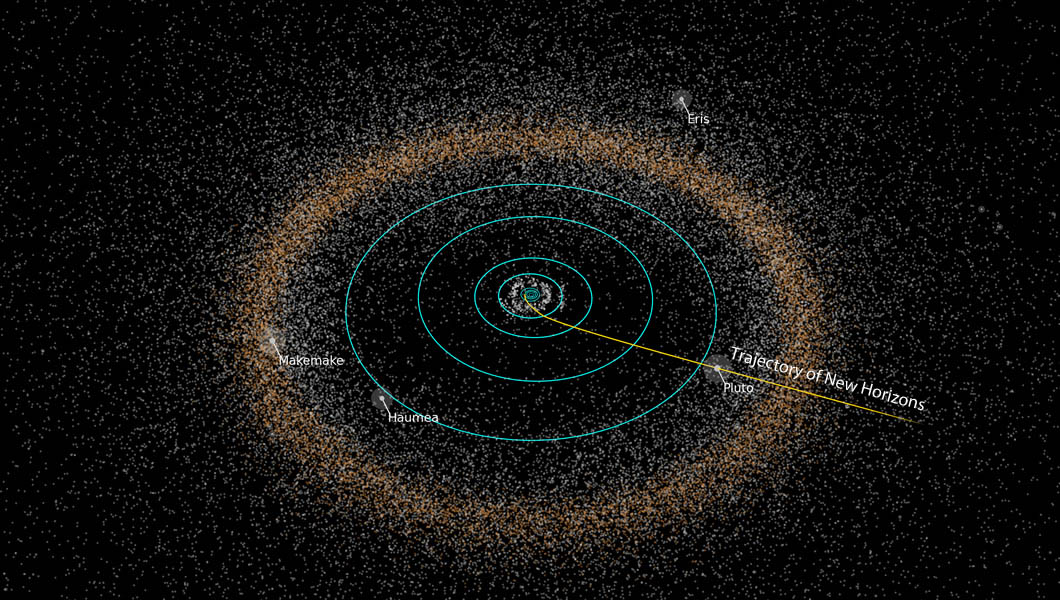
The Kuiper Belt was named in honor of Dutch-American astronomer Gerard Kuiper, who postulated a reservoir of icy bodies beyond Neptune. The first Kuiper Belt object was discovered in 1992. We now know of more than a thousand objects there, and it's estimated it's home to more than 100,000 asteroids and comets there over 62 miles (100 km) across. Credit: JHUAPL

More Evidence that the Kuiper Belt is Bigger Than We Thought

As the New Horizons spacecraft continues its epic journey to explore the Kuiper Belt, it has a study partner back here on Earth. The Subaru Telescope on the Big Island of Hawaii is deploying its Hyper Suprime-Cam imager to look at the Kuiper Belt along the spacecraft’s trajectory. Its observations show that the Kuiper Belt extends farther than scientists thought.

The observations support the search for Kuiper Belt objects (KBO) for New Horizons to explore next. So far, Subaru has found many smaller bodies out there. However, none of them are along the spacecraft’s trajectory. In a big surprise to the science teams at Subaru, at least two of those objects orbit beyond 50 astronomical units, which is the current assumed “limit” of the Belt.

If observers continue to find more such objects outside that 50 AU “limit”, it means the Kuiper Belt is bigger than everybody thought. Or it could exist in two parts—a sort of inner and outer Kuiper Belt. Scientists already know that the belt is much dustier than expected, thanks to observations taken with the dust counter onboard New Horizons.

Implications of an Expanded or Two-part Kuiper Belt

Beyond simply expanding the limit of the Kuiper Belt, the Subaru observations have profound implications for our understanding of the solar nebula, according to Fumi Yoshida, who led the research for the Subaru observation team. “Looking outside of the Solar System, a typical planetary disk extends about 100 AU from the host star (100 times the distance between the Earth and the Sun), and the Kuiper Belt, which is estimated to extend about 50 AU, is very compact. Based on this comparison, we think that the primordial solar nebula, from which the Solar System was born, may have extended further out than the present-day Kuiper Belt,” said Yoshida.

Let’s say the primordial disk was quite large. Then it’s possible that undiscovered planetary bodies clipped the outer edge of the Kuiper Belt. If that happened, then it makes sense to search the outer limits of the current Belt to find such a cut-off object. It’s also possible that perhaps that truncation created a second Kuiper Belt beyond the currently known belt. What it’s like is anybody’s guess, although it’s probably dusty and very likely has at least a few larger objects. So, even if there’s nothing along the New Horizons trajectory, using Subaru to study the distribution of objects it has found will help scientists to understand the evolution of the Solar System.

The Hyper Suprime-Cam at the Subaru Telescope in Hawai'i is part of the search for New Horizons flyby targets. It is outfitted with a special filter to aid in the search. Credit: Subaru Telescope. The Hyper Suprime-Cam at the Subaru Telescope in Hawai’i is part of the search for New Horizons flyby targets. It has a special filter to aid in the search. Credit: Subaru Telescope.

Searching for KBOs

Subaru Telescope’s has been searching for more KBOs to explore ever since New Horizons flew past Arrokoth in 2019. The idea is to find additional KBOs along the path of flight. The search focused two Hyper Suprime-Cam fields along the spacecraft’s trajectory through the Belt. The New Horizons team spent about 30 half-nights to find more than 240 outer Solar System objects.

The next step was for a Japanese team to analyze images from those observations. However, they used a different method than the mission team did and found seven new outer Solar System objects. The scientists then analyzed the HSC data with a Moving Object Detection System developed by JAXA. Normally it detects near-Earth asteroids and other space debris. Those types of bodies move very fast, compared to more distant ones. So, looking for very dim, faraway, slow-moving objects was a challenge. That’s because the team had to adjust for the speed of the Kuiper Belt objects. Then they applied some updated image analysis to confirm their findings. Scientists now know the orbits of two of the seven new objects and they’ve been assigned provisional designations by the Minor Planet Center (MPC.

Schematic diagram showing the orbits of the two discovered objects (red: 2020 KJ60, purple: 2020 KK60). The plus symbol represents the Sun, and the green lines represent the orbits of Jupiter, Saturn, Uranus, and Neptune, from the inside out. The numbers on the vertical and horizontal axes represent the distance from the Sun in astronomical units (au, one au corresponds to the distance between the Sun and the Earth). The black dots represent classical Kuiper Belt objects, which are thought to be a group of icy planetesimals that formed in situ in the early Solar System and are distributed near the ecliptic plane. The gray dots represent outer Solar System objects with a semi-major axis greater than 30 au. These include objects scattered by Neptune, so they extend far out, and many have orbits inclined with respect to the ecliptic plane. The circles and dots in the figure represent their positions on June 1, 2024. Credit: JAXA  Schematic diagram showing the orbits of the two discovered objects (red: 2020 KJ60, purple: 2020 KK60). The plus symbol represents the Sun; green lines are the orbits of Jupiter, Saturn, Uranus, and Neptune. The numbers on the vertical and horizontal axes represent the distance from the Sun in astronomical units. (1 AU corresponds to the distance between the Sun and the Earth). The black dots represent classical Kuiper Belt objects. These are thought to be a group of icy planetesimals that formed early in Solar System history. The gray dots represent outer Solar System objects with a semi-major axis greater than 30 au. These include objects scattered by Neptune. They extend far out, and many have orbits inclined with respect to the ecliptic plane. The circles and dots in the figure represent their positions on June 1, 2024. Credit: JAXA

Continuing to Search the Kuiper Belt

The discovery of more KBOs in the outer Solar System (along with New Horizons’ continued dust detection activities) tells scientists that there’s more to the Kuiper Belt than anyone expected. The proof will be in continued Subaru observations to detect and confirm more objects “out there.”

“The mission team’s search for Kuiper Belt objects using Hyper Suprime-Cam continues to this day, and a series of papers will be published in the future, mainly by the North American group,” said Yoshida. “This research, the discovery of sources with the potential to expand the Kuiper Belt region using a method developed in Japan and led by Japanese researchers, serves as a precursor to those publications.”

For More Information

{https://www.universetoday.com/ }

Hoe vind je dit bericht?
Geschreven door peter om 01:48 Stuur door

'Disc-shaped craft' hovers over Colorado concert venue, employees say: 'It knew it was being watched'

Hoe vind je dit bericht?
Geschreven door peter om 01:34 Stuur door

JUNE 2024 MUFON UFO Sightings Report

JUNE 2024 MUFON UFO Sightings Report

COUNTRIES OF THE WORLD

UNITED STATES 362

FRANCE 21

CANADA 16

UNITED KINGDOM 15

AUSTRALIA 14

GERMANY 6

BRAZIL 5

ITALY 4

NEW ZEALAND 3

SWITZERLAND 2

SWEDEN 2

SPAIN 2

SOUTH AFRICA 2

ARGENTINA 1

BELGIUM 1

TURKEY 1

SINGAPORE 1

POLAND 1

PANAMA 1

KENYA 1

KAZAKHSTAN 1

JAMAICA 1

IRAN 1

GIBRALTAR 1   

TOTAL: 465

SHAPE

Circle 66

Sphere 66

Oval 35

Other 35

Unknown 34

Triangle 33

Disc 24

Star-like 23

Cigar 21

Cylinder 16

Tic Tac 13

Square/Rectangular 10

Fireball 7

N/A 5

Flash 5

Chevron 5

Boomerang 4

Saturn-like 4

Diamond 4

Bullet/Missile 3

Egg 3

Cone 2

Blimp 1

Cross 1

Teardrop 1

STATES OF THE USA

California 35

Arizona 24

Texas 22

Washington 16

Pennsylvania 16

Florida 16

New York 15

Oregon 14

Colorado 14

Ohio 13

North Carolina 11

Illinois 10

Massachusetts 10

Nevada 9

Tennessee 8

New Mexico 8

Michigan 8

Georgia 7

Indiana 7

Kansas 7

Arkansas 7

South Carolina 6

Utah 6

Missouri 6

Mississippi 5

Alabama 5

Iowa 5

Oklahoma 5

Wisconsin 5

New Jersey 4

Kentucky 4

West Virginia 4

Virginia 4

Minnesota 3

Louisiana 3

Idaho 3

Nebraska 2

Connecticut 2

Maryland 2

Wyoming 1

Vermont 1

Rhode Island 1

New Hampshire 1

Hawaii 1

Delaware 1

Alaska 1

DISTANCE

< 100 ft 43

101-500 ft 60

501 ft - 1 Mile 92

Over 1 Mile 94

Unknown 35

NO VALUE 12

Most impressively there were 10 Landings, Hovering, or Takeoffs reported and 22 Entities observed.

{ Mufon.com }

Hoe vind je dit bericht?
Geschreven door peter om 00:18 Stuur door

We Might Witness A Star Explode Soon — And It’s Not Betelgeuse

We Might Witness A Star Explode Soon — And It’s Not Betelgeuse

Any day now...

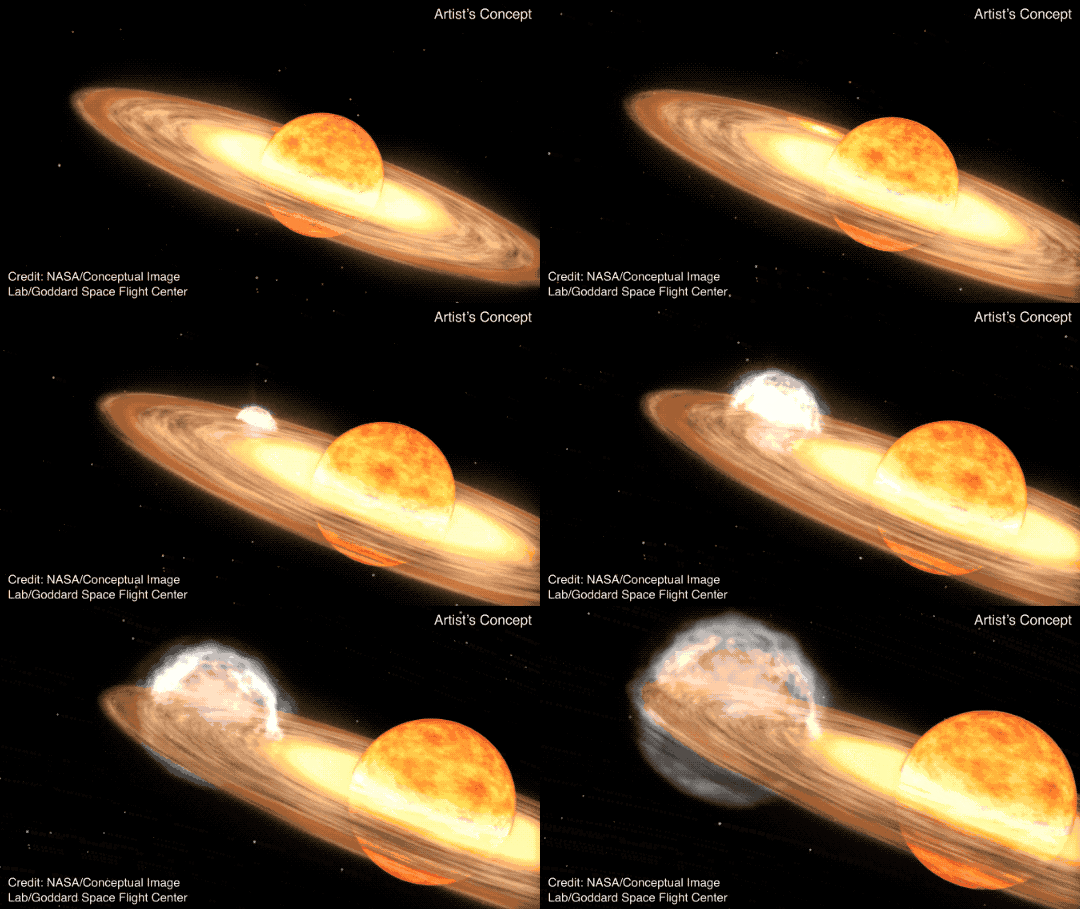
 23fb5f88-e4e5-4345-bc21-1fed1aa6bcd5-375a64a7-1b1a-4b90-9bde-bef215adbab8-novacygni_artistconcept_watermarked.gif
NASA

A mismatched pair of stars 3,000 light years away may be gearing up for an explosion in the next few months. T Coronae Borealis (T CrB to its friends) is normally too dim to see with the unaided eye, but roughly every 80 years, it flares brightly enough to appear as a “new” star, or nova, in Earth’s northern sky. Its last event was in 1946, and astronomers say it’s likely to go off again this summer.

TWINKLE, TWINKLE, LITTLE — BOOM

T CrB is actually a pair of stars, trapped in each other’s orbit — and in an extremely messy relationship that sometimes literally explodes.

One member of the pair is an aging red giant, which has burned up all its hydrogen fuel and is now fusing helium atoms together at its core. Helium fusion produces a tremendous amount of heat and radiation pressure, so the aging star’s outer layers have swelled outward to many times its original size (this is the same fate that will eventually befall our Sun in about 5 billion years). The other half of the dynamic duo is a white dwarf: the burned-out remains of a star’s core (this is what our Sun will look like sometime after its red giant phase).

About every 80 years, the red giant shrugs off its outermost layers of gas, and the white dwarf’s gravity grabs them. White dwarfs are nowhere near as dense as neutron stars, but they're still pretty dense, being the remnants of stellar cores — and it doesn't take much to ignite one again, at least temporarily. When the gas discarded by the red giant falls onto the surface of the white dwarf, it puts just enough pressure on the inner layers of the white dwarf to kickstart nuclear fusion.

That sudden burst of fusion triggers a chain reaction that eventually engulfs the outer layers of the star in what's called a runaway thermonuclear reaction. The envelope of gas around the white dwarf (the same envelope it just snatched away from the nearby red giant), heated by the runaway nuclear fusion, explodes outward at roughly 3,700 miles per second. In other words, KABOOM.

And 3,000 light years away, people on Earth will be able to see what looks like a new star in the night sky.

23fb5f88-e4e5-4345-bc21-1fed1aa6bcd5-375a64a7-1b1a-4b90-9bde-bef215adbab8-novacygni_artistconcept_watermarked.gif

This illustration shows the red giant in T CrB with a disk of discarded gas around it. The white dwarf (the bright spot in the disk at the beginning of the animation) eventually gobbles up so much material that its surface explodes in a runaway thermonuclear reaction.

HOW TO SEE THE NOVA IN T. CORONAE BOREALIS

You can’t see the T Coronae Borealis system with the unaided eye right now, because it’s too dim and too far away. When the nova happens, that will change; the now-invisible star will suddenly appear, blazing brightly for about a week. But you’ll need to know where to look.

This occasionally explosive pair of stars is located in a very small, C-shaped constellation called Coronae Borealis (or the Northern Crown if you’re not a fan of conversational Latin). The Northern Crown lies between the big kite-shaped constellation Boötes and the smaller constellation Hercules. Hercules makes a good landmark, because it’s shaped a little like the more familiar Orion, and it’s almost directly overhead after sunset.

If you’re not an experienced stargazer with a clear view of the night sky, though, your best bet might be to download a star-chart app that can help you pinpoint objects in the sky. It’s a good idea to play with the app and find out where T Coronae Borealis is – the better to appreciate its sudden appearance when the nova finally goes off.

HOW DO WE KNOW WHEN T. CORONAE BOREALIS WILL GO SUPERNOVA?

For the last several centuries, astronomers have watched this pair of stars flare up fairly regularly: about once every 80 years. And the last time this happened, in 1946, astronomers had advanced enough equipment to measure changes in the stars’ brightness in specific wavelengths of light, especially during the months and years leading up to the nova.

“Its behavior over the past decade appears strikingly similar to the observed behavior in a similar timeframe leading up to the 1946 eruption,” writes NASA in a recent press release. “If this pattern continues, some researchers say, the nova event could occur by September 2024.”

But there are no guarantees, and predicting a nova in a star system 3,000 light years away is far from an exact science, especially since astrophysicists still don’t understand the mechanics of these explosions in much detail (which is something they’re hoping this year’s nova can shed more light on).

“Recurrent novae are unpredictable and contrarian,” says NASA astrophysicist Koji Mukai in a recent statement. “We’ll see how T Coronae Borealis behaves.”

WHAT WILL WE LEARN FROM THE NOVA?

The handful of stars in our galaxy that regularly flare up in bright novae are even farther away than T Coronae Borealis (which is actually pretty close by, in stellar terms). That makes it difficult for astronomers to see much detail about exactly how the runaway thermonuclear reaction kicks off and how it finally burns itself out. If predictions are correct, though, T Coronae Borealis should give astronomers an excellent view of all the gory details this time around.

Amateur astronomers all over the world are watching T Coronae Borealis’s dark spot in the night sky right now so they can alert scientists the moment it explodes. When that happens, electronic eyes all over the planet – and in orbit – will pivot toward the star system to record what happens. Teams of astronomers plan to watch the fireworks show with JWST, the Fermi Gamma-Ray Space Telescope, the Swift Observatory, the Very Large Array, and a host of other telescopes on Earth and in space. Those observations should cover pretty much the whole spectrum of radiation, from long, slow radio waves to short, energetic gamma rays.

Much of that information will be new; scientists didn’t have anything like the Fermi Gamma-Ray observatory back in 1946, so they have no idea how a nova looks in gamma rays. Another new addition is NASA’s Imaging Polarimetry Explorer, or IXPE, with its ability to study how closely the light waves in a given beam of x-rays line up with one another; that can reveal all sorts of detail about the x-rays’ origins and the space they’ve traveled through.

WHAT ABOUT BETELGEUSE?

It won’t take T CrB’s white dwarf very long to burn up all its hydrogen fuel and settle back down: It’ll only be visible in the sky for a few days, and the runaway thermonuclear reaction itself will last just a fraction of that time. When Betelgeuse eventually explodes, however, the glow of its death throes will hang in the sky for several months. What’s the difference?

The kind of explosion that lights up T CrB once every 40 years is called a nova, and it happens when a white dwarf gets briefly reignited in a runaway nuclear reaction. Imagine throwing lighter fluid and a match onto a pile of burned-up charcoal. It will catch fire and burn for a moment, but it won’t last.

When Betelgeuse dies, however, it will go out in a blaze of glory called a supernova. A supernova happens when an extremely massive star runs out of fuel for its nuclear reactions; the outer layers collapse, and the pressure of the collapse triggers an enormous explosion. Think of it as blowing up the grill: It’s going to be bigger and brighter than what happened when you lit up the charcoal, and you’re only going to be able to do it once.

Novae like T CrB, though, are the explosive cosmic gifts that just keep on exploding.

  • This article was originally published on March 20, 2024

 { https://www.inverse.com/ }

Hoe vind je dit bericht?
Geschreven door peter om 23:48 Stuur door

Google Maps users convinced they've spotted a UFO in new 2024 images - what the vehicle actually is

Google Maps users convinced they've spotted a UFO in new 2024 images - what the vehicle actually is

Hoe vind je dit bericht?
Geschreven door peter om 21:51 Stuur door

MEET THE REAL-LIFE FOX MULDER: NICK POPE TALKS UFOS, CLICHES AND BUSTS MYTHS

MEET THE REAL-LIFE FOX MULDER: NICK POPE TALKS UFOS, CLICHES AND BUSTS MYTHS

Nick Pope’s dive into the world of UFOs happened by pure chance. Back in 1991, while working for the UK's Ministry of Defence, he was unexpectedly assigned to investigate UFO sightings—a role meant to last just three years. But once he got a taste of the mysteries and compelling data, he couldn’t walk away. Fast forward to today, and Pope’s become a top expert, especially after helping declassify a treasure trove of government documents.

Want to know what he discovered? Keep reading to explore the surprising truths behind UFO sightings and why they matter more than you might think.02/07/2024

Nick Pope

What first drew you to UFO investigations and how did you become a leading expert?

I fell into it rather by accident than design, because I was given it to do as a government job. I was a civilian employee of the Ministry of Defence for 21 years, and I was due in 1991 for a move. You get posted to all the different areas, so you could be in security, policy, finance personnel, and they had a UFO job – I was due for a move at the exact time that that vacancy came up. And I was given that job to do for three years to essentially research and investigate the phenomenon, to assess the defence and national security implications.

I did that for three years and then I just felt that it was too interesting to walk away from, so at the end of that particular posting, I stayed involved. Years later, the British government declassified and released a lot of the Ministry of Defence UFO files. Thousands of documents, many of which I wrote, so I helped with that programme, my name got out there and so the rest is history.

The rest is indeed history. We can see how that would be something that you would sort of fall into and then not want to lead, it sounds so interesting! What would be the most surprising discovery that you came across during a time that, if you can tell us.

Well, I think it was the general point that some of these sightings were much, much more than just vague lights or shapes in the sky, and that there was some really good hard data on a lot of these cases. For example, multiple instances where these things were seen by not just commercial airline pilots, but military pilots [and] simultaneously tracked on radar systems. We've now, particularly in the United States, over the last few years seen senior intelligence officials talk about these things being picked up on satellites, and we've even seen some declassified films of these things shot from fast jets through forward-looking infrared cameras. I think what surprised me was just the fact that this wasn't all just kind of science fiction and conspiracy theory territory, that it really did take you into some fairly hard defence, national security and flight safety issues.

Do you think that [because] there's more evidence cropping up, and a lot more hard, factual evidence, as opposed to the sort of conspiracy theories or general conversations, that the governments are taking more action to be prepared for things, worst case scenario?

Very much so, yes. The US government in particular has really led the way on this subject. There's been a study and reports issued by NASA, who of course a few years ago said we're not interested in UFOs. They said we're looking for life out there, but we don't think any of it's coming down here. But that completely reversed in the last three or four year, and now [they’re a] part of the wider US government UFO research and investigation. Also, the Department of Defence, so the Pentagon, is involved [and] the Office of the Director of National Intelligence has issued reports. [Now that] we've had these declassified US Navy videos that I think a lot of people saw and wondered about because again, there's just been this complete 180° narrative flip, that this subject has come out of the fringe and into the mainstream.

I mean, a few years ago the US government was saying we're not interested, we don't have a programme, and I think what's really amazing is that there's been engagement from the United States Congress, down to the point of having congressional hearings on this and… for all the political divide we see, we've had both Republicans and Democrats come together and push for answers on this. It's less, it's less pronounced in the UK, but there are a few hints that things are going on behind the scenes. Firstly, the US government revealed that the Five Eyes Intelligence Sharing Alliance (United States, Canada, the United Kingdom, Australia and New Zealand) has been doing some work on UFOs, so we know even though they're not talking about it, there's been, there's been some engagement from the UK. The other really interesting thing is that just about a month ago, it was revealed that [the] Department for Science, Innovation and Technology are doing a small study on how the discovery of extraterrestrial life might be announced.

So they're kind of dressing it up as ‘well, what if the James Webb Space Telescope finds something?’ But of course, you can read it across to any scenario you like involving aliens, and just so the fact that the British Government, for the first time is working on a plan of how this would be announced and maybe asking questions like ‘do we have a contingency plan for this?’ Because the answer actually is no, you don't. So, I think they're about to find out they might need one.

Just watching some of the films and some of the programmes like not the not the actual ones or the documentary ones, but just fiction/science fiction, it very much feels like there needs to be a contingency plan and that's just from a viewer's perspective. If you actually started to look into the data behind it, you would definitely think you need a contingency plan.

100% yes. In government, we often use the phrase low probability, high impact and it just well I guess it means what it says. Even if you think there's a comparatively small chance of something happening, if the societal implications are big enough, you must have a plan. So, for example, there are contingency plans, and NASA is actively working on things like what if we discovered a big comet or asteroid heading for the Earth and there have been science fiction movies about that. Of course, Armageddon and Deep Impact for example, and Meteor way before that, I guess Sean Connery back in the 70s.

So you have it's better to have a plan and not need it than need it and not have it. We don't know what extraterrestrials might be like, [or] what they might want, but… if we ever do get visited and they land on the White House lawn, that kind of ‘first-contact’ scenario, about the only good assumption you can make is that their technology will be orders of magnitude above and beyond anything we have, just because they can get here. And we certainly can't get there.

I think now we've got this realisation that previously it's like the iceberg we've just seen the tip of it, but below the surface, there are tens of thousands of people. There's a great line in the movie, Close Encounters of the Third Kind it's “ordinary people under extraordinary circumstances” and it's that I think that's driving it. So, it's coming from the bottom upwards from the public with their sightings. And then it's coming from the top downwards when we've got all these government officials and top guns in the US and suddenly there no stigma anymore – or there's less stigma than there was. There's still some [but] not as much.

I mean, when you were literally in a situation where you can turn on the Evening News and see a U.S. Navy pilot talk about how they were chasing these things, and suddenly they were performing speeds, manoeuvres, accelerations that go way beyond anything they've got. And you think these top guns are fairly difficult to impress and they're just like, wow, this thing, whatever it was, went from virtually standstill to high max speeds in a second, and we got it on radar, so it's not just optical illusion or sensor error. So, I think I think it's those sorts of things that have led to this fundamental change.

It's definitely made it a lot more difficult to ignore. That's probably where a lot of the stigma came from before – it was just a few people here and there who had spoken about their encounters or experiences. And then you've got a lot of people saying ‘well, I didn't see it and you can't prove it’. Whereas now, like you said, there's a lot of things that make it very difficult to ignore – the data, radars, there are experienced pilots, and it's not just the average [person] who said something about something.

Exactly. And all of this ties back to the fact that even when the sceptics say, well, ‘why should I take this seriously?’, you can now say, well, they've just had a hearing on it in Congress or the office of the Director of National Intelligence just issued a report on it. And these are the people who normally report on things like ballistic missile programmes or next-generation stealth fighters, whatever it might be. And then you can go on to the website and read [UFO reports], or at least the unclassified versions.

When you have that comparison – they're talking about those important things, and they're also talking about UFOs, it very much like these are things that everyone should be paying attention to, sitting up and being a bit more observant about what they see and who says what.

Yes, exactly. And you when, when government and the military and the intelligence community are taking it seriously, demonstrably so, then I think even the most hardened sceptic might sit up and say ‘well, wait a minute. Why? Why are they suddenly doing all these studies and issuing all these reports and having all these hearings?’ Because there's no smoke without fire.

Exactly! What do you think is the biggest misconception about UFOs that you possibly have encountered?

I think one that springs to mind is the shape people going to still have this idea of flying saucers and disc-shaped craft. I'm not saying that there haven't been sightings over the years, clearly there have been, but I think most times now when you talk to the pilots, they talk about smaller craft which are either spherical or oval-shaped. In the US very famously one of them was even known as the Tic Tac incident because this thing was white and oval-shaped.

But also, these things are often triangular shape to sort of flat triangle. I've spoken to witnesses who've seen these things slide directly overhead. And I remember one witness very clearly said that he just thought it was a really, really cloudy night because one by one the stars disappeared as if behind some cloud. Then he suddenly realised that he was looking at the underside of a huge black triangular shaped craft, just a couple of hundred feet above him, just moving almost silently overhead, and he was like, wow. I think by his own admission he stood there with his mouth open, his eyes wide, thinking what the heck is that?

Another counterintuitive point is that people always think UFOs are very, very fast, and they're not necessarily. Sometimes they are capable of hovering or moving at very slow speeds, then accelerating away to the horizon in a split second. Another surprising fact, I'm busting all the cliches today, is that these things are just often seen in really remote rural areas. And it's not true. Actually, if you plot them out on a map, a lot of the sightings are in the big cities.

Now you could say that from a sort of statistical point of view, a lot of these lists are not controlled, they don't factor in population. So, in one sense, if you've got a city like London with 8+ million people, if there's something strange in the sky, there are more potential witnesses.

But people just think that [with the] light pollution and the obstructed view from tall buildings. ‘oh you don't have UFO sightings in big cities’. You absolutely do. London, Manchester, Glasgow, Edinburgh, Leeds, these are all UFO hotspots.

Looking ahead, what do you think the future holds for UFO research? Or what do you hope is the next big breakthrough?

I think and I forgot to add this to one of your earlier questions when you asked what's driving this. And one of the things I meant to bring in is the way in which science and academia are now engaging on this. So for example, we have people like Professor Avi Loeb at Harvard, who leads a research programme called Galileo Project, and he's an astrophysicist. A few years ago, scientists wouldn't touch this subject with a barge pole, but now they are. Academics are studying this, more scientists are coming on board. We're seeing UFOs now studied not just by enthusiasts, but by governments, the military, the intelligence agencies, science, academia, and I think that's the future.

And [I think] we're going to see the scientific search for extraterrestrial life, so things like astrobiology come closer and closer, develop linkages with UFO research, because in a sense, as I always say, all these people are looking for the same thing, but they're just looking in different places, and with different methodologies. But what we're now seeing for the first time is those people linking up and doing a bit of both. So, like I say, NASA using James Webb Space Telescope to look for biosignatures, but also doing UFO sightings because going back to that cliché of life out there, you'd feel pretty foolish if you spent millions and millions looking for life out there. And the very thing you were looking for was down here, under your nose all along.

Finally, you've been a regular guest on various TV shows and documentaries and also a spokesperson and consultant for several UFO and alien-themed movies to date. Has there been any that has been a favourite sort of experience or favourite to talk about or consult on?

Well, I think I can't not mention The X-Files, it's just such an iconic TV series and of course now spin-off movies. And in the early years when Chris Carter was creating The X-Files, he went around quietly attending UFO conferences, sitting at the back taking notes. So, it's this great situation where art imitates life, or life imitates art. People say that there's a relationship between science fiction and the UFO phenomenon, and there is but not in the way that a lot of people think. People think ‘ohh these people who see UFOs, they're just picking this up from science fiction’. Often, it's the other way around.

I did some spokesperson work for Fox on The X-Files, one of movies and I think a DVD box set and I got to meet Chris Carter, David Duchovny and Gillian Anderson and things. And the media had for years called me the real-life Fox Mulder. So that was fun.

Two of the most thoughtful and possibly realistic science fiction movies are Contact and Arrival – like all good science fiction, yes, it's about aliens, but it's also about us, and the human reaction to all of this, so that was good. And, of course, more recently, with UFO Day on BLAZE, I'm on a lot of those shows. I'm one of the series regulars on Ancient Aliens, and I know now I'm segueing into documentaries, but Ancient Aliens is obviously an institution that's been running for multiple seasons and still going strong, and I'm very happy to be involved in that show. I know BLAZE are going to be showing a lot of episodes.

And then of course the new show UFO Encounters UK that I'm also on both those episodes. I mentioned that Close Encounters of the Third Kind quote – “ordinary people under extraordinary circumstances” – I guess that's the epitome of that quote because that's it's just very visceral, how these people just tell their stories. People with nothing to gain, and but potentially quite a lot to lose. Just telling it straight, and how this is what happened. With the UFO subject comes back to the ordinary people and their sightings, their experiences of this and. And I mentioned again there's this thing that people often say the day before I had my sighting or experience, and the day after and these people are changed profoundly and deeply by it and often it sets them on a quest, a sort of journey of discovery as they try and make sense of all this and try and find other people like them, who've had these experiences because often they often think that's the only people I could talk to about this is somebody else who's been through it. I've had people who haven't even told family members about sightings and experiences, but they'll try and connect with other people who've had that shared experience.

UFO Encounters UK

Yeah, it is about the shared experience, isn't it? It's difficult when you have something like you said that's profoundly changes you that no one else can really relate to.

Yes. It's not necessarily that these people are looking for validation. I mean they know what they saw, But they want that sense of community. They want that sense of oh, it's not just me.

  • Tune into BLAZE (Freesat channel 162) all day on Tuesday 2nd June to find the very best UFO shows, and catch the premiere of UFO Encounters UK from 9pm.

{ https://www.freesat.co.uk/ }

Hoe vind je dit bericht?
Geschreven door peter om 20:54 Stuur door

Webb Sees Hourglass-Shaped Molecular Cloud around Protostar

Webb Sees Hourglass-Shaped Molecular Cloud around Protostar

Astronomers using the MIRI (Mid-Infrared Instrument) cameraaboard the NASA/ESA/CSA James Webb Space Telescope have captured a striking new photo of the molecular cloud L1527.

L1527, shown in this image from Webb’s MIRI instrument, is a molecular cloud that harbors the IRAS 04368+2557 protostar. The more diffuse blue light and the filamentary structures in the image come from organic compounds known as polycyclic aromatic hydrocarbons (PAHs), while the red at the center of this image is an energized, thick layer of gases and dust that surrounds the protostar. The region in between, which shows up in white, is a mixture of PAHs, ionized gas, and other molecules. Image credit: NASA / ESA / CSA / STScI.

L1527, shown in this image from Webb’s MIRI instrument, is a molecular cloud that harbors the IRAS 04368+2557 protostar. The more diffuse blue light and the filamentary structures in the image come from organic compounds known as polycyclic aromatic hydrocarbons (PAHs), while the red at the center of this image is an energized, thick layer of gases and dust that surrounds the protostar. The region in between, which shows up in white, is a mixture of PAHs, ionized gas, and other molecules.

Image credit: NASA / ESA / CSA / STScI.

L1527, also known as LDN 1527, is located approximately 447 light-years away from Earth in the constellation of Taurus.

An infant protostar called IRAS 04368+2557 is embedded within the molecular cloud, which is part of the Taurus star-forming region.

IRAS 04368+2557 is only 100,000 years old — a relatively young stellar body.

Given its age and its brightness in far-infrared light, the star is considered a class 0 protostar, the earliest stage of star formation.

IRAS 04368+2557 hosts an edge-on disk with two misaligned parts.

The inner and outer parts of the disk have slightly different orbital planes, connected at 40 to 60 AU (astronomical units) from the protostar, but the disk has point symmetry with respect to the protostar’s position.

Webb’s previous observation of L1527, with NIRCam (Near-Infrared Camera), allowed astronomers to peer into this region and revealed this molecular cloud and protostar in opaque, vibrant colors.

Both NIRCam and MIRI show the effects of outflows, which are emitted in opposite directions along the protostar’s rotation axis as the object consumes gas and dust from the surrounding cloud.

These outflows take the form of bow shocks to the surrounding molecular cloud, which appear as filamentary structures throughout.

They are also responsible for carving the bright hourglass structure within the molecular cloud as they energize, or excite, the surrounding matter and cause the regions above and below it to glow.

“Unlike NIRCam, however, which mostly shows the light that is reflected off dust, MIRI provides a look into how these outflows affect the region’s thickest dust and gases,” the Webb astronomers said in a statement.

“The areas colored here in blue, which encompass most of the hourglass, show mostly carbonaceous molecules known as polycyclic aromatic hydrocarbons.”

“The IRAS 04368+2557 protostar itself and the dense blanket of dust and a mixture of gases that surround it are represented in red.”

“In between, MIRI reveals a white region directly above and below the protostar, which doesn’t show as strongly in the NIRCam view.”

“This region is a mixture of hydrocarbons, ionized neon, and thick dust, which shows that the protostar propels this matter quite far away from it as it messily consumes material from its disk.”

“As IRAS 04368+2557 continues to age and release energetic jets, it’ll consume, destroy, and push away much of this molecular cloud, and many of the structures we see here will begin to fade.”

“Eventually, once it finishes gathering mass, this impressive display will end, and the star itself will become more apparent, even to our visible-light telescopes.”

“The combination of analyses from both the near-infrared and mid-infrared views reveals the overall behavior of this system, including how the central protostar is affecting the surrounding region.”

“Other stars in Taurus, the star-forming region where L1527 resides, are forming just like this, which could lead to other molecular clouds being disrupted and either preventing new stars from forming or catalyzing their development.”

{ https://www.sci.news/ }

Hoe vind je dit bericht?
Geschreven door peter om 22:35 Stuur door

Scientists Revise Famous Drake Equation

Scientists Revise Famous Drake Equation

Within the uncertainties of involved astronomical and biological parameters, the Drake equation typically predicts that there should be many exoplanets (< 100 to millions) in our Milky Way Galaxy hosting active, communicative civilizations. These optimistic calculations are however not supported by evidence, which is often referred to as the Fermi paradox. University of Texas at Dallas Professor Robert Stern and ETH-Zurich’s Professor Taras Gerya elaborate on this long-standing enigma by showing the importance of long-term plate tectonics as well as oceans and continents for the evolution of active, communicative civilizations.

Stern & Gerya propose that the lack of evidence for active, communicative civilizations reflects the scarcity of long-lived plate tectonics and/or continents and oceans on exoplanets with primitive life. Image credit: Sci.News.

Stern & Gerya propose that the lack of evidence for active, communicative civilizations reflects the scarcity of long-lived plate tectonics and/or continents and oceans on exoplanets with primitive life.

Image credit: Sci.News.

In 1961, the American astrophysicist and astrobiologist Dr. Frank Drake devised an equation in which several factors are multiplied together to estimate the number of intelligent civilizations in our Galaxy capable of making their presence known to humans:

N = R * fp * ne * fl * fi * fc * L

N: the number of civilizations in the Milky Way Galaxy whose electromagnetic emissions (radio waves, etc.) are detectable;

R: the number of stars formed annually;

fp: the fraction of those stars with planetary systems;

ne: the number of planets per solar system with an environment suitable for life;

fl: the fraction of suitable planets on which life actually appears;

fi: the fraction of life-bearing planets on which intelligent life emerges;

fc: the fraction of civilizations that develop a technology that produces detectable signs of their existence;

L: the average length of time (years) such civilizations produce such signs.

Assigning values to the seven variables has been an educated guessing game, leading to predictions that such civilizations should be widespread. But if that is true, why is there no conclusive evidence of their existence?

This contradiction is known as the Fermi paradox, named for the Italian and later naturalized American nuclear physicist and Nobelist Dr. Enrico Fermi, who informally posed the question to colleagues.

“Life has been around on Earth for about 4 billion years, but complex organisms like animals didn’t appear until about 600 million years ago, which is not long after the modern episode of plate tectonics began,” Professor Stern said.

“Plate tectonics really jump-starts the evolution machine, and we think we understand why.”

In their paper, Professor Stern and Professor Gerya propose refining one of the Drake equation factors — fi, the fraction of life-bearing planets on which intelligent life emerges — to take into account the necessity of large oceans and continents and the existence of plate tectonics for more than 500 million years on those planets.

“In the original formulation, this factor was thought to be nearly 1, or 100% — that is, evolution on all planets with life would march forward and, with enough time, turn into an intelligent civilization. Our perspective is: That’s not true,” Professor Stern said.

The researchers propose a revision to the Drake equation that defines fi as the product of two terms:

foc: the fraction of habitable exoplanets with significant continents and oceans;

and fpt: the fraction of planets that have had long-lasting plate tectonics.

Based on the team’s analysis, the fraction of the exoplanets with optimal water volume is likely very small.

The authors estimate the value of foc ranges between 0.0002 and 0.01.

Similarly, they conclude that plate tectonics lasting more than 500 million years is also highly unusual, leading to an estimate of fpt at less than 0.17.

“When we multiply these factors together, we get a refined estimate of fi that is very small, between 0.003% and 0.2%, instead of 100%,” Professor Stern said.

“This explains the extreme rareness of favorable planetary conditions for the development of intelligent life in our Galaxy and resolves the Fermi paradox.”

“Biogeochemistry posits that the solid Earth, particularly plate tectonics, speeds up the evolution of species,” he added.

“Studies like ours are useful because they stimulate thinking broadly about larger mysteries and provide an example of how we can apply our knowledge of Earth systems to interesting questions about our Universe.”

  • The paper appeared in the April 2024 edition of the journal Scientific Reports.
  • R.J. Stern & T.V. Gerya. 2024. The importance of continents, oceans and plate tectonics for the evolution of complex life: implications for finding extraterrestrial civilizations. Sci Rep 14, 8552; doi: 10.1038/s41598-024-54700-x

This article was adapted from an original release by the University of Texas at Dallas.

{ https://www.sci.news/ }

Hoe vind je dit bericht?
Geschreven door peter om 22:17 Stuur door

Meer van UFO'S of UAP'S, ASTRONOMIE, RUIMTEVAART, ARCHEOLOGIE, OUDHEIDKUNDE, SF-SNUFJES EN ANDERE ESOTERISCHE WETENSCHAPPEN - DE ALLERLAATSTE NIEUWTJES

↑ Terug naar de berichten