

Date of discovery: May 9, 2024, but video made June 21, 2024
Location: Earths moon


 Inside the mystery of one of America's deadliest roads - as experts find 'evidence' of UFOs and portals at spot where 15 people have died

A team of investigators have claimed to have discovered evidence of interdimensional portals under a bridge where a staggering number of drivers have been killed.
Ex-CIA agent Andy Bustamante and journalist Paul Beban, who delve into paranormal and extraterrestrial activity on their show Beyond Skinwalker Ranch, alleged that they found the cause of the mysterious motor deaths.
The bridge, found on the Miller Ranch in Colorado, has seen at least 15 drivers lose their lives, alongside 16 cattle mutilations across the past 25 years.
Using LIDAR ground laser technology, they claimed to find evidence of underground vacuums under the bridge that were highly strange.
In fact, by the end of the episode, a 3-D model of the bridge constructed from the LIDAR had some points located completely underground - something the investigators say might be due to time-slowing anomaly.
A bridge nearby to the Miller Ranch in Colorado has seen over a dozen deaths just a short walk from mysterious cattle mutilations - which a team of investigators claim may be linked to secret 'portals' underground

A 3-D model of the bridge constructed from the LIDAR had some points located completely underground - something the investigators say might be due to time-slowing anomaly
In the show, the team of investigators said the bridge at the ranch is 'one of the deadliest stretches of road in the country, and we just have no idea why.'
They claimed that after using LIDAR technology to survey the ground underneath the bridge, they potentially found 'portals' that could lead to another dimension.
The team also used electromagnetic pulses through the bridge, which they claim were interrupted by radio waves.
Describing the radio waves as 'data packets', they alleged that the frequent pulses may form part of an encrypted message from beyond.
'What's fascinating is that one is electrical energy, one is radio frequency, so there should be no relationship here,' one investigator pointed out.
The bridge came under scrutiny not only because of the high number of deaths, but also its proximity to the cattle ranch where a number of livestock have been mutilated.
At least 16 cattle have been killed and dismembered over the past 25 years, with no explanation. The cows are often found without any blood or tracks around them, missing organs and limbs that have been cut with neat precision.
The experiment came as part of the show's delving into the UFO-hotbed site Skinwalker Ranch in Utah, and claim that unexplained phenomena in other parts of the country are linked to the site.

Scientists found strange radio wave pulses emanating from the bridge when they ran electromagnetic current through it

Describing the radio waves as 'data packets', the investigators alleged that their tests may have uncovered an encrypted message from beyond

In another recent experiment at the Skinwalker Ranch, the group attempted to understand what is causing a radar blip in the middle of Utah wilderness where a number of 'UFOs' have been reported.
The ground penetrating radar (GPR) they used sends radio signals into the ground, but some are also sent up into the sky, enabling the detection of objects that might be lingering above.
The team noted how in the past, when they were scanning the area using GPS, there were times when all data would suddenly be lost, and the GPS signal would give readings that were below the surface of the ranch.
Although the team had been attempting to uncover an underground tunnel that may lie below, the scientists were perplexed when the data they received appeared to have been altered by an unknown force.

In a series of experiments at Skinwalker Ranch, the group used both ground penetrating radar and rockets, they try to determine what may also be causing the electromagnetic disturbance from above
The testing at the ranch comes as Skinwalker Ranch has grown in infamy in recent decades, particularly due to eerie UFO sightings and cattle mutilations.
Rancher Terry Sherman, who bought the property in the '90s, has revealed several mysterious phenomena at the ranch, that spooked him so much that he eventually sold the property and moved his family of four away.
In one instance, Sherman found several heads of his cattle mutilated after purchasing the land in 1996.
Additionally, Sherman witnessed unexplainable encounters, one in which Sherman saw a wolf-like creature three times the size of a normal wolf.
Another researcher saw an bizarre creature with piercing yellow eyes surveilling him from a tree, among other mysterious instances.
The ranch later became the focus of Pentagon investigations into UFOs through programs like the Advanced Aerospace Threat Identification Program (AATIP).
Structures In Crater On Moon In NASA Map! Link Below. June 2024, UFO Sighting News.
Date of discovery: May 9, 2024, but video made June 21, 2024
Fragment van een papyrus met verhalen over Jezus' kindertijd ontdekt: het onthult nieuwe details Door Janine

Biblioteca statale e universitaria di Amburgo
Jarenlang bewaarde een bibliotheek in Hamburg, Duitsland, een oude papyrus, in de veronderstelling dat het een onbelangrijk document was. De waarheid is echter heel anders, althans volgens de twee experts die het fragment lange tijd hebben bestudeerd en de inhoud ervan hebben onthuld. Het zou de oudst bekende kopie zijn van een van de apocriefe evangeliën, die vertelt over de wonderen die Jezus verrichtte toen hij nog een kind was.
We zijn in de Carl von Ossietzky Staats- en Universiteitsbibliotheek in de stad Hamburg, in Noord-Duitsland. Jarenlang werd gedacht dat een van de bewaard gebleven papyri niets anders was dan een alledaags document, een privébriefje of een boodschappenlijstje. In werkelijkheid, zeggen twee experts die de gelegenheid hebben gehad om het fragment van de papyrus te analyseren, zou het een van de belangrijkste documenten zijn om de eerste eeuwen van het christendom te begrijpen.
De studie, gepubliceerd in de Journal of Papyrology and Epigraphy, beweert dat dit fragment de oudste kopie is die ooit is gevonden van het Kindheidsevangelie van Thomas. Terwijl de eerdere versie dateert uit de 9e eeuw, zou de papyrus die in Hamburg bewaard werd minstens 1600 jaar oud zijn en geschreven zijn tussen de 4e en 5e eeuw. Toch bewaarde de bibliotheek het document jarenlang en niemand realiseerde zich ooit het belang ervan, totdat prof. Lajos Berkes het woord “Jezus” in de tekst opmerkte. En hij besloot op onderzoek uit te gaan.
Het fragment bevat 13 regels geschreven in het Grieks en komt uit het laat-oude Egypte, toen het christendom al een wijdverspreide en waarschijnlijk staatsreligie was geworden. Zoals bevestigd door de twee geleerden die de papyrus analyseerden, Lajos Berkes en Gabriel Nocchi Macedo, gaat de inhoud niet over boodschappen of andere alledaagse zaken. In plaats daarvan vertelt het een verhaal uit de kindertijd van Jezus dat bekend staat als het levend maken van mussen van klei.
De episode is al bekend, omdat hij voorkomt in recentere kopieën van het Kindheidsevangelie van Thomas, en vertelt over het tweede wonder van de jonge Jezus. Op 5-jarige leeftijd is Jezus aan het spelen aan de oever van een rivier en maakt hij kleine musjes met klei. Jozef berispt hem omdat hij op een ongepaste dag werkt, waarop Jezus in zijn handen klapt en leven geeft aan de musjes, die wegvliegen van de rivier.
Er wordt weinig gesproken over het Kindheidsevangelie van Jezus, dat wordt toegeschreven aan de apostel Thomas maar in werkelijkheid in de 2e eeuw is geschreven. Het is in feite één van de apocriefe evangeliën, teksten die zijn uitgesloten van de officiële bijbelse canonvorming van de Katholieke Kerk omdat ze vaak als onbetrouwbaar werden beschouwd of in ieder geval in tegenspraak zijn met de vier testamentaire evangeliën. Het Kindheidsevangelie vertelt bijvoorbeeld over een reeks wonderen die Jezus tussen zijn 5e en 12e levensjaar verrichtte, maar andere evangelies verzamelen gezegden, weer andere episoden uit het leven, enzovoort.
Het belang van de Hamburgse ontdekking ligt niet alleen in de oudheid van het handschrift, dat hoe dan ook een essentieel element is. Naast dit aspect stelt het bestuderen van een papyrus uit de 4e tot 5e eeuw ons in staat de verspreiding van deze evangeliën in de eerste eeuwen van het christendom te begrijpen. De ontdekking schuift de oudste kopie van het Kindheidsevangelie van Thomas daarom niet simpelweg enkele eeuwen terug, maar biedt nieuwe informatie over de context van het kopiëren en bestuderen van deze teksten. Die toen al buiten de traditionele canon werden beschouwd, maar die ons op de een of andere manier hebben bereikt.
Something’s Always Been Off About the Crab Nebula. Webb Has Revealed Why!
The Crab Nebula has always fascinated me, albeit amazed me that it doesn’t look anything like a crab! It’s the result of a star that exploded at the end of its life back in 1054 CE, leaving behind what is known as a supernova remnant. Back then the explosion would have been visible to the naked eye, even in daytime. It was thought that the supernova that led to the cloud was from a less evolved star with a core made from oxygen, neon and magnesium. Recent studies by the James Webb Space Telescope reveals that it may actually be the core collapse of an iron rich star.
The Crab Nebula can be found in the constellation Taurus measuring 11 light years across. Deep inside the cloud, which expands at a rate of 1,500 kilometres per second, lies a rapidly rotating neutron star known as a pulsar. It emits a beam of electromagnetic radiation that sweeps across space much like a lighthouse sweeping out across the ocean. It has been the subject of many studies to learn about the dynamics of stellar evolution.
Previous studies have attempted to understand the total kinetic energy of the original explosion based upon the velocity of the expanding cloud. The data suggested that the supernova was relatively low energy so the progenitor star was likely to be in the range of 8 to 10 times the mass of the Sun. If it had been more massive it would have experienced a more violent supernova which would be revealed in higher velocity of the expanding gas cloud. But there was a problem.

The observations of the Crab Nebula, particularly the high rotational speed of the pulsar, seemed to conflict with current supernova theory. In the model for lower mass stars like that which was the progenitor star of the Crab Nebula, the oxygen in the core ignites as the core collapses. This process does not have sufficient energy to generate such a fast rotating pulsar.
A team of astronomers have addressed this curiosity using MIRI (Mid-Infrared Instrument) and NIRCam (Near-Infrared Camera) onboard the James Webb Space Telescope to collect data from the Crab Nebula. The team was led by Tea Temim from the Princeton University in New Jersey. They report that the gas composition of the cloud suggests the star may have been more evolved with some iron in the core which could have led to a higher energy supernova than previously thought.
 Artist impression of the James Webb Space Telescope
With Webb’s sensitive infrared instruments, the iron and nickel emission lines can be seen with more clarity than ever before. Studying the bright lines in the spectrum of the nebula has allowed a much more reliable estimate of the iron and nickel ratio to be deduced. They found it was a higher percentage compared to the Sun which was expected for a more energetic supernova.
The results are promising but the readings were taken from two small regions of the nebula so to rule out variations across the entire 11 light years further readings are needed. If the data from Webb is representative from the entire nebula then it’s possible one of the mysteries of the nebula may finally be solved.
Source :
Lake Shorelines on Titan are Shaped by Methane Waves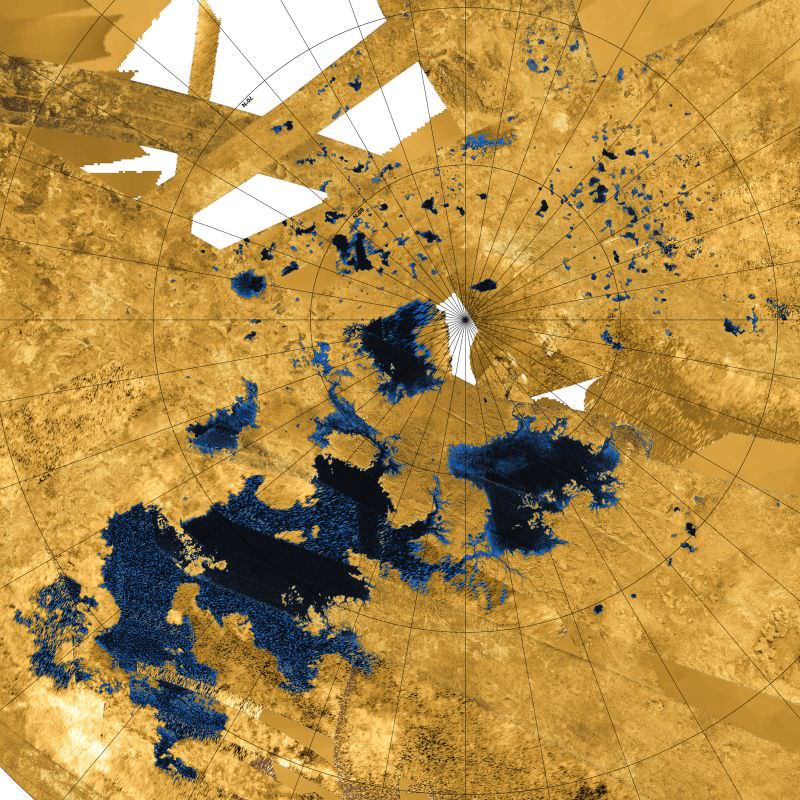
Distant Titan is an oddball in the Solar System. Saturn’s largest moon—and the second largest in the entire Solar System—has an atmosphere denser than Earth’s. It also has stable lakes and seas of liquid hydrocarbons on its surface.
New research shows that waves on these seas are eroding Titan’s coastlines.
The research is “Signatures of Wave Erosion in Titan’s Coasts,” and it’s published in Science Advances. The lead author is Rose Palermo, an MIT graduate and research geologist at the U.S. Geological Survey.
In 2007, the Cassini spacecraft spotted lakes and seas of liquid hydrocarbons, mostly methane and ethane, on Saturn’s moon Titan. Titan and Earth are the only two bodies in the Solar System known to have surface liquids. Scientists have only Cassini data from Titan to work with, and they’ve been poring over the data in an effort to understand this strange world.
The moon’s seas are one of the most intriguing features throughout the entire Solar System. But they’re difficult to observe because of the thick atmosphere. Researchers have wondered if waves shape the coastlines, but there are conflicting signs about the nature of the seas. They could be rough, or they could be smooth. A paper from 2014 suggested that transient features in Titan’s northern sea, Ligeia Mare, could be waves.
But there’s no certainty.
“We found that if the coastlines have eroded, their shapes are more consistent with erosion by waves than by uniform erosion or no erosion at all.”
Rose Palermo, lead author, U.S. Geological Survey
“Some people who tried to see evidence for waves didn’t see any, and said, ‘These seas are mirror-smooth,'” lead author Palermo said in a press release accompanying the research. “Others said they did see some roughness on the liquid surface but weren’t sure if waves caused it.”
It seems likely that there would be waves on Titan. To investigate this question, researchers at MIT compared Titan’s shorelines to shorelines on Earth to see if they match.
The seas and lakes on Titan look much like some on Earth. They appear to be flooded valleys and depressions. But scientists are uncertain if these bodies of water are eroding their coastlines like those on Earth. “Spacecraft observations and theoretical models suggest that wind may cause waves to form on Titan’s seas, potentially driving coastal erosion, but the observational evidence of waves is indirect, and the processes affecting shoreline evolution on Titan remain unknown,” the authors write in their paper.
The problem is that there’s no reliable way to connect shoreline morphology directly to the mechanisms that shape it, even on Earth. To try to understand how erosion affects Titan’s coastlines, the researchers started with Earth. They examined how different coastal erosion mechanisms shape Earth’s coastlines, then applied the framework to Titan.
There are basically two types of coastal erosion: wave-driven erosion and uniform erosion. Each type produces different coastlines.
Wave erosion is driven by wind and produces a change proportional to the strength of the waves. Waves are usually stronger the farther they travel before they hit a coast. Wave erosion creates long, smooth stretches of coast where the coast is fully exposed and bays in protected areas where less erosion occurs. The distance the wind can blow to generate waves on a particular water body before striking a coast is called ‘fetch.’
“Wave erosion is driven by the height and angle of the wave,” Palermo explained. “We used fetch to approximate wave height because the bigger the fetch, the longer the distance over which wind can blow and waves can grow.”
Uniform erosion is different. It doesn’t rely on mechanical wave action. The compositional differences between Earth and Titan are apparent when it comes to uniform erosion. “Titan’s crust consists mainly of water ice, but its surface solids may also include heavy hydrocarbon molecules, such as benzene, that are soluble in liquid methane and ethane, such that the liquid lakes and seas may slowly dissolve the solid coasts of the north polar terrain,” the authors explain in their research.
Over a long enough period of time, uniform erosion occurs at the same rate in all locations, producing distinct morphological features: shorelines that are generally smooth even inside bays with sharp headlands that punctuate them.
“Here, we test the hypothesis that coastal erosion has shaped Titan’s seas by investigating whether coastline shapes are most consistent with wave-driven erosion, uniform erosion, or no coastal erosion,” the authors write.
 This figure from the research illustrates how the two types of erosion would shape shorelines. The images are based on simulated Titan landforms and shorelines. A shows the initial condition of Titan’s water bodies, where rivers carved out channels, and rising seas flooded them. B shows the morphology that wave erosion would produce, where the erosion rate depends on fetch. C shows the morphology that Uniform erosion would produce, where the erosion is uniform in all locations. Darker blue indicates deeper water and lighter yellow indicates higher land.
Image Credit: Palermo et al. 2024.
The different morphological features produced by wave-driven erosion and uniform erosion are obvious. Wave-driven erosion tends to smooth exposed sections of the coastline where fetch is large and preserve the coastline where fetch is small inside embayments.
Uniform erosion is different. It widens embayments and smooths out small-scale roughness on the coastline regardless of fetch. Headlands are the exception, which sharpen into thick-necked points that stick out into the main basin.
“We had the same starting shorelines, and we saw that you get a really different final shape under uniform erosion versus wave erosion,” said co-author Taylor Perron, Professor of Earth, Atmospheric and Planetary Sciences at MIT. “They all kind of look like the Flying Spaghetti Monster because of the flooded river valleys, but the two types of erosion produce very different endpoints.”
 Titan’s Ligeia Mare is the second largest liquid body on Titan. The researchers say that its coastline appears to be altered by wave-driven erosion.
Image Credit: By NASA/JPL-Caltech/ASI/Cornell – http://photojournal.jpl.nasa.gov/catalog/PIA17031,
Public Domain, https://commons.wikimedia.org/w/index.php?curid=26294960
“We found that if the coastlines have eroded, their shapes are more consistent with erosion by waves than by uniform erosion or no erosion at all,” Perron said.
But these are just simulations, and they have to be tested rigorously. The team’s next step was to quantify these differences in the real world. The researchers explain that they “developed a technique focusing on local relationships between shoreline roughness and fetch area” to understand and quantify the differences. Specifically, they quantified what they call “roughness” to differentiate wave-driven erosion from uniform erosion. “Simply put, a lower roughness means a smoother stretch of shoreline compared to the rest of the lake, and a higher roughness means a comparatively rough stretch of shoreline,” they write.
 This figure from the research shows roughness and fetch area for two of Titan’s seas: Kraken Mare and Ligeia Mare. C and D show roughness for each sea. E and F show the normalized fetch area, assuming waves are fetch-limited. Fetch-limited means waves continue to grow as long as the fetch length increases. G and H show normalized fetch area assuming a saturation fetch length of 20 km. That means that waves only grow up to a certain fetch length and then saturate. In that case, the system is saturation-limited, and the “fetch length in all directions is truncated to a maximum value.”
Image Credit: Palermo et al. 2024.
The researchers say that “… shoreline roughness and normalized fetch area can be used to fingerprint wave-driven and uniform erosion and distinguish them from a coastline consisting only of flooded river valleys,” as shown in the first image.
So, what does this all boil down to?
“Our results suggest that the coastlines of Titan’s largest liquid bodies are most consistent with shorelines that have been modified by wave erosion and river incision,” the researchers write in their paper. They analyzed four coastlines and found a less than 5% probability of uniform erosion in a saturation-limited scenario and a less than 20% probability of uniform erosion in a fetch-limited scenario. That leaves wind-driven erosion as the most likely cause of erosion, which seems to confirm that Titan’s lakes and seas experience waves. “Therefore, our results suggest that the largest seas and lakes are not consistent with erosion by uniform processes (i.e., dissolution), as previously hypothesized for some of Titan’s landscapes,” they conclude.
That’s the scientific way of presenting their results, and their paper is like part of a long conversation with other scientists. In the press release, they state their conclusion more plainly for the rest of us.
“We can say, based on our results, that if the coastlines of Titan’s seas have eroded, waves are the most likely culprit,” said Perron, Professor of Earth, Atmospheric and Planetary Sciences at MIT. “If we could stand at the edge of one of Titan’s seas, we might see waves of liquid methane and ethane lapping on the shore and crashing on the coasts during storms. And they would be capable of eroding the material that the coast is made of.”
“Waves are ubiquitous on Earth’s oceans. If Titan has waves, they would likely dominate the surface of lakes,” says Juan Felipe Paniagua-Arroyave, associate professor in the School of Applied Sciences and Engineering at EAFIT University in Colombia, who was not involved in the study.” It would be fascinating to see how Titan’s winds create waves, not of water, but of exotic liquid hydrocarbons.”
The next step is to determine how strong Titan’s winds have to be to create coastal erosion. The researchers also hope to decipher which directions the wind is predominantly blowing from.
“Titan presents this case of a completely untouched system,” Palermo said. “It could help us learn more fundamental things about how coasts erode without the influence of people, and maybe that can help us better manage our coastlines on Earth in the future.”
It’s Not Just Rocks, Scientists Want Samples Mars’s Atmosphere
Mars holds a very special place in our hearts. Chiefly because of all the other planets in the Solar System Mars is probably the place we are going to find some tantalising clues or maybe even evidence of prehistoric life. NASA Perseverance Rover has been trundling around the Jezero Crater looking for evidence that it was once hospitable to life. To that end it has not only been collecting rock samples but air samples too and scientists can’t wait to get their hands on them.
The Mars Perseverance Rover is part of NASA’s Mars 2020 mission. It launched on 30 July 2020 and landed in the Jezero Crater successfully on 18 February 2021. The site was picked because it’s a dried up river bed and if there is any evidence of ancient primitive life on Mars, it is a likely location. Perseverance is equipped with a host of instruments including a drone named Ingenuity to survey the planet.
 Mars Perseverence rover sent back this image of its parking spot during Mars Solar Conjunction.
Courtesy NASA/JPL-Caltech
One exciting element of the mission is the collection of rock samples as part of the Mars Sample Return Campaign. Twenty four core samples have been collected to date and deposited on the surface ready for collection by a future mission. It’s not just rock samples that have been collected though. Known as ‘headspace’ there is air in the space around the rock samples and it is this that has got scientists excited.
Not only do the rocks hold secrets about Mars but the atmosphere does too. It’s an atmosphere rich in Carbon Dioxide but is expected to have trace amounts of other gasses too. Information about the current climate can be gained from the trapped gasses but it’s also possible to learn about the evolution of the atmosphere through analysis of the rocks. There is one particularly important tube that has been filled entirely with gas from the atmosphere.
 Image of the Martian atmosphere and surface obtained by the Viking 1 orbiter in June 1976.
(Credit: NASA/Viking 1)
With the sample sat on the surface of Mars potentially for many years, the gas trapped will interact with the rock in the sample tube. It will only be when the tubes are opened up when they arrive back here on the Earth that the interaction will cease. It’s hoped to understand more about the levels of water vapour near the Martian surface.
It isn’t just the water vapour that is of interest but the levels of trace gas too are of interest. Through analysing the gas samples we can tell if there are gasses like neon, argon and xenon which are non reactive gasses. Because these gasses do not react then there presence in the tube samples may suggest that Mars stated with an atmosphere. We know that it had a much thicker atmosphere in the past but we don’t know whether it has always been there or whether it developed later.
There are many benefits that will come from analysing the samples even, the prevalence of dust that will help future human exploration. As Justin Simon from NASA’s Johnson Space Center in Houston said “The gas samples have a lot to offer Mars scientists, even those who don’t study Mars would be interested because it will shed light on how the planet forms and evolves.”
Source :
Existence of lost temple dedicated to the Greek goddess of war is discovered in 2,500-year-old graffiti
Archeologists have discovered a lost ancient Greek temple dedicated to the goddess of war, after translating a newly found case of 2,500-year-old graffiti.
Among over 2,000 remnants of ancient Greek graffiti, one scholar has uncovered a diagram of this lost temple to Athena, ancient Greece's goddess of war and wisdom.
The graffiti, which experts said was made by a shepherd or herder, depicts a now bygone temple on the very same site as Athens' historic, still-standing Parthenon.
'The structure,' according to the University of Tennessee classics professor who made the discovery, 'is identified by its inscription as 'the Hekatompedon' and was produced by an individual named Mikon.'
Among over 2,000 remnants of ancient Greek graffiti, one scholar has uncovered a diagram (above) of a lost temple to Athena, ancient Greece's goddess of war and wisdom

'The structure,' according to the University of Tennessee classics professor who made the discovery, ' is identified by its inscription as 'the Hekatompedon' and was produced by an individual named Mikon.' Above, the professor's sketch of Mikon's 2,500-year-old graffiti
Hekatompedon was once the official ancient name for the temple to Athena, but it translates literally to '100-footer' in ancient Greek, a reference to the temple's size.
Crucially, however, the alphabet used in this graffiti dates it back to the 6th century BC — at least 50 years before the construction of the Parthenon structure, also dedicated to Athena, even began.
'Mikon's graffito supports the scenario that the Hekatompedon in the decree was an operational temple on the south side of the Acropolis,' classics professor Merle Langdon wrote in his new study, published in the American Journal of Archaeology.
This earlier temple would have been dismantled, and many of its columns and other structures could have been reused, for the ancient Greek structures still standing atop the hill where the Parthenon rests today, within the Acropolis of Athens.
Translated from this ancient Greek alphabet, the engraved inscription simply reads 'the Hekatompedon [—] of Mikon,' according to Langdon who was the first to discover the graffiti.
The professor noted that there are two possible temple 'candidates' known to archeologists that could match the diagram that Mikon drew in his graffiti.
One nicknamed 'the Bluebeard Temple' by archeologists and another called 'the Gigantomachy Temple,' a neutral temporary term used while scholars still debate what the remnants of these historic structures might have once really been.
The Bluebeard Temple, which is theorized to have been built on the north side of the Acropolis around the second quarter of the 6th century, was named by archeologists for a prominent three-headed serpent with a blue beard, found among in its ruins.
The Gigantomachy Temple, also called the Old Temple of Athena by some scholars, dates back to roughly the same 6th century period.
It's remnants were also found on the Acropolis in Athens, but its exact original location is still debated by scholars.
Langdon and his co-author, archeologist Jan van Rookhuijzen, said they would stop short of trying to definitively identify 'the drawn temple' any further, as 'the debate on the architectural history of the Archaic Acropolis has not come to a resolution.'

Hekatompedon, ancient Greek for '100-footer,' was the official ancient name for the temple to Athena. But the alphabet used in this graffiti dates it back to the 6th century BC, over 50 years before construction on the Parthenon even began. Above, on the hill, the Parthenon today

Above, a closer look at the Parthenon today - sitting atop the Acropolis in Athens, Greece
In other words, the complete history of the lost temple to Athena, that Mikon called 'the Hekatompedon' is still shrouded in mystery and remains yet to be written.
For years, the team has studied the 6th century BC sketches, scrawlings and graffiti made by the ancient Greek's in this region — drawings that include ships, horses, and 'erotic scenes.'
'Why the shepherds produced so many graffiti is not known,' van Rookhuijzen wrote in an article at The Conversation, discussing he and Langdon's new study.
'It may have simply been a form of escapism during the dull moments of their job.'
The hill where Mikon's graffiti was located, along the north and east of Vari, Attica, is now a southern suburb of Athens.
The landscape has become a boon to scholars as it is literally covered in ancient shepherd graffiti.
Langdon and van Rookhuijzen employed high-resolution photographs and detailed reproductions to analyze the long-dead shepherd's writing style, hunting for clues in his letter forms, handwriting, and spelling to better date and authenticate the find.

Above, the site where Langdon and his co-author found Mikon's ancient graffiti (red arrow). the shepherd's inscription - made on the exposed marble of Vari's Barako Hill near Athens - has now suffered from two millennia's worth of erosion
The team compared the Mikon drawing and its writing style to other previously discovered architectural drawings and inscriptions from the wider Athens area.
Mikon's sketch of the temple, they concluded is 'the earliest known testimony of admiration of the architecture of the Acropolis,' based on its faithful and favorable depiction of the structure's columns and roof-like entablature.
They also noted that Mikon's graffiti is now the earliest recorded instance of a person using 'Hekatompedon' to mean a large temple or building.
'Our occurrence is earlier than the 37 other known examples of this name in the Greek world,' the team wrote in their new study, 'including 12 from Attica.'
But the ancient graffiti still has some mysteries left to decode, as the shepherd's inscription — made on the exposed marble of Vari's Barako Hill — has now suffered from over two millennia's worth of erosion
'This impedes a full appraisal of both the drawing and the inscription,' the researchers noted, 'of which some letters are illegible.'
2,500-YEAR-OLD GRAFFITI POINTS TO EXISTENCE OF A LOST ANCIENT GREEK TEMPLE
Researchers have uncovered unique graffiti on Barako Hill near Vari, Attica that may indicate there once stood a massive ancient Greek temple or structure on Athen’s famous Acropolis that has since been lost to history.
According to a new study published in the American Journal of Archaeology, this ancient drawing, attributed to a shepherd named Mikon, depicts a building identified as “the Hekatompedon,” a term historically associated with large temples.
“Mikon is not otherwise known, but he was most likely a shepherd who made the graffito while grazing his flocks,” explained Janric van Rookhuijzen, an archaeologist and co-author of the study, in a recent article. “The version of the Greek alphabet used is very ancient, making it clear that the drawing was made as early as the 6th century BCE.”
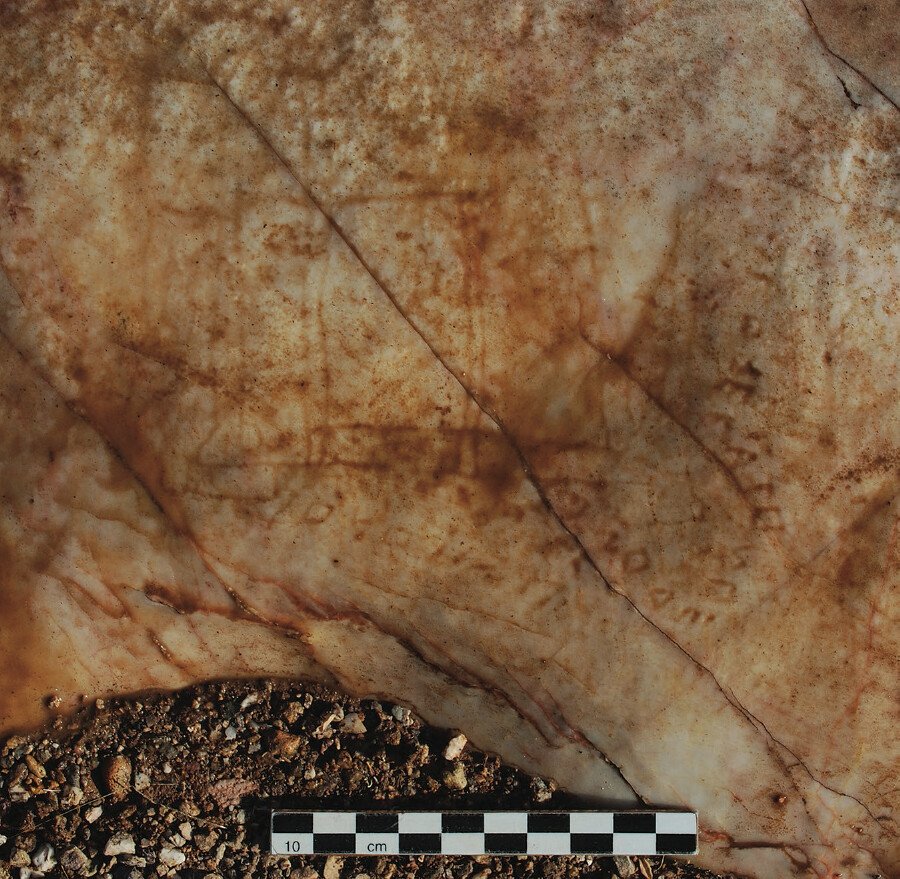 An image of Mikon’s graffiti showing a possible ancient temple.
(Image: MERLE K. LANGDON & JAN Z. VAN ROOKHUIJZEN, AMERICAN JOURNAL OF ARCHAEOLOGY 2024)
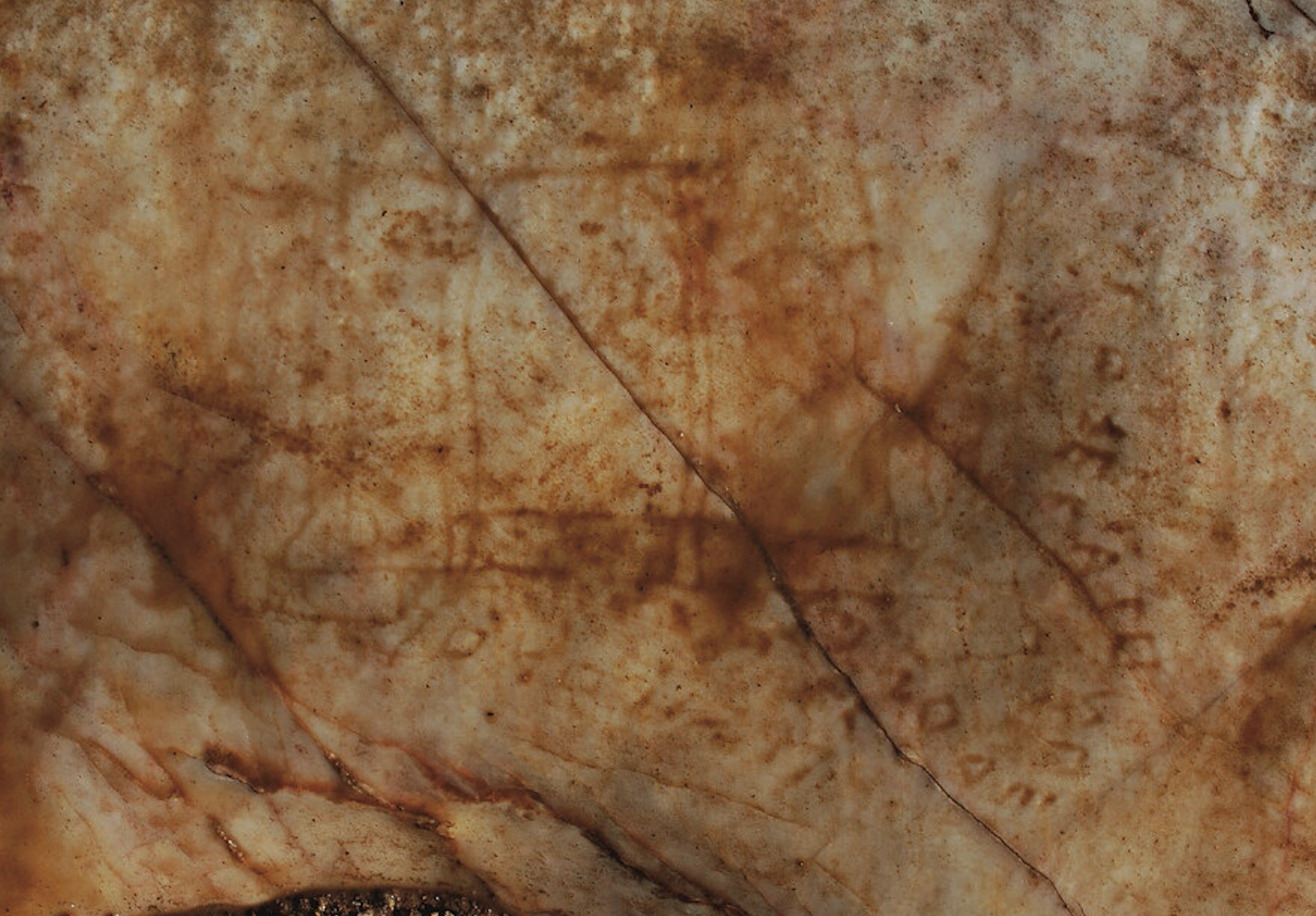
Photograph of the graffiti
(American Journal of Archaeology/Langdon et al)

Close-up view of the words τὸ hεκατόµπεδον.
Credit: Langdon et al., American Journal of Archaeology (2024)
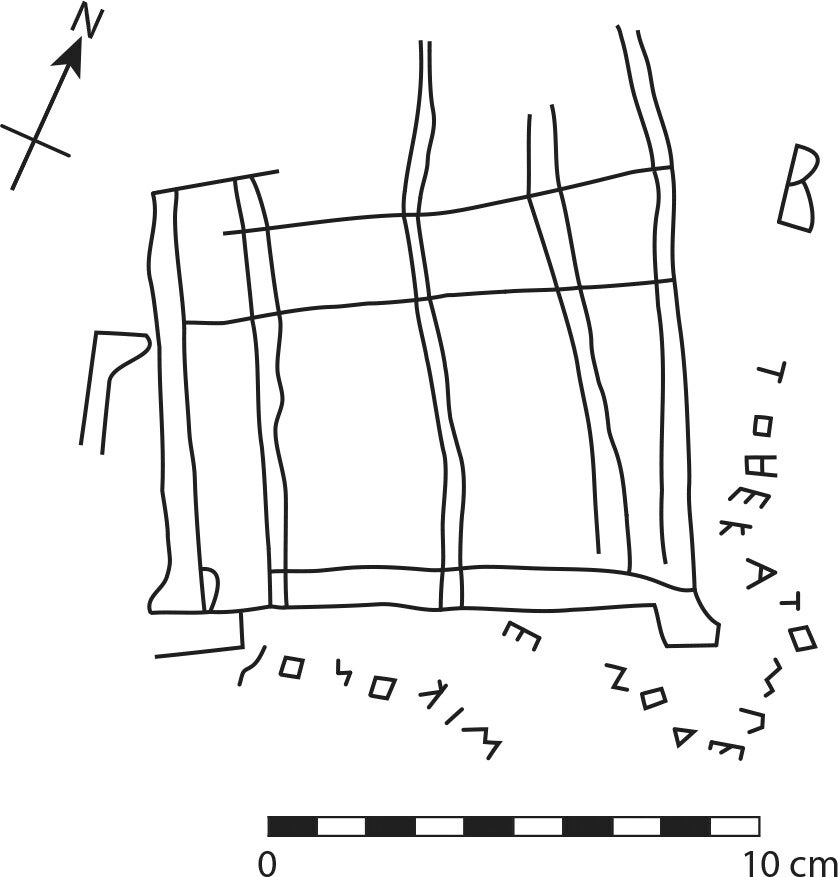
Sketch of the graffiti, indicating reasonably secure lines and letters
(American Journal of Archaeology/Langdon et al)
The graffito (a term sometimes used to describe a singular piece of graffiti) was found among over 2,000 ancient engravings on marble outcrops in the hills north and east of Vari. These engravings, typically created by local herders, include simple drawings of animals, ships, and buildings, as well as short inscriptions. The particular graffito in question looks like a building facade, showing at least five
The term “Hekatompedon” refers to a structure approximately 100 feet in length. In ancient Greek architecture, this term was often used to describe large temples. But, it also means something else.
“The term is known to be the official ancient name of the famous temple dedicated to the Greek goddess Athena – later known as the Parthenon,” van Rookhuijzen explained. “It is likely that Mikon wanted to depict a building on the Acropolis of Athens.”
However, the inscriber, Mikon, pre-dated the Parthenon by several decades.
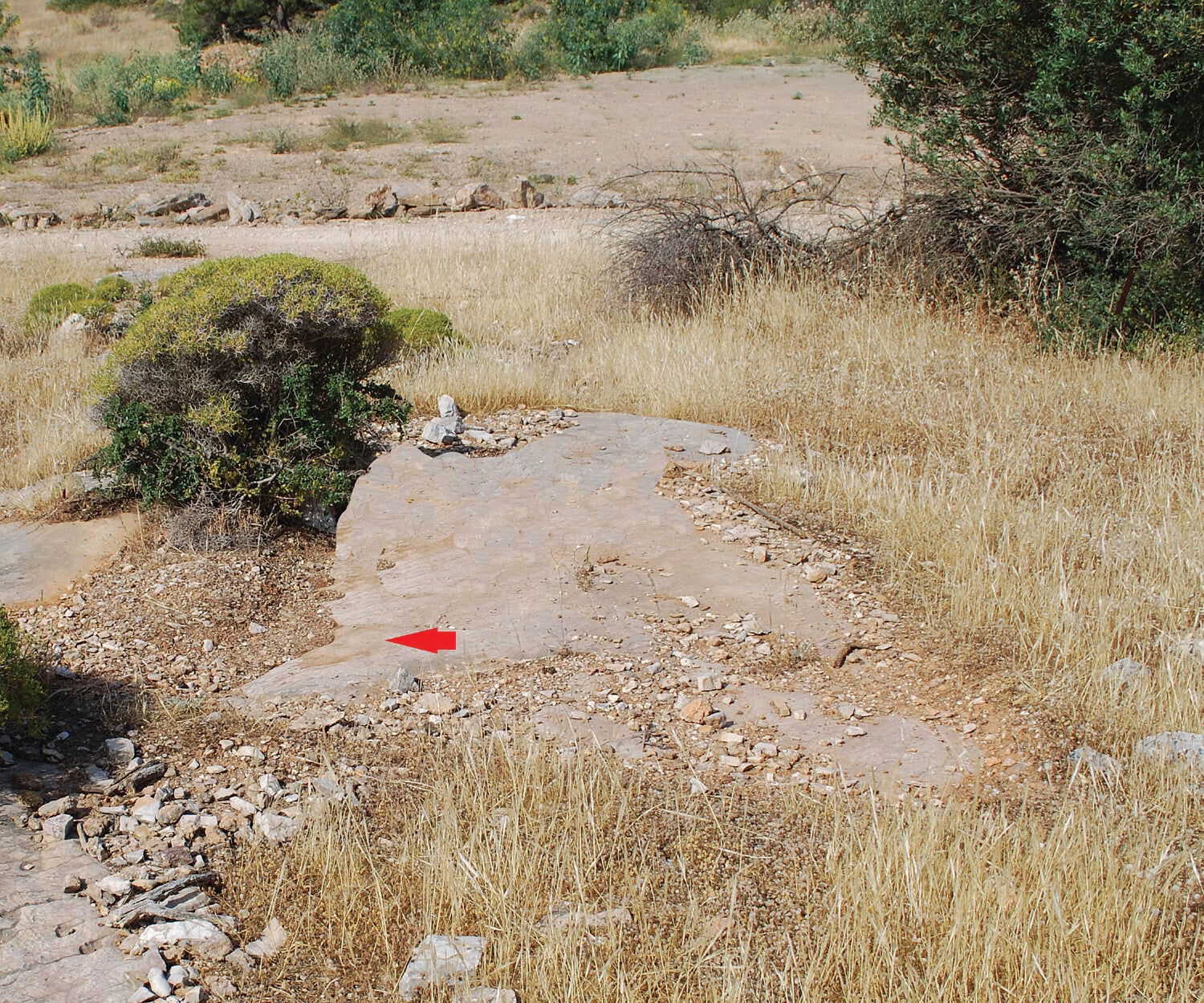
Patch of bedrock where the graffito is located (arrow); the earthen road is visible in the background
(American Journal of Archaeology/Langdon et al)
“Because the alphabet he used can be firmly dated to the 6th century BCE, the drawing must be at least 50 years older than the Parthenon, which was begun around 450 BCE,” van Rookhuijzen wrote.
According to the researchers, they believe that the graffito likely depicts an archaic temple on the Acropolis of Athens, possibly the so-called Bluebeard Temple or the Gigantomachy Temple. These temples are thought to have stood on the Acropolis at the end of the sixth century BCE, but were destroyed by the Persians in 480 BCE.
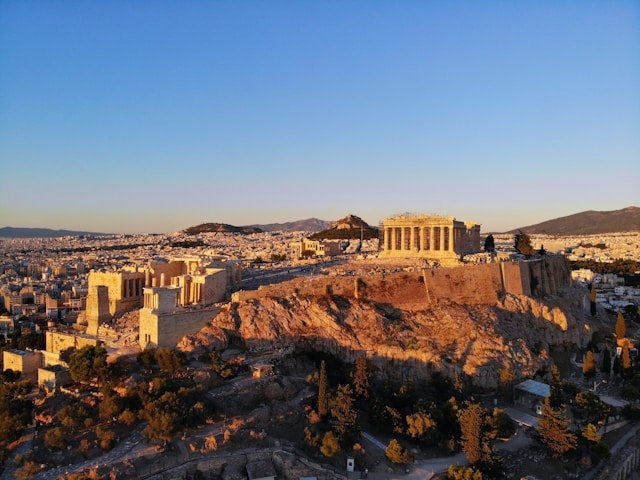
The Acropolis of Athens.
(Image: Unsplash)
Utilizing high-resolution photographs and detailed sketches, the work of this long-dead shepherd was analyzed for the various letter forms, orthography, and layout to determine its authenticity. The team compared this drawing and writing style to other known examples, as well as other known architectural drawings and inscriptions from the area.

Based on their research, they note this is the earliest written record of the term “Hekatompedon” being used to describe a large temple or building. Moreover, noting the style of the graffito, as it features lines for columns and a cross line that represents an entablature (the horizontal lintel that sits on top of the columns), the study argues that this was probably some kind of symbolic gesture of admiration for the temple.
In simple terms, Mikon probably just dug big buildings, and shepherds and herders were notorious for their graffiti. The hill where this drawing was discovered is covered in ancient shepherd graffiti, including images of horses, boats, and, of course, ancient erotica.
“Why the shepherds produced so many graffiti is not known – it may have simply been a form of escapism during the dull moments of their job,” van Rookhuijzen mused.
“However, the graffito made by Mikon shows how a small scribble may be the key to tackling the historical riddles behind one the world’s most iconic archaeological sites.”
Footage Of UFO Landing At Holloman AFB With Aliens Walking Out Exists, Producer Told James Fox
There is a UFO/alien controversy surrounding Holloman Air Force Base in New Mexico, where one of three UFOs allegedly landed in May 1971. The incident has been recently discussed by “Moment of Contact” filmmaker James Fox, who says the full video of the UFO landing exists, including the alien entities walking out of the craft.
However, as it is so often in such cases, instead of the government releasing a film of the entire incident to author/filmmaker Robert Emenegger as promised, it only released 8 seconds of this special footage that ultimately made it into the film. Holloman Air Force Base is the United States Air Force base established in 1942 and located six miles southwest of the central business district of Alamogordo, New Mexico.
The story begins in 1971 when Emenegger and producer/director Allan Sandler were invited by US intelligence to Norton Air Force Base in California to discuss the significant UFO phenomenon that had occurred previously and create a documentary film about it.
Apparently, Mr. Fox recalls the Holloman incident on Julian Dorey Podcast, published on February 25, 2023. He says that he interviewed Sandler and Emenegger about it and they as well believe the UFO landing film footage exists. He points out this happened not far from Socorro, where Lonnie Zamora had his famous sighting roughly a year prior of a similarly shaped “tic tac” white craft and beings walking around the UFO.
There is no official record of the reason why the US government allowed giving secret UFO footage for a documentary film. It is believed that the administration of President Nixon did it to look strong in the science field for the upcoming 1972 re-election campaign.
Emenegger said that he was promised by the USAF officials to get the authentic UFO landing footage that happened at Holloman Air Force Base in New Mexico in 1971. It showed the alien visitors emerging out of the craft that met with the US military. Even though Emenegger was skeptical about it, the Air Force assured him that the footage was authentic.
One of the military’s officials named Paul Shartle, who was in charge of the audio-video department, said in a 1988 national television broadcast with Mike Farrell that he had watched the 16mm film of three disc-shaped craft. One of them landed and the others flew away.
“I saw footage of three disc-shaped crafts one of the crafts landed and two of them went away. It appeared to be in trouble because it oscillated all the way down to the ground. However, it did land on three pods, a sliding door open a ramp was extended, and out came three aliens. They were human-sized. They had an odd gray complexion and a pronounced nose. They wore tight-fitting jumpsuits, thin headdresses that appeared to be communication devices, and their hands in their hands they held a translator I was told.”

Mr. Fox revealed on the podcast that Allan Sandler told him on the phone call that he had seen three discs escorted by a military jet. “He was not sure of the altitude, but he estimated that they were at roughly 10 to 12,000 feet,” Mr. Fox said. He continued: “Paul Shartle (One of the military’s officials at Norton Air Force Base in California who was in charge of the audio-video department) admitted that he had seen it and that it was not of Earth origin.”
Sandler told Mr. Fox that two of the discs peeled away while one wobbled to the ground. He said it was like a leaf floating down from the sky, and it looked like it was in trouble. Mr. Fox said that the wobbling movement was similar to the footage he had seen of a UFO before. He does not think that Allan knew how the UFO hovered. The disc eventually went to the ground.
“He said James, just like in a sci-fi movie, the seamless door opens and out come these beings that had very large noses, slits for mouths, and their eyes were almost like a vertical slit, like a cat’s eye, very, very big. They had… I’m just like… I [Fox] need to make this abundantly clear to your audience. I’m not saying what’s true or what’s not true, or if it happened or if it’s alien or whatever it is. I’m just telling you what I was told by people who saw it, and claimed to have seen it. They came out and they met with the base commanders, and then they either got into a Jeep or were about to get into a Jeep or do something and then the film footage just cuts.”
Emenegger claimed that he personally visited the landing site and inspected the area where the extraterrestrial craft had been stored, and that the US military and the alien visitors had held meetings that lasted for several days.
Additionally, Emenegger’s production team was granted access to highly classified documents at DoD facilities, and they received assistance from military officials who had expertise in UFO-related matters, such as Col. William Coleman of Project Blue Book and Col. George Weinbrenner, who headed Foreign Technology at Wright Patterson Air Force Base.
Paul Shartle, who showed the footage to Allan Sandler, faced some men in dark suits that showed up from an unknown location and warned him not to speak of the incident. They confiscated the footage, stating that it was not supposed to have happened. Sandler did not inform Emenegger for over 40 years.
Emenegger completed extensive research and film production only to feel cheated when the authorization to use real footage was withdrawn. Despite this setback, he went ahead and released his documentary “UFOs: Past, Present, and Future,” which was nominated for a Golden Globe in 1974. The documentary was groundbreaking because it provided information from the Department of Defense (DoD).
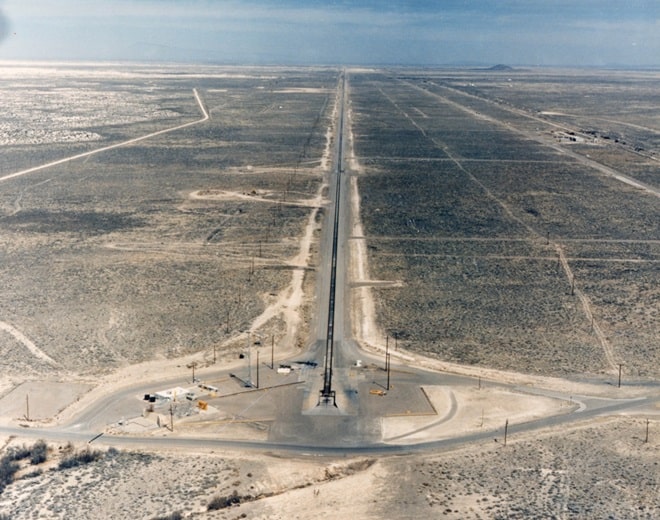 High Speed Test Track at Holloman Air Force Base
The United States Air Force (USAF) required Emenegger to add animated footage of the alleged Holloman UFO landing. According to Emenegger, some frames from the original footage were used during the editing stage with USAF authorization, which was not entirely missing from the frames. The viewers spotted a genuine bright disc coming down slowly in the distance against the backdrop of Holloman’s surrounding landscape.
David Cameron, a UFO researcher, shared in an interview that he was involved in confirming that the Pentagon was not covering up UFO sightings. He recounted the story of the Holloman Air Force Base film, where the government allowed producers to use eight seconds of footage of a landed alien ship in a documentary, but the classified part where an alien got out was removed.
Mr. Fox explains that the point of the story is that there is compelling evidence of an event occurring involving an unidentified object and that there may be film footage of the incident. Despite the existence of this evidence, the story has been overshadowed by other sensational claims, such as secret meetings between President Eisenhower and aliens.
While it is unclear what exactly happened, there is substance to the story and it should not be dismissed outright. However, the addition of other claims has muddied the waters and made it difficult to investigate the case of the president making contact with extraterrestrial life.
ASTRONOMERS SAY THEY JUST WITNESSED A MASSIVE BLACK HOLE APPEAR OUT OF NOWHERE
Astronomers using the Zwicky Transient Facility (ZTF) telescope in the US say they have witnessed a massive black hole appear out of nowhere.
The incident occurred back in December 2019, when astronomers who were observing a distant galaxy they termed “unremarkable” suddenly began to increase in brightness rapidly.
“Imagine you’ve been observing a distant galaxy for years, and it always seemed calm and inactive,” explained Paula Sánchez Sáez, an astronomer at ESO in Germany and lead author of the study accepted for publication in Astronomy & Astrophysics. “Suddenly, its [core] starts showing dramatic changes in brightness, unlike any typical events we’ve seen before.”
Follow-up analysis by a host of the most advanced space observatories confirmed the incredible event while pointing to a likely culprit: a massive black hole lying at the heart of galaxy SDSS1335+0728, which is located 300 million light-years away in the constellation Virgo, had seemingly awakened from a long slumber and was devouring the gas in its immediate surrounding. This activity resulted in the massive and growing glow witnessed by astronomers.
Of course, people in this field regularly observe unexpected changes in the cosmos. However, events like supernova explosions or other tidal disruption events which generate large amounts of light typically last for a very short time, ranging from a few days to a few hundred days, before their brightness runs out. In this case, the researchers behind the discovery say they knew something was different when the increase in brightness first spotted in 2019 not only persisted but began to increase over time.
Since then, they have spent half a decade pouring through archived data collected by other space observatories, including the European Southern Observatory’s Very Large Telescope (ESO’s VLT), to search for an explanation. That analysis found that SDSS1335+0728 was emitting more light in the visible spectrum and ultraviolet, optical, and infrared wavelengths. Then, in February 2024, the galaxy started emitting X-rays. According to Sánchez Sáez, who is also affiliated with the Millennium Institute of Astrophysics (MAS) in Chile, such behaviour is “unprecedented.”
The team followed up on their findings by studying archival data from NASA’s Wide-field Infrared Survey Explorer (WISE) and Galaxy Evolution Explorer (GALEX), the Two Micron All Sky Survey (2MASS), the Sloan Digital Sky Survey (SDSS), and the eROSITA instrument on IKI and DLR’s Spektr-RG space observatory. That work, along with supporting data collected by the Southern Astrophysical Research Telescope (SOAR), the W. M. Keck Observatory, NASA’s Neil Gehrels Swift Observatory and the Chandra X-ray Observatory, confirmed the original findings: astronomers had indeed witnessed a black hole appear out of nowhere.
“The most tangible option to explain this phenomenon is that we are seeing how the [core] of the galaxy is beginning to show (…) activity,” says co-author Lorena Hernández García from MAS and the University of Valparaíso in Chile. “If so, this would be the first time that we see the activation of a massive black hole in real-time.”

This artist’s impression shows two stages in the formation of a disc of gas and dust around the massive black hole at the centre of the galaxy SDSS1335+0728. The core of this galaxy lit up in 2019 and keeps brightening today — the first time we observed a massive black hole become active in real-time.
Image Credit: ESO/M. Kornmesser
“These giant monsters usually are sleeping and not directly visible,” added study co-author Claudio Ricci, from the Diego Portales University, also in Chile. “In the case of SDSS1335+0728, we were able to observe the awakening of the massive black hole, [which] suddenly started to feast on gas available in its surroundings, becoming very bright.”
Hernández García says this process was so rare that it had “never been observed before.” Some previous studies had reported galaxies that were thought to be inactive suddenly becoming active, but this was the first time astronomers had seen it unfolding in real-time.
While the team of astronomers admits they don’t exactly know what makes a black hole appear out of nowhere, they believe it is unlikely to be a one-time event. They even believe it could happen much closer to home, at the center of our own Milky Way galaxy.

“This is something that could happen also to our own Sgr A*, the massive black hole (…) located at the centre of our galaxy,” said Ricci.
Moving forward, the team says that additional observations and data analysis should shed even more light on their discovery. They also believe that collecting more data on SDSS1335+0728, which the Chilean-led Automatic Learning for the Rapid Classification of Events (ALeRCE) broker has classified as having an ‘active galactic nucleus’ (AGN), could benefit other researchers trying to understand the life cycle of black holes.
“Regardless of the nature of the variations, [this galaxy] provides valuable information on how black holes grow and evolve,” Sánchez Sáez said. “We expect that instruments like [MUSE on the VLT or those on the upcoming Extremely Large Telescope (ELT)] will be key in understanding [why the galaxy is brightening].”
