Naar de inhoud

UFO'S of UAP'S, ASTRONOMIE, RUIMTEVAART, ARCHEOLOGIE, OUDHEIDKUNDE, SF-SNUFJES EN ANDERE ESOTERISCHE WETENSCHAPPEN - DE ALLERLAATSTE NIEUWTJES

UFO's of UAP'S in België en de rest van de wereld
akke.beakke.be
Ontdek de Fascinerende Wereld van UFO's en UAP's: Jouw Bron voor Onthullende Informatie! Ben jij ook gefascineerd door het onbekende? Wil je meer weten over UFO's en UAP's, niet alleen in België, maar over de hele wereld? Dan ben je op de juiste plek! België: Het Kloppend Hart van UFO-onderzoek In België is BUFON (Belgisch UFO-Netwerk) dé autoriteit op het gebied van UFO-onderzoek. Voor betrouwbare en objectieve informatie over deze intrigerende fenomenen, bezoek je zeker onze Facebook-pagina en deze blog. Maar dat is nog niet alles! Ontdek ook het Belgisch UFO-meldpunt en Caelestia, twee organisaties die diepgaand onderzoek verrichten, al zijn ze soms kritisch of sceptisch. Nederland: Een Schat aan Informatie Voor onze Nederlandse buren is er de schitterende website www.ufowijzer.nl, beheerd door Paul Harmans. Deze site biedt een schat aan informatie en artikelen die je niet wilt missen! Internationaal: MUFON - De Wereldwijde Autoriteit Neem ook een kijkje bij MUFON (Mutual UFO Network Inc.), een gerenommeerde Amerikaanse UFO-vereniging met afdelingen in de VS en wereldwijd. MUFON is toegewijd aan de wetenschappelijke en analytische studie van het UFO-fenomeen, en hun maandelijkse tijdschrift, The MUFON UFO-Journal, is een must-read voor elke UFO-enthousiasteling. Bezoek hun website op www.mufon.com voor meer informatie. Samenwerking en Toekomstvisie Sinds 1 februari 2020 is Pieter niet alleen ex-president van BUFON, maar ook de voormalige nationale directeur van MUFON in Vlaanderen en Nederland. Dit creëert een sterke samenwerking met de Franse MUFON Reseau MUFON/EUROP, wat ons in staat stelt om nog meer waardevolle inzichten te delen. Let op: Nepprofielen en Nieuwe Groeperingen Pas op voor een nieuwe groepering die zich ook BUFON noemt, maar geen enkele connectie heeft met onze gevestigde organisatie. Hoewel zij de naam geregistreerd hebben, kunnen ze het rijke verleden en de expertise van onze groep niet evenaren. We wensen hen veel succes, maar we blijven de autoriteit in UFO-onderzoek! Blijf Op De Hoogte! Wil jij de laatste nieuwtjes over UFO's, ruimtevaart, archeologie, en meer? Volg ons dan en duik samen met ons in de fascinerende wereld van het onbekende! Sluit je aan bij de gemeenschap van nieuwsgierige geesten die net als jij verlangen naar antwoorden en avonturen in de sterren! Heb je vragen of wil je meer weten? Aarzel dan niet om contact met ons op te nemen! Samen ontrafelen we het mysterie van de lucht en daarbuiten.

Archief

Webb Sees Asteroids Collide in Another Star System

Asteroid collision: CREDIT:NASA/LYNETTE COOK

Webb Sees Asteroids Collide in Another Star System

The James Webb Space Telescope (JWST) continues to make amazing discoveries. This time in the constellation of Pictor where, in the Beta Pictoris system a massive collision of asteroids. The system is young and only just beginning its evolutionary journey with planets only now starting to form. Just recently, observations from JWST have shown significant energy changes emitted by dust grains in the system compared to observations made 20 years ago. Dust production was thought to be ongoing but the results showed the data captured 20 years ago may have been a one-off event that has since faded suggesting perhaps, an asteroid strike!

Beta Pictoris is a young star located 63 light years away in the constellation Pictor. It has become well known for its fabulous circumstellar disk of gas and dust out of which a new system of planets is forming. It has been the subject of many a study because not only does it provide an ideal opportunity to study planetary formation but one of those planets Beta Pictoris b has already been detected. 

Beta Pictoris is located about 60 light-years away towards the constellation of Pictor (the Painter’s Easel) and is one of the best-known examples of a star surrounded by a dusty debris disc. Earlier observations showed a warp of the disc, a secondary inclined disc and comets falling onto the star, all indirect, but tell-tale signs that strongly suggested the presence of a massive planet. Observations done with the NACO instrument on ESO’s Very Large Telescope in 2003, 2008 and 2009, have proven the presence of a planet around Beta Pictoris. It is located at a distance between 8 and 15 times the Earth-Sun separation — or Astronomical Units — which is about the distance Saturn is from the Sun. The planet has a mass of about nine Jupiter masses and the right mass and location to explain the observed warp in the inner parts of the disc. This image, based on data from the Digitized Sky Survey 2, shows a region of approximately 1.7 x 2.3 degrees around Beta Pictoris. Credit: ESO/Sky Survey II

Wind the clock back 20 years and the Spitzer infra-red observatory was observing Beta Pictoris. It was looking for heat being emitted by crystalline silicate minerals which are often found around young stars and on celestial bodies. Back in 2004-2005 no traces were seen suggesting a collision occurred among asteroids destroying them and turning their bodies into find dust particles, smaller even than grains of sand and even powdered sugar. 

Radiation was detected at the 17 and 24 micron wavelengths by Spitzer, the result of significant amounts of dust. Using JWST, the team studied radiation from dust particles around Beta Pictoris and were able to compare with these Spitzer findings. They were able to identify the composition and size of particles in the same area around Beta Pictoris  that was studied by Spitzer. They found a significant reduction in radiation at the same wavelengths from 20 years ago. 

The Spitzer Space Telescope observatory trails behind Earth as it orbits the Sun. Credit: NASA/JPL-Caltech

According to Christine Chen, lead astronomer from the John Hopkins University ‘With Webb’s new data, the explanation we have is that, in fact, we witnessed the aftermath of an infrequent, cataclysmic event between large asteroid-sized bodies, marking a complete change in our understanding of this star system.’

By tracking the distribution of particles across the circumstellar disk, the team found that the dust seems to have been dispersed outward by radiation from the hot young star. Previously with observations from Spitzer, dust surrounded the star which was heated up by its thermal radiation making it a strong thermal emitter. This is no longer the case as that dust has moved, cooled and no longer emits those thermal features. 

The discovery has adjusted our view of planetary system formation. Previous theories suggested that small bodies would accumulate and replenish the dust steadily over time. Instead, JWST has shown that the dust is not always replenished with time but that it takes a cataclysmic asteroid impact to seed new planetary systems with new dust. The team estimate the asteroid that was pulverised was about 100,000 times the size of the asteroid that killed the dinosaurs!

Source : 

{ https://www.universetoday.com/ }

Hoe vind je dit bericht?
Geschreven door peter om 01:33 Stuur door

EINSTEIN TELESCOPE TO USHER NEW ERA IN ASTROPHYSICS WITH OBSERVATIONS OF GRAVITATIONAL WAVES

Tf1FUWQb?format=jpg&name=900x900

(Credit: NIKHEF)

EINSTEIN TELESCOPE TO USHER NEW ERA IN ASTROPHYSICS WITH OBSERVATIONS OF GRAVITATIONAL WAVES

A state-of-the-art new gravitational wave detector could mark the beginning of a new era in astrophysics with the development of the Einstein Telescope.

The telescope, currently still in the planning stages, will employ advanced laser technology to measure gravitational waves and help scientists peer even more deeply at phenomena associated with some of the universe’s greatest secrets. Construction could begin in Europe, and the project could revolutionize our understanding of cosmic events, including the collisions of neutron stars and black holes.

The Einstein Telescope will build on the 2015 discovery of gravitational waves and observations in 2017 produced by the collision of two neutron stars. This unprecedented achievement marked the first time such events were detected both optically and as a spacetime-rippling gravitational wave.

The remnants of burnt-out stars, neutron stars, are relatively small but extremely dense objects that weigh slightly more than the Sun. When these celestial objects collide, they are so powerful that atomic nuclei are ripped apart, resulting in the ejection of large amounts of mass that produce heavy atoms like gold.

Professor Achim Stahl, an astrophysicist from RWTH Aachen University, says that when compared to the mass of the neutron stars themselves, very little gold is created by comparison, comparable in mass to the size of Earth’s moon. Yet most of the gold in the universe was likely produced by such explosions.

In other words, the gold rings, necklaces, and other jewelry we wear probably have origins that would have allowed them to witness events in galactic history.

GRAVITATIONAL WAVE DETECTION

The recent dawn of gravitational wave detection has opened a new chapter in astrophysics. Created when extremely massive objects orbit each other and eventually collide, the resulting “ripples” in spacetime provide us with a once unimaginable way to perceive distant cosmic events.

The initial gravitational wave detected in 2015 was very short, lasting slightly more than 0.2 seconds. However, subsequent detections like the one logged in 2017 lasted 100 seconds, revealing the collision of two neutron stars and the first simultaneous observation of both gravitational waves and electromagnetic signals.

Such advancements are significant since most of the history of astronomy has relied on observations that were limited only to the visible spectrum. However, predictions first made by Einstein more than a century ago revealed the theoretical existence of gravity waves, which only became detectable and able to be measured with the help of laser interferometry, a process that allows movements smaller than the diameter of an atom to be registered.

THE EINSTEIN TELESCOPE

The new Einstein Telescope, representing the third generation of gravitational wave detectors, will be ten times as sensitive as any current detector.

“We want to examine an area that is a thousand times larger than what is possible today for gravitational waves,” Professor Stahl said in a statement. “This also applies to heavier objects that emit gravitational waves at lower frequencies.”

Comprised of a trio of nested detectors, each possessing 10-kilometer arms and built 250 meters belowground to provide shielding from electromagnetic interference, the observatory will represent the pinnacle of multi-messenger astronomy, a nascent approach in astronomy that collects and interprets information from a variety of different signals produced by different astrophysical processes, which include gravitational waves and electromagnetic radiation, as well as particles like neutrinos, and cosmic rays.

Measurements obtained by the Einstein Telescope will rely on international cooperation due to their complexity and will form a network in conjunction with the U.S. Cosmic Explorer, with the project included in the European Strategy Forum on Research Infrastructures (ESFRI) Roadmap in 2021. Currently, construction of the new telescope could begin as early as 2026, and observations may begin as soon as 2035.

New laser technologies are also being developed for the new telescope, which is being produced by a team that includes engineers from RWTH Aachen University and the Fraunhofer Institute for Laser Technology ILT. Such technologies could be beneficial beyond the detection of gravity waves, potentially extending to areas that include quantum and medical technologies.

“With gravitational waves, we can look much further into the universe than with normal telescopes,” Professor Stahl said in a recent statement. Once it enters operation sometime in the next decade, the Einstein Telescope will mark a new horizon in observations of distant galaxies and their formation, as well as glimpses at some of the first stars in the universe as it peers deeper into universal history than optical telescopes can allow.

“In astrophysics, looking further into the universe means – above all – looking back in time,” Stahl said. “With the Einstein Telescope, we will receive signals from the time when the galaxies and the first stars were formed. This goes back further than is possible with optical means.

“And we will hear cosmic explosions live with the gravitational waves before we see them,” Stahl added.

Picture of staff and #telescope - Albert Einstein Yerkes Observatory ...

Along with expanding our perspective of the universe and its formation, the telescope will also help scientists perform systematic measurements of cosmic events and yield other exciting developments for the future of astrophysics.

{ https://thedebrief.org/category/space/ }

Hoe vind je dit bericht?
Geschreven door peter om 01:23 Stuur door

Something 'kicked' this hypervelocity star racing through the Milky Way at 1.3 million miles per hour (video)

Something 'kicked' this hypervelocity star racing through the Milky Way at 1.3 million miles per hour (video)

A simulation of a possible explanation for an L subdwarf named CWISE J124909+362116.0’s speed shows it as a part of a white dwarf binary pair that ended with the white dwarf exploding into a supernova.
Credit: Adam Makarenko / W.M. Keck Observatory
If youwere attacked by a ravenous vampire star or were at risk of falling into two dueling black holes, you'd probably run, too! 

One of these terrifying scenarios is likely responsible for sending a low-mass star on the run through the Milky Way at a staggering million miles per hour (1.6 million kilometers per hour). That's about 1,500 times faster than the speed of sound.

The star is designated CWISE J124909+362116.0 (J1249+36) and was first detected by citizen science volunteers with the Backyard Worlds: Planet 9 project, who are exploring the vast amount of data collected by NASA's Wide-field Infrared Survey Explorer (WISE) mission over the course of almost a decade and a half. J1249+36 immediately stood out because of its immense velocity of specifically 1.3 million mph (2.1 million kph), which is almost three times as fast as the speed of the sun in its orbit around the heart of the Milky Way. The speed of this "hypervelocity" star is so great, in fact, that it is likely to escape our galaxy altogether.

Related: 

To crack the secrets of this hypervelocity star, University of California, San Diego Professor of Astronomy and Astrophysics Adam Burgasser turned to the W.M. Keck Observatory in Maunakea, Hawaii, aiming to observe its infrared spectrum. 

This investigation revealed that the star belongs to a class of the oldest stars in the Milky Way: L subdwarfs. These stars are very rare and remarkable because of their highly low masses and relatively cool temperatures. 

The team's spectral data was combined with a new set of atmospheric models created specifically to study L subdwarfs. This revealed J1249+36's position and velocity through the Milky Way. "This is where the source became very interesting," Burgasser said in a statement. "Its speed and trajectory showed that it was moving fast enough to potentially escape the Milky Way."

The question is, what launched this subdwarf star on its rapid escape trajectory? Well, that brings us to our two suspects.

Is this star running from a white dwarf vampire? 

In the first scenario used to explain the hypervelocity nature of J1249+36, Burgasser and colleagues hypothesized that the low-mass star was once the stellar companion of a type of a "dead" star called a white dwarf.

White dwarfs are born when smaller stars like the sun exhaust the hydrogen supply in their cores. When that happens, a star's nuclear fusion ceases. This cuts off the outward flow of energy that supports the star against the inward pressure of its own gravity. While this ends the lives of lonely, isolated stars like the sun, however, white dwarfs in binary systems can return from the grave by cannibalistically feeding on stellar material stripped from a nearby "donor" star.

This material piles up on the white dwarf until that stellar remnant's mass exceeds the Chandrasekhar limit of around 1.4 times the mass of the sun, above which a star can go supernova. This results in a type of cosmic explosion called a "Type Ia supernova" that completely obliterates the white dwarf.

An illustration shows a white dwarf beginning to erupt as it feeds on a companion star  (Image credit: Robert Lea (created with Canva))

"In this kind of supernova, the white dwarf is completely destroyed, so its companion is released and flies off at whatever orbital speed it was originally moving, plus a little bit of a kick from the supernova explosion as well," Burgasser explained. "Our calculations show this scenario works. However, the white dwarf isn’t there anymore, and the remnants of the explosion, which likely happened several million years ago, have already dissipated, so we don’t have definitive proof that this is its origin."

Could twin black holes have something to do with it?

The second scenario considered by the team sees this hypervelocity star begin life in a globular cluster, a dense and compact conglomeration of stars bound together by gravity. These spherical clusters can contain anywhere from tens of thousands to many millions of stars.

The stars are concentrated toward the center of globular clusters, where scientists theorize that black holes of varying masses also lurk. These black holes can come together and form binaries that are adept at launching any stars that venture too close to them out of their home systems.

"When a star encounters a black hole binary, the complex dynamics of this three-body interaction can toss that star right out of the globular cluster," Kyle Kremer, an incoming Assistant Professor in UC San Diego's Department of Astronomy and Astrophysics, said. 

A globular cluster of tightly packed stars which may have a binary pair of black holes at its heart  (Image credit: NASA, ESA, ESA/Hubble, Roger Cohen (RU))

Simulations generated by Kremer revealed that, on rare occasions, these kinds of interactions can kick a low-mass subdwarf out of a globular cluster and put them on trajectories similar to what's observed with J1249+36.

The team also traced the trajectory of this hypervelocity star back to an extremely crowded region of space, which could indeed be the location of a currently undiscovered globular cluster — or, perhaps. more than one.

The team will now look at the elemental composition of J1249+36 in an attempt to determine which of these ejection scenarios is the correct one. Composition could be a possible indication of origin because when white dwarfs "go nova," they pollute the stars they kick away. In addition to this, stars born in globular clusters have distinct chemical compositions. 

Whatever the origins of this star are, its discovery offers scientists the unique opportunity to investigate hypervelocity stars as a whole. And it's all very cool.

Burgasser presented the team's results at a press conference on Monday (June 10) during the 244th national meeting of the American Astronomical Society (AAS) in Madison, Wisconsin.

{ https://www.space.com/ }

Hoe vind je dit bericht?
Geschreven door peter om 00:00 Stuur door

Boeing’s Starliner Will Attempt A First-Of-Its-Kind Landing For A U.S. Capsule

Boeing’s Starliner Will Attempt A First-Of-Its-Kind Landing For A U.S. Capsule

Watch out for Starliner’s unique landing as early as next week.

BY DORIS ELÍN URRUTIA 
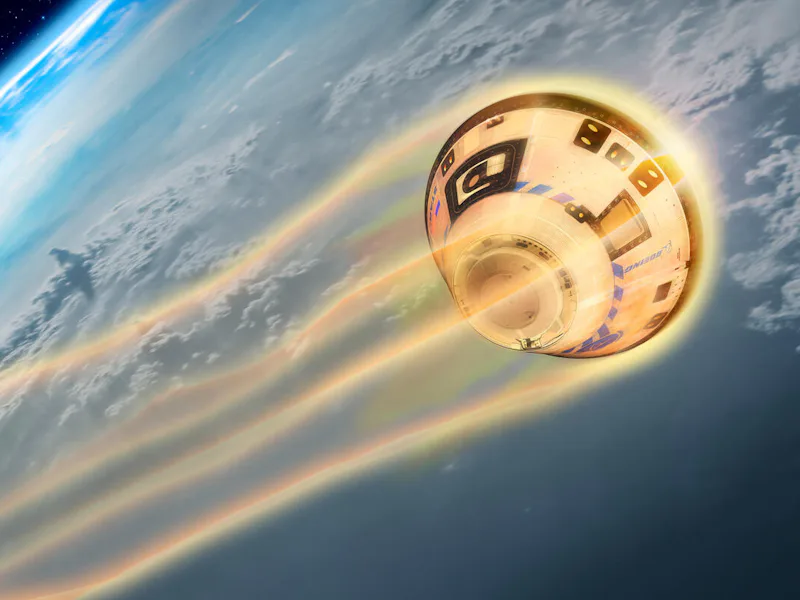
A spacecraft reentering Earth's atmosphere, emitting colorful contrails as it descends against a bac...
Boeing

Two astronauts will break from American spaceflight tradition next week, when their capsule drops down onto land, instead of splashing at sea.

As early as next Tuesday, the Boeing Starliner will undock from the International Space Station (ISS) with two astronauts inside. Instead of landing in the ocean, as their fellow NASA Commercial Crew Program partner, SpaceX, has been successfully doing with its Crew Dragon at least twice each year since 2020, Starliner will become the first and only American orbital crew capsule to touch down on land.

Capsules of the Mercury, Gemini, and Apollo programs landed in the ocean. The Space Shuttles touched down on land, but they coasted onto a runway, a much different approach.

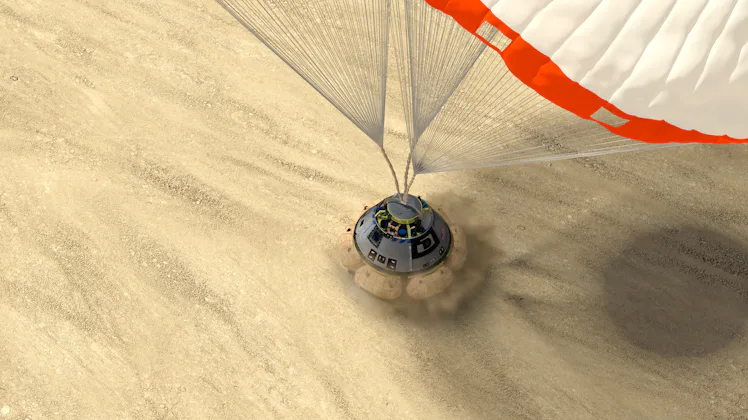
A gumdrop-shaped capsule deploys airbags to cushion its touchdown on a sandy open area. The capsule ...

An illustration of the Boeing Starliner landing on land. 

BOEING

Fortunately, most modern astronauts have experience with soft landing in capsules on land. When the Space Shuttle retired in 2011, and up until Crew Dragon’s Demo-2 mission in 2020 restarted the launch of astronauts from American soil, the U.S. would pay for seats onboard Russian Soyuz capsules to get their astronauts to and from space. Soyuz would and still does touch down on land, over open terrain in Kazakhstan.

Soon it will be Starliner’s turn to utilize this approach. It is in the midst of its Crew Flight Test, which got underway when NASA astronauts Suni Williams and Butch Wilmore successfully launched inside a Starliner called Calypso on June 5. The duo are now onboard the ISS, but as early as June 22, they’ll reboard Calypso to come home.

The Boeing Starliner is important because it provides dissimilar redundancy — a backup plan, in essence — for NASA’s Commercial Crew Program. If SpaceX has a problem, or vice versa, the other company offers a different way for astronauts to continue visiting low-Earth orbit.

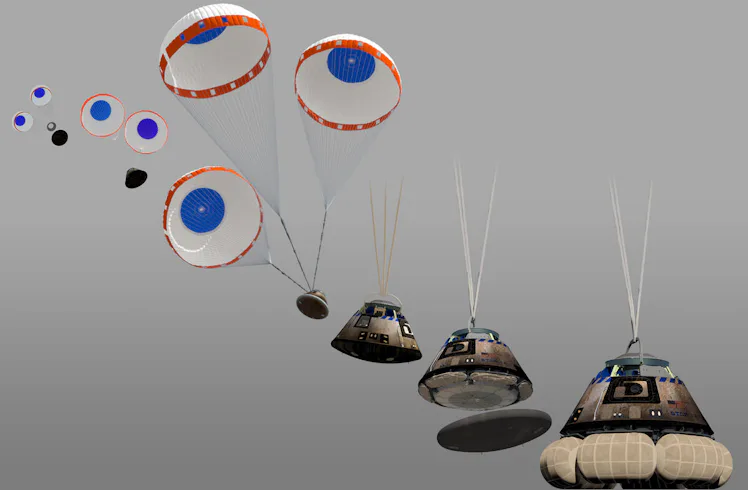
This illustration shows a sequence of six steps by which the Boeing Starliner deploys parachutes and...

An illustration of the parachute and airbag sequence for Starliner’s landing. 

BOEING

One difference is how their astronauts come home. Crew Dragon’s latest return from space for the Crew-7 mission in March delivered four astronauts to the calm waters off the coast of Florida. Teams on boats mobilized to fish the capsule out of the water, and onto a ship, where the hatch was successfully opened roughly 42 minutes after splashdown.

Both Starliner and Crew Dragon begin their descents with parachutes to slow them down.

When Calypso is about 3,000 feet off the ground, the heat shield on its base will jettison. This exposes the Starliner’s airbags. They’ll absorb the initial force of landing at touchdown.

According to NASA astronaut Mike Fincke, who is part of the Starliner Commercial Crew Program, the Starliner can deploy an extra airbag if an emergency water landing must be made.

Boeing will only use this for emergencies, he adds. Salt water is abrasive. This makes refurbishing the capsule tough to do after exposure to the ocean. Landing on land is one way Boeing aims to have the reusable Starliner capsules ready on time with a six-month turnaround.

{ https://www.inverse.com/ }

Hoe vind je dit bericht?
Geschreven door peter om 21:39 Stuur door

'Pregnant' aliens mummies found in Peru set to be tested to ‘prove authenticity’

'Pregnant' aliens mummies found in Peru set to be tested to ‘prove authenticity’

One of the odd looking corpses is said to look pregnant as the mysterious 'mummified' finds could soon finally be tested by experts after being discovered in Peru years ago

One of the two 'non-human' beings displayed to the media is seen during a press conference

Some unusual looking corpses that have been compared to mummified aliens are soon to be tested 

(Image: Anadolu Agency via Getty Images)

A set of infamous Nazca 'alien mummies' are set to undergo tests in attempts to finally get to the bottom of what they really are and where they have come from.

The discovery of the unusual mummified corpses with three fingers and elongated skulls in Peru has long been shrouded in mystery with scientists declaring they could be very real and need further examination.

Now those very corpses, one of which is said to look pregnant, are finally being tested in attempts to to prove their authenticity. It's as a UFO expert claims they are proof of extraterrestrial life and could be hybrids.

READ MORE: 

The corpses have been baffling experts
The corpses have been baffling experts - one of which was said to look pregnant  (Image: Jam Press)

The unusual figures were discovered in Peru's Nazca region but have stumped the world since gaining significant media attention last year and mass speculation about their origins.

Jaime Maussan, journalist and UFO researcher, says there is a possibility they are alien-human hybrids.

He gained significant attention when presenting the mummies. found in Palpa and Nazca in Peru to the Mexican Government in 2023.

Mexican journalist and UFO expert, Jaime Maussan observes the 'non-human' beings before a press conference
Mexican journalist and UFO expert, Jaime Maussan with the 'non-human' beings before a press conference  (Image: Anadolu Agency via Getty Images)
READ MORE

They were purportedly found by local farmers in 2017 and subsequently brought to the attention of researchers but for years they weren't professionally examined.

A team of experts was later put together to change that. The team includes Dr James Caruso, chief medical examiner and coroner of the city and county of Denver, Dr William Rodriguez, a forensic anthropologist and Maryland State medical examiner.

skeletons
The unusual figures were discovered in Peru's Nazca region  (Image: Jam Press)
READ MORE

Elsewhere, Dr John McDowell, a retired professor at the University of Colorado and forensic odontologist, rounds off the team

Maussan now claims there is an ongoing legal battle with Peru to get the "mummies" to more advanced labs in the US for further testing which could prove their authenticity once and for all.

A man named Jois Mantilla too said he believed he'd made a breakthrough with the mummies' DNA.

{ https://www.dailystar.co.uk/news/ }

Hoe vind je dit bericht?
Geschreven door peter om 21:14 Stuur door

Aliens could be hiding among us every day - and we don't even know it

Aliens could be hiding among us every day - and we don't even know it

A study at a top university reckons aliens could be visiting Earth to see alien friends that are already blending in, disguised among us without anyone even knowing

A crowd of people

Research from one of the world's top unis says aliens could be disguised among humans - and we don't even know it 

(Image: Getty Images)

UFOs could be coming to Earth so that aliens can visit their pals already living secretly among us, say researchers at one of the world's best universities.

According to the study, conducted at Harvard University, extraterrestrials could very possibly be living as one with humans already - with us none the wiser. It says this could be underground or on the Moon.

As part of the deep dive, the people behind the research also suggest UFOs might be alien spaceships that are visiting to meet their otherworldly friends living here on Earth - expertly disguised among us.

READ MORE: 

As part of the research paper, they mention the idea that UFOs - also referred to as UAPs - could be spaceships visiting Earth-based "alien friends".

Aliens creature in the forest
Could aliens be living among us? (stock)  (Image: Getty Images/iStockphoto)

The paper also states that the author is aware of the depth of evidence and theory that supports another extraterrestrial explanation. That is the ''crypto terrestrial” hypothesis (CTH), linking UAP activity to the action of hidden non-human entities.

Put together by Harvard University's Human Flourishing Programme, which researches the factors that contribute to human well-being and flourishing, the paper has since been taken down from ResearchGate, where it was published. But it can still be accessed using Internet Archive.

In other extraterrestrial news, a set of infamous Nazca 'alien mummies' are set to undergo tests in attempts to finally get to the bottom of what they really are and where they have come from.

The discovery of the unusual mummified corpses with three fingers and elongated skulls in Peru has long been shrouded in mystery with scientists declaring they could be very real and need further examination.

{ https://www.dailystar.co.uk/news/ }

Hoe vind je dit bericht?
Geschreven door peter om 20:43 Stuur door

No UFOs; Never Has Been, Never Will Be

No UFOs; Never Has Been, Never Will Be

Do you have a burning desire to spend all your money to travel to distant jungles to strike up convos with screeching monkeys in trees?

US Navy confirms UFO footage shows 'unidentified' object

I’m not dressing up posts with header images anymore. Clean and simple. But, for this one, I’ll make an exception. It’s funny, and it drives the point home.

For the past couple of years, I’ve been intrigued by the sudden government-sanctioned “limited hangouts” on UFOs. Some folks, like Tucker Carlson, have latched onto them, prompting me to shake my head in disbelief. Here’s the deal: for 35 years, I’ve held firm that there are no UFOs, never have been, and never will be. Logic is on my side, and I’ll outline why below.

I’m giving out #31 of my 114 No-Pill Advantages. Originally drafted 35 years ago, it has undergone a few revisions, but the core logic and conclusion remains unchanged. As you read through this, keep in mind it was written decades ago. Ask yourself: has anything fundamentally changed? Are there actual bodies now? Artifacts like a phaser or some tricorder gadget? An actual spacecraft dissected? Nope, just the same old grainy photos and blurry videos.

… In an age where everyone has had a phone in their pocket for 20 years, and high-resolution cameras for at least the last decade, where are the clear photos? Modern phones excel even in low-light conditions, yet I’ve never seen a decent, high-res shot of a supposed UFO. Not one.

What gives rise to this post is that I got wind of an article in The Hill. It’s a ridiculous piece, based on a so-called “Harvard study” that I can’t even find. It’s just a bunch of nonsense, really. I don’t even want to dignify it. What it screams to me is the same old pattern in society: blind deference to so-called authorities.

… You know why people really have a problem with totalitarian regimes? What’s the chief distinction between the U.S. government or the EU, or whoever, and a totalitarian regime? The chief distinction is that a totalitarian regime doesn’t have a “God,” doesn’t have a higher authority. People bristle at the idea that there’s no imaginary-friend-personally-looking-out-for-you check on their government’s authority.

So, in the case of the U.S., we have a secular check, which is the Constitution and the separation of powers. It kinda works—except when it usually doesn’t. But then you have the church, right? You can’t really be a successful politician in America without making your obeisance to some form of God. For America, that pretty much has to be Jehovah or Jesus. In countries like where I live, Thailand, you gotta be a Buddhist.

But here’s the kicker: the UFO thing represents a kind of backup authority. Governments need people who have faith in a higher power, higher intelligence, or higher knowledge. If God or whatever manifestation of God isn’t working out quite as well as they’d hoped, they roll out the space aliens. Eventually, they’ll reveal themselves. And of course, since they could get here, they must know everything. They know where we came from. They know the origin story. They’ll be able to tell us all sorts of stuff. Just have faith in that.

They’re looking out for us.

It’s the same faith as religion. Exactly the same on fundamental levels. And that’s what I keep harping on: the lack of agency among individual human beings. People are supposed to be their own authority. Their job in life is to look around, assess what’s real, and distinguish it from what’s not real. Act accordingly. Make mistakes, learn from them, and go forth to do better and better. Be a little less wrong about everything every day, rather than holding up a book written 2000 years ago and claiming it’s right about everything.

OK, enjoy this piece. Keep in mind it was drafted 35 years ago. Ask yourself: Does anything we currently think we know about UFOs make anything said here false? If you’re honest, you’ll say no, it doesn’t. So what’s the big hullabaloo all about?

As with all forms of mysticism, the acceptance of myths ranging from astrology and UFOs to religion and the concept of God can have detrimental effects on an individual’s thinking and integration processes. In fact, this acceptance can severely hinder a person’s personal power, productive competence, financial well-being, psychuous pleasures, and long-range happiness.

When one embraces mysticism, they often surrender critical thinking and rationality in favor of beliefs that lack empirical evidence or logical reasoning. By doing so, they limit their ability to objectively analyze and understand the world around them. This impaired thinking can prevent individuals from making informed decisions, solving problems effectively, and adapting to new situations.

Moreover, the integration processes of a person, which involve synthesizing different aspects of their life and experiences, are also compromised. The acceptance of myths can create cognitive dissonance and conflicts within an individual’s belief system, leading to a fragmented sense of self and difficulty in establishing coherent values and principles. This lack of integration can hinder personal growth and development, as well as negatively impact relationships and social interactions.

Furthermore, embracing mysticism can have adverse effects on an individual’s personal power and sense of agency. By relying on external forces such as astrological predictions or supernatural entities, people may feel disempowered and dependent on factors beyond their control. This can lead to a sense of helplessness and passivity, preventing individuals from taking charge of their own lives and pursuing their goals with determination.

In addition, the acceptance of myths can impede productive competence. Instead of focusing on acquiring practical skills, knowledge, and expertise, individuals may invest their time and energy in pursuits that lack a solid foundation in reality. This diversion of resources can hamper professional growth, limit career opportunities, and hinder financial well-being.

Moreover, the pursuit of psychuous pleasures, which encompass both physical and emotional gratification, can be compromised by the acceptance of myths. By attributing supernatural or cosmic significance to experiences, individuals may overlook the genuine sources of joy and fulfillment in their lives. This can lead to a perpetual search for external validation or transcendent experiences, neglecting the simple pleasures and meaningful connections that can bring long-lasting happiness.

Ultimately, the acceptance of myths in various forms of mysticism can have far-reaching consequences. It can cripple an individual’s thinking and integration processes, limiting their personal power, productive competence, financial well-being, psychuous pleasures, and long-range happiness. By embracing critical thinking, rationality, and evidence-based beliefs, individuals can open themselves up to a world of possibilities, empowering themselves to live a more fulfilled and successful life.

Many popular myths rely on so-called “scientific” evidence to create an illusion of credibility. Supporters of astrology argue that the incredibly weak celestial forces that interact with humans have an impact on their thoughts, actions, behavior, and fate. They use the example of how the moon’s gravitational forces cause ocean tides as “proof.” However, facts and rational thinking demonstrate that humans are solely responsible for their own destiny. A person’s mind has the ability to overpower all the forces of nature combined. In a society that values freedom, an individual’s conscious mind has much more control over their future than all the obvious, direct influences of nature, government, and religion combined.

One’s destiny is primarily determined by their own choices rather than their surroundings. With the exception of natural disasters or oppressive totalitarian regimes, the impact of nature and social environment on an individual’s long-term future is minimal or negligible when compared to the power of the rational conscious mind.

To allow one’s future to be impacted by natural forces like the weather, wind, or rain would diminish the power of their mind and actions. However, astrologers take it a step further by suggesting that even the faintest celestial forces from outer space can influence human beings and their minds. This perspective undermines the potential of the human mind, eroding confidence and self-esteem. Furthermore, those who allow themselves to be controlled or influenced by nonexistent forces like the God myth face even more serious consequences in their confidence and self-esteem.

There is a common misconception among many individuals that the authority of government and religion surpasses their own power. This belief is understandable, given the historical destructive impact these forces have had on humanity. However, it is important to recognize that government and religious influences, although often destructive, do not have to control an individual’s present or future. By employing critical thinking and rational decision-making, one can typically evade or reduce the impact of government and religion on their personal lives, enabling them to live independently, productively, and happily.

Sometimes, the devastating impacts on individuals can be caused by various entities such as the government, religion, or even natural occurrences like earthquakes, floods, and tornadoes. The government has the power to seize or exploit someone’s belongings, as well as imprison or unjustly kill innocent individuals. Religion has the potential to harm a person’s mental well-being and overall happiness. Additionally, when the church wields direct political influence, it has historically inflicted torture and death upon countless innocent people, exemplified by instances like the Dark Ages, Inquisitions, Jonestown, Ayatollah Iran, Witch Trials, and the crusades. However, none of these potential or actual forces essentially govern or determine the course of human lives or destiny. The human mind, in conjunction with the choices made throughout an individual’s life, ultimately shapes the life and future of a productive person, unless they are directly incapacitated or destroyed by government or religious forces.

Believing in “scientific” myths like UFOs, which are unidentified flying objects from intelligent outer space, can have negative effects on a person’s self-esteem and their ability to experience pleasure and happiness. Similar to astrology and other forms of “scientific” mysticism[1], UFO advocates use a scientific-sounding foundation to create the illusion of credibility. They often take the valid hypothesis that there are millions of Earth-like planets in outer space with advanced civilizations and technology beyond our own. These civilizations would likely be capable of communication or even traveling across vast distances to reach Earth, as their conscious beings would have achieved biological immortality a long time ago.

The aforementioned hypotheses hold statistical validity and are likely factual. Based on statistical data, it is plausible to conclude that there are millions, if not billions, of Earth-like planets harboring intelligent life forms across the universe. It is highly probable that a significant number of these civilizations, being far more advanced than ours, have the capability to establish contact with Earth. However, logical reasoning and statistical evidence suggest that these civilizations would not think to contact Earth or any number of other millions of civilizations on par with Earth’s advancement, or more primitive.

The primary rationale for holding the belief that Earth has never been contacted by any extraterrestrial civilization is the lack of any compelling evidence suggesting such an encounter. Any purported evidence that has surfaced thus far has been deemed dubious, fraudulent, or scientifically invalid. Had there been actual contact with intelligent extraterrestrial life, the proof would have been both instantaneous and overwhelmingly convincing. Take, for instance, the highly sophisticated artifacts that would inevitably be left behind by any civilization devoid of mysticism, yet possessing the necessary technological prowess and energy to establish contact with Earth.

Surely, numerous highly sophisticated civilizations within the cosmos possess the technology to reach and communicate with Earth. However, using the following rationale, it is unlikely that they would make contact. The advancement of any civilization is directly proportional to the amount of energy it can harness. This energy capacity is a direct reflection of scientific knowledge and technological development. The energy necessary for interstellar communication and travel far outweighs Earth’s total energy capacity, given our current technological state. Therefore, a civilization capable of reaching us would be significantly more advanced. This implies that such a civilization would have surpassed the Nuclear-Decision Threshold. This critical juncture is one that every advanced civilization must navigate successfully to ensure survival. Currently, our civilization is at this threshold. The Nuclear-Decision Threshold represents the stage at which a civilization’s energy, knowledge, and technology have evolved to the extent that they can produce enough artificial energy (such as nuclear energy) to obliterate all life on their planet. From this point, all civilizations must select one of two paths:

(1) Follow a philosophical system that is irrational, altruistic, and Platonistic, where authoritarian initiatory force persuades others to back “higher” mystical causes that support the deceptive livelihoods of parasitical elites. Such systems will ultimately result in either complete nuclear warfare[2] or a regression to an anti-technological Dark Ages where the majority of knowledge and technology are lost. Regardless of the outcome, the majority of the world’s population will perish and civilization will be destroyed due to the manipulation of pointless mysticism to provide false power and deceptive livelihoods to those who destroy value.

(2) Adopt or transition to a rational, business-oriented, Aristotelian philosophical system that excludes the use of initiatory force. This system enables civilization to securely progress past the Nuclear-Decision Threshold.

Therefore, any civilization that has significantly surpassed this threshold would naturally exist in a logical Aristotelian society (logic: 1+1=2; identity: A is A). This would imply a free-market business society where initiating force is eliminated as it’s uncompetitive, powerless, and immoral. In such a progressed society, all forms of mysticism would naturally have been discredited and abandoned as foolish and harmful. This business-oriented society would be devoid of politicians, theologians, mooching leaches, oppressive governments, quasi-state fascistic Big Corp, and other exploiters and parasites. Actions would be grounded in reality-based logic exercised by free individuals living harmoniously and competitively in line with their sensible best interests.

In a highly advanced society, there would be no logical rationale or discernible advantages to justify the excessive time and energy needed to communicate with Earth or comparable extraterrestrial civilizations. Such an endeavor would neither be scientifically intriguing nor profitable for a civilization possessing such advanced knowledge and technology.

In other words, once a civilization reaches a point of technological progress where it can communicate with other civilizations, the incentive or desire to do so, along with the advantages gained from it, may decrease. This is because such societies would naturally be reasonable and self-serving. People within these societies would be capable of satisfying all their material, emotional, and developmental needs within a reasonable geographic boundary, even though they have the capacity to explore further into space. In addition, these developed civilizations could have access to an imagined universal interstellar computer network. Such a network would manage and provide all crucial knowledge for sharing among developed, advanced civilizations. It would require no access keys. Attaining the advanced knowledge to detect it would, in itself, be the access key.

To sum up, it’s likely that thousands or even millions of highly advanced civilizations exist in the cosmic realm, equipped with the technology to reach out to Earth. However, due to their non-altruistic, profit-driven nature, these societies would lack a rational reason or incentive to invest their time and energy in such contact.[3]

Our civilization would need to transition from our present Platonistic/altruistic philosophical foundation to an Aristotelian/rationally self-interested, business-like philosophical foundation to significantly progress beyond our existing Nuclear-Decision Threshold.

Interestingly, our current stage of civilization allows us to reap substantial economic, technological, and scientific rewards from studying outer space and venturing beyond our solar system. By transitioning to a rational and logical society, our civilization will significantly surpass the Nuclear-Decision Threshold. This will result in our knowledge, technology, and well-being advancing at such a rapid and extensive pace that when we have the energy capacity to communicate with civilizations in distant outer space, the logical reasons or incentives for such contact (economic, social, scientific) will become less relevant. This is because within such an advanced and benevolent society, each individual’s potential can be fully realized, representing the total creative power available in the universe. Upon reaching this potential, there is no need for anything more from outer space, especially once our scientists, driven by business interests, learn to tap into the universal interstellar computer.

The answer, therefore, to the outer-space UFO question reduces to:

  1. It’s likely that numerous highly developed civilizations across the universe possess the ability to reach out to, and even visit Earth.
  2. However, there has never been any credible scientific proof demonstrating that any communication or encounters with extraterrestrial intelligence have taken place on our planet.
  3. It’s logical to assume that these advanced civilizations, equipped with the technology needed to contact Earth, would lack any economic, social, or scientific motivation to do so. This is because once such a civilization has thoroughly explored, understood, and utilized a certain area of space, the urge and incentive to continue probing further and deeper into space, incurring greater costs, would gradually vanish.

[1] “Scientific” mysticism often stems from the desire to find external forces or “authorities” that can relieve the human mind from the task of thinking. Mystics yearn for an effortless guide to knowledge and life, steered by forces beyond their control. However, such an effortless guide does not exist. No external force can replace the work of an individual’s mind. Instances such as the U.S. president relying on astrology or the U.S.S.R. government funding research into ESP, psychokinesis, PK, and other pseudosciences, highlight the intellectual inadequacy of these governments and their leaders. In truth, these governments appear foolish and their leaders are merely jesters. They are gradually becoming obsolete due to the global exposure of their many incompetencies.

[2] Ironically, unilateral peace and disarmament movements, often championed by professional mystics and looters, are not just dishonest and mystical, but they also push the world towards nuclear annihilation. On the other hand, a well-prepared and rational society can not only effectively guard against nuclear war but also thrive in the future. This is because self-protection is a fundamental moral duty. Therefore, developing an efficient Strategic Defense Initiative (SDI) or “Star-Wars” defense system is the most logical and ethical action any country could take to safeguard its citizens and their property. (Refer to No-Pill Advantage #110 for an in-depth discussion on the inherent right to self-defense.)

[3] The only plausible reason for a highly advanced civilization to communicate beyond their immediate star system might be the imminent death of their sun, their primary energy source, through a cataclysmic event or eventuality. Such a civilization would likely seek to explore and colonize planets in nearby star systems. Given the ever-shifting positions of stars within our Milky Way galaxy, Earth could, at certain instances, become a “nearby” star system (for instance, less than a hundred light years away) to a civilization needing to abandon their own solar system due to an impending solar detonation or other disaster. Under such circumstances, Earth could become a target for exploration or even colonization from space. However, statistically, the chance of such a convergence of events is extremely low.

{ https://freetheanimal.com/ }

Hoe vind je dit bericht?
Geschreven door peter om 20:20 Stuur door

STUDY FINDS UFO WITNESSES MAY HAVE PERSONALITY TRAITS THAT INCREASE LIKELIHOOD OF SIGHTINGS

th?id=OVFT.5jgSLFTvVuTYogwWnBpanC&pid=News&w=300&h=186&c=14&rs=2&qlt=90&dpr=1.3

STUDY FINDS UFO WITNESSES MAY HAVE PERSONALITY TRAITS THAT INCREASE LIKELIHOOD OF SIGHTINGS

According to findings in a recent study, UFO witnesses may not be prone to misperceptions or related cognitive factors but instead may possess specific personality traits that increase their likelihood of encountering such phenomena. 

Clinical Psychologist Dr. Daniel Stubbings from Cardiff Metropolitan University and his team found there are numerous factors that contribute to an individual thinking they witnessed what the U.S. Department of Defense now calls unidentified anomalous phenomena (UAP). 

Their study, published in the Journal of Scientific Exploration, examines the big five personality traits: extraversion, neuroticism, openness, agreeableness, and conscientiousness, along with schizotypy traits (behaviors that resemble schizophrenia), to help determine if UAP experiencers could be distinguished from those who had not reported seeing a UAP.

THE BIG FIVE PERSONALITY TRAITS: WHAT ARE THEY? 

In the 1970s, two research teams—one led by Paul Costa and Robert R. McCrae of the National Institutes of Health and the other by Warren Norman and Lewis Goldberg of the University of Michigan at Ann Arbor and the University of Oregon—found that most human character traits can be explained by five dimensions. Surveys of thousands of individuals uncovered these mostly distinct traits:

  • Neuroticism: Emotional stability; individuals with high scores are characterized by anxiety, inhibition, moodiness, and lower self-assurance.
  • Extroversion: Encompasses cheerfulness, initiative, and communicativeness.
  • Openness: Fond of innovation and displays of creativity. 
  • Agreeableness: Dictates how they interact with others. Other traits include being friendly, empathetic, and warm.
  • Conscientiousness: Gauges a person’s level of organization. Individuals with high scores are motivated, disciplined, and trustworthy.

THE FINDINGS

Dr. Stubbings’ experiment involved 206 participants, including 103 who said they had witnessed or self-reported seeing a UAP. The team analyzed personality traits to see how participants naturally grouped together.

The study consisted of three groups. Group one had average traits, whereas the second group, designated the Neurotic/Schizotypy group, was high on neuroticism and schizotypy traits. The last controlled group, labelled O-ACE, was found to have high openness, agreeableness, conscientiousness, and extraversion but low neuroticism and schizotypy traits. 

“These were the groups that ‘emerged’ out of the data analysis,” Dr. Stubbings told The Debrief. “The latent profile analysis demonstrated these three patterns of personality profiles. Prior research looked at correlation and regression (predictive patterns) but not a latent (underlying) profile.”

“This was a new finding,” Stubbings told The Debrief.

The study concluded that the third group, O-ACE, was more likely to see UAPs. Over the years, stigma and stereotypes have helped create narratives that people who see UAPs are more than likely emotionally reactive; in other words, they may display neurotic behavior and are prone to perceptual and cognitive abnormalities.

However, the recent data does not appear to support this narrative. Instead, Dr. Stubbings and his coauthors state in their paper that the “descriptive UAP accounts by the general public were similar to the descriptions provided by military witnesses.” 

Stubbings, when asked why people with high conscientiousness see UFOs, said it is difficult to answer such a question based on the current data in-hand.

“Our data indicates that there is a small statistical relationship, but further research should explore why that relationship exists,” Stubings told The Debrief. “But my guess is that people who are high in conscientiousness might be more willing to admit to themselves that they have seen something and believe it is the right thing to do to admit it.” 

However, Stubbings notes that conscientiousness alone is probably not everything in this equation, but instead, combinations of other variables—specifically low scores in Neuroticism and higher scores in Openness, also contribute.

“We need further research to explore the nuances of these personality factors in the emergence of both belief and experience.”

Dr. Stubbings also noted that “only 28 percent of participants reported their sightings anywhere, and 14 percent used a UFO reporting organization, which suggests that events are vastly underreported.” His paper also suggested that stigma and a lack of proper reporting avenues were the main obstacles impacting their willingness to report their sightings.

Dr. Stubbings initiated his research by referencing an older academic paper on UAPs published in the Applied Cognitive Psychology Journal in 2011, which found that certain personality factors were predictors of an individual’s belief in UFOs. 

“This is relevant to the UFO topic more broadly because what people perceive and recall tends to be in line with their beliefs,” Stubbings told The Debrief. “If beliefs can be predicted by personality factors, then it supports the notion that it is a particular kind of person who is more prone to belief in UAPs, and in turn, they end up seeing and recalling what they believe to be true.” 

“In other words, people see UAP not because they are there but because of the conviction of their beliefs, which are influenced by their personality dispositions. 

“So the idea was born to change the dependent variable of ‘belief’ to ‘have you had a sighting.’ Those who believe in UFOs/UAP might not have the same characteristics [as] those that report to have seen what they believe to be a UAP.”

Fundamentally, Stubbings says that in addition to understanding the kinds of personality traits and psychological drivers that may contribute to a person’s likelihood of observing and reporting UAP, scientists need to be engaging in dialogue about the assessment, diagnosis, formulation, and treatment of mental health distress in individuals who claim to have observed UAP or even had direct contact with purported NHI. 

“This topic is one of the most fascinating areas,” Stubbings told The Debrief, “and I believe other scientists from around the world need to help address this mystery.”

Stubbings and his colleagues Sophie Ali and Alexander Wong’s new paper, “Who Sees UFOs? The Relationship Between Unidentified Anomalous Phenomena Sightings And Personality Factors,” appeared in the Spring 2024 issue of the Journal of Scientific Exploration.

{ https://thedebrief.org/ }

Hoe vind je dit bericht?
Geschreven door peter om 20:00 Stuur door

NASA rover discovers mysterious Mars boulder unlike any others

NASA rover discovers mysterious Mars boulder unlike any others

Story by Elisha Sauers

If looking at this Mars vista conjures up childhood memories of the song, "One of these things is not like the others," NASA scientists are right there with you. 

Perseverance, a car-size lab on six wheels, traveled into the Red Planet's Neretva Vallis last week. Though this region may look like a barren desert, it was once an ancient river channel that fed into the Jezero crater billions of years ago. 

As Perseverance traversed the inlet, the rover came upon a hill covered in boulders, with one in particular attracting the science team's attention: a light speckled rock amid a sea of dark lumps. 

"Every once in a while, you'll just see some strange thing in the Martian landscape, and the team is like, 'Oh, let's go over there,'" Katie Stack Morgan, deputy project scientist of NASA's Mars 2020 mission, told Mashable. "This was like the textbook definition of (chasing) the bright, shiny thing because it was so bright and white."

The boulder is so exceptional, scientists have said it's in a league of its own. Closer analysis with the rover's instruments shows it is likely an anorthosite, a rock type never seen before while exploring Mars, Stack Morgan said, though there have been signs such rocks should exist. Not even the Curiosity rover, which has observed more variety in Gale Crater, has seen one quite like this.

The Perseverance rover found an exceptional boulder on Mars, thought to be an anorthosite.

The Perseverance rover found an exceptional boulder on Mars, thought to be an anorthosite.

© Provided by Mashable

Though such anorthosite rocks are on the moon and in mountain ranges on Earth, they're generally considered rare in the solar system. True Martian examples have eluded researchers, including within our planet's inventory of Red Planet meteorites that traveled through space to get here. 

Related video: 
  • NASA prepares to examine samples from Mars (FOX News)

"This was like the textbook definition of (chasing) the bright, shiny thing."

The rover team named the special boulder, about 18 inches wide and 14 inches tall, "Atoco Point" after a landmark in the Grand Canyon. 

Perseverance has been exploring Jezero crater, an ancient dried delta on Mars, since 2021.
© Provided by Mashable

"Seeing a rock like Atoco Point is one of these hints that, yes, we do have anorthosites on Mars, and this might be a sampling of that lower crust material," Stack Morgan said. "If we see it later on in the context of other rocks, it can give us a sense for how the earliest crust of Mars kind of came to be."

Anorthosites are predominantly made of feldspar, a mineral linked to lava flows. Feldspars are more rich in silica than basalts and some of the last stuff to crystallize out of magma. On the other hand, basalts, dark volcanic rocks rich in iron and magnesium, are ubiquitous on Mars' surface. 

Many of Perseverance's scientists think magma below the surface made the minerals in Atoko Point, and that a giant impact on Mars may have excavated the rock to the surface, a chunk later falling from the crater rim to its present site. Others think the boulder was made somewhere else far away and a gushing ancient river carried it there.

The NASA team hopes to discover many more rocks like Atoco Point in a couple of months when Perseverance reaches the crater rim.
© Provided by Mashable

Whether scientists will ever get their hands on this rock or one like it remains to be seen. Perseverance has been collecting samples from Jezero crater since 2021. The region, an ancient dried delta, is one where scientists think microscopic organisms might have existed long ago. But the plan to fly rocks and dust grains to Earth, a complex mission called Mars Sample Return, is in jeopardy. Its rising costs have led to layoffs and warnings of cancellation from Congress. The agency is now making a desperate plea for ideas to save the mission.

Perhaps surprisingly, the rover team chose to drive away from Atoco Point without even taking a sample, despite its significance. That's because the team hopes to discover many more like it in a couple of months when the rover reaches the crater rim. Finding examples from its original location could provide the scientists with a lot more context. 

"We said, 'OK, let's keep this rock in mind,'" Stack Morgan said. "'Maybe we'll come back here if we don't find this elsewhere in the crater rim.'"

Hoe vind je dit bericht?
Geschreven door peter om 01:44 Stuur door

Private space-junk-inspection probe spots discarded rocket in orbit up close (photo)

Private space-junk-inspection probe spots discarded rocket in orbit up close (photo)

Image

The upper stage of the Japanese H-2A rocket as imaged by the ADRAS-J satellite in May 2024.
 (Image credit: Astroscale)

This is how decades-old space junk drifting in Earth's orbit would look like seen from just 50 meters (164 feet) away.

You are looking at the spent upper stage of a discarded Japanese rocket that launched an Earth observation satellite back in 2009. The rocket body was imaged up close on May 23 by the ADRAS-J satellite, which was designed by private Japanese company Astroscale to approach and study a non-communicative, uncontrollable piece of orbital debris. 

Images and data collected during these inspections record the condition of the dead satellite, including how structurally intact it is after drifting in the harsh space environment for years. The satellite does not transmit GPS signals to Earth, so by closely approaching, imaging and potentially removing it from orbit in the future, ADRAS-J proves technologies that on-orbit services can be used for things like satellite maintenance or  capturing and deorbiting space debris objects, according to Astroscale. 

ADRAS-J, which is short for Active Debris Removal by Astroscale-Japan, launched into orbit atop Rocket Lab's Electron rocket on Feb. 18. By April the 330-pound (150-kilogram) probe had used its onboard cameras and successfully maneuvered within a few hundred meters of its target — the upper stage of the Japanese H-2A rocket that launched the GOSAT Earth-observation satellite back in 2009. This striking photo released late April memorialized the achievement.

ADRAS-J - Astroscale, Securing Space Sustainability

ADRAS-J - Astroscale, Securing Space Sustainability

ADRAS-J - Astroscale, Securing Space Sustainability

Related: 

In an update posted today (Friday, June 14), Astroscale wrote that ADRAS-J had completed a safe and controlled approach to the rocket, which spans 36 feet long by 13 feet wide (11 by 4 meters). The latest image is one of many ADRAS-J captured while holding a fixed position relative to the upper stage, the company said, adding that the mission will soon try snapping additional pictures of the target through various close approach operations.

Spaceflight historian Gunther Krebs previously noted that ADRAS-J is not the first mission to capture close-up images of space junk. In 2003, the U.S. Air Force Research Laboratory's XSS-10 satellite had photographed the used upper stage of a Delta II rocket; those tasks were less complex than ADRAS-J's.

RELATED STORIES:

Following the successful safe and controlled approach of the dead rocket, in late April, the Japan Aerospace Exploration Agency (JAXA) chose Astroscale for the second phase of the mission, which will progress onto capturing and removing the rocket body using a robotic arm that is lighter version of the one on the International Space Station.

"This next phase holds significance in addressing the space debris issue and laying the foundation for a sustainable environment for future generations," Eddie Kato, the president of Astroscale Japan, said in a previous statement.

{ https://www.space.com/ }

Hoe vind je dit bericht?
Geschreven door peter om 01:31 Stuur door

Meer van UFO'S of UAP'S, ASTRONOMIE, RUIMTEVAART, ARCHEOLOGIE, OUDHEIDKUNDE, SF-SNUFJES EN ANDERE ESOTERISCHE WETENSCHAPPEN - DE ALLERLAATSTE NIEUWTJES

↑ Terug naar de berichten