Naar de inhoud

UFO'S of UAP'S, ASTRONOMIE, RUIMTEVAART, ARCHEOLOGIE, OUDHEIDKUNDE, SF-SNUFJES EN ANDERE ESOTERISCHE WETENSCHAPPEN - DE ALLERLAATSTE NIEUWTJES

UFO's of UAP'S in België en de rest van de wereld
akke.beakke.be
Ontdek de Fascinerende Wereld van UFO's en UAP's: Jouw Bron voor Onthullende Informatie! Ben jij ook gefascineerd door het onbekende? Wil je meer weten over UFO's en UAP's, niet alleen in België, maar over de hele wereld? Dan ben je op de juiste plek! België: Het Kloppend Hart van UFO-onderzoek In België is BUFON (Belgisch UFO-Netwerk) dé autoriteit op het gebied van UFO-onderzoek. Voor betrouwbare en objectieve informatie over deze intrigerende fenomenen, bezoek je zeker onze Facebook-pagina en deze blog. Maar dat is nog niet alles! Ontdek ook het Belgisch UFO-meldpunt en Caelestia, twee organisaties die diepgaand onderzoek verrichten, al zijn ze soms kritisch of sceptisch. Nederland: Een Schat aan Informatie Voor onze Nederlandse buren is er de schitterende website www.ufowijzer.nl, beheerd door Paul Harmans. Deze site biedt een schat aan informatie en artikelen die je niet wilt missen! Internationaal: MUFON - De Wereldwijde Autoriteit Neem ook een kijkje bij MUFON (Mutual UFO Network Inc.), een gerenommeerde Amerikaanse UFO-vereniging met afdelingen in de VS en wereldwijd. MUFON is toegewijd aan de wetenschappelijke en analytische studie van het UFO-fenomeen, en hun maandelijkse tijdschrift, The MUFON UFO-Journal, is een must-read voor elke UFO-enthousiasteling. Bezoek hun website op www.mufon.com voor meer informatie. Samenwerking en Toekomstvisie Sinds 1 februari 2020 is Pieter niet alleen ex-president van BUFON, maar ook de voormalige nationale directeur van MUFON in Vlaanderen en Nederland. Dit creëert een sterke samenwerking met de Franse MUFON Reseau MUFON/EUROP, wat ons in staat stelt om nog meer waardevolle inzichten te delen. Let op: Nepprofielen en Nieuwe Groeperingen Pas op voor een nieuwe groepering die zich ook BUFON noemt, maar geen enkele connectie heeft met onze gevestigde organisatie. Hoewel zij de naam geregistreerd hebben, kunnen ze het rijke verleden en de expertise van onze groep niet evenaren. We wensen hen veel succes, maar we blijven de autoriteit in UFO-onderzoek! Blijf Op De Hoogte! Wil jij de laatste nieuwtjes over UFO's, ruimtevaart, archeologie, en meer? Volg ons dan en duik samen met ons in de fascinerende wereld van het onbekende! Sluit je aan bij de gemeenschap van nieuwsgierige geesten die net als jij verlangen naar antwoorden en avonturen in de sterren! Heb je vragen of wil je meer weten? Aarzel dan niet om contact met ons op te nemen! Samen ontrafelen we het mysterie van de lucht en daarbuiten.

Archief

Ontcijferd manuscript blijkt oudste geschreven tekst over “tweede mirakel” uit Jezus’ kindertijd

Het manuscript op papyrus is bewaard in een bibliotheek van Hamburg in Duitsland en vertelt een mirakel dat Jezus in zijn kindertijd zou hebben uitgevoerd.
Het manuscript op papyrus is bewaard in een bibliotheek van Hamburg in Duitsland en vertelt een mirakel dat Jezus in zijn kindertijd zou hebben uitgevoerd. 
© Staats- und Universitätsbibliothek Hamburg/PD / Getty Images

Ontcijferd manuscript blijkt oudste geschreven tekst over “tweede mirakel” uit Jezus’ kindertijd

Een manuscript op papyrus uit de 4de of 5de eeuw, bewaard in een bibliotheek in het Duitse Hamburg, werd altijd beschouwd als een banaal document. Maar wetenschappers hebben de tekst nu ontcijferd en concluderen dat het fragment “van buitengewoon belang voor onderzoek” is.

{ https://www.hln.be/wetenschap-en-planeet/ }

Hoe vind je dit bericht?
Geschreven door peter om 22:01 Stuur door

'I'm a former MoD UFO researcher - and I'm convinced there's alien life out there'

Nick Pope

Nick Pope worked in the Ministry of Defence and has been outspoken about his belief in extraterrestrial life (

Image: (Image: Getty))

'I'm a former MoD UFO researcher - and I'm convinced there's alien life out there'

Nick Pope spent two decades working for the UK Ministry of Defence and was tasked with investigating potential defence, national security, and aviation safety implications of UFO

A former UK Ministry of Defence employee who spent two decades investigating unidentified flying objects (UFOs) is confident that alien life exists. Nick Pope's role in the ministry was crucial, as he was tasked with examining the potential defence, national security, and aviation safety implications of UFO sightings.

After leaving government service, Pope became a well-known figure in the media, regularly appearing on television news programmes and documentaries. His expertise has not only educated audiences but also influenced popular culture, as seen by his work as a consultant and spokesperson for various UFO and extra-terrestrial-themed films.

Such is his influence that he's been dubbed "the real-life Fox Mulder," a clear reference to the X-Files, one of the most popular sci-fi shows of the 90s. Pope is convinced that there is life beyond Earth, telling Express US: "I'm a firm believer that there's life 'out there.'".

Pope remains "open-minded about extra-terrestrial visitation." He said: "Because the laws of physics and chemistry seem to be constant in the observable universe, so unless we thought there was something almost literally magic about Earth, there seems to be no good reasons why life shouldn't arise elsewhere."

Conceptual image of a group of aliens
'There seems to be no good reasons why life shouldn't arise elsewhere' 
( Image: Getty Images)

"My view is that there's some intriguing evidence in some of the better quality UFO cases and testimony, but that we don't have definitive proof."

The spread of conspiracy theories and the close association between belief in extra-terrestrial life and a conspiratorial mindset often leads to scepticism.

Nick Pope, with his extensive experience in the field, provides unique insights. The idea that governments are hiding the truth about UFOs is fundamental to many conspiracy theories, and according to Pope, this suspicion isn't entirely without merit.

Historically, governments have indeed been secretive about their UFO investigations, which has only served to ignite speculation and distrust.

This distrust is further fuelled by the occasional release of information that is either incomplete or heavily redacted, resulting in more questions than answers. When the government releases documents with large sections obscured, it inevitably makes people wonder what is being concealed.

This opacity is fertile ground for the growth of conspiracy theories.

Classic Flying saucer UFO crash site with a green alien. Classified extraterrestrial life on Earth. 3D illustration
Humans have wondered if the government is covering up an alien conspiracy for decades 
( Image: Getty Images/iStockphoto)

Moreover, the psychological allure of these theories cannot be underestimated. Belief in a vast conspiracy can provide a sense of order and an explanation for the inexplicable.

In terms of UFOs, it offers a potential answer to whether we are alone in the universe and, if not, why the truth might be kept hidden from us.

The internet and social media have turned up the volume on these concerns, creating spaces where individuals with similar views can echo and bolster their beliefs. Online forums are hotbeds for the quick spread and debate of UFO sightings and theories, often bypassing critical examination, leading to echo chambers ripe for conspiracy theories.

This scepticism isn't solely aimed at governments but also at scientific bodies. When scientists dismiss UFO reports without in-depth probes, it reinforces the idea that there's a concerted effort to hide the truth.

Illustration of an UFO (unidentified flying object) gravitating over mountain ranges.
People report seeing thousands of UFOs every year 
( Image: Getty Images/Science Photo Library RF)

Nick Pope weighs in: "part of what makes conspiracy theories appealing is likely psychological, and ties in with our search for meaning. In the UK, for example, many people struggled to accept that Princess Diana could be killed in such a trivial way as a car accident; they felt there had to be something more. Yet, the driver had been drinking, the car was traveling on a difficult road at high speed, and she wasn't wearing a seatbelt."

Discussing common misconceptions about conspiracy theories, Pope points out that "the idea that the government is a monolithic, all-powerful entity acting like a supervillain in a James Bond movie," is off the mark. "The government," he continues, "is really just a bunch of people - generally speaking, trying to do the best they can."

The most outrageous theory he's ever encountered?

Without a doubt, it's Project Blue Beam. This theory suggests that there's a secret plan to simulate the Second Coming or an alien invasion using a combination of Hollywood-style special effects, holographic projections, and psychological warfare techniques.

The conspiracy theory posits that the Deep State or the Illuminati would use the ensuing chaos to establish a New World Order. Pope is particularly intrigued by false flag alien invasion theories, especially since he's been accused of being part of such plots!

"The accusation," he notes with a hint of humour, "is that I'm still secretly working for the government and that my role is to help prepare for the operation by using my mainstream news media platform to ramp up the threat narrative about UFOs. It's not true, of course, but that's the thing about conspiracy theories - my denial just generates responses along the lines of 'well he would say that, wouldn't he?'".

{ https://www.mirror.co.uk/ }

Hoe vind je dit bericht?
Geschreven door peter om 21:46 Stuur door

Pentagon engineer reveals mesmerising encounter with glowing blue UFO

Pentagon engineer reveals mesmerising encounter with glowing blue UFO

Illustration of the blue barbell UFO

Three witnesses, including a Department of Defense contractor, report seeing an indigo UFO (Picture: MUFON/Powell, Leech)

A Pentagon engineer claims he had an encounter with an electric blue ‘barbell’ UFO. 

Just over 10 years ago, on August 28, 2013, three witnesses reported that they spotted a UFO half the length of a football field, which glowed an eerie ‘indigo blue’. 

The claim sparked a decade of research.

The US Department of Defense contractor said he and two other witnesses observed the phenomenon in a seven-minute encounter on an old logging road in southwestern Ontario, Canada. 

According to Mail Online, at around 9.40pm, the three witnesses were returning from a black bear hunting expedition. 

The Defense contractor, who wished to remain anonymous, said: ‘The very first thing that was intense was just how bright this thing was. 

‘It was spectacular. Having been involved with optical systems in the past, we’re talking about a vehicle that looked like a stadium lighting scenario – it was brilliant.’ 

The static footage through an oscilloscope
Mr Powell and Mr Leech’s report showed the perfect pulsation function from the UFO(Picture: MUFON/ Powell, Leech)

He claimed the object flew slowly above the tree line, and described ‘an indigo plasma that covered most of the craft’, which was bone-shaped or barbell-shaped and extended around 170-feet long, 60-feet wide and 20-feet tall. 

‘The craft rotated slowly around its centre while emitting an electrical spark-like shower, always opposite of the direction of travel,’ the Defense contractor said, ‘but without a specific origin point.’

The contractor said he first attempted to film the UFO with two devices that he was carrying, a Motorola phone and a Sony HD camera, but the devices malfunctioned, acting like they were in a ‘boot sequence’. 

To get a closer look, he observed the UFO through his rifle sight, and said the light being emitted looked more like a laser light. 

When he tried to capture the UFO on his camera, only static would appear. 

The case’s first investigators told Mail Online that the electronic data from the filmed footage showed ‘white noise’ pulses in the video that occur in one-second loops identical to the strobing light from the UFO itself. 

The Pentagon in the United States
The Pentagon has dealt with a lot of UFO claims (Picture: Hisham Ibrahim)

The case caught the attention of Robert Powell, a UFO investigator, and his co-investigator Phil Leech, a retired former police detective, who have spent a decade looking into what happened. They conducted the investigation for the civilian group, the Mutual UFO Network (MUFON).

Mr Powell told Mail Online that UFO cases with this shape are so rare only around ‘50 to 60 cases’ exist ‘throughout history'.

At first, they looked at the static footage through an oscilloscope – a device that tracks changes in electrical voltages, frequency, and other specs to troubleshoot electronics.

This ‘interference’ matched the rhythm of the UFO’s light show, and, according to them, this ‘perfect pulsation function’ was behaving like a very large version of a normal alternating current (A/C) motor. 

By using their own experience at producing plasma at a smaller scale, the investigators said that ‘a minimum of 160MW (160 million watts)’ of power would be needed to surround the craft in plasma’, which he suspects is the UFO’s propulsion system.

However, Mr Powell is aware that without proof, the whole case is still anecdotal, and he told Mail Online he is still in contact with the witness, attempting to get the raw footage copy of the video. 

{ https://metro.co.uk/ }

Hoe vind je dit bericht?
Geschreven door peter om 21:27 Stuur door

STUDY FINDS UFO WITNESSES MAY HAVE PERSONALITY TRAITS THAT INCREASE LIKELIHOOD OF SIGHTINGS

r/HighStrangeness - Study Finds UFO Witnesses May Have Personality Traits That Increase Likelihood of Sightings - The Debrief

STUDY FINDS UFO WITNESSES MAY HAVE PERSONALITY TRAITS THAT INCREASE LIKELIHOOD OF SIGHTINGS

According to findings in a recent study, UFO witnesses may not be prone to misperceptions or related cognitive factors but instead may possess specific personality traits that increase their likelihood of encountering such phenomena. 

Clinical Psychologist Dr. Daniel Stubbings from Cardiff Metropolitan University and his team found there are numerous factors that contribute to an individual thinking they witnessed what the U.S. Department of Defense now calls unidentified anomalous phenomena (UAP). 

Their study, published in the Journal of Scientific Exploration, examines the big five personality traits: extraversion, neuroticism, openness, agreeableness, and conscientiousness, along with schizotypy traits (behaviors that resemble schizophrenia), to help determine if UAP experiencers could be distinguished from those who had not reported seeing a UAP.

THE BIG FIVE PERSONALITY TRAITS: WHAT ARE THEY? 

In the 1970s, two research teams—one led by Paul Costa and Robert R. McCrae of the National Institutes of Health and the other by Warren Norman and Lewis Goldberg of the University of Michigan at Ann Arbor and the University of Oregon—found that most human character traits can be explained by five dimensions. Surveys of thousands of individuals uncovered these mostly distinct traits:

  • Neuroticism: Emotional stability; individuals with high scores are characterized by anxiety, inhibition, moodiness, and lower self-assurance.
  • Extroversion: Encompasses cheerfulness, initiative, and communicativeness.
  • Openness: Fond of innovation and displays of creativity. 
  • Agreeableness: Dictates how they interact with others. Other traits include being friendly, empathetic, and warm.
  • Conscientiousness: Gauges a person’s level of organization. Individuals with high scores are motivated, disciplined, and trustworthy.

THE FINDINGS

Dr. Stubbings’ experiment involved 206 participants, including 103 who said they had witnessed or self-reported seeing a UAP. The team analyzed personality traits to see how participants naturally grouped together.

The study consisted of three groups. Group one had average traits, whereas the second group, designated the Neurotic/Schizotypy group, was high on neuroticism and schizotypy traits. The last controlled group, labelled O-ACE, was found to have high openness, agreeableness, conscientiousness, and extraversion but low neuroticism and schizotypy traits. 

“These were the groups that ‘emerged’ out of the data analysis,” Dr. Stubbings told The Debrief. “The latent profile analysis demonstrated these three patterns of personality profiles. Prior research looked at correlation and regression (predictive patterns) but not a latent (underlying) profile.”

“This was a new finding,” Stubbings told The Debrief.

The study concluded that the third group, O-ACE, was more likely to see UAPs. Over the years, stigma and stereotypes have helped create narratives that people who see UAPs are more than likely emotionally reactive; in other words, they may display neurotic behavior and are prone to perceptual and cognitive abnormalities.

However, the recent data does not appear to support this narrative. Instead, Dr. Stubbings and his coauthors state in their paper that the “descriptive UAP accounts by the general public were similar to the descriptions provided by military witnesses.” 

Stubbings, when asked why people with high conscientiousness see UFOs, said it is difficult to answer such a question based on the current data in-hand.

“Our data indicates that there is a small statistical relationship, but further research should explore why that relationship exists,” Stubings told The Debrief. “But my guess is that people who are high in conscientiousness might be more willing to admit to themselves that they have seen something and believe it is the right thing to do to admit it.” 

However, Stubbings notes that conscientiousness alone is probably not everything in this equation, but instead, combinations of other variables—specifically low scores in Neuroticism and higher scores in Openness, also contribute.

“We need further research to explore the nuances of these personality factors in the emergence of both belief and experience.”

Dr. Stubbings also noted that “only 28 percent of participants reported their sightings anywhere, and 14 percent used a UFO reporting organization, which suggests that events are vastly underreported.” His paper also suggested that stigma and a lack of proper reporting avenues were the main obstacles impacting their willingness to report their sightings.

Dr. Stubbings initiated his research by referencing an older academic paper on UAPs published in the Applied Cognitive Psychology Journal in 2011, which found that certain personality factors were predictors of an individual’s belief in UFOs. 

“This is relevant to the UFO topic more broadly because what people perceive and recall tends to be in line with their beliefs,” Stubbings told The Debrief. “If beliefs can be predicted by personality factors, then it supports the notion that it is a particular kind of person who is more prone to belief in UAPs, and in turn, they end up seeing and recalling what they believe to be true.” 

“In other words, people see UAP not because they are there but because of the conviction of their beliefs, which are influenced by their personality dispositions. 

“So the idea was born to change the dependent variable of ‘belief’ to ‘have you had a sighting.’ Those who believe in UFOs/UAP might not have the same characteristics [as] those that report to have seen what they believe to be a UAP.”

Fundamentally, Stubbings says that in addition to understanding the kinds of personality traits and psychological drivers that may contribute to a person’s likelihood of observing and reporting UAP, scientists need to be engaging in dialogue about the assessment, diagnosis, formulation, and treatment of mental health distress in individuals who claim to have observed UAP or even had direct contact with purported NHI. 

“This topic is one of the most fascinating areas,” Stubbings told The Debrief, “and I believe other scientists from around the world need to help address this mystery.”

Stubbings and his colleagues Sophie Ali and Alexander Wong’s new paper, “Who Sees UFOs? The Relationship Between Unidentified Anomalous Phenomena Sightings And Personality Factors,” appeared in the Spring 2024 issue of the Journal of Scientific Exploration.

{ https://thedebrief.org/category/uap/ }

Hoe vind je dit bericht?
Geschreven door peter om 21:16 Stuur door

NASA Returns Voyager 1 Spacecraft to Normal Science Operations

NASA Returns Voyager 1 Spacecraft to Normal Science Operations

Voyager 1 is conducting science operations for the first time following a technical issue that arose in November 2023.

Voyager 1 launched from Florida’s NASA Kennedy Space Center on September 5, 1977, 16 days after its twin, Voyager 2. This artist concept depicts one of NASA’s twin Voyager spacecraft. Image credit: NASA / JPL-Caltech.

Voyager 1 launched from Florida’s NASA Kennedy Space Center on September 5, 1977, 16 days after its twin, Voyager 2. This artist concept depicts one of NASA’s twin Voyager spacecraft.

Image credit: NASA / JPL-Caltech.

Voyager 1 stopped sending readable science and engineering data back to Earth on November 14, 2023, even though the mission controllers could tell the spacecraft was still receiving their commands and otherwise operating normally.

They partially resolved the issue in April, 2024 when they prompted Voyager 1 to begin returning engineering data, which includes information about the health and status of the spacecraft.

On May 19, they executed the second step of that repair process and beamed a command to the spacecraft to begin returning science data.

Two of the four science instruments returned to their normal operating modes immediately.

Two other instruments required some additional work, but now, all four are returning usable science data.

The four instruments study plasma waves, magnetic fields, and particles.

This infographic highlights NASA’s Voyager mission’s major milestones, including visiting the four outer planets and exiting the heliosphere, or the protective bubble of magnetic fields and particles created by the Sun. Image credit: NASA / JPL-Caltech.

This infographic highlights NASA’s Voyager mission’s major milestones, including visiting the four outer planets and exiting the heliosphere, or the protective bubble of magnetic fields and particles created by the Sun.

Image credit: NASA / JPL-Caltech.

The twin Voyager probes are NASA’s longest-operating mission and the only spacecraft ever to explore interstellar space.

Launched in 1977, both probes traveled to Jupiter and Saturn, with Voyager 1 moving faster and reaching them first.

Together, they unveiled much about the Solar System’s two largest planets and their moons.

Voyager 1 is more than 24 billion km (15 billion miles) from Earth, and Voyager 2 is more than 20 billion km (12 billion miles) from the planet.

The probes will mark 47 years of operations later this year.

“Voyager 1 and Voyager 2 are the only spacecraft to directly sample interstellar space, which is the region outside the heliosphere — the protective bubble of magnetic fields and solar wind created by the Sun,” the NASA engineers said.

“While Voyager 1 is back to conducting science, additional minor work is needed to clean up the effects of the issue.”

“Among other tasks, we will resynchronize timekeeping software in the spacecraft’s three onboard computers so they can execute commands at the right time.”

“We will also perform maintenance on the digital tape recorder, which records some data for the plasma wave instrument that is sent to Earth twice per year.”

{ https://www.sci.news/ }

Hoe vind je dit bericht?
Geschreven door peter om 21:00 Stuur door

Unveiling the Mysteries of the Dark Side of the Moon: Alien Activity and NASA Cover-Up

Unveiling the Mysteries of the Dark Side of the Moon: Alien Activity and NASA Cover-Up

The Dark Side of the Moon

The far side of the moon, often shrouded in mystery, has been the subject of numerous conspiracy theories and speculative claims, particularly surrounding alleged alien activity and NASA cover-ups. This article delves into these claims, examining the evidence presented by astronauts, whistleblowers, and declassified documents.

The Beginning of Lunar Exploration

On May 25, 1961, President John F. Kennedy set an ambitious goal for the United States: landing a man on the moon and returning him safely to Earth by the end of the decade. This declaration intensified the space race between the U.S. and the Soviet Union, each striving to claim lunar supremacy.

Early Lunar Missions and Mysterious Discoveries

By 1965, lunar probes from both superpowers had begun sending back the first images of the moon’s far side, revealing it to be a crater-filled, barren landscape. However, some claims suggest these initial observations might have missed crucial details. Astronaut Michael Collins, while orbiting the moon during the Apollo 11 mission, reported eerie sounds during periods of radio silence when he was out of contact with Earth. Similarly, the crew of Apollo 10 described hearing “whistling space music” while on the far side of the moon.

Unexplained Phenomena and Whistleblower Testimonies

Several Apollo missions recorded unexplained phenomena. For instance, transcripts from Apollo 11 allegedly include Neil Armstrong and Buzz Aldrin discussing unidentified structures on the moon’s surface, although these transcripts are unofficial and likely fabricated. Despite this, numerous whistleblowers have come forward with startling claims.

Carl Wolf, a technician at NASA’s Lunar Orbiter Project in 1965, reported seeing photographs of structures on the moon’s far side, including mushroom-shaped buildings and towers. After revealing these findings, Wolf’s life ended mysteriously in an unsolved accident. Dr. Ken Johnston, another NASA contractor, claimed to have seen photos of alien cities and ancient machinery. Despite being dismissed by NASA, Johnston held onto one set of pictures, though their authenticity is debated.

Donna Hare, who had secret clearance at NASA, claimed that UFO images were routinely airbrushed out of photographs. Her allegations, while compelling, are supported only by her testimony. Similarly, Robert Dean, a former US Army Major, asserted that NASA had destroyed rolls of film depicting cigar-shaped UFOs and large structures on the moon.

Anomalous Structures and Theories

Photographic evidence from lunar missions has fueled speculation about artificial structures on the moon. For example, the Zan object in the Zan crater has been cited as a possible giant spacecraft. Overlapping and enhancing images of the crater reveal censored sections, leading some to theorize about hidden alien bases.

Other anomalies include giant footprints, pyramids, obelisks, and mile-high towers. The Chinese moon rover’s 2021 photo of a “mystery hut” further sparked curiosity. NASA often attributes these phenomena to pareidolia, the tendency to see familiar objects in random patterns, but such explanations do little to satisfy conspiracy theorists.

The Moon’s Strategic and Mysterious Nature

Before the Apollo missions, both the US and Soviet Union had military plans for the moon. Project Horizon, an American initiative, aimed to establish a lunar base. However, by 1972, both nations had ceased their lunar programs. Some speculate that an unspoken agreement between the superpowers might have been influenced by an external force, possibly extraterrestrial.

Renewed Lunar Interest and Future Prospects

Interest in the moon has surged in recent years. China’s Chang’e 6 mission collected samples from the far side of the moon, and NASA’s Artemis 3 mission aims to send astronauts to the lunar South Pole by 2026. Other countries and private companies are also planning lunar missions, indicating a renewed space race.

VIDEO:

  • The Dark Side of the Moon | Alien Activity and the NASA Cover-Up by The Why Files

The moon’s far side continues to intrigue and mystify. While hard evidence of alien activity remains elusive, the combination of unexplained phenomena, whistleblower testimonies, and ongoing interest in lunar exploration ensures that the mysteries of the moon will captivate our imaginations for years to come. Whether these mysteries will be unraveled or remain the stuff of speculation is a question that future missions may help to answer.

{ https://www.latest-ufo-sightings.net/ }

Hoe vind je dit bericht?
Geschreven door peter om 20:43 Stuur door

A Radio Telescope Captured the Noise Humanity Leaks Into Space

A Radio Telescope Captured the Noise Humanity Leaks Into Space

ROLSES had a bumpy ride aboard the Odysseus Lander earlier this year, but it still pulled off some cool science.

 
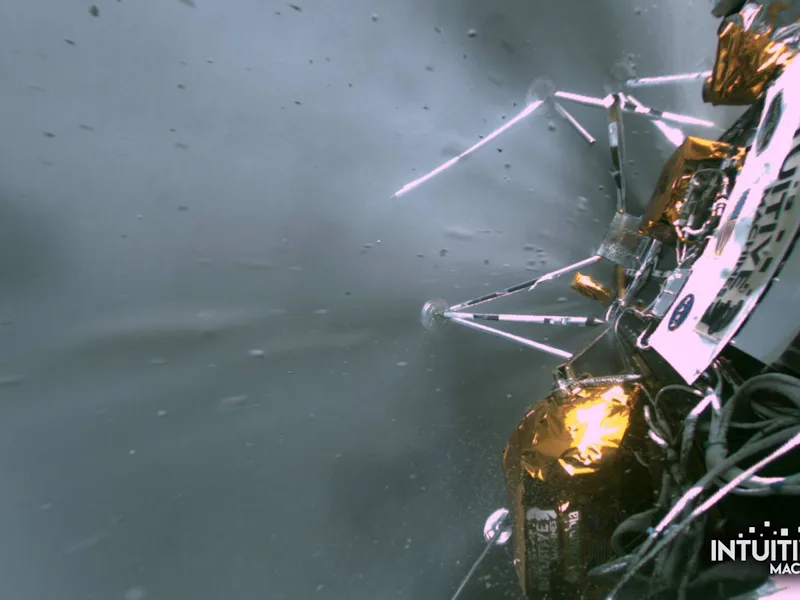
A spacecraft with metallic body and intricate appendages descends through a cloudy, gray sky, likely...
Intuitive Machines

A radio telescope on its way to the Moon captured a “selfie” of our planet’s radio waves, updating a vintage 1990s science experiment by Carl Sagan.

The ROLSES instrument rode to the Moon aboard Intuitive Machines’ Odysseus lander in February 2024, which arrived in a crater near the lunar South Pole in February. Along the way, the team measured the spectrum of radio waves rippling out into space from Earth. It’s not possible yet to decipher all that radio traffic, but it provides an electronic fingerprint of a civilization busily chattering over the airwaves — and leaking that chatter out into space. University of Colorado physicist Jack Burns and his colleagues hope to compare Earth’s radio fingerprint to their observations of other worlds from a telescope they plan to build on the far side of the Moon.

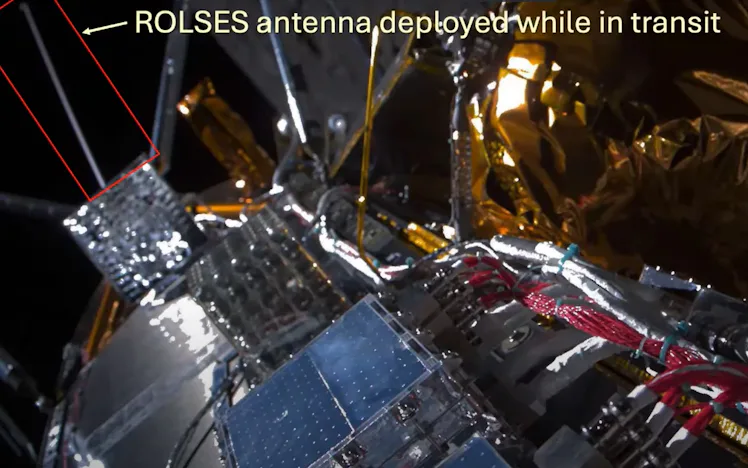
photo of a spacecraft with a deployed antenna highlighted in a red box

One of the antennas on the ROLSES instrument deployed partway to the Moon, so Burns and his colleagues decided they might as well take some measurements of Earth — and it’s a good thing they did, because they only got about 20 minutes’ worth of data once ROLSES landed on the Moon.

INTUITIVE MACHINES AND JACK BURNS

EVERYTHING GETS A REBOOT THESE DAYS

Along the way to the Moon, ROLSES repeated a famous Carl Sagan experiment from 1993: It captured the spectrum of radio waves pouring from our planet out into space. What they measured was an electronic fingerprint of all the wavelengths of radio broadcasts that passing aliens could see if they, too, pointed a radio spectrometer at Earth. They hope the data will give them a more detailed idea of what to look for in radio data from planets around nearby stars.

In 1993, Carl Sagan used the Galileo spacecraft — then on its way to Jupiter — to measure Earth’s atmospheric composition and radio signature.

“The presence of narrow-band, pulsed, amplitude-modulated radio transmission seems uniquely attributable to intelligence,” wrote Sagan in his 1993 paper in the journal Nature. “These observations constitute a control experiment for the search for extraterrestrial life by modern interplanetary spacecraft.” In other words, Sagan hoped that an alien’s-eye view of Earth from Galileo could help astronomers interpret what they saw in observations of planets orbiting other stars. If we could see what the signs of life on Earth looked like from a distance, then we might recognize them if we ever saw them on a distant world.

Astronomical instruments have come a long way since 1993, both literally and figuratively. With the James Webb Space Telescope (JWST), astronomers are finally able to measure how light filters through the atmospheres of planets like the TRAPPIST-1 worlds as they pass in front of their stars. And the radio spectrometer on ROLSES could measure Earth’s radio output in much more detail than the Galileo spacecraft’s instruments could.

“We can re-do the Sagan experiment from 1993 with a much improved radio spectrum,” says Burns in a presentation at the 244th American Astronomical Society conference on Monday.

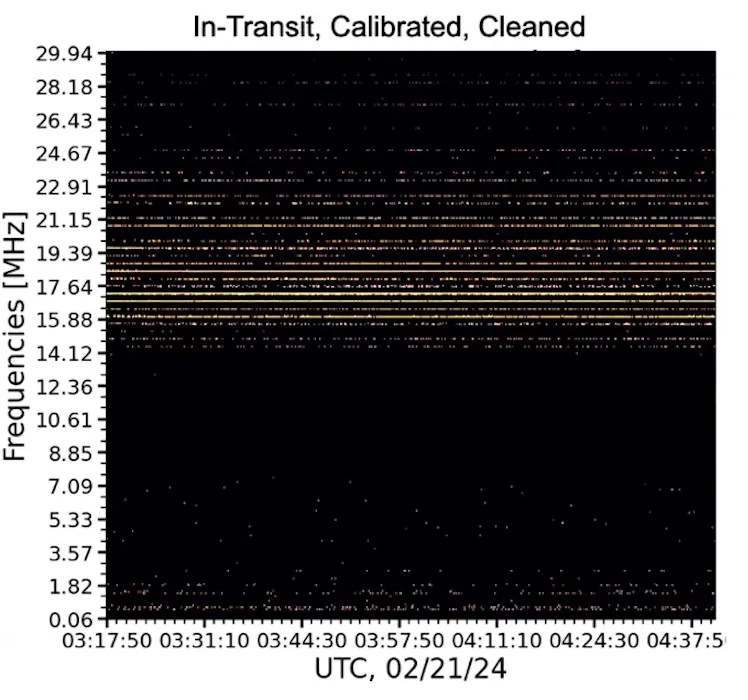
a diagram showing several lines of yellow static on a black background, labelled "In Transit, Calibr...

In case you ever wondered what Earth’s radio signature looks like from space, this is it.

JACK BURNS ET AL.

MAKING THE MOST OF AN AWKWARD SITUATION

ROLSES was meant to spend about 8 days gathering data about how much radio energy from Earth, and the Sun, reaches the southern pole of the Moon. But Intuitive Machines’ Odysseus Lander had a difficult landing in Malapert A crater, and it came to rest with one broken leg, leaning on a nearby slope at about a 30-degree angle. That left the lander’s high-gain antenna pointed at the lunar surface, instead of back toward Earth.

“We were supposed to have 8 days worth of data. We ended up with an hour and a half to 2 hours worth of data,” says Burns.

ROLSES spent only about 20 minutes doing radio astronomy from the surface of the Moon — still a major first and (Burns and others hope) a precursor to full-scale radio observatories on the far side of the Moon. Because the observation time was so short, the data is more noise than signal. The rest, about an hour and a half of much clearer data, was collected on the way to the Moon, when ROLSES wasn’t supposed to have been up and running at all, which underscores how much of spaceflight still relies on being able to improvise quickly.

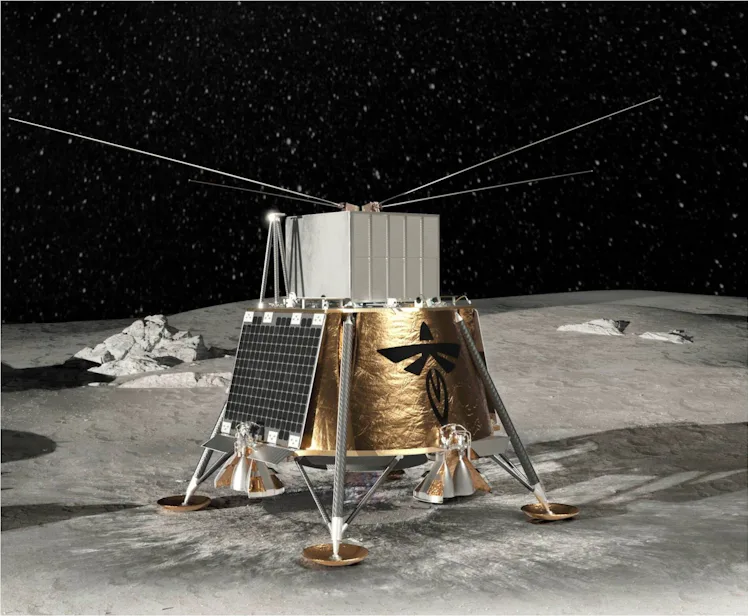
image of a lander on the lunar surface with four long antennas sticking out

This artist’s illustration shows LuSEE-Night, ROLSES’s future successor on the Moon.

FIREFLY AEROSPACE

WHAT’S NEXT?

Burns and his colleagues have ambitious plans for their hour and a half of data from ROLSES.

“As a control experiment, what we're looking forward to is comparing this Earth spectrum to ones of nearby exoplanets that we hope to observe with our FARSIDE array of radio telescopes,” says Burns. FARSIDE would be an array of 128 radio antennas arranged over about 6 square miles of the Moon and connected to a base station. It’s received some design funding from NASA so far.

The FARSIDE antennas will listen for faint signals from the Cosmic Dark Ages, but Burns also wants to use them to scan about 2,000 nearby star systems for signs of intelligent, radio-using life — and compare those signals with the ones Galileo and ROLSES measured coming from Earth.

Burns and his colleagues are also working with Texas-based Lunar Resources, INc. to design a 5-square-mile array of radio antennas sprawling across a lunar plain. Picture something like an old-fashioned television antenna; now picture roughly 100,000 of them, lined up end-to-end in a series of zig-zags. Combined, those antennas will act as one giant radio receiver.

Picture something like an old-fashioned television antenna; now picture roughly 100,000 of them, lined up end-to-end in a series of zig-zags.

The concept competing with Farview is basically a lunar version of the now-defunct Arecibo Observatory (RIP) called the Lunar Crater Radio Telescope, a semicircle of wire mesh about a third of a mile wide, lining the bottom of a 1.9-mile-wide crater on the Moon. Both projects have received some funding from NASA for development and design, but neither is fully funded for actually building or launch.

Before either of those ambitious projects actually break lunar ground, two more small radio telescopes will launch to the Moon in 2026. One is a second, upgraded version of ROLSES. The second is LuSEE-Night, which, if everything goes to schedule, will land on the far side of the Moon in January 2026 and deploy a pair of spring-loaded, 20-foot-long radio antennas. The little telescope will test whether the far side of the Moon is really as good a vantage point for radio astronomy as everyone hopes. It will also give us our first, albeit low-resolution, glimpse of the galaxy at the low radio frequencies we can't see from Earth.

{ https://www.inverse.com/ }

Hoe vind je dit bericht?
Geschreven door peter om 01:36 Stuur door

The Inner and Outer Milky Way Aren’t the Same Thickness, and that’s Surprising

Illustration depicting the Smith Cloud on its journey to the Milky Way Creator: NRAO/AUI/NSF Credit: B. Saxton, NRAO/AUI/NSF

The Inner and Outer Milky Way Aren’t the Same Thickness, and that’s Surprising

At first glance, the universe and night sky seem largely unchanging. The reality is very different, even now, a gas cloud is charging toward the Milky Way Galaxy and is expected to crash into us in 27 million years. A team of astronomers hoping to locate the exact position of the expected impact site have been unsuccessful but have accidentally measured the thickness of the Milky Way! Analysing radio data, they have been able to deduce the thickness of the inner and outer regions and discovered a dramatic difference between the two. 

The team of astronomers from the US National Science Foundation’s Green Bank Observatory were attempting to study the Smith Cloud. This high velocity cloud of hydrogen gas is located in the constellation Aquila at a distance of somewhere between 36,000 and 45,000 light years. Previous studies from the Green Bank Observatory have shown the cloud contains at least 1 million times the mass of the Sun and measures 9,800 light years long by 3,300 light years wide. 

A false-color image of the Smith Cloud made with data from the Green Bank Telescope (GBT). New analysis indicates that it is wrapped in a dark matter halo. Credit: NRAO/AUI/NSF

The plan was simple enough, to observe the spot where the cloud is currently interacting with the Milky Way. The observation is tricky enough though as the cloud is on the far side of the Milky Way and there is a lot of stuff in the way! The team, led by Toney Minter used the 20m Green Bank Telescope to search for dust and emissions from hydroxyl molecules (composed of a hydrogen and oxygen molecule.)  What the team expected to see was a difference in composition in the region of the Milky Way interacted with the cloud which, should have very little dust and hydroxyl molecules. Clouds in the Milky Way tend to have both so a difference should be detectable. 

The Robert C. Byrd Green Bank Telescope. Credit: Jay Young.

Minter was candidly open about the study joking ‘I knew there was a low probability that I’d find what I was looking for—and I didn’t,. But this is all part of the scientific process. You learn from what you DO and DON’T find.’

Disappointingly the team did not detect any differences in composition but what they did find was equally as interesting. The study revealed information about the Milky Way itself and the structure of its inner regions. Minter and his team had to look through the Milky Way’s inner regions for their study and what they were able to determine was the thickness of the layer of molecules in the inner Galaxy. The information enabled them to deduce the scale height of the clouds of molecular gas in the inner Milky Way. The results showed that the layer of molecules in the inner region measured 330 light years thick while those in the outer parts measured twice as much, around 660 light years. 

The discovery still leaves questions unanswered. The observation certainly shows the difference in thickness between the inner and outer regions but it doesn’t give any clue as to what is driving the difference. Further observations are now required to follow up on this discovery to try and model the underlying process.  Of course one other question remains unanswered and that is the nature and mechanics of the Smith Cloud and how it will impact our own Galaxy. Far from being disappointed though, Minter stated ‘That’s why astronomy is exciting, our knowledge is always evolving’

Source : 

{ https://www.universetoday.com/ }

Hoe vind je dit bericht?
Geschreven door peter om 01:19 Stuur door

Starliner Has Five Leaks

Boeing Starliner

Starliner Has Five Leaks

Many space fans have been following the successful launch of the Boeing Starliner, another commercial organisation aiming to make space more accessible. It successfully reached the International Space Station, delivering Butch Wilmore and Suni Williams into orbit but it wasn’t without a hitch. Three of its thrusters experienced problems and there were ‘five small leaks on the service module.’ The crew and ground teams are working through safety checks of power and habitability. To ensure a safe return of the astronauts NASA has extended the mission by four days to 18th June. 

Boeing Starliner is a reusable (partly) spacecraft designed to transport crews to low Earth orbit. NASA is the lead customer so, once certification has been achieved, will be used to deliver astronauts regularly to the ISS. It consists of a crew capsule that can be used ten times and an expendable service module. Measuring 4.6 metres in diameter it is slightly larger than the Apollo Command module that was a part of the historic Armstrong, Aldrin and Collins mission to the Moon.

The Apollo 10 command/service module nicknamed “Charlie Brown” orbiting the Moon as seen from the lunar module. Credit: NASA

The Boeing Starliner launch marked its first crewed trip into orbit, with the objective of data collection for certification by NASA for regular crewed missions to ISS. The tests are numerous and include; running the spacecraft in minimal power mode (for when docked to ISS), checking suitability to support crew on its own in the event of an emergency, performing habitability studies for a four person crew and a multitude of other system checks. The module has been docked to ISS since 6th June. 

Teething problems for any new module are always expected but when the word ‘leak’ pops up it is most definitely a cause for concern. In the case of Starliner, five small leaks have been detected in the service module helium manifolds. When Starliner launched, the ground team already knew there was one leak in the propulsion system but now, four more have been detected! The flight engineers initially suspected a flaw in a manifold seal or possibly even faulty installation but now, with the four additional leaks they’re trying to understand if there is a common problem.

The leaks are not the only problem that has been experienced. As Starliner approached ISS, it relied upon precise pulses from the 28 reaction control thrusters. During this critical phase of the docking process, five of them failed. More accurately, the spacecraft control software deduced they were not working and deselected them. The first docking window was missed as a result but the crew were able to test and restart four of the five engines allowing them to safely dock. Engineers are still looking into the thruster problem but are confidence it will allow the safe return of the astronauts. 

International Space Station. Credit: NASA

As for the helium leak, flight engineers have examined the leak rate and confirmed that Starliner has sufficient margin to support a return trip to Earth. With Starliner docked to the ISS the manifolds are all closed preventing any helium loss until the return trip which takes just seven hours. Even with the manifolds open and the rate of leak there is sufficient helium to support 70 hours of flight time. 

Ground support teams are continuing to work through the problems and the return plan. They will explore tolerances and possible operational mitigations for the remainder of the mission. As the team depart from the ISS, no earlier than 18th June they will slowly adjust orbit away from the Space Station. A deorbit burn will be completed before entering the atmosphere and landing in south-western United States.

Source : 

{ https://www.universetoday.com/ }

Hoe vind je dit bericht?
Geschreven door peter om 01:11 Stuur door

Video: Ret. Navy Rear Admiral sounds alarm over UFO

Video: Ret. Navy Rear Admiral sounds alarm over UFO

r/UfoUapNews - Video: Ret. Navy Rear Admiral Sounds Alarm Over Ufo

The Department of Defense released 3 unclassified Navy videos from 2004 and 2015 showing “unidentified aerial phenomena” on April 27, 2020. (DOD/Released)
JUNE 12, 2024 BETH BROWN

A video that initially surfaced in 2021 depicting unidentified objects surrounding a Navy ship is again raising concerns over potential Maritime security threats.

In the video, which was shared by News Nation, the USS Omaha appears to be surrounded by numerous unidentified flying objects (UFOs). Due to the video source, the Department of Defense analyzed the video.

While the footage was deemed to be likely unaltered, according to a preliminary report issued by the Pentagon, the recorded objects were not considered to be a matter of immediate national security concern.

Instead, the report provided five potential explanations for the objects, including airborne clutter, natural atmospheric phenomena, classified U.S. government programs, foreign adversary systems (technology released from other governmental sources), and “other.”

The report, however, admits limitations to the study and assessment, noting, “The limited amount of high-quality reporting on unidentified aerial phenomena (UAP) hampers our ability to draw firm conclusions about the nature or intent of UAP.” The entire report was not made available to the general public, with an annex to the report remaining “classified.”

Tim Gallaudet, a retired rear admiral in the U.S. Navy, remains concerned over the phenomenon.
In a March 2024 report for the Sol Foundation, Gallaudet stated, “The fact that unidentified objects with unexplainable characteristics are entering US water space and the DOD is not raising a giant red flag is a sign that the government is not sharing all it knows about all-domain anomalous phenomena.”

The objects in the video display capabilities that “jeopardizes U.S. maritime security, which is already weakened by our relative ignorance about the global ocean,” Gallaudet said, according to Fox News.
Gallaudet is urging further research and study of UAP, arguing that the endeavor is “scientifically valid” and that “to meet the security and scientific challenges, transmedium UAP and USOs should be elevated to national ocean research priorities.”

To facilitate that research, the Pentagon reestablished a UAP task force in 2020. According to Defense Scoop, by the end of fiscal year 2024, the All-domain Anomaly Resolution Office (AARO) is expected to reach full operational capability.

{ https://americanmilitarynews.com/ }

Hoe vind je dit bericht?
Geschreven door peter om 23:39 Stuur door

Meer van UFO'S of UAP'S, ASTRONOMIE, RUIMTEVAART, ARCHEOLOGIE, OUDHEIDKUNDE, SF-SNUFJES EN ANDERE ESOTERISCHE WETENSCHAPPEN - DE ALLERLAATSTE NIEUWTJES

↑ Terug naar de berichten