Naar de inhoud

UFO'S of UAP'S, ASTRONOMIE, RUIMTEVAART, ARCHEOLOGIE, OUDHEIDKUNDE, SF-SNUFJES EN ANDERE ESOTERISCHE WETENSCHAPPEN - DE ALLERLAATSTE NIEUWTJES

UFO's of UAP'S in België en de rest van de wereld
akke.beakke.be
Ontdek de Fascinerende Wereld van UFO's en UAP's: Jouw Bron voor Onthullende Informatie! Ben jij ook gefascineerd door het onbekende? Wil je meer weten over UFO's en UAP's, niet alleen in België, maar over de hele wereld? Dan ben je op de juiste plek! België: Het Kloppend Hart van UFO-onderzoek In België is BUFON (Belgisch UFO-Netwerk) dé autoriteit op het gebied van UFO-onderzoek. Voor betrouwbare en objectieve informatie over deze intrigerende fenomenen, bezoek je zeker onze Facebook-pagina en deze blog. Maar dat is nog niet alles! Ontdek ook het Belgisch UFO-meldpunt en Caelestia, twee organisaties die diepgaand onderzoek verrichten, al zijn ze soms kritisch of sceptisch. Nederland: Een Schat aan Informatie Voor onze Nederlandse buren is er de schitterende website www.ufowijzer.nl, beheerd door Paul Harmans. Deze site biedt een schat aan informatie en artikelen die je niet wilt missen! Internationaal: MUFON - De Wereldwijde Autoriteit Neem ook een kijkje bij MUFON (Mutual UFO Network Inc.), een gerenommeerde Amerikaanse UFO-vereniging met afdelingen in de VS en wereldwijd. MUFON is toegewijd aan de wetenschappelijke en analytische studie van het UFO-fenomeen, en hun maandelijkse tijdschrift, The MUFON UFO-Journal, is een must-read voor elke UFO-enthousiasteling. Bezoek hun website op www.mufon.com voor meer informatie. Samenwerking en Toekomstvisie Sinds 1 februari 2020 is Pieter niet alleen ex-president van BUFON, maar ook de voormalige nationale directeur van MUFON in Vlaanderen en Nederland. Dit creëert een sterke samenwerking met de Franse MUFON Reseau MUFON/EUROP, wat ons in staat stelt om nog meer waardevolle inzichten te delen. Let op: Nepprofielen en Nieuwe Groeperingen Pas op voor een nieuwe groepering die zich ook BUFON noemt, maar geen enkele connectie heeft met onze gevestigde organisatie. Hoewel zij de naam geregistreerd hebben, kunnen ze het rijke verleden en de expertise van onze groep niet evenaren. We wensen hen veel succes, maar we blijven de autoriteit in UFO-onderzoek! Blijf Op De Hoogte! Wil jij de laatste nieuwtjes over UFO's, ruimtevaart, archeologie, en meer? Volg ons dan en duik samen met ons in de fascinerende wereld van het onbekende! Sluit je aan bij de gemeenschap van nieuwsgierige geesten die net als jij verlangen naar antwoorden en avonturen in de sterren! Heb je vragen of wil je meer weten? Aarzel dan niet om contact met ons op te nemen! Samen ontrafelen we het mysterie van de lucht en daarbuiten.

Archief

Jongeren vinden een eenvoudige en goedkope manier om microplastics te filteren: ze winnen een prijs van $50.000


Jongeren vinden een eenvoudige en goedkope manier om microplastics te filteren: ze winnen een prijs van $50.000

Janine imageDoor Janine
De twee studenten die $50.000 hebben gewonnen voor hun innovatieve filtersysteem voor microplastics
Dat microplastics overal aanwezig zijn is geen mysterie: ze zitten in ons water, in het voedsel dat we eten en zelfs in ons lichaam. We weten nog steeds niet precies wat hun effecten op de gezondheid zijn, maar het is cruciaal om te leren hoe we ze kunnen opsporen en verwijderen. Een belangrijke stap in deze richting is gezet door Victoria Ou en Justin Huang, twee jongeren uit Texas die een innovatieve methode presenteerden om microplastics uit water te filteren met behulp van ultrageluiden. Laten we eens kijken waar het over gaat.

Een nieuwe methode om microplastics uit water te filteren: twee tieners winnen een prijs

We zijn op de Regeneron International Science and Engineering Fair in Los Angeles, Verenigde Staten. Dit is een evenement dat de beste wetenschappelijke projecten ter wereld samenbrengt en in totaal $9 miljoen aan prijzen toekent aan verdienstelijk onderzoek. Eén daarvan is het project van Victoria Ou en Justin Huang, een nieuwe methode om microplastics uit water te filteren, dat de Gordon E. Moore-prijs van $50.000 won.

Zoals we in de inleiding al zeiden, zijn de korte- en langetermijneffecten van microplastics op de menselijke gezondheid nog steeds niet helemaal duidelijk. Toch blijft het elimineren van microplastics een fundamenteel doel van onze samenleving, misschien met een methode die eenvoudig, effectief en goedkoop te implementeren is. En het lijkt erop dat het project van Ou en Huang aan deze kenmerken voldoet.

Een voordelige, effectieve en eenvoudige oplossing voor het filteren van microplastics

Unsplash

Tijdens de prijsuitreiking vertelden de twee Texaanse studenten hoe ze op het idee kwamen om microplastics uit het water te filteren. Tijdens een bezoek aan een waterzuiveringsinstallatie ontdekten Ou en Huang dat er geen middelen zijn om microplastics uit afvalwater te filteren. Als gevolg daarvan komen deze kleine plastic fragmenten in het ecosysteem terecht. Er bestaan wel enkele methoden, maar om de een of andere reden zijn die niet zo gemakkelijk toe te passen. Het gebruik van chemische coagulanten kan het milieu verder vervuilen, terwijl fysieke filters ineffectief en duur zijn.

In plaats daarvan ontwikkelden de twee studenten een compact apparaat dat ultrasoon geluid gebruikt om microplastics uit water te filteren. Ook in dit geval is het gebruik van ultrageluid om microplastics te verwijderen niet nieuw, een recente studie spreekt erover, maar het is een duurdere en complexere methode. De oplossing van Victoria Ou en Justin Huang is daarentegen goedkoop, effectief en eenvoudig: het verwijdert tussen 84% en 94% van de microplastics in één enkele stap. Maar hoe?

Microplastics uit water verwijderen: werking en perspectieven van het nieuwe instrument

SocietyForScience/Youtube

De werking van de innovatieve methode die Ou en Huang hebben ontwikkeld, is conceptueel gezien relatief eenvoudig. In feite wordt het instrument in het water gestoken zodat het er vrij doorheen kan stromen. Het opgewekte ultrageluid zorgt ervoor dat het water blijft stromen, maar duwt de microplastics terug, waardoor ze effectief worden gefilterd. Zoals we hebben gezien, hebben we het over een verwijdering van ongeveer 90% polyurethaan, polystyreen en polyethyleen, maar dit is ​​nog maar het begin.

Zodra de technologie die de twee studenten hebben ontwikkeld klaar is, kan deze worden gebruikt in verschillende toepassingen, variërend van afvalwaterzuivering tot huishoudelijke wasmachines. Dankzij de prijs van 50.000 dollar kunnen Ou en Huang hun apparaat perfectioneren en het concreet toepassen in het dagelijks leven. We staan ​​uiteraard nog aan het begin, maar het is binnenkort mogelijk om microplastics uit water te filteren: een kleine stap, maar toch fundamenteel voor de toekomst van onze planeet.

{ https://www.curioctopus.nl/ }

Hoe vind je dit bericht?
Geschreven door peter om 18:22 Stuur door

Uncovering the 3.19-Year UFO Crash Cycle: Evidence and Theories

Uncovering the 3.19-Year UFO Crash Cycle: Evidence and Theories

Uncovering the 3.19 Year UFO Crash Cycle

Welcome back, UFO enthusiasts! 🌌 Today, we delve into a fascinating theory that might revolutionize our understanding of UFO crash retrievals. The theory suggests a cyclic pattern, occurring every 3.19 years, which could explain many reported UFO crashes over the past century. From the famous Roswell incident to the Varginha encounter in Brazil, we will explore the evidence and theories behind this intriguing phenomenon. Could these crashes be influenced by planetary cycles, such as Mars’ orbit? Let’s uncover the truth!

The Origin of the Theory

The idea of a 3.19-year UFO crash cycle originates from Joseph Ritrovato, who proposed this theory in his article “A Cyclic Period that Correlates with Alleged UFO Crash Retrievals.” Ritrovato observed that many reported UFO crashes seemed to occur in a repeating pattern approximately every 3.19 years. This pattern intrigued him, leading to a detailed analysis of historical UFO crash data.

Key Incidents Supporting the Cycle

One of the most notable UFO crashes, the Roswell incident, took place in July 1947. However, this was not an isolated event. Over the years, numerous other crashes have been reported, many of which align with the proposed 3.19-year cycle. For instance, the Varginha incident in Brazil in January 1996, often dubbed Brazil’s Roswell, involved the capture of alleged extraterrestrial beings and fits perfectly into the cycle.

Further supporting incidents include:

  • September 1957, Ubatuba, Brazil: Fishermen witnessed a flying disk explode, leaving behind pure magnesium fragments.
  • October 1967, Shag Harbor, Nova Scotia: A UFO was seen crashing into the harbor, with lights visible underwater.

Planetary Cycles and UFO Crashes

Ritrovato theorizes that there might be a connection between these UFO crashes and planetary cycles, particularly Mars’ orbit, which is approximately 776 days (a little over 2 years). It has been suggested that the Mars cycle can affect plate tectonics on Earth, raising questions about the possible influence of planetary positions on UFO activities.

Interestingly, some crash dates coincide with Mars’s closest approaches to Earth. For example, crashes on November 3, 1958, and October 17, 1973, occurred on the same day as Mars’s closest approach, suggesting a potential correlation.

Statistical Analysis and Findings

To further investigate this theory, a detailed analysis was conducted, considering various cycles, including Mars (2.1 years), Jupiter (11.86 years), and Saturn (29.5 years). The analysis revealed:

  • Mars cycle: Multiple pairs of years showed a 2.1-year cycle alignment, suggesting potential correlation, although not consistent enough to establish a definitive pattern.
  • Jupiter cycle: Only one pair of years showed alignment, insufficient to indicate a strong correlation.
  • Saturn cycle: Several pairs of years showed a 29.5-year cycle alignment, indicating potential influence.

These findings suggest that planetary cycles, particularly those of Mars and Saturn, might influence the timing of significant UFO events. However, a larger data set and more precise timing of incidents are needed for more definitive conclusions.

Future Predictions

Based on the 3.19-year cycle, Ritrovato predicted future peak dates for UFO crashes. Notable predictions include April 24, 1999, and September 9, 2005. While some of these predictions align with reported UFO activities, the theory requires further investigation and validation.

VIDEO:

  • Chris Lehto – Uncovering the 3.19 Year UFO Crash Cycle: Evidence & Theories

Joseph Ritrovato’s research presents a compelling case for a cyclic pattern in UFO crash retrievals. While further investigation is necessary, the evidence suggests a potential link between planetary cycles and UFO activities. This theory opens up new avenues for understanding UFO phenomena and encourages further research and data collection.

As we look to the future, could we anticipate significant UFO events based on these cycles? By studying past data and predicting future patterns, we might be better prepared to investigate and understand these mysterious occurrences.

Thank you for joining us on this exploration of the 3.19-year UFO crash cycle. Please like and subscribe for more intriguing content. If you have any insights or data to share, join the discussion on the UAP Society Discord. Until next time, keep watching the skies!

{ https://www.latest-ufo-sightings.net/ }

Hoe vind je dit bericht?
Geschreven door peter om 18:00 Stuur door

Alien Abducted Irish Man And Told Him The World Would END in 850 Years

Alien Abducted Irish Man And Told Him The World Would END In 850 Years ...

Alien Abducted Irish Man And Told Him The World Would END in 850 Years

A retired carpenter named Gerry Battles (65) claimed that he had been abducted by aliens while coming home after Christmas drinks in Pallaskenry (a village in County Limerick, Ireland) on December 26, 2001. The aliens warned him that the Earth would end with an asteroid the size of Munster in 850 years.

Gerry Battles Gerry Battles, Kilidmo, a local man, was abducted by aliens in 2001. Picture Brendan Gleeson

In 2016, Gerry told the Limerick Post what had happened to him in 2001. He said that the sky was very clear and beautiful on the night he had been abducted.

“IT was a clear, dry night. It was really crisp and frosty — just beautiful. You could have read a book with the light off the night sky, but I wasn’t drawn by the light of the stars or the moon but by a bright, surgical, white light coming from the other end of the boreen,” he said.

Read also:

It was around 8 PM, he was returning home from The Seven Sisters Pubs in Kildimo, when a strange light coming from the end of the laneway took him to the spacecraft. He remembered that there were 40 males of different ages upon the board, but they all were in a subdued state, standing shoulder to shoulder like mannequins and not moving.

Gerry Battles Gerry Battles told the alien talked with him through telepathy

The man standing next to Gerry was wearing a Columbo-style coat and hat. He felt himself in a state of paralysis and could only move his eyes. “I was only minutes away from my house but it was such a clear and beautiful night that I stopped to gaze at the stars,” he explained.

“They were all male, of different age groups, all standing shoulder to shoulder like mannequins. I remember one man next to me wearing a Columbo-style coat and hat. We were all in a state of paralysis, I could only move my eyes, so I couldn’t see much,” Gerry tells me.

After that, he found himself floating into another chamber but bigger in size with a 360-degree view, and that was the place where he first saw the extraterrestrial. He only remembered seeing the alien’s big cone head and his beautiful, ginormous eyes.

The alien talked to Gerry through telepathy and said to him not to be terrified.

“No, I am not. Should I be?” Gerry asked.

The next thing the alien asked Gerry was what would he like to see. He instantly chose the North Pole. The alien fulfilled his wish and took him to the North Pole within seconds.

Gerry compared the incident with the  Star Trek film.

He said that people laughed at him when he revealed his fantastical story to them, but he assured them that he had never had any history of mental illness.

Gerry Battles The world will be destroyed in 850 years, the alien said.

Gerry claimed the alien had told him they are four million light-years more advanced than humans, and they have been observing us for thousands of years.

On Stephen’s Night, 2001, the alien warned him that an asteroid the size of Munster (a city in Germany) originating from the ’35th Quadrant’ would end our world in 850 years (19 years have passed since the message was conveyed).

“In all that time you have only excelled at two things — global warfare and lying to your own species. You must use force. Be one with the force. Harness the force,” the alien said.

According to Gerry, the alien told him that the government and the banks tell lies to people because they are a hidden agenda and we should not trust them.

“He also forewarned the impending global financial crisis and told me that if we do not change our ways we are going to end up like the dinosaurs.”

Gerry did not remember how he was abducted and had no memory of the incident only until he found his coat he had been wearing on the day of his abduction.

A few weeks later, his coat was found at the rooftop of the regional hospital, and he had no idea how it had got there. After he received his coat, his memory of December 26, 2001, started to come back.

According to him, the aliens use ‘dark matter’ or ‘dark energy’ to hide in the universe. He is hopeful his story will reach the world’s scientific community and prove useful in helping to finally uncover these distant galaxies. “The truth is definitely out there,” he insisted.

References:

{ https://www.howandwhys.com/ }

Hoe vind je dit bericht?
Geschreven door peter om 23:45 Stuur door

Man Who Knew Two Photographers Who Took 1990 Calvine UFO Photo Reveals They Disappeared Mysteriously From The Face Of The Earth

calvine ufo photo truth

Man Who Knew Two Photographers Who Took 1990 Calvine UFO Photo Reveals They Disappeared Mysteriously From The Face Of The Earth

The biggest UFO revelation happened in 2022. A mysterious UFO photo from the Calvine incident, which was set to be released on January 1, 2072, was somehow found and released by UAP Media UK. The 1990 Calvine UFO incident is one of the most discussed cases in the UAP community. After 34 years, the colleague of the two British photographers who witnessed and captured this historic UFO photo has finally come forward with an even more bizarre story.

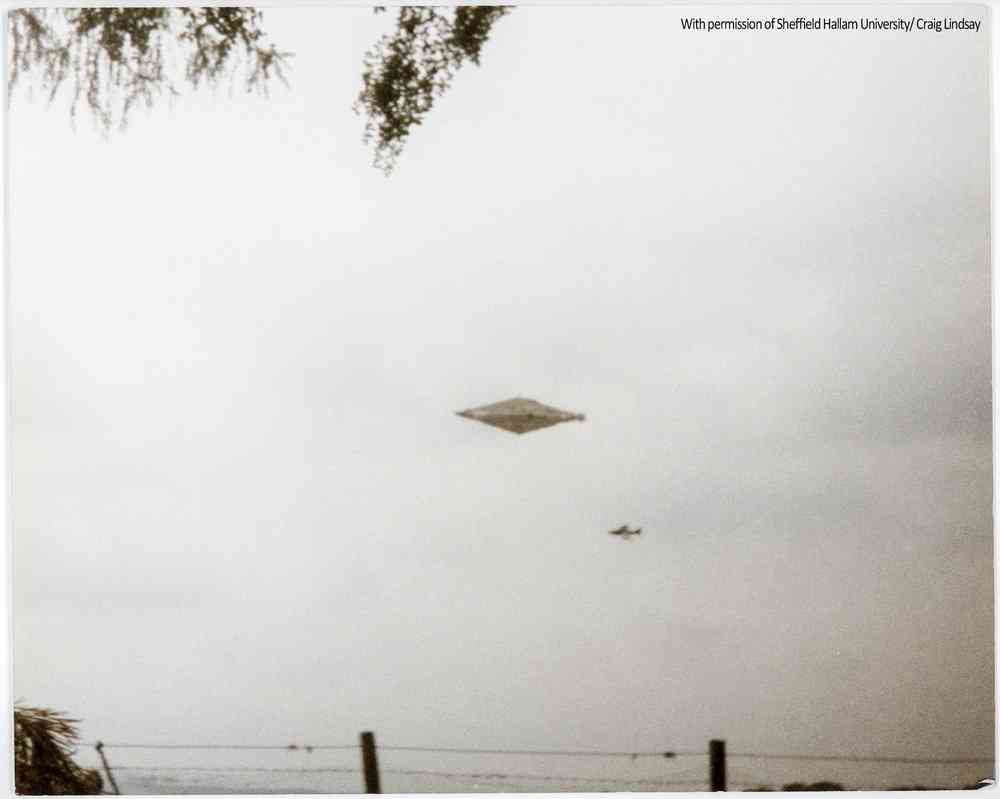
There are many videos and photographs of UFOs on the Internet, and some of them have credibility. However, there is one photograph sent to the UK defense ministry, the MoD, which is considered to be the most spectacular UFO photo, although somehow, it has disappeared. The photograph contains a 100-foot diamond-shaped flying saucer hovering over a village named Calvine in the Scottish Highlands. The photo was taken in 1990.

Vinnie Adams of the UAP Media UK disclosed that his team not only found the original print of the Calvine “UFO,” taken directly from the negatives, but also the original envelope which was sent from the Scottish Daily Record to Craig Lindsay, who was the MOD Press Officer that dealt with the case at the time.

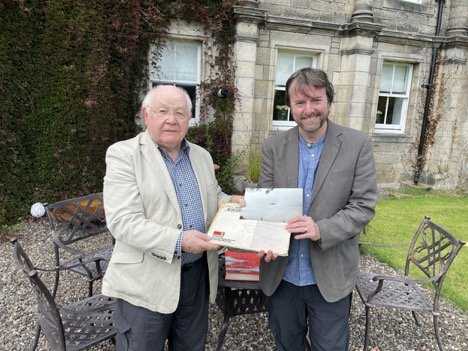
Calvine UFO Photo Original Retired RAF Press Officer Craig Lindsay and Dr. David Clarke.
Credit: VINNIE ADAMS

Mail Online has covered the new addition to the Calvine incident. Dr David Clarke, a research fellow and lecturer in journalism at Sheffield Hallam University writes that retired chef Richard Grieve, who at the time of the incident was 21, spoke about that mysterious night in 1990 for the first time in 34 years. The story goes like this: (Source)

On a dark, stormy night in Pitlochry, Scotland, a group of young chefs took a break outside their hotel kitchen. Normally, they joked and shared drinks, but this night was different. Two chefs were talking excitedly about seeing a huge, diamond-shaped object hovering silently in the sky while hiking in Calvine a few nights earlier. They took photos and showed them to a newspaper.

As they discussed their experience, a dark car arrived, and two men in black suits emerged, calling the two chefs by name. The rest of the group was ordered to get back inside. The chefs were taken for a private talk.

The following morning, different chefs were on duty. Richard remembered the two chefs being very shaken after the meeting with the men who claimed to be from the Royal Navy. Following the encounter, the chefs felt they were being followed, their behavior changed dramatically, and they eventually left their jobs. Richard never saw them again. One of the chefs hinted that whatever they saw involved Americans.

Dr. David Clarke writes that for over 15 years, he has been deeply intrigued by the “Calvine Incident” and the mystery surrounding the photographs taken by two chefs on that night. His search for the truth has led him from the Highlands of Scotland to the secretive depths of the US Pentagon. Dr. Clarke first discovered the story in 2009 when the UK Ministry of Defence (MoD) disbanded its UFO desk and released thousands of files. Among these files, he found the heavily redacted Calvine file, which contained a poor photocopy of the chefs’ photograph.

After years of continued investigation with other experts, Dr. Clarke finally found the original photo at the home of Craig Lindsay, a retired RAF press officer. Lindsay had kept the photo hidden on a bookshelf for 32 years. When Dr. Clarke contacted him in 2022, Lindsay, then in his 80s, revealed he had been waiting for someone to ask about the photo for more than 30 years.

Calvine UFO Photo Original

The original Calvine photograph, showing the diamond-shaped craft and a Harrier aircraft in what appears to be close proximity. credit: VINNIE ADAMS From UAP Media UK

In 2022, this Calvine UFO photo was published by the Daily Mail. Dr. Clarke has been flooded with emails from UFO enthusiasts wanting more information and sharing their theories about the object in the photo. Some believe it is an alien spacecraft that was intercepted by Royal Air Force (RAF) jets. Others think that it might be a secret U.S. military project involving advanced technology, like the Hopeless Diamond or Aurora, which is known for its stealth capabilities.

Some skeptics think the photo could be a hoax. Despite all this interest, Dr. Clarke has not been able to contact the two men who had taken the photo. Richard Grieve, who worked at a hotel in Pitlochry where those men were chefs in 1990, mentioned that they seemed to have disappeared.

The name “Kevin Russell” was written on the back of the photo print. The Daily Record newspaper sent the photo to Lindsay. Lindsay then faxed the photo to the Ministry of Defense (MoD) and tried to contact the photographer using the phone number provided by the newspaper. However, there was no luck finding any further information about them.

The chefs who took the photo reported seeing a military Harrier jet flying below the UFO, and another jet circling it. They also said the UFO shot up into the sky without making any noise. Lindsay summarized this account and sent it to the MoD, who told him to let their London office handle it.

Dr. Clarke and a film crew have been looking for Kevin Russell, the photographer of a controversial photo, for 18 months. They found 140 people named Kevin Russell, but none admitted to taking the photo. It is possible the name is fake, or the real photographer is still too scared to come forward.

Richard Grieve believes they were genuinely frightened and would not have made up the story. After developing the photos, one chef took a bus to Glasgow to deliver them to the Daily Record newspaper. Soon after, a mysterious dark car appeared. One chef hinted to Richard that “it was the Americans,” suggesting U.S. involvement. The Ministry of Defence refuses to release information about the photos, saying the negatives were returned to the newspaper and all other records were sent to The National Archives or destroyed.

The MoD file mentions that analysis of one of the missing images revealed a second jet in the distance, making a hoax even less likely. The images underwent at least three separate analyses by UK and US government agencies. A 1990 briefing for Defence Minister Ken Carlisle concluded that the jet in the photo was likely a Harrier, even though no Harriers were known to be flying in Scotland that evening. The experts could not definitively identify the diamond-shaped object.

Despite preparing for a story, the Daily Record never published the photos. Malcolm Speed, a former news editor at the paper, recalls seeing the photos and being surprised they were not published, especially after being told by the picture editor, Andy Allan, that the RAF said they were fakes. Andy Allan, who passed away in 2007, could not provide his account, leaving Malcolm Speed to wonder if Andy was misled by the RAF.

Richard Grieve

Richard Grieve who is now 55 describes the mysterious night of 1990. Image via Dail Mail

Dr. Clarke noted the sighting’s date, August 4, 1990, coincided with the early stages of the Gulf War. The US military was mobilizing many resources, including the F117A stealth fighter, which had been in development for years and resembled the object photographed in Scotland. The US government has since admitted to flying prototype aircraft that looked like UFOs, including triangle-shaped ones capable of hovering. The Calvine UFO might have been one of these prototypes.

The US Department of Defence’s All Domain Anomaly Resolution Office (AARO) recently released a report stating that many UFO sightings were actually misidentified highly sensitive national security programs. The report refers to a 1990s sighting near a US military facility, possibly Area 51, where experimental aircraft were tested. This sighting had characteristics matching those of a secret platform being tested at the time.

Read also:

Dr. Clarke suggests that what the chefs saw over Calvine might have been one of these secret American prototype aircraft.

According to a 30-year rule in the UK, the MoD was supposed to release the secret UFO dossier on January 1, 2021, but the UK government banned the release for another 50 years. This secret file is said to contain the infamous UFO photo from the Calvine incident. Now, it is set to be released on January 1, 2072.

UAP Media UK has been working hard to bring a serious resource to British media outlets on the discussion of UFOs. One of the members of this project, Vinnie Adams had been working with Dr. Clarke and a small team of researchers on the Calvine case from 1990 in Scotland.

In May 2022, Dr. Clarke interviewed Craig in Scotland and was shown the original print. In June, Craig agreed to donate the photograph to the Sheffield Hallam University Archives, handing it to Dr. Clarke and Vinnie Adams. The image now resides in its new home at the Sheffield Hallam University folklore archives.

Authenticity of Calvine UFO Photo

Andrew Robinson, a senior lecturer in Photography at Sheffield Hallam University claims the authenticity of the 1990 Scottish highlands UFO photo. In his detailed analysis, he found the image showing no evidence of negative or print-based manipulation, and all visible signs suggest this is a genuine photograph of the scene before the camera. (Source)

Robinson concluded in his study:

  • The photograph is a color print from XP-1 or XP-2 chromogenic Black and White C41 film printed on a standard;
  • It is not possible to identify the object in the center of the frame. However, the evidence present suggests that this object was in front of the camera in the position shown when the photograph was captured;
  • Thus it follows that this is either a genuine unidentified flying object in the sky OR that any construction or manipulation used to create this effect occurred in front of the camera and not in the capturing of the scene on film nor in the subsequent processing and printing of the image;
  • The results of this analysis are consistent with, and support the claimed heritage of the print.

{ https://www.howandwhys.com/ }

Hoe vind je dit bericht?
Geschreven door peter om 23:16 Stuur door

Journalist Reveals Bob Lazar’s Astonishing Claim: Extraterrestrials See Humans as ‘Containers of Souls’

Journalist Reveals Bob Lazar's Astonishing Claim: Extraterrestrials See ...

Journalist Reveals Bob Lazar’s Astonishing Claim: Extraterrestrials See Humans as ‘Containers of Souls’

The origin of humanity is perhaps the most significant mystery that the world needs to unravel. In mainstream science, the theory of evolution is proposed to provide an explanation for human biological history. However, not many people subscribe to this theory, and there may be much more to the story that we are not yet aware of.

In episode number 2028 of the Joe Rogan podcast, the two current popular figures in UFOlogy, Jeremy Corbell & George Knapp discussed the possibility that humans were genetically engineered by a non-human intelligence for nefarious purposes, and some individuals within the government are aware of this. Knapp also mentions that he knows someone high-ranking who told him that human conflict, specifically war, is sometimes intentionally designed by a malevolent non-human intelligence through manipulation.

During the podcast, George Knapp discussed Bob Lazar and mentioned that Lazar was told while working on “the program” that humans were viewed by extraterrestrials as “containers of souls.” This may sound bizarre and fictional to many people; however, Lazar can be seen saying the exact same thing in his 1989 interviews. (Source)

“These beings conveyed information about the capability of affecting the human brain to anesthetize the human body. This is done without any physical contact from a remote source. For this anesthesia to be accomplished, the brain has to be in a relaxed state, similar to that required for hypnosis. If the brain is subject to any external stimulation, like stimulant drugs or loud music, this manipulation of the nervous system is ineffective.

These beings said that man was the product of externally corrected evolution. They said that man, as a species, had been genetically altered 65 times. They referred to humans as containers. Yet, I don’t know what we’re containers of. As I’m sure you now know, it was impossible for me to corroborate the information in the second section. And obviously, if this information is true, the ramifications are far-reaching and you don’t have to be a nuclear physicist to figure that out.”

In the podcast, Corbell discusses John Lear, who told him that “Aliens see us like a wine and our bodies are containers and our souls are beings matured as like a commodity.” Moreover, according to another bizarre theory that has been covered by researchers like Linda M. Howe, David Icke, etc., these non-human intelligence or extraterrestrials feed on human souls.


“It’s my conclusion over many years that reincarnation is a trap. It’s not that it doesn’t exist although I don’t think it’s quite the same as it’s explained it’s a bit more subtle maybe but I do think it’s a trap, said David Icke.” Whereas Linda said, “The recycling of souls reincarnation is the Machinery of this universe.” (Watch this episode of the Why Files for more context)

Robert Allan Monroe (1915-1995) was a radio broadcasting executive from Indiana known for his research into altered consciousness and founding The Monroe Institute. His 1971 book, “Journeys Out of the Body,” popularized the term “out-of-body experience.”

In 1958, Monroe suffered a series of bizarre events, prompting him to seek medical advice, but doctors found him to be healthy. He decided to dedicate his life to studying altered states of consciousness, eventually developing Hemispheric Synchronization (Hemi-Sync), a technology using binaural beats to harmonize brain hemispheres.

The US government took an interest in Monroe’s work and invited him to join a classified project called the Gateway Process, aimed at using his techniques for remote viewing. According to declassified files, this program aimed to alter consciousness, allowing participants to access intuitive knowledge and other dimensions. (CIA file)

During these experiments, participants sat in darkness wearing headphones and reported encountering interdimensional entities. According to Robert, subjects would often encounter interdimensional entities. Most frequently, reptilian humanoids were witnessed. Viewers referred to the uncanny creatures as ‘the alligators’ due to their crocodilian features. Curiously, Monroe was already quite familiar with the unsettling breed. During countless expeditions, he observed identical saurian creatures. For over 35 years, he gathered insight about these startling beings.

Here is what he uncovered: For millennia, humanity has been controlled and enslaved by nefarious vertebrates known as Reptilians, who operate within the 4th dimension, invisible to most but those who can perceive beyond our limited spectrum of visible light. These parasitic entities thrive on our spiritual lifeforce, referred to as “loosh” by Monroe, and rely on negative and low vibrational energy for their survival. Viewing Earth as a vast farm, they harvest human emotions such as fear, hatred, anxiety, anger, and depression. With intelligence equal to or surpassing that of humans, this elusive lizard-like race considers itself superior and the rulers of mankind.

Read also:

Robert Monroe pursued transcendental endeavors until he passed away in 1995. His beliefs never changed, and he frequently warned of the sinister spiritual vampires. Gateway’s revolutionary experiments continued throughout the 1980s.

There is a case of a British woman named Samantha McDonald who claimed that she had been repeatedly abducted by reptilians since her first contact in the 1990s, but on every abduction, her memory was wiped by her abductors. In 2014, she was invited to a British talk show named “This Morning,” where she revealed there were two alien species, the Greys and Reptilians, who worked together. (Source)

She said that when she woke up, there were needle marks, scratches, and bruises on her body. “I’ve asked them what they want with me and they said they have come to take me and my family. What they were after was my energy and soul essence. I don’t know why they keep coming back to me. I think it is to do with my energies as I’m into healing and meditation.”

Dr. Ellis Silver, an author of the book “Humans are not from Earth: A Scientific Evaluation of the Evidence,” has a strong belief that life on Earth was sparked by aliens thousands of years ago. He said, “Mankind is supposedly the most highly developed species on the planet, yet is surprisingly unsuited and ill-equipped for Earth’s environment: harmed by sunlight, a strong dislike for naturally occurring foods, ridiculously high rates of chronic disease, and more.” (Source)

Ellis strongly believes that Earth is some kind of galactic jail made by aliens to teach humans a behavior lesson. Similarly, in 2019, members of METI (Messaging Extraterrestrial Intelligence), a San Francisco-based research organization, convened in Paris and suggested that we could all be living in a Galactic Zoo run by aliens.

Florence Raulin Cerceau, who is the METI director as well as an astrobiologist explained: “This puzzle of why we haven’t detected extraterrestrial life has been discussed often,” adding, “But in this workshop’s unique focus, many of the talks tackled a controversial explanation first suggested in the 1970s, called the ‘zoo hypothesis.’” METI president Douglas Vakoch weighed in by saying, “Perhaps extraterrestrials are watching humans on Earth, much like we watch animals in a zoo.” (Source)

MIT researcher John Ball presented the zoo hypothesis in his 1973 paper. He wrote, “Extraterrestrial intelligent life may be almost ubiquitous,” adding, “The apparent failure of such life to interact with us may be understood in terms of the hypothesis that they have set us aside as part of a wilderness area or zoo.” He later wrote in another research paper: “ETI may be discreetly and inconspicuously watching us but not dabbling.”

Additionally, former U.S. Army Counterintelligence Special Agent, UFO advocate, and media personality Luis Elizondo explained his reasoning behind claiming that UFO mysteries have made him “somber.” His speculative ideas are straight out of middle 20th-century science fiction, particularly the so-called “zoo hypothesis” that appeared in a number of stories at that time, imagining that Earth was essentially a zoo run by space aliens.

“What if it turns out that there’s another species that is even higher on that ladder than we are? Do we need the social institutions that we have today, do we need government and religious organizations that we have today, if it turns out that there is something else or someone else that is technologically more advanced and, perhaps from an evolutionary perspective, more advanced? Have we been wasting our time all this time? Or are we doing exactly as we are supposed to be doing?

[What] if it turns out that mankind is in fact just another animal in the zoo? If we saw ourselves as the zookeeper before, maybe we’re just another exhibit inside the zoo? What would that mean to us?

So, when I say ‘somber’ or ‘sobering’, I mean there’s going to come a point in this conversation when we’re going to have to do a lot of reconciling with ourselves, whatever that means, from whatever philosophical background you have. This is going to impact every single one of us. And I think that’s important. Do we find ourselves in a situation where history may have to be rewritten? So that’s what I meant.”

{ https://www.howandwhys.com/ }

Hoe vind je dit bericht?
Geschreven door peter om 01:41 Stuur door

The 'hole' on Mars making headlines could be crucial to Red Planet exploration

The 'hole' on Mars making headlines could be crucial to Red Planet exploration

A white background with a black circle that appears to be a hole.
The alluring pit crater on Arsia Mons, imaged by the High Resolution Imaging Science Experiment (HiRISE) instrument on the Mars Reconnaissance Orbiter.
 (Image credit: NASA/JPL–Caltech/UArizona)

A mysterious pit on the flank of an ancient volcano on Mars has generated excitement recently because of what it could reveal beneath the surface of the Red Planet. Here's what that means.

First things first, the pit, which is only a few meters across, was actually imaged on Aug. 15, 2022 by NASA's Mars Reconnaissance Orbiter, which was about 159 miles (256 kilometers) above the Martian surface at the time. This hole in the ground is also not alone. It's one of many seen on the flanks of a trio of large volcanoes in the Tharsis region of Mars. This particular pit is found on a lava flow on the extinct volcano Arsia Mons, and appears to be a vertical shaft. That raises a question: Is it just a narrow pit, or does it lead to a much larger and remarkable cavern? Or, could it perhaps be a really deep lava tube formed underground long ago when the volcano was still active? 

Related: 

There are several reasons why pits and caves on Mars are of interest. For one, they could provide shelter for astronauts in the future; because Mars has a thin atmosphere and lacks a global magnetic field, it cannot ward off radiation from space the way that Earth does. Consequently, radiation exposure on the Martian surface averages between 40 and 50 times greater than on Earth. 

The other enticing aspect of these pits is they might not just provide shelter for human astronauts; they could hold astrobiological interest in the sense that they could have been sheltered abodes for Martian life in the past — perhaps even today, if microbial life indeed exists there.

The presence of these so-called holes on the flanks of volcanoes is a big clue that they are probably connected to volcanic activity on Mars. Channels of lava can flow away from a volcano underground; when the volcano grows extinct, the channel empties. That leaves behind a long, underground tube. We see such tubes not only on Mars, but also on the moon and on Earth. 

Another pit crater on Arsia Mons, again imaged by the HiRISE instrument on the Mars Reconnaissance Orbiter.  (Image credit: NASA/JPL–Caltech/UArizona)

Sometimes, if the crust is thin enough, the ceiling of these tubes collapses. If a collapse happens along the tube's entire length, it forms a feature called a rille, which is a long trench commonly found on the moon and sometimes in other areas of Mars. If the tube's ceiling just collapses in small areas, however, we get pits like those imaged on Arsia Mons. Planetary scientists have also seen pit chains on the flanks of Martian volcanoes, which are linear stretches of multiple pits seemingly following the length of a lava tube.

A grayscale scene with features on the surface of this world, which is viewed from an above angle. Some look like a dotted path and other look like long streaks.

Pit chains in a region of Mars called Tractus Catena, which is on the south-western flank of Alba Mons, an old volcano. This image was taken by the European Space Agency's Mars Express mission.    (Image credit: ESA/DLR/FU Berlin (G. Neukum))

How deep these pits descend is a mystery, however, and it remains uncertain whether the pits open into a large cavern or whether they are contained to a small, cylindrical depression. Some Martian pits have been imaged when the sun is high enough in the sky to illuminate what appears to be the sides of the pit wall, which implies they are shafts that go straight down into the flank of the volcano. This would seem to suggest these pits are unlikely to open into larger caves or tubes. If so, this would make them similar to pit craters found on the volcanic mountains of Hawaii, which also don't open up to anything larger and which are produced by the collapse of material deeper underground, which causes material above to sink.

However, pits on the moon have been shown to have boulder-strewn floors that appear as though they could lead to a larger subterranean volume.

A pit crater on the moon, imaged by NASA’s Lunar Reconnaissance Orbiter. Boulders can be seen on the floor of the pit, and it gives the impression of opening into a wider chasm.   (Image credit: NASA/Goddard/Arizona State University)

Pits can also be formed through tectonic stresses that fracture a world's surface, and these may be less likely to lead to a larger cavern. And finally, one other — possibly less likely — explanation is that these pits open up into where underground rivers once flowed billions of years ago.

We can see a similar phenomenon on Earth, in the form of a geological feature called a karst, which forms when limestone bedrock dissolves and weakens, creating pits and sinkholes that open up into areas of groundwater. If that is the case on Mars, then, if the Red Planet ever once had life, those organisms may have sheltered in karsts. Indeed, running water down the flank of an active volcano would have been warm, providing the perfect protected environment for life to flourish and stay safe.

Still, this is all speculation for now. We'll only have some concrete answers after future missions actually explore some of these pits. Though a rover that drives to the edge of a pit would be unable to descend, an airborne mission along the same lines as NASA's Ingenuity helicopter, which operated on Mars for three years before it became grounded in January 2024 after damaging one of its rotor blades, would have the ability to hover over and descend into a pit to see what is down there.

If these pits do open up into caves, they may become a preferred landing site for future crewed missions to Mars that will require astronauts to build a sheltered basecamp away from the world's unrelenting radiation.

{ https://www.space.com/ }

Hoe vind je dit bericht?
Geschreven door peter om 01:24 Stuur door

Eindelijk functie van ‘Seahenge’ onthuld: ‘de mysterieuze houten cirkel verrees om zorgen over prehistorische klimaatverandering’

Eindelijk functie van ‘Seahenge’ onthuld: ‘de mysterieuze houten cirkel verrees om zorgen over prehistorische klimaatverandering’

a0ed2141-9cd3-a8b1-ce2b-2f1f025314a3.jpg

Seahenge werd opgericht tijdens een periode van intense kou, met als doel de zomer te verlengen en de warmere dagen terug te brengen, zo vermoedt een Engelse onderzoeker nu.

Op het strand in Norfolk, gelegen in het oosten van Engeland, werd in 1998 een mysterieuze, duizenden jaren oude houten cirkel ontdekt. Het monument, dat bestaat uit een omgekeerde boomstronk die omringd is door 55 nauwsluitende eiken palen, kwam aan het licht door verschuivende zandduinen. Sinds zijn ontdekking vragen wetenschappers zich al af waar dit monument in vervlogen tijden precies voor diende. En onderzoeker David Nance denkt het nu te weten.

Seahenge
Hoewel het raadselachtige monument oorspronkelijk bekend stond als Holme I, verwierf het al snel de bijnaam Seahenge vanwege zijn gelijkenis met Stonehenge en zijn ligging aan de kust. Wat we over het monument weten, is dat het zo’n 4000 jaar oud is en uit de oude Bronstijd stamt. Het lijkt te zijn gebouwd met hout dat dateert uit het voorjaar van 2049 vóór Christus. In eerste instantie werd het gebouwd op het zoutmoeras, ver verwijderd van de kustlijn. Door de moerassige omgeving ontstond er een laag turf die geleidelijk aan de houten structuren bedekte, waardoor ze werden beschermd tegen verval.

Het mysterieuze monument Holme I (Seahenge): een houten cirkel met een omgekeerde eiken boomstronk in het midden. Afbeelding: Mark Brennand

Functie
Ondertussen gaan al veel speculaties over de oorspronkelijke functie van het monument de ronde. Men vermoedde al eerder dat de cirkel is opgericht om de dood van een persoon te markeren. Sommigen denken dat het werd gebruikt voor begrafenissen, waarbij de overledenen binnenin werden gelegd om door aaseters te worden opgepikt. Maar nu brengt Nance in zijn onderzoek een ander idee naar voren.

Prehistorische klimaatverandering
Nance vermoedt dat Seahenge werd gebouwd als reactie op een periode van hevige klimaatverandering tegen het einde van het derde millennium vóór Christus. Zo zou het zijn opgericht tijdens een periode van extreme kou. Hij denkt dat dit gebeurde met het doel om rituelen uit te voeren die bedoeld waren om de zomer te verlengen en warmer weer terug te brengen. “Ongeveer 4000 jaar geleden, toen Seahenge werd gebouwd, waren er langdurige periodes van koud weer met strenge winters en late lentes,” licht Nance toe. “Dit zorgde voor problemen voor de mensen die langs de kust woonden. Het lijkt er sterk op dat dit monument werd gebouwd met als doel om de ernstige dreiging van het koude weer te stoppen.”

Koekoek
Om dit te ondersteunen, wijst Nance op de uitlijning van Seahenge met de zonsopgang tijdens de zomerzonnewende. “Het onderzoek naar de houten palen van Seahenge toonde aan dat ze in het voorjaar werden omgehakt,” licht Nance toe. “Het is aannemelijk dat deze palen werden geplaatst in overeenstemming met de opkomst van de zon tijdens de zomerzonnewende.” Hij denkt dat Seahenge opgericht werd om een oude legende na te bootsen waarbij een koekoek wordt gevangen om de zomer langer te laten duren. “Volgens de oude verhalen stopte de koekoek, die werd gezien als een symbool van vruchtbaarheid, op de zomerzonnewende met zingen,” zegt Nance. “Dan keerde hij terug naar de ‘Andere Wereld’, en verdween de zomer samen met hem.” Het lijkt erop dat het monument de vorm nabootst van twee veronderstelde winterverblijven van de koekoek uit de legende: een holle boom of de ‘bogen van de Andere Wereld’, gerepresenteerd door de omgekeerde eiken boomstronk in het midden.

Holme II
Nance bestudeerde ook ‘Holme II’ – een tweede, aangrenzende cirkel die dateert uit hetzelfde jaar, en die gecentreerd is rond twee plat gelegde eiken stammen. Voor Holme II verwijst hij naar legendes over ‘heilige koningen’ uit de IJzertijd in Ierland en noordelijk Groot-Brittannië. Volgens deze legendes werden deze koningen geofferd als er tegenspoed over de gemeenschap kwam. Dit werd gedaan in een poging om de godin Venus gunstig te stemmen en zo harmonie te herstellen. “Ze werden elke acht jaar ritueel geofferd tijdens Samhain (nu Halloween), in overeenstemming met de achtjarige cyclus van Venus,” legt Nance uit. “De structuren in Holme II, die verondersteld werden een doodskist vast te houden, waren gericht op de zonsopgang tijdens Samhain in het jaar 2049 vóór Christus, toen Venus nog steeds zichtbaar was.”

Al met al denkt Nance voor beide mysterieuze monumenten nu een sluitende verklaring te hebben gevonden. “Hoewel beide monumenten zijn opgericht voor verschillende rituelen, delen ze één gemeenschappelijk doel: het stoppen van het extreme koude weer,” besluit hij.

Bronmateriaal

{ https://scientias.nl/ }

Hoe vind je dit bericht?
Geschreven door peter om 00:32 Stuur door

Nu ook microplastics ontdekt in bloedpropjes die uit de hersenen en harten van mensen zijn gehaald

Nu ook microplastics ontdekt in bloedpropjes die uit de hersenen en harten van mensen zijn gehaald.

Plastic is overal, zo blijkt maar weer eens uit een nieuw onderzoek waarin wetenschappers de samenstelling van bloedpropjes die werden verwijderd nadat ze bloedvaten in onder meer de hersenen en het hart van mensen blokkeerden, onderzochten. In maar liefst 80 procent van de bloedpropjes werden microplastics aangetroffen.

Dat heel kleine stukjes plastic – ook wel microplastics genoemd – ook in het menselijk lichaam rondwaren, komt niet als een verrassing. Tijdens eerdere onderzoeken werden ze bijvoorbeeld ook al aangetroffen in de longen, het hart, het bloed, de lever, teelballen en placenta. Een nieuw onderzoek onthult nu echter nog een plek waar microplastics zich op kunnen houden: in bloedpropjes. Dat is te lezen in het blad eBioMedicine.

Het onderzoek
Voor het onderzoek verzamelden de wetenschappers 30 patiënten bij wie bloedpropjes verwijderd waren nadat ze gediagnosticeerd waren met een beroerte, hartinfarct of diepveneuze trombose. Het ging dan om bloedpropjes die zich respectievelijk ophielden in slagaders in de hersenen, kransslagaders in het hart of bloedvaten in de benen. De onderzoekers bogen zich over de samenstelling van deze bloedpropjes en hoopten zo een aantal prangende vragen te beantwoorden, vertelt onderzoeker Shaowei Guo aan Scientias.nl. “Zijn in deze bloedpropjes microplastics aanwezig? En zoja, in welke concentraties? En wat voor typen microplastics komen het vaakst voor? En hoe groot zijn ze? En is er misschien een verband tussen de concentraties waarin de microplastics voorkomen en de ernst van de ziekte?”

De resultaten
De analyse onthult allereerst dat microplastics inderdaad in bloedpropjes terug te vinden zijn. In 80 procent van de bestudeerde bloedpropjes kwamen namelijk microplastics voor. Hun concentraties liepen gemiddeld uiteen van 61.75 microgram per gram (voor bloedpropjes die uit de hersenen waren gehaald) tot 141.80 microgram per gram (voor bloedpropjes die uit het hart waren verwijderd). In de bloedpropjes werden ook verschillende soorten microplastics teruggevonden. De meestvoorkomende vorm was polyetheen, een type plastic dat bijvoorbeeld gebruikt wordt om flesjes en tasjes van te maken. Maar ook ontdekten de onderzoekers polyacrylaat (wordt ook wel gebruikt in cosmeticaproducten) en polypropeen (dat bijvoorbeeld gebruikt wordt om jerrycans en plastic meubelen te maken). De omvang van de microplastics die in de bloedpropjes werden teruggevonden, liep behoorlijk uiteen. De meeste teruggevonden microplastics waren tussen de 20 en 50 micrometer groot, maar er werden ook microplastics gedetecteerd die tussen de 100 en 500 micrometer groot waren.

Herkomst
Hoe de microplastics in de bloedpropjes beland zijn, is onduidelijk. “We hebben wel demografische informatie verzameld, waarbij we ook keken naar leefgewoonten, het gebruik van plastic producten en de beroepen die mensen beoefenden, maar de resultaten daarvan waren niet uitzonderlijk,” vertelt Guo. In andere woorden: de 30 patiënten leefden een vrij gewoon leven. “Maar we vermoeden – ook afgaand op eerdere studies – dat de microplastics in de bloedpropjes terecht zijn gekomen nadat mensen die microplastics hebben ingeslikt of geïnhaleerd of nadat deze tijdens een medische ingreep in het lichaam zijn beland.”

Medische ingreep
De 30 patiënten die aan deze studie deelnamen, hebben vanwege hun beroerte, hartinfarct of trombosebeen natuurlijk ook een medische ingreep ondergaan, waarbij de bloedpropjes uit hun lichaam zijn gehaald. In theorie zou het kunnen dat de bloedpropjes tijdens die ingreep met microplastics zijn ‘besmet’, bijvoorbeeld doordat de microplastics los zijn gekomen van door de chirurgen gebruikte materialen of gereedschappen. Om er zeker van te zijn dat dat niet het geval was, hebben de onderzoekers zeven materialen of instrumenten die tijdens het verwijderen van bloedpropjes gebruikt worden – zoals katheters – getest. Vijf daarvan waren tijdens de daadwerkelijke verwijdering van bloedpropjes gebruikt; twee waren nog ongebruikt. Voor alle instrumenten bleek te gelden dat ze geen enorme hoeveelheden microplastics afgaven. “En daarmee is besmetting door microplastics uit de omgeving uitgesloten,” zo concluderen de wetenschappers.

Verband tussen bloedpropjes en microplastics?
Veruit de meest opvallende conclusie die de wetenschappers op basis van hun studie kunnen trekken, is dat er een verband bleek te zijn tussen de concentratie microplastics in de bloedpropjes en de ernst van de ziekte die de patiënten daardoor ondervonden. “In feite betekent het dat wanneer er meer microplastics in de bloedpropjes zitten, de patiënten ernstigere symptomen ondervonden,” vertelt Guo. Het is interessant, omdat het er mogelijk voorzichtig op hint dat microplastics een rol spelen in het ontstaan en de verdere ontwikkeling van bloedpropjes. “Maar meer onderzoek is nodig om dat te kunnen bevestigen,” benadrukt Guo. Op basis van hun onderzoek kunnen de onderzoekers namelijk alleen concluderen dat er mogelijk sprake is van een verband (of correlatie) tussen bloedpropjes en microplastics. Maar ze kunnen op basis van de data niet concluderen dat dat een causaal verband is. “We kunnen dus niet concluderen dat microplastics de vorming van bloedpropjes veroorzaken, maar de microplastics lijken er wel op de één of andere manier mee verbonden te zijn.”

Geen paniek
In afwachting van vervolgonderzoek is het gemakkelijk om je veel zorgen te maken over deze nieuwe bevindingen. Maar dat heeft geen zin, zo benadrukt Guo. “Ik denk dat het belangrijk is om niet in paniek te raken door deze resultaten. Hoewel het klopt dat plastics schadelijk zijn voor het milieu en we nu ook weten dat microplastics aanwezig zijn in bloedpropjes, zijn er nog steeds maatregelen die je als individu kan nemen om milieubewuster en gezonder te leven. Zo kun je het gebruik van plastic producten bijvoorbeeld beperken.”

Guo hoopt ondertussen vooral dat zijn studie onderzoekers aanzet om meer onderzoek te doen naar microplastics, de impact die zij hebben op de menselijke gezondheid en manieren om die impact te verkleinen. “Aangezien microplastics zo wijdverspreid zijn in onze lichamen, is het essentieel dat klinische onderzoekers strategieën ontwikkelen om de belasting die microplastics voor onze patiënten kunnen vormen, aan te pakken.” Gelijktijdig is er echter ook werk aan de winkel voor beleidsmakers. “Zij moeten striktere regelgeving opstellen om de plastic vervuiling terug te dringen.”

Bronmateriaal

{ https://scientias.nl/ }

Hoe vind je dit bericht?
Geschreven door peter om 00:24 Stuur door

NASA Needs SpaceX’s Starship to Work — Here’s the Critical Reason Why

NASA Needs SpaceX’s Starship to Work — Here’s the Critical Reason Why

It's Not Just About Artemis 3, there's also an important side quest.

 
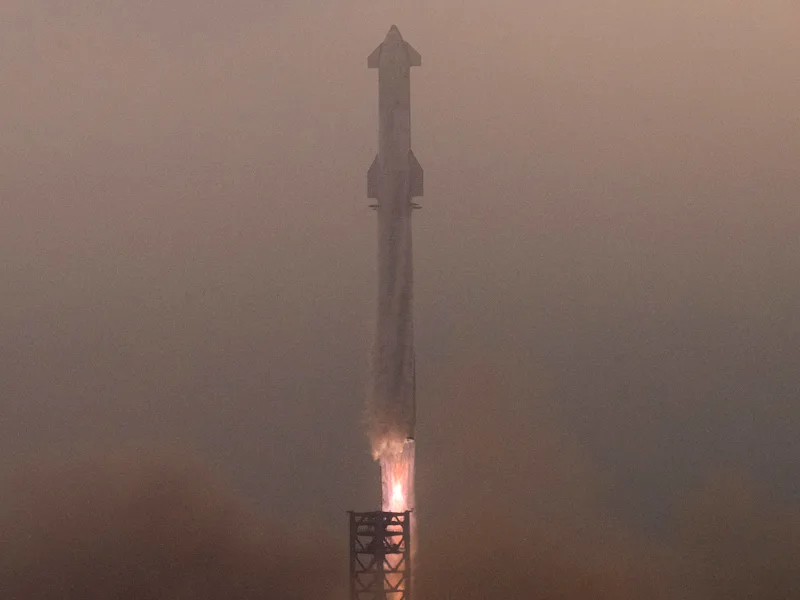
The SpaceX Starship launches on its fourth flight test from Starbase in Boca Chica, Texas, on June 6...
CHANDAN KHANNA/AFP/Getty Images

Starship’s fourth test flight launched at 8:50 am Eastern Time today, and both SpaceX and NASA are declaring the flight, which included splashdown of the Super Heavy first stage, plus re-entry and splashdown for Starship itself, a success.

Flights of the world’s largest rocket are starting to seem almost routine this spring, but SpaceX is under tremendous pressure to have Starship ready to fly the Artemis 3 crew to the Moon — and land there — by late 2026. Starship’s test flights are also part of the key to making sure potential future missions to the Moon and Mars don’t run out of gas on the way. As SpaceX put it in a tweet shortly before launch, “The payload for these flights is data.”

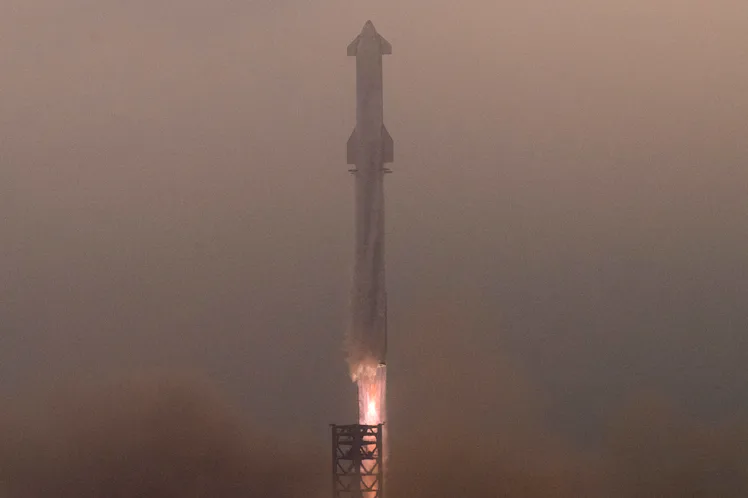
The SpaceX Starship launches on its fourth flight test from Starbase in Boca Chica, Texas, on June 6...

The SpaceX Starship launches on its fourth flight test from Starbase in Boca Chica, Texas, on June 6, 2024. The Starship is vital to NASA's plans for landing astronauts on the Moon later this decade, and to SpaceX CEO Elon Musk's hopes of eventually colonizing Mars. (Photo by Chandan KHANNA / AFP) (Photo by CHANDAN KHANNA/AFP via Getty Images)

CHANDAN KHANNA/AFP/GETTY IMAGES

AN EXTREMELY COOL ENGINEERING CHALLENGE

The largest rocket ever flown, Super Heavy uses a combination of liquid oxygen and methane to get off the ground. Despite the exhaust blasting out the back end of the rocket at several thousand degrees Fahrenheit, the propellant in Super Heavy’s tanks has to be kept at a chilly -300 degrees Fahrenheit; any warmer, and it will boil away into gas, useless for fueling those 33 Raptor engines. SpaceX is one of several contractors — including Eta Space, Lockheed Martin, and United Launch Alliance — whose flights will gather data for NASA’s study of how to manage propellants like these on long flights.

On its third test flight (also known as the first one in which Starship made it to orbit), engineers moved propellant from the header tanks to the main tanks while the ship was coasting in orbit. That's going to be an important step for the Artemis III and IV missions to get the spacecraft out of Low Earth Orbit and on their way to the Moon. Engineers are also using these test flights to study how all those bouncing blobs of rocket fuel affect Starship’s stability in orbit.

Rockets have used super-cold, or cryogenic, liquid propellants, for decades. The Apollo missions traveled to the Moon on a mix of liquid oxygen and liquid hydrogen, both cryogenic (after using liquid kerosene and liquid oxygen to get to space). They work well, but they can be tricky, especially in space, where the temperature can swing from bitter cold to boiling hot in a matter of hours — and the way liquid floats around in microgravity means it’s difficult to transfer fuel from a storage tank to a thruster, or even measure how much is left in the tank.

And if NASA wants to realize its ambitions on the Moon, and eventually Mars, the agency and its contractors will need to store and transfer more cryogenic propellant, for longer flights, than ever before.

“Storing and transferring cryogenic propellant in orbit has never been attempted on this scale before,” said Jeremy Kenny, project manager, NASA’s Cryogenic Fluid Management Portfolio at Marshall, in a March 2024 statement.

That’s where SpaceX comes in, along with a few of its competitors. Starship is working on a particular piece of the problem, called slosh. Once Starship’s main engines cut off, there’s no acceleration forcing the propellant to sit neatly at one end of its tank, where it’s easy to measure. Instead, you get a bunch of little blobs of super-cold fluid bouncing around in the tank. If there’s not enough pressure to keep the propellant all together, then the engine may end up pulling in a bunch of gas, rather than propellant, which means it won’t fire.

One way Starship deals with this problem is by using header tanks: a pair of smaller propellant tanks that can keep the propellant under enough pressure that it doesn't have room to slosh. The header tanks provide the initial sip of propellant the engines need to restart in orbit. Once the engines restart, their thrust will push the liquid in the main tanks back into the right position to flow to the engines and keep them firing.

{ https://www.inverse.com/ }

Hoe vind je dit bericht?
Geschreven door peter om 00:11 Stuur door

Where Did Venus's Water Go?

In Venus' upper atmosphere, hydrogen atoms, orange, whiz into space, leaving behind carbon monoxide molecules, blue and purple. (Credit: Aurore Simonnet/LASP/CU Boulder)

Where Did Venus's Water Go?

It should not be surprising that Venus is dry. It is famous for its hellish conditions, with dense sulphurous clouds, rains of acid, atmospheric pressures comparable to a 900 meter deep lake, and a surface temperature high enough to melt lead. But it’s lack of water is not just a lack of rain and oceans: there’s no ice or water vapour either. Like Earth, Venus is found within our Solar System’s goldilocks zone, so it would have had plenty of water when it was first formed. So where did all of Venus’s water go?

Venus is an extremely dry planet, although it wasn’t always like this. At some point in its history, a run-away greenhouse effect began, ending with its current extreme state. Most models agree that this process would have driven off most of its original water, but that there should still be some remaining. And yet, observations show us that there is practically no water at all. Planetary scientists at the University of Colorado Boulder believe that they have found an explanation: a molecule called HCO+ high in Venus’s atmosphere may be responsible. Unfortunately, they may have to wait for future missions to Venus before they can confirm it.

Until the middle of the 20th century, Venus was thought of as Earth’s twin. Both planets are approximately the same size and mass, and they’re both within the sun’s habitable zone – the region where temperatures can exist that are warm enough to melt ice, but not so hot that water boils into steam. It was long assumed that, beneath its shining white cloud cover, Venus must have a similar climate to Earth. Science fiction authors even wrote stories about visitors to Venus exploring verdant jungles and meeting exotic civilizations. But the truth is much harsher: Venus is an extreme place, with sulphuric acid rains, crushing atmospheric pressure, and a surface temperature hot enough to melt lead. But it wasn’t always like that.

The general assumption among astronomers and planetary scientists is that both Earth and Venus started life with similar amounts of water. But something happened to release enormous quantities of carbon dioxide into its atmosphere, leading to an extreme runaway greenhouse effect. The high temperatures melted off any ice, and boiled away any liquid water, filling the atmosphere with water vapour. Much of this hot vapour would eventually blow off into space, drying out the planet, but some should remain. The puzzle is that the usual models predict a great deal more remaining water vapour than what is actually there. So, what happened?

According to a study, led by Dr Eryn Cangi and Dr Mike Chafin, both of the Laboratory for Atmospheric and Space Physics (LASP), the answer may be a molecule named HCO+. In their earlier work studying the atmosphere of Mars, they discovered a process by which this molecule can remove water from planetary atmospheres. In their new paper, they suggest that the same process could be at work on Venus. The only catch is that this molecule has never been detected in the Venusian atmosphere.

Unfortunately, there is little evidence to confirm this theory. HCO+ has never been detected in the atmosphere of Venus. However, Cangi and Chafin point out that this is because nobody has ever looked for it, and none of the missions sent to Venus so far were equipped with instruments that could detect it. They are optimistic for future missions, however.

NASA's DAVINCI probe falling to the surface of Venus.

Illustration of NASA’s DAVINCI probe falling to the surface of Venus. (Credit: NASA GSFC visualization by CI Labs Michael Lentz and others)

“One of the surprising conclusions of this work is that HCO+ should actually be among the most abundant ions in the Venus atmosphere,” says Chaffin.
“There haven’t been many missions to Venus,” adds Cangi. “But newly planned missions will leverage decades of collective experience and a flourishing interest in Venus to explore the extremes of planetary atmospheres, evolution and habitability.”

The planetary science community has gotten increasingly interested in Venus, and a number of future missions are planned to study it in more detail. NASA’s planned Deep Atmosphere Venus Investigation of Noble gases, Chemistry, and Imaging (DAVINCI) mission is one example. DAVINCI will drop a probe down to the surface, which will study the atmosphere at different altitudes as it falls. Unfortunately for Cangi and Chafin, it is not designed specifically to look for HCO+, but it may reveal other clues to either confirm or disprove their theory. But they remain optimistic that additional missions will be sent in future that will carry the necessary instruments that they can use to test their work.

For more information, visit CU Boulder’s announcement at 

{ https://www.universetoday.com/ }

Hoe vind je dit bericht?
Geschreven door peter om 23:30 Stuur door

Meer van UFO'S of UAP'S, ASTRONOMIE, RUIMTEVAART, ARCHEOLOGIE, OUDHEIDKUNDE, SF-SNUFJES EN ANDERE ESOTERISCHE WETENSCHAPPEN - DE ALLERLAATSTE NIEUWTJES

↑ Terug naar de berichten