Ontdek de Fascinerende Wereld van UFO's en UAP's: Jouw Bron voor Onthullende Informatie!
Ben jij ook gefascineerd door het onbekende? Wil je meer weten over UFO's en UAP's, niet alleen in België, maar over de hele wereld? Dan ben je op de juiste plek!
België: Het Kloppend Hart van UFO-onderzoek
In België is BUFON (Belgisch UFO-Netwerk) dé autoriteit op het gebied van UFO-onderzoek. Voor betrouwbare en objectieve informatie over deze intrigerende fenomenen, bezoek je zeker onze Facebook-pagina en deze blog. Maar dat is nog niet alles! Ontdek ook het Belgisch UFO-meldpunt en Caelestia, twee organisaties die diepgaand onderzoek verrichten, al zijn ze soms kritisch of sceptisch.
Nederland: Een Schat aan Informatie
Voor onze Nederlandse buren is er de schitterende website www.ufowijzer.nl, beheerd door Paul Harmans. Deze site biedt een schat aan informatie en artikelen die je niet wilt missen!
Internationaal: MUFON - De Wereldwijde Autoriteit
Neem ook een kijkje bij MUFON (Mutual UFO Network Inc.), een gerenommeerde Amerikaanse UFO-vereniging met afdelingen in de VS en wereldwijd. MUFON is toegewijd aan de wetenschappelijke en analytische studie van het UFO-fenomeen, en hun maandelijkse tijdschrift, The MUFON UFO-Journal, is een must-read voor elke UFO-enthousiasteling. Bezoek hun website op www.mufon.com voor meer informatie.
Samenwerking en Toekomstvisie
Sinds 1 februari 2020 is Pieter niet alleen ex-president van BUFON, maar ook de voormalige nationale directeur van MUFON in Vlaanderen en Nederland. Dit creëert een sterke samenwerking met de Franse MUFON Reseau MUFON/EUROP, wat ons in staat stelt om nog meer waardevolle inzichten te delen.
Let op: Nepprofielen en Nieuwe Groeperingen
Pas op voor een nieuwe groepering die zich ook BUFON noemt, maar geen enkele connectie heeft met onze gevestigde organisatie. Hoewel zij de naam geregistreerd hebben, kunnen ze het rijke verleden en de expertise van onze groep niet evenaren. We wensen hen veel succes, maar we blijven de autoriteit in UFO-onderzoek!
Blijf Op De Hoogte!
Wil jij de laatste nieuwtjes over UFO's, ruimtevaart, archeologie, en meer? Volg ons dan en duik samen met ons in de fascinerende wereld van het onbekende! Sluit je aan bij de gemeenschap van nieuwsgierige geesten die net als jij verlangen naar antwoorden en avonturen in de sterren!
Heb je vragen of wil je meer weten? Aarzel dan niet om contact met ons op te nemen! Samen ontrafelen we het mysterie van de lucht en daarbuiten.
"The PPR enables a whole new era in space exploration."
An illustration of Howe Industries' Pulsed Plasma Rocket (PPR) concept.
(Image credit: Howe Industries via YouTube)
An innovative rocket system could revolutionize future deep space missions to Mars, reducing travel time to the Red Planet to just a few months.
The goal of landing humans on Mars has presented a myriad of challenges, including the need to quickly transport large payloads to and from the distant planet, which, depending on the positions of Earth and Mars, would take almost two years for a round trip using current propulsion technology.
The Pulsed Plasma Rocket (PPR), under development by Howe Industries, is a propulsion system designed to be far more efficient than current methods of deep space propulsion, enabling the trip between Earth and the Red Planet to be made in just two months. Specifically, the rocket will have a high specific impulse or Isp, a measure of how efficiently an engine generates thrust. This technology could therefore enable astronauts and cargo to travel to and from Mars more efficiently and rapidly than existing spacecraft, according to a statement from NASA.
Stemming from the Pulsed Fission Fusion concept, the PPR uses a fission-based nuclear power system, which obtains energy from the controlled splitting of atoms, to generate thrust for spacecraft propulsion. However, the PPR is smaller, simpler and more affordable than previous concepts.
In addition to enabling further range missions, the PPR could support much heavier spacecraft, meaning additional shielding could be installed to reduce a crew's exposure to harmful high-energy particles, called Galactic Cosmic Rays, endured during long-duration spaceflight.
"The PPR enables a whole new era in space exploration," NASA officials said.
"The exceptional performance of the PPR, combining high Isp and high thrust, holds the potential to revolutionize space exploration," the statement reads. "The system's high efficiency allows for manned missions to Mars to be completed within a mere two months."
The PPR concept is now moving into Phase II of the NASA Innovative Advanced Concept (NIAC) study, having completed Phase I, which focused on the neutronics of the propulsion system, designing the spacecraft, power system and necessary subsystems, analyzing the magnetic nozzle capabilities, and determining trajectories and benefits, according to the statement.
During Phase II, developers will build upon the assessments from Phase I to optimize the engine design, perform proof-of-concept experiments and design a spacecraft concept to better protect crewed flights to Mars. Currently visited only by robotic explorers, the PPR could one day bring NASA closer to establishing a permanent base on Mars.
Join our Space Forums to keep talking space on the latest missions, night sky and more! And if you have a news tip, correction or comment, let us know at: community@space.com.
This week, NASApublished an enchanting image of a trio of stars emerging from the clouds of dust and gas from which they formed. This young trio shows what amounts to a cosmic nursery — young stars emerging from the gaseous clouds that likely created them.
NASA found that HP Tau, the star in the cloud, at the top of the central trio, changes in brightness. That could be because it’s still consuming material from the clouds, or emitting flares off its surface, or reveling in the general chaos that comes with stellar adolescence. Thanks to the trio’s light, the Hubble Space Telescope was able to capture this scene, located 550 light-years away in the constellation Taurus.
The triple-star system of young stars HP Tau, HP Tau G2, and HP Tau G3.
HP Tau could become a Sun-like star someday, but it still has ways to go. For one, it needs to reach nuclear fusion, the hallmark of any main sequence star. In a star’s heart, immense pressures and high temperatures fuse hydrogen into helium. But HP Tau, which is probably less than 10 million years old, needs more time. By comparison, the Sun is about 4.6 billion years old.
When HP Tau and its stellar brethren came into view, Hubble was investigating protoplanetary disks. These pancake-shaped regions surround stars. They’re another major part of stellar adolescence, and astronomers curious about our own origins love to study them. From protoplanetary disks, over the course of millions of years, planets, moons and extra bits like comets and asteroids take shape.
Hubble captured this scene using its Wide Field Camera 3. Space Shuttle astronauts installed this critical piece of hardware onto the orbiting telescope fifteen years ago, in May 2009. This mission, called Servicing Mission 4, almost didn’t happen. “After the loss of the space shuttle Columbia in 2003, Servicing Mission 4 was canceled due to safety concerns,” according to NASA. “Public support for the mission surged, and two years later it was reinstated,” the agency added.
Een boer heeft een enorm stuk ruimteschroot gevonden op zijn akker in Canada. Dit is wat het precies is.
Voorwerp dat "uit de lucht viel" gevonden op een Canadees veld
Een 66-jarige boer uit Saskatchewan, Canada, dat in het zuiden aan de VS grenst, vond een enorm, schijnbaar ongeïdentificeerd object op zijn akker. Barry Sawchuk, zo heet de man, kon niet vermoeden dat het ruimteafval was toen hij het gigantische brokstuk opmerkte. De boer, die met zijn drie kinderen in de buurt van Ituna woont, ten noordoosten van Regina, concentreerde zich eind april op het planten en het vochtgehalte van zijn land toen hij zich bewust werd van de aanwezigheid van het mysterieuze object. Hoe dichter hij bij de vreemde aanwezigheid kwam, hoe groter zijn verbijstering werd.
Het leek op “een verbrand stuk koolstofvezel met een aluminium honingraat erin. Er leek ook een hydraulische cilinder in het puin te zitten." Hij had nog nooit zoiets gezien, dus het was bijna onmogelijk om de identiteit ervan te begrijpen. Sawchuk en zijn familie vermoedden echter waar het vandaan kwam: "We wisten dat het uit de lucht kwam, omdat het daar niet uit zichzelf had kunnen komen.”
Astronomen zijn er zeker van: "het is absoluut ruimteafval"
Jonathan McDowell/x
Op dat punt vermoedde een van zijn zonen, Cody, de oorsprong van het enorme object en ging op onderzoek uit om erachter te komen of het echt ruimteschroot was. Nadat ze zich tot een plaatselijke krant hadden gewend om er meer informatie over te krijgen, werden de beelden van de ontdekking ook gezien door Samantha Lawler, universitair hoofddocent astronomie aan de Universiteit van Regina. De deskundige verklaarde zonder enige twijfel: "Dit is absoluut ruimteafval."
Lawler liet de foto's en coördinaten van de ontdekking zien aan astrofysicus Jonathan McDowell van Harvard, die routinematig ruimtelanceringen in de gaten houdt. De collega was in staat om de ware aard van het puin te herkennen. Hij plaatste een afbeelding op zijn X-account en schreef: "Ik besprak dit net met Sam Lawler. Het rompgedeelte van de Dragon Axiom-3 missie keerde op 26 februari terug naar dat gebied. Ik heb er het volste vertrouwen in dat dit een stuk van de romp van de Dragon is."
Het enorme object dat in het veld van de boer belandde, zou dus een stuk zijn van een Space X Dragon-ruimtevaartuig dat in februari terugkeerde naar de aarde, samen met vier bemanningsleden van het internationale ruimtestation.
Het ruimteschroot is de laadruimte van een ruimtevaartuig dat terugkeerde van het ISS
barry sawchuk/Mensa Saskatchewan
McDowell liet op sociale media zien dat het traject van het rompgedeelte van de raket tijdens de terugkeer een paar kilometer verwijderd was van het punt waar het puin viel. Om elke twijfel weg te nemen werd ook de Transportation and Safety Board of Canada geraadpleegd, die bevestigde dat er geen luchtrapporten zijn die verband kunnen houden met het puin.
SpaceX Dragon is een capsule die wordt gebruikt voor ruimtereizen naar het ISS: de niet onder druk staande laadruimte dient om energie te leveren tijdens de reis en tijdens het verblijf op het station. Zodra het ruimtevaartuig terugkeert naar de aarde, wordt de romp uitgeworpen voordat hij opnieuw in de atmosfeer terechtkomt, en het zou zijn lot moeten zijn om te verbranden en de grond niet intact te bereiken. Maar dat gaat niet altijd zo, zoals bijvoorbeeld in Florida gebeurde, waar ruimteschroot op het dak van een huis belandde.
Buiten ons zonnestelsel zijn er verschillende planeten die we als “enkelvoudig” zouden kunnen definiëren en die astronomen in veel gevallen niet kunnen verklaren, zoals de laatste “nieuwkomer”: de planeet die gemaakt lijkt te zijn van suikerspin.
WASP-193 b, de superzachte planeet
Freepik
Het universum is zo uitgestrekt en rijk aan hemellichamen dat ontdekkingen over nieuwe exoplaneten, dat wil zeggen die buiten ons zonnestelsel, vrij frequent voorkomen. Sommige van de nieuw geïdentificeerde planeten trekken echter bijzondere belangstelling vanwege hun excentriciteit. De laatste is er zo één: de samenstelling is extreem zacht en licht, zozeer zelfs dat je hem kunt vergelijken met een suikerspin.
De breedte is ongeveer 1,5 keer die van Jupiter en de naam die is gekozen om hem te identificeren is WASP-193 b. Hoewel hij groter is dan onze gasreus, is zijn massa slechts 0,139 van die van Jupiter: dit betekent dat het de tweede lichtste planeet is in de lange lijst van planeten met dit kenmerk. In feite bevat de lijst 5400 planeten en de enige die WASP-193 b overtreft is Kepler 51 d, vergelijkbaar met Neptunus. Maar waar bevindt zich de “suikerspinplaneet”?
Enorme planeten met kleine dichtheden: al jaren een mysterie
WASP-193 b bevindt zich op ongeveer 1200 lichtjaar van onze planeet en draait rond zijn ster op een afstand gelijk aan 0,7 maal die tussen de zon en de aarde. Het duurt slechts 6,2 dagen om een baan te voltooien. Met zijn ontdekking wordt er een stukje toegevoegd aan de prachtige puzzel van het universum. Khalid Barkaoui van MIT, Massachusetts Institute of Technology, en co-auteur van de ontdekking, legde uit: “Het vinden van deze gigantische objecten met zo’n kleine dichtheid is echt heel zeldzaam. Er is een klasse planeten die gezwollen Jupiters worden genoemd, en wat ze zijn is al vijftien jaar een mysterie. Dit is een extreem geval van die klasse."
WASP-193 werd ontdekt door het MIT-team via het Wide Angle Search for Planets (WASP)-systeem, dat twee robotobservatoria heeft, één voor het noordelijk halfrond en één voor het zuidelijk halfrond, evenals talrijke telescopen.
Het mysterie van de vorming van de "suikerspinplaneet"
Freepik
De gezwollen, pluizige gasplaneet werd door het WASP-systeem gedetecteerd door de microscopische vermindering van het sterlicht te observeren, veroorzaakt door zijn passage voor zijn ster. Julien de Wit van het Department of Earth, Atmospheric and Planetary Sciences van MIT en lid van het team, zei: “Normaal gesproken zijn grote planeten vrij eenvoudig te detecteren, omdat ze doorgaans massief zijn en een grote aantrekkingskracht op hun ster uitoefenen. Maar het lastige aan deze planeet is dat, ook al is hij groot en enorm, zijn massa en dichtheid zo laag zijn dat het eigenlijk heel moeilijk was om deze alleen met de radiale snelheidstechniek te detecteren. Het was een interessante wending."
Waarnemingen met WASP duurden vier jaar voordat een zeer klein maar detecteerbaar signaal werd verkregen. WASP-193 b lijkt echter in tegenspraak te zijn met de huidige concepten met betrekking tot planeetvorming, omdat het extreem “zacht” is, zoals uitgelegd door de co-auteur van de ontdekking Francisco Pozuelos, onderzoeker aan het Instituut voor Astrofysica van Andalusië: "We weten niet waar we deze planeet moeten plaatsen in alle vormingstheorieën die we nu hebben, omdat het een abnormale waarde heeft. We kunnen niet verklaren hoe het is ontstaan op basis van klassieke evolutionaire modellen."
De suikerspin heeft een dichtheid van ongeveer 0,05 gram per kubieke centimeter, terwijl die van de planeet 0,059 is. Dit is waar de vergelijking vandaan komt. Die van de aarde bedraagt echter 5,5 gram. "De reden dat het vergelijkbaar is met een suikerspin is dat ze allebei voornamelijk uit lichte gassen bestaan in plaats van uit vaste stoffen. De planeet is in principe heel zacht en het is moeilijk om aan een analoog materiaal in vaste toestand te denken”, verduidelijkte Barkaoui. Aangenomen wordt dat WASP-193 b, net als Jupiter, voornamelijk uit helium en waterstof bestaat.
Native Alaskans Capture ‘Dancing’ UFOs on Camera: An Unforgettable Encounter
In the quiet, remote community of Nenelchik, Alaska, the night sky has long held a sense of wonder and mystery. For Sherry, a seventh-generation native, and her daughter Tiffany, an unforgettable event in 2020 would forever alter their perception of the cosmos. Their story, a vivid account of encountering what they describe as “dancing” UFOs, adds a fascinating chapter to the growing lore of extraterrestrial sightings in Alaska.
A Night Like No Other
Sherry and Tiffany’s encounter began on a seemingly ordinary evening. After work, Sherry and Tiffany decided to unwind at a local bar, a common gathering spot for residents. The relaxed atmosphere took an unexpected turn when a bright light outside the window caught their attention. The sight was astonishing: four enormous, glowing orbs hovered near the mountains, emitting an otherworldly light. Unlike anything they’d ever seen, these orbs moved in a coordinated, dance-like pattern, defying the typical behavior of satellites or aircraft.
The Chase to the Beach
Driven by a mix of curiosity and awe, Sherry, Tiffany, and other onlookers rushed to the nearby beach for a closer view. There, they witnessed a spectacle that seemed straight out of a science fiction movie. The lights appeared even larger and brighter, and smaller lights seemed to move in synchronization with the main orbs. The phenomenon was captivating and bewildering, leading Tiffany to attempt to record it on her phone. However, the images were fleeting and unclear, possibly due to interference from the UFOs themselves.
A Community Divided
The encounter left Sherry and Tiffany convinced of the presence of extraterrestrial visitors. However, their claims were met with skepticism by many in their village. Detractors suggested the lights were military flares or some other explainable phenomenon. Despite the doubts, Sherry and Tiffany remained steadfast in their belief, bolstered by the profound impact of what they had witnessed.
Speculations and Theories
Sherry speculates that these UFOs might be drawn to Alaska for its rich mineral resources, potentially mining the mountains and causing increased seismic activity. This theory, while unproven, adds an intriguing dimension to the mystery, suggesting a possible motive for these extraterrestrial visits.
Another Sighting: Bruce Manley’s Experience
Further adding to the mystique of Alaskan UFO sightings is the account of Bruce Manley from Kasilof. Bruce, a long-time resident and commercial fisherman, had his own close encounter with a triangular UFO. One night, after a long shift in the oil fields, Bruce spotted a slow-moving, silent triangle hovering over the Swanson River. The craft had three distinct lights and moved with a grace and silence that left Bruce in awe. Before this experience, Bruce was skeptical about UFOs. But the sighting left no doubt in his mind about the existence of something beyond our world.
The Vast Alaskan Skies
Alaska’s vast, dark landscapes offer a unique vantage point for sky watchers. The state’s expansive, unpolluted skies provide ideal conditions for spotting unusual aerial phenomena. It’s no wonder that stories of UFO sightings are relatively common here. For people like Sherry, Tiffany, and Bruce, these experiences are not just tales of curiosity but profound events that challenge our understanding of the universe.
VIDEO:
Native Alaskans Capture “Dancing” UFOs On Camera | Aliens In Alaska
The sightings in Nenelchik and Kasilof contribute to the growing body of anecdotal evidence suggesting that Alaska might be a hotspot for UFO activity. Whether driven by natural curiosity or a quest for answers, the experiences of Sherry, Tiffany, and Bruce highlight a fascinating aspect of life in this remote part of the world. As stories like these continue to emerge, they invite us all to look up and wonder about the mysteries that may be unfolding in the skies above us.
However, now the star has left the wild nights of partying behind for an eco-friendly countryside cottage.
The 68-year-old TV personality moved to the old farmhouse in 2019 and has embraced 'off-grid' living, generating her own electricity and nurturing her own vegetable patch.
Aside from WiFi, she more or less lives self-sufficiently and has traded in her days of drinking and joints for homegrown veg and is even creating a capsule supplement called Longevity to boost her health.
Speaking to The Telegraph, Jo admitted that she didn't have an addictive personality which made it easier for her to walk away from the party lifestyle after it suddenly dawned on her one day that way of living wasn't what she wanted.
Inside Jo Wood's eclectic off-grid farmhouse as she reveals why she ditched rock 'n' roll hedonism for UFO spotting and growing veg
The 68-year-old TV personality moved to the old farmhouse in 2019 and has embraced 'off-grid' living, generating her own electricity and nurturing her own vegetable patch
She explained: 'I could drink all night, suffer the next day and not touch a drop for a few days. I never had a problem with it. I used to smoke a joint every evening and then one day I thought "No, I don't want this any more" and stopped. I'm lucky like that.'
Jo was married to Rolling Stones rocker Ronnie for 24 years between 1985-2011 and the two share children Leah, 44, and Tyrone, 39.
Jo is also mum to another son, Jamie, 48, from her first marriage to clothing entrepreneur Peter Greene.
After ditching her unhealthy lifestyle, Jo converted to organic food in 1991 after she was diagnosed with Crohn's disease, this was later revealed to be a misdiagnosis and she actually had a perforated appendix.
'I laid in hospital and said to myself "from now on, I will be an organic girl",' Jo explained.
Her obsession with organics led to her interest in plastics and chemicals in cosmetics which led to her fragrance company Jo Wood Organics.
The star got Ronnie on a healthy diet, and her son Jamie even joked that he left home because he couldn't stand her being so health conscious anymore.
She added: 'I'm going to live forever. That's the plan. I certainly want to make sure to live to an old age because I want to see what's going to happen with my grandchildren.'
Jo admitted that it suddenly dawned on her one day that the wild party lifestyle wasn't what she wanted (pictured with Ronnie Wood in 1999)
She told The Telegraph: 'I could drink all night, suffer the next day and not touch a drop for a few days. I never had a problem with it. I used to smoke a joint every evening and then one day I thought "No, I don't want this any more" and stopped. I'm lucky like that' (pictured with Kate Moss at Ronnie's 50th in 1997)
Aside from WiFi, she more or less lives self-sufficiently and has traded in her days of drinking and joints for homegrown veg and loves her house so much as there are no chemtrails in the sky
After ditching her unhealthy lifestyle, Jo converted to organic food in 1991 after she was erroneously diagnosed with Crohn's disease, she added: 'I'm going to live forever. That's the plan'
As well as growing her own fruit and vegetables, she has also created her own wood-fired sauna and pond-pool which she dug out of the gentle hillside that slopes down from the house.
She remarked she loves her house so much as there are no chemtrails in the sky.
Her and Jamie are also created their health capsule supplement Longevity, which is a made with a blend of lions mane, turkey tail and reishi mushrooms as well as maca powder, he shou wu and astragalus root and promises to boost all aspects of health.
Living in the middle of nowhere, Jo also explained that she feels free at home, away from the censoring and cancel culture of the world.
The star remarked that she is unable to post anything that is even slightly controversial on Instagram as somehow it is blocked.
Jo also confessed she did not get vaccinated due to her organic beliefs as she doesn't wish to be forced to get something she didn't feel like she needed it.
The star also has a slight obsession with aliens, and her home contains a selection of alien-themed fittings.
Showing off her extraterrestrial trinkets and even wallpaper on an episode of Abbey Clancy: Celebrity Homes last October, Jo confessed: 'I am obsessed with all things alien. The alien wallpaper I designed because I love them so much!'
Her kitchen boasts a huge eclectic mix of furnishings and ceramics
Showing off her extraterrestrial trinkets and even wallpaper on an episode of Abbey Clancy : Celebrity Homes last October, Jo confessed: 'I am obsessed with all things alien'
She designed her own alien wallpaper as she loves them so much
The bedroom features a huge rug with a skull on it
Revealing how her love of aliens came to be, she explained: 'I was in Brazil in this place called Recife with my ex husband [Ronnie Wood].
'He was outside and he said "Jo, Jo get here, there's something weird in the sky! I went outside and thought "what's wrong with him?" and there above the sea was a craft!
'As I watched it it lifted straight up, went to the right and then shot across the sky at a speed that was just... and I just went, "oh my god!"'
In her spacious living room, Jo removed double doors in order to have a wall large enough to hang her beloved portrait of Marilyn Monroe.
Revealing the importance behind the painting, Jo explained: 'Marilyn reminds me of my mummy.'
She also pointed out her 'valuable' yet 'fake' fireplace with no fire as she toured Abbey through her home.
Discussing her decorating inspiration, Jo explained: 'My style I suppose is very eclectic obviously and things that I think are beautiful.
'All this stuff here, it's me. It's the things that I've got because I love them.'
Jo Wood describes her encounter with a suspected UFO
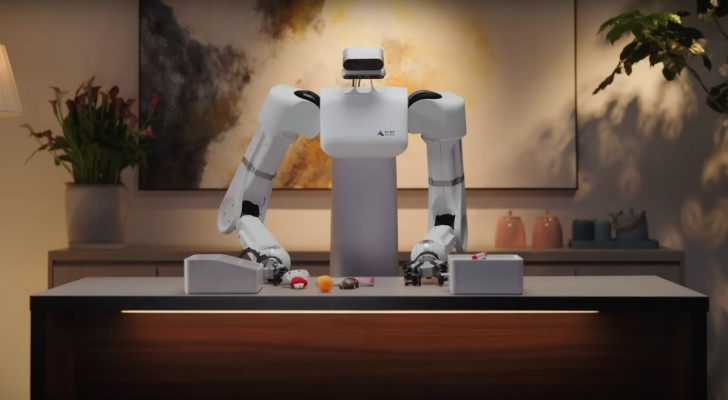
Het landschap van door AI aangedreven humanoïde robots wordt steeds drukker. Tegenwoordig zijn er verschillende androïden die innovatieve prestaties beloven en soms handhaven: sommigen zetten koffie, anderen weten hoe ze stemmen moeten imiteren, weer anderen dragen grote ladingen. In zo’n context valt Astribot S1 echter op, een mensachtige robot ontwikkeld door een Chinees bedrijf die een ongekende combinatie van snelheid en precisie belooft. Kijkend naar de videopresentatie lijkt het of ze er echt in geslaagd zijn.
Een nieuwe robot geanimeerd door kunstmatige intelligentie
Astribot/Youtube
Stardust Intelligence is een innovatieve startup op het gebied van kunstmatige intelligentie en heeft in iets meer dan een jaar een mensachtige robot ontwikkeld die nu al buitengewone resultaten laat zien. Het geheim van Astribot S1 ligt in de integratie met kunstmatige intelligentie, waardoor het taken kan uitvoeren die als exclusief voor mensen worden beschouwd, en in het vermogen om op verschillende manieren te leren. We hebben het over het correct opvouwen van kleding, snelle bereiding van voedsel, nauwkeurig schrijven in Japanse kanji: we zullen het zien in de video "Hello world".
Volgens Stardust Intelligence vertegenwoordigt de Astribot S1 het hoogtepunt in het gebruik van kunstmatige intelligentie met androïden, zoals blijkt uit de video waarin de mensachtige robot aan de hele wereld wordt gepresenteerd. Bovendien kan S1 snelheden bereiken van 10 meter per seconde (mensen arriveren rond de 7) en is hij bestand tegen zware lasten.
Een behendigheid die de confrontatie met mensen niet schuwt
Astribot/Youtube
Het is logisch om je af te vragen hoe Astribot S1 zo snel en precies is in zijn bewegingen, zozeer zelfs dat het de exclusiviteit van sommige activiteiten, die tot nu toe als louter menselijk werden beschouwd, in twijfel trekt. Het bedrijf heeft geen technische details bekendgemaakt over het S1 AI-trainingsproces, noch over hoe het mogelijk was om het in iets meer dan een jaar te ontwikkelen, maar het is mogelijk om een beetje een idee te krijgen.
Allereerst lijkt het hybride ontwerp een winnende keuze: vanaf de taille heeft de Astribot S1 een basis met wielen, terwijl het bovenaan een mensachtige robot is. Aan de softwarekant kan het videogegevens verzamelen, nauwkeurige bewegingsregistratie uitvoeren en zelfs bewerkingen op afstand uitvoeren. In de videopresentatie zien we Astribot S1 een reeks taken uitproberen: de Android plaatst voorwerpen in bak, ontkurkt een fles, stofzuigt.
De toekomst van robotica
Astribot/Youtube
Stardust Intelligence zorgt ervoor dat de video’s op normale snelheid worden afgespeeld en geen manipulaties bevatten: als dit wel het geval zou zijn, zouden we de toekomst van robotica en de samenleving tegemoet treden. En misschien is dit wel het meest zorgwekkend. Astribot S1 ontleent zijn naam aan het Latijnse motto per aspera ad astra, wat “via moeilijkheden naar de sterren” betekent, en weerspiegelt de ambitie van Stardust Intelligence op het gebied van robotica. De mogelijkheden van de S1 lijken inderdaad zowel buitengewoon als onwerkelijk, alsof de toekomst op de deur klopt. Een deur die binnenkort opengaat: Astribot S1 is bijna klaar om op de markt te worden gebracht.
Aan de ene kant kan men daarom niet anders dan de enorme vooruitgang erkennen die is geboekt door het onderzoek naar kunstmatige intelligentie en de ontwikkeling van steeds snellere en nauwkeurigere androïden. Aan de andere kant is het legitiem om je af te vragen welke toekomst deze nieuwe machines kunnen bouwen. En wat ons aandeel daarin is.
The Hubble Space Telescope is amazing! It's still going strong more than 34 years after it was launched. This Hubble image showcases a nearly edge-on view of the lenticular galaxy NGC 4753. ESA/Hubble & NASA, L. Kelsey
The Venerable Hubble Space Telescope Keeps Delivering
The world was much different in 1990 when NASA astronauts removed the Hubble Space Telescope from Space Shuttle Discovery’s cargo bay and placed it into orbit. The Cold War was ending, there were only 5.3 billion humans, and the World Wide Web had just come online.
Now, the old Soviet Union is gone, replaced by a smaller but no less militaristic Russia. The human population has ballooned to 8.1 billion. The internet is a fixture in daily life. We also have a new, more powerful space telescope, the JWST.
But the Hubble keeps delivering, as this latest image shows.
The lenticular galaxy NGC 4753 is about 60 million light-years away. Lenticular galaxies are midway between elliptical and spiral galaxies. They have large-scale disks but only poorly defined spiral arms. NGC 4753 sees very little star formation because like other lenticulars, it’s used up most of its gas. The fact that they contain mostly older stars makes them similar to elliptical galaxies.
Among lenticulars, NGC 4753 is known for the dust lanes surrounding its nucleus. Astronomers think that spirals evolve into lenticulars in dense environments because they interact with other galaxies and with the intergalactic medium. However, NGC 4753 is in a low-density environment. Its environment and complex structure make it a target for astronomers to test their theories of galaxy formation and evolution.
This Hubble image is the sharpest ever taken of NGC 4753, revealing its intriguing complexity and highlighting the space telescope’s impressive resolving power.
Astronomers think that NGC 4753 is the result of a merger with a dwarf galaxy over one billion years ago. The dwarf galaxy was gas-rich, and NGC 4753’s distinct dust rings probably accreted from the merger. NGC 4753’s powerful gravity then shaped the gas into the complex shapes we see in this image. Image Credit: ESA/Hubble & NASA, L. Kelsey
NGC 4763’s unique structure results from a merger with a dwarf galaxy about 1.3 billion years ago. The video below from NOIRlab explains what happened.
NGC 4753 also hosts two known Type 1a supernovae, which are important because they help astronomers study the expansion of the Universe. They serve as standard candles, an important rung in the cosmic distance ladder.
Galaxies like NGC 4753 may not be rare, but the viewing angle plays a key role in identifying them. Our edge-on view of the galaxy makes its lenticular form clear. We could be seeing others like it from different angles that obscure its nature.
This is a model of NGC 4753, as seen from various viewing orientations. From left to right and top to bottom, the angle of the line of sight to the galaxy’s equatorial plane ranges from 10° to 90° in steps of 10°. Although galaxies similar to NGC 4753 may not be rare, only certain viewing orientations allow for easy identification of a highly twisted disk. This infographic is a recreation of Figure 7 from a 1992 research paper.
If we were looking at NGC 4753 from the “top” down, its detailed dust lanes wouldn’t be obvious to us. But fortunately, we are.
Did Earth’s Multicellular Life Depend on Plate Tectonics?
How did complex life emerge and evolve on the Earth and what does this mean for finding life beyond Earth? This is what a recent study published in Nature hopes to address as a pair of researchers investigated how plate tectonics, oceans, and continents are responsible for the emergence and evolution of complex life across our planet and how this could address the Fermi Paradox while attempting to improve the Drake Equation regarding why we haven’t found life in the universe and the parameters for finding life, respectively. This study holds the potential to help researchers better understand the criterion for finding life beyond Earth, specifically pertaining to the geological processes exhibited on Earth.
Here, Universe Today discusses this study with Dr. Taras Gerya, who is a Professor of Earth Sciences at the Swiss Federal Institute of Technology (ETH-Zurich) and co-author of the study, regarding the motivation behind the study, significant results, follow-up studies, what this means for the Drake Equation, and the study’s implications for finding life beyond Earth. So, what was the motivation behind this study?
Dr. Gerya tells Universe Today, “It was motivated by the Fermi Paradox (“Where is everybody?”) pointing out that the Drake Equation typically predicts that there are from 1000 to 100,000,000 actively communicating civilizations in our galaxy, which is too optimistic of an estimate. We tried to figure out what may need to be corrected in this equation to make the prediction with the Drake Equation more realistic.”
For the study, the research duo compared two types of planetary tectonic processes: single lid (also called stagnant lid) and plate tectonics. Single lid refers to a planetary body that does not exhibit plate tectonics and cannot be broken into separate plates that exhibit movement by sliding towards each other (convergent), sliding past each other (transform), or slide away from each other (divergent). This lack of plate tectonic activity is often attributed to a planetary body’s lid being too strong and dense to be broken apart. In the end, the researchers estimated that 75 percent of planetary bodies that exhibit active convection within their interiors do not exhibit plate tectonics and possess single lid tectonics, with Earth being the only planet that exhibits plate tectonics. Therefore, they concluded that single lid tectonics “is likely to dominate the tectonic styles of active silicate bodies in our galaxy”, according to the study.
Additionally, the researchers investigated how planetary continents and oceans contribute to the evolution of intelligent life and technological civilizations. They noted the significance of life first evolving in oceans due to them being shielded from harmful space weather with single-celled life thriving in the oceans for the first few billion years of Earth’s history. However, the researchers also emphasize how dry land provides a myriad of benefits for the evolution of intelligent life, including adaptations to various terrains, such as eyes and new senses, which contributed to animals evolving for speed to hunt among other biological assets that enabled life to adapt to the various terrestrial environments across the planet.
In the end, the researchers concluded dry land helped contribute to the evolution of intelligent life across the planet, including abstract thinking, technology, and science. Therefore, what were the most significant results from this study, and what follow-up studies are currently in the works or being planned?
Dr. Gerya tells Universe Today, “That very special condition (>500 million years coexistence of continents, oceans, and plate tectonics) is needed on a planet with a primitive life in order to develop an intelligent technological communicative life. This condition is very rarely realized: only <0.003-0.2 of="" planets="" with="" any="" life="" may="" satisfy="" this="" condition="" span="">
Dr. Gerya continues, “We plan to study water evolution in the planetary interior in order to understand how stability of surface ocean volume (implying stability of coexistence of oceans and continents) can be maintained for billions of years (like on Earth). We also plan to investigate the survival time of technological civilizations based on societal collapse models. We also started a project on the oxygenation state evolution of planetary interior and atmosphere in order to understand how oxygen-rich atmospheres (essential in particular for developing technological civilizations) can be formed on planets with oceans, continents and plate tectonics. Progress in these three directions is essential but will greatly depend on the availability of research funding.”
As noted, this study was motivated and attempts to improve the Drake Equation, which proposes a multivariable equation that attempts to estimate the number of active, communicative civilizations (ACCs) that exist in the Milky Way Galaxy. It was proposed by in 1961 Dr. Frank Drake to postulate several notions that he encouraged the scientific community to consider when discussing both how and why we haven’t heard from ACCs and reads as follows:
N = R* x fp x ne x fl x fi x fc x L
N = the number of technological civilizations in the Milky Way Galaxy who can potentially communicate with other worlds
R* = the average star formation rate in the Milky Way Galaxy
fp = the fraction of those stars with planets
ne = the average number of planets potentially capable of supporting life per star with planets
fl = the fraction of planets capable of supporting and developing life at some point in its history
fi = the fraction of planets that develop life and evolves into intelligent life
fc = the fraction of civilizations who develop technology capable of sending detectable signals into space
L = the length of time that technological civilizations send signals into space
According to the study, the Drake Equation estimates the number of ACCs range widely, between 200 to 50,000,000. As part of the study, the researchers proposed adding two additional variables to the Drake Equation based on their findings that plate tectonics, oceans, and continents have played a vital role in the development and evolution of complex life on Earth, which are as follows:
foc= the fraction of habitable exoplanets that possess notable continents and oceans
fpt= the fraction of habitable exoplanets that possess notable continents and oceans that also exhibit plate tectonics that have been functioning for at least 500 million years
Using these two new variables, the study provided new estimates for fi (chances of planets that develop life and evolve into intelligent life). So, what is the importance of adding two new variables to the Drake Equation?
Dr. Gerya tells Universe Today, “This allowed us to re-define and estimate more correctly the key term of the Drake equation fi – probability of a planet with primitive life to develop an intelligent technological communicative life. Originally, fi was (incorrectly) estimated to be very high (100%). Our estimate is many orders of magnitude lower (<0.003-0.2 which="" likely="" explains="" why="" we="" are="" not="" contacted="" by="" other="" civilizations="" span="">
Additionally, when inputting these two new variables into the entire Drake Equation, the study estimates a far smaller number of ACCs at < 0.006 to 100,000, which is in stark contrast to the original estimates of the Drake Equation of 200 to 50,000,000. Therefore, what implications could this study have on the search for life beyond Earth?
Dr. Gerya tells Universe Today, “It has three key consequences: (1) we should not hope much that we will be contacted (probability of this is very low, in part because the life time of technological civilizations can be shorter than previously expected), (2) we should use remote sensing to look for planets with oceans, continents and plate tectonics (COPT planets) in our galaxy based on their likely distinct (CO2-poor) atmospheres and surface reflectivity signatures (due to the presence of oceans and continents), (3) we should take care about our own planet and civilization, both are extremely rare and must be preserved.”
This study comes as the search for life beyond Earth continues to gain traction, with NASA having confirmed the existence of 5,630 exoplanets as of this writing, with almost 1,700 being classified as Super-Earths and 200 being classified as rocky exoplanets. Despite these incredible numbers, especially since exoplanets first started being discovered in the 1990s, humanity has yet to detect any type of signal from an extraterrestrial technological civilization, which this study referred to as ACCs.
Arguably the closest we have come to receiving a signal from outer space was the Wow! signal, which was a 72-second radio blast received by Ohio State University’s Big Ear radio telescope on August 15, 1977. However, this signal has yet to be received since, along with a complete lack of signals at all. With this study, perhaps scientists can use these two new variables added to the Drake Equation to help narrow the scope of finding intelligent life beyond Earth.
Dr. Gerya concludes by telling Universe Today, “This research is part of an emerging new science – Biogeodynamics, which we try to support and develop. Biogeodynamics aims to understand and quantify relations between the long-term evolution of planetary interiors, surface, atmosphere, and life.”
How will these two new variables added to the Drake Equation help scientists find life beyond Earth in the coming years and decades? Only time will tell, and this is why we science!
What the Vatican knows about aliens and why UFO 'cover-up' won't go away for Pope
The Vatican has long been thought to be hiding something very telling when it comes to it - and The Pope's - involvement with alien cover-ups, with continued silence seemingly not helping
Does The Pope now about alleged cover-ups by his predecessors?(Image: Getty Images)
For decades, the truth about the Vatican's relationship with aliens has been kept hidden from the public – with officials refusing to comment on it.
Speculation has been running riot about what lies beneath the Vatican's walls, with rumours of aliencover-ups and evidence being kept inside its vaults ramping up in recent years. But the pressure on the Vatican to front up to the claims ramped up last year thanks to a whistleblower.
David Grusch is a US Air Force veteran and has often made claims about the US Government's involvement in covering up the truth about aliens and UFOs. However, last year he brought the Vatican into the fold by claiming that it knows about aliens and was involved in a cover-up as far back as 1933.
What lies beneath the Vatican's walls inside the vault? Aliens, obviously
(stock)(Image: Getty Images/iStockphoto)
He said: “1933 was the first recovery in Europe, in Magenta, Italy. They recovered a partially intact vehicle, and the Italian government moved it to a secure airbase in Italy until around 1944-1945
“The Pope back-channelled that, and told the American's what the Italians had and we ended up scooping it.”
He was then asked by NewsNation to clarify whether or not the Catholic Church was aware of “non-human” existence on Earth, to which he replied: “Certainly.” And when asked why he should be believed, he said: “I have the credentials, and I was an intelligence officer.”
The rumours stem from an alleged 1933 cover-up(Image: Getty Images)
But when probed about the claims, the Vatican refused to respond – and has yet to do so to this very day.
Journalist Ross Coulthart suggested: "It's a very difficult situation for the Vatican because if Mr Grusch is telling the truth, it's a difficult thing for the Vatican to admit without the US concurring. I'm told the Vatican does have a very efficient intelligence service and it's long collaborated with intelligence services like the CIA providing useful intelligence, and especially in the wake of the Second World War."
We're unlikely to ever found out the truth(Image: Getty Images)
Coulthart claims to be in touch with people with access to the Vatican’s archives, which consists of 53-mile-long shelves full of documents. Answers to Grusch’s claims may lie there, he added.
It has often been claimed that if the Vatican were to open its vault doors and be honest about what it knows, it could do irreparable damage to itself.
But for now, the truth remains . . . more hidden than “out there”.
Meer van UFO'S of UAP'S, ASTRONOMIE, RUIMTEVAART, ARCHEOLOGIE, OUDHEIDKUNDE, SF-SNUFJES EN ANDERE ESOTERISCHE WETENSCHAPPEN - DE ALLERLAATSTE NIEUWTJES


 NASA-funded pulsed plasma rocket concept aims to send astronauts to Mars in 2 months