Naar de inhoud

UFO'S of UAP'S, ASTRONOMIE, RUIMTEVAART, ARCHEOLOGIE, OUDHEIDKUNDE, SF-SNUFJES EN ANDERE ESOTERISCHE WETENSCHAPPEN - DE ALLERLAATSTE NIEUWTJES

UFO's of UAP'S in België en de rest van de wereld
akke.beakke.be
Ontdek de Fascinerende Wereld van UFO's en UAP's: Jouw Bron voor Onthullende Informatie! Ben jij ook gefascineerd door het onbekende? Wil je meer weten over UFO's en UAP's, niet alleen in België, maar over de hele wereld? Dan ben je op de juiste plek! België: Het Kloppend Hart van UFO-onderzoek In België is BUFON (Belgisch UFO-Netwerk) dé autoriteit op het gebied van UFO-onderzoek. Voor betrouwbare en objectieve informatie over deze intrigerende fenomenen, bezoek je zeker onze Facebook-pagina en deze blog. Maar dat is nog niet alles! Ontdek ook het Belgisch UFO-meldpunt en Caelestia, twee organisaties die diepgaand onderzoek verrichten, al zijn ze soms kritisch of sceptisch. Nederland: Een Schat aan Informatie Voor onze Nederlandse buren is er de schitterende website www.ufowijzer.nl, beheerd door Paul Harmans. Deze site biedt een schat aan informatie en artikelen die je niet wilt missen! Internationaal: MUFON - De Wereldwijde Autoriteit Neem ook een kijkje bij MUFON (Mutual UFO Network Inc.), een gerenommeerde Amerikaanse UFO-vereniging met afdelingen in de VS en wereldwijd. MUFON is toegewijd aan de wetenschappelijke en analytische studie van het UFO-fenomeen, en hun maandelijkse tijdschrift, The MUFON UFO-Journal, is een must-read voor elke UFO-enthousiasteling. Bezoek hun website op www.mufon.com voor meer informatie. Samenwerking en Toekomstvisie Sinds 1 februari 2020 is Pieter niet alleen ex-president van BUFON, maar ook de voormalige nationale directeur van MUFON in Vlaanderen en Nederland. Dit creëert een sterke samenwerking met de Franse MUFON Reseau MUFON/EUROP, wat ons in staat stelt om nog meer waardevolle inzichten te delen. Let op: Nepprofielen en Nieuwe Groeperingen Pas op voor een nieuwe groepering die zich ook BUFON noemt, maar geen enkele connectie heeft met onze gevestigde organisatie. Hoewel zij de naam geregistreerd hebben, kunnen ze het rijke verleden en de expertise van onze groep niet evenaren. We wensen hen veel succes, maar we blijven de autoriteit in UFO-onderzoek! Blijf Op De Hoogte! Wil jij de laatste nieuwtjes over UFO's, ruimtevaart, archeologie, en meer? Volg ons dan en duik samen met ons in de fascinerende wereld van het onbekende! Sluit je aan bij de gemeenschap van nieuwsgierige geesten die net als jij verlangen naar antwoorden en avonturen in de sterren! Heb je vragen of wil je meer weten? Aarzel dan niet om contact met ons op te nemen! Samen ontrafelen we het mysterie van de lucht en daarbuiten.

Archief

UAPS IN CANADA: A CONVERSATION WITH MP LARRY MAGUIRE ON DISCLOSURE, TRANSPARENCY, AND GOVERNMENT ACTION

UAPS IN CANADA: A CONVERSATION WITH MP LARRY MAGUIRE ON DISCLOSURE, TRANSPARENCY, AND GOVERNMENT ACTION

r/UfoUapNews - Uaps In Canada: A Conversation With Mp Larry Maguire On Disclosure, Transparency, And Government Action

The Canadian government is no stranger to the subject of UFOs, objects that today the United States government prefers to call unidentified anomalous/aerial phenomena, or UAP.

Between 1950 and 1995, the Canadian military investigated UFOs, beginning with Project Magnet on December 2, 1950, under the direction of senior radio engineer Wilbert Brockhouse Smith and developed by Transport Canada to collect data and research on unidentified flying objects. The goal was to apply any recently recovered data to modern-day technologies or engineering. At the end of the first study, Smith concluded that UFOs were ET in origin and used the manipulation of magnetism to fly the object or craft.

Shortly thereafter, on April 22, 1952, Project Second Story (also known as Project Flying Saucers and Project Theta) was established by the Defence Research Board, Canada’s military science agency.

The distinction between the two Canadian projects lies in their origins and scope. While Project Magnet was initiated and overseen by one individual, Project Second Story was a collaborative effort involving government agencies and Canadian military intelligence and was specifically tasked with handling UFO reports. Additionally, Project Second Story was funded by the Defence Research Board in Canada. In total, the committee held 6 meetings and ended in 1954. The program’s demise resulted from the government’s determination that, ultimately, the UFO phenomenon was not conducive to scientific investigation.

From a Canadian perspective, developments regarding the UAP topic have been relatively quiet for the past 70 years. That is, until Former Minister of Defense Paul Hellyer stepped forward in 2005, publicly expressing his belief that extraterrestrials are visiting Earth. Media, government officials, and Canadian civilians had mixed reactions to his statement which became a global conversation overnight. Hellyer was the first formal government official from a G7 country to step forward and speak on ETs and UFOs.

Hellyer passed away on August 8, 2021, at the age of 98. He didn’t live long enough to see how, in 2023, Canadian MP Larry Maguire would similarly come forward, writing a letter claiming that the Canadian government possesses material related to UAP.

Shortly prior to Maguire’s statement, the Canadian government established Sky Project Canada, in which the Office of the Chief Science Advisor (OCSA) was tasked with developing Canadian protocols for documenting and addressing UAP observations.

Since the release of Maguire’s initial statement on UAP, Maguire has only addressed the subject on a few occasions, which included an appearance at the Sol Foundation inaugural symposium in Palo Alto, California, in November 2023.

In a conversation with The Debrief, MP Larry Maguire recently explored his thoughts on the UAP subject, the Canadian government’s position, and his proposals for advancing the subject in Canada (the following Q&A has undergone minor editing for additional clarity).

Larry Maguire
MP Larry Maguire (Credit: House of Commons of Canada).

Chrissy Newton: What sparked your initial interest in the topic of Unidentified Aerial Phenomena (UAP) in Canada?

MP Larry Maguire: The New York Times story in 2017, that showed the American government was investigating UAPs.

CN: What made you want to come forward in 2023 to address the alleged crash retrievals and secret multi-nation UAPs program Canada and the United States have participated in?

LM: Policymakers in Canada need to understand that, over the decades, various parts of the government have investigated UAP. I do not know which people know what information or what has been shared with our allies.

CN: How do you think the public perception of UAP sightings and the government’s handling of these reports could be improved?

LM: This is why we have the Sky Canada Project: to do an analysis and provide recommendations.

CN: Why is it so important that the Canadian government become more involved in investigating these phenomena?

LM: This lies in the fact that the government as a whole is not investigating UAP reports as well as the fact there are countless reports laying around in filing cabinets and no one is dealing with them.

THE CANADIAN GOVERNMENT AND UAPS

CN: Why do you feel it is important that Canadians know about Canadian and American governments being aware of UAPs? Why does it make a difference?

LM: It is abundantly clear that our government does not have a process to identify or investigate UAPs, or more prosaic reports being submitted by pilots or other observers.

CN: What ideas, concepts, or solutions would you propose to the Canadian government to help create transparency within Canada regarding the UAP subject?

LM: Firstly, to send a ministerial directive to all departments to have a standard reporting mechanism. Secondly, to determine who in government would be best to investigate reports and give them the resources they need. Third, declassify information so it can be shared with academics and researchers.

CN: If the American government is saying there have been confirmed UAPs, then why would the Canadian government back away from this topic?

LM: The short answer is we don’t know. Perhaps there will be more pressure put on the government once Sky Canada publishes their recommendations.

CANADIAN AND US MILITARY FORCES

CN: Why do you think the Canadian military cooled on its interest in its ‘UAP file’ after an initial meeting on sharing information with allies on unidentified flying objects (UFOs)?

LM: I don’t know what communication is happening behind the scenes. It was not until I received an answer from DND on my OPQ did they admit they held a meeting two years ago.

CN: Why do the officers not appear to have been successful in determining who attended the Pentagon meeting to discuss UAPs? Shouldn’t this be government knowledge and recorded for accuracy and historical records?

LM: From my experience in dealing with departments, it is quite common for them to not provide the names of individuals to the public.

CN: Do you know what initially sparked the flurry of inquiries at National Defence headquarters in Ottawa regarding the meeting at the Pentagon?

LM: No. It could have been American officials who share the same continental airspace and have a close working relationship.

CN: What’s the point of Sky Project Canada if the Canadian military will not be working with the federal government’s science advisor on the phenomena of UFOs?

LM: It is absurd that Minister Blair has not directed DND to cooperate with the Chief Science Advisor. It begs the question – what is the motivation for not being transparent? Minister Blair needs to declassify everything to the CSA as well as other departments such as Transport Canada that have relevant information.

CN: To your knowledge, what Canadian government political parties have been briefed on the UAP topic to date?

LM: I am aware of MPs from the Liberal Party and the New Democratic Party who have shown interest and spoken with people in this space.

CN: What type of reporting systems or suggestions do you think the Canadian government could implement to help capture civilian data?

LM: This is why we need the Sky Canada Project to table recommendations, as they are best placed to advise the government.

CANADIAN POWER PLANTS AND UAP ACTIVITY

CN: Can you share any specific incidents or reports that have particularly caught your attention regarding UAP sightings near Canadian nuclear facilities?

LM: There have been several reports regarding UAP sightings near Canadian nuclear facilities. The most recent that comes to mind was in Pickering, Ontario, in 2021

CN: Mr. Maguire, considering the extensive reporting of Unidentified Aerial Phenomena (UAP) in Canada, including near nuclear power facilities, and the efforts of journalist Daniel Otis to access records related to these phenomena, what steps do you believe should be taken to ensure transparency and public access to information regarding UAP sightings near Canadian nuclear sites?

LM: The Minister of Natural Resources should issue a ministerial directive to the Canadian Nuclear Safety Commission to immediately declassify all incidents and set up a process for future incidents.

POLITICS AND UAPS IN CANADA

CN: Do you think the UAP topic will be used as a political ploy in the next election for votes? If so, how and why?

LM: No.

CN: Looking ahead, what do you hope to achieve or see in terms of government action or policy changes regarding UAP phenomena in Canada?

LM: Having all relevant information given to the Chief Science Advisor, and once we see the Sky Canada report and recommendations, the Parliamentary Science Committee should do its own individual study. Then we can determine the next steps and provide further recommendations to the government.

CN: How do you think our Canadian government legislation could be updated or changed to reflect both UAP and whistleblower transparency?

LM: Firstly, Support Bill C-377. Secondly, provide whatever protections are necessary for former or current government employees and contractors to share relevant information. Third, inform Parliament of any previous or existing memorandums or treaties with allies on sharing UAP data. Fourth, clearly articulate a policy decision to be transparent on all matters to Parliament and Canadians.

CN: Why is it that the Canadian government always follows the American lead instead of standing firm on its own work and political policies?

LM: It is impossible to answer that question without knowing what is being agreed to within the MOUs and treaties.

CN: Thank you for your time, Mr. Maguire.

{ https://thedebrief.org/ }

Hoe vind je dit bericht?
Geschreven door peter om 00:32 Stuur door

Cassini Observations Suggest Underground Ocean on Titan

Cassini Observations Suggest Underground Ocean on Titan

Titan, the largest moon of Saturn, harbors an internal low-density ocean of water or ammonia, according to an analysis of archival data from NASA’s Cassini mission.

Representation of Cassini’s orbits used to calculate Titan’s gravity; the colored part of the orbits shows the distance from Cassini to Titan with the smallest distance in red; the cross-section of Titan shows the moon’s different layers with the ocean in blue; Saturn with rings and ring shadows can be seen in the background. Image credit: Britt Griswold, NASA’s Goddard Space Flight Center.

Representation of Cassini’s orbits used to calculate Titan’s gravity; the colored part of the orbits shows the distance from Cassini to Titan with the smallest distance in red; the cross-section of Titan shows the moon’s different layers with the ocean in blue; Saturn with rings and ring shadows can be seen in the background.

Image credit: Britt Griswold, NASA’s Goddard Space Flight Center.

“Liquid water is one of the prerequisites for the emergence of life,” said Dr. Sander Goossens from NASA’s Goddard Space Flight Center and colleagues.

“Water is rarely liquid on the surface of a planet, but a number of moons in our Solar System, such as Titan, contain underground oceans.”

“These probably formed long ago, which raises the question of why they are not yet frozen in the cold environment far from the Sun.”

“Our study supports the explanation that ammonia extended the life of the liquid ocean in Titan. In addition, it provides insight into Titan’s deeper layers.”

NASA’s Cassini mission explored Saturn and its icy moons for more than a decade.

Among its many instruments, Cassini carried a radio science subsystem that enabled Earth-based radiometric tracking of the spacecraft by the Deep Space Network.

These data were used to determine the gravity field and interior structure of several of Saturn’s moons as well as those of Saturn itself. Cassini data were also used to determine Titan’s tidal response.

“The Cassini space mission flew around Saturn between 2005 and 2017,” the researchers said.

“To precisely measure Titan’s gravity, the spacecraft was sent close to the moon several times.”

“Cassini had to skim past Titan at exactly the right time to properly map the change in gravity.”

“This is because Titan’s deformation is due to Saturn’s tidal force, which depends on the distance between Titan and Saturn.”

“By measuring at times when Titan is close and far away from Saturn, the difference in Titan’s deformation and thus its effect on gravity was maximum.”

From precise radar measurements, the scientists calculated Cassini’s velocity and then the change in gravity and Titan’s deformation associated with it.

They carefully examined the effect of tides on Titan at each location in the spacecraft’s orbit and concluded that the deformation is smaller than previously calculated.

Numerical simulations of the moon’s deformation for different internal structures show that the most likely scenario is that the ocean has a density similar to that of water with a small proportion of ammonia.

“An underground ocean can help transport organic material from a moon’s rock core to the surface,” the authors said.

“For Titan, it was assumed that a thick ice layer between the ocean and the core made this difficult.”

“Our analysis suggests that the ice layer is possibly thinner than previously thought, making exchange of material between rock and the ocean more plausible.”

“The organic molecules that this can produce are seen as important ingredients for the emergence of life.”

  • The study was published in the journal Nature Astronomy.
  • S. Goossens et al. A low-density ocean inside Titan inferred from Cassini data. Nat Astron, published online March 21, 2024; doi: 10.1038/s41550-024-02253-4

{ https://www.sci.news/ }

Hoe vind je dit bericht?
Geschreven door peter om 23:20 Stuur door

Open Minds UAP News: Covering UFOs with Journalist Sarah Scoles

Open Minds UAP News: Covering UFOs with Journalist Sarah Scoles

On today’s episode we discuss the latest UAP news, including updates from congress and former AARO chief Sean Kirkpatrick. We also discuss journalist Sarah Scoles’ experience coving UFOs over the last few years.

Link to Enigma Labs UAPs:

Known object: 

Possibly identified objects:

Feedback:

Subscribe to the podcast: 

Link to our upcoming Twitter Spaces on the La Guardia NYC UAP case: 

Links to articles and info discussed:

{ https://openminds.tv/ }

Hoe vind je dit bericht?
Geschreven door peter om 22:31 Stuur door

De Sahara is niet altijd een woestijn geweest en zal in de toekomst weer vruchtbaar worden: dat stelt een onderzoek

De Sahara is niet altijd een woestijn geweest en zal in de toekomst weer vruchtbaar worden: dat stelt een onderzoek

Janine image Door Janine

Het belang van simulaties om het verleden van de Sahara te begrijpen

De cyclus van de Sahara tussen woestijn en ecosysteem vol leven

Pexels / Freepik

Dankzij de simulaties van het HadCM3B-model, gebruikt om deze resultaten te verkrijgen, ontdekten de onderzoekers een cyclus van wedergeboorte van de Sahara, maar niet alleen dat. Elke 21 duizend jaar keert de woestijn bij uitstek terug om een ​​ecosysteem te huisvesten dat rijk is aan leven, synchroon met de oscillatie van de aardas. Deze beweging controleert in feite de intensiteit van de Afrikaanse moessons, periodieke winden die op hun beurt de hoeveelheid regen bepalen die op de Sahara valt, en dus ook op de vegetatie.

Het laatste element dat verband houdt met de vochtige perioden in Afrika betreft de ijskappen. In de praktijk is het onmogelijk dat er een natte periode ontstaat als het noordelijk halfrond van de aarde een grote ijskap heeft. Deze koelen in feite de atmosfeer af, waardoor de regenval in gebieden zoals de Sahara afneemt en daardoor woestijnvorming veroorzaakt.

De invloeden van de Sahara tussen verleden en toekomst

Luchtfoto van de Saharawoestijn

NASA

Volgens Edward Armstrong, hoofdauteur van het onderzoek, vertegenwoordigt de cyclus van transformatie van de woestijn in savanne en bos een van de belangrijkste veranderingen in het milieu die op aarde plaatsvinden. Het belang van het gebruikte rekenmodel ligt juist in het vermogen om de Afrikaanse vochtige perioden succesvol te reproduceren en daardoor een duidelijker beeld te geven van hun cycliciteit. De cycli van 21.000 jaar hebben immers niet alleen de geografie beïnvloed, maar behoren ook tot de oorzaken van de verspreiding van onze soort uit Afrika.

Tegelijkertijd zijn dit natuurlijke veranderingen die theoretisch niet gekoppeld zijn aan recentere fenomenen zoals de stijgende temperaturen op aarde. Al is het niet uitgesloten dat het een het ander kan beïnvloeden. Hoe je het ook bekijkt, onze planeet verandert op een dynamische manier en blijft zelden hetzelfde: dit blijkt uit de vochtige periode die de Sahara opnieuw zou kunnen transformeren in een weelderige uitgestrektheid vol leven. Over een paar duizend jaar

{ https://www.curioctopus.nl/ }

Hoe vind je dit bericht?
Geschreven door peter om 22:12 Stuur door

Look! This Strange Cosmic Cloud Looks Like a Dinosaur

Look! This Strange Cosmic Cloud Looks Like a Dinosaur

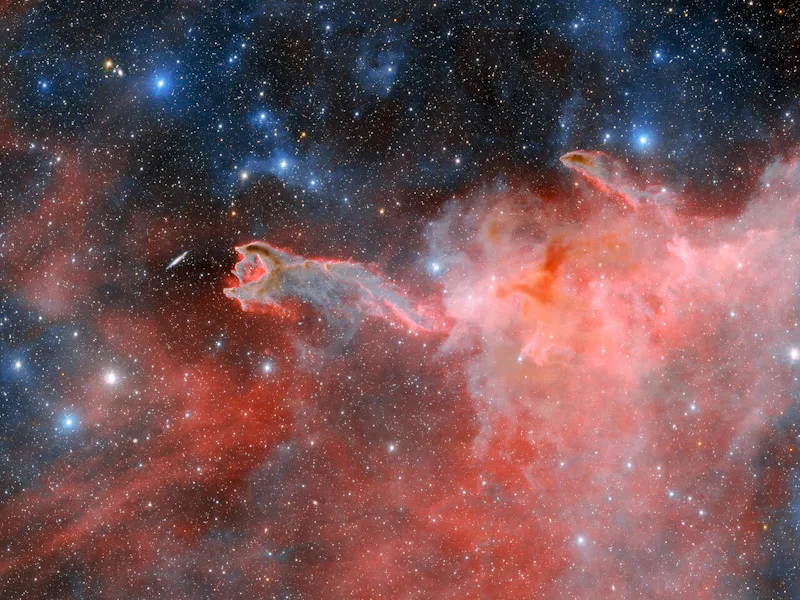
This striking image of CG4 was captured by a telescope instrument originally built to study dark energy.

image of a reddish cloud of gas and dust in space, which is shaped vaguely like a dinosaur.
NOIRLab

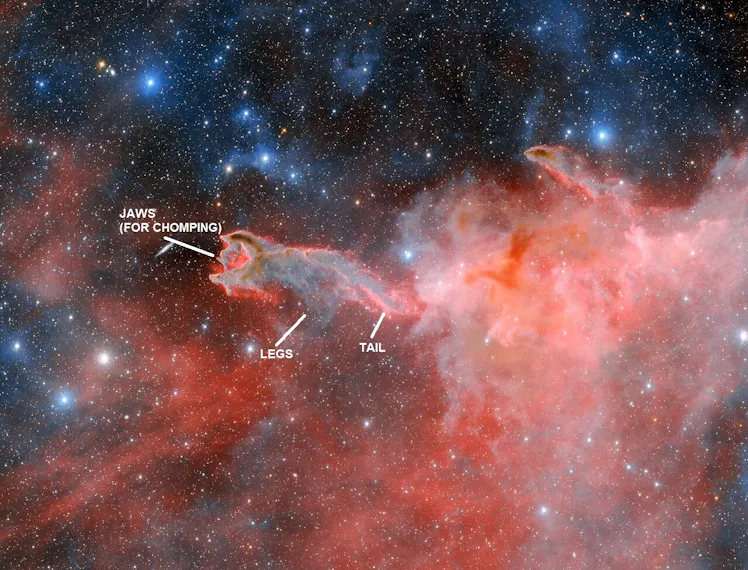
This strange cosmic cloud is called “the hand of God,” but it looks more like a Tyrannosaurus rex to us.

The reddish aura surrounding the cloud of gas and dust called CG4 comes from hydrogen gas, heated and ionized (electrically charged) by the radiation from massive nearby stars. That powerful bombardment of radiation is probably what eroded and stretched CG4 into its distinctive shape.

Astronomers call clouds like CG4 cometary globules, because their long, dust-shrouded tails look a bit like comets, even though they form completely different ways and on drastically different scales (one cometary globule probably contains a few star systems’ worth of actual comets). This one, CG4, is an especially dense patch of gas and dust within the larger Gum Nebula, which is home to the Vela Supernova Remnant and the Vela Pulsar.

image of a reddish cloud of gas and dust in space, which is shaped vaguely like a dinosaur, with the...

Once you see it, you can’t unsee it.

NOIRLAB

Cometary globules like CG4 are just one form of a type of cosmic cloud called a Bok Globule. These clouds of gas and dust are so dense that visible and ultraviolet light can’t pass through them, making them appear as dark shadows in telescope images (when we can see them at all). The best way to see a Bok Globule is with an infrared telescope, like the Dark Energy Camera: an instrument mounted on the Victor Blanco Telescope on a mountaintop in Chile.

Weirdly, all of the 32 cometary globules in the Gum Nebula have their heads pointed toward the center of the nebula, where the fast-spinning Vela Pulsar lurks at the heart of the Vela Supernova Remnant; the pulsar and the expanding cloud of stellar debris around it are all that’s left of a massive star that exploded in a supernova about 1 million years ago. That explosion, along with radiation and charged particles from nearby massive stars in the Gum Nebula, may have shaped CG4 and other cometary globules into their streamlined shapes.

If you’d like a sense of scale, CG4 is about 1300 light years away. Its head is about 1.5 light-years wide, and its faint tail stretches across 8 light years.

{ https://www.inverse.com/ }

Hoe vind je dit bericht?
Geschreven door peter om 21:57 Stuur door

Sahara was ooit weelderig groen, blijkt uit rotstekeningen van 4.000 jaar geleden die vee afbeelden

Sahara was ooit weelderig groen, blijkt uit rotstekeningen van 4.000 jaar geleden die vee afbeelden

Artikel door Michaël Torfs

De rotstekeningen zijn uitgebreid onderzocht tijdens veldwerk in de jaren 2018 en 2019. Julien Cooper van de Macquarie University in Australië leidde toen een team archeologen in het zogenoemde Atbai Survey Project, waarin 16 nieuw ontdekte rotstekeningen uit Wadi Haifa werden bestudeerd. 

Vandaag is het een kurkdroge regio in het oosten van Soedan. Maar de tekeningen suggereren dat de omgeving er toen compleet anders uitzag. Er viel veel meer regen en het landschap zag er groen uit, weelderig groen zelfs, moet blijken uit de rotstekeningen waarop vee staat afgebeeld. 

"Het was een raadsel om vee afgebeeld te zien op de wanden van rotsen midden in de woestijn, want voor het houden van runderen is veel water nodig, en weiland. Ze zouden in de Sahara van vandaag geen kans maken", zegt Cooper in een mededeling van de universiteit. 

Volgens Cooper is de aanwezigheid van heel wat vee in de tekeningen "een van de belangrijkste bewijsstukken van een voormalige groene Sahara". Dat komt ook overeen met eerdere bevindingen van experts. 

Groene Sahara? 

Eerder archeologisch en klimatologisch veldwerk heeft al aangetoond dat alvast een deel van de huidige Sahara in Afrika er vroeger totaal anders moet hebben uitgezien tijdens de zogenoemde "Afrikaanse natte periode"

Er viel toen veel regen in de regio tijdens moessonregens in de zomer. De vochtige periode zou van ongeveer 15.000 jaar geleden tot ruwweg 5.000 jaar geleden hebben gelopen en dan langzaam zijn uitgedoofd. Er zou plaats geweest zijn voor een afwisselende Afrikaanse savanne waar ook giraffes en olifanten leefden. 

Rond 3.000 voor Christus begonnen meren en rivieren uit te drogen en verdwenen ook de grazige weiden. De mensen trokken weg in de richting van de Nijl. 

De aanwezigheid van mensen bij het vee suggereert dat de dieren gemolken werden. Er zouden herders geleefd hebben in het gebied, maar zij begonnen het rond 3.000 voor Christus moeilijker te krijgen.

"De bevolking trok weg en er waren hoogstens nog schapen of geiten. De impact op het leven moet groot geweest zijn", zegt Cooper. 

De tekeningen tonen niet enkel vee. Er zijn ook boten afgebeeld. Die hebben speciale kenmerken in deze tekeningen, en waren misschien het werk van plaatselijke Nubische Nubische stammen. 

Sahara was ooit weelderig groen, blijkt uit rotstekeningen van 4.000 jaar geleden die vee afbeelden
© Foto: Paul Wordsworth

{ https://www.msn.com/nl-be/ }

Hoe vind je dit bericht?
Geschreven door peter om 21:47 Stuur door

Unveiling the Enigmatic Secrets of Area 51 and UFOs

Unveiling the Enigmatic Secrets of Area 51 and UFOs

Inside Area 51's UFO Secrets

Area 51, nestled within the desolate stretches of the Nevada desert, has long captivated the imagination of millions around the world. Officially a remote detachment of Edwards Air Force Base, this highly classified U.S. Air Force facility is shrouded in secrecy, giving rise to numerous theories and stories about extraterrestrial activities and groundbreaking technology. Let’s delve into some of the intriguing accounts that contribute to the legendary status of Area 51.

Historical Context and Alleged Alien Encounters

The intrigue surrounding Area 51 often centers on accounts of unidentified flying objects (UFOs) and their purported connection with the U.S. government. One of the most storied events allegedly occurred on May 19, 1953, during a series of nuclear tests under the codename “Upshot-Knothole” at Yucca Flat, Nevada. Observers reported seeing a disc-shaped object descending rapidly from the sky, which then disappeared into the mountains south of Las Vegas. This incident was followed by rumors that the U.S. government swiftly assembled a team to investigate a UFO crash in the outskirts of Kingman, Arizona, approximately 175 miles south of the test site.

The Kingman UFO incident is said to involve a 40-foot diameter disc-shaped craft that was found intact, with no visible damage, and accompanied by four extraterrestrial beings. The recovered craft and beings were reportedly transported to what is now known as Area 51 for further examination and reverse engineering.

Theories of Reverse Engineering and Collaboration

Speculations suggest that Area 51’s primary purpose might extend beyond testing experimental aircraft and weaponry. It is believed to include the reverse engineering of alien technology. According to some accounts, this includes working directly with extraterrestrial beings, such as an entity named J-Rod, who allegedly assisted U.S. scientists and engineers in understanding alien technology.

Area 51’s lore also includes tales of underground facilities where extensive collaboration between humans and aliens takes place. These stories are bolstered by testimonies from individuals like Captain Bill U House, a former U.S. Air Force officer who claimed to have worked closely with an extraterrestrial being to gain insights into alien science and engineering.

Modern Myth or Hidden Truths?

As fantastical as these stories might sound, they are supported by various whistleblowers and former employees who assert the existence of alien technology at Area 51. These claims, while lacking concrete evidence and often dismissed by skeptics, fuel ongoing interest and debate regarding what truly lies within the confines of this secretive base.

Despite numerous public disclosures and declassifications of documents, the U.S. government remains largely silent about the full extent of activities at Area 51. This secrecy only amplifies the mystery and the allure of the base, making it a central figure in UFO folklore.

VIDEO:

  • Ancient Aliens: Inside Area 51’s UFO Secrets

Area 51 continues to be an emblematic symbol of UFO conspiracy theories and a focal point for those who believe in extraterrestrial visits. Whether these beliefs are grounded in reality or are merely products of the human imagination, Area 51 undeniably holds a significant place in popular culture as a repository of the unknown and possibly the extraterrestrial. As long as the veil of secrecy remains, the theories about what really happens behind the gates of Area 51 will continue to proliferate, captivating the minds of those who seek answers to the age-old question: Are we alone in the universe?

{ https://www.latest-ufo-sightings.net/ }

Hoe vind je dit bericht?
Geschreven door peter om 21:36 Stuur door

'I saw glowing white flaming orb UFO – it was like one from 1350s Jesus Christ painting'

'I saw glowing white flaming orb UFO – it was like one from 1350s Jesus Christ painting'

An infamous painting housed in the Visoki Decani Monastery in Kosovo, and painted by an unknown artist, shows a pretty standard scene of Christ's crucifixion - with two odd extras

By Adam Cailler / Journalist

The infamous painting features two potential alien-filled UFOs

The infamous painting features two potential alien-filled UFOs 

(Image: Visoki Decani Monestary)

A bloke has claimed he saw a “glowing white orb UFO” and it looked exactly like one depicted in the infamous 1300s painting of Jesus Christ's crucifixion.

According to a post on Reddit's biggest alien forum, the poster – going by the name of Kaiserschleier – was talking to his brother-in-law while in an unidentified countryside when he has his “first experience” of an encounter with a UFO.

Taking to the forum, he said: “I was chatting with my brother-in-law in the countryside when suddenly, I glanced up and spotted a glowing white orb. It swiftly shot away the moment I looked at it, hovering about 20 feet above ground, leaving behind a trail of orange flame-like glow as it moved. It moved swiftly and emitted no sound.

READ MORE: 

He saw a flying glowing orb (stock)

He saw a flying glowing orb (stock) 

(Image: Getty Images)

“I was so stunned, I jolted and said 'What the f**k is that?!' – my brother-in-law confirmed to have seen the same thing as me, saying that it looked like a flying glowing moon.”

The poster returned later on to add more to his story, to explain that the object he saw look suspiciously like the strange UFO-like object depicted in the 1350s painting of the crucifixion of Jesus Christ.

Located in the Visoki Decani Monastery in Kosovo, and painted by an unknown artist, the image shows a pretty standard scene of Christ's crucifixion . . . but what is in the top left and right corners has left people baffled for centuries. It shows two UFO-shaped objects, with people inside, flying across the skyline. And it is those that the original Reddit poster claims he saw.

Was this what the bloke saw in the field . . . ?

Was this what the bloke saw in the field . . . ?  (Image: Visoki Decani Monestary)

READ MORE

He explained: “Despite its radiant glow, it emitted no illumination onto its surroundings. Its hues of white and orange were exceptionally vivid, yet it remained silent as it traversed in a perfectly straight trajectory, devoid of any audible disturbance even amidst the passage through the air.

“This occurrence defied any rational explanation, unlike anything I've ever encountered before. Its proximity ruled out possibilities like a comet or shooting star, as it hovered closer to the ground than the tree canopy.

“I'm left baffled by this enigmatic phenomenon, never before witnessed or heard of, and the mere fact that I bore witness to it fills me with a profound sense of awe.”

So, Daily Star reader, what do you think?

{ https://www.dailystar.co.uk/news/ }

Hoe vind je dit bericht?
Geschreven door peter om 00:21 Stuur door

New NASA Visualization Shows Supermassive Black Hole’s Event Horizon

New NASA Visualization Shows Supermassive Black Hole’s Event Horizon

Thanks to a new visualization produced on a NASA supercomputer, you can plunge into the event horizon, a black hole’s point of no return.

“People often ask about this, and simulating these difficult-to-imagine processes helps me connect the mathematics of relativity to actual consequences in the real Universe,” said Dr. Jeremy Schnittman, an astrophysicist at NASA’s Goddard Space Flight Center.

“So I simulated two different scenarios, one where a camera — a stand-in for a daring astronaut — just misses the event horizon and slingshots back out, and one where it crosses the boundary, sealing its fate.”

To create the visualizations, Dr. Schnittman teamed up with Goddard Space Flight Center scientist Brian Powell and used the Discover supercomputer at the NASA Center for Climate Simulation.

They generated about 10 terabytes of data and took about 5 days running on just 0.3% of Discover’s 129,000 processors. The same feat would take more than a decade on a typical laptop.

The destination is a supermassive black hole with 4.3 million times the mass of our Sun, equivalent to the monster located at the center of our Milky Way Galaxy.

“If you have the choice, you want to fall into a supermassive black hole,” Dr. Schnittman said.

“Stellar-mass black holes, which contain up to about 30 solar masses, possess much smaller event horizons and stronger tidal forces, which can rip apart approaching objects before they get to the horizon.”

This occurs because the gravitational pull on the end of an object nearer the black hole is much stronger than that on the other end. Infalling objects stretch out like noodles, a process astrophysicists call spaghettification.

The simulated black hole’s event horizon spans about 16 million miles (25 million km), or about 17% of the distance from Earth to the Sun.

A flat, swirling cloud of hot, glowing gas called an accretion disk surrounds it and serves as a visual reference during the fall.

So do glowing structures called photon rings, which form closer to the black hole from light that has orbited it one or more times.

A backdrop of the starry sky as seen from Earth completes the scene.

As the camera approaches the black hole, reaching speeds ever closer to that of light itself, the glow from the accretion disk and background stars becomes amplified in much the same way as the sound of an oncoming racecar rises in pitch.

Their light appears brighter and whiter when looking into the direction of travel.

The movies begin with the camera located nearly 640 million km (400 million miles) away, with the black hole quickly filling the view.

Along the way, the black hole’s disk, photon rings, and the night sky become increasingly distorted — and even form multiple images as their light traverses the increasingly warped space-time.

In real time, the camera takes about 3 hours to fall to the event horizon, executing almost two complete 30-min orbits along the way. But to anyone observing from afar, it would never quite get there.

As space-time becomes ever more distorted closer to the horizon, the image of the camera would slow and then seem to freeze just shy of it. This is why astronomers originally referred to black holes as “frozen stars.”

At the event horizon, even space-time itself flows inward at the speed of light, the cosmic speed limit.

Once inside it, both the camera and the space-time in which it’s moving rush toward the black hole’s center — a one-dimensional point called a singularity, where the laws of physics as we know them cease to operate.

The NASA visualization tracks a camera as it approaches, briefly orbits, and then crosses the event horizon -- the point of no return -- of a supersized black hole similar in mass to the one at the center of our Galaxy. Image credit: J. Schnittman & B. Powell, NASA’s Goddard Space Flight Center.

The NASA visualization tracks a camera as it approaches, briefly orbits, and then crosses the event horizon — the point of no return — of a supersized black hole similar in mass to the one at the center of our Galaxy.

Image credit: J. Schnittman & B. Powell, NASA’s Goddard Space Flight Center.

“Once the camera crosses the horizon, its destruction by spaghettification is just 12.8 seconds away,” Dr. Schnittman said.

From there, it’s only 128,000 km (79,500 miles) to the singularity. This final leg of the voyage is over in the blink of an eye.

In the alternative scenario, the camera orbits close to the event horizon but it never crosses over and escapes to safety.

If an astronaut flew a spacecraft on this 6-hour round trip while her colleagues on a mothership remained far from the black hole, she’d return 36 min younger than her colleagues.

That’s because time passes more slowly near a strong gravitational source and when moving near the speed of light.

“This situation can be even more extreme,” Dr. Schnittman said.

“If the black hole were rapidly rotating, like the one shown in the 2014 movie Interstellar, she would return many years younger than her shipmates.”

{ https://www.sci.news/ }

Hoe vind je dit bericht?
Geschreven door peter om 23:48 Stuur door

Krachtige zonne-explosies hebben een sterke impact op de aarde: wat zou er kunnen gebeuren?

Krachtige zonne-explosies hebben een sterke impact op de aarde: wat zou er kunnen gebeuren?

Door JanineJanine image

Zonnevlam gedetecteerd in mei 2024

De krachtige uitbarstingen die op onze moederster exploderen, hebben een sterke impact op de aarde en lijken niet te stoppen. Dit is wat er gebeurt.

Wat zijn zonnevlammen?

Zonnevlam die uitbarst vanaf het oppervlak van de zon

SPACE WEATHER PREDICTION CENTER

Een zonnevlam, zo meldt NASA, is "een intense uitbarsting van straling door het vrijkomen van magnetische energie die gepaard gaat met zonnevlekken". Dit zijn, legt de Amerikaanse ruimtevaartorganisatie uit, de grootste explosieve gebeurtenissen in ons zonnestelsel. Ze manifesteren zich als heldere gebieden op de zon die enkele minuten tot enkele uren zichtbaar zijn.

Wat ons in staat stelt om ze te detecteren is het licht, dus de fotonen, die vrijkomen en die worden gecontroleerd door optisch licht en röntgenstraling. In zonnevlammen worden de zwaarste deeltjes versneld. De afgelopen dagen zijn zonnevlammen in volle actie: X1.6 vond plaats op 3 mei, gevolgd door andere krachtige fenomenen volgens het Space Weather Prediction Center van NOAA. Elk van deze fenomenen heeft een grote impact gehad op onze planeet.

De gevolgen van krachtige zonnevlammen op aarde

Een X1.3 en een X1.2 zonnevlam barstten op 5 mei los uit de actieve groep zonnevlekken AR 3663. In beide gevallen traden radio blackouts op op onze planeet, in Japan, Australië en grote delen van China, en de effecten zouden langer kunnen duren als coronale massa uitstoot, enorme wolken van zonneplasma doordrenkt met magnetische veldlijnen, geladen deeltjes naar de aarde zouden leiden.

Hierover zijn echter geen zekere gegevens bekend. Er zijn momenteel negen clusters zonnevlekken aanwezig aan de kant van de zon die naar onze planeet is gericht, die ongeveer 150 zonnevlekken omvatten. AR 3663 is op dit moment in ieder geval het meest actief en heeft sinds 30 april meerdere M-klasse en vier X-klasse vlammen uitgezonden, waarmee hij op de tweede plaats staat van de sterkste vlammen die onze ster kan produceren.

Maar wat zijn de voorspellingen van de wetenschappers en wat kunnen we verwachten? Volgens de voorspellers zullen er meer M-klasse vlammen zijn en mogelijk nog een of meer X-klasse vlammen voordat ze buiten de baan van de aarde draaien.

Keith Strong, een zonnefysicus, schreef in een bericht op X, voorheen Twitter: “Het gebied van zonnevlekken AR3663 produceerde een X4.5 vlam, de op twee na grootste sinds het begin van zonnecyclus 25 (4,3 jaar geleden)." Hij voegde eraan toe dat de vlam een sterke black-out veroorzaakte in een groot deel van Azië, Oost-Afrika en Oost-Europa. "Als het een coronale massa uitstoot produceerde, zal deze waarschijnlijk binnen een dag of twee de aarde raken."

Geomagnetische storm op komst? Er is iets positiefs aan

SDO | Solar Dynamics Observatory NASA

Zonnevlammen gaan soms gepaard met uitbarstingen die de aarde met een paar dagen vertraging kunnen bereiken, omdat plasma zich minder snel verplaatst dan licht. Op het moment dat de coronale massa uitstoot ons bereikt, ontstaat er echter een geomagnetische storm met aanzienlijke gevolgen voor de communicatie. Op het moment dat het de magnetosfeer van de planeet raakt, ontstaan er elektrische stromen die door elektriciteitsnetwerken kunnen reizen, stroomuitval kunnen veroorzaken en satellieten, radio- en navigatiesignalen kunnen beïnvloeden.

Maar er is ook een positief aspect: de wisselwerking tussen zonnedeeltjes, de magnetosfeer en de atmosfeer van de aarde leidt tot een opvallend poollicht boven de polen van de aarde, dat alleen 's nachts zichtbaar is, wanneer er geen zonlicht is. In elk geval zullen de volgende uitbarstingen kleine gevolgen hebben, omdat AR 3663 van de baan van de aarde af draait, maar de zon zit midden in haar activiteitscyclus, haar piek vindt om de elf jaar plaats en kan ons nog meer “verrassingen” bezorgen.

Source:

{ https://www.curioctopus.nl/ }

Hoe vind je dit bericht?
Geschreven door peter om 23:38 Stuur door

Meer van UFO'S of UAP'S, ASTRONOMIE, RUIMTEVAART, ARCHEOLOGIE, OUDHEIDKUNDE, SF-SNUFJES EN ANDERE ESOTERISCHE WETENSCHAPPEN - DE ALLERLAATSTE NIEUWTJES

↑ Terug naar de berichten