Naar de inhoud

UFO'S of UAP'S, ASTRONOMIE, RUIMTEVAART, ARCHEOLOGIE, OUDHEIDKUNDE, SF-SNUFJES EN ANDERE ESOTERISCHE WETENSCHAPPEN - DE ALLERLAATSTE NIEUWTJES

UFO's of UAP'S in België en de rest van de wereld
akke.beakke.be
Ontdek de Fascinerende Wereld van UFO's en UAP's: Jouw Bron voor Onthullende Informatie! Ben jij ook gefascineerd door het onbekende? Wil je meer weten over UFO's en UAP's, niet alleen in België, maar over de hele wereld? Dan ben je op de juiste plek! België: Het Kloppend Hart van UFO-onderzoek In België is BUFON (Belgisch UFO-Netwerk) dé autoriteit op het gebied van UFO-onderzoek. Voor betrouwbare en objectieve informatie over deze intrigerende fenomenen, bezoek je zeker onze Facebook-pagina en deze blog. Maar dat is nog niet alles! Ontdek ook het Belgisch UFO-meldpunt en Caelestia, twee organisaties die diepgaand onderzoek verrichten, al zijn ze soms kritisch of sceptisch. Nederland: Een Schat aan Informatie Voor onze Nederlandse buren is er de schitterende website www.ufowijzer.nl, beheerd door Paul Harmans. Deze site biedt een schat aan informatie en artikelen die je niet wilt missen! Internationaal: MUFON - De Wereldwijde Autoriteit Neem ook een kijkje bij MUFON (Mutual UFO Network Inc.), een gerenommeerde Amerikaanse UFO-vereniging met afdelingen in de VS en wereldwijd. MUFON is toegewijd aan de wetenschappelijke en analytische studie van het UFO-fenomeen, en hun maandelijkse tijdschrift, The MUFON UFO-Journal, is een must-read voor elke UFO-enthousiasteling. Bezoek hun website op www.mufon.com voor meer informatie. Samenwerking en Toekomstvisie Sinds 1 februari 2020 is Pieter niet alleen ex-president van BUFON, maar ook de voormalige nationale directeur van MUFON in Vlaanderen en Nederland. Dit creëert een sterke samenwerking met de Franse MUFON Reseau MUFON/EUROP, wat ons in staat stelt om nog meer waardevolle inzichten te delen. Let op: Nepprofielen en Nieuwe Groeperingen Pas op voor een nieuwe groepering die zich ook BUFON noemt, maar geen enkele connectie heeft met onze gevestigde organisatie. Hoewel zij de naam geregistreerd hebben, kunnen ze het rijke verleden en de expertise van onze groep niet evenaren. We wensen hen veel succes, maar we blijven de autoriteit in UFO-onderzoek! Blijf Op De Hoogte! Wil jij de laatste nieuwtjes over UFO's, ruimtevaart, archeologie, en meer? Volg ons dan en duik samen met ons in de fascinerende wereld van het onbekende! Sluit je aan bij de gemeenschap van nieuwsgierige geesten die net als jij verlangen naar antwoorden en avonturen in de sterren! Heb je vragen of wil je meer weten? Aarzel dan niet om contact met ons op te nemen! Samen ontrafelen we het mysterie van de lucht en daarbuiten.

Archief

UFO shut down the Nukes

UFO shut down the Nukes

UFOs and Nuclear Facilities

UFO Sightings and Nuclear Facilities: A Mysterious Intersection

Introduction:

Unidentified Flying Objects (UFOs) have long been a subject of fascination and controversy, sparking interest from conspiracy theorists, scientists, and governments alike. Among the myriad of reported sightings, one particularly intriguing pattern has emerged: the frequent association of UFOs with nuclear facilities. This article delves into the mysterious world of UFO sightings near nuclear installations, exploring incidents, implications, and the quest for understanding that continues to elude us.

Unraveling the Enigma: UFOs at the World’s Nuclear Doorstep

Historic Incidents: The Malmstrom AFB Encounter

In March 1967, an incident at Malmstrom Air Force Base in Montana sent shockwaves through the defense community. Robert Salas, a former U.S. Air Force officer, reported a UFO shutting down several Minuteman nuclear missiles. The object, described as a pulsating orange light, rendered ten ICBMs inoperative, a situation unprecedented in military history. This event is not an isolated case; it’s a scenario that has repeated itself at various nuclear sites worldwide, suggesting a deliberate pattern or message from an unknown origin.

A Global Phenomenon: From the US to the USSR

UFO sightings at nuclear facilities are not confined to the United States. Similar incidents have occurred globally, including a notable event in Ukraine in 1982, where a UFO reportedly initiated a missile launch sequence before abruptly stopping it. These recurring incidents across different nations and political climates indicate a global phenomenon that demands attention and understanding.

The Implications: Security, Technology, and Extraterrestrial Interest

National Security Concerns:

The presence of unidentified objects capable of disabling nuclear weapons systems raises profound security questions. If these objects are extraterrestrial or represent an unknown advanced technology, what are their intentions? Are they a threat, a warning, or a mere observation from a distant civilization?

Technological Marvels:

The technology implied by these sightings is far beyond human capabilities, particularly concerning speed, maneuverability, and the ability to interfere with electronic systems. Understanding this technology could leap forward in human scientific knowledge, potentially offering new energy sources, propulsion methods, or other revolutionary advancements.

Extraterrestrial Messaging:

Many, like Robert Salas, believe these incidents are a message about the dangers and moral implications of nuclear weapons. If an advanced civilization is monitoring us, it might be cautioning humanity about a path that could lead to destruction and urging a reevaluation of our most destructive technologies.

The Quest for Transparency and Understanding

Despite numerous credible reports and evidence, there remains a significant shroud of secrecy and dismissal around UFO sightings, especially those associated with nuclear facilities. Advocates for transparency, including military personnel and researchers, call for open investigations and government disclosure to understand the phenomena truly.

VIDEO:

  • Coast to Coast AM: UFOs and Nuclear Facilities: An Investigation into Sightings and Incidents

https://youtu.be/ywbe6Udc3p8

The intersection of UFO sightings and nuclear facilities presents a compelling narrative that challenges our understanding of technology, security, and the potential for extraterrestrial life. As we stand at this crossroads of mystery and discovery, the quest for answers continues. It’s a journey that requires an open mind, rigorous scientific inquiry, and perhaps most importantly, a global conversation about our place in the universe and the choices we make for our future.

https://youtu.be/vwzBO3LsGSQ

https://www.youtube.com/watch?v=vwzBO3LsGSQ

{ https://www.latest-ufo-sightings.net/ }

Hoe vind je dit bericht?
Geschreven door peter om 17:58 Stuur door

THESE MYSTERIOUS SOUNDS HAVE BAFFLED SCIENTISTS FOR DECADES. WHATEVER IS CAUSING THEM REMAINS UNKNOWN.

S0CwtoJS?format=jpg&name=900x900

THESE MYSTERIOUS SOUNDS HAVE BAFFLED SCIENTISTS FOR DECADES. WHATEVER IS CAUSING THEM REMAINS UNKNOWN.

Earlier this year, scientists with the U.S. Department of Energy revealed that unusual infrasonic phenomena had been detected emanating from the Earth’s upper atmosphere during high-altitude experiments involving sonic devices carried aloft with balloons. The exact source of these mysterious sounds had been undetermined at the time, and seemingly remain so today.

“[In the stratosphere,] there are mysterious infrasound signals that occur a few times per hour, Daniel Bowman, a Principal Scientist at Sandia National Laboratories, said in May about the unusual discovery, adding that “the source of these is completely unknown.” Pending further data, Bowman’s findings were the focus of a presentation he gave at the 184th Meeting of the Acoustical Society of America in Chicago

 The unusual stratospheric mystery Bowman and his colleagues are investigating is just one of many varieties of unusual sonic enigmas that have long baffled scientists. Reports of mysterious sounds date back several centuries and involve phenomena compared to mysterious humming, odd noises likened to blaring trumpets, thunderous “booms,” and even loud metallic scraping, which have been reported coming from the sky, from below ground, and even from within the depths of our oceans over the decades.

Examples include those discovered by Dr. Gordon J. F. MacDonald, an American geophysicist and former charter member of the president’s three-man Council on Environmental Quality, who uncovered a letter from 1906 that documented reports of booms that occurred seemingly in conjunction with foreshocks that preceded the Great San Francisco Earthquake of that same year. More than two decades earlier, similar reports were documented in Charleston, S.C. in 1883, while across the globe, reports of loud noises were documented along with the rain of a strange, ash-like substance over Queenstown, South Africa.

Not unlike the high-altitude infrasonic events detected by Department of Energy scientists earlier this year, the cause underlying the mystery sounds of the late 19th and early 20th century also remained undetermined. Curiously, many of them have also persisted over the decades, occasionally arousing the attention of scientists due to their perplexing—and often explosive—nature.

THE MYSTERY BOOMS

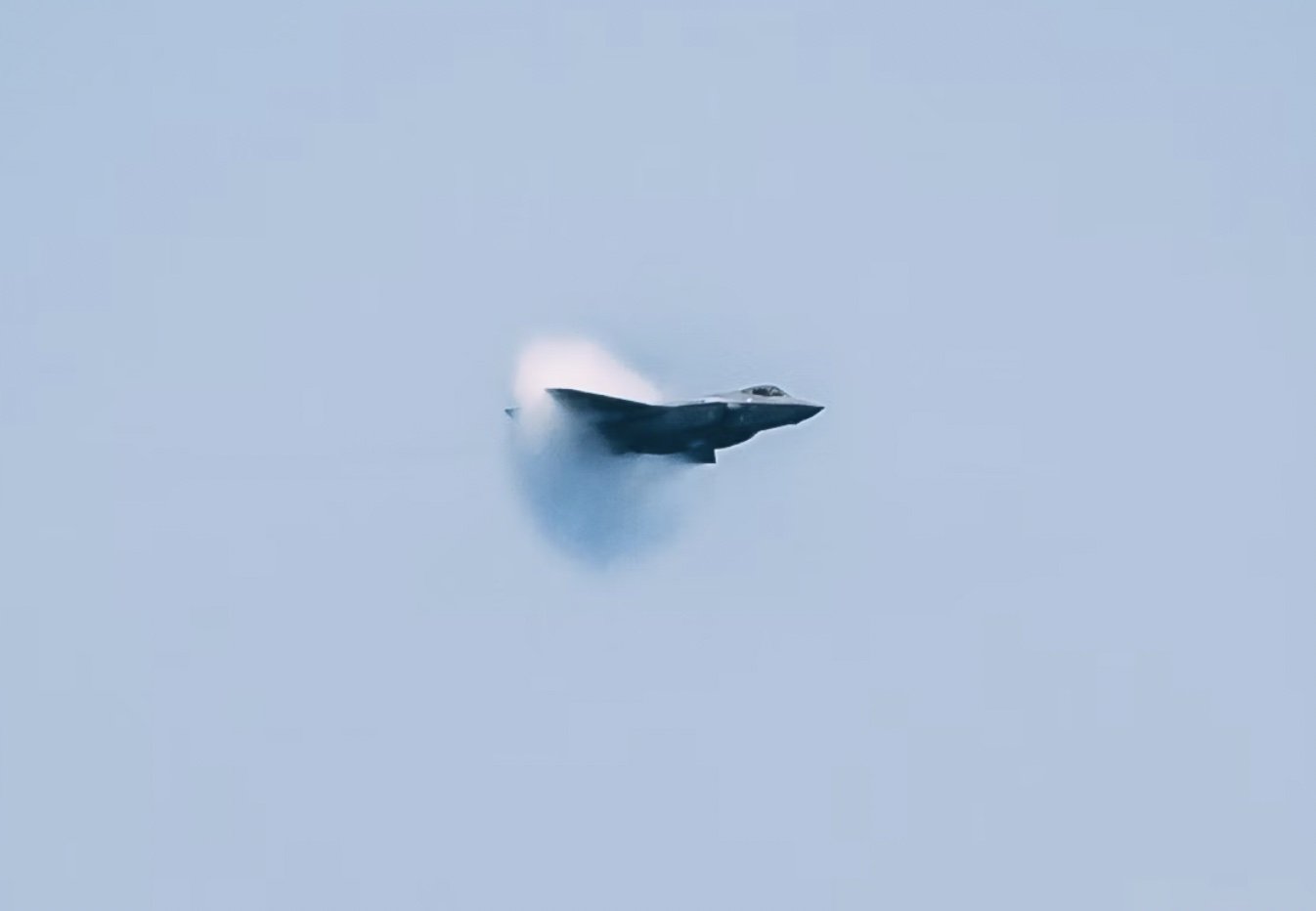
Among the most intriguing and widely reported sounds of unknown origin are the so-called “mystery booms” that have been logged for many decades, with occasional waves of activity that have often garnered widespread attention from the media. Between 1977 and 1978, more than 600 reports of mystery booms were documented along the east coast of the United States, with several of the incidents centered around southern New Jersey.

mysterious sounds

Bell Island, Newfoundland, the location of a famous high-energy boom in April 1978 (CC 4.0)

The frequency of reports around that time led to speculation about whether some variety of aircraft or weapons tests might be underway. It was even considered whether the booms had been precursors to a famous mystery explosion that occurred on Bell Island off the Newfoundland coast on April 2, 1978. The incident, explored by Canadian journalist Rick Seaward in a CBC television documentary later that year, was later determined to have been detected by the U.S. government’s Vela Satellite array, used to monitor nuclear testing and compliance with the 1963 Partial Test Ban Treaty.

Although the unusually energetic boom over Bell Island remained an outlier, many of the thundering noises reported around the same time were mild by comparison and could have had more conventional explanations. It was the opinion of Jeremy Stone, former president of the Federation of American Scientists, that many of the booms reported during the late 1970s were sonic booms from aircraft. The sudden cause of these booms had been due to flight paths made by the Concorde, a turbojet-powered supersonic passenger jet airliner, which remained in service between 1976 and 2003. Expounding on this theory, some argued that combining the sonic booms with unusual jet stream configurations occurring at the time could explain the rash of reports.

However, the sonic boom theory didn’t find favor with all the experts who examined the 1977 mystery boom wave. In opposition to his colleagues who supported the manmade origin of the booms, Dr. Gordon MacDonald, based on his previous research into historic occurrences of these phenomena, maintained that as many as 181 of the incidents had been more likely to have natural causes related to upper atmospheric weather phenomena.

Another wave of mystery booms occurred in southern California between 1991 and 1993, prompting investigations by MIT’s Lincoln Labs and researchers at Caltech. A paper by researchers Joseph E. Cates and Bradford Sturtevant examined whether correlations existed between seismic events and the boom reports, but ultimately concluded that sonic booms propagated from offshore operations of military aircraft were a more likely cause. However, the Caltech researchers were unsuccessful at correlating the specific source of the booms with any known military or other aircraft activity in the region.
sonic boom

(Unsplash)
Reports of mystery booms continue today, often occurring during colder weather periods (possibly in association with cryoseisms or “frost quakes”), and discussion surrounding the various underlying causes is as hotly debated now as in the past.

SUBTERRANEAN ORGAN-LIKE AND HORN-LIKE SOUNDS

In the 1970s, William R. Corliss, an American physicist known for his interest in reports of anomalous phenomena in virtually every branch of the sciences, began his Sourcebook Project, an effort that resulted in several catalogs featuring accounts of odd happenings harvested mainly from scientific literature and periodicals. Many of the subjects in Corliss’s work had been previously documented by Charles Fort, one of Corliss’s chief inspirations. The obvious similarity between Corliss and Fort’s interests had inspired Arthur C. Clarke to refer to Corliss as, “[Charles] Fort’s latter-day–and much more scientific–successor.”

Probing beyond the bombastic reports of mystery booms, Corliss was successful at uncovering accounts of far subtler sonic mysteries. An example had been a series of reports collected by M. von Humboldt that appeared in the Edinburgh Philosophical Journal in 1819, which described sounds emanating from rocks along the banks of the Orinoco River that resembled, of all things, pipe organ music.

mysterious sounds

The Orinoco River in Venezuela (Anagoria/ CC 3.0)

A similar phenomenon in Greenland, dubbed “Ton der Dove-Bai”, was reported in August of 1932 by a French Expedition exploring the Scoresby Sound. This sound resembled a massive foghorn and had previously been reported by an expedition group who heard it eight times, spanning five different locations, both during the day and after the polar nightfall. Like some “mystery booms,” this sound may very well be a description of a variety of cryoseism resulting from the movement of glaciers, an idea first proposed by A. Dauviller in his 1934 Nature article, “Strange Sounds from Inland Ice, Greenland”, who at that time, compared it with a similar phenomenon he had learned of:

“Is this vibrating sound really caused by the detachment of icebergs or is it similar to the ‘desert song’, that strange musical note produced by the sand?” Dauviller wrote. “In fact, there is a close analogy between the fields of powdery dry snow of the inland ice and the fields of sand of the Arabian Desert.”

MUSICAL SAND AND “DESERT SONG”

From the Outer Banks of North Carolina to Lake Seneca, New York, occurrences of loud booming sounds in various locales have led to popular legends about the so-called “Seneca Guns,” booming sands, and other names associated with sounds that occur where sand dunes are present.

“Under proper circumstances, sand dunes are capable of producing a variety of low-level whispering, whistling, singing, humming, or squeaking sounds, and less commonly, loud booming sounds,” wrote geologist David P. Hill with the U.S. Geological Survey. “The so-called ‘booming sands’ appear to be limited to large sand dunes with steep leeward faces in arid climates.”

mysterious sounds

(Unsplash)

According to Hill, rumbling noises have been reported as far away as several kilometers from the locations associated with “booming sands” and lasting for durations up to 15 minutes. Sometimes these sounds are also associated with seismic phenomena. “To produce booming sounds evidently requires very low humidity and loosely packed, quasispherical sand grains with high surface smoothness, although details of the process by which the acoustic emissions are produced remain poorly understood,” Hill wrote.

NATURAL MELODY

Another of the odd sonic phenomena documented by William Corliss involved what he called “natural melody” which involves “the production of musical notes and combinations thereof by the action of wind upon passive natural and artificial structures.”

  • government ufos

Sounds reminiscent of musical tones were reported in nature dating as far back as the 2nd century AD, as described in the writings of Pausanias and his descriptions of the “tuneful waves” of the Aegean Sea. Other localities where musical sounds have been reported include Germany’s Black Forest and Mount Renalux, the Spanish Pyrenees, and the communes within Haute Saône along the Saône River in France.

Drawing reports mostly from the stories of world travelers, Corliss complained about the lacking data in scientific literature that documented such phenomena. “It is difficult to separate some of the music-makers in this category from musical echoes or analyzed sound,” Corliss noted. “[T]he initial sounds may be nonmusical in the case of analyzed sound, but small reflecting surfaces nearby quickly convert it into more pleasing tones.”

UNDERWATER MUSICAL SOUNDS

Sounds emanating from bodies of water have also occasionally been reported in various parts of the world. These have often been likened to music, or sometimes rumbling sounds that are reminiscent of a locomotive engine, although one intriguing example that appeared in the journal Nature in 1870 described a reverberating noise likened to the singing of cicadas heard by passengers on board a boat navigating the Tavoy river:

“One moonlit night in 1854, on board a steamer anchored near the Tavoy river (Tenasserim) we were struck by an extraordinary noise which appeared to proceed from the shore about a quarter of a mile off, or from the water in that direction. It was something like the sound of a stocking loom, but shriller, and lasted perhaps five or six seconds, producing a sensible concussion on the ear like the piercing scream of the cicada; and this gave an impression as if the vessel itself were trembling, or reverberating from the sound.” One of two Burmans on board said simply, the noise was produced by ‘fishes,’ but of what kind they did not describe. It was repeated two or three times.”

A similar observation that occurred decades earlier 1824, later published in Popular Science Monthly in 1883, describes a deep, musical droning that had similarly been attributed to the movement of fish below a sailing vessel:

“Lieutenant White, of our Navy, relates that, when at the mouth of a river in Cambodia in 1824, he and the crew of his vessel were struck by hearing extraordinary sounds, like a mixture of the bass of an organ, the ringing of bells, the guttural cries of a frog, and the tones of an enormous harp, which they heard around the bottom of their vessel. The interpreter said they were produced by a troop of a kind of fish.”

Although the circumstances involving most of these sonic mysteries point to the likelihood of prosaic explanations, several of them do remain somewhat mysterious—even after several decades of investigations into their potential causes—and may offer fresh grounds for scientific exploration into some of the enigmas about our natural world that have lingered into the twenty-first century.

LINKS RELATED VIDEOS

https://youtu.be/5bO5DZmE2Uk

https://youtu.be/CuaeRoBaXis

https://youtu.be/pAxuvK8-SMg

  • This is an updated version of an article by the author originally sourced from mysterybooms.com, portions of which have been reprinted here with permission.
  • Micah Hanks is the Editor-in-Chief and Co-Founder of The Debrief. He can be reached by email at micah@thedebrief.org. Follow his work at micahhanks.com and on X: @MicahHanks.
{ https://thedebrief.org/ }

Hoe vind je dit bericht?
Geschreven door peter om 00:37 Stuur door

Een allesvernietigende kernbom inzetten tegen inkomende ruimtestenen: onderzoekers zijn bijzonder positief gestemd

Een allesvernietigende kernbom inzetten tegen inkomende ruimtestenen: onderzoekers zijn bijzonder positief gestemd

Het klinkt misschien wat rigoureus, maar als de dreiging hoog is, moeten we toch actie ondernemen.

Astronomen hebben tot nu toe de meeste grote en potentieel gevaarlijke planetoïden opgespoord en geanalyseerd. En voorlopig lijkt er geen reden tot zorg te zijn. Uit hun bevindingen blijkt dat er op dit moment geen enkele bekende planetoïde is die in de komende 100 jaar een serieuze bedreiging voor de aarde vormt. Desalniettemin nemen onderzoekers geen risico’s en bestuderen manieren om onze planeet te beschermen tegen mogelijke inslagen van ruimtestenen. En ondanks de veelbelovende resultaten van de DART-missie, overwegen experts of een iets rigoureuzere ingreep met kernbom mogelijk een nog effectievere oplossing kan bieden.

Nucleaire explosie
“Hoewel de kans op een grote planetoïde-inslag tijdens ons leven klein is, zouden de mogelijke gevolgen enorm verwoestend kunnen zijn,” zegt onderzoeker Bruck Syal. Daarom bestudeert hij samen met zijn collega’s of mogelijk een nucleaire explosie soelaas zou kunnen bieden. “Kernwapens hebben de grootste verhouding van energiedichtheid per massa van alle menselijke technologieën,” legt hoofdauteur Mary Burkey uit. “Hierdoor zijn ze uitermate waardevol bij het verminderen van dreigingen veroorzaakt door aardscheerders.”

Zo werkt het
In een nieuwe studie hebben onderzoekers een model ontwikkeld waarmee ze kunnen bekijken of het mogelijk is om een kernwapen te gebruiken om de aarde te beschermen tegen allesverwoestende inslagen van planetoïden. En de bevindingen zijn veelbelovend. “Als we genoeg waarschuwingstijd hebben, kunnen we een kernwapen afvuren en het naar een planetoïde op miljoenen kilometers afstand sturen die onderweg is naar de aarde,” stelt Burkey. “Daarna zouden we het apparaat laten ontploffen, waardoor de planetoïde van koers verandert. Hierdoor zou de aardscheerder intact blijven, maar wel een gecontroleerde duw weg van de aarde krijgen. Een andere optie is om de planetoïde te verstoren, waardoor hij in kleine, snelbewegende stukken uit elkaar valt en onze planeet ook zou missen.”

Het model laat zien hoe een planetoïde uit elkaar ‘spat’ door een denkbeeldige kernbom die explodeert in de buurt van de aardscheerder. Afbeelding: Mary Burkey

DART
Met dit model bouwen de wetenschappers voort op de lessen die zijn geleerd tijdens de recente DART-missie van NASA. Tijdens deze missie, die in september 2022 plaatsvond, werd bewust een ruimtesonde naar een planetoïde gestuurd om diens baan te wijzigen. Dankzij deze missie hebben we veel geleerd over wat er nodig is om een gevaarlijke planetoïde om te leiden. En hoewel de DART-missie succesvol was, heeft een dergelijke strategie ook enkele haken en ogen. We kunnen bijvoorbeeld maar een beperkte hoeveelheid massa de ruimte in sturen. Daarom kijken wetenschappers nog steeds naar het gebruik van nucleaire afbuiging als een mogelijk alternatief.

Meer over de DART-missie
Als een planetoïde regelrecht op de aarde afstevent, geven wetenschappers de voorkeur aan een missie waarbij ze de baan van de planetoïde willen veranderen. Tijdens zo’n missie wordt de planetoïde voorzichtig aangeraakt, wat resulteert in een kleine wijziging van de baansnelheid. Hierdoor blijft het grootste deel van de planetoïde bij elkaar, maar wordt de baan voorzichtig afgebogen, zodat de planetoïde niet meer in botsing komt met de aarde. Deze aanpak werd getest tijdens de DART-missie, waarbij een ruimtevaartuig koers zette naar de planetoïde Didymos om te proberen de baan van het maantje Dimorphos te veranderen, door zich tegen de ruimtesteen te pletter te slaan. En met succes. Voorafgaand aan de inslag van DART voltooide het maantje Dimorphos elke 11 uur en 55 minuten een rondje rond zijn grotere moederlichaam Didymos. Maar nu cirkelt Dimorphos in 11 uur en 23 minuten rond Didymos. En dat betekent dat zijn omlooptijd met 32 minuten is verkort.

Met het nieuwe model kunnen de onderzoekers eigenlijk nabootsen wat er gebeurt als een nucleaire bom in de buurt van een planetoïde tot ontploffing wordt gebracht. Deze tool draagt bij aan een beter begrip van hoe de straling van een nucleaire explosie reageert op het oppervlak van een ruimtesteen en onderzoekt ook de schokgolfdynamiek die het binnenste van de steen kan beïnvloeden. Hierdoor begrijpen we beter hoe de straling werkt als we zo’n wapen gebruiken om de koers van een hemelobject te veranderen.

Simulaties
Het artikel omvat een handige en precieze verzameling van informatie over hoe röntgenstralen worden geabsorbeerd door oppervlakken. Met zeer nauwkeurige simulaties werden fotonen gevolgd terwijl ze het oppervlak van asteroïde-achtige materialen, zoals steen, ijzer en ijs, binnendrongen. Het model houdt rekening met verschillende omstandigheden, zoals de samenstelling van de materialen, verschillende porositeit en de hoek waaronder de straling invalt. Hierdoor is het model bruikbaar voor verschillende mogelijke scenario’s.

De nieuwe simulaties bieden wetenschappers meer inzicht en meer keuzemogelijkheden mocht er onverhoopt toch een ruimterots op de aarde afstevenen. “Als er ooit een echte noodsituatie ontstaat waarbij de aarde moet worden verdedigd, is het van cruciaal belang om zeer nauwkeurige simulatiemodellen te hebben,” zegt onderzoeker Megan Bruck Syal. “Deze modellen kunnen besluitvormers voorzien van waardevolle informatie. Hiermee kunnen ze mogelijke inslagen van planetoïden voorkomen, essentiële infrastructuur beschermen en levens redden.”

Bronmateriaal

LINKS GERELATEERDE VIDEO'S

https://youtu.be/vMu5bNadlGo

https://youtu.be/MG5cubU9QRI

https://youtu.be/m4D2CjmoIIU

{ https://scientias.nl/ }

Hoe vind je dit bericht?
Geschreven door peter om 23:49 Stuur door

Turkey Kumburgaz UFO Videos Are 100% Real With Clear View Of Alien Entities Sitting Inside Craf

Turkey Kumburgaz UFO Videos

Turkey Kumburgaz UFO Videos Are 100% Real With Clear View Of Alien Entities Sitting Inside Craft

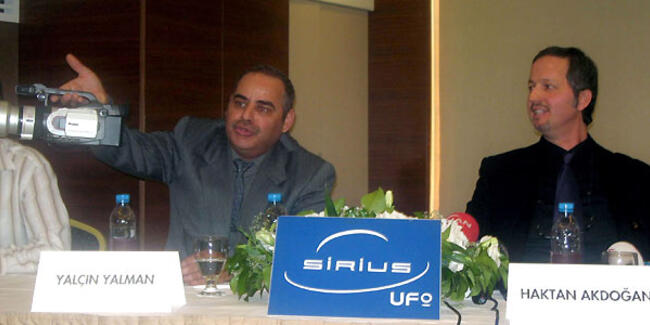
A series of UFO incidents occurred between 2007 and 2009 in the town of Kumburgaz, situated near Istanbul, Turkey. The events stunned the media and UFO enthusiasts after the images and videos of the sightings went viral on the Internet. The video evidence of UFOs shared by a nightwatchman named Yalcin Yalman could be another strong evidence of non-human technology.

Back in 2008, Yalcin Yalman worked as a night watchman at the Yenikent facility from where he shot all these amazing videos of UFOs, hovering over the Marmara Sea near Kumburgaz. He even showed his second-hand camera to the media in a press conference held at the Dedeman Hotel in Istanbul.

Yalman said he started recording the strange crafts as a hobby to pass his time in the night. Due to the shaky videos, some skeptics claimed that the mysterious objects over the skies of Turkey could have been a US stealth drone or other aircraft. However, numerous experts confirmed that the videos were authentic. Besides, many people witnessed the same unknown crafts in the sky. The sightings gained attention from locals, national media, and even CNN. Several videos were recorded between June 8 and 12, 2009, showing mysterious objects and lights.

Originally, the video was analyzed and made public by the Sirius UFO Space Sciences Research Center led by researcher Haktan Akdoğan. Haktan said the UFOs were often seen by civilians and military pilots during an International UFO Congress in 2009. (Source)

Yalcin Yalman

Yalcin Yalman (Left) sitting next to Akdoğan (Right), showing his camera during a press conference in Istanbul in 2009

Dr. Leir told Knapp that he, Yalman and others went to Kumburgaz to film UFOs. The group stayed up from midnight to 4 o’clock in the morning to capture any possible sightings. The conditions were ideal, with clear skies and no obstructions. During the filming, they observed a bright object below the full moon, which initially appeared as a potential star or planet. As they focused on this object, they discovered a semi-circular craft with a multitude of lights, possibly shaped like a boomerang or a cylindrical saucer.

Dr. Leir said, “You’d think, ‘Well, gee, a bright sky, bright moon, you’re not going to see anything.’ But in this case, the moon was a big help. It essentially lit up the exterior portion of the craft, which initially, when we saw it, looked a bit like a boomerang because we weren’t seeing it straight on, so we couldn’t tell the exact shape of the craft. But then we went to full film on it, and we could see that it was either a boomerang, or we were looking at a certain portion of a cylindrical craft or a saucer.

Till this day, I don’t know, and I don’t know what the analysts said about the shape. But it was either one of the two: either a boomerang shape with a round front or a complete saucer. It did turn a couple of times, so we were able to see the side, and it looked like it could have been saucer-shaped. But then we got the biggest shock of our lives because we could see light that was emanating from the internal portion of the craft in three areas. One was directly in front, and one was on either side.

This was a full-on front view, and folks can look at the Coast website and they can not only see the video but please go to the Chilean analysis because there are some still photos there which show what we saw when we looked in the central portion. That was a big shock to look and see, not a Rorschach-type thing, but actual entities that were, whatever they were doing, looking out the front of the craft, just the same as we were looking at them.”

Video Observation

From 2007 to 2009, Yalman recorded approximately 30 videos. The footage was taken with a MiniDV Canon DM-GR1-A based on the NTSC system with a diaphragm set at a maximum of 1.8. It is a 3CCD 20x optic 100x with a teleconverter mounted on a 58 mm adapter. The tele-objective is a Sony VCL HGD 1758 model lens, x 1.7. [2007 to 2009 Original Raw Footage]

The videos were examined by two influential state-sponsored organizations in Turkey, “The Scientific and Technology Research Board of Turkey” and “The TUG National Observatory.” Their objective was to identify any evidence of forgery, but the results supported the authenticity of the videos. The original film cassettes were also studied by individuals from Japan, Chile, Brazil, and Russia, and despite several attempts, no one has been able to conclusively demonstrate evidence of a hoax, fraud, or manipulation, leaving the case unidentified.

Yalman’s camera was equipped with a zoom option which allowed him to even capture the pilots, sitting in one of the crafts. The image is shaky due to the hand movements while zooming. However, with the editing software, the video was stabilized, and the result shocked everyone. Two humanoid figures could be seen in the image with large black eyes and oversized heads.

Haktan Akdoğan noted that these are the most important images in Turkey and in the world, saying: “After doing all the necessary analysis which went on for several weeks, the board came to a definite conclusion with no doubt that these are 100% genuine videos. The objects sighted in the aforementioned footage that have a structure that is made of specific material are definitely not made up by any kind of computer animation nor are they any form of special effects used for simulation in a studio or for a video effect therefore in conclusion it was decided that the sightings were neither a mock up or hoax. It is concluded that these objects in the sightings that have physical and material structures do not belong in any category such as; planes, helicopters, meteors, Venus, Mars, satellites, fireballs, Chinese lanterns, fireballs, weather balloons, natural or atmospheric phenomenon etc. and but rather fall into the category of UFOs.”

“We see the heads of not only one UFO but also of two beings in the images. This is the first in the world.” He further added that those images would have a great impact on UFOlogy. He had been researching UFOs for 22 years and had never seen something like this. He stated: “These are the most remarkable images taken in Turkish history.”

[In translation] Akdoğan stated that “these beings are generally seen in areas rich with resources, volcanic areas, and historical places. They started to come more frequently after nuclear tests. Maybe the released radiation also harms the cosmic neighbors, we disrupt the balance in the universe. Maybe they observe this dangerous process.” (Source)

According to the report issued by the Scientific and Technology Research Board of Turkey, the examination of these frames has yielded the following results:

The images were recorded in digital NTSC format by the above-mentioned camera.

  • The date on the video indicates that the recordings were made during 2007, 2008, and 2009.
  • The footage images of the object that visibly have a certain configuration are not computer animations, special video effects or studio-re-created images or models. The footage is genuine.
  • The first observation made from the footage is that some of the images were recorded in the nighttime sky at a certain altitude from the horizon. The footage also covers images of the moon in some parts which proves that the video was shot in the nighttime and open air. But, the fact that digital date displays show AM in certain frames and PM in others, raises suspicion about the validity of the time in which the recordings were made.
  • Since in some parts, there is no other object that can be featured as a reference in the close-up frames and no observable differences were found on background examination, the actual location, distance, dimensions and nature of the objects could not have been determined.
  • Through the examination of shootings of multiple dates, it is a strong possibility that 2-3 different objects were captured. However, it is difficult to determine whether the objects are moving or not. Their movement is slow even if they do so.
  • The reflections of light on the objects are sometimes caused by the moon which was in a convenient location at that time, and sometimes produced by some other sources of light.
  • The light reflection from the left side of the object which is seen on the August 10th shootings is not produced by the moon. At that time, the moon was in a phase that was pretty close to the “new moon” phase and located approximately at a 10-degree proximity/angle to the horizon. Moreover, the image processing analysis conducted on some parts of the footage revealed that the center of the object has the same density as its background, namely is of a transparent nature.

Not Debunked

Adam Goldstack of UAP Media UK mentions that many debunkers try to explain the craft as cruise ships but according to former F-16 fighter pilot and researcher Chris Letho, it does not add up. Letho analyzed the videos and case and calculated the object’s size, horizon distance, plus visual angles from the Marmara Sea. He concluded the logistics of a cruise ship did not match the reported UAP. (Source)

Additionally, the triangulation of the UAP in most video cases was calculated to be too high to be a cruise ship or boat, by other researchers. Alternatively, in the fixed/stabilized camera videos (as shown below), we can see that the objects are motionless against a black background in the vast majority of videos. The motionless aspect of the UAP could also discount the “small-boat theory,” given that even on calm waters/oceans floating objects will still move and rock around slightly. Additionally, despite the mass mainstream media coverage in Turkey at the time, no person has ever come forward to state that the objects/boats belonged to them or that they were sailing off the coast in the middle of the night.

Goldstack writes, “From an analytical perspective, the Turkey Kumburgaz UFO case is unique with regards to the clear and multiple video footage obtained. Through this case, we also have sequential data that display behavioral patterns, times, and dates. We see all of the twenty-five video encounters/incidents at night-time/early morning (with one in the late evening), which is in keeping with the wider range of Ufology data that suggests UAP often appears at night-time.

We also see another significant pattern displaying the encounters around water – in this case, the Marmara Sea. The Sea of Marmara itself is a small sea with an area of 11,350 km2 (4,380 sq mi) and with dimensions of 280 km × 80 km (174 mi × 50 mi). The sea has a greatest depth of 1,370 m (4,490 ft). How significant the Sea of Marmara is to potential UAP has still not been explained. No connection to nuclear facilities or weapons has been linked in this case.”

LINKS RELATED VIDEOS

https://www.youtube.com/watch?v=JXznyjZiOoo

https://youtu.be/Nhsz1Wkkp18

https://youtu.be/NDUh8F0TvPg

{ https://www.howandwhys.com/ }

Hoe vind je dit bericht?
Geschreven door peter om 23:33 Stuur door

THE 8 MOST EPIC SPACE FAILS OF 2023

ead854e6-221f-493d-92ab-30dfee6106b7-inv_spacefails_02.jpg?w=360&h=480&fit=crop&crop=faces&auto=format%2Ccompress

THE 8 MOST EPIC SPACE FAILS OF 2023

Space is hard.

BY JON KELVEY

Space travel is hard. From building the rockets to braving the vacuum, surviving the radiation, and safely returning to terra firma, there are few things about it that don’t have a high potential to fail spectacularly.

And yet when everything goes as planned — like when Curiosity touches down on Mars, the James Webb Space Telescope launches, or a spaceship grabs a sample of a hard-to-reach asteroid — space travel can seem easy, if not miraculous. But despite the best efforts of humans, the natural entropy of the space environment and the persnickety nature of rockets and software code still occasionally prevail. One in 25 NASA rockets have failed historically. In 2023, we’re not doing much better. Engineering bloopers abound: Some 50 percent of Space X’s Starship rockets blew up (but, hey, 50 percent didn’t!); researchers kept contact with Voyager 2 for the better part of 46 years (until that dropped call), and only one asteroid retrieval failed to deliver thanks to a canister that was screwed on just a bit too tight.

This is what science is all about, folks. Without further ado, here are the top eight Space Fails of 2023:

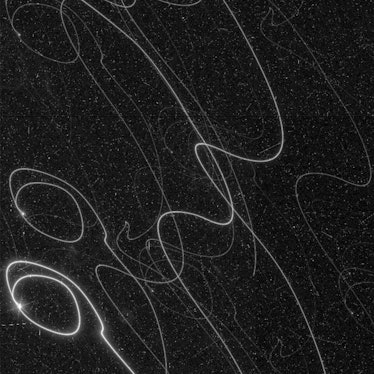
8. THE EUCLID SPACECRAFT MADE A COSMIC DOODLE

The Euclid spacecraft's Fine Guidance Sensor failed to lock into place, creating star trails as loop...

Euclid’s imperfect observation of a star field made a pretty picture in space.

ESA / EUCLID CONSORTIUM / TAS-I, CC BY-SA 3.0 IGO

The European Space Agency spent more than a decade developing the Euclid mission before it launched in July. A space telescope capable of making fine measurements of the shapes of galaxies up to 10 billion light years away and across a third of the sky, Euclid will serve as a window into the dark universe, dark matter, and dark energy. Invisible to any direct observation, Euclid will search for the gravitational influence of dark matter and dark energy on the shapes of galaxies and of space itself.

But while commissioning Euclid’s instruments, they ran into a problem: The Fine Guidance Sensor, designed to hold Euclid’s Visible Instrument on target when viewing a star field, wasn’t working properly. This caused the instrument to wobble while taking an image in October, resulting in an image of a star field with a bright, looping, lasso-like trail, the astrophotography equivalent of painting tracers for a camera with a sparkler. Only in this case, the camera was moving, and the sparkler was a distant sun. No stars or telescopes were harmed due to the failure, and a software update appears to have fixed the problem.

7. NASA IS STILL UNABLE TO OPEN THE OSIRIS-REX ASTEROID SAMPLE CONTAINER

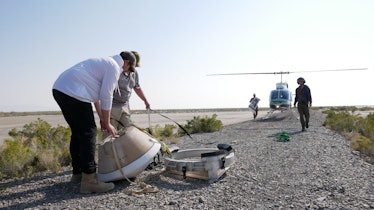
NASA is still unable to open the OSIRIS-Rex asteroid sample container

Once they got the sample return capsule back to Johnson Space Center and carefully placed it in a sealed box filled with a neutral nitrogen atmosphere, they hit a snag: two of the 35 fasteners sealing the capsule shut couldn’t be removed.

NASA

Imagine spending $1.16 billion on a jar of pasta sauce and then being unable to open the lid. It’s an absurd scenario, but then, that’s probably the only way to describe the frustration NASA’s science team must be feeling at the moment. The Origins, Spectral Interpretation, Resource Identification, and Security–Regolith Explorer, OSIRIS-REx, was launched in 2016 with the expressed goal of rendezvousing with the near-Earth asteroid Bennu, grabbing a sample of the space rock, and bringing it back to Earth. It was a fantastically complex mission pulled off with precision, right down to the coordinated retrieval of the sample-containing capsule on September 24 after it reentered the Earth’s atmosphere and floated onto the Utah desert.

But once they got the sample return capsule back to Johnson Space Center and carefully placed it in a sealed box filled with a neutral nitrogen atmosphere, they hit a snag: two of the 35 fasteners sealing the capsule shut couldn’t be removed. And unlike a jar of marinara, they can’t just run it under some hot water, tap it on the counter, and twist it really hard with one of those rubber jar openers. NASA is currently working to develop entirely new tools to remove the obstinate fasteners. But at least in the meantime, they have plenty of Bennu material to work with — a surplus of the material coalesced on the outside of the capsule, more material, in fact, than the mission originally hoped to extract from Bennu altogether.

6. A PRIVATE SPACE TUG SPUN OUT OF CONTROL AFTER A RECENT SPACEX LAUNCH

After successfully reaching orbit atop a SpaceX Falcon 9 rocket, the SN3 began spinning uncontrollab...

After successfully reaching orbit atop a SpaceX Falcon 9 rocket, the SN3 began spinning uncontrollably, forcing Launcher to prematurely deploy its payloads.

LAUNCHER SPACE

Sometimes a space mission fails because a bolt won’t come out or an O-ring deteriorates. But sometimes, it fails because even mission-critical software can be buggy. That’s what happened after the June 12 launch of the Orbiter SN3, designed by the company Launcher to act as an orbital tugboat that could maneuver smaller satellites into their operational orbits. After successfully reaching orbit atop a SpaceX Falcon 9 rocket, the SN3 began spinning uncontrollably, forcing Launcher to prematurely deploy its payloads. One of those was Otter Pup, a spacecraft built by Starfish Space to service satellites in orbit. Starfish had hoped to demonstrate an on-orbit Rendezvous between Otter Pup and a satellite, but the spacecraft was also set to spinning by the SN3 failure, and in November, Starfish Space abandoned plans to attempt the mission. Launcher did apologize, at least.

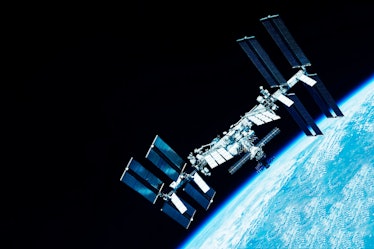
5. TWO ASTRONAUTS LOST A TOOL BAG IN SPACE

International Space Station. Elements of this image furnished by NASA. High quality photo

On November 1, NASA astronauts Jasmin Moghbeli and Loral O’Hara spent more than six hours on a spacewalk to perform some maintenance on the International Space Station exterior, and as a NASA update put it, “during the activity, one tool bag was inadvertently lost.”

SHUTTERSTOCK

Anyone who has worked on their car or tried to fix a leaky sink has experienced that moment where they can’t find that wrench or screwdriver they were just using a minute ago. They put it down somewhere, but where is the question. It turns out astronauts are not immune to the syndrome, but of course, it gets much worse in an environment where things can actually float away when you’re not looking.

On November 1, NASA astronauts Jasmin Moghbeli and Loral O’Hara spent more than six hours on a spacewalk to perform some maintenance on the International Space Station exterior, and as a NASA update put it, “during the activity, one tool bag was inadvertently lost.”

That tool bag now joins the more than 36,000 pieces of space debris larger than 3.9 inches orbiting the Earth at more than 17,000 miles per hour. We hope it didn’t contain anyone’s favorite wrench.

4. VIRGIN ORBIT BLAMED ITS LAUNCH FAILURE ON UPPER-STAGE ANOMALY, FILED FOR BANKRUPTCY

The Virgin Orbit "Cosmic Girl" - a modified Boeing Co. 747-400 - sits parked at the Long Beach Airpo...

After a Virgin Orbit rocket failed to reach orbit on January 9 due to an engine shutting down, the company pitched into a financial nosedive.

PATRICK T. FALLON/AFP/GETTY IMAGES

Virgin Orbit founder Richard Branson was one of the first billionaires to hop on the commercial space tourism bus when he founded Virgin Galactic in 2004, and the first billionaire to actually ride to space aboard his company’s spacecraft in July 2021. But he was late to the small satellite space launch game. Virgin Orbit was spun out of Virgin Galactic in 2017 with the intention of providing launch services for small payloads using a rocket that would be carried aloft by an aircraft, dropped, and then launched toward the heavens — a possible shortcut to reusability without having to engineer the sorts of self-recovering first stage rocket boosters SpaceX developed for it’s Falcon 9 rockets.

Instead, it was a shortcut to failure.

After a Virgin Orbit rocket failed to reach orbit on January 9 due to an engine shutting down, the company pitched into a financial nosedive. By March, the company had laid off 675 people and by April, filed for Chapter 11 bankruptcy. The bankruptcy was finalized in May, and what was left of the company was sold off for a fraction of its initial value.

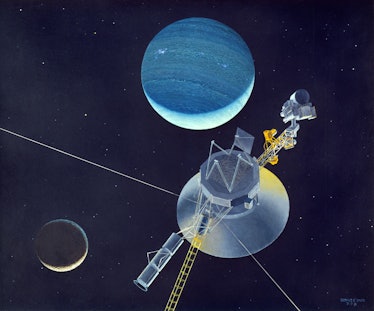
3. VOYAGER 2’S DROPPED CALL

1981: A simulation of the space probe Voyager 2 preparing to leave our solar system to become the fo...

On July 21, the operators of the Voyager 2 space probe at NASA’s Jet Propulsion Laboratory accidentally sent a message that commanded the spacecraft to tilt its antenna two degrees away from Earth.

MPI/ARCHIVE PHOTOS/GETTY IMAGES

It’s the second longest distance call you can make, and NASA almost hung up by accident. On July 21, the operators of the Voyager 2 space probe at NASA’s Jet Propulsion Laboratory accidentally sent a message that commanded the spacecraft to tilt its antenna two degrees away from Earth. Given that the spacecraft is now more than 12.3 billion miles away on a trajectory toward interstellar space, that meant Voyager wasn’t listening for NASA in the right part of the sky anymore. Was that it for the famous spacecraft launched 46 years ago in 1977? The probe that brought us our first close-up images of the ice giant planets Neptune and Uranus? The second further human emissary to the Cosmos, trailing only its twin spacecraft Voyager 1? On August 4, NASA announced they had been able to get Voyager 2’s attention with the equivalent of an interstellar “shout” using the radio antenna dishes making up the space agency’s Deep Space Network. Barring any other unexpected dropped calls, Voyager 2 will keep sending data home from outside our Solar System until 2035.

2. LUNA-25 — RUSSIA’S GLORIOUS RETURN TO THE MOON THAT WASN’T

Luna-25 launched on August 10 and would have beaten India’s Chandrayaan-3 lander to the Moon by just...

Luna-25 launched on August 10 and would have beaten India’s Chandrayaan-3 lander to the Moon by just a few days.

XINHUA NEWS AGENCY/XINHUA NEWS AGENCY/GETTY IMAGES

On August 20, the Russian space agency Roscosmos’s hopes for a triumphant return “ceased to exist as a result of a collision with the surface of the Moon.” The Luna-25 lander launched on Aug. 10, but crash landed near the lunar south pole after a failed orbital maneuver, a blow to both the Russian space program and national pride at a time when the nation has become a pariah over its invasion of Ukraine in February 2022. Initially dubbed Luna-Glob, it was renamed Luna-25 in the tradition of the Soviet era Luna probes, which included the first soft landing on the Moon by Luna-9 in 1966. But it ultimately had more in common with the July 3, 1969 explosion of the Soviet N-1 rocket on the launchpad — the launch vehicle was meant to carry a Soviet crew to the Moon, and the USSR quietly abandoned the project following the US Apollo 11 mission later that month. Adding a historical echo to the Luna-25 failure, Russia was again surpassed by a foreign rival: India successfully landed its Chandrayaan-3 spacecraft near the lunar south pole on August 23.

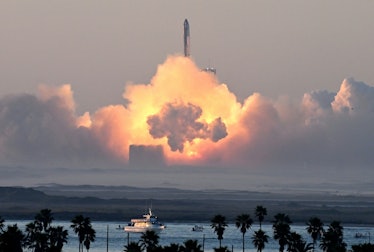
1. SPACEX'S STARSHIP MAINTAINED A 100 PERCENT EXPLOSION RATE

The Super Heavy Booster, the launch vehicle’s main rocket stage, exploded shortly after it separated...

The Super Heavy Booster, the launch vehicle’s main rocket stage, exploded shortly after it separated from the Starship spacecraft. The investigation is still ongoing, but SpaceX believes Starship exploded not long afterward, a self-destructive act by the spacecraft’s flight termination system, which blows the rocket up if it veers off course.

TIMOTHY A. CLARY/AFP/GETTY IMAGES

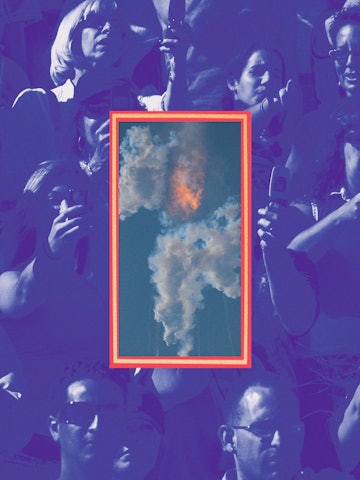
On November 18, the second attempt at an uncrewed test flight of Starship and the Super Heavy Booster ended in a fiery explosion in the skies over Texas. The Super Heavy Booster, the launch vehicle’s main rocket stage, exploded shortly after it separated from the Starship spacecraft. The investigation is still ongoing, but SpaceX believes Starship exploded not long afterward, a self-destructive act by the spacecraft’s flight termination system, which blows the rocket up if it veers off course.

Not an ideal second outing for the world’s largest and most powerful rocket, which Musk hopes will take humans to Mars and a variant of which NASA hopes will land its astronauts on the Moon in 2025. But Starship did technically make it to space this time, flying for about eight minutes before blowing up — the first orbital Starship test flight in April ended in flames just moments after launch.

{ https://www.inverse.com/ }

Hoe vind je dit bericht?
Geschreven door peter om 17:48 Stuur door

First contact with aliens could end in colonization and genocide if we don't learn from history

First contact with aliens could end in colonization and genocide if we don't learn from history

SETI has been listening for markers that may indicate alien life -- but is doing so ethical?  Donald Giannati via Unsplash

We’re only halfway through 2023, and it feels already like the year of alien contact.

In February, President Joe Biden gave orders to shoot down three unidentified aerial phenomena – NASA’s title for UFOs. Then, the alleged leaked footage from a Navy pilot of a UFO, and then news of a whistleblower’s report on a possible U.S. government cover-up about UFO research. Most recently, an independent analysis published in June suggests that UFOs might have been collected by a clandestine agency of the U.S. government.

If any actual evidence of extraterrestrial life emerges, whether from whistleblower testimony or an admission of a cover-up, humans would face a historic paradigm shift.

As members of an Indigenous studies working group who were asked to lend our disciplinary expertise to a workshop affiliated with the Berkeley SETI Research Center, we have studied centuries of culture contacts and their outcomes from around the globe. Our collaborative preparations for the workshop drew from transdisciplinary research in Australia, New Zealand, Africa and across the Americas.

In its final form, our group statement illustrated the need for diverse perspectives on the ethics of listening for alien life and a broadening of what defines “intelligence” and “life.” Based on our findings, we consider first contact less as an event and more as a long process that has already begun.

Who’s in charge of first contact

The question of who is “in charge” of preparing for contact with alien life immediately comes to mind. The communities – and their interpretive lenses – most likely to engage in any contact scenario would be military, corporate and scientific.

By giving Americans the legal right to profit from space tourism and planetary resource extraction, the Commercial Space Launch Competitiveness Act of 2015 could mean that corporations will be the first to find signs of extraterrestrial societies. Otherwise, while detecting unidentified aerial phenomena is usually a military matter, and NASA takes the lead on sending messages from Earth, most activities around extraterrestrial communications and evidence fall to a program called SETI, or the search for extraterrestrial intelligence.

SETI is a collection of scientists with a variety of research endeavors, including Breakthrough Listen, which listens for “technosignatures,” or markers, like pollutants, of a designed technology.

SETI investigators are virtually always STEM – science, technology, engineering and math – scholars. Few in the social science and humanities fields have been afforded opportunities to contribute to concepts of and preparations for contact.

In a promising act of disciplinary inclusion, the Berkeley SETI Research Center in 2018 invited working groups – including our Indigenous studies working group – from outside STEM fields to craft perspective papers for SETI scientists to consider.

Ethics of listening

Neither Breakthough Listen nor SETI’s site features a current statement of ethics beyond a commitment to transparency. Our working group was not the first to raise this issue. And while the SETI Institute and certain research centers have included ethics in their event programming, it seems relevant to ask who NASA and SETI answer to, and what ethical guidelines they’re following for a potential first contact scenario.

SETI’s Post-Detection Hub – another rare exception to SETI’s STEM-centrism – seems the most likely to develop a range of contact scenarios. The possible circumstances imagined include finding ET artifacts, detecting signals from thousands of light years away, dealing with linguistic incompatibility, finding microbial organisms in space or on other planets, and biological contamination of either their or our species. Whether the U.S. government or heads of military would heed these scenarios is another matter.

SETI-affiliated scholars tend to reassure critics that the intentions of those listening for technosignatures are benevolent, since “what harm could come from simply listening?” The chair emeritus of SETI Research, Jill Tarter, defended listening because any ET civilization would perceive our listening techniques as immature or elementary.

But our working group drew upon the history of colonial contacts to show the dangers of thinking that whole civilizations are comparatively advanced or intelligent. For example, when Christopher Columbus and other European explorers came to the Americas, those relationships were shaped by the preconceived notion that the “Indians” were less advanced due to their lack of writing. This led to decades of Indigenous servitude in the Americas.

This 16th century engraving shows Christopher Columbus landing in the Americas, where he and his explorers deemed the Indigenous people there as ‘primitive,’ as they had no writing system. <a href="https://commons.wikimedia.org/wiki/File:Columbus_landing_on_Hispaniola.JPG" rel="nofollow noopener" target="_blank" data-ylk="slk:Theodor de Bry/Wikimedia Commons;elm:context_link;itc:0" class="link ">Theodor de Bry/Wikimedia Commons</a>

This 16th century engraving shows Christopher Columbus landing in the Americas, where he and his explorers deemed the Indigenous people there as ‘primitive,’ as they had no writing system.  Theodor de Bry/Wikimedia Commons

The working group statement also suggested that the act of listening is itself already within a “phase of contact.” Like colonialism itself, contact might best be thought of as a series of events that starts with planning, rather than a singular event. Seen this way, isn’t listening potentially without permission just another form of surveillance? To listen intently but indiscriminately seemed to our working group like a type of eavesdropping.

It seems contradictory that we begin our relations with aliens by listening in without their permission while actively working to stop other countries from listening to certain U.S. communications. If humans are initially perceived as disrespectful or careless, ET contact could more likely lead to their colonization of us.

Histories of contact

Throughout histories of Western colonization, even in those few cases when contactees were intended to be protected, contact has led to brutal violence, pandemics, enslavement and genocide.

James Cook’s 1768 voyage on the HMS Endeavor was initiated by the Royal Society. This prestigious British academic society charged him with calculating the solar distance between the Earth and the Sun by measuring the visible movement of Venus across the Sun from Tahiti. The society strictly forbade him from any colonial engagements.

Though he achieved his scientific goals, Cook also received orders from the Crown to map and claim as much territory as possible on the return voyage. Cook’s actions put into motion wide-scale colonization and Indigenous dispossession across Oceania, including the violent conquests of Australia and New Zealand.

The 1768 voyage of British captain James Cook, center, put into motion wide-scale colonization and Indigenous dispossession across Oceania. <a href="https://nla.gov.au/nla.obj-135646842/view" rel="nofollow noopener" target="_blank" data-ylk="slk:John Hamilton Mortimer via the National Library of Australia;elm:context_link;itc:0" class="link ">John Hamilton Mortimer via the National Library of Australia</a>

The 1768 voyage of British captain James Cook, center, put into motion wide-scale colonization and Indigenous dispossession across Oceania.  John Hamilton Mortimer via the National Library of Australia

The Royal Society gave Cook a “prime directive” of doing no harm and to only conduct research that would broadly benefit humanity. However, explorers are rarely independent from their funders, and their explorations reflect the political contexts of their time.

As scholars attuned to both research ethics and histories of colonialism, we wrote about Cook in our working group statement to showcase why SETI might want to explicitly disentangle their intentions from those of corporations, the military and the government.

Although separated by vast time and space, both Cook’s voyage and SETI share key qualities, including their appeal to celestial science in the service of all humanity. They also share a mismatch between their ethical protocols and the likely long-term impacts of their success.

The initial domino of a public ET message, or recovered bodies or ships, could initiate cascading events, including military actions, corporate resource mining and perhaps even geopolitical reorganizing. The history of imperialism and colonialism on Earth illustrates that not everyone benefits from colonization. No one can know for sure how engagement with extraterrestrials would go, though it’s better to consider cautionary tales from Earth’s own history sooner rather than later.

  • This article has been updated to correct the date of James Cook’s voyage.
  • This article is republished from The Conversation, a nonprofit, independent news organization bringing you facts and trustworthy analysis to help you make sense of our complex world.The Conversation has a variety of fascinating free newsletters.

It was written by: David Delgado Shorter, University of California, Los Angeles; Kim TallBear, University of Alberta, and William Lempert, Bowdoin College.

Read more:

David Delgado Shorter has received funding from the National Science Foundation, the University of California, and the California Community Foundation.

William Lempert has received funding from Bowdoin College, the Wenner-Gren Foundation for Anthropological Research, the Fulbright IIE US Scholar Program, the Lois Roth Endowment, the Andrew W. Mellon Foundation, and the American Council of Learned Societies.

Kim TallBear does not work for, consult, own shares in or receive funding from any company or organization that would benefit from this article, and has disclosed no relevant affiliations beyond their academic appointment.

{ https://theconversation.com/us }

Hoe vind je dit bericht?
Geschreven door peter om 17:32 Stuur door

‘Tardis’: Woman Freaks Out About UFO That Keeps Flying Over Her Home

‘Tardis’: Woman Freaks Out About UFO That Keeps Flying Over Her Home

Shutterstock/LeedsSkyline

Shutterstock/LeedsSkyline

KAY SMYTHE - NEWS AND COMMENTARY WRITER

A mother from Middleton, Leeds, “freaked out” in December as a UFO barreled over her home … again!

Kay Thorpe was pretty shaken after photographing a UFO she claims has been flying over her home for the last few years, according to The Mirror. The 36-year-old mother-of-three reportedly snapped the picture while in her back garden at some point in December, hoping she’d be able to zoom in and figure out what the thing she keeps seeing really is. But the results left her more confused than ever.

“Where I live, you don’t often see a lot of stars but this one particular star is above my house every night and every morning,” Thorpe explained to the outlet. “And I kept looking at it thinking ‘that can’t be a star’ because it’s always there but it doesn’t flicker like a star. It’s been there for years. It wasn’t twinkling and I thought what else could it be?” 

But when she zoomed in, things became “distorted.” Eventually she was able to snap a more stable photograph. “My first thought was it could be some sort of extra terrestrial. I didn’t think it was a spaceship but when I saw the shape, I thought that’s not normal,” she continued. “When I looked at it, I was freaked out. I thought ‘am I safe?’ I thought, could it be the International Space Station?”

Thorpe reportedly posted the images to her social media accounts, with a handful of people replying that the thing looks like a “Tardis,” the infamous time-travel machine from hit sci-fi show “Doctor Who.”

Photographs taken by Thorpe have seemingly already been sold, which is a shame. But during my digging, I found a few other photographs shared online of a weird, Tardis-looking contraptions.

“I shared it online and everyone started saying it’s Doctor Who, it’s the TARDIS. I’m not a Doctor Who fan but I knew what people meant when they said it. A lot of people said TARDIS. I don’t believe we’re alone. I think there’s something out there — I don’t think we’re the only species,” Thorpe continued.

“The thought has dawned on me that something could be looking down on us,” Thorpe said. “Because it’s been there for that many years I know I must be safe. Unless I’ve been abducted and my memory’s been wiped! A couple of people said it’s heaven’s door and we’ve recently had a bereavement so I’d like to think it’s maybe that.” 

Across the pond, we’re all still wondering when the government will stop lying to us about UFOs and finally release their data. My gut feeling says it’ll never happen, so perhaps whoever is watching us from our skies will come down and introduce themselves in 2024.

{ https://dailycaller.com/ }

Hoe vind je dit bericht?
Geschreven door peter om 17:22 Stuur door

Fermi Produces Unique Time-Lapse Tour of Gamma-Ray Sky

Fermi Produces Unique Time-Lapse Tour of Gamma-Ray Sky

A new movie from NASA’s Fermi mission shows the intensity of gamma rays — the highest-energy form of light — with energies above 200 million electron volts (MeV) detected by Fermi’s Large Area Telescope between August 2008 and August 2022. For comparison, visible light has energies between 2 and 3 electron volts. Brighter colors mark the locations of more intense gamma-ray sources.

“The bright, steady gamma-ray glow of the Milky Way is punctuated by intense, days-long flares of near-light-speed jets powered by supermassive black holes in the cores of distant galaxies,” said Dr. Seth Digel, a senior staff scientist at SLAC National Accelerator Laboratory.

“These dramatic eruptions, which can appear anywhere in the sky, occurred millions to billions of years ago, and their light is just reaching Fermi as we watch.”

“One of the first things to strike your eye in the movie is a source that steadily arcs across the screen,” said Dr. Judy Racusin, a researcher at NASA’s Goddard Space Flight Center.

“That’s our Sun, whose apparent movement reflects Earth’s yearly orbital motion around it.”

Most of the time, Fermi’s Large Area Telescope (LAT) detects the Sun faintly due to the impact of accelerated particles called cosmic rays. When they strike the Sun’s gas or even the light it emits, gamma rays result.

At times, though, the Sun suddenly brightens with powerful eruptions called solar flares, which can briefly make our star one of the sky’s brightest gamma-ray sources.

The Fermi team made an all-sky time-lapse movie using 14 years of data acquired by Fermi’s Large Area Telescope. Image credit: NASA’s Goddard Space Flight Center / DOE / LAT Collaboration.

The Fermi team made an all-sky time-lapse movie using 14 years of data acquired by Fermi’s Large Area Telescope.

Image credit: NASA’s Goddard Space Flight Center / DOE / LAT Collaboration.

“The new movie shows the sky in two different views,” the astronomers said.

“The rectangular view shows the entire sky with the center of our Galaxy in the middle.”

“This highlights the central plane of the Milky Way, which glows in gamma rays produced from cosmic rays striking interstellar gas and starlight.”

“It’s also flecked with many other sources, including neutron stars and supernova remnants.”

“Above and below this central band, we’re looking out of our Galaxy and into the wider Universe, peppered with bright, rapidly changing sources.”

“Most of these are actually distant galaxies, and they’re better seen in a different view centered on our Galaxy’s north and south poles.”

“Each of these galaxies, called blazars, hosts a central black hole with a mass of a million or more Suns.”

“Somehow, the black holes produce extremely fast-moving jets of matter, and with blazars we’re looking almost directly down one of these jets, a view that enhances their brightness and variability.”

“The variations tell us that something about these jets has changed,” Dr. Racusin said.

“We routinely watch these sources and alert other telescopes, in space and on the ground, when something interesting is going on.”

“We have to be quick to catch these flares before they fade away, and the more observations we can collect, the better we’ll be able to understand these events.”

Fermi plays a key role in the growing network of missions working together to capture these changes in the Universe as they unfold.

“Many of these galaxies are extremely far away,” the researchers said.

“For example, the light from a blazar known as 4C +21.35 has been traveling for 4.6 billion years, which means that a flare up we see today actually occurred as our Sun and Solar System were beginning to form.”

“Other bright blazars are more than twice as distant, and together provide striking snapshots of black hole activity throughout cosmic time.”

“Not seen in the time-lapse are many short-duration events that Fermi studies, such as gamma-ray bursts, the most powerful cosmic explosions.”

“This is a result of processing data across several days to sharpen the images.”

You Might Like

{ https://www.sci.news/ }

Hoe vind je dit bericht?
Geschreven door peter om 17:11 Stuur door

The other realm' Proof of life after death

The other realm' Proof of life after death

You wake up. Sleepiness fades as your eyes slowly open to a bright white light. And it feels warm and familiar; it feels like home. And your whole family is there to meet you. 

Your entire life flashes before your eyes, like scenes from a movie. The good. The bad. Even the awful things you've done. But everything comes together. It all finally makes sense. 
afterlife,%20reincarnation,%20spirit.jpg

 A familiar voice says: "We're happy you're here. We missed you. But - you can't stay." What? You just got here. You're getting kicked out already? 
The voice says, "They need you. But we'll see you again when the time is right." And you know, somehow, the voice is telling the truth. 
Suddenly, a burst of red-hot pain rips through your chest. It feels like every single cell in your body is on fire. You can't breathe. 
A scream forces your eyes open. It's a blood-curdling scream, like an animal being eaten alive. Then you realize: the scream is coming from you. 
You're in a hospital bed surrounded by doctors and nurses. They all take a step back. Stunned. They're staring at you. But why? 
Well - you just came back from the dead. 
The above story is one of many similar stories told by people who have had a near death experience where they witnessed and experienced the reality of another world. 
Even after people have medically died scientists have discovered that awareness may continue which led to the assumption that death may not be as terminal as we think it is. 
Professor Robert Lanza from Wake Forest University School of Medicine in North Carolina, claims the theory of biocentrism teaches that death as we know it is an illusion created by our consciousness. 
From this perspective, our bodies function as mere living, breathing vessels. When the physical body succumbs to death, the spirit that once resided within the biological form departs, returning to the light or, one might say, transitioning to another higher dimension all the while, not only maintaining its awareness, but also capable of traveling through time and space, assuming any desired form it wishes. 
Many spirits will return from this dimension to their original planet (reincarnation) or eventually embark on intergalactic journeys. 
The Why Files discusses the various aspects that prove that there is an afterlife.
  

{ https://ufosightingshotspot.blogspot.com/ }

Hoe vind je dit bericht?
Geschreven door peter om 16:55 Stuur door

Officer Schirmer’s 1967 UFO Abduction and “Inside UFO” Encounter

Officer Schirmer’s 1967 UFO Abduction and “Inside UFO” Encounter

Herbert Schirmer UFO abduction

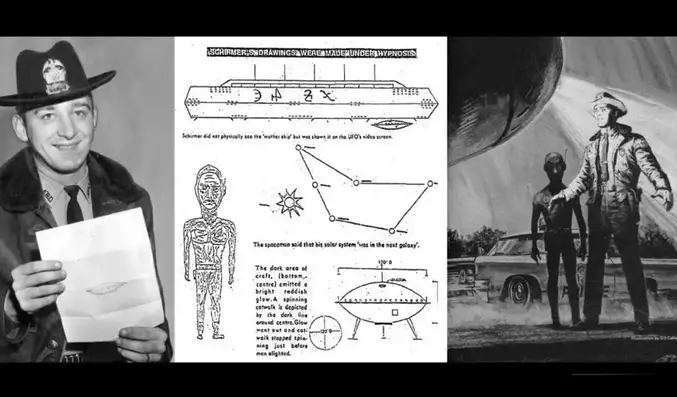
In the quiet town of Ashland, Nebraska, the cold winter air of December 3, 1967, was pierced by an event so bizarre it would etch itself into UFO lore forever. Police Officer Herbert Schirmer, a man sworn to protect and serve, found himself face-to-face not with a criminal, but with the unknown occupants of a UFO. His detailed account of abduction and otherworldly interaction presents a compelling case for one of the most fascinating UFO sightings in history.

The Encounter Begins

Herbert Schirmer, while on routine patrol around 2:30 AM, noticed unusual flashing lights that he first mistook for a truck. As he approached, the lights transformed into a hovering, football-shaped craft emitting a red-orange glow. This was no truck; it was something far beyond his understanding.

Abducted by the Unknown

What followed was nothing short of cinematic. Schirmer described being pulled towards the craft, feeling stunned and terrified. As he got closer, the craft landed, revealing its intricate structure and otherworldly technology. A hatch opened, and beings resembling humans emerged. They approached Schirmer, one wielding a strange, pencil-like device, which he used to press against Schirmer’s neck, causing him pain and then an inexplicable calm.

Inside the UFO

Schirmer was then led inside the UFO, where he witnessed the wonders and horrors of alien technology. He described the interior as a hive of activity, with cylindrical structures, a spinning cocoon emitting rainbow colors, and a control room filled with panels and screens beyond human comprehension. The beings explained their propulsion system to him, a concept far ahead of our time, hinting at the advanced civilization they came from.

A Message for Mankind

During his time aboard, Schirmer received a cryptic message about the universe and the aliens’ interest in Earth’s electricity. The beings, while not overtly threatening, conveyed a sense of urgency and purpose in their actions. Schirmer, overwhelmed by the experience, was eventually returned to his patrol car, finding that time had inexplicably slipped away.

The Aftermath

The incident left Schirmer changed. He reported the incident, despite the potential ridicule, driven by a sense of duty and a need for answers. His story, scrutinized and studied by UFO researchers, stands as a detailed, first-hand account of human-alien interaction. Schirmer’s experience offers a glimpse into the possibility that we are not alone and that our understanding of the universe is just beginning.

VIDEO:

  • Police officer Herbert Schirmer describes the inside of a UFO after his abduction experience in 1967

https://youtu.be/SAc9fnpvDGw

Officer Herbert Schirmer’s encounter in 1967 remains one of the most detailed and compelling UFO sightings ever recorded. It challenges our perception of reality and forces us to consider the vast, unexplored cosmos. As we continue to search the skies for answers, Schirmer’s story stands as a testament to the human spirit’s unyielding quest for the truth about our place in the universe.

https://youtu.be/_p9yTJaee6g

{ https://www.latest-ufo-sightings.net/ }

Hoe vind je dit bericht?
Geschreven door peter om 16:47 Stuur door

Meer van UFO'S of UAP'S, ASTRONOMIE, RUIMTEVAART, ARCHEOLOGIE, OUDHEIDKUNDE, SF-SNUFJES EN ANDERE ESOTERISCHE WETENSCHAPPEN - DE ALLERLAATSTE NIEUWTJES

↑ Terug naar de berichten