Naar de inhoud

UFO'S of UAP'S, ASTRONOMIE, RUIMTEVAART, ARCHEOLOGIE, OUDHEIDKUNDE, SF-SNUFJES EN ANDERE ESOTERISCHE WETENSCHAPPEN - DE ALLERLAATSTE NIEUWTJES

UFO's of UAP'S in België en de rest van de wereld
akke.beakke.be
Ontdek de Fascinerende Wereld van UFO's en UAP's: Jouw Bron voor Onthullende Informatie! Ben jij ook gefascineerd door het onbekende? Wil je meer weten over UFO's en UAP's, niet alleen in België, maar over de hele wereld? Dan ben je op de juiste plek! België: Het Kloppend Hart van UFO-onderzoek In België is BUFON (Belgisch UFO-Netwerk) dé autoriteit op het gebied van UFO-onderzoek. Voor betrouwbare en objectieve informatie over deze intrigerende fenomenen, bezoek je zeker onze Facebook-pagina en deze blog. Maar dat is nog niet alles! Ontdek ook het Belgisch UFO-meldpunt en Caelestia, twee organisaties die diepgaand onderzoek verrichten, al zijn ze soms kritisch of sceptisch. Nederland: Een Schat aan Informatie Voor onze Nederlandse buren is er de schitterende website www.ufowijzer.nl, beheerd door Paul Harmans. Deze site biedt een schat aan informatie en artikelen die je niet wilt missen! Internationaal: MUFON - De Wereldwijde Autoriteit Neem ook een kijkje bij MUFON (Mutual UFO Network Inc.), een gerenommeerde Amerikaanse UFO-vereniging met afdelingen in de VS en wereldwijd. MUFON is toegewijd aan de wetenschappelijke en analytische studie van het UFO-fenomeen, en hun maandelijkse tijdschrift, The MUFON UFO-Journal, is een must-read voor elke UFO-enthousiasteling. Bezoek hun website op www.mufon.com voor meer informatie. Samenwerking en Toekomstvisie Sinds 1 februari 2020 is Pieter niet alleen ex-president van BUFON, maar ook de voormalige nationale directeur van MUFON in Vlaanderen en Nederland. Dit creëert een sterke samenwerking met de Franse MUFON Reseau MUFON/EUROP, wat ons in staat stelt om nog meer waardevolle inzichten te delen. Let op: Nepprofielen en Nieuwe Groeperingen Pas op voor een nieuwe groepering die zich ook BUFON noemt, maar geen enkele connectie heeft met onze gevestigde organisatie. Hoewel zij de naam geregistreerd hebben, kunnen ze het rijke verleden en de expertise van onze groep niet evenaren. We wensen hen veel succes, maar we blijven de autoriteit in UFO-onderzoek! Blijf Op De Hoogte! Wil jij de laatste nieuwtjes over UFO's, ruimtevaart, archeologie, en meer? Volg ons dan en duik samen met ons in de fascinerende wereld van het onbekende! Sluit je aan bij de gemeenschap van nieuwsgierige geesten die net als jij verlangen naar antwoorden en avonturen in de sterren! Heb je vragen of wil je meer weten? Aarzel dan niet om contact met ons op te nemen! Samen ontrafelen we het mysterie van de lucht en daarbuiten.

Archief

Quantum batteries could charge faster by scrambling the rules of cause and effect

Quantum batteries could charge faster by scrambling the rules of cause and effect

Quantum Entanglement
An artist's illustration of a particle in a quantum superposition.
 (Image credit: agsandrew | Shutterstock.com)

Quantum batteries of the future could gain charge by breaking the conventional laws of causality, research has shown.

Conventional batteries charge by converting electrical energy into chemical energy on the scale of vast numbers of electrons.

But in a new proof-of-principle experiment researchers have demonstrated how a weird quantum effect may lead to batteries that charge faster and with more efficiency by scrambling cause and effect, according to research Dec. 14 in the journal Physical Review Letters. 

Causality, or the relationship between cause and effect, is not always straightforward in quantum mechanics, the strange rules that govern the world of the very small.

Related:

"Normally, if event A comes first and causes event B, it is assumed that B cannot in turn cause A at the same time," co-first author Yuanbo Chen, a physicist at the University of Tokyo, told Live Science. "However, recent advancements in theoretical physics propose that in certain frameworks, scenarios where 'A causes B' and 'B causes A' could simultaneously be true."

The principle of quantum superposition enables particles to exist in many different states at once, at least until they are observed and "pick" a state to land in. 

Any property of a quantum object (such as its momentum, location, or, in the famed case of Erwin Schrödinger’s hypothetical cat, whether it’s alive or not) can exist in superposition — a probabilistic jumble of every possible state that only collapses into a definite outcome when the object is viewed. 

This realization has led physicists to conduct all kinds of bizarre experiments that contradict our intuitive notions of what should be possible, including ones where a single particle can both exist and not exist in many different places at the same time.

But superposition doesn’t just mess with our intuitive sense of space, it scrambles our sense of causality too. In 2009, physicists used a device called a quantum switch to observe a phenomenon called indefinite causal order. By sending a light particle, or photon down a pair of diverging paths, the physicists caused it to split into two possible versions of itself — one which went down the first path, and the other the second. 

Then, depending on the path the photon took, physicists applied two different processes in a different order depending on the path. The result was a photon that had its causality jumbled: it was in a quantum superposition where both orders of events were true. 

"Say that we have two processes: A and B," Chen said. "With a quantum switch, you can create a superposition of (First apply A and then B) and (First apply B and then A)."

Chen and his colleagues wondered if they could incorporate this into a quantum battery, a proposed device that could theoretically store the energy of photons and charge faster than conventional electrochemical batteries. 

They compared three charging methods: connecting two chargers to a battery sequentially, simultaneously, or in a superposition that made it impossible to tell the order of input. 

Their calculations showed that the superposition method would enable a low-power, causally-scrambled charger to deliver more energy more efficiently than a conventional high-power charger. 

They followed up their calculations with a proof-of-principle experiment using light. By sending photons through a quantum switch with two possible paths, the researchers split the light particles into two possible versions of themselves, each one traversing a different path.

Then, after subjecting the light to two inputs that would polarize them in a different order (A then B or B then A) based on the path they were on, the researchers measured the polarization at the end and found that the individual photons had been causally scrambled.

Having tested their protocol, the scientists say their next challenge is to create a physical quantum battery that can hold a charge. However, the first experimental evidence for a quantum battery was only published last year, so it may not happen any time soon.

"Given the current situation characterized by limited experimental efforts and ongoing theoretical exploration in the realm of quantum batteries, it is challenging to estimate a precise timeline for achieving conclusive outcomes," Chen said.

https://www.youtube.com/watch?v=D4lO_-iTlw4

https://youtu.be/K5Po5R-1rgY

{ https://www.space.com/ }

Hoe vind je dit bericht?
Geschreven door peter om 00:24 Stuur door

INTELLIGENCE: THE PATH TOWARD EXPONENTIAL GROWTH

jAXTBHM0?format=jpg&name=900x900

INTELLIGENCE: THE PATH TOWARD EXPONENTIAL GROWTH

What is the mark of a genius? The ability to reach a solution through an unforeseen shortcut instead of a random walk or an elaborate effort.

In the late 1940s, the brilliant physicists Shin’ichirō Tomonaga and Julian Schwinger offered an operator method for calculating quantum electrodynamics, which was entirely different from Richard Feynman’s diagrammatic method. The two approaches appeared very different, until a 25-year old physicist, Freeman Dyson, had an Eureka moment and demonstrated in a 1949 paper that they are equivalent. The circumstances were unexpected.

In the spring of 1948, Dyson took a cross-country road trip with Feynman. Upon his return, Dyson went to Ann Arbor to spend six weeks with Schwinger. Subsequently, he left Michigan for another cross-country bus trip. Dyson referred to a “flash of illumination on the Greyhound bus,” where everything fell into place. He saw the equivalence of the two competing formulations that had evaded both Feynman and Schwinger.

I often tell my students and postdocs that scientific insights are not necessarily the product of hard work. Take a vacation … go to the movies … enjoy music. If at the end of it all, you’ll return with a brilliant solution to a problem that others were struggling with, your contribution is invaluable. Your intelligence is measured by the originality of your intellectual discoveries and not by the number of likes you get on social media.

What makes human intelligence so unique relative to animals? It is in its ability to promote knowledge exponentially fast. Natural selection is often set up through gradual zero-sum games in an environment that offers limited resources. Animals with better motor skills maintain territorial control more effectively than their competitors. This perspective changed drastically over the past century of human history. Modern science and technology now offer an infinite-sum game with unlimited resources. Whereas natural evolution was limited to Earth, humans launched spacecraft towards new domains of real estate within the solar system and beyond.

Human intelligence allows exponential growth of technological capabilities. Moore’s Law for the miniaturization of semiconductors applies to a broader range of technological capabilities, including 3D printing, drones, robotics, artificial intelligence and synthetic biology.

Without intelligence, unplanned progress is limited to random walks. For example, mutations sample by chance alternative designs of biological systems. Science is made efficient by design  through constructive cooperation, as summarized in a 1675 letter by Isaac Newton to Robert Hooke: “if I have seen further, it is by standing on the shoulders of giants.” Sharing scientific and technological knowledge among individuals and groups makes the growth rate of knowledge proportional to the amount of existing knowledge. When the rate scales with the amount, growth is exponential.

Communication via language and mathematics is key to the exponential evolution of science and technology. Sharing information promotes its growth at a rate that is proportional to what is already known by the community.

It is reasonable to imagine that these traits are universal and likely also apply to alien species on exoplanets. If extraterrestrial gadgets can reach Earth, then the senders probably communicate with each other through a language. In other words: technological aliens communicate!

And if their technological growth is exponential as is ours, they could be far more superior if their technological age exceeds ours. When we encounter their gadgets we might be filled with religious awe, like Moses witnessing the burning bush which was never consumed and concluding that it was manufactured by a superhuman entity.

Humans exceeded the evolutionary level of chimpanzees not by developing better motor skills, but by developing rockets that can reach the Moon and Mars. Given this perspective, it is surprising that some of my colleagues insist that interstellar meteors must be stones. I refer to this perspective as “the stone age of science.”

Imagining what might lie beyond the solar system is a mark of intelligence. We know that 83% of the cosmic matter is not comprised of stones, but an unknown substance labeled “dark matter”. Our ability to consider alternatives to the familiar enables growth in our scientific knowledge. Those who insist on past knowledge will remain ignorant in the same way that chimpanzees never imagined landing on the Moon and non-avian dinosaurs never looked through telescopes in anticipation of a looming catastrophe from an asteroid impact.

  • star

Extending our ventures to interstellar space beyond the boundaries of the Solar system would be the next mark of human intelligence and ingenuity. Enrico Fermi asked: “where is everybody?” The answer may arrive as soon as we exit the Oort Cloud to interstellar space: “Welcome to the club of intelligent civilizations whose knowledge grows exponentially.”

  • Avi Loeb is the head of the Galileo Project, founding director of Harvard University’s – Black Hole Initiative, director of the Institute for Theory and Computation at the Harvard-Smithsonian Center for Astrophysics, and the former chair of the astronomy department at Harvard University (2011-2020). He chairs the advisory board for the Breakthrough Starshot project, and is a former member of the President’s Council of Advisors onScience and Technology and a former chair of the Board on Physics and Astronomy of the National Academies. He is the bestselling author of “Extraterrestrial: The First Sign of Intelligent Life Beyond Earth” and a co-author of the textbook “Life in the Cosmos”, both published in 2021. His new book, titled “Interstellar”, was published in August 2023.

{ https://thedebrief.org/category/science/ }

Hoe vind je dit bericht?
Geschreven door peter om 00:10 Stuur door

Pentagon Hides 23-Minute UFO Video & UFO Photo 50 Feet From Cockpit, Elizondo Claimed

Luis Elizondo 23-minute UFO video

Pentagon Hides 23-Minute UFO Video & UFO Photo 50 Feet From Cockpit, Elizondo Claimed

In the 2023 July congressional UAP hearings, former US intelligence official David Grusch testified that the United States government has been concealing evidence of UFOs and indications of non-human intelligence. He claimed the government possessed retrieved intact and partially intact craft of non-human origin and he knows the location. Finally, the subject of unidentified aerial phenomena (UAP) is considered serious due to the lack of information about them and increasing military encounters. Meanwhile, UFO enthusiasts are waiting for the Pentagon to release a 23-minute video that will reportedly leave viewers “rattled.” Luis Elizondo claimed that it shows UFOs moving in a strange pattern.

It is more than 4 years since the New York Times article revealed the existence of the secret program (AATI) funded by the United States Army to investigate UFOs. Luis Elizondo ran the Advanced Aerospace Threat Identification Program (AATI) from 2007 to 2012. Since then, he has spoken about various incidents that happened to the US pilots and possibilities of alien existence.

Elizondo, who resigned from the Pentagon in 2017, has made several bold statements since then. His claims literally change the US government’s perspective on viewing UFOs. Moreover, he refused to talk more as he is afraid of being arrested.

In 2021, he stated to have seen the UFO footage, describing it as showing unidentified floating objects for 23 minutes. He made this revelation while talking to the YouTube channels Fade to Black and Witness Citizen UAP. During the talk, Elizondo revealed that the UFO video was extremely compelling.

According to Elizondo, the video is said to show multiple UFOs that are moving in ways and strange “patterns” that humans do not conventionally understand – with data recorded using US military systems.

Luis Elizondo 23-minute UFO video

Lue Elizondo was a former US Army intelligence officer who helped trace terrorists after 9/11. credit: The Sun

He also mentioned this video in his interview with GQ. He stated: “It was the overwhelming weight of evidence and data. I was talking to pilots routinely. There’s videos out there [in government, that the public haven’t seen] – there’s one that’s 23 minutes long. There’s another one where this thing is 50 feet away from the cockpit. I mean, it ain’t ours. We know that. Sometimes you just couldn’t believe it – you’d have seven or eight incidents in a single day. I’d get these emails from an admiral or a ship’s captain saying, ‘Lue, what do you want me to do? I can’t keep people below deck forever. These things are swarming my ship, they’re all over the place.’ That’s tough. I kept promising the cavalry was coming and I’d have answers for them and the cavalry never came. Senior leadership didn’t want to deal with it.”

Read also:

While discussing the 23-minute UFO video, Elizondo mentioned that it is a very compelling footage. “I did not say what it was. I sent it out to some highly trained experts in the ISR (Intelligence, surveillance, and reconnaissance) community. And when they came back to me, the title of the email was quote unquote ‘that UFO video’.”

He added: “It is definitive and its perplexing, every time you think you are like ‘thats what I am looking at’ – bang, it changes.” When quizzed by host Jimmy Church on the way the object moved, its speed and if it was “beyond our capabilities,” Elizondo said it was enough to make officials “raise our eyebrows and say woah.”

Here is the transcript of Luis Elizondo’s interview with Sean of Witness Citizen, where he talked about the 23-minute video and 50-foot photo:

Elizondo: You know, the problem is that this battle isn’t over. We won a major battle with the report coming out of the UAP report, it was historic like you said, in the very first sentence of the very first paragraph. It says this is a preliminary report which means there are other reports, you know, congratulations, you won, you got it, right? And then it said that there were 144 incidents and only one they were able to identify. By the way, that was only in the last year and a half, it was from November 2019 and forward. By the way, it only involved the navy, right, so yeah, so people say, well there was one from the Nimitz, okay.

Sean: That equipment sucks or…
Elizondo: This is… well, so, you’ve got a lot of stuff happening, right? So, you know, we’re just now starting this journey together.

Sean: Yeah, you know, it is kind of overwhelming for a lot of people but I’ll tell you, the message is getting out there in the right way and the way that I kind of… uh… evaluate, that is talking to my wife because she’s not very into this stuff, so not that, she’s not against it, we did see something together but she’s not like me, she doesn’t have a podcast. But the news comes on, they talk about the report, I come home later, ask her about it, what was your takeaway? And she says, well, I guess they only identified one out of what a hundred something, and I’m like, yes…

Elizondo: Right.
Sean: …That’s exactly right, honey.
Elizondo: Exactly, by the way, some of these things were really, really close, so you know, you tell me.
Sean: Wow, that’s crazy, yeah… Oh, when are we going to see that 50-foot-away pic?
Elizondo: Oh, man, that’s not up to me, but yeah, there’s a couple there that will rattle you pretty good, um… Yeah, there’s one I won’t go into detail, but the video is about 23 minutes long, it’s pretty good, man, gotta get that popcorn and some 3D glasses and maybe some Coca-Cola or something…

In order to have a glimpse of what the Navy and Air Force might capture in their camera, see the video below by the U.S. Navy that has been recently released, showing the support ship Shahid Baziar, from Iran’s Islamic Revolutionary Guard Corps Navy, unlawfully towing the Saildrone Explorer. From this video, one may wonder how many high-quality UFO videos are in possession of the US Navy.

Elizondo clarifies that his job was never intended to study UFOs. It was to hunt terrorists and spies – and then use those same skills to hunt UFOs. “It’s the same thing,” he said. He further noted: “I didn’t care if it was supernatural technology, bottom line is there is something over controlled US airspace performing in ways we can’t – we’ve got to figure it out.” (Source)

He compared the growing push for disclosure on what the US knows about the mysterious craft to when mankind first came out of caves to look at the stars, or when man-made fire. He said the world may see a “paradigm shift” in our thinking – just like when the astronomer Galileo established the Earth was not the center of the Solar System. “They tried to persecute him, to put him to the death – but at the end [the revelation] didn’t disrupt society and it benefited the species,” Elizondo said.

{ https://www.howandwhys.com/ }

Hoe vind je dit bericht?
Geschreven door peter om 23:54 Stuur door

EXCLUSIVEA bird, plane... or a UFO? Woman spots illuminous 'Tic-Tac' shaped object from her kitchen in Stockport - but experts think there might be a simple explanation

EXCLUSIVE - A bird, plane... or a UFO? Woman spots illuminous 'Tic-Tac' shaped object from her kitchen in Stockport - but experts think there might be a simple explanation

Yet another woman has spotted a bizarre Tic Tac shaped object in UK skies – the second in as many months. 

Karen Brown, from Stockport, was looking out of her kitchen window when she spotted the unidentified flying object (UFO). 

Her photos show the illuminous oblong object – which, at first glance, looks similar to the famous white breath mint – bobbing around over the trees at night in September. 

A similar UFO – possibly the same one – was seen by another Stockport resident the following month. 

Experts are intrigued by the presence of aerial entities that look like the original 'Tic Tac' UFO seen in 2004 – but there could be a simple explanation. 

Karen Brown, from Stockport, was looking out of her kitchen window when she spotted the unidentified flying object (UFO)

Karen Brown, from Stockport, was looking out of her kitchen window when she spotted the unidentified flying object (UFO)

Photos show the illuminous entity bobbing around over the trees in the suburb of Heaton Mersey at night time

Photos show the illuminous entity bobbing around over the trees in the suburb of Heaton Mersey at night time

READ MORE: 

Composite of the bizarre objects which were seen on separate nights in the first week of October

Composite of the bizarre objects which were seen on separate nights in the first week of October 

Mrs Brown said she was 'really intrigued' by the mysterious phenomena which she spotted on September 6. 

'I was looking out of my kitchen window and I noticed what I thought was a star,' she told MailOnline. 

'But when I really looked it was round with little circles around the outer edge.

'I took these pictures but the shapes were changing.' 

It was back in September that another Stockport resident who preferred to remain anonymous spotted two bizarre objects in the night's sky.

The first, described as looking like a square or triangle, had a hazy appearance and was changing shape and 'darting around the sky'. 

Meanwhile, the second object – a much brighter white in colour and 'shaped like a Tic Tac' – kept vanishing and reappearing. 

It's unclear if the 'Tic Tac' sightings by two different people in the same town are of the same object. 

Mrs Brown told MailOnline: 'It was very strange that a lady in Stockport saw something at the beginning of October and I saw a similar sighting the beginning of September.' 

Its brilliant white colour made it stand out in the British night's sky. It comes nearly two decades after the original 'Tic Tac' UFO was spotted in the US

Its brilliant white colour made it stand out in the British night's sky. It comes nearly two decades after the original 'Tic Tac' UFO was spotted in the US

Mrs Brown said she was 'really intrigued' by the mysterious phenomena which she snapped in Heaton Mersey

Mrs Brown said she was 'really intrigued' by the mysterious phenomena which she snapped in Heaton Mersey 

Earlier in 2023, a 'concerned citizen' shared her encounter with two unidentified flying objects (UFOs) from her back garden in Stockport

Earlier in 2023, a 'concerned citizen' shared her encounter with two unidentified flying objects (UFOs) from her back garden in Stockport

  • A bizarre face-shaped object changed colour while in the sky

    A bizarre face-shaped object changed colour while in the sky

According to the Defence and Security Media Advisory (DSMA) Committee, the matter falls under the remit of UK Space Command, who MailOnline has contacted for comment. 

Nick Pope, a UFO expert formerly with the UK's Ministry of Defence, has called the presence of Tic Tac shaped objects in UK skies 'intriguing'. 

'Any mention of a Tic Tac-shaped object performing unusual manoeuvres is particularly intriguing given the US Navy sightings of such objects,' he told MailOnline. 

Another British UFO researcher, Philip Mantle, said: 'I see no reason why these photos are not of an aircraft or drone'. 

'It's basically a light in the distance and the elongated shape is made by the unsteady hand of the photographer,' he told MailOnline.

'Why would two people in consecutive months spot the same thing? Well maybe aircraft are scheduled to take off at certain times and this is the flight path they take.' 

When the original Tic Tac UFO was spotted nearly 20 years ago, it marked a seismic shift away from the entities being perceived as simply 'flying saucers'. 

US Navy pilots were conducting a routine training mission with the aircraft carrier USS Nimitz off the Southern California coast in November 2004. 

{ https://www.dailymail.co.uk/ }

Hoe vind je dit bericht?
Geschreven door peter om 20:14 Stuur door

Astronomers Find New Way to Detect Water Oceans and Alien Life on Rocky Exoplanets

Astronomers Find New Way to Detect Water Oceans and Alien Life on Rocky Exoplanets

Planets too close to their star are too hot (such as Venus), those too far, are too cold (like Mars), whereas planets in the habitable zone are just right. Whilst there has been much effort in identifying planets in the theoretical habitable zones of their stars, until now there was no way of knowing whether they truly have liquid water. Now, astronomers from the University of Birmingham, MIT and elsewhere have shown that if an exoplanet has a reduced amount of carbon dioxide in its atmosphere compared to neighboring planets, it suggests there is liquid water on that planet’s surface.

An artist’s impression of the super-Earth planet Ross 508b. Image credit: Sci.News.

An artist’s impression of the super-Earth planet Ross 508b.

Image credit: Sci.News.

Astronomers have so far detected more than 5,200 extrasolar worlds. With current telescopes, they can directly measure a planet’s distance to its star and the time it takes it to complete an orbit.

Those measurements can help scientists infer whether a planet is within a habitable zone.

But there’s been no way to directly confirm whether a planet is indeed habitable, meaning that liquid water exists on its surface.

Across our own Solar System, astronomers can detect the presence of liquid oceans by observing glints — flashes of sunlight that reflect off liquid surfaces.

These glints, or specular reflections, have been observed, for instance, on Saturn’s largest moon, Titan, which helped to confirm the moon’s large lakes.

Detecting a similar glimmer in far-off planets, however, is out of reach with current technologies.

But MIT astronomer Julien de Wit, University of Birmingham astronomer Amaury Triaud and their colleagues realized there’s another habitable feature close to home that could be detectable in distant worlds.

“An idea came to us, by looking at what’s going on with the terrestrial planets in our own system,” Dr. Triaud said.

Venus, Earth, and Mars share similarities, in that all three are rocky and inhabit a relatively temperate region with respect to the Sun.

Earth is the only planet among the trio that currently hosts liquid water. And the researchers noted another obvious distinction: Earth has significantly less carbon dioxide in its atmosphere.

“We assume that these planets were created in a similar fashion, and if we see one planet with much less carbon now, it must have gone somewhere,” Dr. Triaud said.

“The only process that could remove that much carbon from an atmosphere is a strong water cycle involving oceans of liquid water.”

Indeed, the Earth’s oceans have played a major and sustained role in absorbing carbon dioxide.

Over hundreds of millions of years, the oceans have taken up a huge amount of carbon dioxide, nearly equal to the amount that persists in the Venusian atmosphere today.

This planetary-scale effect has left Earth’s atmosphere significantly depleted of carbon dioxide compared to its planetary neighbors.

“On Earth, much of the atmospheric carbon dioxide has been sequestered in seawater and solid rock over geological timescales, which has helped to regulate climate and habitability for billions of years,” said Dr. Frieder Klein, a researcher at the Woods Hole Oceanographic Institution.

The astronomers reasoned that if a similar depletion of carbon dioxide were detected in a far-off planet, relative to its neighbors, this would be a reliable signal of liquid oceans and life on its surface.

“After reviewing extensively the literature of many fields from biology, to chemistry, and even carbon sequestration in the context of climate change, we believe that indeed if we detect carbon depletion, it has a good chance of being a strong sign of liquid water and/or life,” Dr. de Wit said.

In the study, the researchers lay out a strategy for detecting habitable planets by searching for a signature of depleted carbon dioxide.

Such a search would work best for ‘peas-in-a-pod’ systems, in which multiple terrestrial planets, all about the same size, orbit relatively close to each other, similar to our own Solar System.

The first step the scientists propose is to confirm that the planets have atmospheres, by simply looking for the presence of carbon dioxide, which is expected to dominate most planetary atmospheres.

“Carbon dioxide is a very strong absorber in the infrared, and can be easily detected in the atmospheres of exoplanets,” Dr. de Wit said.

“A signal of carbon dioxide can then reveal the presence of exoplanet atmospheres.”

Once astronomers determine that multiple planets in a system host atmospheres, they can move on to measure their carbon dioxide content, to see whether one planet has significantly less than the others.

If so, the planet is likely habitable, meaning that it hosts significant bodies of liquid water on its surface.

But habitable conditions don’t necessarily mean that a planet is inhabited. To see whether life might actually exist, the authors propose that astronomers look for another feature in a planet’s atmosphere: ozone.

On Earth, plants and some microbes contribute to drawing carbon dioxide, although not nearly as much as the oceans. Nevertheless, as part of this process, the lifeforms emit oxygen, which reacts with the Sun’s photons to transform into ozone, a molecule that is far easier to detect than oxygen itself.

If a planet’s atmosphere shows signs of both ozone and depleted carbon dioxide, it likely is a habitable, and inhabited world.

“If we see ozone, chances are pretty high that it’s connected to carbon dioxide being consumed by life,” Dr. Triaud said.

“And if it’s life, it’s glorious life. It would not be just a few bacteria. It would be a planetary-scale biomass that’s able to process a huge amount of carbon, and interact with it.”

The team estimates that the NASA/ESA/CSA James Webb Space Telescope would be able to measure carbon dioxide, and possibly ozone, in nearby, multiplanet systems such as TRAPPIST-1, a seven-planet system that orbits a bright star, just 40 light-years from Earth.

“TRAPPIST-1 is one of only a handful of systems where we could do terrestrial atmospheric studies with Webb,” Dr. de Wit said.

“Now we have a roadmap for finding habitable planets. If we all work together, paradigm-shifting discoveries could be done within the next few years.”

  • The study was published in the journal Nature Astronomy.
  • A.H.M.J. Triaud et al. Atmospheric carbon depletion as a tracer of water oceans and biomass on temperate terrestrial exoplanets. Nat Astron, published online December 28, 2023; doi: 10.1038/s41550-023-02157-9

{ https://www.sci.news/ }

Hoe vind je dit bericht?
Geschreven door peter om 18:55 Stuur door

UFO appears after plasma twister broke apart from the sun

UFO appears after plasma twister broke apart from the sun

A plasma twister in the sun's northern hemisphere broke apart on December 28, 2023 and hurled a spinning cloud of hot gas into space. NASA's Solar Dynamics Observatory recorded its escape. 
sun%20ufo%20plasma%20twister%20(1).png

At first glance this tiny cloud may seem inconsequential. However, on its way out of the sun's atmosphere, it triggered magnetic instabilities that turned into a surprisingly large CME. The CME will not hit Earth. 
Remarkable, right after the plasma twister's breakup, a substantial unidentified object emerged from the sun and shot into space. 
sun%20ufo%20plasma%20twister%20(2).png

Considering the history of similar objects passing near the sun, which were clearly not charged particles released from the sun we may wonder whether this object could be of extraterrestrial origin and if it could be linked to the earlier disintegration of the plasma twister from the sun?
  

{ https://ufosightingshotspot.blogspot.com/ }

Hoe vind je dit bericht?
Geschreven door peter om 18:47 Stuur door

Organic Molecules Come from the Universe’s Cold Places

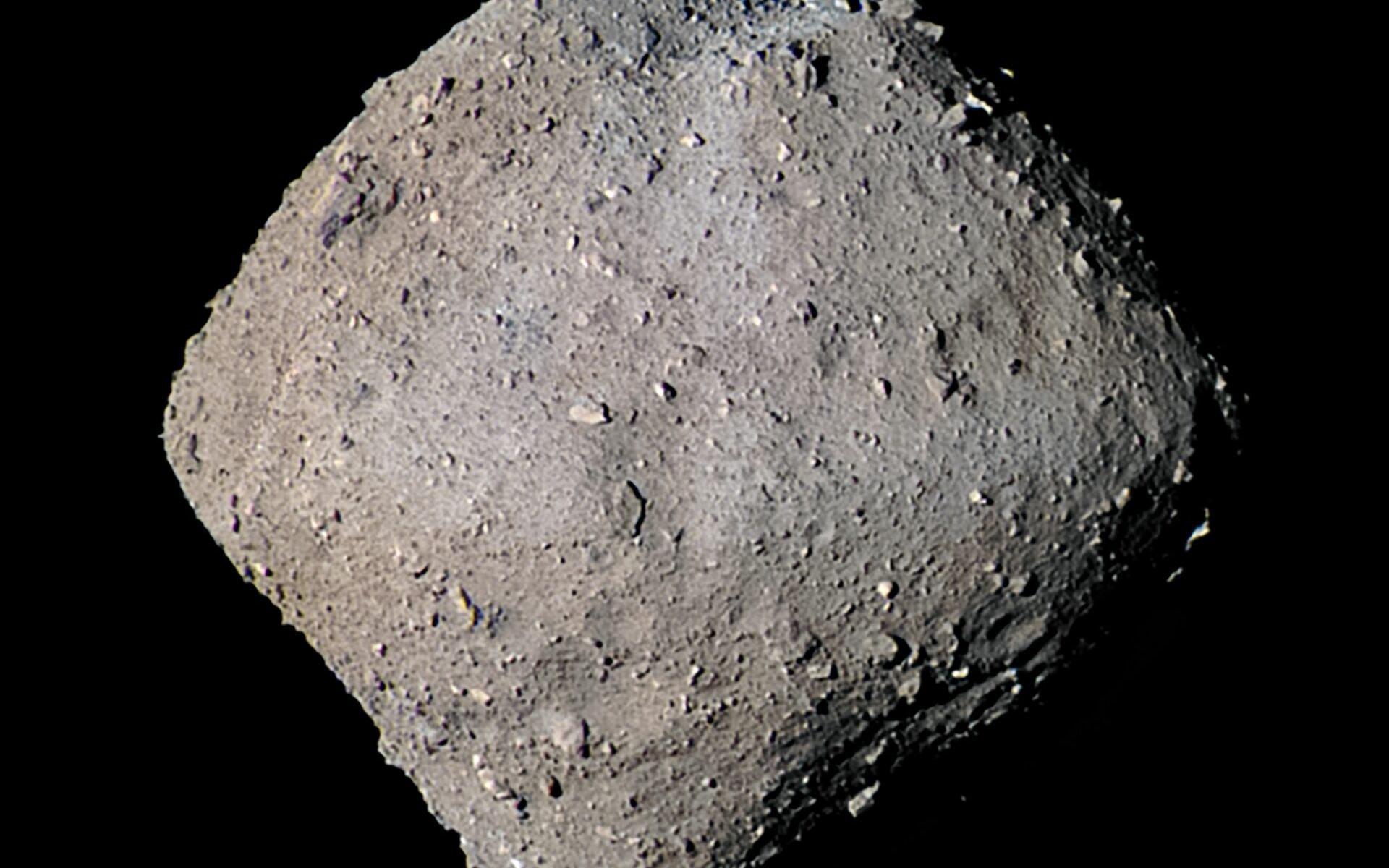
Asteroid Ryugu contains organic molecules called polycyclic aromatic hydrocarbons, thought to be chemical building blocks for life. Courtesy ISAS/JAXA

Organic Molecules Come from the Universe’s Cold Places

Life, as we all know, is based on chemistry. Prebiotic chemical building blocks existed on our planet for a long time before life arose. Astrobiology and cosmochemistry focus on the formation of those building blocks. They also look at the role each played in creating all the life forms we know today.

For a long time, cosmo-chemists have known that organic molecules called polycyclic aromatic hydrocarbons (PAHs) are quite plentiful in the Universe. Scientists consider them plausible prebiotic building blocks that likely played an important role in the formation of life on Earth. What’s not as well understood is their origin story. For a long time, scientists suspected that they formed in regions where temperatures get to around 1000 K. That would supply energy to promote chemical activity to create PAHs, such as in star-forming molecular clouds or circumstellar disks. It’s also possible they form as part of the processing of carbon-rich dust grains by nearby energy sources (such as stars).

However, based on recent studies of an asteroid and meteorite, it turns out that some PAHs formed in cold regions of space, too. In those regions, the temperature does not get much higher than 100 K. That finding opens up new pathways for understanding life’s chemical journey on other planets and celestial bodies.

Understanding These Organic Molecules

According to Professor Kliti Grice, a researcher at the Western Australia Organic and Isotope Geochemistry Centre at Curtin University, understanding these materials is a big step. “PAHs are organic compounds made up of carbon and hydrogen that are common on Earth but are also found in celestial bodies like asteroids and meteorites,” said Grice.

They’re spread throughout the interstellar medium and detected in galaxies across the Universe. Generally, they’re used as a tracer of cold molecular gas, which is where stars—and planets—begin their formation journey.

An image of an interstellar nebula with some polycyclic aromatic hydrocarbon (PAH) molecular structures superimposed. These organic molecules exist throughout the Universe. Courtesy: NASA.

An image of an interstellar nebula with some polycyclic aromatic hydrocarbon (PAH) molecular structures superimposed. These organic molecules exist throughout the Universe. Courtesy: NASA.

As such, scientists want to trace their path from space to Earth and compare space-based PAHs to Earth-based ones. That’s because PAHs are a very likely precursor to the kinds of materials that eventually lead to the formation of life. That makes their presence on other celestial bodies intriguing as scientists work to understand the formation and evolution of life.

Beyond Earth, PAHs account for about 30 percent of all carbon found in regions around stars, in molecular clouds, and on planets (and other bodies). On Earth, many PAHs exist in coal deposits and oil reservoirs. Plants burning (as in forest fires) also produce these compounds. They work their way into the soil and eventually end up in plants (among other things).

Organic Molecules and Rocky Bodies

Grice is part of an international research team that focused on pieces of asteroid Ryugu and the famous Murchison meteorite to figure out where their PAHs formed. The team started with an unusual chemistry project: burning plants. That’s because plants contain PAHs that form here on Earth. “We performed controlled burn experiments on Australian plants,” said Grice, “which were isotopically compared to PAHs from fragments of the Ryugu asteroid that were returned to Earth by a Japanese spacecraft in 2020, and the Murchison meteorite that landed in Australia in 1969. The bonds between light and heavy carbon isotopes in the PAHs were analyzed to reveal the temperature at which they were formed.”

The Murchison Meteorite, which fell to  Earth in 1969. Courtesy Basilicofresco, CC BY-SA 3.0

The Murchison Meteorite, which fell to Earth in 1969. It contains organic molecules. Courtesy Basilicofresco, CC BY-SA 3.0

Using high-tech methods to study Ryugu and Murchison, the team found two sources of PAHs with slightly different characteristics. “The smaller ones likely formed in cold outer space, while bigger ones probably formed in warmer environments, like near a star or inside a celestial body,” according to Grice.

Ryugu is particularly interesting since it formed early in the Solar System’s history. A critical analysis of its chemistry found several PAHs. The team also detected organosulfides (compounds with sulfur). These all likely formed in very cold interstellar clouds. That means they predate the formation of the Solar System, making bits of Ryugu older than the Sun and planets.

PAHs on the Pathway of Life

Why are scientists interested in PAHs? Their role as precursor compounds for life is intriguing. The fact that they can exist out in space opens up avenues of research into life beyond Earth. In addition, their presence gives new insight into the bodies that contain them.

Research team member Dr. Alex Holman said that studying the isotopic composition of PAHs found in celestial bodies offers a glimpse of their formation conditions. “This research gives us valuable insights into how organic compounds form beyond Earth and where they come from in space,” Dr Holman said. Ultimately, in the search for life elsewhere in the Universe, understanding the chemical pathways it takes through different formation environments will be important information.

For More Information

{ https://www.universetoday.com/ }

Hoe vind je dit bericht?
Geschreven door peter om 18:41 Stuur door

NASA Tests Out 3D-printed Rotating Detonation Rocket Engine!

Engineers at NASA’s Marshall Space Flight Center in Huntsville, Alabama, conduct a successful, 251-second hot fire test of a full-scale Rotating Detonation Rocket Engine combustor in fall 2023, achieving more than 5,800 pounds of thrust. Credit: NASA

NASA Tests Out 3D-printed Rotating Detonation Rocket Engine!

Looking to the future, NASA is investigating several technologies that will allow it to accomplish some bold objectives. This includes returning to the Moon, creating the infrastructure that will let us stay there, sending the first crewed mission to Mars, exploring the outer Solar System, and more. This is particularly true of propulsion technologies beyond conventional chemical rockets and engines. One promising technology is the Rotating Detonation Engine (RDE), which relies on one or more detonations that continuously travel around an annular channel.

In a recent hot fire test at NASA’s Marshall Space Flight Center in Huntsville, Alabama, the agency achieved a new benchmark in developing RDE technology. On September 27th, engineers successfully tested a 3D-printed rotating detonation rocket engine (RDRE) for 251 seconds, producing more than 2,630 kg (5,800 lbs) of thrust. This sustained burn meets several mission requirements, such as deep-space burns and landing operations. NASA recently shared the footage of the RDRE hot fire test (see below) as it burned continuously on a test stand at NASA Marshall for over four minutes.

While RDEs have been developed and tested for many years, the technology has garnered much attention since NASA began researching it for its “Moon to Mars” mission architecture. Theoretically, the engine technology is more efficient than conventional propulsion and similar methods that rely on controlled detonations. The first hot fire test with the RDRE was performed at Marshall in the summer of 2022 in partnership with advanced propulsion developer In Space LLC and Purdue University in Lafayette, Indiana.

During that test, the RDRE fired for nearly a minute and produced more than 1815 kg (4,000 lbs) of thrust. According to Thomas Teasley, who leads the RDRE test effort at NASA Marshall, the primary goal of the latest test is to understand better how they can scale the combustor to support different engine systems and maximize the variety of missions they could be used for. This ranges from landers and upper-stage engines to supersonic retropropulsion – a deceleration technique that could land heavy payloads and crewed missions on Mars. As Teasley said in a recent NASA press release:

“The RDRE enables a huge leap in design efficiency. It demonstrates we are closer to making lightweight propulsion systems that will allow us to send more mass and payload further into deep space, a critical component to NASA’s Moon to Mars vision.”

Meanwhile, engineers at NASA’s Glenn Research Center and Houston-based Venus Aerospace are working with NASA Marshall to identify ways to scale the technology for larger mission profiles.

Further Reading: 

{ https://www.universetoday.com/ }

Hoe vind je dit bericht?
Geschreven door peter om 18:30 Stuur door

Why Quantum Mechanics Defies Physics

Why Quantum Mechanics Defies Physics

The full, weird story of the quantum world is much too large for a single article, but the period from 1905, when Einstein first published his solution to the photoelectric puzzle, to the 1960’s, when a complete, well-tested, rigorous, and insanely complicated quantum theory of the subatomic world finally emerged, is quite the story.

This quantum theory would come to provide, in its own way, its own complete and total revision of our understanding of light. In the quantum picture of the subatomic world, what we call the electromagnetic force is really the product of countless microscopic interactions, the work of indivisible photons, who interact in mysterious ways. As in, literally mysterious. The quantum framework provides no picture as to how subatomic interactions actually proceed. Rather, it merely gives us a mathematical toolset for calculating predictions. And so while we can only answer the question of how photons actually work with a beleaguered shrug, we are at least equipped with some predictive power, which helps assuage the pain of quantum incomprehensibility.

Doing the business of physics – that is, using mathematical models to make predictions to validate against experiment – is rather hard in quantum mechanics. And that’s because of the simple fact that quantum rules are not normal rules, and that in the subatomic realm all bets are off.

Interactions and processes at the subatomic level are not ruled by the predictability and reliability of macroscopic processes. In the macroscopic world, everything makes sense (largely because we’ve evolved to make sense of the world we live in). I can toss a ball enough times to a child that their brain can quickly pick up on the reliable pattern: the ball leaves my hand, the ball follows an arcing path, the ball moves forward and eventually falls to the ground. Sure, there are variations based on speed and angle and wind, but the basic gist of a tossed ball is the same, every single time.

Not so in the quantum world, where perfect prediction is impossible and reliable statements are lacking. At subatomic scales, probabilities rule the day – it’s impossible to say exactly what any given particle will do at any given moment. And this absence of predictability and reliability at first troubled, and then disgusted, Einstein, who would eventually leave the quantum world behind with nothing more than a regretful shake of his head at the misguided work of his colleagues. And so he continued his labors, attempting to find a unified approach to joining the two known forces of nature, electromagnetism and gravity, with an emphatically not quantum framework.

When two new forces were first proposed in the 1930’s to explain the deep workings of atomic nuclei – the strong and weak nuclear forces, respectively – this did not deter Einstein. Once electromagnetism and gravity were successfully united, it would not take much additional effort to work in new forces of nature. Meanwhile, his quantum-leaning contemporaries took to the new forces with gusto, eventually folding them into the quantum worldview and framework.

By the end of Einstein’s life, quantum mechanics could describe three forces of nature, while gravity stood alone, his general theory of relativity a monument to his intellect and creativity.

{ https://www.universetoday.com/ }

Hoe vind je dit bericht?
Geschreven door peter om 18:21 Stuur door

NASA Astronauts are Trying Out the Starship Lunar Elevator

NASA Astronauts are Trying Out the Starship Lunar Elevator

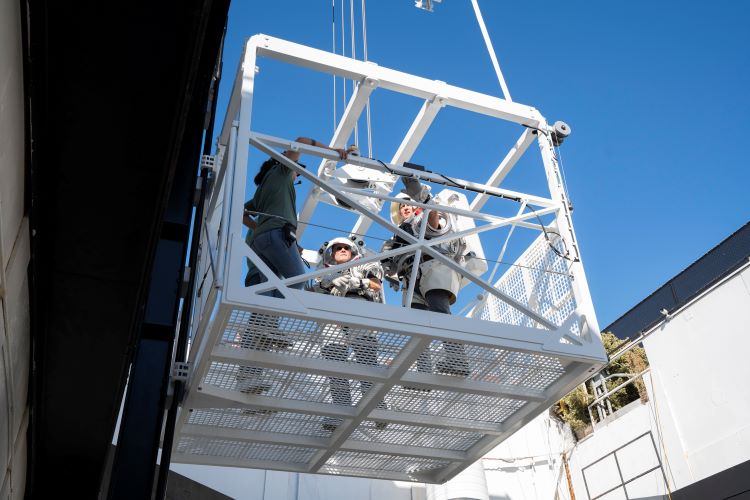
As NASA continues to ramp up efforts for its Artemis program, which has the goal of landing the first woman and person of color on the lunar surface, two NASA astronauts recently conducted training with a replica of SpaceX’s Starship human landing system (HLS), albeit on a much smaller scale. Given that Starship is 50 meters (160 feet) tall, and the crew quarters are located near the top of Starship, the HLS will need an elevator with a basket to transport crew and supplies from the crew quarters down to the surface. The purpose of this training is to familiarize astronauts with all aspects of this system, including elevator and gate controls and latches, along with how the astronauts perform these tasks in their bulky astronaut suits, which both astronauts wore during the training. 

The two NASA astronauts who participated in the recent training are Nicole Mann and Doug “Wheels” Wheelock. NASA Astronaut Mann is a Colonel in the United States Marine Corps who was selected as a NASA astronaut in the 2013 NASA Group 21. Her spaceflight experience includes 157 days in space as part of Expedition 68 onboard the International Space Station (ISS) and being launched aboard the SpaceX Crew-5 mission. NASA Astronaut Wheelock is a Colonel in the United States Army who was selected as a NASA astronaut in the 1998 NASA Group. His spaceflight experience includes 178 days in space as part of STS-120 and later as part of Expedition 24/25 on the ISS and being launched aboard the Soyuz TMA-19.

As noted, Starship is 50 meters (160 feet) tall and 9 meters (30 feet) in diameter and capable of landing 100 tons (99,790 kilograms/220,000 pounds) on the lunar surface, which is in stark contrast to the Apollo lunar module that landed 12 men on the lunar surface during the Apollo program, which was only 5.5 meters (17.9 feet) tall and approximately 4.3 meters (14 feet) in diameter and a mass of 15,103 kilograms (33,296 pounds) with fuel.

Ironically, the original plan for landing astronauts on the Moon during the Apollo program was known as direct ascent that involved a single, large vehicle with a payload of 74,000 kilograms (163,000 pounds) landing on the lunar surface. While NASA was in favor of using the direct ascent method in early 1961 since spacecraft rendezvous and docking had not been performed in Earth orbit yet, this was later scrapped in favor of the lunar orbit rendezvous (LOR) mission mode that was advocated by NASA aerospace engineer, John Houbolt, who estimated this would significantly reduce the weight involved in such a landing approach. LOR not only successfully landed six Apollo missions on the Moon, but it was also responsible for saving the Apollo 13 crew when one of their oxygen tanks ruptured and the crew was able to use the lunar module as a lifeboat as they flew around the Moon and came back to Earth.

As NASA astronauts train for using the Starship HLS elevator someday, Starship has already conducted two flight tests—Ship 24 in April 2023 and Ship 25 in November 2023, respectively. While both flights ended in failure, Ship 25 officially passed the Karman Line, which is the traditional boundary of outer space. A third Starship test flight is currently scheduled to occur sometime in the first quarter of 2024, which also comes as the crewed Artemis II mission is gearing up for their 10-day mission orbiting the Moon in November 2024 and Artemis III currently scheduled to land astronauts near the lunar south pole sometime in 2025.

How will Starship HLS help future Artemis astronauts on the lunar surface in the next few years? Only time will tell, and this is why we science!

  • As always, keep doing science & keep looking up!

{ https://www.universetoday.com/ }

Hoe vind je dit bericht?
Geschreven door peter om 18:14 Stuur door

Meer van UFO'S of UAP'S, ASTRONOMIE, RUIMTEVAART, ARCHEOLOGIE, OUDHEIDKUNDE, SF-SNUFJES EN ANDERE ESOTERISCHE WETENSCHAPPEN - DE ALLERLAATSTE NIEUWTJES

↑ Terug naar de berichten