Naar de inhoud

UFO'S of UAP'S, ASTRONOMIE, RUIMTEVAART, ARCHEOLOGIE, OUDHEIDKUNDE, SF-SNUFJES EN ANDERE ESOTERISCHE WETENSCHAPPEN - DE ALLERLAATSTE NIEUWTJES

UFO's of UAP'S in België en de rest van de wereld
akke.beakke.be
Ontdek de Fascinerende Wereld van UFO's en UAP's: Jouw Bron voor Onthullende Informatie! Ben jij ook gefascineerd door het onbekende? Wil je meer weten over UFO's en UAP's, niet alleen in België, maar over de hele wereld? Dan ben je op de juiste plek! België: Het Kloppend Hart van UFO-onderzoek In België is BUFON (Belgisch UFO-Netwerk) dé autoriteit op het gebied van UFO-onderzoek. Voor betrouwbare en objectieve informatie over deze intrigerende fenomenen, bezoek je zeker onze Facebook-pagina en deze blog. Maar dat is nog niet alles! Ontdek ook het Belgisch UFO-meldpunt en Caelestia, twee organisaties die diepgaand onderzoek verrichten, al zijn ze soms kritisch of sceptisch. Nederland: Een Schat aan Informatie Voor onze Nederlandse buren is er de schitterende website www.ufowijzer.nl, beheerd door Paul Harmans. Deze site biedt een schat aan informatie en artikelen die je niet wilt missen! Internationaal: MUFON - De Wereldwijde Autoriteit Neem ook een kijkje bij MUFON (Mutual UFO Network Inc.), een gerenommeerde Amerikaanse UFO-vereniging met afdelingen in de VS en wereldwijd. MUFON is toegewijd aan de wetenschappelijke en analytische studie van het UFO-fenomeen, en hun maandelijkse tijdschrift, The MUFON UFO-Journal, is een must-read voor elke UFO-enthousiasteling. Bezoek hun website op www.mufon.com voor meer informatie. Samenwerking en Toekomstvisie Sinds 1 februari 2020 is Pieter niet alleen ex-president van BUFON, maar ook de voormalige nationale directeur van MUFON in Vlaanderen en Nederland. Dit creëert een sterke samenwerking met de Franse MUFON Reseau MUFON/EUROP, wat ons in staat stelt om nog meer waardevolle inzichten te delen. Let op: Nepprofielen en Nieuwe Groeperingen Pas op voor een nieuwe groepering die zich ook BUFON noemt, maar geen enkele connectie heeft met onze gevestigde organisatie. Hoewel zij de naam geregistreerd hebben, kunnen ze het rijke verleden en de expertise van onze groep niet evenaren. We wensen hen veel succes, maar we blijven de autoriteit in UFO-onderzoek! Blijf Op De Hoogte! Wil jij de laatste nieuwtjes over UFO's, ruimtevaart, archeologie, en meer? Volg ons dan en duik samen met ons in de fascinerende wereld van het onbekende! Sluit je aan bij de gemeenschap van nieuwsgierige geesten die net als jij verlangen naar antwoorden en avonturen in de sterren! Heb je vragen of wil je meer weten? Aarzel dan niet om contact met ons op te nemen! Samen ontrafelen we het mysterie van de lucht en daarbuiten.

Archief

This day in UFO history: The Rendlesham Forest UFO Incident of 1980

This day in UFO history: The Rendlesham Forest UFO Incident of 1980

Rendlesham’s UFO Event

In the quiet, wintry scape of Rendlesham Forest, Suffolk, a series of events unfolded during the Christmas season of 1980 that would etch its name into UFOlogy annals forever. Known as Britain’s Roswell, the Rendlesham Forest UFO incident stands as a seminal and compelling narrative in the realm of unexplained phenomena.

The Encounter Begins 

It all commenced in the early hours of December 26, 1980. Military personnel from the nearby RAF Woodbridge witnessed an inexplicable array of lights descending into the dense forestry. Compelled by the possibility of a downed aircraft, they ventured into the darkness, only to encounter something far beyond their understanding. What they found was not the wreckage of a plane, but a strange, metallic, triangular craft, capable of moving through the trees with an eerie, almost otherworldly agility.

Rendlesham+ufo.png

Continued Sightings and Enigmatic Evidence 

Over subsequent nights, the phenomena only escalated. More lights were seen, beams of unknown origin were spotted descending into the base, and personnel reported strange, static-filled voices on their radios. Perhaps the most unsettling was the radiation levels found at the supposed landing site, which were anomalously high. The physical effects reported by those who ventured near the craft included symptoms resembling radiation exposure, adding a layer of urgency and danger to the already baffling occurrences.

Government Response and Public Fascination 

The UK Ministry of Defence’s stance was one of dismissive caution; it deemed the event as posing no threat to national security and thus unworthy of further investigation. This, however, did little to quell the public’s fascination or the conviction of those who had witnessed the events firsthand. The witnesses, many of them seasoned military personnel, were adamant about what they had seen and experienced, insisting on the presence of an unidentified craft of unknown origin.

The Legacy and Lasting Questions 

Decades have passed since the lights first appeared in Rendlesham Forest, yet the incident remains a captivating enigma. Despite numerous theories ranging from lighthouse beams to top-secret aircraft, no explanation has fully accounted for all the witnessed events and gathered evidence. The Rendlesham Forest UFO incident continues to be a focal point for UFO enthusiasts and researchers, a case that seemingly resists conventional explanation and fuels the universal human quest for answers about what may lie beyond our understanding.

In a world where the search for extraterrestrial life has never been more intense, the Rendlesham Forest incident stands as a testament to the enduring allure of the unknown. It’s a story that continues to provoke, challenge, and inspire, a reminder that perhaps, in the vastness of the cosmos, we are not alone.

LINKS RELATED VIDEOS

https://youtu.be/rI5VmN_D9o8

https://youtu.be/6Y8wHmLgDks

https://youtu.be/RzlcWaqQItI

{ https://www.latest-ufo-sightings.net/ }

Hoe vind je dit bericht?
Geschreven door peter om 18:28 Stuur door

Should We Be Preparing for First Contact?

054.jpg

BY CAROLYN COLLINS PETERSEN

Should We Be Preparing for First Contact?

First Contact. It’s a topic guaranteed to inspire a mix of emotions in people. It’s also one of the most fascinating SF scenarios we can imagine. What will people do when “they” appear? Or when we find evidence of life elsewhere in the Universe? For answers, one suggestion is to turn to a discipline called “exosociology”.

According to a paper released recently by German researcher Andreas Anton and his partners, exosociology tackles the big questions that first contact raises. Will we be ready? What will we do when ET appears? And, what can the world’s societies do to prepare themselves? That paper delves into the answers and reviews the many ways humans will act when we discover we’re not alone in the cosmos.

You’d think that with all the signal hunting and exoplanet discoveries in the news, we would be ready for visitors from beyond. Anton and his colleagues suggest that with all our scientific expertise in space exploration, we still don’t have what it takes to prepare completely for “first contact”. We need to learn to communicate with those aliens. And, even more important, we need to understand our own reactions when they do appear. What we do and say will be part of the social and political response not only from scientists, but from world leaders and others who will deal with people’s reactions.

Communication is Key

Now, as it turns out, humanity isn’t totally without experience in communicating with alien “others”. Our entire history is one of learning to send messages between cultures that don’t always speak the same language (with variable results). But, that supposes that we have humans trying to talk to each other. What about communications with beings who don’t share our body type, brain abilities, or even sensory apparatus? There’s precedent. Very recently, scientists reported some success in communicating with whales—an entirely different species. And, there have been other efforts, such as simulating a message from aliens as practice. Can we apply what we learn in those efforts to communications with “alien cultures”? It’s possible, but we need a whole new research discipline to do it.

Andreas Anton and his colleagues suggest that communicating with aliens is very much a part of exosociology. Starting with other life forms here on Earth is a great idea. “Communications with other species on Earth is a topic of interest to exosociology”, he wrote in an email. “Communication with extraterrestrial entities could present us with enormous challenges, contrary to what is often depicted in science fiction. We could have to deal with entities for whom we cannot even begin to assume similar sensory channels, perceptual spaces, spatiotemporal orientations, etc. We refer to such a situation as a confrontation with the “maximum stranger”. The more we learn about interaction and communication with species on our planet, the better communication and interaction with extraterrestrials could succeed.”

What Will First Contact with Aliens Be Like?

Anyone who reads or watches science fiction can cite their favorite stories about the inevitable meeting between ET and humans. They range from evil aliens in “War of the Worlds” and “Mars Attacks” to benevolent beings like those in “Childhood’s End”, “E.T.”, and “Close Encounters of the Third Kind” (to name a few). SF is one way to imagine what it will be like. However, Anton and his team looked beyond science fiction and analyzed a few more likely scenarios for first contact.

The first one they looked at is the “signal” scenario. Essentially, this is the “intercept a signal from far away” that forms the basis of current SETI search programs. Someday we’ll pick up a signal from outer space, similar in content to the one in the movie “Contact”. The chances are pretty good that it traveled a very long distance. That means any kind of “instant communication” back and forth is going to be tough. But, it would signal to us in a very clear way that we’re not alone, even if ET is thousands of light-years away. It would probably spur scientists to ramp up their searches for more signals from other civilizations. Not only that, but a whole cottage industry would spring up of people trying to decipher the messages. Maybe they’d even figure out a way to reply.

Radio telescopes monitor the sky at the Allen Telescope Array in California. Finding a signal from a distant civilization is one way we could experience first contact with ET. (SETI Institute Photo)

Radio telescopes monitor the sky at the Allen Telescope Array in California. Finding a signal from a distant civilization is one way we could experience first contact with ET. (SETI Institute Photo)

Of course, if the signal is from a nearby civilization, Anton, et al, write, “On the one hand, this could lead to national and international efforts to establish a dialog or even direct contact through space travel. On the other hand, fears about the consequences of contact among the terrestrial population are likely to increase with decreasing distance. A signal from a comparatively short distance would add an element of uncertainty to individual and collective (political, economic) planning for the future.”

First Contact and Technosignatures of ET

Another scenario doesn’t involve any kind of active contact. Instead, it assumes that we find evidence of past or present technological civilizations. That could be the discovery of a Dyson sphere around a distant planet, for example. Or, perhaps signals from weapons used during a long-ago war in a faraway stellar system. Like the “signal” scenario, the social and societal effects of technosignatures would also depend on distance. Finding evidence of something many thousands of light-years away isn’t likely to excite as much interest as one made fairly close by. But, the paper makes clear that the mere existence of these technological “clues” would affect our science and sociology in many ways. The authors write, “The scientific community would go to great lengths to learn more about the nature and capabilities of these extraterrestrial civilizations.” And, of course, there would be political and social ramifications.

Artist's impression of a Dyson Sphere, an proposed alien megastructure that is the target of SETI surveys. Finding one of these qualifies in a

Artist’s impression of a Dyson Sphere, an proposed alien megastructure that is the target of SETI surveys. Finding one of these qualifies in a “first contact” scenario. Credit: Breakthrough Listen / Danielle Futselaar

Let’s say that somebody spots a Dyson sphere around a world. As a result, it’s possible that floodgates of funding would open up to help us understand that discovery. Whole new branches of science could develop as we figure out if we, too, could create one of these objects. Exosociology would benefit, too, as the authors point out. “In addition, the discovery of a technosignature would also have a strong impact on the social sciences and humanities and lead to new fields of research and questions. One of the central questions here is likely to be: What reasonable conclusions can be drawn about the extraterrestrial civilization from the discovered technological markers?”

An even bigger question deals with the political sphere. How will the leaders of Earth’s civilizations communicate the discovery of alien tech to their people? If the discovery was of a Dyson sphere, it could lead our political leaders to involve the military. Or, they might give more funding to science institutions to understand it. Of course, there’s always a question about whether the civilization that created the sphere poses a threat to us. That engenders another set of questions, along with planning for an “evil alien” scenario.

Meeting Aliens and Finding Spacecraft

Then there is the scenario of aliens showing up here on Earth. One of the more endearing traditions among Trekkies (fans of Star Trek) is to celebrate “First Contact Day” each year on April 5th. It commemorates the future date (in 2063) when humans and Vulcans first meet. It’s a lovely idea and presents a much-dreamed-about fictional interpretation of a benevolent meetup. We can only hope that it will happen that way. Certainly, such an encounter will also have incredibly profound effects on human societies.

If we DO end up having extraterrestrial visitors land on Earth for a visit, that brings us back to some important questions. How do we communicate with them? Should we fear them? Can we take advantage of their knowledge to improve our own science and societies? The communication challenge is something we’re working on now, with the whale project. However, beyond that, humans have shown throughout their history that communicating with “others” is problematic. It often leads to misunderstanding, wrong assumptions, and in the worse case, war. So, we need to focus on the “contact” part of “first contact”. That means improving our methods of communication and understanding among ourselves (and other species on THIS planet) if we want to have any hope of doing the same with ET, when and if they get here.

Zephram Cochrane makes first contact with a Vulcan explorer in the Star Trek" The Next Generation episode "First Contact." Credit: Paramount Global.

Zephram Cochrane makes first contact with a Vulcan explorer in the Star Trek” The Next Generation episode “First Contact.” Credit: Paramount Global.

In recent years, another type of “contact” has been touted by a Harvard scientist who is convinced that an interstellar asteroid is, in fact, an alien spaceship. There’s little evidence to support that idea, and rather more scientific data to show that the rock (called ‘Oumuamua) is a rocky alien asteroid taking a trip through our solar system. But, it certainly excited a lot of talk and scientific interest. So that raises the question: what if we did find an alien artifact in our solar system?

There’d be a cultural impact as people rush to understand what it is, how old it is, and where it originated. And, that would ripple out through the science, political, and social science communities. The spacecraft would represent a technology that we’d like to have for ourselves and our own future space travel. Its existence would probably spur a race among countries to be the first to exploit that information.

Artist’s impression of the interstellar object, `Oumuamua, experiencing outgassing as it leaves our Solar System. Evidence points to its origin as an asteroid from another system, not necessarily an alien seeking first contact. Credit: ESA/Hubble, NASA, ESO, M. Kornmesser

Artist’s impression of the interstellar object, `Oumuamua, as it experiences outgassing as it leaves our Solar System. Evidence points to its origin as an asteroid from another system, not necessarily an alien seeking first contact. Credit: ESA/Hubble, NASA, ESO, M. Kornmesser

So, How Do We Prepare for First Contact?

Right now, we’re lucky. We don’t have any solid evidence of life elsewhere or aliens on this planet. That lets us be a little bit ignorant about what to do since we haven’t had to worry about it. But, we should be prepared because everything will change when first contact is made. So, we need to be ready. Anton and his co-authors suggest the following: we think of the search for extraterrestrial intelligence as a high-risk research project that needs to be discussed openly. It’s a global risk, not just confined to one country. It’s also not just a scientific endeavor and any research done to discover other civilizations needs to be shared across all governments and political systems.

If first contact takes place, it’s going to be a global concern and international institutions will be involved. They’ll likely want to draw up policies and regulations, probably at the level of the United Nations. However, that doesn’t mean it becomes a secret. The first contact of any kind will be an incredibly extraordinary event. It will change the way we think about ourselves, our societies, and our planet. And, if history is any guide, we can either do it right, with advance preparation. Or, we can muddle through and hope that Mars doesn’t attack, or aliens with a hunger for more than knowledge of other species don’t see us as a tasty smorgasbord in space.

For More Information

{https://www.universetoday.com/ }

Hoe vind je dit bericht?
Geschreven door peter om 01:24 Stuur door

Questions Remain on Chinese Rocket That Created an Unusual Double Crater on the Moon

076.jpg

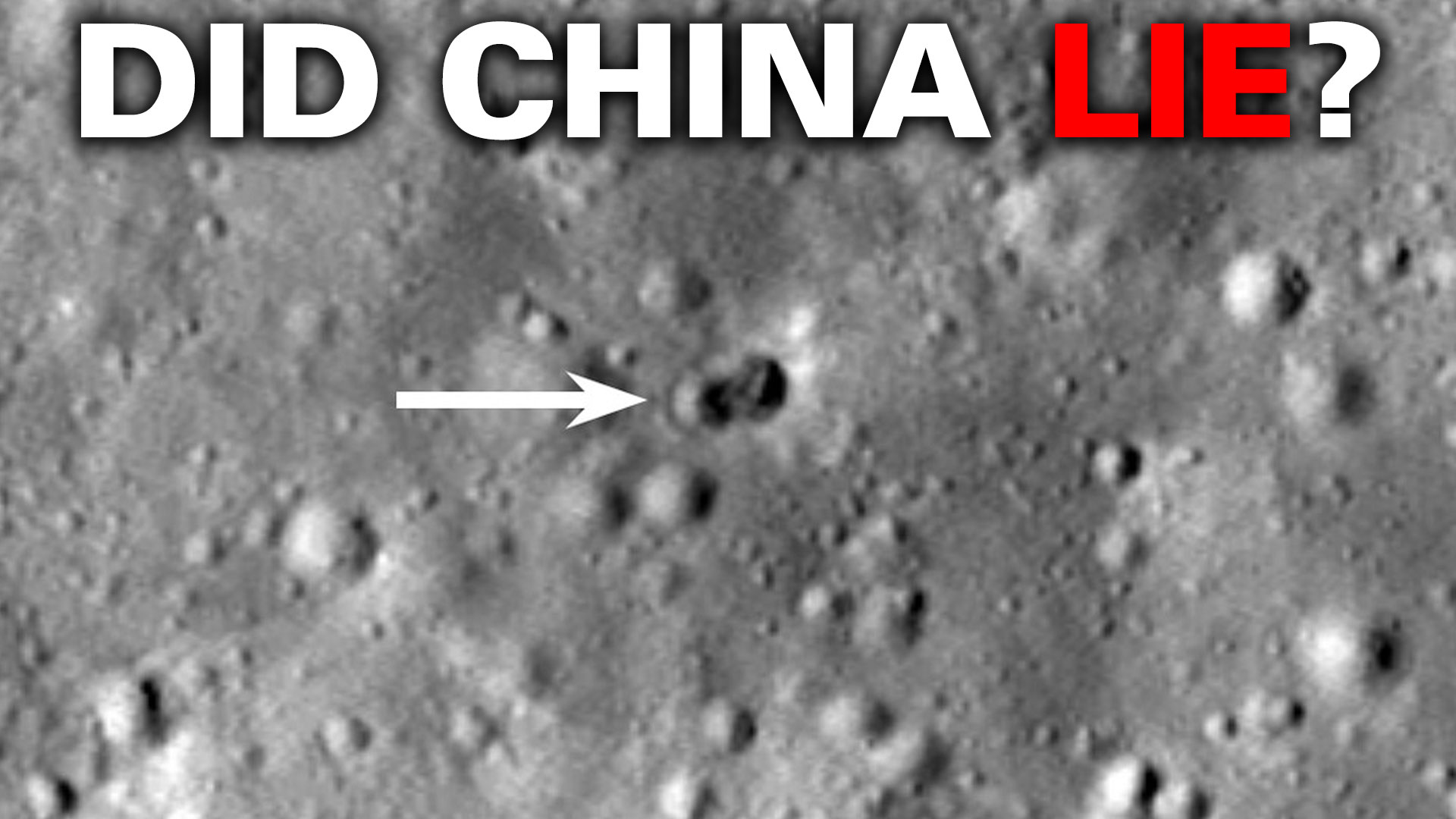
A rocket body impacted the Moon on March 4, 2022, near Hertzsprung crater, creating a double crater roughly 28 meters wide in the longest dimension. Credits: NASA/Goddard/Arizona State University

Questions Remain on Chinese Rocket That Created an Unusual Double Crater on the Moon

In November, we reported how an impact on the Moon from a Chinese Long March rocket booster created an unusual double crater. For a single booster to create a double crater, some researchers thought there must have been an additional – perhaps secret – payload on the forward end of the booster, opposite from the rocket engines. But that may not necessarily be the case.

Other researchers feel the extra mass wasn’t anything secretive, but possibly an inert structure such as a payload adapter added to the rocket to support the primary mission payload.

Chang’e 5-T1 was an experimental robotic spacecraft, launched on October 23, 2014, by the China National Space Administration (CNSA) to test out the return capsule design planned for use on the future Chang’e 5 mission, China’s first-ever sample-return effort. Chang’e 5 landed on the Moon in November 2020 and successfully gathered lunar samples from the Moon’s Ocean of Storms region, with the container landing back on Earth on December 16, 2020.

Chang'e-5 capsule

Chang’e-5’s soot-streaked sample return capsule sits amid the snows of Inner Mongolia with a Chinese flag set up nearby. (Image via CCTV)

Before engaging in the first sample return effort for the country (and first in over forty years), China wanted to test out procedures and their sample return capsule. That was one of the 5 T-1 mission’s goals.

“The rocket was carrying a ‘Service Module’ satellite with a sample return capsule attached,” said Phillip Stooke, professor emeritus at the University of Western Ontario, in an email to Universe Today.  “It would need a fairly substantial support structure (called a payload adaptor) to support the mass against the vibration and acceleration of launch.”

Stooke explained how the Service Module flew around the Moon and back to Earth, where it released the capsule to test its ability to survive atmospheric re-entry. Then the Service Module headed back out to the Earth-Moon L2 point, staying there for a few months before entering a low lunar orbit, possibly to perform a gravity mapping mission. The Service Module is still in lunar orbit.   

“The combination Service Module and capsule had a mass of 2,500 kg – 2.5 tons,” Stooke said, “so it can’t just sit on top of the rocket’s fuel tanks.  I can’t guess at the mass [of the payload adapter] but it would be quite significant.”

Payload adaptors for medium-sized payloads can weigh anywhere from 135 Kg (300 lbs.) to 225 kg (500 lbs) or more.

The Chang’e 5 T-1 test vehicle captured this beautiful view of Earth over the far side ofthe Moon on October 28, 2014. Credit: Chinese national space agency (CNSA) and Chinese Academy of Sciences (CAS)

Chang’e 5-T1 did also have additional payloads, but they were small (and known to be onboard) and couldn’t account for the mass large enough to create a second crater. The two payloads were a small radiation exposure experiment for bacteria and plants, as well as the first commercial payload to the Moon called the 4M mission (Manfred Memorial Moon Mission) for the German space technology company OHB System, in honor of the company’s founder, Manfred Fuchs, who died in 2014. That payload weighed only 14 kilograms but contained two scientific instruments: a radio beacon to test a new approach for locating spacecraft and a radiation dosimeter (provided by the Spanish company iC-Málaga) to continuously measure radiation levels throughout the satellite’s circumlunar journey. The 4M mission was mounted in the equipment bay of the booster.

“There would be no reason to suspect the rocket had anything else attached to it other than 4M and the usual flight electronics,” said citizen scientist Scott Tilley, who monitors the orbits of artificial satellites of the Earth and the Moon. “There would also be some extra mass to support the payload adapter and related structure for supporting the payload stack, which was likely at the limit of the rocket’s capabilities.  Consider this is the first mission they launched toward the Moon with stacked payload.  It would have likely been more complex to mount and secure it than the other payloads, which were more self-contained.”

The ongoing debate on the extra mass and what it might be would not have ensued if not for two things: the unusual double crater created by this booster’s impact and the denial by Chinese foreign ministry officials that the space junk and the impact is from their rocket. They insist that the Chang’e 5T-1 rocket already burned up on its return trip to Earth in 2014. However, on March 1, 2022, the U.S. Department of Defense’s Space Command, which tracks low-Earth orbit space junk, released a statement saying that China’s 2014 rocket never de-orbited.

Additionally, Chinese officials have never commented on the nature of the double crater.

The crater was imaged by NASA’s Lunar Reconnaissance Orbiter (LRO).

This animated GIF confirms the location of the newly formed rocket body double crater. The before image is LRO’s view from Feb. 28, 2022 (M1400727806L). The after image is from May 21, 2022 (M1407760984R). The width of the frame is 367 meters, about 401 yards. Credit: NASA/Goddard/Arizona State University

“Typically, a spent rocket has mass concentrated at the motor end; the rest of the rocket stage mainly consists of an empty fuel tank,” wrote Mark Robinson, principal investigator with LRO Camera (LROC), back in June of 2022 when the images were released.

A team of researcher from the University of Arizona discovered the errant booster (it was initially thought to be an asteroid), tracking its movements to determine it came from the Chang’e 5-T1 mission. They also conducted spectroscopic analysis of the object from ground-based telescope observations during several Earth flybys, which showed conclusively that the object was the Long March 3C rocket body from the Chang’e 5-T1 mission. They were able to predict approximately where and when the booster would impact the Moon, which was why the LRO team could search for and easily find the impact crater in their data.  

Everyone was surprised the impact created a double crater. No other rocket body impacts on the Moon created double craters, as seen in these images of craters from four Saturn rocket boosters from Apollos 13, 14, 15, 17.

These four images show craters formed by impacts of the Apollo SIV-B stages: crater diameters range from 35 to 40 meters (38.2 to 43.7 yards) in the longest dimension. Credits: NASA/Goddard/Arizona State University.

The researchers from the University of Arizona said there had to be additional, undisclosed mass at the front end of the rocket body.

“The results from the Bayesian analysis imply that there may have been additional mass on the front of the rocket body,” wrote Tanner Campell, Vishnu Reddy and several others in their paper “Physical Characterization of Moon Impactor WE0913A.”  “Comparing the pre- and post-impact images of the location shows two distinct craters side by side that were made by the Chang’e 5-T1 R/B. The double crater supports the hypothesis that there was additional mass at the front end of the rocket body, opposite the engines, in excess of the published mass of the secondary permanently affixed payload.”

Asked about the payload adaptor as the possible culprit for the excess mass, team member Vishnu Reddy didn’t want to venture a guess without more data.  

“It is hard to speculate on the support structure because we are not aware of anything like that on usual boosters sent to the Moon,” he said.

Tilley told Universe Today that among both amateur and professional satellite and rocket trackers, it is known that China’s space agency has “struggled” in the past with their aim for having these type boosters to re-enter the Earth’s atmosphere or get ejected from the Earth-Moon system to properly dispose of the object.

“The Chinese expected the rocket to re-enter the Earth’s atmosphere,” Tilley explained, noting details in a paper by LuxSpace, the company that operated the 4M mission. “That didn’t happen so it seems that part of their mission failed, which is likely why the Chinese denied it was their rocket later on.”

Subsequently, however, more recent missions, such as the booster for the Chang’e 5 sample return mission successfully re-entered Earth’s atmosphere and was properly disposed of.   

Another question about the impact is understanding the dynamics of why a single booster, even if it had substantial weight at each end, would create a double crater.

“Regarding the double crater,” Vishnu explained, “I think the booster impacted at a near vertical angle, so the engines created the first crater and the secondary mass toppled over and created the second crater.” Vishnu added, however, it is also possible that if the booster was tumbling and happened to be horizontal when it hit, it could create the two craters.

But like much of this unusual space drama story, questions still remain.

“That is why we leave the actual mechanism for a future paper when we have better data to model,” Vishnu said.

{ https://www.universetoday.com/ }

Hoe vind je dit bericht?
Geschreven door peter om 01:07 Stuur door

Watch 14 Years of Gamma-Ray Observations in This Fascinating NASA Video

14399_Fermi_14Year_Narrated_sub100.jpg

Still from the video showing 14 years of data gathered by the Fermi Gamma-ray Space Telescope. Credit: NASA Goddard

Watch 14 Years of Gamma-Ray Observations in This Fascinating NASA Video

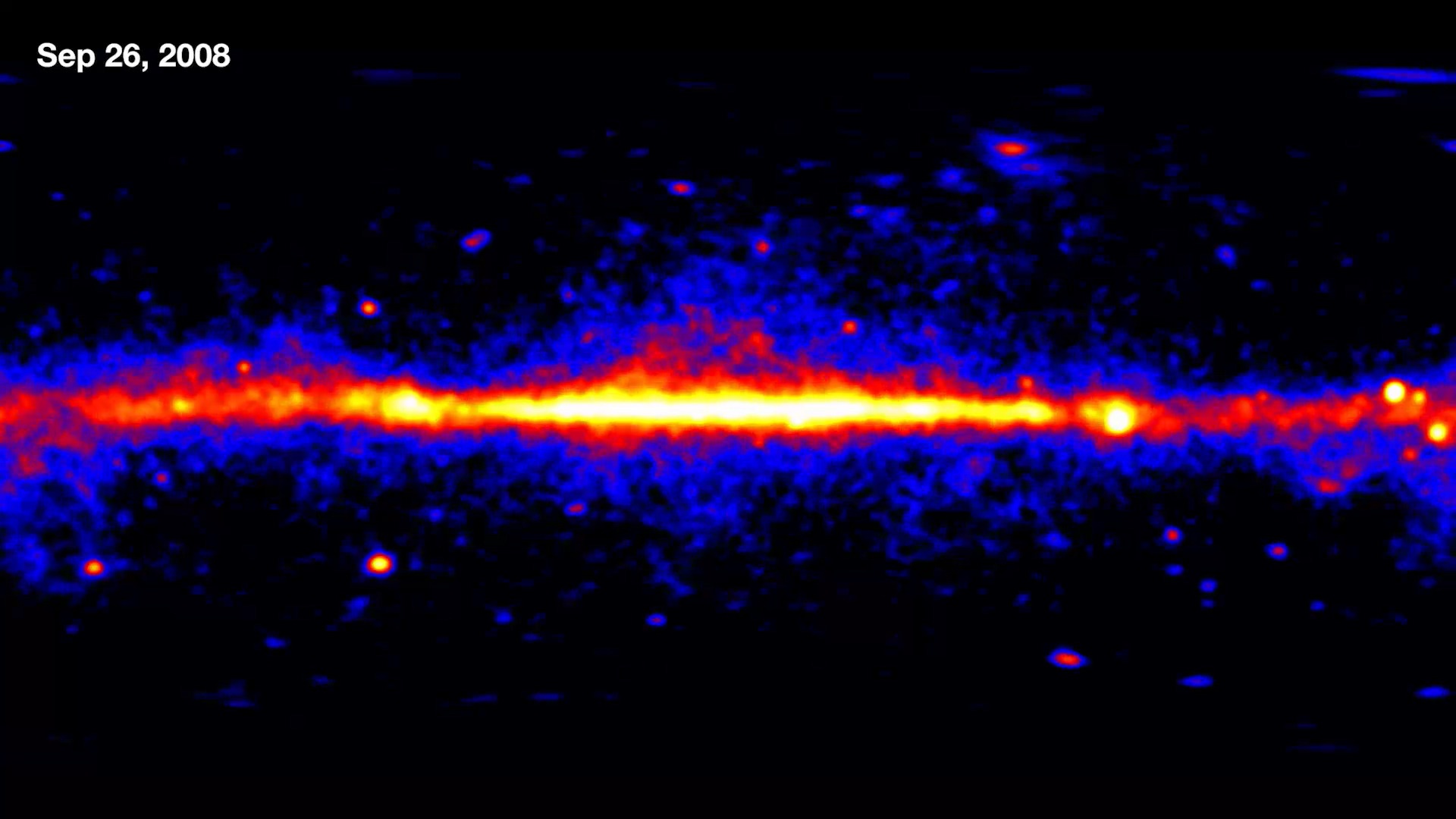
The Fermi Gamma-ray Space Telescope, named in honor of noted physicist Enrico Fermi, has been in operation for almost a decade and a half, monitoring the cosmos for gamma rays. As the highest-energy form of light, these rays are produced by extremely energetic phenomena – like supernovae, neutron stars, quasars, and gamma-ray bursts (GRBs). In honor of this observatory’s long history, NASA’s Goddard Spaceflight Center has released a time-lapse movie that shows data acquired by the Fermi Space Telescope between August 2008 and August 2022.

The movie shows gamma rays with energies above 200 million electron volts (MeV), where brighter colors indicate more intense gamma-ray sources detected by Fermi’s Large Area Telescope (LAT) during its 14-year run. The movie also shows the gamma-ray sky from two perspectives. First, there’s the rectangular view that shows a full-sky view with the central plane of the Milky Way Galaxy in the center. The disk glows predominantly from gamma rays produced by cosmic rays striking interstellar gas and starlight.

Other tiny light sources indicate the presence of neutron stars and supernova remnants, with cosmic sources peppered about the cosmic background. The second perspective shows what the gamma-ray sky looks like when Fermi is oriented towards Galactic North and South (or “up” and “down” relative to the galactic disk). This perspective allows astronomers to view gamma-ray sources in the extra-galactic sky, including distant galaxies with active nuclei (aka. quasars). The central plane of our galaxy wraps around the edges of both circles, where its brightness is suppressed, and our view of active galaxies in the distant Universe is improved.

The Sun can occasionally be seen passing into view and flaring against the background of high-energy sources within our galaxy and beyond. The brightest extra-galactic sources are blazars, or galaxies that host central black holes of a million Solar masses or more. These supermassive black holes (SMBH), as they’re called, produce jets of superheated material that travel at a fraction of the speed of light (aka. relativistic jets). For some blazars, Fermi could look almost directly down some of these jets, enhancing their brightness and variability.

When these galaxies flare, their central regions temporarily outshine all the stars in their disk. These flare-ups also cause them to temporarily become the brightest objects in the gamma-ray sky, then fade to obscurity. Many of these galaxies are billions of light-years away, meaning that flare-ups occurred when Earth and the Solar System were still young (or didn’t even exist yet!) Not seen in the time-lapse are many short-duration events, such as gamma-ray bursts, resulting from data processing designed to sharpen the images.

This is not the only big news item for the Fermi mission. On November 27th, the mission team released a new catalog – “The Third Fermi Large Area Telescope Catalog of Gamma-Ray Pulsars” – which contains the more than 300 pulsars discovered by the Fermi mission since 2008. Be sure to check out NASA’s Science Visualization Studio to learn more about the Fermi animation and the work that went into creating it.

Further Reading: 

{ https://www.universetoday.com/ }

Hoe vind je dit bericht?
Geschreven door peter om 23:49 Stuur door

Miniaturized Jumping Robots Could Study An Asteroid’s Gravity

Gravity-Poppers.jpg

 BY ANDY TOMASWICK

Miniaturized Jumping Robots Could Study An Asteroid’s Gravity

Missions focusing on small bodies in the solar system have been coming thick and fast lately. OSIRIS-Rex, Psyche, and Rosetta are all examples of projects that planned or did rendezvous with a small body in the solar system. But one of their biggest challenges is understanding the gravity of these bodies – which was especially evident when Philae, Rosetta’s lander, had a hard time staying on the surface of its intended comet. A new idea from researchers at the University of Colorado Boulder and NASA’s Jet Propulsion Laboratory could help solve that problem – by bouncing small probes around.

The concept, called Gravity Poppers, resulted from a NIAC grant back in 2020. The idea is simple enough – release a bunch of probes onto the surface of a small body and have them periodically jump off it. When they do so, keep track of them. If you know the force they jumped off with and can track them as they return to the surface, you can estimate the gravity of the area they’re floating over more accurately than alternative techniques.

Scientists use three main alternative techniques to calculate the gravity of small bodies – radar tomography, seismic imaging, and gravimetry. Each has disadvantages that the Gravity Poppers can overcome.

Here’s Dr. Benjamin Hockman, one of the researchers, describing the concept at the NIAC symposium.
Credit – Ben Hockman YouTube Channel

Radar tomography uses reflections of radio signals to estimate what the gravity is like in a particular area. However, it’s difficult to penetrate the deeper sections of a small body. Some materials don’t reflect electromagnetic waves at all, making it impossible to characterize areas with these materials.

Seismic imaging is commonly used on Earth. By tracking the movement of seismic waves across the surface of a body, scientists can estimate the gravity of regions surrounding them. However, some small bodies, especially asteroids, are just piles of rubble with no internal coherent structure. Seismic waves don’t do very well in such environments. Ryugu, the asteroid Hayabusa-2 visited, absorbed the seismic energy of an impact event such that the spacecraft couldn’t even discern any changes in its surface features.

Gravimetry is the most straightforward of the three techniques and requires the least equipment onboard the spacecraft. How does the small body pull on the spacecraft orbiting it? As it passes over different regions, does the gravity increase or decrease? However, measuring gravity from far away isn’t easy, as orbits tend to be relatively far away. So, the accuracy of this technique is relatively low.

Fraser discusses techniques to stop a potentially dangerous asteroid from hitting Earth. Many of the techniques would involve understanding its gravity.

Enter Gravity Poppers. An orbiter could release a few dozen of these – a paper detailing the idea suggests 20. As they land on the surface of the asteroid, comet, or small moon, they occasionally use an internal force to jump off the surface, but not enough to break the hold of gravity. Depending on the intended area to be studied, they could do this at an angle or straight up.

As they fly off the surface, the orbiting mothership tracks them and calculates their trajectory, which can then be used to calculate the gravity of the region they are flying over. They then land, reset themselves, and do it repeatedly with the orbiter tracking them. The team studied two types of structures for the poppers: spherical and cubic. They settled on the cube, which also had embedded LEDs that create a light source the orbiter could track. 

It’s not as simple as tracking the light source, though – plenty of system dynamics go into calculating the trajectory angle, the force with which the popper jumped, and the landing location. The paper also details simulations of how such a mission would operate in practice, using modeling software developed at NASA.

Unfortunately, that means that there are no prototypes in the works for this as of yet. It did not receive NIAC Phase II funding as of yet either. But the idea is unique and simple enough that with a little bit of development effort, engineers might be able to master this novel way of prospecting some of the most economically and scientifically interesting worlds in our solar system.

Learn more:

Lead Image:

  • Artist’s depiction of the mission concept of Gravity Poppers
    Credit – Benjamin Hockman

{ https://www.universetoday.com/ }

Hoe vind je dit bericht?
Geschreven door peter om 23:28 Stuur door

The Roswell UFO: Forensically rendered from the testimony of multiple witnesses

The Roswell UFO: Forensically rendered from the testimony of multiple witnesses

Over the years, much has been written about the crashed Roswell UFO, and never have images been released of the real UFO due to the cover-up of this remarkable crash. Now, not only has a composite image been generated, reflecting the craft before its crash based on the accounts of multiple witnesses, but it also provides specific details about the crew. 
roswell%20UFO%20(1).png

The "General Composite of the Roswell Aerospace Interplanetary Skiff" is originated and forensically rendered from the testimony of multiple witnesses who were the retired United States Army Counter-Intelligence Corps atom bomb security agents guarding all atom bomb manufacturing, testing and deployment facilities in New Mexico from 1943 to 1951. 
Further and far more substantial testimony came from Clarence L. ("Kelly") Johnson and Dr. Ben R. Rich (both of whom were the now deceased founding CEOs of Lockheed Martin's famous "Skunk Works") as provided to Bill McDonald via the inter-mediation of the late John Andrews, Special Projects Chief Designer of the Testor Corporation. Kelly mentored Ben and John Andrews. 
The spacecraft was a single, integrated, machine component; the originating inspiration for all high-altitude, hypersonic, "Waverider," aerosurf, "Biomorphic" aircraft and space shuttle configuration concepts. 
She mimicked the design forms of multiple sea animals including porpoises and stingrays. Her life support system and in-flight ballast was an oxygenated amniotic fluid-like broth with an advanced filtration system in the flight deck. 
roswell%20UFO%20(2).png

She carried a crew of seven humanoids who interfaced with the vessel's artificial intelligence (AI) cortex directly, physically through the headrests of their individual crash-couches and their surrounding consoles. 
The organic minds of the flight crew are believed to have functioned as "multiple brain nodes" for distributed processing and navigation. They and the spacecraft functioned as a "combined biological organic/artificial life form and machine system."
  

{ https://ufosightingshotspot.blogspot.com/ }

Hoe vind je dit bericht?
Geschreven door peter om 22:55 Stuur door

Mysterious Daytime Orb Spotted Over Sydney: A Fascinating UFO Sighting

Mysterious Daytime Orb Spotted Over Sydney: A Fascinating UFO Sighting

 Sydney UFO

Silverwater, NSW, Australia – On the tranquil afternoon of December 25, 2023, the skies over Silverwater, a serene suburb in western Sydney, became the stage for an extraordinary event. A local resident, enjoying a peaceful fishing session, witnessed an enigmatic object traversing the sky. This is not just another story; it’s a firsthand account of an encounter that challenges our understanding of the skies above us.

An Unearthly Visitor?

The witness describes the object as comparable in size to a small passenger plane, hovering about 30 meters above the ground. What makes this sighting particularly intriguing is the absence of any wind, a detail substantiated by the stillness of the trees in the accompanying video. Skeptics might suggest a balloon, but the witness contests this notion, citing the object’s unusual size and behavior.

A Closer Look Reveals More

Upon closer examination of the video, a peculiar glowing ring becomes apparent, with the object exhibiting erratic movements when viewed in slow motion. This detail adds a layer of mystery to the sighting, suggesting that this is no ordinary balloon or aircraft. The witness’s struggle to capture the footage resonates with many who have tried to document these fleeting phenomena, often re3sulting in shaky and unclear videos.

Be the Judge

The witness invites viewers to be the judge of what they see. With a hard copy of the video in hand, they offer a glimpse into a moment that is as baffling as it is captivating. The sighting in Silverwater adds to the growing list of UFO encounters, each contributing to the larger puzzle of what might be sharing our skies.

A Call to the Curious

For those intrigued by the unknown, this sighting is a clarion call to keep our eyes on the skies and our minds open. UFO sightings like this one continue to spark curiosity and debate, driving us to explore and understand the mysteries that loom above us. Whether you’re a skeptic or a believer, the story of the Silverwater orb is a compelling addition to the annals of UFO encounters.

{ https://www.latest-ufo-sightings.net/ }

Hoe vind je dit bericht?
Geschreven door peter om 22:18 Stuur door

Jacques Vallee On Footage Of UFO Landing At Holloman AFB: Occupant Carried Vertical Staff With Spiral Antenna

Jacques Vallee On Footage Of UFO Landing At Holloman AFB

Jacques Vallee On Footage Of UFO Landing At Holloman AFB: Occupant Carried Vertical Staff With Spiral Antenna

Holloman Air Force Base is infamous for the most debated UFO landing footage that was in the possession of the United States Air Force as claimed by Robert Emmenegger and Allan Sandler. The director of “Moment of Contact” James Fox has recently discussed the Holloman AFB UFO/alien controversy on a podcast, adding valuable information to the legendary case.

Interestingly, there are other credible people in the UFO community who have given credence to the authenticity of this case. There is more to the Holloman AFB UFO story. Joe Murgia, an avid UFO researcher revealed that Dr. Eric Davis (a former Pentagon physicist) met with George Bush Sr. to talk about Holloman AFB Incident.

The UFO phenomenon has long been a subject of fascination and controversy, with countless reports of sightings and encounters over the years. However, the truth behind these mysterious incidents has remained elusive, with government agencies often accused of covering up information and discrediting witnesses.

According to Murgia, on March 26, 2004, he met Hal Putoff (an American physicist who has co-authored several books on gravitational and paranormal research) at the Fiesta Rancho Casino Hotel, Las Vegas after taking an early flight to the airport. Upon meeting, Hal wasted no time and shared with him the story of Dr. Eric Davis. It turns out that Dr. Davis was the one who conducted the interview with Wilson at the EG&G parking lot. Dr. Davis had reached out to the admiral about his project to revive a local chapter of AFIO (Association of Former Intelligence Officers) in Las Vegas, but the conversation eventually shifted to the topic of ufology.(Source)

Wilson davis UFO documentAstrophysicist Eric Davis during an interview with New York Post.

Murgia stated that Former President George Bush Sr. had taken an interest in Dr. Davis’ discussion and spoke to him twice on the phone, expressing his belief that the German secrets had been filed away and not used as a cover for anything else. However, he did show interest in pursuing the topic and requested Dr. Davis’ recent physics papers.

During the second phone call, Bush revealed that he was aware of the Holloman film, which Hal, Dr. Davis, and Murgia were fixated on. “The former President was aware of it. Was it a training film, a special ops exercise? No, he replied, ‘it was “the real thing.”’ There was a secret project, and the security was obscene,” writes Joe Murgia.

Moreover, the Holloman AFB UFO landing incident was also discussed by Dr. Jacques Vallée in his book “Forbidden Science – Volume II.” He writes:

Kit [Green] just left, along with Hal, Russell and two of his kids. We had a long discussion after a demo of my landing catalogue. Kit has dropped out of Sams’ covert “Group of Twelve.”

Emenegger tells me that Colonel Bill Coleman, who represented the Air Force in the film, had been retired for three weeks when he got the job. For nine years he’d served as the Air Force’s spokesman and had been intimately linked to the UFO question. More games: One of his men, a Captain Horner, confiscated the Holloman movie just before Sandler could get his hands on it.

The Holloman sequence is based on a bluff by Emenegger. He couldn’t find anyone on the Base who recalled such an event. There was only a rumor that in 1971 a helicopter had filmed three objects, one of which landed.

Three occupants had supposedly come out. They had Assyrian noses, a rope twisted on their head for a hat, bluegreen skin, eyes like ping-pong balls with a hole in the middle. One of them had a wire in one ear and carried a vertical staff with a spiral antenna. The Aliens were taken to Building 830, then to building 930 on Mars Avenue. They remained there two or three years, allegedly “helping the United States decode space messages from another Alien civilization.”

A biologist named Alfred Lorenzo is supposed to have worked with them. None of this makes any sense. When Allan was here I asked him if he still had his clearance. He said yes, theoretically he did, but he didn’t think it was active, yet Kit has found Allan’s clearances active. “Do you know there are 800 reports of foreign UFOs in the CIRCOL files?” he asked. “Why didn’t Hynek ever look into that?”

He warned me that a new experimental device was being tested. It is known lovingly as a “flying bathtub.” It is a flying triangle with a rounded front, but it could look strikingly like a saucer when seen from the side, and will surely be mistaken for one.

On Julian Dorey Podcast, Mr. Fox recounted a phone call from Allan Sandler, who claimed to have seen three unidentified flying objects (UFOs) escorted by a military jet. Sandler said that two of the UFOs peeled away while one wobbled to the ground, and he witnessed the beings with unique features emerge from the grounded UFO before the footage abruptly cut off.

Read also:

Paul Shartle, an official at Norton Air Force Base, allegedly confirmed that the object was not of Earth origin. Mr. Fox did not make any claims about the veracity of the story, only reporting what he had been told.

During a recent Reddit AMA, journalist Christopher Sharp expressed interest in finding more information about the number of alien species visiting Earth. He mentioned that he had heard from multiple sources that the visitation at Holloman Air Force Base was real, but was unsure if the beings were extraterrestrial, interdimensional, or ultra-terrestrial. Sharp shared a link to the interview with Grant Cameron for further information.

In 1974, Robert Emenegger released his documentary “UFOs: Past, Present, and Future,” which was nominated for a Golden Globe. While he had originally been granted permission to use real footage, the Department of Defense later withdrew that permission.

Emenegger was forced to add animated footage of the alleged Holloman UFO landing. He claimed that some frames from the original footage were used in the reconstruction during editing, which was authorized by the USAF. Viewers spotted a genuine bright disc coming down slowly in the distance against the backdrop of Holloman’s surrounding landscape.

The documentary was re-released in 1979, with additional footage and narration by Dr. Vallée, who discussed ancient astronaut theory.

{ https://www.howandwhys.com/ }

Hoe vind je dit bericht?
Geschreven door peter om 00:56 Stuur door

Voyager 1 satellite reprogramed by aliens to send a repeating message to Earth, UFO Sighting News.

Voyager 1 satellite reprogramed by aliens to send a repeating message to Earth, UFO Sighting News.

3453454.png

Date of NASA news: Dec 23, 2023
Location of news source: 
Location of Voyager 1 now:  15 billion miles away, or 24 billion km away from earth.
 
Now this is really odd, NASA just published a post on the official NASA Voyager page that says and I quote, "Recently, the TMU began transmitting a repeating pattern of ones and zeros as if it were “stuck.” After ruling out other possibilities, the Voyager team determined that the source of the issue is the FDS. This past weekend the team tried to restart the FDS and return it to the state it was in before the issue began, but the spacecraft still isn’t returning useable data." 
 
Voyager 1 was sent to space on Sept 5, 1977, so thats 46 years old! And many scientists over those decades have said if aliens ever sent us a message to Earth, it's highly likely it will be in the most basic mathematical form...binary. Hmmm...now you are seeing the clues. 
 
So, after ruling out other possibilities...like Voyager 1 being reprogramed by an alien entity perhaps? I feel NASA is hiding the truth, trying to cover it up after recording the alien message and reprogram and fix Voyager 1 to keep the public in the dark. Yeah, NASA has a job to inform the public...but only if it's not a matter of national security. Any message from aliens will have to go up the chain of command to the commander in chief himself...the US president to get a full release. It's no small deal like you may have thought, and most data about aliens are stopped before even getting close to presidential ears. Because the US president is busy with other more pressing matters. So...yes NASA covers things up when satellites record data that shows evidence of aliens, but only if they notice it themselves, they are often underpaid and over worked so they skim briefly and somethings, just sometimes something big slips past them. Like the Black Knight satellites I discovered and fought for. So...yes you can trust NASA to tell you what they think you should know, but don't think you are so important that they will tell you everything. NASA was created to keep the public in the dark and drip feed basic scientific data to appease the public so they continue to get gov payments to pay for NASA. 
 
Below is a clip from Star Trek the motion picture, where Enterprise confronts Voyager 1 probe, called Vger, which was reprogramed by aliens and sent back to its creator on earth. Yes, Star Trek thought of it first, and yes, we are seeing such things now with Voyager 1. 
Scott C. Waring

{ https://www.ufosightingsdaily.com/ }

Hoe vind je dit bericht?
Geschreven door peter om 21:32 Stuur door

The Roswell UFO: Forensically rendered from the testimony of multiple witnesses

The Roswell UFO: Forensically rendered from the testimony of multiple witnesses

Over the years, much has been written about the crashed Roswell UFO, and never have images been released of the real UFO due to the cover-up of this remarkable crash. Now, not only has a composite image been generated, reflecting the craft before its crash based on the accounts of multiple witnesses, but it also provides specific details about the crew. 
roswell%20UFO%20(1).png

The "General Composite of the Roswell Aerospace Interplanetary Skiff" is originated and forensically rendered from the testimony of multiple witnesses who were the retired United States Army Counter-Intelligence Corps atom bomb security agents guarding all atom bomb manufacturing, testing and deployment facilities in New Mexico from 1943 to 1951. 
Further and far more substantial testimony came from Clarence L. ("Kelly") Johnson and Dr. Ben R. Rich (both of whom were the now deceased founding CEOs of Lockheed Martin's famous "Skunk Works") as provided to Bill McDonald via the inter-mediation of the late John Andrews, Special Projects Chief Designer of the Testor Corporation. Kelly mentored Ben and John Andrews. 
The spacecraft was a single, integrated, machine component; the originating inspiration for all high-altitude, hypersonic, "Waverider," aerosurf, "Biomorphic" aircraft and space shuttle configuration concepts. 
She mimicked the design forms of multiple sea animals including porpoises and stingrays. Her life support system and in-flight ballast was an oxygenated amniotic fluid-like broth with an advanced filtration system in the flight deck. 
roswell%20UFO%20(2).png

She carried a crew of seven humanoids who interfaced with the vessel's artificial intelligence (AI) cortex directly, physically through the headrests of their individual crash-couches and their surrounding consoles. 
The organic minds of the flight crew are believed to have functioned as "multiple brain nodes" for distributed processing and navigation. They and the spacecraft functioned as a "combined biological organic/artificial life form and machine system."
  
Hoe vind je dit bericht?
Geschreven door peter om 21:04 Stuur door

Meer van UFO'S of UAP'S, ASTRONOMIE, RUIMTEVAART, ARCHEOLOGIE, OUDHEIDKUNDE, SF-SNUFJES EN ANDERE ESOTERISCHE WETENSCHAPPEN - DE ALLERLAATSTE NIEUWTJES

↑ Terug naar de berichten