Naar de inhoud

UFO'S of UAP'S, ASTRONOMIE, RUIMTEVAART, ARCHEOLOGIE, OUDHEIDKUNDE, SF-SNUFJES EN ANDERE ESOTERISCHE WETENSCHAPPEN - DE ALLERLAATSTE NIEUWTJES

UFO's of UAP'S in België en de rest van de wereld
akke.beakke.be
Ontdek de Fascinerende Wereld van UFO's en UAP's: Jouw Bron voor Onthullende Informatie! Ben jij ook gefascineerd door het onbekende? Wil je meer weten over UFO's en UAP's, niet alleen in België, maar over de hele wereld? Dan ben je op de juiste plek! België: Het Kloppend Hart van UFO-onderzoek In België is BUFON (Belgisch UFO-Netwerk) dé autoriteit op het gebied van UFO-onderzoek. Voor betrouwbare en objectieve informatie over deze intrigerende fenomenen, bezoek je zeker onze Facebook-pagina en deze blog. Maar dat is nog niet alles! Ontdek ook het Belgisch UFO-meldpunt en Caelestia, twee organisaties die diepgaand onderzoek verrichten, al zijn ze soms kritisch of sceptisch. Nederland: Een Schat aan Informatie Voor onze Nederlandse buren is er de schitterende website www.ufowijzer.nl, beheerd door Paul Harmans. Deze site biedt een schat aan informatie en artikelen die je niet wilt missen! Internationaal: MUFON - De Wereldwijde Autoriteit Neem ook een kijkje bij MUFON (Mutual UFO Network Inc.), een gerenommeerde Amerikaanse UFO-vereniging met afdelingen in de VS en wereldwijd. MUFON is toegewijd aan de wetenschappelijke en analytische studie van het UFO-fenomeen, en hun maandelijkse tijdschrift, The MUFON UFO-Journal, is een must-read voor elke UFO-enthousiasteling. Bezoek hun website op www.mufon.com voor meer informatie. Samenwerking en Toekomstvisie Sinds 1 februari 2020 is Pieter niet alleen ex-president van BUFON, maar ook de voormalige nationale directeur van MUFON in Vlaanderen en Nederland. Dit creëert een sterke samenwerking met de Franse MUFON Reseau MUFON/EUROP, wat ons in staat stelt om nog meer waardevolle inzichten te delen. Let op: Nepprofielen en Nieuwe Groeperingen Pas op voor een nieuwe groepering die zich ook BUFON noemt, maar geen enkele connectie heeft met onze gevestigde organisatie. Hoewel zij de naam geregistreerd hebben, kunnen ze het rijke verleden en de expertise van onze groep niet evenaren. We wensen hen veel succes, maar we blijven de autoriteit in UFO-onderzoek! Blijf Op De Hoogte! Wil jij de laatste nieuwtjes over UFO's, ruimtevaart, archeologie, en meer? Volg ons dan en duik samen met ons in de fascinerende wereld van het onbekende! Sluit je aan bij de gemeenschap van nieuwsgierige geesten die net als jij verlangen naar antwoorden en avonturen in de sterren! Heb je vragen of wil je meer weten? Aarzel dan niet om contact met ons op te nemen! Samen ontrafelen we het mysterie van de lucht en daarbuiten.

Archief

The 12 Most Mind-Blowing Science Breakthroughs of 2023

The 12 Most Mind-Blowing Science Breakthroughs of 2023

The work of these scientists will nonetheless move research, medicine, and technology forward for a more enlightened 2024.

A collage of a human brain with images of space, a keyboard, and a clock on a purple background, sym...

BY ELANA SPIVACK

The year 2023 featured mind-blowing advancements in nearly every -ology imaginable. While ranking this progress is fraught with subjectivity, these breakthroughs are no-doubt-about-it advances that crucially improved our medical, technological, or astronomical understanding.

Of course, some of the year’s biggest science news ended up being “advancements” that didn’t quite pan out, especially the “room temperature superconductor” that never was. And while these 12 breakthroughs may not change lives immediately (unless some friendly aliens from exoplanet K2-18b drop by to say hello), the work of these scientists will nonetheless move research, medicine, and technology forward for a more enlightened 2024.

12. WE DISCOVERED A NEW KIND OF BRAIN CELL

Neurons (nerve cells) in the human brain, computer illustration

A study published this past September in the journal Nature describes a newly observed brain cell that seems to be a hybrid between a neuron and an astrocyte, a cell that helps support neurons in the brain and spinal cord. 

ARTUR PLAWGO / SCIENCE PHOTO LIBRARY/SCIENCE PHOTO LIBRARY/GETTY IMAGES

A study published this past September in the journal Nature describes a newly observed brain cell that seems to be a hybrid between a neuron and an astrocyte, a cell that helps support neurons in the brain and spinal cord. Examining mouse brains, the team at the University of Lausanne in Switzerland found these hybrid cells clustered in very specific brain regions. In contrast, astrocytes are typically found all over the brain.

These hybrids also produce a neurotransmitter, “glutamate,” which influences a neuron’s activity and consolidates memory. These astrocyte-esque hybrid cells not only protect neurons but also process information. They produce glutamate and other specialized proteins, which serve as the neurotransmitters that communicate with other cells. The new cells could be key for exploring how the brain protects itself from ailments, such as memory impairment in Alzheimer’s disease.

11. CHATGPT EXPLODED INTO WORLD CONVERSATION

Stock image showing a smartphone  being used in an open plan office. A woman’s hand is asking an AI ...

The tool has dominated headlines in 2023 (both hopeful and Terminator-esque) and even wrote a few itself.

LAURENCE DUTTON/E+/GETTY IMAGES

Officially released Nov. 30, 2022, by OpenAI, ChatGPT was the talk of the town in 2023. The tool has dominated headlines (both hopeful and Terminator-esque) and even wrote a few itself. One particular example is an editorial published in the journal Cellular and Molecular Bioengineering in early January 2023, written by ChatGPT with suggestion prompts from Michael King, a biomedical engineering professor at Vanderbilt University.

The resulting paper addressed concerns about artificial intelligence and plagiarism in higher education, using the article itself as “Exhibit A.” Although released in 2022, this large language model really came into its own in 2023 by becoming a go-to search engine, chat buddy, and adviser — delivering baffling sitcom rip-offs, nutrition advice, and endless oodles of content.

10. THE JAMES WEBB SPACE TELESCOPE DETECTED A LONG SOUGHT AFTER ORGANIC MOLECULE IN SPACE FOR THE FIRST TIME

In June this year, astronomers using the James Webb Space Telescope announced the detection of a signal for a long sought-after molecule called methyl cation (that’s “cat-ion”) from deep in the Orion Nebula

ESA/WEBB, NASA, CSA, M. ZAMANI (ESA/WEBB), PDRS4ALL ERS TEAM

In June this year, astronomers using the James Webb Space Telescope announced the detection of a signal for a long sought-after molecule called methyl cation (that’s “cat-ion”) from deep in the Orion Nebula. Methyl cation (CH3+) is an organic (i.e., carbon-containing) molecule that may be foundational to life as we know it.

The Nebula, 1,350 light years from Earth, holds a bevy of young star systems and their pancake-shaped protoplanetary disks made of gas, dust, asteroids, and other material that may eventually become a planet. One such system, d203-506, in a burgeoning area called the Orion Bar, emitted the CH3+ signal, which had never before been detected in space. Its mere presence can elicit the growth of more sophisticated organic molecules.

9. SCIENTISTS CREATED THE FIRST SYNTHETIC HUMAN EMBRYO FROM STEM CELLS

In Vitro Fertilization. Artificial Insemination concept. Medical procedure whereby an egg is fertili...

Circumventing the biological song and dance between egg and sperm, scientists have used human stem cells to make a model embryo at 14 days postfertilization.

NATA SERENKO/MOMENT/GETTY IMAGES

Circumventing the biological song and dance between egg and sperm, scientists have used human stem cells to make a model embryo at 14 days postfertilization. Two preprint papers published on the bioRxiv server in June describe work by teams at the University of Cambridge and the Weizmann Institute of Science in Rehovot, Israel.

Fourteen days after fertilization is generally the limit on how long you can culture human embryos, though embryo models don’t technically fall under that purview. These embryo models could theoretically grow to later stages of development and aid researchers in understanding developmental defects and miscarriages.

8. HEALTHY MOUSE PUPS WERE BORNE FROM TWO MALE MICE PARENTS
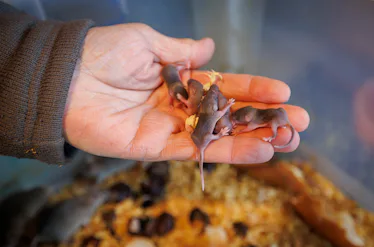
Hand holding newborn mice (Mus musculus)

In a win for family medicine, a team of researchers in Japan produced seven mouse pups using cells from two biological fathers.

BRAIS SEARA/MOMENT/GETTY IMAGES

In a win for family medicine, a team of researchers in Japan produced seven mouse pups using cells from two biological fathers. A paper published in the journal Nature in March details a process known as “in vitro gametogenesis” (IVG), which involves genetically altering any type of animal cells into stem cells and then into egg or sperm cells.

In this case, the team used tail skin cells from a male mouse and turned them into stem cells. They then switched these cells’ genetic sex by dumping their Y chromosome and creating another X chromosome, which created eggs. Sperm from another male mouse fertilized these eggs, which then transferred into a surrogate female mouse’s uterus. The team transplanted 630 embryos made from these altered cells but produced only seven healthy, living pups. In the future, human same-sex couples could hopefully one day produce a child that’s biologically related to each parent.

7. ASTRONOMERS SPOTTED AN EXOPLANET THAT MAY CONTAIN THE TRAPPINGS FOR LIFE
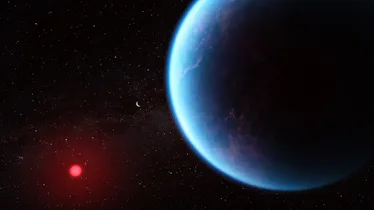
This past September, a team of astronomers, with the help of JWST of course, found a planet dubbed the oh-so-memorable K2-18b. It has an atmospheric chemical blend that denotes the presence of liquid water, a major ingredient needed for supporting life.

NASA, CSA, ESA, J. OLMSTED (STSCI), SCIENCE: N. MADHUSUDHAN (CAMBRIDGE UNIVERSITY

This past September, a team of astronomers, with the help of JWST of course, found a planet dubbed the oh-so-memorable K2-18b. It has an atmospheric chemical blend that denotes the presence of liquid water, a major ingredient needed for supporting life. They also sniffed out traces of the molecule dimethyl sulfide, which on Earth only comes from living things (though they still need more evidence of its presence).

Published in The Astrophysical Journal Letters in October, the paper refers to the search for habitable environments and biomarkers as “the holy grail of exoplanet science.” An immense world covered in liquid water with a mostly hydrogen atmosphere, K2-18b orbits the red dwarf star 120 light years from Earth. It could become the first Hycean (hydrogen + ocean) world ever discovered and the first instance of liquid water on a planet orbiting a star.

6. NOW THERE’S LIVE, 3D-PRINTABLE INK MADE FROM BACTERIA

A paper published in February in the journal Materials Today details the process of printing a biocomposite filament that contains Sporosarcina pasteurii, which initiates mineralization when it makes contact with a solution containing urea, a waste by-product that many organisms create from breaking down amino acids.

HIRSCH ET AL.

2023 brought us a method for 3D printing with an ink that contains living bacteria, called BactoInk. A paper published in February in the journal Materials Today details the process of printing a biocomposite filament that contains Sporosarcina pasteurii, which initiates mineralization when it makes contact with a solution containing urea, a waste by-product that many organisms create from breaking down amino acids. After a few days of mineralization, the ink hardens to calcium carbonate (CaCO3), a key substance in mollusk shells.

Designed by researchers at the Soft Materials Laboratory in the School of Engineering at Ecole Polytechnique Fédérale de Lausanne, energy-efficient BactoInk can 3D-print in nearly any structure that gradually hardens into CaCO3 over a few days, and it could aid in repairing broken mineral-based organic structures like coral reefs or even bone.

5. A PIG ORGAN WAS SUCCESSFULLY TRANSPLANTED INTO A HUMAN BODY

Organ donation.

Surgeons at New York University Langone Health transplanted a genetically modified pig kidney into a brain-dead patient as a proof-of-concept procedure called a xenotransplant.

COOLPICTURE/MOMENT/GETTY IMAGES

During the dog days of summer 2023, surgeons at New York University Langone Health transplanted a genetically modified pig kidney into a brain-dead patient as a proof-of-concept procedure called a xenotransplant. Not only was the kidney accepted, but it also functioned as well as a human kidney in the month after the surgery.

Foreign organs are a promising solution to the medical shortage that plagues those needing new livers, kidneys, and more. Through gene editing, scientists can modify animal organs to make them compatible with human bodies. In this case, the kidney came from a lineage of genetically altered swine that lacks “alpha-gal.” Because this sugar molecule can be found in many mammals except for humans, it can cause a human body to reject a nonhuman organ. This milestone represents a victory for the future of xenotransplantation.

4. A NEW GENE-EDITING THERAPY COULD TRANSFORM HIGH-CHOLESTEROL TREATMENT

Modifying DNA (deoxyribonucleic acid), conceptual image. A pair of tweezers removes a segment from a...

The therapy entails an updated version of CRISPR called base editing, which removes small components of DNA strands rather than breaking the entire strand.

MARK GARLICK/SCIENCE PHOTO LIBRARY/SCIENCE PHOTO LIBRARY/GETTY IMAGES

Statins have long been the prescribed treatment for familial hypercholesterolemia, a condition that increases individuals’ risk for heart disease and early death. But they are far from perfect. The daily medication comes with an increased risk of stroke and diabetes, as well as other side effects like headaches and nausea. A new gene therapy presented this past November at the annual American Heart Association meeting could supplant statins.

The therapy entails an updated version of CRISPR called base editing, which removes small components of DNA strands rather than breaking the entire strand. The treatment, called VERVE-101, is an infusion that targets a gene in liver cells called PCSK9 that controls “bad” low-density lipoprotein (LDL) cholesterol in the blood. VERVE-101 instructs liver cells to manufacture an ineffective version of this gene, lowering those “bad” cholesterol levels.

In a small clinical trial of 10 people, those who received the highest dosages of VERVE-101 saw their “bad” cholesterol fall between 39 and 55 percent. VERVE-101 is still in Phase 1 clinical trials, so it will be a few years before we can see it approved by the FDA, and that’s if everything goes well.

3. A TINY NUMBER FROM A TINY PARTICLE COULD UPEND THE STANDARD MODEL OF PHYSICS

This past August, researchers at the Fermi National Accelerator Laboratory announced that they measured the wobble of a muon, a negatively charged subatomic particle that throws a wrench in everything we think we know about particle physics, also known as the Standard Model.

REIDAR HAHN

Thispast August, researchers at the Fermi National Accelerator Laboratory announced that they measured the wobble of a muon, a negatively charged subatomic particle that throws a wrench in everything we think we know about particle physics, also known as the Standard Model. According to the Standard Model, muons in magnetic fields should wobble, like a spinning top’s axis, at a certain speed — and yet they don’t, indicating that the model may lack some crucial information.

A muon’s wobble is determined by the particle’s magnetic moment or how muons align with magnetic fields. Theoretically, the magnetic moment, represented as g, should be 2. However, experiments yield another figure entirely. The new measurement comes to 0.00233184110, which physicists simply call “g-2.” This experimental gulf between g and g-2 can put the Standard Model through a crucible.

2. THIS MAN RECEIVED THE FIRST EVER WHOLE-EYE AND PARTIAL-FACE TRANSPLANT
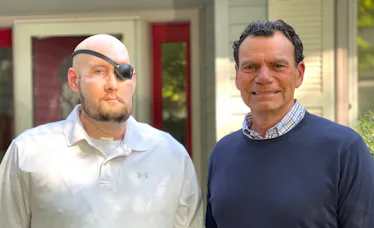
Surgeons at NYU Langone Health successfully performed the first whole-eye and partial-face transplant on a 46-year-old military veteran and high-voltage power lineman named Aaron James.

NYU LANGONE HEALTH

Finally, in May, surgeons at NYU Langone Health successfully performed the first whole-eye and partial-face transplant on a 46-year-old military veteran and high-voltage power lineman named Aaron James. Two years earlier, James suffered a 7,200-volt shock to his face when a live wire touched his skin.

The surgery lasted 21 hours and involved 140 healthcare professionals, and while it’s uncertain whether the transplanted eye will gain sight, normal direct flow to the retina suggests it’s healthy. Today, James can also speak and eat normally again, and this breakthrough surgery brings new transplant possibilities to millions.

1. NUCLEAR FUSION IS — FINALLY — IN ITS IGNITION ERA

Nuclear fusion

Over the course of this year, the NIF has officially reproduced this gain three times

JAPATINO/MOMENT/GETTY IMAGES

Almost a year ago, scientists at the National Ignition Facility (NIF) achieved something decades in the making: They attained a gain of 1, a controlled fusion reaction that produces more energy than it puts in. If that was the crowning achievement for physics in 2022, then 2023’s pinnacle was subtle, though undeniably more consequential. Over the course of this year, the NIF has officially reproduced this gain three times, ensuring that the late-breaking, end-of-2022 triumph would enable perhaps physics’ most influential year yet: the year of fusion energy.

{ https://www.inverse.com/ }

Hoe vind je dit bericht?
Geschreven door peter om 20:30 Stuur door

Eerie Lights Over Anchorage: A Personal Account of UFO Sightings in Alaska

Eerie Lights Over Anchorage: A Personal Account of UFO Sightings in Alaska

In the remote expanses of Anchorage, Alaska, the night sky holds more than just stars and the aurora borealis. It’s a canvas for some of the most intriguing and unexplained phenomena known to humankind—UFO sightings. This captivating tale unfolds through the eyes of Bill Carter and Patricia Roll, residents of Anchorage, whose lives were forever altered by an eerie encounter on a cold December night in 2019.

The Unforgettable Night

Bill, a seasoned aviation enthusiast with deep family roots in flying, and Patricia, a lifelong Alaskan, were no strangers to the skies. Yet, nothing could have prepared them for the sight that awaited them. As they stepped into the frigid night, their gaze was drawn to an extraordinary vision—orange orbs, bright and silent, gliding across the sky. These glowing spectacles defied explanation, moving in a coordinated fashion that suggested an intelligence behind their flight.

A Seeker’s Perspective

Bill’s expertise in aviation left him bewildered. These were no ordinary aircraft; their silent approach and luminous presence were unlike any known human-made machines. The couple’s attempt to capture the moment on camera was hindered by the biting cold, yet the images they retained were not just in their devices but etched in their memories. This experience propelled them into a world of questions and a quest for answers.

Echoes of Past Encounters

The story of Bill and Patricia is not an isolated incident. Alaska’s vast skies have long been a stage for mysterious sightings. UFO expert Krista Stewart notes that multiple object sightings are not uncommon and often resemble military fleet formations. The historical incident involving Japan Airlines in 1986, where multiple lights accompanied by a “mothership” were reported, mirrors the orchestrated nature of what the couple witnessed.

The Implications of Silence

What troubles Bill and other witnesses is not just the sightings themselves but the lack of official acknowledgment or explanation. The proximity of their experience to Merrill Field and military bases raises concerns about airspace security and the potential implications of these unidentified objects. The absence of other reports and the silence from authorities only deepen the mystery and the thirst for understanding.

The Search for Meaning

This personal account does more than narrate an unexplained event; it touches on the universal human curiosity about our place in the cosmos. Patricia’s lifelong wonderment about extraterrestrial life reflects a broader human yearning to know if we are alone in the universe. The sighting has transformed skepticism into belief, and disbelief into wonder, leaving the couple and the readers pondering the age-old question: Why are they here?

A  Glimpse into the Unknown

As we delve into this Alaskan enigma, we are reminded of the vastness of the unknown. The skies above us hold endless mysteries, and the experiences of Bill and Patricia are but a glimpse into the potential realities that lie beyond our understanding. Their story is a testament to the human spirit’s unrelenting quest for knowledge and the profound impact that a moment of contact with the unknown can have on our lives.

VIDEO:

  • Eyewitnesses Share Their Encounters With UFOs And Provide Video Evidence | Aliens In Alaska

https://www.youtube.com/watch?v=jAuV3xJRN9E?si=Oye9TYjEi0fGiTT_

https://youtu.be/jAuV3xJRN9E

In sharing this narrative, we invite readers to look up and wonder, to question and seek. The skies over Anchorage have shown us that sometimes, the most profound mysteries are not in the far reaches of space but right above us, in our own earthly backyard.

 { https://www.latest-ufo-sightings.net/ }

Hoe vind je dit bericht?
Geschreven door peter om 18:04 Stuur door

Video: SpaceX voert een statische vuurtest uit van de Starship

Video: SpaceX voert een statische vuurtest uit van de Starship

Video: SpaceX voert een statische vuurtest uit van de Starship. Foto’s en video’s: Reproductie Twitter @SpaceX
Video: SpaceX voert een statische vuurtest uit van de Starship. Foto’s en video’s: Reproductie Twitter
@SpaceX© Aangeboden door Tech Break

SpaceX heeft woensdag (20 december) een “statische test” uitgevoerd met het prototype van het bovenste trapgedeelte van de Starship dat bekend staat als Ship 28, waarbij de Raptor-motoren van het voertuig kort werden ontstoken terwijl het verankerd bleef aan het platform op de Starbase-basis van het bedrijf in het zuiden van Texas.

Ruimteschip 28 wordt voorbereid om de derde testvlucht van de Starship uit te voeren, die SpaceX in de komende weken wil lanceren. En dit tijdschema lijkt binnen de planning te blijven, aangezien de test op woensdag goed verliep.

“Starship Flight 3 heeft succesvol een totale statische vuurproef met alle zes Raptor-motoren voltooid”, aldus SpaceX in een tweet, waarin ook de video van de test was opgenomen.

De Starship bestaat uit twee elementen: een enorme eerste trapversterker genaamd Super Heavy en een 50 meter hoog bovenste traptuig dat bekend staat als Starship.

Beide trappen zijn ontworpen om volledig en snel herbruikbaar te zijn en worden aangedreven door de volgende generatie Raptor-motor van SpaceX.

Super Heavy heeft 33 Raptors en Starship wordt aangedreven door zes daarvan.

Fullscreen button
Video: SpaceX voert een statische vuurtest uit van de Starship. Foto's en video's: Reproductie Twitter @SpaceX
© Aangeboden door Tech Break

{ http://techbreak.ig.com.br/ }

Hoe vind je dit bericht?
Geschreven door peter om 00:41 Stuur door

Former NASA scientist says aliens 'could have secret base beneath Earth's oceans'

Former NASA scientist says aliens 'could have secret base beneath Earth's oceans'

There are solid scientific reasons why the pilots of UFOs visiting the Earth might perfer to base themselves in the deep oceans, says former NASA researcher Kevin Knuth.

By Michael Moran  - Audience Writer

A former NASA researcher believes pilots of UFOs could be living underneath our oceans.

Kevin Knuth, a distinguished academic who worked at NASA's Ames Research Center from 2001 to 2005, thinks there are many reasons why alien visitors might choose to base themselves underwater, rather than on the Earth’s surface.

For a start, he says, if they prefer to remain undetected, the deep oceans are ideal. He told the Theories of Everything podcast: “75% of the Earth's surface is water and we really have very little access to it. So, if you are going to hide out somewhere, that's perfect.”

READ MORE: 

Many recent UFO sightings have involved craft that appear to move effortlessly between the air and sea, and Kevin adds that aliens from a water-world home planet would have many reasons to base themselves beneath the sea.

Kevin Knuth

Kevin outlines the reasons why extraterrestrials might find our environment quite inhospitable  (Image: Kevin Knuth)

RELATED ARTICLES

He continued: “If you come from an aquatic environment, aquatic environments on planets are going to be much better to live in than atmospheric environments. Atmospheres have a low heat capacity, so the temperature varies a lot …you get huge temperature variations.

“And then going from planet to planet, you have huge temperature variations in the atmosphere: go to Mars, and you're looking at 100 degrees below zero Fahrenheit. You go to Venus, and you're looking at 800 degrees Fahrenheit. It's dramatic. And the air pressure is dramatically different, too, from planet to planet…”

Underwater UFO

Aliens might be more comfortable underwater, Kevin says  (Image: Getty Images/Science Photo Library RF)
READ MORE

Kevin explains that the atmosphere on Venus is is about 100 times denser than ours, while the Martian “air” is more like 100 times thinner. And on none of those planets does the atmosphere do anything to protect against cosmic radiation or other hazards.

“There's all sorts of problems with living on a surface protected only by an atmosphere,” he said. “But if you live in an ocean, going to another planet with an ocean is actually a pretty good thing.

“If it's a water ocean, then a water ocean on another planet is going to be between the temperatures of 32 degrees Fahrenheit and 212 degrees Fahrenheit. So, the temperatures aren't going to change dramatically from ocean to ocean, going from one planet to another.”

AQUATIC UFO

Some of the most credible UFO sightings of recent years have involved 'trans-medium' craft cutting through the waves
READ MORE

Pressures, too, will be more consistent between oceans of different planets. He added: “So you can actually find a nice place to hang out if that's the pressure you're used to. The main differences are going to be chemicals dissolved in the ocean.”

For that reason, he said, it’s highly likely that alien life forms visiting our planet might choose to base themselves beneath the waves. Even if we were to ever make contact with them, though, he’d advise against touching an alien. Kevin explained: “The biology is probably very different. You don't want to touch them… your biology isn't compatible, so there's going to be all sorts of horrible chemical reactions.

“You don't want to come in contact with their organic molecules,” he adds, “because you don’t know what kind of reactions you'd have.”

{ https://www.dailystar.co.uk/ }

Hoe vind je dit bericht?
Geschreven door peter om 00:00 Stuur door

Former NASA scientist says aliens 'could have secret base beneath Earth's oceans'

Former NASA scientist says aliens 'could have secret base beneath Earth's oceans'

There are solid scientific reasons why the pilots of UFOs visiting the Earth might perfer to base themselves in the deep oceans, says former NASA researcher Kevin Knuth.

By Michael Moran  - Audience Writer

A former NASA researcher believes pilots of UFOs could be living underneath our oceans.

Kevin Knuth, a distinguished academic who worked at NASA's Ames Research Center from 2001 to 2005, thinks there are many reasons why alien visitors might choose to base themselves underwater, rather than on the Earth’s surface.

For a start, he says, if they prefer to remain undetected, the deep oceans are ideal. He told the Theories of Everything podcast: “75% of the Earth's surface is water and we really have very little access to it. So, if you are going to hide out somewhere, that's perfect.”

READ MORE: US Navy officer 'saw 300ft triangular UFO above house that blasted out radiation'

For more stories of the paranormal, strange and unexplained, check out the Daily Star's Weird News section.

Many recent UFO sightings have involved craft that appear to move effortlessly between the air and sea, and Kevin adds that aliens from a water-world home planet would have many reasons to base themselves beneath the sea.

Kevin outlines the reasons why extraterrestrials might find our environment quite inhospitable (Image: Kevin Knuth)

{ https://www.dailystar.co.uk/ }

Hoe vind je dit bericht?
Geschreven door peter om 00:00 Stuur door

Mum 'freaked out' as UFO that looks like Doctor Who's TARDIS flies over her house

Mum 'freaked out' as UFO that looks like Doctor Who's TARDIS flies over her house

The 36-year-old mum was adamant the unidentified flying object was not a star and decided to investigate the matter further by using the ultra-zoom camera on her phone

By Eleanor Ovens

Hoe vind je dit bericht?
Geschreven door peter om 00:00 Stuur door

Alien Invasion! The 11 Most Gripping Alien and UAP Events Of 2023

Alien Invasion! The 11 Most Gripping Alien and UAP Events Of 2023

It’s never aliens... until it is.

There’s nothing like a little trouble at home to make you look for greener pastures. And green or not, aliens were everywhere in 2023. Well, at least in the news.

From Unidentified Anomalous Phenomena (UAP, the classy new way to talk about UFOs) to the Search for Extraterrestrial Intelligence (SETI) and all the way to tiny molecules clinging to frozen dust grains in interstellar space, the eyes of experts and the public were looking for life elsewhere.

The biggest alien stories — at least the most popular — came from military releases of data, hinting at cover-ups (or just ill-prepared government officials). But the most important — at least by our reckoning — were those that were steeped in science, offering hints of what life might look like outside of our planet, and where to find it. If you really do want to turn over that rock, that is.

Here, ranked from 11 to 1 by their chances of introducing us to real alien life, are the top alien and UAP events of 2023 that remind us the truth really is out there.

11. NASA RELEASED A GRIPPING REPORT ON UAPS

A resolved UAP sighting. The dot in the middle, and two dots that appeared to move in tandem with th...

A resolved UAP sighting. The dot in the middle, and two dots that appeared to move in tandem with the central dot are airplanes waiting to land. 

AARO/NASA TV

In September, ASA released its much-anticipated report on Unidentified Anomalous Phenomena, and the agency says some of the sightings — between 16 and 40 out of roughly 800 — just can’t be explained — but Inverse spoke to experts, and it turns out the problem might just be that we don't have enough information. Most UAP reports come from sensors designed to guide weapons to objects, not gather detailed data about them, so it’s easy for fairly mundane objects to look bizarre when viewed through these sensors — or so says NASA.

Meanwhile, Inverse argues that the agency still needs a dedicated UAP office to take the investigation mainstream.

10. ... AND SO DID THE DEPARTMENT OF DEFENSE.

The Department of Defense also published its own UAP report in January 2023, admitting that it has investigated more than 500 cases of possible UAP. Of those, more than a quarter were (of course) weather balloons; to be fair to DoD, weather stations in the U.S. alone launch 240 balloons every day. But according to a Pentagon spokesperson, “Some of these uncharacterized UAP appear to have demonstrated unusual flight characteristics or performance capabilities, and require further analysis.”

But don’t worry; experts tell Inverse that the military probably couldn’t pull off an alien cover-up. Swarms of commercial satellites, along with ubiquitous smartphones and social media — not to mention political pressure — would make it almost impossible to keep the cat in the bag for long.

“I still strongly maintain that alien visitation is not something that could be kept secret. The size of such a secret is just too big,” wrote SETI researcher Seth Shostak in a July 2023 essay for the SETI Institute.

9. THE MYSTERIES OF OUMUAMUA WERE UNVEILED.

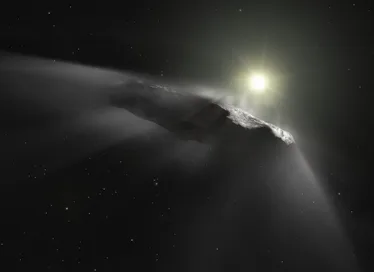
illustration of a long, thin rock venting a fan-shaped cloud of pale gas, with a yellow sun in the d...

This artist’s illustration shows Oumuamua venting gas as the Sun heats it, although no such venting was actually visible to astronomers.

ESA

Speaking of UAP, a chunk of interstellar debris called ‘Oumuamua caused a stir when it passed through our Solar system a few years ago — and an even bigger uproar when it seemed to accelerate under its own power, without leaving a tail like a comet. This year, a study suggested a possible explanation. Spoiler alert: It’s definitely not aliens.

8. WE CRAFTED A DECENT IDEA OF WHAT ALIEN SPACECRAFT COULD LOOK LIKE

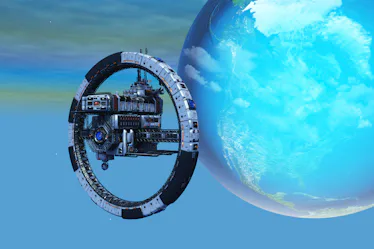
A space station wheel orbiting planet Earth. The space station wheel is a habitat that a human crew can live for extended periods of time. 

COREY FORD/STOCKTREK IMAGES/STOCKTREK IMAGES/GETTY IMAGES

One team of SETI researchers did some math and suggested that if an alien probe ever does visit our Solar System, it’s likely to be a zippy high-tech model, not an alien version of the Voyager probes.

7. ... AND ALSO WHAT CELESTIAL SIGNS MIGHT POINT US TO ALIEN CIVILIZATIONS.

An illustration of a futuristic sci-fi city on a ring planet. 

EDUARD MUZHEVSKYI / SCIENCE PHOTO LIBRARY/SCIENCE PHOTO LIBRARY/GETTY IMAGES

SETI researchers also proposed some ways we might be able to spot high-tech alien civilizations from a distance — and some really wild ways the aliens might make themselves known to the rest of the universe, such as rearranging an entire star system into a cosmic “Kilroy Was Here” sign.

Other telltale signs to look for around distant stars include giant megastructures, built to siphon off mass and prolong the life of a dying star or the gleam of starlight on sprawling alien cities. But it may be easier to just look for pollution in a distant world’s atmosphere.

6. WE RULED OUT A WHOLE LOT OF HABITABLE PLANETS FOR INTELLIGENT LIFE

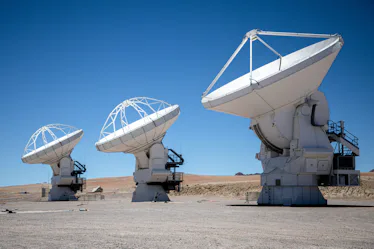
ATACAMA DESERT, CHILE - OCTOBER 28: The Atacama Large Millimeter/submillimeter Array (ALMA) radio te...

Humans wouldn’t be able to search for extraterrestrial intelligence today if our ancestors hadn’t learned to harness fire around a million years ago. 

ANADOLU AGENCY/ANADOLU AGENCY/GETTY IMAGES

None of that advanced alien technology is likely to happen in a world without a lot of oxygen in its atmosphere, though. One study this year pointed out that unless about sixteen percent of the atmosphere is made of oxygen, you can’t start a fire. And without fire, you can’t work metals, cook food, or signal to distant alien civilizations.

5. ... AND LEARNED ALIENS PROBABLY WON’T THINK TOO FONDLY OF OUR INTELLIGENCE.

UFOs flying over winter landscape. 3D generated image.

GREMLIN/E+/GETTY IMAGES

If intelligent, technologically advanced aliens are out there, they may not recognize us as intelligent. That could be good news because it means they may not see us as a threat — and they may even think we need protection, according to one 2023 study. If the first aliens we contact are vastly more advanced than we are — or just very different — they may not realize we're sentient. That means they probably won't see us as a threat to galactic peace, which needs to be eliminated posthaste. But the jury's out on whether these hypothetical aliens might turn Earth into a nature preserve or treat us with callous indifference.

4. ALIEN LIFE, INTELLIGENT OR NOT, IS PROBABLY QUITE COMMON

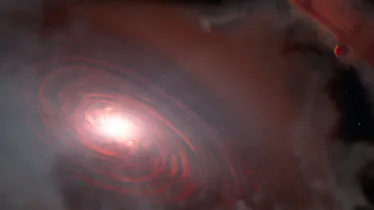
Left of center, a bright light source illuminates a surrounding disc colored dusky red. The disc is...

An artist’s depiction of the star PDS 70 and its inner disk. The haze represents the water vapor. In the top right of the image appears an exoplanet. 

NASA, ESA, CSA, J. OLMSTED (STSCI)

Alien encounters may be worth thinking about. It turns out that the basic ingredients for life are everywhere.

This year, astronomers found water vapor amid the rocky building blocks of a planetary system. Another team found some important chemical building blocks of organic chemistry clinging to dust grains in a cold cloud of interstellar gas. Elsewhere in the universe, astronomers found the amino acid tryptophan in one star-forming nebula, and a chemical essential for kickstarting the growth of complex organic molecules in another.

A few decades ago, we thought the chemicals involved in building cells and making them work might be rare in the universe, but now it looks like many of those ingredients could be part of the standard starter pack for new star systems. And that means life may — eventually — turn out to be more common than we ever dared to hope.

3. ... AND K2-18B IS A GREAT PLACE TO LOOK FOR IT.

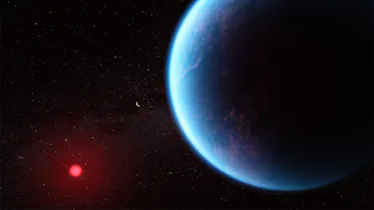
a large blue planet in the foreground with a small red star in the background

This artist’s illustration shows what K2-18b might look like, with its dim red star in the background.

NASA, ESA, CSA, JOSEPH OLMSTED (STSCI)

One team of astronomers says they’ve found an ocean world orbiting a distant star, called K2-18b — and its atmosphere may contain evidence of life somewhere in that alien ocean. Even the researchers who studied the planet with the James Webb Space Telescope (JWST) aren’t convinced, though. It’s going to take more data to settle the debate, but the possibility is intriguing.

2. TRAPPIST-1 OFFERS EXPERTS HOPE AND FRUSTRATION.

photo of several planets passing in front of a dim red star, with a larger planet in the foreground

The star and six of the planets as they would appear from the vantage point of the fifth outermost planet, Trappist-1f. All of the planets and the Sun are to scale. One of the worlds is seen transiting in front of the star.

MARK GARLICK/SCIENCE PHOTO LIBRARY/SCIENCE PHOTO LIBRARY/GETTY IMAGES

Another swirl of debate, also fueled by JWST observations, is centered on the TRAPPIST-1 system. Home to at least seven rocky planets, three of which are in the habitable zone, TRAPPIST-1 is a hotspot for hopeful astrobiologists.

Earlier this year, JWST revealed that the system’s innermost two worlds — TRAPPIST-1b and TRAPPIST-1c — look like airless rocks, although it’s possible they just have really thin atmospheres. Neither of those planets is in the habitable zone, but many astronomers took the news as a discouraging sign that the star TRAPPIST-1 might have swept away the atmospheres of all its closest planets, including the potentially habitable ones. But others say it’s too soon to give up hope.

1. BUT DO WE NEED TO LOOK THAT FAR? ALIEN LIFE MIGHT BE RIGHT HERE IN OUR BACKYARD.

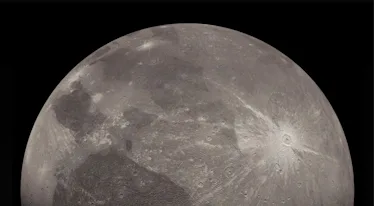
A grayscale moon with a cracked icy surface on a black background.

The Juno spacecraft’s Junocam instrument captured this detailed photo of Jupiter’s icy moon Ganymede during a June 2021 flyby.

NASA

Closer to home, several studies this year show that Jupiter’s icy moons look extremely promising for alien life, or at least habitability, in a part of our Solar System that we used to consider totally uninhabitable.

NASA’s JUNO spacecraft spotted salt and organic molecules splattered across the icy surface of Jupiter’s moon Ganymede, and JWST revealed frozen carbon dioxide on the surface of Europa. Both moons are hiding vast, dark oceans beneath their thick, icy exteriors, and finding those chemicals on the surface suggests two important things: one, material from the ocean can reach the surface, where it might be easier for us to study. And two, those ice-covered alien oceans seem to have chemistry that could support life as we know it.

Meanwhile, another study suggested that every star system could host at least one Europa-like planet with an ocean hidden beneath an icy outer layer.

The truth is out there, all right — and it may be closer than we ever thought.

https://youtu.be/S3KipYOcspA

https://www.youtube.com/watch?v=S3KipYOcspA

{ https://www.inverse.com/ }

Hoe vind je dit bericht?
Geschreven door peter om 22:38 Stuur door

US Military Has Machine That Can Levitate UFO Metal, Confirms Stanford Top Scientist

Garry Nolan terahertz UFO

US Military Has Machine That Can Levitate UFO Metal, Confirms Stanford Top Scientist

Professor Garry Nolan is one of the most reputable experts examining the enigma of Unidentified Aerial Phenomena (UAPs). He has been studying UAP materials for many months and has made numerous astonishing statements about UFOs. His contributions lend credibility to this particular mystery, which many mainstream scientists hesitate to discuss.

Dr. Nolan works at Stanford University as a professor of Immunology. He was nominated for the Nobel Prize, which is a big honor. He is known as one of the best immunologists in the world. He has many patents and has written a lot of research papers. He has also started two companies listed on the NASDAQ stock exchange because of his successful inventions.

In June 2022, Australian investigative journalist Ross Coulthart interviewed Dr. Nolan and learned from him shocking UAP information that the U.S. government had been investigating for the past few years. Dr. Nolan said that one thing he is sure about is that we do not know what UAPs are: “We do know that there is something here something that I think defies explanation but that something can be studied from a scientific Viewpoint.”

Although this interview was recorded in 2022, Dr. Nolan adheres to David Grusch’s statement that the U.S. government has been lying about UAPs for the last 60-70 years. He believes the reason behind this is that the U.S. government itself does not know what they are dealing with. “Absolutely, there is a cover-up,” says Dr. Nolan. “I mean, there has been both a cover-up and a disinformation campaign to make people appear as if they were crazy.”

Coutlhart questions the potential dangers of admitting one’s thoughts on these mysterious events, to which Dr. Nolan responds, “I think it’s dangerously necessary… ignoring the physics of what these things are capable of doing.” Coutlhart further asks, “Let’s talk about ‘It.’ What is it?”

Dr. Nolan replies, “You know, I wish I knew… Whatever it is appears to be so far advanced from us that it beggars understanding.” When pressed further by Coutlhart if he believes the phenomenon to be of human origin, Dr. Nolan decisively states, “I’m sure it’s not human..I think it’s whatever it is it’s been here a long time so and certainly it’s been here longer than we’ve been civilized so at the very least who really owns the planet who was here first uh I’m not sure it was.”

Dr. Nolan explained he studied the brains of pilots who claimed to have encountered the phenomena. After their UAP/ UFO encounters, they all got damaged or hurt such as buzz noises in their head, got sick, etc. Most of them have had similar kinds of bad things. He showed the MRIs of some people that revealed damage in the middle of the basal ganglia – an area responsible for motor control and other core brain functions, including intuition.

Dr. Nolan said the damage should have killed those people, yet they were alive. He obtained MRIs of some prior to their encounters and they had the damage, so they were most likely born with it. “These are all so-called high-functioning people. They’re pilots who are making split-second decisions, intelligence officers in the field, etc,” he said.

Alleged UFO material

Former Pentagon UFO official Lue Elizondo shared a truly eye-opening statement in his interview with James Iandoli of Engaging The Phenomenon on June 11, 2021. They discussed crash retrievals and materials related to unidentified flying objects (UFOs) or unidentified aerial phenomena (UAPs). Elizondo acknowledged the sensitivity of the topic and the potential consequences of discussing it openly.

However, Elizondo expressed his belief that the US government does possess exotic materials but could not provide further details due to the lack of transparency from the government. He mentioned the three layers of analysis that can be conducted on a piece of material, namely physical, chemical, and atomic or nano-level research.

Coulthart asked the Stanford professor about this research on a peculiar material known as Bismuth magnesium. Dr. Nolan described it as a layered substance consisting primarily of bismuth, with traces of lead and magnesium. Despite his assessment of its isotope ratios showing nothing out of the ordinary, he expressed his intent to study a significantly larger sample in the future. This expanded sample size would allow him to conduct more comprehensive tests, potentially shedding light on its properties.

Terahertz Transmistter

Coulthart speculated on the material’s ability to levitate when exposed to a specific waveform. While Nolan acknowledged hearing about such claims, he had not personally witnessed or tested the phenomenon. When pressed by Coulthart about whether he had attempted any experiments, Nolan clarified that the required waveform for levitation would be “Terahertz Waves,” which he had not utilized.

Coulthart highlighted that the U.S. Army possessed the necessary terahertz transmitter for potential experiments with the Bismuth magnesium material. However, Dr. Nolan remained tight-lipped about the specifics, stating he could not discuss whether such research had been conducted.

Coulthart mentioned that Tom Delonge’s To the Stars Academy (TTSA) worked with the U.S. Army to study this material using the right equipment. Coulthart wondered why the U.S. government keeps such materials if stories about flying objects are just made up. Nolan thinks there is a lot of false information out there but believes there might be real materials that we should know about. He wants the government to tell us clearly if those special materials are real or not.

In 2019, Tom DeLonge claimed that his UFO research organization had acquired “potentially exotic materials featuring properties not from any known existing military or commercial application.” “The structure and composition of these materials are not from any known existing military or commercial application,” Steve Justice, TTSA’s COO and former head of Advanced Systems at Lockheed Martin’s Skunk Works said in a statement. (Source)

According to the press release, some of these materials were in the possession of investigative journalist and UFO researcher Linda Moulton Howe, who, in 2004, gave a presentation at the Xcon Conference regarding these materials. In her lecture, a video of which has been on the Internet for years, she suggests that the material could become a “lifting body” with the right amount of electromagnetic static and certain RF frequency. These are undoubtedly the same materials mentioned  by Tom DeLonge on his Joe Rogan interview where he stated, “if you hit it with enough terahertz, it’ll float.”

In this video, Dr. David Chester, a scientist from Quantum Gravity Research, makes several references to pulsed terahertz waves. Towards the end, he mentions that pulsed terahertz waves in a metamaterial can slow down the speed of light. He further explains that this is beneficial for anti-gravity engineering. According to him, due to the way everything couples together in the equations, a reduced speed of light requires less energy to achieve the desired anti gravitic effects.

This is some really interesting information on terahertz, thanks to Observing The Anomaly.

AAWSAP commissioned 37 scientific papers that are now public. Someone FOIA’d about UAP materials being studied and DIA responded with 5 of these papers. One paper was on spintronics and another on metamaterials. TTSA bought an alleged sample of Roswell crash material and gave it to the Army to study in 2019. According to Puthoff it appeared to be a metamaterial that acts as a waveguide at the terahertz frequency. The two papers on spintronics and metamaterials also touches on creating materials that operate at this frequency and specifically that such materials would be radiation resistant and ideal for long space travel.

Hal Puthoff also discusses the sample with UFO Joe. Notice the bolded statement below. (Source)

So the answer is, we don’t, yet, really know where it came from. And it’s true that ten years ago Linda Howe provided us with a sample. And we did a lot of tests. Got electron microscope pictures and irradiated it with various gigahertz frequencies, megahertz frequencies and so on. We couldn’t make anything out of it. So it kind of went on the shelf. And it was only after this paper on meta-materials was published, we said, “Oh my gosh. The claim here, that this could have some real utility as microscopic waveguides, would actually fit the structure, you know, that we see there.” Okay, well where do we go with that?

Well, the truth of the matter is, that piece is actually pretty mangled and what you’d really like to do is say, “Okay, well let’s have a nice, clean piece of this, and let’s irradiate with terahertz frequencies, first of all, to see if it really does act as a microscopic waveguide for terahertz frequencies. And then, if that works, we’ll iradiate it with other kinds of fields and see if there are any unexpected responses and so on.” So it is still, despite the fact it gets unbelievable publicity out there, it’s still an absolutely unknown. It does range all the way from…this was a fraud of junk material sent to us, to…no, this came off the wedge of an ET craft.

We don’t know the answer to that, and the only way we are going to get something of value is to determine its properties or maybe reproduce it under nice conditions and determine its properties. So, it is still a giant question mark out there. So even though it’s, you know, it’s like…a few percent of our effort at TTSA, it’s like 99% of our criticisms (laughs). That’s just what you get in this field. That’s the way it goes. Some of us have developed very hard skins. Another question?

Puthoff elaborates further in another interview: (Source)

Well, years later, decades later actually, finally our own science moves along. We move into an area called metamaterials, and it turns out exactly this combination of materials at exactly those dimensions turn out to be an excellent microscopic waveguide for very high frequency electromagnetic radiation terahertz frequencies. So, the wavelength is 60 microns, which is a pretty small size. But it turns out because of the metamaterial aspect of this material, those bismuth layers that act as waveguides can be one twentieth the size of the wavelength, and usually when you make a waveguide it’s gotta be about the size of the wavelength. So, in fact this turned out to be a material that would propagate sub-wavelength waveguide effects. Why somebody wants to do that we still don’t know the answer to that.

Dr. Nolan is said to have a good friendship with Jacques Vallée, Kit Green, Eric Davis, and Colm Kelleher. They all came to him to analyze the UAP materials after he had developed some wonderful instruments using mass spectrometry.

“Some of the objects are nondescript, and just lumps of metal. Mostly, there’s nothing unusual about them except that everywhere you look in the metal, the composition is different, which is odd. It’s what we call inhomogeneous. That’s a fancy way of saying ‘incompletely mixed.’ The common thing about all the materials that I’ve looked at so far, and there’s about a dozen, is that almost none of them are uniform. They’re all these hodgepodge mixtures. Each individual case will be composed of a similar set of elements, but they will be inhomogeneous,” he explained.

Dr. Nolan found out that some of the fragments from the so-called UFO crash in Brazil have extraordinarily altered isotope ratios of magnesium. He explained:

“It was interesting because another piece from the same event was analyzed in the same instrument at the same time. This is an extraordinarily sensitive instrument called a nanoSIMS – Secondary Ion Mass Spec. It had perfectly correct isotope ratios for what you would expect for magnesium found anywhere on Earth. Meanwhile, the other one was just way off. Like 30 percent off the ratios. The problem is there’s no good reason humans have for altering the isotope ratios of a simple metal like magnesium. There’s no different properties of the different isotopes, that anybody, at least in any of the literature that is public of the hundreds of thousands of papers published, that says this is why you would do that. Now you can do it. It’s a little expensive to do, but you’d have no reason for doing it.”

Dr. Vallée collected purported metal from the UFO cases dated back to 1947 and brought them to Stanford University for analysis. Dr. Gary Nolan, a Stanford microbiologist analyzed the 3-D atomic structure of the unknown metal with a state-of-the-art Multiparameter Ion Beam Imager (MIBI) capable of discerning the precise composition of matter at the level of its isotopes.

The result might be shocking for non-believers, as when he put the sample in the vacuum chamber of the machine, he found out that their composition was unlike any other known metal on Earth.

“If you’re talking about an advanced material from an advanced civilization you’re talking about something that I’ll just call it an ultra material right it’s something which has properties where somebody is putting it together again at the atomic scale so we’re building our world with 80 elements somebody else is building the world with 253 different isotopes,” Dr. Nolan said.

Could humans be altering the isotopes in these strange objects for unknown purposes? Dr. Nolan speculates that it is possible, but proving it requires getting down to the atomic level, possibly with a super quantum interference device (SQUID). However, neither his budget nor the budgets of the groups analyzing UFO/UAP encounters have that kind of funding yet.

https://www.youtube.com/watch?v=bN5e6FPlpK0

 { https://www.howandwhys.com/ }

Hoe vind je dit bericht?
Geschreven door peter om 21:41 Stuur door

Soviet Union’s Classified UFO Chronicles

Russia's UFO Secrets

In the vast and enigmatic territory of the former Soviet Union, a series of chilling encounters with unidentified flying objects (UFOs) unfolded, shrouded in as much secrecy as the regime itself. These sightings and incidents, once buried in classified files, have slowly come to light, revealing a narrative as intriguing as it is unsettling.

The Iron Curtain’s Mysterious Visitors

Spanning over the 20th century, the Soviet Union’s skies were a hotspot for UFO sightings. Unlike the open discussions and sensationalism in the West, the Soviet regime maintained a notorious veil of secrecy. This silence was not just a matter of state security but also a reflection of the Cold War’s tension-filled atmosphere, where information was a prized asset.

The Tunguska of UFO Incidents: The Dalnegorsk Crash

On January 29, 1986, the small mining town of Dalnegorsk was thrust into the UFO spotlight. A fireball streaked across the sky, crashing into a nearby mountain and leaving a trail of mystery in its wake. Witnesses were astounded, and the incident quickly gained international attention as the “Russian Roswell.” Investigators discovered a crater surrounded by strange metallic beads with properties that baffled even the top Soviet scientists. These beads exhibited anti-gravitational characteristics and a composition unlike any known material, igniting speculation about extraterrestrial origins.

The Dyatlov Pass Mystery: A Deadly Encounter?

One of the most haunting tales from Soviet UFO lore is the Dyatlov Pass incident. In 1959, nine experienced hikers embarked on a journey through the Ural Mountains only to meet a tragic and unexplainable fate. Their tent was found torn open from the inside, and their bodies were discovered under mysterious and violent circumstances. The official explanation of hypothermia did little to quell rumors of alien encounters, especially when reports of strange lights and high levels of radiation were introduced into the narrative.

The Secret Files and the Quest for Transparency

As the iron grip of the Soviet regime loosened under Mikhail Gorbachev’s policies of glasnost and perestroika, more information began to surface. Secret files and reports were slowly released, revealing decades of hidden encounters and investigations. These documents detailed not only sightings but also the government’s attempts to understand and perhaps harness the technology behind these mysterious visitors.

The Global Implications of Soviet UFO Incidents

The Soviet Union’s UFO encounters were not isolated events. They reflected a global pattern of sightings, particularly around military and nuclear facilities. Incidents like the one in 1982 at a nuclear missile base in Ukraine, where unidentified crafts reportedly tampered with missile launch systems, echoed similar occurrences in the United States. These alarming events led to speculation about the intentions and capabilities of the beings behind these crafts. Were they here to warn, observe, or intervene?

Beyond the Secrecy: A Legacy of Questions

The dissolution of the Soviet Union opened the floodgates for information, but with it came more questions than answers. The legacy of the Soviet UFO sightings is a complex web of fear, curiosity, and intrigue. It challenges us to look beyond the political and ideological divides and consider the broader implications of these encounters. What were the Soviet authorities hiding, and why? How does this fit into the global narrative of UFOs and extraterrestrial life?

As we continue to sift through the remnants of the Soviet Union’s UFO files, we are reminded of the vastness of our universe and the potential for mysteries that lie beyond our understanding. The Soviet UFO chronicles are not just tales of the past; they are ongoing puzzles that challenge us to keep looking up at the sky and questioning what might be out there.

LINKS RELATED VIDEOS

https://youtu.be/bkC4_fxPtXU

https://youtu.be/ps84WoWZRl0

https://youtu.be/xwFQfKvKs3w

{ https://www.latest-ufo-sightings.net/ }

Hoe vind je dit bericht?
Geschreven door peter om 20:54 Stuur door

Hubble Benadrukt Heldere Melkweg op Bijna 300 Miljoen Lichtjaar van de Aarde

Hubble Benadrukt Heldere Melkweg op Bijna 300 Miljoen Lichtjaar van de Aarde

Hubble Benadrukt Heldere Melkweg op Bijna 300 Miljoen Lichtjaar van de Aarde (ESA/Hubble & NASA, C. Kilpatrick)
© Aangeboden door Tech Break

De Hubble Space Telescope heeft de afbeelding vrijgegeven van het heldere spiraalvormige sterrenstelsel dat bekend staat als MCG-01-24-014, dat een zeer interessante eigenschap vertoont.

Dit sterrenstelsel bevindt zich op een ongelooflijke afstand van ongeveer 275 miljoen lichtjaar van de aarde en heeft een zeer intense helderheid. MCG-01-24-014 wordt geclassificeerd als een Seyfert Galaxy of Type-2, omdat het wordt gekenmerkt door een goed gedefinieerde spiraal en een zeer energieke kern genaamd ‘actieve galactische kern (AGN)’ heeft.

Seyfert-galaxies herbergen, samen met quasars, een veelvoorkomende klasse van actieve galactische kernen, waarbij Seyfert de neiging heeft dichterbij te zijn en een kern te hebben die de helderheid van het gaststerrenstelsel niet overstraalt, terwijl quasars verre AGN’s zijn met intense helderheden die hun gaststerrenstelsels overtreffen.

{ http://techbreak.ig.com.br/ }

Hoe vind je dit bericht?
Geschreven door peter om 20:18 Stuur door

Meer van UFO'S of UAP'S, ASTRONOMIE, RUIMTEVAART, ARCHEOLOGIE, OUDHEIDKUNDE, SF-SNUFJES EN ANDERE ESOTERISCHE WETENSCHAPPEN - DE ALLERLAATSTE NIEUWTJES

↑ Terug naar de berichten