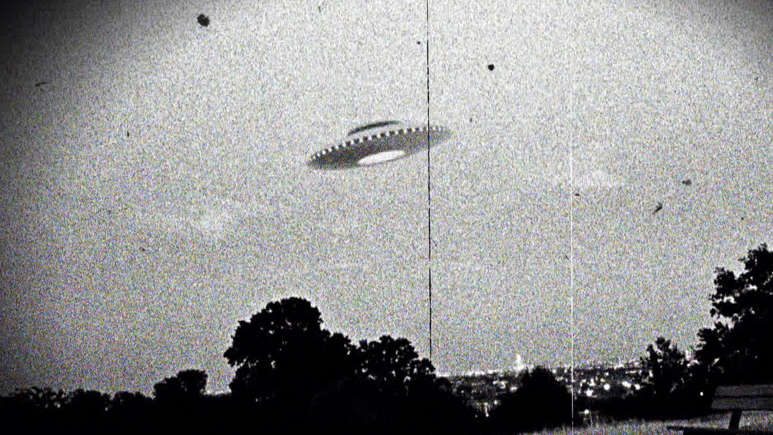
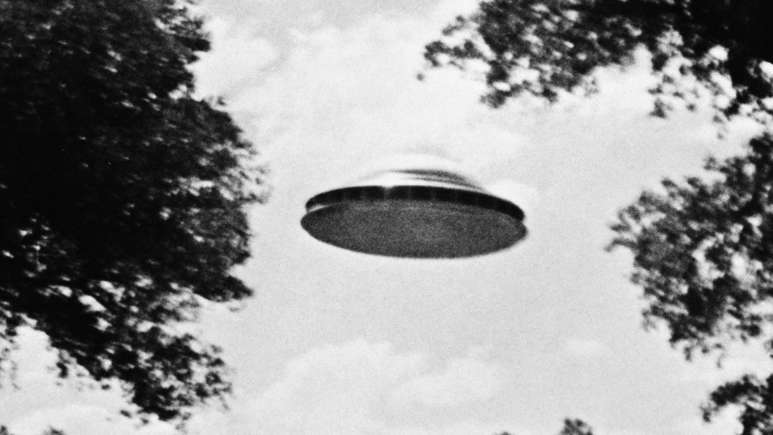
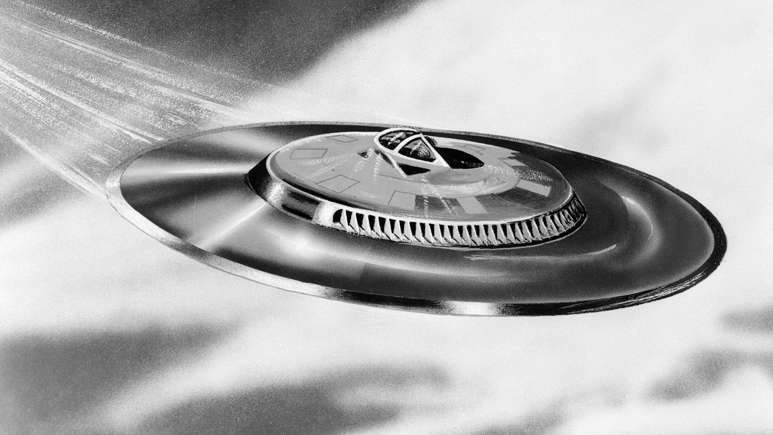
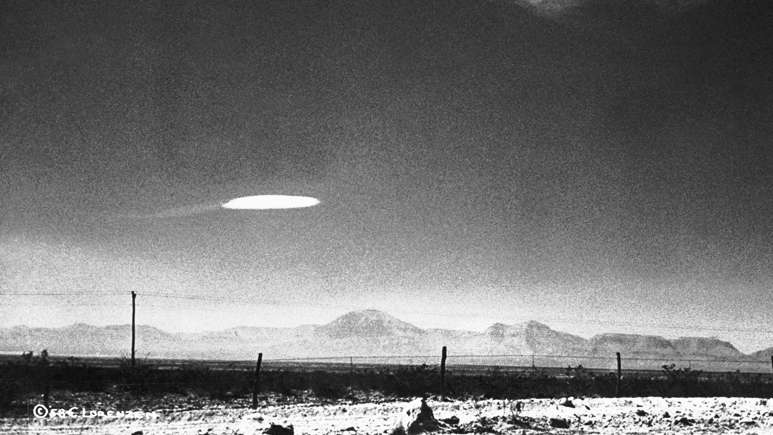
Ontdek de Fascinerende Wereld van UFO's en UAP's: Jouw Bron voor Onthullende Informatie!
Ben jij ook gefascineerd door het onbekende? Wil je meer weten over UFO's en UAP's, niet alleen in België, maar over de hele wereld? Dan ben je op de juiste plek!
België: Het Kloppend Hart van UFO-onderzoek
In België is BUFON (Belgisch UFO-Netwerk) dé autoriteit op het gebied van UFO-onderzoek. Voor betrouwbare en objectieve informatie over deze intrigerende fenomenen, bezoek je zeker onze Facebook-pagina en deze blog. Maar dat is nog niet alles! Ontdek ook het Belgisch UFO-meldpunt en Caelestia, twee organisaties die diepgaand onderzoek verrichten, al zijn ze soms kritisch of sceptisch.
Nederland: Een Schat aan Informatie
Voor onze Nederlandse buren is er de schitterende website www.ufowijzer.nl, beheerd door Paul Harmans. Deze site biedt een schat aan informatie en artikelen die je niet wilt missen!
Internationaal: MUFON - De Wereldwijde Autoriteit
Neem ook een kijkje bij MUFON (Mutual UFO Network Inc.), een gerenommeerde Amerikaanse UFO-vereniging met afdelingen in de VS en wereldwijd. MUFON is toegewijd aan de wetenschappelijke en analytische studie van het UFO-fenomeen, en hun maandelijkse tijdschrift, The MUFON UFO-Journal, is een must-read voor elke UFO-enthousiasteling. Bezoek hun website op www.mufon.com voor meer informatie.
Samenwerking en Toekomstvisie
Sinds 1 februari 2020 is Pieter niet alleen ex-president van BUFON, maar ook de voormalige nationale directeur van MUFON in Vlaanderen en Nederland. Dit creëert een sterke samenwerking met de Franse MUFON Reseau MUFON/EUROP, wat ons in staat stelt om nog meer waardevolle inzichten te delen.
Let op: Nepprofielen en Nieuwe Groeperingen
Pas op voor een nieuwe groepering die zich ook BUFON noemt, maar geen enkele connectie heeft met onze gevestigde organisatie. Hoewel zij de naam geregistreerd hebben, kunnen ze het rijke verleden en de expertise van onze groep niet evenaren. We wensen hen veel succes, maar we blijven de autoriteit in UFO-onderzoek!
Blijf Op De Hoogte!
Wil jij de laatste nieuwtjes over UFO's, ruimtevaart, archeologie, en meer? Volg ons dan en duik samen met ons in de fascinerende wereld van het onbekende! Sluit je aan bij de gemeenschap van nieuwsgierige geesten die net als jij verlangen naar antwoorden en avonturen in de sterren!
Heb je vragen of wil je meer weten? Aarzel dan niet om contact met ons op te nemen! Samen ontrafelen we het mysterie van de lucht en daarbuiten.
2.7 mile UFO found landed in Mars Crater, Seen On Google Mars Map! UFO Sighting News.
Date of discovery: Nov 7, 2023
Location of discovery: Mars
Google Coordinates: 69°26'0.85"N 86° 1'9.48"W
I found a disk structure with another smaller circle on its top center. The structure was found using Google Mars map. According to google ruler, the disk is 2.7 miles across and 1.8 miles high. Why is it not noticeable to astronomers? Well first off its hidden in a crater which itself is at least 3 to 4 miles deep and its located on Mars, which can only be seen close up by orbiting satellites. Hiding in a crater is perfect for them because it shields the alien ship from micro meteorites which could damage the hull of the ship.
On a brisk November evening in 1986, the skies above Alaska became the stage for one of the most intriguing and well-documented UFO sightings in aviation history. This incident, involving Japan Airlines Flight 1628, captivates UFO enthusiasts and skeptics alike, offering a rare blend of eyewitness credibility, radar confirmation, and government inquiry that continues to provoke discussion and speculation decades later.
The Puzzling Pursuit in the Alaskan Sky
The crew of JAL Flight 1628 couldn’t have anticipated that their routine cargo trip from Paris to Tokyo would catapult them into the annals of UFO legend. Captain Kenju Terauchi, an ex-fighter pilot with a wealth of experience, found his 747 being shadowed by lights that defied conventional explanation. These were no ordinary lights: they maneuvered with an unsettling precision, pacing the airplane as it cruised at 500 miles per hour.
VIDEO:
Ancient Aliens: GIGANTIC SPACESHIP Towers Over 747 Plane (Special)
The presence of these mysterious lights was just the prelude to a more extraordinary revelation. As the flight continued, an enormous object appeared — one that Captain Terauchi described as a “gigantic spaceship,” large enough to dwarf their 747. This object, seemingly ripped from the pages of science fiction, held the attention of the seasoned pilot and his crew, compelling a series of evasive maneuvers to avoid a collision.
A Cascade of Corroboration
In the realm of UFO sightings, corroborating evidence is as rare as it is vital. This incident sets itself apart with multiple layers of verification. Ground control radar systems mirrored the reports from the flight crew, painting a picture of an inexplicable object in close proximity to the commercial jet. In a further attempt to understand the situation, another commercial flight was diverted to observe the phenomenon. Yet, by the time they arrived, the unidentified object had vanished, leaving more questions than answers.
The Aftermath and Official Scrutiny
Following the encounter, the official response was swift. Captain Terauchi’s report prompted immediate interest from the FAA and an assortment of federal agencies, including NORAD. The detailed investigation included a comprehensive review of audio recordings, highlighting the urgent dialogues between the pilot and air traffic control. However, the incident took an unexpected turn when Captain Terauchi decided to go public with his belief in the extraterrestrial origin of the craft, a move that resulted in his reassignment within Japan Airlines.
Conspiracy or Cover-Up?
Adding to the enigma, John Callahan, the FAA’s Division Chief of Accidents and Investigations at the time, pushed for a deeper investigation. His involvement led to a high-level meeting in Washington, D.C., attended by representatives from the CIA, the FBI, and the Reagan administration. The narrative that emerged from this meeting — particularly the claim of a CIA agent dismissing the incident and confiscating evidence — fueled ongoing speculation about government transparency and the existence of UFOs.
The Enduring Legacy of Flight 1628
Decades have passed, but the UFO sighting by JAL Flight 1628 continues to resonate. Its impact is felt not only in the community of UFO researchers but also in the broader conversation about aerial phenomena and their implications for national security and understanding of the world. As governments worldwide become more open about their investigations into UAPs, the Alaska incident remains a touchstone, a case study in the complex interplay between witness testimony, technological evidence, and the endless quest for answers that lie beyond our understanding.
In the digital age, the story of Flight 1628 finds new life, as curious minds search for “UFO sightings” and stumble upon the extraordinary tale of that fateful night over Alaska. Whether you’re a steadfast believer or a staunch skeptic, the story of JAL Flight 1628 offers an undeniable intrigue that continues to challenge our perception of the skies above.
Het verhaal van de ontvoering door aliens van Betty en Barney Hill
Artikel van Zeleb.es
De zaak van de ontvoering van Betty en Barney
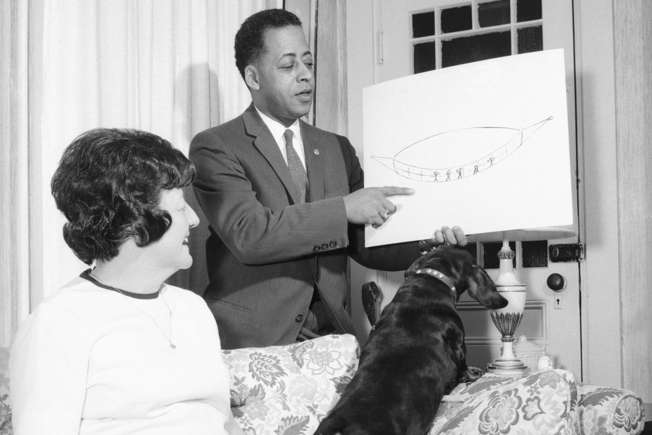
De vermeende ontvoering van Betty en Barney Hill door een groep aliens omstreeks 1961 is een iconisch verhaal in ufologische kringen.
Emblematische zaak voor ufologen
Misschien is dit verhaal voor de meeste mensen onbekend, maar het heeft gedurende tientallen jaren grote belangstelling gewekt bij ufo-experts en -toeschouwers.
Een verblindend licht
Het echtpaar beweert dat ze in de nacht van 19 september 1961 een verblindend licht zagen terwijl ze over Route 3 naar huis reden. Ze dachten aanvankelijk dat het een vallende ster was.
Het echtpaar reed in Lincoln, New Hampshire. Nadat ze de auto hadden stilgezet en een verrekijker hadden gepakt om het vreemde object (dat geen vallende ster was) nader te bekijken, besloten Betty en Barney Hill weer op de weg te gaan. Het ruimteschip raasde achter hen aan en kwam steeds dichterbij.
De ontmoeting met aliens
Het echtpaar herinnerde zich dat ze door de ramen ongeveer tien mensachtige figuren zagen. Barney Hill beweert dat deze wezens door middel van telepathie met hen communiceerden.
Een grote schrik
De gebeurtenis vond plaats toen het vermeende ruimteschip in de buurt van de auto neerkwam. Bij het zien van de wezens herinnert Barney Hill zich dat hij in angst terug naar het voertuig rende en schreeuwde dat ze hen wilden vangen.
Vreemde geluiden
Terug in de auto startte Barney de motor weer en probeerde weg te rijden. Het echtpaar vertelt dat ze op dat moment een vreemde reeks ritmische piepgeluiden hoorde.
Details klopten niet
Eenmaal thuis bekroop hen echter een vreemd gevoel en merkten ze ongewone dingen op: kleine scheurtjes in Betty's jurk, een scheur in de riem van Barney's verrekijker en gaten in zijn schoen.
Geheugenverlies
Het raarste wat ze merkten was dat ze een hiaat hadden in de rit naar huis. Ze herinnerden zich niets meer van een stuk van ongeveer 56 km van de reis direct na de ontmoeting. De herinnering aan wat ze gezien hadden was zo gefragmenteerd dat ze niet konden samenvoegen wat er gebeurd was.
Regressieve hypnose
Twee jaar na deze gebeurtenis ging het echtpaar naar een therapeut die regressieve hypnotherapie uitvoerde om hen te helpen zich de gebeurtenissen van die nacht te herinneren. Inmiddels hadden ze ingezien dat ongeveer twee uur uit hun geheugen was verdwenen.
Eindelijk was alles duidelijk
Na veel regressieve hypnosesessies konden Betty en Barney Hill reconstrueren wat er gebeurd was. Ondanks dat ze tijdens de sessies gescheiden waren, kwamen hun versies van de gebeurtenissen aardig overeen.
The Ufo Incident
Een tv-film uit 1975 genaamd 'The Ufo Incident' verzamelde de geluidsbanden van die sessies. Regisseur Richard A. Colla had de regie.
Een film gebaseerd op archiefstukken
In de aftiteling van de films beweert de regisseur dat het verhaal gebaseerd is op een reeks archiefstukken van de Amerikaanse luchtmacht. De Hills hadden zich onmiddellijk na het incident tot de autoriteiten gewend.
Proeven en experimenten
Onder hypnose vertelden Betty en Barney Hill hun therapeut dat de aliens hen hadden ontvoerd. Ze werden meegenomen naar hun ruimteschip en onderworpen aan proeven en experimenten.
Foto: Wikipedia
Huid- en haarmonsters
Volgens de Hills namen de tweevoetige aliens met grijze huid en uitpuilende ogen haar- en weefselmonsters van verschillende lichaamsdelen met gereedschap dat leek op spuiten.
Geheugen uitgewist
Betty en Barney Hill herinnerden zich dat de aliens hen, nadat ze verschillende monsters hadden verzameld, vrijlieten, waarna hun bewuste geheugen werd uitgewist.
Zeta Reticuli
Betty Hill slaagde er ook in een sterrenkaart te reconstrueren die de herkomst van de aliens aangaf. Uit deze reconstructie concludeerden deskundigen dat het ging om sterrensysteem Zeta Reticuli in het zuidelijke sterrenbeeld Raster, 39,2 lichtjaar van de aarde.
De eerste gedocumenteerde ufo-waarneming
De zaak Hill was een van de eerste gevallen van gedocumenteerde ufo-waarnemingen. De archieven van de New Hampshire University bewaren nog steeds alle documenten en geluidsopnamen die tijdens de hypnosesessies en interviews zijn gemaakt.
De conclusies van de therapeut
In de laatste aflevering van een docuserie over de gebeurtenissen onthulde de therapeut die het stel behandelde zijn visie. Hij concludeerde dat hun vermeende ontmoeting met aliens te maken had met de vermeende sociale druk die ze ervaarden als interraciaal koppel, iets wat in een tijd slecht werd gedragen. De show, genaamd 'Ufo', werd in 2021 uitgezonden door streamingdienst 'Showtime,' zoals gemeld door sify.com.
Een wisselend standpunt
Dezelfde therapeut beweert dat hij zes maanden later van gedachten veranderde en concludeerde dat het echtpaar de waarheid sprak, zoals uit een fragment van de docuserie blijkt.
'Captured! The Betty and Barney Hill UFO Experience'
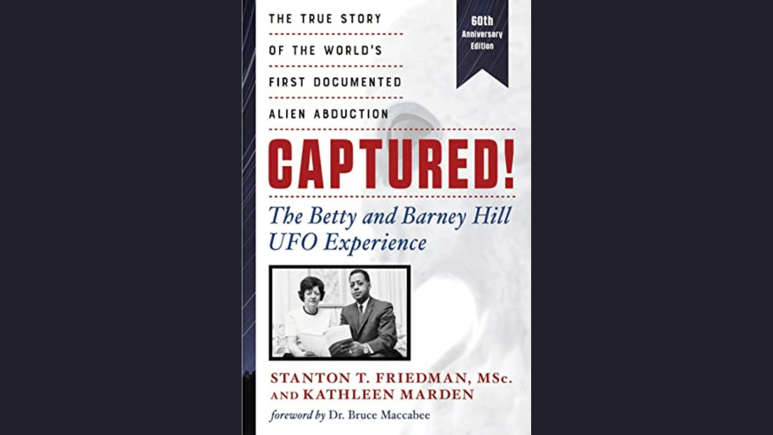
Barney Hill overleed in 1969, slechts acht jaar na het incident, maar zijn vrouw Betty overleed pas in 2004. Haar leven lang heeft ze uitgebreid gevochten om hun verhaal en het bestaan van aliens te bewijzen. Haar nicht, Kathleen Marden, schreef in 2007 een boek over haar tante: 'Captured! The Betty and Barney Hill UFO Experience'.
Een fascinerend verhaal over ufo's
Of het waar is of niet, één ding is zeker: het verhaal van Barnie en Betty Hill blijft een mijlpaal voor de ufologische gemeenschap en een van de fascinerendste verhalen over waarnemingen van aliens.
Saturn's moon Enceladus isn't just bright and beautiful. It has an ocean under all that ice that has chemicals necessary for life. Image Credit: NASA, ESA, JPL, SSI, Cassini Imaging Team
Saturn’s ocean moon, Enceladus, is attracting increasing attention in the search for life in our Solar System. Most of what we know about Enceladus and its ice-covered ocean comes from the Cassini mission. Cassini ended its exploration of the Saturn system in 2017, but scientists are still working through its data.
New research based on Cassini data strengthens the idea that Enceladus has the chemicals necessary for life.
During its mission, Cassini discovered geyser-like plumes of water erupting through Enceladus’ icy shell. In 2008, Cassini performed a close-proximity flyby and analyzed the plumes with its Cosmic Dust Analyzer (CDA). The CDA showed that the water in the plumes contained a surprising mix of volatiles, including carbon dioxide, water vapour, and carbon monoxide. It also found trace amounts of molecular nitrogen, simple hydrocarbons, and complex organic chemicals.
The plumes of Enceladus have phosphate-rich ice grains entrained.Credit: NASA
The work centers on the discovery of ammonia and inorganic phosphorous in Enceladus’ ocean. The researchers used ecological and metabolic theory and modelling to understand how these chemicals could make Enceladus amenable to life. “Apart from speculating about threshold concentrations of bioactive compounds to support ecosystems, metabolic and ecological theory can provide a powerful interpretative lens to assess whether extraterrestrial environments are compatible with living ecosystems,” the authors explain.
A critical component of ecological theory is the Redfield ratio. It’s named after the American oceanographer Alfred Redfield. In 1934, Redfield published results showing that the ratio of carbon to nitrogen to phosphorous (C:N:P) was remarkably consistent across ocean biomass at 106:16:1. Other researchers found that the ratio shifted slightly depending on the area and the phytoplankton species present. More recent work refined the ratio to 166:22:1.
The exact numbers aren’t necessarily the critical point. Redfield’s conclusion is the vital part. The Redfield ratio shows a remarkable unity between the chemistry of living things in the deep ocean and the ocean itself. He proposed that there’s an equilibrium between ocean water and plankton nutrients that’s based on biotic feedback. He described a chemical framework for nutrients and simple life.
“Whatever its explanation, the correspondence between the quantities of biologically available nitrogen and phosphorus in the sea and the proportions in which they are utilized by the plankton is a phenomenon of the greatest interest,” Redfield said in the conclusion of his paper.
So, how does the discovery of ammonia and phosphorous in Enceladus’ ocean relate to the Redfield ratio and Enceladus’ biological potential?
This figure illustrates a cross-section of Enceladus, summarizing the processes SwRI scientists modelled in the moon in a 2020 study. Oxidants produced in the surface ice when water molecules are broken apart by radiation can combine with reductants produced by hydrothermal activity and other water-rock reactions, creating an energy source for potential life in the ocean. Image Credit: SwRI
The Redfield ratio is widespread all across the Tree of Life on Earth. “Because of this seeming ubiquity, the Redfield ratio has been considered a target signature for astrobiological life detection, especially on ocean worlds such as Europa and Enceladus,” the authors of the new paper write. When it comes to life, all we have to go on is Earth. So it’s sensible to use foundational aspects of life’s chemistry here on Earth as a lens through which to examine other potential life-supporting worlds.
Analysis of Cassini’s data from Enceladus’ plumes shows a high level of inorganic phosphate in the ocean. Other geochemical simulations based on Cassini’s findings indicate the same. “These reports of phosphorus follow on the tails of previous work identifying numerous elemental constituents of terrestrial life (C, N, H, O) from the Enceladus plume,” the authors explain. Even more analysis suggests that the ocean contains many of the chemicals common in living organisms, like amino acid precursors, ammonium, and hydrocarbons.
So Enceladus’ ocean has a rich chemistry, and many chemicals reflect life’s chemical makeup. In particular, there’s an emerging hypothesis that Enceladus could support methanogenesis. Earth’s Archaea perform methanogenesis across a wide swath of different environmental conditions on Earth and have done so for over three billion years, proving their survivability. Biochemical modelling suggests that Earth’s methanogens are compatible with Enceladus’ ocean.
The researchers developed a new, more detailed model for methanogens on Enceladus to see if they could survive and thrive there. Their model leaned heavily on the Redfield ratio. They found that though phosphorous is present in high levels in the moon’s ocean, the overall ratio “may be limiting to Earth-like cells.”
“High standing stocks of these nutrients could be consistent with incomplete drawdown due to a small or metabolically slow biosphere, a biosphere with a recent origin of life,” or other reasons that could cause an imbalance.
So where does that leave the prospects for life on Enceladus?
We’re improving at identifying individual chemicals on other worlds, and the JWST is leading the way. But we need a better understanding of overall chemical environments to advance the search for life. A transmission spectrum of the hot gas giant exoplanet WASP-39 b, captured by Webb’s Near-Infrared Spectrograph (NIRSpec) on July 10, 2022, reveals the first definitive evidence for carbon dioxide in the atmosphere of a planet outside the Solar System. Credit: NASA, ESA, CSA, and L. Hustak (STScI). Science: The JWST Transiting Exoplanet Community Early Release Science Team
We’re only at the beginning of biosignature science. We can identify individual chemicals, but from this great distance away, we can’t accurately measure Enceladus’ overall chemistry. Newer biosignature research, including this paper, aims to identify how biological processes reorganize chemical elements in telltale ways. By looking at entire ecosystems, as Redfield did, scientists may discover new biosignatures that are less ambiguous.
If we can do that, we may discover that non-Earthly lifeforms reorganize chemicals in entirely different ways.
This research is part of a new effort to detect more than individual chemical biosignatures, some of which can be false positives. Methane, for example, can be a biosignature but can also be produced abiotically. There are others, like the recently discovered phosphine on Venus
The problem with individual biosignatures like methane is that they can have both biological and abiotic sources. This image illustrates possible ways methane might get into Mars’ atmosphere and be removed: microbes (left) under the surface that release the gas into the atmosphere, weathering of rock (right), and stored methane ice called a clathrate. Ultraviolet light can work on surface materials to produce methane as well as break it apart into other molecules (formaldehyde and methanol) to produce carbon dioxide. Credit: NASA/JPL-Caltech/SAM-GSFC/Univ. of Michigan
Understanding ecosystems as a whole is the next step. There’s a bewildering number of factors to consider. Cell size, nutrient availability, radiation, salinity, temperature. On and on. But to understand the overall chemical environment at Enceladus, Europa, or anywhere else, we need more detailed data.
Luckily, instrument science keeps improving, and upcoming missions to Europa will start to paint a fuller picture. According to the authors, the next step requires more fulsome data and a more generalized approach.
“We suggest two priorities for further astrobiological research to better understand the implications of these conclusions,” they write. “First, we echo previous calls in the astrobiology literature to explore more generalized notions of metabolism and physiology.” They also suggest that looking for direct parallels to terrestrial life in the form of biochemistry may not be the best strategy for looking for life on Enceladus.
“Second, we recommend broadening the scope of Earth analogue environments to include those with extreme resource supply ratios mirroring that suggested for Enceladus,” they explain.
Our understanding of habitability grows incrementally, as this study clearly shows. There’ll likely be no revelatory moments where we suddenly understand it.
Nature has created a vast variety of worlds, each with its own chemistry. While using tools like the Redfield ratio as a lens is one way of looking at these worlds in all their unique glory, we can’t get tunnel vision.
While most of what our imaginations dream up about life on other worlds is fanciful and unlikely, life could’ve found another way on Enceladus. There could be different ways that life exists in and reorganizes chemical environments
Archaeologists in Belgium have demonstrated that spearthrowers were used for launching projectiles armed with tanged flint points at the Early Upper Paleolithic site of Maisières-Canal around 31,000 years ago.
Coppe et al. identified the use of spearthrower around 31,000 years ago at the Early Upper Paleolithic site of Maisières-Canal, Belgium.
Image credit: Neanderthal Museum.
Humans have been hunter-gatherers for most of our past, but scientists still lack knowledge about what our prehistoric ancestors gathered and how they hunted because of the near lack of organic preservation at Paleolithic sites.
Of these two modes of subsistence, hunting tends to be better visible archaeologically because it can leave behind durable stone and bone implements that once served as weapon components.
Four weapon systems — thrusted spears, thrown spears, the spearthrower, and the bow — are assumed to have existed in the Stone Age, but the timing of their invention and their possible co-existence remain debated.
“Until now, the early weapons have been infamously hard to detect at archaeological sites because they were made of organic components that preserve rarely,” said lead author Dr. Justin Coppe, a researcher in TraceoLab at the University of Liège.
“Stone points that armed ancient projectiles and that are much more frequently encountered at archaeological excavations have been difficult to connect to particular weapons reliably.”
“Most recently published claims for early use of spearthrowers and bows in Europe and Africa have relied exclusively on projectile point size to link them to these weapon systems.”
“However, ethnographic reviews and experimental testing have cast serious doubt on this line of reasoning by showing that arrow, dart, and spear tips can be highly variable in size, with overlapping ranges.”
A tanged point from the site of Maisières-Canal, Belgium.
Image credit: Coppe et al., doi: 10.1038/s41598-023-45554-w.
In the research, Dr. Coppe and colleagues examined a sample of 329 flint artifacts from the site of Maisières-Canal, which is located in Belgium near the town of Mons, on the northern edge of the alluvial plain of the Haine.
“Maisières-Canal is a reference site for the Early Upper Paleolithic of north-west Europe and one of the few Early Upper Paleolithic open-air sites known from the region,” the researchers said.
“The site has been interpreted as having a single main Early Upper Paleolithic occupation layer that shows limited vertical displacement of finds.”
“Thirteen radiocarbon dates consistently place the occupation to around 28,000-31,000 years ago.”
The excellent preservation of the stone points, their large number, their distinct morphologies, and recent technological analyses that allowed their careful experimental replication presented a unique opportunity to reconstruct the delivery systems with which the projectiles were shot.
“We carried out a large-scale experiment in which we fired replicas of Paleolithic projectiles using different weapons such as spears, bows and spearthrowers,” said Dr. Noora Taipale, also from TraceoLab at the University of Liège.
“By carefully examining the fractures on these stone points, we were able to understand how each weapon affected the fracturing of the points when they impacted the target.”
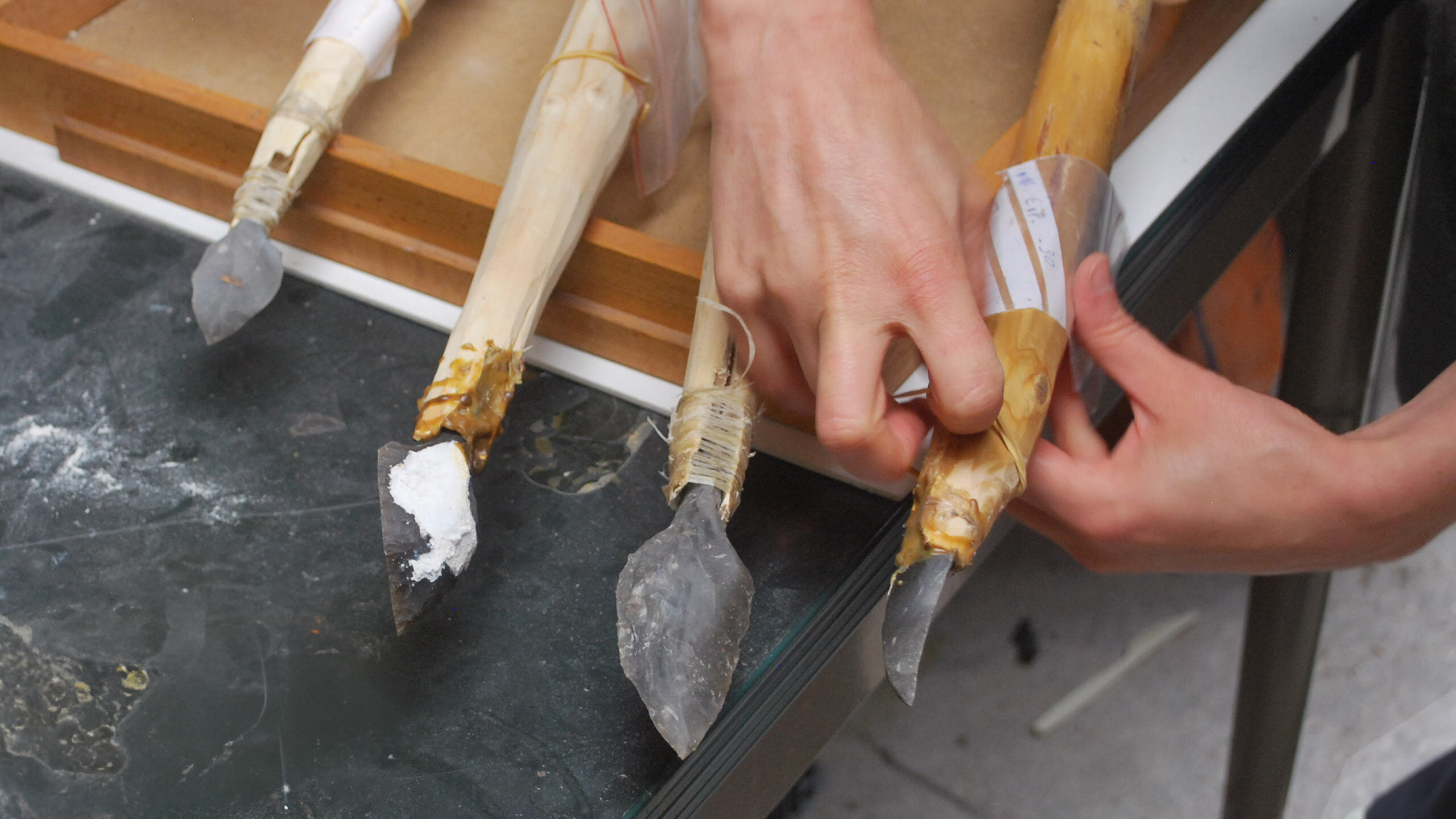
Examples of experimental thrusting spears and javelins armed with replicas of the archaeological flint points.
Credit: TraceoLab/ULiège
“Each weapon left distinct marks on the stone points, enabling us to match these marks to archaeological finds.”
“In a way, it’s like identifying a gun from the marks the barrel leaves on a bullet, a practice known from forensic science.”
“The excellent match between the experimental spearthrower sample and the Maisières-Canal projectiles confirmed that the hunters occupying the site used these weapons.”
The findings push back the dates for spearthrower use in Europe by over 10,000 years.
“Representing the first attempt to carefully consider the idiosyncrasies of different prehistoric weapons in all their complexity, our results provide the thus far oldest reliable evidence for the use of long-range weaponry in prehistoric hunting,” the scientists said.
The study was published in the journal Scientific Reports.
J. Coppe et al. 2023. Terminal ballistic analysis of impact fractures reveals the use of spearthrower 31 ky ago at Maisières-Canal, Belgium. Sci Rep 13, 18305; doi: 10.1038/s41598-023-45554-w
NASA heeft een verbluffende nieuwe afbeelding van Jupiter vrijgegeven, vastgelegd door de Hubble Space Telescope! Op de afbeelding verschijnt de grootste planeet in ons zonnestelsel in een compositie van ultraviolet licht.
De Hubble heeft de planeet ook in zichtbaar licht getoond, waar een grote rode vlek te zien is, die in ultraviolette golflengten blauw lijkt en een storm vertegenwoordigt.Deze gegevens maken deel uit van een onderzoek naar diepe waterwolken in de atmosfeer vanJupiter.
DeHubbleheeft een geschiedenis van het bestuderen van externe planeten en, met zijn ultraviolette mogelijkheden, maakt het de analyse van kosmische fenomenen en de evolutie van sterrenstelsels mogelijk.
Daytime Tic Tac UFO sighting filmed in Clovis, California
The quiet skies of Clovis, California, became the canvas for an extraordinary celestial enigma as local resident Jason Beard’s casual glance upwards turned into a brush with the unknown. The skies, often a gateway to the stars, seemingly tore open the fabric of reality to present a sight that would stir the town with whispers of extraterrestrial visitors. Beard’s account and subsequent video footage have thrust the small Californian town into the limelight, adding a riveting chapter to the annals of UFO sightings.
The UFO in question, a Tic Tac-shaped anomaly, streaked across the midday sky, exhibiting behavior and characteristics that defied conventional understanding. This object did not just pass unnoticed; it left an indelible mark on the community, sparking debate, analysis, and the undivided attention of UFO enthusiasts worldwide.
With a fervor characteristic of the most ardent truth-seekers, Beard’s video was scrutinized by a so-called UFO expert. Through specialized software, a startling revelation was made: a “big ball of energy” appeared to envelop the craft, setting the social media sphere ablaze with speculation. Was this an advanced propulsion mechanism or something even more profound?
In the digital era, where drones and satellites are common, it’s not every day that a sighting manages to pierce through the veil of skepticism and ignite the collective imagination. The Clovis sighting has done just that, with its blend of mystery and visual evidence creating the perfect storm of intrigue.
Let’s delve into what makes this sighting a headliner in the world of UFO sightings:
The Shape and Speed:The iconic Tic Tac shape, also echoed in military sightings, presents an aerodynamic conundrum. Its seamless velocity points to technology that is not yet available to the public.
The Daylight Factor: Most UFO sightings occur at night, making it easier to dismiss them as misidentified planes or atmospheric phenomena. A clear-day sighting provides higher clarity, leaving fewer places for doubt to hide.
The Witness’s Conviction: Beard, having observed the skies for years, asserted the novelty of this encounter with the confidence of someone who has seen it all—yet nothing like this.
So, what could it be? A secret military experiment? A drone of unknown origin? Or perhaps a visit from an otherworldly civilization? The debate continues, fueled by the enigmatic nature of the sighting and the human yearning for answers.
As the Clovis incident takes its place among the most talked-about UFO sightings, one thing is clear: the sky is not just a space over our heads; it’s a domain of endless possibilities and, sometimes, mysterious visitors.
In the quest for truth, the skies above Clovis have become a theatre where the curious and the skeptical alike gaze upwards, pondering the vastness of our universe and the potential for encounters that shake the core of our understanding. Whether terrestrial or not, the Clovis UFO sighting is a reminder that, sometimes, looking up can be the beginning of an extraordinary journey.
Shocking new video by James Fox: “Feels like someone is trying to extinguish my career, it’s pretty terrifying.”
In the tranquil solitude of nature, filmmaker James Fox often reflects on his groundbreaking work, piecing together narratives that challenge our understanding of the unknown. Known for his compelling documentaries delving into the enigmatic realm of UFOs, Fox has dedicated his recent years to uncovering the layers of secrecy surrounding unidentified aerial phenomena. However, a recent turn of events, as revealed in a distressing video to his social media followers, suggests that Fox is now navigating through the most tumultuous chapter of his career.
Fox, who has become a significant voice in the UFO documentary scene, has spent the last few years interviewing credible witnesses and military officials, earning him a reputation for his earnest search for truth in a field often clouded by skepticism. His documentaries, such as “I Know What I Saw” and “Out of the Blue,” have been pivotal in bringing the discussion of UFOs into the mainstream, presenting meticulously researched evidence to the public.
The filmmaker’s exploration of the Varginha UFO incident, Brazil’s own Roswell, encapsulates his commitment to shedding light on such encounters. By examining this 1996 event, where residents of Varginha reported seeing creatures and a UFO, Fox has contributed to preserving the narrative while igniting fresh discussions on the topic.
Yet, in a somber and unexpected announcement from his favorite spot – a place of reflection and solace – Fox shared with his followers that he has been grappling with profound challenges aimed at his professional endeavors. With palpable concern in his voice, he alludes to an unseen battle that has been waging for six months, suggesting a targeted effort to “extinguish” his career, leaving him feeling “pretty terrifying.”
Although details were sparse due to legal constraints, Fox’s message conveyed a dire sense of urgency and vulnerability. The decision to address his audience directly, ahead of a more detailed revelation promised for later in the week, speaks to the gravity of the situation and his reliance on the community’s support.
Fox’s commitment to his work has never been in question, but this current adversity reveals the fragile intersection where pioneering research meets the machinations of power structures resistant to disclosure. His journey is a stark reminder of the complexities facing those who dare to question and uncover truths that may unsettle the status quo.
While the full extent of Fox’s current predicament remains shrouded, what is clear is his unwavering passion for his craft and the causes he champions. As the UFO community and the public await further details with bated breath, the resilience of this tenacious filmmaker is being tested.
This unfolding story serves as a poignant narrative of a man deeply entrenched in the search for truth, standing firm against forces that threaten to silence his voice. James Fox’s plight is not merely his own but resonates with anyone who has faced adversity in pursuit of their life’s work. As Fox prepares to share more with the world, his experience underscores the complexities of challenging entrenched beliefs and the courage required to confront the unknown, both in the skies above and in the trials we face on the ground.
When I was a young fast-stream civil servant at the UK Cabinet Office in the 1990s, the Government seemed to have a line-to-take on everything. There would be an official, maybe in a far-flung division of an obscure department, responsible for each policy, as hard as it might be to find that person and track them down.
I think my observation remains true today concerning the UK Government’s policy on Unidentified Anomalous Phenomena (UAPs), even if the Government tries hard to make it appear as though there is no policy and that no one is in charge.
The UK’s Ministry of Defence used to have a ‘UFO Desk,’ which is where Nick Pope is said to have worked in the 1990s. Famously, the then-Secretary of State, Bob Ainsworth, announced the closure of the desk in 2009 under the following logic:
“In more than 50 years, no UFO sighting … has indicated the existence of any military threat to the UK; there is no defence benefit in … recording, collating, analysing, or investigating UFO sightings”
and
“the level of resources devoted to this task is … diverting staff from more valuable defence-related activities”.
Yet, at a time when the United States has set up the All-domain Anomaly Resolution Office (AARO) to investigate UAP sightings, have held a hearing on UAPs in the House of Representatives, and have the Schumer amendment on UAP transparency making its way through Congress, are we really to believe that the UK Government has no resources focusing on UAPs?
Speaking to Julian Worricker on the World Tonight program on August 3rd, David Grusch, one of those UAP whistleblowers who provided testimony under oath to the U.S. Congress, said information about UAPs “does cross into other countries and other allies to include the Five Eyes alliance,” which echoes the statement from Sean Kirkpatrick, Director of AARO, on May 31st that in the previous week, he had met with the Five Eyes to discuss UAP data collection and collaboration.
The Five Eyes Alliance is an intelligence-sharing network between the United States, the United Kingdom, Canada, Australia and New Zealand. So clearly, the UK is interested and involved in some capacity.
According to files from the National Archives, Carl Mantell of the RAF’s Air Command was the civil servant who penned the advice to Sir Bob Ainsworth in 2009 on the UFO desk closure. So, presumably, he was in the UFO policy hot seat then. But who might be in charge of UAP policymaking today?
Looking across the Machinery of Government, I suspect that policy for UAPs is spread across the Cabinet Office, Ministry of Defence, Foreign and Commonwealth Office, and the Secret Intelligence Service (MI6). With operational involvement of the Royal Air Force, DE&S, and DSTL. Plus, in all likelihood, some private contractor support, both from UK Aerospace companies and UK subsidiaries of US contractors.
Somewhere within the U.K. Government, someone is responsible. The ‘UFO desk’ lives on under another name.
I suspect, too, that the civil servant in question is growing increasingly alarmed at the level of dissonance between the current line-to-take and the way in which events are unfolding. A friend of mine received a reply from “Air Command Secretariat” at the MOD that contained the following rather extraordinary paragraph:
“I must inform you that the MOD has no opinion on the existence of either extraterrestrials, Unidentified Flying Objects (UFOs) or Unidentified Aerial Phenomena (UAPs). While I recognise you have used the term Unidentified Anomalous Phenomena, the Department does not recognise this term, and I have therefore answered your question using our definition of UAP.”
The response goes on to repeat the 2009 Sir Bob Ainsworth line about there being no military threat. This feels like a tired reply that is past its sell-by date. I am sure that there are civil servants in the areas in question who are coming to this view, too.
By continuing to employ this line-to-take, the Government is delegitimizing conversations about UAPs. Taking away people’s voices on the topic leads to bad policymaking. If civil servants are inhibited from discussing the UAP topic – not only with the public but also with other branches of government – they cannot fully consider people’s needs, develop options, and offer their thinking up for constructive challenge.
Take flight safety risks. In June 2021, the US Office of the Director of National Intelligence produced a Preliminary Assessment on UAPs that stated:
“Most of the UAP reported probably do represent physical objects…”
and
“UAP clearly pose a safety of flight issue.”
One might reasonably expect the UK’s Civil Aviation Authority (CAA) to have been in touch with the US authorities about this statement and to have conducted a risk assessment on flight safety risk.
“Please provide copies of any risk assessments (quantified or unquantified) that the Civil Aviation Authority has carried out to assure itself that the existing measures in place are sufficient to protect pilots and air passengers from any risks associated with Unidentified Anomalous Phenomena (UAPs). Please, further, provide copies of correspondence in relation to the risk from UAPs to and from air safety andregulatory bodies in the United States; and any guidance given to pilots about UAP risks.”
The response that came back was as follows:
“Following a review of held information it has been determined, on the balance of probability, that the CAA holds no information within scope of the above original enquiry.”
My subsequent requests to try to get an explanation as to why they have not carried out a risk assessment or been in touch with the US authorities have not been answered. A request for a meeting was denied.
Of course. What else could the Head of Safety at the CAA do? He is not permitted to acknowledge the legitimacy of the UAP topic, so he is not able to talk to me or offer a substantive response to my question. Does anybody think this is good for pilots or air passengers? Or for confidence in air regulation and safety?
Another area in which this absence of a policy is causing real damage is the lack of physical and psychological health support for people affected by seeing anomalous objects in the sky. Sometimes called ‘experiencers’, these individuals are harmed in two ways: first from seeing something potentially frightening and then, when they ask for help, by being told directly or implicitly by doctors and other health professionals that they are mistaken or unwell. What are individual doctors to do when their professional bodies, such as the General Medical Council and the Royal Colleges, offer no guidance on the topic? Again, as with the CAA example above, it is the lack of a policy position on UAPs from the Government that is the fundamental problem.
On this front, I am part of a team that is setting up a new organization to help. We are establishing uNHIdden to promote mental health and well-being around anomalous experiences, as well as to help reduce anxiety around non-human intelligence and disclosure. It will be set up as a charity formally in the new year. uNHIdden has a medical board made up of doctors and clinical psychologists who are keen to help develop strategies that support both patients and therapists in this difficult area.
uNHIdden mirrors and works closely with UAP Med, which is based in the US and is focused on mitigating the effects of UAP/UFO exposures on witnesses, families, communities and society. Founder and Director Ted Roe explains his philosophy as follows:
“Like uNHIdden, our focus is on looking after and supporting the people affected by unexplained objects and unusual sightings. We need both strategies and front-line care to help people whose lives literally change in the instant that they see something that they cannot explain. At present, these people seem largely ignored.”
There are now indications that things may be about to change. Writing in Liberation Times on 13th October in an article, “The United Kingdom and the Looming UFO Paradigm Shift,” British journalist Christopher Sharp wrote:
“Multiple sources have informed Liberation Times that they anticipate some form of confirmation regarding programs linked to crafts of unknown or non-human origin in 2024, which lack any mundane explanation.
“If events continue to develop on this trajectory in the US, it will become abundantly clear that the prospects for maintaining the status quo [on UAP policy], as pursued by some individuals within the UK Government, are rapidly diminishing.”
Chris adds that senior UK Members of Parliament are closely following the UAP topic, but fear talking publicly on the topic due to associated stigma.
This seems optimistic. I must say I have a great deal of sympathy for the civil servant who finds him- or herself in the UAP hot seat today. They did not construct the “no military threat” line 14 years ago. Nor are they responsible for 80 years of obfuscation and denial. Plus, there is no UK equivalent of AARO or the Schumer Amendment, on which to hang a new line-to-take that shows the Government in a positive, proactive light.
Here is my thinking. The Government does not need to go “full tonto” (as Ben Wallace might say) on UAP disclosure; it just needs to show that it is taking the topic seriously. If I may offer a suggested new line-to-take, it would be something like the following:
“The Government acknowledges the legitimacy of observations of anomalous objects in the sky. We are working with our international partners to investigate the causes and their implications.”
This would be transformational in that it would start to reduce the stigma associated with the UAP topic. People who have seen unusual things would be able to feel that their experiences were seen as legitimate, so they could start to seek the help they need. Many in the ‘UAP community’ may feel that this line-to-take does not go far enough. But it would be a start. A journey of a thousand miles, and all that.
We at uNHIdden want to play a constructive part in helping to shape the future support of people affected by anomalous experiences. As well as starting to help create better conversations on the UAP topic.
I hope that the U.K. Government is listening.
John Priestland is the Founder and Chairman of uNHIdden (www.unhidden.org).
UC San Diego Professor of Astronomy and Astrophysics Shelley Wright has a lifelong love of outer space. She’s made a career of building state-of-the-art telescopes that can study everything from black holes to “technosignatures” from alien civilizations. Wright, who recently served on NASA’s panel on unexplained anomalous phenomena (UAPs), takes a moment to reflect on her career, the panel and the ongoing search for extraterrestrial life.
What kind of research do you specialize in?
I'm an experimental astrophysicist. One topic I've studied throughout my career is SETI — the search for extraterrestrial intelligence — particularly in trying to build new devices that operate at unique wavelengths to search for what we call “technosignatures” — technological evidence or signals from an alien civilization that is detectable across interstellar distances.
How did you become interested in astrophysics and SETI?
I was captivated by humanity’s question of “Are we alone?” This led me to ponder our place in the universe and whether there is other intelligent life that existed and co-exists with us now. In pursuing those questions, I fell in love with the universe.
Shelley Wright is a professor of astronomy and astrophysics at UC San Diego.
I got involved with SETI early in my career. I was a junior at UC Santa Cruz and saw an advertisement for the first-ever astrobiology conference, which was an emerging field at the time. On a whim, I decided to cut school and attend. It was there I met other SETI researchers, and I've collaborated with them and the community ever since.
How did you get selected for the NASA UAP panel?
I’ve been exploring this topic for over 20 years and have established myself as a SETI researcher in the field of astrobiology. I also specialize in developing unique instrumentation, and have thought extensively about how to image and sense unusual characteristics in the night sky. I think these qualifications likely played a role in why I was selected.
For NASA to even form a UAP panel — it lent credibility to the field was a big deal for the scientific community and the public. It was apparent that the panel process was intended to make a positive impact in the field and within our scientific and national community. I was also struck by the caliber and diversity of the panel members and could see that our approach to this problem would be unique, so I agreed to participate.
What was the main objective of the panel?
I think the public and even the scientific community had different expectations about what our panel was charged to do. Some people presumed we would sit down and analyze every single UAP case out there. We did investigate several UAP cases to better understand the characteristics of observed and reported UAPs, but our primary objective wasn’t to diagnosis each case.
The panel was tasked with understanding the landscape of UAPs, what they look like and how often UAPs were reported. What kind of resources could NASA and other government agencies offer? What kind of industry partnerships could be beneficial? Our goal was to establish guidelines for processes, scientific protocols and communications across government agencies for future UAP events.
The NASA UAP panel boasted a diverse membership, including oceanographers, astrophysicists, government agencies and industry experts.
(cr: NASA)
How would someone report a sighting?
It’s a great question. The panel spent a lot of time investigating how things were reported, and the truth is, there isn’t really a functioning reporting mechanism within U.S. government agencies. One of our leading recommendations was to fix this and to have better inter-agency communication. The difficult thing with reporting is that it's often anecdotal, and there’s little-to-no data to assess.
The panel explored the use of cell phones and metadata on cell phones. If someone did record something, what metadata would be associated with it? For instance, in what direction was the phone pointing? What were the conditions? Was the data manipulated? The panel also looked at earth-observing satellites and the type of data we have today and will have in the future for scientific investigations. Proper reporting in all these cases is important since we want to access the right scientific data for follow-up investigation.
Do you think in our lifetime we will find something that looks like a sign of extraterrestrial life?
In the context of UAPs, I think it would be really surprising if we ever found a marker that alien life was here on planet Earth. Simply because of the energy resources needed to travel between stars, the time it would take — it really is unfathomably large. You get humbled by it, being an astronomer.
But I do think that in our lifetime we will find something. Maybe a biosignature in a distant planet's atmosphere. It could even be what we call an “artificial signal” in another atmosphere that showed the presence of some technology. Maybe it’s a direct signal, but that’s an even rarer possibility.
Truthfully though, we don't know the answer to this question. And what shocks me most is that we barely try to answer it. That’s why I’m interested in this field. I do SETI research because we should be looking for the answer.
(L-R): Graduate students Sanchit Sabhlok and James Wiley assembling a Panoramic SETI telescope in Shelley Wright's lab.
(cr: Regents of the University of California)
Now that the panel has concluded, what’s next on the horizon for you?
In terms of life in the universe, there are a lot of exciting projects out there. Of course, James Webb Space Telescope is capturing amazing images and is also recording spectra to try to understand the chemical compositions of exoplanet atmospheres. There are also future missions like the Roman Space Telescope, launching in 2027.
We have ground-based facilities too — extremely large telescopes coming online that will also record spectra of planetary atmosphere. There are dedicated SETI programs, like Breakthrough Listen, where we continue to look for technosignatures at radio wavelengths.
For myself and my projects here at UC San Diego, we did the first ever near-infrared SETI search to explore signals at new wavelengths. Now we have an ambitious program to build an optical, or visible light, observatory where we try to image the entire observable sky, all the time at very fast speeds. Which, coincidentally, is also interesting for Earth-bound objects that are moving quickly in our atmosphere as well. That project is called Panoramic SETI. We've spent the last several years conducting research and development, building unique detectors and telescopes. Panoramic SETI is now ready, and our goal is to build a SETI optical observatory. If we pull this off, it’ll be a first in technosignature and astrophysical research. I’m really excited about what we might discover.
Meer van UFO'S of UAP'S, ASTRONOMIE, RUIMTEVAART, ARCHEOLOGIE, OUDHEIDKUNDE, SF-SNUFJES EN ANDERE ESOTERISCHE WETENSCHAPPEN - DE ALLERLAATSTE NIEUWTJES


 2.7 mile UFO found landed in Mars Crater, Seen On Google Mars Map! UFO Sighting News.