Ontdek de Fascinerende Wereld van UFO's en UAP's: Jouw Bron voor Onthullende Informatie!
Ben jij ook gefascineerd door het onbekende? Wil je meer weten over UFO's en UAP's, niet alleen in België, maar over de hele wereld? Dan ben je op de juiste plek!
België: Het Kloppend Hart van UFO-onderzoek
In België is BUFON (Belgisch UFO-Netwerk) dé autoriteit op het gebied van UFO-onderzoek. Voor betrouwbare en objectieve informatie over deze intrigerende fenomenen, bezoek je zeker onze Facebook-pagina en deze blog. Maar dat is nog niet alles! Ontdek ook het Belgisch UFO-meldpunt en Caelestia, twee organisaties die diepgaand onderzoek verrichten, al zijn ze soms kritisch of sceptisch.
Nederland: Een Schat aan Informatie
Voor onze Nederlandse buren is er de schitterende website www.ufowijzer.nl, beheerd door Paul Harmans. Deze site biedt een schat aan informatie en artikelen die je niet wilt missen!
Internationaal: MUFON - De Wereldwijde Autoriteit
Neem ook een kijkje bij MUFON (Mutual UFO Network Inc.), een gerenommeerde Amerikaanse UFO-vereniging met afdelingen in de VS en wereldwijd. MUFON is toegewijd aan de wetenschappelijke en analytische studie van het UFO-fenomeen, en hun maandelijkse tijdschrift, The MUFON UFO-Journal, is een must-read voor elke UFO-enthousiasteling. Bezoek hun website op www.mufon.com voor meer informatie.
Samenwerking en Toekomstvisie
Sinds 1 februari 2020 is Pieter niet alleen ex-president van BUFON, maar ook de voormalige nationale directeur van MUFON in Vlaanderen en Nederland. Dit creëert een sterke samenwerking met de Franse MUFON Reseau MUFON/EUROP, wat ons in staat stelt om nog meer waardevolle inzichten te delen.
Let op: Nepprofielen en Nieuwe Groeperingen
Pas op voor een nieuwe groepering die zich ook BUFON noemt, maar geen enkele connectie heeft met onze gevestigde organisatie. Hoewel zij de naam geregistreerd hebben, kunnen ze het rijke verleden en de expertise van onze groep niet evenaren. We wensen hen veel succes, maar we blijven de autoriteit in UFO-onderzoek!
Blijf Op De Hoogte!
Wil jij de laatste nieuwtjes over UFO's, ruimtevaart, archeologie, en meer? Volg ons dan en duik samen met ons in de fascinerende wereld van het onbekende! Sluit je aan bij de gemeenschap van nieuwsgierige geesten die net als jij verlangen naar antwoorden en avonturen in de sterren!
Heb je vragen of wil je meer weten? Aarzel dan niet om contact met ons op te nemen! Samen ontrafelen we het mysterie van de lucht en daarbuiten.
Mind-bending discovery deep inside notorious UFO hotspot leaves experts stunned
Researcher Brandon Fugal claims his team drilled into a mesa in Utah, US and discovered underground voids and a debris field of material that does not match the area's natural soil composition
A discovery at a paranormal “hotspot” notorious for UFO sightings has left experts stunned.
Skinwalker Ranch is a massive 512-acre property in northeast Utah, US and has been a centre for paranormal investigations for over 30 years. Owner Brandon Fugal claims his team has retrievedmanufactured materials from deep withinthe ranch's rocky mesa, including heat-resistant ceramic fragments and peculiar metals.
He told American Alchemy podcast hostJesse Michels that drilling equipmentrepeatedly hit an enigmatic underground object before extracting material that didn't resemble the surrounding landscape.
“There's something under the mesa,” said Fugal. “To be extracting material that is manufactured, that's engineered, from hundreds of feet within the mesa.”
The team has also detected potential underground voids and identified what it believes to be an invisible energy anomaly enveloping the site. But no spacecraft has been discovered and the material has not been definitively linked to extraterrestrial technology or scrutinised in a published, a peer-reviewed study found.
Fugal, a real estate developer, bought Skinwalker Ranch from billionaire aerospace entrepreneur Robert Bigelow in 2016 and converted it into a closely monitored outdoor laboratory.
Owner Brandon Fugal claims his team has extracted manufactured material
(Image: American Alchemy with Jesse Michels)
The team of researchers started drilling into the mesa in 2021 after ground-penetrating radar hinted at potential voids and an odd subterranean formation. The probe was initially launched to verify long-standing rumours that caves, tunnels or a man-made structure were hidden beneath the rocks.
“We thought, well, let's debunk it,” said Fugal. But the researchers stumbled upon a debris field filled with material that seemed out of place with the region's natural soil and rocks.
“There's both a debris field of material that does not fit,” said Fugal. “It is unusual and not a natural part of the landscape or soil composition, which has been verified. It appears that there are voids within the mesa, which is what initially led us to conduct ground-penetrating radar studies.”
Researcher Brandon Fugal claims his team drilled into a Utah mesa and discovered underground voids and a debris field of material that does not match the area's natural soil composition.
Guys, you know I love searching the NASA indexes of odd and excitingly revealing things. Well, found one in Sol 3076 today thats a bit spooky. This one is a coffin...and not just any coffin, but a pod-like organic looking coffin. The veins in the wall of the coffin is a dead give away. Also the lid of the coffin is about one quarter of the full width...same as coffins here on Earth. The veins...wow! The veins run through the walls of the coffin as if it were grown...which makes me wonder if this alien species was able to make their own biological resting place...like a butterfly makes a cocoon. We have so much to learn about other intelligent alien species...like how they begin life, live life and how they deal with the end of life.
Guys this whole post just disappeared off my site, so I'm writing it again...weird. I found this rectangle UFO in a NASA photo and its hovering very close to the International Space Station. The UFO is in high detail, no wings, no windows, no engines, no insignia. This thing has zero signs that its made by humans...so I'm saying its alien tech. Also compounded with the fact that this is about 100 meters across and so close to the space station that the alien crew could easily use telepathy to not just view the experience through the eyes of the crew, but can also hear, feel and understand the thoughts as if it were their own. They are literally in the heads of the astronauts on board the space station. They can even download a persons full life memories in just 6 seconds without the person being harmed in any way. Why? To learn if humans are a danger or not to them and to other alien species. But not only that, knowledge is the most prized possession of aliens. They want to experience human behavior first had. Also compounded with the fact most alien species are so ancient they forgot their own history millions of years ago at the beginning, so they watch over us, protecting Earth, and studying us to learn more about themselves.
When a glowing UFO outmaneuvered a Pan Adria Airliner and MiG-21 Interceptors
The Pan Adria Incident is one of the most famous UFO cases from the former Yugoslavia. It reportedly occurred on 16 August 1977, when a Pan Adria Airways aircraft flying the route Zagreb → Belgrade → Titograd (now Podgorica) encountered a mysterious glowing object that allegedly remained alongside the aircraft for hundreds of kilometers.
The flight crew noticed a bright red-orange spherical light flying parallel to their aircraft and reportedly maintained a constant distance and altitude, matching the aircraft's movements. The crew informed civilian air traffic control, which allegedly confirmed an unusual radar contact. Also military radar stations were reportedly alerted, and the object was also said to have appeared on military radar systems.
Witnesses interviewed years later, including former radar operators and military personnel claimed that the object displayed extraordinary acceleration.
According to later witness testimony, the Yugoslav Air Force scrambled MiG-21 interceptors to investigate but the UFO easily outmaneuvered the MiG-21 fighters, and one or more interceptors experienced serious problems, eventually a MiG-21 crashed and its pilot was killed after the encounter. However, this part of the story has never been independently verified through official military records and remains controversial.
RELATED
The Pan Adria Incident (1977) - UFO Encounter Over Yugoslavia
Fazenda Atlântica archaeological site in Acre, Brazil. Credit: M. Pärssinen & F. de Novaes
New research conducted using airborne laser scanning reveals that a multicultural civilization that flourished in southwestern Amazonia between 600 BCE and 850 CE was home to millions of people. Spanning roughly 183,000 square kilometers (71,000 square miles), the Aquiry civilization built large centers for political and ritual purposes.
By surveying a representative section of the area, researchers identified the remains of more than 400 well-preserved sites of monumental ceremonial architecture, along with some later settlement sites.
Extrapolating their findings to the civilization's full territory, the researchers arrived at a cautious estimate of more than 20,000 ancient earthwork ceremonial centers. The largest known site covers 50 hectares (124 acres).
Comprehensive surveys and radiocarbon dating showed that the Aquiry territory—which makes up less than 3% of Greater Amazonia—was already home to 1.25–3 million people at the start of the first millennium. This finding challenges earlier, more conservative estimates of the population across the wider Amazon region, which have ranged between 1 million and 10 million. The Amazon's total population may have numbered in the tens of millions.
"Our findings overturn our understanding of the Amazon region's past," says the emeritus professor at the University of Helsinki who led the study published in Nature.
Plants shaped by human hands
The Aquiry left their mark on the Amazonian landscape. They burned bamboo-dominated forest to clear land for fields of maize, squash and manioc, for monumental ceremonial centers, and for the wide roads leading to them.
The Aquiry also practiced horticulture and managed valuable tree species.
"The research shows that the human impact on the Amazon's environment has been far greater than previously believed," Pärssinen notes.
Several protein-rich tree species in the region—including the Brazil nut tree, peach palm, also valued for its edible palm heart, and various other fruit-bearing trees—have been shown to reflect long-term human interaction.
The Aquiry also promoted the spread of culturally significant trees at the expense of other species.
"This has direct implications for our understanding of the region's biocultural history. The civilization also affected ancient Amazonia's carbon production and carbon balance, which should be better accounted for in future climate models," Pärssinen adds.
Diverse earthwork types with their topographical contexts. Credit:Nature(2026). DOI: 10.1038/s41586-026-
Laser scanning reveals traces of land modification
The research was conducted using airborne laser scanning, or LiDAR. This technology maps landforms beneath vegetation, and the survey revealed thousands of traces of the ancient civilization in previously unstudied parts of the rainforest. The laser scanning covered an area of about 4,500 square kilometers (1,700 square miles), more than half of which was used for systematic assessment of the civilization's earthworks.
"We flew straight transects roughly 450 kilometers (280 miles) long, mapping a strip about 1 kilometer (0.6 mile) wide every 10 kilometers (6 miles). This allowed us to cover as large a continuous area as possible," says Professor Juha Hyyppä of the Finnish Geospatial Research Institute (National Land Survey of Finland), who was responsible for the study's technical execution.
The detected features include large geometric shapes and straight roads.
"Their varying dimensions, shapes, construction methods and locations reflect the distinct geographical and cultural characteristics of the region," notes Risto Kalliola, emeritus professor at the University of Turku.
According to native oral traditions, these centers were built to foster relations among communities and with significant other beings, while also serving as venues for gatherings, political decision-making and displays of chiefly generosity. Ceremonies included ritual dance, music, feasting, athletic contests and ball games.
Tequinho archaeological site in Acre, Brazil.
Credit: University of Helsinki
A civilization without stone ruins
Relatively little is still known about the Aquiry civilization. Its territory was roughly equivalent in size to modern-day Syria. Because the region lacks stone, no stone ruins remain, but the monumental geometric earthworks—known as Amazonian geoglyphs—nonetheless reveal the scale of the civilization.
The name Aquiry comes from the name Indigenous peoples used for the Acre River. "This was not a single realm but a network of many different communities," notes the professor of Indigenous studies at the University of Helsinki.
It is not known what languages were spoken across these communities, nor what they called themselves.
Nor is it known what caused the civilization's apparently rapid collapse around 850 CE. Around the same time, the Classic Maya civilization in Central America also collapsed relatively abruptly.
Publication details
Martti Pärssinen, Over 20,000 precolonial earthworks in the Southwest Amazonia, Nature (2026).
A paranormal hotspot in Utah notorious for UFO sightings, strange creatures and unexplained events may be hiding its greatest secret beneath the surface.
Skinwalker Ranch, a 512-acre property in the state’s northeast, has been the focus of paranormal investigations for more than three decades.
Now, owner Brandon Fugal claims his team has extracted manufactured material from hundreds of feet inside the ranch’s rocky mesa, including heat-resistant ceramic fragments and unusual metals.
Fugal told American Alchemy podcast host Jesse Michels that drilling equipment repeatedly struck a mysterious underground object before pulling out material that did not match the surrounding landscape.
‘There’s something under the mesa,’ Fugal declared. ‘To be extracting material that is manufactured, that’s engineered, from hundreds of feet within the mesa.’
The team has also detected possible underground voids and identified what it believes is an invisible energy anomaly surrounding the site.
However, no spacecraft has been uncovered, and the material has not been conclusively linked to extraterrestrial technology or examined in a published, peer-reviewed study.
Regardless, the discoveries have fueled extraordinary speculation that a UFO, secret technology or even a portal could be buried beneath the paranormal hotspot.
Skinwalker Ranch has long been associated with reports of UFOs, cattle mutilations, wolf-like creatures, unexplained illnesses and equipment failures
Fugal, a prominent real estate developer, purchased Skinwalker Ranch from billionaire aerospace entrepreneur Robert Bigelow in 2016 and transformed it into a closely monitored outdoor laboratory.
The ranch has long been associated with reports of UFOs, cattle mutilations, wolf-like creatures, unexplained illnesses and equipment failures.
Researchers began drilling into the mesa in 2021 after ground-penetrating radar detected possible voids and an unusual underground formation.
The investigation was initially intended to test longstanding rumors that caves, tunnels or an artificial structure had been concealed beneath the rocks.
‘We thought, well, let’s debunk [it],’ Fugal said, explaining that his team wanted to either find evidence supporting the stories or dismiss them.
Instead, he claimed, the researchers discovered a debris field containing material that appeared inconsistent with the area’s natural soil and rocks.
‘There’s both a debris field of material that does not fit,’ Fugal said. ‘It is unusual and not a natural part of the landscape or soil composition, which has been verified.
‘It appears that there are voids within the mesa, which is what initially led us to conduct ground-penetrating radar studies.’
Owner Brandon Fugal claims his team has extracted manufactured material from hundreds of feet inside the ranch’s rocky mesa, including heat-resistant ceramic fragments and unusual metals
Fugal told American Alchemy podcast host Jesse Michels that drilling equipment repeatedly struck a mysterious underground object before pulling out material that did not match the surrounding landscape
Fugal said samples recovered through two boreholes included fragments resembling heat-resistant ceramic tiles used on spacecraft.
He also claimed some samples produced electromagnetic signatures that appeared to restore themselves after being disrupted, although he did not provide enough technical information to establish what the alleged ‘self-repairing’ effect involved.
Michels said europium and thallium had also been identified among material recovered from the mesa.
Europium is a rare-earth element commonly used in electronics, specialized glass and fluorescent materials, while thallium is a toxic metal with several industrial and technological applications.
Both elements occur naturally on Earth and are used in human manufacturing. Their presence alone would not prove that the fragments came from an extraterrestrial spacecraft.
The team also claimed its drills repeatedly struck metal or another extremely hard obstruction inside the formation.
Fugal said experienced drilling crews encountered dramatic equipment failures while attempting to penetrate it.
Fugal claimed much of the available aerial record was missing between 1964 and 1969, while a section of a 1969 image appeared blurred or smoothed over. The apparently altered section reportedly formed a teardrop shape above the same area where radar later detected the underground anomaly
‘Every drilling expert, and I’m talking every one we’ve brought out, has experienced dramatic equipment malfunctions,’ he said.
‘Their tungsten carbide steel drill bits, some of the most durable available, have been rendered completely damaged and unusable.
‘These men perform drilling operations all over the world. They drill through solid granite. They drill through mountains.’
Fugal said the investigation is proceeding slowly because blasting or aggressively excavating the mesa could destroy whatever may be inside.
He compared the work to a delicate medical biopsy, with researchers removing small samples without damaging the larger formation.
‘Imagine if there’s a Stargate within the mesa,’ Fugal said. ‘If there’s some advanced technology that is behind or involved with the phenomena that we’re seeing… you don’t want to damage the very thing that you hope to unearth.’
The mystery deepened when the team recovered a weathered nickel dated 1964 from inside the formation.
Researchers began drilling into the mesa in 2021 after ground-penetrating radar detected possible voids and an unusual underground formation
Archaeologist Chris Roberts reportedly told the researchers that people working at excavation sites sometimes leave a contemporary coin behind to record when the ground was disturbed.
Fugal believes the nickel raises the possibility that someone entered or excavated the mesa during the 1960s, decades before Skinwalker Ranch became internationally famous.
Researchers then examined historical aerial photographs to determine whether the landscape had been disturbed around that time.
Fugal claimed much of the available aerial record was missing between 1964 and 1969, while a section of a 1969 image appeared blurred or smoothed over.
The apparently altered section reportedly formed a teardrop shape above the same area where radar later detected the underground anomaly.
‘Every time we get answers, we get more questions,’ Fugal said.
When Michels directly asked whether a UFO was buried inside the mesa, Fugal stopped short of endorsing that conclusion.
‘We’ll see,’ he replied, noting that an underground object could not technically be described as ‘flying.’
The team has also identified what it calls the ‘bubble,’ an invisible, roughly spherical anomaly believed to extend above and below part of the ranch.
Fugal said researchers used LiDAR and other instruments to map the region after repeatedly experiencing GPS failures, signal interference and equipment malfunctions within its apparent boundaries.
Multiple cameras also captured what he described as an unexplained mass above the ranch’s ‘Triangle’ area as rockets malfunctioned during experiments.
Fugal suggested the alleged field could be connected to whatever lies inside the mesa and may even act as a defense mechanism.
Researchers have reported UFOs appearing while the area was being probed, leading him to speculate that the team was being ‘monitored or warned.’
However, the existence of an underground craft or force field has not been independently established.
Ground-penetrating radar can detect differences in rock, moisture, density and underground cavities, but it cannot prove that an anomaly is an artificial structure or buried spacecraft.
Damaged drill bits and malfunctioning instruments could also have conventional mechanical, environmental or geological explanations.
Critics have further noted that much of the evidence has been presented through the History Channel series The Secret of Skinwalker Ranch, rather than scientific studies allowing independent researchers to scrutinize the samples, methods and complete data.
Fugal insists the investigation is genuine and said he welcomes skeptical examination of the team’s work. ‘We’re led by the data, not an inherited narrative,’ he said.
Now,new clues uncovered near the Nile have suggested that ancient builders may have mastered advanced construction techniques centuries before the pyramids of Giza rose from the desert.
Archaeologists excavating a 5,000-year-old burial ground on the Nile’s eastern bank have uncovered two tombs containing architectural features that appear to foreshadow those later used to construct Egypt’s pyramids.
The structures had walls that were thicker at the bottom and gradually narrowed toward the top, a design that provided greater stability.
Similar engineering principles would later be employed on a monumental scale in Egypt’s step pyramids and the great pyramids of Khufu, Khafre and Menkaure that followed.
Researchers also discovered evidence of ancient stone-cutting methods and enormous wooden supports built into the tombs, some extending along the full length of the walls.
Their resemblance to royal tombs at Abydos, where Egypt’s earliest kings were buried, suggests advanced building knowledge was already spreading across the country during the civilization’s formative centuries.
Egypt’s iconic pyramids have captivated the world for centuries, as questions persist over exactly how ancient builders constructed the towering monuments with such remarkable precision
The discovery could rewrite ancient Egyptian history by suggesting that sophisticated engineering techniques linked to pyramid construction emerged earlier and spread more widely across the country than previously believed.
Dr Hisham El-Leithy, secretary general of the Supreme Council of Antiquities, said early analysis revealed similarities between the newly discovered structures and the tomb of King Den, one of the most powerful rulers of Egypt’s First Dynasty.
The First Dynasty was the first line of kings to rule a united ancient Egypt, beginning around 3100 BC after Upper and Lower Egypt were brought together as one kingdom.
It marked the beginning of ancient Egypt as an organized state, with a central government, royal burial traditions and major advances in writing, engineering and architecture. King Den was one of its most influential rulers.
El-Leithy described the first tomb as an exceptional discovery with a unique design, while noting that the second has a similar layout and remains remarkably well preserved.
Sherif Fathy, Egypt’s minister of tourism and antiquities, said the structures could help researchers trace how burial architecture evolved throughout ancient Egyptian history.
The structures had walls that were thicker at the bottom and gradually narrowed toward the top, a design that provided greater stability
Archaeologists also uncovered oxidation marks on the stone that may have been left as workers cut and prepared the blocks, along with wooden supports used to reinforce the walls.
Researchers also discovered evidence of ancient stone-cutting methods and enormous wooden supports built into the tombs, some extending along the full length of the walls. Above is an aerial view of the tombs
A second tomb discovered to the south was far better preserved, offering researchers a clearer view of its original design.
The team said the tombs provide a rare glimpse into the architectural experiments that preceded Egypt’s great stone pyramids, as builders began creating burial monuments designed to survive for thousands of years.
Several people had been buried in curled positions and wrapped in woven plant mats, alongside black-topped pottery from the Naqada II and Naqada III periods.
The team also found human remains inside wooden coffins and laying outside in the dusty landscape
Naqada II and Naqada III were prehistoric stages of Egyptian civilization before the country was united under its first pharaohs.
The Amazon rainforest may look like one of the last truly wild places on Earth – but experts have discovered evidence of a sprawling lost civilisation hidden beneath its dense canopy.
Scientists say the untamed wilderness was once home to millions of people who ‘flourished’ in sprawling communities connected by roads and ceremonial centres.
Using laser technology to peer through the rainforest, researchers uncovered hundreds of previously unknown ceremonial structures hidden beneath the trees.
The findings suggest the ancient Aquiry civilisation occupied an area the size of the UK and may have built more than 20,000 earthworks across the region.
Researchers estimate that between 1.25 million and three million people lived there at the start of the first millennium, overturning long-held beliefs about the Amazon's past.
The huge settlements featured political and religious centres linked by an extensive network of roads, revealing a remarkably sophisticated society.
The team, from the University of Helsinki, said the discovery could transform our knowledge of how ancient people lived in one of the world's most challenging environments.
‘Our findings overturn our understanding of the Amazon region’s past,’ Professor Martti Pärssinen, lead author of the study, said.
A geoglyph built by the Aquiry civilisation in Acre, Brazil. This large design was made by digging and shaping soil
Lidar uses infrared light to uncover the shapes hidden underneath dense tree canopies. The huge settlements featured political and religious centres linked by an extensive network of roads, revealing a remarkably sophisticated society
For the study, the team used an airborne laser scanning technique known as LiDAR, which fires millions of laser pulses through gaps in the forest canopy to produce a detailed map of the ground hidden beneath the trees.
The scans revealed nearly 400 previously unknown earthworks – giant structures created by digging and shaping soil into enormous ditches, banks and geometric enclosures.
The researchers then used computer modelling to estimate how many similar sites are likely to remain undiscovered, concluding there could be around 20,000 earthworks spread across an area of roughly 400,000 square kilometres.
Many of the structures were built by digging deep ditches and piling the excavated earth into raised embankments, creating enormous shapes including circles, squares, rectangles and octagons, with some measuring hundreds of metres across.
Rather than serving as forts or homes, many of these earthworks appear to have been ceremonial and political centres, where people gathered for rituals, trade, feasting and important community events.
According to native oral traditions, these centres were built to foster relations among communities.
They also served as venues for gatherings, political decision-making and displays of chiefly generosity. Ceremonies included ritual dance, music, feasting, athletic contests and ball games.
The largest sites were linked by remarkably straight roads and causeways, suggesting the settlements formed part of a carefully planned regional network rather than isolated villages scattered through the rainforest.
The scans revealed nearly 400 previously unknown earthworks – giant structures created by digging and shaping soil into enormous ditches, banks and geometric enclosures
The green points on this map indicate the areas where the huge earthworks were picked up by scanners
The Aquiry civilisation
An ancient Amazonian civilisation that lived in what is now the Brazilian state of Acre
They flourished during the first millennium AD, with researchers estimating their population peaked between AD 100 and 300
Scientists estimate the region was home to between 1.25 million and three million people, making it one of the largest known pre-Columbian populations in the Amazon
Their territory covered around 400,000 square kilometres (154,000 square miles) in the southwestern Amazon—an area roughly comparable to the size of the UK
They constructed thousands of giant earthworks - huge ditches and raised embankments forming circles, squares, rectangles and octagons - along with roads connecting major ceremonial centres
The Aquiry cultivated crops including maize, cassava and squash, practised horticulture and managed valuable tree species while maintaining much of the surrounding rainforest
The findings indicate the Aquiry people transformed the landscape on a vast scale while still maintaining extensive areas of forest.
This challenges the long-held belief that the Amazon was an untouched wilderness before European contact.
The researchers explained that the Aquiry burned sections of forest to clear land for the ceremonial centres and for fields of maize, squash and cassava.
This civilisation also practised horticulture and managed valuable tree species, they said.
‘The research shows that the human impact on the Amazon’s environment has been far greater than previously believed,’ Professor Pärssinen added.
‘This has direct implications for our understanding of the region’s biocultural history.’
He explained the Aquiry were not a single realm but a network of many different communities.
It is not known what languages were spoken across these communities, nor what they called themselves. It is also not clear what caused the civilisation's apparently rapid collapse around 850 AD
Researchers say only a tiny proportion of the rainforest has so far been surveyed using LiDAR.
This means thousands more ancient settlements and monumental earthworks could still lie hidden beneath the jungle canopy.
‘On the basis of both existing data and our LiDAR documentation, we show that this cultural area alone contains as many earthworks as previously estimated for the whole of Amazonia,’ the researchers wrote in the journal Nature.
‘We also propose that the total human population of the area in 100 - 300 AD was 1.25 to three million people.
‘If similar results are found elsewhere in Amazonia, the total precolonial population density and its effect on the current Amazonian soil and forest structure, biodiversity and even some modelling of the global climate should be re-evaluated.’
rRELATED
The Ancient Amazon: Evidence That a Massive Civilization Existed in the Rainforest
The Civilization That Disappeared Into the Jungle | Lost Cities of the AMAZON
Archaeologists Just Found the Amazon City Where a Famous Explorer Disappeared
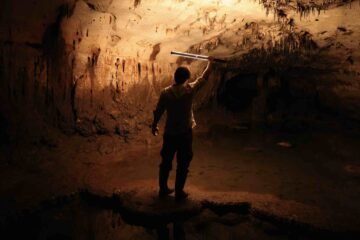
A remarkable collection ofancient inscriptionswithin a cave in eastern Spain is providing archaeologists with deep new insights into the early religious practices it once housed.
Among the new findings, researchers say the inscriptions are shedding new light on the prominent role women played in a subterraneancult, which centered on a previously unknown ancient goddess.
There, researchers recently documented at least 120 Latin inscriptions dating to the first and second centuries A.D.—a significant increase in the number of writings from this era known to exist at Cova Dones.
Previously, only around 15 of these inscriptions had been identified. The new findings elevate Cova Dones to what may be the Roman Empire’s largest known cave sanctuary containing Latin inscriptions.
One of the newly uncovered Latin inscriptions, enhanced with image overlay shown in lighter coloration (Image Credit: University of Alicante).
The Ritual Space of an Ancient Goddess is Revealed
Research at the cave was led by researchers from the University of Alicante and the University of Zaragoza, which revealed not only the inscriptions, but also a well-preserved ritual space located at a depth of close to 200 meters within the cave.
Among the discoveries researchers have made are a small collection of votive inscriptions, which are dedicated to what appears to be a goddess referred to simply as “Domina,” which means “The Lady.”
Three of those inscriptions also feature an unrecognized epithet—MALACI—which the researchers believe may describe some aspect of this mysterious goddess, possibly related in some way to the water that flows through the underground ritual space within the cave.
“Thanks to a set of five votive inscriptions, we know for certain that in Roman times a goddess, reverentially called Domina, ‘the Lady,’ was venerated in the cave,” says Silvia Alfayé, a professor of Ancient History at the University of Zaragoza.
Alfayé also says that the inscriptions further indicate the active role women played in the deity’s worship during this period.
Anatomy of an Ancient Roman Subterranean Cult
Within the newly-identified ritual space at Cova Dones, several individual female names were identified among the newly discovered inscriptions. This, according to Alfayé and her colleagues, reinforces the notion that the sanctuary had been a regular destination for women, rather than merely serving as an occasional site of pilgrimage.
Members of the research team during the documentation of the Latin inscriptions at Cova Dones (Image Credit: University of Alicante).
Specifically, the presence of the inscriptions all within a single chamber, which the research team has dubbed the “Roman Sanctuary,” places them alongside natural pools fed by underground water, which may have added to the allure of the subterranean ritual landscape the cave offered.
Strengthening that interpretation, the archaeologists also discovered spindle whorls, a variety of small tools used for spinning thread that were closely linked with women’s domestic and symbolic roles in the ancient Roman world, and beyond. Their presence near the inscriptions, the researchers believe, could imply links to ceremonies performed in the cave long ago, which may have incorporated textile-related offerings.
Ongoing Discoveries at Cova Dones
The recent findings at Cova Dones are only the latest offerings from the ancient site, which is already renowned for the ancient human presence it has preserved.
In 2023, The Debrief reported on discoveries within the cave that are now recognized as the largest known collection of surviving Paleolithic cave art in eastern Iberia. Such discoveries include more than 100 paintings and engravings dating back over 24,000 years.
The discovery of the Roman sanctuary occurred the following year, with the detection of Latin inscriptions and a coin featuring the Roman emperor Claudius, which archaeologists believe may have been left as a votive offering.
Then in 2025, archaeologists discovered more than 100 intentionally modified stalagmite formations, a unique category of archaeological evidence known as speleofacts. Altogether, such discoveries have helped cement Cova Dones as one of the most important sites in Europe to preserve evidence of prehistoric human modifications to an underground space.
One of a pair of bronze rings uncovered beneath the rock inscriptions at Cova Dones (Image Credit: University of Alicante).
Unraveling the Mysteries of a Subterranean World
Adding to the recent Roman inscription discoveries, Alfayé and her colleagues have also discovered artifacts that include bronze rings, a bracelet, ceramic vessels, faunal remains, and additional ritual objects—all of which provide additional clues that may help to reconstruct centuries of religious activity that once occurred deep within the cave.
Presently, many of the inscriptions await deciphering, and some large sections of the cave remain that have not yet been explored. With the promise of additional discoveries, archaeologists are confident that Cova Dones has only just begun to reveal its secrets.
In the coming years, new chapters in the story of this ancient subterranean landscape await discovery, exploration, and interpretation.
RELATED
Cova de les Dones (Millares, Valencia)
The Cave Where Roman Women Wrote Their Names in the Dark
Micah Hanks is the Editor-in-Chief and Co-Founder of The Debrief. A longtime reporter on science, defense, and technology with a focus on space and astronomy, he can be reached atmicah@thedebrief.org. Follow him on X @MicahHanks, and atmicahhanks.com.
UFO Over Los Angeles, California, USA July 26, 2026, UAP Sighting News
Date of sighting: July 26, 2026
Location of sighting: Los Angeles, California, USA
Source: NUFORC
Hey this UFO was seen over the area I was born...Los Angeles and its not a city without its UFOs...Its a hot bed of activity there mixed in with all the military experiments happening at the labs there too. Aliens in LA is just a fact, they not only walk among the people but they also entertain them in Hollywood and even run for public office. So...is this triangle an alien craft or military TR3B or its evolved from the TR3B? Alien craft do have lights to confuse people into believing its a normal aircraft. This looks like the UFOs seen over the East coast last year...and I call it 100% alien.
Scott C. Waring - Taiwan
Eyewitness states:
Lights on object Unknown object - not a drone or helicopter - hovering for long period of time and moving strangely Observed an unidentified illuminated aerial object on July 26, 2026, at approximately 9:10–9:20 PM PDT, southwest of View Park/Windsor Hills, Los Angeles, California. The object was visible for approximately 25+ minutes, remaining within a relatively small area of the sky while exhibiting irregular, swaying or swerving movements. Multiple lights were visible, including red/orange and bright white/blue lights. Original video recorded at approximately 9:13 PM PDT, along with original photographs, is attached.
UFO Over Los Angeles, California, USA July 26, 2026, UAP Alien Paranormal Entity Breaking News.
Meer van UFO'S of UAP'S, ASTRONOMIE, RUIMTEVAART, ARCHEOLOGIE, OUDHEIDKUNDE, SF-SNUFJES EN ANDERE ESOTERISCHE WETENSCHAPPEN - DE ALLERLAATSTE NIEUWTJES


 Mind-bending discovery deep inside notorious UFO hotspot leaves experts stunned