Naar de inhoud

UFO'S of UAP'S, ASTRONOMIE, RUIMTEVAART, ARCHEOLOGIE, OUDHEIDKUNDE, SF-SNUFJES EN ANDERE ESOTERISCHE WETENSCHAPPEN - DE ALLERLAATSTE NIEUWTJES

UFO's of UAP'S in België en de rest van de wereld
akke.beakke.be
Ontdek de Fascinerende Wereld van UFO's en UAP's: Jouw Bron voor Onthullende Informatie! Ben jij ook gefascineerd door het onbekende? Wil je meer weten over UFO's en UAP's, niet alleen in België, maar over de hele wereld? Dan ben je op de juiste plek! België: Het Kloppend Hart van UFO-onderzoek In België is BUFON (Belgisch UFO-Netwerk) dé autoriteit op het gebied van UFO-onderzoek. Voor betrouwbare en objectieve informatie over deze intrigerende fenomenen, bezoek je zeker onze Facebook-pagina en deze blog. Maar dat is nog niet alles! Ontdek ook het Belgisch UFO-meldpunt en Caelestia, twee organisaties die diepgaand onderzoek verrichten, al zijn ze soms kritisch of sceptisch. Nederland: Een Schat aan Informatie Voor onze Nederlandse buren is er de schitterende website www.ufowijzer.nl, beheerd door Paul Harmans. Deze site biedt een schat aan informatie en artikelen die je niet wilt missen! Internationaal: MUFON - De Wereldwijde Autoriteit Neem ook een kijkje bij MUFON (Mutual UFO Network Inc.), een gerenommeerde Amerikaanse UFO-vereniging met afdelingen in de VS en wereldwijd. MUFON is toegewijd aan de wetenschappelijke en analytische studie van het UFO-fenomeen, en hun maandelijkse tijdschrift, The MUFON UFO-Journal, is een must-read voor elke UFO-enthousiasteling. Bezoek hun website op www.mufon.com voor meer informatie. Samenwerking en Toekomstvisie Sinds 1 februari 2020 is Pieter niet alleen ex-president van BUFON, maar ook de voormalige nationale directeur van MUFON in Vlaanderen en Nederland. Dit creëert een sterke samenwerking met de Franse MUFON Reseau MUFON/EUROP, wat ons in staat stelt om nog meer waardevolle inzichten te delen. Let op: Nepprofielen en Nieuwe Groeperingen Pas op voor een nieuwe groepering die zich ook BUFON noemt, maar geen enkele connectie heeft met onze gevestigde organisatie. Hoewel zij de naam geregistreerd hebben, kunnen ze het rijke verleden en de expertise van onze groep niet evenaren. We wensen hen veel succes, maar we blijven de autoriteit in UFO-onderzoek! Blijf Op De Hoogte! Wil jij de laatste nieuwtjes over UFO's, ruimtevaart, archeologie, en meer? Volg ons dan en duik samen met ons in de fascinerende wereld van het onbekende! Sluit je aan bij de gemeenschap van nieuwsgierige geesten die net als jij verlangen naar antwoorden en avonturen in de sterren! Heb je vragen of wil je meer weten? Aarzel dan niet om contact met ons op te nemen! Samen ontrafelen we het mysterie van de lucht en daarbuiten.

Archief

InSight’s Largest Marsquake Was Likely Caused by Geological Processes, Study Says

InSight’s Largest Marsquake Was Likely Caused by Geological Processes, Study Says

During its time on Mars, NASA’s InSight (Interior Exploration using Seismic Investigations, Geodesy and Heat Transport) lander recorded over 1,300 seismic events, known as marsquakes. Of these, a number were identified as coming from meteoroid impact cratering events on the planet’s surface. The largest event identified by InSight, labeled S1222a, bore some similarities to two large impact events recorded earlier in the mission. In order to investigate whether the S1222a event might also have been caused by an impact event, planetary scientists from the University of Oxford and elsewhere undertook a comprehensive search of the region in which the S1222a marsquake occurred. The researchers did not identify any fresh craters in the area, implying that the marsquake was likely caused by geological processes.

An artist’s impression of the InSight lander on Mars. Image credit: NASA / JPL-Caltech.

An artist’s impression of the InSight lander on Mars.

Image credit: NASA / JPL-Caltech.

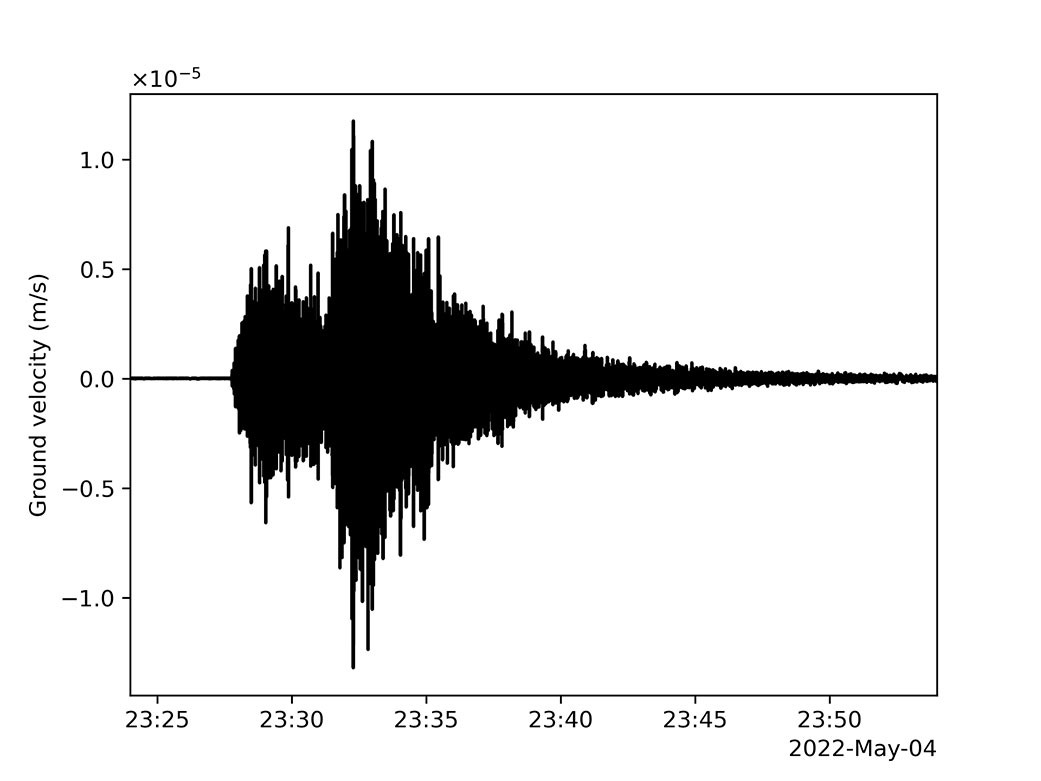
On May 4, 2022, InSight recorded the seismic waves from an event on Mars of magnitude 4.7.

This event, labeled S1222a in the catalog, was the largest of the mission and displayed characteristics spanning all previously identified marsquake families. The event also displayed clear evidence of surface waves.

Because its seismic signal was similar to previous quakes known to be caused by meteoroid impacts, the InSight team believed that S1222a might have been caused by an impact as well, and launched an international search for a fresh crater.

Although Mars is smaller than Earth, it has a similar land surface area because it has no oceans.

In order to survey this huge amount of ground (144 million km2), University of Oxford researcher Benjamin Fernando and colleagues sought contributions from ESA, the Chinese National Space Agency, the Indian Space Research Organisation, and the United Arab Emirates Space Agency.

This is thought to be the first time that all missions in orbit around Mars have collaborated on a single project.

Each group examined data from their satellites orbiting Mars to look for a new crater, or any other tell-tale signature of an impact (e.g. a dust cloud appearing in the hours after the quake).

After several months of searching, the scientists announced that no fresh crater was found.

They conclude that the S1222a event was instead caused by the release of enormous tectonic forces within Mars’ interior.

The results indicate that the Red Planet is much more seismically active than previously thought.

This spectrogram shows the magnitude 5 marsquake discovered by NASA’s InSight lander on May 4, 2022. Image credit: NASA / JPL-Caltech / ETH Zurich.

This spectrogram shows the magnitude 5 marsquake discovered by NASA’s InSight lander on May 4, 2022.

Image credit: NASA / JPL-Caltech / ETH Zurich.

“We still think that Mars doesn’t have any active plate tectonics today, so this event was likely caused by the release of stress within Mars’ crust,” Dr. Fernando said.

“These stresses are the result of billions of years of evolution; including the cooling and shrinking of different parts of the planet at different rates.”

“We still do not fully understand why some parts of the planet seem to have higher stresses than others, but results like these help us to investigate further.”

“One day, this information may help us to understand where it would be safe for humans to live on Mars and where you might want to avoid!”

“This experiment shows how important it is to maintain a diverse set of instruments at Mars, and we are very glad to have played our part in completing the multi-instrumental and international approach of this study,” said Dr. Daniela Tirsch, science coordinator for the High Resolution Stereo Camera on board ESA’s Mars Express spacecraft.

“We are willing to collaborate with scientists around the world to share and apply this scientific data to get more knowledge about Mars, and are proud to have provided data from the color imagers on Tianwen-1 to contribute to this effort,” said Dr. Jianjun Liu, an astronomer at the National Astronomical Observatories of the Chinese Academy of Sciences.

“This has been a great opportunity for me to collaborate with the InSight team, as well as with individuals from other major missions dedicated to the study of Mars,” said Dr. Dimitra Atri, group leader for Mars at New York University Abu Dhabi and contributor of data from UAE’s Hope spacecraft.

“This really is the golden age of Mars exploration!”

Spectrogram shows the largest quake ever detected on another planet

This seismogram shows the largest quake ever detected on another planet. Estimated at magnitude 5, this quake was discovered by NASA’s InSight lander on May 4, 2022, the 1,222 Martian day, or sol, of the mission. 
Credits: NASA/JPL-Caltech

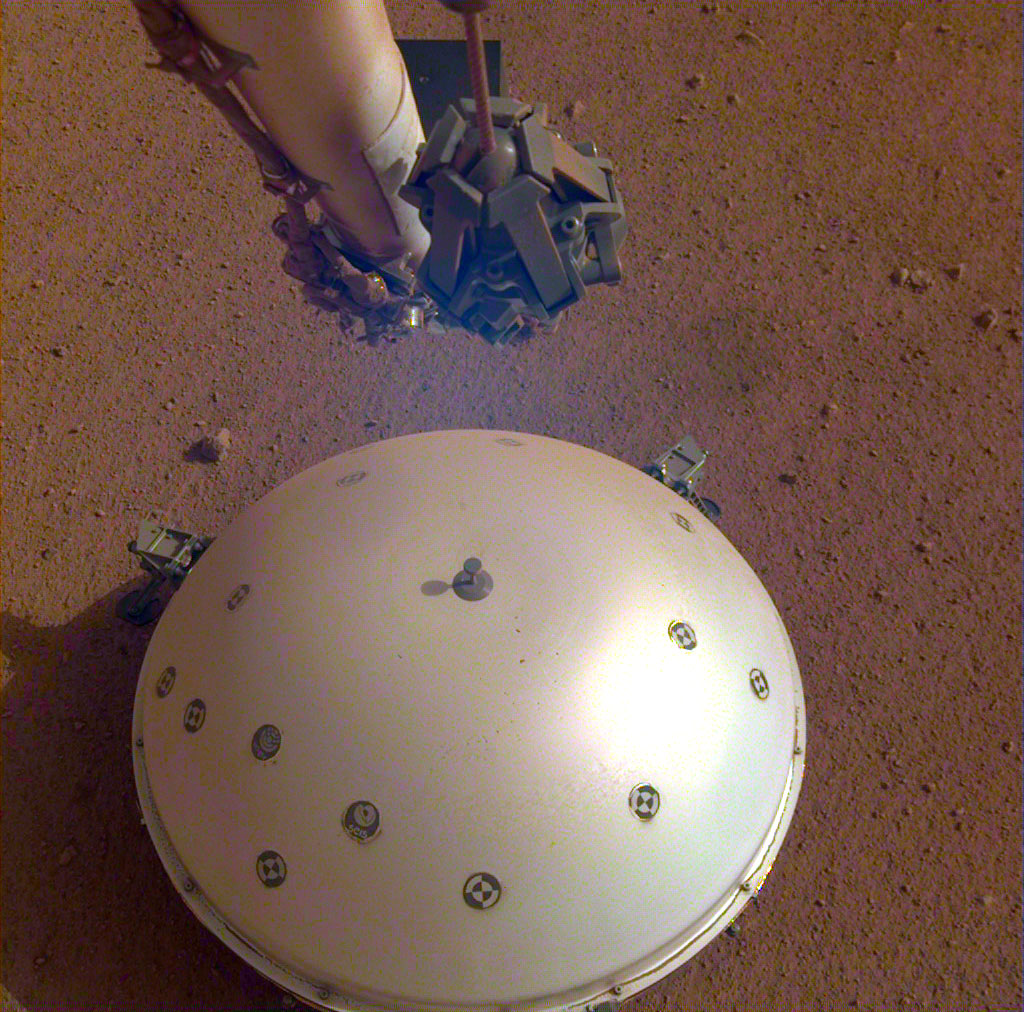
InSight’s domed Wind and Thermal Shield covers the lander’s seismometer

InSight’s domed Wind and Thermal Shield covers the lander’s seismometer, called Seismic Experiment for Interior Structure, or SEIS. The image was taken on the 110th Martian day, or sol, of the mission. 
Credits: NASA/JPL-Caltech

  • The results appear in the journal Geophysical Research Letters.
  • Benjamin Fernando et al. 2023. A Tectonic Origin for the Largest Marsquake Observed by InSight. Geophysical Research Letters 50 (20): e2023GL103619; doi: 10.1029/2023GL103619

{ https://www.sci.news/ }

Hoe vind je dit bericht?
Geschreven door peter om 23:41 Stuur door

Planetary Researchers Probe Origin of Complex Organics on Ceres

Planetary Researchers Probe Origin of Complex Organics on Ceres

How aliphatic organic compounds originated on the dwarf planet Ceres has been the subject of intensive research since their discovery by NASA’s Dawn mission in 2017. Some studies have concluded that a comet or other organic-rich impactor delivered them to Ceres; others indicate the molecules formed on the dwarf planet after its primordial materials were altered by briny water. New research led by Johns Hopkins Applied Physics Laboratory planetary scientists is extending our understanding of how impacts have affected Ceres’ aliphatic molecules and what the implications are for determining their origin and assessing the dwarf planet’s habitability.

This false-color image shows the dwarf planet Ceres. Scientists use false color to examine differences in surface materials. The color blue on Ceres is generally associated with bright material, found in more than 130 locations, and seems to be consistent with salts. Image credit: NASA / JPL-Caltech / UCLA / MPS / DLR / IDA.

This false-color image shows the dwarf planet Ceres. Scientists use false color to examine differences in surface materials. The color blue on Ceres is generally associated with bright material, found in more than 130 locations, and seems to be consistent with salts.

Image credit: NASA / JPL-Caltech / UCLA / MPS / DLR / IDA.

“The organics were initially detected in the vicinity of a large impact crater, which is what motivated us to look at how impacts affect these organics,” said lead author Dr. Terik Daly, a planetary scientist at the Johns Hopkins Applied Physics Laboratory.

“Although researchers have performed impact and shock experiments on various types of organics in the past, what was missing was a study dedicated to the type of organics detected on Ceres using the same type of analytical method used by the Dawn spacecraft to detect them.”

Dr. Daly and colleagues conducted a series of experiments at the NASA Ames Vertical Gun Range.

The experiments mimicked the impact conditions typical of Ceres, with impact speeds ranging between 2-6 km/s (4,400-13,000 mph) and impact angles varying between 15 and 90 degrees relative to horizontal.

The authors also conducted a new analysis that combined data from two different instruments — the camera and the imaging spectrometer that flew on the Dawn spacecraft — and then used an algorithm to extrapolate the compositional information from the spectrometer down to the camera’s higher spatial resolution.

The results allowed them to investigate the organics at finer detail than has previously been possible.

“People had looked at the Dawn camera data and the Dawn spectrometer data separately, but no one else had taken the approach our team used to extrapolate the data from one instrument to another, which provided new leverage in our search to map and understand the origin of organics on Ceres,” said co-author Dr. Jessica Sunshine, an astronomer at the University of Maryland.

“By capitalizing on the strengths of two different datasets collected over Ceres, we’ve been able to map potential organic-rich areas on Ceres at higher resolution,” said Dr. Juan Rizos, an astrophysicist at the Instituto de Astrofisica de Andalucia.

“We can see a very good correlation of organics with units from older impacts and with other minerals like carbonates that also indicate the presence of water.”

“While the origin of the organics remains poorly understood, we now have good evidence that they formed in Ceres and likely in the presence of water.”

“There is a possibility that a large interior reservoir of organics may be found inside Ceres. So, from my perspective, that result increases the astrobiological potential of Ceres.”

The researchers hope the results from NASA’s Lucy mission will soon shed more light on organics in the Solar System.

“We will likely find differences, as the Trojan asteroids have experienced very different impact histories from Ceres, and because there are two compositionally different types of Trojan asteroids,” Dr. Sunshine said.

“Comparisons to Ceres will help up us understand the distribution of organics in the outer Solar System.”

  • The scientists present their findings today at the Geological Society of America’s GSA Connects 2023 meeting.
  • R. Terik Daly et al. 2023. The effects of impacts on the reflectance spectra of aliphatic organics: implications for Ceres. Geological Society of America Abstracts with Programs 55 (6): 153-1; doi: 10.1130/abs/2023AM-392730

{ https://www.sci.news/ }

Hoe vind je dit bericht?
Geschreven door peter om 22:54 Stuur door

Admiral’s Bombshell: UFOs Beneath Our Oceans!

Admiral’s Bombshell: UFOs Beneath Our Oceans! 

Underwater UFOs

In an era where every smartphone is equipped with a camera and social media platforms are rife with shared content, “UFO sightings” have risen to a level of prominence never seen before. Yet, while grainy images and shaky footage often dominate UFO discussion boards, an increasing number of credible professionals are turning their attention to the sky, and beneath the ocean’s waves, in search of answers.

Uncharted Waters: UFOs Beneath the Sea?

We’re all familiar with tales of mysterious flying objects zipping through the sky, but what about those that plunge into our planet’s oceans? Recent revelations suggest that unidentified aerial phenomena (UAPs) may not just be confined to our atmosphere. Ocean scientists have come forward, detailing instances where UAPs transition from the sky and disappear beneath the water’s surface. These trans-medium occurrences are a new frontier in the study of UFO sightings.

The Ocean’s Silent Observers

Dr. Chris, an ocean scientist with three and a half decades of experience, expressed astonishment that more ocean experts aren’t delving into what he calls “the story of the century.” He described instances where submariners from the Cold War era reported inexplicable sonar readings—objects that moved in ways no known underwater vessel could. Another captivating account includes the USS Omaha’s radar operator, who noticed a USO (unidentified submerged object) speeding by underwater.

An Involved Scientific Community

But it’s not just anecdotal evidence that’s raising eyebrows. Research teams, like those from the Galileo project, are developing intricate collection systems, employing a combination of radar, electro-optical/infrared (EOIR), and acoustic means. These systems have picked up spheroid objects detectable only in infrared—meaning they’d be invisible to the naked eye. Such advancements underscore the evolving landscape of UFO sightings research.

Championing a New Age of Exploration

UAP Society, a recently founded organization, is taking the hunt for UFO evidence to new heights (and depths). They’ve announced a “UAP Video Challenge,” urging enthusiasts to share their ideas on capturing tangible UAP evidence. From sophisticated camera systems to innovative apps, they’re looking for fresh perspectives to shed light on these enigmatic phenomena.

Video:

  • Admiral Revelations: Underwater UFOs

UFO sightings are no longer just the domain of conspiracy theorists or science fiction enthusiasts. From seasoned oceanographers to dedicated research teams, the concerted effort to unravel the mystery of UAPs is in full swing. As technology advances and the world becomes ever more connected, perhaps we’re on the cusp of understanding one of the universe’s most intriguing questions: Are we truly alone?

RELATED VIDEOS

{ https://www.latest-ufo-sightings.net/ }

Hoe vind je dit bericht?
Geschreven door peter om 21:27 Stuur door

NASA benadrukt een fascinerende foto van een komeet tussen de sterrenstelsels

NASA benadrukt een fascinerende foto van een komeet tussen de sterrenstelsels

Artikel van Redação  
NASA benadrukt een fascinerende foto van een komeet tussen de sterrenstelsels (Dan Bartlett // NASA – APOD)
© Aangeboden door Tech Break

Astronomen en ruimteliefhebbers hebben de kans om dagelijks naar de bijzonderheden van het heelal te kijken dankzij de “Astronomische Foto van de Dag” van de NASA. Op de afbeelding van vandaag (20 oktober) kun je het exacte moment zien waarop een komeet zich een weg baant tussen de sterrenstelsels.

De foto is genomen op 12 oktober onder de hemel van June Lake, Californië, Verenigde Staten, en toont fascinerende sterrenstelsels in het noordelijke sterrenbeeld Canes Venatici, ofwel de ‘Jachthonden’.

In de linkerbovenhoek van de afbeelding, op een afstand van ongeveer 23,5 miljoen lichtjaar, zie je het prachtige spiraalvormige sterrenstelsel NGC 4258, ook wel bekend als Messier 106. Direct boven en rechts van het midden, op een afstand van 60 miljoen lichtjaar, bevindt zich een ander spiraalvormig sterrenstelsel, NGC 4217. Opmerkelijk in deze waarneming is de komeet C/2023 H2 Lemmon, die in april is ontdekt.

De komeet vertoont een groene kleur en een gladde staart die zich uitstrekt naar de bovenkant van de afbeelding. C/2023 H2 Lemmon zal op 29 oktober het perihelium bereiken, het punt het dichtst bij de zon, terwijl het perigeum, het punt het dichtst bij de aarde, zal plaatsvinden op 10 november.

NASA benadrukt een fascinerende foto van een komeet tussen de sterrenstelsels (Dan Bartlett // NASA – APOD)
© Aangeboden door Tech Break

O post NASA benadrukt een fascinerende foto van een komeet tussen de sterrenstelsels apareceu primeiro em TechBreak.

{ http://techbreak.ig.com.br/ }

Hoe vind je dit bericht?
Geschreven door peter om 20:55 Stuur door

Webb telescope discovers a new 3000 mile wide jet stream on Jupiter

Webb telescope discovers a new 3000 mile wide jet stream on Jupiter

This jet stream is about 25 miles high and travels about 320 miles per hour.

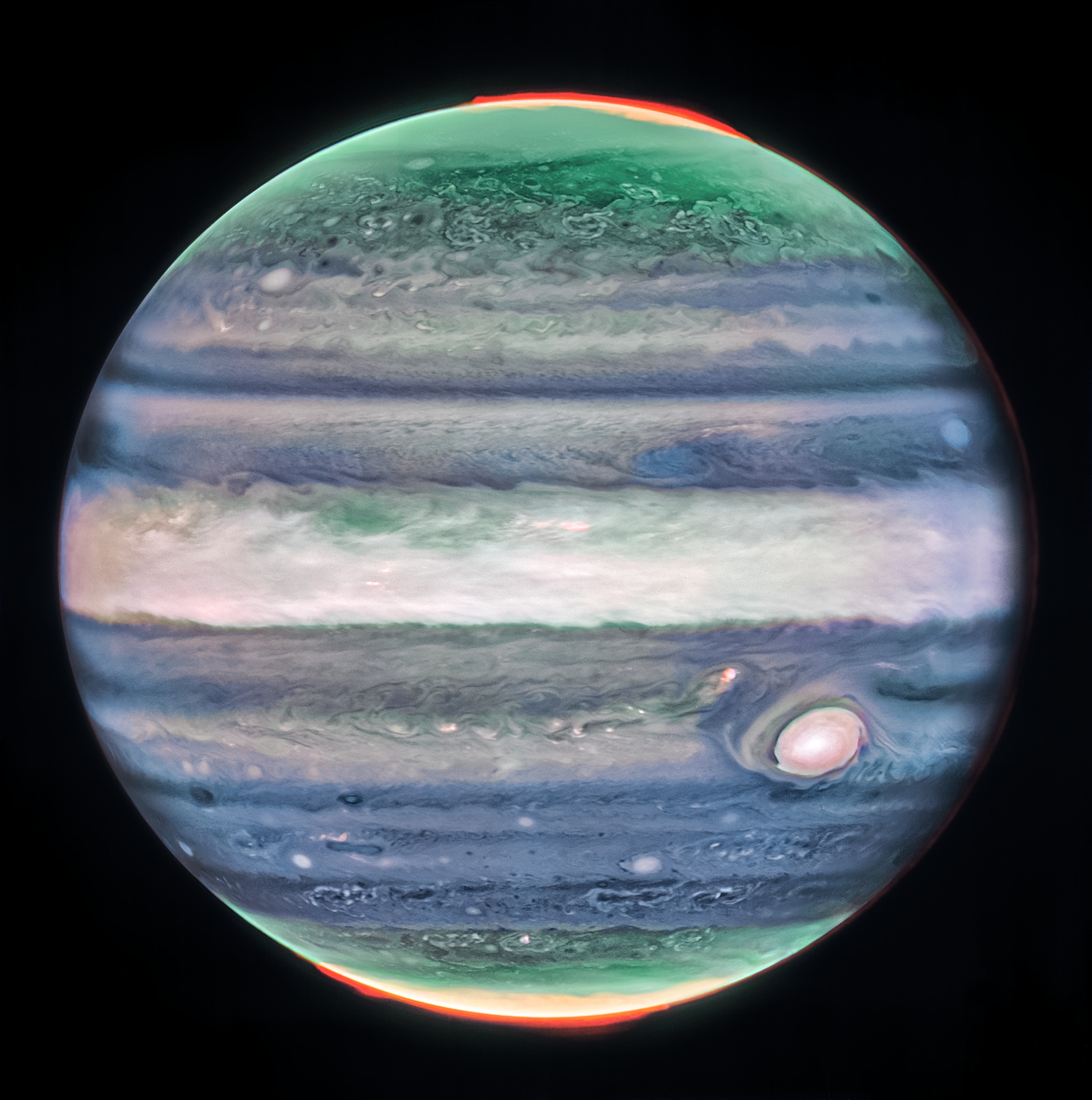
This image of Jupiter from NASA’s James Webb Space Telescope’s NIRCam (Near-Infrared Camera) shows stunning details of the majestic planet in infrared light.

NASA, ESA, CSA 

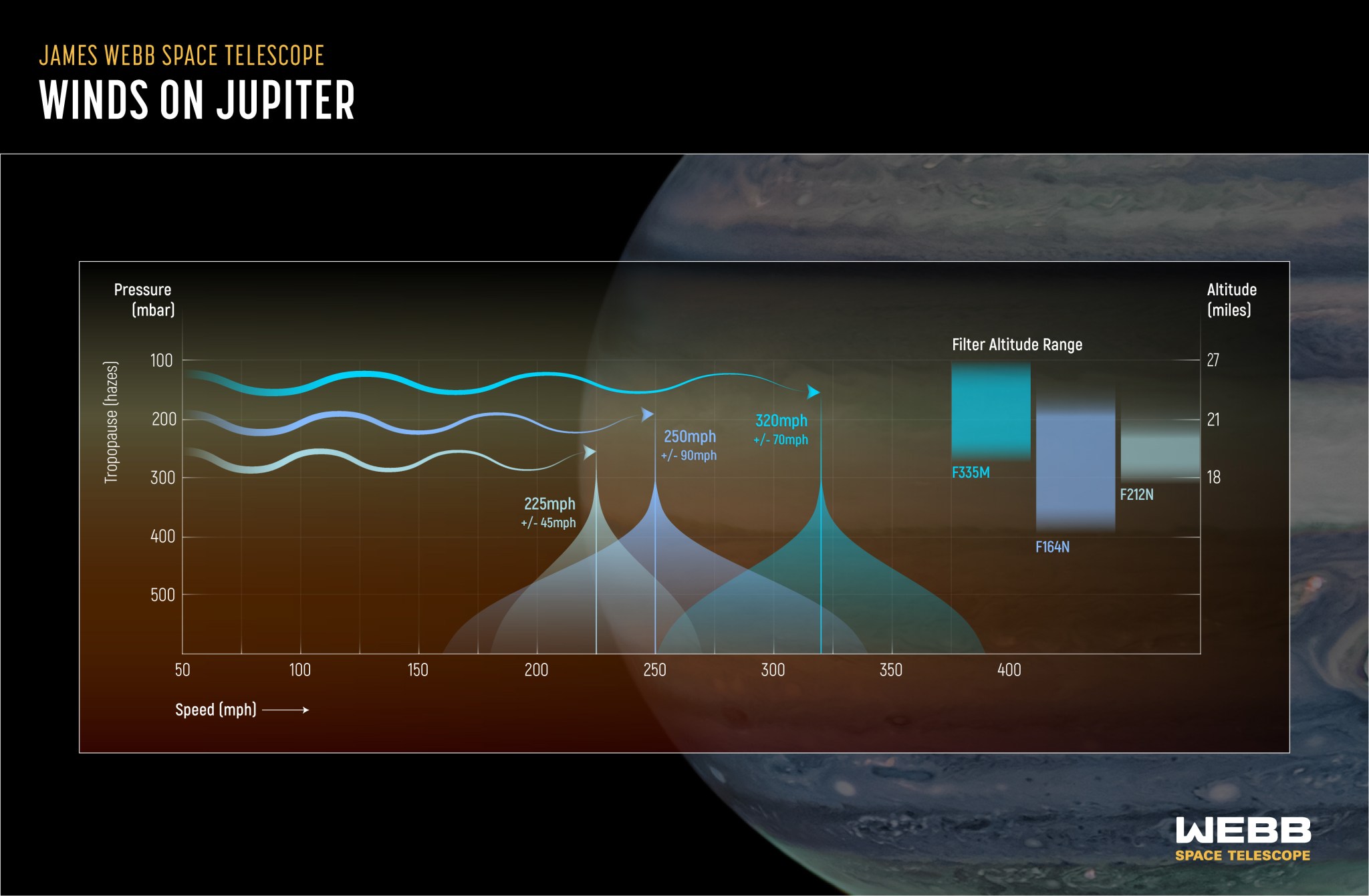
NASA's James Webb Space Telescope has discovered something new in Jupiter's atmosphere. Above the leading clouds, a high-speed jet stream runs over the giant planet's equator. This jet stream is about 3,000 miles (4,800 km) wide and travels about 320 miles (515 km) per hour. It is located in the lower stratosphere, about 25 miles (40 km) above the clouds.

Discovery of this jet stream

The discovery of this jet stream surprises the scientists who study Jupiter's weather. They are interested in how the different layers of the atmosphere interact with each other and create the planet's famous storms and winds. The jet stream could be a clue toRELATED understanding these processes. The researchers' results were recently published in Nature Astronomy.

The research team used Webb's NIRCam (Near-Infrared Camera) data in July 2022. The camera captured images of Jupiter in four different filters, each showing a different altitude of the atmosphere. The images were taken 10 hours apart, or one Jupiter day.

De Pater noted that despite the observations made by various ground-based telescopes, spacecraft such as NASA's Juno and Cassini, and NASA's Hubble Space Telescope on the changing weather patterns within the Jovian system, Webb has already delivered fresh insights on Jupiter's rings, satellites, and its atmosphere.

Webb telescope discovers a new 3000 mile wide jet stream on Jupiter

NIRCam images of Jupiter/Multiwavelength maps of the equatorial region.

Jupiter is very different from Earth, but both planets have layered atmospheres. The other missions have observed the lower layers of Jupiter's atmosphere, with massive storms and ammonia ice clouds. Webb can see farther into the near-infrared than before and detect the higher layers of the atmosphere, about 15-30 miles (25-50 km) above the cloud tops. In these layers, high-altitude hazes usually look blurry in near-infrared images. But with Webb, they look sharper and more detailed.

Webb and Hubble data

The researchers used Webb and Hubble data to compare the winds at different altitudes. They found that the winds change speed and direction with height, creating wind shears. They also saw that some storms in Jupiter's equator were not connected to the jet stream.

Michael Wong, a team member from the University of California, Berkeley, who led the Hubble observations associated with the study, explained that the distinct wavelengths of Webb and Hubble allowed them to unveil the three-dimensional configuration of storm clouds. Additionally, they harnessed the timing of the data to track the rapid development of storms.

The researchers added some context to their findings by explaining that Jupiter has a complex pattern of winds and temperatures in its equatorial stratosphere, which repeats itself over time. They said that one of their team members, Leigh Fletcher of the University of Leicester in the United Kingdom, suggested that the strength of the new jet stream might be related to this pattern and that they expected it to vary a lot over the next 2 to 4 years. They said that they were excited to test this theory in the future.

They also said that Fletcher was amazed by their discovery, as he had been tracking Jupiter's clouds and winds from many observatories for years, and he expected to find such a hidden feature when they saw the new NIRCam images in 2022.

Study abstract:

The atmosphere of Jupiter haseast–westt zonal jets that alternate as a function of latitude as tracked by cloud motions at tropospheric levels. Above and below the cold tropopause at ~100 mbar, the equatorial atmosphere is covered by hazes at levels where thermal infrared observations used to characterize the dynamics of the stratosphere lose part of their sensitivity. James Webb Space Telescope observations of Jupiter in July 2022 show these hazes in higher detail than ever before and reveal the presence of an intense (140 m s−1) equatorial jet at 100–200 mbar (70 m s−1 faster than the zonal winds at the cloud level) that is confined to ±3° of the equator and is located below stratospheric thermal oscillations that extend at least from 0.1 to 40 mbar and repeat in multiyear cycles. This suggests that the new jet is a deep part of Jupiter’s Equatorial Stratospheric Oscillation and may therefore vary in strength over time.

Image: Jupiter’s Winds

A portion of the graphic that displays wind speeds on Jupiter at different altitudes. The portion of this graphic shows the ends of three arrows that travel across the graphic from the left to the right. The top most arrow (colored in sky blue) extends the farthest right to about 3/4 the way across the graphic, the middle arrow (colored in periwinkle) extends to a little less than halfway across the graphic, and the bottom arrow (colored in light grey) extends to about 1/4 the way across the graphic. Extending out below each arrow is a cone of the same color to indicate the +/- error margin. There is Webb's image of Jupiter in the background of the graphic.

Researchers using NASA’s James Webb Space Telescope’s NIRCam (Near-Infrared Camera) have discovered a high-speed jet stream sitting over Jupiter’s equator, above the main cloud decks. At a wavelength of 2.12 microns, which observes between altitudes of about 12-21 miles (20-35 kilometers) above Jupiter’s cloud tops, researchers spotted several wind shears, or areas where wind speeds change with height or with distance, which enabled them to track the jet. This image highlights several of the features around Jupiter’s equatorial zone that, between one rotation of the planet (10 hours), are very clearly disturbed by the motion of the jet stream.
Image : NASA, ESA, CSA, STScI, Image: NASA, ESA, CSA, STScI, R. Hueso (University of the Basque Country), I. de Pater (University of California, Berkeley), T. Fouchet (Observatory of Paris), L. Fletcher (University of Leicester), M. Wong (University of California, Berkeley), A. James (STScI)

While Webb’s exquisite resolution and wavelength coverage allowed for the detection of small cloud features used to track the jet, the complementary observations from Hubble taken one day after the Webb observations were also crucial to determine the base state of Jupiter’s equatorial atmosphere and observe the development of convective storms in Jupiter’s equator not connected to the jet.  

“We knew the different wavelengths of Webb and Hubble would reveal the three-dimensional structure of storm clouds, but we were also able to use the timing of the data to see how rapidly storms develop,” added team member Michael Wong of the University of California, Berkeley, who led the associated Hubble observations.

The researchers are looking forward to additional observations of Jupiter with Webb to determine if the jet’s speed and altitude change over time.

Image: Zoom in on Webb’s View of Jupiter

Jupiter dominates the black background of space. The image is a composite, and shows Jupiter in enhanced color, featuring the planet’s famous Great Red Spot, which appears white with light pink around the edges. The planet is striated with swirling horizontal stripes of green, periwinkle, light pink, and cream. Horizontally across the equator is a wide cream-colored band, whose height extends about 1/7 of the planet. This is the planet’s equatorial zone. The stripes across the planet interact and mix at their edges. Along both of the northern and southern poles, the planet glows in green. Bright red auroras glow just above the planet’s surface at both poles.

A zoomed in view of Webb’s Jupiter image.
Image: NASA, ESA, CSA, STScI, R. Hueso (University of the Basque Country), I. de Pater (University of California, Berkeley), T. Fouchet (Observatory of Paris), L. Fletcher (University of Leicester), M. Wong (University of California, Berkeley), J. DePasquale (STScI)

“Jupiter has a complicated but repeatable pattern of winds and temperatures in its equatorial stratosphere, high above the winds in the clouds and hazes measured at these wavelengths,” explained team member Leigh Fletcher of the University of Leicester in the United Kingdom. “If the strength of this new jet is connected to this oscillating stratospheric pattern, we might expect the jet to vary considerably over the next 2 to 4 years – it’ll be really exciting to test this theory in the years to come.”

“It’s amazing to me that, after years of tracking Jupiter’s clouds and winds from numerous observatories, we still have more to learn about Jupiter, and features like this jet can remain hidden from view until these new NIRCam images were taken in 2022,” continued Fletcher.

The researchers’ results were recently published in Nature Astronomy.

  • The James Webb Space Telescope is the world’s premier space science observatory. Webb is solving mysteries in our solar system, looking beyond to distant worlds around other stars, and probing the mysterious structures and origins of our universe and our place in it. Webb is an international program led by NASA with its partners, ESA (European Space Agency) and the Canadian Space Agency.

{ https://interestingengineering.com/ }

Hoe vind je dit bericht?
Geschreven door peter om 23:21 Stuur door

Webb Spots High-Speed Equatorial Jet in Jupiter’s Stratosphere

Webb Spots High-Speed Equatorial Jet in Jupiter’s Stratosphere

The newly-discovered intense (140 m/s) jet is confined to ±3° of Jupiter’s equator, is approximately 4,800 km wide, and is located in the gas giant’s lower stratosphere, according to a paper published in the journal Nature Astronomy.

This Webb image of Jupiter shows stunning details of the majestic planet in infrared light. In this image, brightness indicates high altitude. The numerous bright white ‘spots’ and ‘streaks’ are likely very high-altitude cloud tops of condensed convective storms. Aurorae, appearing in red in this image, extend to higher altitudes above both the northern and southern poles of the planet. By contrast, dark ribbons north of the equatorial region have little cloud cover. Image credit: NASA / ESA / CSA / STScI / Ricardo Hueso, UPV / Imke de Pater, UC Berkeley / Thierry Fouchet, Observatory of Paris / Leigh Fletcher, University of Leicester / Michael H. Wong, UC Berkeley / Joseph DePasquale, STScI.

This Webb image of Jupiter shows stunning details of the majestic planet in infrared light. In this image, brightness indicates high altitude. The numerous bright white ‘spots’ and ‘streaks’ are likely very high-altitude cloud tops of condensed convective storms. Aurorae, appearing in red in this image, extend to higher altitudes above both the northern and southern poles of the planet. By contrast, dark ribbons north of the equatorial region have little cloud cover.

Image credit: NASA / ESA / CSA / STScI / Ricardo Hueso, UPV / Imke de Pater, UC Berkeley / Thierry Fouchet, Observatory of Paris / Leigh Fletcher, University of Leicester / Michael H. Wong, UC Berkeley / Joseph DePasquale, STScI.

“This is something that totally surprised us,” said Dr. Ricardo Hueso, an astronomer at the University of the Basque Country.

“What we have always seen as blurred hazes in Jupiter’s atmosphere now appear as crisp features that we can track along with the planet’s fast rotation.”

In the study, Dr. Hueso and colleagues analyzed data gathered by Webb’s Near-Infrared Camera (NIRCam) instrument in July 2022.

“Even though various ground-based telescopes, spacecraft like NASA’s Juno and Cassini, and the NASA/ESA Hubble Space Telescope have observed the Jovian system’s changing weather patterns, Webb has already provided new findings on Jupiter’s rings, satellites, and its atmosphere,” said Professor Imke de Pater, an astronomer at the University of California, Berkeley.

“While Jupiter is different from Earth in many ways — Jupiter is a gas giant, Earth is a rocky, temperate world — both planets have layered atmospheres.”

“Infrared, visible, radio, and ultraviolet-light wavelengths observed by these other missions detect the lower, deeper layers of the planet’s atmosphere — where gigantic storms and ammonia ice clouds reside.”

“On the other hand, Webb’s look farther into the near-infrared than before is sensitive to the higher-altitude layers of the atmosphere, around 25-50 km above Jupiter’s cloud tops.”

“In near-infrared imaging, high-altitude hazes typically appear blurry, with enhanced brightness over the equatorial region. With Webb, finer details are resolved within the bright, hazy band.”

Hueso et al. discovered a high-speed jet stream sitting over Jupiter’s equator, above the main cloud decks. At a wavelength of 2.12 microns, which observes between altitudes of about 20-35 km above Jupiter’s cloud tops, the astronomers spotted several wind shears, or areas where wind speeds change with height or with distance, which enabled them to track the jet. This image highlights several of the features around Jupiter’s equatorial zone that, between one rotation of the planet (10 hours), are very clearly disturbed by the motion of the jet stream. Image credit: NASA / ESA / CSA / STScI / Ricardo Hueso, UPV / Imke de Pater, UC Berkeley / Thierry Fouchet, Observatory of Paris / Leigh Fletcher, University of Leicester / Michael H. Wong, UC Berkeley / Joseph DePasquale, STScI.

Hueso et al. discovered a high-speed jet stream sitting over Jupiter’s equator, above the main cloud decks. At a wavelength of 2.12 microns, which observes between altitudes of about 20-35 km above Jupiter’s cloud tops, the astronomers spotted several wind shears, or areas where wind speeds change with height or with distance, which enabled them to track the jet. This image highlights several of the features around Jupiter’s equatorial zone that, between one rotation of the planet (10 hours), are very clearly disturbed by the motion of the jet stream.

Image credit: NASA / ESA / CSA / STScI / Ricardo Hueso, UPV / Imke de Pater, UC Berkeley / Thierry Fouchet, Observatory of Paris / Leigh Fletcher, University of Leicester / Michael H. Wong, UC Berkeley / Joseph DePasquale, STScI.

The newly-discovered jet stream travels at about 515 km per hour, twice the sustained winds of a Category 5 hurricane here on Earth.

It is located around 40 km above the clouds, in Jupiter’s lower stratosphere.

By comparing the winds observed by Webb at high altitudes, to the winds observed at deeper layers from Hubble, the astronomers could measure how fast the winds change with altitude and generate wind shears.

While Webb’s exquisite resolution and wavelength coverage allowed for the detection of small cloud features used to track the jet, the complementary observations from Hubble taken one day after the Webb observations were also crucial to determine the base state of Jupiter’s equatorial atmosphere and observe the development of convective storms in Jupiter’s equator not connected to the jet.

“We knew the different wavelengths of Webb and Hubble would reveal the three-dimensional structure of storm clouds, but we were also able to use the timing of the data to see how rapidly storms develop,” said Dr. Michael Wong, an astronomer at the University of California, Berkeley.

The researchers are looking forward to additional observations of Jupiter with Webb to determine if the jet’s speed and altitude change over time.

“Jupiter has a complicated but repeatable pattern of winds and temperatures in its equatorial stratosphere, high above the winds in the clouds and hazes measured at these wavelengths,” said Dr. Leigh Fletcher, an astronomer at the University of Leicester.

“If the strength of this new jet is connected to this oscillating stratospheric pattern, we might expect the jet to vary considerably over the next 2 to 4 years — it’ll be really exciting to test this theory in the years to come.”

“It’s amazing to me that, after years of tracking Jupiter’s clouds and winds from numerous observatories, we still have more to learn about Jupiter, and features like this jet can remain hidden from view until these new NIRCam images were taken in 2022.”

  • R. Hueso et al. An intense narrow equatorial jet in Jupiter’s lower stratosphere observed by JWST. Nat Astron, published online October 19, 2023; doi: 10.1038/s41550-023-02099-2

Discovery of this jet stream

{ https://www.sci.news/ }

Hoe vind je dit bericht?
Geschreven door peter om 22:49 Stuur door

Huge alien structures in moon craters, NASA photos, UFO Sighting News.

Huge alien structures in moon craters, NASA photos, UFO Sighting News.

Screenshot%202023-10-19%20at%2010.09.00%20AM.png
Guys, this is just a sample of what I found today during breakfast. Think about what I can find by lunch time. These structures have a lot of right angles, similar to structures on Earth. They also have some unique colors to them, green, pink, dark blue and dark gold-orange. 
 
This is from a much larger map-like photo and I will make a few videos about it soon. I'm just blown away that NASA didn't discover these structures and edit them out. 
 
Scott C. Waring 
Screenshot%202023-10-19%20at%2010.06.20%20AM.png

Screenshot%202023-10-19%20at%2010.04.22%20AM.png

Screenshot%202023-10-19%20at%2010.04.14%20AM.png

Screenshot%202023-10-19%20at%209.55.42%20AM.png

RELATED

{ https://www.ufosightingsdaily.com/ }

Hoe vind je dit bericht?
Geschreven door peter om 21:33 Stuur door

Mysterious UFO sightings over Florida and Colombia

Mysterious UFO sightings over Florida and Colombia

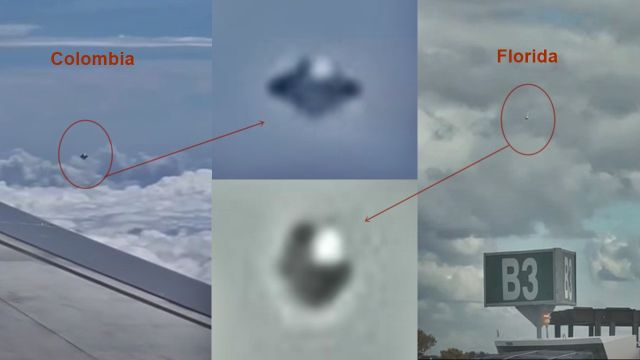
Two compelling UFO sightings have emerged; the first incident unfolds over SRQ Sarasota Bradenton International Airport in Florida, where a metallic orb defied explanation and the second sighting, occurring over the skies of Colombia, where a plane passenger while traveling from Bogotá to Salento captured an amazing footage of a spinning flying saucer. 
ufo%20sightings%20florida%20colombia%20(1).jpg

UFO sighting over Florida's SRQ Airport: 
 
ufo%20sightings%20florida%20colombia%20(2).jpg
The live footage captures a steady, silver orb hovering in the sky, its metallic surface gleaming in the sunlight. The orb maintaining a consistent position, defying the characteristics commonly associated with conventional aircraft. 
Some suggest that the object might be a top-secret military aircraft, while others lean towards the possibility of extraterrestrial involvement. The absence of discernible propulsion systems or conventional wings only adds to the mystery, leaving room for various interpretations. 
A Spinning Saucer over Colombia:
ufo%20sightings%20florida%20colombia%20(3).jpg

As if synchronized with the intrigue over SRQ Airport, another astonishing sighting occurred high above the Colombian skies. 
A passenger, en route from Bogotá to Salento, managed to capture a video of a spinning flying saucer. The footage, taken from the vantage point of an airplane, depicts the saucer-like object rotating gracefully against the backdrop of clouds and sky. There is much speculation on the origins and intentions of the mysterious craft. 
The Florida and Colombia UFO sightings add new chapters to the ongoing saga of mysterious aerial phenomena. Whether these sightings are the result of experimental human-made crafts or encounters with extraterrestrial intelligence, the search for answers continues...
   

{ http://ufosightingshotspot.blogspot.com/ }

Hoe vind je dit bericht?
Geschreven door peter om 21:13 Stuur door

Nan Madol: The Mysterious Ancient Coral Reef City

Nan Madol: Ceremonial Center of the Eastern Micronesia: Pohnpei Island.

Nan Madol: The Mysterious Ancient Coral Reef City

Nan Madol is the only ancient city ever built upon a coral reef.  It is comprised of a set of almost 100 stone and coral filled platforms atop artificial islands separated by narrow channels and enclosed by an outer seawall. Nan Madol includes the remains of stone palaces, temples, tombs and residential domains.

Despite the enormity of the undertaking in building the city, no records exist regarding when exactly it was built, where the enormous rocks came from, how they were transported there, and for what reason Nan Madol was constructed on top of a reef .

A Globally Significant Masterpiece of Creative Genius

UNESCO has finally paid attention to the immense historical significance of Nan Madol, a mysterious ancient coral reef city off the island of Pohnpei in Micronesia, by placing it on the World Heritage List. Describing it as a “globally significant masterpiece of creative genius”, Nan Madol is an engineering marvel, but it has not yet given up all its secrets.

The ancient city of Nan Madol was built atop a coral reef.

( Dmitry / Adobe )

Evidence of the early human activity on the islands dates back to the first or second century BC, but it is not known exactly when the construction of the artificial islets started. Theories range from the 5th to the 11th century AD, when it was purportedly built as a ritual and ceremonial center for the ruling chiefs of the Saudeleur Dynasty. UNESCO dates the site at 1200 to 1500 AD.

However, uranium dating techniques completed in 2016 suggest it was built sometime between 1180 and 1200. This date means it is the oldest known monumental scaled burial site on the remote islands of the Pacific.

The Saudeleur dynasty was the first organized government uniting the people of Pohnpei island, ruling from around 1100 to around 1628 AD. However, this era was preceded by the Mwehin Kawa (“period of building”) and Mwehin Aramas (“period of peopling”).

Nan Madol was Originally the Reef of Heaven

The name Nan Madol means “spaces between” and refers to the canals that crisscross the ruins. However, its traditional name was  Soun Nan-leng  (Reef of Heaven), according to Gene Ashby in his book  Pohnpei, An Island Argosy .

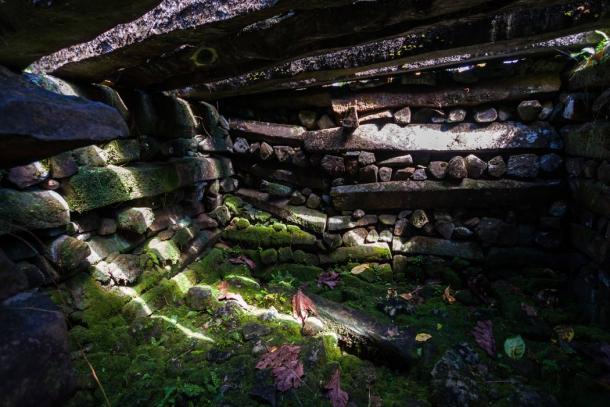
The total area of the enclosure is 75 hectares. The foundations of the islets were constructed of huge basalt boulders , on which walled enclosures were built using columnar basalt in a header and stretcher pattern in-filled with coral rubble. Walls were as high as 15 meters (49.21 ft.) and up to 5 meters (16.40 ft.) thick.

The average weight of each stone is 5 tons, with some weighing as much as 50 tons, and it has been estimated that the total weight of the columnar basalt that makes up the city’s construction is up to 750,000 metric tons.

The walls of Nan Madol.

( robnaw /adobe)

Probable quarry sites around the island have been identified, but the exact origin of the stones used in the construction of Nan Madol is yet to be determined. No quarries exist in the immediate vicinity meaning that the stones must have been transported to their current location. What is even more incredible is that the builders managed to accomplish the task without pulleys, levers, or metal to aid in the process.

Legends of Nan Madol’s Construction

Most Pohnpeians still believe the legend that Nan Madol began with the arrival of twin sorcerers Olisihpa and Olosohpa from the mythical Western Katau. The twins were said to be much taller than native Pohnpeians.

The brothers sought a place to build an altar so that they could worship Nahnisohn Sahpw, the god of agriculture . The two sorcerers successfully built an altar at Nan Madol, where they performed rituals to levitate the huge stones with the aid of a flying dragon. When Olisihpa died of old age, Olosohpa became the first Saudeleur.

Historians and archaeologists have suggested that they huge rocks may have been floated via raft to the islets, however, the exact means of engineering with which the massive stones were moved from their distant quarries, over land and water, and erected on the reef complexes is still unknown.

According to UNESCO, Nan Madol represents a “globally significant masterpiece of creative genius” because it exhibits the most perfectly preserved habitation, leadership, and ceremonial plan of an architectural ensemble of the Pacific region. In a statement published on their website, they write: “The huge scale of the edifices, their technical sophistication and the concentration of megalithic structures bear testimony to complex social and religious practices of the island societies of the period.”

However, it seems that local authorities are not yet ready for the UNESCO status to encourage large-scale international tourism at Nan Madol. Concerns have recently been raised that the site is “more fragile than it appears” and that sustainable tourism is the only real option to preserve the site.

Huge stones were transported to the ancient city.

( bluesea / Adobe)

The Tyrannical Saudeleur Dynasty

Nan Madol housed the ruling elite caste of Saudeleur dynasty and was used as a political and ceremonial seat of power. As a means of control of their subjects, Saudeleur rulers forced local chieftains to leave their home villages and move to the city where their activities could be more closely observed.

The islets to the northeast, particularly Nan Douwas, were used for rituals and ceremonies, while over time all the seawall islets (nearly 60) functioned as burial places. Other islets were administrative and residential, and some served special purpose, such as food preparation, coconut oil production or canoe construction .

Rule was maintained by one man, the Saudeleur, at Nan Madol. The land, its contents, and its inhabitants were owned by the Saudeleur ruler, who leased the land to landlord classes overseeing commoners harvesting the land. The commoners were required to present the ruler with frequent tributes of fruit and fish.

The logistical difficulties of the site, which involved having no fresh water and no place capable of growing crops, were not a problem for the Saudeleur because the people of the islands brought everything that was needed.

The Saudeleur dynasty ruled the islands for more than a millennium, yet there is nothing left of them but legend and the crumbling black basalt ruins. There is no art, no carvings, and no writing. The only knowledge that remains is that which has been passed down through oral history by the Pohnpeians, who describe the Saudeleurs as deeply religious, tyrannical, and cruel, and the remains of their civilization are often viewed with fear and superstition by modern-day Pohnpeians.

According to local lore, the ultimate downfall of the Saudeleurs was their increasingly oppressive rule and centralized social system. The dynasty was toppled in 1628 by the semi-mythical warrior Isokelekel, who came from the island of Kosrae 530 km (329.33 miles) to the east, creating the modern Nahnmwarki system of tribal chiefdom that has existed in one form or another to this day in the island’s five municipalities.

Saudeleur dynasty tomb (mausoleum) inside walls of Nan Madol.

( Dmitry/ Adobe)

New Rulers and the Abandonment of Nan Madol

There is much variation among sources for the exact events before, during, and after the invasion of Nan Madol by Isokelekel; at least 13 different accounts of the war have been published and told by the Pohnpeians. In most versions of the legend, the Saudeleur ruler had become oppressive and its lords had offended the Thunder God revered by the Pohnpeians.

Thus, the Thunder God left Pohnpei for Kosrae, where he impregnated a human by feeding her a lime. This union produced the semi-divine Isokelekel, who in the womb knew his destiny of vengeance.

There are many accounts of Isokelekel’s battle with the Saudeleur ruler. In one version, Isokelekel's warriors are aided by hidden weapons that suddenly appeared. The tide of war reversed several times, but ended against the Saudeleur, who retreated with his army into the main island of Pohnpei.

Legend recounts that the battle ended with the Saudeleur lord retreating uphill to a stream, where he transformed into a fish and remains today. Isokelekel took the title of Nahnmwarki and assumed the seat of power in Nan Madol.

When the period of the Nahnmwarkis began, the new rulers at first resided at Nan Madol, but they could not depend on anyone regularly supplying them with food and water and eventually they moved back to their own districts, abandoning Nan Madol forever.

Since then local legends have arisen saying that the ruins of Nan Madol are haunted, and the site has received the nickname “Ghost city.” The strange tales associated the abandoned city led H.P. Lovecraft to make it the home of Cthulhu in a short story.

By any measure, the city of Nan Madol is impressive. The work required to build it was on such an enormous scale, yet the current inhabitants of Pohnpei live in humble grass huts . What accounts for this huge contrast? More importantly, how was the city built in the first place?

The fact that there are no existing records on Nan Madol means that we may never know the secrets buried within the walls of this unique coral reef city.

  • Top Image: Nan Madol - archaeological site on the island of Pohnpei, Federated States of Micronesia.
  • Source: robnaw /Adobe

By Joanna Gillan

RELATED VIDEOS

{ https://www.ancient-origins.net/ }

Hoe vind je dit bericht?
Geschreven door peter om 18:38 Stuur door

Unraveling Nan Madol’s Mind-Blowing ALIEN Mysteries!

 Unraveling Nan Madol’s Mind-Blowing ALIEN Mysteries!

Strange ALIEN Secrets of Nan Madol

Nestled amid the serene waters of the Western Pacific lies one of the world’s most enigmatic archaeological sites: Nan Madol. With its labyrinthine network of canals and artificial islands, the stone city rises majestically from the sea, seemingly defying the very laws of physics with its massive basalt columns. How could an ancient civilization have built such a colossal structure? The legends and mysteries surrounding this site make it a perfect backdrop for an epic tale.

A Sight to Behold

When adventurers David and Georgio first laid eyes on the towering walls of Nan Madol, they were left awestruck. Spread over a vast expanse, this site boasts an estimated 250 million tons of basalt stacked into immense walls and artificial islands. Some of the individual blocks are so huge that they would dwarf a modern-day car. David’s reaction perfectly encapsulates the grandeur of the site: “It boggles the mind… some of these blocks are massive, just massive.”

Many, like David, believe that Nan Madol might predate its officially recorded history. The awe-inspiring complexity of the site suggests a level of engineering and architecture that many think was not possible for the era it is believed to have been built in.

The Legends of Nan Madol

The people of Pohnpei, the island upon which Nan Madol stands, have passed down tales of its creation for generations. The most enduring legend tells of two twin sorcerers, Olopa and Osba, who were foreign to the island. These towering figures, with their vast knowledge and inexplicable powers, are said to have levitated the massive stones into place.

While skeptics might scoff at such tales, one cannot help but draw parallels between the legends of Nan Madol and those of other ancient sites. From the giant statues (Moai) of Easter Island to the mammoth blocks of the Great Pyramid in Giza, stories of levitating stones and otherworldly assistance are a recurring theme.

Extraterrestrial Theories

Given the seemingly impossible feat of constructing Nan Madol, some ancient astronaut theorists, including Georgio, argue that the site may be the handiwork of extraterrestrial beings. They base this theory on oral traditions, like the one that speaks of a “giant bird” – possibly a misunderstood piece of advanced technology – that flew the basalt blocks from their quarry to the construction site.

Such theories gain traction when you consider the baffling fact that around 60% of the basalt used in Nan Madol’s construction cannot be sourced to any known location. Furthermore, a recent revelation suggests that some stones might have been excavated from the top of a nearby volcanic outcrop, Pen Mik. The sheer inaccessibility of this location has led many to wonder how such a feat could have been achieved without advanced technology.

Video:

  • Ancient Aliens: Decoding the Strange ALIEN Secrets of Nan Madol

The mysteries of Nan Madol, from its awe-inspiring architecture to its enigmatic legends, make it a must-visit for any history or archaeology enthusiast. Whether the site was the result of human ingenuity, extraterrestrial intervention, or a mix of both remains a topic of passionate debate. What is undeniable, however, is the sense of wonder and intrigue that this ancient city evokes in all who lay eyes upon it.

RELATED VIDEOS

{ https://www.latest-ufo-sightings.net/ }

Hoe vind je dit bericht?
Geschreven door peter om 17:51 Stuur door

Meer van UFO'S of UAP'S, ASTRONOMIE, RUIMTEVAART, ARCHEOLOGIE, OUDHEIDKUNDE, SF-SNUFJES EN ANDERE ESOTERISCHE WETENSCHAPPEN - DE ALLERLAATSTE NIEUWTJES

↑ Terug naar de berichten