Naar de inhoud

UFO'S of UAP'S, ASTRONOMIE, RUIMTEVAART, ARCHEOLOGIE, OUDHEIDKUNDE, SF-SNUFJES EN ANDERE ESOTERISCHE WETENSCHAPPEN - DE ALLERLAATSTE NIEUWTJES

UFO's of UAP'S in België en de rest van de wereld
akke.beakke.be
Ontdek de Fascinerende Wereld van UFO's en UAP's: Jouw Bron voor Onthullende Informatie! Ben jij ook gefascineerd door het onbekende? Wil je meer weten over UFO's en UAP's, niet alleen in België, maar over de hele wereld? Dan ben je op de juiste plek! België: Het Kloppend Hart van UFO-onderzoek In België is BUFON (Belgisch UFO-Netwerk) dé autoriteit op het gebied van UFO-onderzoek. Voor betrouwbare en objectieve informatie over deze intrigerende fenomenen, bezoek je zeker onze Facebook-pagina en deze blog. Maar dat is nog niet alles! Ontdek ook het Belgisch UFO-meldpunt en Caelestia, twee organisaties die diepgaand onderzoek verrichten, al zijn ze soms kritisch of sceptisch. Nederland: Een Schat aan Informatie Voor onze Nederlandse buren is er de schitterende website www.ufowijzer.nl, beheerd door Paul Harmans. Deze site biedt een schat aan informatie en artikelen die je niet wilt missen! Internationaal: MUFON - De Wereldwijde Autoriteit Neem ook een kijkje bij MUFON (Mutual UFO Network Inc.), een gerenommeerde Amerikaanse UFO-vereniging met afdelingen in de VS en wereldwijd. MUFON is toegewijd aan de wetenschappelijke en analytische studie van het UFO-fenomeen, en hun maandelijkse tijdschrift, The MUFON UFO-Journal, is een must-read voor elke UFO-enthousiasteling. Bezoek hun website op www.mufon.com voor meer informatie. Samenwerking en Toekomstvisie Sinds 1 februari 2020 is Pieter niet alleen ex-president van BUFON, maar ook de voormalige nationale directeur van MUFON in Vlaanderen en Nederland. Dit creëert een sterke samenwerking met de Franse MUFON Reseau MUFON/EUROP, wat ons in staat stelt om nog meer waardevolle inzichten te delen. Let op: Nepprofielen en Nieuwe Groeperingen Pas op voor een nieuwe groepering die zich ook BUFON noemt, maar geen enkele connectie heeft met onze gevestigde organisatie. Hoewel zij de naam geregistreerd hebben, kunnen ze het rijke verleden en de expertise van onze groep niet evenaren. We wensen hen veel succes, maar we blijven de autoriteit in UFO-onderzoek! Blijf Op De Hoogte! Wil jij de laatste nieuwtjes over UFO's, ruimtevaart, archeologie, en meer? Volg ons dan en duik samen met ons in de fascinerende wereld van het onbekende! Sluit je aan bij de gemeenschap van nieuwsgierige geesten die net als jij verlangen naar antwoorden en avonturen in de sterren! Heb je vragen of wil je meer weten? Aarzel dan niet om contact met ons op te nemen! Samen ontrafelen we het mysterie van de lucht en daarbuiten.

Archief

NEW U.S. GOVERNMENT REPORT DETAILS LATEST FINDINGS IN THE PENTAGON’S INVESTIGATIONS OF UNIDENTIFIED ANOMALOUS PHENOMENA

th?id=OVFT.ig3nleYIi-YK49sAq6JUqy&pid=News&w=300&h=186&c=14&rs=2&qlt=90&dpr=1.3

NEW U.S. GOVERNMENT REPORT DETAILS LATEST FINDINGS IN THE PENTAGON’S INVESTIGATIONS OF UNIDENTIFIED ANOMALOUS PHENOMENA

A classified report detailing the Pentagon’s latest findings in its ongoing investigations into unidentified anomalous phenomena, or UAP, has been delivered to Congress, the U.S. Department of Defense (DOD) has revealed.

The 2023 Annual Report on Unidentified Anomalous Phenomena was presented to Congress by the DoD and the Office of the Director of National Intelligence (ODNI) on Wednesday, October 18, 2023, according to a Pentagon press release issued that same evening.

An unclassified version of the report, required by the National Defense Authorization Act (NDAA) for Fiscal Year 2022, as amended by the NDAomaly ResoA for Fiscal Year 2023, was also subsequently made available on the website of the All-domain Anlution Office (AARO), the official office within the DoD tasked with investigations into mysterious aerial incursions and other phenomena encountered by U.S. personnel which currently remain unresolved.
2023 UAP Report
Cover page of the 2023 Annual UAP Report, released on October 18, 2023
(Credit: AARO/DoD).

What follows are several of the key findings detailed in the unclassified version of the 2023 Annual UAP Report released late on Wednesday:

291 NEW REPORTS OF UNIDENTIFIED ANOMALOUS PHENOMENA

The latest UAP report primarily documents sightings that occurred between August 31, 2022 and April 30, 2023, with 274 of the reports having occurred during this period, and an additional 17 from previous reporting periods dating as far back as 2019, amounting to a combined total of 291 reports.

As of April 2023, AARO has reportedly been reviewing more than 800 UAP incident reports.

COLLECTION BIASES REMAIN, DESPITE BROADENING SOURCES

The report, while acknowledging the persistence of a “strong but shifting collection bias,” notes that the abundance of UAP reports AARO has received that occurred within restricted military airspace has been tempered somewhat by reports from commercial pilots which show “a more diverse geographic distribution of UAP sightings across the United States.”

However, even the broadening number of reports from commercial aviators AARO has begun to integrate into its dataset still conveys what the report calls a “U.S.-centric collection bias that will grow significantly relative to the rest of the world.”

NO ADVERSE HEALTH EFFECTS ASSOCIATED WITH UAP INCIDENTS

The report says that none of the reports collected between August 2022 and April 2023 indicated U.S. personnel or other witnesses had suffered any adverse health effects resulting from their unexplained encounters.

“ODNI and DoD acknowledge that health-related effects may appear at any time after an event occurs,” the report states, “therefore any reported health implications related to UAP will be tracked and examined if and when they emerge.”

CONCERNING PERFORMANCE CHARACTERISTICS

Some UAP reports involved objects that “potentially exhibited one or more concerning performance characteristics such as high-speed travel or unusual maneuverability,” the report states, raising concerns over possible flight safety issues that may result from UAP encountered by aviators. While acknowledging such safety risks, the report adds that “none of these reports suggest the UAP maneuvered to an unsafe proximity to civil or military aircraft” or posed any other direct threats to any aircraft or their crew and passengers.

NO EVIDENCE LINKING RECENT UAP SIGHTINGS TO FOREIGN ACTORS

The report also states that none of the UAP reports from the period in question have been directly linked to foreign activities by any U.S. adversaries or other state actors.

BETTER DATA IS NEEDED

Insufficient data from various sensors and other collection platforms “can cause observational misperceptions,” the report adds, noting that as better data is collected over time, “most UAP will likely resolve to ordinary phenomena and significantly reduce the amount of UAP case submissions.”

UAP REPORTING IS INCREASING OVERALL

The report states that reports involving unidentified anomalous phenomena are increasing, primarily due to what it characterizes as “deepening federal relationships and AARO’s ability to incorporate new reports into its adjudication and research process.

290 of the most recent batch of reports involved aerial encounters, while just one occurred “in the maritime domain.” There were no space-based UAP sightings during the recent period, nor were there any incidents involving transmedium phenomena that were observed.

AN ABUNDANCE OF SPHERICAL UNIDENTIFIED ANOMALOUS PHENOMENA

Among the most common shapes reported in the recent batch of sightings, about a quarter (25%) involve

Earlier this year during an April 2023 Senate hearing, Dr. Sean Kirkpatrick, Director of the DoD’s All-domain Anomaly Resolution Office (AARO), said at that time that more than half of all UAP reports collected by his Office involved observations of objects characterized as orbs or otherwise spherical objects with white, silver, or translucent coloration.

“That’s what we’re looking for and trying to understand what that is,” Kirkpatrick said during the hearing, shortly before sharing footage obtained by an MQ-9 Reaper Drone in the Middle East in 2022 where a flying object resembling a metallic sphere could be seen passing through the air.

unidentified anomalous phenomena Diagram displaying common morphologies associated with unidentified anomalous phenomena in reports collected between August 2022 and April 2023 (Credit: AARO/DoD).

While more than half (53%) of all sightings provided no details on the shape of the objects that were encountered, 6% of the incidents involved “irregular shapes,” while 4% involved oval-shaped objects, discs and rectangles each comprised 2% respectively, while cylindrical objects and triangles each comprised 1% respectively. An additional 5% of reports involved what were characterized as “Ambiguous Sensor Contact.”

FEWER UAP DISPLAYED LIGHTS

Of the 291 reports from the recent collection period, less than a quarter (21%) possessed lights, while the vast majority (79%) appeared to possess no lights, or at least none were displayed at the time of the observations.

IT’S ALL ABOUT THE DATA

Intriguingly, the report also describes the data collection and analysis process as new UAP reports are acquired, noting that “AARO’s analysts scour multiple classified and unclassified databases to identify any existing data on each UAP case,” adding that investigations prioritize “technical sensor information that yields the highest quantity of pertinent, valuable data for review.”

HIGH SPEED TRAVEL AND OTHER ODDITIES

Based on the ongoing analysis of UAP sightings AARO has collected, the report states that “only a very small percentage of UAP reports display interesting signatures, such as high-speed travel and unknown morphologies.” Currently, most of the sightings AARO has collected involve objects that “demonstrate ordinary characteristics of readily explainable sources,” although a lack of data has prevented a large number of cases from being able to be resolved.

unidentified anomalous phenomena
Screenshot from a video filmed off the Baja California coast in 2004 depicting unidentified anomalous phenomena famously nicknamed the “Tic Tac” by U.S. Navy personnel who encountered it
(Credit: DoD).

“For the few objects that do demonstrate characteristics of interest,” the report adds, “AARO is approaching these cases with objectivity and analytic rigor.”

SENSOR CALIBRATION TO HELP RULE OUT KNOWN OBJECTS

Known objects, which include balloons, unmanned aircraft systems (UAVs), atmospheric events and other natural phenomena are all being considered in relation to ongoing sensor calibration efforts which are aimed to help rule out such objects or events, and offer future avenues for pilot training and algorithm development.

DECLASSIFICATION OF “FULL-MOTION VIDEOS” AND MORE

Notably, the report states that AARO is “working to standardize and routinize” a declassification process for the release of data and “full-motion videos,” adding that this process had been employed prior the public display of such data during Congressional hearings held earlier this year.

UAP BY AIR, SPACE, AND SEA

Within the report’s Appendix section, a new series of definitions is provided for UAP respective of the domains in which they are observed. These are Spaceborn UAP, defined as “Sources of anomalous detections above the Karman Line (i.e., 100 km above Earth’s mean sea level),” Airborne UAP, which occur “between Earth’s mean sea level and the Karman Line,” and Seaborn UAP, which involve “Sources of anomalous detections at or below Earth’s mean sea level within a body of water.”

Additionally, the report advises that integration between space and maritime domains into AARO’s current analytic efforts would be beneficial, though adding that “Collaboration with Space Force, U.S. Space Command, NRO, and NASA is well underway.”

ONGOING CONTROVERSY OVER UNIDENTIFIED ANOMALOUS PHENOMENA

The 2023 annual report arrives amidst widespread public interest in the UAP subject that has ensued since 2017, following a report featured in The New York Times that reinvigorated the debate over mysterious aerial encounters reported by military personnel.

More recently, whistleblower allegations first reported by The Debrief in June 2023 resulted in additional scrutiny of the subject, garnering attention from lawmakers over the possibility that the U.S. has maintained secretive programs for decades that may have involved the acquisition of exotic technologies.

The 2023 Annual UAP Report was also preceded by the release of new government documents in recent weeks detailing sightings of aerial phenomena that have occurred over sensitive U.S. government facilities.

Sandia

Sandia National Laboratories, one of several U.S. Department of Energy sites where UAP observations have been made in recent years

(Credit: DOE).

“Analyzing and understanding the potential threats posed by UAP is an ongoing collaborative effort involving many departments and agencies,” said Pentagon Press Secretary Brig. Gen. Pat Ryder in a statement following the release of the unclassified version of the 2023 Annual UAP Report, which appeared on AARO’s official website.

“The safety of our service personnel, our bases and installations, and the protection of U.S. operations security on land, in the skies, seas, and space are paramount.”

“We take reports of incursions into our designated space, land, sea, or airspaces seriously and examine each one,” Ryder added.

The entire 2023 Annual UAP Report can be read online at AARO’s website.

{ https://thedebrief.org/ }

Hoe vind je dit bericht?
Geschreven door peter om 00:43 Stuur door

There are 14,000 Potentially Hazardous City-Killing Asteroids Left to Find

10882_v_2-868x1200.jpeg

BY ANDY TOMASWICK

There are 14,000 Potentially Hazardous City-Killing Asteroids Left to Find

Everyone likes a cool infographic, right? Does that statement hold even if the infographic points out a gap in our knowledge that could kill millions of people? Because that’s what a cool-looking infographic NASA released on October 16th does. 

One of NASA’s more practical tasks is commonly known as “Planetary Defense” – basically, it’s keeping an eye out for asteroids that could potentially hit the Earth and cause widespread devastation. Most people have heard about what happened to dinosaurs. NASA’s planetary defense side wants to ensure it doesn’t happen to us. 

That’s easier said than done. Asteroids don’t emit any of their own light, so usually, the only way to detect them is when sunlight reflects off their surface down to one of the various telescopes watching the night sky. Lately, there have been more and more of them that are specially designed to be asteroid hunters.

Fraser discusses how difficult it is to find asteroids

Those new telescopes have been doing work – the infographic points out that, as of the end of August 2023, there are 32,000 known Near-Earth asteroids. The effort to find and track them has been even more impressive – more than 405 million observations from amateur and professional astronomers alike have been submitted to the Minor Planet Center, one of the central hubs of NASA’s planetary defense strategy and a central clearinghouse for asteroid hunters all over the globe.

Now for the disturbing parts – of those 32,000 near-Earth asteroids, more than 10,000 are more than 140 m in diameter. By most common estimates, if one of those were to hit the Earth, it would be capable of wiping out an entire city. In comparison – the asteroid that hit the Chelyabinsk district of Russia back in 2013, shattering windows and injuring almost 1,500 people, was estimated to be at most 20 meters.

An asteroid seven times that size would be much more devastating and likely hit the ground. In contrast, the Chelyabinsk meteor disintegrated in an air burst before it got there. Placed in the right spot, such an asteroid could easily wipe out a city and, depending on where it came down, could potentially kill millions of people.

Finding the dangerous ones is the most important – Fraser discusses how with expert Dr. Ned Wright.

As of now, we aren’t aware of any of those 10,000 140-meter-wide asteroids that are on a collision course with Earth. But another number in the infographic is probably the most terrifying – NASA’s planetary defense experts think we haven’t even found half of the near-Earth asteroids of this size.

They estimate there are more than 14,000 140m diameter asteroids that we have yet to find. And one of those could well be on a collision path. Even more strikingly, they estimate that there are around 50 1km diameter asteroids that we have yet to find floating in the void of space. An asteroid that size could be catastrophic to civilization on a scale far larger than a single city, though still not quite on the scale of the impact that did for the dinosaurs, estimated to be about 10 kilometers in diameter.

The planetary defense community, which includes a slew of other organizations – not just NASA, has a lot more work to do to ensure the safety of humankind if these estimates are correct. But every little bit helps – even infographics that simply convey information can potentially inspire someone to join the hunt. We need all the help we can get.

Learn More:

Lead Image:

  • Infographic released from NASA regarding the current population of near-Earth asteroids.
    Credit – NASA

{ https://www.universetoday.com/ }

Hoe vind je dit bericht?
Geschreven door peter om 22:47 Stuur door

If There Was Ever Life on Mars, this Ancient Mud Lake is the Perfect Place to Look

USGS-Mars-MC-11-OxiaPalusRegion-mola-1-2000x1200.jpg

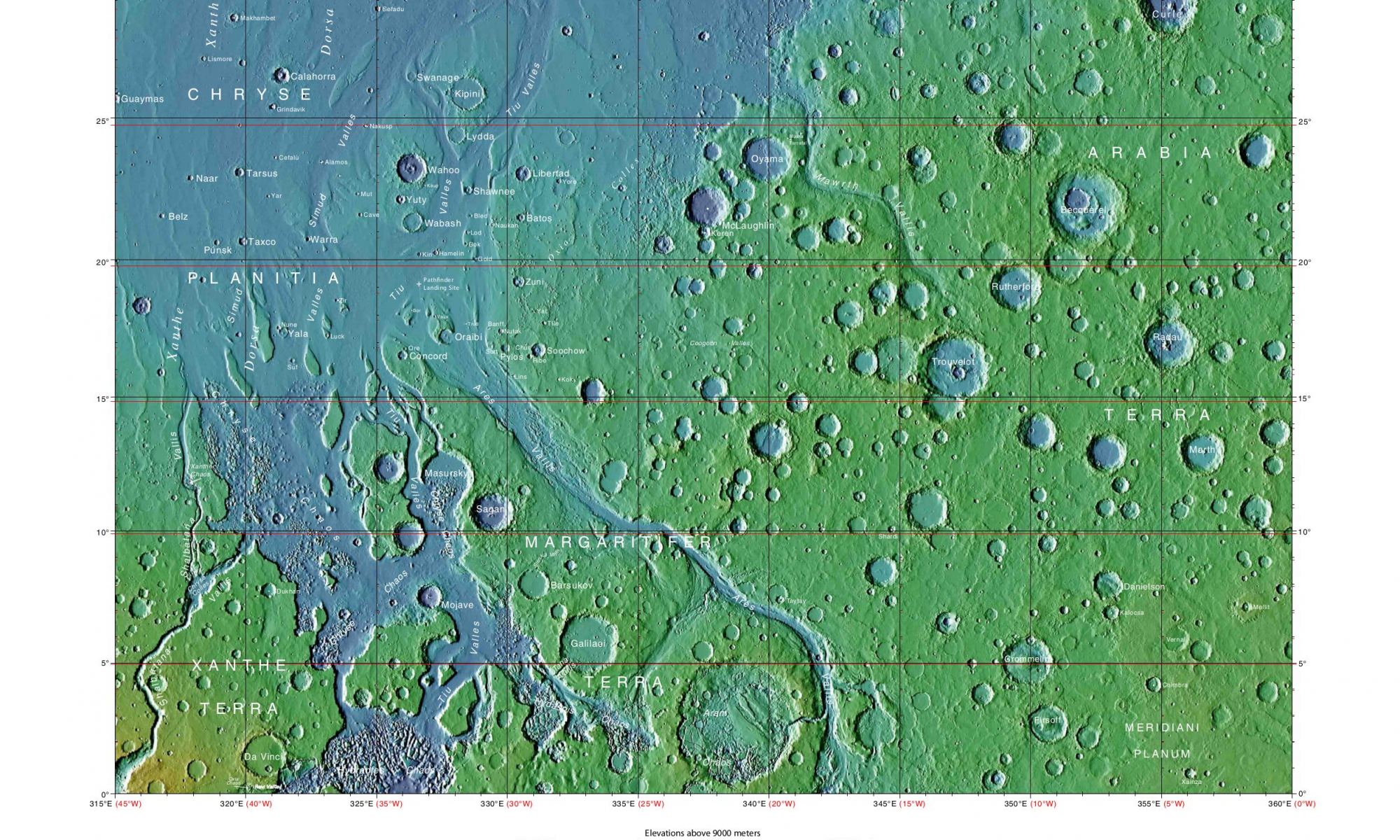
This image of Mars shows a region dominated by massive outflows from the planet's Southern Highlands to its Northern Lowlands. All that sediment could hold evidence for ancient life, if scientists look in the right place. Image Credit: NASA / JPL-Caltech / MOLA Science Team

If There Was Ever Life on Mars, this Ancient Mud Lake is the Perfect Place to Look

When it comes to Mars and our ongoing efforts to understand that planet’s ancient habitability, evidence is so far elusive. But scientists have an idea where the evidence is likely hiding: in sediments.

New research shows that an ancient mud lake is a good place to explore.

Where should we search for evidence of life on Mars? It’s not obvious, though regions with plenty of sediments are a good starting point. That’s one of the reasons NASA’s Perseverance rover is in Jezero Crater, the site of an ancient paleolake, where sediment deposits could be one km. deep. But there are many sediment-rich regions. Where else should scientists search to widen their scope?

“The quest for past Martian life hinges on locating surface formations linked to ancient habitability,” the researchers write in their paper.

One region that attracts attention is where massive outflow channels carried material from Mars’ Southern Highlands into its Northern Lowlands, to the east of Valles Marineris. Massive amounts of sediments accumulated in these northern lowlands, and that might suggest that it’s a good place to explore. But the authors of a new paper say that might be a mistake.

The paper is “Exploring the evidence of Middle Amazonian aquifer sedimentary outburst residues in a Martian chaotic terrain.” It’s published in Nature Scientific Reports, and the lead author is Alexis Rodriguez, Senior Researcher at the Planetary Science Institute.

Instead of exploring the region where the sediments flowed into, scientists should focus on the source of the sediments.

“Venturing into the northern plains for sampling could prove precarious, as distinguishing between materials sourced from the aquifers and those eroded and transported during channel formation could become an intricate task,” said Rodriguez.

Instead, researchers should focus on the Hydraotes Chaos region, a sub-region of Oxia Palus. Hydraotes Chaos might contain an ancient mud lake in the form of plains, and the sediments there could be hiding evidence of life.

This is the Oxia Palus quadrangle, one of 30 quadrangle maps that the USGS uses. There are massive, ancient outflows in the region which attract scientific attention. But a new study says an area called Hydraotes Chaos, in the yellow box, is a better target because its the source of some of the sediments. A new study suggests this is a promising region to search for evidence of life. Image Credit: USGS

This is the Oxia Palus quadrangle, one of 30 quadrangle maps that the USGS uses. There are massive, ancient outflows in the region which attract scientific attention. But a new study says an area called Hydraotes Chaos, in the yellow box, is a better target because its the source of some of the sediments. The authors suggest this is a promising region to search for evidence of life. Image Credit: USGS

“The plains, situated within Hydraotes Chaos, offer a unique glimpse into ancient aquifer materials. These plains, which we think formed from mud extruding into a basin directly above their source aquifer, provide a more targeted exploration opportunity,” Rodriguez said.

The vast flood channels stretching from the highlands into the lowlands are a region that’s so vast it’s almost impossible to explore. There’s also the complicated task of differentiating between sediments from different sources in the enormous region. The flat basin in Hydraotes Chaos could simplify exploration. “Unlike vast flood channels with their complex erosion patterns, this finding simplifies the examination of Martian aquifers, reducing the risk of overland sedimentary acquisition, and opens a new window into Mars’ geological past,” said Rodriguez.

This basin is more directly connected to Mars’ subsurface, and if the planet was ever habitable, its subsurface would’ve likely remained habitable longer than the surface. When Mars’ magnetic shield failed around four billion years ago, the surface became an inhospitable place. But simple life could’ve persisted underground, in the right conditions.

“Our research focuses on a sedimentary unit within Hydraotes Chaos, which we interpret to be the remnants of a mud lake formed by discharges from gas-charged mudstone stratigraphy dating back to nearly 4 billion years ago, a time when the surface of Mars was likely habitable. These sediments might harbor evidence of life from that or subsequent periods,” said Rodriguez. “It is important to remember that the subsurface of Mars might have included habitability lasting the duration of life’s history on Earth,” added Rodriguez.

This figure from the study shows Hydraotes Chaos (white outline), including the location of the proposed mud lake (black arrow). Image Credit: Rodriguez et al. 2023/NASA.

This figure from the study shows Hydraotes Chaos (white outline), including the location of the proposed mud lake (black arrow).  Image Credit: Rodriguez et al. 2023/NASA.

Mars’ surface and its geology is a puzzle that’s not easy to solve, even though scientists have made progress. Sometimes it involves some deep sleuthing, as in this research. The ancient mud lake isn’t where life persisted, but it’s intricately linked to where it could have existed, if it did at all.

Here’s what the researchers think happened in this region in Mars’ deep past.

The ancient mud lake had a source aquifer of mudstone directly under the lake. Within the mudstone, igneous activity triggered phase segregation, forming vast chambers of mostly liquid water that were several kilometers wide and hundreds of meters in depth. The chaotic nature of Hydraotes Chaos’ terrain suggest there were many of them, and that they were interlinked. Earth has similar features, but nowhere near as large.

This figure from the research shows some of the detail behind the mud lake's formation. Note the inter-linked chambers underground and how an igneous intrusion helped drive water and sediment into a subsidence basin, which is the mud lake. Image Credit: Rodriguez et al. 2023.

This figure from the research shows some of the detail behind the mud lake’s formation. Note the inter-linked chambers underground and how an igneous intrusion helped drive water and sediment into a subsidence basin, which is the mud lake. Image Credit: Rodriguez et al. 2023.

But all that water and sediment didn’t stay in the aquifer.

“Initially, biomolecules could have been dispersed throughout the volume of large groundwater filled cavities.” Rodriguez said. “As the water was released to the surface and ponded, the water went away leaving behind lags of sediments and potentially high concentrations of biomolecules.”

Potentially high concentrations is a good place to start, and NASA has taken note.

“NASA Ames is considering the plains as a possible landing site for a mission to search for evidence of biomarkers, specifically lipids. These biomolecules are extremely resistant and could have endured billions of years on Mars,” co-author Mary Beth Wilhelm of NASA Ames Research Center said.

The region holds other interesting features as well, and they’re also pieces of the Martian puzzle. There are widespread mud volcanoes and also diapirs, igneous intrusions of deformable material forced through brittle overlying rock. That gives researchers a glimpse of underground processes and structures without having to dig for them.

This figure from the research shows how what could be mud volcanoes (orange dots) and diapirs (white dots) are widespread. In both of these types of features, sediments could've breached the surface. The yellow box highlights the potential landing spot. Image Credit: Rodriguez et al. 2023/NASA.

This figure from the research shows how what could be mud volcanoes (orange dots) and diapirs (white dots) are widespread. In both of these types of features, sediments could’ve breached the surface. The yellow box highlights the potential landing spot. Image Credit: Rodriguez et al. 2023/NASA.

“In addition, the study region includes widespread mud volcanoes and possible diapirs, providing additional windows into subsurface, potentially habitable rocks,” said co-author Jeffrey Kargel, also from NASA AMES. “A small rover could within short distances sample the mud lake sediments and these materials, dramatically increasing the odds of biosignature detection.”

The region’s age also aligns with Mars exploration goals, and the planet’s history. The plains may be only one billion years old, meaning any biomolecules wouldn’t have been on the surface for three or more billion years like some other regions. That boosts the chances of finding any intact biomolecules, since the surface exposure would degrade them.

“Our crater counts indicate that the plains are relatively recent, returning an age of 1 billion years. This age is good news for our search for life. This age is way younger than the ages of most aquifer releases on Mars, dating back to approximately 3.4 billion years ago. So, the materials spent a huge amount of time in the subsurface.” co-author Berman said.

A small rover could visit many of these features without travelling great distances, and that’s always an attractive idea. The farther a rover needs to travel, the larger, more complicated, and more expensive it usually needs to be. There’s also more risk of failure, breakdown, or other problems.

The ESA’s upcoming Rosalind Franklin rover will land in Oxia Planum sometime after 2028, but it’s landing spot is far from this region. There are currently no plans for a mission to Hydraotes Chaos and the ancient mud lake. But the team has targeted a particular landing site for a potential mission to the region.

This image shows the region inside the yellow box in the image above. It shows the lobate margin forming part of a constant elevation contact, which the authors say is the lake’s inundation periphery. This region is a good landing spot because of its proximity to so many features. Image Credit: Rodriguez et al. 2023/NASA.

This image shows the region inside the yellow box in the image above. It shows the lobate margin forming part of a constant elevation contact, which the authors say is the lake’s inundation periphery. This region is a good landing spot because of its proximity to so many features. Image Credit: Rodriguez et al. 2023/NASA.

Who knows how long or how many missions it’ll take before we find the evidence we’re looking for. Maybe we never will. But as long as we keep looking, there’s a chance. The better we understand the planet as a whole, the more we know where to look. This work points out what could be a prime location for exploration, but we’ll have to wait and see.

{ https://www.universetoday.com/ }

Hoe vind je dit bericht?
Geschreven door peter om 22:24 Stuur door

The Combination of Oxygen and Methane Could Reveal the Presence of Life on Another World

superearth20180412-16.jpg

This artist’s impression shows the planet orbiting the Sun-like star HD 85512 in the southern constellation of Vela (The Sail). This planet is one of sixteen super-Earths discovered by the HARPS instrument on the 3.6-metre telescope at ESO’s La Silla Observatory. This planet is about 3.6 times as massive as the Earth lis at the edge of the habitable zone around the star, where liquid water, and perhaps even life, could potentially exist. Credit: ESO

The Combination of Oxygen and Methane Could Reveal the Presence of Life on Another World

In searching for life in the Universe, a field known as astrobiology, scientists rely on Earth as a template for biological and evolutionary processes. This includes searching for Earth analogs, rocky planets that orbit within their parent star’s habitable zone (HZ) and have atmospheres composed of nitrogen, oxygen, and carbon dioxide. However, Earth’s atmosphere has evolved considerably over time from a toxic plume of nitrogen, carbon dioxide, and traces of volcanic gas. Over time, the emergence of photosynthetic organisms caused a transition, leading to the atmosphere we see today.

The last 500 million years, known as the Phanerozoic Eon, have been particularly significant for the evolution of Earth’s atmosphere and terrestrial species. This period saw a significant rise in oxygen content and the emergence of animals, dinosaurs, and embryophyta (land plants). Unfortunately, the resulting transmission spectra are missing in our search for signs of life in exoplanet atmospheres. To address this gap, a team of Cornell researchers created a simulation of the atmosphere during the Phanerozoic Eon, which could have significant implications in the search for life on extrasolar planets.

The research was led by Rebecca Payne and Lisa Kaltenegger, a research associate and assistant professor with the Carl Sagan Institute at Cornell University (respectively). The paper that describes their findings, “Oxygen Bounty for Earth-like exoplanets: Spectra of Earth through the Phanerozoic,” recently appeared in the Monthly Notices of the Royal Astronomical Society: Letters. They have made the full model and high-resolution spectra available online, which provide a tool to plan, optimize, and interpret observations with ground- and space-based telescopes.

The study of exoplanets is currently experiencing a transition. With 5,528 exoplanets confirmed to date, and another 9,899 candidates awaiting confirmation, the process has been moving from discovery to characterization. This transition has benefitted from next-generation ground and space-based telescopes capable of obtaining spectra directly from exoplanet atmospheres. This is a process where light is analyzed using spectrometers to identify absorption features that correspond to different chemical compounds, thus revealing vital data about the composition of an exoplanet’s atmosphere.

This can be done using the Direct Imaging method, where astronomers examine light reflected from a planet’s atmosphere (or surface). Another method involves obtaining “transmission spectra,” where astronomers analyze light passing through an exoplanet’s atmosphere as it passes in front of its star relative to the observer (transits). Thanks to observatories like the James Webb Space Telescope (JWST), astronomers can finally obtain transmission spectra from smaller rocky planets that orbit closer to their suns – where potentially habitable, Earth-like planets are believed to reside. As Prof. Kaltenegger told Universe Today via email:

“To date, we know of about 35 rocky exoplanets circling in the habitable zones of their stars. While at the edge of technical capability for NASA’s James Webb Space Telescope, analyzing the atmosphere of some of these exoplanets is now a possibility. But scientists need to know what to look for. Our models identify planets like a Phanerozoic Earth as really promising targets to find life in the cosmos, of course, that life by no means would have to be dinosaurs.”

Despite the plethora of exoplanets that have been discovered and characterized, there is a shortage of Earth analogs whose atmospheres are in various phases of evolution. This is particularly true of the Phanerozoic Eon, the current and the latest of the four geologic eons preceded by the Proterozoic, Archaen, and Hadeon Eons. This period was particularly important for the evolution of terrestrial lifeforms because of the many crucial developments that took place throughout. This includes the Cambrian Explosion, characterized by the appearance of most modern animal species in the fossil record.

The Pleistocene of Northern Spain showing woolly mammoths, cave lions eating reindeer, tarpans, and woolly rhinoceros. Credit: Wikipedia Commons/Mauricio Antón

It also included the Devonian, where countless aquatic species adapted to dry land; the Triassic and Jurassic, which began and ended with major extinction events (the Permian–Triassic and the Triassic–Jurassic extinction event extinction events, respectively); the Cretaceous–Paleogene extinction event, the extinction of the dinosaurs; and the Neogene, where mammals and birds continued to evolve into modern forms, and the first modern humans appeared in the geological record. To predict what the atmosphere of this Eon would look like, said Kaltenegger, they created a model that combined established models with new atmospheric simulations:

“Our models simulated the transmission spectra generated by a planet with an atmosphere crossing our line of sight to its star, a transit. The planet’s atmosphere absorbs some of the colors of the starlight but lets others filter through, creating a ‘light fingerprint’ that scientists use to determine the atmosphere’s composition and whether there are signs of life in that atmosphere. Using estimates from two established climate models (called GEOCARB and COPSE), Rebecca Payne simulated Earth’s atmospheric composition and resulting transmission spectra over five 100-million-year increments of the Phanerozoic, the epoch when the biosphere diversified and forests became widespread, changing the mix of oxygen and other gasses in the air.”

Key to their simulations was the oxygen content of the atmosphere, which rose from about 10% at the beginning of the Phanerozoic (the Cambrian period) to 35% by the end (the Neogene). The resulting higher oxygen levels, they state, were arguably a prerequisite for the evolution of complex life – including the dinosaurs, mammals, and hominids (eventually leading to modern humans). Regardless, the “light fingerprint” their simulation produced would stand out even more than that of modern-day Earth because of the higher oxygen content.

“Analyzing the most recent 540 million years of Earth’s evolution, the Phanerozoic Eon, we found that chemical signatures of life in the atmosphere of an Earth-like exoplanet are more pronounced than for modern Earth,” said Kaltenegger. “During the Phanerozoic – that includes the time of the dinosaurs (245-66 Mio years ago), two key biosignature pairs – oxygen and methane, and ozone and methane – appeared stronger about 300 Million years ago, when oxygen levels were significantly higher.”

This artistic conception illustrates large asteroids penetrating Earth’s oxygen-poor atmosphere. Credit: SwRI/Dan Durda/Simone Marchi

This research is bolstered by another recent study led by a team from Dartmouth College (on which Kaltenegger was a co-author). In their paper, which recently appeared in the Monthly Notices of the Royal Astronomical Society (“An Information Theory Approach to Identifying Signs of Life on Transiting Planets“), the team described how they simulated a range of transmission spectra to create an algorithm for identifying potential biosignatures on Earth-analogs. They tested this algorithm on three epochs of atmospheric evolution for Earth-like planets orbiting a range of host stars.

The resulting diagnostic tool, they said, can be applied to future observations to constrain planetary habitability. This research and the model created by Payne and Kaltenegger could have drastic implications for astrobiology by providing a template for finding planets in various stages of habitability. As Kaltenegger summarized:

“So for identifying potentially habitable worlds, there was a time when this fingerprint of life was even more pronounced than now – and it was during the reign of the dinosaurs. Thus, even though finding life in the cosmos is incredibly hard,  it just might have gotten a little bit easier than we thought. Jurrasic worlds  – with their large, complex life – might just give us the chance to find it a tiny bit easier. And who knows, maybe we get lucky, and there are other dinosaurs waiting to be found.”

Further Reading:

{ https://www.universetoday.com

/ }

Hoe vind je dit bericht?
Geschreven door peter om 21:46 Stuur door

Thinking About Time Travel Helps Solve Problems in Physics

gettyimages-1494236463-dp.jpg

Physicists have shown that simulating models of hypothetical time travel can solve experimental problems that appear impossible to solve using standard physics. Credit: Yaroslav Kushta via Getty Images

Thinking About Time Travel Helps Solve Problems in Physics

Time travel. We’ve all thought about it at one time or another, and the subject has been explored extensively in science fiction. Once in a while, it is even the subject of scientific research, typically involving quantum mechanics and how the Universe’s four fundamental forces (electromagnetism, weak and strong nuclear forces, and gravity) fit together. In a recent experiment, researchers at the University of Cambridge showed that by manipulating quantum entanglements, they could simulate what could happen if the flow of time were reversed.

The research team was led by David Arvidsson-Shukur, a quantum researcher with the Hitachi Cambridge Laboratory (HCL) at the University of Cambridge. He was joined by Aidan G. McConnell, a Ph.D. student with Cambridge’s Cavendish Laboratory, the Paul Scherrer Institute, and Eidgenössische Technische Hochschule Zürich (ETH Zurich); and Nicole Yunger Halpern, an Adjunct Assistant Professor at the Joint Center for Quantum Information and Computer Science (QuICS) and the Institute for Physical Science and Technology (IPST) at the University of Maryland. Their paper, “Nonclassical Advantage in Metrology Established via Quantum Simulations of Hypothetical Closed Timelike Curves.”

In the realm of quantum theory, entanglement describes when a group of particles are generated, interact, or share proximity in such a way that their quantum states become identical. As physicists have observed for over a century, these particles will remain in this state long after, even though they may become separated by vast distances (what Einstein referred to as “spooky action at a distance.”) This is the basis of quantum computing, where entangled particles are used to perform computations that are too complex for classical computers.

Illustration depicting quantum entanglement between particles. Credit: ATLAS Experiment

Whether or not particles can travel backward in time has also been the subject of considerable debate among physicists. While physicists have previously simulated models of how such “time travel” might occur, the Cambridge team took a new approach by connecting their theory to quantum metrology, which uses quantum theory to make highly sensitive measurements. As a result, the Cambridge team showed that entanglement can solve problems that otherwise seem impossible. Said lead author Arvidsson-Shukur in a Cambridge press release:

“Imagine that you want to send a gift to someone: you need to send it on day one to make sure it arrives on day three. However, you only receive that person’s wish list on day two. So, in this chronology-respecting scenario, it’s impossible for you to know in advance what they will want as a gift and to make sure you send the right one. Now imagine you can change what you send on day one with the information from the wish list received on day two. Our simulation uses quantum entanglement manipulation to show how you could retroactively change your previous actions to ensure the final outcome is the one you want.”

In their experiment, the team entangled two particles. The first was sent to be used in the experiment, while the second was maintained separately. The experiment then manipulated the second particle to effectively alter the first particle’s past state, changing the experiment’s outcome. To demonstrate the potential relevance of their experiment to quantum computing and other technologies, the team incorporated quantum metrology. In traditional metrology experiments, photons are prepared before being introduced onto a sample and then registered with a special camera.

Their results showed that the team can use time travel simulations to retroactively change the original photons, even if they only learn how to prepare the photons after reaching the sample. However, the team also noted that this effect was only observable in one out of four experimental runs, meaning the simulation has a 75% chance of failure. The theorists propose sending many entangled photons to counteract the high chance of failure, knowing that some will eventually carry the updated information.

This illustration shows the “arrow of time” from the Big Bang to the present cosmological epoch. Credit: NASA

They also recommend using a filter to remove the “uncorrected” photons while the updated photons pass to the camera. At best, said Arvidsson-Shuku, the experiment will produce the desired results a quarter of the time, which is tantamount to getting the desired “gift” one in four times. Moreover, if the “gifts” are inexpensive, many can be sent over extended periods, eventually leading to a statistically significant number of desirable outcomes. Of course, Arvidsson-Shuku and his colleagues stress that this is not “time travel” in the traditional sense:

“That we need to use a filter to make our experiment work is actually pretty reassuring. The world would be very strange if our time-travel simulation worked every time. Relativity and all the theories that we are building our understanding of our universe on would be out of the window. We are not proposing a time travel machine but rather a deep dive into the fundamentals of quantum mechanics. These simulations do not allow you to go back and alter your past, but they do allow you to create a better tomorrow by fixing yesterday’s problems today.”

The team’s research was supported by the Sweden-America Foundation, the Lars Hierta Memorial Foundation, Girton College, and the Engineering and Physical Sciences Research Council (EPSRC), part of UK Research and Innovation (UKRI).

Further Reading: 

RELATED

{ https://www.universetoday.com/ }

Hoe vind je dit bericht?
Geschreven door peter om 21:14 Stuur door

US Govt. Has UFO & They Can Go Inside It, Reveals Ex-DIA Intelligence Officer

Dr. James Lacatski UFO and its inside

US Govt. Has UFO & They Can Go Inside It, Reveals Ex-DIA Intelligence Officer

UFO expert Jeremy Corbell, accompanied by investigative journalist George Knapp, released a groundbreaking episode of “Weaponized,” featuring Dr. James Lacatski and Dr. Colm Kelleher. The episode revealed insider information that had never been shared before. Dr. Lacatski and Dr. Kelleher played pivotal roles in the operation of a UFO program funded by the US government for five years, with a total budget of $22 million.

Dr. James Lacatski is a retired DIA intelligence officer who set up the UFO program that ran from 2008 to 2010. In the early 2000s, he headed up the DIA annual missile threat assessment. He originally started the research out of concern that UFOs could pose a national security threat, specifically to U.S. missile defense systems. In the interview, he says the United States Government is in possession of a UFO and has accessed the inside of it.

In the interview, while addressing the events mentioned in the newly launched book “Inside the US Government Covert UFO Program Initial Revelations,” Dr. Lacatski clarified the differences between AAWSAP and AATIP. He stated that AAWSAP (Advanced Aerospace Weapon Systems Applications Program) was created in collaboration with Senator Harry Reid at the DIA, with a budget of $22 million and the capacity to run for five years, though they completed their objectives in two years.

He further explains that the name AATIP (Advanced Aerospace Threat Identification Program) was not created by him but was chosen for a specific reason, which he did not disclose. The need for a different name arose from a document that indicated DIA’s receipt of funding, with “secret” written next to the program name. To avoid potential security concerns, a different name was necessary. It is implied that AAWSAP was the original name, and someone in Congress may have designated it as AATIP.

Dr. Lacatski discussed some of the intriguing aspects of UFO cases and their various designs. He mentions how some cases involved people reporting seeing the same UFO decades apart, which raises questions about time and the nature of these sightings.

Knapp brings up a particularly important revelation in the book regarding a craft of unknown origin that the government accessed the inside of. Dr. Lacatski confirms that the book contains an exact statement of the event that occurred within a congressional facility. However, he could not provide further details due to security concerns. He clarified that the DOD reviewed the book for release, and the wording was approved.

UFO & Its Inside

In Chapter 9 of the book, Dr. Lacatski reveals that the United States government possesses a craft of unknown origin and has successfully accessed its interior. This craft has a streamlined configuration suitable for aerodynamic flight but lacks conventional features like an engine, wings, intakes, exhaust, or fuel tanks.

Corbell presses for further confirmation, asking Dr. Lacatski if the government indeed has a UFO in its possession and has been reverse-engineering it, to which Dr. Lacatski affirms, “Yes.”

Knapp follows up with a question about the nature of this object, asking how they know it is a craft and not just a doorstop. Dr. Lacatski hints that there is more to the discussion that day, but they cannot delve into those details. However, he does mention that it is described in the book as looking “primitive.”

Corbell questions why this topic is considered delicate, given that the United States government possesses a UFO and has been reverse engineering it. Dr. Lacatski explains that the sensitivity arises from the presence of adversaries and competitors who may be monitoring the information. He emphasizes that the government cannot say more than what they have been approved to share due to security concerns.

In fact, Lacatski asserted that there is no reason for humanity to fear potential non-human intelligence, provided that the human species discovers its full capabilities, stating: “If full human capabilities were known to us right now, it is not something that we need to fear.”He added: “Our capabilities have never been fully revealed. And we’re still learning; we’ve got a long way to evolve still.”

Dr. Lacatski then shifts the focus to the questions raised in his previous books, particularly “Skinwalkers at the Pentagon: An Insiders’ Account of the Secret Government UFO Program.” He points out that they have posed questions about why the program was started, why it ended, and certain unexplained meetings with high-level officials from other countries. He suggests that reading between the lines is crucial but warns that there may be multiple answers or no clear-cut bottom line.

“So the thing is, we can’t say anything more than what we’ve been approved to say, and there’s insight to this. But I want to shift it just slightly, but it shows my point: Skinwalkers at the Pentagon: An Insiders’ Account of the Secret Government UFO Program, if I might use the shorter title on this new book, has what I would call zingers in it. But it has some interesting doors that have not even been mentioned. One, why was this program started? Two, why was this program ended? And we’ve raised this partially, and Skin Walkers at the Pentagon, did it end? Also, we had a chapter in Skin Walkers at the Pentagon where we met with a high-level Brazilian official at a meeting started introducing some of our cohorts, and no one ever asked us, why did you have that meeting? What was so important about that meeting? You know, there’s a lot of material in there that, as Kit Green, Dr. Kit Green, one of our consultants on the asset program, said, ‘Read between the lines.’ That applies both to Skin Walkers at the Pentagon and Initial Revelations. Read between the lines. Now, you may come to the wrong conclusions, and I can tell you, on the topics I just read to you, you don’t have enough information to come to the correct answers

David Grusch is credible but there are forged documents

Corbell brings up the fact that former US intelligence officer David Grush testified before Congress, and many were hoping that Dr. Lacatski would testify as well. Dr. Lacatski responds that he does not know Mr. Grush and has never met him. When asked about the credibility of Grush’s claims, Dr. Lacatski refrains from making any definitive statements but mentions that he personally did not witness any illegal activities during his time in the program. He acknowledges that Grush’s claims are reasonable but does not confirm or dispute them.

Corbell probes further about Grush’s claims, particularly regarding UFOs and reverse engineering. Dr. Lacatski responds that he cannot provide any additional information on certain topics, including biological aspects, due to security reasons. “I can’t answer…no, that goes back to something that occurred, a similar question, very similar to your question. It wasn’t asked by you, but it was asked to Colm, and he said, ‘We found no smoking gun. That is the standard answer we’re to give,” Dr. Lacatski says.

Corbell expresses his curiosity about the reasons behind the secrecy and alludes to a sense of suspicion among the public. He speculates whether the reasons for withholding certain information might be dark or disturbing.

Read also:

Dr. Lacatski replies, “If you want my opinion on that, I see no darkness at all here. Basically, there were some considerable write-ups on the skinwalker at the Pentagon that our program was stopped due to religious concerns from the far right. Well, if there were, I knew nothing about that. I saw no evidence of that being true. But people can say whatever they want on the internet, apparently. And that was not, that was not—I did not witness any of that. And I think that that’s come up in some of these Congressional hearings.”

Corbell asks if David Grush’s information is considered credible by Dr. Lacatski, to which he responds, “I do,” implying that the information is credible. Dr. Lacatski mentions that Grush worked with someone he knows and trusts in the UAP Task Force, indicating that there’s a level of trust in the source. However, he brings up the phenomenon where individuals can genuinely believe in and talk about things that are factually incorrect.

Corbell emphasizes that Grush has talked about tangible and physical aspects, such as program names and the locations of UFOs, along with the involvement of individuals who worked on these “Legacy UFO programs.” Dr. Lacatski confirms the existence of Legacy UFO programs and mentions the presence of forged documents.

Dr. Lacatski mentions that AAWSAP has also faced similar challenges, with certain documents being misrepresented as genuine. He highlights the closed and secretive nature of AAWSAP, comparing it to the way SAPs (Special Access Programs) operate. Only a select few within the program were aware of its existence, and it was structured to limit exposure to external influences and political inquiries.

He points out that the documents that have emerged over time as forgeries have no official endorsement or validation. It is not clear why these forgeries were created, and Dr. Lacatski suggests that if they were part of a Counter Intelligence effort, it might not have been very effective. He emphasizes that their work is based on real, verifiable references.

{ https://www.howandwhys.com/ }

Hoe vind je dit bericht?
Geschreven door peter om 18:38 Stuur door

Area 51’s Hidden Mysteries UNVEILED: Dive into Bob Lazar’s Extraterrestrial Odyssey!

Area 51’s Hidden Mysteries UNVEILED: Dive into Bob Lazar’s Extraterrestrial Odyssey! 

S4-AREA 51 SECRETS EXPOSED Recreating Bob Lazar

In the world of ufology, few names resonate as loudly as Bob Lazar’s. From claims of working on reverse-engineered extraterrestrial technology at Area 51‘s S4 base to revealing government secrets, Lazar has been a figure of fascination and controversy for decades. Now, an ambitious project aims to bring his stories to life through the immersive power of virtual reality.

Introducing Project Gravur: a unique endeavor led by Luigi Vatelli and his dedicated team. Their goal? To reconstruct Lazar’s experience at the S4 base, allowing users to walk in Bob’s shoes, so to speak.

Delving deep into this project, one uncovers the meticulous care that the Gravur team has taken. The representation is not just about the infamous sports model UFO that Lazar spoke of, but the entirety of S4—from hallways to briefing rooms and beyond. A standout feature is the recreation of the “sports model” craft. With exacting precision and attention to detail, Vatelli’s team has constructed a lifelike simulation, guided by Lazar’s own descriptions.

The project isn’t just about sights; it’s also about emotion. The aim is to humanize Bob Lazar’s story. To help users understand the thrill, curiosity, and trepidation Lazar might have felt in those hidden hallways, staring at a craft from another world.

One delightful tidbit reveals a fun aspect of the simulation. There’s a virtual death ray, inspired by one in Lazar’s Oregon lab, that can “burn a hole through anything.” While it adds a touch of levity, it also symbolizes the impressive technological feats Lazar has achieved beyond his time at S4.

Bob Lazar‘s journey with this project has been deep and collaborative. Vatelli speaks of a mutual respect and trust between them. The entire team, once skeptical, has grown to appreciate Lazar not just for his stories but as a genuine, down-to-earth individual.

Video:

  • S4-AREA 51 SECRETS EXPOSED: Recreating Bob Lazar’s Alien Tech Journey | The Richard Dolan Show

Scheduled for an early 2024 release, this immersive VR experience promises to be a groundbreaking addition to the realm of ufology and beyond. The film treatment, “Lazar: The Original Whistleblower,” will precede the VR project. Viewers can first understand Bob’s narrative and then virtually “become” Bob, exploring the S4 base on their own.

In an age where technology constantly evolves, the marriage of Lazar’s revelations with cutting-edge VR innovation might just be the next big step in understanding the mysteries of our universe.

RELATED

{ https://www.latest-ufo-sightings.net/ }

Hoe vind je dit bericht?
Geschreven door peter om 18:04 Stuur door

UAP Over Sarasota Airport, Florida Oct 16, 2023, Video, UFO Sighting News.

UAP Over Sarasota Airport, Florida Oct 16, 2023, Video, UFO Sighting News.

ovni,%20omni,MUFON,%20%E7%9B%AE%E6%92%83%E3%80%81%E3%82%A8%E3%82%A4%E3%83%AA%E3%82%A2%E3%83%B3,%20%20UFO,%20UFOs,%20sighting,%20sightings,%20alien,%20aliens,%20ET,%20anomaly,%20anomalies,%20vreemdelinge,%20%20.png

ET,%20UFO,%20UFOs,%20sighting,%20sightings,%20alien,%20aliens,%20W56,%20%20classified,%20ESA,%20UN,%20CNN,%20CNBC,%20.png

Date of sighting: Oct 16, 2023
Location of sighting: Sarasota, Florida, USA
Source: MUFON
 
Guys, this UFO is very similar to shape, color and movement to recently government released UFO videos. This object was seen over the airport which must have gotten on radar screens, but did it delay any flights? This craft is awesome, the shape is oval and about the size of a car. Breathtaking catch. Also it's compounded by the fact it's near the ocean, just a few miles away. Most alien bases on Earth are under the ocean floor, since 75% of this planet is covered it water, its just logical aliens would choose ocean floors to avoid detection and interactions with humans. 
Scott C. Waring 

Eyewitness states:
 I was at SRQ airport waiting for my flight inside the terminal and I saw this silver orb outside. Thought it was a balloon at first but it didn’t behave like one. It stayed at the same elevation/altitude the entire time. It was so steady in its flight there was no way it could have been a Mylar balloon that would have reflected light in that way.

{ https://www.ufosightingsdaily.com/ }

Hoe vind je dit bericht?
Geschreven door peter om 23:15 Stuur door

The mysterious 'Fiji mermaid' examined by NKU students

The mysterious 'Fiji mermaid' examined by NKU students

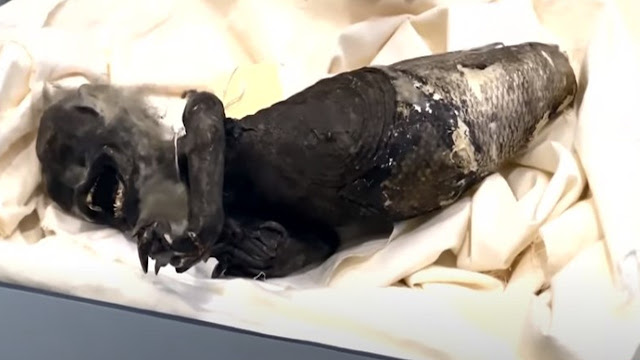
The Fiji Mermaid, a mysterious creature housed in an Ohio museum for over a century, recently underwent examination by radiology students from Northern Kentucky University. 
fiji%20mermaid.jpg

The creature, a 3 feet long mummified, black-looking diminutive specimen was discovered with it's mouth open, its tail turned over, and its arms thrown up, giving it the appearance of having died in great agony, reportedly donated to Ohio's Clark County Historical Society in 1906 by a Navy sailor who obtained it in Japan, intrigued the students. 
The peculiar creature, featuring a human-like head and a fish's body, prompted the university's radiology department to employ CT scans and X-rays to unravel its construction. 
Contrary to initial expectations of a combination of a monkey and a fish, the scans revealed additional amphibious features, especially towards the hands. The university plans to share the scan results with experts at the Cincinnati Zoo and Newport Aquarium to identify the specific animals involved in creating this enigmatic creature.
   

{ http://ufosightingshotspot.blogspot.com/ }

Hoe vind je dit bericht?
Geschreven door peter om 23:04 Stuur door

LATEST UFO SIGHTINGS (VIDEOS) - 18/10/2023

LATEST UFO SIGHTINGS (VIDEOS) - 18/10/2023

Ruimtevernietiging | Waarschuwing voor ruimtepuin

Tegenwoordig is het probleem van afval in de ruimte een nachtmerrie geworden voor astronauten en ruimtevaartexploitanten. De hoeveelheid puin in de ruimte is de afgelopen zestig jaar gestaag toegenomen, omdat steeds meer satellieten in een baan om de aarde zijn gebracht en talloze raketten zijn getest. In 2009 kwamen twee werkende satellieten met elkaar in botsing, waardoor tonnen nieuw ruimteafval met een ongelooflijke snelheid in een baan om de aarde terechtkwamen. Dit soort gebeurtenissen creëert een vicieuze cirkel: elke keer dat er puin botst, wordt er steeds meer afval geproduceerd. Iedereen die betrokken is bij de verovering van de ruimte is nu gedwongen de afvalwolken voortdurend in de gaten te houden en in geval van nood hun werkende satellieten om te leiden. Maar veel satellieten zijn ‘vergeten’ en zullen onvermijdelijk botsingen veroorzaken. Momenteel zijn alle pogingen om dit puin te minimaliseren of te vermijden ontoereikend en kunnen zware gevolgen hebben voor onze satellieten en andere activiteiten op aarde. Het wordt hoog tijd dat we onze ruimterommel opruimen!

Regie: Bertrand Loyer

Unexplained Discoveries That Could Rewrite History

Classic Flying Saucer Shaped UFO Sigthed During A Commercial Flight Over Colombia.

This footage was taken about two weeks ago while the witness was traveling from Bogotá to Salento in Colombia. The footage was posted to the Spanish Internet forum "Forocoches". In the footage we can see this flying saucer just fly without a care in the world and not afraid to be seen but what could this object be???

RELATED

How far does the Milky Way REALLY extend? Discoveries at the Edge of Our Galaxy | Space Documentary

Have you ever imagined what lies at the edge of our galaxy?

The Milky Way has captivated human eyes since the dawn of time. It remains magnificent and fascinating on a dark night, whether you're in the middle of the desert or on top of a mountain. On beautiful summer nights, devoid of light pollution, we can follow its path through the celestial vault without even needing an observation instrument. It forms a wispy band around the entire sky. In this band, over 200 billion stars are gathered together. Of these, around 6,000 are detectable without binoculars or telescopes

We've known since the 20th century that the Milky Way is our galaxy. This immense disk of stars is made up of a very luminous, compact central region, known as the bulge, and smaller spiral arms. The Milky Way has an estimated diameter of 100,000 light-years and a thickness of over 1,000 light-years. Since the 1990s, astronomers have discovered that our galaxy is not simply a spiral galaxy, but a barred spiral galaxy. It has a short bar of stars on either side of the central bulge.
The Milky Way is home to the solar system, and thus to the Earth. It is part of the Local Group itself attached to the Virgo supercluster belonging to Laniakea.

Most Powerful Planetary Collision Ever Seen Detected In Our Galaxy

0:00 Planetary collisions

1:10 New collision was insane

1:40 How it was found

2:10 Type of a star and the effects observed

3:50 Other similar detections before

4:30 How this usually looks and what is expected

5:20 How this is different and why this is so unexpected

8:00 What's there now

RELATED

Most Powerful Solar Storm Ever Happened 14,300 Years Ago

Vela Pulsar Did Something That Make No Physical Sense

0:00 Vela pulsar in a nutshell

2:45 Unexplained new detection

3:18 How all of this is discovered

5:20 Vela pulsar releases super powerful emissions

6:30 Potential explanation

7:50 Potential answers from SN1987A

9:20 Signs of a pulsar being formed

9:50 JWST confirms a pulsar formation

RELATED

James Webb Telescope Just Intercepted A Mysterious Object No One Can Explain

About six months after the James Webb Space Telescope was launched into space, it intercepted a mysterious object no one can explain. The telescope spotted four most distant galaxies, which happened to be the oldest about 13.4 billion years ago. The cosmos was just 350 million years old at the time, or roughly 2% of its present age. What is this mysterious object, and how important is it to space exploration and research? What other mysteries are out there in space waiting to be uncovered by James Webb and space probes?

Orbiting Mars, We Discovered Another Ship. It's Not Human, And It's Not Empty | Sci-Fi Creepypasta

{ https://www.youtube.com/ }

Hoe vind je dit bericht?
Geschreven door peter om 22:01 Stuur door

Meer van UFO'S of UAP'S, ASTRONOMIE, RUIMTEVAART, ARCHEOLOGIE, OUDHEIDKUNDE, SF-SNUFJES EN ANDERE ESOTERISCHE WETENSCHAPPEN - DE ALLERLAATSTE NIEUWTJES

↑ Terug naar de berichten