Ontdek de Fascinerende Wereld van UFO's en UAP's: Jouw Bron voor Onthullende Informatie!
Ben jij ook gefascineerd door het onbekende? Wil je meer weten over UFO's en UAP's, niet alleen in België, maar over de hele wereld? Dan ben je op de juiste plek!
België: Het Kloppend Hart van UFO-onderzoek
In België is BUFON (Belgisch UFO-Netwerk) dé autoriteit op het gebied van UFO-onderzoek. Voor betrouwbare en objectieve informatie over deze intrigerende fenomenen, bezoek je zeker onze Facebook-pagina en deze blog. Maar dat is nog niet alles! Ontdek ook het Belgisch UFO-meldpunt en Caelestia, twee organisaties die diepgaand onderzoek verrichten, al zijn ze soms kritisch of sceptisch.
Nederland: Een Schat aan Informatie
Voor onze Nederlandse buren is er de schitterende website www.ufowijzer.nl, beheerd door Paul Harmans. Deze site biedt een schat aan informatie en artikelen die je niet wilt missen!
Internationaal: MUFON - De Wereldwijde Autoriteit
Neem ook een kijkje bij MUFON (Mutual UFO Network Inc.), een gerenommeerde Amerikaanse UFO-vereniging met afdelingen in de VS en wereldwijd. MUFON is toegewijd aan de wetenschappelijke en analytische studie van het UFO-fenomeen, en hun maandelijkse tijdschrift, The MUFON UFO-Journal, is een must-read voor elke UFO-enthousiasteling. Bezoek hun website op www.mufon.com voor meer informatie.
Samenwerking en Toekomstvisie
Sinds 1 februari 2020 is Pieter niet alleen ex-president van BUFON, maar ook de voormalige nationale directeur van MUFON in Vlaanderen en Nederland. Dit creëert een sterke samenwerking met de Franse MUFON Reseau MUFON/EUROP, wat ons in staat stelt om nog meer waardevolle inzichten te delen.
Let op: Nepprofielen en Nieuwe Groeperingen
Pas op voor een nieuwe groepering die zich ook BUFON noemt, maar geen enkele connectie heeft met onze gevestigde organisatie. Hoewel zij de naam geregistreerd hebben, kunnen ze het rijke verleden en de expertise van onze groep niet evenaren. We wensen hen veel succes, maar we blijven de autoriteit in UFO-onderzoek!
Blijf Op De Hoogte!
Wil jij de laatste nieuwtjes over UFO's, ruimtevaart, archeologie, en meer? Volg ons dan en duik samen met ons in de fascinerende wereld van het onbekende! Sluit je aan bij de gemeenschap van nieuwsgierige geesten die net als jij verlangen naar antwoorden en avonturen in de sterren!
Heb je vragen of wil je meer weten? Aarzel dan niet om contact met ons op te nemen! Samen ontrafelen we het mysterie van de lucht en daarbuiten.
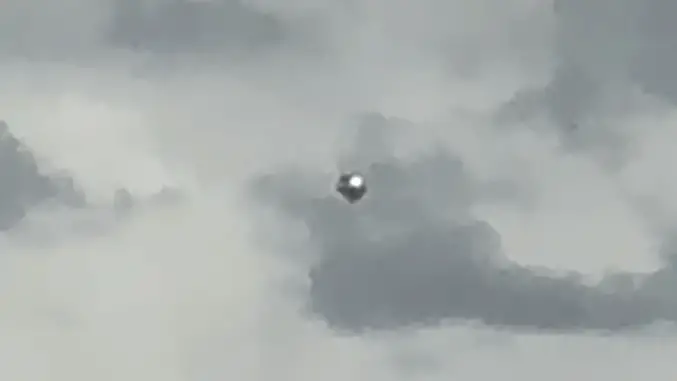
Amazing UFO video – Flying saucer filmed from a plane over Colombia 2 weeks ago
UFO Sighting Caught on Camera: Bogotá to Salento Flight Reveals Stunning Saucer!
In the vast realm of UFO sightings, every once in a while, a video emerges that sends chills down the spines of even the most skeptical observers. Early this October 2023, such a video surfaced, taken by a passenger aboard a commercial airliner journeying from Bogotá to Salento in Colombia.
The Encounter
While it’s not uncommon for plane passengers to capture breathtaking views of the clouds or the sunset, capturing a potential UFO is definitely not on the usual itinerary. The footage, described as both “clear” and “crisp,” depicts what many might call a classic flying saucer, making its way through the vast blue sky.
The object’s distance from the plane or its size is hard to pinpoint. However, its distinctive shape and appearance are unmissable. At first glance, one might mistake it for a stray balloon, peacefully floating and adrift in the wind. But as you continue to observe, the object seemingly spins on its axis – a behavior often attributed to many Unidentified Aerial Phenomena (UAP).
Mysteries Remain
The conversations and reactions of the passengers onboard remain a mystery, as the video doesn’t provide clarity on their sentiments. Yet, one can’t help but wonder: Was this UFO moving with purpose, or was it just gracefully floating, allowing the plane and its passengers a fleeting glimpse into the unknown?
A Must-Watch
For those intrigued by mysteries of the skies, the video is a must-watch, especially with its stabilised version, which provides an even clearer view of this remarkable sighting. Whether you’re a believer in extraterrestrial encounters or just someone with a penchant for the unexplained, this footage from the skies above Colombia will undoubtedly pique your curiosity.
As we continue to search for answers in the vastness of the universe, one thing is certain: UFO sightings, like the one captured on this Bogotá to Salento flight, remind us that the skies are full of wonders waiting to be explored.
Interested in more intriguing UFO sightings? Dive deeper into our collection of similar UFO videos at our Youtube channel and stay updated with the latest unexplained phenomen.
Florida: UFO Over SRQ Airport? Shocking Daytime Sighting of Metallic Orb
Florida, 16th October 2023 – UFO sightings have always captured the imagination of enthusiasts and skeptics alike. Yesterday, the skies above SRQ Sarasota Bradenton International Airport bore witness to a curious phenomenon: a metallic orb, steadily hovering in broad daylight.
Check the video bellow here to view the remarkable footage.
As the afternoon sun shimmered over the horizon, travelers inside the airport terminal busied themselves, awaiting their respective flights. Among them was an observant traveler who couldn’t help but notice something out of the ordinary through the vast terminal windows.
“I was at SRQ airport waiting for my flight inside the terminal and I saw this silver orb outside,” the witness reported. At first glance, one could mistake it for a shiny balloon lost in the vast blue yonder. Yet, upon closer observation, it became evident that this was no ordinary object.
“Thought it was a balloon at first but it didn’t behave like one,” the witness added. The peculiar orb maintained its altitude with a precision not associated with conventional airborne objects like balloons. Even if it was a Mylar balloon, the reflection it cast was unusually consistent and steady.
Given the proximity of the sighting to the airport and its flight pattern, questions are abound. Was it a drone? A novel type of aircraft? Or perhaps something more mysterious?
UFO enthusiasts and researchers will undoubtedly pore over the video footage, analyzing its every detail, trying to decipher what it could possibly be. As with most UFO sightings, definitive answers might be elusive, but the intrigue and fascination will endure.
For those lucky enough to witness such events, or for anyone with an interest in the unexplained, the skies above Florida seem to hold more mysteries than ever before. With this recent sighting added to the ever-growing list of UFO encounters, one thing’s for sure: the search for answers continues.
Have you had any recent UFO sightings or encounters? Share your experiences and join the global community in the quest for understanding the unknown.
The Big Bang Theory explains how the universe began.
The Big Bang Theory explains how the universe began 13.7 billion years ago.
(Image credit: RomoloTavani via Getty Images)
The Big Bang Theory is the leading explanation for howbegan. Simply put, it says the universe as we know it started with an infinitely hot and dense single point that inflated and stretched — first at unimaginable speeds, and then at a more measurable rate — over the next 13.7 billion years to the still-expanding cosmos that we know today.
Existing technology doesn't yet allow astronomers to literally peer back at the universe's birth, much of what we understand about the Big Bang comes from mathematical formulas and models. Astronomers can, however, see the "echo" of the expansion through a phenomenon known as the cosmic microwave background.
While the majority of the astronomical community accepts the theory, there are some theorists who have alternative explanations besides the Big Bang — such as eternal inflation or an oscillating universe.
Around 13.7 billion years ago, everything in the entire universe was condensed in an infinitesimally small singularity, a point of infinite denseness and heat.
Suddenly, an explosive expansion began, ballooning our universe outwards faster than the speed of light. This was a period of cosmic inflation that lasted mere fractions of a second — about 10^-32 of a second, according to physicist Alan Guth’s 1980 theory that changed the way we think about the Big Bang forever.
When cosmic inflation came to a sudden and still-mysterious end, the more classic descriptions of the Big Bang took hold. A flood of matter and radiation, known as "reheating," began populating our universe with the stuff we know today: particles, atoms, the stuff that would become stars and galaxies and so on.
Hubble images show the far-distant galaxy GN-z11 as it appeared shortly after the Big Bang. (Image credit: NASA)
This all happened within just the first second after the universe began, when the temperature of everything was still insanely hot, at about 10 billion degrees Fahrenheit (5.5 billion Celsius), according to NASA. The cosmos now contained a vast array of fundamental particles such as neutrons, electrons and protons — the raw materials that would become the building blocks for everything that exists today.
This early "soup" would have been impossible to actually see because it couldn't hold visible light. "The free electrons would have caused light (photons) to scatter the way sunlight scatters from the water droplets in clouds," NASA stated. Over time, however, these free electrons met up with nuclei and created neutral atoms or atoms with equal positive and negative electric charges.
This allowed light to finally shine through, about 380,000 years after the Big Bang.
Sometimes called the "afterglow" of the Big Bang, this light is more properly known as the cosmic microwave background (CMB). It was first predicted by Ralph Alpher and other scientists in 1948 but was found only by accident almost 20 years later.
A map of the background radiation left over from the Big Bang, taken by the ESA's Planck spacecraft, captured the oldest light in the universe. This information helps astronomers determine the age of the universe. (Image credit: ESA and the Planck Collaboration, CC BY-SA)
This accidental discovery happened when Arno Penzias and Robert Wilson, both of Bell Telephone Laboratories in New Jersey, were building a radio receiver in 1965 and picked up higher-than-expected temperatures, according to a NASA article. At first, they thought the anomaly was due to pigeons trying to roost inside the antenna and their waste, but they cleaned up the mess and killed the pigeons and the anomaly persisted.
Simultaneously, a Princeton University team led by Robert Dicke was trying to find evidence of the CMB and realized that Penzias and Wilson had stumbled upon it with their strange observations. The two groups each published papers in the Astrophysical Journal in 1965.
BIG BANG THEORY FAQS ANSWERED BY AN EXPERT
We asked Jason Steffens, assistant professor of physics and astronomy at the University of Nevada, Las Vegas, a few frequently asked questions about the Big Bang Theory.
Jason Steffens
Assistant Professor
Jason Steffens is an assistant professor of physics and astronomy at the University of Nevada, Las Vegas.
Has the Big Bang Theory been proven?
This isn't really a statement that we can make in general. The best we can do is say that there is strong evidence for the Big Bang Theory and that every test we throw at it comes back in support of the theory. Mathematicians prove things, but scientists can only say that the evidence supports a theory with some degree of confidence that is always less than 100%.
So, a short answer to a slightly different question is that all of the observational evidence that we've gathered is consistent with the predictions of the Big Bang Theory. The three most important observations are:
The Hubble Law shows that distant objects are receding from us at a rate proportional to their distance — which occurs when there is uniform expansion in all directions. This implies a history where everything was closer together.
The properties of the cosmic microwave background radiation (CMB). This shows that the universe went through a transition from an ionized gas (a plasma) and a neutral gas. Such a transition implies a hot, dense early universe that cooled as it expanded. This transition happened after about 400,000 years following the Big Bang.
The relative abundances of light elements (He-4, He-3, Li-7, and Deuterium). These were formed during the era of Big Bang Nucleosynthesis (BBN) in the first few minutes after the Big Bang. Their abundances show that the universe was really hot and really dense in the past (as opposed to the conditions when the CMB was formed, which was just regular hot and dense — there's about a factor of a million difference in temperature between when BBN occurred and when the CMB occurred).
Is there any occurrence that contradicts the Big Bang Theory?
Not that I know of. There are some issues that arise with the simplest model of the Big Bang, but those can be resolved by invoking a physical process that is still consistent with the basic premise of the Big Bang Theory. Specifically, the fact that the CMB temperature is the same everywhere, that the universe does not appear to have any curvature, and that density fluctuations from quantum mechanical predictions do not produce galaxy clusters of the right size and shape today. These three issues are resolved with the theory of inflation — which is part of the broader Big Bang Theory.
When was the Big Bang Theory established?
Who came up with the idea?
Hubble was really the person who set up the observations. Evidence continued to mount, especially in the 1970s with the detection of the CMB. The term "Big Bang" was first used in the late 1940s by the astronomer Fred Hoyle — eventually, it caught on in the 1970s.
MODELLING THE BIG BANG
Because we can't see it directly, scientists have been trying to figure out how to "see" the Big Bang through other measures. In one case, cosmologists are pressing rewind to reach the first instant after the Big Bang by simulating 4,000 versions of the current universe on a massive supercomputer.
"We are trying to do something like guessing a baby photo of our universe from the latest picture," study leader Masato Shirasaki, a cosmologist at the National Astronomical Observatory of Japan (NAOJ), told our sister website Live Science.
With what is known about the universe today, the researchers in this 2021 study compared their understanding of how gravitational forces interacted in the primordial universe with their thousands of computer-modeled universes. If they could predict the starting conditions of their virtual universes, they hoped to be able to accurately predict what our own universe may have looked like back at the beginning.
Other researchers have chosen different paths to interrogate our universe's beginnings.
In a 2020 study, researchers did so by investigating the split between matter and antimatter. In the study, not yet peer-reviewed, they proposed that the imbalance in the amount of matter and antimatter in the universe is related to the universe's vast quantities of dark matter, an unknown substance that exerts influence over gravity and yet doesn't interact with light. They suggested that in the crucial moments immediately after the Big Bang, the universe may have been pushed to make more matter than its inverse, antimatter, which then could have led to the formation of dark matter.
THE AGE OF THE UNIVERSE
Artist's impression of the European Space Agency's Planck spacecraft. Planck's main goal is to study the Cosmic Microwave Background — the relic radiation left over from the Big Bang. (Image credit: ESA/C. Carreau)
The CMB has been observed by many researchers now and with many spacecraft missions. One of the most famous space-faring missions to do so was NASA's Cosmic Background Explorer (COBE) satellite, which mapped the sky in the 1990s.
Several other missions have followed in COBE's footsteps, such as the BOOMERanG experiment (Balloon Observations of Millimetric Extragalactic Radiation and Geophysics), NASA's Wilkinson Microwave Anisotropy Probe (WMAP) and the European Space Agency's Planck satellite.
Planck's observations, first released in 2013, mapped the CMB in unprecedented detail and revealed that the universe was older than previously thought: 13.82 billion years old, rather than 13.7 billion years old. The research observatory's mission is ongoing and new maps of the CMB are released periodically.
The maps give rise to new mysteries, however, such as why the Southern Hemisphere appears slightly redder (warmer) than the Northern Hemisphere. The Big Bang Theory says that the CMB would be mostly the same, no matter where you look.
Examining the CMB also gives astronomers clues as to the composition of the universe. Researchers think most of the cosmos is made up of matter and energy that cannot be "sensed" with our conventional instruments, leading to the names "dark matter" and "dark energy." It is thought that only 5% of the universe is made up of matter such as planets, stars and galaxies.
WHAT ARE GRAVITATIONAL WAVES?
While astronomers study the universe's beginnings through creative measures and mathematical simulations, they've also sought proof of its rapid inflation. They have done this by observing gravitational waves, tiny perturbations in space-time that ripple outwards from great disturbances like, for instance, two colliding black holes or the universe's birth.
According to leading theories, in the first second after the universe was born, our cosmos ballooned faster than the speed of light. (That, by the way, does not violate Albert Einstein's speed limit. He once said that light speed is the fastest anything can travel within the universe — but that statement did not apply to the inflation of the universe itself.)
As the universe expanded, it created the CMB and a similar "background noise" made up of gravitational waves that, like the CMB, were a sort of static, detectable from all parts of the sky. Those gravitational waves, according to the LIGO Scientific Collaboration, produced a theorized barely-detectable polarization, one type of which is called "B-modes."
In 2014, astronomers said they had found evidence of B-modes using an Antarctic telescope called "Background Imaging of Cosmic Extragalactic Polarization," or BICEP2.
"We're very confident that the signal that we're seeing is real, and it's on the sky," lead researcher John Kovac, of the Harvard-Smithsonian Center for Astrophysics told Space.com in March 2014.
But by June, the same team said that their findings could have been altered by galactic dust getting in the way of their field of view. That hypothesis was supported by new results from the Planck satellite.
By January 2015, researchers from both teams working together "confirmed that the Bicep signal was mostly, if not all, stardust," the New York Times said.
This graphic shows a timeline of the universe based on the Big Bang theory and inflation models. (Image credit: NASA / WMAP Science Team)
However, since then gravitational waves have not only been confirmed to exist, they have been observed multiple times.
These waves, which are not B-modes from the birth of the universe but rather from more recent collisions of black hles, have been detected multiple times by the Laser Interferometer Gravitational-Wave Observatory (LIGO), with the first-ever gravitational wave detection taking place in 2016.
A major gravitational wave breakthrough was announced on June 28, 2023 when teams of scientists around the world reported the discovery of a "low-pitch hum" of these cosmic ripples flowing through the Milky Way. While astronomers don't definitively know what's causing the hum, the detected signal is "compelling evidence" and consistent with theoretical expectations of gravitational waves emerging from copious pairs of "the most massive black holes in the entire universe" weighing as much as billions of suns, said Stephen Taylor, a gravitational wave astrophysicist at Vanderbilt University in Tennessee who co-led the research.
Although the Big Bang is often described as an "explosion", that's a misleading image. In an explosion, fragments are flung out from a central point into a pre-existing space. If you were at the central point, you'd see all the fragments moving away from you at roughly the same speed.
But the Big Bang wasn't like that. It was an expansion of space itself – a concept that comes out of Einstein's equations of general relativity but has no counterpart in the classical physics of everyday life. It means that all the distances in the universe are stretching out at the same rate. Any two galaxies separated by distance X are receding from each other at the same speed, while a galaxy at distance 2X recedes at twice that speed.
THE EXPANSION OF THE UNIVERSE
The universe is not only expanding, but expanding faster. This means that with time, nobody will be able to spot other galaxies from Earth or any other vantage point within our galaxy.
"We will see distant galaxies moving away from us, but their speed is increasing with time," Harvard University astronomer Avi Loeb said in a March 2014 Space.com article.
"So, if you wait long enough, eventually, a distant galaxy will reach the speed of light. What that means is that even light won't be able to bridge the gap that's being opened between that galaxy and us. There's no way for extraterrestrials on that galaxy to communicate with us, to send any signals that will reach us, once their galaxy is moving faster than light relative to us."
Some physicists also suggest that the universe we experience is just one of many. In the "multiverse" model, different universes would coexist with each other like bubbles lying side by side. The theory suggests that in that first big push of inflation, different parts of space-time grew at different rates. This could have carved off different sections — different universes — with potentially different laws of physics.
"It's hard to build models of inflation that don't lead to a multiverse," Alan Guth, a theoretical physicist at the Massachusetts Institute of Technology, said during a news conference in March 2014 concerning the gravitational waves discovery. (Guth is not affiliated with that study.)
"It's not impossible, so I think there's still certainly research that needs to be done. But most models of inflation do lead to a multiverse, and evidence for inflation will be pushing us in the direction of taking [the idea of a] multiverse seriously."
While we can understand how the universe we see came to be, it's possible that the Big Bang was not the first inflationary period the universe experienced. Some scientists believe we live in a cosmos that goes through regular cycles of inflation and deflation, and that we just happen to be living in one of these phases.
JWST AND THE BIG BANG
The James Webb Space Telescope has the ability to look deep into the past. (Image credit: dima_zel via Getty Images)
A telescope is almost like a time machine, allowing us to peer back into the distant past. With the aid of the Hubble space telescope, NASA has shown us galaxies as they were many billions of years ago — and Hubble's successor, the James Webb Space Telescope, has the ability to look even deeper into the past.
NASA hopes it will see all the way back to when the first galaxies formed, nearly 13.6 billion years ago. And unlike Hubble, which sees mainly in the visible waveband, JWST is an infrared telescope — a big advantage when looking at very distant galaxies. The expansion of the universe means that waves emitted from them are stretched out, so light that was emitted at visible wavelengths actually reaches us in the infrared.
THE BIG BANG THEORY: BECOMING A HOUSEHOLD NAME
Although it took a while, TV audiences have taken a liking to the geek-inspired comedy The Big Bang Theory. (Image credit: CBS)
The name "Big Bang Theory" has been a popular way to talk about the concept among astrophysicists for decades, but it hit the mainstream in 2007 when a comedy T.V. show with the same name premiered on CBS.
Running for 279 episodes over 12 seasons, the show "The Big Bang Theory" followed the lives of a group of scientists, which included physicists, astrophysicists and aerospace engineers. The show explores the group's nerdy friendships, romances and squabbles. Its first season premiered on Sept. 24, 2007, and the show officially ended on May 16, 2019.
Although the show itself didn't dive too much into actual science, the showrunners did hire UCLA astrophysicist David Saltzberg as a science consultant for the entire run of the show, according to Science magazine. Science consultants are often hired for sci-fi and science-related shows and movies to help keep certain aspects realistic.
Thanks to Saltzberg, the characters' vocabulary included a host of science jargon and the whiteboards in the background of labs, offices and apartments throughout the show were filled with a variety of equations and information.
Over the course of the show, Saltzberg said, those whiteboards became coveted space as researchers sent him new work that they hoped might be featured there. In one episode, Saltzberg recalled, new evidence of gravitational waves was scrawled across a whiteboard that ostensibly belonged to famed physicist Steven Hawking, who also approved the text.
Veteran NASA astronaut Mike Massimino (right) poses for a photo with Big Bang Theory actor Simon Helberg and another actor during a break from filming the season finale of CBS' Big Bang Theory. (Image credit: Mike Massimino (via Twitter as @Astro_Mike))
The show took some liberties, as it was fictional. This included fabricating some new scientific concepts and fictionalizing the politics of Nobel prizes and academia, according to Fermilab physicist Don Lincoln.
Notably, several characters in the series take trips. One episode sees main characters Leonard, Sheldon, Raj and Howard set out on a research expedition to the Arctic — many physics experiments are best performed at or near the extreme environments of the poles. Another put aerospace engineer Howard on a Russian Soyuz spacecraft and, later, a model of the International Space Station along with real-life astronaut Mike Massimino.
ADDITIONAL RESOURCES
Discover more about CMB on NASA's webpage on putting the Big Bang theory to the test. NASA has also put together what the Big Bang might have looked it in this animation. Here are 5 quick facts about the Big Bang from How It Works magazine.
Join our Space Forums to keep talking space on the latest missions, night sky and more! And if you have a news tip, correction or comment, let us know at: community@space.com.
There are accounts of astronauts seeing unidentified flying objects (UFOs) while being in the International Space Station (ISS). Sometimes they have beenspotted during the live broadcast but the space agencies ignore them, claiming space debris, dirt in the camera’s lenses, or light effect.
However, the case of two UAPs and Samantha Cristoforetti’s scream in fear, Italy’s first female astronaut onboard the Soyuz spacecraft during docking with the International Space Station (ISS) in 2014 is still unexplainable.
Samantha Cristoforetti was born in Milan, Italy, on April 26, 1977. Between November 2014 and June 2015, she spent 200 days in space on her Futura mission to the International Space Station as a Flight Engineer for Expeditions 42 and 43. Samantha was selected as an ESA astronaut in May 2009. She joined ESA in September 2009 and completed her basic astronaut training in November 2010. She’s completely fluent in Italian, English, German, French, and Russian.
ESA astronaut Samantha Cristoforetti floating sideways with her colleagues, NASA astronaut Terry Virts (left) and cosmonaut Anton Shkaplerov in the International Space Station. They are dressed in the Sokol suits they wear in the Soyuz spacecraft that takes them to the Space Station and back. Image credit: NASA
On November 23, 2014, the Soyuz TMA-14 spacecraft was planning to drop its Russian robot, Skybot F-850 to dock at the International Space Station. Cristoforetti was onboard Soyuz TMA-14 along with Roscosmos astronaut Anton Shkaplerov, and NASA astronaut Terry Virts at that time.
As the spacecraft approached the ISS and docking was in process, Cristoforetti saw what appeared to be two huge, glowing orbs zooming toward each other. The orb can be seen moving from top to bottom in the center of the screen at approximately the 1:20 mark.
What appeared on the screen, shocked Cristoforetti so much that she screamed in fear, and immediately her colleague Anton Shkaplerov can be heard saying her to calm down. The video quickly went viral and in no time, it was all over social media.
After the noticeable excitement on the video, many were wondering what Cristoforetti actually saw that caused such a response so she took to Google+ to give an explanation for the shout. Cristoforetti explains she “wasn’t prepared in the least for what I saw when we were at about 30-40 meters [from the Space Station].”
“I had released my shoulder straps quite a bit at that point, so I was floating over my seat. As I turned to look outside, at first I looked back and saw one of our Soyuz solar panels, which I had seen before of course. Then my eyes caught something in the peripheral view.
And as I slowly turned my gaze and when I realized what I was seeing, I was overcome by pure amazement and joy: the Space Station was there, but not just any view. The huge solar panels were flooded in a blaze of orange light, vivid, warm almost alien.
I couldn’t help exclaiming something aloud, which you can probably hear in the recordings of our docking, since at that point we were “hot mic” with Mission Control. Anton reminded me of that and so I tried to contain my amazement and return to the docking monitoring. When I peaked again later, the orange glow was gone.
Butch told me later that he had heard my amazement on com when “the Station had turned orange.” I didn’t know, but apparently there’s only a few seconds during day-night transition that the Station is lit by that amazing orange glow. And it happened to be exactly when I peaked outside! I feel very fortunate that I had such a unique first glimpse of our human outpost in space: such a great welcome!
The ISS live stream spotted two anomalies in 2014 while Soyuz spacecraft docking with the International Space Station (ISS)
In fact, former US Department of Defense UFO investigator Nick Pope stated that this was not only an unprecedented occurrence but also one of the greatest proofs of extraterrestrial life, not only in space but in our Solar System and very close to us.”
In her Wiki, her NASA.gov profile, and interview with Financial Times there’s no mention of the scream incident. The reporter gets closest to the mystery when asking, “Did you suffer from any unexpected/unpleasant experiences while in space?” She never mentions the scream (which seems odd considering the question) but answers in the affirmative because she “didn’t fall into the 50% who suffer space sickness.” In her latest video by NASA, she mentioned no scream incident as well.
It is unprecedented that even after everything was recorded on live footage, she never spoke about it. However, there are other outer space incidents that happened with astronauts who publicly admitted experiencing strangeness in space.
Former NASA astronaut Leland Melvin claimed to have seen what appeared to be an “organic, alien-like creature” in the space shuttle payload bay and even reported the sighting to ground control.
During his time in space, former NASA astronaut Jerry M. Linenger saw some anomalies that were not space debris. He shared his sightings in a live interview with Bild in 2018.
On May 5, 1981, retired Russian cosmonaut Vladimir Kovalyonok saw something remarkable from the porthole of Salyut 6. According to Kovalyonok, at around 6 p.m., when the spacecraft was flying over South Africa moving towards the Indian ocean, he saw an elliptical-shaped object that was flying along with the spacecraft.
Former NASA astronaut Franklin Story Musgrave said about his experience in space would shock anyone. He claimed to have seen an 8-foot-long snake, white in color, floating through space. It is hard to explain how a snake could reach space, but Musgrave has never denied it. (Click here to read the full story)
Unveiling UFO Secrets: Men in Black, Alien Autopsy, and Global Enigmas
In a universe teeming with the vastness of space, the possibility of otherworldly beings has intrigued and haunted us for centuries. However, when two rational individuals came across evidence that potentially showcased an actual extraterrestrial entity, the world was spellbound.
For Ray and the unnamed protagonist of our story, this wasn’t just another conspiracy or a quirky headline; it became the center of their lives. In the heart of Cleveland, the cameraman stumbled upon what seemed like an alien autopsy footage. This wasn’t just another vague UFO sighting or grainy photograph from an amateur. This was a meticulous recording of what looked like an actual extraterrestrial being.
The imagery in the footage matched eerily with the worldwide reports of alien sightings. From the delicate, otherworldly features of the supposed alien to its unique biological characteristics, the footage seemed to reveal a creature straight out of millions of eyewitness accounts. But was this the ultimate proof humanity had been waiting for?
VIDEO:
However, the enigma didn’t end there. Stories of military leaders, astronauts, doctors, lawyers, and ordinary individuals witnessing UFOs or having encounters with extraterrestrial beings have been consistent across history. Tales of sky battles in the 16th century, UFO sightings in the 18th century, and many more weave a tapestry of mystery that blankets our past.
As our duo delved deeper, they came across a slew of evidence pointing to an ongoing interaction between humanity and these otherworldly entities. From the alleged animal mutilations to chilling accounts of human genetic and hybrid experimentation, it felt as though humanity was but a plaything in the hands of a far more advanced civilization.
But the most significant question that remains is, do the governments of the world already know about these beings? If they do, why the silence?
The weight of the evidence grows heavier every day. As more people from all corners of the world continue to report strange occurrences, lights in the sky, and encounters with beings not of this world, the clamor for transparency becomes even more urgent.
In the end, whether you’re a skeptic or a believer, the evidence is undeniable that we’re not alone. As we continue our quest for understanding, one can only hope that the truth will soon emerge from the shadows. Until then, the enigma of the alien autopsy remains one of the greatest mysteries of our time.
'Scary Barbie' is an incredibly bright cosmic object that has been burning for two years, and it has yet to sputter out.
An artist's illustration of a black hole swallowing a star, the event that gave rise to Scary Barbie.
(Image credit: Mark Garlick/Science Photo Library via Getty Images)
Astronomers have detected one of the longest, brightest and most energetic cosmic objects ever observed — and they've named it "Scary Barbie," in part due to its terrifying power.
The remote object, an astonishingly bright flash of light that has lasted for more than two years, was discovered lurking inside an enormous data set gathered by computer-guided telescopes.
After finding the brightly burning patch of sky in the data and cross-referencing it with observations made by other telescopes, the astronomers realized they had stumbled across one of the most powerful cosmic explosions ever witnessed. They reported their findings April 17 on the preprint server arXiv, and their paper has been accepted for publication in The Astrophysical Journal Letters.
"It's absurd. If you take a typical supernova and multiply it a thousand times, we're still not at how bright this is — and supernovas are among the most luminous objects in the sky," co-author Danny Milisavljevic, an assistant professor of physics and astronomy at Purdue University, said in a statement. "This is the most energetic phenomenon I have ever encountered."
Scary Barbie was born from the final death throes of a star being torn to shreds by a supermassive black hole.
Black holes feed upon unfortunate stars that cross their paths, using tidal forces exerted by their immense gravitational pulls. As the star is reeled ever closer to the black hole's maw, the gravity affecting the regions of the star closer to the black hole is far stronger than that acting on the star's farside. This disparity "spaghettifies" the star into a long, noodle-like string that gets tightly wound around the black hole layer by layer — like spaghetti around a fork.
This noodle of hot plasma then quickly accelerates around the black hole and spins out into an enormous jet of energy and matter, which produces a distinctive bright beam of light — known as a transient event — that optical, X-ray and radio-wave telescopes can detect.
Because Scary Barbie's light came from a remote region of the sky — traveling around 7.7 billion years across the expanding fabric of space-time — astronomers didn't spot the event directly. Instead, by developing a machine-learning system called Recommender Engine For Intelligent Transient Tracking, the researchers combed through data from many observations before finding the extremely bright light source. By using the Lick Observatory in California and the Keck Observatory in Hawaii, the researchers were better able to characterize the light as coming from a transient event.
But Scary Barbie — a nickname made by appending its randomly assigned alphanumeric name, ZTF20abrbeie, with a reference to its frightening power — is weird even among other rare and extreme astronomical events. It is much brighter than any other transient event the astronomers could compare it to, and, while transient events usually last only weeks or months, Scary Barbie has already burned incandescently for more than two years, with no indication it will sputter out.
The astronomers said further observations of Scary Barbie, possibly using the Hubble Space Telescope and the James Webb Space Telescope, could enable them to snap some high-resolution images of the incredibly rare cosmic outburst.
"There are few things in the universe that can be so powerful, reactions that can be this long-lived," Milisavljevic said. "Discoveries like this really open our eyes to the fact that we are still uncovering mysteries and exploring wonders in the universe — things no one has ever seen before."
Mysterious Messages from the Cosmos: The Enigma of Crop Circles
For decades, vast fields of wheat and corn have been transformed overnight into intricate designs known as crop circles. These complex patterns often appear without explanation and have intrigued scientists, paranormal enthusiasts, and skeptics alike. Do these crop circles serve as a message from extraterrestrial intelligences, or are they just elaborate hoaxes?
Crop Circles – An Overview:
Crop circles, geometric patterns that emerge overnight in fields, have been a topic of intense debate and curiosity. Originating in the English countryside, these patterns have since been reported worldwide. With perfect geometry and precision, they often stretch hundreds of meters, leaving many experts baffled.
Significance of the Date – July 14th:
A particularly interesting observation is the recurring appearance of intricate designs on the date of July 14th. One such design in Somerset mirrored the geometry of particles being pulled into a black hole. Could these patterns hint at interdimensional portals or methods of traversing vast cosmic distances?
The Phenomenon of Phantom Shapes:
In 2017, a remarkable event occurred in Clay Hill, England. A design spanning over 70 meters appeared in a wheat field. The subsequent year, canola plants were sown in the same area. Astonishingly, the canola did not grow where the previous year’s design had been, hinting at residual energy impacting the growth. These ghostly imprints are referred to as “phantom shapes”, serving as evidence that the phenomenon is not just a simple man-made deception.
A Touch of the Spiritual:
Perhaps one of the most moving accounts came from Switzerland. Following the passing of a field’s owner, a crop circle manifested nearby. The design, a circle with 12 left-leaning blades, appeared during the family’s time of grief, leading many to interpret it as a cosmic message of love and connection.
The Message Behind Crop Circles:
Jaime Maussan, a renowned Mexican journalist covering extraterrestrial phenomena, believes that crop circles are a way of communicating a simple, yet profound message: “You are not alone”. He suggests that these patterns are a call to humanity to mature, acknowledge our place in the cosmos, and address the environmental crises we face.
VIDEO:
Crop Circle Realities (2021) | Full Documentary Movie | Stephen Bassett | Gary King
While the origins and meanings of crop circles remain shrouded in mystery, one thing is certain: they captivate our imagination and challenge our understanding of the world. Whether they are interstellar messages, natural phenomena, or human-made art, crop circles continue to be a subject of wonder and speculation.
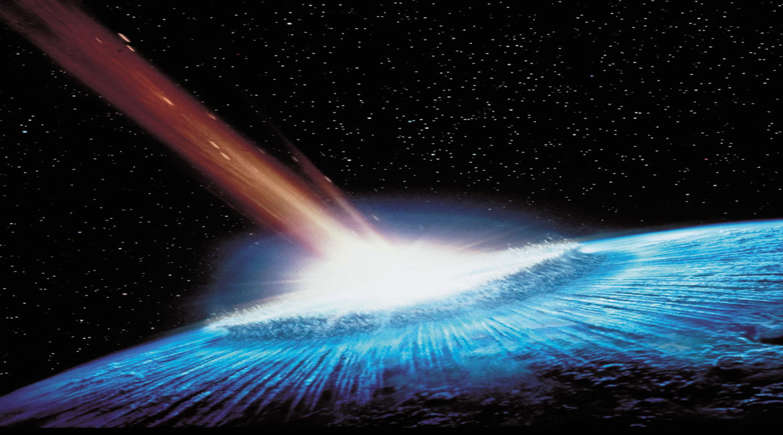
Onderzoekers hebben de precieze datum bepaald waarop een asteroïde mogelijk de aarde zou kunnen inslaan, met een kracht die gelijk is aan die van 22 atoombommen. Dit hemellichaam, genaamd Bennu, nadert onze planeet elke zes jaar. Wetenschappers zijn echter van mening dat 24 september 2182 de datum zou kunnen zijn waarop er een reëel risico bestaat op een botsing tussen de aarde en de asteroïde.
Ondanks dat de mogelijke datum van de apocalyptische gebeurtenis nog ver weg is, is NASA momenteel bezig met intensieve inspanningen om de asteroïde Bennu af te buigen en bevindt zij zich in de laatste fase van haar missie. Zeven jaar geleden lanceerde de Amerikaanse ruimtevaartorganisatie een sonde naar de asteroïde met als doel monsters te verzamelen, in de hoop dat de verzamelde informatie een mogelijke catastrofale ontmoeting zou kunnen helpen voorkomen.
Asteroïden hebben de aarde door de jaren heen vele malen getroffen. Bekijk de volgengalerij voor enkele van de meest betekenisvolle effecten.
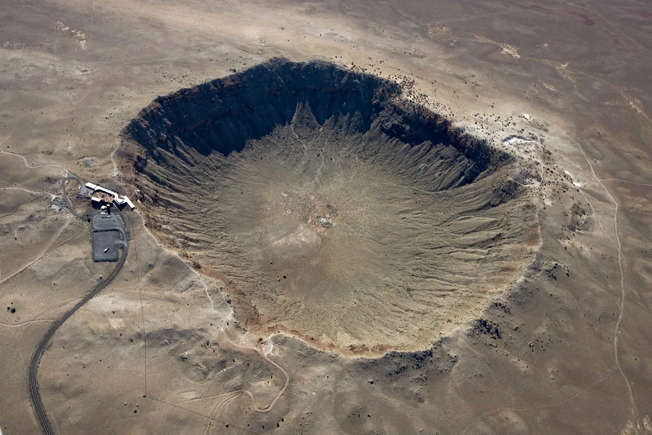
Meteor Crater, ook bekend als Barringer Crater, gelegen nabij Flagstaff, Arizona, is een grote meteorietinslagkrater. Dit opmerkelijke natuurverschijnsel is een van de best bewaarde kraters in zijn soort op onze planeet, met een diameter van ongeveer 1200 meter en een diepte van ongeveer 170 meter.
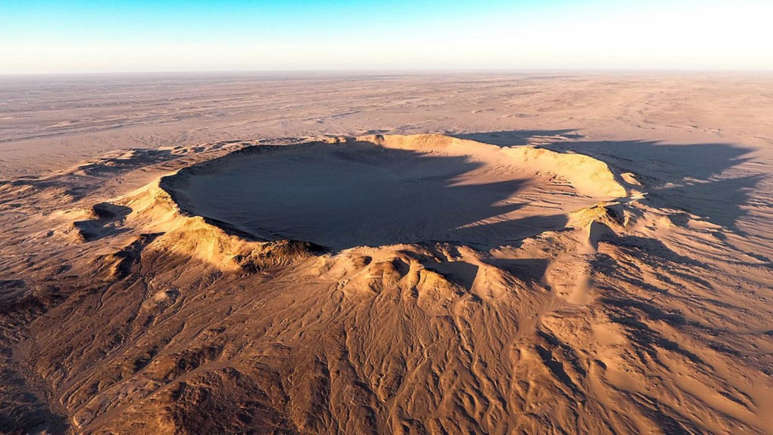
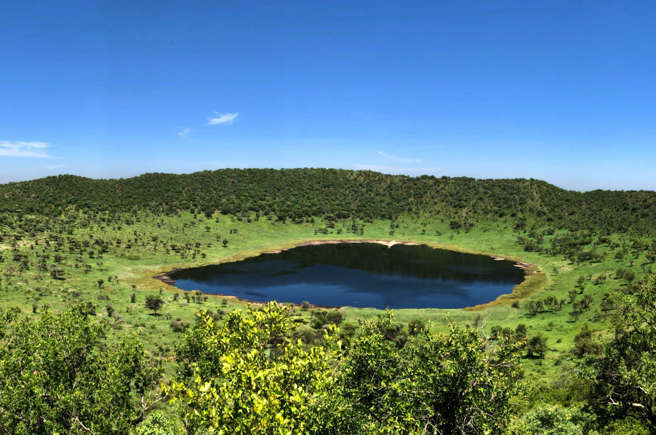
Het kenmerkende geologische kenmerk van de Tenoumer-krater in de Sahara-woestijn van Mauritanië is de dramatische, bijna cirkelvormige rand. De foto van Michael Dennig geeft perfect de afmetingen van de krater weer.
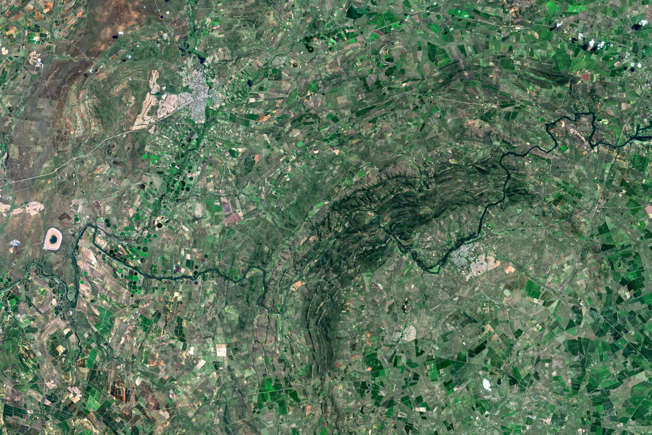
De Vredefort krater in de Zuid-Afrikaanse provincie Vrijstaat is de grootste bevestigde inslagkrater op aarde, met een diameter van meer dan 300 km (190 mijl). De afbeelding toont de Vredefort Dome, het centrale deel van de krater.
Kaali verwijst naar een groep van negen meteorietkratermeren in het dorp Kaali op Saaremaa, een Ests eiland. Dit cluster van meren werd gevormd rond 1530-1450 v.Chr.
De opmerkelijke meteoorkrater Gosses Bluff, gelegen in het zuidelijke deel van het Northern Territory, heeft een diameter van 5 km en een randhoogte van 200 meter. Deze locatie wordt door de westerse Arrernte Aboriginals Tnorala genoemd en wordt als een heilige plaats beschouwd.
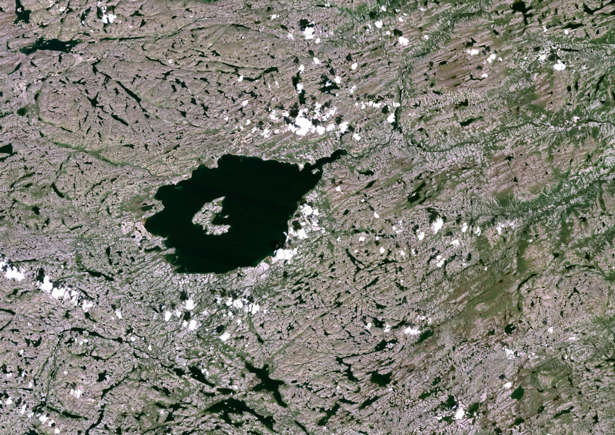
Het Manicouagan Reservoir in het centrum van Quebec ontstond 214 miljoen jaar geleden door een meteoorinslag. René-Levasseur Island is het eiland in het midden van het meer. De hele formatie wordt gewoonlijk "het oog van Quebec" genoemd.
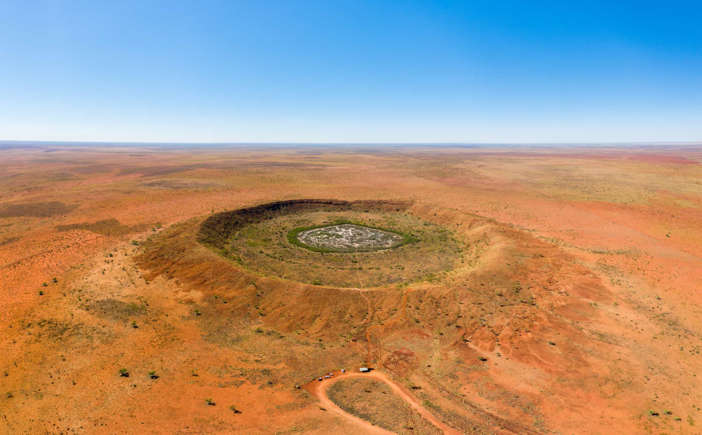
De Wolfe Creek-krater in West-Australië is een opmerkelijk intacte inslaglocatie. Het meet een diameter van ongeveer 875 meter (2871 ft) en heeft een diepte van 60 meter (200 ft) van rand tot vloer. Deze krater, die minder dan 120.000 jaar oud is, ligt in het hart van het Wolfe Creek Meteorite Crater National Park.
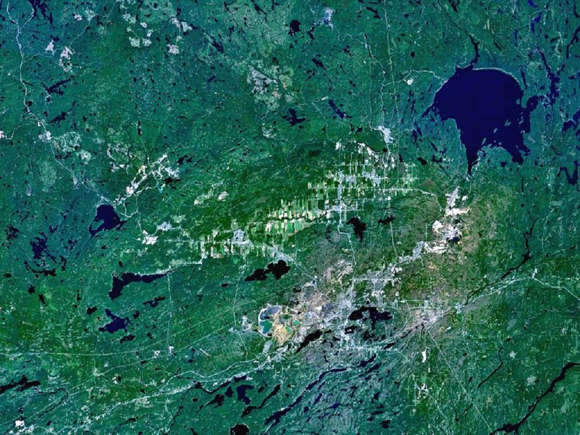
Het Sudbury Basin in Ontario beslaat ongeveer 10-15 km (6,2-9,3 mijl) en ontstond ongeveer 1,8 miljard jaar geleden. Een afbeelding van het bassin wordt weergegeven in NASA's wereldbolsoftware WorldWind.
De Popigai-krater, gelegen in Siberië, werd ongeveer 35 miljoen jaar geleden gevormd. De oostkant van de krater, met een diameter van 100 km (62 mijl), is linksboven in het satellietbeeld zichtbaar.
Lake Acraman in Zuid-Australië is een opvallend kenmerk van de Acraman-krater, die ongeveer 590 miljoen jaar geleden werd gevormd door een asteroïde-inslag. Dit satellietbeeld legt de 40 km lange krater vast, met het meer in het hart.
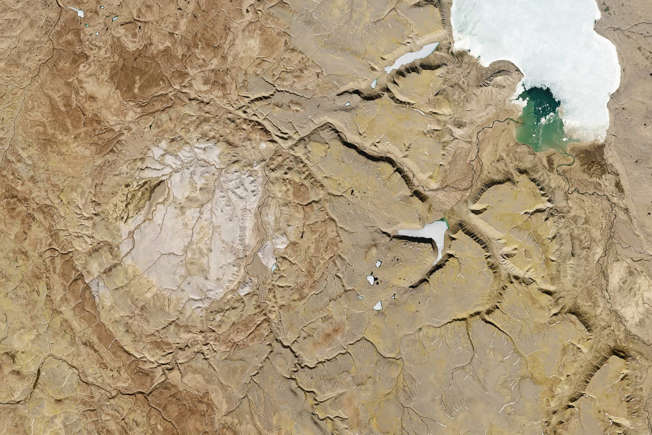
Karakul is de aangewezen naam voor het meer gelegen in een aanzienlijke inslagkrater van 52 km (32 mijl) in het Tadzjiekse Nationale Park. Deze formatie, zichtbaar op dit satellietbeeld, is ongeveer 25 miljoen jaar geleden ontstaan.
Ongeveer 35 miljoen jaar geleden werd de Chesapeake Bay aan de oostkust van Amerika gevormd door sediment dat over het puin van een meteoorinslag viel. De afbeelding toont een deel van de inslagstructuur in Virginia.
Lake Bosumtwi is het enige natuurlijke meer in Ghana, gelegen in een oude inslagkrater ten zuidoosten van Kumasi. De Ashanti-bevolking vereert Bosumtwi als een heilig waterlichaam.
Het Morasko Meteoriet Natuurreservaat ligt in de bossen nabij Poznań. Bezoekers kunnen zeven kraters verkennen, waarvan de grootste een diameter van ongeveer 100 meter (328 ft) heeft en een diepte van ongeveer 11 meter (36 ft) bereikt
De Middlesboro-krater in Kentucky dankt zijn naam aan de stad waar hij nu staat. De krater is ongeveer 5 km breed en vermoedelijk minder dan 300 miljoen jaar oud.
De Middlesboro-krater in Kentucky dankt zijn naam aan de stad waar hij nu staat. De krater is ongeveer 5 km breed en vermoedelijk minder dan 300 miljoen jaar oud.
De schilderachtige Tswaing-krater ligt ten noordwesten van Pretoria en is vermoedelijk tussen de 220.000 en 52.000 jaar oud. Met name blijkt uit archeologisch bewijs dat de krater minstens 100.000 jaar geleden door mensen werd bezocht, zoals blijkt uit stenen werktuigen uit het middensteentijdperk.
Het Henbury Meteorites Conservation Reserve in het Northern Territory van Australië bestaat uit minstens 14 kraters. Deze kraters zijn het resultaat van een meteoriet die uit elkaar viel bij een botsing met het aardoppervlak. De grootste krater, die een combinatie is van twee kleinere kraters, is 217 meter lang, 111 meter breed en 15 meter diep.
Het El'gygytgyn-meer ligt binnen de poolcirkel in het noordoosten van Siberië en werd ongeveer 3,6 miljoen jaar geleden gevormd uit een inslagkrater van een asteroïde.
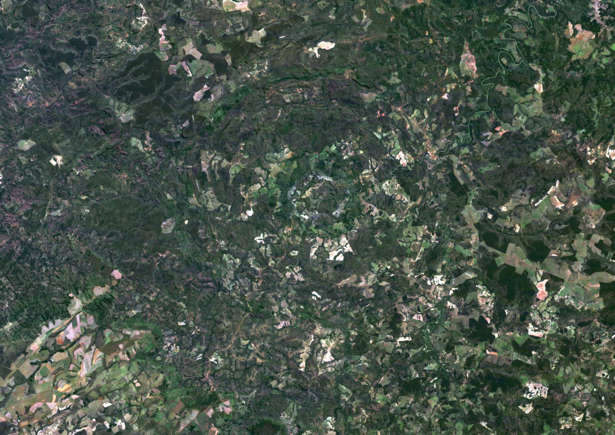
De inslagstructuur van Araguainha is gemakkelijk herkenbaar als een cirkelvormige omtrek met een diameter van 40 km (25 mijl), gelegen op de grens van de staten Mato Grosso en Goiás. Het wordt beschouwd als de grootste inslagkrater van Zuid-Amerika.
De Nördlinger Ries is een belangrijke inslagkrater in het westen van Beieren en het oosten van Baden-Württemberg. Het werd gebruikt als trainingslocatie voor de Apollo 14-astronauten. De foto toont de zuidelijke bosrand van de Nördlinger Ries.
De Haughton-krater, gevonden op het eiland Devon in Nunavut, is vermoedelijk ongeveer 39 miljoen jaar oud en is het resultaat van een asteroïde-inslag die een 23 km brede krater creëerde.
Het Lappajärvi-meer, gelegen in de Finse regio Zuid-Österbotten, is een watermassa die de gedeeltelijk geërodeerde meteorietinslagkrater van Lappajärvi beslaat. Deze indrukwekkende krater, die 23 kilometer (14 mijl) beslaat, dient als herinnering aan een gebeurtenis die ongeveer 76 miljoen jaar geleden plaatsvond.
De Chicxulub-krater, gelegen onder het schiereiland Yucatán, is het gevolg van een enorme asteroïde-botsing die ongeveer 66 miljoen jaar geleden plaatsvond en leidde tot het uitsterven van dinosauriërs. Op deze NASA-foto van het noordwestelijke deel van het schiereiland benadrukt een vage donkergroene curve de overblijfselen van de inslagkrater, die de op een na grootste ter wereld is.
In het jaar 1908 drong een meteoriet de atmosfeer van de aarde binnen, maar in plaats van de grond te raken, ontplofte hij in de lucht. Deze buitengewone gebeurtenis vond plaats nabij de rivier Podkamennaya Tunguska en resulteerde in een wijdverbreide verwoesting. Hoewel er zich geen zichtbare krater vormde, veroorzaakte de explosie het afvlakken van ongeveer 80 miljoen bomen, waardoor een uitgestrekt bosgebied van 2.150 vierkante kilometer (830 vierkante mijl) werd aangetast. Bekende bronnen die informatie verstrekken over dit incident zijn onder meer NASA, de National Park Service, Smithsonian Magazine, Geopark Ries en EarthSky.
Als je geïnteresseerd bent, kun je hier ook enkele van de gevaarlijkste vulkanen ter wereld verkennen: Ontdek enkele van de gevaarlijkste vulkanen ter wereld
Milky Way is Embedded in Tilted Dark Matter Halo, Research Suggests
The outer disk of our Milky Way Galaxy is warped and flared. Several mechanisms have been proposed to explain these phenomena, but none have reproduced both features. Recent work has demonstrated that the Milky Way’s stellar halo is tilted with respect to the disk plane, suggesting that at least some component of the dark matter halo may also be tilted. In a new modeling study, astronomers from the Harvard and Smithsonian’s Center for Astrophysics show that a dark halo tilted in the same direction as the stellar halo can induce a warp and flare in the Milky Way’s disk at the same amplitude and orientation as the data. The work bolsters current thinking about how our Galaxy evolved and may offer clues into some of the mysteries of dark matter.
From a great distance, our Milky Way Galaxy would look like a thin disk of stars that orbits once every few hundred million years around its central region, where hundreds of billions of stars provide the gravitational ‘glue’ to hold it all together. But this pull of gravity is much weaker in the Galaxy’s far outer disk. There, the hydrogen atoms making up most of the Milky Way’s gas disk are no longer confined to a thin plane, instead they give the disk an S-like, or warped, appearance.
Image credit: Xiaodian Chen.
The Milky Way Galaxy is located inside a diffuse cloud called the stellar halo, which extends much farther out into the Universe.
In a previous work, Jiwon Jesse Han and colleagues deduced that the stellar halo is tilted and elliptical in shape, like a zeppelin or football.
Building on that, they assumed the same shape for the dark matter halo, the larger entity that encompasses everything in and around the Milky Way.
Dark matter makes up 80% of the Galaxy’s mass but is invisible because it doesn’t interact with light, so the shape of that halo must be inferred.
Using models to calculate the orbits of stars within a tilted, oblong dark matter halo, the astronomers found a near-perfect match to existing observations of a warped, flared galaxy.
“A tilted dark halo is actually fairly common in simulations, but no one had explored its effect on the Milky Way,” said Dr. Charlie Conroy, co-author of the study.
“It turns out that the tilt is an elegant way to explain both the magnitude and direction of our Galaxy’s wobbly disk.”
Astronomers had long surmised that the Milky Way formed due to a galactic collision; the new work further underscores that hypothesis.
“If the Galaxy was just evolving on its own, it would have had this nice, spherical halo, this nice, flat disk,” Han said.
“So the fact that the halo is tilted and has a football-like shape suggests that our Galaxy experienced a merger event, where two galaxies collide.”
Their calculation of the dark matter halo’s probable shape may also provide clues as to the properties and particle nature of dark matter itself, which remain unsolved mysteries in physics.
“The fact that the Galaxy is not spherical in our data implies that there is some limit to which dark matter can interact with itself,” Han said.
“Confidence in these findings might lead to better ways to cleverly study the unobservable dark matter that makes up most of the Universe.”
“This includes new ways to pick up on kinematic signatures of dark sub-halos, which are miniature dark matter halos zipping around the Galaxy.”
A paper on the findings was published in the journal Nature Astronomy.
J.J. Han et al. A tilted dark halo origin of the Galactic disk warp and flare. Nat Astron, published online September 14, 2023; doi: 10.1038/s41550-023-02076-9
For over 90 years, the UFO enigma has captivated people’s minds worldwide, sparking curiosity, debates, and countless investigations into the phenomenon. The wait is over, as David Grusch, David Fravor & Ryan Graves are set to testify before the US Congress during the congressional meetings scheduled for July 26, 2023.
Meanwhile, various theories were postulated by United States Representative Mike Gallagher on the possible origin of UFOs while he appeared on Pat McAfee’s show on June 27, 2023. The former Marine suggested that unidentified flying objects (UFOs) might possibly represent an enigmatic “ancient civilization” that had remained hidden on Earth until recently when they began to surface.
“This should be an opportunity for the government to be transparent,” he said. “If we have information that disconfirms the extraterrestrial hypothesis, or all these other ones, at least it shows the government doing something competent and being forward-leaning by declassifying information to the public.”
Rep. Gallagher made this statement in response to the wild interview of David Grusch with Ross Coutlhart that hit the media. Mr. Grusch, who is confirmed to testify before Congress in the upcoming hearings, claimed that the US government has proof of alien life and that there are spacecraft from another species. He mentions that there is a significant number of these spacecraft, some of which have landed while others have crashed.
When asked about the duration of the cover-up, Grusch mentions that the first recovery of a UAP occurred in 1933 in Magenta, Italy, during the regime of Benito Mussolini. He explains that the Italian government moved the recovered craft to a secure air base until 1944-1945 when the Vatican informed the Americans about it.
Appearing on the sports talk show, Gallagher suggested that one possible explanation of supposed UFO sightings was the so-called “Terminator” theory — derived from the film of the same name — that aliens were actually human beings from the future. Gallagher further put forth another theory, suggesting the following: “Instead of us from the future, it might indeed be an ancient civilization that has been lurking here, and suddenly it’s making its presence known.” Ancient Aliens, does it ring a bell?
A similar theory was also proposed by Tim Peake, one of Britain’s famous astronauts. He said that the UFOs filmed by the US military over 100 times could either time traveling humans or aliens from other civilizations. During an interview with Good Morning Britain in June 2022, Briton astronaut Tim Peake, who spent more than six months on the International Space Station, was asked about the UAP videos, which the Pentagon recently declassified.
Peake said: “I heard one theory where a pilot was talking about that potentially in the future, they’ve developed time travel – is it something that’s come back from the future?” He did not exactly say what the UFOs are but shared some theories that have long been discussed by UFOlogists.
“I don’t think it’s a development of any state nation or non-state organization at all. I think it’s quite remarkable when you see the video footage. It does seem extraordinary as to what these machines are capable of.”
There is a huge buried UFO hidden outside the US, and Ross Coulthart claimed that he knows the location of this immovable craft. There is no confirmation from Coulthart about the nature of this craft if it was retrieved. However, some have speculated this could be an archeological dig. Could this particular craft potentially be a remnant of a bygone civilization?
Considering Rep. Gallagher’s theory, scientists have explored the possibility of detecting ancient civilizations in Earth’s geological record. A recent paper called “The Silurian Hypothesis” discusses how traces of industrial civilizations could be found. While fossils and artifacts are unlikely to survive over millions of years, anomalous changes in chemical compositions could serve as clues. By studying geological anomalies and applying models to other planets, scientists hope to understand if civilizations existed in the distant past.
NASA has spent many years seeking the truth regarding extraterrestrial life. Furthermore, the space agency has never denied the existence of non-human life beyond Earth in any form. This is sufficient to discuss the idea of non-human life existing beyond Earth in any form, from the microscopic to the macroscopic. Avi Loeb, a professor at Harvard, has supported the idea that there may have been earlier civilizations on both Earth and Mars, and that these civilizations may have been the origin of UAPs. (Click here to read the full article)
Mr. Loeb writes: “Planets like Mars or Earth could have given multiple births to technological civilizations that were a billion years apart and hence were not aware of each other. Like stable parents, the planets recovered from the environmental impact of these civilizations over time. We may have been separated in time from siblings that we never had the opportunity to meet and so we are unaware of their existence.”
Former Pentagon UFO official, Lue Elizondo, shared intriguing insights in an interview about crash retrievals and materials related to UFOs/UAPs. He believes the US government possesses exotic materials but lacks transparency on the matter. (Click here to read the full article)
Elizondo used an analogy of finding an out-of-place object in King Tut’s tomb to emphasize the significance of finding advanced materials before our known technology existed. Some interpreted this analogy as a hint that UFOs could be considered archaeological findings, possibly ancient rather than just old.
Interestingly, Bob Lazar, on the Joe Rogan Experience, mentioned hearing that at least one recovered UFO was found during an archaeological dig, suggesting its ancient origin. Astronomer Avi Loeb suggested that some advanced devices made by early inhabitants of Mars and Earth might still be operational elsewhere in the Solar System, potentially accounting for some Unidentified Aerial Phenomena reports.
Physicist John E. Brandenburg’s 2015 study speculated about a massive thermonuclear explosion that destroyed Mars’ once-Earthlike atmosphere, considering the Cydonian Hypothesis and Fermi’s Paradox. These ideas explore the possibility of ancient advanced civilizations in our solar system.
Meer van UFO'S of UAP'S, ASTRONOMIE, RUIMTEVAART, ARCHEOLOGIE, OUDHEIDKUNDE, SF-SNUFJES EN ANDERE ESOTERISCHE WETENSCHAPPEN - DE ALLERLAATSTE NIEUWTJES


 Amazing UFO video – Flying saucer filmed from a plane over Colombia 2 weeks ago