Ontdek de Fascinerende Wereld van UFO's en UAP's: Jouw Bron voor Onthullende Informatie!
Ben jij ook gefascineerd door het onbekende? Wil je meer weten over UFO's en UAP's, niet alleen in België, maar over de hele wereld? Dan ben je op de juiste plek!
België: Het Kloppend Hart van UFO-onderzoek
In België is BUFON (Belgisch UFO-Netwerk) dé autoriteit op het gebied van UFO-onderzoek. Voor betrouwbare en objectieve informatie over deze intrigerende fenomenen, bezoek je zeker onze Facebook-pagina en deze blog. Maar dat is nog niet alles! Ontdek ook het Belgisch UFO-meldpunt en Caelestia, twee organisaties die diepgaand onderzoek verrichten, al zijn ze soms kritisch of sceptisch.
Nederland: Een Schat aan Informatie
Voor onze Nederlandse buren is er de schitterende website www.ufowijzer.nl, beheerd door Paul Harmans. Deze site biedt een schat aan informatie en artikelen die je niet wilt missen!
Internationaal: MUFON - De Wereldwijde Autoriteit
Neem ook een kijkje bij MUFON (Mutual UFO Network Inc.), een gerenommeerde Amerikaanse UFO-vereniging met afdelingen in de VS en wereldwijd. MUFON is toegewijd aan de wetenschappelijke en analytische studie van het UFO-fenomeen, en hun maandelijkse tijdschrift, The MUFON UFO-Journal, is een must-read voor elke UFO-enthousiasteling. Bezoek hun website op www.mufon.com voor meer informatie.
Samenwerking en Toekomstvisie
Sinds 1 februari 2020 is Pieter niet alleen ex-president van BUFON, maar ook de voormalige nationale directeur van MUFON in Vlaanderen en Nederland. Dit creëert een sterke samenwerking met de Franse MUFON Reseau MUFON/EUROP, wat ons in staat stelt om nog meer waardevolle inzichten te delen.
Let op: Nepprofielen en Nieuwe Groeperingen
Pas op voor een nieuwe groepering die zich ook BUFON noemt, maar geen enkele connectie heeft met onze gevestigde organisatie. Hoewel zij de naam geregistreerd hebben, kunnen ze het rijke verleden en de expertise van onze groep niet evenaren. We wensen hen veel succes, maar we blijven de autoriteit in UFO-onderzoek!
Blijf Op De Hoogte!
Wil jij de laatste nieuwtjes over UFO's, ruimtevaart, archeologie, en meer? Volg ons dan en duik samen met ons in de fascinerende wereld van het onbekende! Sluit je aan bij de gemeenschap van nieuwsgierige geesten die net als jij verlangen naar antwoorden en avonturen in de sterren!
Heb je vragen of wil je meer weten? Aarzel dan niet om contact met ons op te nemen! Samen ontrafelen we het mysterie van de lucht en daarbuiten.
The Houston Enigma: Exploring the Mysteries Behind UFO Sightings Near NASA
There’s a buzz in the air, and no, we’re not just talking about drones or aircraft from the nearby Johnson Space Center in Houston. We’re referring to the increasing reports of mysterious “UFO sightings” in the area—enigmatic luminous circles and formations of lights that have captivated residents and caught the attention of ufologists worldwide.
The Infamous August 2014 Footage
The story reaches a pivotal moment on August 11th, 2014, when a Houston resident decided to film a building storm. Between thespectacular flashes of lightning, what was caught on tape was far more puzzling: a circle of lights hovering in the air, a spectacle clearly visible from the ground. The footage sparked immediate speculation about whether we’re alone in the universe, or at least whether someone—or something—might be keeping tabs on NASA.
Theories and Explanations
Natural Phenomena
When it comes to UFO sightings, the skeptic in us all often looks to natural explanations first. One of the most discussed theories is that the lights could be reflections from noctilucent clouds—clouds that form in the upper atmosphere and can produce unusual glowing effects. Another theory pointed toward the mysterious phenomenon known as ball lightning. However, the circular formation of lights made this explanation implausible, to say the least.
Advanced Technology
NASA itself was not exempt from the list of suspects. The organization has developed its Low-Density Supersonic Decelerator (LDSD), a craft designed to help with landing on Mars. Some speculated that what people saw was actually a test of this technology. However, the LDSD’s nature and its operational risks quickly ruled it out as the mysterious craft hovering over Houston.
Alien Surveillance?
What raised eyebrows further was the proximity of these sightings to NASA’s Johnson Space Center—just less than 30 miles away. Speculation ran rampant that maybe, just maybe, extraterrestrial beings were surveilling the hub of human space exploration. However, it should be noted that these claims were, and still are, based on pure speculation rather than any concrete evidence.
The Down-to-Earth Reality
As months of speculation passed, a local Houston resident provided a much more prosaic explanation. The UFO sightings could be lens flares from distinctive, circular street lights that adorn the freeways of Houston. These lights can create the optical illusion of hovering circles when filmed under specific conditions.
A Cosmic Twist
As if the story wasn’t fascinating enough, the history of skywatching for unusual activities stretches back decades. For instance, in the 1960s, satellite data indicated a surge in atmospheric radiation. Initially, this was thought to be the result of secret nuclear tests but was later discovered to be gamma-ray bursts from distant galaxies. Perhaps, in a universe filled with countless mysteries, the answer to the Houston enigma lies somewhere we haven’t looked yet.
VIDEO:
Is NASA Under Surveillance By A UFO Spotted in the Sky? | NASA’s Unexplained Files
UFO sightings near Houston offer a fascinating blend of natural science, advanced technology, and the ever-tantalizing possibility of extraterrestrial life. While we don’t have a definitive answer yet, the quest for understanding continues. One thing is certain: the skies over Houston will continue to captivate imaginations and keep eyes looking upward for years to come.
The Emilcin, Poland, UFO encounter and alien abduction of farmer Jan Wolski
Close encounters of the strange kind have perplexed both the general public and the scientific community for decades. One such encounter that has raised a swirl of questions is the incident involving Mr. Wolski, a rural farmer with no reason to seek out the limelight. His experience has left experts scratching their heads, pondering the validity and origin of the tale he unfolds.
The Encounter: A Night Unlike Any Other
One ordinary evening, Mr. Wolski claims he had a surreal encounter with unidentified flying objects—yes, in the plural. He describes strange beings in an even stranger vehicle, floating in the air as though defying the very laws of physics. According to Wolski, the occupants of this vehicle had distinguishing features: slanted eyes, protruding cheekbones, and an oriental, almost Asian appearance.
VIDEO:
The Emilcin, Poland, UFO encounter and alien abduction of farmer Jan Wolski, May 10, 1978
The mystery deepens. These beings, dressed in black one-piece suits, offered him an unidentified type of food. A spectacle unfolded as these beings also interacted with various elements around them, including birds and bats, in seemingly inexplicable ways. Wolski describes the vehicle’s interior as barren—no lamps, lights, or motors—just an empty shell with mysterious occupants.
Verification or Coincidence? Interestingly, some aspects of Wolski’s story align with other well-known accounts of UFO sightings, reported from all corners of the globe. From the protruding cheekbones to the peculiar greenish hue of the skin and the mysterious black suits, the similarities are unnerving. Could it be mere coincidence, or is there more to his story?
The Skeptical Inquisition Despite a multitude of skeptics and critics, Wolski underwent various psychological evaluations. The consensus? The man is neither mentally ill nor seems to be lying. He is highly resistant to suggestions, ruling out the possibility that someone “programmed” him to tell this story.
But if we rule out deceit and psychological disorders, what are we left with? Could Wolski have been the subject of a grand hoax? Or perhaps he encountered an experimental vehicle, carefully hidden from public knowledge?
More Questions Than Answers In a world where we seek concrete evidence and crave rational explanations, Wolski’s case stands as an anomaly that challenges our understanding of reality. It prompts us to question the limitations of both scientific inquiry and human imagination.
So, we are left with a compelling question: What did Mr. Wolski see? Even the psychologists and experts who examined him closely cannot provide a definitive answer. Maybe it’s a puzzle that challenges the limits of our imagination. Perhaps it’s a real encounter that stands as a testament to the mysterious universe we live in.
Whatever the case may be, the story of Mr. Wolski invites us to entertain the possibility of the unknown, reminding us that there are phenomena beyond our comprehension, waiting to be explored.
And so, the enigma of Mr. Wolski remains unsolved, a lingering question mark in the ever-evolving dialogue between science and the inexplicable. It’s a tale that stimulates our curiosity, demanding further inquiry and open-minded exploration.
Indeed, the world is full of mysteries—some are meant to be solved, while others serve as a humbling reminder that not all questions have answers. But isn’t that what makes life so interesting?
Unveiling the Mystery: Ancient “Alien” Corpses Displayed in Mexico’s Congress
In a staggering event that captured the world’s attention, Mexico’s Congress became the setting for a controversial revelation—two alleged “non-human” corpses, displayed for all to see, with claims that they’re around 1,000 years old. Orchestrated by Jaime Maussan, a high-profile Mexican journalist and ufologist, the spectacle provoked a whirlwind of emotions, from awe to skepticism, within and beyond the UFO community.
The Enigmatic Figure Behind the Revelation
Maussan is no stranger to the limelight. Known for his explorations into the unknown, he has previously stirred public curiosity and debate by delving into the unidentified and the unexplained. Critics argue that his enthusiasm sometimes outpaces scientific rigor, but there’s no denying that when Maussan speaks, people listen.
The Origin Story: A Discovery in Cusco, Peru
The alleged alien specimens were unearthed in Cusco, Peru—a region with a rich history of mysterious phenomena. Nestled among the Andean mountains, Cusco was once the capital of the Incan Empire, which had its own plethora of legends surrounding celestial gods and otherworldly beings.
Jaime Maussan
Interestingly, Peru has been a hotbed for UFO sightings, with claims dating back decades. Locals and visitors alike have reported unexplained aerial phenomena, making the country a natural focal point for ufologists.
The Event: A Collision of Worlds
The showcase in Mexico’s Congress was not an isolated affair. It was a joint endeavor, co-hosted by scientists and attended by Ryan Graves, the Executive Director of Americans for Safe Aerospace and a former U.S. Navy pilot. The specimens were presented in windowed boxes, and Maussan spoke under oath, a gesture meant to underscore the seriousness of the revelations.
The Scientific Angle: Skepticism Meets Possibility
Maussan stated that the specimens were studied at the Autonomous National University of Mexico (UNAM), where DNA evidence was allegedly obtained through radiocarbon dating. “These specimen are not part of our terrestrial evolution,” he proclaimed. While this is a striking statement, science demands rigorous testing and peer review, a process that has yet to be publicly verified in this case.
The Ethical Quandary: Questions Unanswered
Displaying any form of remains, human or otherwise, brings up significant ethical considerations. Were the specimens removed from Peru with proper consent and documentation? Are there indigenous cultural rights that should be acknowledged? Such questions add layers of complexity to an already bewildering event.
Video:
Shocking Revelation: 1,000-Year-Old ‘Alien’ Corpses Displayed in Mexico’s Congress!
As the world grapples with this enigmatic revelation, questions far outnumber answers. Skeptics and believers alike are calling for more evidence, preferably from a range of independent scientific bodies. After all, extraordinary claims demand extraordinary proof.
In a world that often seems void of wonder, the aliens —whether authentic or not—serve as a vivid reminder that the universe still has its secrets. And as Jaime Maussan continues his quest for the unknown, one can only wonder what he—or any of us—will uncover next.
VIDEO:
Alien Mummies of Peru
As we ponder the possibilities, the specimens lie in their glass cases—silent, mysterious, and challenging us to confront the boundaries of our understanding.
The Apollo 17 lunar lander base is creating small-scale moonquakes on a daily basis.
Dr. Maurice Ewing, professor of geophysics of the University of Texas at Galveston, studies seismometer readings from the Apollo Lunar Surface Experiments Packages (ALSEP) on the moon in 1972.
(Image credit: NASA)
When they went to the moon, Apollo astronauts placed seismometers on the surface. Those instruments strikingly revealed that the moon experiences moonquakes, just as the Earth experiences earthquakes. In fact, scientists have since determined there are four types of moonquakes: Deep, shallow, thermal and the kind stemming from meteoriteimpacts.
But a new look at thermal earthquake data recorded by instruments from the Apollo 17 mission has unveiled a fifth and unexpected type of moonquake — one that emanates from the Apollo 17 lunar lander base itself.
During the Apollo 17 mission, scientists calibrated three seismometers to record thermal earthquakes on the moon. Placed on the lunar surface, these devices recorded data from October 1976 to May 1977. Such thermal quakes are caused by intense temperature changes that occur on the moon as it transitions from the lunar day to lunar night, which can swing from 250 degrees Fahrenheit (121 degrees Celsius) to -208 degrees Fahrenheit (-133 degrees Celsius).
Using modern techniques, including machine learning, researchers from the California Institute of Technology reanalyzed the data, determining that thermal quakes occur with very precise regularity the day. But, they also found new tremors in the data that weren't linked to the thermal quakes — ones that only occurred in the morning.
Triangulating the origin of the mystery quakes, researchers surprisingly realized they came from the Apollo 17 lunar lander base, which expands and vibrates each morning as it becomes heated by the sun.
"Every lunar morning when the sun hits the lander, it starts popping off," Allen Husker, a Caltech research professor of geophysics who worked on the project, said in a statement. "Every five to six minutes another one, over a period of five to seven Earth hours. They were incredibly regular and repeating."
So while these new moonquakes might not be moon-generated quakes, they're still contributing to our seismic knowledge of the celestial body — and that's particularly important for future lunar development.
"It's important to know as much as we can from the existing data so we can design experiments and missions to answer the right questions," said Husker. "The Moon is the only planetary body other than the Earth to have had more than one seismometer on it at a time. It gives us the only opportunity to thoroughly study another body."
A new seismic instrument just landed on the moon last month with India's Chandrayaan 3 Lander, and it managed to record its own evidence of moonquakes. The Instrument for Lunar Seismic Activity (ILSA), comprising six high-sensitivity accelerometers, recorded a seemingly natural moonquake on August 26, 2023 — though the source is being investigated. Chandrayaan-3 entered sleep mode on Sept. 2 in preparation for the lunar night.
Through further lunar seismic research, "[w]e will hopefully be able to map out the subsurface cratering and to look for deposits," said Husker. "There are also certain regions in craters at the Moon's South Pole that never see sunlight; they are permanently shadowed. If we could put up a few seismometers there, we could look for water ice that may be trapped in the subsurface; seismic waves travel slower through water."
Join our Space Forums to keep talking space on the latest missions, night sky and more! And if you have a news tip, correction or comment, let us know at: community@space.com.
On July 27, 2022, the James Webb Space Telescope released an image of Jupiter’s Great Red Spot using one of its infrared cameras. The image contains a cylindrical-shaped object floating high above Jupiter’s atmosphere that appears to be more than a thousand miles long. The image corroborates claims of giant spacecraft recently arriving in our solar system and parking in the vicinity of Jupiter.
Space.com was among the first news outlets to release the new Webb image of Jupiter and explained that it was taken using the Near Infrared Camera. In addition to the Great Red Spot, Webb was also studying bands in the gas giant’s atmosphere. However, the Webb image also caught a very large cylindrical-shaped object whose direction of motion could be traced directly to the Giant Red Spot.
The object appears white in the filter, as does the Giant Red Spot. Also, the thing seems to be very close to Jupiter, which makes possible an estimate of it being several thousand miles in length. If the object is closer to the Webb telescope, which is one million miles away from Earth, facing away from the sun, then that would make it harder to estimate the object’s true size. Importantly, the object is unlike any of the smaller objects making up Jupiter’s bands or near the Giant Red Spot.
One of my sources, JP, who currently serves with the US Army, sent me the above Webb picture of Jupiter and believes it is a mothership drawing energy from the Red Spot. This is what he told me via Skype:
The red spot is hotter than most areas.
Atmospheric gravity waves and lightning-driven acoustic waves.
A great source of energy for the ships
This is amazing you can [can’t] see if the ship is heading towards the storm or coming out from the storm but you can see the direction.
JP traveled to Jupiter’s moon Ganymede in September 2021 for a covert assignment to meet with representatives of an incoming extraterrestrial fleet. JP said that US Space Command has been setting up facilities on Ganymede to meet and liaise with members of the extraterrestrial fleet, some of whom he met during his assignment.
JP subsequently told me “that we were going to be shown soon all these ships and that people were going to see them” and, incredibly, some of these motherships are 6,000 miles long according to JP. This suggests that the Webb image is part of a disclosure initiative to reveal the truth about extraterrestrial visitation.
This is supported by NASA’s current program to use the Webb Telescope to study the distant universe and our solar system, with Jupiter being a particular focus of attention.
If the cylindrical object is a mothership that is several thousand miles in length, as JP contends, then its size would make it capable of accommodating millions of people and thousands of smaller spacecraft.
The Webb image and JP’s data about Jupiter corroborates information previously released by Elena Danaan concerning the composition of the extraterrestrial fleets she described as belonging to the Seeder races (aka Intergalactic Confederation). She provided an illustration of the different craft and beings that belonged to the Seeder fleets, one of which had a cylindrical design.
In an August 31 Skype conversation, Danaan said that the cylindrical shaped scout craft of the Intergalactic Confederation are 20 miles long and that the saucer-shaped mother ships are far bigger than that.
This is the second Webb image of Jupiter that shows a very large anomaly high above its atmosphere. The first image from July 13 showed a massive moon-sized dark area between Europa and Jupiter. According to information Danaan received from her contact Oona (a member of the Intergalactic Confederation), the object was a mix of large rocks and spacecraft parked in Jupiter’s orbit.
In conclusion, estimating the size of the cylindrical-shaped object photographed above Jupiter is difficult as we can’t be sure whether it’s closer to Jupiter or the Webb telescope. If the object is close to Jupiter, then it’s likely to be thousands of miles in length, as claimed by JP. If the object is closer to the Webb Telescope, then it could be a 20-mile-long cylinder shaped Intergalactic Confederation scout craft as described by Elena Danaan.
If JP is correct, we can expect to learn the truth soon about that and many other extraterrestrial spacecraft that have recently arrived in our solar system, as the Webb Telescope is releasing images that are part of an official disclosure initiative. The disclosure of a newly arrived extraterrestrial space fleet with giant mother ships parked around Jupiter would have an enormous impact on global politics, science and technology, and world religions.
To learn more about the role of extraterrestrial civilizations in historically shaping human society especially in relation to historic texts from around the world describing creator gods and their return, I highly recommend my August 13, 2022 webinar, “World Religions and Extraterrestrial Contact.”
Video Version of this article is available on YouTube & Rumble.
Podcast version available on Apple, Spotify and Google.
Many thanks to Elena Danaan for permission to include her drawing of different spacecraft and extraterrestrials comprising the Intergalactic Confederation fleet parked around Jupiter.
[Update Aug 4, 2022 – A higher resolution version of the JSWT image of Jupiter found in the Space.com article is available here or click image below to expand]
[Update Aug 2, 2022 – Below is a close up of the object floating above Jupiter in JWST photo I discussed in the above article. Notice shadow it casts. Shows object is very close to Jupiter, rather than something closer to the JWST, or dust on the camera lens. Clear evidence of a giant mothership parked around Jupiter.]
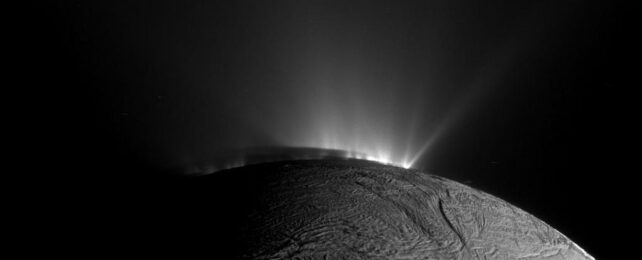
Since the Cassini spacecraft discovered plumes of water vapor erupting from geysers on Enceladus nearly 20 years ago, Saturn's ice-covered ocean moon has been a hot topic.
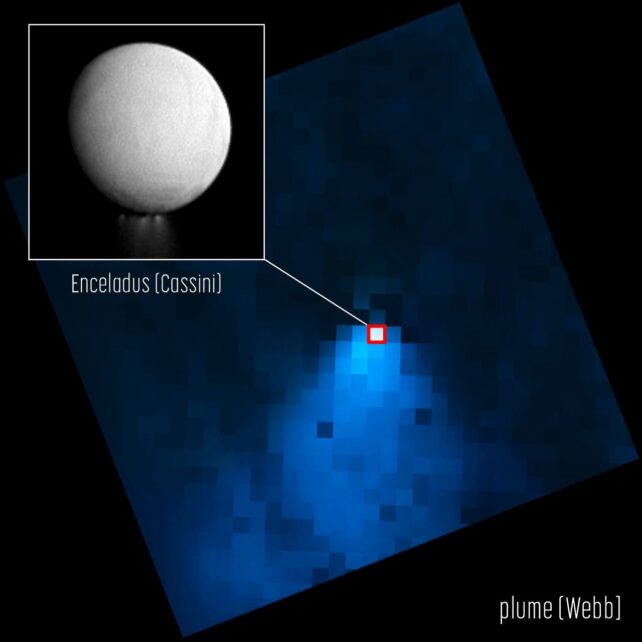
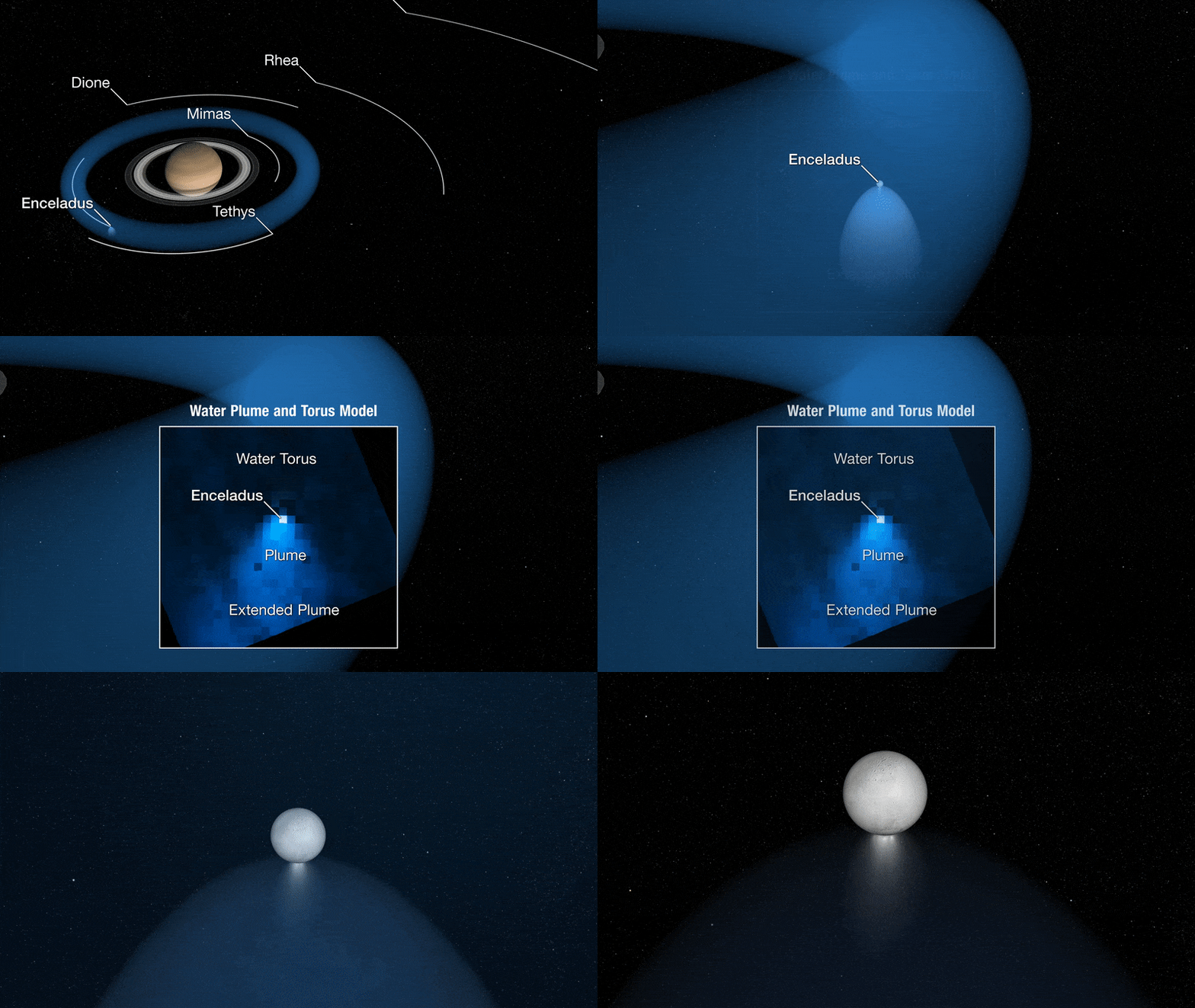
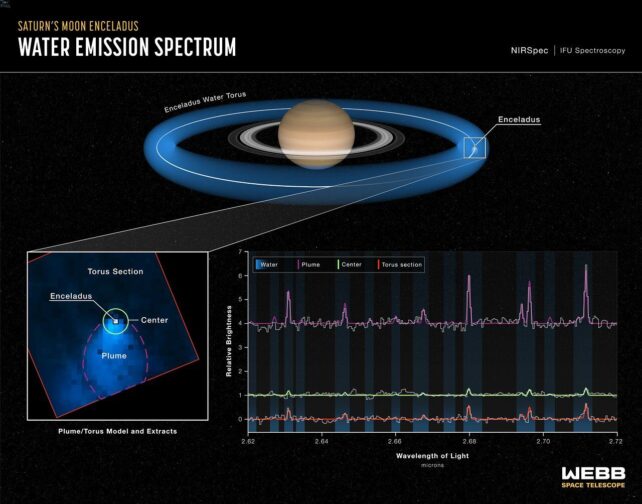
The James Webb Space Telescope has now caught sight of the largest plume yet. The telescope's astonishingly sensitive eye measured an eruption of water vapor punching at least 10,000 kilometers (over 6,000 miles) out into space. That's around 20 times the size of Enceladus itself, and it has given scientists an unprecedented glimpse at how the moon's geysers supply material to Saturn's icy rings.
"When I was looking at the data, at first, I was thinking I had to be wrong, it was just so shocking to map a plume more than 20 times the diameter of the moon," says planetary scientist Geronimo Villanueva of NASA's Goddard Space Flight Center.
"The plume extends far beyond what we could have imagined."
The geysers Cassini detected in 2005 changed everything we thought about the cold moon: They were proof that Enceladus wasn't a solid, frozen ball, as previously thought, that under its shell of thick ice lurks a global liquid ocean, kept liquid by the heat created by the constant push-pull of its gravitational interaction with Saturn.
That's still an open question since getting through kilometers of ice on an alien world to look for what might be no more than microbes is not exactly simple. But Enceladus is intriguing for other reasons, too – not least of which is its contribution to Saturn's ring system.
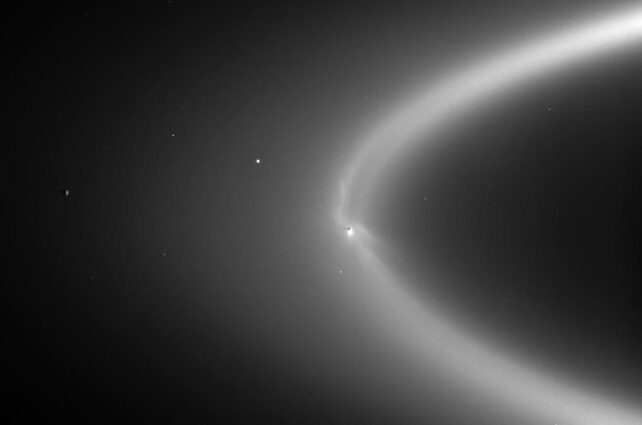
In 2011, scientists using the Herschel infrared observatory discovered that Enceladus isn't just actively spewing water out randomly into space. Its geysers generate a diffuse and fuzzy donut-shaped ring, or torus, of microscopic frozen particles, mostly water ice, with some traces of silicates, carbon dioxide, and ammonia. It's centered around the same location as Saturn's E ring, the second-outermost of Saturn's rings, and Enceladus's orbit.
"The orbit of Enceladus around Saturn is relatively quick, just 33 hours. As it whips around Saturn, the moon and its jets are basically spitting off water, leaving a halo, almost like a donut, in its wake," Villanueva explains. "In the Webb observations, not only was the plume huge, but there was just water absolutely everywhere."
Water vapor is hard to find in space because it tends to be transparent at most wavelengths. In infrared, however, water vapor fluoresces, and that's why the infrared Herschel observatory could detect the torus in 2011. The JWST is an infrared telescope that is significantly more powerful than Herschel.
In November 2022, the JWST collected just 4.5 minutes' worth of data on Enceladus. That was sufficient to capture the largest plume anyone had ever seen erupting from the moon – providing direct evidence for how the plumes feed into the torus.
Animation contextualizing JWST's observations with the torus and its position around Saturn. (Leah Hustak/STScI)
Based on this data, the team could ascertain the plume's ejection rate. At the time of the observations, Enceladus was spewing out water vapor at 300 liters (79 gallons) per second. That's roughly two bathtubs' worth of water. Imagine the water pressure required to fill your bathtub in half a second. You probably wouldn't have a bathtub after that.
The researchers also calculated that roughly 30 percent of the water vapor would stay in the torus. The remaining 70 percent supplies the rest of the Saturn system, including the icy rings and Saturn's upper atmosphere.
Sadly, it seems the plumes are probably too diffuse to detect possible molecular signs of life that scientists hoped might be collected by flying through them. But this helps narrow down where and how to look for biomolecules when astrobiology missions reach the icy moon.
And, on the surface of Enceladus, the team detected something that could be cyanide compounds. Although cyanide is poisonous, it could have played a key role in the emergence of life on Earth, and if it is on the surface of Enceladus, its presence would be very intriguing.
In its second round of observations, JWST will return to Enceladus for a longer look. Scientists hope this will yield more clues about the possibility of life on Enceladus. In particular, the researchers will look for hydrogen peroxide, a biomolecule with a wide range of functions.
"Enceladus is one of the most dynamic objects in the Solar System and is a prime target in humanity's search for life beyond Earth," says geochemist Christopher Glein of the Southwest Research Institute.
"In the years since NASA's Cassini spacecraft first looked at Enceladus, we never cease to be amazed by what we find is happening on this extraordinary moon."
The research has been accepted into Nature Astronomy, and a preprint is available via the NASA website.
Researchers have shown that if the James Webb Space Telescope was pointed at Earth from a distant star, it could detect the signatures of intelligent life in our planet's atmosphere.
A new study suggests that the James Webb Space Telescope could detect Earth's human civilization from across the galaxy
(Image credit: Getty Images)
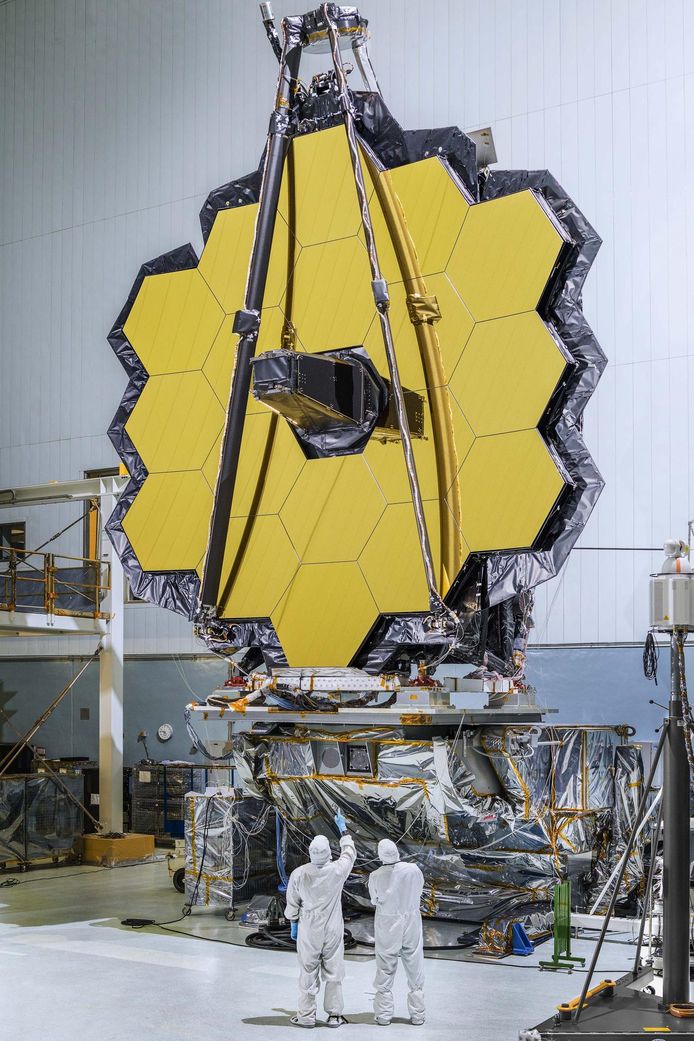
The James Webb Space Telescope (JWST) would be able to spot the signs of our civilization on Earth if it was spying on us from another star system in the Milky Way, a new study shows. The finding raises hopes that the state-of-the-art spacecraft could detect alien civilizations as it stares out toward distant worlds in our galaxy.
Since launching in late 2021, JWST has been predominantly peering out into the deepest reaches of the cosmos in search of clues about how the early universe formed. But one of the telescope's secondary objectives is to analyze the atmospheres of nearby exoplanets, or planets beyond the solar system, to look for gases produced by biological life, known as biosignatures, and chemicals produced by advanced alien civilizations, known as technosignatures.
But despite being the most advanced telescope currently in operation, it is still unclear how well JWST will be able to spot the tell-tale signs of intelligent life. To answer this question, researchers decided to test whether the space telescope could successfully detect intelligent life from the only planet in the universe that is known to be both habitable and currently inhabited — Earth.
In the new study, uploaded to the pre-print server arXiv on Aug. 28, researchers took a spectrum of Earth's atmosphere and deliberately decreased the quality of the data to mimic how it would look to an observer dozens of light-years away. The team then used a computer model, which replicated JWST's sensor capabilities, to see if the spacecraft could detect the key biosignatures and technosignatures from the dataset, such as methane and oxygen, produced by biological life, and nitrogen dioxide and chlorofluorocarbons (CFCs), which are produced by humans.
The results, which have not yet been peer-reviewed, show that JWST could likely detect all the key markers of non-intelligent and intelligent life in our planet's atmosphere.
This graph shows the raw atmospheric data used in the new study. Specific biosignatures and technosignatures are highlighted in different colors. (Image credit: Lustig-Yaeger, et al)
The researchers noted that the quality of the altered dataset is roughly equivalent to JWST observations of planets from TRAPPIST-1 — a star system containing seven exoplanets that orbit a red dwarf star around 40 light-years from Earth. This suggests the telescope should be able to detect life or alien civilizations on exoplanets within 40 light-years of Earth. But the team believes JWST could possibly detect signs of extraterrestrial life up to 50 light-years from Earth.
Only around 20 exoplanets have been officially discovered within a 50-light-year radius of Earth, but based on the number of suspected stars in this region of space, experts predict that there may actually be as many as 4,000 exoplanets within JWST's reach, according to Project EDEN, an international astronomical collaboration dedicated to finding potentially habitable planets close to Earth.
However, this doesn't guarantee that JWST would be able to detect life on other planets.
An artist's interpretation of what the TRAPPIST-1 system might look like. (Image credit: Getty Images)
Detecting biosignatures and technosignatures on other worlds "may prove challenging to interpret without contextual knowledge about the habitable environment," the researchers wrote. In this study, the team already knew which markers to look for, but on an exoplanet with different conditions and alternate potential life forms or technologies those life-signatures may not be as obvious, they added.
“Op aarde kunnen enkel levende organismen dit gas maken”: heeft James Webb ruimtetelescoop eerste teken van leven gevonden op exoplaneet?
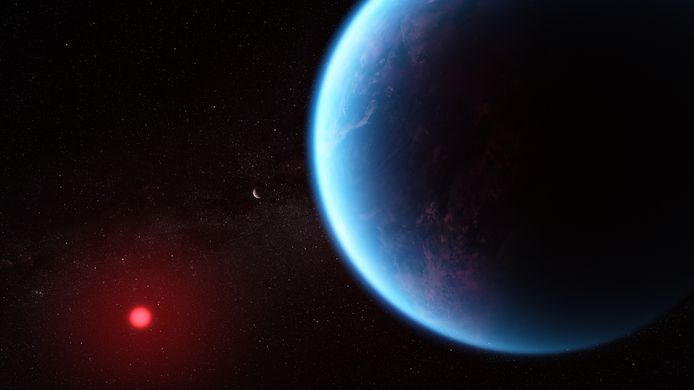
NASA’s James Webb ruimtetelescoop (JWST) heeft tijdens het bestuderen van K2-18b, een exoplaneet die 8,6 keer zo massief is als de aarde, de aanwezigheid van belangrijke moleculen aangetoond. Het gaat hier om koolstofhoudende moleculen, waaronder methaan en koolstofdioxide, en dimethylsulfide. Deze bevinding suggereert niet alleen dat K2-18b een met water bedekte planeet zou kunnen zijn, maar ook dat er mogelijk levende organismen aanwezig zijn.
Martijn Peters
K2-18b is een exoplaneet die rond een koele dwergster draait, genaamd K2-18 op 12 lichtjaren afstand van de aarde in het sterrenbeeld Leeuw. De planeet bevindt zich in de ‘Goldilocks zone’, de omgeving rond een ster waar leven mogelijk is. Wetenschappers vermoeden dat K2-18b een ‘Hycean’ zou kunnen zijn, een planeet met water op het oppervlak en waterstof in de atmosfeer. Dit maakt deze exoplaneet een interessant doelwit in de zoektocht naar leven in het universum.
“Traditioneel concentreerde de zoektocht naar leven op exoplaneten zich vooral op kleinere rotsachtige planeten zoals de aarde. Maar de grotere Hycean-werelden zijn even interessant en gemakkelijker om atmosferische waarnemingen op te doen”, legt Nikku Madhusudhan (astronoom aan de Universiteit van Cambridge). “Ons onderzoek onderstreept het belang van de zoektocht naar leven op een andere planeet te durven verbreden.”
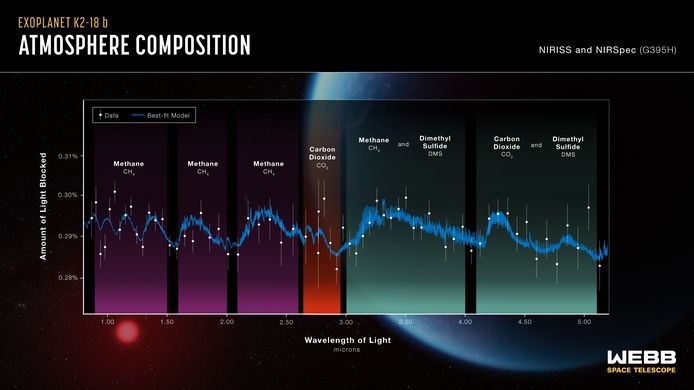
De wetenschappers toonden met hun nieuwe studie in ‘The Astrophysical Journal Letters’ aan dat er zich een overvloed aan methaan en koolstofdioxide in de atmosfeer van K2-18b bevindt. Dit deden ze door spectra te nemen van de exoplaneet met de ‘Near-Infrared Imager and Slitless Spectrograph’ en ‘Near-Infrared Spectrograph’ van de James Webb ruimtetelescoop. Het waarnemen van methaan en koolstofdioxide en het tekort aan ammoniak ondersteunen de hypothese dat er zich op K2-18b mogelijk een oceaan bevindt samen met een waterstofrijke atmosfeer.
Minstens even bijzonder is de mogelijke ontdekking van een molecuul genaamd dimethylsulfide (DMS) in de atmosfeer van de planeet door de ruimtetelescoop. Op aarde kunnen enkel levende organismen dit gas produceren. Specifiek is het fytoplankton in zeeën en oceanen dat hiervoor verantwoordelijk is. We kennen geen enkel ander proces dat DMS maakt. Het signaal van DMS is echter minder uitgesproken en vereist nog bevestiging. “Toekomstige JWST observaties van deze exoplaneet kunnen de aanwezigheid van DMS in significante hoeveelheden bevestigen”, legt Madhusudhan uit.
Hoewel K2-18b zich in de bewoonbare zone bevindt en het nu bekend is dat het koolstofhoudende moleculen herbergt, betekent dit niet noodzakelijk dat de planeet leven kan ondersteunen. De grote omvang van de K2-18b, met een straal die 2,6 keer groter is dan die van de aarde, betekent dat het binnenste van de planeet waarschijnlijk een grote mantel van ijs bevat zoals Neptunus. Daarbovenop bevindt zich dan een dunnere waterstofrijke atmosfeer en oceaanoppervlak. Het is echter mogelijk dat de oceaan te heet is om bewoonbaar of vloeibaar te zijn.
“Ons ultieme doel is het waarnemen van leven op een bewoonbare exoplaneet. Dit zou een ongeziene impact hebben op hoe wij naar onszelf kijken en onze rol in het universum”, concludeert Madhusudhan. “Deze bevindingen zijn alvast een eerste stap in de juiste richting.”
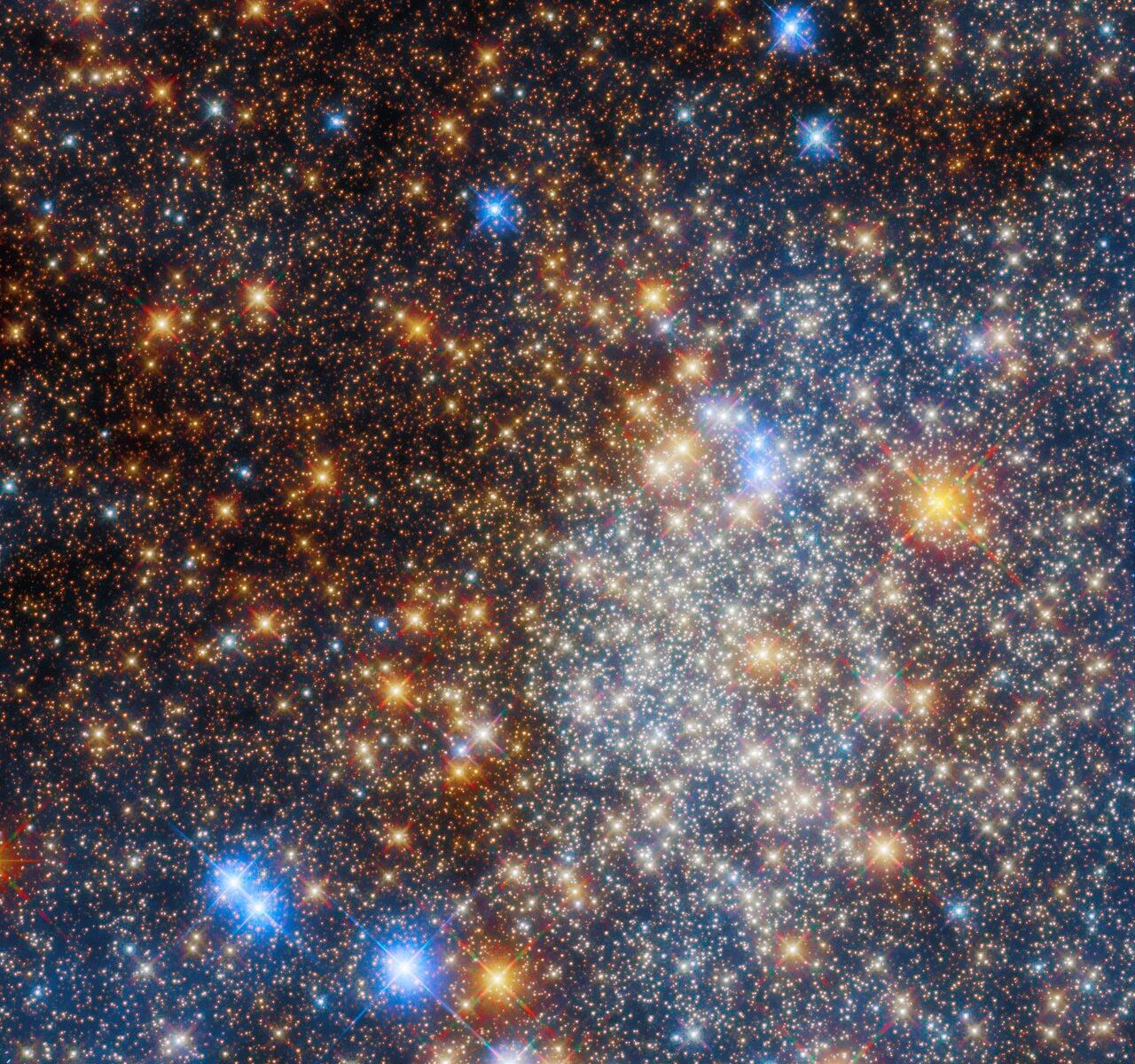
Most globular clusters are found in the Milky Way's halo. But some, like the glittering globular cluster Terzan 12, are near the galactic centre. Image Credit: ESA/Hubble & NASA, R. Cohen (Rutgers University)
The Hubble Imaged Some Globular Clusters in an Unusual Place: Near the Milky Way’s Centre
Our galaxy has about 200 Globular Clusters (GCs,) and most of them are in the galaxy’s halo. Astronomers think most GCs were taken from dwarf galaxies and merged with the Milky Way due to the galaxy’s powerful gravity. That explains why so many of them are on the outskirts of the galaxy. But they’re not all in the halo. Some are towards the Milky Way’s galactic bulge. What are globular clusters doing there?
Globular Clusters (GCs) are spherical associations of stars bound together by gravity. The smaller ones have tens of thousands of stars, and the more massive ones can hold millions of stars. Their stars are typically older and have low metallicity, and in our galaxy, most of them are in the galactic halo.
Most globular clusters are in the Milky Way’s halo, but some are near the center. Image Credit: Left: NASA/JPL-Caltech; right: ESA; layout: ESA/ATG medialab
Globular clusters are ancient. They likely formed between 10 and 13 billion years ago when the Universe was much younger. They’re found in all types of galaxies, and the Milky Way has something like 200 of them. They’re some of the Milky Way’s building blocks, and it’s the same in other galaxies.
Stars in GCs all formed from the same gas cloud. Since the stars are old, many of them are red and bloated and have left the main sequence behind. Any short-lived stars that formed in GCs—like blue giants—are no longer prominent.
Much about globular clusters is still mysterious, though astronomers continue to make progress in understanding them. The Hubble Space Telescope has made a large contribution to our growing understanding of GCs since it first gained its vantage point in low-Earth orbit over 30 years ago.
One Hubble observing program was directed at GCs near the galaxy’s center. It was called “Opening the Window on Galaxy Assembly: Ages and Structural Parameters of Globular Clusters Towards the Galactic Bulge.” The title explains the program. The idea is to understand what role GCs played in the formation and evolution of the Milky Way.
But gazing toward the galactic center is challenging. The region is shrouded in gas and dust that blocks some light and diffuses some light. Fortunately, infrared light is less affected, and this is where the Hubble comes in. The observing program combined images from Hubble’s Advanced Camera for Surveys and the Wide-Field Camera 3, which both sense near-infrared (NIR) light, with other pre-existing images.
The program gave us great images of these clusters and has led to a number of papers examining GCs near the Milky Way’s center.
This Hubble image shows Terzan 1, a globular cluster that lies about 22,000 light-years from Earth in the constellation Scorpius. It’s the closest GC to the galactic center, at only 4200 light-years distant. Image Credit: By ESA/Hubble, CC BY 4.0, https://commons.wikimedia.org/w/index.php?curid=135405328
Djorgovski 1 is another GC that’s found its way into the galactic bulge, close to the Milky Way’s center. Djorgovski 1’s stars contain hydrogen and helium, but not much else, and the cluster is one of the most metal-poor clusters in the inner galaxy.
The NASA/ESA Hubble Space Telescope imaged the globular star cluster Djorgovski 1, which was only discovered in 1987. Djorgovski 1 is located close to the centre of our Milky Way Galaxy, within the bulge. Globular clusters like Djorgovski 1 formed early in the Milky Way’s history, and as such, may hold clues about the inner galaxy’s early evolution. Image Credit: By ESA/Hubble & NASA – http://www.spacetelescope.org/images/potw1126a/, CC BY 3.0, https://commons.wikimedia.org/w/index.php?curid=15645577
The Hubble observing program and the papers it spawned taught us a few things about the GC in the galactic center or bulge. One of the papers showed that two GCs, Djorgovski 1 and Terzan 10, are not actually part of the bulge. Instead, they follow typical halo orbits and are just near the bulge at this time. That paper called the pair of GC ‘Halo intruders.’ Both of these GCs are faint, and research suggests that’s due to mass loss as their trajectories take them repeatedly across the bulge and disk over many orbits.
This is the globular cluster called Palomar 6, or ESO 520-21. This sparkling starfield was also captured by the NASA/ESA Hubble Space Telescope’s Wide Field Camera 3 and Advanced Camera for Surveys. This densely packed cluster is also close to the centre of the Milky Way, where interstellar gas and dust absorb starlight and make observations more challenging. Image Credit: ESA/Hubble and NASA, R. Cohen – https://esahubble.org/images/potw2138a/, CC BY 4.0, https://commons.wikimedia.org/w/index.php?curid=110253296
Palomar 6 has another back story.
At least some of the GCs in the galactic center formed there. A 2021 paper showed that Palomar 6 shares the same metallicity as some other GCs in the region, including M62. That paper concluded that Palomar 6 is about 12.5 billion years old and probably formed in the bulge in the Milky Way’s early days, along with several other GCs.
Globular clusters look every bit like nature is a jeweller that arranged all these stars just so we could be enchanted by them. That’s nonsense, of course. We’re natural beings, and we find natural patterns pleasing.
But they’re more than just visually pleasing. They’ve played a role in how the Milky Way came to be the galaxy it is today, and GCs are an ongoing research topic in astronomy. Many things we thought we knew about them have been overturned as our technology and science improve. For instance, we used to think that they contained a single population of stars that formed from the same cloud and have the same metallicities. But now we know GCs can have multiple, chemically distinct populations.
Surprisingly, astronomers have also found that there’s a mass correlation between GCs and a galaxy’s supermassive black hole (SMBH.) In lenticular and elliptical galaxies, the mass of the SMBH is often very close to the combined mass of the GCs in the galaxy. The authors of this paper aren’t sure why that is, but it might be because the growth of both SMBHs and GCs is associated with mergers. Galaxies that have undergone recent major mergers may have anomalously large SMBHs and GCs.
The science behind globular clusters is intriguing, and there are still a host of unanswered questions. What will we find out next? Who knows.
But at least they’re gorgeous, so while we wait for a better understanding of these visually stunning stellar arrangments, we can enjoy their beauty.
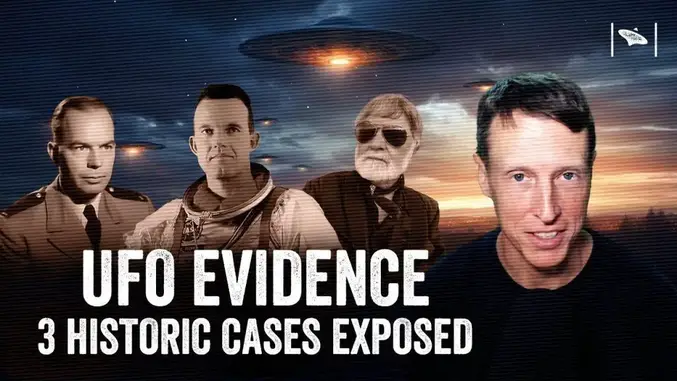
In a world that thrives on skepticism, the topic of UFO sightings often raises a few eyebrows. The enduring enigma has fascinated humanity for decades. But when military personnel step forward with their own UFO sightings, we’re all forced to pay attention. Are these advanced craft mere experimental technologies, or is there more to the story than meets the eye?
The Legacy of UFO Sightings
For over 70 years, reports of UFO sightings have been making headlines. Since the 1950s, Project Blue Book and other investigations have attempted to get to the bottom of these mysterious occurrences. But what’s fascinating is that these sightings aren’t limited to civilian accounts; they also include highly credible reports from military personnel.
The Astonishing Accounts You Can’t Ignore
Delbert Newhouse’s Intriguing Sighting
In 1952, Delbert Newhouse, a Navy chief photographer, reported a UFO sighting in Tremonton, Utah. The craft was said to have resembled a “silver dollar in the sky,” flying in unusual patterns and making erratic movements. Newhouse even filmed the spectacle with his camera. The sighting remains one of the most well-documented cases, backed by a military man trained to observe.
Gordon Cooper: From Outer Space to Inner Circles
In another intriguing case, Astronaut Gordon Cooper reported two UFO incidents, the most astonishing of which took place at Edwards Air Force Base in California. A film captured a flying saucer landing on three telescoping legs. Cooper personally viewed the negatives and sent the film for further analysis, but the footage mysteriously disappeared. Cooper’s credibility and high rank make this case hard to dismiss.
Bob Jacobs and the ICBM Incident
Perhaps the most unsettling account comes from Dr. Robert Jacobs. In the 1960s, while stationed at Vandenberg Space Force Base, Jacobs filmed an intercontinental ballistic missile test. The film captured a UFO shooting beams of light at the missile, disabling it in mid-flight. Despite attempts to discredit him and even erasing his official military records, Jacobs remains steadfast in his account.
Why the Silence?
All these accounts share a disturbingly similar pattern: the footage and evidence are swiftly whisked away, never to be seen again. This gives rise to crucial questions: What does the U.S. government know, and why is this information being withheld?
The Call for Transparency
Christopher Mellon, a former Deputy Assistant Secretary of Defense for Intelligence, has been vocal about the need for the U.S. government to release its UFO data. The call for transparency isn’t just for the public but also serves as validation for the military personnel who have risked their reputation by sharing their encounters.
VIDEO:
Chris Lehto: The US HAS UFO Video Evidence
The consistency in these military UFO sightings is compelling and warrants thorough investigation. As technology advances, so does the quality of evidence. It’s time for a renewed conversation, public disclosure, and in-depth inquiry into what could be one of the most significant discoveries of our time.
If you found this article engaging, don’t forget to like, share, and subscribe for more insights into UFO sightings. Your support helps us unveil the mysteries that continue to captivate our imaginations.
Meer van UFO'S of UAP'S, ASTRONOMIE, RUIMTEVAART, ARCHEOLOGIE, OUDHEIDKUNDE, SF-SNUFJES EN ANDERE ESOTERISCHE WETENSCHAPPEN - DE ALLERLAATSTE NIEUWTJES


 The Houston Enigma: Exploring the Mysteries Behind UFO Sightings Near NASA