Ontdek de Fascinerende Wereld van UFO's en UAP's: Jouw Bron voor Onthullende Informatie!
Ben jij ook gefascineerd door het onbekende? Wil je meer weten over UFO's en UAP's, niet alleen in België, maar over de hele wereld? Dan ben je op de juiste plek!
België: Het Kloppend Hart van UFO-onderzoek
In België is BUFON (Belgisch UFO-Netwerk) dé autoriteit op het gebied van UFO-onderzoek. Voor betrouwbare en objectieve informatie over deze intrigerende fenomenen, bezoek je zeker onze Facebook-pagina en deze blog. Maar dat is nog niet alles! Ontdek ook het Belgisch UFO-meldpunt en Caelestia, twee organisaties die diepgaand onderzoek verrichten, al zijn ze soms kritisch of sceptisch.
Nederland: Een Schat aan Informatie
Voor onze Nederlandse buren is er de schitterende website www.ufowijzer.nl, beheerd door Paul Harmans. Deze site biedt een schat aan informatie en artikelen die je niet wilt missen!
Internationaal: MUFON - De Wereldwijde Autoriteit
Neem ook een kijkje bij MUFON (Mutual UFO Network Inc.), een gerenommeerde Amerikaanse UFO-vereniging met afdelingen in de VS en wereldwijd. MUFON is toegewijd aan de wetenschappelijke en analytische studie van het UFO-fenomeen, en hun maandelijkse tijdschrift, The MUFON UFO-Journal, is een must-read voor elke UFO-enthousiasteling. Bezoek hun website op www.mufon.com voor meer informatie.
Samenwerking en Toekomstvisie
Sinds 1 februari 2020 is Pieter niet alleen ex-president van BUFON, maar ook de voormalige nationale directeur van MUFON in Vlaanderen en Nederland. Dit creëert een sterke samenwerking met de Franse MUFON Reseau MUFON/EUROP, wat ons in staat stelt om nog meer waardevolle inzichten te delen.
Let op: Nepprofielen en Nieuwe Groeperingen
Pas op voor een nieuwe groepering die zich ook BUFON noemt, maar geen enkele connectie heeft met onze gevestigde organisatie. Hoewel zij de naam geregistreerd hebben, kunnen ze het rijke verleden en de expertise van onze groep niet evenaren. We wensen hen veel succes, maar we blijven de autoriteit in UFO-onderzoek!
Blijf Op De Hoogte!
Wil jij de laatste nieuwtjes over UFO's, ruimtevaart, archeologie, en meer? Volg ons dan en duik samen met ons in de fascinerende wereld van het onbekende! Sluit je aan bij de gemeenschap van nieuwsgierige geesten die net als jij verlangen naar antwoorden en avonturen in de sterren!
Heb je vragen of wil je meer weten? Aarzel dan niet om contact met ons op te nemen! Samen ontrafelen we het mysterie van de lucht en daarbuiten.
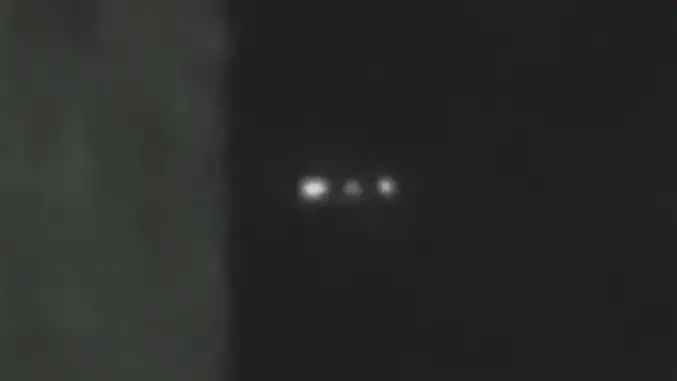
Armada Of 20 UFOs Spotted Leaving Popocatépetl Volcano In Mexico! Super UFO Highway? August 24, 2023
In this footage we can see this group of objects ( about 20 in all ) fly over Popocatépetl Volcano In Mexico and heading in the same direction. Look at the size of them they seem fairly large and on a mission...
RELATED
NASA’s SpaceX Crew-7 Flight Day 1 Highlights
NASA astronaut Jasmin Moghbeli, ESA (European Space Agency) astronaut Andreas Mogensen, JAXA (Japan Aerospace Exploration Agency) astronaut Satoshi Furukawa, and Roscosmos cosmonaut Konstantin Borisov launched aboard the SpaceX Dragon Endurance spacecraft on Aug. 26 on a Falcon 9 rocket from Launch Complex 39A at the agency’s Kennedy Space Center in Florida. The four crew members are scheduled to arrive at the International Space Station on Aug. 27 where they will conduct a six-month mission living and working aboard the microgravity laboratory to advance scientific knowledge and demonstrate new technologies for future human and robotic exploration missions. Such research benefits people on Earth and lays the groundwork for future human exploration through the agency’s Artemis missions, which will send astronauts to the Moon to prepare for future expeditions to Mars.
The Secret of the Moon’s South Pole Revealed by India’s Chandrayaan-3 Mission
In this episode, we will tell you about India’s historic feat of landing a spacecraft near the lunar south pole for the first time. We will explain why the lunar south pole is a unique and challenging region, where there might be water ice trapped in the dark craters. We will also describe how India’s Chandrayaan-3 mission aims to study the lunar environment and resources around the south pole, and what it has discovered so far. We will also discuss the future plans and goals of Chandrayaan-3, and how it can benefit humanity’s exploration and utilization of the Moon. This episode is based on the latest updates from ISRO, which you can find on their official website or X (formerly known as Twitter) account. Join us as we explore the secrets and surprises of the Moon’s south pole with Chandrayaan-3.
A Rare Comet is Approaching our Planet! It Can Now Be Seen In The Sky
Comet P1 Nishimura will fly past Earth in September 2023, and it is expected to be visible to the naked eye. The September 2023 comet was discovered by Japanese amateur astronomer Hideo Nishimura. At the time of discovery, the comet had an apparent magnitude of 10.4, or about 40 times fainter than a star on the threshold of naked-eye visibility. The comet is brightening as it approaches the Earth and the Sun. As of August 26, its magnitude had skyrocketed to 7.9, a ten-fold increase in brightness as compared to the night it was discovered.
In this video, you will find every detail on how to see Comet Nishimura in the coming days. Space
Unveiling The Reasons Why UFO/UAP Technologies Have Been Hidden
For nearly a century, the truth about UFOs and Unidentified Aerial Phenomena has remained shrouded in secrecy. But now, the tides are turning, and the era of disclosure is hurtling towards us. As this revelation unfolds, a fascinating dichotomy emerges: some will readily embrace the notion, even those who once dismissed it as absurd, while others will struggle to to accept this idea.
Yet, the heart of the matter transcends the debate about extraterrestrial intelligence. It centers on an awe-inspiring array of technologies, carefully concealed from the public eye for reasons known only to a select few in positions of power. These technologies hold the potential to revolutionize our world, to mend the very fabric of our existence.
Imagine oceans cleansed of their pollutants, hunger obliterated by boundless resources, and a planet powered by clean, accessible energy, free to all. The prospect is tantalizing, a utopian vision on the cusp of becoming reality. Join us on this thought-provoking journey as we delve into the labyrinthine corridors of hidden knowledge, exploring the untold stories that could reshape humanity's destiny. The countdown to revelation has begun, and the course of history stands at a crossroads. Will you be a witness to the dawning of a new era?"
Breaking News: US Scientists Unveil Mind Blowing UFO Inspired Airplane Technology
Breaking News: US Scientists Unveil Mind Blowing UFO Inspired Airplane Technology
Join us on an extraordinary journey into the secretive world of classified military aircraft in this captivating YouTube video. In the vast skies of California's Antelope Valley, where aerospace giants like Northrop Grumman and Boeing have made history, we unravel the mystique surrounding the TR-3A Black Manta—a marvel of stealth born from collaboration between the U.S. Air Force and Northrop. Discover its audacious power plant, almost radar-invisible design, and the intriguing fusion of science fiction and reality that led to an aircraft capable of defying gravity's limits. The Black Manta's rumored roles, from laser targeting during the Gulf War to its connection with the legendary SR-71 Blackbird, add layers of intrigue to its enigmatic legacy.
But our exploration doesn't stop there. Dive into the revolutionary F-117 Nighthawk, a stealth masterpiece that changed the face of aerial warfare during Operation Desert Storm, and witness its legacy in shaping stealth technology. Then, we transition to the world of unmanned aerial guardians with the RQ-170 Sentinel, Lockheed Martin's Skunk Works creation, and delve into the speculative realm with the Boeing Bird of Prey. Lastly, we glimpse the Aurora, an aircraft cloaked in conspiracy and extraterrestrial tales, leaving us pondering its true capabilities. This journey through the clandestine world of military aviation is a testament to human innovation and our unquenchable thirst for exploration, where fact and fiction blur in the boundless skies.
World's 7 Speediest Robots You MUST See!
From robots that can run faster than Olympic sprinters to those that can solve complex puzzles in record time, the world of robotics is advancing at an incredible pace.
Today, we’re going to take a closer look at the 7 fastest robots in the world, and you won’t believe what these robots are capable of.
RELATED
25 Rare Historical Photos That Scientists Can Not Explain
25 Rare Historical Photos That Scientists Can Not explain. Have you ever come across a photograph that leaves you utterly perplexed, defying all rational explanation? What if the pages of history held secrets that even the most brilliant minds couldn't unravel? Brace yourself as we dive into a mesmerising collection of puzzling images, raising more questions than answers. In this captivating journey, we unveil twenty-five rare historical photographs that have left scientists baffled and historians scratching their heads. From mind-bending enigmas to historical anomalies, this is a blockbuster adventure you can't afford to miss.
Apollo Astronaut Reveals Declassified Images From The Moon Before His Death
Evidence For The Biggest Impact Crater on Earth At 520 km Across
The Latest UFO Sighting in Albuquerque’s International District
The Enigma That Caught Albuquerque Off Guard
Is the truth really out there? Residents of Albuquerque’s International District would say “yes” after an inexplicable UFO sighting that occurred on March 16, 2023 and it was just submitted to us today. The skies were clear, but what unfolded was anything but ordinary.
A Close Encounter of the ‘Flying Saucer’ Kind
On the fateful evening, sky gazers and casual pedestrians alike were stunned as they saw what appeared to be a flying saucer dart across the sky. The object emanated a soft, otherworldly glow as it soared with a speed that defied all logic.
With smartphones in hand, onlookers managed to capture this jaw-dropping spectacle before the unidentified object concealed itself behind a building. The short video clip, which you can view alongside this article, incited both excitement and curiosity from people around the world.
The Debate Rages On
The design, movement, and the extraordinary speed of the object make any explanations insufficient. As for now, the sighting has both the scientific community and UFO enthusiasts puzzled and intrigued.
More Than Just an Isolated Event?
What makes this sighting even more compelling is that Albuquerque, and New Mexico at large, have long histories of UFO sightings and unexplained phenomena. This includes the infamous Roswell incident in 1947. Is this latest sighting an isolated event or part of a bigger picture?
VIDEO:
For those interested in UFO sightings, this latest event is another piece of the ever-growing puzzle. Keep your eyes on the skies and your cameras at the ready; you never know when the next inexplicable event will take place!
So, whether you’re a believer or a skeptic, this latest UFO sighting in Albuquerque’s International District adds yet another layer to the enduring mystery of what really is out there.
German aerospace company POLARIS Raumflugzeuge is advancing in its ambitions to produce disruptive aerospace technologies with a recent series of test flight demonstrations in advance of the development of AURORA, the company’s next-generation spaceplane concept with a name already familiar to longtime aviation enthusiasts.
Drawing from more than three decades of combined German and European aerospace research, the company’s focus mainly involves the development of reusable space launch capabilities and the production of a versatile hypersonic transport system capable of maintaining the ability to operate like a traditional aircraft.
In recent months, successful test flights involving demonstrator aircraft have allowed POLARIS to validate several crucial technologies, and the company is now approaching the development of a new demonstrator craft that will represent the final test before it begins production of its ambitious next-generation spaceplane.
AURORA: THE SPACEPLANE OF TOMORROW
AURORA, an innovative spaceplane design that combines the rocket launch capabilities the company is currently testing with traditional air flight modes, has its origins in early innovations that began at the German Aerospace Center DLR. The result, the company says, is a vehicle with a design unlike any other, which POLARIS says will provide an economical means of access to space in the years ahead.
Among its key benefits, AURORA will offer worldwide space launch capabilities without any need for a launch pad, as the spaceplane’s aircraft-like operation allows it to take off from any traditional runway. Eliminating the need for a launch pad also greatly reduces fuel costs associated with traditional rocket-driven spaceflight.
(Credit: Polaris Raumflugzeuge)
AURORA will be capable of carrying payloads greater than 2200 pounds (1000 kg) in orbit, and roughly ten times that amount for suborbital/hypersonic flight. In keeping with the company’s objectives to develop sustainable aerospace technologies, AURORA is also designed with close to 100% system reusability.
DEFENSE, RESEARCH, AND BEYOND
With its versatility and sustainable design, POLARIS expects that its spaceplane will be equipped to meet the demands of a variety of markets, enabling satellite and orbital cargo launch operations with relative ease and significantly reducing flight times, enabling swift, economical delivery of payloads across great distances in record time.
However, its defense and research applications are evident, as AURORA will be capable of reaching any orbit inclination and is already being touted as a potential solution for hypersonic reconnaissance and a variety of other defense applications.
While AURORA will be designed to function as an unmanned aircraft, POLARIS says it will offer an optional upgrade of its spaceplane that will facilitate human transport, enabling flights capable of carrying passengers for research and training purposes and a range of other potential spaceflight missions.
THE MYSTIQUE OF THE FABLED AURORA
The aircraft’s name seems to be no accident, either. In the 1990s, AURORA had been the alleged name of an aerospace development project aiming to build the successor aircraft to the famous SR-71.
In fact, as early as January 1979, Aviation Week & Space Technology reported rumors about the development of a “Mach 4, 200,000-ft.-altitude aircraft that could be a follow-on to the Lockheed SR-71 strategic reconnaissance vehicle in the 1990s,” which it reported “has been defined by the Air Force Aeronautical Systems Division and Lockheed.”
Efforts to determine whether such a spacecraft had indeed ever been developed continued for years, prompting the Federation of American Scientists to investigate “observations of mysterious aerial phenomena” which began to be “connected with the 1988 reports that Aurora was a Mach 6 stealthy reconnaissance aircraft that was being developed to replace the SR-71.”
Ultimately, it was never determined whether such an unacknowledged aircraft truly existed. Kelly Johnson, who developed both the SR-71 and its predecessor, the U-2, during his time with Lockheed, later said the name “Aurora” had been the code name for funding of an Air Force black program which later leaked during congressional appropriations hearings, prompting the media to presume it involved a secret hypersonic aircraft.
“Although I expect few in the media to believe me,” Johnson later wrote, “there is no code name for the hypersonic plane, because it simply doesn’t exist.”
While Johnson maintained the U.S. had never successfully developed a hypersonic successor to the SR-71, not surprisingly, invocation of the fabled aircraft’s name has been seen again and again by various agencies and aerospace companies in recent years.
Now, perhaps by the end of the decade, POLARIS appears to be the latest company poised to bring its version of AURORA out of the shadows of modern space-age mythology and into reality.
TECHNOLOGY VALIDATION AND THE PATH TO AURORA
POLARIS has announced that it expects to begin flight with its light spaceplane by as early as 2026, with a heavy vehicle that will become operational by the early 2030s.
In advance of AURORA’s development, the company has undertaken technology validation with the production of several scaled flight demonstrators.
Chandrayaan-3 hits an important scientific milestone.
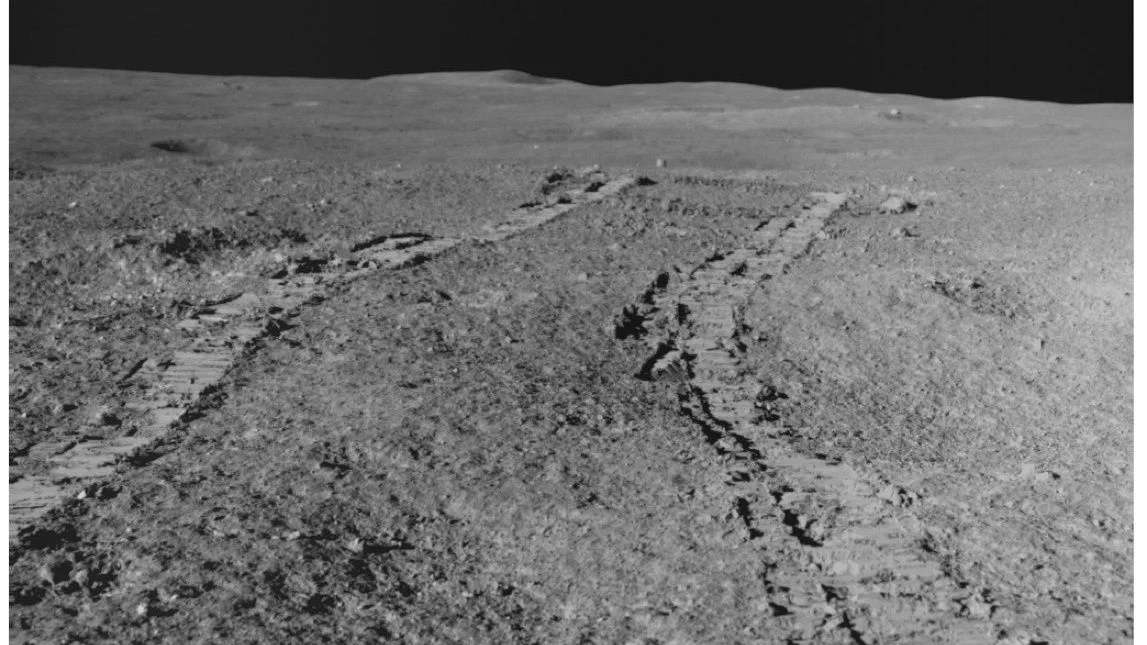
After witnessing a hazardous crater, the Pragyan rover retraced its path to get to safety. This image of the path was taken by its navigation camera.
(Image credit: ISRO)
On Aug. 23, thanks to the success of Chandrayaan-3, India made a strong mark in space history. Not only did it become the first nation to land a spacecraft near the south pole of the moon, but also the fourth to create imprints on Earth's gleaming companion at all. However, the lunar lander's touchdown was only step one of its ultimate story.
Since reaching the moon's south pole, Chandrayaan-3 has been hard at work – having deployed a rover named Pragyan to explore the cratered surface, harnessed integrated cameras to send back videos of its environment and even started completing research objectives planned for a two-week stay on the orb.
On Saturday (Aug. 26), for instance, scientists with the Indian Space Research Organization presented a video on X (formerly known as Twitter) of Pragyan roaming around the mission's landing point, which has been named the Shiv Shakti Point. In the video, the gold-colored moon explorer is seen on the other end of two delicate tracks it has created in lunar soil since exiting the lander that ushered it over there, named Vikram. The gingerly way Pragyan treads on a desolate gray world is almost charming.
Chandrayaan-3’s Pragyan rover going down a ramp from the lander to reach the surface of the moon
ISRO
Shortly after releasing this update, ISRO also posted a sort of checklist on X saying that, after successful completion of a safe and soft landing as well as Pragyan's deployment, Chandrayaan-3 has begun conducting scientific experiments on site. "All payloads are performing normally," the agency posted on X.
That prelude to lunar south pole science was quickly elaborated upon when, on Sunday (Aug. 27), ISRO posted yet another update on X regarding one of Chandrayaan-3's payloads called the ChaSTE experiment, or Chandra's Surface Thermophysical Experiment.
The purpose of this experiment, in essence, is to use a temperature probe as well as 10 individual temperature sensors to measure temperature profiles of lunar south pole soil. The goal, ISRO explains, is for ChaSTE to help scientists understand what the thermal behavior of the moon's surface is like. And, as it appears, ChaSTE has already found some stuff out.
Illustrated by a graph ISRO released, the experimen has probed various temperatures of the moon's surface at different depths, marking the "first such profile for the lunar south pole."
The hazardous crater on the moon seen by Pragyan. (Image credit: ISRO)
Detailed observations on that front, the agency noted, are still underway – but if you're wondering what Pragyan is up to, the last we heard, it has come across a dangerous crater. Due to the nature of the lunar south pole, hazards such as this are kind of expected. In fact, that's a major reason for why Chandrayaan-3's landing was such a massive occasion. Though everyone wants to get to the lunar south pole — because it's expected to host solid quantities of water ice — actually landing there is tough because the region is so very covered in craters.
Just about 3 meters (nearly 10 feet) from its location on Sunday (Aug. 27), the rover spotted a crater that seemed to be about 4 meters (13 feet) wide. "The rover was commanded to retrace the path," ISRO posted on X, "It's now safely heading on a new path."
Join our Space Forums to keep talking space on the latest missions, night sky and more! And if you have a news tip, correction or comment, let us know at: community@space.com.
John Ramirez, a former CIA official with 25 years of experience, has been sharing the knowledge he gained about UAPs in the course of his work since 2021. He possesses a wealth of information and experience on the subject of UAPs and the U.S. intelligence organization. Due to his revelations of UAP riddles that had never been discussed in public by government officials, he established himself as an influential figure on social media. Among all his claims, the most surprising reveal is about the alleged human-hybridization programs. He strongly believes that the 1947 Roswell crash happened and its occupants that were unlike humans were recovered.
The recent tweet on retired CIA Officer John Ramirez by investigative Journalist Ross Coulthart has opened up a new channel to discuss the topics that were considered fringe before. The UAP phenomenon is becoming more intense and mysterious with more credible sources, bringing new information. Coulthart questions why the US government lied about the Roswell crash.
Coulthart’s tweet mentions Ramirez’s interview with Martin Willis Live Shows, where he revealed the never-told information on the Roswell UFO crash, alien occupants and their DNA that only came out after World War II. Ramirez discussed an unclassified meeting he attended about “modern human origins,” his personal thoughts on the subject, his own personal experiences, and the UFO connection between him and several of his colleagues that led to their careers.
John Ramirez served at the CIA Directorate of Science and Technology, Directorate of Intelligence, and ODNI National Counterproliferation Center between 1984 and 2009. At the CIA, he was a chief intelligence analyst specializing in ballistic missile defense, weapon system radars, and technical collection activities. He was the SIGINT expert and multi-discipline collection needs strategist at the NCPC. Ramirez served in the US Navy as an Electronics Warfare Technician aboard surface ships from 1973 to 1979. He majored in political science at George Washington University, Washington, DC, and graduated in 1983.
Ramirez says that he attended a one-day symposium at a hotel in 2001 that was unclassified, about which he was himself surprised. He recalled the story went back to after World War II. He said that the CIA was interested in the hybridization of humans, and he was told by two top officials (their names are classified) that they discovered an alien DNA in the human genome.
“I give credence to the fact that Roswell actually happened. I will believe personally that bodies were recovered and if these bodies were examined and then their DNA was examined and they know what that alien genome looks like and they look at humans and they can identify the same sequences in the human genome. I think that was what led them to believe that there’s a hybridization of humans and they further said in this one-day symposium that… they have not only alien DNA but enhanced alien DNA.”
“We know that Roswell happened in July of 47… if we believe in Colonel Corso, if you believe in eyewitnesses, if we believe the Roswell’s story then we know that the bodies were recovered. We have to believe that those bodies were examined somewhere and we have to believe that they were able to sequence something in those bodies that look like a genome and from there they checked the human genome and saw the correlations. That’s what I believe because that’s what I was told. I don’t have any evidence of that but by releasing these names I would hope that serious researchers and journalists would contact these people and try to get the story. If they would even admit to the story but I heard it with my own ears,” Ramirez said.
Many netzines refute to accept Ramirez’s narrative of Roswell’s alien DNA story as they believe DNA was discovered in 1953. That is not true. Ramirez is correct: “DNA was discovered in 1869 by Swiss researcher Friedrich Miescher, who was originally trying to study the composition of lymphoid cells (white blood cells).”
Then, in the decades that followed Miescher’s discovery, other scientists, notably Phoebus Levene and Erwin Chargaff, conducted a series of studies that revealed additional characteristics about the DNA molecule, such as its fundamental chemical components and the manner in which they were connected. Watson and Crick’s ground-breaking conclusion of 1953, that the DNA molecule exists in the form of a three-dimensional double helix, may never have been achieved without the scientific groundwork supplied by these pioneers. (Source)
Ramirez made an intriguing statement in response to the rumor that the US government is reluctant to discuss the potential UFO occupants. The U.S. Air Force may be partially to blame for this current stance, according to Ramirez. However, not for obvious reasons. He commented:
“The air force and their exploitation of that type of technology made a mess of things, as when people see the triangular craft, and they’re not flying in space but in our atmosphere, it points to the fact that we know what the triangles are and we want people to think they’re seeing UFOs because then people won’t know exactly what they’re seeing.”
Some others believed Ramirez’s assertion that the USAF might be to blame for reports of triangular aircraft — dubbed the TR3B by some — may be true. Tom Delonge hinted that the US government controlled these ships on the Joe Rogan Experience, but he also said that some of them belonged to other intelligence. Delonge asserted that triangle-shaped ship, presuming they have tail fins, represent technological advancements made by humans.
Moreover, Ramirez also stated in an interview with Project Unity that humans are hybrids. According to him, Elizondo is unable to use the word “hybridization,” but the Pentagon employees are counting on him to do so eventually. Elizondo discussed the possibility that non-human intelligence have been in contact with humans for a very long time on the Theories of Everything podcast. This would imply that we have all forgotten about our own past, which would hide the possibility that we are hybrids of humans and extraterrestrials.
In Iceland, residents have been thrown into a fright after a bizarre story emerged regarding peoples being scared at a volcano location by what has been described as a “UFO”.
UFO footage flying over a volcano in Iceland, UFO footage 2023, UFO news, tic tac UFO, real? Let's analize. That and more strange events caught on tape. Real or fake?
Alien technology? Harvard professor finds fragments that could be of otherworldly origin
Harvard professor Avi Loeb's team was combing the floor of the Pacific Ocean looking for remnants from a 2014 asteroid strike when they turned up something unmatched in our solar system.
An astrophysicist at Harvard University believes he may have found proof of extraterrestrial life not by studying the vast night sky, but by combing the bottom of the Pacific Ocean.
Last month, a crew aboard a boat called the Silver Star embarked on an expedition to Papua New Guinea with the mission of recovering fragments from a mysterious meteor that had crashed into Earth in 2014.
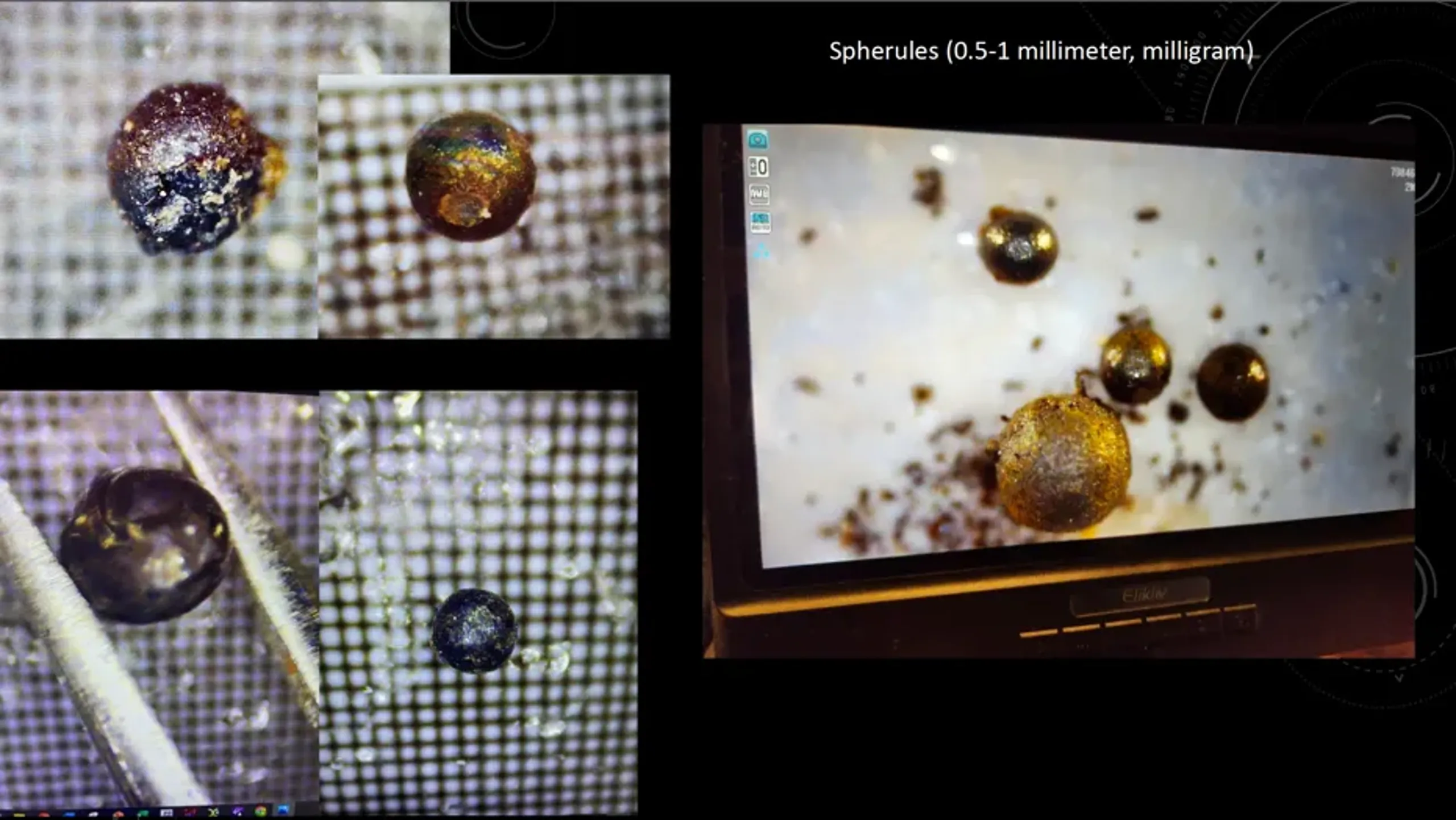
During the two-week excursion, the team scoured over 100 miles of ocean bed before recovering 50 tiny spheres composed of a metallic substance they say is unmatched to any existing alloys in our solar system.
The spheres — which are so miniscule that they require a microscope to see — require further testing to determine whether they're natural or technological in nature. Depending on the findings, the objects could be the first time that humanity has found solid evidence of interstellar beings.
In other words, aliens.
"Our findings open a new frontier in astronomy of studying what lies outside the solar system through microscopes rather than telescopes, said Avi Loeb, a professor and astrophysicist at Harvard University, who led the expedition as its chief scientist.
The hunt for an interstellar meteor yields surprising findings
The fragments the team uncovered are believed to be from a basketball-sized meteorite that in 2014 slammed into the Earth’s atmosphere and into the western Pacific Ocean.
Originating from outside the solar system, the meteor moved at a speed two times faster than nearly all of the stars in the vicinity of the sun, Loeb said. Though too small to be noticed by telescopes through its reflection of sunlight, its collision with Earth generated a bright fireball recorded by U.S. government sensors, Loeb added.
The $1.5 million expedition that Loeb led was to recover the fragments left over from the explosion on the floor of the Pacific Ocean at its crash site near Manus Island in Papua New Guinea. Between June 14-28, the crew searched over 108 miles of the ocean floor by combing it with a sled full of magnets attached to their boat.
A photo of the crew
COURTESY OF AVI LOEB
Loeb said it took days to get the magnetic sled on the ocean floor and a few more days after that to understand just what the crew collected along the expected path of the meteor — about 53 miles off the coast of Manus Island.
"As we scooped the magnets, the most abundant material attached to them was a black powder of volcanic ash," he wrote on Medium.com.
But after a week at sea, the breakthrough Loeb had been seeking finally came. A member of the team observed through the microscope a "beautiful metallic marble of sub-millimeter size and sub-milligram mass," Loeb wrote. After the discovery, the team continued to find more spherules.
A preliminary analysis of the spherules' composition suggested they do not match commonly manufactured alloys or natural meteorites in our solar system, Loeb said. The crew brought the 50 spherules to the Harvard College Observatory for further study.
The fundamental question scientists hope to answer is whether the meteor was natural in origin, or artificially-made. In other words, is it remnants of an alien spaceship?
"We've been looking for something the size of a watermelon in the middle of the Pacific Ocean and somehow managed to find some fragments," according to a statement from, American entrepreneur Charles Hoskinson, who funded the expedition. "This operation has produced excellent science and I hope captures the imagination of the general public for the pursuit of intelligent life in the universe."
The expedition team recently held its first meeting to plan and put together a scientific paper to describe the findings, Loeb said.
The team hopes to complete a preliminary analysis at three laboratories at Harvard, in Germany and at the University of California, Berkeley, the findings of which Loeb said will be incorporated into a paper that will be submitted for publication in a peer-reviewed journal within the month.
It's not lost on Loeb how significant of a discovery he could have on his hands, the implications of which would fundamentally alter humanity's understanding of the universe and our place in it. A few days after returning from the expedition, Loeb recalled that FedEx delivered a black plastic suitcase with the materials to his front door.
"I then realized that for the first time in history, humans are in possession of materials from a meter-size object that came from outside the solar system, the first recognized interstellar meteor," Loeb told USA TODAY. "FedEx was the last step in a journey that this package may have made for billions of years through interstellar space before it arrived at my doorstep."
Eric Lagatta covers breaking and trending news for USA TODAY. Reach him at elagatta@gannett.com and follow him on Twitter @EricLagatta.
UFOs & Mainstream Science: Astrophysicist Avi Loeb Calls for a New Era of Clarity and Inquiry
In a recent round-table conversation with Neil deGrasse Tyson and Elizabeth Vargas, Avi Loeb stood out as the antithesis to armchair science theorists. The Harvard Professor and Chair of Astronomy believes that talking about science isn’t enough; one needs to “walk the talk” by actively participating in data collection and analysis.
In Search of Intergalactic Artifacts
While deGrasse Tyson cautioned against the reliability of eyewitness accounts as scientific evidence, Loeb actively engages in fieldwork that takes him to extraordinary lengths. He isn’t just theorizing about cosmic bodies and potential life beyond our planet; he’s out there looking for tangible evidence. In one ambitious project, Loeb led a team to sift through the depths of the Pacific Ocean, hoping to find materials that might have originated from outside our solar system.
Ocean Floors Over Classified Files
Loeb challenges the notion that we must wait for government-released evidence to advance our understanding of phenomena like UFOs or extraterrestrial material. According to him, the oceans are not classified; hence, they serve as a more democratic ground for scientific exploration. He believes the answers we seek might be buried not in classified government documents but possibly under miles of ocean water.
Avi Loeb’s approach also raises questions about the role skepticism plays in scientific progress. While deGrasse Tyson represents a cautionary perspective, urging for “better data,” Loeb calls for more open-minded exploration. He points out that skepticism should not become a barrier to seeking empirical evidence. There is a difference, he argues, between being scientifically rigorous and being dismissive of groundbreaking avenues of study.
Bring Back the Scientific Adventure
Loeb laments that some scientists have become too cautious, even stalling the wheels of progress. The passionate astronomer advocates for a return to the golden age of scientific discovery, an era marked by audacious explorations and path-breaking findings. He challenges the scientific community to not just speak about the colossal implications of discovering life beyond Earth, but to actively seek out that evidence.
New Book on the Horizon
For those intrigued by Loeb’s unconventional approach to scientific discovery, there’s good news. He has a new book in the pipeline that delves into these very topics, discussing the significance of potential discoveries and their transformative impact on humanity.
VIDEO:
Avi Loeb calls on scientists to seek UFO evidence before discrediting claims | Elizabeth Vargas Repo
In a world where scientific discourse often takes place in conference rooms and on social media platforms, Avi Loeb serves as a poignant reminder of what scientific adventure used to be—and can still be. His efforts to merge discourse with action lay down a formidable challenge to both scientists and skeptics alike: Stop just talking about finding evidence and start actively looking for it.
So, whether it’s combing through the ocean depths for cosmic relics or pushing the boundaries of mainstream scientific thought, Avi Loeb is more than just a theorist. He is an adventurer at heart, aiming to take the scientific community along on a journey to uncharted territories.
For over 90 years, the UFO enigma has captivated people’s minds worldwide, sparking curiosity, debates, and countless investigations into the phenomenon. The wait is over, as David Grusch, David Fravor & Ryan Graves are set to testify before the US Congress during the congressional meetings scheduled for July 26, 2023.
Meanwhile, various theories were postulated by United States Representative Mike Gallagher on the possible origin of UFOs while he appeared on Pat McAfee’s show on June 27, 2023. The former Marine suggested that unidentified flying objects (UFOs) might possibly represent an enigmatic “ancient civilization” that had remained hidden on Earth until recently when they began to surface.
“This should be an opportunity for the government to be transparent,” he said. “If we have information that disconfirms the extraterrestrial hypothesis, or all these other ones, at least it shows the government doing something competent and being forward-leaning by declassifying information to the public.”
Rep. Gallagher made this statement in response to the wild interview of David Grusch with Ross Coutlhart that hit the media. Mr. Grusch, who is confirmed to testify before Congress in the upcoming hearings, claimed that the US government has proof of alien life and that there are spacecraft from another species. He mentions that there is a significant number of these spacecraft, some of which have landed while others have crashed.
When asked about the duration of the cover-up, Grusch mentions that the first recovery of a UAP occurred in 1933 in Magenta, Italy, during the regime of Benito Mussolini. He explains that the Italian government moved the recovered craft to a secure air base until 1944-1945 when the Vatican informed the Americans about it.
Appearing on the sports talk show, Gallagher suggested that one possible explanation of supposed UFO sightings was the so-called “Terminator” theory — derived from the film of the same name — that aliens were actually human beings from the future. Gallagher further put forth another theory, suggesting the following: “Instead of us from the future, it might indeed be an ancient civilization that has been lurking here, and suddenly it’s making its presence known.” Ancient Aliens, does it ring a bell?
A similar theory was also proposed by Tim Peake, one of Britain’s famous astronauts. He said that the UFOs filmed by the US military over 100 times could either time traveling humans or aliens from other civilizations. During an interview with Good Morning Britain in June 2022, Briton astronaut Tim Peake, who spent more than six months on the International Space Station, was asked about the UAP videos, which the Pentagon recently declassified.
Peake said: “I heard one theory where a pilot was talking about that potentially in the future, they’ve developed time travel – is it something that’s come back from the future?” He did not exactly say what the UFOs are but shared some theories that have long been discussed by UFOlogists.
“I don’t think it’s a development of any state nation or non-state organization at all. I think it’s quite remarkable when you see the video footage. It does seem extraordinary as to what these machines are capable of.”
There is a huge buried UFO hidden outside the US, and Ross Coulthart claimed that he knows the location of this immovable craft. There is no confirmation from Coulthart about the nature of this craft if it was retrieved. However, some have speculated this could be an archeological dig. Could this particular craft potentially be a remnant of a bygone civilization?
Considering Rep. Gallagher’s theory, scientists have explored the possibility of detecting ancient civilizations in Earth’s geological record. A recent paper called “The Silurian Hypothesis” discusses how traces of industrial civilizations could be found. While fossils and artifacts are unlikely to survive over millions of years, anomalous changes in chemical compositions could serve as clues. By studying geological anomalies and applying models to other planets, scientists hope to understand if civilizations existed in the distant past.
NASA has spent many years seeking the truth regarding extraterrestrial life. Furthermore, the space agency has never denied the existence of non-human life beyond Earth in any form. This is sufficient to discuss the idea of non-human life existing beyond Earth in any form, from the microscopic to the macroscopic. Avi Loeb, a professor at Harvard, has supported the idea that there may have been earlier civilizations on both Earth and Mars, and that these civilizations may have been the origin of UAPs. (Click here to read the full article)
Mr. Loeb writes: “Planets like Mars or Earth could have given multiple births to technological civilizations that were a billion years apart and hence were not aware of each other. Like stable parents, the planets recovered from the environmental impact of these civilizations over time. We may have been separated in time from siblings that we never had the opportunity to meet and so we are unaware of their existence.”
Former Pentagon UFO official, Lue Elizondo, shared intriguing insights in an interview about crash retrievals and materials related to UFOs/UAPs. He believes the US government possesses exotic materials but lacks transparency on the matter. (Click here to read the full article)
Elizondo used an analogy of finding an out-of-place object in King Tut’s tomb to emphasize the significance of finding advanced materials before our known technology existed. Some interpreted this analogy as a hint that UFOs could be considered archaeological findings, possibly ancient rather than just old.
Interestingly, Bob Lazar, on the Joe Rogan Experience, mentioned hearing that at least one recovered UFO was found during an archaeological dig, suggesting its ancient origin. Astronomer Avi Loeb suggested that some advanced devices made by early inhabitants of Mars and Earth might still be operational elsewhere in the Solar System, potentially accounting for some Unidentified Aerial Phenomena reports.
Physicist John E. Brandenburg’s 2015 study speculated about a massive thermonuclear explosion that destroyed Mars’ once-Earthlike atmosphere, considering the Cydonian Hypothesis and Fermi’s Paradox. These ideas explore the possibility of ancient advanced civilizations in our solar system.
De wolken op Neptunus komen en gaan, maar waarom dat gebeurt, was tot nu toe een raadsel. Astronomen hebben nu ontdekt dat de elfjarige cyclus van de zon er iets mee te maken heeft.
Elke ongeveer elf jaar keert de polariteit van de magnetische velden van de zon om. Dat gaat gepaard met hevige zonnevlammen en een toename van het aantal zonnevlekken. Op het moment dat de activiteit piekt, storten de magnetische velden in en draaien de polen om. Dan komt de zon weer tot rust om uiteindelijk weer aan een nieuwe cyclus te beginnen.
Heel ver van de zon Dat dit invloed heeft op de wolken van Neptunus, is opmerkelijk, omdat de planeet zo ongelooflijk ver van de zon af staat. Slechts 0,1 procent van het zonlicht dat de Aarde bereikt, komt op Neptunus aan. En toch worden de wolken op de planeet beïnvloed door zonneactiviteit en niet door de vier seizoenen, die ieder zo’n veertig jaar duren op Neptunus.
De ontdekking ging niet over één nacht ijs: de Hubble, NASA’s beroemde ruimtetelescoop, heeft Neptunus zeker dertig jaar geobserveerd. Daarnaast zijn er data van het W. M. Keck Observatory in Hawai gebruikt plus observaties van het Lick Observatory in Californië.
Wolken weg Daardoor zagen de astronomen in 2019 de wolken vrij plotseling wegtrekken. “Ik was verbaasd hoe snel wolken verdwijnen op Neptunus”, zegt Imke de Pater, emerita professor aan UC Berkeley. “We zagen binnen een paar maanden de wolkenactiviteit inzakken.” En die wolken keerden niet zomaar terug. “Zelfs nu nog, vier jaar later, zien we op de meest recente beelden van afgelopen juni dat de wolken nog niet op hun oude niveau zijn”, vertelt onderzoeker Erandi Chavez. “Dit is extreem spannend en onverwacht, zeker omdat de vorige periode waarin er weinig wolken waren op Neptunus lang niet zo heftig was en veel korter duurde.”
Woest weer De beelden van onder meer de Hubble onthullen een intrigerend wolkenpatroon gebaseerd op de seizoenen en de zonnecyclus. Als het woest weer is op de zon stroomt er meer intense uv-straling het zonnestelsel in. De onderzoekers ontdekten dat twee jaar na de piek van de zonnecyclus het aantal wolken op Neptunus toeneemt. Ook bleek er een link tussen het aantal wolken en de helderheid van de ijsreus door het zonlicht dat op de planeet reflecteert.
Dertig jaar wolken op Neptunus. Afbeelding: NASA, ESA, Erandi Chavez (UC Berkeley), Imke de Pater (UC Berkeley)
“Deze opmerkelijke data leveren het sterkste bewijs tot nu toe dat de dikte van het wolkendek op Neptunus samenhangt met de zonnecyclus”, zegt De Pater. “Onze bevindingen ondersteunen de theorie dat de uv-straling van de zon, als die maar sterk genoeg is, een fotochemische reactie in gang kan zetten, waardoor wolken ontstaan op de planeet.”
Vertraging Aangezien een zonnecyclus elf jaar duurt, waren de wetenschappers wel even bezig om een verband aan te tonen met de wolken op Neptunus. Ze volgden gedurende 29 jaar 2,5 cyclus aan wolkenactiviteit. In deze periode nam de helderheid van de planeet toe in 2002 en dimde weer in 2007. De planeet werd weer helder in 2015 en donkerder in 2020, toen het aantal wolken een dieptepunt bereikte.
De helderheid van Neptunus, die wordt veroorzaakt door de zon, lijkt in dezelfde mate toe- en af te nemen als de wolken op de planeet, al zit er wel enige vertraging in: de piek van de zonnecyclus komt twee jaar voor de piek van het wolkendek op Neptunus. Dat komt doordat er een fotochemische reactie plaatsvindt in de bovenste laag van de atmosfeer van Neptunus en het duurt even voor er dan wolken worden gevormd.
Nog veel te leren “Het is fascinerend dat we telescopen op Aarde kunnen gebruiken om het klimaat te bestuderen van een wereld die miljarden kilometers bij ons vandaan is”, zegt astronoom van het Keck Observatory, Carlos Alvarez. “Technologische vooruitgang en betere observatiemogelijkheden hebben ervoor gezorgd dat we betere modellen konden maken van de atmosfeer van Neptunus. Die waren cruciaal om de correlatie te begrijpen tussen het klimaat van de ijsreus en de zonnecyclus.”
De wolken op Neptunus in relatie tot de zonnecyclus. Afbeelding: NASA, ESA, LASP, Erandi Chavez (UC Berkeley), Imke de Pater (UC Berkeley)
Maar de astronomen begrijpen nog lang niet alles. Zo kan een toename van de uv-straling van de zon meer wolken produceren, maar ze ook donkerder maken en zo de helderheid van Neptunus juist verminderen. Stormen op Neptunus hebben ook invloed op het wolkendek maar zijn niet gerelateerd aan fotochemisch geproduceerde wolken. Die kunnen daardoor correlatiestudies met de zonnecyclus compliceren. Ook zijn er nog meer observatie van Neptunus nodig om te zien hoe lang de huidige bijna afwezigheid van wolken duurt.
Neptunus versus exoplaneten “We hebben al meer wolken gezien op de meest recente Keck-beelden, die in dezelfde tijd zijn gemaakt als waarin de James Webb-telescoop de planeet observeerde. Deze wolken zijn vooral waargenomen op noordelijke breedtegraden en op grote hoogte, precies zoals verwacht na de geobserveerde toename van uv-straling in de afgelopen twee jaar”, zegt De Pater.
De gecombineerde data van de Hubble, James Web en de twee observatoria op Aarde zullen ook in de toekomst nog veel nieuwe info opleveren over het dynamische bestaan van de planeet. Zo leren we niet alleen Neptunus beter begrijpen, maar mogelijk ook verre exoplaneten, aangezien er waarschijnlijk vele zijn die op Neptunus lijken.
Meer van UFO'S of UAP'S, ASTRONOMIE, RUIMTEVAART, ARCHEOLOGIE, OUDHEIDKUNDE, SF-SNUFJES EN ANDERE ESOTERISCHE WETENSCHAPPEN - DE ALLERLAATSTE NIEUWTJES


 LATEST UFO SIGHTINGS AND VIDEOS - 29/08/2023