Ontdek de Fascinerende Wereld van UFO's en UAP's: Jouw Bron voor Onthullende Informatie!
Ben jij ook gefascineerd door het onbekende? Wil je meer weten over UFO's en UAP's, niet alleen in België, maar over de hele wereld? Dan ben je op de juiste plek!
België: Het Kloppend Hart van UFO-onderzoek
In België is BUFON (Belgisch UFO-Netwerk) dé autoriteit op het gebied van UFO-onderzoek. Voor betrouwbare en objectieve informatie over deze intrigerende fenomenen, bezoek je zeker onze Facebook-pagina en deze blog. Maar dat is nog niet alles! Ontdek ook het Belgisch UFO-meldpunt en Caelestia, twee organisaties die diepgaand onderzoek verrichten, al zijn ze soms kritisch of sceptisch.
Nederland: Een Schat aan Informatie
Voor onze Nederlandse buren is er de schitterende website www.ufowijzer.nl, beheerd door Paul Harmans. Deze site biedt een schat aan informatie en artikelen die je niet wilt missen!
Internationaal: MUFON - De Wereldwijde Autoriteit
Neem ook een kijkje bij MUFON (Mutual UFO Network Inc.), een gerenommeerde Amerikaanse UFO-vereniging met afdelingen in de VS en wereldwijd. MUFON is toegewijd aan de wetenschappelijke en analytische studie van het UFO-fenomeen, en hun maandelijkse tijdschrift, The MUFON UFO-Journal, is een must-read voor elke UFO-enthousiasteling. Bezoek hun website op www.mufon.com voor meer informatie.
Samenwerking en Toekomstvisie
Sinds 1 februari 2020 is Pieter niet alleen ex-president van BUFON, maar ook de voormalige nationale directeur van MUFON in Vlaanderen en Nederland. Dit creëert een sterke samenwerking met de Franse MUFON Reseau MUFON/EUROP, wat ons in staat stelt om nog meer waardevolle inzichten te delen.
Let op: Nepprofielen en Nieuwe Groeperingen
Pas op voor een nieuwe groepering die zich ook BUFON noemt, maar geen enkele connectie heeft met onze gevestigde organisatie. Hoewel zij de naam geregistreerd hebben, kunnen ze het rijke verleden en de expertise van onze groep niet evenaren. We wensen hen veel succes, maar we blijven de autoriteit in UFO-onderzoek!
Blijf Op De Hoogte!
Wil jij de laatste nieuwtjes over UFO's, ruimtevaart, archeologie, en meer? Volg ons dan en duik samen met ons in de fascinerende wereld van het onbekende! Sluit je aan bij de gemeenschap van nieuwsgierige geesten die net als jij verlangen naar antwoorden en avonturen in de sterren!
Heb je vragen of wil je meer weten? Aarzel dan niet om contact met ons op te nemen! Samen ontrafelen we het mysterie van de lucht en daarbuiten.
India becomes first nation to land spacecraft near Moon's south pole
This handout screen grab taken and received from the live feed of Indian Space Research Organisation (ISRO) website on August 23, 2023, shows the successful lunar landing of Chandrayaan-3 spacecraft on the south pole of the Moon.
(Photo by ISRO / AFP)
Bengaluru, India: India on Wednesday became the first nation to land a craft near the Moon's south pole, a historic triumph for the world's most populous nation and its ambitious, cut-price space programme.
The unmanned Chandrayaan-3, which means "Mooncraft" in Sanskrit, touched down at 6:04 pm India time (1234 GMT) as mission control technicians cheered wildly and embraced their colleagues.
Its landing comes days after a Russian probe crashed in the same region and four years since the previous Indian attempt failed at the last moment.
Prime Minister Narendra Modi smiled broadly and waved an Indian flag on a live broadcast to announce the mission's success as a triumph that extended beyond his country's borders.
"On this joyous occasion I would like to address the people of the world," said Modi from the sidelines of the BRICS diplomatic summit in South Africa.
"India's successful moon mission is not just India's alone," he added. "This success belongs to all of humanity."
The Chandrayaan-3 mission has captivated public attention since launching nearly six weeks ago in front of thousands of cheering spectators.
Chandrayaan-3 took much longer to reach the Moon than the Apollo missions in the 1960s and 1970s, which arrived in a matter of days.
India used rockets much less powerful than the ones the United States used back then, meaning the probe had to orbit the Earth several times to gain speed before embarking on its month-long journey.
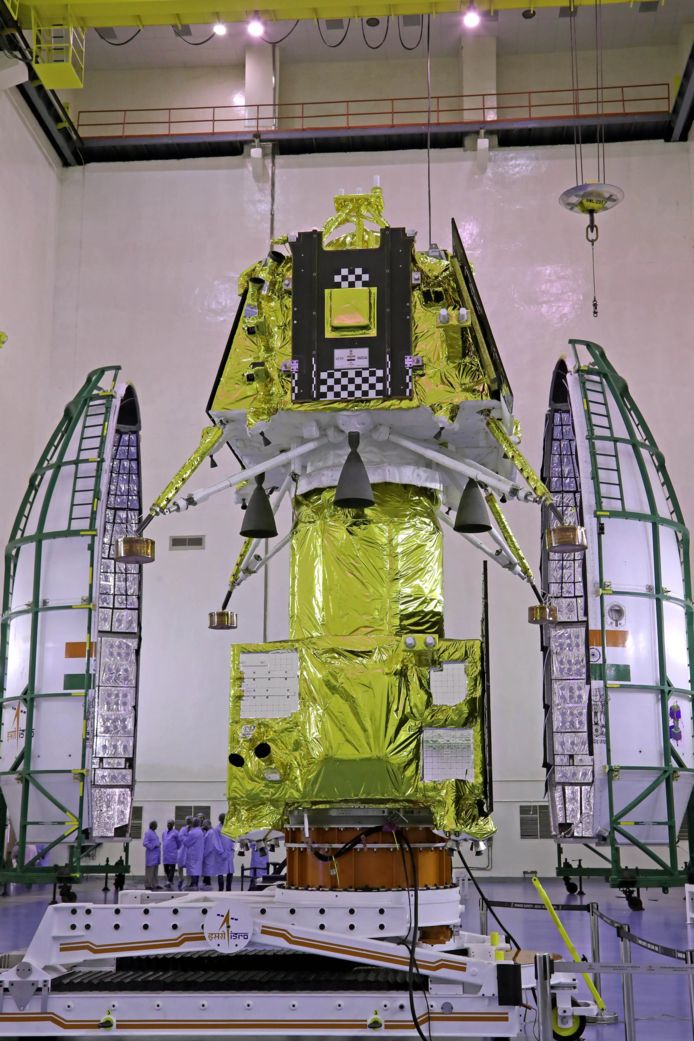
The lander, Vikram, which means "valour" in Sanskrit, detached from its propulsion module last week and has been sending images of the Moon's surface since entering lunar orbit on August 5.
Now that Vikram has landed, a solar-powered rover will explore the surface and transmit data to Earth over its two-week lifespan.
Ambitious programme
India is closing in on milestones set by global space powers such as the United States and Russia, conducting many of its missions at much lower price tags.
The South Asian nation has a comparatively low-budget space programme, but one that has grown considerably in size and momentum since it first sent a probe to orbit the Moon in 2008.
The latest mission has a cost of $74.6 million -- far lower than those of other countries, and a testament to India's frugal space engineering.
Experts say India can keep costs low by copying and adapting existing technology, and thanks to an abundance of highly skilled engineers who earn a fraction of their foreign counterparts' wages.
In 2014, India became the first Asian nation to put a craft into orbit around Mars and is slated to launch a three-day crewed mission into Earth's orbit by next year.
Wednesday's landing had been eagerly awaited by the Indian Space Research Organisation (ISRO) after the frustrating failure of its previous mission at the last hurdle in 2019.
Back then, mission control lost contact with the Chandrayaan-2 lunar module moments before its slated landing.
'Very, very important'
Former ISRO chief K. Sivan told AFP that India's efforts to explore the relatively unmapped lunar south pole would make a "very, very important" contribution to scientific knowledge.
Only Russia, the United States and China have previously achieved controlled landings on the Moon.
Russia launched a lunar probe in August -- its first in nearly half a century.
If successful, it would have beaten Chandrayaan-3 by a matter of days to become the first mission from any nation to make a controlled landing around the south pole.
But Luna-25 crashed on Saturday after an unspecified incident as it prepared to descend.
Journalists film the live telecast of spacecraft Chandrayaan-3 landing on the moon at ISRO's Telemetry, Tracking and Command Network facility in Bengaluru, India, Wednesday, August 23, 2023.
Missie geslaagd: India landt als eerste ooit onbemand ruimtetuig op de zuidpool van de maan
India heeft een onbemand ruimtetuig laten landen op de zuidpool van de maan. Het is het eerste land ter wereld dat daarin is geslaagd. Voor India is het een dubbele primeur. Voor het land is het de eerste succesvolle maanlanding.
Laurens Dekock
m 14u33 raakte de onbemande Indische maanraket Chandrayaan-3 het maanoppervlak, precies zoals verwacht. Voor het eerst in de geschiedenis landt een ruimtetuig op de zuidpool van de maan, iets waar Rusland afgelopen weekend niet in was geslaagd. Ruimtesonde Loena-25 crashte toen tegen de maan.
Het is voor India een dubbele primeur. Voor het land is het ook de allereerste maanlanding. Daarmee is het slechts het vierde land dat daar is in geslaagd. De Sovjet-Unie deden het eerst, de Verenigde Staten brachten de eerste mens op de maan en de laatste maanlanding was in 2020 door China.
"Dit succes behoort de gehele mensheid toe", zei Indiaas premier Narendra Modi, meteen na de landing. Hij was zelf niet in India, maar volgde de landing vanop de Brics-top in Zuid-Afrika. Op X, het vroegere Twitter, spreekt hij over "een historische dag voor de Indiase ruimtesector".
Maanwagen
Loena-25 moet zo'n jaar lang op de zuidpool van de maan opereren om onder meer bodemstalen te nemen. Daar is in de kraters bevroren water ontdekt de afgelopen jaren.
Dat kan toekomstige ruimtemissies meer mogelijkheden geven. We zouden er als mens langer kunnen blijven en de maanbodem ontginnen.
Het zuidelijke gebied op de maan is bijzonder interessant voor wetenschappers. De voorbije jaren is daar bevroren water ontdekt in kraters en wetenschappers willen dat maar wat graag verder onderzoeken. De zuidpool is ook interessant voor een basis omdat er bijna altijd zon schijnt.
Aan boord van de Chandrayaan-3 is een rover of maanwagen. Die zal stalen verzamelen en de chemische verbindingen ervan analyseren. De verzamelde data wordt doorgestuurd, maar de maanlander zelf vliegt niet terug naar de aarde. De hele missie duurt 14 dagen, oftewel een maan-dag.
India just became the fourth nation to stick a lunar landing.
India has joined the moon-landing club.
The Chandrayaan-3 spacecraft touched down softly near the moon's south pole today (Aug. 23), notching a huge milestone for the nation. India is now the fourth country to stick a lunar landing, after the United States, the former Soviet Union and China.
The historic touchdown occurred at 8:33 am ET (1233 GMT or 6:03 p.m. India Standard Time), according to the Indian Space Research Organisation (ISRO). "We have achieved soft landing on the moon! India is on the moon!" ISRO chairman Sreedhara Somanath announced after the landing.
"This success belongs to all of humanity and it will help moon missions by other countries in the future," India's Prime Minister Narendra Modi said in a speech following the landing. "I'm confident that all countries in the world, including those from the global south, are capable of achieving such feats. We can all aspire to the moon and beyond."
A little over two hours after landing, ISRO posted images to X (formerly known as Twitter) showing the moon's surface as seen by Chandrayaan-3's during its descent, adding that the agency has successfully established a communication link between the spacecraft and mission control.
Mission controllers applaud after the landing of Chandrayaan-3 near the lunar south pole, with inset graphic of spacecraft on moon from the Indian Space Research Organisation's broadcast. (Image credit: ISRO)
Soon, a solar-powered rover named Pragyan (Sanskrit for "wisdom") is expected to roll off Chandrayaan-3's Vikram ("valor") lander. The robotic duo will spend one lunar day (about 14 Earth days) exploring its new home, with the goal of collecting scientific data about the moon's makeup before its batteries drain after sunset.
"The whole country is excited about this mission," Anil Bhardwaj, director of the Physical Research Laboratory (PRL) in India, which built a few of the instruments onboard Chandrayaan-3, told Space.com prior to the landing. "We all hope that we will be successful in ... bringing out new science from this mission."
A live image from the moon by Chandrayaan-3 and a plot of its position during landing. (Image credit: ISRO)
Chandrayaan-3 was India's second try at landing near the moon's south pole, a largely uncharted region of immense interest to scientists and exploration advocates alike. The south polar region is thought to harbor large amounts of water ice, which, if accessible, could be mined for rocket fuel and life support for future crewed missions. The country's first attempt at a lunar touchdown, in September 2019, failed when the Chandrayaan-2 lander crashed into the moon due to a software glitch.
Close to four years and many design and software upgrades later, the homegrown Chandrayaan-3 spacecraft launched atop a LVM3 rocket on July 14 from a spaceport in Sriharikota, on India's east coast. The spacecraft entered an elliptical orbit around the moon earlier this month, then performed multiple maneuvers to shift into a nearly circular path, which took it about 93 miles (150 kilometers) above the lunar surface.
A photo of the moon's far side captured on Aug. 19, 2023, by Chandrayaan-3. (Image credit: ISRO)
Last Thursday (Aug. 17), the Vikram-Pragyan duo separated from the mission's propulsion module, which will study Earth from its orbit around the moon. The lander and rover, which had entered an egg-shaped lunar orbit after separation, braked successfully on Friday (Aug. 18) and then again on Sunday (Aug. 20) to get closer to the moon's surface.
While still in orbit around the moon on Monday (Aug. 21) and Tuesday (Aug. 22), the duo established contact with Chandrayaan-2's orbiter, which has been circling the moon since 2019 and will serve as the critical communication link with Earth for the Chandrayaan-3 mission.
When the sun rose today on the targeted landing site, which was seen from Earth on one edge of the moon, mission control at ISRO's headquarters in Bengaluru commanded the lander to begin its descent to the lunar surface, activating its fully automatic landing system.
The historic landing was covered live by ISRO and broadcast by Indian public broadcaster Doordarshan. Once the powered descent began, the lander first braked to reduce its height from 18.6 miles (30 km) to just 0.4 miles (0.8 km) above the moon's surface. Then, the lander turned such that its altimeters, which measure height to the surface real-time using cameras onboard, faced downward in preparation for landing.
At 8:33 a.m. EDT (1233 GMT and 18:03 India time), the lander Vikram touched down in its target landing area, at roughly 70 degrees south latitude. This location is close to where Russia had hoped its first moon mission in 47 years, Luna-25, would land on Monday (Aug. 21). That effort, however, failed when the probe crashed into the moon over the weekend after a final orbital maneuver went sideways.
India's success today can be attributed to "extensive changes" to its landing strategy after Chandrayaan-2's 2019 crash, Bhardwaj said. Onboard algorithms that calculate spacecraft speed in real time during descent were reworked to allow for "more freedom to deviate" from protocol "but still do the landing," he added.
Other changes that helped facilitate the mission's success include a larger target landing zone, stronger legs for Vikram to withstand higher landing speeds and dynamic engines that adjusted the spacecraft's velocity for a smoother touchdown.
Images of the moon that Chandrayaan-2's orbiter has been sending home since 2019 also painted a clearer picture of the landing site than what scientists knew previously, according to Bhardwaj. "There is not much of a hurdle in this [landing] area," he said.
Now that Vikram is settled on the moon, Pragyan is expected to roll onto the lunar surface and start analyzing lunar soil and rocks.
Similar to the unfortunate rover on Chandrayaan-2, Pragyan's wheels are etched with the Ashoka Chakra, a religious symbol of a wheel with 24 spokes depicted on the Indian flag, and ISRO's logo. So when Pragyan inches along on the moon, ISRO hopes both symbols will be stamped onto the surface, where they will remain untouched for eons.
The lander Vikram is equipped to sense moonquakes near the landing site using an onboard seismometer, and to probe lunar soil to record its temperature.
The Chandrayaan-3 mission, which costs a modest 6 billion rupees ($73 million US at current exchange rates), is unfolding at a time when multiple nations — notably, the U.S. and China — are eyeing the moon for future crewed missions. NASA, for example, aims to land astronauts near the lunar south pole in late 2025 or 2026 on its Artemis 3 mission, and to build one or more bases in the region shortly thereafter.
Chandrayaan-3 could also help spur India's space program, leading to even greater accomplishments in the future.
"It is going to be a game changer for the new generation," said Bhardwaj, adding that the success is important for the country's "strategic and geopolitical purposes" as well as to drive "the youth to do something different and unique."
When the sun sets upon the landing site in two weeks, the robotic duo will be left to fight a frigid night, which will be "very difficult to survive because the batteries will be drained out and it is too cold for electronics," Bhardwaj said.
Meanwhile, his team has geared up for what they hope will be a busy fortnight: "Our job starts after landing."
Update for 11 am ET:This story was updated to include Chandrayaan-3's image of the lunar surface during descent and ISRO's confirmation of communication link.
Join our Space Forums to keep talking space on the latest missions, night sky and more! And if you have a news tip, correction or comment, let us know at: community@space.com.
Along with still operational missions, these observatories will gather massive volumes of high-resolution spectroscopic data. Sorting through this data will require cutting-edge machine-learning techniques to look for indications of life and biological processes (aka. biosignatures). In a recent paper, a team of scientists from the Institute for Fundamental Theory at the University of Florida (UF-IFL) recommended that future surveys use machine learning to look for anomalies in the spectra, which could reveal unusual chemical signatures and unknown biosignatures.
The study was conducted by a mix of physicists and machine learning experts, including Associate Professor Katia Matcheva, physics graduate student Roy T. Forestano, Professor Konstantin T. Matchev, and Ph.D. student Eyup B. Unlu. A preprint of their paper, “Searching for Novel Chemistry in Exoplanetary Atmospheres using Machine Learning for Anomaly Detection,” recently appeared online and is being reviewed for publication in the Astrophysical Journal. As they explained, the central premise of their paper is that what constitutes “life” remains an open question for scientists, and it would be advantageous to expand the scope of our search.
Spectra from the WASP-96b’s atmosphere obtained by JWST. Credit: NASA/ESA/CSA/STScI
First off, it is important to acknowledge how far the study of exoplanets has come in recent decades. The first confirmed detection did not take place until 1992, which consisted of two Super-Earths (Poltergeist and Phobitor) observed around a pulsar (PSR B1257+12, aka. Lich) located 2,300 light-years from Earth. While scientists firmly believed that most stars had their own system of planets, they had no incontrovertible proof before this discovery. And until the Kepler Space Telescope launched in 2009, exoplanet discoveries were being added at a rate of a few per year.
Since then, a total of 5,496 exoplanets have been confirmed in 4,096 systems, with another 9,820 candidates awaiting confirmation. In recent years, the process has shifted from the process of discovery towards characterization, where improved instruments and methods have enabled astronomers to analyze exoplanet atmospheres directly to measure their potential habitability. As Prof. Matcheva explained to Universe Today via email:
“The instruments are getting better and better: better spectral resolution, exceptional signal-to-noise level, wider wavelength coverage. In addition to JWST, which has returned some exceptional spectroscopic observations of several exoplanets, ESA is planning a dedicated exoplanet space telescope ARIEL that will observe 1000 planets. Analyzing this data will keep scientists busy for a long time.”
According to Matcheva, the fields of exoplanet studies and astrobiology are incredibly fascinating because of the sheer potential involved. Currently, the field is largely concerned with constraining “habitability” through the targeted search for biosignatures: evidence of life and organic processes. Using Earth as a template, the only planet where we know life exists, the most highly-sought biosignatures include nitrogen gas (N2), oxygen gas (O2), carbon dioxide (CO2), methane (CH4), ammonia (NH?), and water (H2O).
This constitutes the “low-hanging fruit approach,” where scientists are looking for life that conforms to terrestrial standards. This is not an accident, nor is it a lazy approach. It’s simply because it is exceedingly difficult to search for signs of life that we are completely unfamiliar with. But this also presents an opportunity to contemplate the possibilities and expand the range of what we know. “Do we know what to search for?” Matcheva added. “Do we know where to search? Would we recognize it if we saw it? The exoplanet science community always works with these questions in mind.”
For their study, Matcheva and her colleagues investigated how machine learning could be trained to look for “anomalies” in transit spectra. This refers to light curves obtained by observing distant stars for periodic dips in luminosity, which could indicate the presence of a planet passing in front of the star relative to the observer. This is known as Transit Spectroscopy (or the Transit Method), which remains the most effective and widely-used method for detecting exoplanets. In addition to detection, this method allows astronomers to occasionally observe light passing through the planet’s atmosphere.
When measured with a spectrometer, these observations will reveal data on the atmosphere’s chemical composition, which could include telltale biosignatures! In the coming years, the combination of next-generation telescopes and machine learning (ML) will allow astronomers to more accurately determine the potential habitability of exoplanets. “We believe that ML methods in astrophysics can be a game changer in how we process data in terms of speed, volume, and methodology, said Matcheva. “And we see that across all fields of science.”
“The spectra are calculated with current models, assuming that the atmosphere of each planet is a mixture of 5 different gasses in different proportions. As an experiment, we treated one of the absorbers (for example, H2O) as a ‘mystery’ absorber. We trained the ML algorithm on a subset of the data that is deficient in H2O and tested if it will correctly flag planets with water as anomalous.”
“We repeated the experiment for four of the gasses. We used both LOF and OCSVM. Both methods did an outstanding job in finding the anomalous planets when no noise or very little noise (~10 ppm) is present, even for very small amounts of the ‘mystery’ gas. Unsurprisingly, the ML model starts making mistakes when the noise level increases too much.”
A major objective for next-generation space telescopes will be the search for signs of life (biosignatures).
Credit: NASA
As Matcheva indicated, their paper demonstrated that LOF and OCSVM methods are very robust, even in the presence of signal noise. These results offer a taste of what could be possible in the near future, where literally thousands of exoplanets can be analyzed rapidly and systematically using ML methods to identify anomalous planets for follow-up investigations. These examinations will likely be very educational, given that inconsistencies between theoretical models and observations are often how the most exciting discoveries are made.
“Although looking for biosignatures was not a primary goal of this paper, it is a very interesting outcome, and we are very excited about the potential of the method,” said Matcheva. “Looking for signatures of life in the Universe is more like looking for a needle in a haystack rather than for a smoking gun. It is actually even more challenging because we do not know what the needle looks like. The novelty detection methods are designed exactly for that: rare events [where] we do not know what they look, smell, or sound like.”
As noted earlier, the search for extraterrestrial life – and indeed, the search for extraterrestrial intelligence (SETI) – can be summarized as searching for life “as we know it.” But if life is very rare in the Universe or very “exotic” in nature (meaning that it can arise from all sorts of chemicals and conditions), then it makes sense to cast a wider net. After all, if our frame of reference is an impediment to our astrobiology efforts (one could certainly argue as much), expanding it could be the difference between finding evidence that we are not alone and leaving the question unanswered for another generation. Said Matcheva:
“The astrobiology community has been working on a definition of “life” for a long time, but we have no idea what aliens really look like and how they would interact with their environments. We are biased by our human experience, and the current strategies are to search for life in the “habitable zone,” which by definition is human (or terrestrial life) friendly. So how do you search for something when you don’t know what it looks like? That is where the novelty detection machine learning techniques come in – they can flag data points that are inconsistent with the training data, i.e., do not agree with the current theoretical models. So indeed, in that sense, our method is searching for life “as we don’t know it”.
As Isaac Asimov famously said, “The most exciting phrase to hear in science, the one that heralds new discoveries, is not ‘Eureka!’ but ‘That’s funny.'”
Vector shaped UFO parked on the surface of the moon
The resurgence of the Vector symbol across various space agencies, including NASA, has sparked intrigue. Questions arise about the significance of the Vector symbol and its presence on these agency logos.
One wonders if the symbol refers to a symbolic talisman, representing an emblem of occult worship or linked to celestial beings such as angels, demons, or other entities or eventually it is an allusion to ancient times, a sign denoting the essence of the multiverse itself? Does it symbolize the mastery over time and space?
Now if you take a look at the following images and video the use of this vector symbol across multiple space agencies appears less coincidental.
Consider the intriguing images below, captured by the Apollo 11 crew during their return journey from the moon to Earth. With a closer look involving zooming in, enhancement, and application of various filters, the object becomes more discernible. It unveils a structure shaped like a vector, complete with three supporting legs, situated on the lunar surface.
Comparisons of this object with another object photographed by the Apollo 17 crew reveals a striking similarity in the vector structure's appearance.
Additionally, an image captured during a spacewalk by a member of the STS115 mission reveals the very same vector configuration intriguingly mirrored on the astronaut's helmet.
Despite much speculation, these images as well as analysis of the lunar object in the video of YouTube channel 1967Sander provided below, suggest that these vector-shaped objects potentially represent highly advanced alien vehicles.
In an age where the skies are constantly being watched, and where most of the mysteries have been debunked, a newly submitted UFO sighting has rekindled the fervor of extraterrestrial enthusiasts everywhere. Despite being filmed back in 2021, this sighting has only recently seen the light of day on the MUFONwebsite. Along with this captivating article, a riveting video showcases the mysterious event in all its wonder.
When & Where: The sighting occurred on the evening of January 23, 2021, in the scenic backdrop of Oregon, USA.
Witness Account:
A regular family evening, spent in the company of a television, took a startling turn for an Oregon family. The witness recounts, “My wife, son, and I were deeply engrossed in our TV show when my wife’s gaze was pulled towards our front door. A series of strange, luminous lights danced outside.” Joining her in her astonishment, the witness and his son observed a rotating craft adorned with lights all around its perimeter. Realizing the rarity of what they were witnessing, a quick-witted video was captured, providing a glimpse into their otherworldly experience.
“After the initial shock and awe, we were drawn to it – almost like a moth to a flame. We moved upstairs for a clearer, unobstructed view,” the witness elaborates. The craft, however elusive in nature, continued its dance in the Oregon night sky for a few more tantalizing minutes. In a spur of courage and curiosity, the witness, accompanied by his wife, decided to chase the enigmatic vision. But alas, the craft, with its dazzling lights, vanished into the vastness, leaving behind a trail of questions and intrigue.
VIDEO:
The Burning Questions: As with allUFO sightings, this one too leaves us wondering – was it a visitor from a distant world, a top-secret human-made aircraft, or something else entirely? What made the family wait almost a decade before sharing it with the world?
To the Enthusiasts: For those always on the lookout for verified and intriguing UFO sightings, this newly surfaced evidence is certainly one for the records. Do watch the accompanying video and join the global conversation.
In the vast tapestry of the unknown, this sighting, like a bright star, beckons for attention. And as always, the truth remains out there.
Newly Released UFO Sighting in Arizona: Ephemeral Yet Captivating
April 3rd, 2023, Arizona: Months after the event, a breathtaking video capturing a UFO sighting has finally been unveiled to the public via the MUFON website. UFO enthusiasts and skeptics alike are buzzing with anticipation and curiosity, seeking answers to yet another tantalizing episode of extraterrestrial wonder.
Unearthly Encounter in Arizona Skies
On a seemingly regular day in Arizona, an unsuspecting witness glanced up to find an unexplainable anomaly hovering silently above. The object, seemingly defying the laws of physics, remained stationary amidst the azure expanse, with its luminous features shining more brightly than what the video could truly capture.
Witness report
However, the most baffling part of this UFO sighting wasn’t its stationary presence, but rather its abrupt exit. As described by the witness, merely moments after ceasing the recording, this ethereal craft took off with unprecedented speed, vanishing into thin air within a mere 1-2 seconds.
Unanswered Questions and Rising Curiosity
Such events, especially when supported by tangible evidence, often stir a mixture of emotions—awe, disbelief, wonder, and a myriad of questions. What was the nature of this craft? Why did it choose to appear, only to disappear just as quickly? Was this an extraterrestrial visitation or a product of advanced human technology yet unknown to the public?
With the growing number of UFO sightings reported worldwide, it’s more essential than ever to approach these events with an open mind and a discerning eye. As researchers and enthusiasts continue to dissect this newly released footage, the pursuit for answers intensifies.
To all intrigued souls, the video accompanying this article offers a glimpse into that mysterious April afternoon in Arizona. Whether you’re a firm believer in extraterrestrial life or a curious skeptic, this sighting promises a fascinating journey into the vast world of the unknown.
For more tales of the unexplained, insights, and the latest updates on UFO sightings, stay tuned and keep gazing at the stars, for the truth, as they say, is out there.
India maakt zich op voor zijn allereerste maanlanding: wat zijn ze van plan met de Chandrayaan 3 missie?
Morgen is het zover. Op woensdag 23 augustus onderneemt de ‘Indian Space Research Organization’ (ISRO) een poging om met de Chandrayaan 3 missie een rover op het maanoppervlak te zetten. Indien succesvol meteen ook de eerste landing op de zuidpool van de maan nadat die van Rusland recent nog mislukte. Spannende tijden voor India en de ruimtevaart. Derde keer, goede keer?
Redactie Wetenschap
Martijn Peters Wetenschapsexpert
Al 47 jaar is er, buiten China, niemand in geslaagd om succesvol op de maan te landen. De laatste geslaagde landing vond plaats in 1976 toen de Russische Luna 24-missie maanstenen terug naar de aarde bracht met een robotachtig ruimtevaartuig. Sinsdien bereikte enkel nog China het maanoppervlak. Het deed dat 3 keer, met onder andere een eerste gecontroleerde landing op de achterkant van de maan. In de afgelopen jaren ondernamen Israëlische en Japanse teams nog een poging, maar zij faalden allemaal tijdens hun afdaling naar het maanoppervlak.
Spannende tijden dus voor de Indiase ruimtevaartorganisatie die morgen een poging onderneemt. Het ruimtevaartuig Chandrayaan 3 maakt zich klaar om woensdag af te dalen naar het maanoppervlak, 4 dagen nadat de Russische Luna 25 lander hier niet in slaagde. Als alles volgens plan verloopt zal Vikram, zo heet de Chandrayaan 3-lander, morgen om 14u34 Belgische tijd zachtjes op het maanoppervlak landen.
Chandrayaan 3 maakte al enkele mooie beelden van het maanoppervlak met de camera van de landingsmodule
Zoals de naam al doet vermoeden, is dit de derde missie in het Indiase ruimtevaartprogramma voor de verkenning van de maan. De vorige mislukte landingspogingen van India, de Chandrayaan 1 en 2 missie, vonden plaats in 2008 en 2019. De kostprijs van de nieuwe Chandrayaan 3-missie die op 14 juli van start ging met de lancering is ongeveer zo’n 80 miljoen euro. Op zich een lage kost voor een onderzoeksmissie, vergelijkbaar met de kosten van een SpaceX Falcon 9-lancering.
Als de Vikram-lander succesvol kan neerdalen op de zuidpool van de maan zal hij de Pragyan lanceren, een kleine rover. De op zonne-energie werkende mobiele robot zal met behulp van wetenschappelijke instrumenten de chemische samenstelling van het maanoppervlak bestuderen. Pragyan zal dit ongeveer een 14-tal dagen doen. Zolang duurt immers een ‘maan-dag’. Daarna gaat de zon onder op de landingsplaats en daalt de temperatuur waardoor de rover niet meer kan werken.
Tijdens de missie zullen ook nog andere wetenschappelijke experimenten uitgevoerd worden zoals het meten van maanbevingen en afstanden op de maan met lasers. De resultaten van deze metingen kunnen bijvoorbeeld helpen bij het bepalen van toekomstige locaties om te landen of een basis te bouwen op de maan. Voor dat laatste is de zuidpool van de maan vooral interessant door de aanwezigheid van kraters die permanent in schaduw gehuld zijn. Van bovenaf is daar namelijk al water in de vorm van ijs waargenomen, wat essentieel is wanneer er een basis gevestigd zou worden. Dit is ook een van de redenen waarom de Artemis III missie van NASA op de zuidpool van de maan wil doen wandelen binnen enkele jaren.
Zal India het vierde land worden dat na de Sovjet-Unie, VS en China op de maan kan landen? En het eerste op de zuidpool? We zullen het morgen weten. Wetenschappers van over de hele wereld hopen alvast op een goede afloop.
In 1973, before the presidential elections, yet to become President, Jimmy Carter filed a report with the International UFO Bureau claiming he had seen a UFO in October 1969. Along with other witnesses, Carter saw a bright UFO that changed colors and moved towards and away from the Earth before disappearing. He was quite vocal about his beliefs on UFOs and promised to public all available information about UFOs if he became president.
“He described waiting outside for a Lion’s Club Meeting in Leary, Georgia, to begin, at about 7:30 p.m., when he spotted what he called ‘the darndest thing I’ve ever seen’ in the sky.” Along with 10 to 12 other witnesses, Carter observed a bright object in the sky, which was about the size of the moon. (Source)
“We all saw it. And then the light, it got closer and closer to us. And then it stopped, I don’t know how far away, but it stopped beyond the pine trees. And all of a sudden it changed color to blue, and then it changed to red, then back to white,” Carter told GQ in 2005. The object reportedly hovered about 30 degrees above the horizon, moved towards and away from the Earth, and eventually disappeared into the distance. Carter’s experience led him to make a vow to never again ridicule individuals who claimed to have seen a UFO.
“One thing’s for sure, I’ll never make fun of people who say they’ve seen unidentified objects in the sky. If I become President, I’ll make every piece of information this country has about UFO sightings available to the public and the scientists,” Carter said.
As for the object that Carter saw, it has since been classified as “a high altitude barium release cloud launched from Eglen AFB,” which sounds legit. However, after winning the presidency, Carter backed away from this promise, citing concerns about national security and defense implications. His experience with a UFO is just one of many reported sightings that have fueled conspiracy about extraterrestrial life and government cover-ups.
President Carter’s Disturbing Briefing on UFOs and Religion
Former NASA researcher Ed Harris claimed that serious researchers on the subject believe the story of former President Jimmy Carter crying after being briefed about classified UFO information to be true. According to the story corroborated by multiple witnesses, U.S. presidents are given only a brief overview of the subject by the CIA, and presidential curiosity is not considered a sufficient need to know.
After being repeatedly stonewalled, Carter was given “the talk,” which reportedly left him deeply sobbing and visibly disturbed for weeks. He was told that major religions, including Christianity, were created by extraterrestrials to prevent humans from destroying themselves while they ran experiments on us, and that they made us. Carter, a deeply religious man who had witnessed a UFO with six other people, realized that releasing such information could cause tremendous economic and social upheaval.
Below you can read Ed Harris’ statement on the subject that he wrote on Quora:
Yes, the incident of Jimmy Carter crying after being briefed about classified information regarding UFO’s is largely believed to be true by the serious researchers on the subject. As a forewarning, the following information is very unsettling and will explain why Carter never “kept his promise” of revealing classified UFO information to the public.
According to the story that was corroborated by more than one witness, U.S. presidents are only given a cursory overview of the subject. Apparently, the CIA runs the program, only provide information to the President on a need to know basis, and do not consider presidential curiosity as sufficient need to know. This was implemented after Kennedy, and all presidents after him have been given only summary briefings (some presidents for unknown reasons were given more than others).
Okay on to your question. President Carter is a deeply religious man who had also witnessed a UFO with 6 other people. Everyone thought that he would be the one to finally release UFO info to the public but as the story goes, he was repeatedly stonewalled. Eventually, the CIA had “the talk” with him, and afterward it was reported that he sunk his head in his hands and not only began to deeply sob, but was visibly disturbed for some weeks afterward.
What was he told and shown?
He was told that the major religions including Christianity were programs created by extraterrestrials to prevent us from destroying ourselves while they ran their experiments on us – and that they made us. At this moment it became clear to Carter that such information could cause tremendous economic and social upheaval. I should add that I am not only a Christian but a clergyman, so I am in no way attempting to promote atheism here. In fact, how God fits into this might be an interesting separate post. Nevertheless, these are the facts as I know them to be.
Author and world’s leading UFO researcher Richard Dolan also writes about this incident in his book “UFOs and the National Security State: The Cover-Up Exposed.” According to his book, there are claims that President Carter was given a UFO briefing at the White House on June 14, 1977, which he was then bound to secrecy about.
The briefing was supposedly given by a lone MJ-12 briefing officer and several independent sources. The leaked “Executive Briefing: Project Aquarius” document gives the standard account of multiple retrievals of alien technology. While there is no hard evidence to support the claims of the briefing, a presidential aide, who was “very, very close to Carter,” witnessed President sobbing after a UFO-related briefing in the Oval Office.
Carter Administration & Project Blue Book
Daniel Sheehan, a Harvard-educated Constitutional Trial Lawyer and Appellate Attorney has worked on many high-profile cases in his career. In 1977, he was approached by his friend Marcia Smith, who informed him that President Carter had demanded that the CIA provided classified information about unidentified flying objects to him, but George H. Bush, who was the CIA director at the time, refused to give this information to the president.
Sheehan tried to obtain information on the UFO phenomena and extraterrestrials from the Vatican Library but was unsuccessful. However, with Carter’s help, he managed to get access to the classified portions of the Air Force’s Project Blue Book for a few hours in May 1977, where he claimed to have discovered classified documents and photographs of a crashed UFO being investigated by Air Force personnel.
“There were these photographs of unmistakable — of a UFO sitting on the ground. It had crashed,” Sheehan said. “Apparently, it had hit into this field and had dug up, kind of plowed this kind of trough through this field,” he paused for a second.
“It was wedged into the side of this bank,” he said after taking a deep breath. “There was snow all around the picture. The vehicle was wedged into the side of this mud-like embankment — kind of up at an angle. There was Air Force personnel. As I cranked the little handle and looked at additional photos, these Air Force people were taking pictures.” (Click here to read the full article)
When Mr. Sheehan left the room, the guard asked to see his yellow legal pad and flipped through the pages, missing the alien hieroglyphs Sheehan had copied on the back of the pad. Sheehan offered to share this information with the religious establishment; they told him they were not interested.
Russia’s Luna-25 lander met an untimely end this weekend, according to the Russian space agency Roscosmos.
Luna-25 crashed on the Moon sometime on Saturday afternoon (Moscow time) after something went drastically wrong with its engine. The Russian lunar lander had been neck-and-neck with India’s Chandrayaan-3 lander in the race to become the first spacecraft to land near the Moon’s south pole. With Russia’s contender out of the race, India has a clear shot on Wednesday — but also a grim reminder that space is hard.
Russia’s Luna-25 lander “ceased to exist as a result of a collision with the surface of the Moon,” said Russian space agency Roscosmos in a statement.
Luna-25 was supposed to field-test landing technology for Russia’s next three lunar landers, then spend a year studying the surface near the lunar south pole — but the technology test evidently didn’t go so well. Mission controllers lost contact with the spacecraft on Saturday afternoon Moscow time, after firing the lander’s engine to shift the spacecraft into a closer orbit around the Moon to line up for a landing attempt.
“Most likely the braking thrust was either too strong, or it was in a wrong direction,” Natan Eismont of the Space Research Institute of the Russian Academy of Sciences told the New York Times. The institute led science operations on Luna-25, but Eismont was not directly involved with the lander.
The Luna-25 mission came nearly 50 years after its predecessor, Luna-24, which launched in August 1976. That mission successfully landed on the Moon on Aug. 18, 1976. During its mission, it retrieved a sample of lunar soil and returned it safely to Earth.
Luna-25 launched on Aug. 10 and would have beaten India’s Chandrayaan-3 lander to the Moon by just a few days.
Luna-25 should have tested the technology that will be used on Russia’s next three landers: Luna-26, Luna-27, and Luna-28. Those landers, in turn, are intended to pave the way for an eventual joint lunar base with China near the Moon’s south pole. But the next three installments in the Luna series are already years behind schedule, and now Roscosmos faces the choice to redo Luna 25 (which means additional expense and additional delays) or fly the next mission without successfully tested technology.
Meanwhile, Luna-25’s crash leaves a path wide open for the other contender in the race to the pole, India’s Chandrayaan-3 lander. The Indian lander launched on July 14, nearly three weeks ahead of Luna-25, on a longer but more fuel-efficient course to the Moon, and is set to land on Wednesday. India’s last attempted Moon landing, the Vikram lander, fell silent about a mile from the lunar surface, and it’s not too hard to guess what happened next. Making it to the south pole first would be a huge win for India, which so far hasn’t successfully landed anything on the Moon.
Artemis II is scheduled to launch in late 2024, and Chang’e 6 lander, which plans to return rock and regolith samples from a site near the south pole, is set to launch earlier in the same year.
Meer van UFO'S of UAP'S, ASTRONOMIE, RUIMTEVAART, ARCHEOLOGIE, OUDHEIDKUNDE, SF-SNUFJES EN ANDERE ESOTERISCHE WETENSCHAPPEN - DE ALLERLAATSTE NIEUWTJES


 India becomes first nation to land spacecraft near Moon's south pole