Ontdek de Fascinerende Wereld van UFO's en UAP's: Jouw Bron voor Onthullende Informatie!
Ben jij ook gefascineerd door het onbekende? Wil je meer weten over UFO's en UAP's, niet alleen in België, maar over de hele wereld? Dan ben je op de juiste plek!
België: Het Kloppend Hart van UFO-onderzoek
In België is BUFON (Belgisch UFO-Netwerk) dé autoriteit op het gebied van UFO-onderzoek. Voor betrouwbare en objectieve informatie over deze intrigerende fenomenen, bezoek je zeker onze Facebook-pagina en deze blog. Maar dat is nog niet alles! Ontdek ook het Belgisch UFO-meldpunt en Caelestia, twee organisaties die diepgaand onderzoek verrichten, al zijn ze soms kritisch of sceptisch.
Nederland: Een Schat aan Informatie
Voor onze Nederlandse buren is er de schitterende website www.ufowijzer.nl, beheerd door Paul Harmans. Deze site biedt een schat aan informatie en artikelen die je niet wilt missen!
Internationaal: MUFON - De Wereldwijde Autoriteit
Neem ook een kijkje bij MUFON (Mutual UFO Network Inc.), een gerenommeerde Amerikaanse UFO-vereniging met afdelingen in de VS en wereldwijd. MUFON is toegewijd aan de wetenschappelijke en analytische studie van het UFO-fenomeen, en hun maandelijkse tijdschrift, The MUFON UFO-Journal, is een must-read voor elke UFO-enthousiasteling. Bezoek hun website op www.mufon.com voor meer informatie.
Samenwerking en Toekomstvisie
Sinds 1 februari 2020 is Pieter niet alleen ex-president van BUFON, maar ook de voormalige nationale directeur van MUFON in Vlaanderen en Nederland. Dit creëert een sterke samenwerking met de Franse MUFON Reseau MUFON/EUROP, wat ons in staat stelt om nog meer waardevolle inzichten te delen.
Let op: Nepprofielen en Nieuwe Groeperingen
Pas op voor een nieuwe groepering die zich ook BUFON noemt, maar geen enkele connectie heeft met onze gevestigde organisatie. Hoewel zij de naam geregistreerd hebben, kunnen ze het rijke verleden en de expertise van onze groep niet evenaren. We wensen hen veel succes, maar we blijven de autoriteit in UFO-onderzoek!
Blijf Op De Hoogte!
Wil jij de laatste nieuwtjes over UFO's, ruimtevaart, archeologie, en meer? Volg ons dan en duik samen met ons in de fascinerende wereld van het onbekende! Sluit je aan bij de gemeenschap van nieuwsgierige geesten die net als jij verlangen naar antwoorden en avonturen in de sterren!
Heb je vragen of wil je meer weten? Aarzel dan niet om contact met ons op te nemen! Samen ontrafelen we het mysterie van de lucht en daarbuiten.
In recent days the internet has been buzzing after former US intelligence officer Davis Grusch testified under oath before members of the US Congress that he had seen conclusive proof that the US authorities have recovered crashed UFOs and their occupants.
The one thing on everyone’s mind was, of course, “show us the evidence Mr. Grusch”.
Sadly, he could not as it was classified. But the fact is there are cases already out there that would stand up in a court of law and prove that something quite extraordinary has happened. Such cases are close encounters or better known in the popular imagination as “alien abductions”.
One such case that I and my colleague Dr Irena Scott in the USA have been working on does just that.
The date of the close encounter was October 11, 1973; the location was the Pascagoula River, Mississippi.
Two shipyard workers Charles Hickson, 42, and Calvin Parker, 18, decided to go fishing on the river after work. Both anglers were not having much luck that night and they thought about calling it a night when something happened that would change their lives forever.
A dazzling blue light from behind them illuminated the entire scene. Turning around both men watched in awe as a rugby ball-shaped object descended.
A door opened and three bizarre looking humanoid entities glided out across the terrain to the two terrified onlookers. Both Parker and Hickson later that night made their way to their local Sheriff’s Department to tell them that they had been abducted by aliens.
It wasn’t long before the story found its way into the media and the story went around the world. Charles Hickson readily told his story, but Calvin Parker wanted simply to be left alone. Hickson co-authored a book with William Mendez in 1983 and it wasn’t until 2018 that Calvin Parker finally told his story in full for the first time.
It was Calvin Parker’s book and subsequent publicity that made this case probably the best documented such event on record. It wasn’t necessarily what Calvin Parker related in his two books, but it is what happened when they were published.
Much to everyone’s surprise, more and more firsthand eyewitnesses began to step forward. A number of these witnesses reported seeing something a few days prior to the Parker/Hickson encounter and others a few days after. UFO sightings were made in and around Pascagoula, Mississippi and in neighbouring states as well.
Added to that more eyewitnesses stepped forward with their accounts of what they observed on the very same night. Two of these witnesses were on the other bank of the Pascagoula River that night at the very same time as Parker and Hickson were experiencing their close encounter.
One last thing that has left the authors completely baffled is what could be proof of a physical contact with something by Parker and Hickson that night. Both men reported that when the bizarre looking humanoids took hold of them, they felt a kind of scratch or prick similar to an injection.
We uncovered a document written on October 13, 1973, just two days after the encounter, which describes a physical examination of the two men and that “puncture wounds” were located on Charles Hickson’s arm and Calvin Parker’s foot.
The document, located in 2018, also mentioned that photographs of these marks were taken. In the file sadly there was no sign of these photographs.
In 2021 when this book was being written the authors received an email from a colleague that mentioned he had accidentally found a couple of photos that he thought we would be interested in.
The photographs in question were those mentioned in the ‘puncture wounds’ document obtained three years earlier and show marks on Charles’s Hickson’s arm and Calvin Parker’s foot. These photos will be published in our book for the first time ever.
This book concentrates on the independent eyewitness testimony, the puncture wounds evidence, the hypnosis sessions of the new witnesses and of Calvin Parker both of which were conducted exclusively for this book and it is left for the reader to draw their own conclusion.
The book is fully illustrated with photographs, documents, newspaper cuttings and exclusive artwork by UK artist Jason Gleaves and has a foreword by Calvin Parker.
We believe that the evidence provided in this book if it was taken to court could prove something truly extraordinary took place that October night in 1973 in the Pascagoula area.
This year, 2023, will be the 50th anniversary of this encounter and we have provided all of the evidence we have. All we ask is for you to take an objective look at this evidence and see if you agree with us or not.
Beyond Reasonable Doubt: The Pascagoula Alien Abduction [ ]
Philip Mantle is a veteran UFO researcher, author and publisher in the UK.
Dr Irena Scott is from Ohio, USA and received her PhD in physiology from the University of Missouri. She too is an internationally published author.
Men In Black Encounter After UFO Crashed in Man's Backyard - Greer UFO Crash Whistleblower Interviewed By Jeffery Pritchett
Interview with Robert Earl White who was just on Laura Eisenhower’s show.
Men In Black Encounter After UFO Crashed in Man’s Backyard – Greer UFO Crash Whistleblower Interviewed By Jeffery Pritchett
Men in Black, in American popular culture and in UFO conspiracy theories, are men dressed in black suits who claim to be government agents who harass or threaten UFO witnesses to keep them quiet about what they have seen.
Two Tic-tac UFOs Over Bristol, Indiana May 28, 2023, UFO Sighting News.
Date of sighting: May 28, 2023
Location of sighting: Bristol, Indiana, USA Source: MUFON
Two huge tic-tac shaped UFOs flew one after another over Bristol, Indiana a few months back. The report just came in so this is fresh. The objects are so close that they only have a quarter the size of the ships between them. The ships are the same size, same white color and show no wings, no contrail, no windows, no painted markings or landing gear. This is 100% proof that aliens are flying over Indiana.
The first 8 seconds of the video is a close up of the UFOs I made, then after is the original 18 seconds attached to it. This way you can see them closer, and yet see the original untouched video at the end.
Scott C. Waring
Eyewitness states:
This was taken on may 28, 2023 at 3:13pm. It was filmed in Bristol, Indiana. I’m not sure what it could be and I’m hoping someone can help me out with it.
UAP over Reno, Nevada On Aug 18, 2023, UFO Sighting News.
Date of sighting: Aug 18, 2023
Location of sighting: Reno, Nevada, USA Source: MUFON
This UFO appeared to a guy in Reno yesterday and he got really excited about it. He even described it to us as a glowing shining spinning disk. Something thats hard to tell for sure without a closer high quality camera, but his iPhone did good. This video reveals its movements, colors, shape and it seems to be watching the eyewitness. Aliens...they love watching, but not so much into intervening.
Scott C. Waring
Eyewitness states:
Standing in my backyard around 8:30pm on Friday, August 18th, I looked up and saw a very bright, very fast orb like UFO that would stop without inertia and made no noise. The orb looked to be bigger than an airplane and much faster. It flashed many colors and then darted off. It came back shortly after, hovering in place flashing red and green and then vanished. Sorry for the poor quality, I have an iPhone SE.
UFO Seen Over Field In Argentina Aug 2023, Photos, UFO Sighting News.
Date of sighting: Aug 13 or 14th, 2023 Location of sighting: Chubut, Argentina
This UFO is tilting to an angle that will allow it to enter an underground alien base about 5-6km below the surface. The ground just opens into a huge tunnel and allows anything to enter, and as it does so, the tunnel behind it will close, never collapsing, but always slowing the ship to move forward in a tunnel until it reaches the city underground. Awesome photos, notice the dust storm below the UFO, it's clearly causing quite a disturbance with its energy propulsion...unless of course, that dust is from the tunnel opening up to enter the underground base. Wow, just wow! 100% proof of ancient aliens visiting this month in Argentina!
Scott C. Waring
Eyewitness states:
A few days ago in Argentine Patagonia, precisely in the province of Chubut, a witness named Calaverita Mateos took several panoramic views of an unknown object, which is already being speculated to be false photos and a montage.
Former Navy pilot shares images and video of his encounter with UFOs
Ryan Graves, a prominent whistleblower who testified during the recent congressional hearing on the UFO/UAP phenomenon, has shared a compelling account of his personal encounter with a UFO through his X(Twitter) channel. This incident reportedly took place during a routine flight.
Images above and below
credit: Ryan Graves
Excerpt:
"I am a (Major US Carrier) A320/321 Captain, the following sighting occurred during one of my flights recently. Since I have shared my story, several other (Major US Carrier) pilots have reached out to me and shared their similar experiences.
Last week of July, 2023, I departed Santo Domingo DR at 2305 destined for New York JFK. My route of flight was L453 in NY Oceanic airspace, non radar hundreds of miles offshore. At approximately 1 hour into the flight as we were approaching the southern boundary of the NY oceanic airspace, and at 32,000 feet, I called out a visual on traffic that was excessively bright and looked like about 80 miles range... and then disappeared visually. I never saw the traffic on TCAS.
Then a few minutes later I saw two objects round in shape, one lighted and one not flying in a formation just above the horizon, at a range I guessed of 120-200 NM. The object/s would illuminate to be as bright as a star for several seconds, then go dark for a few minutes, only to illuminate again. The brightness would vary from bright to very bright to dark. The color of the lighted object was white light.
There was a second object you can clearly see in the photos that would follow the illuminated object, but it would not illuminate itself.
I have the brand new Samsung S23 phone which has the best camera on the market for a cell phone and I started recording this object in video. I have a great 7 min video (see below) of it appearing and disappearing while I was talking to other airliners on 123.45 vhf about it. You can hear that conversation in the video! Another airliner approximately 400 NM ahead of us at 36,000 feet stated they saw the same thing.
In one of the photos I took (see first and second image above) you can actually see the lighted object and the unlit object very clearly as round metallic objects.
In the image above, you will be able to see in the long exposure photos the stars are pins of light but the UFO's are streaks of light because they are moving! It is actually amazing!
The light seemed to be on or just above the horizon until we got closer to our destination of NY. Just prior to beginning our descent the objects appeared much higher in the sky 80-90 degrees above the horizon and much further away, actually out of the atmosphere."
Woman In Florida Shares Terrifying Image Of UFO Sighting
In a quiet neighborhood in Florida, a chilling event took place that would remain etched in the annals of UFO sightings. Trish Bishop, a courageous woman, not only experienced an extraordinary encounter with the unknown but also managed to document it, offering a glimpse into the elusive world of extraterrestrial encounters.
UFO sightings have long captured the imagination of the masses. Be it luminescent objects dashing across the sky or inexplicable phenomenon observed in remote locations; such instances spark intense debate and intrigue. Yet, what sets Trish’s encounter apart is its sheer intimacy and the tangible evidence she provided.
Trish described an eerie moment when she observed a being approaching a “wavy thing” – an entity possibly from another world. In a mesmerizing recount, she detailed how the entity took several steps forward, entered the “wavy thing”, and then vanished completely. However, what’s most intriguing is that she waited for years to speak about the incident. Why? She worked for a government contractor and had clearance. The implications of sharing her story were vast. Trish’s job and credibility were on the line.
But why did she eventually come forward? The Mutual UFO Network (MUFON) – an organization dedicated to understanding UFO phenomena – played a pivotal role. After stumbling upon them online, she felt an overwhelming urge to share her experience. John Gagnon, a representative from MUFON, verified her account and even went on to classify her as one of the top three credible witnesses he’s encountered.
Adding to the mystery, a trail camera captured a mystifying image, which Trish believes to be linked to her sighting. Astonishingly, another sighting had been reported just six months prior, a mere 11 miles away from Trish’s location. The parallels in the two reports reignite questions: Are we alone? Or is our understanding of the universe more limited than we think?
In the vast tapestry of UFO sightings, Trish Bishop’s story stands out not just for its gripping narrative but also its authenticity. For those who scour the skies in hopes of spotting a UFO or those who remain skeptical, her tale serves as a compelling testament to the fact that sometimes, truth is stranger than fiction.
Vorig jaar vonden wetenschappers de verste ster ooit– Earendal – op een recordbrekende afstand van 28 miljard lichtjaar. Nu is de James Webb-telescoop gebruikt om het bestaan van de ster te bevestigen.
En ja, Earendel blijkt inderdaad te bestaan en is daarmee officieel de verste ster ooit gevonden. Sterker nog: astronomen weten eindelijk meer over de gasbol.
Earendel bestond in de ‘kinderjaren’ van ons heelal, toen het universum slechts zeven procent van zijn huidige leeftijd was. Het licht van de ster is 12,9 miljard jaar oud. Nu denk je misschien: hoe kan de afstand dan 28 miljard lichtjaar zijn? Dit komt doordat de ster door de uitdijing van het heelal verder van ons is verwijderd. Gedurende de bijna 13 miljard jaar dat het licht nodig had om de aarde te bereiken, is het heelal zo uitgebreid dat de ster nu maar liefst 28 miljard lichtjaar van ons vandaan is.
Zichtbaar met dank aan een zwaartekrachtlens Earendel bevindt zich in het zogenoemde Sunrise Arc-sterrenstelsel dat door een zwaartekrachtlens is vervormd. Een zwaartekrachtlens is een soort kosmisch vergrootglas en buigt het licht van verre objecten. Het licht van Sunrise Arc is duizend tot vierduizend keer versterkt door het zware cluster WHL0137-08 en heeft de vorm van een lange halve maan gekregen. Doordat het licht door de kosmische loep wordt versterkt is de verre ster te zien.
Earendel: is dat niet… …een personage uit Lord of the Rings? Klopt, Eärendil is de zoon van de dochter van de koning van Gondolin en vader van Elrond. We zien hem terug in de serie ‘The Rings of Power’. Earendil vaart met een schip langs de hemel met een juweel op de boeg (Silmaril) en is de ochtend- én avondster. Net als in de Noors-Germaanse mythologie. Daarnaast betekent Earendel ‘morgenster’ in het Oud-Engels. Verder is Arendelle de naam van het fictieve koninkrijk in Frozen.
Earendel is mogelijk niet alleen Dankzij James Webb weten we eindelijk wat meer over Earendel. Zo blijkt de ster een massieve type B-ster te zijn. De gasreus is meer dan twee keer zo heet als onze zon en geeft ongeveer een miljoen keer meer licht dan onze moederster. Daarnaast blijkt de ster nog een verrassing in petto te hebben. Bij Earendel bevindt zich mogelijk een tweede, zwakke ster. Dit noemen astronomen een begeleider. De meeste massieve sterren hebben één of meerdere begeleiders. Toch is het knap dat James Webb sporen ziet van de aanwezigheid van een begeleidende ster. De ster is niet direct te zien, maar volgens astronomen verraden de kleuren van Earendal de aanwezigheid van een koel sterretje.
De volgende stap: echte oersterren Wetenschappers hopen in de toekomst de allereerste sterren te vinden. De eerste sterren in het heelal – zogenoemde populatie-III-sterren – leefden heel kort: mogelijk enkele honderdduizenden jaren. Ze bestonden alleen uit waterstof en helium. Ze zijn wel belangrijk geweest voor de ‘evolutie’ van het universum. Deze sterren zetten lichte elementen in korte tijd om in zwaardere elementen, zoals zuurstof, stikstof, koolstof en ijzer. Zonder deze elementen waren wij er niet geweest, want ze zijn heel belangrijk voor het ontstaan van leven. Hopelijk gaan astronomen meer zwaartekrachtlenzen vinden en lukt het hen ooit een oerster op te sporen.
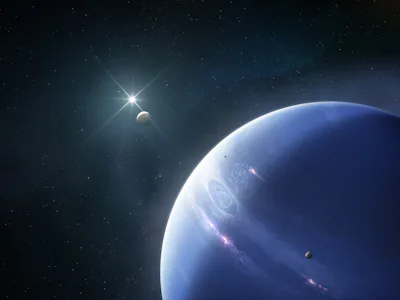
Neptunereceives a tiny fraction of the sunlight that strikes Earth, yet somehow, that’s enough to transform the clouds of this faraway world.
The main driver of cloud formation is generally the seasons, when a planet tilts a different part of its body towards or away from the Sun. Neptune’s seasons last decades, so short-term changes on the timescale of months to the cirrus clouds in the gas giant’s upper atmosphere must have another explanation.
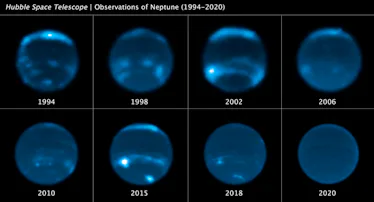
With help from the resilient science program of the Hubble Space Telescope, astronomers are finding that while the outer Solar System is far away, it’s never out of the Sun’s reach. Astronomers, using nearly 30 years worth of data, watched Neptune’s cloud cover transform over time — including a recent turn toward near-cloudlessness.
"It's fascinating to be able to use telescopes on Earth to study the climate of a world more than 2.5 billion miles away from us," Carlos Alvarez, staff astronomer at Keck Observatory in Hawaii and co-author of the new research, shares in an announcement NASA published on Thursday.
A sequence of Neptune images reveals changing clouds.
The Sun goes through mood swings every 11 years. In fact, we’re currently due soon for a peak in activity, when sunspots will sprout and solar flares will more frequently blast out.
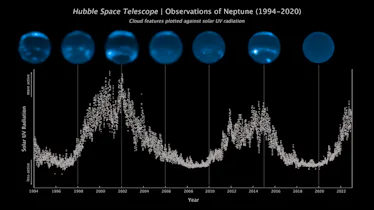
In the new work, astronomers have connected the Sun’s ultraviolet radiation, which peaks as the Sun roars up, and dips as the Sun quiets down, with the appearance (or in this case, disappearance) of clouds on Neptune. That’s despite the fact that Neptune is the farthest planet known in the Solar System, and receives sunlight roughly 0.1 percent the intensity of what Earth gets.
The researchers behind a new paper, published in the journal Icarus, made the fascinating finding when they combined archival Hubble observations beginning in 1994, as well as ground-based observations from the Lick Observatory in California (from 2018-2019) and the Keck Observatory (2002-2022).
It all began when lead paper author Erandi Chavez, who is currently a graduate student at the Center for Astrophysics | Harvard-Smithsonian in Cambridge, Massachusetts, was an astronomy undergraduate student at the University of California, Berkeley. Years of research and troves of imagery later, Chavez has enough data to support the theory that solar ultraviolet radiation triggers a photochemical reaction that produces Neptune’s clouds.
The team found that Neptune’s cloud tops not only react to the ultraviolet radiation, but sustain changes, too. The telescopes show that cloud activity can drop in just a few months, and in some cases, clouds can take years to return to their former levels. Chavez, who also shared her thoughts in NASA’s announcement, said the decades-long data on Neptune’s clouds is “extremely exciting” and packed with science that’s “unexpected.”
The Neptune images are plotted chronologically with the solar radiation levels charted below.
Rather than looking at data across just one solar cycle, the team looked at 2.5 solar-cycle’s worth of data. As a result, they noticed that some cycles created different changes than others, details that fortify the connection between the Sun and Neptune.
"These remarkable data give us the strongest evidence yet that Neptune's cloud cover correlates with the Sun’s cycle," Imke de Pater, emeritus professor of astronomy at UC Berkeley and senior author of the study, shares in the announcement.
The telescopic trio whose observations made this discovery possible will also be handy for future work into Neptune’s “dynamic appearance,” NASA officials said. And they’ll facilitate our best guesses for what worlds beyond the Sun might look like.
The probe has been taking lots of photos along the way, recording such milestone moments for posterity. For example, Chandrayaan-3 snapped a shot of its newly free-flying propulsion module yesterday, which the Indian Space Research Organisation (ISRO) shared today (Aug. 18) via X (formerly Twitter).
The moon's surface, as seen by India's Chandrayaan-3 probe from lunar orbit on Aug. 17, 2023. (Image credit: ISRO)
That X post features a 31-second video, which stitches together a number of images captured yesterday by Chandrayaan-3's landing module. Most of those photos show the lunar surface; ISRO labels a few of the many craters passing underneath the probe, including Fabry and Giordano Bruno.
ISRO shared yet more Chandrayaan-3 moon imagery in another X post today. That one featured a 17-second video consisting of photos the probe snapped on Tuesday (Aug. 15).
Such reconnaissance is part of the prep work for Chandrayaan-3's landing attempt, which will occur Aug. 23 or Aug. 24 near the lunar south pole. Success would be huge for India; to date, the U.S., the former Soviet Union and China are the only nations ever to have soft-landed a probe on the moon.
And no craft has ever set down near the lunar south pole, a region thought to be rich in water ice that could sustain human settlement. (Russia may beat Chandrayaan-3 to that punch, however; Russia's Luna-25 probe is scheduled to land near the south pole in the coming days, perhaps as early as Aug. 21.)
Chandrayaan-3 has a budget of 6 billion rupees (about $72 million at current exchange rates). The mission features a lander named Vikram, which carries a small rover called Pragyan.
If all goes according to plan, the robotic duo will explore their exotic environs for one lunar day (roughly 14 Earth days) after touching down. They'll gather a variety of data before the cold, dark lunar night turns out their lights.
Meer van UFO'S of UAP'S, ASTRONOMIE, RUIMTEVAART, ARCHEOLOGIE, OUDHEIDKUNDE, SF-SNUFJES EN ANDERE ESOTERISCHE WETENSCHAPPEN - DE ALLERLAATSTE NIEUWTJES


 This new research is proof of alien life, says Philip Mantle